Introduction
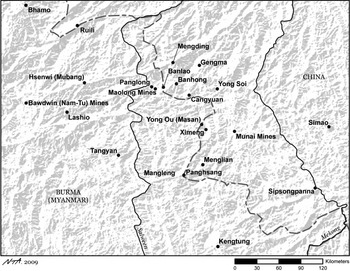
Before they were divided between the modern nation-states of China and Burma, the lands of the Wa, midway between the Salween and Mekong rivers (see Figure 1) were more densely populated, and wealthier, than neighbouring areas.Footnote 1 This confounds expectations about Southeast Asia’s highlands, which today are mostly sparsely populated, exploited peripheries of the region’s more heavily populated, valley-based nation-states. The higher population density in the historical Wa country surprised the British, as they (unsuccessfully) sought to incorporate Wa areas into their Burmese colony in the late nineteenth and early twentieth centuries. They noted conspicuous jewellery and other confounding signs of wealth, indicating that these people were ‘much more prosperous than on our side’.Footnote 2
The Wa lands between the Salween and Mekong rivers, with the modern Burma–China border and the names of important places mentioned in the text.

With this in mind, it will seem less strange that many Wa people themselves in that same period – even into the present – have insisted that their land is an important centre, not a periphery. Their origin myths famously recount how humanity emerged out of a hole in the ground in the middle of Wa country. In these myths, as told today in this area, the first people on earth were the Wa, who settled at this ground zero of human history. The ancestors of the Burmese, Chinese, Shan, Americans, and so on emerged only later, and thus had to settle further away from the already-occupied ground zero. Based on this scenario, many Wa identify their land as the centre of the world, and their own people as the ‘elder brothers’ of humankind, with special responsibilities on its behalf.Footnote 3
These myths obviously help to bolster Wa land claims, and the updating of myths to deal with present-day challenges is not unique to the Wa.Footnote 4 But one cannot simply dismiss these myths as self-serving concoctions. Most ethnic neighbours of the Wa (Shan, Lahu, Chinese, and so forth) unanimously take it for a fact that the ancestors of the Wa were indeed present before all others.Footnote 5 Other indications concur that Mon-Khmer speaking ancestors were, in fact, in the area first, or at least ‘first’ in a relative sense, in the last millennium.Footnote 6
Nevertheless, the Wa claims to centrality and importance will still seem outrageous from the perspective of the Chinese or Burmese universalizing empires and kingdoms, or even that of the smaller Shan ‘client states’, historically flourishing in the neighbourhood of the Wa.Footnote 7 In a Chinese setting, the Wa claims are sure to elicit the famous proverbial dismissal of the king of Yelang, who reportedly dared to compare his smaller realm, in today’s Yunnan and Guizhou, with the vast Chinese empire (‘Yelang zi da’, ‘Yelang thinks he’s big’). That kingdom was indeed later incorporated into the empire; yet it was actually more powerful than the Chinese accounts suggest, and the proverbial dismissal of Yelang must be read as a tendentious Chinese interpretation.Footnote 8
While the Wa, historically, were even more distant from Chinese power centres, they, too, are an example of how people in centres of civilization such as China and Burma forge imaginary descriptions of their peripheries as backward and hapless. This tendency is integral to civilization as ideology,Footnote 9 and frequently creates glaring discrepancies between historical fact and civilizing fantasy, as with the Yelang and the Wa. These discrepancies become apparent in the variation between discourses produced by civilization’s flag-bearers (officials, historians, and the like) and those recoverable from people less invested in its project. The inclination of Chinese merchants to refer to the powerful central Wa as ‘Big Wa’, instead of using the tendentious ‘Raw’ (or ‘Wild’) Wa is one good example.Footnote 10 The power and autonomy of the Wa recognized in such pragmatics depended not just on geographical advantages but on their manipulation of marketable resources. Here, I mainly discuss mining and largely pass over other key items such as cotton (similarly important, in an earlier period) and opium, to which I return in the conclusions.Footnote 11
A key difference between the Wa and kingdoms such as the Yelang (or the Shan states) is that the Wa for the most part had no kings, no army, and no state. They did not engage in Yelang-style secondary-state formation – that is, the build-up of state apparatuses in the shadow of pre-existing ones, such as the Chinese empire, which ‘provoke’ new states into existence and which they in turn mimic in various ways, as we know from around the world.Footnote 12 Secondary state formation theory is seldom debated in Zomia discussions,Footnote 13 and in this context – as well as for world history generally – the egalitarian Wa negation of such state formation is most relevant. One major contribution, which will be discussed here, is Jonathan Friedman’s System, structure and contradiction, originally offered as a structuralist-Marxist remedy for the poverty of explanations of change in Edmund Leach’s much more widely read Political systems of highland Burma.Footnote 14 Friedman’s analysis of state–periphery dynamics in Zomia remains a powerful attempt to explain both secondary state formation processes and why Wa armed autonomy and population density historically developed in the absence of social hierarchy and state institutions.
Until the end of Wa autonomy in the 1950s, in the central Wa country every man, and generally also every woman, was regarded as independent and autonomous in themselves, according to an ethos that strongly emphasized equality and that was bolstered by codes of honour and moral norms. Of course, these also regulated such institutions as marriage, which persons could only establish through patrilineages other than their own. Such collectivities did have certain prerogatives, and people would also unite to defend villages and, in larger conflicts, the genealogically connected networks known as jaig’ qee (‘realms’), or even, when necessary, Wa country in general. But personal and local autonomy was retained and exercised as far as possible, contributing to frequent internecine quarrels governed by internal laws of conflict – much as under the ‘ordered anarchy’ of the politically segmentary kingless Nuer people in the Sudan, famously described by Evans-Pritchard.Footnote 15 In the Wa lands, too, the British were disappointed in their search for Wa leaders to engage.Footnote 16 Several kinds of leadership positions existed but all with limited authority. Mainly, these were the hereditary o lang, associated with pan-village rituals, and the a meang, non-hereditary individual leaders rising to contingent challenges of war and foreign affairs, but none had the power to order fellow Wa around.Footnote 17
I am mainly referring to the central Wa area (autonomous until the mid twentieth century), which was no secondary-state formation but rather the opposite of state formation. It was quite unlike the Wa areas subjugated and dominated by others (such as the Shan and Chinese) as in the classic ‘peripheral situation’.Footnote 18 It also contrasted with the incipient Shan-styled Wa ‘kingship’ twice arising on the outskirts of Wa country in the era before modern nation-states, in the mine-rich Wa areas of Banhong (the so-called ‘Hulu kings’) and Mangleng.
This article will discuss the historical central Wa in relation to these two cases of would-be ‘kings’. I will largely pass over the dependent Wa peripheries, and refer only briefly to the post-1989 centralized government of Burma’s current Wa State, which has many of the trappings of statehood (such as a hierarchical structure and a formal army). Its area was once the western part of Wa territory; today it is ruled by the United Wa State Party and its Army (UWSA), which maintains a tenuous ceasefire with Burma’s military government but also acknowledges that its lands are part of Burma (Myanmar), which calls it ‘Special Region II’.Footnote 19
As for the historically autonomous central Wa, we must not accept the old ‘primitivist’ explanations concocted from the perspective of the region’s civilized state powers (China, Britain, Burma, and so forth). These portray the egalitarianism of the Wa past as a survival of a primitive, non-hierarchical stage in human history, with the sometimes unspoken corollary conclusion that peoples who did not coalesce into a state failed to do so because they were stupid.Footnote 20
But how should we understand the Wa anti-state and its resemblance to Nuer ‘ordered anarchy’? Is it possible to identify these social forms as the conscious refusal to be drawn into the processes of state formation, as James C. Scott suggests? Or should it be seen, with Friedman, as the consequence of social ‘devolution’ forced by circumstance and circumscription? More concretely, we can ask: How should the seemingly powerless ‘chiefs’ of the obsessively egalitarian Wa be understood? Are these the shadow remnants of chieftainship whose growth into permanent authority, kingship, and state structures could not be sustained – even as Wa autonomy solidified, however precariously and in non-hierarchical mode? Or do they represent a spectacle of pretend-chiefs, a conscious ruse, reflecting historical agency and even mastery of the situation, against many odds, when the situation demanded it, by people who purposefully avoided the road of state formation? The former is one of Friedman’s key points, whereas the latter would be favoured by Scott.Footnote 21 To shed light on these questions I will review the history of Wa autonomy with a special focus on the manipulation of mining resources.
Subterranean riches in Wa country
The rich mineral resources in the Wa area include silver, gold, iron, and tin. Rumours about them have long been widespread. Precious minerals and gems originating in the region have figured in Chinese accounts of tributes since ancient times. They have served, both symbolically and materially, to fuel the building of the Chinese and other states. Mineral wealth was a major motivation for the incorporation of today’s Yunnan province (which now includes part of the Wa lands) into the body of the Chinese state, beginning 2,000 years ago.Footnote 22 Such territorial ingestion was often preceded by tribute relations that ensnared and transformed local society. As we shall see, forward parties of Chinese miner-entrepreneurs often insinuated themselves into such processes.
The pattern is broadly comparable to the case of the British, who were taking over Burma in the late nineteenth century and who were also attracted by rumoured riches in the Wa lands. They, too, saw divergences between strategic-imperialist and commercial-entrepreneur interests. At first, they focused on rumours of a Wa ‘gold tract’ south of Ximeng (Möng Hka), perhaps identical with the ‘Shwe Thamin Chaung’ (Golden Deer Stream) that a royal Burmese army had once attempted to reach – blocked by ‘Wild Wa’ resistance.Footnote 23 In the 1890s, a Chinese traveller in the area reported local gold lore, as well as fears of British intrusion.Footnote 24 The British surveyed the area but found no ‘gold tract’, and retreated. All this speaks to the key role of underground riches, real and rumoured, in the positioning of outside powers with regard to the Wa lands. With the British annexation of Burma in the nineteenth century, a race developed between the twin empires of Britain and China, a mimetic desire for control, which the independent-minded Wa attempted to resist.
The Maolong mines and the ‘king’ of Banhong
In the Wa region, the once-famous but now largely exhausted Maolong silver mines stand out in history. They cover about fifteen square kilometres of once-disputed territory in the northernmost Wa country, now just inside Burma. Large-scale silver mining was carried here between about 1650 and 1800. The site became one of the most important silver mines of the Chinese south-west, and was increasingly important as a Chinese source of copper, gold, and silver: at times, Yunnan yielded half of the empire’s silver. Many people arrived from China’s interior for mining work, while private merchant-entrepreneurs were often permitted to run profitable silver mines, without the state subsidies granted to other mines.Footnote 25 Most were within Yunnan, but some were in areas that had never been under Chinese administration and remained apart. Maolong was ‘the biggest to the south of China’.Footnote 26 Bawdwin was another large silver mine farther into Burma (outside of the Wa area), where as many as 10,000 Chinese miners were still present in 1855 at the time of the outbreak of the Muslim–Chinese mining wars in Yunnan, which severely disrupted the trade.Footnote 27
Significantly, whereas at Bawdwin the Chinese miners paid dues to the Burmese sovereign,Footnote 28 the Maolong site was located in a self-administered Wa area, in between Chinese and Burmese sovereignty and removed from the control of local Burmese or Chinese Shan client kingdoms. Chinese miners initially, and possibly into the twentieth century, paid dues to the Wa. The earliest discovery and exploitation may have been by the Wa themselves, before Chinese entrepreneurship, but indigenous written records are lacking. ‘Maolong’ may originally be a Wa name, although it is often taken as another example of the Sinicization of a Shan name, like so many Chinese place names in this region, where Chinese traders and officials often first encountered and dealt with the literate valley-based Shan Buddhist polities, and only subsequently, through them, with non-literate people such as the Wa. The first syllable in ‘Maolong’ (also Mulung or Molung) may derive from me, Wa for ‘silver’,Footnote 29 while long is the common Wa word for ‘upper’. The ‘Upper Silver’ mines may thus relate to the Munai and Xinchang silver mines near Ximeng, to the south in (and near) Wa country.Footnote 30
Chinese sources carry little trace of any Wa initiatives, instead ascribing mining entrepreneurship entirely to Chinese investment and tutelage. They suggest that mining at Maolong was started after the downfall of the Ming dynasty in 1644, by Li Dingguo (1620–62), a loyalist general commanding thousands of retreating soldiers, who arrived in the area to mine silver, gold, copper, and iron.Footnote 31 In one story recorded from the area, a silver nugget found by two Wa men was carried by their mother in a cotton basket to the Shan market town of Mengding. Li Dingguo and his soldiers identified it as silver, and began operations after the general received permission from the Wa Banlao polity and the Mengding Shan prince, who would share the profits.Footnote 32
Chinese sources suggest there already was a Banlao ‘king’ (Chinese wang), part of a Hulu (‘Gourd’) kingdom, a group of five or more related Wa hereditary chiefs, also including Banhong, which subsequently became more important.Footnote 33 The position of wang may have been inaugurated when the Chinese mining general identified his interlocutor as such and obtained permission – and it then became hereditary, as the Chinese paid respects to ‘royal’ descendants.
However, the origin of Hulu kings precedes the Chinese creation of convenient counterparts. Chit Hlaing recently discussed these kings, their titles, their relation to Shan and Burmese Buddhist conceptions of rulership,Footnote 34 their partial conversion to Buddhism, and the influence of Shan culture (on dress, village architecture, etc.), possibly all of it before mining operations. Banhong and other kings had styled themselves as Shan-like cao fa (‘kings’ or ‘princes’), or cao meng (‘rulers of the land’, a lesser title), with Shan regalia and so on, converting their own ‘subjects’ to Buddhism,Footnote 35 and prohibiting Christianity.Footnote 36 I believe that these Wa areas were drifting into the orbit of Shan states and were thus susceptible, like many other originally non-Buddhist upland people, to ending up as suppliers of tribute and labour to Shan kings. But these Wa deflected Shan dominance by seizing on their geopolitical position to set themselves up as Shan-style princes, on the model of those same threatening Shan states, so as to be able to compete with them. There are many reasons for religious conversion, but here it was probably concerned with sharing in Buddhism’s universal appeal to set the stage for competition on equal terms.Footnote 37 Later on, and especially with the confrontation between the British and Chinese empires (and the Chinese Republic), the Banhong dynasty, as we shall see, became a vassal of China instead, and the Chinese state apparatus overtook the Shan-derived model of Buddhist kingship.
Note that the unique position of the Banhong Wa, with their mines, stands out particularly in comparison with the peripheral Wa areas worked by American Baptist missionaries in the early twentieth century, such as in Lancang County further south, where there were no mines that could be controlled by the Wa. No Wa ‘kingdoms’ appeared and the conversion to a foreign religion there proceeded (as usual, and similarly to the appeal of non-Christian indigenous prophets) in the ‘hope against hope’ of patronage and protection in a peripheral situation of dependency, landlessness, debt, and oppression. The missionaries, tellingly, kept complaining internally of the superficiality of Wa faith, while the Chinese authorities, incredulous of the missionaries’ stated motives, repeatedly suspected them of involvement, ironically, in mining exploitation.Footnote 38
The contrast between the Wa converting to Christianity or syncretic millenarianism in a situation of powerlessness, on the one hand, and the respect demanded by the more powerful central Wa and the Buddhist Banhong Wa, on the other, is stark. This is illustrated in British glimpses of Banhong from 1900 and 1929:
In 1900 the Chinese even with an escort of 100 rifles dared not take our Boundary Commission surveyors into Panghung [Banhong] but turned back at its border … they did not administer Panghung, but stopped short at the western border of Mengting [Mengding]. Rev. R.B. Buker AMB [American Baptist Mission] says he has never heard of the Chinese daring to enter Panghung. In March 1929, the deputy Ma Lien-wei could not visit Panghung without sending gifts and waiting for permission to enter. In October 1929 the escort of 60 rifles which under the orders of the Yunnan government took Draper (& Barton) to visit the mines, halted at the Panghung border for three consecutive days while waiting for its chief to accepts its gifts and grant permission to cross his territory; while crossing it … the whole escort was in a state of nerves, men sleeping in their boots, for terror of the Panghung Wa (& these are not wild Wa, but comparatively tame).Footnote 39
In the British sources we gain revealing glimpses of this sort, but this history is significantly and interestingly distorted in the more voluminous Chinese sources. Even contemporary Chinese scholars portray Li Dingguo as a forerunner of Wa–Chinese friendship.Footnote 40 For example, much like Mao’s army, Li’s seventeenth-century ragtag soldiers are supposed to have ‘eaten grass roots and tree bark’ rather than take food from the Wa who, supposedly, as ‘primitive’ swiddeners hardly had food for themselves (despite their ‘kingdom’). Li Dingguo is even said to have become deified among the Wa on this score, along with Wu Shangxian, who later revived the Maolong mines, and a Chinese Buddhist monk, who supposedly instructed the Wa in how to ‘to grow the five grains, to build houses, and abolish headhunting’ and converted the Wa of Banlao and Banhong to Buddhism. A local Chinese saying suggests that it was Li and Wu who taught the La-jia (or Buddhist Wa) ‘to work iron, to use wood, and build houses’ (sic).Footnote 41 Of course, the Wa do have their own rich traditions of agriculture,Footnote 42 as well as of house-building. The motive here is to impose (mostly for Chinese consumption) a value hierarchy that relegates Wa to primitiveness on civilization’s ladder, at the same time elevating Chinese agriculture and technology.
In reality, Wa headhunting, as well as its framing as a primitive custom, is a relatively recent phenomenon, born out of exactly the kind of conflicts discussed here. Its juxtaposition with other supposedly primitive aspects of Wa existence denies Wa history, or ‘overwrites it’.Footnote 43 At the same time, this defines the Chinese engagement as a civilizing mission – even purposefully omitting the Shan intermediaries. However, the civilizing mission may have been fashioned mostly at a distance – by officials, literati, and (later) modern patriots – whereas actual mining entrepreneurs probably seldom campaigned explicitly for it. In order to maintain peace and maximize profits, they probably interacted pragmatically, or even respectfully, with Wa natives. We do know that such entrepreneurs did fall in line whenever dealing with Chinese officials – probably playing both sides, for maximum lee room. The famous miner-entrepreneur Wu Shangxian, who revived the mines in the 1740s, is a prime example – including of the mortal dangers involved in this game. His case also offers further insights into the nature of ‘Hulu kingship’.
Wu is said to have had supernatural talents for finding hidden silver ores. Within years, he became very wealthy, living in his own Maolong ‘palace’, which Barton saw in 1929.Footnote 44 Like Li Dingguo, Wu started with Wa permission: ‘under licence of the Wa king Panghsu [Bangzhu] of the big Mu mountain, who ruled five Wa circles, between Mengting and the Salween’.Footnote 45 Fang Guoyu, the patriotic Yunnan historian, visited the area in 1935 and found a 1743 tablet recording that the ‘Hulu king’ granted Wu the right to run the mines.Footnote 46 In 1746, Wu embarked upon a foolish diplomatic adventure, taking a delegation of himself, three ‘Kawa’ (Wa)Footnote 47 leaders, and a representative from Gengma, one of the most important nearby ‘Chinese’ Shan tusi politiesFootnote 48 (and derivative of Mengding), to the provincial capital Kunming. Wu pressed for tributary status for one ‘Hulu king’ (Bangzhu), whom he had offered to pay for his lease. The Wa king had refused, he said, proposing instead to enter it as tribute to the Chinese empire, and acquire status as a tributary polity, which was a potentially beneficial position of alliance and secure profit-making, through trade. While they signified submission to the Chinese state, such requests were brought by many who sought acceptance as trading partners within the Chinese system, or as Chinese-appointed ‘native chiefs’, some of whom were not ‘native’ at all but Chinese from the interior, posing as such to reap the profits of frontier trade. This, as Pasquet suggests, may have been Wu Shangxian’s objective, and the mission may have been entirely his initiative, with his Wa hosts duped by some other tale. Regardless, it indicates the structural interrelationship of the actors involved.
Some Chinese already knew of the Wa,Footnote 49 but they had not hitherto figured in Qing imperial calculations. In 1746, Yunnan’s governor general reported to the throne in Beijing that the origin of the ‘Hulu king of the Kawa’ was unknown, that his territory bordered on the (autonomous) ‘Raw Kawa’,Footnote 50 and that the polity had ‘never since antiquity had relations with China’, but that it was also not subject to Burma.Footnote 51 Nominal tributary status was accepted, but with reservations that signalled the beginning of the end for the volunteer intermediary Wu Shangxian:
[Emperor’s] Council report upon a proposition of the Viceroy that the offer of the K’awa Hulu Prince [wang] Pengchuh be accepted: This prince says that the Maolong silver mines are within his territory and that a large number of Chinese are working there and offer to pay a royalty or rent, which he the [Wa] prince cannot venture to receive: he offers to pay this rent as tribute. The Council think[s] that the expression of loyalty on the part of a prince far beyond our limits is sufficient without our accepting his tribute, and advise that the Viceroy be instructed to preach him a homily in this sense and send him back to his lair. But Wu Shang-hsien and his companions have no business to surreptitiously cross the frontier to work mines and the Viceroy should be called upon to report who is responsible for this carelessness. … The Viceroy explains that Yunnan has no agricultural wealth, and depends upon its minerals for the sustenance of its poor population. Though the barbarians have mines, too, they don’t know how to work them, and the presence of Chinese here is advantageous to both. The prohibition to cross the border has always been understood not to refer to traders, so long as they do not trade in contraband goods. There are now between 20,000 and 30,000 persons there engaged in mining or trading peacefully, and no disturbance has taken place for over a hundred years. Though the Hulu Prince may be a barbarian beyond the vivifying influence of civilization, his offer of tribute is a genuine piece of loyalty, … he might well be allowed to pay in half the royalties (Rs. 33,000) offered by him, as was done with the SawbwaFootnote 52 of Meng Lien in the case of the Munai mines,Footnote 53 keeping the other half to himself. The Council approves, but adds that the Viceroy should at the same time watch the frontier more carefully. – Sanctioned.Footnote 54
Pasquet relates the court’s debate over Wu Shangxian’s machinations and whether to allow the Chinese-run mine to deliver tribute in the name of the Hulu. The ‘viceroy’ argued that the region’s economies were interdependent and that the empire would gain from resources located on barbarian lands. The court, unimpressed, prohibited subjects from working mines outside its control. The imperial Chinese authorities were wary of entrepreneurs venturing beyond the limits of their administration, because of the risk of loss of technological know-how, the increased threats to social order, and concerns with imperial over-extension.Footnote 55 Indeed, later, the devastating Panthay Muslim wars in Yunnan (1856–73) began over conflicts with immigrant Chinese attempting to appropriate mines already worked by local Muslims.Footnote 56 Moreover, many imperial soldiers sent to these southern regions perished from disease, not fighting, and the 1765–70 Burma campaign became ‘the most disastrous frontier war that the Qing dynasty had ever waged’.Footnote 57
In 1746, prudence reigned, and border trade not under direct state control was curtailed.Footnote 58 The Wa were left in place, mainly because they, too, were beyond control: ‘All through this dynasty they [the Wa] have not been crushed as they extend into foreign territory, and it was feared that foreign troubles might ensue.’Footnote 59 Wu Shangxian, the self-appointed spokesman, was detained, and died in a Kunming prison, though only after accompanying, in 1750–51, a Burmese tributary mission to Beijing. Tribute was accepted, but Wu was again rejected as mediator. With Wu gone, the silver ran out. The Maolong mines were declared closed in about 1800, as was the once-important Munai mine to the south.
At Maolong, vast mountains of lead-rich slag remained, but their economic potential was not realized until the British stirred again in the early twentieth century, in turn provoking renewed Chinese interest. There is fragmentary evidence for Wa exploitation in the intervening period, and for Wa interests diverging from those of the Chinese. More than a century after the Chinese disengagement, when Britain and China began eyeing the lead-rich slag, the Wa were still granting concessions, using the lead-rich slag to manufacture bullets both on their own and through Chinese contractors.Footnote 60 The Wa polity of Banhong retained independence but was slowly drifting into the Chinese state system. In 1891, Banhong aided China in quelling a dispute between minor Shan polities in the area, and its wang was recreated with a low-ranking Chinese tusi title (tudufu), and a Chinese surname (Hu).Footnote 61 Meanwhile, control of the mines apparently shifted temporarily to the nearby Wa polity that the British called the ‘statelet’ of Yungpang (Yongbang), closely connected with nearby Panglung. The latter was a settlement of Muslim refugees from the nineteenth-century Panthay wars, and a new factor in the local power balance, especially after the Wa–Panthay War of 1926–28, in which the better-armed Muslim traders won their own emancipation from tribute obligations to the local Wa, and afterwards overcame a Wa boycott.Footnote 62 However, even if power was shifting away from Wa natives and their ‘Hulu kings’ to ‘bandits’ such as the Panthay – and to the reformed Chinese state looming in the background, in the shape of Yunnan’s semi-independent governor, Long Yun, who pushed for interventions responding to British advances – the Wa clearly still remained in control of the mines until the 1930s. In 1929, Barton interviewed a military representative of the Chinese Republic at Mengding, Yao Hsiang, who remarked candidly on the Maolong mines:
whatever their position with regard to MupangFootnote 63 or China, [the mines] still are very definitely in the hands of the Wa and can only be visited, not to mention worked, with the Wa’s consent, but the Wa’s [sic] are quite keen on having them worked, by a private concern, and not by the Chinese government.Footnote 64
An opportunity thus existed for British overtures but it was not exploited successfully. In 1920, a British mining expert, Oberlander,Footnote 65 noted the enormous old, lead-rich slag heaps only 120 miles east of Lashio and rekindled the interest of the British, including their mining company running the Bawdwin mines, the Burma Corporation. Previously, it had not mattered much to either Britain or China that it had been impossible to define their border in the independent Wa area (the first attempt, in 1898–1900, was a failure partly because of Wa resistance), but now the rediscovery of Maolong stirred new interest in ‘the obstinate Wa and their slag-heaps’.Footnote 66
This culminated in a British military intervention, the 1934 ‘Banhong incident’ – also a failure, owing to the resistance of Wa, and others. In China, this incident is generally defined as glorious Wa patriotism on China’s behalf.Footnote 67 British sources speak of ‘Chinese forces … supported by bandits and tribesmen’.Footnote 68 The ‘tribesmen’ were diverse: according to one Chinese account, the British, too, ‘bought’ the service of certain ‘treacherous, Wild Kawa, … given to killing for heads and robbing villages’, who never would ‘allow the border areas to have peace’.Footnote 69 Evidently the Wa once again – like so many others mired in the peripheral situation – were manipulated, but themselves also sought to manipulate a situation that closely evoked past patterns.
The key Chinese figure in repelling the British and subduing anti-Chinese ‘Kawa disturbances’ was Li Xizhe, a modern reincarnation of the Yunnanese-Chinese soldier-entrepreneur, a former salt miner and modern patriot, whose irregular operations were sanctioned by the Chinese Republic that had succeeded to the empire’s concerns. Li prevailed, with modern weaponry, and reportedly lavishly rewarded Wa allies, including Banhong, with salt and cloth. Setting himself up as their spokesman, he invoked an anti-British alliance of eighteen Wa leaders and composed a patriotic declaration in their name – in Chinese.Footnote 70 Banhong’s chief Hu Zhonghan (Hu ‘Loyal-to Han’, a name previously bestowed by Chinese officials) figured prominently, now with the modern title of ‘plenipotentiary’ (zong’guan). Before the hostilities, he purportedly insisted to the British that China must be consulted, which may make sense given his Chinese affiliations and the long history ‘hosting’ Chinese miners. However, given the contradictory assessment of the Chinese military representative at Mengding, cited above, this may be another tendentious Chinese representation supporting the official Chinese recognition, redefinition, and strategic investments made in ‘their’ Wa kings.
This ‘Banhong incident’ was soon dwarfed by the Second World War. Fighting involved Japan, Britain, and the US, and the ensuing Chinese civil war spilled over into the Wa area itself. This became the beginning of the end of all forms of Wa independence, which were terminated by socialist China in the 1950s in the Wa east, and in the 1960s, in the west, by China’s ally, the Burmese Communist Party.Footnote 71 The eastern Wa lands have become a classic extractive periphery. In today’s post-socialist situation, Chinese businesses and state enterprises, including numerous mining entrepreneurs and investors, are also active in the Wa State in Burma, beyond Chinese territory. The situation is new in some respects, as the UWSA’s state-like structures are derived in part from Communist models, but it can be argued that the historical pattern of mutual manipulation known from Banhong and elsewhere have reappeared in new form, with Wa State hosts/owners entertaining Chinese clients/entrepreneurs eyeing Chinese and global markets for licit or illicit goods.
The question remains as to whether the defunct Banhong and other Hulu ‘kings’ developed substantial powers over their own people, or mainly deployed a spectacle of, first, Shan-styled rulership and, later, Chinese-styled officialdom, which mattered in relations with outsiders but not at home. The latter would support Scott’s interpretation of political forms derived from the outside deployed as an occasional ruse, part of a strategy to evade state interference and incorporation.Footnote 72 Indeed, these kings differed little from their fellow men, supposedly their subjects. An astonished Fang Guoyu noted that the woman pounding rice for dinner at the royal Banhong household was the king’s own queen, as in any Wa house.Footnote 73 He had not expected this at a court granted state tax revenues sufficient to employ forty soldiers. This was in the 1930s, after the infamous incident pushed Banhong further into the Chinese orbit, but there is little evidence that its ‘king’ was ever owed allegiance by fellow Wa. On the contrary, the rising Chinese influence at Banhong raised alarms among the Wa in general, as suggested by their cited preference for excluding Chinese state authorities from mining exploitation.
Chit Hlaing writes of Banhong institutions as ‘Buddhism manqué’, and their political institutions may be described as statehood manqué. They reflected a conscious deployment of the trappings of statehood only where this served the long-term purpose of safeguarding Wa independence, here supported by profitable mining concessions (a strategy ultimately overpowered by Chinese schemes). This interpretation is further supported by the curious discrepancy of the dual versions (in Chinese and Shan) of another ostensibly patriotically pro-Chinese tract handed in on behalf of the Wa to the League of Nations commission in 1936. The Chinese version says that, while the Wa may be ‘stupid’ (yu), they reject the British. It is not clear who penned the Shan version, but it is likely to reflect Wa views more directly. Demanding that the Chairman ‘order the British to withdraw their forces’, it refers to what it says is the ‘common saying’ that ‘the Wa have bowed neither to Burma nor China’.Footnote 74
Wa mining at Mangleng and other sites
The other case of Wa-controlled mining, at Mangleng, is less well known. It occurred farther away from Shan competition, in the midst of supposedly ‘raw’ or ‘wild’ Wa of south-central Wa country. These were described by the British as the ‘Wa states’ proper, sometimes ambiguously as ‘statelets’ or ‘circles’. These are all deceptive terms, since there is no evidence here of states or even ‘circles’, in the Shan sense, of communities arranged around a power centre. The area was dominated instead by the same sort of autonomous communities in a state of ordered anarchy as would have surrounded Banhong’s experiments with Buddhism and Chinese titles.
Independent Wa mining and corresponding sophistication in manipulating its geopolitics clearly has a deep history. With the scarcity of outside visitors who would record it, the evidence is necessarily fragmentary, but some can be resurrected. In 1778, only decades after the Burmese forces had reached the southern Wa frontier area,Footnote 75 the Chinese imperial official Li Shirao journeyed there, noting that the ‘Kawa’Footnote 76 had repelled a Burmese attempt to seize the ‘Mangleng mines’ ‘beyond’ Menglian. The miners even fabricated rumours that Chinese forces would intervene in their favour:
Your servant obtained information that the wild Kawa people beyond the Mian–Shun [Burma–Shunning] border since former times possessed the mines of Mangleng. The man in charge of the mines is called the ‘Mangleng official’ by the wild people. [I] heard that Burman bandits craved the profit from the mines, and went there armed, to claim their part of it. With the leadership of the chief of Mangleng, these Burman bandits were beaten and pursued into Mubang [Hsenwi], devastating the Burmese area of Lashio as they retreated. Since it was feared that they would come back to exact revenge, [Mangleng] spread the word that [they] had ‘heard the Celestial Dynasty was bringing in troops to attack the bandit bases, and said they themselves will join in the slaughter’, and so forth. Comparing this with the accounts given by A-li, Lao-yan, and others captured at the time of the last two [incidents], all confirm that there have been battles between the Burmans and Mangleng …Footnote 77
Mangleng was an independent Wa-controlled operation (at Kat Maw, six miles from its ‘capital’, Ta Küt), with silver mines reduced by the late nineteenth century to ‘fairly rich’ lead pits ‘only worked when there is a demand for lead, that is to say, when peace in the hills is disturbed’.Footnote 78
In 1824, armed Mangleng Wa tried to take over the Munai silver mines, then exploited by the Menglian Shan prince, but were repelled by his still-powerful forces. The objective may have been to expand lead-bullet manufacturing,Footnote 79 and to usurp profits, but without intending to style themselves as Shan kings or to adopt Buddhism. There is even evidence of individual Wa stopped by their peers when they attempted to develop Shan-style mining chieftainship. Slightly earlier, a certain Ta Awng attempted to set himself up as a chief based in silver and gold mining, but he was rejected and isolated by the traditional chiefs of the Mangleng area. He lingered on, supported militarily by the Hsenwi Shan in exchange for an alliance, but died in 1822. His son held on to the dream, submitting tribute to Hsenwi and deploying Shan paraphernalia. In 1849, Burma attempted to reclaim control. Local struggles later left a weak ‘West Mangleng’ lorded over by the British, while an ‘East Mangleng’ affiliated with the independent Wa continued to escape British rule.Footnote 80 Mangleng thus recalls the Banhong–Banlao pattern, including how the China card was played locally (Banhong tried that too, only less successfully). However, aspirations to Shan-styled kingship, whatever their motives, were rejected, and Mangleng managed to avoid becoming entangled in Chinese officialdom, even though here, too, the Chinese tried issuing titles, seals, and so forth.Footnote 81
In the late nineteenth century, the mines exhausted, Mangleng’s former glory was largely forgotten and its past was seldom mentioned. The exception was the vain hope of the British to find in the failed Shan-styled Mangleng polity a true sawbwa, who could help them, as elsewhere in the Shan states, to control the area. Even the lingering West Mangleng chief was but a shadow, and became subservient to the ‘Wild Wa’.Footnote 82
The autonomous Wa were also in a controlling position at nearby Ox Ag, in Chinese named the ‘New Mines’ (Xinchang) because they attracted Chinese miners later than Laochang (the ‘Old Mines’) at Munai. The latter had been exploited by the Menglian Shan prince, possibly as early as the fifteenth century, briefly occupied by Burma around 1760, and then attracted Chinese adventurers, before closing for the same reasons as Maolong. Xinchang is near the rumoured ‘gold tract’, in present-day Ximeng Autonomous Wa County; they were was reopened in the 1980s as tin mines with local Wa workers. In Wa, they are still known as a rang mee Ox Ag, ‘Crossbow Bamboo silver rocks’. They may have been started by local Wa, perhaps in tenuous collaboration with Shan neighbours. The Wa here, like the earliest Banhong chiefs, engaged in competitive Wa–Shan alliances, receiving Shan princesses as wives.
By 1882, considerable numbers of Chinese miners worked these mines, paying obligatory fees. A conflict arose, in which the Menglian prince joined the Wa in massacring a ‘great many’ miners.Footnote 83 However, by 1891, Xinchang – still deep inside Wa country – was again worked by Chinese miners in a shaky relationship with ‘Kawa’ hosts who killed two Chinese officials on a scouting mission
at a distance from Munai of more than a hundred li is Xinchang, located within the Kawa area. The barbarians here do not know the methods, and all the extraction and management is done by Han people. When the Kawa come, they are treated with liquor and food, for fear of otherwise provoking their anger and stirring up trouble. In 1891 [Guangxu 17], Wang Cheng and general Yuchi were surveying the area; arriving at this spot the Kawa and others in the area suspected that they might be planning to take over their profits. Thus they were slain.Footnote 84
Note how the writer, the enlightened administrator Chen Can, repeats the commonplace denial of Wa capabilities.
Wa metal-working and the Wa deployment of mine slaves
The Wa have a long history of repairing and maintaining imported guns, which explains the drive for manufacturing bullets. Wa smiths have also long used recycled iron to make tools like dibbling-stick points, machete-like swords for clearing swiddens and waging war, and other weapons such as spear points. Early Shan immigrants noted that the Wa already possessed these tools,Footnote 85 and there were even sites for mining and processing of the ironFootnote 86 – though it is clear that most iron was imported. It was paid for in opium or other currencies, or obtained from Wa peripheries as tribute in exchange for exemption from raiding.
Wa mining is rarely mentioned in the literature, even when these metalworking traditions are discussed. Neither Chinese nor British authors could imagine that the ‘primitive’ Wa could run mining operations for their own benefit, administering entrepreneur concession fees, or that the Wa also had slaves working directly for them, without pay. Before the 1950s, however, some central Wa did capture and deploy such mine slaves. Interestingly, they did not use slaves for any other activity, not even labour-intensive opium production, increasingly important over the twentieth century. Thus foreign mine slaves, by no means common, are unique compared to other Wa slave-like figures, constituting the only category of acknowledged slaves in their social universe. They were the only kind of ‘war captives’ who were neither sacrificed in the context of the Wa headhunting nor adopted as full social beings, as some child ‘slaves’ were, whether captured or traded, within Wa society.Footnote 87 Since mine slaves were adult foreigners, it was difficult either to adopt them as full members of society or to maintain a separate stratum of non-person mine slaves, which would be contradictory in this society so permeated by ideals of autonomy.
In a case recorded in 1932, a group of able-bodied Chinese miners at Munai was captured by a group of sixty Wa, who divided them between themselves, so that each Wa held only one or two slaves. One was kept for ten years excavating silver ores sold to China, at a mine ‘two days north of’ Möng Hka (Ximeng), until he started going blind and was set free. He was well fed, and received his own rations of opium,Footnote 88 perhaps to prevent illness, since opium calms stomach irregularities. The Mangleng mines may also once have been run with such slaves. Reports from the 1890s mention captured Chinese being ‘drugged and sold’ to the Wa by neighbouring Lahu,Footnote 89 probably as a neighbourly tribute to the Wa.
Why should the Wa capture mine slaves, when there is no evidence that they ever used slaves in the equally labour-intensive opium work or for other farm labour? First, capturing skilled miners helped to alleviate the lack of such skills among the Wa. Second, the Wa are generally reluctant to dig into the soil and disturb waterways. Excessive tampering with waterways is, in the Wa imagination and sacrificial ideology, bound to be punished by the a yong, a major deity who dwells underground and is disturbed by excavations obstructing the natural flow of water.Footnote 90 In the vicinity of Xinchang, where I did extensive fieldwork, there are memories of freewheeling Chinese mining entrepreneurs who paid advance cash for small mining concessions nearby, dealing directly with local Wa much as opium buyers would. The a yong caused the mountain to cave in, ‘devouring’ an entire Chinese party of forty men and transport mules. In another locally famous case, Chinese miner-entrepreneurs were caught cheating on a deal regulating the portion of silver paid to the Wa concession-givers, by attempting to smuggle silver in a coffin supposedly holding a dead miner. Discovering the ruse, the Wa killed all the Chinese miners on the spot.
Slave exploitation may have originated with the expropriation of such smaller Chinese-initiated enterprises on account of offences against Wa morality or honour. Slaves would face the wrath of the a yong while the Wa reaped the profits. Such a displacement of Wa sin onto immoral, profit-seeking Chinese appears as ambivalent as other aspects of commodification expanding in this period (of opium and people, among others). Though mine slaves were only a minor component in the tribute and trade relations operating between the central Wa country and its surroundings, they constitute evidence that people in the egalitarian Wa area continued to seize on subterranean riches to enrich themselves and to defend their autonomy, while consciously seeking to solidify existing non-hierarchical social structures and prevent the emergence of new hierarchies or the building of a Wa state. The destruction by egalitarian-minded Wa of the failed nineteenth-century attempt to create a Shan-style mine-based Wa kingdom near Mangleng is a striking example. The tentative emergence of a slave substratum suggests that Wa society was being pulled in the direction of an internally stratified society on the empire’s margin, as had once been true for the Yelang, or, more recently, the Yi in southwest China, who held numerous foreign slaves.Footnote 91
Conclusions
Several key points emerge from this critical review of mining and the non-development of Wa political hierarchy before the mid twentieth century. I leave aside the Wa under the control of other powers, in a ‘peripheral situation’ of exploitation and despair, because they obviously could not develop autonomous political institutions.
The fledgling kingship of the Banhong chief, also on the edge of Wa country but struggling to avoid becoming another ‘periphery’, developed in the shadow of mutually competitive Shan polities and belongs with a range of upland chieftainships developing out of ‘leadership in organizing trade’.Footnote 92 The trade here was in mining ore or in concessions for its extraction, and in opium sold to Chinese and other global markets. But the Banhong chiefs seem never to have built themselves up as kings, setting themselves apart from their people to command service and extract taxes to accumulate further wealth. We do not know how mine wealth was shared in Wa communities beyond Banhong, but it may well have been dispersed into the collective feasting that sustained society. It does not seem to have been gathered at Banhong to finance royal pursuits of state formation. It is quite likely that Banhong remained a conditional representative for the egalitarian Wa nearby. The shifts seen in the custody of the mines among Wa polities may have been a rotating arrangement derailed by the Chinese interventions at Banhong, overwhelming Banhong’s original autonomy at the same pace as that at which Chinese titles rained down on it.
Banhong did at first creatively adopt the trappings of competitive Shan kingship, but this spectacle, or any real royal ambitions, would have been closed down by egalitarian Wa, as with the Mangleng contender whose attempts to emerge as a Shan-style prince were cut short by egalitarian-minded brethren seeking to prevent both such hubris and the monopolization of mining wealth. This recalls the contempt of many Kachin, further north in Burma, for fellow Kachins trying to model themselves on Shan kings, recasting followers as hereditary subjects and rejecting traditional Kachin chieftainship and identity. Some pretentious chiefs were assassinated.Footnote 93
In fact, the shared enjoyment of fixed natural resources under a strong, shared egalitarian ethos is not unknown from upland Southeast Asia. The egalitarian Angami Nagas and their famous salt wells is one example.Footnote 94 Such wells did not exist in Wa country,Footnote 95 but as fixed, high-yield sources of items desirable to outsiders they present a challenge similar to the Wa mines: How will the exploitation of a highly profitable income source affect – or be permitted to affect – the existing internal political organization in these upland societies? Should these riches be allowed to form the basis of new kinds of rulership, with a royal dynasty set apart, as in the Shan-Buddhist model?
In kingship, royalty is mystified as somehow deserving wealth and obedience (tribute, corvée, and the like), simply because of dynastic inheritance to a position mediating the supernatural for the benefit of all, and transcending kin ties. This ruse is a key element distinguishing kingship from indigenous forms of upland chieftainship based in agricultural accumulation. But Friedman’s powerful theorizing in System, structure and contradiction suggests how such chieftainship might eventually develop into kingship, and states. Initially, there is an inflationary movement from competitive prestige accumulation to accumulating surplus; then there is the mystification of the chief as performing mediation with gods that enables all production, and is thus deserving of fundamentally unequal corvée and tribute. Emergent dynasties replace kinship with kingship as the organizing principle and begin to rule through bureaucracies, turning ‘their’ farmers into subordinate peasants, by force if necessary. This recalls Clastres’ famous understanding of the state as a violent break.Footnote 96 However, Friedman’s alternative, complementary model shows just how processes of exchange could lead to state formation in the region. He suggests that Burma, China, and other states originated in this way, and cites Manipur as a recent example.Footnote 97
Even more relevant are Friedman’s answers as to why such evolution should fail on the margins of empire. The violence of state-making is easier to perpetrate on lowland farmers, and highlands offer an escape. But the dynamics of state–margin relations may be even more crucial. Insisting on the global context as directly consequential in the internal dynamic of these upland Southeast Asian polities, Friedman points to how pre-existing states may block the appropriation of resources and expansion that otherwise could fuel local aggrandization. Environmental degradation, likewise inseparable from the regional context, also may preclude the mobilization of surpluses driving competitive spirals. Secondary states may emerge anyway, built on the control of trade routes or other resources, and evolve into large-scale ‘predatory’ states based on conquest and subjugation just like primary states, albeit often reliant on trade rather than on agriculture.
There is also the possibility of political devolution, the inhibition and reversal of political hierarchy. Friedman singled out the Naga and the Wa, where circumscribed space for agricultural migration and the resulting intensification of agriculture and degradation of the productive environment blocked the development of hierarchy. Contrary to earlier evolutionary theory, the high population density developing among the Naga and the Wa did not – indeed could not – lead to state formation. Populations grew dense, says Friedman, because the dispersal and expansion expected in these societies was prevented. With dwindling returns from agriculture, the basis of indigenous political institutions, these institutions’ inherent trend towards hierarchy collapsed as they became unsustainable. Chiefly authority was rendered impotent, and society ‘permanently’ egalitarian,Footnote 98 as a result of a dynamic process involving both society and environment, as well as neighbours.
When Friedman’s structuralist-Marxist book was reissued in 1998, the author insisted on his thesis, but confessed in a new preface to overlooking historical agency. He also addressed history in terms of the explosion of export-market opium cultivation in the lands of the Wa, Kachin, and others from the nineteenth century.Footnote 99 Opium, as yet another potential source of wealth with political consequences, was different in that it could be grown as a cash crop anywhere by anyone, unlike fixed-location Naga salt, Kachin gems, or Wa mines. Existing chiefs might try exploiting opium in the manner that they exploited existing sources of wealth but, with social devolution already in process, opium would reinforce egalitarian tendencies (recall how Wa slavers each took a few slaves for themselves). Indeed, areas most closely associated with opium also show the strongest tendency towards political egalitarianism.Footnote 100 The circumscription of the Wa lands by other states and the ensuing agricultural intensification and population density, together with the opportunities of opium, very probably had a role in encouraging egalitarianism and individual commercial entrepreneurism. These factors also reduced the importance of the hereditary o lang, who may indeed have been a more commanding figure in the past, even if he was no king but rather a Wa solution to the fundamental problem of constraining delegated authority (as in Clastres’ American account). In the process outlined by Friedman, he then became an illustration of chieftainship manqué, as Lehman described Kachin gumlao chiefs.Footnote 101
Friedman’s theory is surely far more productive than Leach’s reference to the availability of Indian and Chinese models of kingship, with no real explanation for why people would drift towards them.Footnote 102 That said, neither author considers the powerful role of ‘wild’ others in the self-legitimation and military state-building projects of lowland states.Footnote 103 And Friedman wrongly saw the Wa situation as exemplifying an ‘end of the road’ of circumscription-induced impoverishment, and opium as ‘a cash crop of last resort of impoverished and declining polities’.Footnote 104 Moreover, it is not true, as Friedman said, that all Wa were hopelessly indebted to outsiders. This is to confuse the indebted peripheries with the central lands, which had not yet been reduced to periphery status. Neglecting Wa agency, and wealth, he also disconnected headhunting warfare from the history of conflicts over land and honour, and even saw it as an ‘unconscious’ means of population control.Footnote 105 He mistook the tribute-receiving Wa around Maolong for ‘a more developed political organization with paramount chiefs’ in a distant Wa past,Footnote 106 even though, as we have seen, ‘paramount’ Banhong was not mainly an evolution of ancient Wa forms but a precarious innovation based on Shan models, which might have been terminated by Wa warriors if it had not been overwhelmed by Chinese state incorporation.
In their precarious situation, the central Wa took charge, including of the egalitarian politics into which circumstances drove them. Headhunting, developed from earlier indigenous models and redeployed as strategic deterrence, may be the prime example. Opium is another, seized on as a new source of wealth, but also not permitted to become the fuel of individual aggrandizement. As a profitable but illicit crop, it could be grown with impunity only in these mountains, well away from the interference of states. The central Wa relied on their armed autonomy, exchanging opium and mining wealth for cattle and other necessities used to continue to drive their socioeconomic life in traditional forms, especially large-scale sacrifice and feasting. Some outsiders saw this as indications of the ‘primitive’ Wa, but they might better have said ‘conservative’. The Wa placed curbs on internal competitive trends, calibrating the rotation of duties in ritual community feasting, thus restricting the aggrandizement of individuals,Footnote 107 who might otherwise, if permitted to rise in political stature, become vulnerable targets of co-option by threatening external powers (as happened in Banhong). This exercise of historical agency is the true explanation for why the Mangleng Wa so decisively rejected the attempt of one of their own to set himself up as a Shan-styled mine chief. Friedman’s scheme applies, but the Wa did not walk blindfold into ‘devolution’. The mine issues would have been known as formidable challenges to the egalitarian order even if, in the absence of writing, such lessons were unsystematically dispersed and haphazardly applied. Thus their strange kind of egalitarian-based anti-state polity demands a revision of Friedman’s model, to involve historical agency. It also raises several issues for our debate over ‘Zomia’.
Scott has emphasized the intentionality, or agency, among Zomia populations, for theirs is not merely the story of being pushed aside as victims of state expansion. Their move was often a conscious escape.Footnote 108 This interpretation is especially fertile regarding swiddening as escapist agriculture, the ‘friction of terrain’, and the rejection of writing by many upland peoples. The escapist argument actually does apply for some Wa, as Mon-Khmer-speaking people clearly once existed further north in China but have either migrated south or become subjugated and assimilated in place. However, even though the emphasis on historical agency resonates with the thrust of my own argument here, the notion of refuge is inadequate for the autochthonous central Wa, who cannot be described as fugitive or maroon communities.Footnote 109 Their land cannot be termed a refuge, except for outsider runaways entering it to settle there, on Wa terms. The Wa, moreover, engaged in some of the worst sins of the states that surrounded them: war, slavery, the forced extraction of tribute or taxes, and so forth. Arguably, headhunting also belongs here, and its main inspiration may have come from Chinese practices.
The genesis of the polity that was the autonomous Wa lands is not easily accounted for in a history emphasizing an agency of refuge. Their social space was certainly non-state,Footnote 110 but not mainly because they ‘resisted the projects of nation-building and state-making of the states to which it belonged’.Footnote 111 They were not part of any state, and their social formation emerged from a trajectory involving complex factors (including resistance to others’ state-making) adding up to more than the negation of state-making. This accounts for the profound differences between people such as the Wa, entrenched in ancestral lands, and refugees resisting by escaping. Perhaps ‘resistance’ must be reserved for refugees, since it seems inadequate for the Wa. Scott’s observation that the Wa have ‘both relatively hierarchical and relatively decentralized, egalitarian subgroups’, of which some can develop a parasitic relation with their host empires,Footnote 112 omits the whole discussion of how such strangely non-state, egalitarian, and predatory periphery formations are made.
The importance of state-formation processes becomes starkly obvious if we compare the Wa to, say, the famous slaving states of Segu and others in western Africa during the shift of the African slave trade from a Mediterranean orientation towards the Atlantic and the Americas.Footnote 113 Arising at out-of-reach crossroads of empires, building up their power by controlling trade in desirables, both were shaped by the agency of those involved. But the astonishing lack of political stratification among the Wa and other ‘predatory’ formations in Zomia could not be explained solely as an act of will, just as the formation of the slave aristocracy of Segu was not exactly a planned project: there are determining circumstances at play in processes of social formation. Our challenge remains to explain the ensuing dialectic of fate and agency.