Throughout the last 40 years, major changes have occurred in the nature and patterns of work largely because of the emergence of a global economy. Additionally, careers and their training requirements, along with qualifications sought by employers, have also changed (Carnevele & Desrochers, Reference Carnevale and Desrochers2003; Feller, Reference Feller2003; Neault, Reference Neault2005; Patton, Reference Patton, Bartrum and Creed2005; Rosenbaum & Person, Reference Rosenbaum and Person2003). These changes demand new methods in career training, rather than continuing to use old and outdated methods (Amundson, Reference Amundson2005; Guichard, Reference Guichard2005; Gysbers, Heppner, & Johnston, Reference Gysbers, Heppner and Johnston2009; Gysbers & Lapan, Reference Gysbers and Lapan2009; Savickas, Reference Savickas2001). These new values and expectations have had a major impact on and have dramatically influenced school guidance services, especially in regard to career education programs. The purpose of this study was to investigate the career development of upper primary school students in Turkey.
The periods of childhood and adolescence are regarded as years of preparation for adulthood. During this time, which covers primary school and upper primary school, major changes occur in the physical, intellectual, emotional and social development of young people. When children interact with others outside the home they begin to discover the world of adults, and subsequently begin to prepare for this world themselves. The discovery of the social environment and of self in relation to it continues during the years of upper primary school (Arı, Reference Arı2003; Aydın, Reference Aydın1999, Reference Aydın2004; Bacanlı, Reference Bacanlı2000; Yeşilyaprak, Reference Yeşilyaprak2000).
The importance of childhood years has been the focus of attention of many career theorists, especially Donald E. Super (see, e.g., Busshoff, Reference Busshoff2001; Dupont, Reference Dupont2001; Guichard, Reference Guichard2001; Marques, Reference Marques2001; Tang, Reference Tang2003; Vondracek, Reference Vondracek2001; Watts, Reference Watts2001) and Linda S. Gottfredson (see, e.g., Armstrong & Crombie, Reference Armstrong and Crombie2000; Helwig, Reference Helwig2001; Tracey, Reference Tracey2001; Wahl & Blackhurst, Reference Wahl and Blackhurst2000) who have contributed to international acceptance that career development begins in the childhood years. Super studied the childhood years in detail and developed a model that encompasses this period. For him, during primary and upper primary school years, students are considered to be in a ‘growth stage’. The career self-concept starts to develop with the processes of identification and modelling, and although students’ fanciful needs are very evident at the outset of this period, they gradually begin to shift to more realistic perspectives (Super, Reference Super1980, Reference Super, Saviskas and Lent1994).
The growth stage outlined includes four major career development tasks: becoming concerned about the future, increasing personal control over one's own life, convincing oneself to achieve at school and at work, and acquiring competent work habits and attitudes (Super, Savickas, & Super, Reference Super, Savickas, Super and Brown1996). During this period, students typically grow in their capacity to work by learning productive habits and attitudes. They also increase in confidence in their ability to do well at tasks, and to make their own decisions. At the same time, children are expected to learn to get along with others, and to balance this cooperation with an attitude aimed at becoming the best that they can be. Slowly, they acquire a more adult concept of time, and near the end of the growth stage, become more aware of, and concerned about, their long-term future. At this stage, children and pre-adolescents usually develop positive self-awareness and career awareness, and start to become planful explorers and knowledgeable deciders on their futures.
In the childhood years of Super's (Reference Super, Saviskas and Lent1994) career development model, there are nine concepts that assist in the awareness of career and in the decision-making process: curiosity, exploration, information, key figures, self-concept, interests, locus of control, time perspective and planning. Curiosity is a need leading to inquisitive behaviour. Exploration involves activities that elicit information to meet curiosity needs. Information is an awareness of how to learn about the characteristics of careers. Key figures are role models and people who have played a meaningful role in one's life. Interest is awareness of one's likes and dislikes. Locus of control is the degree to which one feels in control over one's present and future. Time perspective is an awareness of how the past, present, and future can be used to plan future events. Self-concept is an image of the self in some role, situation, or position performing a set of functions. Planfulness is an awareness of importance of making plans to achieve career aims.
Gottfredson (Reference Gottfredson and Brown1996, Reference Gottfredson and Brown2002) examined the career development of children from a sociological perspective. She observed the career development characteristics of children and separated their development into four phases. In the first phase (between the ages of approximately 3 and 5) children start to realise that young and old people exist and they also become aware of gender differences. In the second phase (between the ages of approximately 6 and 8) they focus on differences between the two genders. They not only realise that there are gender differences between parents and siblings, but also become aware of the fact that human beings have different roles at home, at work and within society. In the third phase (between the ages approximately of 9 and 13), children understand that there are social values and that these are given relative importance by peers, families and society. They also realise that careers have different social values and they start to identify career objectives that incorporate the social values they desire for themselves. All of these values influence the career development of children. In time, they realise that some careers require more talent or special competencies as well. They better understand the relationship between both education and careers and between careers and income. The fourth phase continues from around the age ofn14 until adulthood. In this phase, internal factors begin to outweigh the influence of external factors in career choices, with these factors comprising career interests and personal needs, both of which have a role in career choice. During this phase, the adolescent begins to look towards careers compatible with his/her internal factors (talents, interests) more than external factors (gender models, social values).
It has been found that career consciousness develops in primary school students (Helwig, Reference Helwig2001; Magnuson & Starr, Reference Magnuson and Starr2000; Trice & King, Reference Trice and King1991; Walls, Reference Walls2000), in that they are able to associate their own characteristics with careers (Blackhurst, Auger, & Wahl, Reference Blackhurst, Auger and Wahl2003; Nazli, Reference Neault2007; Palladino-Schultheiss, Palma, & Manzi, Reference Palladino-Schultheiss, Palma and Manzi2005). During the upper primary school years children are able to evaluate careers in a more realistic way and relate careers to education (Helwig, Reference Helwig1998a, Reference Helwig2001; Morton, Reference Morton1997).
The Purpose of This Study
Although there has been research undertaken about the career development of children and pre-adolescents, it is still quite limited. In Turkey most studies have been conducted on the career development of high school students (9th–12th grades). In order to prepare our children for changeable economic circumstances, the characteristics of career development in today's world needs to be well understood. As a result of economic, social, and political changes and progress, restructuring of career education programs has been initiated in many countries, according to the Organisation for Economic Co-operation and Development (OECD, 2004); however, many fall short of what is required. The OECD suggested that there is a need to increase the quality of career education programs in schools and especially to focus on the career management skills of students. OECD countries are attaching rising importance to lifelong learning and active employment policies as tools of economic growth (OECD, 2004; Watts & Sultana, Reference Watts and Sultana2004).
Turkey, as an OECD member and European Member candidate, has a young and dynamic human resource that makes it an important economic force. According to 2011 data, Turkey's population has exceeded 74 million, and 26% of the total population consists of the 0–14 age group (Türk İstatistik Kurumu, 2011). Turkey is expected to produce appropriate and effective education policies and programs. It is crucial to optimise educational opportunities in order to create competent human power, and effective career training programs should be implemented in order to create chances for Turkish young people to work in global markets. Therefore, career education programs need to be conducted that are in harmony with current career conditions and students’ developments.
This study aimed to examine the career development of upper primary school students in Turkey, with a view to being better able to develop career education programs suited to their needs and suitably prepare them for the contemporary world of work.
Method
The present study is exploratory and descriptive in nature. Six hundred and forty-four Turkish upper primary school students from 14 schools participated in the study. The students were aged between 11 and 14 years, with a mean age of 12.6 year (SD = .87). Three hundred and thirty-eight students were females and 306 males; 197 were 6th graders, 277 were 7th graders and 170 were in the 8th grade. Parents of the students were from modest socio-economic backgrounds.
Instrumentation and Procedures
The Revised Career Awareness Survey (RCAS), developed by McMahon and Watson (Reference McMahon and Watson2005), was used in the study. This instrument comprises five sections. Section 1 contains nine open-ended items that focus on children's personal–social knowledge. Sections 2 and 3 focus on career gender stereotyping: Section 2 contains five open-ended items requiring children to name careers, and Section 3 contains 12 items requiring children to indicate whether nominated careers would be best done by males, females or either gender. Section 4 contains six items relating to the coding of careers where children are asked to indicate what selected groups of jobs have in common with each other. Section 5 relates to possible links between school learning and careers, and requires children to indicate what they learn or do at school that could be related to six nominated careers.
Three language translators translated the RCAS from English into Turkish. The translated text was examined by the author. Taking into account similar sentences, a Turkish form of the RCAS was established. A language expert opinion was received in order to check the compliance of the sentences with Turkish. Following the translation, the validity of the survey's scope was assessed by four experts (guidance and counselling educationalists; Anastai & Urbina, Reference Anastasi and Urbina1997). According to the expert opinion, the survey comprised items that measure career development, the items were clear and understandable, and it was applicable to upper primary school students. The survey was subjected to a pilot application in an upper primary school (separate from the 14 schools the survey was to be conducted in) involving 60 students (17 of whom were 6th graders, 23 were 7th graders, and 20 were 8th graders). As a result of the pilot application, it was determined that the survey was clear and understandable and was suited to being administered to groups of 25–30 students in a classroom during a lesson (a lesson is 40 minutes in Turkey). The data gained from the pilot application were coded by two individuals and their intercoder reliability was found to be .80 (Cohen, Manion, & Morrison, Reference Cohen, Manion and Morrison2002).
After the pilot application, the RCAS was administered in 14 different upper primary schools, involving two classes in each school. Students were given the choice to participate or not. The school counsellor in each case was asked to administer the survey to two classes of 25–30 students during a lesson period.
Data Analysis
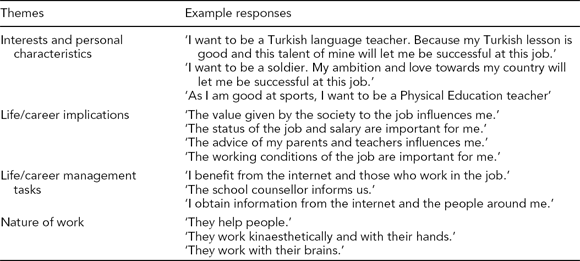
Analysis of the data was conducted in three stages. In the first stage, themes under which the data would be considered were identified, based on standard themes in career information resources (cf., Jarvis, Reference Jarvis2003; Jarvis & Keeley, Reference Jarvis and Keeley2003; McMahon, Patton, & Tatham, Reference McMahon, Patton and Tathan2003; McMahon & Watson, Reference McMahon and Watson2005; Walls, Reference Walls2000). This step identified four themes: interests and personal characteristics, life/career implications, life/career management tasks, and the nature of work. The first theme, interests and personal characteristics, included both the students’ own individual characteristics, interests, skills, achievements and hobbies, as well as the association of these with careers. The second theme, life/career implications, also involved students’ answers about career income, career satisfaction, future living style, status of a career, and its value for society. The third theme, life/career management tasks, is related to the students’ answers on career preparation and ways to access information about careers. The last theme, nature of work, included students’ responses to the characteristics of careers, the quality of working environments, and the skills required for careers.
In the second stage, research data were organised under the four headings (see Table 1 for the themes and sample student responses):
• The first three questions of the first section of the survey (‘What jobs are you interested in doing when you grow up?’, ‘Of those jobs you wrote down, which one is your favourite?’, ‘What is it about you that would make you good at your favourite job?’) were coded under the first theme of ‘interests and personal characteristics’. For example, expressions such as ‘This profession is ideal for me’, ‘I want to be a kindergarten teacher because I adore children’, ‘I believe my talents and skills match those of a policeman’, were considered in regard to the students’ interests and personal characteristics.
• The data from the 4th and 5th questions of the first section (‘Who could influence you toward or away from choosing jobs?’, ‘What could influence you toward or away from choosing jobs?’) were considered in regard to the ‘life/career implications’ theme. For example, expressions such as ‘The jobs preferred mostly currently influence me’, ‘I adore this job’, ‘Economic freedom and the job having a good future’, ‘The living conditions that the job offers influence me’, ‘My love towards the job and my belief that I will be successful’, were considered in regard to students’ life/career implications.
• The data from the 6th, 7th, 8th and 9th questions in the survey's first section (‘How did you find out about those jobs that you wrote down?’, ‘How else could you find out information on jobs?’, ‘When you think about jobs, what information do you need to find out?’, ‘What do you do at school that might help prepare you for the jobs that interest you?’) and data from the 5th section (linking school learning with nominated careers), were considered under the third theme of ‘life/career management tasks’. For example, expressions such as ‘I obtain information about jobs through asking my teachers and searching on the internet’, ‘I obtain career information from the people around me and through the internet’, ‘I search for information about the jobs through those who work in that job, books and the internet’, ‘I receive information about jobs from the school counsellor’, were considered in regard to students’ life/career management tasks.
• The data from the 2nd, 3rd and 4th sections of the survey (covering matters of gender and career characteristics) were considered under the fourth theme ‘nature of work’. For example, expressions such as ‘They help people’, ‘They work kinaesthetically’, ‘They work with their hands’, were considered in regard to the nature of work.
Response Samples

In the third stage, the data under each of the four themes (interests and personal characteristics, life/career implications, life/career management tasks, and nature of the work) were analysed for each individual separately in terms of their inner consistency. Under each theme, the answers of the students were assessed as to whether they were consistent with or in contradiction to each other. By examining the consistency of the answers given by the students, it was determined whether they were interested in and have knowledge about their future career or whether they had not started to think about it and have less knowledge in the four themes. For instance, under the first theme (interest and personal characteristics), the consistency of the students’ answers to the first three questions (i.e., ‘What jobs are you interested in doing when you grow up?’ ‘Of those jobs you wrote down, which one is your favourite?’ ‘What is it about you that would make you good at your favourite job?’) of the survey were examined. If a student gave consistent answers to these three questions (e.g., ‘I like to be with children and teach something to them, therefore I believe I will be successful in being a kindergarten teacher’, ‘I want to be a maths teacher because my mathematics is good and this talent of mine will let me be successful at this job’) — that is, she/he identified personal characteristics and made an appropriate connection between them and career(s) (as shown in the examples in Table 1) — she/he was considered to have knowledge and interest related to this theme. If his/her answers were contradictory (e.g., ‘I want to be a lawyer when I grow up but I don't know which characteristics of me will allow me to be successful in this job’, ‘My ambition is to be an athlete because my family wants it’, ‘I want to be a doctor because it is a popular job’), s/he was regarded as less knowledgeable about this theme.
After the determination of responses of all 644 students under the four themes, the gender and grade level distribution for each heading was calculated. Chi-square analysis was carried out to determine whether there was a difference or not in career development according to gender and grade levels.
Results
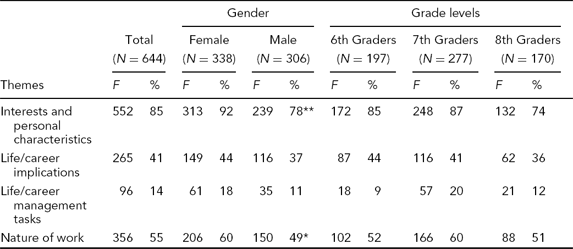
The findings according to the four themes under which the data were coded are examined below and presented in Table 2. In regard to the first heading (interests and personal characteristics), most participants could suitably associate their own characteristics with careers (85%). It is inferred from this that the career self-concept of the Turkish junior high school students was developed — that is, students were aware of their own interests, skills and hobbies — and that they could associate their own characteristics with careers. The results also suggested that this self-awareness/career connection was slightly better for girls than for boys (p < .01). There were no differences according to grade levels.
Responses for Total Sample, Gender, and Grade Levels
Note: *p < .05, **p < .01
In regard to the second theme (life/career implications), data indicated that most students had less knowledge about career satisfaction, income and status in order to aspire to such careers or associated lifestyles (41%). It was determined this was similarly the case for girls as for boys and grade levels. Although there was not a meaningful difference statistically, in percentage terms it was evident that girls were slightly better than boys in regard to this life/career implications dimension.
Students were found to be particularly lacking (only 14%) in regard to the third theme (life/career management task). The data demonstrated that the Turkish 11- to 14-year-old students have limited knowledge about how to prepare for the careers they might be interested in, how to get information, and also had limited ability in associating their school experiences with careers. Although there was not a meaningful difference statistically, in percentage terms it was evident that girls were slightly better than boys in regard to this life/career management dimension. No difference was evident in the statistical analysis of this theme in terms of grade levels (p > .05).
Students were found to be informed (55%) in regard to the last theme (the nature of work). It is inferred from the data that Turkish students are informed about the characteristics of careers, their working conditions and the skills required, with girls being better in this regard than boys (p < .05). However, no difference was detected in terms of grade level (p > .05).
In general, the study determined that overall the Turkish upper primary school students seemed able to associate their own characteristics with careers, and that they had some knowledge about the nature of work, but that their knowledge of life/career implications and life/career management tasks was more limited. In terms of gender, female students were seen to be better in differing degrees than male students on all four categories. No differences were discovered among of students according to grade levels.
Discussion
The data suggests that students were aware of their own career-related characteristics and that they were able to associate these with careers. Career development theorist Donald Super has asserted that upper primary-aged students are at a growth stage in which their experiences and career self-concepts start to develop. One of the most significant indicators of career maturity is career self-concept (Super, Reference Super, Saviskas and Lent1994). According to Gottfredson (Reference Gottfredson and Brown1996, Reference Gottfredson and Brown2002), career self-concept starts to form in children around 3rd grade when they become capable of targeting career objectives compatible with their career self-concept. Based on other research (e.g., Armstrong & Crombie, Reference Armstrong and Crombie2000; Hartung, Porfeli, & Vondracek, Reference Hartung, Porfeli and Vondracek2005; Helwig, Reference Helwig1998b; McMahon & Watson, Reference McMahon and Watson2005; Nazlı, Reference Nazlı2007; Walls, Reference Walls2000; Watson & McMahon, Reference Watson and McMahon2005), it seems that primary and upper primary school students seem to have a sound awareness of their personal characteristics and interests and that they are capable of associating these with careers. Turkish junior high school students also demonstrate awareness in this regard and it can be said are similar to their international peers.
The findings also suggest that students have less knowledge about life/career implications. Yet, according to Gottfredson (Reference Gottfredson and Brown1996, Reference Gottfredson and Brown2002), 9- to 13-year-old students will be in a period when they are aware of the status and income levels of careers and of the related living styles. Lapan, Adams, Turner, & Hinkelman (Reference Lapan, Adams, Turner and Hinkelman2000) determined that 7th-grade students were interested in careers and liked talking about the social status and income that careers offer. In addition, Walls (Reference Walls2000) and Helwig (Reference Helwig2001) discovered that students started to think more about the duration of education and the monetary value and status of careers in 9th grade. In their study, however, McMahon and Watson (Reference McMahon and Watson2005) determined that students in Australia and South Africa were less informed about life/career implications as seemed to be the case with the Turkish students in this study.
The results indicated that Turkish students seem informed about careers. Super (Reference Super1980, Reference Super, Saviskas and Lent1994) stated that children are curious about their environment, and that they are motivated to learn about and investigate professions. Super believes that acquiring information about the business world is a sign of career maturity. Ültanır (Reference Ültanır2003) determined that Turkish and German 8th graders were interested about their surroundings and that they tried to find out about careers. McMahon and Watson (Reference McMahon and Watson2005) noted that upper primary school students from Australia and South Africa seemed appropriately informed about careers. Walls (Reference Walls2000) determined that students had knowledge about careers. Helwig (Reference Helwig2001) stated that children start to think realistically as they acquire more information about themselves and careers. Children are affected by the social environment in which they live (Watson & McMahon, Reference Watson and McMahon2005). As their interests move toward the world of adults (Tracey, Reference Tracey2001) they develop varied strategies in order to search the types of career (Hartung et al., Reference Hartung, Porfeli and Vondracek2005).
In this study, it was noted that in all themes (interests, personal characteristics and the nature of work), female students were in percentage terms better interested and had more knowledge than boys. Some previous studies found that no differences in terms of career development were evident in terms of gender (Armstrong & Crombie, Reference Armstrong and Crombie2000; Gregg & Dobson, Reference Gregg and Dobson1980; McMahon & Watson, Reference McMahon and Watson2005; Lapan et al., Reference Lapan, Adams, Turner and Hinkelman2000; Turner & Lapan, Reference Turner and Lapan2002). However, other research suggested that career development in terms of career awareness and knowledge does differ according to gender (Helwig, Reference Helwig2001; Morton, Reference Morton1997; Patton, Bartrum, & Creed, Reference Patton2005). While McMahon and Patton (Reference McMahon and Patton1997) found that in their study boys had more career knowledge than girls, in contrast, Patton and Creed (Reference Patton and Creed2001) discovered that girls had more career knowledge than boys.
The study determined that there are no differences among career development in terms of grade level. This finding does not support Super's (Reference Super, Saviskas and Lent1994) views, because Super believes that career development gradually increases in children as they grow older. Research has shown that children's career development strengthens according to age (Hartung et al., Reference Hartung, Porfeli and Vondracek2005; Helwig, Reference Helwig1998a, Reference Helwig1998b, Reference Helwig2001; Tracey, Reference Tracey2001; Walls, Reference Walls2000). Finding no differences among students in terms of grade level suggests that school career education programs in upper primary schools could support career development in Turkey.
Limitations
This study has two major limitations. First, it was carried out with students from one socio-economic level — the middle class. Second, data were sought in written form only. If lower and upper socio-economic levels of students were included in the study and more in-depth qualitative data included, a fuller appreciation of career development levels and issues would be likely.
Conclusions
As a member of the OECD, Turkey is supposed to provide career education programs to support students’ career development. It is suggested that more time be devoted to the field of career development in Turkey's school guidance programs, and that these programs should also focus more on the development of life/career management tasks, and an understanding of life/career implications, along with relating individual and career characteristics.