An interatrial communication within the oval fossa, the so-called “ostium secundum” defect, is a common congenital malformation, with a reported incidence of 7% of all congenital cardiac lesions.Reference Hoffman1 Echocardiographic screening of neonates and infants for murmurs, however, suggests that interatrial shunting might be found in from one-quarter to one-half of all neonates.Reference Radzik, Davignon, van Doesburg, Fournier, Marchand and Ducharme2 The majority of these patients remains asymptomatic, with spontaneous resolution of the shunts in nine-tenths.Reference Radzik, Davignon, van Doesburg, Fournier, Marchand and Ducharme2 Only a minority of infants and small children with isolated interatrial communications, therefore, experience symptoms and require closure.Reference Butera, De Roasa and Chessa3–Reference Lammers, Hager, Eicken, Lange, Hauser and Hess5
Despite surgical closure of such defects carrying a low risk, and being a widely accepted procedure,Reference Lammers, Hager, Eicken, Lange, Hauser and Hess5, Reference Horvath, Burke, Collins and Cohn6 the rate of complications is reduced, and length of stay in hospital shorter, after closure with a device inserted on a catheter.Reference Butera, Lucente and Rosti7 Moreover, after surgical treatment, concerns remain concerning the impact of cardiopulmonary bypass on developmental outcome.Reference Visconti, Bichell, Jonas, Newburger and Bellinger8 Hence, even though there are no randomized trials comparing transcatheter and surgical closure, most centres now favour the transcatheter approach, providing the anatomy is suitable. The previous nonrandomized studies on transcatheter closure have mostly been carried out in adults and older children.Reference Fisher, Stieh, Uebing, Hoffmann, Morf and Kramer9 Even in small children, nonetheless, recent reports from a single centre have shown that transcatheter closure can be performed safely and successfully in experienced hands,Reference Butera, De Roasa and Chessa3, Reference Butera, Lucente and Rosti7 with another report showing the procedure also to be safe and effective in a smaller centre with less experience.Reference Patel, Cao, Koening and Hijazi10 The efficiency of such closure on clinical symptoms, however, has yet to be demonstrated in small children. In this report, therefore, we describe the multicentric French experience with transcatheter closure in children weighing 15 kilograms or less, paying particular attention to the relief of symptoms and to subsequent growth.
Patients and Methods
We chose to study patients weighing 15 kilograms or less, since the majority of the patients previously reported in studies assessing transcatheter closure in small children also weighed 15 kilograms or lessReference Butera, De Roasa and Chessa3, Reference Butera, Lucente and Rosti7, Reference Patel, Cao, Koening and Hijazi10, Reference Cardenas, Panzer, Boshoff, Malekzadeh-Milani and Ovaert11 and because 15 kilograms represents a cut-off below which it is necessary to use a paediatric rather than an adult transoesophageal probe.Reference Stevenson and Sorensen12 With this in mind, we sought to collect data on all children weighing 15 kilogram of less, and seen between January, 1997, and June, 2004, who underwent transcatheter closure of a defect within the oval fossa. To achieve this end, we contacted all the French centres performing transcatheter closure of such defects, via the good offices of the Paediatric Working Group of the French Society of Cardiology. All agreed to participate to the study.
We excluded all those patients with defects considered too large for percutaneous closure before or at the time of catheterization. We also excluded closure of interatrial communications associated with complex congenital cardiac disease. We reviewed the hospital records to collect clinical features, along with electrocardiographic, echocardiographic, and haemodynamic data, at the time of closure and during the follow-up.
We diagnosed a residual shunt if colour Doppler flow mapping showed either a left-to-right or a right-to-left shunt across the atrial septum. We have expressed the data as a frequency or a percentage for nominal variables, and as the median with range for continuous variables. Differences between weight centiles at the time of closure and during follow-up were analyzed by Student’s paired t-test. A value for p of less than 0.05 was considered to be statistically significant.
Results
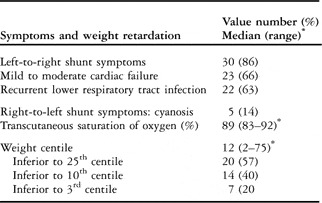
General characteristics (Table 1, Figure 1)
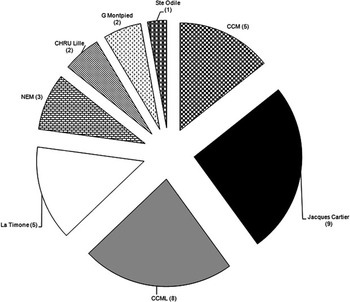
Transcatheter closure was performed in 35 patients weighing 15 kilograms or less, of whom 14 were male and 21 female, the procedures being performed in 8 different centres (Fig. 1). The median age was 3 years, with a range from birth to 6.2 years, and median weight was 13 kilograms, with range from 3.6 to 15 kilograms. All the patients had been clinically symptomatic (Table 1), related to a significant left-to-right shunt in the majority, with several children experiencing significant cyanosis due to right-to-left shunt. In 1 of these patients, supplementation with oxygen was needed as part of long-standing hospitalisation. The majority of the patients had also experienced poor weight gain, including failure to thrive (Table 1). An associated cardiac malformation was present in 4 cases, with valvar pulmonary stenosis in 3 cases, and a persistent patency of the arterial duct in the other. In 2 cases, the stenotic pulmonary valve was dilated with a balloon at birth, followed by construction of a modified Blalock-Taussig shunt in one patient. Other associated cardiac features included drainage of a persistent left superior caval vein to the coronary sinus in one case. In 5 patients, birth had been premature, with bronchodysplasia in 2 cases. Down’s syndrome was present in 3 cases, and Adams Oliver syndrome in another.
Participating centres, with the number of procedure(s) performed for each of the centres during the period of study. CCM, Centre Cardiothoracique de Monaco, Monaco; CCML, Centre Chirurgical Marie-Lannelongue, Le Plessis Robinson; CHRU Lille, Hôpital Cardiologique du centre hospitalier régional de Lille, Lille; G Montpied, Hôpital Gabriel Montpied, Clermont-Ferrand; Jacques Quartier, Institut Hospitalier Jacques Quartier, Massy; La Timone, Hôpital de la Timone, Marseille; NEM, Hôpital Necker-Enfants-Malades, Paris; Ste Odile, Clinique Sainte Odile, Strasbourg.

Clinical presentation of the 35 patients undergoing transcatheter closure.

Results and complications
All procedures were performed under general anaesthesia, using fluoroscopy and transoesophageal echocardiographic guidance. In 2 cases, the procedure was performed under fluoroscopy with transthoracic echocardiographic guidance. After obtaining femoral venous access, we administered 50 to 100 units per kilograms of heparin, and proceeded to catheterisation of the right heart. In one patient born prematurely at 27 weeks with bronchodysplasia at the time of the procedure, the mean pulmonary arterial pressure was elevated, at 50% of systemic levels, whereas pressures were within the normal range in the remaining 34 patients. The procedure for sizing and closure of the defects was as previously described.Reference Butera, De Roasa and Chessa3, Reference Vogel, Berger, Dahnert, Ewert and Lange4, Reference Butera, Lucente and Rosti7, Reference Patel, Cao, Koening and Hijazi10, Reference Cardenas, Panzer, Boshoff, Malekzadeh-Milani and Ovaert11 We implanted 35 Amplatzer septal occluders (AGA Medical Corp.), the sizes ranging from 4 to 24 millimetres, with a median of 13 millimetres. During the same procedure, one patient underwent closure of a persistently patent arterial duct with an Amplatzer occluder (AGA Medical Corporation), and a modified Blalock-Taussig shunt was occluded with a coil in another patient. We administered oral aspirin in a dose of 3 to 5 milligrams per kilogramme per day for 6 months after implantation.
There was no mortality, albeit that 1 patient required emergency cardiac surgery 24 hours after the procedure to resect a previously undiagnosed shelf dividing the right atrium, with a favourable outcome. There was no other major complication. Transthoracic echocardiography after the procedure showed a small residual shunt in 5 cases.
Follow-up
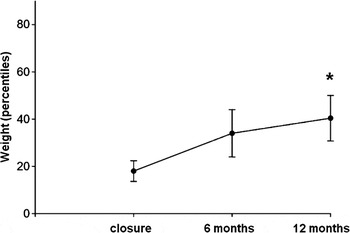
After a median follow-up of 2 years, with a range from 0.5 to 5.2 years, all the patients are asymptomatic except the long-standing patient who still remains hospitalised with supplemental oxygen at the last follow-up one year after closure of the atrial defect. In 1 patient with a previous right-to-left shunt, there is a small bidirectional residual shunt of less than 2 millimetres as detected by colour Doppler flow mapping. No patient has presented a significant arrhythmia or high degree atrioventricular block. In 17 patients, 7 boys and 10 girls, with previous left-to-right shunt and more than 12 months follow-up, we have found a significant gain in weight when comparing the mean centiles at the time of closure (p = 0.02, Fig. 2).
Evolution of the mean centiles for weight in 17 children followed for more than 12 months after closure of the defect in the oval fossa.

Discussion
Our multicentric study has confirmed the feasibility and safety of percutaneous transcatheter closure of defect within the oval fossa in very young children, even in small and less experienced centres (Fig. 1). Fluoroscopy and transoesophageal echocardiography provide appropriate guidance for such procedures, and even transthoracic echocardiography can occasionally be used.Reference Kardon, Sokoloski and Levi13 Others have reported the successful use of intracardiac echocardiographic guidance when closing such defects in children weighing less than 15 kilograms, with the potential of eliminating the need for general anaesthesia, although this must be set against the need for insertion of an 11 French sheath so as to obtain intracardiac echocardiographic venous access.Reference Cardenas, Panzer, Boshoff, Malekzadeh-Milani and Ovaert11
Not all defects within the oval fossa need to be treated, since they can still close spontaneously beyond infancy,Reference Radzik, Davignon, van Doesburg, Fournier, Marchand and Ducharme2, Reference Brassard, Fouron, van Doesburg, Mercier and De Guise14 especially when measuring less than 8 millimetres.Reference Radzik, Davignon, van Doesburg, Fournier, Marchand and Ducharme2 In our study, however, we closed only symptomatic defects. Although no official guidelines have been published, referring interventionists from the Paediatric Working Group of the French Society of Cardiology have stated that transcatheter closure of defects within the oval fossa should be avoided in small children (Jérome Petit, personal communication, 1st Journée Choussat, September 2003, Dijon, France). This probably explains the small number of procedures reported in our study, especially when compared to a similar survey in Belgium, when 52 patients weighing 15 kilograms or less underwent transcatheter closure within 4 years.Reference Patel, Cao, Koening and Hijazi10 The shunt was also rarely assessed in our patients during the catheterization, since the symptomatology already reflected a significant shunt. Moreover, there is no way exactly measure the content of oxygen in so-called mixed venous blood, this usually involving estimation from the saturations of oxygen in the superior and inferior caval veins. With the use of general anaesthesia, the contribution from the inferior caval vein is stronger, and such estimation of mixed venous saturation is even more unreliable.Reference Brassard, Fouron, van Doesburg, Mercier and De Guise14, Reference Kehrli, de Sépibus, Ehrengruber, Weber, Stocker and Gurtner15
We were able to show a significant gain in weight after closure of the defects. This is in agreement with other studies that reported gains in weight after either transcatheterReference Butera, De Roasa and Chessa3 or surgicalReference Lammers, Hager, Eicken, Lange, Hauser and Hess5 closure in young children, although previous findings were not statistically significant. In a recent report of surgical closure of defects in infants, the frequently associated noncardiac malformations were also considered responsible for failure to thrive.Reference Lammers, Hager, Eicken, Lange, Hauser and Hess5 Our findings show that the retardation in growth can be attributed at least in part to the shunt. Other studies have shown that patients with congenital cardiac disease have delayed growth, especially those with increased flow of blood to the lungs.Reference Jacobs, Leung and Karlberg16 Poor nutrition associated with increased metabolic demands clearly plays a prominent role, although another recent investigation has shown that endocrinal factors may also be important, with lower levels of insulin growth factor I being found in the serum from infants with congenitally malformed hearts when compared to controls.Reference Barton, Hindmarsh and Preece17 The degree of preoperative failure of growth in patients with various congenital cardiac defects has also been shown to affect the postoperative catch-up.Reference Schuurmans, Pulles-Heintzberger, Gerver, Kester and Forget18 Hence, patients with growth retardation who undergo repair at a relatively older age have less optimal growth than expected.Reference Sholler and Celemajer19 This further emphasizes the potential for transcatheter closure of defects within the oval fossa in small patients.
We encountered no major complication that could be related to the young age of the patients, and had no problems with vascular access. Nor did Patel and colleagues,Reference Patel, Cao, Koening and Hijazi10 who closed defects in 19 patients weighing less than 15 kilograms using intracardiac echocardiographic guidance that required insertion of 11 French sheaths, or Butera and colleagues.Reference Butera, De Roasa and Chessa3 Conversely, Vogel and associatesReference Vogel, Berger, Dahnert, Ewert and Lange4 reported embolization of 2 devices requiring surgical retrieval. The erosion that can be produced by the Amplatzer septal occluder device has not been shown to be related to younger age.Reference Divekar, Gaamangwe, Shaikh, Raabe and Ducas20
Our study has its limitations. Beside its retrospective nature, there was lack of specificity regarding the symptoms of the left-to-right shunting that prompted closure in a heterogeneous population of patients, frequently with associated extracardiac diseases. Relief of the symptoms after closure, as well as the documented gain in weight, suggests that the defect had played a prominent role in the clinical state, although this cannot be fully demonstrated.
We conclude, therefore, that transcatheter closure of defects within the oval fossa in children weighing 15 kilograms or less is feasible and efficient. The technique can be proposed as a first line of treatment in symptomatic patients. Children with retarded growth tend to have complete recovery within one year of closure.