INTRODUCTION
Information on trophic relationships among species is fundamental to understand how a marine ecosystem works as well as to anticipate the potential effects that anthropogenic activities have on an ecosystem. To elucidate the food web, analysis of stable isotope ratios is commonly used when direct observation and gut content analysis is not easy or possible (Fry & Sherr, Reference Fry and Sherr1984). This technique assumes that the isotopic composition of a consumer is directly related to the isotopic composition of its food source (DeNiro & Epstein, Reference DeNiro and Epstein1978). The nitrogen isotope ratio (δ14N/δ15N) determines the trophic position of a consumer in a food web because δ15N tends to increase ~3–4‰ between any two trophic levels, apparently due to the loss of the light 14N isotope in excretory products (Minagawa & Wada, Reference Minagawa and Wada1984). Carbon signatures establish the trophic enrichment (usually 1%, DeNiro & Epstein, Reference DeNiro and Epstein1978) and are mainly used to elucidate sources of primary production that support food webs (Persic et al., Reference Persic, Roche and Ramade2004). Therefore, the dual isotope ratios can resolve ambiguities in food-web relationships, particularly for most benthic invertebrates where gut content analysis by stereoscopic microscope observation is difficult.
The sandy coastal ecosystem off Mar del Plata, Argentina, has supported a number of demersal and benthic fisheries for many years. One of the most important fisheries is the ‘prawn-shrimp’, Artemesia longinaris Spence Bate, 1888 and Pleoticus muelleri (Spence Bate, 1888) fishing grounds (Scelzo et al., Reference Scelzo, Martinez Arca and Lucero2002). The gastropod community associated with this fishery is dominated by the olive snails Olivancillaria deshayesiana (Ducros de Saint Germain, 1857), Olivancillaria urceus (Röding, 1798) and Olivancillaria carcellesi Klappemnbach, 1965 as well as the whelk snails Buccinanops monilifer (Kiener, 1834) and Buccinanops duartei Klappenbach, 1961. These snail species are found buried in the sandy-silty bottom, living between 5 and 20 m depth, and little is known about their life history except for their direct development, presence of imposex (masculinization of the females caused by the presence of tributyltin in the water) (Penchaszadeh et al., Reference Penchaszadeh, Averbuj and Cledón2001; Teso & Penchaszadeh, Reference Teso and Penchaszadeh2009; Averbuj & Penchaszadeh, Reference Averbuj and Penchaszadeh2010; Teso et al., Reference Teso, Arrighetti and Penchaszadeh2012) as well as age and growth (Arrighetti et al., Reference Arrighetti, Teso, Brey, Mackensen and Penchaszadeh2012). These gastropods are important food sources for a number of species in this ecosystem (Penchaszadeh et al., Reference Penchaszadeh, Arrighetti, Cledón, Livore, Botto and Iribarne2006) but their relative contribution to the food web is still not known.
The objective of this study was to characterize the trophic role of the gastropod community associated with the local prawn-shrimp fishery. This aim was achieved using a dual isotope approach (δ13C and δ15N) and a multiple-source mixing model to examine the relative contribution of potential food sources to gastropod diet, and the contribution gastropods make to the diet of the local predators. These results will increase understanding of trophic relationships within this exploited community and provide valuable baseline data to study future changes to the food web.
MATERIALS AND METHODS
Study area
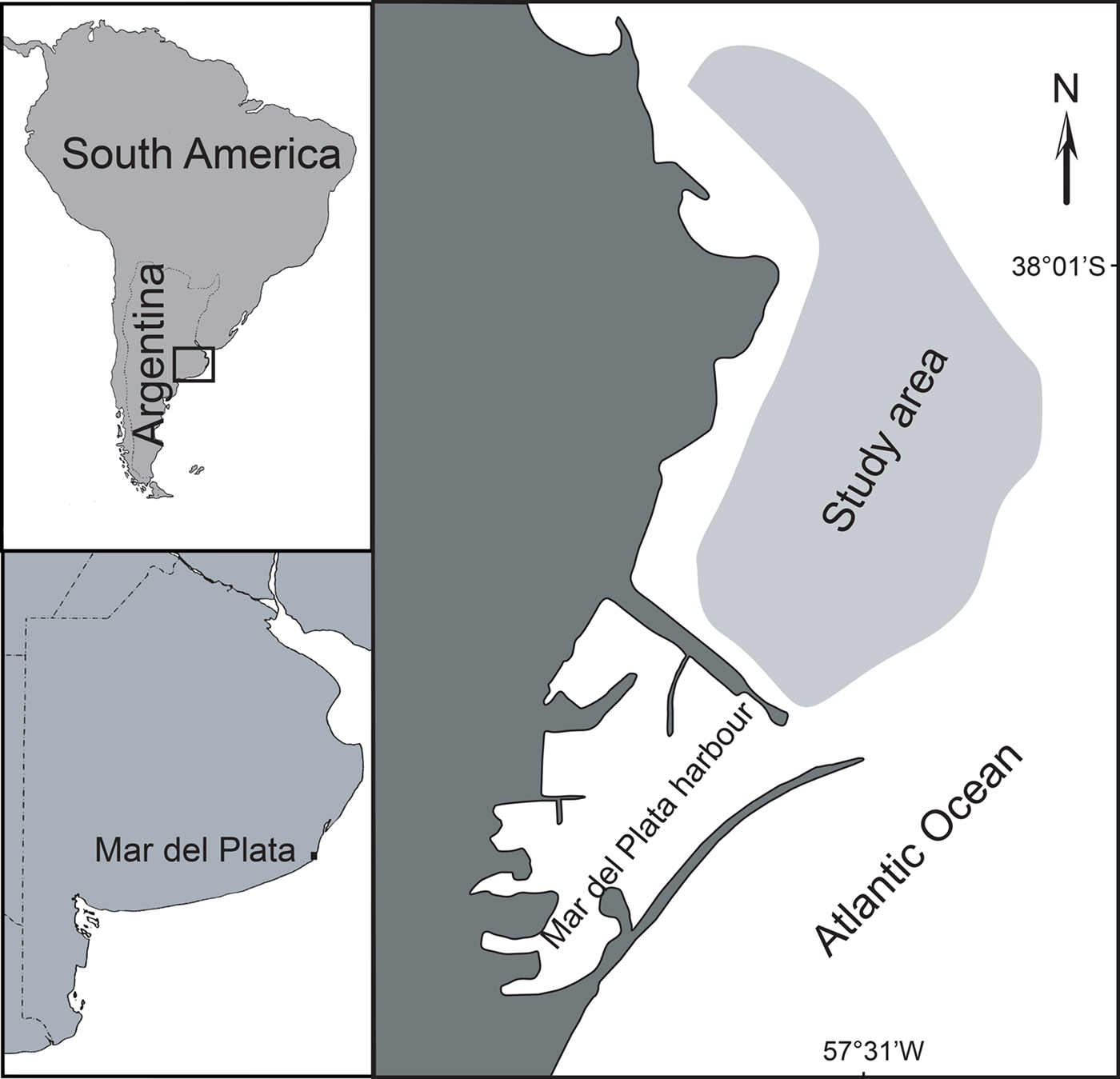
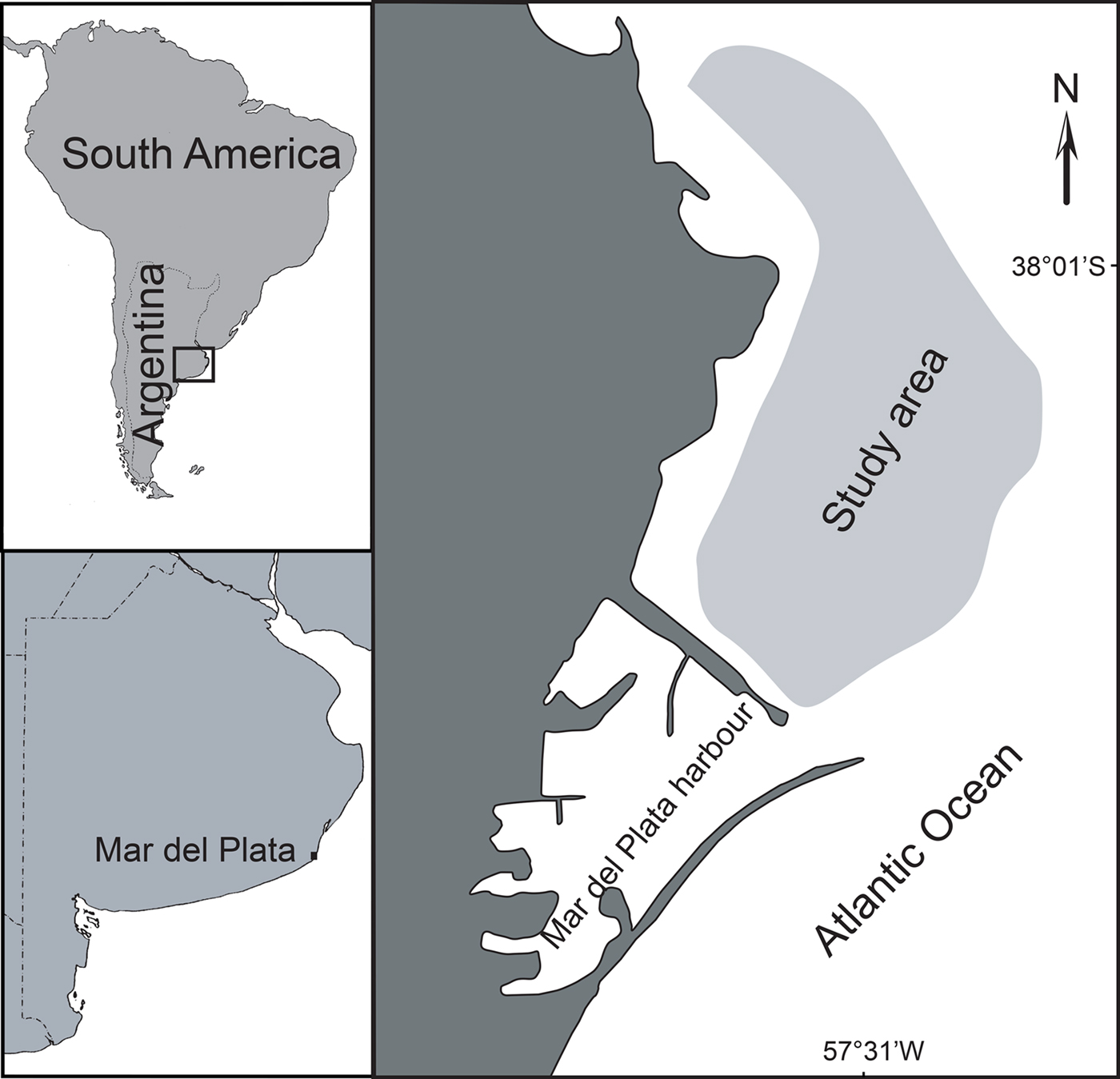
Sampling was carried out in the coastal area off Mar del Plata, Argentina (38°01′S 57°31′W), during summer 2006 (Figure 1). Annual range of salinity and temperature are 33.5–33.8 and 8–21°C, respectively (Guerrero & Piola, Reference Guerrero, Piola and Boschi1997; Teso et al., Reference Teso, Arrighetti and Penchaszadeh2012). The area is dominated by sandy and sandy-silty bottoms (Olivier et al., Reference Olivier, Bastida and Torti1968). Rocky bottoms nearby support large amounts of macroalgae that may serve as allochthonous food sources for soft bottom benthic consumers and as a refuge for the associated community (Scelzo, Reference Scelzo and Boschi2016).
Location map of the study area.
Sample collection and isotope ratio determination
Eight hauls were conducted at ~1 knot from a depth range of 5–10 m with a bottom trawl (2 cm mesh size at the cod end and 2 m mouth opening). The dominant species were selected for the isotope analysis. Broad species groups included macroalgae, benthic epifauna (bivalves, gastropods, sea anemones, shrimps, crabs and hermit crabs) and fishes. All samples were individually frozen at −20°C until further analysis.
Macroalgal fronds were rinsed with distilled water, all visible epibionts were removed from their surface and samples were pooled to create a representative composite sample. Pieces of body wall of cnidarians and muscle tissue from crustaceans' abdomen (shrimp and prawn) and legs (crabs) were taken for analysis. Molluscs were removed from shells and foot muscle was dissected. Muscle tissue samples were dissected from the dorsal musculature of fishes. All samples were dried at 60°C until they reached a constant weight and then ground into a fine powder with mortar and pestle. The dried samples were stored in Eppendorf tubes and kept frozen until analysis to prevent rehydration prior to transportation. Samples were transported to the GeoBioCenterLMU, University of Munich and then were acidified to remove inorganic carbonates by adding 2 N HCl drop-by-drop until no more CO2 was released, in order to make stable isotope data comparable between taxa with variable CaCO3 content (Jacob et al., Reference Jacob, Mintenbeck, Brey, Knust and Beyer2005). The samples were re-dried at 60°C without rinsing to minimize loss of dissolved matter and ground again to a homogeneous powder.
Mass-spectrometric measurement of stable nitrogen and carbon isotope composition was carried out at the GeoBioCenterLMU, University of Munich (Thermo/Finnigan Delta Plus). Data were expressed in the standard δ unit notation according to the following equation:
 $$\delta X = [(R{\rm sample}/R{\rm standard}) - 1] \times 1000$$
where X is 13C or 15N and R is the corresponding ratio 13C/12C or 15N/14N and are reported relative to the Vienna Pee Dee Belemnite standard (PDB) for carbon and to atmospheric N2 for nitrogen. Experimental precision (based on standard deviation of replicates of a peptone standard) was better than ±0.2‰. Considering a mean trophic fractionation in δ13C of ~1‰ (DeNiro & Epstein, Reference DeNiro and Epstein1978; Peterson & Fry, Reference Peterson and Fry1987) and a mean trophic enrichment in δ15N of 3.4‰ (DeNiro & Epstein, Reference DeNiro and Epstein1981; Post, Reference Post2002), as a result of the assimilation of food, we can estimate the mean isotopic composition of the diet of the macrofauna.
Isotope analysis
To quantitatively assess the importance of gastropods as predators and food sources, we used the available biological information on the consumer and mixing models in order to determine the most plausible diet. The IsoSource Visual Basic™ program developed by Phillips & Gregg (Reference Phillips and Gregg2003) provides an indication of relative prey consumption when the number of potential sources exceeds the number of isotopes used by more than one. This program is designed to use isotopic signatures to determine the range of feasible source contributions to a mixture when there are too many sources. We followed the ‘a priori source aggregation’ technique as given by Phillips et al. (Reference Phillips, Newsome and Gregg2005). This method relies on an iterative model that considers all possible combinations of source proportions (that sum 100%) by some small increment (in this case 1%). Then the predicted isotopic signature(s) for the mixture are computed as each combination is created and compared with the observed mixture signatures. If they are equal, or within some small balance tolerance (in this case 1%) this combination of source proportions represents a feasible solution. In order to reduce the uncertainty of the results, potential sources with different isotope values from each other and a high number of samples were included in the model. The results were reported as means and lower and upper ranges.
Pre-existing values of δ15N and δ13C of the same community between 10 and 18 m water depth published by Penchaszadeh et al. (Reference Penchaszadeh, Arrighetti, Cledón, Livore, Botto and Iribarne2006) were included in this analysis, i.e. the fish species Callorynchus callorynchus Meuschen, 1778, Urophycis brasiliensis (Kaup, 1858), Micropogonias furnieri (Desmarest, 1823) (small), Micropogonias furnieri (big) and Cynoscion striatus (Cuvier, 1829).
Samples of individual macroproducers and macroconsumers were pooled to create representative composite samples (Corbisier, Reference Corbisier, Soares, Petti, Muto, Silva, McClelland and Valiela2006).
RESULTS
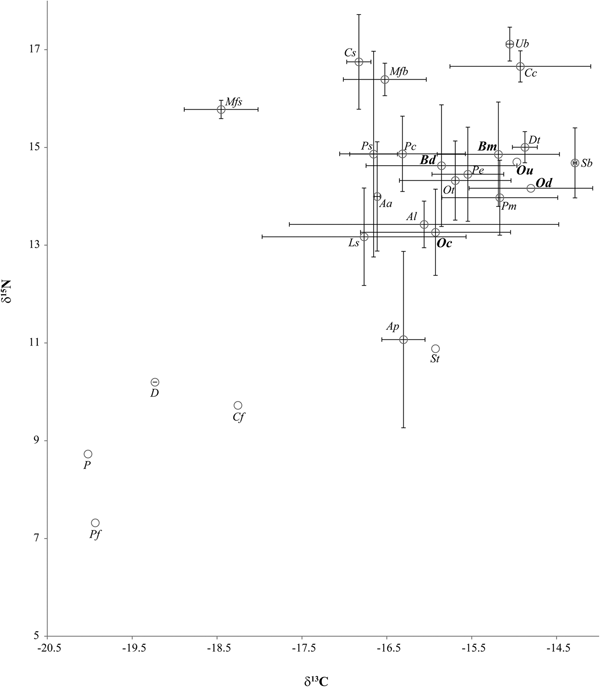
Macroalgae were at the base of the food web (Figure 2) with δ15N values ranging from 7.3‰ (Petalonia fascia (O.F. Müller) Kuntze, 1898) and 10.2‰ (Dictyota sp.) (Table 1).
Distribution of δ 15N and δ 13C stable isotope ratio values (mean ± standard deviation). D – Dictyota sp.; Pf – Polysiphonia fucoides; Cf – Codium fragile; Pf – Petalonia fascia; Aa – Antholoba achates; Ap – Amiantis purpurata; St – Solen tehuelchus; Ps – Parona signata; Pe – Pagurus exilis; Bm – Buccinanops monilifer; Bd – Buccinanops duartei; Od – Olivancillaria deshayesiana; Oc – Olivancillaria carcellesi; Ou – Olivancillaria urceus; Ls – Libinia spinosa; Ot – Ovalipes trimaculatus; Pc – Platyxanthus crenulatus; Pm – Pleoticus muelleri; Al – Artemesia longinaris; Sb – Sympterigia bonapartii; Dt – Discopyge tschudii; Cs – Cynoscion striatus; Cc – Callorynchus callorynchus; Ub – Urophycis brasiliensis; Mfs – Micropogonias furnieri small; Mfb – Micropogonias furnieri big.

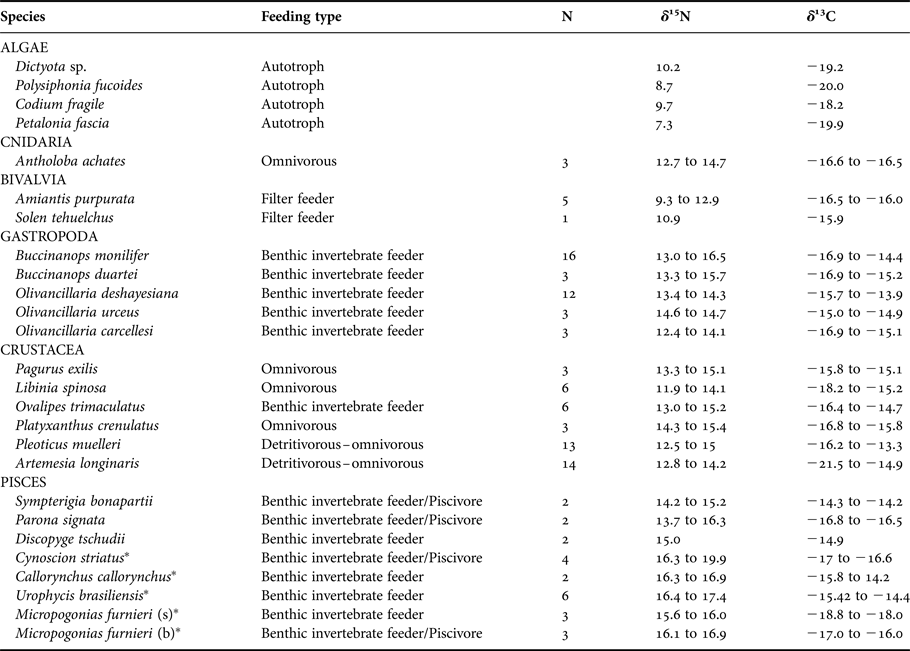
δ 15N and δ 13C stable isotope range of values of coastal food web and corresponding feeding strategy.

* Refers to Penchaszadeh et al. (Reference Penchaszadeh, Arrighetti, Cledón, Livore, Botto and Iribarne2006).
Filter feeder species had the lowest δ15N values, with 10.88‰ for the bivalve Solen tehuelchus (D'Orbigny, 1843) and 11.1 ± 1.8‰ for the bivalve Amiantis purpurata (Lamarck, 1856). Among gastropods, Olivancillaria carcellesi had the lowest δ15N signature (13.26 ± 0.88‰) and the Brazilian codling Urophycis brasiliensis was the species with the highest δ15N value (17.1 ± 0.3‰) (Penchaszadeh et al., Reference Penchaszadeh, Arrighetti, Cledón, Livore, Botto and Iribarne2006).
The corresponding δ 13C values for macroalgae, invertebrates and fishes are presented in Table 2. The ray Sympterygia bonapartii Müler and Henle, 1841 was relatively 13C-enriched (−14.3 ± 0.02‰) while the macroalgae Polysiphonia fucoides was more 13C-depleted (−20.0‰).
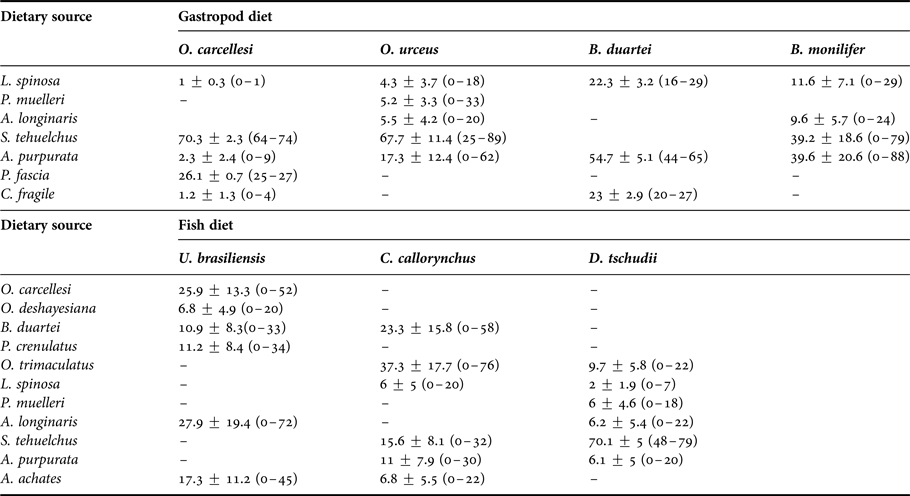
Probable contribution of each potential food source based on IsoSource mixing model. Values are given as the mean per cent contribution, and 1st and 99th percentiles of the distribution of feasible solutions of each source to prey diet. Dashes indicate that the potential prey were not included in the analysis.

The mixed model analysis (Table 2) indicated that A. purpurata and S. tehuelchus constitute the majority of the diet of O. urceus and B. monilifer. The spider crab Libinia spinosa Milne-Edwards, 1834 and the shrimp A. longinaris are an important secondary food source for B. monilifer while B. duartei feeds mainly upon A. purpurata with a small component of the macroalgae Codium fragile (Suringar) Hariot, 1889 and L. spinosa. Olivancillaria carcellesi showed evidence of having S. tehuelchus as the main prey item with a secondary contribution of the macroalgae P. fascia. Olivancillaria deshayesiana, O. carcellesi and B. duartei are important items in the diet of the Brazilian codling U. brasiliensis. The plownose chimaera C. callorhynchus also feeds on B. duartei with the crab Ovalipes trimaculatus (De Haan, 1833) as an additional important prey (Table 2). The electric ray Discopyge tschudii Heckel, 1846 showed evidence of having S. tehuelchus as the main prey item.
DISCUSSION
Traditionally, for reconstructing food webs, identification of food sources is accomplished by underwater direct observation, stomach content, and/or faecal pellet analysis. High turbidity in the study area reduces visibility making it impossible to directly observe gastropod foraging habits. It is also difficult to interpret the stomach content of gastropods. Isotope analysis was therefore the best possible tool to study the trophic role of local gastropods.
In recent years, a common application is to use linear mixed models (Fry & Sherr, Reference Fry and Sherr1984). The isotopic composition of the consumer reflects their diet, so this mathematical model could calculate the proportion of each source after correcting for diet-tissue fractionation. Dietary mixing models, traditionally, have been developed to determine the diet proportion for n + 1 different food sources (n is the isotope value). However, when interpreting a food web, the most common situation is to have more food sources than potential isotopes. For this reason, Phillips & Gregg (Reference Phillips and Gregg2003) developed the IsoSource software, which determines multiple feasible solutions based on a mass-balanced approach. However, some controversial aspects arise from this model; one of them is that mixing models are sensitive to missing sources and the results may be interpreted erroneously if some sources are not included. The other limitation is the degree of uncertainty in diet proportion that the model provides (Philips et al., Reference Phillips, Inger, Bearhop, Jackson, Moore, Parnell, Semmens and Ward2014). According to Phillips (Reference Phillips2012), the most important factor that affects the estimation on the uncertainty is the isotopic differences among sources. In our study, to reduce this uncertainty, sources with different isotope values from each other and a high number of samples were included in our analysis, with the exception of the bivalve S. techuelchus. This species is an important component of the food web (Penchaszadeh et al., Reference Penchaszadeh, Arrighetti, Cledón, Livore, Botto and Iribarne2006) and we consider that by excluding it from the analysis we would lose valuable information. Moreover, the life-history parameters of each individual were used to interpret the probable food sources.
General food web structure
The diverse algae, invertebrate and fish species considered are broadly representative of the community present in the benthic shallow-water ecosystem off Mar del Plata (Olivier et al., Reference Olivier, Bastida and Torti1968; Scelzo et al., Reference Scelzo, Martinez Arca and Lucero2002; Mantelatto et al., Reference Mantelatto, Biagi, Meireles and Scelzo2007; Scelzo, Reference Scelzo and Boschi2016).
Among crustaceans, the spider crab L. spinosa is known to feed mainly on detritus, with a small proportion of crustaceans, molluscs and macroalgae (Acuña et al., Reference Acuña, Excoffon and Scelzo2003). However, its δ13C values were lower than expected unless the unidentifiable detritus found by Acuña et al. (Reference Acuña, Excoffon and Scelzo2003) in its stomach content was composed mainly of macroalgal matter. The sea anemone, A. achates, is an epibiont of the spider crab and the volutid gastropod Adelomelon brasiliana (Lamarck, 1811) with a probably mutualistic relationship (Acuña et al., Reference Acuña, Excoffon and Scelzo2003). The crab uses the anemone as camouflage while the latter benefits from the mobility and food availability of the crab, which is why the δ13C values of both species were similar to those of the spider crab (Acuña et al., Reference Acuña, Excoffon and Scelzo2003). Adelomelon brasiliana is a large snail up to 1 kg wet weight which is known to prey on A. purpurata (Penchaszadeh et al., Reference Penchaszadeh, Arrighetti, Cledón, Livore, Botto and Iribarne2006). The shrimps A. longinaris and P. muelleri are considered to be detritivorous-omnivorous (Olivier et al., Reference Olivier, Bastida and Torti1968) as is the hermit crab Pagurus exilis (Benedict, 1892) (Roberts, Reference Roberts1968). Our results show great variation in the δ13C and δ 15N values of these three species, which suggests a considerable inter-individual variability in diet.
The whitemouth croaker M. furnieri (small) displayed the most depleted δ13C values suggesting food sources that were not included in our analysis, probably polychaetes and small crustaceans, while adult specimens showed values more consistent with a diet based on bivalves (Penchaszadeh et al., Reference Penchaszadeh, Arrighetti, Cledón, Livore, Botto and Iribarne2006; Botto et al., Reference Botto, Gaitán, Mianzan, Acha, Giberto, Schiariti and Iribarne2011). The δ 15N values for P. signata were lower than expected for a species that feeds on benthic invertebrates and fishes (Perrota et al., Reference Perrota, Guerrero, Carozza, Quiroga and Macchi2006). The isotopic data were taken from juvenile individuals of P. signata (84 and 90 mm total length) with a limited range of prey compared with larger-sized individuals, that are able to feed on larger prey and select from a greater variety of prey species (Hobson & Welch, Reference Hobson and Welch1992; Davenport & Bax, Reference Davenport and Bax2002).
Trophic role of gastropods
Species of the family Nassariidae have been considered to be carrion feeders (Harasewych, Reference Harasewych, Beesley, Ross and Wells1998), nevertheless Penchaszadeh (Reference Penchaszadeh1971) and Averbuj et al. (Reference Averbuj, Palomo, Brogger and Penchaszadeh2013) demonstrated that Buccinanops monilifer and B. cochlidium, primarily feed on living bivalves and crustaceans respectively. In our mixing models B. monilifer feeds on bivalves (A. purpurata and S. tehuelchus) which coincides with previous findings (Penchaszadeh et al., Reference Penchaszadeh, Arrighetti, Cledón, Livore, Botto and Iribarne2006). However, B. duartei is likely to feed on macroalgae such as Codium fragile, in addition to bivalves (A. purpurata) and crustaceans (L. spinosa). This sandy-bottom environment is characterized by drifting algae on which small invertebrates inhabits, especially crustaceans (Scelzo, Reference Scelzo and Boschi2016). It is possible that B. duartei prey on crustaceans and associated algae as a food source. Therefore, the differences found in prey items between these two Buccinanops species may indicate micro-habitat partitioning. Small-scale trophic plasticity is a common mechanism in consumers, allowing them to adjust their diet to environmental availability of food items (Dubois et al., Reference Dubois, Blin, Bouchaud and Lefebvre2007). The same occurred for the Olivancillaria species. For O. carcellesi, our mixing models showed that among all the feasible potential food sources considered, their diet is likely to include bivalves with a small proportion of macroalgae. However, according to the mixing model procedure, no feasible solution could be modelled for O. deshayesiana, although the δ13C and δ15N values (−13.8 and 17.5‰ respectively) are close to the corresponding values obtained for a diet based on filter feeder species. Olivancillaria vesica (Gmelin, 1791) and Olivancillaria auricularia (Lamarck, 1811) in Brazil consumed the bivalves Donax hanleyanus Philippi, 1847 and Mesodesma mactroides Reeve, 1854 and the crustacean Emerita brasiliensis Schmitt, 1935 (Rocha-Barreira, Reference Rocha-Barreira2002). Hence, it is possible that O. deshayesiana feeds on small bivalves or crustaceans not captured by the mesh size employed in this study.
Our data indicate that gastropod species probably feed on carrion or on severely injured organisms rather than directly catching healthy prey. Since the study area is an important fishing ground, it is possible that food sources include by-catch returned to the sea after a fishing haul. Our isotopic analysis also showed that gastropods contribute to the diet of several important commercial fish species in the area. Fish species with isotopic values that match with gastropods as a food source were mainly demersal species, such as U. brasiliensis and C. callorynchus. Callorynchus callorynchus predation on bivalves and gastropods has been reported from several areas (Orensanz et al., Reference Orensanz, Pascual, Fernandez and Shumway1991; Di Giácomo et al., Reference Di Giácomo, Parma and Orensanz1994) while U. brasiliensis is known to feed mainly on crustaceans (Olivier et al., Reference Olivier, Bastida and Torti1968; Acuña Plavan et al., Reference Acuña Plavan, Sellanes, Rodríguez and Burone2007). Another fish associated with the gastropod community studied in this work was the electric ray D. tschudii whose diet was dominated by bivalves, also reported by Arrighetti et al. (Reference Arrighetti, Livore and Penchaszadeh2005).
This study was focused in a highly vulnerable environment due to anthropogenic activities. On one hand, all the gastropod species included in our study are taken as by-catch in the fisheries of the prawn A. longinaris and shrimp P. muelleri (Arrighetti et al., Reference Arrighetti, Teso, Brey, Mackensen and Penchaszadeh2012). In this fishery context, it is important to understand the trophic interactions between target and non-target organisms. The overexploitation of the dominant species could change these interactions and in the last instance modify the biodiversity of this ecosystem. In addition, high concentrations of butyltins (BTs) have been found in surface sediments, gastropod tissues and egg capsules in the studied area (Goldberg et al., Reference Goldberg, Averbuj, Cledon, Luzzatto and Sbarbati Nudelman2004; Cledón et al., Reference Cledón, Theobald, Gerwinski and Penchaszadeh2006; Bigatti et al., Reference Bigatti, Primost, Cledón, Averbuj, Theobald, Gerwinski, Arntz, Morriconi and Penchaszadeh2009; Laitano et al., Reference Laitano, Castro, Costa, Fillmann and Cledón2015). Gastropods and bivalves have the ability of incorporate and accumulate organotin compounds, attaining in some cases 30 times the concentration found in sediments (Horiguchi et al., Reference Horiguchi, Shiraishi, Shimizu, Yamazaki and Morita1995; Cledón et al., Reference Cledón, Theobald, Gerwinski and Penchaszadeh2006). Consequently, several gastropod species of the region developed imposex (Penchaszadeh et al., Reference Penchaszadeh, Averbuj and Cledón2001; Cledón et al., Reference Cledón, Theobald, Gerwinski and Penchaszadeh2006; Bigatti et al., Reference Bigatti, Primost, Cledón, Averbuj, Theobald, Gerwinski, Arntz, Morriconi and Penchaszadeh2009; Teso & Penchaszadeh, Reference Teso and Penchaszadeh2009; Averbuj & Penchaszadeh, Reference Averbuj and Penchaszadeh2010). Since many of the exploited fishes studied here feed on bivalves and gastropods, further studies should evaluate butyltin bioaccumulation along the food chain with a view on the possible human dietary exposure to butyltins.
CONCLUSION
Our study confirms most of the previous information on feeding habits of the species investigated, although some hitherto unknown feeding relationships were identified. The bivalves A. purpurata and S. tehuelchus play an important role in this trophic web contributing to a variable extent to the diet of most of the gastropods studied. The prawn–shrimp fishery indirectly supports the diet of the gastropod community by returning by-catch to the sea. According to our results, only B. duartei, O. deshayesiana and O. carcellesi contribute substantially to the diet of the economically important fishes of the area. As this investigation was mainly concerned with large epifauna, meiofauna and demersal species, further studies need to focus on the sedimentary fraction, including meiofauna and microinvertebrates.
ACKNOWLEDGEMENTS
We especially thank the anonymous reviewers who made very useful comments that improved an early version of the manuscript. We would like to thank Alex Meyer for his help during field sampling and the late fisherman J.L. Ungarelli. F.A., V.T. and P.E.P. are members of CONICET.
FINANCIAL SUPPORT
This work was supported by the German Academic Exchange Service (DAAD); ANPCyT under grant PICT 0669, PICT 2504 and PIP 0022.