Children with a congenital heart defect are at an increased risk for certain physical and psychological diseases and conditions including cardiovascular disease,Reference Kavey, Allada and Daniels1 depression, and anxiety.Reference Karsdorp, Everaerd, Kindt and Mulder2 The presence of disease may limit participation in physical activity, resulting in exercise intolerance, reduced health, and decreased quality of life.Reference Douard, Labbe, Barat, Broustet, Baudet and Choussat3, Reference Fredriksen, Ingjer, Nystad and Thaulow4 Increased sedentary behaviours in combination with less time spent in physical activities may exacerbate the mental and physical health challenges faced by this group.Reference Massin, Hovels-Gurich and Seghaye5, Reference Stefan, Hopman and Smythe6 Published research on children with a congenital heart defect has shown the benefits of participating in structured exercise. Cardiac rehabilitation programmes have shown an increase in aerobic capacity for this population by 15%.Reference Rhodes, Curran and Camil7 Although successful, these programmes are provisional and may not be available to all children with a congenital heart defect. Physical activities such as walking, riding a bike, and playing in a playground are available to most children and have shown mental and physical health benefits in children without a congenital heart defect.Reference Fraser, Phillips and Harris8–Reference Parfitt and Eston10 Unfortunately, there is a paucity of similar research for children with a congenital heart defect.
Despite limited research supporting the health benefits of physical activity in children with a congenital heart defect, most physicians encourage their patients, with the exception of those children who have absolute restrictions such as severe aortic stenosis, primary pulmonary hypertension, etc., to be physically active in some manner. Specific recommendations may depend on the severity of the defect, the child's overall health, and the physician working with the child. Physicians may take a more conservative approach where they recommend that the child avoid engaging in intense static activities such as wrestling or some weightlifting activities, as these activities may increase the pressure load on the heart. Others may direct their patients into sports such as golf, to create habits of physical activity that can be performed for a lifetime. Overall, physicians generally encourage their patients to participate in physical activity and to self-limit as needed.
Given that children with a congenital heart defect are generally encouraged to be physically active, questions arise as to how much physical activity these children are performing and whether they are meeting the physical activity guidelines.Reference Janssen11, 12 Research examining this issue has relied on self-report physical activity tools that have documented limitations. Self-report physical activity tools are susceptible to recall bias and tend to underestimate habitual activities such as walking.Reference Welk, Corbin and Dale13 In contrast, objective physical activity assessment tools (pedometers and accelerometer-based motion sensors) overcome these limitations and have been shown to be valid and reliable methods of assessing physical activity for children and youth.Reference Trost, Ward, Moorehead, Watson, Riner and Burke14 Furthermore, data regarding the intensity, duration, and frequency of physical activity can be obtained by using accelerometers.
Given that little is known about the relationship between physical activity and health in children with congenital heart defects, little is known about the quantity and quality of physical activity performed by children with a congenital heart defect, and given that physicians generally encourage physical activity in their patients, examining and evaluating daily physical activity levels of children with congenital heart defects is pertinent. This information is important to better understand the habits and physical activity practices of these children, to identify opportunities for intervention, and to better develop clinical physical activity interventions to maintain and improve health and quality of life for this population.
The aim of this study was to objectively evaluate and describe physical activity levels of children with a congenital heart defect and compare those levels with children who do not have a congenital heart defect.
Materials and methods
Participants
Children with a previously diagnosed congenital heart defect, who were stable, and were patients at a local children's hospital, were recruited. Gender- and grade-in-school-matched children without a congenital heart defect or any other congenital or acquired disease were recruited through flyers and through family members of children with a congenital heart defect. Matching for grade in school was based on previously published data with children first categorised into one of the three age groups – that is, 6–11 years, 12–15 years, and 16–19 years – and then matched for grade in school within the respective age range.Reference Matthews, Chen and Freedson15 The rationale for matching on this grade-in-school variable was the expectation of comparable physical education- and recess-related physical activity at similar grade levels. Participants were excluded if they had cardiac surgery in the last 6 months, had a heart transplant or were on a list for a heart transplant, were restricted from participating in physical education, had any limitations to walking – for example, orthopaedic injury, using a wheelchair for mobility – had a chronic or acute disease or condition that may have impacted their physical activity levels, were being home-schooled – school-related physical activity would not have been comparable – or if they did not speak, read, or understand English. For children with a congenital heart defect, medical records were retrieved to verify the diagnosis and the type(s) and number of cardiac surgeries that were performed. All procedures were reviewed and approved by the University and the Hospital Institutional Review Boards.
Study procedures
All study procedures were completed between March and June of 2008 in a Midwest region of the country. Consent and assent were obtained, and participants completed a health history and demographics questionnaire. Participants’ height and body mass were obtained, and body mass index was calculated. Participants were then given an accelerometer-based motion sensor to wear for 7 consecutive days. Once the 7-day monitoring period was completed, participants were asked to return the accelerometer-based motion sensor.
Accelerometer-based motion sensor
The Actigraph 7164 accelerometer-based motion sensor (Actigraph, LLC, Fort Walton Beach, FL, USA) was used to assess total daily physical activity, time spent in moderate- and vigorous-intensity physical activity, as well as time spent in sedentary behaviour. The Actigraph 7164 accelerometer-based motion sensor has been shown to be valid for estimating physical activity intensity in children.Reference Trost, Ward, Moorehead, Watson, Riner and Burke14, Reference Janz16, Reference Puyau, Adolph, Vohra and Butte17 A 30-second epoch was utilised in order to ensure that the sporadic movement of children was captured. Participants and parents received visual, verbal, and written instructions as to where the monitors should be worn. The monitors were worn on an elastic belt over the midline of the right hip in accordance with the manufacturer's instructions for all waking hours except when bathing or swimming. Participants were asked to record the time they put on and took off the accelerometer. Any illness affecting physical activity during the monitoring period resulted in discontinuation of the study and re-recruitment of that subject for a later date.
Motion sensor data were downloaded to a computer using the Actigraph software (Actigraph, LLC, Fort Walton Beach, FL, USA). Once the data were downloaded, counts per 30 seconds were exported to an Excel spreadsheet.Reference Trost, McIver and Pate18 A validity check of the data was performed, and 120 consecutive data points reading “zero” was indicative of the participant not wearing the monitor, and were deleted.Reference Wickel and Eisenmann19 Participants were included in the analysis if they wore the monitor for a minimum of 10 hours per day for 3 weekdays and 1 weekend day.Reference Masse, Fuemmeler and Anderson20 Total daily physical activity was determined by summing up each 30-second count to get total counts per day. To determine the average total daily activity, total counts were averaged over the entire daily monitoring period (total counts per 30 seconds per day).
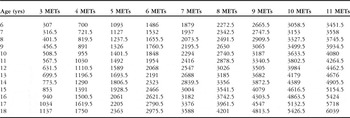
Activity intensity was defined with the following metabolic equivalents: moderate-intensity physical activity was 4.0–6.9 metabolic equivalents and vigorous-intensity physical activity was greater than or equal to 7 metabolic equivalents.Reference Wickel and Eisenmann19 Sedentary behaviour was defined by any activity count being less than or equal to 50 counts per 30-second period. Each 30-second count was categorised into the age-appropriate intensity level derived from a metabolic equivalent prediction equation and was then summed to get the total daily time spent in moderate-intensity physical activity and in vigorous-intensity physical activity.Reference Trost, Pate and Sallis21, Reference Freedson, Pober and Janz22 To accommodate for the 30-second epoch length, count thresholds were divided by 2. Table 1 displays the age-appropriate activity count thresholds in counts per 30-second period. In addition, average daily physical activity, moderate-intensity physical activity, vigorous-intensity physical activity, and sedentary behaviour were calculated for the weekdays and weekend days.
Activity count intensity thresholdsFootnote * (counts per 30 seconds).

* Count thresholds were derived from the following regression equation by Trost et al., 2002Reference Trost, Pate and Sallis21: METs = 2.757 + (0.0015 × counts/min) − (0.0896 × age [yrs]) − (0.000038 × counts/min × age)
Statistical analysis
Demographic variables of the two groups, that is, children with and without a congenital heart defect, were compared using t-tests, and are displayed as means and standard deviations. A paired samples t-test was used to assess differences in total daily physical activity levels (average counts per 30-second period), sedentary behaviour, moderate-intensity physical activity, and vigorous-intensity physical activity between the entire sample of grade-in-school and gender-matched children with and without a congenital heart defect. Further analyses using paired samples t-tests were performed to determine whether total physical activity, moderate-intensity physical activity, vigorous-intensity physical activity, and sedentary behaviour differ between the two study groups during the weekdays and the weekend. Effect sizes were calculated for each variable, while utilising an effect size index of: small (d = 0.20); medium (d = 0.50); and large (d = 0.80).Reference Cohen23, Reference Cohen24
Results
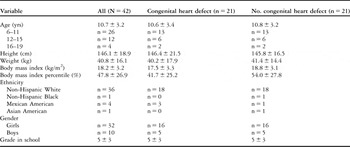
A total of 60 children were recruited and provided assent to participate in the study; this included 31 participants with a congenital heart defect and 29 participants without a congenital heart defect. Of the 60 volunteers, 48 children – that is, 23 participants with a congenital heart defect and 25 participants without a congenital heart defect – met inclusion criteria and successfully completed the study. Out of those 48 children, 42 children were matched by gender and grade in school, and were therefore included in the analyses. Participants ranged in age from 6.6 to 17.1 years and were in grades 1 to 11. The study sample comprised mostly of girls, that is, 76%, and was primarily classified as non-Hispanic White, that is, 86%. Almost three-fourths of the sample was at, or below, the 50th percentile for body mass index-for-age. No significant differences were found in the descriptive variables between children with and without a congenital heart defect. Table 2 displays the descriptive characteristics for participants.
Participant characteristics (mean ± standard deviation).

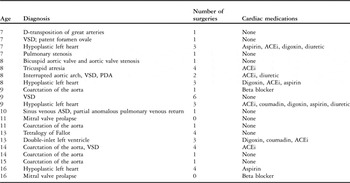
Table 3 shows the clinical characteristics of the participants with a congenital heart defect and their pharmacologic management at the time of the study. Coarctation of the aorta and hypoplastic left heart were the two most common cardiac defects in this participant pool. Of the 21 children with a congenital heart defect, 19 had a history of cardiac surgery, with 10 children having undergone more than one surgery. Of the 21 children with a congenital heart defect, 11 were taking medication(s) for their cardiac defect. Both children with cyanotic and acyanotic defects were taking medication.
Clinical characteristics of children with a congenital heart defect (n = 21).

ACEi = angiotension-converting enzyme inhibitor; ASD = atrial septal defect; PDA = patent ductus arteriosus; VSD = ventricular septal defect
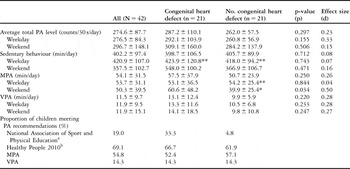
Table 4 presents accelerometer-based motion sensor data. Participants wore the motion sensor for an average of 782.4 minutes per day – 13 hours per day – and 6 days per week. The paired samples t-tests revealed no difference in total physical activity levels between children with a congenital heart defect and children without a congenital heart defect (t(20) = 1.07, p = 0.297, d = 0.23; Table 4). Physical activity level did not differ between the two study groups for weekdays (t(20) = 1.478, p = 0.155) or weekend days (t(20) = 0.68, p = 0.506).
Physical activity characteristics of children with and without a congenital heart defect (mean ± standard deviation).

MPA = moderate-intensity physical activity; PA = physical activity; VPA = vigorous-intensity physical activity
p-values and effect sizes represent differences between children with and without congenital heart defect
aPhysical activity recommendation: 60 minutes of age-appropriate PA on all days of the week or participants who engaged in 60 minutes of PA each day the accelerometer-based motion sensor was worn12
bPhysical activity recommendation: engage in MPA for 30 minutes per day, 5 or more days a week or VPA for 20 minutes per day, 3 or more days a week34
*p < 0.05, significantly different than congenital heart defect; **p < 0.05, significantly different than weekend days
On average, participants spent 6.7 hours of the 13 monitored hours, or 52% of monitored time, in sedentary behaviour. No differences were found in the amount of time spent in sedentary behaviour between children with and without a congenital heart defect (t(20) = −0.374, p = 0.712, d = 0.08; Table 4). Examination of physical activity during the weekdays and weekend days showed no difference between the two study groups during either portion of the week (weekdays: t(20) = 0.332, p = 0.743, d = 0.07; weekend days: t(20) = −0.735, p = 0.471, d = 0.16). Both study groups spent less time in sedentary behaviour during the weekend days when compared with weekdays. Children with a congenital heart defect spent 75.9 (standard deviation: 66.9) more minutes in sedentary behaviour during the weekdays compared with the weekend days (t(20) = −5.197, p < 0.001, d = 1.16). Children without a congenital heart defect spent 51.1 (standard deviation: 83) additional minutes in sedentary behaviour during the weekdays (t(20) = −2.185, p = 0.011, d = 0.49) when compared with weekend days.
Participants spent 6.9% of monitor wear time, or just less than 1 hour, in moderate-intensity physical activity. No differences were found for time spent in moderate-intensity physical activity between children with and without congenital heart defect (t(20) = 1.185, p = 0.250, d = 0.26; Table 4). Participants with and without a congenital heart defect engaged in similar amounts of moderate-intensity physical activity during the weekdays (t(20) = −0.200, p = 0.844, d = 0.04; Table 4), but children with a congenital heart defect engaged in significantly more moderate-intensity physical activity during the weekend days compared with children without a congenital heart defect (t(20) = 2.269, p = .034, d = 0.50; Table 4).
Participants spent 11.5 (standard deviation: 9.7) minutes per day in vigorous-intensity physical activity. No difference was seen in time spent in vigorous-intensity physical activity between children with and without a congenital heart defect (t(20) = 1.266, p = 0.220, d = 0.28; Table 4). Examination of time spent in vigorous-intensity physical activity during weekdays and weekend days revealed no differences for either period between the two study groups (weekdays: t(20) = 1.230, p = 0.233, d = 0.28; weekend days: t(20) = 1.192, p = 0.247, d = 0.27; Table 4).
Discussion
Physical activity plays an important role in the growth and development of childrenReference Saris25 and has been associated with both physicalReference Katzmarzyk, Malina and Bouchard26 and mental health benefits.Reference Parfitt and Eston10 These benefits may be particularly important for children who are born with a congenital heart defect, who have been shown to have a reduced exercise toleranceReference Karsdorp, Everaerd, Kindt and Mulder2–Reference Fredriksen, Ingjer, Nystad and Thaulow4 and an increased risk for anxiety and depression.Reference Karsdorp, Everaerd, Kindt and Mulder2 Before health benefits of physical activity can be explored for this population, a description of habitual physical activity in children with a congenital heart defect needs to be evaluated. To date, there is a paucity of research examining the physical activity level of this population. With the few studies conducted, none have described the intensity, duration, and frequency of the activities in which children with a congenital heart defect engage. Therefore, the aim of this study was to objectively evaluate and describe physical activity levels of children with a congenital heart defect and compare those levels with children who do not have a congenital heart defect. This investigation suggests that similarities exist in total daily physical activity levels, time spent in moderate-intensity physical activity, vigorous-intensity physical activity, and sedentary behaviour between children with and without a congenital heart defect.
Although it has been hypothesised that children with a congenital heart defect participate in less physical activity,Reference Fredriksen, Ingjer, Nystad and Thaulow4 previous research has reported similar physical activity levels between children with and without a congenital heart defect.Reference Lunt, Briffa, Briffa and Ramsay27 Few studies have used objective measurement for physical activity; however, none have reported total physical activity levels, that is, counts per day or counts per 30 seconds per day, making direct comparisons between the current study and past studies difficult.Reference Massin, Hovels-Gurich and Seghaye5, Reference Fredriksen, Ingjer and Thaulow28, Reference McCrindle, Williams and Mital29 Similarities exist between the current investigation and past studies, showing no difference in the quantity of physical activity between children with and without a congenital heart defect. Similarities in physical activity levels between children with and without a congenital heart defect in this study may be due to the inclusion of a large number of girls (n = 32). Unlike boys, previous studies show that girls with a congenital heart defect often have similar physical activity levels to that of girls without a congenital heart defect.Reference Lunt, Briffa, Briffa and Ramsay27, Reference Fredriksen, Ingjer and Thaulow28 In one particular study, Fredriksen et al (2000) demonstrated that boys, in the age group of 11–16 years, with a congenital heart defect had significantly lower physical activity levels than boys without a congenital heart defect.Reference Fredriksen, Ingjer and Thaulow28
Owing to the increasing awareness of the benefits of physical activity, as well as the increasing prevalence of sedentary behaviours in children, physical activity guidelines have been established. These recommendations/guidelines for children are based on the quality of physical activity, recommending that children engage in 60 minutes of moderate-intensity physical activity and/or vigorous-intensity physical activity per day to obtain health benefits.12 On average, all participants of this study spent 54.1 minutes per day engaging in moderate-intensity physical activity and 11.5 minutes per day engaging in vigorous-intensity physical activity; however, only 19% of all participants met the recommended levels. Unlike previous research, the current study found that children with and without a congenital heart defect were participating in similar amount of moderate- and vigorous-intensity physical activity. McCrindle et alReference McCrindle, Williams and Mital29 found that children, in the age group of 6–18 years, who had undergone a Fontan surgery at least 6 months before initial study testing were spending less time in moderate-intensity physical activity, vigorous-intensity physical activity, and moderate- to vigorous-intensity physical activity when compared with “healthy” children from a previously published study.Reference McCrindle, Williams and Mital29, Reference Pate, Freedson and Sallis30 Although the specific amount of time was not reported, the authors reported that these values fell at, or below, the 5th percentile (moderate- to vigorous-intensity physical activity: 2–158 minutes per day; vigorous-intensity physical activity: 0–9 minutes per day) of reference values, depending on gender and age.Reference McCrindle, Williams and Mital29, Reference Pate, Freedson and Sallis30 Results from the current study showed that physical activity levels of children with a congenital heart defect also fell at, or below, the 5th percentile of moderate- to vigorous-intensity physical activity participationReference McCrindle, Williams and Mital29, Reference Pate, Freedson and Sallis30 – moderate- to vigorous-intensity physical activity with a range from 4.4 to 146.3 minutes per day (data not shown) – meaning that participants in the current study are engaging in moderate- to vigorous-intensity physical activity levels similar to that of other children with a congenital heart defect. However, with regard to vigorous-intensity physical activity, participants with a congenital heart defect in this study were slightly more active than children with a congenital heart defect in previously published literature. On an average, children with a congenital heart defect in this study spent 13.1 (standard deviation: 12.4) minutes per day with a range from 0.4 to 49.6 minutes per day in vigorous-intensity physical activity, whereas children with congenital heart defect in a previously published study engaged in 2–9 minutes per day of vigorous-intensity physical activity, with 75% of their participants engaging in less than 3 minutes per day of vigorous-intensity physical activity.Reference McCrindle, Williams and Mital29 When comparing the results from these two studies, the range of defects included in each study should be considered. McCrindle et alReference McCrindle, Williams and Mital29 examined only children who had undergone a Fontan procedure, implying that the children had a cyanotic defect. In the current study, children with all defects, excluding the most severe, were included. Many physicians and researchers hypothesise that the severity of the defect will impact physical activity level, with those individuals having a more severe defect engaging in less physical activity. Children who have a cyanotic defect may not be able to perform or sustain vigorous-intensity physical activity, and their physician may deter them from performing vigorous-intensity physical activity. Further research in this area is warranted.
This study is unique in its design and methodology and therefore offers insight that others studies have not. The use of a shortened epoch period (30 seconds) allowed for a better representation of the sporadic nature of children's movements and a more accurate assessment of moderate-intensity physical activity and vigorous-intensity physical activity in children compared with the classic 1-minute epoch, which tended to underestimate moderate-intensity physical activity.Reference Baquet, Stratton, Van Praagh and Berthoin31 In addition, moderate-intensity physical activity was defined as a metabolic equivalent of 4–6.9 and vigorous-intensity physical activity was defined as equal to, or above, 7 metabolic equivalents,Reference Pate, Freedson and Sallis30 providing a more accurate estimate of resting metabolism in children.Reference Treuth, Schmitz and Catellier32
Sedentary behaviour, or inactivity, has been identified by the Center for Disease Control as a coronary artery disease risk factor and as a health-risk behaviour that is associated with morbidity and mortality in children and young adults.Reference Eaton, Kann and Kinchen33 It also has been associated with poor physical and mental health in children.Reference Parfitt and Eston10 Thus, measuring sedentary behaviour is imperative to begin evaluating and understanding associations with health benefits. This was the first study to measure the amount of time spent in sedentary behaviour by children with congenital heart defect. Participants in this study were sedentary for 6 hours and 42 minutes per day of the 13 hours, or 52%, of the time they wore the monitor. There was no difference in the amount of time spent in sedentary behaviour between children with and without congenital heart defect. The amount of time spent in sedentary behaviour was strikingly similar, with children without congenital heart defect spending only 7 minutes more than children with congenital heart defect. Results from this study are consistent with results from Matthews et alReference Matthews, Chen and Freedson15 who reported that healthy children in the United States spend about 6–8 hours per day in sedentary behaviour, depending on gender and age.Reference Matthews, Chen and Freedson15 It is important to note that children spend a large portion of their weekday in school. Both children with and without congenital heart defect had engaged in sedentary behaviour for approximately 1 hour less during the weekend days when compared with the weekdays.
Similar to all studies, this study is not without limitations. The study sample was heavily populated with girls and with children under the age of 11 years. Thus, it made it difficult to make comparisons within the different age groups and also between genders. Although boys and older children were underrepresented in this study, age and gender matching was used to allow for more rigorous comparison between children with and without a congenital heart defect than seen in previous studies.
To our knowledge, this is the first study to show no difference in objectively measured total physical activity between children with and without congenital heart defect, supporting previous research using subjective physical activity assessment tools. Very few participants (19%) in either group accumulated sufficient physical activity to meet the current physical activity recommendation for children and adolescents. In those subjects with a congenital heart defect, the severity of the defect did not appear to impact physical activity level. This investigation provides insight into the physical activity behaviour of children with a congenital heart defect. Children with a congenital heart defect have activity behaviours that are similar to children without a congenital heart defect. Future studies are needed in order to evaluate why children with and without a congenital heart defect are not meeting current physical activity recommendations. These studies should emphasise the specific amounts and intensities of physical activity required to provide optimal health benefits. It is thought that if children can develop strong physical activity patterns early in life, then their risk for developing certain chronic diseases later in life can be decreased. Thus, habitual physical activity in children with a congenital heart defect should be encouraged early on in life in order to protect them from additional co-morbidities.
Acknowledgement
This work was partially supported by a Student Research Grant from the College of Health Sciences, University of Wisconsin-Milwaukee.