




No CrossRef data available.
Financial Intermediation in the Early Roman Empire
Published online by Cambridge University Press: 01 September 2004
Abstract
I evaluate the effectiveness of financial markets in the early Roman Empire in this article. I review the theory of financial intermediation to describe a hierarchy of financial sources and survey briefly the history of financial intermediation in eighteenth-century Western Europe to provide a standard against which to evaluate the Roman evidence. I then describe the nature of financial arrangements in the early Roman Empire in terms of this hierarchy. This exercise reveals the extent to which the Roman economy resembled more recent societies and sheds light on the prospects for economic growth in the Roman Empire.
Information
- Type
- ARTICLES
- Information
- Copyright
- © 2004 The Economic History Association
In this article I use a theoretical hierarchy of financial sources to evaluate the effectiveness of the financial markets in the early Roman Empire. The goal of this exercise is two-fold. First, it reveals the extent to which the Roman economy resembled more recent societies. No ancient historian claims that the Romans operated in a twentieth-century mode, but most of the financial institutions that we take for granted today are less than two centuries old. More relevant is how the Roman financial system compares with the advanced agrarian economies of the eighteenth century. Second, this exploration sheds light on the prospects for economic growth in the Roman Empire. Good financial markets and institutions help people who have ideas for production get resources to implement those ideas. Empirical investigations of recent economic growth have exposed a clear connection between financial institutions and economic growth; without these markets and institutions, the prospects for economic progress appear far more limited.1
King and Levine, “Finance and Growth”; Levine, “Financial Development”; Rajan and Zingales, “Financial Dependence”; and Rousseau and Sylla, “Financial Systems.”
Greene, “Technological Innovation”; Mattingly and Salmon, Economies; and Wilson, “Machines.”
In order to evaluate the sophistication of the Roman financial market, we need to know if there were credit intermediaries, that is, institutions that mediate between borrowers and lenders, obviating direct contact between them. The most popular credit intermediaries in many societies are banks, and we are fortunate that ancient historians and modern economists employ the same definition of a bank. Edward Cohen opened his discussion of Athenian banking by quoting the legal definition in use in the United States today. This same definition can be found in a recent textbook on financial markets and institutions, which states: “Banks are financial institutions that accept deposits and make loans.” The text explains that, “Banks obtain funds by borrowing and by issuing other liabilities as deposits. They then use these funds to acquire assets such as securities and loans.”3
Cohen, Athenian Economy, p. 9; and Mishkin, Financial Markets, pp. 8, 322–23.
This definition has been used by ancient historians investigating the financial markets. Raymond Bogaert defined banks, typically individual bankers identified as trapezitai or argentarii, as accepting deposits and making loans. Jean Andreau expanded this definition slightly by adding a third function: “Banking is a commercial business involving receiving deposits from clients to whom the banker provides cashier services and lends available funds to third parties with whom the bank acts as a creditor.”4
Bogaert, Banques; and Andreau, La vie financière, p. 17.
Andreau in The Cambridge Ancient History minimized the role of ancient banks, asking and answering, “Should the ancient bank be compared to that of the nineteenth century, or even to that of the eighteenth? If the question is put this way, then the reply is clearly negative.”5
Andreau, “Commerce,” pp. 775–76.
Loans between individuals are an important part of any financial system, but they do not by themselves show the existence of a sophisticated web of financial transactions. For example, the presence of interest-bearing loans informs us only about one way of raising funds for someone seeking to start or expand a business activity. Money from family and friends has been a resource throughout the ages, whereas selling equities (stocks) has become frequent only in the twentieth century. Financial analysts organize the variety of ways to raise money by recognizing a hierarchy of financial sources of business activities.
In the body of the article, I first review the theory of financial intermediation to describe the hierarchy of financial sources and its relation to the functioning of the economy as a whole. This provides an abstract evaluation of the Roman evidence, but not a historical one. I then survey briefly the history of financial intermediation in pre-industrial western Europe to provide a standard against which to evaluate the Roman evidence. Finally, I describe the nature of financial arrangements in the early Roman Empire in terms of this hierarchy. The issue turns out to be not whether financial markets in Rome resembled those in other advanced agricultural economies, but rather which eighteenth century European economy did it resemble most closely.6
I choose to compare Roman financial conditions with those of economies on the eve of industrialization, rather than to search through institutions of the Renaissance and early modern period for financial institutions that resemble Roman ones. (See Van der Wee, “Monetary, Credit and Banking Systems,” for a survey.) My aim is to compare economies, not isolated institutions.
A HIERARCHY OF FINANCIAL INTERMEDIATION
“Financial systems facilitate pooling, or the aggregation of household wealth, to fund indivisible or efficient-scale enterprises.” This is the opening sentence of an essay on the pooling of resources in a Harvard Business School volume about the functions of a financial system today. The authors go on to explain, “Without pooling aggregate wealth to fund enterprises, firm size would be constrained by the wealth under the control of a single household. Pooling relieves society of this limitation, bridging firms' capital needs and households' investing needs.”7
Sirri and Tufano, “Economics of Pooling,” pp. 81, 88.
The economic problem of funding economic activity was raised to prominence by John Maynard Keynes when he observed that in industrial systems, savers were not necessarily investors. One group of people had accumulated resources by not consuming all their income, or by being the children of people who had been abstemious. Another group had ideas, projects, or business enterprises for which they needed resources. The problem of a capitalist system was to bring them together. In Keynesian economics, mass unemployment is the result of an aggregate mismatch between the amount that savers want to save and investors want to invest. Although macroeconomics has progressed speedily since Keynes wrote in the 1930s, this insight has remained central to policy planning in industrial societies.
We do not observe Keynesian unemployment in mostly agricultural societies because large savers typically are large investors. Large land-owners often have incomes that exceed even their large consumption, and they have projects of land improvement or transport enhancement that can absorb the extra resources. There is no need for financial intermediation in such a system because there is no need to intermediate between distinct savers and investors. Of course, there may be mismatches between savers and investors in such an economy, if a landlord is particularly profligate in his consumption or if a poor landowner sits on a bend in the river where canalization would make transport easier. These mismatches would not lead to Keynesian unemployment; they would make the economy function less efficiently than if a financial system could eliminate or reduce the mismatches.
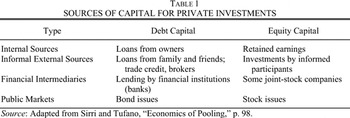
Most economic organizations in history operated somewhere between the conditions of modern life and this purely agrarian case. In order to assess the financial systems of historical economies, we need an index of financial sophistication that we can use to evaluate any specific society. A suitable measure can be constructed from modern discussions of the sources of capital for modern businesses, as summarized in Table 1. The table lists a hierarchy of sources of capital for investment in the first column. The second and third columns distinguish sources by the type of the obligations between the parties involved. Debt capital consists of loans, where the lender gets the assurance of a known rate of return, and the borrower has the right to keep any earnings over the cost of his loans. Equity capital participates in the ownership of the investment. The investor shares the risk of the operator who is doing the work, and he has the possibility of earning far more than a lender—and also of earning less.8
Borrowers and lenders were primarily, but not exclusively, men in the pre-industrial world.

The entries in the first row of Table 1 list the sources of capital for autarkic farms or businesses. They find their resources within the organization, that is, from internal sources. The owners of the farm or business can lend money among themselves for individual projects or they can share the results of their joint earnings from old investments to take shares in new projects. In each case resources are found within the enterprise to make an investment; the difference is in the allocation of risk and reward among the people involved. This source of capital is still used today, even in our sophisticated economy. Businesses today are hardly autarkic, but they often find that internally generated resources are cheaper than those obtained through one of the other types. Retained earnings are an important source of capital even for very large firms.9
Froot, “Incentive Problems,” discussed the distortions that can arise today from using a combination of cheap internal funds and more expensive external capital.
The informal external sources of capital described in the second row are those used in societies without highly developed financial systems, although they also are used today as components of a finely tuned and articulated financial system. This source anticipates getting capital from outside the farm or firm desiring to make an investment, but still within the circle of family and friends of the owners. Owners can borrow from their relatives and friends because they are known to their relatives and friends. If a person borrows from a member of his local or religious community, he is far more likely to repay the loan than he would be to a stranger, particularly if the legal system is not very good at finding and punishing people who renege on their financial obligations.10
Mathias, “Minorities.”
This asymmetric knowledge can lead to the market failure due to “lemons” first analyzed by Akerlof, “Market for Lemons,” and extended to finance by Stiglitz and Weiss, “Credit Rationing.”
There are two institutions in which this problem of asymmetric information can be attenuated. Merchants are engaged in many repetitive transactions with each other, during which they are able to gather information about each other. The merchant who pays his bills on time quite possibly is the one who will repay a loan on time. A responsible merchant gains a reputation for honoring his obligations, and a good reputation may substitute for a family connection or personal friendship in providing enough assurance to a lender to justify making a loan.12
Greif, “Cultural Beliefs.”
Brokers try to overcome the problems of symmetric information—finding a lender if you are a potential borrower, or a borrower if you are a potential lender—and the problems of asymmetric knowledge that derive from the opaqueness of strangers.
The same problems of information arise when investors contemplate sharing the risk with strangers, that is, raising equity capital instead of debt capital. The problems are more severe for equity than for debt because the equity purchaser assumes more risk than the lender. People therefore typically only make equity investments with people that they know. Neither reputations nor brokers are strong enough to overcome the problems of asymmetric information when equity investment is involved. In an economy where there are few financial intermediaries, we expect to find more loan activity than equity investments.
The entries in the third row of Table 1 introduce financial intermediaries and pooling institutions for the first time. Financial intermediaries collect funds from people with resources they have saved, pool them together into a single fund, and then make loans from this pooled fund of resources. Individuals lend money to banks by depositing money in them, and the banks then lend their accumulated funds to other individuals. There is no direct connection between the final borrowers and lenders; they communicate only with the financial intermediary. The presence of this intermediary, which we can call a bank for its simplest manifestation, solves a lot of the information problems present in the conditions of the preceding row. The bank solves the problem of finding borrowers and lenders because they each know to go to the bank to place their excess purchasing power or to borrow. It also assumes the risk of not being paid back by a borrower. The lender need not worry, unless the bank operates with such bad judgment that it has so many failed loans that it fails itself. The bank has the responsibility for evaluating potential borrowers, and banks typically develop expertise or staffs to make these kinds of decisions.
Banks reduce the risks from asymmetric information, but they cannot eliminate them entirely. The same restriction to known groups seen in informal lending appears among banks. Merchant banks, to cite an important example, loaned to the merchant community. They relied on the expectation of continued patronage and the ease of communication within the merchant community the same way informal lenders did. Banks in rural New England in the early nineteenth century loaned within their local communities, and even their own families, for similar reasons.14
Neal, Rise; and Lamoreaux, Insider Lending.
Financial intermediaries that provide equity investments are harder to characterize than banks. In the modern world, intermediaries that provide equity capital on an individual basis are known as venture capitalists. In earlier economies, some joint-stock companies acted in this way. They served as financial intermediaries if they engaged in varied activities, that is, if they used their resources to fund several activities and groups. Savers bought shares of these companies to participate in the average fortunes of these ventures. They were not making a bank deposit with its sure, albeit limited, return; they were participating in the equity of the joint-stock company to grow rich or poor as the company's investments did. Joint-stock companies that sent out expeditions and made other investments from the pool of resources raised by selling shares were financial intermediaries. (Joint-stock companies that used their resources to fund a single group performing a single activity used stocks to pool resources, but they were not financial intermediaries.) We think of early joint-stock companies in terms of their activities in various parts of the world, but some of them were financial intermediaries and precursors of modern conglomerate firms.
The modern type of capital raised in public markets by large companies today is shown in the final row of Table 1. These companies are large enough and the information about them is plentiful enough that there are public markets in which people can lend to them by purchasing their bonds or participate in their activities by purchasing stocks. There is no need for financial intermediaries at this stage.15
Of course, the public information may not be accurate, as the recent failures of Enron and other large corporations makes clear. It is not yet clear how a modern economy deals with this problem, much less an ancient one.
Even today, however, most companies are too small to go to the open market for their capital. They start with internal and informal external sources of capital; they progress to the use of public markets only if they are very successful. They may have the form of joint-stock companies early in their history, but only after they are known outside a small circle can they “go public” and sell shares on the open market. The types of capital sources shown in the rows in Table 1 can be seen as a progression of funding sources for a modern enterprise that starts with capital from an individual or a family and progresses through the types of sources shown in the table to arrive finally at the New York Stock Exchange or the NASDAQ Market. Although it is not necessary for all companies to go through all these stages, the progression shows an idealized history of modern firms. In the modern world, we expect to see all types of capital co-existing.16
Calomiris, “Costs.”
We can use the same progression as a measure of financial sophistication of economies from the past. If only the first type of capital, internal sources, is available to people who want to engage in economic activity, then that economy should be described as lacking a financial system at all. If informal external sources also are available, then the economy has a limited financial system. If financial intermediation is available, an economy has a very good financial system, adequate to finance many activities, certainly any activity of the pre-industrial world. And the presence of public capital markets indicates the kind of modern financial system that we find in advanced industrial countries.17
Public capital markets are more important in Anglo-Saxon economies than in many others. There is no unique constellation of financial institutions in industrial economies.
EARLY MODERN FINANCIAL INTERMEDIARIES
In order to evaluate the capital markets of Rome, we need a standard of comparison. In this section, I briefly survey the capital markets of early modern Europe to provide a relevant standard. The most advanced capital markets were in Amsterdam and London, and the most common way that credit was extended there was by book credit on the part of a merchant. The merchant loaned money to his purchasers by not requiring payment immediately. He loaned money to his suppliers by paying them quickly or in advance for goods he received. There was no intermediation; the merchant had excess resources that he loaned to others. The bill obligatory or promissory note was a more formal form of credit. This was a way for prominent merchants and individuals to borrow on their good names. A bill obligatory could be sold to a third person in England, but it did not travel far because it had to come back to the borrower for payment. The original bill obligatory did not need intermediation; it was a simple loan. If a third party bought a bill, there was simple intermediation but still individual placement of loans.
More extensive credit intermediation was accomplished through bills of exchange in the course of international trade. Bills of exchange were a way of financing trade by arranging for payment at a distance and a later time. Sellers like to be paid when and where the goods are shipped from, while buyers like to pay when the goods are sold and at their eventual destination. The bill of exchange was a way to deal with the ownership of the goods in the gap between these two events, which could easily be three months or more in time and across an ocean in space. A seller drew a bill on a buyer who accepted the obligation in the bill. The accepted bill could be sold to a third party.
The sale of accepted bills was a form of financial intermediation; merchants or others who bought bills were extending credit indirectly. The presence of a uniform credit instrument allowed people who had resources to lend to find people who wanted to borrow. The use of multiple signatures on the accepted bills reduced the need for the lender to know all about the credit-worthiness of the borrower. The drawer and the acceptor both stood behind the bill, as did other people who had purchased it on its way to the eventual holder. Because bills could be bought and sold, because they were assignable, they facilitated credit intermediation.18
Neal, Rise, and “Finance.”
Inland bills of exchange were used to finance trade within England. They were given the same legal standing as foreign bills at the start of the eighteenth century. An inland bill could be drawn and made payable in the same place, making the provision of credit much simpler. In fact, it could circulate in a local area where potential purchasers of the bill knew the people involved in its origins. After 1765, it could even be made payable to bearer, making it suitable for use as money.
These are all short-term debt instruments, typically for three months. Longer loans could be secured by rolling over these bills, and often were. The English and French governments both found themselves with a lot of existing debt at the start of the eighteenth century from their wars in the previous century. They experimented with schemes to reduce the burden of these debts under the influence of the notorious John Law, and experienced financial panics around 1720. The English government retreated into offering 3-percent perpetual bonds, that is, loans that never came due. These bonds were collected into the Three Per Cent Consol—for consolidated loan—in 1751. Consols became in time the safest and most liquid (that is, saleable on short notice) financial assets available for potential lenders.
There were several kinds of financial institutions in eighteenth-century England, mostly specialized to a particular kind of credit. Goldsmiths and scriveners, who performed research into land titles, had begun to accept deposits in the seventeenth century on which they paid interest, suggesting that the funds were loaned out. Merchant banks, which loaned both to the government and to merchants, grew during the eighteenth century. They “accepted from merchants and large landowners deposits on both current account and on term; they lent money at interest by opening credit on current account or by advances, and discounted inland or outland bills and various official securities.”19
Van der Wee, “Monetary, Credit and Banking Systems,” p. 351.
Private banking began slowly in the early years of the eighteenth century, and the number of banks grew over the century. These banks, located in the west end of London, were quite distinct from bankers lending to the tight community of merchants, and they had to learn the craft of banking anew. They loaned to a wider class of people, but they also retained some archaic practices, for example, charging simple interest for their loans and making almost all loans at the fixed 5-percent usury rate, limiting their ability to differentiate among potential borrowers.20
Joslin, “London Private Bankers”; Capie, “Origin,” p. 46; Quinn, “Glorious Revolution's Effect”; and Temin and Voth, “Banking.”
England in the eighteenth century, therefore, had a variety of financial intermediaries from which aspiring borrowers could choose. They however lacked a complete means of payment deriving from the actions of these intermediaries. The Bank of England issued notes of ten pounds or more, and the Exchequer issued bills of five and ten pounds, but these notes and bills did not operate well for small purchases or outside London. There was a shortage of currency, and “traders and industrialists all over the country issued their own tokens and their own notes.”21
Pressnell, Country Banking, p. 16. See also Selgin, “Steam,” and sources cited there for the “big problem of small change” in eighteenth-century Britain.
Joint-stock companies multiplied and grew during the seventeenth century. The financial bubble and collapse in 1720 led to restrictions on these companies, and they did not grow much if at all in the eighteenth century. Joint-stock companies clearly pooled resources, and they facilitated equity investments by informed participants, as described in the second row of Table 1. Some joint-stock companies engaged in a variety of activities, subcontracting their operations to many smaller operations. They were financial intermediaries, as described in the third row of Table 1. It is, however, hard to see in the surviving records how these companies were administered. Modern accounts discuss the operations of the companies as if they were administering their activities from London, implying that they were pooling funds but not acting as financial intermediaries.22
Scott, Constitution.
Joint-stock companies played another, possibly even more important, part in credit intermediation as well. Their shares could be used as collateral for bank loans. This began in Holland in the early seventeenth century, using shares from the Dutch East India Company (VOC) and spread to England. By the time of the South Sea bubble in 1720, it was common for borrowers to pledge stocks as securities for bank loans.23
Gelderblom and Jonker, “Completing a Financial Revolution”; and Temin and Voth, “Banking.”
The Dutch financial market was more developed in the seventeenth century than the English, and the English borrowed institutions and practices from it at the end of the century. Dutch financial institutions did not develop as fast as the English ones in the eighteenth century, but they already had achieved an impressive level. There were extensive merchant banks, dealing primarily with trade, as well as abundant private shares and government debt that changed during the eighteenth century from named to bearer bonds. There were many loans among individuals secured by public and private stocks, but few institutions such as banks that pooled funds. Cashiers or kassiers provided transfers of funds, but never developed into banking institutions.24
Riley, International Government, p. 31; and de Vries and van der Woude, First Modern Economy, p. 132.
Dehing and Hart, “Linking,” p. 47.
The French credit market in the eighteenth century appears to have been more limited than the English or Dutch. Inland bills never became legal instruments and could not circulate. Bills of exchange were allowed only when currency exchange was involved, and the credit market for merchants could not spill over into more general credit provision as it did in England. Interest rates were fixed by law and did not vary. Joint-stock companies were exceedingly rare. Payments typically were made in coin; there was little paper money. The French fiscal system was based on farmed taxes that did not raise enough revenue to make government debt secure. Frequent defaults by the French government did not encourage the growth of private finance.26
North and Weingast, “Constitutions.”
Short-term domestic loans were made with the French version of the bill obligatory, an unsecured note backed by the reputation of the borrower. Longer credits were arranged through notaries who recorded them for legal reasons and preserved the records in order to provide credit histories of borrowers. There were exactly 113 notaries in Paris throughout the eighteenth century. This number is more than sufficient to create a credit market, but probably not enough to make credit available throughout the economy. They were not banks that separated the acquisition and disbursement of funds in deposits and loans, providing intermediation where borrowers need not borrow for the same period that lenders want to lend. Notaries were brokers who brought borrowers and lenders together.27
Some Parisian notaries attempted to pool funds invested with them and act as banks around 1750, but they returned to being brokers in the 1760s after a wave of bankruptcies among the notaries. See Hoffman et al., Priceless Markets, pp. 136–45. There also were other banks in Paris, but they do not appear to have offered much competition to the notaries. The literatures on the notaries and the banks, however, have not yet been connected. See also White, “Paris Bourse.”
As in London, the rate of interest on loans in France did not vary. Usury laws restricted the maximum rate of interest that could be charged to 5 percent for the entire century (with a few short suspensions), and almost all loans arranged by Paris notaries were at this rate. A recent study of the Paris notaries describes the French credit market as a priceless market—meaning without variable prices rather than very expensive.28
Temin and Voth, “Banking”; and Hoffman et al., Priceless Markets.
One view of the French financial market comes through the eyes of Voltaire, who mentioned his financial dealings in his letters. The primitive state of the French financial markets can be seen in a 1737 letter from Voltaire to his agent in Paris, monsieur l'abbé Moussinot: “You can very safely place the 300 L. well packed into the stage coach without declaring them and without paying anything as long as the crate is correctly and duly registered to the address of Madame la Marquise, as precious furniture.”29
Voltaire Correspondance, vol. 1, lettre 872, p. 1004.
In fact, Voltaire was engaged in both lending and borrowing money, apparently making all the arrangements himself. He worked through a notary from time to time, but there is no sense that he could deposit money with the notary without specifying a specific use for it. This can be seen in his own summary of a complex set of instructions to his agent in January 1738, “The result of all this verbiage is that you would place twenty five thousand livres in life annuities at 5 percent and that you would try at your leisure to assure towards the month of April a loan of around 20 to 30 thousand livres to place by privilege on a land of 3000 livres tournois of rent. That would not, I think, be difficult.”30
Ibid., lettre 911, p. 1063. Voltaire expressed the interest rate on the annuity as au denier 20, literally “at one penny [interest for a loan of] 20.” This is not very different from the Roman shorthand for interest. See footnote 56.
Kindleberger, “Financial Institutions.”
Credit markets elsewhere in Europe were in the range of England and France. The Dutch credit market was the most sophisticated in the seventeenth century, but it lagged behind the English market in the eighteenth. Merchants in what would become Germany and Italy had access to ample credit intermediation, but ordinary residents probably had more trouble than Voltaire moving and lending money. Joint-stock companies and stable government securities also were confined to England, France, and Holland.32
England's American colonies participated to a limited extent in the credit markets of England. Colonial merchants were connected with their fellows from London and Liverpool, but mercantile credit had little impact on other investments.
These historical observations can be summarized with the aid of Table 1. Investors in England in the eighteenth century could make use of internal sources, informal external sources, and financial intermediation, that is, the sources of capital in the first three rows of the table. There were banks, at least in London, and a few joint-stock companies. Some investors in Holland had the same opportunities, but not all. French investors by and large were restricted to the sources listed in the top two rows; they did not have access to financial intermediaries. Potential investors in other countries were like France, although perhaps even more dependent on the internal sources listed in the first row. Only England had a good all-purpose financial system; other countries had only limited ones.
ROMAN FINANCIAL INTERMEDIATION
It is clear from the literature that Rome had a financial system that included internal and informal external sources of capital. This by itself is impressive, but still provides only limited support for economic endeavors. The question is whether Roman investors could make use of financial intermediaries, that is, whether the financial system of Rome was adequate to demands that might have been put upon it. Phrased differently, the question is whether or to what extent banks were present in the early Roman Empire.
To start with informal external sources of capital, we know that Romans loaned money to each other with great frequency.33
Kehoe, Investment, pp. 45–54.
Columella, On Agriculture, 3, 3, 7–11.
We also know of many loans made to finance trade. Merchants typically were at the center of European capital markets before the Industrial Revolution, and they appear to have been in antiquity as well. Cohen documented the extensive use of loans to finance maritime trade in classical Athens. Andreau argued that maritime loans were as extensive in Rome, albeit not as well documented. Dominic Rathbone identified the Muziris papyrus as the “master contract” for a standard maritime loan of the early Roman Empire. The careless grammar and syntax, the general sloppiness of the document, suggest a scribe copying the boilerplate of a standard contract. In other words, maritime loans were common enough in the early Roman Empire to have a standard form known to all the merchants and their clerks. This particular loan was for a shipment worth 6,926,852 sesterces, 20 times the size of Columella's hypothetical agricultural investment.35
Cohen, Athenian Economy; Andreau, Banking, pp. 54–56; Rathbone, “‘Muziris’ Papyrus.” To calibrate seven million sesterces, compare it with the property requirement of one million sesterces for a senator in the early Roman Empire.
The business nature of these loans indicates that they were extended to business associates, not to friends or relatives. We must presume that markets in ancient times were far from the anonymous markets of today; the land-owners and merchants were known at least by reputation by moneylenders. They constituted the kind of loose commercial groups known from other agricultural economies. They were numerous, and the loans were numerous enough for commentators to speak of a market rate of interest. That is, they could speak of the rate of interest separate from the rate on any particular loan, which has meaning only if it was possible for people to borrow at this rate more or less on demand. Cicero commented that “interest [rates] went up on the Ides of July from 1/3 to 1/2 percent [per month].” There was “a 60 per cent drop in interest-rates after Augustus brought back treasure from Egypt.” Providing a possible earlier example, Livy reported that in the peaceful consulship of Titus Manlius Torquatus and Gaius Plautius in the fourth century BCE, “the rate of interest was reduced [by the city] from one percent to one-half per cent [per month].”36
Cicero, Letters to Atticus, 4, 15, 7; Duncan-Jones, Economy, p. 21; and Livy, History, 7, 27, 3–4.
More often we see loans at 1 percent a month or 12 percent per year. This was the official maximum, and it appears to be the default rate on many loans. Bogaert catalogued dozens of loans in Roman Egypt for 12 percent.37
Bogaert, “Operations.”
Livy, History, 35, 7.
The inscription of a second-century Dacian loan says that the borrower will repay whomever is holding the loan when it comes due:
Julius Alexander, the lender, required a promise in good faith that the loan of 60 denarii of genuine and sound coin would be duly settled on the day he requested it. Alexander, son of Cariccious, the borrower, promised in good faith that it would be so settled, and declared that he had received the sixty denarii mentioned above, in cash, as a loan, and that he owed them. Julius Alexander required a promise in good faith that the interest on this principal from this day would be one percent per thirty days and would be paid to Julius Alexander or to whomever it might in the future concern. Alexander, son of Cariccius, promised in good faith that it would be so paid. Titius Primitius stood surety for the due and proper payment of the principal mentioned above and of the interest. Transacted at Alburnus Maior, October 20, in the consulship of Rusticus (his second consulship) and Aquilinus.39
Corpus inscriptionum latinarum (CIL) 3.934-35, reproduced in Shelton, As the Romans, pp. 136–37.
This contract exemplifies the assignability of loans assumed by Livy, although the assignment referred to here normally was done only if the lender was deceased or otherwise indisposed. This kind of loan sets up the possibility of wider negotiability, but we do not have any evidence that it happened.
Loans are one thing; banks are another. It is the difference between informal external sources of capital and credit intermediation in Table 1. Banks and related financial institutions were widespread in the early Roman Empire, as shown in many descriptions by many authors. There were banks in Greece before Rome came that continued in operation after the Roman conquest. The most famous banks were on Delos, where there were both temple and private banks. There appears to have been a constant number of private banks, suggesting that the banks continued to operate over time with great stability. The Temple of Apollo appeared to give loans with houses as security, what we now would regard as mortgages. There can be no doubt that these institutions were what we call commercial banks.40
Inscriptions de Delos; Frank, Economic Survey, vol. 4, p. 357; and Reger, “Private Property.”
Bogaert noted that some bank deposits in Roman Egypt had fixed terms. He argued that they were in reality loans disguised as deposits.41
Bogaert, “Operations,” p. 255.
Argentarii in Rome therefore received deposits and made loans. This has been recognized widely, although seldom unambiguously. Peter Garnsey and Richard Saller said, “the Principate saw no major developments in the Roman law of banking…. But texts of Antonine and Severan jurists recognize an investment account at a bank as a category of depositum and admit the payment of interest to the depositor.” This appears to be a clear statement of laws for banks, despite the dismissive tone of the first sentence.42
Andreau, La vie financière, p. 646; and Garnsey and Saller, Roman Empire, p. 55. Duncan-Jones analyzed the coinage of Rome in his monumental Money and Government in the Roman Empire. By treating the volume of coinage as the stock of money, he implicitly assumed the absence of bank deposits even though he described banks of different types in the course of his discussion.
Harris, “Between Archaic and Modern,” p. 21.
Andreau, La vie financière, pp. 538–44.
Lucius Caecilius Jucundus may be the most famous Roman banker, because the rapid burial of Pompeii preserved some of his transitory records. He received goods on consignment, made arrangements for their sale, paid merchants when goods were sold, and loaned money to purchasers. This was store credit, commonly extended by merchants in early modern times. But Jucundus was not a merchant, even though he acted on behalf of merchants. Where then did he get the capital to lend money to purchasers? We do not know; those records did not survive; there is only one tablet showing Jucundus holding a deposit. If he held deposits as other argentarii did, he was a banker.45
Andreau, Affaires; and Jongman, Economy, p. 222.
Only slightly less known, another group of tablets provides a window into the economic affairs of the Sulpicii, businessmen from Puteoli, in the middle of the first century. The tables provide direct evidence of commercial loans. They were not consumption loans, but credit extended to facilitate trade through the port of Puteoli. The Sulpicii obtained money to lend from the households—slaves and freedmen—of the Emperor and senators. One imperial slave loaned the Sulpicii 94,000 sesterces.46
Camodeca, L'Archivio, pp. 248–57.
Andreau, “Affaires financiers” and Banking, p. 75, argued that the Sulpicii were not argentarii, but a different kind of financial intermediary who loaned money. In the definition of a bank given previously, they were bankers who accepted what we call time deposits, that is, interest-bearing loans of fixed duration.
Josephus reported that debtors burned down the center of Antioch in the hopes of destroying debt records and thereby possibly evading the need to repay them. Although this is not direct evidence of banks, the story presupposes the existence of professional moneylenders in the center of Antioch who loaned to people known only through their explicit agreements. If these moneylenders held deposits, as opposed to being merchants or very rich, then there were banks in Antioch during the Jewish War.48
Josephus, Jewish War, 7, 56–62. Josephus told the story because the fire was blamed initially on the Jews. Only later were debtors found to be the real arsonists.
Cicero noted the interconnection of financial markets around the Roman world, describing conditions in 66 bce by reference to events 20 years earlier:
For, coinciding with the loss by many people of large fortunes in Asia, we know that there was a collapse of credit at Rome owing to suspension of payment. It is, indeed, impossible for many individuals in a single State to lose their property and fortunes without involving still greater numbers in their ruin. Do you defend the commonwealth from this danger; and believe me when I tell you—what you see for yourselves—that this system of credit and finance which operates at Rome, in the Forum, is bound up in, and depends on capital invested in Asia; the loss of the one inevitably undermines the other and causes its collapse.49
Cicero, Pro lege Manilian, 7, 19.
This passage clearly talks of linked financial markets. It is possible that all these connections were made by loans from one individual to another, but it would be unprecedented in the history of commerce. It is far more likely that Roman loans to Asia were done at least partly through financial intermediaries. Banks (argentarii) or joint-stock companies concerned with Mediterranean trade (societates publicanorum). Even when individuals transferred money between locations, they did not appear to have the problems Voltaire did.50
Ligt, “Tax Transfers.”
Banks would transmit information, and they of course would transfer money. Roman senators and even equestrians had investments all over; they needed some way to repatriate their earnings. They might have done so as did the Egyptian bank that reported in 155 CE: “Paid into the bank of Titus Flavius Eutychides by Eudaemon, son of Sarapion, and partners, overseers …for the rent of the 17th year, one talent and four thousand drachmae, on condition that an equivalent amount should be paid at Alexandria to the official in charge of the stemmata, total of 1 tal., 4000 dr.” This document attests not only to the existence of banks, but of either branch banks or interbank activity. This transfer might have been accomplished by the bank sending the money to its branch in Alexandria or by having a correspondent bank in Alexandria that was willing to honor obligations from the bank of Titus Flavius Eutychides, possibly because the Fayum bank held a balance in Alexandria for that purpose.51
P. Fayum 87 in Grenfell et al., Fayum Towns, pp. 220–22. Grenfell et al., opted for the latter choice speaking of “mutual arrangements” between the local and urban banks. The document does not say how the bank or banks charged for the service of transferring this large balance.
Tax farmers, publicani, often organized into joint-stock companies, societates publicanorum, transferred money by means of bank drafts. Taxes that were collected and not yet spent were the property of the government, and the societates of the publicani were obligated to pay interest for their interim use. The Senate, however, allowed the tax farmers to keep the interest, perhaps as payment for the banking services provided. This procedure amounts to the government holding demand deposits in tax-farming companies, interest on which was paid in services rather than cash. Cicero accused Verres of stealing the foregone interest from the tax farmers! Tax farming is well documented in the late Republic. It continued into the early Empire, although it is less well documented, and appears to have been replaced eventually by direct tax collection.52
Cicero, Verrine Orations, 2.3.165–68; and Badian, Publicans, pp. 76–78.
Endowments were not quite banks. They received resources that were used to fund various sorts of religious activities. When these resources were in the form of money, as they often were, then the funds had to be loaned out to earn interest and support the activities of the endowment. Whereas some endowments were established by committing land, we know of many endowments established with money.53
Laum, Stiftungen; Andreau, “Fondations,” p. 1; and Sosin, “Agio.”
Corpus inscriptionum latinarum (CIL) 6, 10234; Laum, Stiftungen, vol. 2, Latin 6; and Dessau, Inscriptiones, vol. 3, 739, #7213.
Some endowment accounts anticipated expenditures at or near 12 percent annually, implying that the funds had to earn at least this amount to preserve the endowment. The temples holding these aggressive endowments sometimes paid out only 10 percent, slightly less than 12 percent, to allow a margin of error on 12 percent loans.55
Sosin, “Accounting.” Duncan Jones argued that high interest rates were limited to small endowments, under HS20,000, and that others spent only 5–6 percent of the endowment. He presumed that these funds were loaned to farmers. See Duncan-Jones, Economy, pp. 132–35.
Laum, Stiftungen; and Andreau, “Fondations.”
Financial systems in early modern Europe were dominated by government borrowing. Government loans were of high quality in England and the Dutch Republic. They provided collateral on which a system of credit intermediation developed. The Roman Empire did not borrow; it ran on a cash basis. One effect of this practice was that Roman citizens did not have a liquid asset that could be used as security to obtain bank loans. It is possible that the lack of a market for such securities, growing out of a market for joint-stock company shares, was one reason the Roman emperors did not borrow to finance wars.
The lack of a stable government debt hampered the growth of credit intermediation in eighteenth-century France and in the early Roman Empire. Operating the government on a cash basis also created other problems, which the Roman financial system solved. There needed to be a buffer between revenues and expenses because they did not move together. In order for the Imperial government to avoid borrowing, the best buffer was to accumulate tax returns for future expenditures. If these funds were loaned out, then provincial and even municipal governments provided resources to Romans in the same way that endowments did.
We know they were loaned out from an exchange of letters between Pliny the Younger and Trajan in 109 or 110 CE, when the emperor sent Pliny to Bithynia in Asia Minor to straighten out the local government finances. Pliny wrote that tax revenues were accumulating at the local government, but that they might lie idle because no one wanted to borrow at the offered rate of 9 percent.57
Pliny, Letters, 10, 54. The interest rate is unclear from the Latin, duodenis assibus. This might refer to 12 out of 16 asses to a denarius, meaning 3/4 percent a month, or 9 percent annually, for a loan of 100 denarii; or it might mean 12 asses, one a month, indicating the maximum legal rate of 12 percent for a loan of 100 asses. The lower rate appears more likely because it fits with the normal practice of quoting rates on a monthly basis. See Billeter, Geschichte, p. 105.
Pliny, Letters, 10, 55.
This interchange reveals that local governments holding government revenues for some future use loaned out this money as a matter of course. The whole reason for Pliny to write was to avoid having the funds sit idle in some strong box. Trajan's response was to choose a market solution over an administrative one, and his imperial directive had the force of law. His realization that a financial institution could lend more by reducing the interest rate shows further that Romans up to and including the emperor conceptualized a demand curve for loans.59
Finley, Ancient Economy, p. 118, argued that, “neither the city nor the emperor saw anything improper in allowing the money to lie idle.” This inference flies in the face of the obvious effort by both Pliny and Trajan to find a productive use for the accumulated tax revenues.
Bogaert decried the absence of evidence on bank loans in his exhaustive survey of banks in Roman Egypt. He found ample evidence of loans between individuals. Some of these may have been banks, as private banks did not have a separate legal existence. Roman bankers accepted deposits and made loans in their own names, but were no less banks for that. Unfortunately, the limitations of our sources preclude the firm identification of such individual bankers. Bogaert argued that our sources limit our knowledge of Roman banks in other ways: “We believe that in Egypt most bank loans, particularly large ones, were made in Alexandria, because that is where the biggest banks were…. The fact that almost all Alexandrian documents have been lost explains why we have so little evidence of bank loans.”60
“Nous croyons qu'en Égypte les prêts bancaires et plus spécialement ceux de sommes importantes se faisaient surtout à Alexandrie, parce que là se trouvaient les grands banquiers…. Le fait que presque la totalité des documents établis à Alexandrie est perdue peut expliquer la grande rareté des données sur les crédits bancaires.” Bogaert, “Operations,” pp. 265–66.
Andreau and Bogaert, both using the modern definition of a bank, chronicle an impressive volume of banking activity in the early Roman Empire, and they both argue that there were many argentarii and other banks. The evidence compiled by these historians therefore shows that there was extensive credit intermediation in the early Roman Empire, although accomplished in a particular Roman way. Deposit banks of a modern type do not appear to have been common at this stage of our knowledge. People with lots of money could make loans through banking institutions, but they may not have been able to recover their funds easily on demand. Rich Romans probably had to keep more cash on hand than do modern people.61
Jongman, “Roman Economy.”
We do not have much information about credit intermediation through equity ownership, but the societates publicanorum of the Roman Republic appear to have been joint stock companies with several qualities of modern corporations. The societates could outlive their principals (unlike partnerships), their shares traded at variable prices, and share ownership was extensive.62
Malmendier, “Shares.”
Plutarch, Cato Major, 21.5–6.
CONCLUSIONS
The early Roman Empire consequently pooled funds with the aid of financial intermediaries, albeit not through many private banks. Interest rates for loans could vary, making the Roman financial market more accessible and flexible than much of the English and French eighteenth-century financial markets. But there was not a plethora of private banks as there was in eighteenth-century London. Banks outside London were rare in the eighteenth century, and banking conditions in the rest of England may have been not too far from those in the early Roman Empire.
The Roman Empire lacked a national debt and a centrally chartered bank. The presence of both in England facilitated large transactions, particularly in London, but their advantages were limited by a lack of standardized coins and small notes. Rural transactions in Rome were made with relatively uniform coins, as in eighteenth-century France, and possibly more easily than in eighteenth-century rural England.
This article has reached these conclusions by describing a hierarchy of financial services and alternative sources of capital. This abstract “model” was used to give a capsule description of pre-industrial European financial conditions. As everyone knows, conditions varied in early modern Europe; Britain and Holland were more advanced in many ways than other countries. Conditions in the early Roman Empire therefore cannot be compared with those in Europe because European financial institutions varied so widely. I therefore have compared Roman financial institutions to those of specific countries. The surprising result is that financial institutions in the early Roman Empire were better than those of eighteenth-century France, albeit not as developed as those of eighteenth-century England and Holland.
A good financial system promotes growth, and indeed there appears to have been growth during the Roman Republic and the early Roman Empire. Keith Hopkins noted that the Roman population rose at the same time that urbanization increased. Agricultural productivity must have increased, and nonagricultural economic activities prospered. As pax romana spread across the Mediterranean, trade also contributed to a rise in income.64
Millett, “Productive.”
Hopkins, “Taxes”; and Parker, Ancient Shipwrecks.
Hopkins, “Rome,” p. 57.
Saller recently drew a schematic graph of Roman per-capita production, reaching a maximum around 100 CE. He insisted that the rise before 100 was not cumulative growth, saying: “It would be wrong to read this graph to show that the Roman economy displayed a consistent capacity for growth through the Principate before the political shocks of the third century.”67
Saller, “Framing the Debate,” p. 263.
I thank Andrea Crandall and Eveline Felsten for research assistance, Joshua Sosin for invaluable guidance and support, Jean Andreau, Elise Brezis, Keith Hopkins, Dominic Rathbone, and Richard Talbert for helpful comments. I thank the Simon R. Guggenheim Foundation for financial support. All errors and omissions are mine alone.
References
Akerlof George A.
1970
“The Market for ‘Lemons’: Quality Uncertainty and the Market Mechanism.”
Quarterly Journal of Economics
84,
no. 3
488–
500.Google Scholar
Andreau Jean.
1974
Les affaires de Monsieur Jucundus.
Rome:
École Française de Rome,
Andreau Jean.
1977
“Fondations privées et rapports sociaux en Italie romaine.”
Ktema
2
157–
209.Google Scholar
Andreau Jean.
1987
La vie financière dans le monde romain: les metiers de manieurs d'argent.
Rome:
École Française de Rome,
Andreau Jean.
1994
“Affaires financiers à Pouzzoles au premier siècle ap. J.-C.: les tablettes de Murecine.”
Revue des études latines
72
39–
55.Google Scholar
Andreau Jean.
1999.
Banking and Business in the Roman World.
Cambridge:
Cambridge University Press,
Andreau Jean.
2000
“Commerce and Finance.”
In The Cambridge Ancient History,
vol. 11, The High Empire, A.D. 70–192,
edited by Alan K. Bowman,
Peter Garnsey, and
Dominic Rathbone,
769–
87.
Cambridge:
Cambridge University Press,
Badian Ernst.
1972
Publicans and Sinners.
Ithaca, NY:
Cornell University Press,
Billeter Gustav.
1898
Geschichte des Zinsfusses im Griechisch-Römischen Altertum bis auf Justinian.
Leipzig:
Teubner,
Bogaert Raymond.
1968
Banques et Banquiers dans les Cités Grecques.
Leyden:
Sijthoff,
Bogaert Raymond.
2000
“Les operations des banques de l'Égypte romaine.”
Ancient Society,
30
135–
269.Google Scholar
Calomiris Charles W.
1995
“The Costs of Rejecting Universal Banking: American Finance in the German Mirror, 1870–1914.”
In Coordination and Information,
edited by Naomi R. Lamoreaux and
Daniel M. G. Raff,
257–
315.
Chicago:
University of Chicago Press,
Camodeca Giuseppi.
1992
L'Archivio puteolani dei Sulpicii,
Vol. 1.
Naples:
Jovene,
Capie Forrest.
2001
“The Origin and Development of Stable Fiscal and Monetary Institutions in England.”
In Transferring Wealth and Power from the Old to the New World,
edited by Michael D. Bordo and
Roberto Cortés-Conde,
19–
58.
Cambridge:
Cambridge University Press,
Cicero.
1999
Letters to Atticus.
Cambridge, MA:
Harvard University Press,
Cicero.
1969
Pro Lege Manilian.
Cambridge, MA:
Harvard University Press,
Cicero.
1969
The Verrine Orations.
Cambridge, MA:
Harvard University Press,
Cohen Edward E.
1992
Athenian Economy and Society: A Banking Perspective.
Princeton, NJ:
Princeton University Press,
Columella.
1969
On Agriculture.
Cambridge, MA:
Harvard University Press,
Dehing Pit, and
Marjolein ‘T Hart.
1997
“Linking the Fortunes: Currency and Banking, 1550–1800.”
In A Financial History of the Netherlands,
edited by Marjolein ‘T Hart,
Joost Jonker and
Jan Luiten van Zanden,
37–
63.
Cambridge:
Cambridge University Press,
1893
Corpus Inscriptionum Latinarum.
Berolini:
Apud G. Reimerum,
Dessau Hermann.
1962
Inscriptiones Latinae Selectae.
Berolini:
Apud Weidmannos,
Duncan-Jones Richard.
1982
The Economy of the Roman Empire, 2nd ed.
Cambridge:
Cambridge University Press,
Duncan-Jones Richard.
1994
Money and Government in the Roman Empire.
Cambridge:
Cambridge University Press,
Finley M. I.
1973
The Ancient Economy.
Berkeley:
University of California Press,
Frank Tenney, ed.
1933–40
Economic Survey of Ancient Rome.
Baltimore:
John Hopkins Press,
Froot Kenneth A.
1995
“Incentive Problems in Financial Contracting: Impacts on Corporate Financing, Investment, and Risk Management Policies.”
In The Global Financial System: A Functional Perspective,
edited by Dwight B. Crane, et al.,
225–
62.
Boston:
Harvard Business School Press,
Garnsey Peter, and
Richard Saller.
1987
The Roman Empire: Economy, Society, and Culture.
Berkeley, CA:
University of California Press,
Gelderblom Oscar, and
Joost Jonker.
2004
“Completing a Financial Revolution: The Finance of the Dutch East India Trade and the Rise of the Amsterdam Capital Market, 1595–1612.”
This JOURNAL
64,
no. 3
641–
72.Google Scholar
Greene Kevin.
2000
“Technological Innovation and Economic Progress in the Ancient World: M. I. Finley Re-Considered.”
Economic History Review
53,
no. 1
1, 29–
59.Google Scholar
Greif Avner.
1994
“Cultural Beliefs and the Organization of Society: A Historical and Theoretical Reflection on Collectivist and Individualist Societies.”
Journal of Political Economy
102,
no. 5
912–
50.Google Scholar
Grenfell Bernard P.,
Arthur S. Hunt, and
David G. Hogarth.
1900
Fayum Towns and their Papyri.
London:
Egypt Exploration Fund,
Harris W. V.
1993
“Between Archaic and Modern: Some Current Problems on the History of the Roman Economy”
In The Inscribed Economy: Production and Distribution in the Roman Economy in the Light of the ‘Instrumentum Domesticum’,”
edited by W. V. Harris,
11–
29.
Ann Arbor:
University of Michigan Press,
Hoffman Philip T.,
Gilles Postel-Vinay, and
Jean-Laurent Rosenthal.
2000
Priceless Markets: The Political Economy of Credit in Paris, 1660–1870.
Chicago:
University of Chicago Press,
Hopkins Keith.
1980
“Taxes and Trade in the Roman Empire (200 B.C.–A.D. 400).”
Journal of Roman Studies
70
101–
25..Google Scholar
Hopkins Keith.
2002
“Rome, Taxes, Rents and Trade,”
Kodai: Journal of Ancient History
6/7 (1995–96), 41–75, reprinted in The Ancient Economy,
edited by Walter Scheidel and
Sitta Von Reden,
190–
530.
London:
Routledge,
1926
Inscriptions de Delos.
Paris:
H. Champion,
Jongman Willem.
1988
The Economy and Society of Pompeii.
Amsterdam:
J. C. Gieben,
Jongman Willem.
2002
“The Roman Economy: From Cities to Empire.”
In The Transformation of Economic Life under the Roman Empire,
edited by Lucas de Blois and
John Rich,
28–
47.
Amsterdam:
Gieben,
Josephus.
1969
The Jewish War.
Cambridge, MA:
Harvard University Press,
Joslin D. M.
1954
“London Private Bankers, 1720–85.”
Economic History Review
7,
no. 2
167–
86.Google Scholar
Kehoe Dennis P.
1997
Investment, Profit, and Tenancy: The Jurists and the Roman Agrarian Economy.
Ann Arbor:
University of Michigan Press,
Kindleberger Charles P.
1984
“Financial Institutions and Economic Development: A Comparison of Great Britain and France in the Eighteenth and Nineteenth Centuries.”
Explorations in Economic History
21,
no. 2
103–
24.Google Scholar
King Robert G., and
Ross Levine.
1993
“Finance and Growth: Schumpeter Might be Right.”
Quarterly Journal of Economics
108,
no. 3
717–
37.Google Scholar
Lamoreaux Naomi R.
1994
Insider Lending: Banks, Personal Connections, and Economic Development in Industrial New England.
Chicago:
University of Chicago Press,
Laum Bernhard.
1914
Stiftungen in der griechischen und romischen Antike. Ein Beitrag zur antiken Kulturgeschichte.
Leipzig:
Teubner,
Levine Ross.
1997
“Financial Development and Economic Growth: Views and Agenda.”
Journal of Economic Literature
35,
no. 2
688–
726.Google Scholar
De Ligt Luuk.
2002
“Tax Transfers in the Roman Empire.”
In The Transformation of Economic Life under the Roman Empire,
edited by Lucas de Blois and
John Rich,
48–
66.
Amsterdam:
Gieben,
Livy.
1969
History of Rome.
Cambridge, MA:
Harvard University Press,
Malmendier Ulrike.
“Shares in Ancient Rome.”
In Of Interest and Enterprise: Essays in the History of Financial Innovation,
edited by G. Rouwenhorst and
W. Goetzmann,
forthcoming.
Mattingly David J., and
John Salmon, eds.
2001
Economies Beyond Agriculture in the Classical World.
London:
Routledge,
Mathias Peter.
1999
“Minorities and Elites: How Do Minorities Become Elites?”
In Elites, Minorities, and Economic Growth,
edited by Elise Brezis and
Peter Temin,
115–
28.
Amsterdam:
Elsevier,
Millett Paul.
2001
“Productive to Some Purpose? The Problem of Economic Growth.”
In Economies Beyond Agriculture in the Classical World,
edited by David J. Mattingly and
John Salmon,
17–
48.
London:
Routledge,
Mishkin Frederick S.
1998
Financial Markets and Institutions,
Second Edition.
Reading, MA:
Addison-Wesley,
Neal Larry.
1990
The Rise of Financial Capitalism: International Capital Markets in the Age of Reason.
Cambridge:
Cambridge University Press,
Neal Larry.
1994
“The Finance of Business during the Industrial Revolution”
In The Economic History of Britain since 1700,
Second Edition, edited by Roderick Floud and
Donald McCloskey,
vol. 1,
151–
81.
Cambridge:
Cambridge University Press,
North Douglass, and
Barry Weingast.
1989
“Constitutions and Commitment: The Evolution of Institutions Governing Public Choice in Seventeenth-Century England.”
This JOURNAL
49,
no. 4
803–
32.Google Scholar
Parker A. J.
1992
Ancient Shipwrecks of the Mediterranean & the Roman Provinces.
Oxford:
Tempus Reparatum,
Pliny (the Younger).
1969
Letters.
Cambridge, MA:
Harvard University Press,
Plutarch.
1969
Cato Major (the Elder).
Cambridge, MA:
Harvard University Press,
Pressnell L. S.
1956
Country Banking in the Industrial Revolution.
Oxford:
Oxford University Press,
Quinn Stephen.
2001
“The Glorious Revolution's Effect on English Private Finance: A Microhistory, 1680–1705.”
This JOURNAL
61,
no. 3
593–
615.Google Scholar
Rajan Raghuram G., and
Luigi Zingales.
“Financial Dependence and Growth.”
American Economic Review
88,
no. 3
1998
559–
86.Google Scholar
Rathbone Dominic.
2000
“The ‘Muziris’ papyrus (SB XVIII 13167): financing Roman trade with India.”
In Alexandrian Studies II in Honor of Mostafa el Abbadi, Bulletin de la Société archéologique d'Alexandrie
4-6
39–
50.Google Scholar
Reger Gary.
1992
“Private Property and Private Loans on Independent Delos (314–167 B.C.).”
Phoenix
46
322–
41.Google Scholar
Riley James C.
1980
International Government Finance and the Amsterdam Capital Market, 1740–1815.
Cambridge:
Cambridge University Press,
Rousseau Peter L., and
Richard Sylla.
2003
“Financial Systems, Economic Growth, and Globalization.”
In Globalization in Historical Perspective,
edited by Michael D. Bordo,
Alan M. Taylor, and
Jeffrey G. Williamson,
373–
413.
Chicago:
University of Chicago Press,
Saller Richard.
2002
“Framing the Debate over Growth in the Ancient Economy.”
In The Ancient Economy: Evidence and Models,
edited by Joseph Manning and
Ian Morris.
Stanford, CA:
Stanford University Press,
forthcoming. Reprinted in The Ancient Economy,
edited by Walter Scheidel and
Sita von Reden,
251–
69.
New York:
Routledge,
Scott William Robert.
1995
The Constitution and Finance of English and Irish Joint-Stock Companies to 1720.
Bristol:
Thoemmes Press,
a reprint of the 1910–12 edition.
Selgin George.
2003
“Steam, Hot Air, and Small Change: Matthew Boulton and the Reform of Britain's Coinage.”
Economic History Review
56,
no. 3
478–
509.Google Scholar
Shelton Jo-Ann.
1998
As the Romans Did: A Sourcebook in Roman Social History, Second edition.
New York
Oxford University Press,
Sirri Erik R., and
Peter Tufano.
1995
“The Economics of Pooling.”
In The Global Financial System: A Functional Perspective,
edited by Dwight B. Crane, et al.,
81–
128.
Boston:
Harvard Business School Press,
Sosin Joshua.
2001
“Accounting and Endowments.”
Tyche: Beiträge zur Alten Geschichte, Papyrologie und Epigraphik
16
161–
75.
Stiglitz Joseph E., and
Andrew Weiss.
1981
“Credit Rationing in Markets with Imperfect Information.”
American Economic Review
71,
no. 3
393–
410.Google Scholar
Temin Peter, and
Hans-Joachim Voth.
2003
“Banking as an Emerging Technology: Hoare's Bank 1702–1742.”
MIT Economics Department working paper,Google Scholar
Van der Wee Herman.
1977
“Monetary, Credit and Banking Systems.”
In The Cambridge Economic History of Europe,
vol. 5,
edited by E. E. Rich and
C. H. Wilson,
290–
392.
Cambridge:
Cambridge University Press,
De Vries Jan, and
Ad van der Woude.
1997
The First Modern Economy.
Cambridge:
Cambridge University Press,
Voltaire.
1977
Correspondance.
Edited by Theodore Besterman.
Paris:
Gallimard,
White Eugene.
2003
“The Paris Bourse, 1724–1814: Experiments in Microstructure.”
In Finance, Intermediaries, and Economic Development,
edited by Stanley Engerman, et al.,
Chapter 2.
Cambridge:
Cambridge University Press,
2002
Wilson Andrew.
“Machines, Power and the Ancient Economy.”
Journal of Roman Studies
92
1–
32.Google Scholar
SOURCES OF CAPITAL FOR PRIVATE INVESTMENTS
 You have
Access
- 53
- Cited by