We address comorbidity, continuity, and discontinuity of anxiety-related disorders both with each other and with some disorders not usually classified as anxiety related. Current symptom-based classifications of mental disorders emphasize discrete and unitary diagnoses. However, our analysis, grounded in neuropsychology, not only expects symptoms to be mixed, even in the absence of true syndromal comorbidity, but also expects some syndromes to co-occur more often than chance, either as a result of common risk factors or by feeding off each other in a vicious pathological cycle (which can involve both physiological and psychological elements).
We distinguish three distinct ways in which anxious and fearful states can occur: normal, symptomatic, and syndromal. Consider panic as an example. In the normal case, the panic state occurs in the face of a very high level of immediate threat in the environment and is, in a general evolutionary sense, adaptive. In the symptomatic case, the external level of threat would be lower and below the normal threshold for adaptive panic, but the panic could still be seen as appropriate provided we allow for the level of (pathological or syndromal) fear or anxiety experienced. In the syndromal case, the panic response itself would be excessive in relation to the modest level of threat and of (normal) fear or anxiety, or panic would occur spontaneously as a result of epileptiform discharges in its control module that are unrelated to any fear or anxiety input.
We also categorically distinguish anxiety from fear, seeing them as functional opposites. In particular, we argue that pharmacology requires a complete separation of anxiety (involved in the approach to threat) from fear (involved in escape and the active avoidance of threat). In addition, we argue for multiple distinct disorders (that depend on the immediacy of threat) of each of fear and anxiety. On this view, “anxiety disorders” and “fear disorders” are classes of disorders and are absolutely distinct from each other. Moreover, the current classes of “anxiety-related disorders” according to DSM-5 (American Psychiatric Association, 2013) or “neurotic, stress-related and somatoform disorders” according to the International classification of Diseases—10th Revision (ICD-10; World Health Organization, 2010) conflate fear and anxiety inappropriately.
From our anxiety versus fear perspective, what are commonly seen as anxiety-related disorders include what are in our terms “fear” disorders (e.g., panic disorder and obsessive–compulsive disorder [OCD]); while some “fear” disorders (in the sense of being labeled as phobias) are better seen as anxiety disorders (e.g., social phobia, which is now often referred to as social anxiety, or agoraphobia). Diagnostic systems, such as the DSM-5 (American Psychiatric Association, 2013), not only include fear and anxiety within a single category of “anxiety disorders” but also entangle fear and anxiety together; for example,
Anxiety disorders include disorders that share features of excessive fear and anxiety and related behavioral disturbances. Fear is the emotional response to real or perceived imminent threat, whereas anxiety is anticipation of future threat. Obviously these states overlap… . Panic attacks feature prominently within the anxiety disorders as a particular type of fear response. Panic attacks are not limited to anxiety disorders but rather can be seen in other mental disorders as well. (p. 826)
At the level of symptom presentation, the DSM-5 picture seems reasonable. However, we believe this is a (scientific) confusion that has roots entangled deep in the psychological and psychiatric literature: where “anxiety” is often seen as a cognitively enhanced form of “fear.” In one sense, this is not far from our theory. Anxiety includes activation of the avoidance system and is more complex in also including activation of the approach system and, critically, in engaging mechanisms that allow conflict resolution. However, it is crucial that we draw attention to the functional opposition between fear and anxiety where they not only represent quite distinct evolutionary adaptations but also activation of the anxiety system can suppress outputs of the fear system, such as panic (Deakin & Graeff, Reference Deakin and Graeff1991).
However, there are also good reasons for grouping anxiety and fear disorders (and also depression) into a higher order grouping of “neurotic disorders” linked to high levels of the personality trait of neuroticism (Andrews, Stewart, Morris-Yates, Holt, & Henderson, Reference Andrews, Stewart, Morris-Yates, Holt and Henderson1990; Eysenck & Eysenck, Reference Eysenck and Eysenck1964; Kendler, Neale, Kessler, Heath, & Eaves, Reference Kendler, Neale, Kessler, Heath and Eaves1992a, Reference Kendler, Neale, Kessler, Heath and Eaves1992b). Here we are close to the ICD-10 “neurotic, stress-related and somatoform disorders” except for our categorical distinction between classes of fear, anxiety, and depression disorder within the higher order “neurotic” class. It is important to note that high neuroticism is not itself a disorder. Instead a high level of neuroticism increases the risk of developing any one of a range of defensive disorders that include anxiety, fear, and depression. Given the above evidence, neuroticism may also be responsible for some of the comorbidity and shared genetic predisposing factors of defensive disorders. We leave open the question of whether “neurosis” is still a useful clinical category when applied to a diffuse coactivated cluster of symptoms that do not lend themselves to distinct clinical subdivision. However, there is now strong molecular genetic evidence for a general trait of neuroticism, as measured by normally distributed personality scales (Smith et al., Reference Smith, Escott-Price, Davies, Bailey, Colodro and Ward.2015). We note below that the widespread modulation of brain systems by monoamines provides one possible substrate for such a global source of comorbidity and genetic influence.
We will use the terms panic and obsession to refer to states in a generally similar way to their common usage, but we will treat their pure syndromal occurrences as primary fear disorders that can result in (see below), and usually present in the clinic with, symptomatic or syndromal comorbid anxiety. According to this perspective, symptoms are a poor guide to syndromes, and in many clinical cases there will be apparent comorbidity of, for example, panic disorder with anxiety disorder when only panic or anxiety is syndromal and anxiety or panic, respectively, is symptomatic. There will also often be genuine syndromal comorbidity. Our neuropsychological perspective (see below) leads to a hierarchical, system-based, scheme that incorporates overlapping and interacting causes of different disorders and accounts for patterns of comorbidity among a range of defensive disorders.
We emphasize the links between psychology and neurobiology in psychopathology. In particular, we will look at the multiple ways that psychological and neurobiological factors can interact in generating symptoms. The clinician is faced with co-occurring symptom clusters. Our primary task, here, is to account for the specific neural modules that define continuity and discontinuity of the specific anxiety-related clinical syndromes that can generate such shared clusters. Equally important, in terms of both basic theory and clinical implications, is how anxiety-related disorders interface with a range of other types of disorder. We will argue for a range of local symptomatic and syndromal ways in which co-occurring clusters of symptoms can be produced. However, we will also argue for a global level at which higher level risk factors (not pathological in and of themselves) can be common to defensive disorders and so can generate comorbidity. In addition to comorbidity among defensive disorders, we describe links to externalizing disorders, such as substance use disorder (SUD) and attention-deficit/ hyperactivity disorder (ADHD), that, on the face of it, we might not expect to be directly related to internalizing disorders such as anxiety.
We also emphasize that comorbidity between two disorders can be generated in either direction. In the case of anxiety and SUD, alcohol abuse, for example, is often a form of self-medication for stress-induced anxiety. In the past, a primary social anxiety may often have been misdiagnosed as SUD because the latter, secondary, condition was more salient (Connor, Davidson, Sutherland, & Weisler Reference Connor, Davidson, Sutherland and Weisler1999). In contrast, dependence on sedative antianxiety drugs, which act via GABAA receptors, can result from inappropriate use of these drugs as hypnotics. This dependence and resultant problems with withdrawal can then generate significant anxiety disorder.
We will discuss a number of ways in which comorbidity can result from vicious cycles. The capacity for two-way traffic between SUD and anxiety disorder that we described in the previous paragraph provides one explanation of how positive feedback between self-medication and withdrawal can sustain comorbidity of SUD (as an externalizing disorder) and anxiety (as an internalizing disorder). Positive feedback can also occur within the internalizing disorders, with panic and anxiety feeding off one another. Much of this can be conditioned by the environment and, more generally, life events that people experience and construct; these can impact the settings of biological systems (Kendler, Thornton, & Gardner, Reference Kendler, Thornton and Gardner2000). Disorders, such as anxiety and depression, can also increase the incidence of disorder-enhancing life events (Harkness, Monroe, Simons, & Thase, Reference Harkness, Monroe, Simons and Thase1999). In contrast to these external mediators of comorbidity, the paradoxical association of ADHD with anxiety disorder may result from a feedback reaction of one part of the brain to disorder in another. We explore these various issues of psychiatric comorbidity further below, but we have omitted discussion of anxiety symptoms linked to more obviously neurological conditions such as epilepsy (Adamec & Young, Reference Adamec and Young2000).
Pharmacological Dissection of the Neurotic Disorders
We have argued, so far, both for a degree of commonality among the neurotic disorders and for a need to distinguish a wide range of neurally differentiated syndromes. Before proceeding to the detailed neural model that we will use to support the remainder of our discussion, we will cover the basic pharmacology from which the key elements of the neural model are derived. This pharmacology provides reason both to distinguish among syndromes and to see them as sharing some aspects of their control.
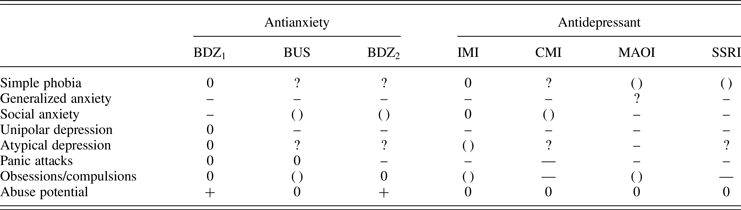
The ideal drug would be a “magic bullet,” targeting specific symptoms or a specific syndrome, but virtually all are less than specific in their effects. However, as academic researchers rather than clinicians, we can gain neurally specific information by asking what effects are not produced by a set of drugs (Table 1). Consider buspirone, a serotonergic antianxiety drug that targets serotonin 1A (5-HT1A) receptors. It improves anxiety (and depression), but not panic, and is not sedative or addictive. These differential effects show that the neural systems controlling fear (as exemplified by panic) and anxiety are somewhat independent. Buspirone also shows that an effective antianxiety drug need not be sedative, muscle relaxant, or addictive. We can compare buspirone with benzodiazepines and note that, at doses that treat anxiety, benzodiazepines do not generally affect panic, obsession or, unlike buspirone, depression. Taking buspirone and benzodiazepines together, then, we have reason to see anxiety systems (affected by both buspirone and benzodiazepines) as being distinct from those (unaffected by at least one of buspirone or benzodiazepines) controlling panic, obsession, depression, SUD, and a wide range of side effects. As we will discuss later, we can also use experimental comparison of the effects of these classes of drug to validate potential biomarkers of anxiety disorder.
Relative effectiveness of drugs in treating different aspects of neurotic disorder a
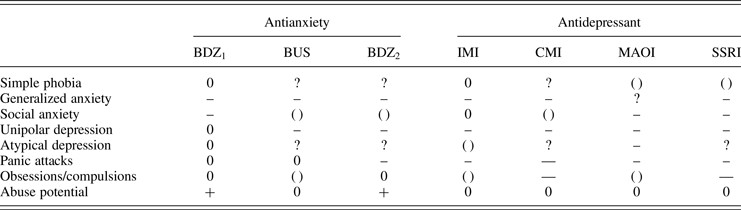
Note: Simple phobia is included for comparison as a fear/anxiety-related disorder that is not linked to neurotic personality. Abuse potential is included to emphasize that antianxiety efficacy per se is not linked to abuse. Different patterns of response in this table can be attributed to the variation in receptor occupancy or interaction by particular drugs in different parts of the brain. No drug or drug class produces a specific limited effect (despite the omission of side effects from this table), but the variation in relative effectiveness across the different aspects of neurotic disorder argues for distinct neural control of each. (0) No effect; (–) reduction; (—) extensive reduction; (+) increase; ( ) small or discrepant effects; BDZ1, early benzodiazepines, for example, chlordiazepoxide (Librium) and diazepam (Valium) administered at typical antianxiety doses. Other sedative antianxiety drugs (barbiturates, meprobamate) have similar effects; BDZ2, later high potency benzodiazepines, for example, alprazolam (Xanax). The antipanic effect is achieved at higher doses and this has also been reported with equivalent high doses for BDZ1 (Noyes et al., Reference Noyes, Burrows, Reich, Judd, Garvey and Norman1996); BUS, buspirone (BuSpar) and related 5HT1A agonists; CMI, clomipramine (Anafranil); IMI, imipramine (Tofranil) and other tricyclic antidepressants, but excluding clomipramine; MAOI, monoamine oxidase inhibitors, for example. phenelzine (Nardil); SSRI, selective serotonin reuptake inhibitors, for example, fluoxetine (Prozac).
Table and text adapted from “The Neurobiology of Anxiety: Potential for Comorbidity of Anxiety and Substance Use Disorders,” by N. McNaughton. In Anxiety and Substance Use Disorders: The Vicious Cycle of Comorbidity, by H. Stewart and P. J. Conrod (Eds.), Reference McNaughton, Stewart and Conrod2008, New York: Springer Science+Business Media. Copyright 2008 by Springer Science+Business Media. Adapted with permission.
a According to Gray and McNaughton (Reference Gray and McNaughton2000); McNaughton (Reference McNaughton, D'haenen, Den Boer, Westenberg and Willner2002); Stein, Vythilingum, and Seedat (Reference Stein, Vythilingum, Seedat and Maj2004); Stevens and Pollack (Reference Stevens and Pollack2005); Westenberg (Reference Westenberg1999); Stein, Hollander, Mullen, DeCaria, and Liebowitz (Reference Stein, Hollander, Mullen, DeCaria and Liebowitz1992); and Rickels and Rynn (Reference Rickels and Rynn2002).
In contrast to buspirone and benzodiazepines, there are (Table 1) antipanic drugs that show that fear systems are drug sensitive and that the lack of action on panic of some antianxiety drugs is not simply because panic is insensitive to drugs. There are drugs (such as clomipramine) that have not only antipanic but also antidepressant and antiobsessional actions, as well as treating generalized anxiety disorder. These act on monoamine systems, and have very delayed (weeks or months) development of their therapeutic effects. This suggests that they may be acting, directly or indirectly, via a system that controls a “neurotic disorder” risk factor.
In order to understand the full range of these neurally distinct disorders, we require a model that accounts for the extremely varied symptom presentation in the clinic and the significant variation in the capacity of drugs to treat specific types of disorder. However, we must also account for the extensive comorbidity among anxiety disorders seen in the clinic, the wide effectiveness of some of the classes of drug, and the shared neurotic predisposition to these disorders. It is to such a model that we now turn.
A Two-Dimensional Neuropsychology of Fear and Anxiety
Our picture of fear, anxiety, and their syndromes and symptoms has at its core the behavioral inhibition system (BIS) postulated by Jeffrey Gray (Reference Gray1975, Reference Gray, Feldman and Broadhurst1976). Gray's BIS was defined by sensitivity to anxiolytic drugs (Gray, Reference Gray, Iversen, Iversen and Snyder1977), and its psychological nature is still being progressively determined. The BIS is distinct from, and interacts with, the systems controlling pure approach and active avoidance (Gray, Reference Gray1982; Gray & McNaughton, Reference Gray and McNaughton2000). In the later versions of the model (Corr & McNaughton, Reference Corr and McNaughton2012; Gray & McNaughton, Reference Gray and McNaughton2000; McNaughton & Corr, Reference McNaughton and Corr2004, Reference McNaughton, Corr and Corr2008), fear and anxiety are distinct functionally, chemically, structurally, and genetically. We see fear (controlled by a fight–flight–freeze system [FFFS]) and anxiety (controlled by the BIS) as differing in terms of a categorical dimension of “defensive direction.” That is, fear is a set of often concurrent reactions (e.g., autonomic activation, escape, and avoidance) that have evolved to allow us to move away from danger and are sensitive to antipanic drugs, but not antianxiety drugs. In contrast, anxiety is a set of reactions (e.g., autonomic activation and risk assessment) that have evolved to allow us to move toward, or passively avoid, danger and are sensitive to antianxiety drugs (and also antipanic drugs).
The ethoexperimental work of Robert and Caroline Blanchard (D. C. Blanchard & Blanchard, Reference Blanchard, Blanchard, McNaughton and Andrews1990; R. J. Blanchard & Blanchard, Reference Blanchard, Blanchard, McNaughton and Andrews1990) not only provides the basis for a functional distinction between fear and anxiety but also shows that the specific fearful or anxious behavior generated depends on “defensive distance”: this is a cognitive construct consisting in perceived immediacy of threat. For any individual on any particular occasion faced with a threat, it is directly related to physical distance from the threat in space or time. However, for more or less threat-sensitive individuals, a particular physical distance represents a lesser or greater defensive distance, respectively (see Corr & Perkins, Reference Corr and Perkins2006).
Although it is not obvious from any single observation of their action, antianxiety drugs alter defensive distance rather than just reducing a specific behavior: in a highly anxious individual, showing little movement toward a threat, an antianxiety drug will reduce defensive quiescence and allow risk assessment to start; however, a less anxious individual (at the same physical or temporal distance) will already be undertaking risk assessment, and the drug will reduce risk assessment, allowing prethreat, for example, appetitive, behavior to appear (Blanchard, Blanchard, Tom, & Rodgers, Reference Blanchard, Blanchard, Tom and Rodgers1990).
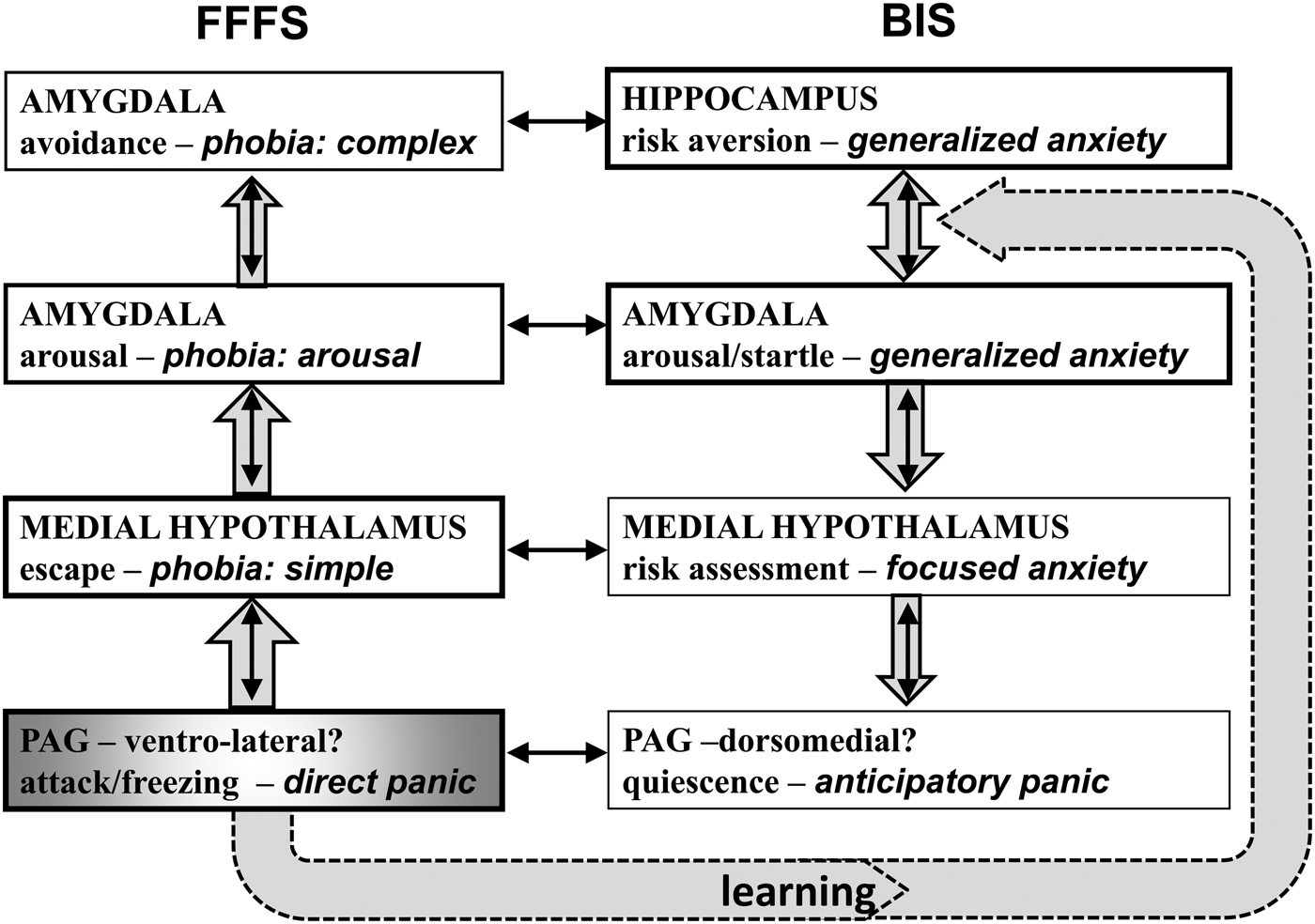
Figure 1 shows the mapping of this two-dimensional (defensive direction × defensive distance) functional picture to a corresponding neural and clinical one. A stream of structures is shown (top to bottom), one controlling fear (panic, escape, and active avoidance), on the left of the figure, the other controlling anxiety (passive avoidance, risk assessment, and approach to threat), shown on the right-hand side. As can be seen at the bottom of Figure 1, structures at the lowest neural level control quick and dirty responses (LeDoux, Reference LeDoux1994) to immediate threats, and those shown at the top of Figure 1 control relatively slower, sophisticated responses to more distant threats.
The two-dimensional defense system (direction × distance), updated from McNaughton and Corr (Reference McNaughton and Corr2004). Brain area in capitals, normal function lowercase, and nominal disorder (closest current diagnosis) in italics. Note the reciprocal (excitatory and inhibitory) connections between levels and systems. The stippled oval represents areas that show rhythmical slow activity (RSA; see text), which is modulated by 5-HT1A and BDZ receptor agonists. Dashed lines indicate 5-HT/NA modulation. FFFS, fight–flight–freeze system; BIS, behavioral inhibition system; 5-HT, 5-hydroxytryptamine/serotonin; 5-HT1A, 5-HT 1A receptors; BDZ, benzodiazepine receptors; NA, noradrenaline; OCD, obsessive–compulsive disorder; PAG, periaqueductal gray; PFC, prefrontal cortex. Figure and legend adapted from “Development of a Theoretically-Derived Human Anxiety Syndrome Biomarker,” by N. McNaughton, Reference McNaughton2014, Translational Neuroscience, 5, 137–146. Copyright 2014 by De Gruyter. Adapted with permission.

An important feature of the control of behavior is the reciprocal links between modules both within and between systems (Figure 1). Each structure could operate alone, but in practice they tend to be coactivated and often interact (LeDoux, Reference LeDoux1996). Any specific threat will activate multiple modules concurrently. These in turn, via one set of connections, will activate other adjacent modules. Higher level modules will often inhibit the outputs (but not the activations) of lower level modules. Thus, a high level of activation in an area like the amygdala that can generate a learned avoidance response will inhibit competing directed escape or undirected panic controlled by the hypothalamus and periaqueductal gray (PAG), respectively, while leaving autonomic activation, for example, intact. As noted previously, it is the combination of activation of the FFFS and the approach system that activates the BIS. Activation of the BIS in turn increases activation of the FFFS but not the approach system and so increases risk aversion, negative cognitive bias, and arousal. At the same time, the BIS blocks output from the PAG so that inappropriate panic/escape does not interfere with cautious approach or passive avoidance. (The inhibition of PAG output by BIS activation accounts for the otherwise surprising phenomenon of relaxation-induced panic attacks; see Deakin & Graeff, 1991.) However, higher order mechanisms can also release panic. The PAG receives direct, topographically organized, input from the prefrontal cortex (Shipley, Ennis, Rizvi, & Behbehani, Reference Shipley, Ennis, Rizvi, Behbehani, Depaulis and Bandler1991), which allows complex threat appraisal mechanisms (including traits such as catastrophizing) to produce a panic response if a complex threat is assessed as being close/immediate.
To conceptualize the relationship among normal behavior, symptoms, and syndromes for these structures, we consider the PAG as the simplest case. It is thought to control all instances of panic both in humans and in rodents, and consistent with this claim, in terms of symptoms, panic is much the same whatever the cause (Barlow, Reference Barlow2002). An extreme threat in a normal person will produce normal (potentially adaptive) panic, and “panic attacks” can be mild (Marks, Reference Marks, Noyes, Roth and Burrows1988). A weak threat in a pathologically fearful or anxious person will produce an abnormally high input to the PAG and so panic appropriate to the pathological fear or anxiety experienced (Goisman et al., Reference Goisman, Warshaw, Steketee, Fierman, Rogers and Goldenberg1995). Spontaneous activity in PAG (Dantendorfer et al., Reference Dantendorfer, Amering, Baischer, Berger, Steinberger and Windhaber1995) could generate spontaneous panic: a neurological syndrome of “pure panic disorder.” Pure panic disorder could also arise from excessive reaction to any one of a range of input stimuli: hypersensitivity to blood carbon dioxide, producing a “suffocation false alarm” (Klein, Reference Klein1995); an exaggerated autonomic response (Gurguis et al., Reference Gurguis, Antai-Otong, Vo, Blakeley, Orsulak and Petty1999) to stimulant drugs; poor autonomic control (Middleton, Ashby, & Robbins, Reference Middleton, Ashby and Robbins1994); or altered central responses to, or levels of, endogenous benzodiazepines (Randall et al., Reference Randall, Bremner, Krystal, Nagy, Heninger and Nicolaou1995), orexins (Johnson et al., Reference Johnson, Truitt, Fitz, Minick, Dietrich and Sanghani2010), cholecystokinin, or monoamines (Sandford, Argyropoulos, & Nutt, Reference Sandford, Argyropoulos and Nutt2000). We will discuss how such a syndrome of pure neurological panic disorder relates to current “panic disorder” diagnoses in the following sections.
A similar case can be made for obsessions and OCD. As we have argued in more detail previously (Gray & McNaughton, Reference Gray and McNaughton2000, pp. 288–289, 324–326), “the repetitive checking of a toddler by a parent can seem obsessive” (p. 289) but is actually normal and functional and would be the result of the normal activation of the anterior cingulate (or prefrontal) cortex (Rapoport, Reference Rapoport1989). Similarly, “pathologically maintained anxiety (most likely generalized anxiety) could provide an unusually high level of input to the cingulate-basal ganglia circuitry … [which] could then trigger any latent obsessions or compulsions” (Gray & McNaughton, Reference Gray and McNaughton2000, p. 326) producing a symptomatic form of OCD. In the syndromal case, “obsession and compulsions can arise from over-activity in the cingulate-basal ganglia circuitry. Often this will give rise to avoidance behavior (or successful checking), will not produce major increased in anxiety, and will not lead to the seeking of clinical help… . Where the frequency of fully fledged avoidance is very high, … or the avoidance response is in some other way blocked, then there will be conflict … with consequent anxiety … [particularly] in those with a neurotic introvert personality” (Gray & McNaughton, Reference Gray and McNaughton2000, p. 326).
Simple panic, simple phobia, simple obsession, and so on, would arise from pathology of specific modules (Figure 1) of the defensive systems. However, the theory allows for more widespread influences. For example, structures on the right-hand side of Figure 1 are coordinated by a “theta rhythm” that is specifically altered by all antianxiety drugs with no positive or negative exceptions to date (McNaughton, Kocsis, & Hajós, Reference McNaughton, Kocsis and Hajós2007). This means that the entire BIS can be modulated by any endogenous anxiolytic compound and that dysfunction of this modulation would generate a disorder that would likely be diagnosed as generalized anxiety.
The theory also allows us to relate morbidity and comorbidity to the idea of “neurotic disorders” that we considered above. Monoamine systems are a likely substrate for the general factor of neuroticism (Takano et al., Reference Takano, Arakawa, Hayashi, Takahashi, Ito and Suhara2007), and as shown in Figure 1, the monoamines (5-HT and noradrenaline) diffusely innervate most modules of the defense systems. As we noted earlier (Table 1), tricyclic drugs, clomipramine, monoamine oxidase inhibitors, and specific serotonin reuptake inhibitors all affect both anxiety and fear. However, they are also antidepressant, and so the monamine systems take us beyond the two-dimensional defense system to neurotic disorders more generally.
Our message is that individual syndromes may well depend on specific structures (or receptors or uptake systems specific to those structures), but more general modulatory (and likely predisposing) influences could result in the coordinated activity of (comorbid) groups of structures.
This model predicts a number of observations: a wide range of potential syndromes (each resulting when a specific module becomes hyper- or hyporeactive); extensive symptom overlap because of the interaction between modules (resulting in apparent comorbidity in relation to current diagnostic systems); and risk factors that modulate multiple modules, and even systems, simultaneously, precipitating comorbidity.
We are focusing at a relatively low level of control, but we may well expect that, with negative reinforcement generating conditioning and cognitive elaboration, what is presented to the psychiatric diagnostician is far removed from the primary activation of the neural modules, discussed above. It is for this reason, we believe, that it is difficult to predict the efficacy of antipanic, antifear, antidepression, and antianxiety drugs at the level of the individual patient, many of whom are prescribed a variety of medications until one seems to work. In order to determine primary causes, it is at the relatively low level of modules that we will likely want to start the scientific search and ultimately develop biomarkers (see below).
Our model also predicts that what will appear on the surface to be a single class of comorbidity can arise from two primary alternatives. The first alternative is that (primary) hyperreactivity of one module within one of the systems controlling defense can result in excessive symptoms produced by (secondary) hyperactivity of another part that is otherwise normal. This is not comorbidity in the classic medical sense (the coexistence of two distinct syndromes), but with current psychiatric diagnosis based on symptom clusters, it will currently fulfill the criteria for more than one disorder. The second alternative is that multiple modules may be (primarily) hyperreactive. This can easily occur if two hyperreactivities share a common risk factor or if one initial hyperreactivity tends to result in the development of another. We believe that the symptomatic and syndromal alternatives are intertwined often in clinical practice; in many cases, the same superficial symptomatology can arise from a range of different, single or multiple, primary (syndromal) causes. In the absence of some form of neuropsychological diagnostic tool (see below), it is difficult to differentiate between these possibilities.
Symptomatic Fear/Anxiety Comorbidities
The simplest form of comorbidity anticipated by our perspective is more apparent than real. It involves cases where a genuine underlying hyperreactivity of some part of a system results both directly in symptoms related to its own activity and indirectly in symptoms related to the consequent activity in other structures. This consequent activity can result from both neural connections with other parts of the same system and, more important for the appearance of comorbidity, from processes such as conditioning that can affect parts of other systems. We will use panic as our primary exemplar of these various effects.
Let us consider symptomatic development that proceeds from primary morbidity in the FFFS to generation of additional BIS-related symptoms. Pure physiological/neurological panic without additional complications presents rarely in the psychiatric clinic (Shear & Maser, Reference Shear and Maser1994), but is more readily measured in the general population (Joyce & Oakley-Browne, Reference Joyce, Oakley-Browne, McNaughton and Andrews1990) and presents in the cardiology clinic (Carter et al., Reference Carter, Maddock, Zoglio, Lutrin, Jella and Amsterdam1994; Holt, Reference Holt, McNaughton and Andrews1990). Despite the existence of these cases of unprovoked, uncomplicated, “pure panic” attacks, current psychiatric criteria for diagnosis of panic disorder require secondary avoidance or anxiety accompanying the panic. However, the occurrence of panic itself ceases to be a problem once avoidance and anxiety are treated (Franklin, Reference Franklin, McNaughton and Andrews1990). We would argue, therefore, that panic disorder proper is not, by itself, a major problem; but in a person with a neurotic personality, for example, it can engender inconvenient reactions, including increased autonomic responses that increase the incidence of panic, and then present as the current psychiatric panic disorder entity.
The presentation of panic as a syndrome with symptomatic comorbid anxiety is shown in Figure 2. Pathological activity (Dantendorfer et al., Reference Dantendorfer, Amering, Baischer, Berger, Steinberger and Windhaber1995), or reactivity (see previous section), of the PAG produces a panic attack. This will produce consequent neural activation of other structures in the FFFS generating, for example, increased arousal via the amygdala. A panic attack that is restricted in this way should, from our point of view, be labeled panic disorder, but unless there are additional developments, it will most likely be reported clinically as “irritable heart syndrome” (Holt, Reference Holt, McNaughton and Andrews1990). If the patient accepts that the symptoms are completely benign, then the consequent arousal will not increase and may even decrease. However, particularly if the patient has a neurotic disposition, association of the initial aversive panic attacks with, for example, mildly threatening social situations can result in conditioned anxiety (via the BIS; right-hand side of Figure 2) and so increased arousal. Increased adrenaline can then precipitate more frequent panic attacks (Sandford et al., Reference Sandford, Argyropoulos and Nutt2000), creating a vicious cycle that may result in presentation as what is currently diagnosed as panic disorder (if only high arousal and frequent panic attacks are present), or agoraphobia with panic (if conditioning results in avoidance of the situations that have come to elicit the panic attacks). Treatment of this avoidance, and of the negative interpretation of the panic attacks, can eliminate this vicious cycle, and result in a return to normal functioning, but with a low level of residual panic attacks remaining (Franklin, Reference Franklin, McNaughton and Andrews1990) because the primary neurological cause remains.
Panic as a syndrome with symptomatic comorbid anxiety. Lower levels of the fight–flight–freeze system (FFFS; bottom left) produce spontaneous activity (or hyperreactivity) of the periaqueductal gray generating pathological panic attacks. Active avoidance and arousal are increased via existing ascending neural connections of the FFFS (solid outline filled gray arrows, width indicates degree of activation, simple black double headed arrows show available connections). Coincidence of the occurrence of the panic attack with distinctive or threatening environmental circumstances can result, particularly in neurotic introverts, in the learning of anticipatory anxiety (dashed outline filled gray arrow), mediated by the hippocampus and amygdala, and the normal spread of neural activity through the behavioral inhibition system (BIS). Thus, abnormal panic produces fear and anxiety that are normal given the level of perceived threat generated by the panic. Note that this implies that a treatment such as cognitive behavioral therapy could modify the anxiety, and considerably reduce the incidence and increase the tolerability of panic attacks, while leaving a primary, neurological, incidence of panic intact. Figure adapted from Fears and Anxieties: A Map of Your Dark Side, by N. McNaughton, Reference McNaughton2005. Copyright 2005 by University of Otago. Adapted with permission.
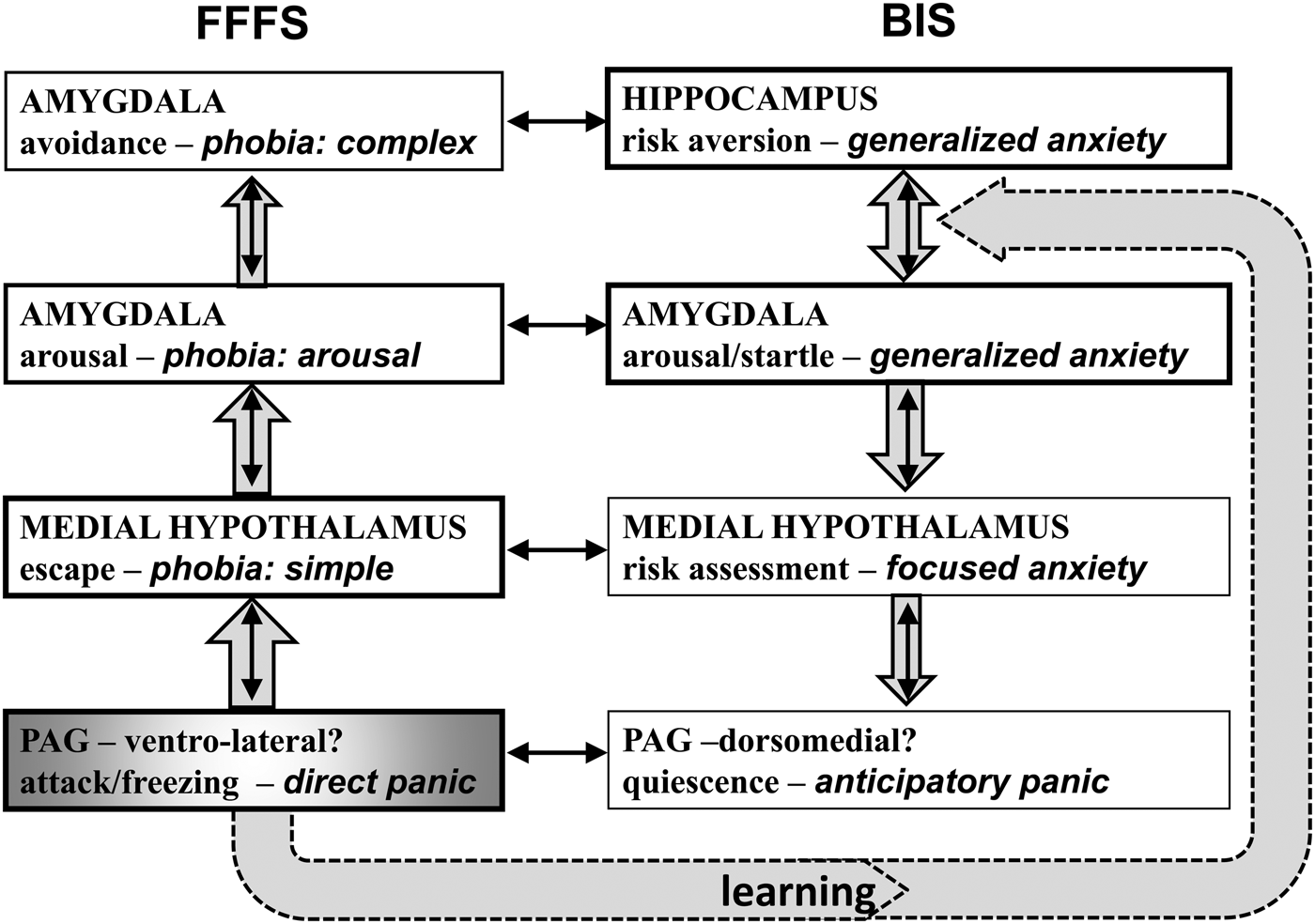
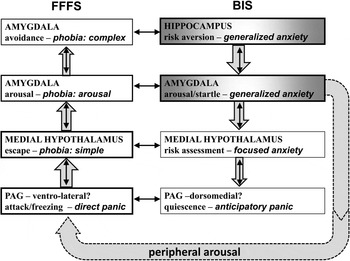
Such symptomatic developments can also proceed in the other direction, from primary morbidity in the BIS to generation of additional FFFS-related symptoms. If elements of the BIS are hyperreactive (right-hand side of Figure 3), this will generate a primary pathology such as generalized anxiety disorder with increased general levels of arousal. (Note that there may be a form of agoraphobia that, initially at least, presents without panic attacks. This, social anxiety disorder, and dysfunctions of other parts of the BIS, could all follow this same symptomatic panic generation scenario.) As we noted in the previous paragraph, increased adrenaline will often precipitate panic attacks, particularly in those with a system that is highly sensitive to its normal inputs (which need not be the case for the spontaneous panic attacks of our previous scenario). These adrenaline-induced panic attacks, which are in principle normal given the level of (pathological) anxiety being experienced, can then result in conditioned increases in the original anxiety, its accompanying arousal, and so further panic attacks.
Symptomatic comorbid panic with syndromal anxiety disorder. Upper levels of the behavioral inhibition system (BIS; top right) show abnormal spontaneous activity (or hyperreactivity) of the hippocampus, amygdala, or both, generating pathological generalized anxiety. Other aspects of anxiety are increased via existing descending neural connections (solid outline filled gray arrows) of the behavioral inhibition system (and also ascending connections, not shown). Increased peripheral arousal, for example, levels of adrenaline, activates the periaqueductal gray (dashed outline filled gray arrow) and generates panic attacks, particularly in panic prone individuals, and also produces a normal spread of neural activity through the fight–flight–freeze system (FFFS). Thus, abnormal anxiety produces panic and fear that are normal given the level of perceived anticipatory threat generated by the pathological anxiety. Figure adapted from Fears and Anxieties: A Map of Your Dark Side, by N. McNaughton, Reference McNaughton2005. Copyright 2005 by University of Otago. Adapted with permission.

Syndromal Fear/Anxiety Comorbidities
It is clear from the extensive overlap in the elements of the two scenarios we have described that symptomatic comorbidity would be expected to be common and for the primary cause of symptoms of anxiety + panic to be difficult to determine. Coincidence will not always be the case, with both simple panic attacks and pure GAD/agoraphobia/social anxiety occurring, particularly in those who lack a neurotic personality type or a tendency to arousal-elicited panic, respectively. However, a combination of symptoms is likely to be common.
A further expectation is that such symptomatic overlap can lead to a true syndromal overlap. Anxiety accompanied by panic is likely to be chronic; anxiety results in the release of stress hormones, and chronic stress is likely to result in a progressive development of sensitivity (“kindling”) of the systems involved (Adamec, Reference Adamec1997; Adamec, Holmes, & Blundell, Reference Adamec, Holmes and Blundell2008; Adamec & Shallow, Reference Adamec and Shallow1993; Schmidt, Abraham, Maroun, Stork, & Richter-Levin, Reference Schmidt, Abraham, Maroun, Stork and Richter-Levin2013). Thus, primary dysfunction of one node (with secondary increases in symptoms mediated by another node) can evolve into primary dysfunction of both nodes and so true syndromal comorbidity.
For related reasons, we would anticipate a considerable level of comorbidity of initial syndromes. Where disorder is generated by chronic stress, this can precipitate not only any one of the neurotic disorders but also more than one at a time. Similarly, if the source of disorder is a genetic predisposition to anxiety (i.e., BIS activation) in general then more than one node of the system (and so more than one form of anxiety disorder) is likely to be involved simultaneously. Likewise, if there is a genetic problem with monoamine systems (potentially expressed as neuroticism or a related trait) then both the FFFS and the BIS could contribute multiple disordered nodes.
Whichever of these various routes is involved, our theory accepts that massive apparent comorbidities of its set of proposed symptom clusters will occur with potentially a range of concurrent underlying syndromes. This promiscuity creates the current complex clinical picture and emphasizes the difficulty of separating symptom parallels from true syndromal comorbidities. However, while multiple positive feedback loops (Figure 4) complicate the diagnostic picture, they are also likely to provide some degree of flexibility of treatment. For example, as we have noted already, treating the neurologically normal anxiety that is consequent on abnormal panic will reduce arousal, eliminate avoidance, and reduce, even when it does not eliminate, panic attacks.
Syndromal comorbidity and positive feedback between anxiety and panic. Genetic and or environmental predisposing factors (particularly those linked to neuroticism) can result in pathological activity in both the periaqueductal gray, generating panic, and in the hippocampus and amygdala, generating anxiety. These can concurrently reinforce each other through the state feedback mechanisms detailed in Figures 2 and 3 (dashed outline filled gray double headed arrow), resulting in positive feedback. Repetitive or chronic activation of either or both of the fight–flight–freeze system (FFFS) and the behavioral inhibition system (BIS; and particularly the resultant release of stress hormones, see Figure 5) can result in a progressive sensitization of the other system (“kindling”), and this can also generate longer term trait positive feedback (circular arrows). Not only does this imply that symptomatic comorbidity can result in trait comorbidity, but it also implies that therapeutic intervention at any one of the main links in these positive feedback circuits can produce some improvement. Figure adapted from Fears and Anxieties: A Map of Your Dark Side, by N. McNaughton, Reference McNaughton2005. Copyright 2005 by University of Otago. Adapted with permission.

Syndromal Comorbidities Beyond Fear/Anxiety
We have already touched on the issue of syndromal comorbidities that may be consequent on, or etiologically mixed with, symptomatic comorbidities. The syndromes have been envisaged as directly involving the FFFS, the BIS, or both; as a result, the true comorbidities can appear continuous, with primary syndrome plus secondary symptoms shading into a pair of primary syndromes.
In the following sections, we discuss comorbidities that go beyond the FFFS and BIS systems and involve appetitive systems. In some cases, they share with FFFS/BIS syndromes chronic stress as a source of syndrome development. The three primary classes we will consider are an internalizing disorder (i.e., depression) and two externalizing disorders (i.e., SUD and ADHD). All three have a high probability of being comorbid with anxiety but for quite different causal reasons. We argue that a neuroscientific perspective of the type outlined above will help to shed new light on these more broad ranging comorbidities.
Anxiety and depression
Anxiety and depression are likely to co-occur even in the absence of morbidity. There is reason (McNaughton, Reference McNaughton1989, pp. 148–149), for example, in the specific case of separation distress, to see an initial active anxiety response (leading to reuniting with the parent) as being adaptive in the short term and its conversion to a risk- and resource-reducing depressed state as being equally adaptive in the long term (allowing survival until the parent's eventual return). Under more general conditions of conflict, depression may also become adaptive as a means of “communicating a need for help, signalling yielding in a hierarchy conflict, fostering disengagement from commitments to unreachable goals, and regulating patterns of investment … [in] situations in which effort to pursue a major goal will likely result in danger, loss, bodily damage, or wasted effort” (Nesse, Reference Nesse2000). Thus anxious, depressive, and stress responses may have coevolved (Nesse, Reference Nesse1999) to solve the problems presented by both immediate (anxiety), and longer term (depression), goal conflict. On this view, it is not surprising that the hippocampus is not only the key node of the BIS but also the main structure in the brain through which stress hormone levels are regulated (see Sapolsky, Reference Sapolsky2004; Sapolsky, Krey, & McEwen, Reference Sapolsky, Krey and McEwen1984). While acute anxiety-related responses involve increased activity in the FFFS but do not change the behavioral approach system (BAS), and so potentially solve the problem of goal conflict by withdrawal, the more chronic depression-related responses can suppress BAS activity (reducing the tendency to approach what are now seen as unreachable goals) not only via a reduction of output but via processes such as anhedonia.
The most obvious reason for a high comorbidity between anxiety and depression is that they share a common predisposing risk factor: neurotic personality. Even if their precipitating causes and neural substrates were independent, shared risk would lead us to expect co-occurrence. Potentially linked to this, 5-HT signaling is altered in anxiety and depression and may contribute to comorbidity (Deakin, Reference Deakin1998). Specific serotonin reuptake inhibitors (SSRIs) are now a first-line therapy in the treatment of anxiety-depression comorbidity (Kaufman & Charney, Reference Kaufman and Charney2000). 5-HT1A receptor ligands are effective in both disorders, but normalization of 5-HT produces distinct antidepressant and anxiolytic actions (Deakin, Reference Deakin1993). If quite separate 5-HT systems mediate deficits in anxiety and depression, selectively, then neither would control specific comorbidity, which could nonetheless depend on more general variation in the global control of 5-HT.
Anxiety and depression also appear to share precipitating causes. The triple comorbidity of posttraumatic stress disorder (PTSD) + anxiety + depression occurs in about half of war veterans, this being about three times the rate in this population of PTSD alone or of PTSD comorbid with only one of anxiety/depression (Ginzburg, Ein-Dor, & Solomon, Reference Ginzburg, Ein-Dor and Solomon2010). Thus, even more so than with the other neurotic disorders, we can see anxiety and depression as linked and, therefore, often comorbid.
Anxiety, as we have noted already, is a stressor; it releases corticosterone. Stress system dysregulation appears to precipitate affective disorders (Kessler, Reference Kessler1997), being moderate in primary anxiety disorder and strong in primary and comorbid major depressive disorder (Kara, Yazici, Güleç, & Ünsal, Reference Kara, Yazici, Güleç and Ünsal2000). Clinical depression can be viewed as a form of dysfunctional stress response (Pariante, Reference Pariante2003; Pariante & Miller, Reference Pariante and Miller2001), and so it is unsurprising that clinical depression can be consequent on chronic anxiety (which will itself often be pathological), resulting in the two being comorbid.
Finally, we should note that there may be a distinct condition that presents symptomatically as depression comorbid with anxiety but where both sets of symptoms are generated by a common underlying dysfunction that is more chronic and severe than those giving rise to anxiety or depression, separately, and which is accompanied by a higher suicide risk (Roy-Byrne et al., Reference Roy-Byrne, Stang, Wittchen, Ustun, Walters and Kessler2000). Consistent with this, war veterans who “would endorse a lifetime triple comorbidity [of PTSD + anxiety + depression] are likely to have more impaired functioning” (Ginzburg et al., Reference Ginzburg, Ein-Dor and Solomon2010, p. 249).
Anxiety and SUD
Conversely to anxiety producing comorbid depression, SUD can produce comorbid anxiety. (For a more detailed version of the following discussion, see McNaughton, Reference McNaughton, Stewart and Conrod2008.) Recreational use of alcohol or the regular use of barbiturates or benzodiazepines as hypnotics results in tolerance, dependence, and addiction. Tolerance, in particular, then leads to rebound anxiety upon withdrawal of the drugs. (Each of these classes of drug has its own binding site on the GABAA receptor system, through which all produce antianxiety actions as well as euphoria and muscle relaxation.) However, this antianxiety action, and the stressful nature of anxiety, gives it a capacity to generate SUD. SUD can often start with, and be substantially maintained by, self-medication particularly with alcohol. Once alcohol intake has started, the story is essentially the same as with recreational use leading to SUD. Here again we have the potential for a vicious cycle (as when anxiety and panic feed off each other), with anxiety and SUD reinforcing each other (for detailed reviews, see Stewart & Conrod, Reference Stewart and Conrod2008). It should be emphasized that we are describing only one aspect of SUD, here, and that the causes of addiction go much deeper than a response to anxiety.
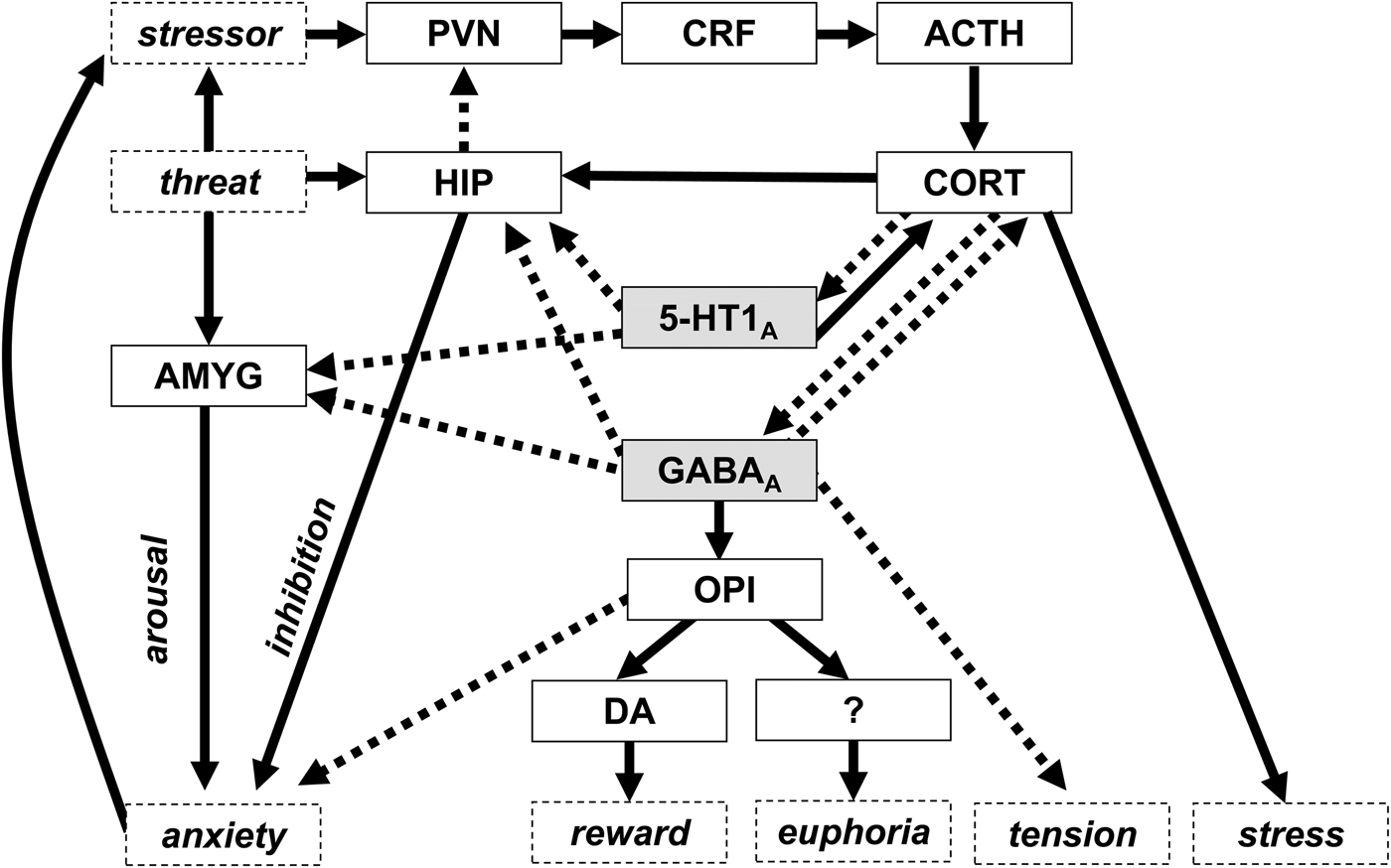
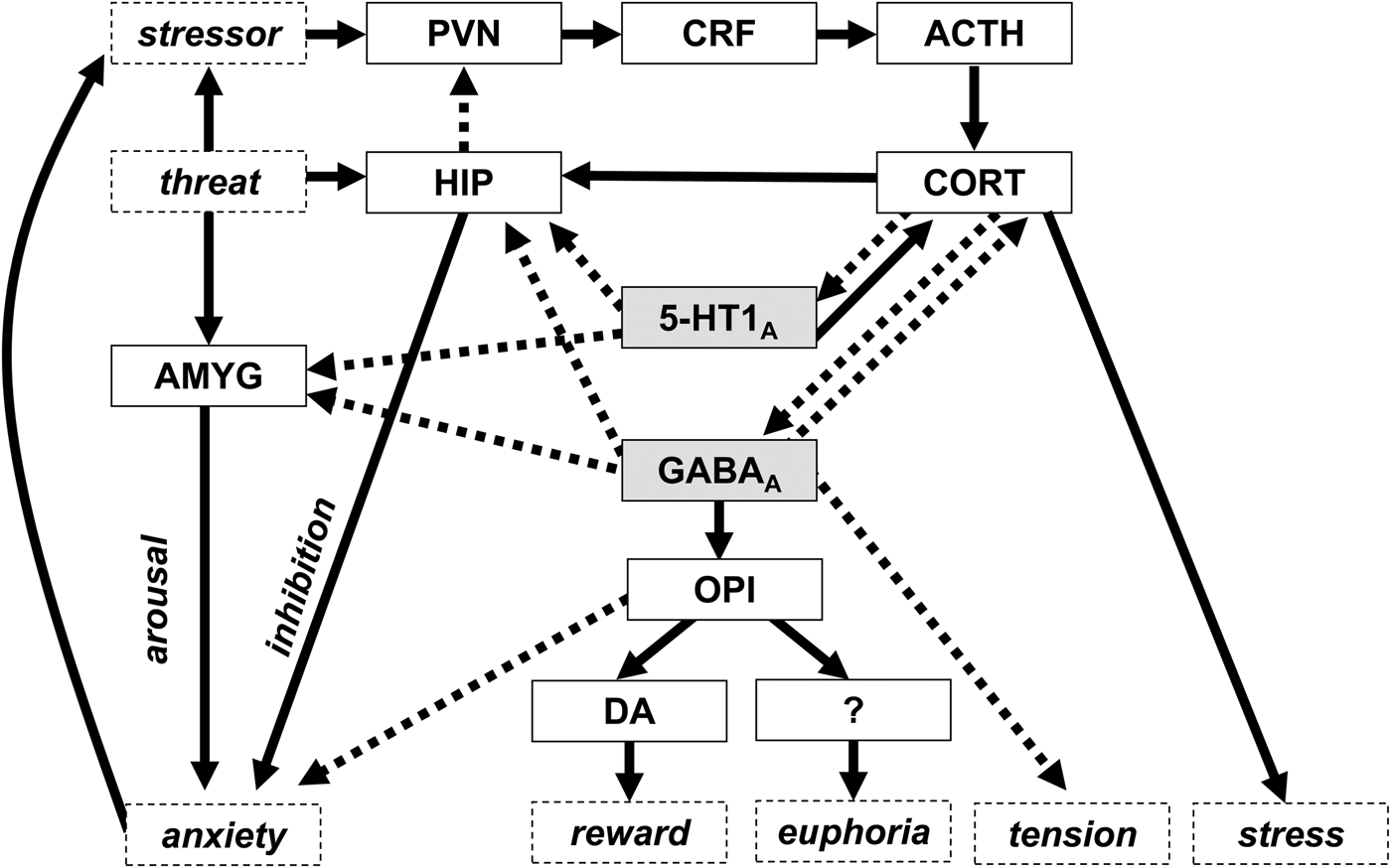
An important point to note in relation to the self-medication story we have just presented is that SUD and the control of anxiety are linked through a complex web of endogenous interacting compounds (Figure 5). Serotonergic antianxiety drugs (such as buspirone or fluoxetine) impact on the neural structures that control anxiety (e.g., the hippocampus and amygdala) in much the same way as GABAA drugs, and without showing tolerance. Both classes of drug also (Figure 5) have their antianxiety action reduced (Meijer & de Kloet, Reference Meijer and de Kloet1994; Meijer, Van Oosten, & de Kloet, Reference Meijer, Van Oosten and de Kloet1997) by corticosterone/cortisol (CORT). However, 5-HT1A drugs differ from GABAA drugs in two important respects. The first (Figure 5) is that serotonergic drugs release CORT on initial use, while GABAA drugs inhibit it (Broadbear, Winger, & Woods, Reference Broadbear, Winger and Woods2005), with both classes of drug showing tolerance of their effects on CORT release. This partially explains the initial dysphoric effects of the serotonergics and the euphoric effects of the GABAA drugs. The second is that GABAA drugs, but not serotonergics, activate opiate systems (Kostowski & Biénkowski, Reference Kostowski and Bienkowski1999; Richardson, Reynolds, Cooper, & Berridge, Reference Richardson, Reynolds, Cooper and Berridge2005) that in turn activate dopamine systems producing rewarding and euphoriant actions that contribute to their abuse potential. We can argue, then, that the strong links between anxiety disorder and SUD relate to endogenous compounds that regulate not only anxiety but also reward systems.
Pathways for comorbidity beyond the fight–flight–freeze system (FFFS) and the behavioral inhibition system (BIS). A selection of sources of potential interaction between the FFFS and BIS, primarily the amygdala and hippocampus, and other systems are shown. Solid lines represent net excitatory connections, and dashed lines represent net inhibitory connections. Of most immediate relevance to the long-term trait changes of Figure 4 are the interactions with the stress system. Anxiety is a stressor, releasing corticosterone/cortisol (CORT) via activation of the paraventricular nucleus, release of corticotrophin releasing factor, and adrenocorticotropin hormone (ACTH). Negative feedback control of the release of CORT is achieved by its action on the hippocampus and its connection with the paraventricular nucleus. High levels of CORT can damage the hippocampus, reduce this feedback inhibition, and so result in progressive increases in CORT. Continuously high CORT can then result in depression (see text) as well as other problems. CORT will also reduce the effects of endogenous anxiolytic action mediated by 5-HT1A and GABAA (particular benzodiazepine site) receptors. At least in the short term, 5-HT1A activation releases CORT, but benzodiazepine activation inhibits it. (Both of these effects show tolerance.) The GABAA system is particularly important for comorbidity because it not only reduces anxiety (without tolerance) but also produces muscle relaxation, euphoria, and rewarding effects via endogenous opiate systems that cause the release of dopamine. These effects show tolerance and lead to addiction. Thus, use of anxiolytics can lead to substance use disorder, and via tolerance and withdrawal, substance use disorder can result in anxiety disorder (see text).
Anxiety and ADHD
The final case that we will consider also likely involves complex interactions but between neural rather than chemical systems. The starting point is the observed high level of comorbidity of anxiety with ADHD (Costello, Mustillo, Erkanli, Keeler, & Angold, Reference Costello, Mustillo, Erkanli, Keeler and Angold2003); 30% can have comorbid anxiety disorders (Pliszka, Reference Pliszka1998; Spencer, Biderman, & Wilens, Reference Spencer, Biederman and Wilens1999). This is, at first blush, surprising both at a superficial level and at the deeper theoretical level. At the superficial level, ADHD is thought to involve a fundamental problem of insufficient behavioral inhibition (Barkley, Reference Barkley1997) akin to the effect of antianxiety drugs. At the theoretical level, ADHD has been attributed to a fundamental hypofunction of the BIS (Quay, Reference Quay1997), a system that we have argued generates anxiety. We will argue that ADHD is the result of dysfunction of both more (dopamine and white matter) and less (prefrontal but not subcortical) than the BIS as a whole. Because only prefrontal modules of the BIS are involved, this allows for comorbidity of externalizing and internalizing disorders, resulting from opposite frontal (hypoactive) and subcortical (hyperactive) BIS dysfunctions, respectively.
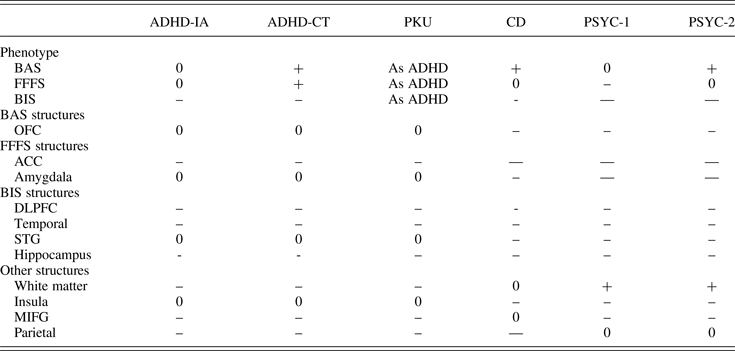
As is well known, ADHD involves two main types of symptom cluster: inattentive (ADHD-IA; distractibility and difficulty focusing on tasks for a sustained period) and hyperactive/impulsive (fidgeting, excessive talking, and restlessness). These often occur together as a combined type (ADHD-CT; downgraded to combined “presentation” in DSM-5). The clearest neural abnormalities (see Table 2) are of the frontal lobe and white matter connections between the frontal lobe and subcortical regions, including the basal ganglia (Castellanos et al., Reference Castellanos, Lee, Sharp, Jeffries, Greenstein and Clasen2002; Sowell, Toga, & Asarnow, Reference Sowell, Toga and Asarnow2000). “The most replicated alterations [in ADHD] … include significantly smaller volumes in the dorsolateral prefrontal cortex, caudate, pallidum, corpus callosum, and cerebellum” (Seidman, Valera, & Makris, Reference Seidman, Valera and Makris2005, p. 1263). As we have discussed in more detail elsewhere (Corr & McNaughton, Reference Corr, McNaughton, Beauchaine and Hinshaw2016), several externalizing disorders share these prefrontal developmental distortions, and we will discuss their differences, particularly in subcortical abnormalities, in the next section. There is dysfunction of noradrenergic systems (e.g., Pliszka, Reference Pliszka1998), and reduced dopamine in both mesocortical input to the dorsolateral prefrontal cortex and mesolimbic input to the nucleus accumbens may account for some cognitive impairments in ADHD (Sonuga-Barke, Reference Sonuga-Barke2005) but with clear individual differences (see Volkow, Wang, Newcorn, Fowler, et al., Reference Volkow, Wang, Newcorn, Fowler, Telang and Solanto2007, p. 1182; see also Volkow, Wang, Newcorn, Telang, et al., Reference Volkow, Wang, Newcorn, Telang, Solanto and Fowler2007).
A tentative summary of relations between motivational phenotype and neural source
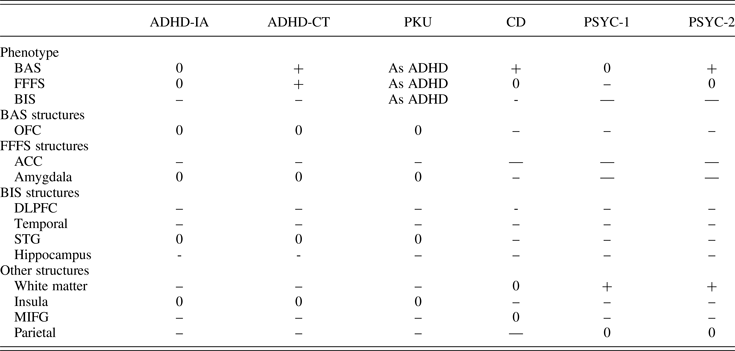
Note: With the exception of the amygdala and hippocampus, affected subcortical areas, the posterior cingulate, and the cerebellum have been omitted. Subtypes of both attention-deficit/hyperactivity disorder (ADHD) and psychopathy (PSYC) have been assigned the same structural values (grey shading) because there is insufficient data to delineate their neural differences. Involvement of an area is indicated for (—) major dysfunction, (–) dysfunction, (-) minor dysfunction or disconnection, (0) no reported involvement, and (+) hyperactivity. ADHD-IA, ADHD inattentive subtype; ADHD-CT, ADHD combined subtype; PKU, phenylketonuria; PSYC-1, primary PSYC; PSYC-2, secondary PSYC; ACC, anterior cingulate cortex; BAS, behavioral approach system; BIS, behavioral inhibition system; DLPFC, dorsolateral prefrontal cortex; FFFS, fight–flight–freeze system; MIFG, medial or inferior frontal gyrus; OFC, orbital frontal cortex; STG, superior temporal gyrus. Table and legend adapted from “Neural Mechanisms of Low Trait Anxiety and Risk for Externalizing Behaviour,” by P. J. Corr and N. McNaughton. In T. P. Beauchaine and S. P. Hinshaw (Eds.), The Oxford Handbook of Externalizing Spectrum Disorders, Reference Corr, McNaughton, Beauchaine and Hinshaw2016, New York: Oxford University Press. Copyright 2016 by Oxford University Press. Adapted with permission.
Dysfunctional BIS activity has been implicated in ADHD (Beauchaine, Katkin, Strassberg, & Snarr, Reference Beauchaine, Katkin, Strassberg and Snarr2001; Quay, Reference Quay1997). Low BIS activity would result in reduced behavioral inhibition (i.e., a reduced capacity to inhibit prepotent goals and to resolve conflict by increased risk aversion), reduced attention (including both environmental and memory scanning), and reduced arousal. This profile of symptoms features particularly in ADHD-IA. However, the neural abnormalities we have just described involve only frontal and not subcortical aspects of the BIS (see Sauder, Beauchaine, Gatzke-Kopp, Shannon, & Aylward, Reference Sauder, Beauchaine, Gatzke-Kopp, Shannon and Aylward2012; Stevenson & McNaughton, Reference Stevenson and McNaughton2013). Conversely, there are behavioral changes that go beyond the BIS. Of particular note is stopping in the stop signal task. Impaired stopping in ADHD has been taken as evidence of BIS involvement, but stopping in the stop signal task appears to depend on action rather than goal circuits (Neo, Thurlow, & McNaughton, Reference Neo, Thurlow and McNaughton2011) and, critically, is insensitive to the anxiolytic drugs that define the BIS (McNaughton, Swart, Neo, Bates, & Glue, Reference McNaughton, Swart, Neo, Bates and Glue2013). Therefore, in relation to both positive and negative features, it is difficult to see ADHD-IA simply as the low end of a BIS dimension. It is best seen as a dysfunction of prefrontal but not subcortical aspects of the BIS coupled with dysfunction of other prefrontal systems with the motivational component of the resultant phenotype being primarily BIS−.
Moving on to ADHD-CT, one idea is that it is associated with not only poor cognitive control (BIS−) but also with high positive and negative emotionality (BAS+, FFFS+; respectively). This combination of BAS+ and FFFS+ would result in the generation of a greater tendency to make responses in the absence of conflict as well as in much higher levels of motivation under conditions of conflict (when the BAS and FFFS are equally activated). If so, all types of ADHD would show some dysfunction of the BIS. However, we cannot, as yet, rule out the possibility that in ADHD-CT the BIS is dysfunctional in relative rather than absolute terms, being activated by conflict but with insufficient power to inhibit the outputs of BAS hyperactivity.
We can see two reasons for the known ADHD neurology giving rise to both inhibitory problems and anxiety. The prefrontal components of the BIS normally process conflicts between goals that are at greater defensive distances than the subcortical components. When they are activated, they will tend to inhibit output from the subcortical components. Therefore, if the prefrontal BIS is relatively unreactive, behavioral inhibition will be lost for distant but not close goals (allowing impulsivity free reign), and this will tend to result in situations where threats that would previously have been avoided at a distance occur at close range, and so generate anxiety via the subcortical components of the BIS. A second alternative, which is not mutually exclusive with the first, is that threats will be more likely to produce outputs via areas that normally deal with more immediate reactions and lack the inhibition that would normally be provided by slow and sophisticated systems. This will result in greater perceived immediacy of a threat than if the reactions were mediated by prefrontal components of the BIS.
A Neuropsychology of Externalizing Disorders
Our resolution of the paradox of ADHD (an externalizing disorder) being often comorbid with internalizing anxiety disorders raises the question of why such comorbidity is not also true of other externalizing disorders with similar prefrontal neurology (i.e., excluding SUD). As summarized in Table 2, and discussed in more detail by Corr and McNaughton (Reference Corr, McNaughton, Beauchaine and Hinshaw2016), the pathology of the BIS and FFFS combine with important hyperactivity of the BAS to generate aspects of ADHD, phenylketonuria (PKU), conduct disorder (CD), and psychopathy, and contribute to the comorbidity of these disorders. While the BIS is often seen to be exclusively related to internalizing disorders, we emphasize that it contributes (through underactivity) to externalizing ones. The detailed neurology of this contribution can account not only for differences between the externalizing disorders and their comorbidity with each other but also for their pattern of comorbidity with internalizing disorders.
Dysfunctional behavior can result from dysfunction of any one of the BAS, FFFS, and BIS in isolation but will also often result from dysfunction of these and other systems acting in combination (see, e.g., Beauchaine, Reference Beauchaine2001; Beauchaine et al., Reference Beauchaine, Katkin, Strassberg and Snarr2001). In conditions involving a pure excess of approach behavior, the BAS is likely to be functionally dominant. However, the BIS is often important for clinical presentation because it is involved in the regulation of goal conflict detection and resolution. BIS dysfunction causes failure of inhibition of inappropriate behavior, which can be as important as excessive approach in generating externalizing symptoms.
The externalizing disorders shown in Table 2 appear to arise from a number of quite different proximal developmental causes. However, they ultimately converge on largely similar neural substrates (dopamine, white matter, and large neutral amino acids) that alter largely similar prefrontal and temporal lobe circuits. For example, PKU has a quite distinct (point mutation) etiology from ADHD, but subject to the extent of dietary control, has a very similar final neural and behavioral phenotype; therefore, PKU, as a syndrome, can often be seen as comorbid with ADHD (Stevenson & McNaughton, Reference Stevenson and McNaughton2013). We have argued that the differences between disorders may reflect relatively small differences in the boundaries of the systems affected. On this view, there is a “topographically variable zone of neural dysfunction” (Corr & McNaughton, Reference Corr, McNaughton, Beauchaine and Hinshaw2016) with details of the individual topography of different cases accounting for common (neurally overlapping) and unique (nonoverlapping) presenting features of the externalizing psychopathologies. There appears to be a common set of rostral prefrontal structures across the disorders with what appears to be a caudal progression of prefrontal and subcortical involvement. In the specific case of the BIS, as we progress from ADHD through CD to psychopathy, the caudal boundary of dysfunction appears to progress from the dorsolateral prefrontal cortex to the hippocampus, and then to the superior temporal gyrus and the amygdala. That is, ADHD has the least subcortical BIS dysfunction (albeit with some evidence of hippocampal disconnection) and psychopathy the most.
This topographical perspective accounts for not only many details of the individual syndromes but also for certain aspects of comorbidity. On this view, it is the combination of nominally syndrome-specific forms of damage that produces specific forms of comorbidity (e.g., ADHD + psychopathy). For example, some 60% of children with ADHD also have a diagnosis of ODD and/or CD (Beauchaine, Hinshaw, & Pang, Reference Beauchaine, Hinshaw and Pang2010), and approximately 70% of CD children have comorbid diagnosis of ADHD (Beauchaine et al., Reference Beauchaine, Katkin, Strassberg and Snarr2001). On the face of it, ADHD and CD would seem very different disorders. “With respect to externalising disorders in childhood, Quay suggested that ADHD and CD reflect different problems in the functioning of the BAS and the BIS. ADHD is characterised by an underactive BIS, whereas CD is associated with a BAS that dominates over the BIS: when cues for both reward and punishment are present, CD children focus on cues for reward at the expense of cues for punishment” (Matthys, van Goozen, de Vries, Cohen-Kettenis, & van Engeland, Reference Matthys, van Goozen, de Vries, Cohen-Kettenis and van Engeland1998, p. 644; see Matthys, Vanderschuren, & Schutter, Reference Matthys, Vanderschuren and Schutter2013). However, their neurologies have clear commonalities, and a case with neurological abnormality overlapping both syndrome-specific zones is eminently likely. There is evidence that comorbid ADHD + CD children are prone to develop severe externalizing disorders in adulthood (Beauchaine et al., Reference Beauchaine, Hinshaw and Pang2010; Beauchaine & McNulty, Reference Beauchaine and McNulty2013), including psychopathy (Greshman, Lane, & Lambros, Reference Gresham, Lane and Lambros2000). In addition, when we come to genetic loading, it is useful to think in terms of dosage: “comorbidity between CD and the hyperactive/impulsive subtype of ADHD … represents a particularly virulent condition, characterised by a strong genetic loading, increased rates of aggression, and elevated risks of future antisocial behaviour … and score [high] on measures of psychopathy” (Beauchaine et al., Reference Beauchaine, Katkin, Strassberg and Snarr2001, p. 610; see Finger et al., Reference Finger, Marsh, Blair, Reid, Sims and Ng2011, p. 152; Gresham et al., Reference Gresham, Lane and Lambros2000). Our topographical view, coupled with the extent of comorbidities, would not be incompatible with a “spectrum” view of ADHD-CD-psychopathy, with the specific presentation of any particular individual case reflecting their particular map of affected frontotemporal areas and tracts.
Neuropsychology, Personality, and Biomarkers
We have presented a strongly neuropsychological view of both internalizing and externalizing disorders. We did discuss psychological factors, particularly in relation to symptomatic comorbidity, but nonetheless we could be taken to have implied that primary psychiatric disorder results from explicit neural pathology. Here, we redress the balance noting that (a) a normally distributed long-term neurobiological sensitivity can be psychiatrically problematic at either extreme without requiring any explicit neural pathology (hence our exclusion of epilepsy earlier); (b) such sensitivities (and associated sometimes fairly gross developmental variation in neural structures) must be the fundamental substrates of personality factors, traits, or facets; and (c) a solution to the problem of diagnosing primary morbidity and, hence, syndromal comorbidity is to develop biomarkers that assess the sensitivity of the relevant neurobiological systems.
It has long been argued that establishing links between personality and disorder is vital to understanding diathesis, etiology, progression, prognosis, and treatment of mental illness (e.g., Costa & Widiger, Reference Costa and Widiger1994; Harkness & Lilienfeld, Reference Harkness and Lilienfeld1997; Krueger & Markon, Reference Krueger and Markon2006; Krueger & Tackett, Reference Krueger and Tackett2003; Tackett, Reference Tackett2006; Watson, Clark, & Harkness, Reference Watson, Clark and Harkness1994; Widiger & Trull, Reference Widiger and Trull1992; Widiger, Verheul, & van den Brink, Reference Widiger, Verheul, van den Brink, Pervin and John1999). We have identified a range of neural processes, the sensitivities of which could underlie long-term consistency of behavioral reactivity (i.e., “personality”). Either extreme of any neurobiological trait can then potentially be a risk factor for some set of disorders, the substrate of a specific disorder, or both.
Most functionally general are the monoamine and pituitary–adrenal systems. We have discussed long-term effects of serotonin, noradrenalin, and stress hormones on systems controlling internalizing disorders, and briefly touched on the long-term, particularly developmental, effects of dopamine on systems controlling externalizing disorders. Chronic levels of monoamines or hormones, systemwide, alter the reactivity of many parts of each system concurrently, giving rise to clusters of characters that define, for example, the “neurotic individual.” Consistent with this, anxiety disorder, in the typical population, has an estimated genetic loading of approximately 30%, and this is true even with generalized anxiety, which is comorbid with other conditions, including depression (Kendler et al., Reference Kendler, Neale, Kessler, Heath and Eaves1992a, Reference Kendler, Neale, Kessler, Heath and Eaves1992b, Reference Kendler, Neale, Kessler, Heath and Eaves1992c). Thus, genetic vulnerability is of “neurotic disorders” (including depression, but excluding simple phobia) and is not specific for any one “anxiety disorder” (Andrews et al., Reference Andrews, Stewart, Morris-Yates, Holt and Henderson1990).
At the other end of the specificity spectrum, there are personality predispositions (e.g., obsessionality, panic proneness, and social anxiousness) that depend on the sensitivity of quite specific modules within the FFFS or BIS. While the reactivity of the modules concerned will depend, in concert, on monoamine inputs (and so be impacted on by “neuroticism”), each can have its own unique reactivity: obsessionality depending on, for example, the specific reuptake systems in the cingulate cortex that are sensitive to clomipramine but not imipramine (Rapoport, Reference Rapoport1989); panic proneness being dependent on long-term settings of a wide variety of systems we have already discussed; and social anxiety dependent on, perhaps, prefrontal monoamine oxidase. Each of these sensitivities will have its own epigenetic, genetic, and environmental (particularly developmental) contribution.
At the intermediate, system level (FFFS/BIS), it is important to remind ourselves that anxiolytic drugs alter defensive distance and so change the level of the BIS that is in control of behavior rather than altering any single module and, thus, any single behavior. They act like a personality factor of “anxiety proneness” distinct from any “fear proneness” and from any more specific proneness to panic or obsession. The antianxiety action of the benzodiazepines is achieved by adjusting the amplification of any subsequent effect of GABA at the GABAA receptor but does not affect the current state of the chloride channel (Haefely, Reference Haefely1992). The benzodiazepine site is likely to be the target of circulating “anxiety-specific” hormonelike compounds (quite distinct from stress hormones and, as noted above, likely antagonized by stress hormones). Different benzodiazepines can increase, or decrease, sensitivity to GABA. Endogenous compounds active at the “benzodiazepine” receptor may then have a hormonal-like action (see Gray & McNaughton, Reference Gray and McNaughton2000) controlling long-term reactivity and supporting a personality factor, high levels of which could represent generalized anxiety disorder. Unlike changes in the serotonin system, changes in this system would not affect morbidity for pure OCD, panic disorder, or depression. It could affect the extent to which anxiety resulted from, and so was comorbid with, those conditions, and so impact on current DSM/ICD diagnoses. Conversely, longer term decreases in reactivity could provide vulnerability to a range of disorders of insufficient anxiety, generating some form of externalizing disorder. On this view, both extremely high and extremely low levels of anxiety would be dysfunctional, a proposition consistent with the maintenance of a normal distribution of this trait in the general population.
In contrast to benzodiazepines, serotonergic agents achieve antianxiety action by binding to the 5-HT1A receptor. The normal ligand for this receptor is serotonin, which is also released concurrently onto other 5-HT receptors. An endogenous, 5-HT1A-specific hormone is unlikely. Changes in the 5-HT system should affect a broad range of the amazing variety of 5-HT receptors (similar to effects of serotonin-selective reuptake inhibitors such as fluoxetine) or monoamines more generally (similar to effects of monoamine oxidase inhibitors) would therefore be expected to produce concurrent variation in both the FFFS (trait fear) and the BIS (trait anxiety), thus generating factors with broad-ranging effects, such as neuroticism. However, selective changes in 5-HT1A receptor density or sensitivity could underlie more anxiety-specific chronic effects. It should also be noted that, as discussed earlier, stress hormones may act fairly generally as antagonists of antianxiety hormonal actions.
Clinical and genetic data are consistent with our suggested endogenous benzodiazepine/endogenous monoamine modulation of defense systems. Statistical models of reported symptoms extract a higher order internalizing (e.g., depression and generalized anxiety disorder) factor encompassing lower order facets of “fear” and “anxious-misery,” which share about 50% of their variance (Krueger, Reference Krueger1999). There appear to be distinct risk factors for anxiety and mood disorders, on the one hand, and phobias and panic disorders, on the other (Krueger & Markon, Reference Krueger and Markon2006). These two risk factors are labeled “distress” and “fear,” which seem to parallel BIS and FFFS sensitivities, respectively. Distress and fear, though distinct, are strongly correlated, reflecting a more general internalizing factor that resembles a personality factor of neuroticism (Griffith et al., Reference Griffith, Zinbarg, Craske, Mineka, Rose and Waters2010). Likewise, the general genetic risk for internalizing disorders breaks down “anxious-misery” (i.e., depression and generalized anxiety disorder) and specific fear (i.e., animal and situational phobia) components (Kendler, Prescott, Myers, & Neale, Reference Kendler, Prescott, Myers and Neale2003). Therefore, comorbidity, continuity, and discontinuity in clinical disorders would appear to be reflected in personality traits related to these disorders.
If psychiatric disorder is fundamentally an extreme of a personality trait, this immediately raises a problem for diagnosis. Here, the contrast between PKU and ADHD is instructive. PKU, qua disorder, can be detected with a simple blood test (although the extent to which it generates psychiatric problems varies strongly with dietary control). ADHD, in contrast, cannot be simply defined in terms of a point mutation or other single simple biological character. The neurotic disorders represent an even harder problem with common predisposing factors and overlapping symptom/syndrome presentations. What are required are distinct biomarkers for the syndromal basis for the presenting neurotic symptoms.
The solution to the biomarker problem here is to determine the sensitivity of the underlying neuropsychological systems that support both the relevant fundamental personality factor and its clinical extreme. As yet, there are no proven biomarkers of this type for any psychiatric disorder. However, the strong neuropsychological basis of the theory of the BIS has allowed development of a putative biomarker for BIS reactivity as a whole (McNaughton, Reference McNaughton2014) that we are currently testing for its capacity to be the substrate of a clinical disorder. The key aspects of this biomarker are as follows: (a) it is a rhythmic EEG signal in the same frequency band (Shadli, McIntosh, Glue, & McNaughton, Reference Shadli, McIntosh, Glue and McNaughton2015) as the rat hippocampal theta rhythm that acts as the most reliable current assay of antianxiety drug action (McNaughton et al., Reference McNaughton, Kocsis and Hajós2007); (b) it correlates with the shared variance of “neuroticism” and “trait anxiety” personality measures (Neo et al., Reference Neo, Thurlow and McNaughton2011); and (c) it is sensitive to benzodiazepines, buspirone (McNaughton et al., Reference McNaughton, Swart, Neo, Bates and Glue2013), and pregabalin (Shadli et al., Reference Shadli, McIntosh, Glue and McNaughton2015), that is, all the known classes of antianxiety drug that lack either antipanic or antidepressant action. Our prediction is that this biomarker will show abnormally high values in some subgroups of, for example, panic + anxiety symptom patients with the remainder of the, superficially similar, patients showing abnormally high values on, for example, some future biomarker of PAG dysfunction.
Conclusions
We have argued here that the complex, apparently comorbid, symptom patterns of fear and anxiety disorders observed in the clinic can be accounted for by a simple two-dimensional neuropsychology of fear and anxiety. Critically, any module of these defense systems can generate normal behavior, react normally but to abnormality in another module and so generate symptoms, or react abnormally producing a syndrome. Patients who are superficially similar in terms of their symptoms may then have one, or another, or both of any two fundamental disorders. We argue that diagnosis must, therefore, proceed via the use of biomarkers that detect hyperreactivity of the various different neural modules and so allow detection of true syndromes and true comorbidity. We have provided one example of a recently developed biomarker that may achieve this for one anxiety syndrome.