Substantial evidence suggests that development of the ventral striatum is particularly vulnerable to disruptions in early caregiving (reviewed in Fareri & Tottenham, Reference Fareri and Tottenham2016). For example, rodent studies show that early caregiver deprivation leads to decreases in reward-related behaviors that are mediated by the ventral striatum (Matthews & Robbins, Reference Matthews and Robbins2003), in part resulting from corticosterone-induced dysregulation of dopaminergic release into the ventral striatum (nucleus accumbens; Härfstrand et al., Reference Härfstrand, Fuxe, Cintra, Agnati, Zini, Wikström and Steinbusch1986; Overton, Tong, Brain, & Clark, Reference Overton, Tong, Brain and Clark1996). Many functions linked to the ventral striatum and its structural and functional connections with the medial prefrontal cortex (mPFC) in humans have exhibited alterations following caregiving adversity broadly defined (reviewed in Tottenham & Galvan, Reference Tottenham and Galván2016). To date, the literature has largely focused on psychiatric dimensions associated with corticostriatal loops, such as depressive phenotypes (Goff et al., Reference Goff, Gee, Telzer, Humphreys, Gabard-Durnam, Flannery and Tottenham2013; Hanson, Hariri, & Williamson, Reference Hanson, Hariri and Williamson2015) and increased attention problems and impulsivity (Lovallo et al., Reference Lovallo, Farag, Sorocco, Acheson, Cohoon and Vincent2012; McLaughlin et al., Reference McLaughlin, Sheridan, Winter, Fox, Zeanah and Nelson2014). However, this circuitry has also been widely implicated in social behavior (for reviews, see Fareri & Delgado, Reference Fareri and Delgado2014; Meyer-Lindenberg & Tost, Reference Meyer-Lindenberg and Tost2012), a behavioral domain also associated with altered development following early adversity. The current paper investigated the association between corticostriatal development and social behavior following early adverse caregiving.
The ventral striatum and mPFC belong to a network of interconnected brain regions that collectively support social behavior (Amodio & Frith, Reference Amodio and Frith2006; Burnett, Sebastian, Kadosh, & Blakemore, Reference Burnett, Sebastian, Kadosh and Blakemore2011; Crone & Dahl, Reference Crone and Dahl2012; Fareri & Delgado, Reference Fareri and Delgado2014). The ventral striatum is a key region at the center of neural circuits involved in processing social and affective signals, which shares anatomical connections with the mPFC, among other regions such as the amygdala and hippocampus (Groenewegen, Wright, Beijer, & Voorn, Reference Groenewegen, Wright, Beijer and Voorn1999; Haber, Reference Haber2003; Haber & Knutson, Reference Haber and Knutson2010; Robbins, Cador, Taylor, & Everitt, Reference Robbins, Cador, Taylor and Everitt1989). Broadly, connections between the ventral striatum and mPFC support reward-related learning and valuation in both nonsocial (Bartra, McGuire, & Kable, Reference Bartra, McGuire and Kable2013; Delgado, Nystrom, Fissell, Noll, & Fiez, Reference Delgado, Nystrom, Fissell, Noll and Fiez2000; Knutson, Adams, Fong, & Hommer, Reference Knutson, Adams, Fong and Hommer2001; Knutson, Taylor, Kaufman, Peterson, & Glover, Reference Knutson, Taylor, Kaufman, Peterson and Glover2005; Li, Schiller, Schoenbaum, Phelps, & Daw, Reference Li, Schiller, Schoenbaum, Phelps and Daw2011; Rutledge, Dean, Caplin, & Glimcher, Reference Rutledge, Dean, Caplin and Glimcher2010; Schonberg, Daw, Joel, & O'Doherty, Reference Schonberg, Daw, Joel and O'Doherty2007; Wang, Smith, & Delgado, Reference Wang, Smith and Delgado2016) and social contexts (Fareri, Chang, & Delgado, Reference Fareri, Chang and Delgado2015; Izuma, Saito, & Sadato, Reference Izuma, Saito and Sadato2008; Reference Izuma, Saito and Sadato2010; Kohls, Perino, Taylor, Madva, & Cayless, Reference Kohls, Perino, Taylor, Madva and Cayless2013; Phan, Sripada, Angstadt, & McCabe, Reference Phan, Sripada, Angstadt and McCabe2010; Smith et al., Reference Smith, Hayden, Truong, Song, Platt and Huettel2010; Somerville, Heatherton, & Kelley, Reference Somerville, Heatherton and Kelley2006). These regions often exhibit heightened reactivity during adolescence (Ernst et al., Reference Ernst, Nelson, Jazbec, McClure, Monk, Leibenluft and Pine2005; Fareri, Martin, & Delgado, Reference Fareri, Martin and Delgado2008; Galván et al., Reference Galván, Hare, Parra, Penn, Voss, Glover and Casey2006; Galván & McGlennen, Reference Galván and McGlennen2012; Jones et al., Reference Jones, Somerville, Li, Ruberry, Powers, Mehta and Casey2014; Somerville, Hare, & Casey, Reference Somerville, Hare and Casey2011) and childhood (Silvers et al., Reference Silvers, Insel, Powers, Franz, Weber, Mischel and Ochshner2014). Resting-state functional connectivity (rsFC) studies have shown strong coupling between the ventral striatum and mPFC across development, often with stronger coupling at younger ages (Di Martino et al., Reference Di Martino, Kelly, Grzadzinski, Zuo, Mennes, Mairena and Milham2011; Fareri, Gabard-Durnam, et al., Reference Fareri, Gabard-Durnam, Goff, Flannery, Gee, Lumian and Tottenham2015; Supekar, Musen, & Menon, Reference Supekar, Musen and Menon2009). Fareri, Gabard-Durnam, et al. (Reference Fareri, Gabard-Durnam, Goff, Flannery, Gee, Lumian and Tottenham2015) also showed that age-related changes in testosterone were associated with the decline in coupling between the ventral striatum and ventral regions of mPFC across age. Taken together, these findings indicate strong communication between the ventral striatum and mPFC, with dynamic changes across development, particularly in the adolescent years.
Children and adolescents with a history of caregiving adversity are at increased risk for altered development of the ventral striatum and mPFC and associated behaviors. For example, previously institutionalized (PI) youth, who are raised in the absence of species-typical parenting prior to adoption, exhibit a hypoactive striatal response during processing of reward predictive information (Mehta et al., Reference Mehta, Gore-Langton, Golembo, Colvert, Williams and Sonuga-Barke2010) and rewarding social cues (Goff et al., Reference Goff, Gee, Telzer, Humphreys, Gabard-Durnam, Flannery and Tottenham2013). Relatedly, PI youth exhibit alterations in patterns of risk evaluation during reward-based decision making (Humphreys et al., Reference Humphreys, Lee, Telzer, Gabard-Durnam, Goff, Flannery and Tottenham2015; Loman, Johnson, Quevedo, Lafavor, & Gunnar, Reference Loman, Johnson, Quevedo, Lafavor and Gunnar2014) and impulse control (Lovallo et al., Reference Lovallo, Farag, Sorocco, Acheson, Cohoon and Vincent2012; McLaughlin et al., Reference McLaughlin, Sheridan, Winter, Fox, Zeanah and Nelson2014). Such patterns of altered decision making are likely also impacted by PI youth exhibiting altered functional interactions between mPFC and both the amygdala and hippocampus during aversive learning situations (Silvers et al., Reference Silvers, Lumian, Gabard-Durnam, Gee, Goff, Fareri and Tottenham2016) and in response to social stimuli (Gee, Gabard-Durnam, et al., Reference Gee, Gabard-Durnam, Flannery, Goff, Humphreys, Telzer and Tottenham2013).
Difficulties in social behaviors have been noted since some of the earliest reports of PI youth (Hodges & Tizard, Reference Hodges and Tizard1989), which can range from difficulties maintaining close relationships with peers to attachment difficulties (Bos et al., Reference Bos, Zeanah, Fox, Drury, McLaughlin and Nelson2011) to “hypersocial” tendencies such as indiscriminate friendliness (Gleason et al., Reference Gleason, Fox, Drury, Smyke, Nelson and Zeanah2014). Responsive and sensitive caregiving forms the basis for many skills necessary for social competence and engaging in successful social interactions. PI youth therefore may struggle within social relationships (Gunnar & Quevedo, Reference Gunnar and Quevedo2007), exhibiting difficulty establishing close friendships (Roy, Rutter, & Pickles, Reference Roy, Rutter and Pickles2004), poor regulation of social approach behavior (Olsavsky et al., Reference Olsavsky, Telzer, Shapiro, Humphreys, Flannery, Goff and Tottenham2013), enhanced feelings of social rejection (Puetz et al., Reference Puetz, Kohn, Dahmen, Zvyagintsev, Schüppen, Schultz and Konrad2014), and attentional avoidance of threatening social stimuli (Tottenham et al., Reference Tottenham, Hare, Millner, Gilhooly, Zevin and Casey2011). Though ventral striatal–mPFC loops have been implicated in the reactive and motivational aspects of social approach behavior (i.e., wanting) and the formation of relationships across normative development (Tops, Koole, Ijzerman, & Buisman-Pijlman, Reference Tops, Koole, Ijzerman and Buisman-Pijlman2014; Vrtička & Vuilleumier, Reference Vrtička and Vuilleumier2012), an understanding of how ventral striatal connectivity emerges following early caregiving adversity remains unknown.
Given that previous work has identified alterations in neural circuitry supporting socioaffective processes as a function of caregiving adversity, including the ventral striatum, we sought to examine the nature of ventral striatal rsFC in PI youth. We expected that PI youth would demonstrate significant alterations in ventral striatal rsFC with regions commonly altered by early caregiving adversity (e.g., mPFC and amygdala), and that these alterations would be associated with social problems as reported by parents. Moreover, we anticipated that associations between ventral striatal rsFC and social behavior would be stronger in adolescents.
Method
Participants
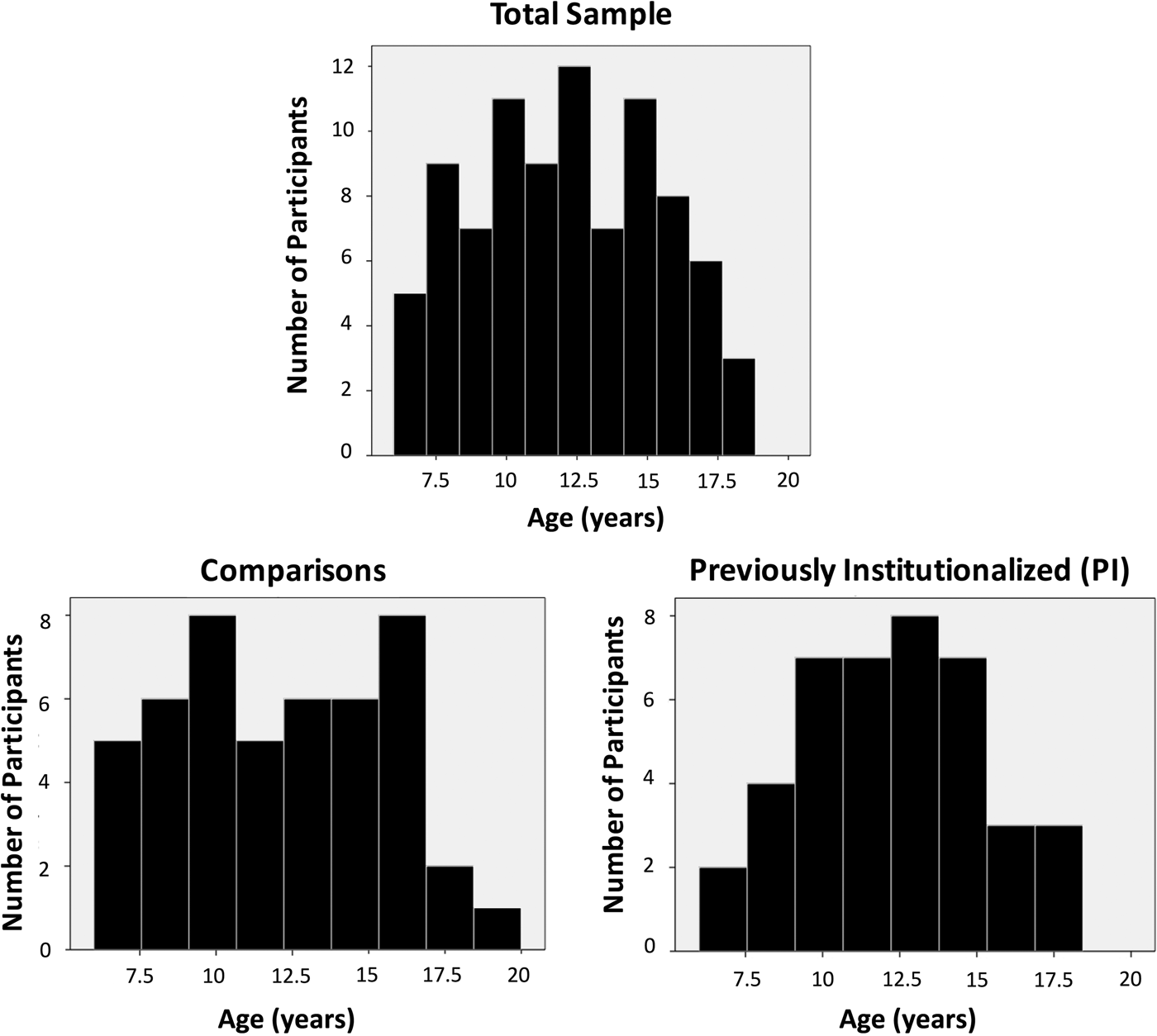
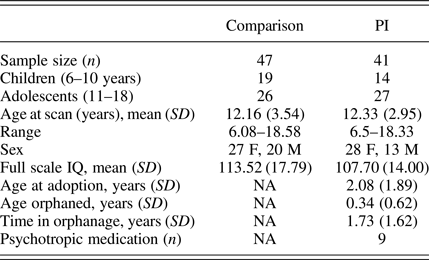
Resting-state functional magnetic resonance imaging (fMRI) data were acquired for 95 comparison (i.e., raised with biological family from birth) and PI (i.e., adopted out of institutional care) children and adolescents from the greater Los Angeles area. Two participants (1 comparison, 1 PI) were excluded from analyses due to missing parental assessments of child behavior. An additional 2 comparison participants were excluded due to exhibiting scores in the clinical range on measures of total problems and social problems as measured by the Child Behavior Checklist (CBCL; Achenbach, Reference Achenbach1991). Three PI participants were excluded as a function of the age at which they entered institutionalized care (after age 4). The final sample (see Table 1) included 88 participants between the ages of 6 and 18, comparison: N = 47, 27 female, 20 male, mean age = 12.15, SD = 3.54, N children (6–10 years) = 19, N adolecents (11–18 years) = 28; PI: N = 41, 28F/13M, mean age = 12.33, SD = 2.95; N children (6–10 years) = 14, N adolecents (11–18 years) = 27; see Figure 1. Mean age did not differ between comparison and PI groups, t (85.82) = 0.25, p > .80.
Distribution of participants’ ages.

Participant demographics
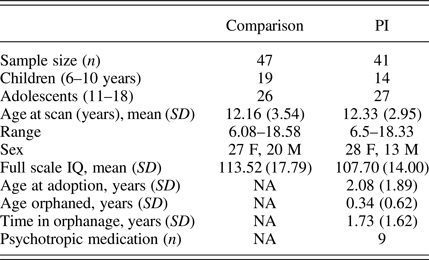
Data were collected at the University of California, Los Angeles. All procedures were approved by state and local institutional review boards. Comparison participants were recruited for this study via local advertisements and state birth records. PI participants were recruited through family networks in the Greater Los Angeles area. PI participants were placed into institutionalized care in Eastern Europe, Asia, South America, and Africa within the first 2 years of life before being adopted into stable families in the United States (mean age placed in orphanage = 0.34 years, SD = 0.62; mean age of adoption = 2.08 years, SD = 1.89; mean time spent in institutional care = 1.73 years, SD = 1.62). All families of potential study participants, comparisons and PIs, underwent a phone screening to ascertain whether children and adolescents met physical and psychological contraindications for fMRI, including psychotropic medication status, developmental disabilities, and neurological disorders. Comparison participants were free of psychotropic medication and clinical diagnoses as per parent report. Nine of the 41 PI participants were taking psychotropic medication. Upon arrival at the laboratory, after obtaining informed consent and assent, parents completed a series of assessments of mental health including the CBCL (Achenbach, Reference Achenbach1991). All comparison participants were below clinical cutoff scores (T = 64) for measures of CBCL total problems (M = 43.06, SD = 9.91), and below clinical cutoff scores on CBCL syndrome scales (T = 70). IQ was assessed prior to the scan session using the Wechsler Abbreviated Scale of Intelligence (Weschsler, Reference Weschsler1999); participants in both groups on average were within normal limits (comparisons: M = 113.52, SD = 17.79; PIs: M = 107.70, SD = 14.00).
fMRI data acquisition
All participants were acclimated to the fMRI scanner environment through a mock scanning session. Resting-state data were acquired at the end of a 45-min scanning session, which also included task-based scanning, to ensure that all participants were fully acclimated to being in the scanner. The resting-state scans were preceded by approximately 15 min of structural neuroimaging sequences to minimize influence from task-based scans (Fareri, Gabard-Durnam, et al., Reference Fareri, Gabard-Durnam, Goff, Flannery, Gee, Lumian and Tottenham2015; Gabard-Durnam et al., Reference Gabard-Durnam, Flannery, Goff, Gee, Humphreys, Telzer and Tottenham2014). We took extensive measures to minimize motion artifact in our data, as motion can have undue influence on measures of functional connectivity, including the use of a vacuum-packed pillow surrounding the head and then placing additional padding around participants’ heads during fMRI scanning. We also employed additional measures to deal with potential motion artifact during data preprocessing (described below). During the resting-state sequence, participants were instructed to remain still with their eyes closed, without falling asleep. A black screen with a white fixation cross was presented during the resting-state scan via MR-compatible video goggles (Resonance Technology, Inc.) to minimize distraction, in case participants did not remain with their eyes closed. Alertness was assessed via direct observation upon completion of the scan session and self-report.
All data were collected using a Siemens Trio 3T scanner with a 12-channel head coil. Anatomical data were acquired during a T1-weighted MPRAGE sequence prior to the resting-state scan (in-plane resolution: 256 × 256, field of view = 256 mm, 192 1 × 1 × 1 mm slices). Resting-state data were collected during a 6-min T2-weighted echoplanar imaging sequence in accordance with the following parameters: 33 oblique-axial slices, voxel size = 3.4 × 3.4 × 4.0 mm, slice thickness = 4 mm, field of view = 220 mm, 64 × 64 matrix, repetition time = 2000 ms, echo time = 30 ms, flip angle = 75°. Functional data were resampled to 3 × 3 × 3 mm space. Previous work indicates that a resting-state sequence of 6-min long allows for reliable and stable detection of rsFC (Van Dijk et al., Reference Van Dijk, Hedden, Venkataraman, Evans, Lazar and Buckner2010). Oblique axial slices were acquired at an angle of approximately 20–30 degrees in order to maximize functional coverage while minimizing signal dropout.
fMRI data preprocessing
Processing and analyses of neuroimaging data were conducted using Analysis of Functional Neuroimages (AFNI) software (Version 16.2.01; Cox, Reference Cox1996). The first two volumes of the resting-state scan were discarded in addition to those discarded by the scanner to account for stabilization of the blood oxygen level dependent signal. Standard preprocessing steps were employed via afni_proc.py including slice-time correction (Fourier interpolation) and six-parameter motion correction (Fourier interpolation). Volumes of data exhibiting greater than 0.5 mm frame-to-frame motion and their preceding volume were excluded from analysis (i.e., censored). The mean amount of volumes censored across participants in our sample was 22.86 (SD = 24.65; ~12.9%). Thus, on average, participants contributed 155.14 (SD = 24.65) usable volumes of resting-state data, and no individual participant had more than 3 SD above the mean amount of volumes censored. Functional data were normalized to percent signal change, and registered to anatomical images and warped to standard Talairach space (Talairach & Tournoux, Reference Talairach and Tournoux1988). Evidence indicates that registration of child and adolescent neuroimaging data to a standard adult template is methodologically appropriate within the age range of this study (Burgund et al., Reference Burgund, Kang, Kelly, Buckner, Snyder, Petersen and Schlaggar2002; Kang, Burgund, Lugar, Petersen, & Schlaggar, Reference Kang, Burgund, Lugar, Petersen and Schlaggar2003). Subject-specific anatomical data were skull-stripped and segmented into tissue classes to create masks used to subsequently generate subject specific tissue regressors for white matter and cerebrospinal fluid, as well as mean global signal across the brain.
Resting-state fMRI data are particularly susceptible to confounding influence from submillimeter motion and physiological noise (Power, Barnes, Snyder, Schlaggar, & Petersen, Reference Power, Barnes, Snyder, Schlaggar and Petersen2012; Power, Schlaggar, & Petersen, Reference Power, Schlaggar and Petersen2015; Van Dijk, Sabuncu, & Buckner, Reference Van Dijk, Sabuncu and Buckner2012), particularly in developmental samples (Satterthwaite et al., Reference Satterthwaite, Wolf, Loughead, Ruparel, Elliott, Hakonarson and Gur2012; Van Dijk et al., Reference Van Dijk, Hedden, Venkataraman, Evans, Lazar and Buckner2010, Reference Van Dijk, Sabuncu and Buckner2012). To address these potential spurious influences on resting-state connectivity estimates, we applied a conservative bandpass filter (0.009 Hz < f < 0.08 Hz) to remove high-frequency signals that may be more susceptible to motion artifact, thereby exerting undue influence on resting-state connectivity estimates (Satterthwaite et al., Reference Satterthwaite, Wolf, Loughead, Ruparel, Elliott, Hakonarson and Gur2012). We performed simultaneous bandpassing and regression of nuisance signals from the resting-state blood oxygen level dependent data at the single-subject level (Hallquist, Hwang, & Luna, Reference Hallquist, Hwang and Luna2013). Nuisance regressors included 6 standard motion parameters (3 translation, 3 rotation) and their first-order temporal derivatives for a total of 12 motion regressors (Van Dijk et al., Reference Van Dijk, Hedden, Venkataraman, Evans, Lazar and Buckner2010, Reference Van Dijk, Sabuncu and Buckner2012), separate tissue regressors for white matter and cerebrospinal fluid signal across the brain, and a regressor for the mean global signal. There has been extensive debate regarding the inclusion of global signal regression in studies of resting-state connectivity due to the potential to induce spurious negative correlations (Hampson, Driesen, Roth, Gore, & Constable, Reference Hampson, Driesen, Roth, Gore and Constable2010; Saad et al., Reference Saad, Reynolds, Jo, Gotts, Chen, Martin and Cox2013; Satterthwaite et al., Reference Satterthwaite, Elliott, Gerraty, Ruparel, Loughead, Calkins and Wolf2013) and altered distant-dependent functional relationships. However, additional evidence suggests that inclusion of the global signal is an effective method of reducing motion-related artifact in resting-state data (Miranda-Dominguez et al., Reference Miranda-Dominguez, Mills, Grayson, Woodall, Grant, Kroenke and Fair2014; Power et al., Reference Power, Schlaggar and Petersen2015), particularly in the absence of additional physiological measurements (e.g., heart rate) that could serve as nuisance regressors (Chen et al., Reference Chen, Chen, Xie, Ward, Li, Antuono and Li2012).
Gaussian spatial smoothing was performed using the 3dBlurtoFWHM option in AFNI. The 3dBlurtoFWHM program applies an “adaptive smoothing” method such that all participants’ data are smoothed up to an approximate given limit to better ensure consistency in the amount of smoothing applied based on differences in the intrinsic noise of the residuals in single participants’ data. We set an upper limit of smoothing to be 9 mm for our data.
We were primarily interested in examining differences between comparison and PI participants in ventral striatal rsFC, and as such, we performed a seed-based analysis. As we had no a priori hypotheses regarding laterality differences, we used a bilateral ventral striatal region of interest (ROI) mask taken from the Oxford-GSK-Imanova structural striatal atlas (Tziortzi et al., Reference Tziortzi, Searle, Tzimopoulou, Salinas, Beaver, Jenkinson and Gunn2011) included in FSL (FMRIB, Oxford, UK), as in our previous work (Fareri, Gabard-Durnam, et al., Reference Fareri, Gabard-Durnam, Goff, Flannery, Gee, Lumian and Tottenham2015). This mask includes the nucleus accumbens, ventral caudate, and ventral putamen, given difficulties in precisely defining anatomical boundaries between the nucleus accumbens and different ventral striatal subregions in humans, which are best delineated as a function of afferent/efferent projections and differences in neurotransmitter concentrations (Haber, Kim, Mailly, & Calzavara, Reference Haber, Kim, Mailly and Calzavara2006; Haber & Knutson, Reference Haber and Knutson2010; Haber & McFarland, Reference Haber and McFarland1999). The ventral striatal ROI was warped to standard Talairach space in AFNI and overlaid on each participant's anatomical data; the overlap between the ROI and an individual participants’ white matter mask was subtracted out to avoid including white matter voxels within the ventral striatal ROI. Raw time series from the ventral striatum was extracted from each participant's functional data after nuisance regression but prior to spatial smoothing of the data. Single-subject regression using 3dREMLFit in AFNI was used to generate single-subject, whole-brain rsFC maps; 3dREMLFit uses least squares restricted maximum likelihood estimation via an ARMA(1,1) model to determine the best fit for each voxel in the brain and to address serial autocorrelations in the residuals of the data. Whole-brain maps reflecting parameter estimates from the regression model of ventral striatal connectivity at the single-subject level were converted to correlation coefficients (r) to improve stability of the connectivity estimates.
Behavioral analyses
We conducted linear regression using R statistical language to test for group differences on parent reports of behavior from the CBCL (total problems raw scores and social problems raw scores), controlling for age and sex. We used raw scores so as not to be redundant in subsequent analyses described below including age and sex as regressors, as T scores are normed on these variables (Achenbach, Reference Achenbach1991).
Group connectivity analyses
Our first aim was to characterize the effect of group (PI, comparison) on ventral striatal rsFC. We conducted whole-brain analyses in AFNI using 3dttest++. Individual participants’ whole-brain connectivity estimates were entered into whole-brain linear regression with group, age, and sex as regressors in our model; we also included mean framewise displacement (FD) as a group-level motion regressor to further account for potential influence of motion (Fareri, Gabard-Durnam, et al., Reference Fareri, Gabard-Durnam, Goff, Flannery, Gee, Lumian and Tottenham2015; Gabard-Durnam et al., Reference Gabard-Durnam, Flannery, Goff, Gee, Humphreys, Telzer and Tottenham2014, Reference Gabard-Durnam, Gee, Goff, Flannery, Telzer, Humphreys and Tottenham2016; Power et al., Reference Power, Schlaggar and Petersen2015; Van Dijk et al., Reference Van Dijk, Sabuncu and Buckner2012).
For whole brain-analyses, regressors were mean-centered across groups in AFNI using the –center SAME option within 3dttest++. Whole-brain results for all analyses were set to an initial height threshold of p < .025 and subsequently corrected for multiple comparisons to a corrected level of p < .05 using the most updated version of the 3dClustSim program in AFNI. This program runs a series of Monte Carlo simulations across the whole brain based on the noise of the residuals of the single-subject regression output. Using 3dFWHMx and applying the spatial autocorrelation function (-acf) to account for the non-Gaussian nature of imaging data, we calculated the average smoothness of the residuals of all participants. Across all participants in our sample, the fit of the residual noise in our data to a Gaussian estimation was approximately 45%, and approximately 55% exponential. An effective smoothness was calculated to be 13.76 mm when accounting for these factors. (For completeness, we note the average smoothness of the residuals only estimating a Gaussian distribution, i.e., not incorporating the autocorrelation function, was 8.57 mm). The noise smoothness estimates were then entered as inputs into 3dClustSim (estimated smoothness = 13.76 mm). Whole-brain statistical parametric maps were set to a cluster level threshold of k = 250 voxels (using first nearest neighbor clustering) as determined by 3dClustSim.
Associations between connectivity and social functioning
Ventral striatal rsFC associations with CBCL social problems were assessed. Connectivity estimates were extracted from voxels surviving correction for multiple comparisons (see below) and entered into offline regression analyses in R statistical language, residualized for age, sex, and motion. Residual connectivity estimates were then entered into a linear regression to examine relationships with social problems. We also conducted this analysis controlling for age, sex, and measures of CBCL total problems (total problems was included as a control variable to identify the unique associations for social problems).
To assess whether observed group differences in CBCL social problems were associated with ventral striatal–mPFC rsFC, and whether age moderated either of these relationships, we conducted a no-parametric bootstrapped moderated mediation analysis (Model 15) in SPSS using the PROCESS macro (v. 2.16.3; Hayes, Reference Hayes2012). Moderation and mediation were assessed via bias-corrected bootstrapped confidence intervals (BC CIs; Efron, Reference Efron1987; Hayes & Scharkow, Reference Hayes and Scharkow2013). CIs not crossing zero indicate significant effects. Age was entered as a moderating variable in this analysis; regressors for the interaction products (i.e., age, group, and ventral striatal–mPFC rsFC) were mean centered within PROCESS using the mean center for products option. Mean FD was also entered as an additional mean centered regressor of no interest.
Adoption-related analyses
Associations between adoption-related variables (i.e., age of adoption, age placed into institutionalized care, and time with family) and clusters exhibiting rsFC with the ventral striatum were assessed. Linear regressions were conducted offline in R statistical language, controlling for age, sex, and mean FD.
Results
Group differences in behavioral measures
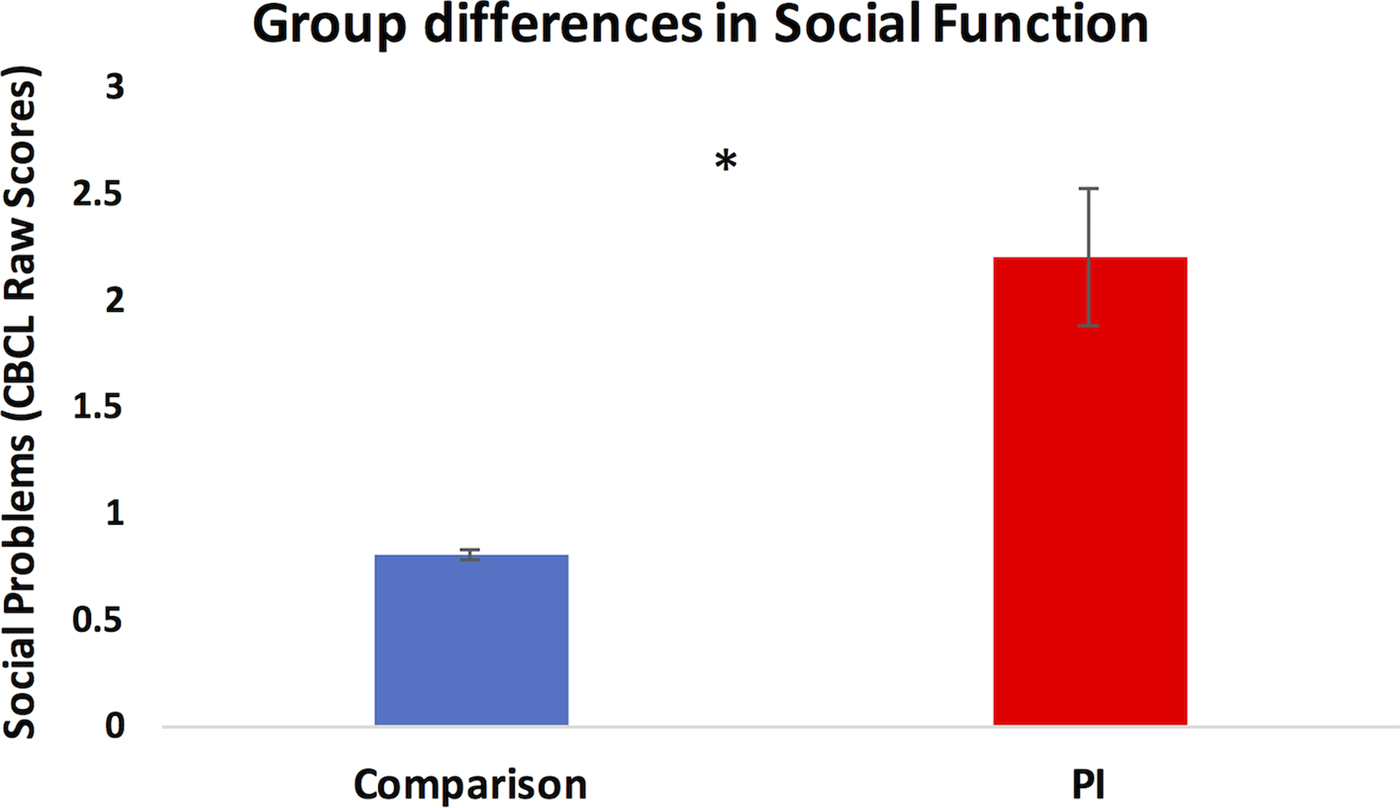
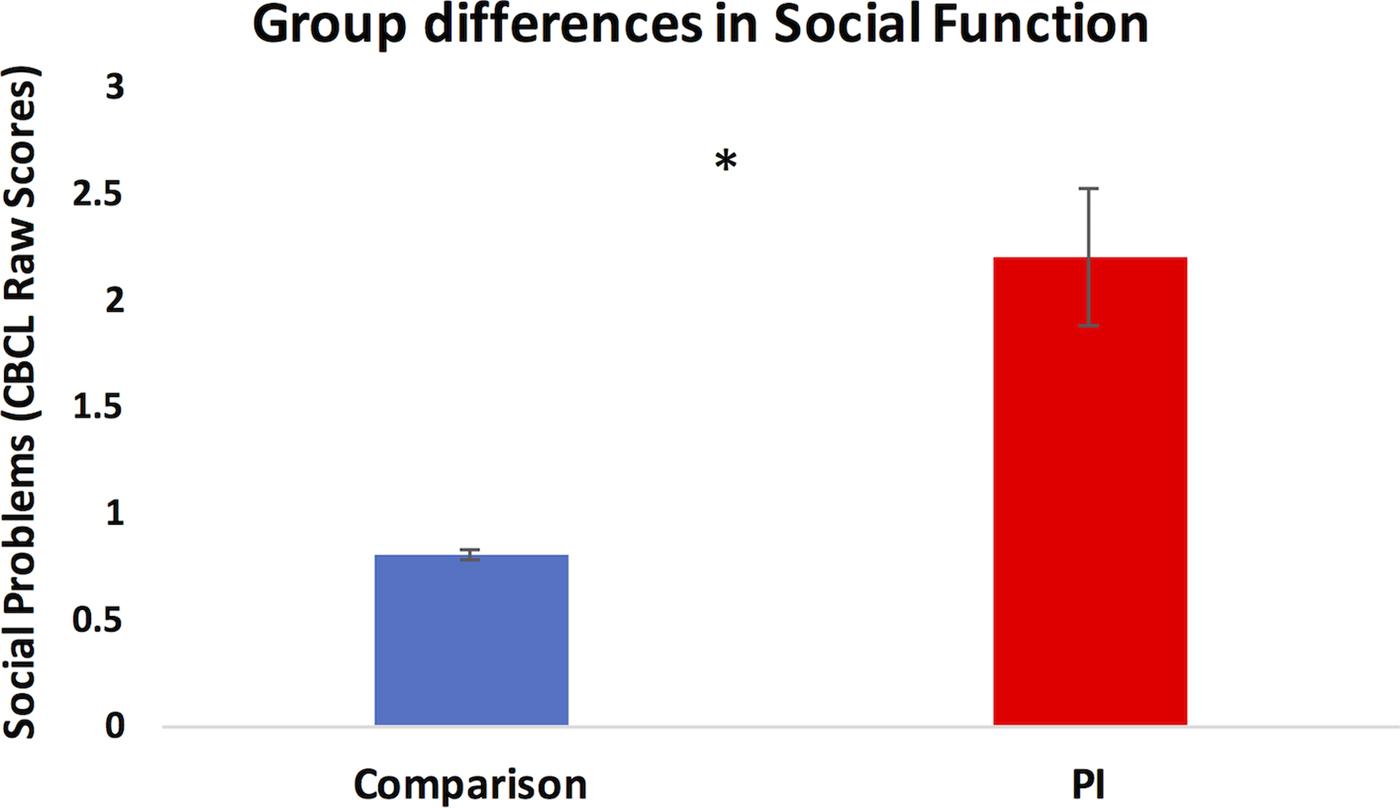
Linear regression revealed significant group differences (β = 1.41, SE = 0.37, t = 3.81, p < .0005) on parent-reported CBCL social problems and total problems, controlling for age and sex. PI youths demonstrated significantly higher scores on social problems (PI: M = 2.20, SD = 2.18; comparison: M = 0.81, SD = 1.12; Figure 2) and total problems (PI: M = 35.71, SD = 22.98; comparison: M = 13.34, SD = 10.71) than comparison youth.
(Color online) Group differences in Child Behavior Checklist social problems.
Whole-brain connectivity analyses: Group differences
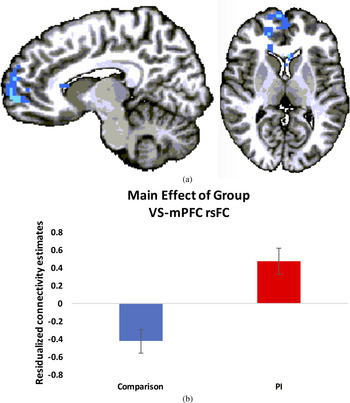
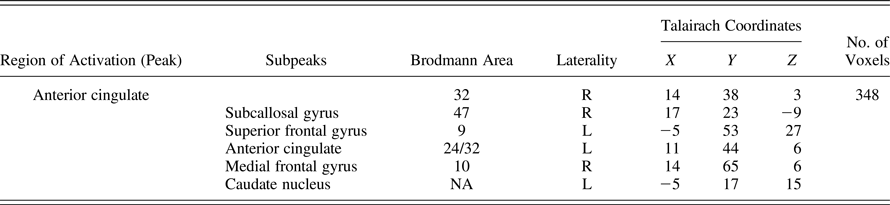
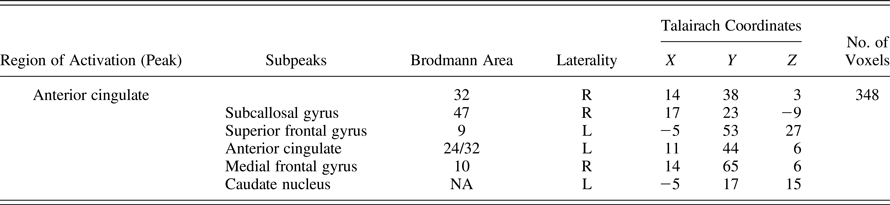
We conducted a whole-brain analysis examining a main effect of group, controlling for age, sex, and mean FD. Correcting for multiple comparisons, a significant main effect of group emerged in connectivity between the ventral striatum and a large cluster of the bilateral medial prefrontal cortex (see Figure 3a, Table 2). This cluster encompassed portions of Brodmann area 9 (BA9), BA10, BA24, BA32, and BA47 within the mPFC, and extended posteriorly to the head of the caudate bilaterally. Extracting connectivity estimates from voxels in the mPFC revealed significantly more positive ventral striatal rsFC with the mPFC in PI participants versus comparison participants (Figure 3b). No other regions emerged as showing significant group differences or interactions of group and age, group and gender, or main effects of age.
(Color online) Group differences in ventral striatal resting-state functional connectivity (rsFC). (a) A whole-brain analysis controlling for age, sex, and mean framewise displacement revealed significant group differences in ventral striatal rsFC with regions of the anterior medial prefrontal cortex (mPFC; cluster-level corrected, p < .05). (b) Previously institutionalized youth exhibited significantly more positive rsFC between the ventral striatum and mPFC than comparison youth.

Regions demonstrating a main effect of group in ventral striatal resting-state functional connectivity
Associations between rsFC and social functioning
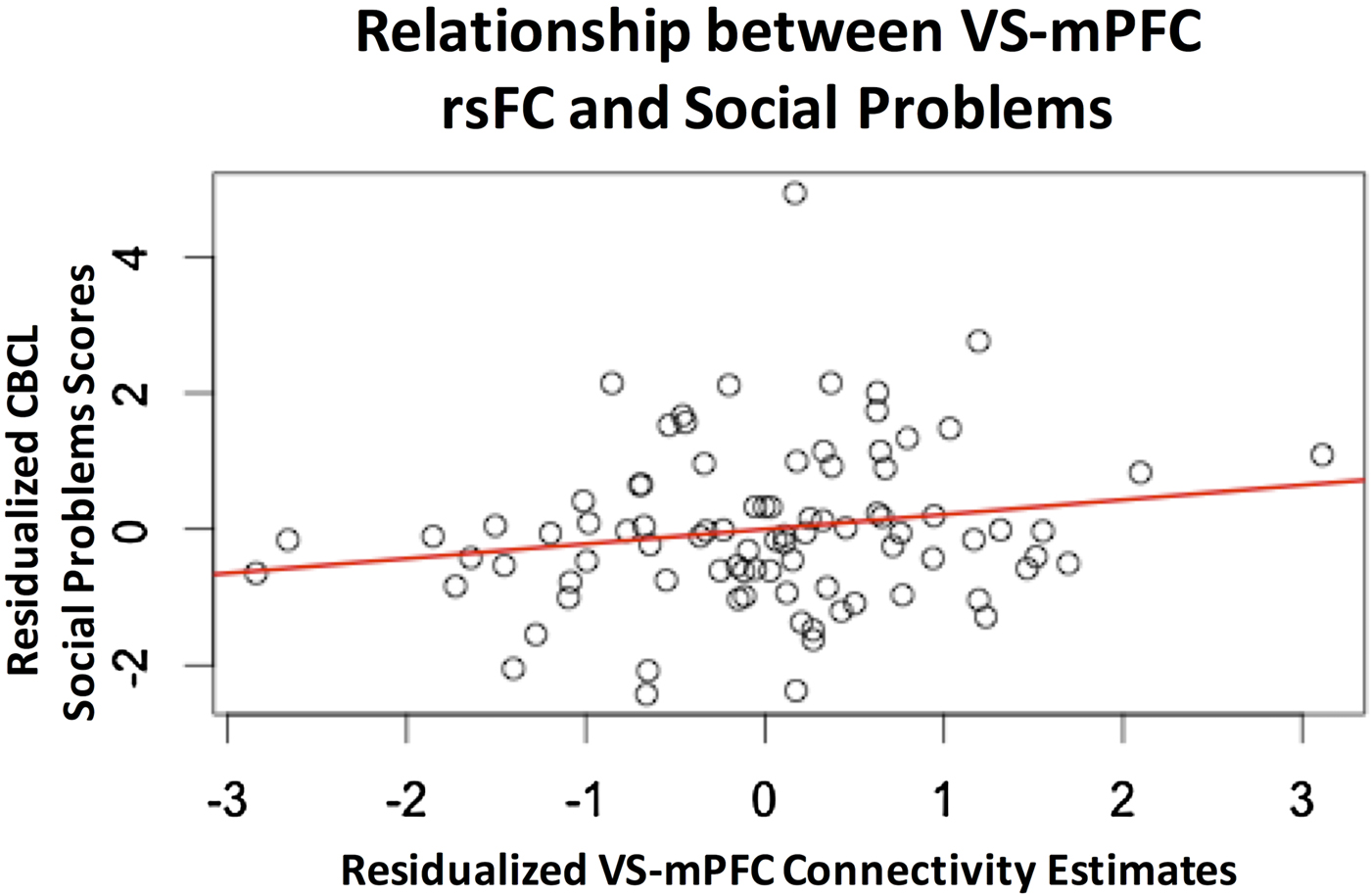
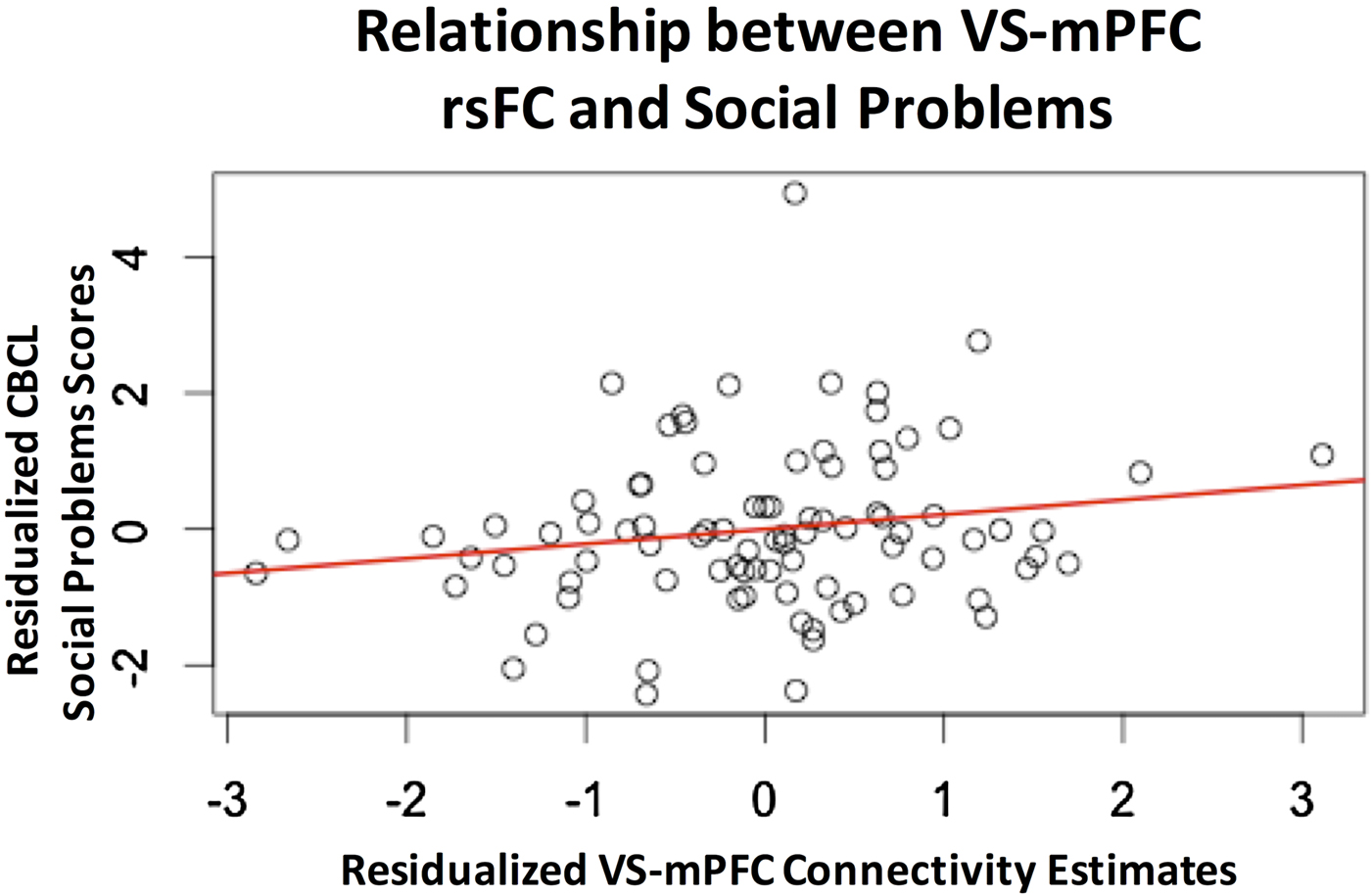
We employed linear regression to examine the relationship between ventral striatal–mPFC rsFC and CBCL social problems. Across all participants in our sample, a significant positive relationship emerged between social problems and ventral striatal–mPFC rsFC (Figure 4). Higher social problems scores were associated with stronger positive connectivity (β = 0.28, SE = 0.11, t = 2.63, p < .01). This overall pattern held when conducting the analysis controlling for levels of total problems, age, and sex, albeit we note that the relationship became slightly weaker (β = 0.13, SE = 0.07, t = 1.774, p = .095).
(Color online) Relationship between ventral striatal–medial prefrontal cortex (VS–mPFC) resting-state functional connectivity (rsFC) and Child Behavior Checklist (CBCL) social problems. A linear regression revealed a positive association between VS–mPFC connectivity and social problems scores across the entire sample (p < .01), which remained a trend when controlling for age, sex, and CBCL total problems (p = .095). Plot depicts connectivity estimates residualized for age, motion, and sex against CBCL social problems raw scores, residualized for age, sex, and CBCL total problems raw scores.
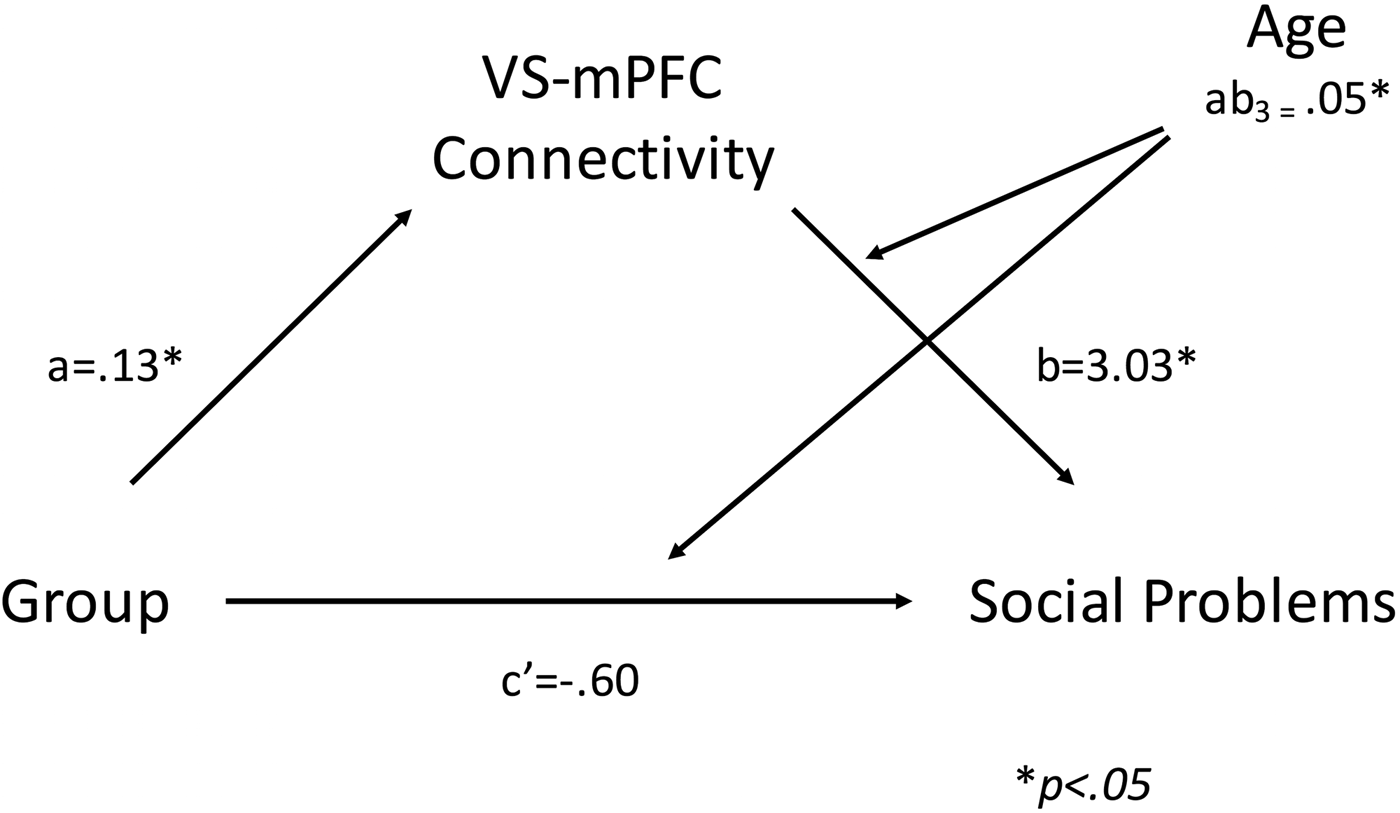
To further examine the relationship between ventral striatal–mPFC connectivity and social functioning, we conducted a nonparametric bootstrapped moderated mediation analysis to test whether higher levels of social problems in PI youth were significantly mediated by ventral striatal–mPFC rsFC, examining a moderating role of age. This analysis revealed that the direct effect of group on social problems became nonsignificant, c′ = 0.60, BC CI [–1.27, 0.07], with significant indirect effect of group on social problems through ventral striatal–mPFC rsFC at all values of the moderator (age), mean centered age value = –3.26: path coefficient = 0.21, BC CI [0.04, 0.47]; mean centered age value = 0: path coefficient = 0.39, BC CI [0.14, 0.79]; mean centered age value = 3.26: path coefficient = 0.56, BC CI [0.18, 1.21]; see Figure 5). The positive slope indicated by the path coefficients and CIs, in conjunction with the sign of the index of moderated mediation, ab3 = 0.005, BC CI [0.002, 0.14], suggests that the effect of connectivity on social problems increases with age in our sample.
Age moderates the mediating effect of ventral striatal–medial prefrontal cortex resting-state functional connectivity on group differences in social function. *p < .05.

Adoption-related variables
Separate linear regressions within the PI sample examining associations between ventral striatal–mPFC rsFC and age of adoption, age placed into institutionalized care, and time with family as regressors of interest controlling for age, sex, and mean FD revealed no significant associations with adoption-related variables.
Discussion
Early caregiving adversity has been associated with increased risk for socioaffective difficulties and altered development of the ventral striatum and mPFC, regions central to social behaviors. The current study identified alterations of the intrinsic functional connectivity between the ventral striatum and mPFC and associations with social problems as reported by parents. Our main results showed that the ventral striatal rsFC mainly with anterior regions of mPFC differed as a function of early life adversity: on average, PI youth showed significantly more positive connectivity than did comparison youth. Atypical ventral striatal–mPFC rsFC was associated with parental reports of social problems. Ventral striatal–mPFC rsFC significantly mediated the relationship between group differences in early caregiving history and social function. This mediation was moderated by age, such that ventral striatal–mPFC connectivity was more likely to statistically explain social problems in adolescents. These findings suggest that early institutional care increases the risk for social problems, which is mediated by alterations to ventral striatal connectivity with the mPFC.
Altered ventral striatal rsFC in PI youth
Our first goal was to examine differences in resting-state connectivity between PI and comparison youth who were raised with their biological families from birth. There is an extensive literature across species suggesting that both the ventral striatum and mPFC are targets of early caregiving adversity (Callaghan & Tottenham, Reference Callaghan and Tottenham2015; Fareri & Tottenham, Reference Fareri and Tottenham2016; Gee, Gabard-Durnam, et al., Reference Gee, Gabard-Durnam, Flannery, Goff, Humphreys, Telzer and Tottenham2013; Matthews, Dalley, Matthews, Tsai, & Robbins, Reference Matthews, Dalley, Matthews, Tsai and Robbins2001; Matthews & Robbins, Reference Matthews and Robbins2003; Matthews, Wilkinson, & Robbins, Reference Matthews, Wilkinson and Robbins1996; Mehta et al., Reference Mehta, Gore-Langton, Golembo, Colvert, Williams and Sonuga-Barke2010), regions associated with social and affective function (Burnett et al., Reference Burnett, Sebastian, Kadosh and Blakemore2011; Crone & Dahl, Reference Crone and Dahl2012; Fareri & Delgado, Reference Fareri and Delgado2014; Tottenham & Galván, Reference Tottenham and Galván2016). We found support for our hypothesis of aberrant ventral striatal rsFC, with PI youth exhibiting more positive connectivity between the ventral striatum and mPFC.
The mechanisms underlying this difference cannot be ascertained from this current study. We did not observe associations with adoption variables, thus leaving open many possibilities as to the reasons for this group difference. For example, it is possible that these neural patterns reflect differences in prenatal or genetic factors to which the PI youth could have been exposed. Alternatively, it is possible that the effect of institutional caregiving is so species atypical that there is no dose-response association observable (i.e., even short durations of caregiver deprivation and/or institutional care increases the risk). It is also possible, however, that these brain differences reflect an ontogenetic adaptation to compensate for the lack of expected social input early in life, as has been argued in other neurodevelopmental domains (Callaghan & Richardson, Reference Callaghan and Richardson2011; Gee, Humphreys, et al., Reference Gee, Humphreys, Flannery, Goff, Telzer, Shapiro and Tottenham2013; Tottenham et al., Reference Tottenham, Hare, Millner, Gilhooly, Zevin and Casey2011). Viewed through this lens, more positive connectivity between the ventral striatum and mPFC in PI youth may be a neural adaptation to enhance connections between the mPFC and a hypoactive ventral striatum (Goff et al., Reference Goff, Gee, Telzer, Humphreys, Gabard-Durnam, Flannery and Tottenham2013; Mehta et al., Reference Mehta, Gore-Langton, Golembo, Colvert, Williams and Sonuga-Barke2010). As the more anterior regions of the mPFC exhibiting positive connectivity with the ventral striatum in the current sample of PI youth have been associated with positive connectivity in adults (Di Martino et al., Reference Di Martino, Scheres, Margulies, Kelly, Uddin, Shehzad and Milham2008), and the comparison youth demonstrated negative ventral striatal–mPFC rsFC, it is possible that PI youth show an accelerated development of ventral striatal–mPFC rsFC. However, the lack of adults in our sample, and lack of a Group × Age interaction in these voxels makes this purely speculative. Future studies of individuals with a history of previous institutionalization that incorporate adult participants will be important for better evaluating differences in the development of connectivity following early caregiving adversity.
Associations between ventral striatal–mPFC rsFC and social function
A significant positive association was observed between ventral striatal–mPFC rsFC and parental report measures of CBCL social problems across the entire sample. This overall pattern of results remained when controlling for parent-reported total problems, sex, and age, suggesting that ventral striatal–mPFC connectivity at rest is related to social function and cannot be explained completely by general problem behaviors. We also found that the nature of connectivity between the ventral striatum and mPFC significantly mediated group differences in social function. Further, this relationship was moderated by age: the link between ventral striatal–mPFC rsFC and group differences in social problems was a linearly increasing function of age. Because we identified no age-related change in ventral striatal–mPFC rsFC, this finding suggests that atypical ventral striatal–mPFC connectivity is more likely to explain social problems in PI adolescents to a greater degree than it does in PI children (whose social problems might be related to different neural systems). The nature of items making up the social problems scale on the CBCL includes, among other things, parental assessments of their child's social dependency, loneliness, how well they get along with/are liked by peers, and the degree to which they prefer interacting with same-aged and older peers. Thus, higher scores on this composite measure of social function would indicate poorer abilities to relate to and establish normative interactions with same-aged peers. Adolescence is not only a time characterized by heightened sensitivity to incentives and increased exploration (Galván, Reference Galván2010) but also a time during which interactions and relationships with peers take on increasing importance (Casey, Reference Casey2015; Casey, Duhoux, & Malter Cohen, Reference Casey, Duhoux and Malter Cohen2010); these behavioral phenomena are often studied within the context of ventral striatal-prefrontal development (Crone & Dahl, Reference Crone and Dahl2012; Galván, Reference Galván2013; Pfeifer et al., Reference Pfeifer, Masten, Moore, Oswald, Mazziotta, Iacoboni and Dapretto2011, Reference Pfeifer, Kahn, Merchant, Peake, Veroude, Masten and Dapetto2013; Somerville, Jones, & Casey, Reference Somerville, Jones and Casey2010). Placed within this context, the altered patterns of ventral striatal–mPFC connectivity exhibited by PI youth may place them at greater risk for social difficulty during adolescence via instantiation of dysregulated social approach behaviors and a decreased ability to appropriately integrate social signals from others. Future studies should include tasks involving social incentives that incorporating real-life social context (i.e., close peer relationships) to better characterize the nature of social function as dependent upon ventral striatal–mPFC connectivity in adolescents with a history of previous institutionalization.
The mechanistic link between ventral striatal–mPFC rsFC and social problems cannot be determined from the current study. There may be many reasons for this link. For example, a robust literature in humans and nonhuman animals implicates the ventral striatum as critical to reward valuation within social contexts. The ventral striatum is critically involved in social interactions, supporting the learning of others’ reputations (Delgado, Frank, & Phelps, Reference Delgado, Frank and Phelps2005; Fareri, Chang, & Delgado, Reference Fareri, Chang and Delgado2012), integrating the value of social relationships into the representation of shared experiences (Fareri, Chang, & Delgado, Reference Fareri, Chang and Delgado2015; Fareri, Niznikiewicz, Lee, & Delgado, Reference Fareri, Niznikiewicz, Lee and Delgado2012), and representing social actions (Báez-Mendoza, Harris, & Schultz, Reference Báez-Mendoza, Harris and Schultz2013), the value of reciprocity (Phan et al., Reference Phan, Sripada, Angstadt and McCabe2010), and mutually interdependent outcomes (Rilling et al., Reference Rilling, Gutman, Zeh, Pagnoni, Berns and Kilts2002). This region may thus serve as a hub to translate social value signals into appropriate social action (Báez-Mendoza & Schultz, Reference Báez-Mendoza and Schultz2013). In typically developed humans, the mPFC is implicated in both reward-based (Bartra et al., Reference Bartra, McGuire and Kable2013) and social cognitive processes, that is, mentalizing, self/other representations, and representing the social value of others (Amodio & Frith, Reference Amodio and Frith2006; Fareri, Chang, et al. Reference Fareri, Chang and Delgado2015; Frith & Frith, Reference Frith and Frith2006; Hampton, Bossaerts, & O'Doherty, Reference Hampton, Bossaerts and O'Doherty2008; Krienen, Tu, & Buckner, Reference Krienen, Tu and Buckner2010; Mitchell, Banaji, & Macrae, Reference Mitchell, Banaji and Macrae2005; Smith, Clithero, Boltuck, & Huettel, Reference Smith, Clithero, Boltuck and Huettel2014). Thus the altered ventral striatal–mPFC rsFC observed in PI youth could reflect an altered ability to assess and use socially valued information appropriately. Initial support for this idea can be drawn from related work suggesting altered neural responses in the amygdala and dorsal mPFC in PI youth is related to atypical social evaluation, social approach behaviors, and blunted responses to negative social experiences (Olsavsky et al., Reference Olsavsky, Telzer, Shapiro, Humphreys, Flannery, Goff and Tottenham2013; Puetz et al., Reference Puetz, Kohn, Dahmen, Zvyagintsev, Schüppen, Schultz and Konrad2014). Alternatively, it is possible that atypical ventral striatal–mPFC connectivity increases impulsivity in social contexts and directs the individual toward more reactive social drives (Tops et al., Reference Tops, Koole, Ijzerman and Buisman-Pijlman2014). The value of the current study is in its identification of a brain–behavior link that necessitates further investigation to identify mechanistic explanations.
Limitations
There are limitations of this study worth noting. We used a validated, composite measure of social problem behavior in the CBCL social problems scale. However, as noted above, this composite measure makes it difficult to link specific types of social difficulties with ventral striatal–mPFC rsFC. Future work investigating social function in PI samples can employ more specific measures of social domains to examine the functional significance of ventral striatum resting-state connectivity (e.g., social approach, social learning, impulsivity, and competence) and should explore associations between both resting-state measures of connectivity and task-based measures of functional connectivity (Gabard-Durnam et al., Reference Gabard-Durnam, Gee, Goff, Flannery, Telzer, Humphreys and Tottenham2016) during social processes across development.
We also acknowledge the current state of affairs in the field regarding issues of thresholding and false positives (Eklund, Nichols, & Knutsson, Reference Eklund, Nichols and Knutsson2016). We note that our cluster formation threshold was lenient, and our findings should be considered in light of that. However, current suggestions to address false positives in neuroimaging data also include more stringent cluster correction procedures, including correctly accounting for the non-Gaussian nature of the intrinsic smoothness of imaging data via spatial autocorrelation. Our findings do survive these stricter algorithms for employing cluster based correction, and therefore we feel confident in our assessment of the differences in ventral striatal–mPFC rsFC between comparison and PI youth.
Conclusions
The current findings identify group differences in resting-state connectivity as a function of early care environments and link these to reported social problems in a task-free manner. While there are many more questions that require further study, these data provide a first step towards understanding how early caregiving experiences might influence resting-state connectivity and associated behavior.