Introduction
Globalization has led to a significant rise in the rate at which species are being introduced to regions beyond their natural areas (Roy et al. 2023, Seebens et al. Reference Roy, Pauchard, Stoett, Renard Truong, Bacher, Galil, Hulme, Ikeda, Sankaran, McGeoch, Meyerson, Nuñez, Ordonez, Rahlao, Schwindt, Seebens, Sheppard and Vandvik2021). While only a small proportion of introduced species become invasive (i.e., survive and spread over long distances in the introduced areas, Richardson et al. Reference Richardson, Pyšek, Rejmánek, Barbour, Panetta and West2000), invasive species can have dramatic environmental and socioeconomic impacts (Bacher et al. Reference Bacher, Blackburn, Essl, Jeschke, Genovesi, Heikkilä, Jones, Keller, Kenis, Kueffer, Martinou, Nentwig, Pergl, Pyšek, Rabitsch, Richardson, Roy, Saul, Scalera, Vilà, Wilson and Kumschick2018, Kumschick et al. Reference Kumschick, Bacher, Bertolino, Blackburn, Evans, Roy and Smith2020), and biological invasions are among the major threats to biodiversity globally (Brondizio et al. Reference Brondizio, Settele, Díaz and Ngo2019, Roy et al. Reference Roy, Pauchard, Stoett, Renard Truong, Bacher, Galil, Hulme, Ikeda, Sankaran, McGeoch, Meyerson, Nuñez, Ordonez, Rahlao, Schwindt, Seebens, Sheppard and Vandvik2023). In the last decade, knowledge of the global distribution of alien organisms has increased dramatically (Pyšek et al. Reference Pyšek, Hulme, Simberloff, Bacher, Blackburn, Carlton, Dawson, Essl, Foxcroft, Genovesi, Jeschke, Kühn, Liebhold, Mandrak, Meyerson, Pauchard, Pergl, Roy, Seebens, van Kleunen, Vilà, Wingfield and Richardson2020b), as has awareness of invasions in protected areas (Foxcroft et al. Reference Foxcroft, Pyšek, Richardson, Genovesi and MacFadyen2017, Shackleton et al. Reference Shackleton, Foxcroft, Pyšek, Wood and Richardson2020). While protected areas are frequently the focus of intensive ecological research programmes, the effect of biological invasions is comparatively poorly studied (Hulme et al. Reference Hulme, Pyšek, Pergl, Jarošík, Schaffner and Vilà2014), leading to a lack of quantitative data on impacts on which to base decisions.
Protected areas were shown to act as barriers to invasions by alien plants (Foxcroft et al. Reference Foxcroft, Jarošík, Pyšek, Richardson and Rouget2011, Pyšek et al. Reference Foxcroft, Jarošík, Pyšek, Richardson and Rouget2003) and offer refuge from invasive species under climate change (Gallardo et al. Reference Gallardo, Aldridge, González-Moreno, Pergl, Pizarro, Pyšek, Thuiller, Yesson and Vilà2017). However, alien species still penetrate into protected areas, and nowadays, very few are known to be free of invasive species (Pyšek et al. Reference Pyšek, Pergl, Essl, Lenzner, Dawson, Kreft, Weigelt, Winter, Kartesz, Nishino, Antonova, Barcelona, Cabezas, Cárdenas, Cárdenas-Toro, Castaño, Chacón, Chatelain, Dullinger, Ebel, Figueiredo, Fuentes, Genovesi, Groom, Henderson, Inderjit, Kupriyanov, Masciadri, Maurel, Meerman, Morozova, Moser, Nickrent, Nowak, Pagad, Patzelt, Pelser, Seebens, Shu, Thomas, Velayos, Weber, Wieringa, Baptiste and van Kleunen2017, Reference Pyšek, Hulme, Simberloff, Bacher, Blackburn, Carlton, Dawson, Essl, Foxcroft, Genovesi, Jeschke, Kühn, Liebhold, Mandrak, Meyerson, Pauchard, Pergl, Roy, Seebens, van Kleunen, Vilà, Wingfield and Richardson2020b). In addition, the number and magnitude of alien plant invasions in protected areas are increasing; this trend is most pronounced for invasive plants that pose the greatest continued threat of all taxonomic groups, as their numbers in protected areas worldwide have increased by ∼30% compared to the situation 40 years ago (Shackleton et al. Reference Shackleton, Foxcroft, Pyšek, Wood and Richardson2020). Impacts by alien species have been shown to be as significant inside protected areas as outside, but only a small proportion provide actionable management recommendations (Hulme et al. Reference Hulme, Pyšek, Pergl, Jarošík, Schaffner and Vilà2014). Invasive plants are being introduced into protected areas by various means associated with human activities (ornamental species, tourism, vehicles), but also naturally via water courses (Foxcroft et al. Reference Foxcroft, Jarošík, Pyšek, Richardson and Rouget2011, Foxcroft et al. Reference Foxcroft, Spear, van Wilgen and McGeoch2019, Jarošík et al. Reference Foxcroft, Spear, van Wilgen and McGeoch2011). Thus, efforts to protect these areas from plant invasions are constrained by the introduction of alien species’ propagules. For example, rivers entering protected areas represent a big risk, as one cannot control what they bring in. Studies showed that the number of alien invasive plants inside a protected area could be predicted by several factors, of which water runoff from adjacent areas was the most important one (Foxcroft et al. Reference Foxcroft, Jarošík, Pyšek, Richardson and Rouget2011, Jarošík et al. Reference Jarošík, Pyšek, Foxcroft, Richardson, Rouget and MacFadyen2011).
Rivers have long been recognized as major pathways of alien plant introductions. On the one hand, most rivers flow through human settlements, from which they can carry propagules of alien plants into riparian sites (Hood & Naiman Reference Hood and Naiman2000, Planty-Tabacchi et al. Reference Planty-Tabacchi, Tabacchi, Naiman, Deferrari and Decamps1996). Moreover, fluctuating water levels in riparian areas may facilitate the establishment of these propagules since they provide open spaces by removing existing vegetation and increase available resources by depositing nutrients (Richardson et al. Reference Richardson, Holmes, Esler, Galatowitsch, Stromberg, Kirkman, Pyšek and Hobbs2007). As a result, alien plants often concentrate in riparian sites (e.g., Chytrý et al. Reference Chytrý, Maskell, Pino, Pyšek, Vilà, Font and Smart2008, Pyšek et al. Reference Pyšek, Bacher, Chytrý, Jarošík, Wild, Celesti-Grapow, Gassó, Kenis, Lambdon, Nentwig, Pergl, Roques, Sádlo, Solarz, Vilà and Hulme2010), and while some remain restricted to the vicinity of the river, often after a considerable time lag, some spread away from the river (Čuda et al. Reference Čuda, Skálová and Pyšek2020, Pyšek et al. Reference Pyšek, Hulme, Simberloff, Bacher, Blackburn, Carlton, Dawson, Essl, Foxcroft, Genovesi, Jeschke, Kühn, Liebhold, Mandrak, Meyerson, Pauchard, Pergl, Roy, Seebens, van Kleunen, Vilà, Wingfield and Richardson2020b). This represents a major threat to vegetation beyond the riparian ecosystems and can start new invasions into habitats previously unaffected.
Our knowledge of the dynamics and mechanisms of riverine invasions is largely based on temperate climatic regions (Planty-Tabacchi et al. Reference Planty-Tabacchi, Tabacchi, Naiman, Deferrari and Decamps1996, Pyšek et al. Reference Pyšek, Bacher, Chytrý, Jarošík, Wild, Celesti-Grapow, Gassó, Kenis, Lambdon, Nentwig, Pergl, Roques, Sádlo, Solarz, Vilà and Hulme2010). However, the role of rivers in invasions in subtropical and tropical regions may differ from those in temperate regions, where water levels are permanently high and invading plants spread along rivers by colonizing their banks. In subtropical arid regions, where water levels fluctuate depending on the season, invasive populations may occur directly in riverbeds which makes their invasion dynamics more closely dependent on channel dynamics and stream features (Sibiya Reference Sibiya2019) long-term weather patterns, and water level fluctuations (Foxcroft et al. Reference Foxcroft, Rouget and Richardson2007, Richardson et al. Reference Richardson, Holmes, Esler, Galatowitsch, Stromberg, Kirkman, Pyšek and Hobbs2007, Sibiya Reference Sibiya2019). The macro-channel floor in perennial river in ecosystems such as African savannas is formed by a mosaic of water and terrestrial patches, with the balance between the two environments dynamically changing, thus providing a permanent opportunity for the establishment of arriving invaders (Foxcroft et al. Reference Foxcroft, Parsons, McLoughlin and Richardson2008, Sibiya Reference Sibiya2019). Arid ecosystems are, in global comparison to other biomes, less invaded; this is due to several factors, such as the limited introduction of alien plants to these areas or the ability of native plants to resist stressful conditions (Pyšek et al. Reference Pyšek, Pergl, Essl, Lenzner, Dawson, Kreft, Weigelt, Winter, Kartesz, Nishino, Antonova, Barcelona, Cabezas, Cárdenas, Cárdenas-Toro, Castaño, Chacón, Chatelain, Dullinger, Ebel, Figueiredo, Fuentes, Genovesi, Groom, Henderson, Inderjit, Kupriyanov, Masciadri, Maurel, Meerman, Morozova, Moser, Nickrent, Nowak, Pagad, Patzelt, Pelser, Seebens, Shu, Thomas, Velayos, Weber, Wieringa, Baptiste and van Kleunen2017). However, invasions in these areas can have devastating consequences (see Milton & Dean Reference Milton and Dean2010 for review).
Much work has been done on the impacts of invasive alien trees and woody shrubs on river ecosystems (e.g., Beater et al. Reference Beater, Garner and Witkowski2008, Esler et al. Reference Esler, Holmes, Richardson and Witkowski2008, Witkowski & Garner Reference Witkowski and Garner2008), with some work on the management of annual and perennial shrubs and herbaceous species (Morris et al. Reference Morris, Witkowski and Coetzee2008). Unfortunately, to our knowledge, the fine-scale spatial dynamics in relation to invasions and their impacts on native plant communities has been little studied in subtropical and tropical riparian habitats (see Foxcroft et al. Reference Foxcroft, Parsons, McLoughlin and Richardson2008 and Sibiya Reference Sibiya2019 on patterns of alien plants across river geomorphology). To predict future invasions and provide managers and policymakers with a scientifically sound basis to support decision-making, understanding the impacts associated with pathways of invasion, such as rivers, is a key element (Hulme et al. Reference Hulme, Bacher, Kenis, Klotz, Kühn, Minchin, Nentwig, Olenin, Panov, Pergl, Pyšek, Roques, Sol, Solarz and Vilà2008).
Therefore, in this study, using Kruger National Park (KNP) as a model subtropical/tropical African savanna ecosystem, we focus on analysing the impact of three major herbaceous invasive species spreading along rivers on riparian savanna vegetation. The study is a contribution to the broader MOSAIK (Monitoring Savanna Biodiversity in Kruger National Park) project that explores patterns of species diversity across habitats in KNP (Delabye et al. Reference Delabye, Gaona, Potocký, Foxcroft, Halamová, Hejda, MacFadyen, Pyšková, Sedláček, Staňková, Storch, Pyšek and Tropek2022, Hejda et al. Reference Hejda, Čuda, Pyšková, Zambatis, Foxcroft, MacFadyen, Storch, Tropek and Pyšek2022, Pyšek et al. Reference Pyšek, Hejda, Čuda, Zambatis, Pyšková, MacFadyen, Storch, Tropek and Foxcroft2020a, Pyšková et al. Reference Pyšková, Pyšek and Foxcroft2022b). Specifically, we asked (i) what are the impacts of plant invaders generally, and by each dominant invasive species, on the plant community characteristics such as species richness, diversity, and evenness; and (ii) do invasions result in changes in plant species composition, also with regards to the native and alien status of the associated species?
Material and methods
Study area: Kruger National Park
Kruger National Park, established in 1898 and formally proclaimed in 1926, is the largest national park in South Africa and one of the oldest national parks in the world. It is located in the north-eastern part of the country, covering an area of 19,169 km2 and stretching ∼450 km north-south and 84 km east-west. The majority of KNP has a subtropical climate, with the Tropic of Capricorn crossing the park in the North, and several large rivers flow through the park, mostly in a west-east direction (i.e., Sabie, Olifants, Crocodile, Letaba, Shingwedzi, Luvuvhu and Limpopo). The park’s environmental heterogeneity stems from diverse geological conditions (granitoid bedrock in the western vs. volcanic, mainly basalt and gabbro, in the eastern part), altitude (140–780 m a.s.l.), climate (450–750 mm of annual precipitation), and vegetation (Hejda et al. Reference Hejda, Čuda, Pyšková, Zambatis, Foxcroft, MacFadyen, Storch, Tropek and Pyšek2022, MacFadyen et al. Reference Hejda, Čuda, Pyšková, Zambatis, Foxcroft, MacFadyen, Storch, Tropek and Pyšek2016). According to the latest update (Foxcroft et al. Reference Foxcroft, Moodley, Nichols and Pyšek2023), there are an estimated 146 alien plant species occurring in the wild in KNP, of which 30 are casuals, 58 are naturalized, 21 have become invasive, and for 37 species, the status remains to be determined (status categories according to Richardson et al. Reference Richardson, Pyšek, Rejmánek, Barbour, Panetta and West2000). In response to the escalating importance of plant invasions, KNP has initiated several programmes aimed at preventing and mitigating incursions of alien species (Foxcroft & Freitag-Ronaldson Reference Foxcroft and Freitag-Ronaldson2007, Foxcroft et al. Reference Foxcroft, Richardson, Rouget and MacFadyen2009, Koenig Reference Koenig2009), but to date, few studies investigated the impact of major invaders on plant community characteristics (Foxcroft et al. Reference Foxcroft, Parsons, McLoughlin and Richardson2008, Novoa et al. Reference Novoa, Foxcroft, Keet, Pyšek and Le Roux2021, Robertson et al. Reference Novoa, Foxcroft, Keet, Pyšek and Le Roux2011).
Study species
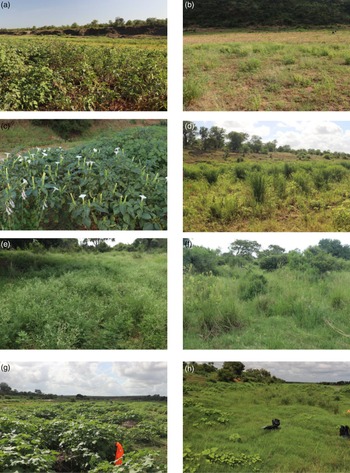
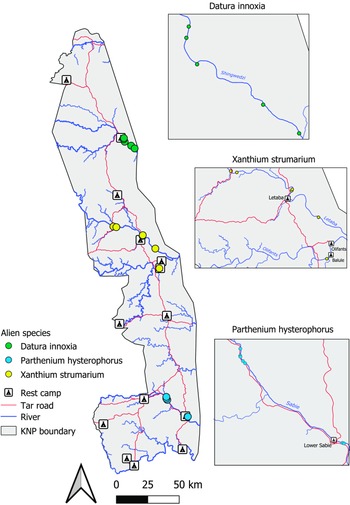
We focused on three major invasive species in KNP (Figure 1), whose selection was based on the following criteria: (i) they occur in riverbeds, where they dominate the invaded communities and form extensive stands (so that they are likely to have impacts on the river channel and adjacent riparian ecosystem); and (ii) they are controversial species of concern to KNP management because little is known about their impacts, potentially leading to the assumption that they are minor (especially for Xanthium strumarium and Datura spp.), and therefore, management recommendations are urgently needed. They represent a potential threat to savanna vegetation as they have successfully naturalized or become invasive, both globally and in other African countries (Table 1). Datura innoxia, Parthenium hysterophorus, and Xanthium strumarium are the species that best meet these criteria and represent the most problematic annual plant invaders in KNP. Parthenium hysterophorus largely occurs in the southern region of KNP, while D. innoxia and X. strumarium are typically found in high abundances in the northern region of the KNP (Figure 2).
Invasive alien species studied (a, c – Datura innoxia, e – Parthenium hysterophorus, g – Xanthium strumarium) and various types of uninvaded control plots (b, d, f) adjacent to those dominated by the invaders. Photos by P. Pyšek.

Characteristics of the target invasive species. Data on the number of regions (at the scale of countries) where the species has naturalized (globally/African) are taken from the GloNAF database (Pyšek et al. Reference Pyšek, Pergl, Essl, Lenzner, Dawson, Kreft, Weigelt, Winter, Kartesz, Nishino, Antonova, Barcelona, Cabezas, Cárdenas, Cárdenas-Toro, Castaño, Chacón, Chatelain, Dullinger, Ebel, Figueiredo, Fuentes, Genovesi, Groom, Henderson, Inderjit, Kupriyanov, Masciadri, Maurel, Meerman, Morozova, Moser, Nickrent, Nowak, Pagad, Patzelt, Pelser, Seebens, Shu, Thomas, Velayos, Weber, Wieringa, Baptiste and van Kleunen2017, van Kleunen et al. Reference van Kleunen, Dawson, Essl, Pergl, Winter, Weber, Kreft, Weigelt, Kartesz, Nishino, Antonova, Barcelona, Cabezas, Cárdenas, Cárdenas-Toro, Castaño, Chacón, Chatelain, Ebel, Figueiredo, Fuentes, Groom, Henderson, Inderjit, Kupriyanov, Masciadri, Meerman, Morozova, Moser, Nickrent, Patzelt, Pelser, Baptiste, Poopath, Schulze, Seebens, Shu, Thomas, Velayos, Wieringa and Pyšek2015). All species are annual and invasive in KNP (Foxcroft et al. Reference Foxcroft, Moodley, Nichols and Pyšek2023)

Location of study sites in the Kruger National Park. The Datura innoxia sites are indicated by red circles, Parthenium hysterophorus by yellow, and Xanthium strumarium by blue circles.

Sampling design and data
The plots invaded by the target species were sampled along Sabie, Letaba, Olifants, and Shingwedzi rivers (Figure 2). We located 12–13 populations of each invader in river beds and/or on river banks, distributed across 5, 6, and 7 sites per species (for D. innoxia, X. strumarium and P. hysterophorus, respectively). Within each population, we established a plot of 100 m2 with the invasive species dominating the vegetation, reaching at least 50% cover. The majority of plots were 10 × 10 m; where the character of the population did not allow to place a square, a different shape was used to achieve the same total cover (e.g., 8.0 × 12.5). For each invasive population, we located a plot of the same size in the adjacent uninvaded vegetation located in similar habitat conditions, representing the control (see Hejda et al. Reference Hejda, Pyšek and Jarošík2009 for details and potential caveats of the space-for-time substitution approach). This design resulted in 74 plots (37 invaded and 37 uninvaded, arranged in pairs) spread over 18 sites by four rivers (Figure 2), where the vegetation was sampled.
All plant species present in the herb layer of a plot were recorded, and their abundance was estimated using the Braun-Blanquet cover-abundance seven-grade scale (Mueller-Dombois & Ellenberg Reference Mueller-Dombois and Ellenberg1974); shrubs of height comparable to the surrounding herbs were included in the herb layer. This yielded the data on species richness, represented by the total number of species recorded in a plot. To quantify the occurrence of species in plots, the Braun-Blanquet scores were transformed to percentage cover values as follows: 5 = 87.5%, 4 = 62.5%, 3 = 37.5%, 2 = 15%, 1 = 2.5%, + = 1.0%, r = 0.02% (van der Maarel Reference van der Maarel1979). These values were considered as a measure of species abundance in a plot and included in the calculations of Shannon diversity and Pielou evenness.
The nomenclature of species was based on Pooley (Reference Pooley1998), Schmidt et al. (Reference Schmidt, Lötter and McCleland2002), van der Walt (Reference van der Walt2009), and van Oudtshoorn (Reference van Oudtshoorn2012).
Univariate statistical analyses
Two types of data were used as importance values for the univariate analyses. First, data considering all species recorded in the herbal layer (including the target dominants and other aliens) were used to calculate species richness S, Shannon diversity H’, and Pielou evenness J. The same procedure was applied using data only for native species, i.e., excluding the target alien dominants and other aliens.
The Shannon diversity H’ (Magurran Reference Magurran2004) was calculated as
 $$H^\prime = - \sum\left(Pi*LN\left(Pi\right)\right)$$
where Pi = relative abundance of species i. The Pielou evenness (Pielou Reference Pielou1966) was calculated as
 $$J' = {{H'} \over {LN\left( {species\;richness} \right)}}$$
Linear mixed-effect models (LMM, e.g., Raudenbush & Bryk Reference Raudenbush and Bryk2002) were used to detect the pairwise differences between the invaded and uninvaded control plots. Species richness S, Shannon diversity H’, and Pielou evenness J were set as response variables in three separate LMM models; the invaded/uninvaded status of each plot and the target alien species’ identity were the predictors. The site and pairs of invaded and uninvaded plots (nested in sites) represented the random effects, hierarchically arranged as follows: m1<-lme(richness or diversity or evenness∼ invaded-control plots*alien identity, random=∼1|site/pair).
The same LMM models were used to test the differences in the richness of other alien species (besides the three target invaders D. innoxia, P. hysterophorus, and X. strumarium) present in invaded and uninvaded plots. Separate LMM models were used to test the effect of each of the three invaders: m2<-lme(richness or diversity or evennes∼ invaded-control plots, random=∼1|site/pair).
LMM regression models and LMM analyses of covariance were used to test (i) the relations between the native and alien species richness and the dominant species’ relative cover and (ii) the differences in these relations between the native and alien species. The relative cover was expressed as the ratio between the dominant’s cover and the sum of the covers of species present in the herb layer of a given plot. In these models, the dominant’s relative cover was the predictor, the species richness was the response variable, and the native vs. alien origin of species represented the factor variable in the analyses of covariance. The interaction term between the dominant’s relative cover and species’ origin (native vs. alien) was of the most interest in the LMM analyses of covariance, as it represented the difference in the response of native and alien species to the invader’s dominance. As in all LMM models, the sites and pairs of plots (nested in sites) were set as the random effects, hierarchically arranged. The script for the LMM analyses of covariance was: m1<-lme(species richness ∼ dominants’ relative cover*species’ origin, random=∼1|site/pair).
Square root and log transformations of the data were used to achieve normality, which was then tested using the Shapiro-Wilk normality tests (Crawley Reference Crawley2007). The arcsin transformation was applied to the relative dominant’s cover. The accuracy of LMM models was inspected using the plots on the relations between the residuals and fitted values as well as by normal probability plots (Crawley Reference Crawley2007). All univariate models were created in the R software (R Development Core Team 2013) using the package nlme.
Multivariate statistical analyses
First, constrained ordinations were used to test the differences in species composition between the invaded plots and uninvaded control plots; the pair identity was set as a ‘block defining covariable’ (nested in ‘site’ and ‘alien invader’s identity’ that were also included as covariables – see, e.g., Lepš & Šmilauer Reference Lepš and Šmilauer2014). This arrangement ensured that the invaded and uninvaded plots were permuted within closely related pairs, filtering out the variability given by the differences between the three target aliens and the individual sites, as this variability was not considered interesting in relation to research hypotheses. Second, separate ordination models were used to test the compositional differences between the invaded vs. uninvaded vegetation for each invasive dominant (D. innoxia, P. hysterophorus, and X. strumarium). In these analyses, the pair identity was set as a ‘block defining covariable’ nested only in ‘site’.
All species of the herb layer were included in the ordination analyses except the target aliens. Ordination analyses were performed twice: once with percentage covers of species as importance values to detect differences given by species abundances and then with binary presence/absence data to detect purely qualitative differences in species composition.
Results
Univariate analyses
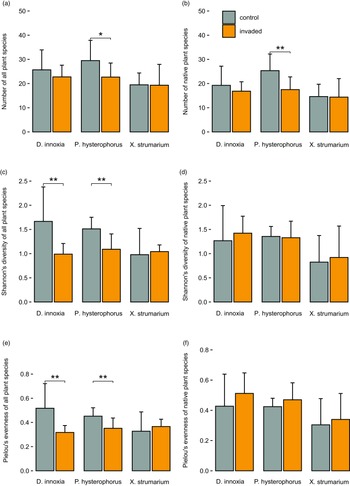
In a model with the three target invaders analysed together, invaded plots harboured less species (both for all and native species only) than uninvaded plots: 21.5 ± 6.7 vs. 24.7 ± 8.2, and 16.2 ± 5.9 vs. 19.6 ± 7.9, respectively; p = 0.011 and p = 0.001 (Table 2, Supplementary Table 1). For individual species, the invasion of P. hysterophorus resulted in significant differences between invaded and uninvaded plots, both in terms of all (22. 7 ± 5.8 vs. 29.5 ± 8.4, p = 0.038) and native species richness (17.5 ± 5.2 vs. 25.3 ± 6.9, p = 0.009). The differences in plots invaded by D. innoxia and X. strumarium and their controls were not significant (Figure 3).
Results of univariate tests comparing species richness S, Shannon diversity H’ and Pielou evenness J between the invaded and adjacent uninvaded (control) plots; n = the number of pairs with invaded plots and their controls, giving the number of replicates used in the respective tests. The differences among the subgroups of data (all species and native and alien separately) were tested using the LMM models, accounting for the autocorrelation of the data. Significant differences are in bold, marginally significant (0.05 < p < 0.1) in italics. The results indicate that, when comparing all invaded plots with adjacent uninvaded plots, the invaded plots show significantly lower species richness (S), lower Shannon diversity (H´) and lower Pielou evenness (J)

Differences in the number of species S, Shannon diversity H’, and Pielou evenness J between invaded and uninvaded (control) plots for the three alien invasive species studied. Bars show means and error bars standard deviation of the mean. Figures on the left side of the panel (a, c, e) show the differences for all species and those on the right (b, d, f) side only for the native plant species. Significant differences are marked with asterisks * p < 0.05, ** p < 0.01. The figure shows that of the three target invaders, Parthenium hysterophorus has the most pronounced negative impact on species richness. However, when considering all present species (i.e., including aliens), Datura innoxia has the most pronounced negative impact on Shannon diversity and Pielou evenness.

Based on all data and the three invasive species merged, invaded plots showed lower Shannon diversity H’ and Pielou evenness J than uninvaded plots: 1.04 ± 0.23 vs. 1.37 ± 0.60, p = 0.005, and 0.35 ± 0.07 vs. 0.43 ± 0.17, p = 0.03, respectively (Table 2, Supplementary Table 1). Among individual species, plots invaded by P. hysterophorus had significantly lower H’ and J for all species than uninvaded plots: 1.09 ± 0.32 vs. 1.51 ± 0.24, p = 0.004, and 0.35 ± 0.09 vs. 0.45 ± 0.07, p = 0.007, respectively. The same was true for D. innoxia (0.99 ± 0.22 vs. 1.67 ± 0.71, p = 0.002 and 0.32 ± 0.06 vs. 0.52 ± 0.20, p = 0.003, respectively). No significant differences in H’ and J were found for X. strumarium (Figure 3).
On the contrary, invaded plots showed slightly higher Shannon diversity H’ (1.22 ± 0.51 vs. 1.14 ± 0.58) and Pielou evenness J (0.44 ± 0.16 vs. 0.38 ± 0.17) for native species, compared to uninvaded plots in a model including all three invasive species, but the differences were not significant (p = 0.880 and p = 0.505, respectively).
No significant differences in the richness of alien species (with the target invaders excluded) were detected between the invaded and uninvaded plots, whether considering all three target invaders together or testing their effects separately.
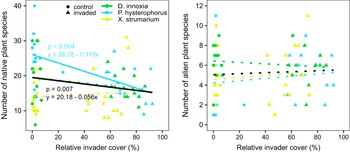
However, alien and native species differed in their response to invaders’ cover. If the species richness for both groups is regressed on the relative cover of the invader (expressed as the proportion of the total community cover it contributes, Figure 4), in a model with data for all three invaders merged, native species richness decreases (T = -3.641, DFres = 34, p = 0.001) whereas the trend for alien species is not significant (T = 1.104, DFres = 34, p = 0.277); this difference in the relationships for natives and aliens is marginally significant (T = 1.935, DFres = 72, p = 0.057). With regard to particular species, P. hysterophorus is the only one with a significantly different relationship of alien and native species to its increasing cover (T = 3.692, DFres = 22, p = 0.001).
Relationship between the numbers of native and alien species in 10 × 10 m plots, and the relative cover of the three invasive species, expressed as the contribution of its cover to the total cover in the plots. Invaded and control plots are marked by different symbols and the target invaders by different colours. Regression lines are based on simplified linear models including only the predictor and response variable; significant relationships are indicated by solid lines, nonsignificant by dotted lines. The trend based on data for all three invaders merged is indicated by the black line.

Multivariate analyses
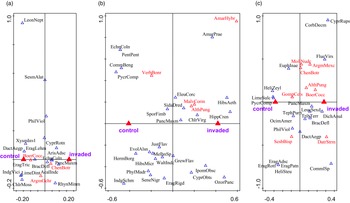
The composition of plots dominated by any of the three invaders significantly differed from that of adjacent uninvaded vegetation, both when species cover and binary presence/absence data were used as importance values in ordination analyses: p = 0.002 and p = 0.002, respectively (Table 3). Concerning the separate models on each of the invaders, their impacts on species composition were always significant, the only exception being that of P. hysterophorus when binary presence/absence data were used as importance values (Table 3). As shown by the ordination plots, the majority of native species are more abundant and frequent in the uninvaded vegetation (Figure 5), but some of them reach higher values of these characteristics in invaded than in uninvaded plots Table 4).
Results of ordination analyses comparing the species composition of invaded and uninvaded plots, using species percentage covers and presence/absence (binary) as input data. The percentage of explained variation is given, and significant results are in bold. The results are shown for all invasive species and each species individually to indicate how much they affect the species composition

Ordination plot showing the compositional differences between the invaded and uninvaded plots for Datura innoxia (a), Parthenium hysterophorus (b) and Xanthium strumarium (c). Binary (presence-absence) data were used as importance values. The locality and pair (nested in locality) were included as covariables; the pair of invaded and uninvaded plots was set as a ‘block defining covariable’. Abbreviations: SeneNigr = Senegalia nigrescens, AcalIndc = Acalypha indica, AlthPung = Althernanthera pungens, AmarHybr = Amaranthus hybridus, AmarPrae = Amaranthus praetermissus, AristAdsc = Aristida adscensionis, ArgmMex = Argemone mexicana, ArmgOchr = Argemone ochroleuca, ArsCong = Aristida congesta, BercDisc = Berchemia discolor, BoerCocc = Boerrhavia coccinea, BracDefl = Brachiaria deflexa, BulbHisp = Bulbostylis hispidula, ChenAmbr = Chenopodium ambrosioides, ChenBotr = Chenopodium bothrys, ChlrMoss = Chloris mossambicensis, ChlrVirg = Chloris virgata, CleoAngs = Cleome angustifolia, CombMoss = Combretum mossambicense, CommBeng = Commelina bengalensis, CommErec = Commelina erecta, CorbDecm = Corbichonia decumbens, CucmZeyh = Cucumis zeyheri, CyprObts = Cyperus obtusiflorus, CyprRotn = Cyperus rotundus, CyprRups = Cyperus rupestris, CyndDact = Cynodon dactylon, CyprSexn = Cyperus sexangularis, DactAegp = Dactyloctenium aegypticum, DactAust = Dactyloctenium australe, DatrStrm = Datura stramonium, DichAnul = Dichantium anulatum, DichrCinr = Dichrostachys cinerea, EchnColn = Echinochloa colona, EleuCorc = Eleusine coracana, EragAdsc = Eragrostis adscensionis, EragCili = Eragrostis cilianensis, EragLehm = Eragrostis lehmaniana, EragPatn = Eragrostis patentipilosa, EragRigd = Eragrostis rigidior, EragRotf = Eragrostis rotifer, EragSupr = Eragrostis superba, EragTric = Eragrostis trichophora, EuphHirt = Euphorbia hirta, EuphInae = Euphorbia inaequilatera, EvolAlsn = Evolvulus alsinoides, FelcMoss = Felicia mossamedensis, FlueVirs = Flueggea virosa, GompCels = Gomphrena celosioides, GrewFlav = Grewia flavescens, HeliSteu = Heliotropium steudneri, HeliZeyl = Heliotropium zeylanicum, HermBorg = Hermannia boraginiflora, HibsAeth = Hibiscus aethiopicus, HibsMicr = Hibiscus micranthus, HippCren = Hippocratea crenata, IpomObsc = Ipomoea obscurra, IpomSine = Ipomoea sinensis, IndgCost = Indigastrum costatum, IndgSchm = Indigofera schimpferi, JustFlav = Justicia flava, JustMatm = Justicia matamensis, IndgVici = Indigofera vicioides, KyphAngs = Kyphocarpa angustifolia, LeonNept = Leonotis nepetifolia, LeucSexd = Leucas sexdentata, LimeDint = Limeum dinteri, LimeSulc = Limeum sulcatum, LippJavn = Lippia javanica, MalvCorm = Malvastrum coromandelianum, MelhAcum = Melhania acuminata, MelhnSp = Melhania sp., MollNudc = Mollugo nudicaulis, OcimAmer = Ocimum americanum, OzorPanc = Ozoroa paniculosa, PancMaxm = Panicum maximum, Pentpent = Pentodon pentandrus, PhilViol = Philenoptera violacea, PhylMadr = Phyllanthus maderaspatensis, PlucDios = Pluchea dioscoridis, PycrComp = Pycreus compressus, RhynMinm = Rhynchosia minima, SesbBisp = Sesbania bispinosa, SesmAlat = Sesamum alatum, SidaDred = Sida dredgei, SprAfrc = Spirostachys africana, SporFimbr = Sporobolus fimbriatus, SporIocl = TephPurp = Tephrosia purpurea, TragBert = Tragus berteronianus, TribTerr = Tribulus terrestris, TricMonc = Tricholaena monachme, TridProc = Tridax procumbens, UrocMoss = Urochloa mossambicense, UrocOlig = Urochloa oligotricha, VerbBonr = Verbena bonariensis, WaltIndc = Waltheria indica, XysmInvl = Xysmalobium involucratum, ZinnPerv = Zinnia peruviana. Alien species codes are shown in red font.

Lists of 10 species that were more represented in either the invaded vegetation or uninvaded control plots. Results are presented for the two types of data, presence/absence (binary) and species covers. Alien species are marked by an asterisk. The ranking of species is based on the ordination scores, expressing the likelihood of a species being more frequent or reaching higher covers in invaded or uninvaded vegetation. Therefore, the ranking does not reflect the most frequent (measured by presence) or abundant (measured by cover) species in absolute terms, but those whose performance between invaded and uninvaded plots differed most, and each species can only be listed in one type of plots where its performance was better

Discussion
Differences in species richness, diversity and evenness
In general, the three target invaders show a negative impact on native vegetation, manifested by the differences between the invaded and adjacent uninvaded plots. At the level of individual species, Parthenium hysterophorus had a consistently negative impact on the species richness and diversity of the invaded community. The lowered species diversity by P. hysterophorus invasion was due to a decrease in species richness and evenness, with both characteristics contributing similarly to the diversity reduction. The invasion by Datura innoxia did not reduce species richness but had a strong negative impact on Shannon diversity, mediated by the markedly reduced evenness. For Xanthium strumarium, consistently across community characteristics and species groups (native or alien), we did not find evidence of impact.
All three species are very strong dominants, reaching up to 100% cover. The significant differences in Shannon diversity and evenness between invaded and uninvaded plots disappear if only native species are considered in analyses, and these community characteristics tend to be even higher than they are in the invader’s presence, more so in D. innoxia invaded plots. This is because with a strong invasive dominant present, other species in the community are suppressed, and the probability of the occurrence of a strong native dominant is low. Once the strong invasive dominant is excluded from the calculation, both H’ and J’ reach the same or even higher values in invaded plots.
Differences in species composition
Besides the observed impact on the community characteristics, the three invaders significantly affected the frequencies with which other species occur and the abundances, proxied by the cover, that they reach. This is reflected in significant compositional differences between invaded and uninvaded plots; for P . hysterophorus, the effect was only obvious in analysis with species covers included, as covers use more information from the data and reflect the differences in abundances, whereas the tests on binary data reflect only qualitative changes in species composition. Yet, from the consistent impact on species composition, it follows that the majority of native species must react consistently to the invasion of any of the three dominant aliens by either decreasing or increasing their cover and frequency in the invaded vegetation. Most native species show a negative response to the invasive dominant, as revealed by the ordination plots. However, there are native species that are more frequent (Abutilon ramosum, Bothriochloa radicans, Cyperus rupestris, Grewia villosa) or more abundant in the invaded vegetation (Abutilon ramosum, Coccinia rehmani, Panicum deustum, Ruellia cordata).
Contrasting ecologies drive impact mechanisms
All three species targeted by our study are noxious invaders not only in Africa but also on a global scale. Their naturalized populations have been recorded in 17–32% of regions of the world, based on the GloNAF database (Pyšek et al. Reference Pyšek, Pergl, Essl, Lenzner, Dawson, Kreft, Weigelt, Winter, Kartesz, Nishino, Antonova, Barcelona, Cabezas, Cárdenas, Cárdenas-Toro, Castaño, Chacón, Chatelain, Dullinger, Ebel, Figueiredo, Fuentes, Genovesi, Groom, Henderson, Inderjit, Kupriyanov, Masciadri, Maurel, Meerman, Morozova, Moser, Nickrent, Nowak, Pagad, Patzelt, Pelser, Seebens, Shu, Thomas, Velayos, Weber, Wieringa, Baptiste and van Kleunen2017, van Kleunen et al. Reference van Kleunen, Dawson, Essl, Pergl, Winter, Weber, Kreft, Weigelt, Kartesz, Nishino, Antonova, Barcelona, Cabezas, Cárdenas, Cárdenas-Toro, Castaño, Chacón, Chatelain, Ebel, Figueiredo, Fuentes, Groom, Henderson, Inderjit, Kupriyanov, Masciadri, Meerman, Morozova, Moser, Nickrent, Patzelt, Pelser, Baptiste, Poopath, Schulze, Seebens, Shu, Thomas, Velayos, Wieringa and Pyšek2015, Reference Pyšek, Pergl, Essl, Lenzner, Dawson, Kreft, Weigelt, Winter, Kartesz, Nishino, Antonova, Barcelona, Cabezas, Cárdenas, Cárdenas-Toro, Castaño, Chacón, Chatelain, Dullinger, Ebel, Figueiredo, Fuentes, Genovesi, Groom, Henderson, Inderjit, Kupriyanov, Masciadri, Maurel, Meerman, Morozova, Moser, Nickrent, Nowak, Pagad, Patzelt, Pelser, Seebens, Shu, Thomas, Velayos, Weber, Wieringa, Baptiste and van Kleunen2019). More importantly, their impacts have been reported in many regions (Holm Reference Holm, Doll, Holm, Pancho and Herberger1997, Weber Reference Weber2017). This is especially true for P. hysterophorus, which has been shown to alter soil nutrient composition and displace native plant species through competition and allelopathy in a wide range of habitats (Adkins & Shabbir Reference Adkins and Shabbir2014, Matzrafi et al. Reference Matzrafi, Raz, Rubin, Yaacoby and Eizenberg2021) and therefore represents the greatest threat to KNP riparian areas (e.g., Bajwa et al. Reference Bajwa, Farooq, Nawaz, Yadav, Chauhan and Adkins2019, Brunel et al. Reference Brunel, Panetta, Fried, Kriticos, Prasad, Lansink, Shabbir and Yaacoby2014, Chhogyel et al. Reference Timsina, Shrestha, Rokaya and Münzbergová2021, Timsina et al. Reference Timsina, Shrestha, Rokaya and Münzbergová2011). Yet, the impact on the richness and diversity of other species in our system, although overall significant and detectable, varied among the invaders and with regard to the community characteristics used to measure it.
When drawing conclusions about what these invasions mean for savanna vegetation, it needs to be borne in mind that the magnitude of impact detected depends on the scale of sampling (Stohlgren et al. Reference Stohlgren, Chong, Schell, Rimar, Otsuki, Lee, Kalkhan and Villa2002). In our study, because we were interested in recording the effect the invasive dominants have in a broader landscape context, we focused on the community scale, using plots of the size commonly used to study herb vegetation layer (Chytrý et al. Reference Chytrý, Jarošík, Pyšek, Hájek, Knollová, Tichý and Danihelka2008, Stohlgren et al. Reference Chytrý, Maskell, Pino, Pyšek, Vilà, Font and Smart2006). With increasing scale, the impacts may become less pronounced because other species in invaded communities can survive or newly colonize by utilizing the gaps in the invader’s cover, a mechanism that we observed in the field. This is also an explanation, at least in part, for the differences in the severity of impacts among the invaders studied. The observed impact of Parthenium hysterophorus was generally the most pronounced of the three, and at the time of sampling, this species created the densest populations with very little space for other species once it reached a high cover; interestingly, it has been suggested that P. hysterophorus has an allelopathic potential (Singh et al. Reference Singh, Batish, Pandher and Kohli2003, van der Laan et al. Reference van der Laan, Reinhardt, Belz, Truter, Foxcroft and Hurle2008) that was not reported for the other two invaders. At the time of sampling, the stands of X. strumarium and D. innoxia were usually patchy, and even if having a high cover, their growth habit provides space for other species on patches of bare ground and lower in the stand – this made the impact of these two species less pronounced.
The differences in the ecology of particular invaders further contribute to the variation in the severity of impacts that we recorded. As P. hysterophorus invades the shrubby savanna and clearings in gallery forest higher at the river edge, it often replaces species-rich grassy savanna (Figure 1f). Hence, the loss of species due to invasion is generally more pronounced compared to other two invaders that replace vegetation that is poorer in species (Figure 3a and b), such as the sandy river channel floor (Figure 1b) or grazing lawns (Figure 1h). There, the invasion often creates patches of different substrates, clayey and richer in nutrients, with plant remnants, seeds, soil, and debris brought by the river flow. Such places provide suitable habitats to ruderal species with higher demands for nutrients, facilitating their colonization of invaded sites (Figure 1a), thereby reducing the impact of D. innoxia and X. strumarium and further strengthening the differences among invaders in the magnitude of their impacts.
In terms of invasion theory, the observed mechanism points to the fertility islands described by Novoa et al. (Reference Novoa, Foxcroft, Keet, Pyšek and Le Roux2021) for KNP (i.e., the presence of alien plants might create favourable conditions for the establishment and growth of other plants) and can be interpreted as an indication of invasional meltdown (Braga et al. Reference Braga, Gómez-Aparicio, Heger, Vitule and Jeschke2018, Simberloff & Von Holle Reference Braga, Gómez-Aparicio, Heger, Vitule and Jeschke1999) – because the mechanism acts more effectively for alien species; it is thus not a ‘ruderal meltdown’ alone. This claim is supported by the result of the analysis of the relationship between invaders’ covers and the occurrence of other species – high cover of invasive species reduced the native species richness (in line with other results, this was most pronounced for P. hysterophorus) but had no negative impact on alien species occurring in the plant communities sampled, rather the opposite trend was indicated (Figure 4).
Impact on vegetation and beyond: implications for management
The species selected provided a suitable model system to infer about different ecologies of invaders and hence mechanisms of invasion. All are annuals from the Americas, which makes species-specific biases, such as those associated with the region of introduction or with different life histories, irrelevant. On the other hand, while all target species spread along rivers, field experience suggests that they differ in their capacity to colonize areas outside riverbeds. Datura innoxia is most closely confined to sandy substrates in riverbeds, where X. strumarium is also common; the two species often occur together in invaded stands or in close proximity to each other. However, the latter species also invades riverbanks higher above the riverbed with more compact soils, and P. hysterophorus is the most widespread of the three beyond riverbeds, commonly invading the understory of the gallery forest and clearings there. The ecology of all three invaders makes the comparison of invaded and uninvaded plots more robust as some of the cautions with regard to the space-for-time substitution approach (see Hejda et al. Reference Hejda, Pyšek and Jarošík2009 for discussion) are less relevant in places where rather large areas of homogeneous habitats in terms of substrate, dispersal opportunities, and disturbance regimes can be found to locate plots. The main potential limitation of the space-for-time approach is the uncertainty in the causality of the observed effects. In our case, the question might arise if the differences between invaded and control plots are really caused by the dominance of the target aliens or by a difference in some confounding factor, which may either promote or suppress the dominance of invading aliens. However, the stands of all three target aliens were spread over large homogenous riparian areas, which makes the presence of confounding factors unlikely. Moreover, a biased significant result would presume there are systematic rather than random differences between the invaded and control plots, which is also unlikely.
From a broader perspective, it needs to be emphasized that in a protected area such as KNP, the biodiversity conservation objectives aim “to maintain the delivery of broad ecosystem services by ensuring its biota and associated terrestrial processes are restored and maintained” (KNP 2018). When studying the impacts of invasive plant species, the focus needs to be on the whole ecosystem and consider other potential ecosystem impacts, such as on herbivores (Pyšková et al. Reference Pyšková, Novoa, Čuda, Foxcroft, Hejda, Pyšek and Linder2022a), other animals (Foxcroft et al. Reference Foxcroft, Novoa, Foord, Thwala, Munyai, Dippenaar-Schoeman and Linder2022), and soils (Novoa et al. Reference Novoa, Foxcroft, Keet, Pyšek and Le Roux2021). Such an approach allows us to gain a holistic understanding of invasion impacts and provide a complete assessment of management needs. Here, we examined the effects of three invasive alien plants on one aspect of a larger programme, namely, impacts on vegetation. Our results show that the invasions of two of the target aliens (Datura sp. div., X. strumarium) are unlikely to have profound effects on the diversity of the riverbed vegetation. However, there is evidence that they still have significant compositional effects. A study on the effects of management and post-control response of invasive alien plants in the KNP (Morris et al. Reference Morris, Witkowski and Coetzee2008) suggested that continuous control of riparian alien species, including X. strumarium, would reduce seed production and limit the displacement of recovering native vegetation, allowing natural rehabilitation. However, with the introduction of X. strumarium in 1953, any reduction in seed production is likely to have little effect at this point. Parthenium hysterophorus, which also spreads outside of the river channel, both reduces overall plant diversity and changes species composition.
When suggesting management policies, the feasibility of achieving the objectives, including the likelihood of success and costs of control, also needs to be considered in addition to their impacts. All management measures need to be designed with the awareness that complete eradication from KNP of these invasive species is impossible. For this reason, it may be necessary to accept the presence of stands of Datura sp. div. and X. strumarium in the riverbeds for part of the year, as being annual species, they die at the end of summer. According to van Wilgen et al. (Reference van Wilgen, Fill, Govender and Foxcroft2017), much funding has been spent on X. strumarium control, with little long-term success. Also, populations of these aliens re-establish rapidly following control. Should the species be found to be invading other areas where there is a higher likelihood of impacts on diversity, management would be recommended. It needs to be noted, however, that these recommendations are based on vegetation impacts, while the impacts on other ecosystem components may enhance the need for control. However, P. hysterophorus deserves special attention due to its stronger impacts and direct competition with co-occurring plant species, especially as it successfully invades outside the riverbeds along the macrochannel bank and in drainage lines or moist areas further away from rivers.
Supplementary material
The supplementary material for this article can be found at https://doi.org/10.1017/S0266467423000299
Acknowledgements
The project was supported by grant no. 22-23532S (Czech Science Foundation) long-term research development project RVO 67985939 (Czech Academy of Sciences). South African National Parks provided additional support.
Financial support
The study was supported by grant no. 22-23532S (Czech Science Foundation). Martin Hejda, Jan Čuda, Klára Pyšková, Ana Novoa and Petr Pyšek were also supported by the long-term research development project RVO 67985939 (Czech Academy of Sciences). South African National Parks provided additional technical support.
Competing interests
None of the authors has a conflict of interest to declare.