Introduction
On the morning of May 19, 1953, radioactive fallout from Harry, a 32-kiloton detonation, descended upon the towns east of the Nevada Test Site (NTS). The communities “downwind” had intermittently experienced fallout since inception of continental atmospheric weapons testing 28 months prior, but Harry was exceptional and the US Atomic Energy Commission (AEC) was scrambling to improvise a response. It appeared in St. George, Utah, 140 miles from the NTS, as a lingering black cloud (Department of Energy 1980). A town of about 4,500, St. George was too big to expeditiously evacuate so the commission issued radio reports advising residents to remain indoors. They were of limited utility, however, as they arrived only shortly before the radionuclides (ibid.).
As Harry swept through St. George and outlying areas some residents reported nausea, headache, burns and blisters on exposed skin, and hair loss (Ball Reference Ball1986; Fradkin Reference Fradkin1989; Gallagher Reference Gallagher1993; Miller Reference Miller1991). Such ailments stood in stark contrast to assurances of safety circulating through the downwind communities in the form of AEC press releases and publications. The inclination to anticipate off-site radioactive contamination may have been lethargic but the commission's public relations effort was gaining momentum.
Under the auspices of the AEC more than 100 atmospheric atomic bombs were detonated over the period from 1951 to 1962 at the NTS (Department of Energy 2000); the southeast entrance of the test site located 65 miles from Las Vegas, Nevada. Top officials at the AEC and the Department of Defense were convinced a continental site was necessary to accelerate weapons development and confident testing would not produce hazardous off-site radioactivity. And yet shot after shot deposited bewilderingly high levels of radionuclides in the communities downwind, but, indeed, little of the country was unaffected (National Cancer Institute 1997; Simon et al. Reference Simon, Bouville and Land2006).Footnote 1 With passage of the Limited Test Ban Treaty in 1963 detonations went underground, but leukemia and thyroid cancer were already arising in the downwind communities. Such illnesses were recognized anecdotally (Gallagher Reference Gallagher1993) and through epidemiological studies (Johnson Reference Johnson1984, Reference Johnson1987; Lyon et al. Reference Lyon, Klauber, Gardner and Udall1979; Stevens et al. Reference Stevens1990).
In 1979 a group of downwinders filed a lawsuit in US Federal District Court. Allen v. United States (588 F. Supp. 247, US District Court, Utah) encompassed three years of discovery processes and legal motions, three months of testimony, and 17 months hence a “groundbreaking legal statement” (Ball Reference Ball1986: 168). Judge Bruce S. Jenkins concluded the AEC misled downwind residents in regard to the plausible health effects of exposure to fallout and failed to adequately monitor radioactivity, release information in a comprehensive and timely manner, and educate residents as to the simple precautions necessary to minimize exposure (Allen v. United States).Footnote 2 Congressional investigation in 1979, moreover, determined the AEC neglected to adequately protect downwind residents from fallout despite the commission's internal knowledge of the risks to public health; noting the residents downwind were “guinea pigs in a deadly experiment” (House Committee on Interstate and Foreign Commerce 1980: iii). Research in the New England Journal of Medicine that same year highlighted a sobering implication—documenting elevated child leukemia deaths in Utah during and in the wake of atmospheric testing (Lyon et al. Reference Lyon, Klauber, Gardner and Udall1979).
The public historian Barton Hacker (Reference Hacker1994: 9), however, argues in reference to AEC atomic testing overall:
Those responsible for radiation safety in nuclear weapons testing under the auspices of the Atomic Energy Commission were competent, diligent, and cautious. They understood the hazards and took every precaution within their power to avoid injuring either test participants or bystanders. . . . Those in charge sometimes made mistakes, but for the most part they managed to ensure that neither test participants nor bystanders suffered any apparent damage from fallout.
Given such divergent opinions, I approach the socionatural history of atmospheric atomic testing as a conundrum to be explained. Drawing from internal and public AEC documents obtained through archival research and the secondary literature, I focus in particular on Operation Upshot-Knothole conducted from March to June 1953. Upshot-Knothole comprised eleven detonations releasing 252 kilotons of radionuclides into the atmosphere. It was the dirtiest of the seven series of atmospheric tests in terms of off-site radioactive contamination (Department of Energy 1995), and there are lessons to be derived from the commission's activities prior to and throughout Upshot-Knothole relevant to contemporary organizational activity.
In what follows, I argue the AEC, as Titus (Reference Titus2001) notes, was neither a “villainous” organization nor unconcerned with public health and safety. Operational conduct, however, clearly deviated from the stated objective of protecting the health and safety of Americans during open-air atomic testing. I argue the AEC devolved into deviancy due to commitment to specious organizational heuristics adopted at the outset of testing. These heuristics had systemic implications such that AEC officials were continually reacting to the unanticipated material and biophysical effects of fallout rather than proactively initiating measures necessary to protect the health of downwind residents. They include: (1) Fallout is subject to predictable atmospheric dispersion and dilution patterns. (2) Radioactivity has noncumulative, undifferentiated effects. Exposure is thus not a hazard if a recognized threshold is not exceeded over a given period of time nor is it necessary to establish variant thresholds for children or pregnant women. (3) The public is prone to unreasoning panic in reference to fallout.
Epistemological cues suggesting each of the foregoing heuristics were erroneous arose repeatedly from the onset of atmospheric testing, but key officials and experts within the AEC were reticent to alter operational conduct accordingly. As Clarke (Reference Clarke1993) notes, organizational actors often rely upon heuristics or mental shortcuts to make decisions in a context of complexity and uncertainty, but such heuristics can eventuate in the failure to recognize or appreciate information at variance with established beliefs and/or policy. Such “disqualification” can lead to substantive organizational failures of foresight (ibid.; Turner Reference Turner1976).
Operational conduct predicated upon the predictability of fallout, confidence in the noncumulative and undifferentiated effects of radioactivity, and the expectation of latent public panic intertwined to inhibit timely implementation of off-site radiological safety procedures. Failures of foresight begat emergent mistakes that then evolved into misconduct as comprised of the withholding of information and, indeed, cover-up. Testing should have been enacted in a safer manner (Allen v. United States; House Committee on Interstate and Foreign Commerce 1980), but the commission's commitment to specious organizational heuristics amplified the adverse impacts of fallout in the rural downwind communities.
The “Dark Side” of Organizational Activity
The German social theorist Max Weber (1864–1920) highlighted the relentless expansion of instrumental rationality as a dominant logic and socioorganizational principle. Instrumental (formal) rationality refers to the conscious, methodical calculation of the most efficacious and efficient means and procedures in the accomplishment of a particular end (Weber Reference Weber, Roth and Wittich1978 [1920]). Capitalism, law, science, and technology are predicated upon instrumentally rational principles (Brubaker Reference Brubaker1984), and the rise of large public and corporate bureaucracies is a central expression of instrumental rationality.
Organizational activity has proven very productive in terms of getting things done, but often produces unintended, deleterious secondary effects extending well beyond the organization. Vaughan refers to the “dark side of organizations” in gathering insights from numerous disciplines into a body of scholarship explicating the dynamics that contribute to and inhibit injurious deviation from organizational objectives. She demarcates three types of organizational deviance: mistake, misconduct, and disaster (Vaughan Reference Vaughan1999). Each is often derived of nonroutine organizational activities “incubating” over time and therefore are accompanied by organizational and institutional failures of foresight or inattention to and even explicit dismissal of cues signaling looming problems (Beamish Reference Beamish2002; Clarke Reference Clarke1993, Reference Clarke1999; Clarke and Perrow Reference Clarke and Perrow1996; Turner Reference Turner1976: 382; Vaughan Reference Vaughan1996, Reference Vaughan and Cerulo2002).
Examination of the development of organizational deviance, moreover, should be cognizant of three levels of analysis (Vaughan Reference Vaughan1999): (1) The broader context in which the organization is situated; (2) the characteristics of the organization, including authority structure, processes, and tasks; and (3) the cognitive, sense-making practices of key officials or units within the organization. Although organizational research often privileges one of the foregoing levels of analysis, Vaughan (Reference Vaughan1996, Reference Vaughan1999) cautions, the origins of organizational mistake, misconduct, and disaster are generally embedded in the connections between each.
The dynamics of interest in the present study do not hinge upon episodic technological component failures or the interaction of complex technological processes combined with tight coupling, as delineated in Perrow's (Reference Perrow1999) distinguished study on “normal accidents.” The physical-technological characteristics inherent to atmospheric testing were undoubtedly of substantive importance but the analysis focuses on that which the technology was situated within: that is, the broader context in which the AEC was situated, salient characteristics of AEC organizational structure, and evolving definitions of the situation in regard to off-site fallout by key AEC officials.
Research Strategy and Data Sources
This study is a qualitative, historically situated, single-case analysis. The data are derived of archival research and consist of internal AEC documents, the commission's publications intended for the public, as well as court opinion and congressional inquiry documents. Many internal AEC reports and memorandum were unavailable to the public for decades but are now accessible through the Nuclear Testing Archive in Las Vegas, Nevada, and online through OpenNet, a US Department of Energy (DOE) database.Footnote 3
The secondary literature (Ball Reference Ball1986; Fradkin Reference Fradkin1989; Fuller Reference Fuller1984; Gallagher Reference Gallagher1993; Miller Reference Miller1991; Titus Reference Titus2001), to varying degrees, as well as court opinion and the conclusions of congressional inquiry (Allen v. United States; House Committee on Interstate and Foreign Commerce 1980), conclude AEC operational conduct during the era of open-air continental testing was a species of organizational deviance. Others, however, are far less critical (Fehner and Gosling Reference Fehner and Gosling2006; Hacker Reference Hacker1994). Throughout the research process I strived to adjudicate whether this case is indeed a case study in organizational deviance and, if so, how best to explicate the character of such deviance. As Yin (Reference Yin2003) notes, a single-case study is particularly suitable to inquiry regarding the how and why of a unique event with the potential to illustrate important dynamics beyond the case under examination. Many journalists and some academics have examined continental open-air testing, but why the AEC engaged in some actions while neglecting others remains obscure.
The analysis is structured chronologically and focuses on key decisions and events shaping the commission's actions and nonactions relative to the monitoring of fallout and efforts to educate and protect downwind residents up to and throughout the Upshot-Knothole series of 1953. I focus in particular on the organizational “cultural construction of risk” (Vaughan Reference Vaughan2004: 321)—that is, how the risks of off-site fallout were defined and redefined, or inhibited from redefinition, as a consequence of dynamics outside the organization, organizational structure, and sociocognitive assumptions of key organizational actors.
There is often a tension in qualitative research between the search for emergent theoretical constructs, that is, the production of grounded theory and the theory-laden background knowledge and biases of the researcher (Kelle Reference Kelle2005). Mindful of this tension, I draw from the scholarship of organizational researchers and environmental sociologists examining organizationally based deviance when relevant to the patterns uncovered.Footnote 4 I also strived to remain open to the emergence of novel theoretical ideas within the data.
The protocol guiding the archival research was informed by Vaughan's model, which entails construction of an explanatory account from the data in a manner wherein analysis, writing, and theorization are intertwined throughout (Vaughan Reference Vaughan1996, Reference Vaughan2004); it involves a sequence of identifying patterns, assessing their validity relative to salient primary and secondary data sources, and striving to articulate the essential factors shaping the dynamics under examination. It is a process, Vaughan (ibid.) notes, of remaining cognizant of emergent contradictory data and therein assembling and reassembling the factual and theoretical account as new information is encountered. Further, the researcher must guard against forcing extant conceptual schemes onto the case or making definitive conclusions before examining the data in-depth. It is crucial, moreover, to elucidate the dynamics of interest as situated within the organizational and historical context in which they occurred. As Scott (Reference Scott1990: 34) notes, “Texts must be studied as socially situated products.” The task entails coming to “understand how people in another time and place made sense of things” (Vaughan Reference Vaughan2004: 321).
The Nuclear Testing Archive consists of more than 375,000 documents. As Hill (Reference Hill1993) stresses, when confronting voluminous archival data it is imperative to devise a strategy for searching the materials contained therein. I began, first, by searching for those documents illustrating how officials in the AEC came to construct an operational protocol in regard to the potential hazards of off-site fallout before testing commenced. Second, the research then focused on the manner whereby officials successively worked to make sense of the intensity, extent, and characteristics of off-site fallout as testing proceeded. Third, I searched for archival materials that might elucidate the propensity for officials to substantively alter operational protocol or indeed highlight reluctance to do so. Fourth, as the research progressed I increasingly came to focus on the juxtaposition between the organizational construction of risk in reference to off-site fallout articulated within internal AEC reports and memorandum versus that expressed in the commission's concurrent documents intended for the general public.
Of note, the AEC was established by the US Congress in 1946 and given charge of promotion and regulation of atomic research and development. A fundamental tension existed, then, between weapons development and public health and safety; too often, the commission gave greater priority to the former at the expense of the latter (House Committee on Interstate and Foreign Commerce 1980). Indeed, Congress abolished the AEC in 1974 due to concerns that promotion had long taken precedence over prudent regulation (Ford Reference Ford1982). While not denying these endemic tensions, I put forward an account focusing upon the proximate, contingent dynamics shaping AEC conduct relative to the management of off-site fallout.
Continental Atomic Testing, 1950–1952: The Road to Upshot-Knothole
In August 1950, a one-day conference at Los Alamos Scientific Laboratory (LASL) focused on potential radiological health effects of continental testing. Attendees discussed prevailing weather and wind patterns at the NTS, the feasibility of accurate meteorological forecasting, and dispersion of fallout relative to wind velocity (Atomic Energy Commission 1950a). The consensus was that there was little risk to the public except as it concerns “rainout” wherein radioactivity is deposited on the ground in concentrated form due to precipitation (ibid.). That dry fallout was not a significant threat was a tacit assumption as it was concluded changes in wind direction and velocity were predictable with “reasonable accuracy” (ibid.: 10). However, it was observed “people will receive perhaps a little more radiation than medical authorities say is absolutely safe” (ibid.: 23).
Attendees also embrace the threshold hypothesis wherein assessment of radiological risk is premised on noncumulative impact such that no permanent health effects ostensibly arise if an established maximum dose is not exceeded within a given time frame. Within the report, moreover, there is no discussion regarding the effects of radiation on children or the problems endemic to short versus long-lived radionuclides. Enrico Fermi, the Noble Prize–winning physicist, injected a note of caution into the proceedings observing “the extreme uncertainty of the elements we had to go on, and that we did our best with these” (ibid.).
The conference at LASL, assembled five months before testing began, is notable as central assumptions underlying AEC operational conduct were not vigorously debated so much as mutually confirmed. And yet, as Fermi observed, there was considerable uncertainty in regard to redeposition of fallout. This is not in itself novel as organizations frequently confront complexity and uncertainty. What is crucial is the degree to which the organizational culture encourages attendance to evidence that problematizes the assumptions underpinning organizational operations. While Fermi seemed to sense the depth of uncertainty, in the years to come key officials and experts in the AEC would not exhibit such reflexivity.
Freudenburg (Reference Freudenburg1992) refers to the “atrophy of vigilance” in noting the tendency of organizations to reduce the robustness of safety procedures and protocol over time due to the absence of substantive mistakes or accidents. Success leads to complacency that eventuates in sudden, sometimes catastrophic, events illustrating the necessity for renewed vigilance. Continental testing was premised upon the opposite: sanguine appraisal of the predictability of fallout that would eventuate in mistakes demonstrating the need to increase safety procedures and protocol beyond what was originally envisioned.
In his detailed judicial opinion in Allen, Jenkins rejects the assertion that officials at or working under the auspices of the AEC paid sufficient attention to the scientific knowledge at that time (Allen v. United States). He notes the threshold concept was not widely embraced among relevant scientific associations and there existed extensive debate regarding genetic alterations due to linear dose-effect exposure to radiation. Much of this concern derived from years of animal studies within and without the AEC and observation of the survivors of Hiroshima and Nagasaki (Atomic Energy Commission 1945; Ball Reference Ball1986; Los Alamos Scientific Laboratory 1950; Malloy Reference Malloy2012; Schull Reference Schull1995; Walker Reference Walker2000).
As Turner (Reference Turner1976) argues, rigidities in belief and perception can inhibit appreciation of information inconsistent with often tacit organizational assumptions, thus contributing to failures of foresight. Clarke makes a similar point in referring to “disqualification heuristics” (1993, 1999). Individuals and organizations rely on judgmental heuristics or mental shortcuts when confronted with complexity and uncertainty to facilitate pursuit of explicit objectives, but undue commitment can lead to systemic error (Clarke Reference Clarke1993). When a heuristic becomes embedded in operational conduct in an uncritical manner it can lead decision makers and experts to disqualify contradictory information (ibid.; Turner Reference Turner1976). Signals portending mistake and even disaster, often readily visible after the fact, are more likely to be misperceived or ignored beforehand (Clarke Reference Clarke1993; Turner Reference Turner1976; Vaughan Reference Vaughan and Cerulo2002). And an organization insulated from outside scrutiny is prone to disqualification heuristics as confrontation with information undercutting established convictions is more likely to be filtered out of key decision-making processes (Clarke Reference Clarke1993; Turner Reference Turner1976). The AEC from 1951 to 1962 was the epitome of an organization insulated from public influence.
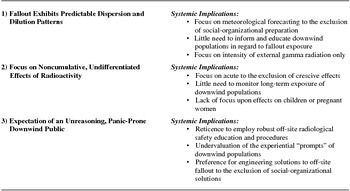
I begin with a brief overview of the LASL conference to highlight two specious heuristics repeatedly invoked within the AEC during the era of open-air continental testing, illustrated in table 1. They include: (1) Fallout is subject to predictable atmospheric dispersion and dilution patterns. (2) Radioactivity has noncumulative and undifferentiated effects on the human body. These heuristics led to a number of crucial implications in terms of AEC operational conduct and contributed to the misperception of alternative information and empirical evidence. AEC officials, in turn, failed to take precautions clearly within their power to enact. Commitment to the heuristics outlined in table 1 and the systemic implications that followed coalesced to create a context in which key decision makers within the AEC were continually chasing problems related to fallout after they emerged.
Disqualification heuristics guiding AEC operational conduct.

Operation Ranger: January–February 1951
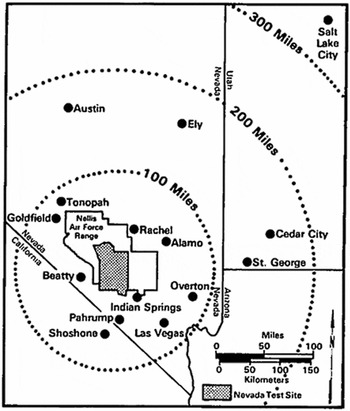
In December 1950 President Truman authorized continental atomic testing (Atomic Energy Commission 1950b). Figure 1 highlights the location of the NTS and surrounding communities.Footnote 5 Southern Nevada offered wide-open spaces, west-to-east wind patterns traversing across rural communities, dry and sunny weather, and proximity to LASL in New Mexico. Southern Nevada would be the “backyard” laboratory LASL desired (Atomic Energy Commission 1953a: 12; 1950b, 1950c). Camp Lejeune on the North Carolina coast was also considered as it was advantageous in regard to off-site fallout with prevailing winds moving over the Atlantic.Footnote 6 The federal government did not possess all of the land needed and there were residents who would have to be relocated. It was easier to carve out a section of the Las Vegas Bombing and Gunnery Range (Atomic Energy Commission 1950b, 1950c), which was established in 1940 from land seized from the Western Shoshone and Southern Paiute Indians (Kuletz Reference Kuletz1998).
Location of the Nevada Test Site and Surrounding Communities

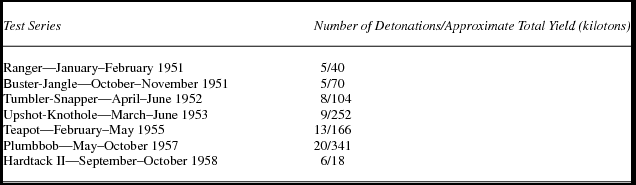
There were seven test series at the NTS from 1951 to 1958, outlined in table 2. The most intensive period in terms of aggregate kilotons of fission products released into the atmosphere occurred in 1953, 1955, and 1957. Management of fallout was predicated upon “dispersal and dilution” (Fehner and Gosling Reference Fehner and Gosling2006: 176). Detonations proceeded when the prevailing winds were moving east across southern Nevada and Utah to preclude fallout over Los Angeles to the southwest, Las Vegas to the southeast, and Salt Lake City to the northeast.
Atmospheric testing series at the Nevada test site.

Note: Table is based on detonations of 1 kiloton or greater. Data obtained from the DOE (2000). Between November 1958 and September 1961 the United States suspended testing. Open-air testing resumed in September 1961 but the majority of subsequent detonations at the NTS consisted of shaft or tunnel shots and several cratering detonations (ibid.).
Testing began in January 1951 with a series of airdrops detonated at a predetermined altitude. As noted in table 2, Operation Ranger was a tepid beginning. It included four detonations less than 10 kilotons while the last shot, codenamed Fox, was notably larger. Trinity, by comparison, was 21 kilotons, Hiroshima 15 kilotons, and Nagasaki 21 kilotons (Department of Energy 2000). A major objective comprised the test firing of fission triggers for the still theoretical hydrogen bomb, and there was little military involvement as it was primarily an AEC endeavor focusing on LASL weapons development priorities (Hacker Reference Hacker1994).
This circumscribed beginning was accompanied by a “low-key approach” to information dissemination (Atomic Energy Commission 1951a: 1; 1951b, 1952a), as only a terse one-page announcement was distributed by the AEC (Atomic Energy Commission 1951c). It refers to experimental detonations “under controlled conditions” and “no danger” may be expected outside the Las Vegas Bombing and Gunnery Range (ibid.). To the relief of AEC officials the announcement did not elicit expressions of public concern among downwind residents (Fehner and Gosling Reference Fehner and Gosling2006).
AEC officials were hoping Americans would scarcely notice the detonations (Atomic Energy Commission 1951b). But they could not contain the blast and flash effects and many residents in the NTS region acquired abrupt knowledge of continental testing beginning with Able—the first atomic detonation on US soil since Trinity six years earlier. Able illuminated the morning sky far beyond the NTS and fallout made an unexpected terrestrial appearance in New York State as radioactive snow in Rochester and surrounding areas (Miller Reference Miller1991). Fallout from the 8-kiloton Baker the day after Able and shot Easy, four days hence, similarly intertwined with precipitation in the northeast and was detected at university facilities and interfered with film manufacturing at Eastman Kodak (ibid.). Fox produced even greater shock waves and the flash was visible as far away as Oakland, California, and Boise, Idaho (ibid.). Radioactive fallout from Fox drifted southeast toward Las Vegas (ibid.)—not the intended direction.
Ranger proceeded with few problems at the NTS (Hacker Reference Hacker1994), but AEC officials were troubled by the detection of radioactivity at universities and its impact upon film production (Fradkin Reference Fradkin1989). The concern stemmed less from the levels of radioactivity, which were considered low, but more from potential lawsuits and negative press. AEC officials decided it was imperative to reach out to Eastman Kodak and the National Association of Photographic Manufacturers, the industry trade association. This encompassed distribution beforehand of the starting date, number of detonations, and approximate length of a test series (Atomic Energy Commission 1952b)—information residents of the downwind communities were not yet privy to.
Further, the public found continental testing entertaining, and national and local media were eager to get in on the story (Miller Reference Miller1991). It is more difficult to sustain a position of rigid information management, Kinsella (Reference Kinsella2001) notes, when material containment is incomplete. The blast wave, flash, and detection of radioactivity at industrial and university facilities threatened to undercut the commission's low-key discursive approach. Testing began with five relatively low-yield detonations, but the AEC was already enmeshed in an uncertain interplay with the material effects, which would only get more volatile as the yields increased.
Operation Buster-Jangle: October–November 1951
Preparing for Buster-Jangle in the fall of 1951, AEC officials realized there were “public relations requirements peculiar to continental tests near settled areas” (Atomic Energy Commission 1951b: 1). “National and public concern had to be recognized, national and local public acceptance had to be obtained, and a degree of Nevada and local cooperation was essential” (ibid.: 1–2). Although Ranger did not elicit notable public concern AEC officials were anxious about latent “unthinking public reaction” (ibid.: 4) and thus decided the public information plan for Buster-Jangle would remain low key but endeavor to desensationalize testing—emphasizing it was “not particularly novel or exciting” (ibid.: 6).
As noted in table 1, the expectation that downwind residents would react in an unreasoning manner to fallout was a foundational heuristic shaping AEC conduct from the beginning, and it elicited a number of crucial systemic implications in terms of operational conduct. This expectation was consistently invoked by key officials even in the absence of observable public concern. Apprehension in the downwind communities, however, arguably arose over time not due to some inexplicable fear of all things atomic but as residents came to suspect the AEC was downplaying the risks of fallout (Ball Reference Ball1986; Fradkin Reference Fradkin1989). Anxiety, in turn, was rooted in burgeoning suspicions of what Freudenburg refers to as “recreancy” or “the failure of institutional actors to carry out their responsibilities with the degree of vigor necessary to merit the societal trust they enjoy” (1993: 909; 2001); it is based upon a “retrogression or failure to follow through on a duty or trust” (Freudenburg Reference Freudenburg1993: 916; Reference Freudenburg2001).
The first detonation of the Buster-Jangle series was Baker, which sent radioactive debris toward the California coast, where it hovered for some time (Miller Reference Miller1991). The next was Charlie, a 14-kiloton detonation. In describing the radioactive cloud, Miller (ibid.: 125) observes:
Meteorologists at the site tried in vain to guess the direction the cloud would take. Conflicting wind patterns twisted the stem into a spiral shape almost 6 miles high. The mushroom hung over the test site in that configuration for almost two hours before beginning a grand—and rainy—tour of the United States.
Other Buster-Jangle detonations displayed similar dynamics. Divergent and capricious winds aloft, temperature inversions, regional topography, and precipitation far from the NTS were confounding factors (ibid.). The AEC had yet to establish a concerted off-site radiological monitoring program in the downwind communities—arguably a reflection of the assumption dry fallout was not a substantive threat. Not until 1953 did the AEC, in conjunction with the US Public Health Service (PHS), establish 17 monitoring stations in the NTS region to assess air and ground intensity and duration of fallout (Ball Reference Ball1986); an effort that would prove inadequate.
Operation Tumbler-Snapper: April–June 1952
Tumbler-Snapper in the spring of 1952 included the first substantial tower shots that generated greater localized fallout due to the mixing of the fireball with terrestrial debris and updraft within the mushroom cloud. Easy, the first large tower shot at the NTS, was a 12-kiloton detonation producing fallout that drifted north over Ely, Nevada, before arching northeast over Salt Lake City (Fradkin Reference Fradkin1989; Miller Reference Miller1991). It then drifted over Cleveland, Ohio, before producing hot spots throughout the eastern seaboard (Miller Reference Miller1991). Easy was followed by Fox, which generated radioactive rain over the Great Lakes area (ibid.). The third tower shot codenamed George, a 15-kiloton detonation, produced a mushroom cloud that rose more than 37,000 feet along with radioactive fallout detected in Elko, Nevada, but the most intense fallout appeared in Illinois, Indiana, Michigan, and Wisconsin (ibid.). The last tower detonation of the series was shot How. Elko was again showered with fallout as were such disparate places as Great Falls, Montana, and Boise, Idaho (ibid.).
By the end of Tumbler-Snapper the AEC had completed three series of testing, and it was becoming evident that anticipating the dispersion and dilution of fallout was more problematic than originally anticipated (Atomic Energy Commission 1951d, 1951e)—particularly that generated by tower shots. It was understood before continental testing began that tower shots generate localized fallout (Atomic Energy Commission 1948; Los Alamos Scientific Laboratory 1950), but the degree to which tower detonations would impose fallout on the downwind communities and beyond elicited surprise and consternation within the AEC. But even as recognition of the intractability of fallout was growing the participants and activities at the NTS were increasing at a faster pace.
Preparing for Upshot-Knothole, an AEC committee was established to review operations to date at the NTS. The report laments the increasing scope of participants and cautions against continued expansion (Atomic Energy Commission 1953b). The Federal Civil Defense Administration was eager to stage its own exercises to determine thermal and blast effects on housing, food, and clothing. The army and marines were impatient to conduct troop exercises ever closer to ground zero and working to convince the commission to experiment with testing in rain and snow (ibid.). There were, moreover, proposals to experiment with atomic missiles and detonate in a canyon surrounded by hills, in addition to a litany of other ideas (ibid.). Norris E. Bradbury, the influential director of LASL, observed that, if the trend continued, LASL would have to abandon Nevada “for no other reason than that the military have taken it over” (ibid.: 14).
Such institutional momentum generated a crucial operational conundrum. Weapons testing frequently required tower shots due to stationary diagnostics instrumentation, but effects testing—experimenting with the impact of detonations on soldiers, equipment, animals, and built infrastructure such as bridges and buildings—increased reliance on tower shots as airdrops were too inaccurate. Even as fallout increased with the utilization of tower shots, so too did the need to utilize this method of deployment—complicating the commission's management of fallout through dispersion and dilution.
The committee also observes the public's attitude in the downwind communities “generally is quite cooperative” (Atomic Energy Commission 1953b: 7). As defined by AEC criteria, no locality has been exposed beyond the established threshold, but, it was noted, this was due in part to “good fortune” (ibid.: 5). Soon after Upshot-Knothole began, the commission's run of good fortune was over (Fradkin Reference Fradkin1989).
Operation Upshot-Knothole: March–June 1953
As Upshot-Knothole began the AEC distributed a pamphlet in the downwind communities. Fallout the previous spring had officials worried and “Continental Weapons Tests . . . Public Safety” was an effort of proactive public relations. It notes (Atomic Energy Commission 1953c: 4, 51):
No person has been exposed to a harmful amount of radiation from fall-out. . . . It is the Commission's hope that in the near future there will be no occasion for alarm through lack of knowledge of the facts about levels of radiation and their degree of hazard, just as there is now no reason in actuality for alarm, since the radioactivity released by fall-out has proved not to be hazardous.
The problems began in earnest just after distribution of the commission's reassuring pamphlet with a 24-kiloton tower shot named Nancy. Radioactivity moved north over Ely, Nevada, before arching northeast and passing near Salt Lake City (Miller Reference Miller1991). In the process dry fallout engulfed sheep and their human caretakers driving them east to lambing grounds at Cedar City, Utah. The sheep exhibited open sores, burns, and the shedding of wool—while some simply dropped dead—and ewes soon gave birth to stillborn and deformed lambs; in total approximately 4,400 sheep and lambs died (Fradkin Reference Fradkin1989; Fuller Reference Fuller1984; Miller Reference Miller1991).
The 43-kiloton Simon followed soon after Nancy. Detonated atop a 300-foot tower, the blast and thermal waves rolled over military personnel engaged in effects testing as well as members of Congress and other spectators as its yield exceeded that anticipated (Fradkin Reference Fradkin1989; Miller Reference Miller1991). By 1953 the commission was regularly hosting politicians, business leaders, and reporters at the NTS to witness detonations. As concern over fallout arose, the AEC would extend invitations to community leaders and select residents of downwind communities to do the same. Moreover, as Kirsch (Reference Kirsch1997) observes, soon after atomic testing began in the Marshall Islands and then the NTS, the AEC transitioned from releasing minimal information to the dissemination of carefully crafted images of exploding atomic bombs, prominent in the pages of Life and other popular magazines in the 1950s. Atomic weaponry as “public spectacle” served to decontextualize and sanitize testing and convey the false impression of the commission's engagement with and accountability to the public (ibid.: 229).
As Simon drifted across southern Nevada and Utah, off-site radiological monitors were hastily dispatched to scattered locales, but the highest levels of radioactivity were detected in Albany and Troy in New York State due to rainout (Miller Reference Miller1991). Samples of tap water in Albany illustrated a level of radiation activity 2,630 higher than normal (ibid.).
Harry followed soon after Simon. Sheep grazing off-site again encountered dry fallout, but radioactivity also descended upon the rural towns to the east in a manner unseen to date due to an unanticipated shift in the prevailing winds (Atomic Energy Commission 1953d). Harry was detonated at 5:05 A.M. but Frank Butrico, a PHS radiological monitor in St. George, only learned of Harry's advance at 8:50 A.M. as his instruments began to register radioactivity (Department of Energy 1980). By 9:30 A.M. he began phoning an NTS official for instructions (ibid.). He then met with the mayor of St. George and arranged for a radio announcement instructing residents to remain indoors. The announcement was at approximately 10:15 A.M. (ibid.). Smaller towns in the area did not have an off-site monitor present nor were residents instructed to remain indoors (Allen v. United States).
At an off-site monitors workshop conducted by the DOE in 1980 in preparation for Allen, Butrico reviewed a memo to his superior, submitted 27 years earlier, and did not recognize handwriting that was purportedly his own. He surmised somebody revised downward the levels of radioactivity he documented and shortened the length of time before the radio report advising St. George residents to take cover (Ball Reference Ball1986; Department of Energy 1980). Butrico repeated these assertions two years later under oath during the Allen trial.
Butrico's recounting of the day Harry moved through St. George, Utah, provides an individual-level snapshot of organizational-level failures of foresight. He stated (Department of Energy 1980: 3):
I got the very distinct feeling that if there was a plan, it sure wasn't made known to us as monitors. If something went wrong, what would we do? Because never were there any instructions to us on that. Just Monitor. If a problem occurs, you can get in touch with Mercury, and so on. I mention this because it was quite obvious in these phone calls that everybody was playing it by ear.Footnote 7
The off-site threshold in 1953 was .3 roentgens of whole-body external exposure per week or 3.9 in a 13-week period (Atomic Energy Commission 1953d)—a roentgen comprising a measure of ionizing radiation relevant to the induction of physical effects. As Jenkins (1984) notes, this approximates the standard for workers in the nuclear industry at the time, but such workers voluntarily placed themselves at risk as a condition of employment and did not include infants or children. Further, workers in the nuclear industry received training as to minimizing exposure (ibid.).
Observed radioactivity in St. George due to Harry was as high as 6 roentgens (Atomic Energy Commission 1953e), but the commission stressed publicly the average dose for the entire Upshot-Knothole series, as opposed to observed hotspots in St. George and elsewhere, was less than the 3.9 guideline over 13 weeks (Atomic Energy Commission 1953d). A conceit was embedded in the commission's statements regarding average radiation exposures—throughout the entirety of atmospheric testing. That is, average radiation readings by scattered fixed monitoring stations or through the transient behavior of mobile off-site monitors obscured the variable and uneven terrestrial deposition of fallout. Fuller (Reference Fuller1984: 16–17) notes:
It fell in globs, like splattered paint on a Jackson Pollock canvas. An average fallout figure meant nothing. It was the hot spots—the unpredictable hot spots—that counted. And no one could tell where all of them were, locally or a long distance away.
A strategy for confronting uneven deposition of external gamma radioactivity entails utilization of film badges. Clipped to one's clothing, a systematic sampling of individuals wearing film badges constituted a more valid and reliable protocol than fixed monitoring stations or the capricious behavior of mobile off-site monitors (Allen v. United States). Although onsite NTS personnel routinely wore film badges, downwind residents were never issued film badges in a systematic manner, Jenkins (ibid.) notes, as the commission preferred to distribute them selectively as testing progressed. This is arguably due to the expectation that it would elicit public anxiety. An experiment in 1957, however, suggested such concerns were unjustified. Film badges were issued to residents of Alamo, Nevada, a town of about 300 people. A subsequent report noted the willingness of Alamo residents to cooperate in the effort (Atomic Energy Commission 1957).
Dead Sheep, “Dirty Harry,” and the Organizational Production of Denial
By July 1953, Upshot-Knothole was over after 11 detonations, including five tower shots, and shortly before the AEC released its Fourteenth Semiannual Report to Congress: a public account of the commission's activities over the previous six months. During Upshot-Knothole fallout was “somewhat higher” than previous series, the report notes, but not a public health hazard, and despite complaints consistent with radiation sickness in the downwind communities the AEC insisted no cases had been substantiated (Atomic Energy Commission 1953d: 48). Moreover, the report was released just after the initiation of an interorganizational investigation into the sheep deaths coordinated by the commission's Division of Biology and Medicine, but it betrayed the preferred explanation. Stating, “Coincident with the 1953 test series, sheep and cattle grazing in Southern Nevada and Utah died. Malnutrition was a major factor in the deaths” (ibid.: 52).
Examination of dead and dying sheep in the spring of 1953 implicated radioactivity as illustrated by Geiger counter readings (Fradkin Reference Fradkin1989; House Committee on Interstate and Foreign Commerce 1980). The AEC quickly moved to oversee an inquiry, but it was characterized by researchers at odds over the causal role of radiation. As Smith (Reference Smith1982a: 545) notes, “Almost immediately, the investigation began to unearth damaging information.” This information was hidden from the public through classification as a strategy of public relations. In January 1954 the AEC announced the results of the investigation—the problem was most likely malnutrition (Atomic Energy Commission 1954a).
The commission's response was a notable illustration of literal denial—“nothing happened” or “nothing is happening” (Cohen Reference Cohen1996: 523), at least as far as radioactivity is concerned. Evidence illustrates officials in the Division of Biology and Medicine coordinated the organizational production of unawareness by cajoling researchers within the AEC and without to yield to the conclusion that radioactivity played no causal role in the sheep deaths (Fradkin Reference Fradkin1989; House Committee on Interstate and Foreign Commerce 1980; Smith Reference Smith1982a, Reference Smith1982b). Such officials were tasked with assessing the effects of radioactivity in the downwind communities but, in regard to the sheep deaths during Upshot-Knothole, were more concerned with the commission's public image. Congressional inquiry in 1979 concluded “all evidence suggesting that radiation was having harmful effects, be it on the sheep or the people, was not only disregarded but actually suppressed” (House Committee on Interstate and Foreign Commerce 1980: 37).
At the highest levels of the AEC, however, officials appeared unaware of the scientifically questionable practices dictating the results of the investigation.Footnote 8 The five AEC commissioners appointed by the president and sitting atop the organizational hierarchy were relieved when they learned the investigation did not identify radioactivity as the sole or even a contributing factor; they were worried for months the issue would derail continental testing.
Literal denial amidst dead sheep did not elicit quiescence but a lawsuit. Bulloch v. United States (145 F. Supp. 824, US District Court, Utah) went to trial in 1956 before Judge A. Sherman Christensen. The ranchers sought financial compensation for their losses, but Christensen was unconvinced of the role of radioactivity in the sheep deaths three years earlier and ruled against the ranchers (Bulloch v. United States 1956). In 1982 they petitioned Christensen once again, this time asking to set aside the original judgment based on newly declassified AEC documents available due to litigation and congressional inquiry. With the new documents at hand Christensen argued government lawyers had perpetrated “fraud upon the court” in 1956 (95 F.R.D. 123, US District Court, Utah) (Bulloch v. United States 1982). He concluded government representatives made false or misleading statements, pressured witnesses in regard to their testimony, and withheld or misrepresented information. He vacated the original judgment and ordered a new trial (ibid.).Footnote 9
The US nuclear weapons complex—comprised of government entities and corporate contractors—has often engaged in proactive and reactive social control efforts (Cable et al. Reference Cable, Shriver and Hastings1999, Reference Cable, Shriver and Mix2008; Mix et al. Reference Mix, Cable and Shriver2009); the former oriented toward eliciting quiescence while the latter is invoked when it is perceived to be eroding. The threat of job losses is a predictable rhetorical strategy employed to manage public discontent, but the downwinders, by and large, were not employed by the AEC or affiliated corporate contractors and therefore not constrained by “job dependence” (Cable et al. Reference Cable, Shriver and Hastings1999: 71). In the wake of Upshot-Knothole the AEC would employ novel means to preempt presumed “latent local fear of radioactivity” (Atomic Energy Commission 1951b: 13).
Preparing for the resumption of testing, for example, the AEC produced a film entitled Atomic Tests in Nevada. It was shot, in part, in St. George and shown widely in the downwind communities in 1955 and 1957, coincident to major test series. The film portrays the orderly response of St. George residents to the timely issuance of instructions to remain indoors during shot Harry, in May 1953. It illustrates everyone took cover in time to avoid fallout—something Butrico denied (Department of Energy 1980). The film, then, depicts events that did not quite happen for an audience that did not quite enact them in an effort to assuage their concerns over fallout that, as portrayed in the film, they scarcely possess. The narrator remarks (Atomic Energy Commission 1955):
That great flash in the western sky! An atomic bomb at the Nevada Test Site 140 miles to the west. But it's old stuff to St. George. Routine. They've seen a lot of them ever since 1951. Nothing to get excited about anymore.
Atomic Tests in Nevada is but one example of the commission's invocation of literal and interpretive denial; the latter asserting “what happened is really something else” (Cohen Reference Cohen1996: 522). Interpretive denial seeks to challenge explication of an event or activity whose occurrence cannot be denied outright (ibid.). It is predicated upon redefining the activity or event in euphemistic terms to undercut the salience of alternative interpretations. Despite the commission's best efforts, the events of May 19, 1953, have long been referred to by the moniker “Dirty Harry” in the downwind communities (Gallagher Reference Gallagher1993), thus denoting a counterhistory rooted in experiential rather than official institutional memory.
From Failures of Foresight to Mistake to Misconduct
As Vaughan (Reference Vaughan1996: 238) observes, complex organizations are frequently characterized by “structural secrecy” such that activities at one point in the organization are obscured from view at another. This is particularly problematic in regard to the sheep inquiry in the wake of Upshot-Knothole as the investigation served to obscure from view a vivid signal indicating operational conduct was inadequate. Regardless, after Upshot-Knothole, high-level AEC officials more explicitly questioned the prudence of testing in southern Nevada, even as the commission continued to issue robust assurances of safety publicly. As Fradkin (Reference Fradkin1989: 110) notes, “The gulf between public assurances and private doubts was to widen considerably after Shot Harry.”
Such concerns led to the creation of a second AEC committee in the summer of 1953 to again reconsider the future of the NTS. The “Report of the Committee to Study Nevada Proving Grounds” observed that predictions regarding fallout location and intensity had been “insufficiently accurate” due to problems forecasting wind direction and speed (Atomic Energy Commission 1954b: 40). But the committee recommended continued testing at the NTS—underscoring the economic investment “largely lost” if another site were deemed necessary (ibid.: 7). The report identifies the need to more thoroughly prepare downwind residents to respond to a significant fallout event (ibid.). It was clear to the committee, in turn, that the commission had yet to implement an adequate public information and off-site monitoring program. The committee suggested “[a] definition and interpretation of the full nature of the radiation hazard (or exposure) which the public in various geographic areas are asked to accept, or may experience in any degree of emergency” (ibid.: 59). The commission would never go this far, but beginning with the next series in 1955 public information was less palpably sanguine if still reassuring.
Each committee tasked with reviewing operations at the NTS (Atomic Energy Commission 1953b, 1954b) exemplified “retroactive sensemaking” or the effort to socially construct the degree to which operations were at variance with that anticipated and why, in order to formulate recommended adjustments to organizational behavior (Weick et al. 2005). As Weick et al. (ibid.: 411) note, “Sensemaking is about labeling and categorizing to stabilize the streaming of experience.”
It is not, however, simply the effort to rationally ascribe meaning to ostensible anomalies or the unstable outcomes of AEC operational conduct but the effort to do so from a given point of view—that of ensuring continued testing at the NTS. Of note, Gephart (Reference Gephart1984) reformulates Turner's (1976) model delineating the dynamics underlying failures of foresight to take account of the influence of group biases and vested interests. Gephart (Reference Gephart1984: 213) argues, “Thus, sensemaking is inherently political: it involves the production of accounts as ground for future action in the face of alternative descriptions of reality.” Failures of foresight may be rooted not just in rigidities in belief and perception, constraints in information flow, and persistent disregard of critique from outside the organization (Turner Reference Turner1976) but also the commitment to a particular definition of the situation (Gephart Reference Gephart1984). Reviewing the committee reports (Atomic Energy Commission 1953b, 1954b), it is clear the AEC engaged in retroactive sense making, but it is tempered by the overarching conviction that testing at the NTS must remain a valid enterprise.
Testing was premised on the assumption that off-site fallout exhibits predictable dispersion and dilution patterns, and this contributed to a focus on meteorological forecasting to the exclusion of socioorganizational preparation. When fallout became a substantive threat, as with shot Harry, the AEC was not prepared to respond in an effective manner; nor were downwind residents educated in regard to simple decontamination procedures. The failure to educate became the pretense not to warn (Allen v. United States). Jenkins (ibid.: 389) states, “The shortage of public information about fallout compounds itself: operational personnel decided that inadequate public education justified a failure to warn.”
Moreover, commitment to the threshold hypothesis led to operational conduct relatively unconcerned with off-site exposure unless it approximated or exceeded the established threshold. In turn, the AEC primarily focused on whole-body external gamma radiation exposure in the immediate aftermath of a detonation. Despite all that was substantiated or suspected among relevant experts and extant scientific associations in regard to radioactivity and the crescive etiology of disease, AEC officials maintained an undue focus on the emergence of acute effects.
The commission's off-site radiological safety protocol in 1953, for example, did not include systematic sampling of milk in the downwind communities (Allen v. United States; Ball Reference Ball1986). With a half-life of eight days, radioiodine (iodine-131) was not anticipated to be a significant threat (Allen v. United States; House Committee on Interstate and Foreign Commerce 1980).Footnote 10 The commission was more concerned with long-lived radionuclides such as strontium-90, which exhibits a half-life of 29 years. Chemically similar to calcium, once ingested through contaminated food or water strontium-90 is readily absorbed in bone where it can cause bone cancer or leukemia (Los Alamos Scientific Laboratory 1950). The fact that internal ingestion of radioiodine was not a significant hazard was another of the commission's tacit assumptions—arguably derived from the expectation that fallout was amenable to prediction and control.
The commission's public assurances testing did not constitute a risk to public health comprised authoritative representations of the characteristics of fallout and its impact on the human body, but by 1954 officials, behind the scenes, were embroiled in a struggle to formulate practical responses to emerging fallout problems. The commission was continually reacting to unanticipated problems—but in a manner tempered by the expectation of an unreasoning public.
There is a momentum to discourse imbued with rational-legal authority such that the longer and more robustly it is put forward, and oppositional claims are rejected, the more difficult it becomes to substantively revise the established discursive position. As the material resistance of radioactive fallout became increasingly apparent, officials in the AEC were beset by the character and content of anterior discursive claims—discursive momentum. That is, authoritative claims at one point in time shape the propensity to substantively revise subsequent claims for fear of undercutting public perceptions of legitimacy. As Cable et al. (Reference Cable, Shriver and Hastings1999: 78) note in reference to dynamics they studied at the Oak Ridge Nuclear Reservation, officials became “ensnared in their own social constructions.”
Confronted with the intransigence of fallout and the liabilities of discursive momentum during Upshot-Knothole, AEC officials opted for heightened discursive containment rather than more open public dialogue and debate. And publicly the AEC increasingly employed various strategies of denial to sustain discursive containment and ensure the continuance of continental testing—strategies that persisted for decades and, indeed, continue to this day.
Following Kinsella (Reference Kinsella2001: 163), discursive containment comprises social practices and rhetorical strategies to “constrain, contain, and discipline public policy discourse.” Rigorous information management is the most efficient means of discursive containment, but secrecy is an “inelegant principle” and more subtle strategies of rhetorical boundary management are often employed (ibid.: 167). Rhetorical boundary maintenance consists of the effort to shape prevailing meaning as well as demarcating those who can legitimately participate in the social construction of meaning regarding current organizational and technological practices, as well as the legacy of past practices. “Discursive leakage” refers to information and/or interpretations that problematize, to some degree, the established discursive regime (ibid.: 164). Congressional hearings, investigative journalism, independent scientific reports, accidents and catastrophe, and even whistle-blowers contribute to discursive leakage.
Through its powers of classification of information and extensive public relations the commission was largely successful in circumscribing the discursive leakage related to Dirty Harry and dead sheep for nearly three decades. That the AEC choose discursive containment, with denial as a central rhetorical strategy, is crucial as more honest dialogue and debate could have contributed to timely, prudent changes in off-site safety procedures.
Continental Atomic Testing, 1954–1962
Upshot-Knothole included several of the dirtiest detonations of the atmospheric era in terms of fallout descending on populated areas (Department of Energy 1995), and in the aftermath crucial operational changes were established. The commission revised the whole-body gamma radiation threshold from 3.9 roentgens in 13 weeks to the same amount in one year, for example, and to reduce fallout increased the height of shot towers from 100 or 300 to 500 feet. Further, the commission increasingly deployed bombs attached to suspended balloons, tethered to the ground, to diminish off-site fallout.
The intensity of testing, however, did not abate after Upshot-Knothole. Operation Plumbbob in 1957 comprised 20 detonations—including a 74-kiloton balloon shot and a tower shot of 44 kilotons (Department of Energy 2000); more than 340 kilotons of fission products were released into the atmosphere that year alone (ibid.).
Nor did the mistakes abate after Upshot-Knothole. Atmospheric testing demonstrated iodine-131 readily settles on pastureland where it is ingested by dairy cows whose milk is then consumed by humans. It then concentrates in the thyroid gland where it can eventuate in cancer, and the effect is particularly pronounced in children (National Cancer Institute 1997). Notably absent within the AEC was appreciation that a majority of downwind residents drank fresh milk, locally produced and sold. The risks were not unanticipated during Upshot-Knothole as the AEC considered sampling fresh milk in St. George and other downwind towns after shot Harry but then declined to do so—worried it would alarm local residents (Allen v. United States; Ball Reference Ball1986; Miller Reference Miller1991). The commission relied instead on the purchase of milk from local retail grocers and performed limited tests on limited samples with an unknown history of manufacture, compromising the results obtained (Atomic Energy Commission 1953f). It would be another decade before radioiodine elicited substantive attention within the AEC, but only after considerable effort to contain research by one of their own.
Eleven years after testing began and shortly before President Kennedy signed the Limited Test Ban Treaty effectively eliminating open-air detonations, the Sedan test in the summer of 1962 deposited higher levels of radionuclides throughout the United States than any other single detonation at the NTS (Miller Reference Miller1991). A 104-kiloton thermonuclear device buried 635 feet below the surface, Sedan was a component of the commission's Plowshare program experimenting with atomic detonations for engineering purposes such as open-pit mining, canals, and ocean ports (Hacker Reference Hacker1994; Kirsch Reference Kirsch2005). The dust cloud was 50 percent larger than anticipated (Kirsch Reference Kirsch2005), and left behind a crater 1,280 feet in diameter and 320 feet deep (Department of Energy 2000).Footnote 11 It was anticipated the majority of radioactivity would be confined within the onsite displaced rock and soil (Hacker Reference Hacker1994; Kirsch Reference Kirsch2005), but Sedan necessitated evacuations north of the NTS and elicited concern by state health officials in Utah (Fradkin Reference Fradkin1989; Hacker Reference Hacker1994; Kirsch Reference Kirsch2005). It also resulted in significant fallout in the Midwest (Miller Reference Miller1991, Reference Miller2001).
While officials in the commission, and Lawrence Livermore Laboratory in particular, were planning to utilize atomic detonations for earth moving, a mathematician in the Division of Biology and Medicine was devising techniques for estimating ingestion of radioiodine through the pasture-cow-milk chain. Dr. Harold Knapp retrospectively estimated iodine-131 in fresh milk and the intensity of radioactivity in the thyroid. Estimates that threatened to undercut more than a decade of AEC assurances of safety to eventuate in discursive leakage more difficult to contain than even thousands of dead sheep. Knapp illustrated previous models were flawed so as to grossly underestimate the irradiation of downwind residents and, indeed, Americans in general from 1951 to 1962. Despite its short half-life, Knapp calculated, radioiodine was one of the most significant hazards of atmospheric testing (Kirsch Reference Kirsch2004).
AEC officials tried to suppress Knapp's research (Kirsch Reference Kirsch2004; Miller Reference Miller1991), fearful of the public and scientific backlash it would generate. It was eventually published in modified form in 1963 as an AEC report (Atomic Energy Commission 1963a), but gained a wider audience after Knapp left the commission and published in Nature, one year later (Knapp Reference Knapp1964). Knapp's calculations indicate infants residing in or around St. George, Utah, during shot Harry could have ingested iodine-131 ranging from 150 to 750 times the existing annual permissible dose (Atomic Energy Commission 1963a, 1963b; Kirsch Reference Kirsch2004). Knapp's research underscored the “concentrating effects” of ingestion of a fission product targeting a specific organ (Kirsch Reference Kirsch2004; Miller Reference Miller1991: 363), thus illustrating the commission's myopic focus on whole-body exposure underestimated the radiation exposure of the downwind population and Americans in general since 1951.
When testing went underground in 1963 overall public concern in the United States over fallout largely dissipated (Boyer Reference Boyer1994), but over time some downwind residents began to piece together evidence of elevated levels of various cancers, keeping account of the ostensible temporal progression of morbidity and mortality within their own communities (Ball Reference Ball1986; Gallagher Reference Gallagher1993). By the late 1970s medical researchers began to amass data illustrating their concerns were not without merit.
Epidemiological research on the health effects of continental open-air testing, however, remains controversial and contradictory.Footnote 12 A 1979 study by Lyon et al. documented elevated leukemia deaths of children up to 14 years of age in Utah over the period from 1959 to 1967, particularly pronounced in the counties experiencing the highest fallout (Lyon et al. Reference Lyon, Klauber, Gardner and Udall1979). Land (Reference Land1979), however, suggested this study contained methodological errors, and in a 1984 study observed elevated leukemia mortality in a cohort more exposed to fallout relative to a lesser exposed cohort—but the difference was not statistically significant at a 90 percent confidence level (Land et al. 1984). Johnson (Reference Johnson1984, Reference Johnson1987) documented elevated levels of a litany of cancers in southwest Utah in the years following atmospheric testing, but Machado et al. (Reference Machado, Land and McKay1987), utilizing a different methodology, did not observe statistically significant occurrences of a wide variety of cancers. Machado et al. (ibid.) did document, however, statistically significant excess leukemia mortality among all ages in southwestern Utah, most pronounced for those under 14 years of age. Subsequent research again observed an association between fallout in Utah and leukemia, principally among those younger than 20 years at the time of exposure (Stevens et al. Reference Stevens1990).
In 1983, amidst the contradictory epidemiological evidence and growing public concern, Congress passed legislation mandating study of the health effects of radioiodine from continental open-air testing. Fourteen years later the National Cancer Institute (NCI) responded by releasing a detailed study illustrating imposition of iodine-131 in every county in the contiguous United States (National Cancer Institute 1997). Counties immediately downwind from the NTS encountered the most intense deposition of iodine-131 (ibid.). But, radioiodine was also widely dispersed throughout those states just east and north of the NTS and, indeed, hotspots were widely observed in the Midwest and more sparsely in the northeast. The NCI estimated between 11,300 and 212,000 additional cases (geometric mean of 49,000) of thyroid cancer (National Cancer Institute 1997; Simon et al. Reference Simon, Bouville and Land2006). The wide variance in predicted cases is indicative of the numerous uncertainties endemic to the research undertaken (Centers for Disease Control and Prevention-National Cancer Institute 2002; Simon et al. Reference Simon, Bouville and Land2006).
In 1998 Congress mandated study of additional radionuclides from NTS as well as global atmospheric testing.Footnote 13 Released in 2002, the Centers for Disease Control and Prevention (CDC) and NCI study estimated about 22,000 additional cases of cancer in the United States due to external gamma radiation from NTS and global open-air testing between 1951 and 1962 of which approximately 11,000 cases are projected to be fatal (Centers for Disease Control and Prevention-National Cancer Institute 2002; Simon et al. Reference Simon, Bouville and Land2006). The disease burden due to external irradiation, moreover, is more pronounced in those parts of the United States subject to frequent rainfall and thus terrestrial redeposition of radionuclides, and while NTS testing accounts for the bulk of radioiodine dispersed throughout the United States, global atmospheric testing is responsible for greater levels of long-lived radionuclides such as cesium-137 and strontium-90 (Centers for Disease Control and Prevention-National Cancer Institute 2002; Simon et al. Reference Simon, Bouville and Land2006). Additional cancers in the United States due to all open-air testing from 1951 to 1962—based on analysis of external and internal irradiation data contained in the NCI (1997) and CDC-NCI study (2002)—is approximately 80,000 of which about 17,000 are predicted to be fatal (Institute for Energy and Environmental Research 2002).Footnote 14 The NCI (1997) and CDC-NCI (2002) studies illustrate the probable disease burden imposed upon the rural communities proximate to the NTS, but, clearly, many more Americans are in some manner “downwinders.”
Conclusion
As it relates to continental atmospheric atomic testing, Hacker's (1994) insistence that AEC officials took every precaution within their power to avoid injuring downwind residents, understood the hazards of testing, and managed to ensure nobody suffered apparent damage due to fallout are unsustainable assertions in light of available archival—and epidemiological—data.
Moreover, such sanguine, uncritical assessment obscures the lessons to be learned from AEC operational conduct relevant to the contemporary management of risky sociotechnical systems.
In bringing a lawsuit against the government in Allen downwind residents did not contest open-air testing per se but rather the commission's failure to exercise due care in reference to the reasonably foreseeable risks (Allen v. United States). While public safety was often a point of concern among key actors within the AEC, the systematic monitoring of radioactivity and robust efforts to educate and inform downwind residents were employed in a belated, deficient manner. In this sense, then, AEC operational conduct during the era of open-air continental testing is indeed a case study in organizational deviance; defined as activity “that deviates from both formal design goals and normative standards or expectations” (Vaughan Reference Vaughan1999: 273).
AEC organizational deviance, however, was an evolving process set in motion by the adoption of erroneous heuristics regarding the predictability of fallout patterns, the noncumulative and undifferentiated effects of radioactivity on the human body, and expectation of an unreasoning public downwind of the NTS. Heuristics facilitate organizational activity but may lead experts and/or decision makers to disregard information inconsistent with the assumptions underpinning established operational conduct (Clarke Reference Clarke1993, Reference Clarke1999). The signals suggesting accumulating mistakes or even disaster are thus obscured by unreflective commitment to specious organizational heuristics. Significant changes to operational conduct were initiated but in a reactive rather than proactive manner. In the interplay between testing and the biophysical-material consequences, the commission was often chasing problems after they arose.
Erroneous organizational heuristics and burgeoning institutional momentum created a context in which AEC operational conduct eventuated in mistakes that then became the impetus to misconduct. AEC misconduct was not inevitable but convenient; easier than seeking an alternative site less disadvantageous in regard to human exposure to radioactive fallout. And as the intransigence of fallout emerged, officials in the AEC were beset by the character of their reassuring prior public statements. Within a context of minimal public accountability, they elected not to put forward substantively revised discursive claims more congruent with the material dynamics evoked through testing. In the absence of robust material containment of fallout, in turn, the commission focused on discursive containment—the effort to circumscribe the information accessible to those outside the closed community involved in atomic testing and to shape the prevailing meaning(s) ascribed to fallout.
The rhetoric of denial was central to the commission's efforts to build and sustain discursive containment, moreover. Denial often involves the deliberate effort to inhibit the transformation of private, personal sufferings into a public issue (Cohen Reference Cohen2001). This involves the stunting of what C. Wright Mills called the sociological imagination or the propensity to make sense of one's own life through reference not simply to individual characteristics but also broader social and cultural dynamics (Mills Reference Mills2000 [1959]). This is what many residents of the rural downwind communities have been struggling to obtain for decades—acknowledgment that their private troubles derive to some degree through mistake and misconduct imposed upon them.
In 2005 the National Atomic Testing Museum opened in Las Vegas, Nevada, interpreting for the public atmospheric and underground testing.Footnote 15 Amidst thousands of square feet of informative, entertaining displays, scant attention is devoted to imposition of fallout on the downwind communities or the American public more broadly. There is no discussion of dead sheep or the Allen trial, and only vague reference to shot Harry. And there is no discussion of the epidemiological debate regarding the health effects of testing. In important respects, the museum perpetuates the discursive containment the AEC initiated more than 60 years ago.
As Carroll (Reference Carroll1996, Reference Carroll2009) observes, science and the expansion of the modern state are intimately intertwined. This is particularly the case in the post–World War II era as each converged upon war making. Science, militarization, and governance shape and reshape each other (ibid.). However, continental open-air atomic testing illustrates the contours of democracy contracted relative to the unprecedented scientific-technological experimentation and development enacted at the NTS over the period from 1951 to 1962.
Indeed, this legacy of state production, imposition, and obfuscation of environmental risk illustrates what can occur when an organization is shielded from outside accountability and possesses the authority to restrict information officials may deem damaging to public opinion. However messy and inefficient democratic oversight of risky sociotechnical development may be, continental atomic testing demonstrates it is crucial to the abeyance of organizational misconduct. Large, complex organizations engaging in technologically sophisticated and risky activities are now ubiquitous (Beamish Reference Beamish2002; Clarke Reference Clarke2006; Perrow Reference Perrow1999; Vaughan Reference Vaughan1999). Their material activities are, at times, obscured from public view by equally sophisticated discursive strategies (Freudenburg and Alario Reference Freudenburg and Alario2007). Without substantive outside checks and balances on organizational activity, in turn, organizational activity is arguably prone to discount obligations to the public.
Independent oversight is essential in regard to not simply sociotechnical activity with the potential for acute, catastrophic outcomes but also that characterized by long-term “crescive” deleterious consequences (Beamish Reference Beamish2002). A key lesson of open-air atomic testing is the difficulties involved in assessing the risk of exposure to something wherein the deleterious implications would not be manifest for many years and, once manifest, would consist of diseases that already exist as part of the tapestry, the natural background rate, of social life. Equally problematic is assuring that large organizations will act responsibly in the present when the untoward effects of mistake and/or misconduct are temporally distant. Such materiality too often eventuates in a kind of “organized irresponsibility” (Beck Reference Beck2009) expressed in the nonascribability and nonresponsibility for the production and imposition of systemic hazards. People are fearful of radioactivity, but this fear is arguably rooted not in some irrational dread of all things nuclear but the recreancy of key organizational and institutional actors; recreancy denoting a “retrogression or failure to follow through” in regard to a duty owed to the broader public (Freudenburg Reference Freudenburg1993: 916; Reference Freudenburg2001).
When the potential for deleterious consequences is high, whether acute or crescive in character, as is scientific-technological uncertainty, it is imperative to allow for expansive deliberation and debate (Funtowicz and Ravetz Reference Funtowicz and Ravetz1993). The incorporation of extended peer communities, both expert and layperson, in evaluating risky organizational activity holds the potential for more robust, less restrictive sense making and inhibits the potentiality of iterative evolution into organizational mistake and misconduct.
Further, continental open-air atomic testing is yet another example illustrating the inadequacies of focusing exclusively on the “amoral calculator thesis” in attempting to explain organizational misconduct. The amoral calculator model suggests organizational actors rationally choose to conform or engage in deviance as derived from estimates of the costs and benefits of either course of action. Specious organizational heuristics, institutional momentum to expand and accelerate activities at the NTS, and insufficient oversight of the AEC, congressional or otherwise, coalesced to eventuate in substantive mistakes. Organizational behavior then came to increasingly approximate amoral calculation as mistakes amassed and the liabilities of amending prior, reassuring public statements accrued. The AEC was not a “villainous” organization (Titus Reference Titus2001), but this may indeed be one of the more sobering conclusions to be drawn from examination of continental atmospheric atomic testing.