In the eighteenth century, volunteers in the British army tended to be seen as free and easy bachelors or as men who wished to be such. Tales of men who entered the army to desert their wives appear in popular fiction throughout the era.Footnote 1 In Betsey Thoughtless, the “honest, industrious” Mrs. Jinks found herself pregnant and alone after her husband “was gone from her and . . . listed himself for a soldier” in order to “sow . . . [his] wild oats.”Footnote 2 With palpable contempt, Daniel Defoe wrote of a feckless husband in Roxana who left his family because he “could not bear to see the Poverty that was coming upon them” from his own extravagant living, and he entered military life in the hopes of escaping from them forever.Footnote 3 John Galt's fictitious memoirs of a Scottish priest penned at the end of the long eighteenth century presented the story of Thomas Wilson, who had grown tired of domestic life and eagerly entered the army despite the pleas of his wife and babies. He refused to budge on his decision to enlist, swearing “that if he staid any longer . . . he would commit some rash act” against his family.Footnote 4
The army did little to soften this image of irresponsible rankers seeking escape from their patriarchal responsibilities. A poster encouraging men to join the Fourteenth Light Dragoons against Napoleon presented the regiment as the ideal refuge for those with “too much wife.”Footnote 5 Wellington himself believed that his recruits were unlikely to comprise many upstanding family men. “I have often been induced to attribute the frequency and enormity of the crimes committed by the soldiers to our having so many who must have left their families to starve for the inducement of a few guineas to get drunk,” Wellington confessed in 1813.Footnote 6 By 1752, soldiers’ unique exemption from the obligation to maintain any dependents had become enshrined in the Common Soldiers’ Case ruling at the King's Bench.Footnote 7
Although Wellington's above statement suggests that there were “many,” it is impossible to know how many recruits were married. At no point in the eighteenth century did the army systematically record such information, nor did it keep a record of the low-ranking men who wed (with or without permission) after they had enlisted. There can, however, be little doubt that the majority of low-ranking soldiers were bachelors.Footnote 8 Nonetheless, anecdotal accounts for this period suggest that a significant minority of serving soldiers had wives.Footnote 9 Even if one accepts only the most conservative estimate that 6 percent of rankers were married at any given time, this percentage still accounted for thousands of men.Footnote 10 Given that the army grew with each mobilization, had an estimated strength of 64,000 in 1748, and reached 250,000 by the era of Waterloo, 6 percent could amount to almost 4,000 married soldiers in the War of Austrian Succession and something in the range of 15,000 by 1815.Footnote 11
A very negative stereotype surrounded the unknown proportion of these men who happened to be married at the time of their enlistment. Virtually all contemporary depictions saw the recruited husband as leaving his wife and children to starve. Kinder accounts stressed the reluctance of this departure and the straitened circumstances that precipitated it. Ralph Mather, for example, spoke of the lack of work for cotton spinners who “chose rather to enlist for soldiers or marines, than to follow any illicit mode of living; the consequence of which has been, that the numerous poor forsaken wives, children, and aged parents of such men . . . were obliged to apply to the parish.”Footnote 12 At the other end of the spectrum, married recruits were presented as having callously abandoned those who depended on them because they wanted to return to a life of carefree bachelorhood.Footnote 13
Historians have continued to accept these contemporary stereotypes. “Enlistment was the institutionally acceptable form of familial desertion,” Keith Snell stated succinctly in 1985.Footnote 14 Subsequent histories have made the same assumption. Joanne Bailey's and Lawrence Stone's influential studies of marital strife both acknowledged the army as a refuge for men seeking a way to extricate themselves from their marriage, and other studies in the field began from this assumption as well.Footnote 15 Stephen Conway's investigation of the Revolutionary War period also conceded that enlistment could be “motivated . . . by a desire to escape from family entanglements or an unhappy marriage.”Footnote 16 Histories that focused on military wives agreed that married recruits had familial abandonment as their prime incentive in enlisting.Footnote 17 The most influential work on the subject comes from David Kent, the only historian to write almost exclusively on the topic of military enlistment as a form of marital desertion.
Kent's 1990 article, titled “‘Gone for a Soldier’: Family Breakdown and the Demography of Desertion in a London Parish, 1750–1791,” looked at the St. Martin's Parish settlement examinations for select sample years and found that the number of service-related marriage desertions increased in periods of war. Though Kent claimed that it would be “a mistake to assume that all soldiers and sailors deserted their families,” he nonetheless concluded that “service in the army or navy offered an escape” for financially strapped husbands and “a way out of domestic strife.”Footnote 18 He worked under the assumption that the married men who enlisted would not be able to either remain with or support their families. His detailed examination of wives who came before the St. Martin's poor relief officers and claimed their husbands had “gone for a soldier” provided empirical support for qualitative evidence from the period.
A few historians have raised doubts about Kent's findings, though unfortunately these studies have not been as widely circulated. John Black's unpublished doctoral thesis dubbed Kent's conclusions “unwarranted.” Black underscored the harshness of life in the military and argued that men who wished to desert their wives had the much safer option of leaving their home for another part of London. He cited Pamela Sharpe's work to argue that “many deserting husbands simply moved to another location and set up a second illegitimate household” rather than enter the army.Footnote 19 Other work has questioned the veracity of the poor relief examinations that formed the backbone of Kent's thesis. “One needs to be cautious about Kent's conclusions as to desertion levels,” Geoff Hudson argued in an unpublished essay in 2005. “Having studied large numbers of women's petitions . . . I have no doubt that many claimed desertion solely because it would benefit a woman to argue for it in her quest for benefits.”Footnote 20 Furthermore, a study of recruiting records by Arthur Gilbert raised the possibility that husbands entered the army to help their wives. Like Kent, Gilbert acknowledged the significant proportion of recruits in their thirties. However, in addition to Kent's assumption that these men were trying to escape financial responsibility for their families, Gilbert also proposed that family men “found it much more difficult to survive on the low wages of the day than a single man.” Consequently, Gilbert argued, they might enlist and “turn the bounty over to the family.”Footnote 21 In other words, some married men enlisted in order to help their dependents, not abandon them. Sadly, beyond this enticing hypothesis, Gilbert did not explore the possibility of enlistment as a family survival strategy.
This article will reexamine the circumstances that lay behind married men's enlistment in eighteenth-century London. It will build upon Gilbert's suggestion that some husbands entered the army to better provide for their families. In making this claim, the article echoes Jeremy Boulton's observations of pauper households in eighteenth-century London, where “in extremis, poor households deliberately fragmented” as part of a family survival strategy with the hope of reuniting when circumstances improved.Footnote 22 This article further argues that some married recruits pursued similar survival strategies.
Contemporary observations of men who enlisted to permanently abandon their wives fed a common stereotype that, in fact, was only a small part of the full picture. Where Kent treated soldiers and sailors indiscriminately, this study focuses on the army because the conditions of recruitment and service in the army differed considerably from those of the navy, as well as because the soldier was far more often cast as the errant husband in popular imagery. Unlike Kent's article, this article also distinguishes between the militia and the guards and line regiments in the regular forces. Those who entered the guards regiments can hardly be seen as abandoning their families, because these regiments were coveted for the reputed rarity of their postings abroad. This was even truer of the husbands who became militiamen. The militia became a more viable option at midcentury, when the reforms of the 1750s specifically targeted married men, offering them an extra day's wage per week to provide for their families.Footnote 23 It is nonetheless important to recognize that, because the militia became more attractive to recruits, the regular forces had to add correspondingly greater incentives during periods of intense mobilization. While this would not have proved sufficient to lure away most family men, it may have succeeded with those whom debt or unemployment had rendered more desperate.Footnote 24 The shorter periods of service introduced during key mobilization periods throughout the century—combined with the pension and higher bounties—were an appealing combination for some married men.Footnote 25
Key manpower shortages periodically inflated bounties throughout the eighteenth century. In wartime, bounties usually rose from three pounds to five or six pounds, a significant windfall for a struggling family man. Records from 1708 indicate that volunteers were given five pounds upon entering the ranks; private subscriptions inflated these totals still further.Footnote 26 In 1745, for example, Suffolk citizens raised sufficient funds to add four guineas to each regular bounty, and Stephen Conway found “a good number of boroughs” that launched similar subscription schemes throughout the 1750s.Footnote 27 New corps, such as those instated in 1760 during the Seven Years’ War, could offer bounties of “up to six or seven pounds,” competing favorably with existing regiments.Footnote 28 By the 1790s, however, the manning problem had escalated, causing bounties to reach what Arthur Gilbert characterized as “astronomical heights.”Footnote 29 Again, private subscriptions played a role, and Gilbert cited one example of three London men who were cumulatively offered one hundred pounds in 1796.Footnote 30 Thus, though the factors affecting married men's enlistment varied over the period, this article focuses on continuity more than change. It charts a sustained pattern throughout the eighteenth century whereby married men saw the incentives introduced in mobilization periods as a way to help their families.
The sections that follow make two main arguments. The first section demonstrates that some husbands had no intention of deserting their wives at the time of their enlistment, but instead couples were misled by recruiters to believe that there was a place for wives in the army. The second section shows how Kent's numbers do not indicate a rise in deserting husbands, but merely that army wives sought parish relief during wartime. Ultimately, this investigation is a reminder that any study of enlistment as a form of marital desertion must recognize the integral involvement of the army and its policies.
■ ■ ■
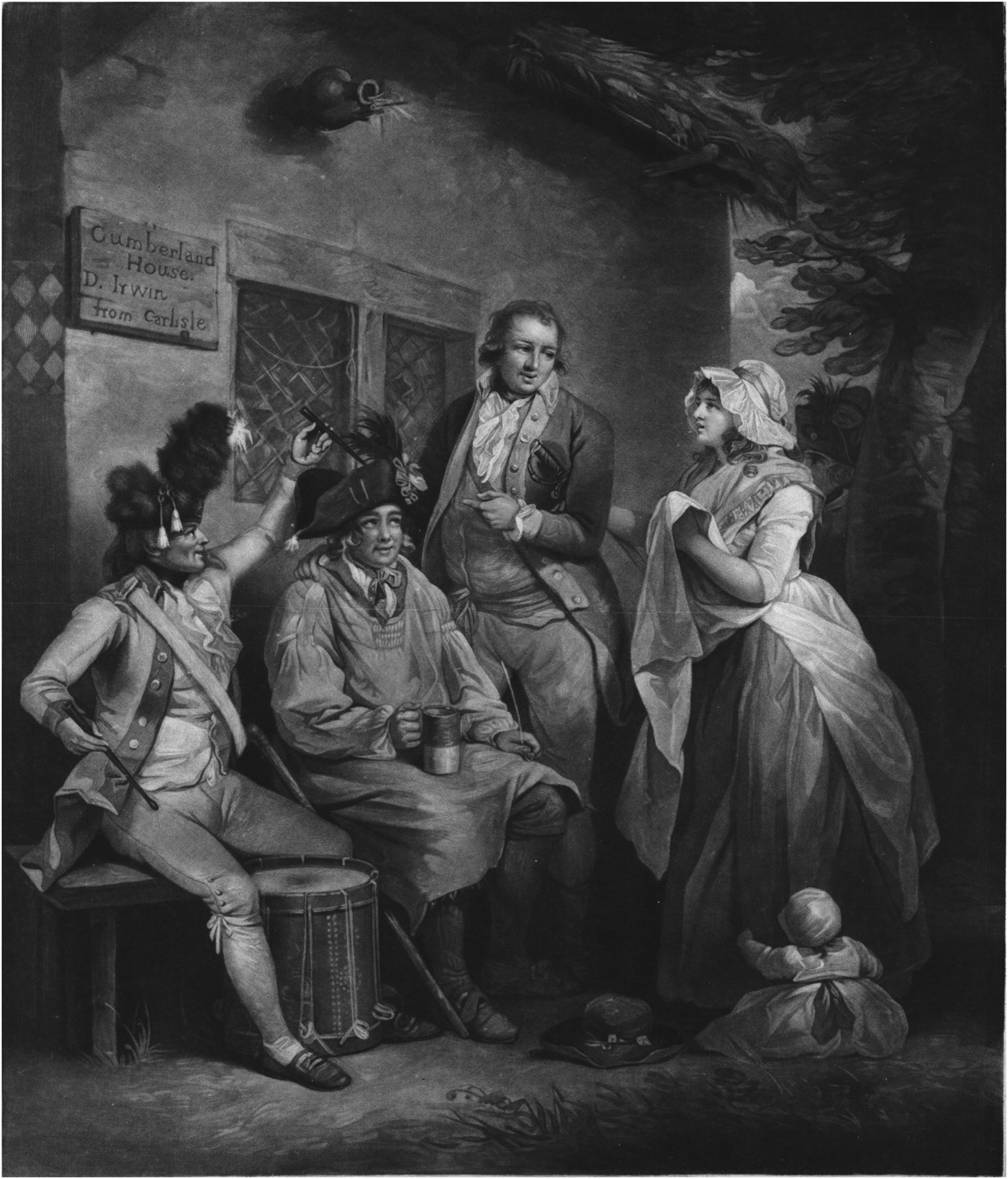
Rather than the nocturnal abandonment conjured up by most popular accounts, some husbands who joined the army clearly did so in their wives’ presence. An evocative print from the end of the century, titled “Trepanning a Recruit” (fig. 1), depicts a youthful husband sandwiched on a bench between two soldiers. He appears to be naively enjoying his mug of ale. The recruiting officer's attention is instead directed at his wife. He has drawn her hand through his arm and presents her with the effect of her spouse in an officer's hat. Her anxiety and that of the innocent babe grasping her skirts is contrasted with the docile smile of her husband. Though this particular wife cannot be said to be eagerly receiving the recruiter's pitch, the painting at least suggests that a wife might be privy to it.
George Keating, print of George Morland, “Trepanning a Recruit,” 1791, mezzotint, British Museum Prints and Drawings 1863,1017.160 ©Trustees of the British Museum.

Other wives may have found the pitch more convincing. George Farquhar served as a lieutenant who recruited men to be sent to Ireland in 1704 and later wrote a comedy that centered on a recruiting party. The popularity of the play throughout the century—there were more than fifty subsequent editions of the original 1706 publication—combined with Farquhar's personal knowledge of army recruitment, attest to the authenticity behind the comedy of his account. At several points in the play, Farquhar's recruiting officer demonstrates wives’ value in convincing their husbands to enlist. “The women . . . are the loadstones everywhere,” Captain Plume stated confidently: “I term it stratagem, since it is so main a part of the service.”Footnote 31 There are other hints that recruiting parties included wives in their discussions with husbands. A sergeant major's wife told the Old Bailey in 1760 that the only time she had met Mrs. Odell, wife of one of her husband's new recruits, was in their home “when he was first inlisted.”Footnote 32 Cases of illegal recruiting for the French or Prussian armies in 1739 also show the expectation that recruits’ wives would participate in the meetings.Footnote 33
It is impossible to know exactly what the army's agents said on these occasions, but it seems likely that they underscored the material benefits of the job. Farquhar included a scene where the recruiting sergeant disguised himself as a cunning man and foretold that one prospective married recruit would attain an officer's rank within three years of donning the uniform.Footnote 34 Ballads parodied the sweeping promises of the recruiting party. One in particular depicted a gullible young man who was told that he would “[s]oon . . . be a corporal” if he donned the uniform, and would quickly move up the ranks to achieve a generalship.Footnote 35 Recruiting parties were powerful theater, and their promises would have operated even more effectively on those desperate for a way for their family to survive.Footnote 36 One later autobiography described the convincing army sales pitch that was accompanied by generous portions of food and drink at a time when the potential recruit had not seen either in three days.Footnote 37 It is easy to imagine a situation where both husband and wife would believe that his entry as a common soldier would solve their immediate financial problems and might promise a more hopeful future—a rare avenue of career advancement from which his wife would inevitably benefit. In order to entice more volunteers to fight for Britain in the Seven Years’ War in 1759, London passed a bylaw granting soldiers the freedom of the City at the time of their discharge from the army, for example, and the Chelsea pension was a further enticement to many.Footnote 38 Contrary to the historiography that stresses the poverty and hardship of life in the ranks, I have argued at length elsewhere that the army held some appeal to family men who found themselves unemployed or in debt. For these men, the significant enlistment bounty, pension, and possibility of augmenting their soldiers’ pay with extra jobs were clear enticements.Footnote 39
More important for the present case, there are also hints that recruits and their wives must have believed that they both would have a place within the army. The army had always carried a number of rankers’ wives “on the strength” of each regiment, entitled to half rations in return for performing tasks such as cooking, laundry, and nursing. Recruiters who argued that wives were free to accompany the regiment may not have intentionally misled couples either. The number of wives permitted fluctuated, dependent upon the circumstances of a campaign. The practice of having ten wives on the strength for every hundred men in a peacetime force and reducing it to only six during wartime virtually ensured that some husbands would be unexpectedly deprived of their wives’ company.Footnote 40 Some officers were remarkably liberal in allowing wives to accompany their husbands, where others enforced central army policy more rigidly.Footnote 41 It is clear that this was the belief under which Alexander McQueen enlisted in the Seven Years’ War. He deserted soon after his arrival in North America and found passage back to England after hearing that his wife and child had been prevented from following his regiment owing to the latter's infection with smallpox.Footnote 42 McQueen can hardly be taken as an example of a husband who used enlistment as a strategy to abdicate his responsibilities for wife and children.
The McQueens were far from unique; couples unwillingly parted by the army appear frequently in accounts of regimental embarkations. In the burgeoning age of military memoirs, hardened veterans wrote of the profound emotional impact of these scenes, often vividly recollecting them many years after they had taken place.Footnote 43 A Napoleonic War veteran wrote that the “parting scene” of his regiment leaving Dover in 1809 “was such . . . that I never wish to witness again. The women clung round the necks of their husbands, so that the officers had much ado to part them. There was such ringing of hands, tearing of hair, and crying, that I was glad to jump into the boat; and I felt thankful that I had no wife to bewail my loss!”Footnote 44 Another testified to “the strength of affection evinced by the soldiers’ wives and children.”Footnote 45 As one wife vowed, “I have been moving Heaven and earth ever since I heard of [the troops’ embarkation], and if I had not succeeded in getting leave to go with him, I would have follow'd him in the first fishing boat that would take me.”Footnote 46 These wives clearly knew of their husbands’ entrance into the army and only forcible separation by the officers kept these couples from remaining together.
Husbands felt the same determination to have their wives at their side. Upon discovering that his spouse would not be permitted to accompany his regiment in the Egyptian campaign against Napoleon, a Welsh private “went into a furious rage, using the most awful imprecations, cursing as well himself, as the authors of his disappointment, and hoping he should never be of any more use in the army.”Footnote 47 Private Duncan Stewart's despondence, though more muted, was no less passionate when the news of her denial of passage with the regiment sent his wife into premature and fatal labor. The comrade in arms who recorded his tragic tale described him as having “scarcely spoke after” the tragic event, and in his lethargic grief, Stewart “was one of the first who fell after the regiment landed in Spain.”Footnote 48 A regiment stationed in Jersey that had just received orders to ship out to Portugal found itself with “a great many more” wives than the allowable six per company. Its chronicler noted the atmosphere in the room where the sergeant prepared to deliver the news of who would be among those selected to travel on the strength. “Here and there you would see the head of a married man pushed forward . . . in the attitude of intense anxiety and attention.”Footnote 49 Another observer in Ireland in 1801 wrote of the “the unparalleled appearance of the distracted, enraged Husbands” facing the prospect of leaving their wives.Footnote 50 In an embarkation from Margate a year earlier, one husband's fellow soldiers actually helped his wife jump from the pier onto the moving ship in a last-ditch defiance of her orders to remain behind. The man's comrades in arms “receiv'd her and laid her gently on the deck, and the officer on board was so touch'd with her perseverance and despair that he permitted her to go.”Footnote 51
As this last example indicates, neither couples nor army officers can be cast purely in the role of villain. Officers frequently exhibited great personal difficulty in attempting to enforce the restrictions limiting the number of wives accompanying troops. The officer who heard Mary Stewart's pleas to remain with Private Duncan Stewart was said to be crying along with the rest of his men.Footnote 52 One officer's words on a similar occasion were recorded for posterity: “I feel for you much,” he told a desperate soldier's wife as the tears filled his eyes, “but my orders are peremptory. . . . [Y]ou have had your chance as well as the other women; and, although it is hard enough on you to be separated from your husband, yet there are many more in the same predicament; and it is totally out of my power to help it.”Footnote 53
These refusals—painful as they were—were buttressed by a growing notion that war was no place for a woman. As John Lynn has argued, the eighteenth century was a period of transition away from the early modern model where camp-following wives had formed an integral part of the troops’ supply system.Footnote 54 As of 1685, soldiers were discouraged from marrying by a policy requiring them to obtain army approval of their bride. Officers were simultaneously instructed to grant permission only in the rarest of circumstances.Footnote 55 This official antimarriage stance remained throughout the eighteenth century. Extant copies of regimental standing orders from the 1780s and 1790s state simply that “marriage is to be discouraged as much as possible” among the men of the line because regiments had “more women than could possibly be allowed to embark for foreign service” and many had to be left behind.Footnote 56
Officers were caught between the pragmatic considerations that dictated limiting the women and children accompanying a campaigning army and the personal agony of having to separate men from their families. Officers such as Sir James McGrigor had steeled themselves to parting with their own beloved spouses and probably saw it as a greater cruelty to countenance members of the fair sex on the battlefield. “I knew well that with the care of . . . wife and Child, I could not do my duty in the way in which . . . it should be done,” he averred, and refused his wife's pleas to accompany him on campaign.Footnote 57 A fictional depiction of an ideal officer from the period loved his wife “fervently and tenderly . . . yet still his country was the mistress to whose service, whenever she pleased to call upon him, he resolved to devote himself in preference to any other.”Footnote 58 Officers’ wives had to expect that marriage into the army required the ability to withstand “separation, when the voice of honour, or the duties of his profession, called” their husband from the household.Footnote 59
Although evidence of these values grew in volume and richness, and is largely concentrated in the Napoleonic era, it does not mean that soldier husbands were spared forcible partings from their wives in earlier decades. There are richer accounts of marital circumstances for Peninsular War soldiers than for those of previous wars because this was an era of greater literacy and self-reflection. There was a larger market for war memoirs and a growing appetite for information about common soldiers outside of the battlefield.Footnote 60 There are few traces of tragic partings from the first half of the century, but evidence is more visible by the era of the Seven Years’ War. In a collection of sermons published in 1758, army chaplain William Agar acknowledged that wives were no longer necessary in battle encampments, and he lamented the situation of the women left without support when foreign wars took their husbands away. The thrust of Agar's argument was that there should be “Hospitals in some cheap Part of the Kingdom” to serve as a refuge for soldiers’ families during the men's absence, and he pledged the profits from a hoped-for second edition of his book toward the erection thereof.Footnote 61
Cryptic references speak volumes for the fact that husbands of the Seven Years’ War were just as subject to the vagaries of army commands as their later counterparts. For example, the Chelsea Parish settlement examinations recorded that a woman was forced to seek relief because her soldier husband “is now ordered away from her” instead of stating that he had willingly left her.Footnote 62 The papers of the aide-de-camp for the commander of the English forces at Flanders reveal wives who attempted to defy the army and accompany their husbands surreptitiously but were ordered off the transport ship.Footnote 63 Two other Seven Years’ War wives surface in the letters of an officer's mother. She writes that two women approached her in Dublin to solicit her to pass on “tidings” through her son to their husbands, because they had not seen them since their regiment went to India in 1754. The mother described the women as being “in great grief” over this fact.Footnote 64 In the American Revolutionary War two decades later, Sergeant Roger Lamb's note that “few young women could be taken on board when the regiment embarked for foreign service” in 1776 is frustratingly brief but telling.Footnote 65
There is no reason to believe that the military couples Napoleonic era memoirs describe differed markedly from those of a few decades earlier. In fact, army attitudes toward wives changed very little from the 1685 regulation discouraging soldiers’ marriage until the late 1800s when the wives left behind were finally entitled to a portion of husbands’ wages or a separation allowance.Footnote 66 Plymouth had so many soldiers’ wives milling about after having said good-bye to their husbands in the early years of the Seven Years’ War, for example, that it made a formal petition to Parliament for more money.Footnote 67 It seems quite clear that all of the war years of the eighteenth century would have held scenes of grieving couples torn apart by a military policy and culture that desired an unencumbered fighting force. It is impossible to know with absolute certainty how many of those husbands parted eagerly from their wives, but it is clear that some, at least, were overwrought by the prospect of a long (and possibly permanent) separation.
■ ■ ■
Unsurprisingly, many of those desperate women on the quayside found themselves before parish officers requesting assistance. To a historian unfamiliar with the broader background of army policy discouraging wives from traveling with troops, they would appear to be little different from the other abandoned wives petitioning for relief in parish records. The St. Martin's settlement exams contained a significant proportion of wives who identified themselves as having soldier or sailor husbands who were “gone from them” upon various war enterprises. However, these men cannot be put in the same class as husbands who had simply abandoned their wives. As the previous section shows, many of these men had their wives with them right up until the moment of their embarkation. They were prevented from remaining together by officers enforcing the army policy that opposed wives’ presence with campaigning troops.
It was expected that army wives in such a situation would go on parish relief. Both contemporaries and subsequent historians have recognized that the eighteenth-century poor relief system served as a de facto separation allowance to army wives. As Myna Trustram has observed, “[T]his dependence of wives on poor relief was endorsed by the War Office practice of sending women back to their home parish.”Footnote 68 Parliament acknowledged this in singling out soldiers’ wives as needing to possess clear documents of settlement that would enable them to move easily through the system and receive assistance during their husbands’ likely absences.Footnote 69 Sir Jerome Fitzpatrick advocated strongly for special funds to be allocated to the Irish wives of soldiers serving abroad precisely because Ireland did not have a parish relief system.Footnote 70 According to Joanna Innes, the eighteenth-century state “considered that the poor and vagrancy laws between them provided a basic safety-net for soldiers’ and sailors’ dependants.”Footnote 71 John Cookson and Arthur Gilbert underscored the benefits of the special entitlements granted to military families to evade guild restrictions and move freely about the country.Footnote 72 In 1799, St. Margaret's Parish identified its provision of relief to “the Wives and Children of Soldiers belonging to his Majesty's Regiments of Guards” as one of its “public yet necessary Burthens” for the nation.Footnote 73 Given this association with relieving army wives as part of a national service, it seems highly likely that army women who turned to poor relief officers and emphasized their husbands’ absence in service would have seen themselves quite differently from other women whose husbands had simply absconded to unknown parts.
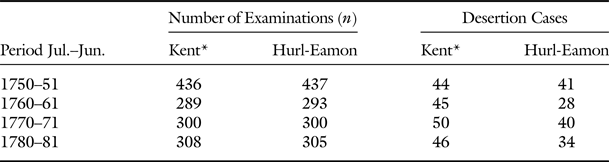
Because the Poor Law system was largely considered to be the instrument by which the army provisioned many wives who were not on its strength, it makes sense that the numbers of military wives seeking parish relief would be higher in times of war, when troops were sent into active theaters where women were largely forbidden. David Kent understood the rise in military wives as applicants for poor relief during wartime to indicate an increase in men enlisting to desert their wives. I have conducted a similar study of the St. Martin's Parish records, locating roughly similar total examinations to Kent (“n” in table 1), but my work shows that those Kent designated as spousal desertions have been somewhat inflated. Where Kent counted women with husbands in military service along with those whose spouses had explicitly left them as marital desertions, I have distinguished the former for further examination. Kent, my study concludes, classified many of these inappropriately as desertion cases. I would argue that Anne Munton fell into a different category than Sarah Barnard, for example. Munton's claim that her husband “ran away and left her five weeks ago and where he is now she knows not but hath heard he is Enlisted for a soldier” contrasts with that of Barnard, who needed assistance because her husband was “a soldier in the Second Battalion in the third Regiment of Guards now in Germany.”Footnote 74 A fuller understanding of the army's treatment of soldiers’ spouses in the eighteenth century illuminates the need to consider such women apart from the broad category of abandoned wives.
Kent's Study versus the Present Study
Source: City of Westminster Archives Centre, St. Martin's Parish Settlement, Examinations F5040–5041, F5051, F5058–5059, F5066–5067, and F5070.
*Taken from David A. Kent, “‘Gone for a Soldier’: Family Breakdown and the Demography of Desertion in a London Parish, 1750–1791,” Local Population Studies 45, no. 29 (1990), table 1.
Kent's numbers indicate that he included women like Barnard, guardsmen's wives, among service-related desertions in his study.Footnote 75 Though the guards were sent abroad on occasion, these regiments were paid better and often served in domestic posts, particularly in and around the capital. The guards thus tended to attract a better character of soldier and would not be an obvious choice for a man who wished to abandon his wife and disappear.Footnote 76 The same was true of the militiamen's wives who came before St. Martin's Parish and appear erroneously as deserted wives in Kent's calculations.Footnote 77 Men who wanted to desert wives would be unlikely to join the militia, which particularly encouraged family men. After the militia reforms of the 1750s, volunteers’ wives benefited from the extra pay allocated to married men, along with additional funds for each of their offspring.Footnote 78 The married men who entered the militia were therefore acting as responsible rather than errant husbands. These women could come forward as supplicants for relief, but they were not women whose husbands had abandoned them.Footnote 79
Many of the other statements to relief officials from the wives of St. Martin's paint a picture of a long-serving soldier in the regular army, who was temporarily unable to remain near his wife and offer provision. The Gordon Riots, for example, removed a large volume of soldiers in posts all around the capital from their regular duties and kept them apart from their families for many weeks. Mary Stone was unable to survive on her own. The forty-year-old Stone came to St. Martin's Parish officers when her guardsman husband of fifteen years had been ordered to the large encampment in St. James's Park to quell the Gordon Riots.Footnote 80 Ann Candler's autobiography related a similar experience. When her husband entered the Coldstream Guards, he convinced her to move the family from their home in Suffolk to his posting in London, only to be called to the St. James's encampment for more than a month. She later told readers that the situation had left her alone in the metropolis, “deprived of all assistance from [her husband], and exposed to the horrors of extreme poverty in the midst of strangers.”Footnote 81 Such women naturally turned to the parish, but they could hardly be seen in the same light as other deserted wives.
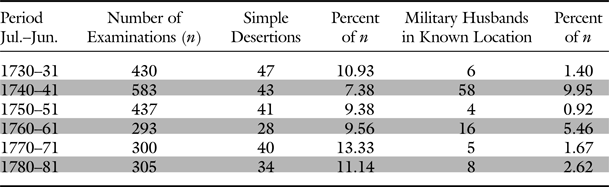
Table 2 shows the distinct portion of women who approached St. Martin's Parish for relief because their husbands were in the military. Many of these husbands, it must be concluded, had not departed under the cloak of secrecy, using the army to abandon their wives. The likelier possibility is that they considered soldiering a way to fulfill their obligation to maintain their wives and children. Men who enlisted out of the desire to escape their wives and children could have relatively easily eluded their wives’ attempts to ascertain their whereabouts, and these men would appear instead among the “simple desertions” in table 2—parish examinations that did not mention military service. Interestingly, table 2 demonstrates that the proportion of deserting husbands in this group did not increase in the sample years of war (indicated by the shaded areas) in comparison to the years of peace (unshaded areas). For Kent's hypothesis to be true, these numbers should have risen in wartime. Instead—with the exception of 1760–61, which saw a marginal increase—they were often lower than the proportion for the preceding decade.Footnote 82 Rather than enlistment being the popular recourse of deserting husbands, it may in fact have allowed more families to survive.
Proportion of Simple Desertions versus Separations by Military Service
Source: City of Westminster Archives Centre, St. Martin's Parish Settlement, Examinations F5023–5024, F5032–5033, F5040–5041, F5051, F5058–5059, F5066–5067, and F5070.
Military husbands’ exemption from the obligation to maintain their wives and children meant that army wives could claim to have very limited means, and it is easy to imagine a scenario whereby a husband decided to enlist because it improved his family's chances of accessing parish funds. In order to be considered a candidate for the army, the husbands of St. Martin's must have been “able bodied,” so their families probably had more difficulty getting parish relief while they remained at home. Their departure from the household opened up a new possibility for the family to get aid, and this logic may have factored into the husband's decision to leave home.Footnote 83 All but four (7 percent) of the army wives in the St. Martin's examinations had no more than two living children, and many were childless. That, too, would have been a strike against these couples in their eligibility for poor relief, because among able-bodied married men, only “the poore man ouercharged with children” was likely to merit special assistance.Footnote 84 In fact, 48 percent of the women claiming relief who knew their soldier husband's whereabouts had no dependents at all. An additional 7 percent had children over the age of three, and were thus out of the vulnerable stage in the life cycle when their children posed a high demand on maternal care and were unable to contribute in any way to the family economy.Footnote 85 Of course, access to poor relief was often a hollow victory; pauper families generally found it necessary to augment parish funds with other menial employment opportunities.Footnote 86 Contemporaries were quick to point out the limitations of parish funds for soldiers’ families in particular. Writing in 1795 on the need for public health institutions for soldiers’ wives and children, Dr. John Ferriar considered parish relief “very inadequate to the wants of a numerous family.”Footnote 87 If enlistment was a survival strategy, as this paper argues, it was part of a complex network of survival tactics that also included begging, pawning, and employment strategies.Footnote 88
Margaret Hegerty's husband had left with his regiment for the West Indies in 1795, but she kept herself and their infant child alive by peddling small goods. Hegerty had probably not intended to abandon his family, because Margaret received word from him after he arrived at his remote posting. Little else can be known of this couple, for Hegerty only surfaced as a theft prosecutor at the Old Bailey; it seems likely, however, that she would have explored the possibility of receiving parish assistance.Footnote 89 John Matthews joined the First Regiment of Foot Guards in 1751 after he had been married for three years. Since their May wedding, the couple had had little luck obtaining steady employment and moved from parish to parish as casual laborers. It seems likely that Matthews's enlistment was a survival strategy rather than desertion because his wife Hannah knew the regiment he joined and he did not lose touch with her after his enlistment. She was informed of his death in March of 1752. There is every likelihood that she received some outdoor relief as a result of his status as a soldier, though the record only states that she “endeavoured to support herself by working or spinning for any person who would employ her.” The probability that she was obtaining some sort of partial relief while he served abroad becomes apparent when the account says that she obtained a servant's post immediately upon her husband's death.Footnote 90 Until this point, she appears to have attempted to survive without entering full domestic service, cobbling together funds from a variety of sources.
As the wife of a serving soldier, a pauper woman had special status that enabled her to take advantage of the periodic outbursts of private charity to add revenue to that derived from her husband's and her own labor. Alannah Tomkins notes that historiography on pauper survival strategies has made a “surprising omission” in neglecting to talk about “charity as an element of the ‘economy of makeshifts.’”Footnote 91 This was especially true of military wives. Military families’ special exemptions under the vagrancy acts meant that soldiers’ wives had a virtual license to beg.Footnote 92 The economic advantages this presented were highlighted when James Dawson Burn's mother falsely claimed to be a soldier's widow in 1810. According to his memoirs, she told a London parish that her husband had died in the nation's service and that his parish of settlement was Northumberland. This got her a vagrant pass that allowed her to take her children all along the east coast, getting cash along the way to pay for travel. Instead of hiring a cart, the paupers walked, and pocketed the travel money. Significantly, they earned enough from their panhandling throughout the journey for Burn to later dub the enterprise “very profitable,” sufficient to set them up as peddlers by the time they reached Newcastle.Footnote 93
As the previous section has already attested, scenes of troop embarkation and return were powerful theater for onlookers, and there can be little doubt that wives and widows received various offerings from observers who were moved by their plight.Footnote 94 When Ann Malagan returned from the West Indies, where her soldier husband had been wounded, “a gentleman” who “heard of the ill situation” gave money to ensure that she “was billeted at a very respectable house . . . in Chelsea.”Footnote 95 Soldiers’ wives seeking philanthropic assistance often had to show themselves worthy. The charitable gifts of the Society for the Encouragement of British Troops provided aid to army wives the Seven Years’ War period, but took care to help only those who “give proof of their virtue, by their tenderness for their children.”Footnote 96 Many women would have had little difficulty giving passionate testimony of their love and devotion to their husbands and children. Just as they pleaded relentlessly with officers for a place with the regiment, wives’ petitioned civilians for help after the troop ships sailed.
Contrary to contemporary and historical opinion, soldiers had a variety of ways of supplementing their paltry wages to assist dependents. First, they might pass their enlistment bounty over to their wives. It is difficult to find evidence of such instances, but there are hints, such as when a neighbor told parish officers in 1709 that William Underwood “was Imprest for Land Service in St. Giles,” and he “pd ye Imprest mony to his wife.”Footnote 97 In 1797, Margaret Hegerty informed the Old Bailey that her husband “left me five guineas” on his departure for the West Indies in the “Old Buffs” (Third or East Kent Regiment of Foot), and this, too, suggests that he had passed on his enlistment bounty to her.Footnote 98 By this period, as this article's introduction indicates, bounties had become even more enticing to an impoverished household head. Married soldiers had other avenues to help their families as well. They might take odd jobs for civilians during their off-duty hours. There is much evidence of this for soldiers in colonial garrisons, but soldiers stationed in London also took on extra work as private security guards, porters, lumpers, and general servants.Footnote 99 The army, too, presented its own opportunities for extra employment or advancement, and conscientious privates could gain income by performing various skilled trades for the regiment or earning a promotion to noncommissioned officer's rank. These advantages were more lucrative than many outsiders realized. For example, Mary Ann Ashford professed herself “agreeably surprised” at the comfortable financial circumstances of her new husband when she married the sergeant shoemaker for the Royal Military Asylum at Chelsea in 1817. He had accumulated “considerable sums” that the couple then “put into the Bank” upon their marriage.Footnote 100 A veteran who had enlisted in 1792 and been made a corporal in 1797 concluded his memoirs by informing his readers that “the most prudent course which a young man who has not better prospects than a common labourer can take is to enter the army.”Footnote 101 “The pauperization of the soldier can be overstated,” John Cookson affirmed in a study of soldiering in the Napoleonic era.Footnote 102 Even before the pay rises of the 1790s, accounts can be found of soldiers like William Cobbett, who was promoted to corporal within the first year of his enlistment in 1784. “I had saved a hundred and fifty guineas,” Cobbett recalled; “the earnings of my early hours, in writing for the paymaster, the quartermaster, and others, in addition to the savings of my own pay” in colonial North America.Footnote 103 It was not inconceivable for noncommissioned officers—along with a few enterprising privates—to earn a reasonable livelihood in the British army.
These excess funds could be passed on to wives even when they were living separately. Contrary to most histories that assume that it was impossible for soldiers serving abroad to contribute to family coffers, officers’ letters from the eighteenth-century wars on the Continent demonstrate that informal allotment schemes existed for men in certain regiments.Footnote 104 In 1759, a corporal in Major Richard Davenport's regiment arranged to send his wife “a little money now and then” with the help of Davenport's brother back in England.Footnote 105 The letters of Lieutenant General Sir Hew Dalrymple to his wife in 1793 depict a similar arrangement. Lady Dalrymple served in the same capacity as Davenport's brother, paying out specified amounts to wives back in England. On campaign in Europe, Sir Hew's men would leave him with a portion of their pay, and he would instruct Lady Dalrymple back in London to dispense that sum to their wives.Footnote 106 Less than a decade later, James Walton of the Coldstream Guards told the Old Bailey that he had paid “2s. 6d. a week for” his wife and two children.Footnote 107 Though few and sparse, these hints of soldiers giving money to their wives are nonetheless significant because they demonstrate the fact that the legal exemption awarded all low-ranking military men by the Soldiers’ Case of 1752 did not stop all of them from trying to provide for their families when they could. Enlistment did not ensure that married men abandoned all efforts to contribute to the household income.
In the decades after Waterloo, parish overseers appear to have become more aware of soldiers’ contributions to their spouses. In 1815, for example, Lancashire officials stopped one woman's relief payments when it found that her husband had “come to the army and is now receiving his pay as a soldier and is at present working.”Footnote 108 Steven King claimed that the parish vestry acted uncharacteristically harshly, but he mistakenly assumed that no married man serving as a soldier would help to maintain his wife and family. Because it was peacetime and the record offered no indication that he was serving away from British shores, it is more likely that the Garstang vestry knew that the newly listed man retained contact with his wife and was offering support by supplementing his military pay with other jobs during his off-duty hours. Garstang's refusal to continue relief payments indicates a growing awareness of pauper families’ use of enlistment as a survival strategy. The Poor Law commissioners of Merthyr Tydfil Union in July of 1842 voiced similar doubts that the married women requesting relief were truly bereft of any support from their husbands.Footnote 109 Such expressions of skepticism paradoxically underscore the success of enlistment as a pauper survival strategy in earlier decades.
This sort of survival strategy would have held most appeal to those who took advantage of the shorter terms of enlistment that were introduced to entice recruits “whenever the Army was raised from a peace to a war establishment.”Footnote 110 As early as 1708, those who agreed to enter the army were asked to commit for only three years, and the army periodically allowed volunteers—and even impressed men—similarly brief periods of enlistment throughout the century.Footnote 111 Though the bounty was correspondingly lower, many men nonetheless preferred the shorter commitment to the king's service. Kevin Linch proposed that some married men were enticed from the militia into Wellington's army by “the benefits of limited service, which included a guaranteed pension.”Footnote 112 Enlistment for a few years, rather than a lifetime commitment, would have appealed precisely to those men who saw the army as a way to support rather than abandon their wives. Whereas the latter offered a permanent job and the chance to disappear and escape from unwelcome entanglements, the former promised the possibility of reunion and a pension to supplement the family thereafter.
It is difficult to trace men after their discharge, but there are hints that at least some went to great lengths to find the wives they left behind and to reconstitute their family. The accounts that have survived are the more sensational stories of betrayal that were printed for a popular audience, or were brought before the courts as bigamy cases. It is important, however, to recognize that even these soldiers who returned home to find their wives had taken a new husband in their absence represent an alternative image to the deserting soldier-husband.Footnote 113 One sergeant who had married and then left his wife to serve in the Peninsular War, for example, had—“by some unaccountable circumstances, incidental to long campaigns”—failed to receive “any tidings of or from her” during the many years of his absence. He nonetheless set out to find her on his return. His search involved “tramping up down and around Portsmouth,” inquiring randomly of passersby for his wife's name, which “drew a crowd of women of all ages about him,” one of whom was able to lead him to his wife. She had remarried, thinking him dead, and a painful scene ensued whereby he accepted her new choice and parted from the couple.Footnote 114 Although the army made it very difficult for soldiers’ families to remain intact, it seems clear that some soldiers kept the hope of reunion alive even under the harshest circumstances.
■ ■ ■
It is highly likely that some eighteenth-century husbands found the peripatetic existence of military life a worthwhile escape from an unhappy marriage. To assume that this was the only reason that a married man might enlist, however, is to see only part of the picture. Evidence that soldiers offered funds to their families, despite their official exemption from any maintenance requirements, shows that some men actually used military service as an avenue by which to fulfill rather than avoid their husbandly duties. Families facing poverty and unemployment may well have regarded the husband's absence in armed service in an optimistic light, adding the bounty money to their increased prospects of receiving aid from parish and private charity. Some couples clearly hoped to stay together despite the husband's acceptance of the king's shilling, evident in the accounts of tearful partings at troop embarkations. Others, such as those who enlisted under shorter terms of service, or in a militia or guards regiment, may have expected their separation to be temporary. For all, the dream of reunion and a Chelsea pension shone as a beacon to lighten their more immediate troubles.
The St. Martin's Parish settlement examinations for the period of highest recruitment for the Seven Years’ War and the war with revolutionary America substantiate this. When read with a full knowledge of the role of parish relief as a de facto separation allowance for military wives, these records show that enlistment was probably not a means by which many men abandoned dependent families. David Kent's neat category of “service-related desertions” simply did not exist in reality.
Even those men who might have enlisted in a momentary lapse of judgment (usually brought on by drunkenness) often repented their decision and tried to remain connected with their wives. This was certainly the case for Duncan Stewart, whose wife, Mary, died in childbirth after she learned that their pleas to travel together with the regiment were denied. Stewart had enlisted in a drunken stupor and only realized his folly upon sobering up in Edinburgh with a band of similarly duped recruits.Footnote 115 By contrast, Ann Candler's husband had been drunk and abusive throughout their marriage and enlisted in the guards after “thoughtful and gloomy” contemplation. Rather than embracing his freedom and never seeing his family again, however, he “obtained leave of absence and came down to Sproughton” to his wife. “During his stay,” she later recalled, “he incessantly importuned me to go to London, and flattered me how well we should live there, as he could throw up his pay and go to work.”Footnote 116 These two examples can only begin to illustrate the complexity of desertion stories.
Ultimately, this article points to the fact that a married man enlisted in the army as the result of a variety of considerations, and that escaping his wife was probably further down on the list than historians have hitherto believed. The literary evidence with which this article began shows that the stereotype of the irresponsible soldier husband held great purchase in the eighteenth century as well, but that it is time to lay that stereotype to rest. While it was undoubtedly true of some married recruits, it was certainly not the story of them all. The preceding evidence has made it abundantly clear that not every married soldier traveling alone blessed the army for extracting him from his marriage. Some undoubtedly hoped that, in donning the uniform, they could help their wives and children.