To limit the transmission of multidrug-resistant organisms (MDROs) such as methicillin-resistant Staphylococcus aureus (MRSA) and vancomycin-resistant enterococci (VRE), contact isolation precautions (CP) have been employed that includes use of gowns and gloves for provider interactions with the patient.Reference Siegel, Rhinehart, Jackson and Chiarello 1 Most studies on CP have been conducted during outbreaks and often include multiple interventions utilized simultaneously.2 CP adversely influences provider behavior and results in decreased provider interactions with patients.Reference Morgan, Pineles and Shardell 2 – Reference Saint, Higgins, Nallamothu and Chenoweth 4 In addition, some studies have associated CP with delays in admission and transfer, excess adverse events, psychologic harm, and patient dissatisfaction.Reference Morgan, Murthy and Munoz-Price 3 , Reference Mehrotra, Croft and Day 5 , Reference Gilligan, Quirke, Winder and Humphreys 6 Other studies do not indicate an increase in adverse consequences.Reference Harris, Pineles and Belton 7 , Reference Masse, Valiquette and Boukhoudmi 8 There is a growing diversity of practice with regard to CP.Reference Morgan, Murthy and Munoz-Price 3 , Reference Edmond, Masroor, Stevens, Ober and Bearman 9 We evaluated the effect of discontinuing CP for patients colonized or infected with MRSA or VRE on the rate of bloodstream infection and pathogen acquisition.
METHODS
This quasiexperimental, before-and-after study was conducted at a 689-bed academic medical center. In January of 2015, CP for endemic MRSA and VRE were discontinued except for patients with uncontained secretions (eg, large wound uncontained by dressing). One month prior to the change in CP, the new policy was communicated broadly to all providers. Contact precautions were continued for patients with Clostridium difficile or norovirus infection and for those colonized or infected with multidrug-resistant gram-negative bacilli (eg, carbapenem-resistant Enterobacteriaceae, etc). Bacteremia due to MRSA was detected and reported using Centers for Disease Control and Prevention (CDC) National Healthcare Safety Network methods. Similar definitions were applied to VRE bacteremia. All clinical cultures yielding MRSA or VRE were reviewed by the same experienced infection preventionist and classified as present on admission or possible/probable hospital-acquired. No active surveillance cultures for MDROs were conducted. The infection preventionist applied the same methods for classification of cultures throughout the study period. Several horizontal infection prevention measures were in place during the study period including hand hygiene, environmental cleaning and disinfection, and chlorhexidine (CHG) patient bathing. Hand-hygiene compliance was tracked using a direct observer system that had been in place since 2008. Trained and validated observers, who are permanently employed on a particular hospital unit, each provide 10–15 minutes of observation per week. Opportunities for hand hygiene are classified by provider type and opportunity type (room entry/exit or patient care). Environmental cleaning and disinfection was tracked using an ultraviolet-tagged marking gel.Reference Carling, Parry and Rupp 10 To evaluate the effect of discontinuation of CP, the monthly rate of MRSA and VRE infection from 2014 and 2015 was analyzed by Poisson regression.
RESULTS
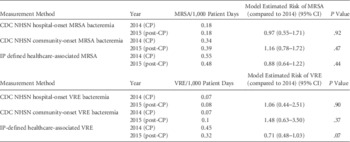
The rate of infection due to MRSA and VRE is summarized in Table 1. The hospital-onset rate of MRSA bacteremia per 1,000 patient days was 0.18 for both 2014 and 2015. The rate of hospital-onset VRE bacteremia per 1,000 patient days was 0.07 and 0.08 for 2014 and 2015, respectively. Poisson regression analysis revealed no significant difference in the rate of hospital-onset or community-onset MRSA or VRE bacteremia between 2014 and 2015. No significant difference was noted in the rate of hospital-acquired MRSA or VRE defined by the infection preventionist. Hand-hygiene compliance was 93.5% in 2014 (17,078 opportunities observed) compared to 91.4% adherence in 2015 (13,732 opportunities observed). Environmental cleaning was thorough. In 2014, 21,345 of 22,805 surfaces (93.6%) tested at the time of terminal cleaning in 1,941 hospital rooms were adequately cleaned compared to 26,397 of 27,411 surfaces (96.3%) in 1,485 hospital rooms in 2015. The method of chlorhexidine bathing and the compliance measurement changed during the study period, precluding comparison. In July 2015, the institution transitioned from bathing patients with CHG bed baths (30 mL 4% CHG in 1 L of water in a bath basin) to using a 4% foam CHG product on premoistened washcloths. The compliance measure was changed from an assessment of inventory to provider-charted CHG baths in the electronic medical record. Although not formally measured, providers at all levels expressed appreciation and satisfaction with the change in CP policy.
Poisson Regression Analysis of the Impact of Change in Contact Isolation Precautions on Methicillin-Resistant Staphylococcus aureus (MRSA) and Vancomycin-Resistant Enterococci (VRE) from 2014 to 2015Footnote a

NOTE. CDC, Centers for Disease Control and Prevention; NHSN, National Healthcare Safety Network; CP, contact precautions; IP, infection preventionist.
a MRSA and VRE event rates are expressed as events per 1,000 patient days.
DISCUSSION
The medical literature does not provide compelling evidence to demonstrate the benefit of CP in the care of patients infected or colonized with MRSA/VRE in endemic situations. Because of the perceived lack of benefit, potential for unintended consequences, and economic costs associated with the routine used of CP, we chose to eliminate CP for the care of patients with endemic MRSA and VRE. We observed no difference in the rate of nosocomial acquisition or invasive infection due to MRSA or VRE. We felt confident in the elimination of CP for several reasons. First, standard infection prevention precautions were emphasized and CP were continued in situations where body fluids were not contained. Second, rigorous horizontal infection prevention interventions were in place with documented high levels of compliance (ie, hand hygiene, environmental disinfection, chlorohexidine patient bathing). Third, standardized prevention bundles and checklists were in place to prevent device-associated infections.
Our study was limited by its observational nature, lack of active surveillance cultures to rigorously detect acquisition, and performance in a single center. Neither data mining or molecular typing were performed to detect unsuspected outbreaks. The change in chlorhexidine bathing method adds an additional potential confounding factor. Nonetheless, our study adds to the growing experience of cessation of CP for endemic MRSA and VRE. Hopefully, more rigorous studies of the utility of CP in relation to standard precautions in facilities with robust horizontal measures will be performed. Until more definitive data are available, institutions with strong horizontal prevention programs in place may consider discontinuation of routine CP for patients with endemic MRSA/VRE and should be guided by institutional needs and available resources.
ACKNOWLEDGMENTS
We thank Ms Sandy Nelson for expert secretarial support.
Financial support: No financial support was provided relevant to this article.
Potential conflicts of interest: All authors report no conflicts of interest relevant to this article.