As one of the prominent fields in counselling practices, school counselling has been extensively studied and reported in the counselling literature (e.g., Branco & Brott, Reference Branco and Brott2017; Chandler et al., Reference Chandler, Burnham, Riechel, Dahir, Stone, Oliver and Bledsoe2018; Sutton & Fall, Reference Sutton and Fall1995), and has received greater attention in recent years. As a keystone of the educational system, school counsellors have been the subject of different studies, such as burnout (e.g., Butler & Constantine, Reference Butler and Constantine2005; Gündüz, Reference Gunduz2012; Wilkerson & Bellini, Reference Wilkerson and Bellini2006), supervision (e.g., Gordon & Luke, Reference Gordon and Luke2016; Neyland-Brown, Laux, Reynolds, Kozlowski, & Piazza, Reference Neyland-Brown, Laux, Reynolds, Kozlowski and Piazza2019), and self-efficacy (e.g., Mullen & Lambie, Reference Mullen and Lambie2016; Özteke, Üre, & Kesici, Reference Ozteke, Ure and Kesici2015). However, while studies of school counselling services, counsellor roles and ethical issues have been examined in the literature, relatively little is known about self-efficacy beliefs of school counsellors and likely methods of enhancement. Thus, in this study, Turkish school counsellors’ counselling self-efficacy beliefs, their weak and strong points in practice, sources of self-efficacy and enhancement mechanisms were revealed using a qualitative approach.
As an important part of the school setting, school counsellors have a prominent role in students’ wellbeing, achievement, abilities, behaviours and attitudes. School counsellor self-efficacy beliefs, including ‘I can do this work or I think I have a capacity to deal with this problem in my work’, directly affects performance and outcomes. Revealing school counsellors’ opinions about their counselling self-efficacy through a qualitative approach, and examining sources and routes for enhancement, has the potential to contribute to the literature of psychology. Although counsellor self-efficacy has been the subject of numerous studies, especially in recent years (e.g., Goreczny, Hamilton, Lubinski, & Pasquinelli, Reference Goreczny, Hamilton, Lubinski and Pasquinelli2015; Morrison & Lent, Reference Morrison and Lent2018; Watt et al., Reference Watt, Ehrich, Stewart, Snell, Bucich, Jacobs and English2019), most have been conducted using a quantitative research method. This study provides an in-depth qualitative investigation of counsellor self-efficacy with regard to several key themes (counselling skills, group management, working with resistant students, consultation skills, and assessment techniques) involving different perspectives: perceived weak and strong elements, sources of self-efficacy, and likely strategies for increasing participants’ self-efficacy.
Sources of Self-Efficacy
Sources of self-efficacy beliefs were conceptualised by Bandura (Reference Bandura and Ramachaudran1994, Reference Bandura1997) in the literature as mastery experiences, vicarious experience, social persuasion, and emotional-physiological state. Mastery experiences refer to an indicator of one’s capability, whereas vicarious experience means one’s self-efficacy beliefs, which is a result of observation of others’ skills. Verbal persuasion is based on others’ comments about one’s skills, and the emotional-physiological state is related to one’s vulnerability or strengths toward a dysfunction. Self-efficacy beliefs are affected by anxiety, stress or mood (Bandura, Reference Bandura and Ramachaudran1994, Reference Bandura1997; Usher & Pajares, Reference Usher and Pajares2008).
Counselling Self-Efficacy
The term ‘counselling self-efficacy’ is derived from Bandura’s social-cognitive theory (Reference Bandura1971, Reference Bandura1988, Reference Bandura and Vasta1989b, Reference Bandura1991), which assumes the interaction of behaviour, environment and personal factors in learning. Social-cognitive theory also highlights the effect of observations (Bandura, Reference Bandura1988) and indirect experiences, such as indirect reinforcement, punishment, motivation and emotion in learning. One of the terms that social-cognitive theory introduced to the psychology literature is ‘self-efficacy beliefs’, which has a prominent role in one’s performance (Bandura, Reference Bandura1989). Self-efficacy beliefs refer to a person’s perceptions about his or her own ability on a task, which is different from the actual ability regarding work. The perception about ability and the ability that humans have may differ (Bandura, Reference Bandura1983).
Self-efficacy beliefs have been studied with regard to several aspects, such as job satisfaction (e.g., Skaalvik & Skaalvik, Reference Skaalvik and Skaalvik2017), academic achievement (e.g., Feldman & Kubota, Reference Feldman and Kubota2015; Honicke & Broadbent, Reference Honicke and Broadbent2016) and career decision making (e.g. Guan, Capezio, Restubog, Read, Lajom, & Li, Reference Guan, Capezio, Restubog, Read, Lajom and Li2016). Counsellor self-efficacy is defined as a counsellor’s beliefs and judgments regarding his or her potential to perform particular counselling behaviours (Larson, Suzuki, Gillespie, Potenza, Betchel, & Toulouse, Reference Larson, Suzuki, Gillespie, Potenza, Bechtel and Toulouse1992; Larson & Daniels, Reference Larson and Daniels1998; Sutton & Fall, Reference Sutton and Fall1995). Larson and Daniels (Reference Larson1998) described counsellor self-efficacy as subjective beliefs regarding one’s own capacity to perform. They argued that counsellors with high self-efficacy believe they can deal with challenging tasks, whereas counsellors with low self-efficacy believe they do not possess the necessary skills for a satisfactory performance. Larson (1989) contended that self-efficacy determines the decision making, counselling skills and overall counselling performance of a counsellor, and also helps the individual to be more patient, strongly motivated to learn difficult tasks and be less anxious.
Bandura (Reference Bandura1982) stated that cognitive factors are effective in dealing with anxiety management by using certain cognitive-behavioural interventions. Self-efficacy enhancement in the literature was reviewed in terms of self-efficacy enhancement programs, and several studies have been conducted, especially in the field of education and health (e.g., Chang, Crogan, & Wung, Reference Chang, Crogan and Wung2007; Drowoju & Onuka, Reference Durowoju and Onuka2015; Khourey-Bowers & Simonis, Reference Khourey-Bowers and Simonis2004). Marks, Allegrante, and Lorig (Reference Marks, Allegrante and Lorig2005) emphasised the sources of self-efficacy beliefs such as facilitating mastery skills, experiencing social and verbal persuasion, exposure to vicarious experience and taking into consideration one’s physical and emotional state before and after the activity in improving intervention programs. Moreover, Fai-Tam (Reference Fai-Tam2000) suggested that self-efficacy enhancement helps individuals to gain better self-concept and coping strategies. For example, Durowoju and Onuka (Reference Durowoju and Onuka2015) revealed in their research that teacher self-enhancement was effective for student achievement. In a population of patients with spinal cord injury, the self-efficacy enhancement program has been found effective to improve a better self-concept.
With regard to the school context, Bodenhorn, Wolfe, and Airen (Reference Bodenhorn, Wolfe and Airen2010) reported that school counsellor self-efficacy is an important factor for students, as a school counsellor with high self-efficacy is likely to have a better effect on students. In the United States, school counsellor self-efficacy has been studied as a subtopic with regard to different circumstances, such as supervision (Cinotti, Reference Cinotti2013; Lin, Reference Lin2012), burnout (Gunduz, Reference Gunduz2012), ethical knowledge (Mullen, Lambie, Griffith, & Sherrell, Reference Mullen, Lambie, Griffith and Sherrell2016), and school climate (Sutton & Fall, Reference Sutton and Fall1995). Numerous studies have also revealed the significant preventive role of counsellors in school settings, such as a detrimental school climate (e.g., Hernández & Seem, Reference Hernández and Seem2004), as well as traditional bullying (e.g., Bauman, Reference Bauman2008; Jacobsen & Bauman, Reference Jacobsen and Bauman2007) and cyberbullying (e.g., Bhat, Reference Bhat2008).
School counsellors have a significant impact on both students and other school staff. They are important for students for their personal, social, educational and vocational growth, and also for school stuff to collaborate for a better and safer school. In this regard, school counsellors’ self-efficacy is related to wellbeing, bullying and personal growth for every member of the school.
The Rationale of the Study
Counsellor self-efficacy has been handled in numerous studies in the literature for years using quantitative analyses (e.g., Daniels & Larson, Reference Daniels and Larson2001; Greason & Cashwell, Reference Greason and Cashwell2009; Watt et al., Reference Watt, Ehrich, Stewart, Snell, Bucich, Jacobs and English2019). The authors demonstrated the links between counselling self-efficacy and other variables such as mindfulness, anxiety or competence by using quantitative data analyses. Moreover, self-efficacy enhancement programs are effective for better health, wellbeing and stress management (Marks et al., Reference Marks, Allegrante and Lorig2005), but in the counselling psychology literature, there is no qualitative research that has investigated counselling self-efficacy. It is important to determine how to enhance counselling self-efficacy, and a qualitative approach will shed light on this aspect of the profession.
The current study aims to reveal Turkish school counsellors’ self-efficacy beliefs, sources of self-efficacy, and ways to enhance it using interviews to understand the nature of counselling self-efficacy more deeply. Patton (Reference Patton2015) emphasises that if we want to measure a variable, we can use a scale and quantitative techniques, but if we need to demonstrate what this variable means to people or how they perceive and interpret that variable, this can be achieved by interviews. Moreover, Patton (Reference Patton2015) stated that qualitative methods enable the acquisition of detailed information about a small group of people, phenomenon or cases. The literature of counselling self-efficacy needs more qualitative data to gain different points of view rather than generalising the results to similar populations. Counsellor self-efficacy is important to be able to predict and assess counsellor behaviour, qualifications and skills as it affects their performance in therapeutic relations. The current study aims to reveal sources of Turkish school counsellor self-efficacy beliefs and enhancement strategies based on participants’ views, interpretations and comments, using the interview method to reach more detailed and deeper knowledge.
In sum, in the current study, sources of school counsellors’ self-efficacy beliefs and likely enhancement strategies for self-efficacy were examined. The responses to two questions were the basis of obtaining such perspectives:
-
1. What do school counsellors think about the sources of their self-efficacy beliefs?
-
2. What do school counsellors suggest to improve school counselling self-efficacy beliefs?
Methodology
Research Design
In this study, a phenomenological design was used to reveal school counsellors’ self-efficacy beliefs, sources of self-efficacy, and reasons and suggestions to increase self-efficacy. Methodologically, a phenomenological research design handles a phenomenon such as marriage, emotion, experiencing pregnancy or a job, and focuses on how humans experience these phenomena. There are two important key points in phenomenological research: first is what individuals experience, and second is how they interpret these experiences (Patton, Reference Patton2015). Giorgi (Reference Giorgi1997) indicated that experiences of people and how they interpret these meanings are important, because the phenomenological meaning may differ from person to person. Moreover, phenomenological research considers the phenomenon and deals with how individuals perceive, experience, and feel it by using in-depth interviews to gather data. In sum, ‘lived experiences’ constitute the key points in this research design (Patton, Reference Patton2002). In phenomenological design, phenomena about which we are aware but do not have deep knowledge is taken into consideration and analysed (Yıldırım & Şimşek, Reference Yıldırım and Şimşek2006). Here, the particular phenomenon is counselling self-efficacy, and how participants perceive, describe, interpret and speak about it was deeply analyzed. The subjective experiences of participants were analysed using in-depth interviews.
Participants
The study group consisted of 19 school counsellors with different years of experience and who worked in different levels at schools. Demographic information of the participants is presented in Table 1. All of the participants were working in public schools but some had previous private school experience. In the Turkish educational system, the state schools are free schools for all students, and every citizen living in Turkey can benefit from these schools. On the other side, the private schools are fee-paying schools, and families may choose any private school for their children. The curriculum and the educational systems are the same in private and state schools. The only difference between these schools is the cost and the distance between school and home. If students want to go to a state school, they must choose the school which is close to their home, but this is not required for private schools. The participants were from different cities in seven regions of Turkey. A maximum diversity sampling method was used in choosing the study group. Creswell and Clark (Reference Creswell and Clark2017) stated that in this sampling method used in social sciences, age, career, organisation and gender may be a criterion. In the current study, the participants were categorised according to their different cities or regions, age, work experience and gender (see Table 1). ‘Primary’ and ‘middle’ school definitions refer to compulsory education for every child living in Turkey, aged from 6 to 13. The first four years of this education system is ‘Primary education’ and the next four years is ‘Middle education’, which allows students to choose different courses based on their interests and skills. ‘High school’ refers to the four-year period from 13 to 17 years when students specifically choose general, vocational or technical schools according to their interests and capabilities (ogm.meb.gov.tr).
Demographic Information for the Study Group

Before the interviews, the participants were informed about the aim and confidentiality of the study. Consent forms were collected from the participants, so only those school counsellors who volunteered participated in the study.
The Development of Instrument
A semistructured interview form was prepared for data collection. Before preparing interview questions, the literature regarding counselling self-efficacy and school counselling was reviewed, and questions were prepared according to the theoretical background of counselling self-efficacy. Five lecturers with doctoral degrees in counselling psychology reviewed the questions, and according to their recommendations, the questions were revised. After preparing the questions, a pilot study with five school counsellors was conducted and some questions were further revised in terms of clarity and relevance of study. Moreover, probing questions were asked to reveal their views during the interviews. The questions were asked under the basic themes that school counsellors work with. These themes were counselling skills, management of group behaviour, working with resistant students, consultation and assessment techniques. The questions were: (1) How do you feel about yourself in (name of theme)? What are your strengths/weaknesses in (name of the theme)? (2) What may be a reason for counselling self-efficacy in this theme? (3) What do you recommend to increase counselling self-efficacy in this theme?
In total, 15 questions were asked to the school counsellors to reveal their self-efficacy views on themes, sources and suggestions.
Data Collection and Analysis
Face-to-face and online interviews (for participants in other cities) were used in data collection. The interviewer has both a theoretical and practical background to interview in qualitative research. During the graduate education process, the theoretical courses were completed, and in practice, several interviews were conducted in the past qualitative researches. Before starting the interview, participants were informed about what was meant by ‘counselling self-efficacy’. In the first phase of interviews, the aim of the study and legal and ethical issues were explained to the participants and they signed a consent form. The participants were informed about the use of pseudonyms. The interviews lasted approximately 26 to 40 minutes.
First, a deductive approach was adopted for the data-analysing process. In this approach, themes are determined before the analysis, based on prior information or a theoretical background (Elo & Kyngas, Reference Elo and Kyngäs2008). A deductive approach is a top-down approach that the codes and themes derive from concepts or ideas which the researcher brings to the data (Braun & Clarke, Reference Braun, Clarke and Cooper2012). Then, thematic and content analyses were used for the data analysis. First, the themes were created using thematic analysis (TA), based on the theoretical background. The TA is a method of data analysis that allows the researcher to describe and organise a dataset based on the theoretical background. The themes and patterns of meanings need to be in relation to the research questions or a particular topic (Braun & Clarke, Reference Braun, Clarke and Cooper2012). The literature of school counsellors’ role, the field of work, job definition and missions at schools was reviewed before creating the research questions. The deductive approach was used in the selection of research questions. Subject-matter experts’ interviews were conducted to determine the themes and questions. Based on their consensus, the themes of the study were created using a thematic analysis. School-counsellor self-efficacy was handled in two ways for creating themes: one was sources of self-efficacy and the other was enhancement strategies. After determining the themes, the transcription process was completed and codes were created for every theme. Based on the themes and codes, the categories were created using content analysis. Content analysis refers to analysing the text or document to reach the core meaning of a qualitative material (Patton, Reference Patton2002). In the data analysis, every participant was coded and participants’ statements were given in parenthesis with symbols describing gender, years of experience and school level, such as F (female) or M (male), Y (year) and P (primary), M (middle) or high (H) school level. A coder created codes after transcription based on certain themes. The categories were created according to these codes under themes. Then the second coder checked the codes, categories and quotations. The calibration was done by checking the categories, and the coders eventually reached consensus after checking the categories.
Reliability and Validity of Interview Form and Study
For reliability, a pilot study was conducted with five participants in which they were asked the questions mentioned above. After data collection and analysis, findings of the study were shared with the participants via electronic mail to get feedback about incorrect or omitted issues and were subsequently approved by them, increasing internal validity (e.g. Patton, Reference Patton2002). For confidentiality, pseudonyms were used during the research and the real names of participants were not given in the findings section. After the codes and themes were determined by the researcher/s, two academics (with doctoral degrees in counselling psychology and experience in qualitative studies) and two practitioners working as school counsellors examined the data collection and analysis process to increase validity and reliability; feedback from professionals is an important factor for such studies (Yıldırım & Şimşek, Reference Yıldırım and Şimşek2006).
Findings
In this section, the themes and categories regarding school counsellor self-efficacy sources and methods of enhancement are described. Five themes were created using descriptive analysis, adhering to the literature of school counselling. These themes were named as counselling skills, management of group behaviour, working with resistant students, consultation, and assessment techniques. Based on the themes, sample statements were given in each category by participants’ codes. The sample statements of participants regarding themes and categories are provided in five tables in the Appendix.
Counselling Skills Theme
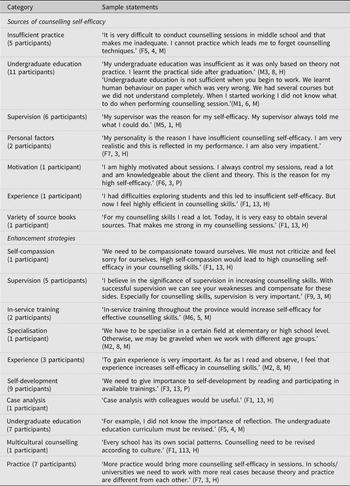
For the theme of counselling skills, the sources of self-efficacy were examined and participants mostly emphasised the lack of undergraduate education. Moreover, ‘Insufficient practice’ became prominent in this theme. Participants generally pointed out that insufficient counselling sessions at schools was a reason for their self-efficacy beliefs. Supervision was revealed as another prominent category related to their source of self-efficacy beliefs. Other categories were personal factors such as personality, motivation, experience, and variety of sourcebooks. Participants were asked how to enhance their self-efficacy related to counselling skills in the second step. Making curriculum revisions in undergraduate education, having more supervision, self-development by following current trends, and attending several trainings were mentioned as the most important factors to enhance their self-efficacy beliefs. Besides in-service training (i.e., attending seminars and courses every year, which are arranged by the National Ministry of Education), self-compassion, having experience, conducting case analysis with other counsellors, and multicultural counselling were the categories mentioned by the participants that could enhance their self-efficacy in counselling skills.
Management of Group Behaviour Theme
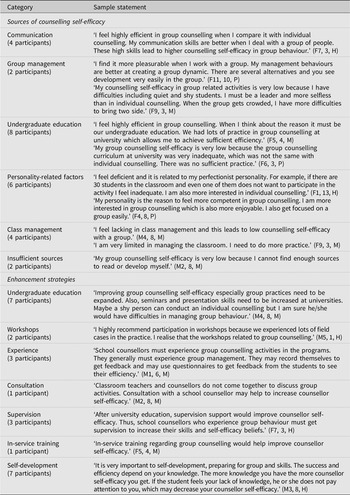
In this theme, the effectiveness of courses in undergraduate education and personality factors were central to the source of self-efficacy in group management. Courses in undergraduate education that are related to group counselling and personal factors such as a perfectionist personality were found to be important factors in sources of self-efficacy. In addition to this, better communication and class management skills, and not finding qualified sourcebooks were created as categories in this theme.
For the enhancement of self-efficacy, including more theoretical and practical lessons regarding group counselling in undergraduate education was the most prominent category in this theme. Self-development was created as another important factor in enhancing self-efficacy. Other categories were getting supervision, gaining experience, attending workshops and in-service training, and consultation with colleagues.
Working with Resistant Students Theme
For this theme, participants reported that experience was the most important factor for counselling self-efficacy. The greater experience was mentioned as a key factor to deal with resistant students, such as those who are resistant or disrupt classes. Undergraduate education was another important mechanism emphasised by participants. They mostly stated that undergraduate education did not include the counselling sessions that focus on working with resistant clients both in theory and practice. Other categories in this theme were case study evaluation, in which counsellors come together and discuss their clients, master’s degree education, self-enhancement, and prejudice.
Participants were asked how to enhance their counselling self-efficacy for working with resistant clients or students. Supervision and self-development were found to be outstanding categories in this theme. The participants stated that a successful supervisory relationship and postgraduate education, seminars and training would enhance counsellor self-efficacy when working with resistant students and clients. Moreover, the development of curriculum in undergraduate education and case-study discussions would also be beneficial for enhancing counsellor self-efficacy.
Consultation Theme
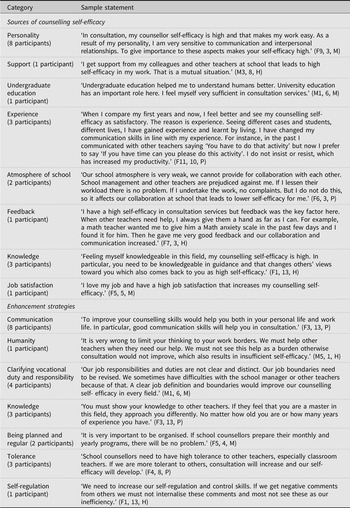
Participants reported that personality was an important category in counsellor self-efficacy regarding consultation. Personality factors such as being extroverted and healthy communication skills were stated as key sources for high self-efficacy beliefs. Experience and being knowledgeable about the field were mentioned as other important sources of self-efficacy beliefs. Moreover, getting support from colleagues, undergraduate education, school atmosphere, getting feedback from colleagues and job satisfaction were the categories in this theme.
In the current theme, participants were asked how to enhance counsellor self-efficacy in consultation and they generally emphasised better communication skills. Also, making vocational responsibilities clearer was indicated by the participants. Some emphasised that because the roles, responsibilities and vocational boundaries were not very clear and distinct, they had difficulties with the duties and responsibilities. Also, increasing humanity, self-regulation, tolerance, and being more knowledgeable and organised were determined as categories under this theme.
Assessment Techniques Theme
Participants were asked about their self-efficacy beliefs regarding student assessment techniques. For sources of self-efficacy, undergraduate education and lack of interest were found to be prominent categories. Whether or not they felt highly self-efficient, they emphasised the importance of undergraduate education. They also stated that they were not interested in applying and evaluating tests. Some participants had a prejudice for certain assessment techniques such as projective tests, which caused a low self-efficacy for this theme. Having experience, lack of knowledge and practice were created as other categories of assessment techniques theme.
Enhancement strategies for self-efficacy in this theme were determined as developing technology-based applications in testing and evaluation of students, including more assessment techniques for undergraduate education, in-service training, supervision and being a successful observer. In this theme, the need to revise the undergraduate curriculum to include varied and different techniques was the most prominent category. For this theme, it was observed that participants mostly focused on tests in evaluation and did not generally use other techniques.
Discussion and Conclusion
In the current study, Turkish school counsellors’ self-efficacy beliefs, sources of self-efficacy and enhancement strategies were revealed through their views. Within five themes — counselling skills, management of group, working with resistant students, consultation, and assessment techniques — certain categories were created for the sources of self-efficacy and enhancement techniques. Counsellor self-efficacy has been subject to numerous studies such as for supervision (e.g., Cashwell & Dooley, Reference Cashwell and Dooley2001; Morrison & Lent, Reference Morrison and Lent2018), anxiety (e.g., Al-Darmaki, Reference Al-Darmaki2004; Barbee, Scherer, & Combs, Reference Barbee, Scherer and Combs2003), and burnout (e.g., Bardhoshi, Erford, & Jang, Reference Bardhoshi, Erford and Jang2019). The current study findings were discussed in parallel with other quantitative study findings because of the lack of qualitative studies. This study will shed light on the literature and will be unique in counselling self-efficacy literature.
Discussing the sources of self-efficacy beliefs, the findings of the current study were parallel with Bandura’s (Reference Bandura and Ramachaudran1994, Reference Bandura1997) theory about sources of self-efficacy. In the current study, especially supervisory relationships, undergraduate education and experience were found to be specific factors affecting counsellor self-efficacy. Handling this in terms of Bandura’s theory, mastery experience and social persuasion are the sources of self-efficacy beliefs (Reference Bandura and Ramachaudran1994, Reference Bandura1997). In this sense, it is possible to conclude that the current findings are parallel with Bandura’s theory of self-efficacy.
In looking at sources of self-efficacy in counselling skills, the featured categories were undergraduate education, supervision and insufficient practice. Participants mostly related their high or low self-efficacy to undergraduate education, supervisory relationships or insufficient practice. They mostly suggested a strong supervisory relationship, revising the undergraduate curriculum, practice and self-development as a means for enhancement, especially in counsellor training programs, where supervisory feedback is one of the most important sources and predictors of counsellor self-efficacy. In a very recent experimental study, Tan and Chou (Reference Tan and Chou2018) revealed that supervision has a significant impact on counsellor self-efficacy and competence. Similar to this current study, Wiggins (Reference Wiggins2018) conducted a qualitative study among counsellors conducting a holistic method and emphasised the importance of client feedback and training on the development of counsellor self-efficacy. Ooi, Jaafar, and Baba (Reference Ooi, Jaafar and Baba2018) revealed that the mastery experience has a strong association with counselling self-efficacy, which supports the current findings. In several themes — especially counselling skills — practising and mastery have been taken into consideration among participants.
In the second theme — management of group behaviour — some of the participants reported high self-efficacy in managing group behaviour as opposed to individual counselling. However, others reported low self-efficacy in group-related activities. Participants mostly tended to compare group counselling to individual counselling in revealing their opinions. In this theme, similar to the first theme, undergraduate education was put forward as a source of counselling self-efficacy. The sufficiency of undergraduate education and curriculum were mentioned in this theme. Moreover, class management skills and personal factors — interest or personality factors — were found to be prominent factors as sources of self-efficacy. For enhancement strategies, revising the undergraduate education curriculum, incorporating more group practices into the curriculum and self-development were suggested by participants.
In working with resistant students, school counsellors mostly related their high or low self-efficacy to experience. Most of the participants indicated that experience was the most important factor affecting counsellor self-efficacy when working with resistant students. They mostly reported that the more experienced counsellors were better at working with difficult tasks and resistant students. Experience has been given as one of the most important predictors of counselling self-efficacy in numerous studies (e.g., Leach, Stoltenberg, McNeill, & Eichenfield, Reference Leach, Stoltenberg, McNeill and Eichenfleld1997; Melchert, Hays, Wiljanen, & Kolocek, Reference Melchert, Hays, Wiljanen and Kolocek1996; Owens, Bodenhorn, & Bryant, Reference Owens, Bodenhorn and Bryant2010). Additionally, participants related insufficient undergraduate education to their counselling self-efficacy. Participants suggested self-development and strong supervisory relationships to increase counsellor self-efficacy for working with resistant students. Participants also suggested relating theoretical background to practice at university to improve counselling self-efficacy. Britner and Pajares (Reference Britner and Pajares2006) emphasised the importance of feedback that includes suggestions for improving oneself in the amelioration of self-efficacy, which again supports the current findings; supervisory feedback was mentioned by participants particularly regarding working with difficult students or resistant students. Several studies have revealed the importance of supervisory feedback among counsellors (e.g., Cashwell & Dooley, Reference Cashwell and Dooley2001; Constantine, Reference Constantine2001; Levitt, Reference Levitt2001). Supervisory relationships were mentioned as one of the most important factors that affected counselling self-efficacy in most of the themes. Both professional school counsellors and trainees gave importance to feedback of the supervisor in increasing their counselling self-efficacy. Working with difficult cases or resistant students, counsellors especially need supervision to see their development.
In the consultation theme, school counsellors evaluated their counselling self-efficacy in terms of consultation, their collaboration with school staff, and communication. Most of the participants defined their self-efficacy in relation to their consultation skills level and sufficiency, but others indicated that they had low self-efficacy for the following reasons. Personality was the most referred to theme in explaining counselling self-efficacy. Knowledge and experience were also proposed as a common source in counselling self-efficacy regarding consultation. Participants generally associated their high counselling self-efficacy in consultation with their strong communication skills as a result of their own extrovert personality. Participants also gave some suggestions to improve school counsellor self-efficacy for consultation. Development of counselling skills were the most referred to category among school counsellors in order to improve self-efficacy. Moreover, determining and clarifying vocational duties and responsibilities were suggested as a means to increase consultation skills, which would also result in higher counselling self-efficacy. Studies with school counsellors undertaken by Sutton and Fall (Reference Sutton and Fall1995) revealed the strong associations between the support of administration and colleagues and self-efficacy beliefs. Similarly, the current findings support the importance of communication skills and consulting with school staff. Self-regulation and development of communication skills were advanced as methods of enhancement of counselling self-efficacy by participants in the current study. Greason and Cashwell (Reference Greason and Cashwell2009) revealed the predictive role of mindfulness in counselling self-efficacy. Increasing mindfulness among school counsellors would be associated with self-regulation strategies and communications skills, which then might result in high counselling self-efficacy in the future.
Finally, school counsellors evaluated their counselling self-efficacy in terms of assessment techniques. Whereas some of them judged their counselling self-efficacy as high and sufficient, others reported a lack of counselling self-efficacy in assessment of students. In the main, they indicated insufficient undergraduate education, lack of interest and prejudice to tests for their source of self-efficacy beliefs. Özyürek (Reference Özyürek2009) investigated ‘Counselling Education’ programs in Turkey and revealed that university students lacked supervision both in terms of individual and group counselling, which supports the current study findings. To increase counselling self-efficacy, participants largely suggested making revisions and adding numerous tests to undergraduate education and in-service training to improve counselling self-efficacy. Undergraduate education has been mentioned by several participants under several themes; whereas some of them indicated insufficient undergraduate education related to their lack of counselling self-efficacy, others revealed the strong educational basis in their high counselling self-efficacy. Johnson, Baker, Kopala, Kiselica, and Thompson (Reference Johnson, Baker, Kopala, Kiselica and Thompson1989) revealed the importance of education in counselling self-efficacy. Barbee et al. (Reference Barbee, Scherer and Combs2003) also revealed that role playing and modelling in undergraduate education were found to be significant predictors in counselling self-efficacy.
Conclusion
In the counselling skills theme, the prominent categories were undergraduate education, supervision and insufficient practice. Participants mostly related their high or low self-efficacy to undergraduate education, supervisory relationships, or insufficient practice. They mostly suggested a strong supervisory relationship, revising undergraduate curriculum, practising and self-development as strategies for improvement. In the theme of management of group behaviour, undergraduate education was the prominent category as a source of self-efficacy. For enhancing self-efficacy in the management of group behaviour, participants suggested the undergraduate education curriculum should incorporate more group practices into the curriculum and self-development. In working with resistant students, the category of experience was revealed as one of the most important factors. Working with difficult cases or resistant students, counsellors especially need supervision for their development. Personality was the most referred to consultation theme in explaining counselling self-efficacy. Knowledge and experience were proposed as other common sources in counselling self-efficacy regarding consultation. The development of counselling skills was the most referred to category among school counsellors in order to enhance self-efficacy. For the last theme, assessment techniques, the participants mostly referred to insufficient undergraduate education, lack of interest, and having a prejudice toward tests for their source of self-efficacy beliefs. To enhance their self-efficacy, participants mostly suggested making revisions in the undergraduate curriculum and in-service training.
Limitations and Recommendations
The current study was limited to Turkish school counsellors working in different grades. Future studies may be conducted with family, career or other groups of counsellors with different cultural backgrounds. This was a qualitative study revealing counselling self-efficacy. Using different methods, different variables could be studied in the future in the cultural context. Undergraduate education, supervisory relationships and experience were the most common and prominent categories mentioned by the participants in the current study. Participants mostly emphasised the lack of practice and specific lessons, such as geriatric or child psychology, in the undergraduate education curriculum. Revisions could be handled in the curriculum of counsellor education undergraduate and graduate programs, including more practical and various lessons, such as child psychology or geriatric psychology. Different cultural studies regarding school counsellor self-efficacy would allow comparisons of counsellor education programs and reveal needed revisions. Collaboration with universities and schools could be extended to include supervisory relationships into school practices. In-service training was generally recommended by participants in the current study, thus in-service training arranged by the National Ministry of Education could be increased including seminars, workshops, and courses for self-development of school counsellors in every school.
Acknowledgment
The author thanks to Dr Deniz Gülmez for her effort during the coding process.
Conflict of interest
None.
Appendix
Counselling Skills Themes/Categories and Sample Statements

Management of Group Behaviour Themes/Categories and Sample Statements

Working with Resistant Students Theme/Categories and Sample Statements

Consultation Theme/Categories and Sample Statements

Assessment Techniques Theme/Categories and Sample Statements