INTRODUCTION
The red alga Gloiocladia furcata (C. Agardh) J. Agardh (Reference Agardh1842: 87) is a perennial species that inhabits the sublittoral zone, usually in shadowy places, and that grows epiphytically on crustose algae. A recent detailed description of its vegetative and reproductive morphology (Sánchez, Reference Sánchez and Rodriguez-Prieto2005; Sánchez & Rodríguez-Prieto, Reference Sánchez2005) has revealed that female reproductive structures are rare and that the tetrasporophytic phase is a common stadium, at least in the Mediterranean Sea, where the species has been widely reported.
During the 19th Century, specimens of G. furcata (as Fauchea and Fauchea microspora) were collected from along the Atlantic coast of France (Feldmann & Lami, Reference Feldmann and Lami1941), however, the vegetative and reproductive morphology of these Atlantic samples have not been previously described. In addition, these records have not been confirmed for other areas of the European Atlantic coast. Here we describe the anatomical and reproductive morphology of Atlantic specimens of G. furcata and establish the first record for the Spanish Atlantic coast of this species. Moreover the geographical distribution of this species along the Atlantic and Mediterranean coasts is reported.
MATERIALS AND METHODS
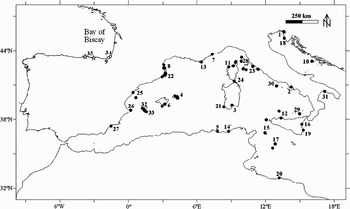
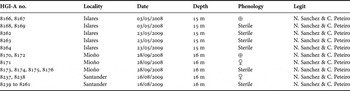
Sections of Gloiocladia furcata were made with either a razor blade or a freezing microtome, stained using acidified 1% aniline-blue/distilled water solution and mounted permanently in 50% Karo® corn syrup (Bestfoods, Englewood Cliffs, NJ, USA). Habit photographs were taken using a Sony Cyber-Shot DSC-P100, Digital Still Camera (Sony Corporation, Aichi, Japan) and photomicrographs were taken with an AxioCam MRc attached to an Axioskop 2 plus microscope (Zeiss, Berlin, Germany). Examined specimens were collected by SCUBA divers in different localities along the Cantabrian coast of Spain (Table 1; Figure 1). Voucher specimens and slides were deposited in the HGI-Herbarium. Preserved specimens from the original collections of C. Sauvageau (PC0116442 as Fauchea sp.) and E. Bornet (PC0145877 as Fauchea microspora and PC0145878 as Fauchea emended by Feldmann as G. furcata, both collected by C. Sauvageau) housed at the PC-Herbarium were also examined. Herbarium acronyms follow Holmgren & Holmgren (Reference Holmgren and Holmgren1998).
European distribution of Gloiocladia furcata. Black dots correspond to locations in the Mediterranean Sea compiled from data unpublished by Sanchez (Reference Sánchez2005); white dots correspond to the confirmed ancient Atlantic records; and a star represents the first record in Atlantic shores off the coast of Spain.
Localities are listed in chronological order, but only the first publication date by province/region is pointed out. (1) Trieste (type locality) (Friuli-Venezia Giulia, Italy), Agardh (Reference Agardh1842); (2) Naples (Campania, Italy); Berthold (Reference Berthold1882); (3) Cagliari (Sardinia, Italy), Barbey (Reference Barbey1884); (4) Minorca (Balearic Islands, Spain), Rodríguez & Femenías (Reference Rodríguez y Femenías1889); (5) Annaba (Annaba, Algeria), Piccone (Reference Piccone1889); (6) Majorca (Balearic Islands, Spain), Buen (Reference Buen1906); (7) Alpes Maritimes (Provence–Alpes–Côte d'Azur, France), Ollivier (Reference Ollivier1929); (8) Pyrénée–Orientales (Languedoc–Roussillon, France), Feldmann (Reference Feldmann1937); (9) Pyrénées–Atlantiques (Aquitaine, France), Feldmann & Lami (Reference Feldmann and Lami1941); (10) Jabuka (Dalmatia, Croatia), Ercegovic (Reference Ercegovic1957); (11) Haute Corse (Corsica, France), Molinier (Reference Molinier1960); (12) Palermo (Sicily, Italy), Giaccone (Reference Giaccone1969); (13) Var (Provence–Alpes–Côte d'Azur, France), Boudouresque (Reference Boudouresque1970); (14) Tabarka (Jendouba, Tunisia), Boudouresque (Reference Boudouresque1970); (15) Trapani (Sicily, Italy), Giaccone et al. (Reference Giaccone, Scammacca, Cinelli, Sartoni and Furnari1972); (16) Catania (Sicily, Italy), Furnari & Scammacca (Reference Furnari and Scammacca1973); (17) Agrigento (Sicily, Italy), Cinelli et al. (Reference Cinelli, Drago, Furnari, Giaccone, Scammacca, Solazzi, Sortino and Tolomio1976); (18) Rovigno (Istria, Croatia), Giaccone (Reference Giaccone1978); (19) Siracusa (Sicily, Italy), Cormaci & Furnari (Reference Cormaci and Furnari1979); (20) Tripoli (Tripolitania, Libya), Nizamuddin et al. (Reference Nizamuddin, West and Menez1979); (21) Carbonia-Iglesias (Sardinia, Italy), Brambati et al. (Reference Brambati, Ghirardelli, Giaccone, Orel and Vio1980); (22) Girona (Catalonia, Spain), Ballesteros & Romero (Reference Ballesteros and Romero1982); (23) Grosseto (Tuscany, Italy), Salghetti-Drioli & Cinelli (Reference Salghetti-Drioli and Cinelli1985); (24) Corse-du-Sud (Corsica, France), Frick et al. (Reference Frick, Boudouresque, Harmelin, Laborel, Laborel, Meinesz, Vacelet and Verlaque1986); (25) Castellón (Comunidad Valenciana, Spain), Barceló & Martí (Reference Barceló Martí1987); (26) Alicante (Comunidad Valenciana, Spain), Boisset López (Reference Boisset López1987); (27) Murcia (Región de Murcia, Spain), Soto (Reference Soto1990); (28) Livorno (Tuscany, Italy), Papi et al. (Reference Papi, Pardi, Lenzini, Benedetti Cecchi and Cinelli1992); (29) Messina (Sicily, Italy), Alongi et al. (Reference Alongi, Pizzuto, Scammacca and Giaccone1993); (30) Latina (Lazio, Italy), Basso (Reference Basso, Albertelli, De Maio and Piccozzo1994); (31) Taranto (Apulia, Italy), Cecere et al. (Reference Cecere, Cormaci, Furnari, Petrocelli, Saracino and Serio1996); (32) Ibiza (Balearic Islands, Spain), Sánchez (Reference Sánchez2005); (33) Formentera (Balearic Islands, Spain), Sánchez (Reference Sánchez2005); (34) Pyrénées–Atlantiques (Aquitaine, France), confirmed record preserved in Bornet Herbarium, collected by C. Sauvageau and labelled as Fauchea; (35) Cantabria (Cantabria, Spain), new records.

Examined specimens collected in different localities along the Cantabrian coast of Spain (⊕, tetrasporophytes; ♀, female gametophytes).

OBSERVATIONS
Habit
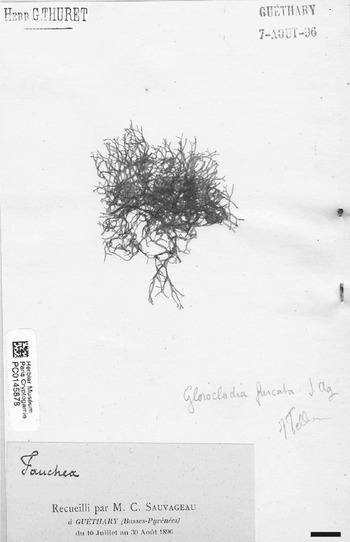
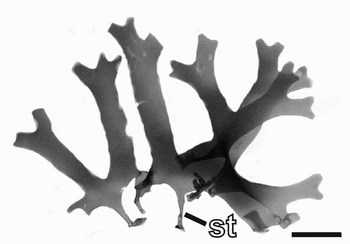
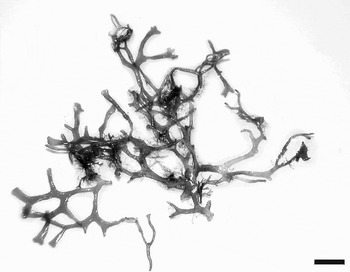
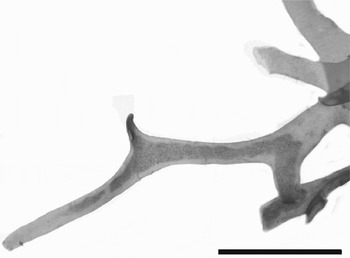
Examined thalli are decumbent, branched, compressed and somewhat dichotomously divided, measuring 1–3 cm high and 0.5–3 cm wide in young specimens, and 1.5–5 cm high and 1.5–5.5 cm wide in mature individuals (Figures 2–4, these measurements refer to the entire specimens). Branches are usually proliferous and anastomose with each other. Most of the thalli are stipitate (Figure 3). Axes are thinner distally, measuring 5 mm wide in lower portions and 0.5 mm wide in the apical parts; tips are furcate and rounded. Fronds are mucilaginous in texture and rose-red in colour.
Gloiocladia furcata: habit and anatomical structure. Habit of the specimen collected by C. Sauvageau in Guethary in 1896 (PC0145878). Transversal sections stained with aniline blue. Scale bar: 1 cm.

Gloiocladia furcata: habit and anatomical structure. Habit of a young specimen (tetrasporophyte) collected in Islares in May 2008 (HGI-A 8166); st, stipe. Transversal sections stained with aniline blue. Scale bar: 0.5 cm.

Gloiocladia furcata: habit and anatomical structure. Habit of an adult specimen collected in Mioño in September 2008 (HGI-A 8175). Transversal sections stained with aniline blue. Scale bar: 0.5 cm.

Vegetative structure
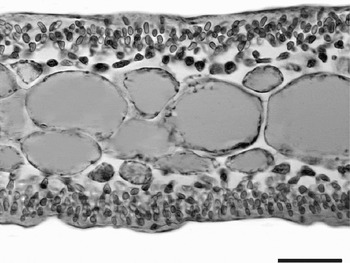
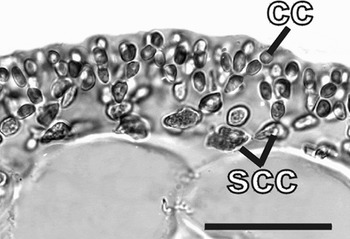
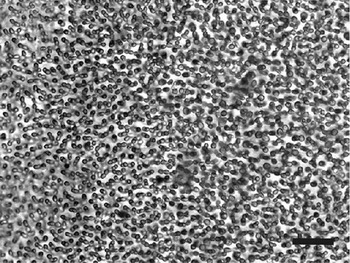
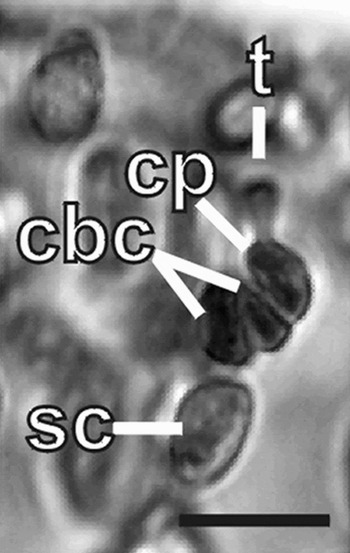
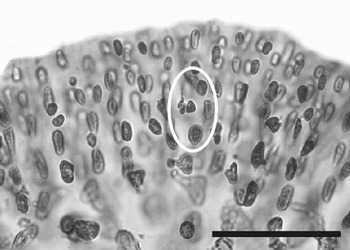
Where it was possible to differentiate the outer cortex, multiaxial and solid axes were seen, formed of lax and anticlinal but basally curved filaments (Figures 5 & 6) of 3–5 ovoid cells that decreased in size towards the outer edge (Figures 5–7). The inner cortex comprised subcortical ovoid cells, connected by secondary pit connections and forming a network parallel to the thallus surface (Figures 5 & 6). The medulla was cellular and compact, composed of large non-pigmented cells that are elongate in longitudinal section and that decrease in size towards the outer edge (Figures 5 & 6). Transverse sections of the female specimen revealed three-celled, slightly curved carpogonial branches growing on a supporting cell located either on cortical filaments or in the subcortical network (Figures 8 & 9).
Gloiocladia furcata: habit and anatomical structure. Transverse section in a middle part of the thallus (HGI-A 8168). Transversal sections stained with aniline blue. Scale bar: 50 µm.

Gloiocladia furcata: habit and anatomical structure. Higher magnification of a transverse section in a sterile area of a tetrasporophytic specimen, where it is detailed observed in the cortical layer composed of lax and anticlinal but basally curved cortical filaments and the subcortical network (HGI-A 8167); cc, cortical cell; scc, subcortical cell. Transversal sections stained with aniline blue. Scale bar: 50 µm.

Gloiocladia furcata: habit and anatomical structure. Surface view of cortical cells in a sterile area of a tetrasporophytic specimen (HGI-A 8167). Transversal sections stained with aniline blue. Scale bar: 50 µm.

Gloiocladia furcata: reproductive structures. Transverse section of a female specimen with a detailed view of a carpogonial branch (HGI-A 8171); cbc, carpogonial branch cell, cp, carpogonium, sc, supporting cell, t, trycogine. Transversal sections stained with aniline blue. Scale bar: 25 µm.

Gloiocladia furcata: reproductive structures. Transverse section of a female specimen with a view of a carpogonial branch (white circle) growing on a supporting cell situated in a cortical filament (HGI-A 8171). Transversal sections stained with aniline blue. Scale bar: 50 µm.

Reproductive structure
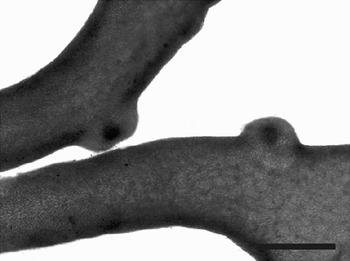
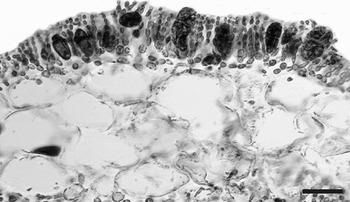
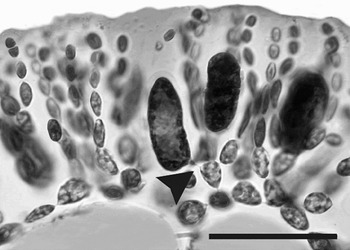
Cystocarps grow on the branch margin and are sessile, prominent and ostiolated (Figure 10). Tetrasporophytic phase has also been observed. Tetrasporangia are grouped in elongate, slightly prominent nemathecia that are located in the middle of the axes and extend along them up to 1 cm (Figure 11). Different stages of tetrasporangia development are observed adjacent to one another in the same nemathecia (Figures 12 & 13). Nemathecial filaments are 7–8 cells long and are longer than in sterile areas (Figures 13 & 14). Tetrasporangia are subapical, arising at one of the first dichotomies on a nemathecial filament and are connected to it by a lateral pit-connection located in the basal part (Figure 14). Tetrasporangia are ovoid, 30–63 × 18–32 mm in diameter, and divide either cruciately or decussately (Figures 13 & 14).
Gloiocladia furcata: reproductive structures. Young cystocarps situated in the branch margin of a female gametophyte (HGI-A 8171). Transversal sections stained with aniline blue. Scale bar: 500 µm.

Gloiocladia furcata: reproductive structures. Tetrasporangial nemathecium situated along the axe centre (HGI-A 8170). Transversal sections stained with aniline blue. Scale bar: 0.5 cm.

Gloiocladia furcata: reproductive structures. Surface view of a tetrasporangia nemathecium (HGI-A 8167). Transversal sections stained with aniline blue. Scale bar: 50 µm.

Gloiocladia furcata: reproductive structures. Transverse section of a well developed raised nemathecium (HGI-A 8172). Transversal sections stained with aniline blue. Scale bar: 50 µm.

Gloiocladia furcata: reproductive structures. Transverse section of a nemathecium with detail of a young tetrasporangium attached to an outer cortical filament by a lateral pit-connection (arrow head) (HGI-A 8172). Transversal sections stained with aniline blue. Scale bar: 50 µm.

Distribution
Gloiocladia furcata has been reported to occur in the Mediterranean Sea off the coasts of Algeria, Croatia, France, Italy, Spain and Tunisia (Sánchez, Reference Sánchez2005; Sánchez & Rodríguez-Prieto, 2005), and in the Atlantic Ocean off the coasts of France (Feldman & Lami, 1941) and Spain (this work) (for more details see Figure 1).
Habitat
In the Mediterranean Sea, Gloiocladia furcata occurs in the sublittoral zone between 20 m and 84 m and grows epiphytically on crustose algae, either on coralligenous assemblages or in the maërl. In the Atlantic Ocean, G. furcata has also been observed in the sublittoral zone at 15–16 m, where it appears frequently and develops an entangled and dense mat in shadowed places.
DISCUSSION
Specimens of Gloiocladia furcata collected from Spanish Atlantic shores (Figures 2–4) are similar morphologically, vegetatively and reproductively to the lectotype and Mediterranean specimens (Sánchez, Reference Sánchez2005; Sánchez & Rodríguez-Prieto, 2005). Moreover, after re-examining the specimens collected during the late 1800s from the Atlantic coast of France, housed in the Sauvageau and Bornet Herbarium (both located in the PC-Herbarium), we can confirm their identity as G. furcata, verifying the report of Feldman & Lami (1941) of the presence of G. furcata along the French Atlantic shore. The occurrence of G. furcata along the Atlantic coast of Spain is not ephemeral, as it has been observed in abundance at a depth of 15 m during 2008–2009. In these shores it inhabits the sublittoral shallow water (15–16 m), while in the Mediterranean Sea it appears in deeper waters (20–84 m). Male gametophytes were not observed but the find of female gametophytes and tetrasporophytes demonstrate that this species is well established in the Spanish Atlantic waters, where it reproduces sexually. However, as there have been no reports of G. furcata in previous floristic studies of the north-eastern Atlantic coast (Hardy & Guiry, Reference Hardy and Guiry2003; Gorostiaga et al., Reference Gorostiaga, Santolaria, Secilla, Casares and Díez2004; Bárbara et al., Reference Bárbara, Cremades, Calvo, López-Rodríguez and Dosil2005a, Reference Bárbara, Díaz, Cremades, Tibaldo, Freire, Peña, Lagos, Calvo, Veiga, Peteiro, López-Rodríguez and Araújob, Reference Bárbara, Díaz, Araújo, Peña, Berecibar, Cremades, Freire, Baamonde, Novo, Calvo, López Rodríguez, Afonso-Carrillo, De Clerck, Santos, Sousa-Pinto, Tibaldo, Lagos, López, Sencilla, Santolaria, Díez and Veiga2006; Martínez-Gil et al., Reference Martínez-Gil, Gallardo, Díaz and Bárbara2007; Araujo et al., Reference Araujo, Barbara, Tibaldo, Berecibar, Tapia, Pereira, Santos and Pinto2009, and references therein), it might be that it was misidentified or overlooked, as it is known to occur alongside other species that have recently been found along the Atlantic coast off the Iberian Peninsula (Berecibar et al., Reference Berecibar, Wynne, Bárbara and Santos2009a, Reference Berecibar, Wynne and Santosb, Reference Berecibar, Wynne and Santosc; Sánchez et al., Reference Sánchez, Freshwater and Rodríguez-Prieto2010).
The marine flora of northern Spain are included in the warm-temperate north-eastern Atlantic subregion according to the phytogeographical scheme proposed by Hoek & Breeman (Reference Hoek, Breeman, Garbary and South1990). However, there are significant floristic differences between the western (Galician coast) and eastern coasts (Basque coast) of northern Spain owing to different maximum summer temperatures (Gorostiaga et al., Reference Gorostiaga, Santolaria, Secilla, Casares and Díez2004). For example, on most eastern coasts (e.g. Cantabria and the Basque Country) cold temperate species, such as fucoids and kelps, are absent or rare and there is an abundance of warm-temperate species which are also found in the Mediterranean Sea. Therefore, the presence of G. furcata, a traditionally Mediterranean species, on the Cantabrian coast could be related to the meridional character of the eastern Atlantic coast of Spain. We suggest that its distribution is not restricted to this part of the Atlantic coast of the Iberian Peninsula, and that it could be present along the coast of the Basque Country or southern Portugal owing to its floristic similarity (Hoek & Donze, Reference Hoek and Donze1966, Reference Hoek and Donze1967; Gorostiaga et al., Reference Gorostiaga, Santolaria, Secilla, Casares and Díez2004).
ACKNOWLEDGEMENTS
We would like to show our appreciation to Dr Bruno de Reviers for the loan of sheets and images of valuable specimens from the Herbarium of C. Sauvageau and E. Bornet located in the Herbarium of the Muséum National d'Histoire Naturelle in Paris, France (PC-Herbarium). We would also like to thank Juan Carlos Arronte for his help in the elaboration of a geo-referenced map of Gloiocladia furcata, all the staff of BuceoAgua, and Habitat Azul for his assistance during sampling. Critical comments from an anonymous referee improved the manuscript. This work is a contribution to the Flora Phycologica Iberica Project, Bonnemaisoniales, Gracilariales, Palmariales y Rhodymeniales (Rhodophyceae), REN 2001-1473-C03-02.