Introduction
Morphological complexity and its status in language processing and representation have been at the centre of much current psycholinguistic research with native (L1) (see Amenta & Crepaldi, Reference Amenta and Crepaldi2012 for a recent review) as well as non-native (L2) users of a target language (see Clahsen, Felser, Sato & Silva, Reference Clahsen, Felser, Sato and Silva2010 for review). Many studies, however, have focused on a restricted set of inflectional (e.g., English past tense: -ed) and/or derivational (e.g., English deadjectival nominalization: -ness) phenomena, concentrating on the issue of storage versus decomposition of morphologically complex word forms. Based on this extensive research, two major proposals have been made as to how morphological and morphosyntactic information is mentally represented. On the one hand, associative network models of inflection have suggested that morphosyntactic features and morphological structure do not have independent mental substance in language knowledge, but that instead morphologically complex words (e.g., geheimem) are stored within a single associative system, i.e., in the same way as simplex word forms (e.g., dog) (Gonnerman, Seidenberg & Andersen, Reference Gonnerman, Seidenberg and Andersen2007; McClelland & Patterson, Reference McClelland and Patterson2002; Rumelhart & McClelland, Reference Rumelhart, McClelland, McClelland and Rumelhart1986; Westermann & Ruh, Reference Westermann and Ruh2012 among others). On the other hand, combinatorial approaches to inflection argue that morphological structure is encoded in the mental lexicon and morphologically complex words are parsed during language comprehension (Pinker, Reference Pinker1999; Stanners, Neiser, Hernon & Hall, Reference Stanners, Neiser, Hernon and Hall1979, see also e.g., Crepaldi, Rastle, Colheart & Nickels, Reference Crepaldi, Rastle, Colheart and Nickels2010; Diependale, Dunabeitia, Morris & Keuleers, Reference Diependaele, Duñabeitia, Morris and Keuleers2011, Rastle & Davis, Reference Rastle and Davis2008; for recent reviews, see e.g., Amenta & Crepaldi, Reference Amenta and Crepaldi2012; Bozic & Marslen-Wilson, Reference Bozic and Marslen-Wilson2010). For instance, L1 behavioral priming studies examining facilitation effects of morphologically complex prime words on inflectionally related targets (e.g., walked - walk) relative to unrelated controls (e.g., laugh - walk) have found that response times (RTs) to target words are faster for morphologically related than unrelated prime-target pairs. This finding has been taken to support the idea of stem-affix decomposition in native speakers of a target language (see e.g., Marslen-Wilson, Reference Marslen-Wilson and Gaskel2007 for review). In contrast, behavioral evidence has suggested that L2 learners might rely less on grammatical processing and more on lexical storage of complex word forms (e.g., Bowden, Gelfand, Sanz & Ullman, Reference Bowden, Gelfand, Sanz and Ullman2010; Clahsen, Balkhair, Schutter & Cunnings, Reference Clahsen, Balkhair, Schutter and Cunnings2013; Jacob, Fleischhauer & Clahsen, Reference Jacob, Fleischhauer and Clahsen2013; Neubauer & Clahsen, Reference Neubauer and Clahsen2009; Silva & Clahsen, Reference Silva and Clahsen2008; Ullman, Reference Ullman2004; Reference Ullman and Sanz2005).
Importantly, in morphologically complex words affixes can have a rich complexity of their own, such that inflectional stems and affixes contain grammatical structure expressed through sets of morphosyntactic feature bundles specifying their respective grammatical functions. For example, the English inflectional affix -s as in walk-s spells out a particular morphosyntactic feature set [i.e., 3rd person, singular, present tense]. That is, affixes themselves can be internally structured, i.e., they encode different sets of morpho-syntactic feature values – marking grammatical case, number, and gender distinctions. Thus, in complex word comprehension, accessing these features is crucial for building morphosyntactic relations between individual lexical items. To date, however, there are only a few L1 studies focusing on the representation and online processing of these subtle, fine-grained morphosyntactic features of inflected words (e.g., Leminen & Clahsen, Reference Leminen and Clahsen2014; Opitz, Regel, Müller & Friederici, Reference Opitz, Regel, Müller and Friederici2013). Although there is a growing interest in the issue of how morphosyntactic cues are used in L2 sentence processing (e.g., Dowens, Vergara, Barber & Carreiras, Reference Dowens, Vergara, Barber and Carreiras2010; Jackson, Reference Jackson2008; Rossi, Gugler, Friederici & Hahne, Reference Rossi, Gugler, Friederici and Hahne2006; Sagarra & Herschensohn, Reference Sagarra and Herschensohn2013), L2 research on the online processing of morphosyntactic feature information encoded in individual morphemes, is still missing. Hence, addressing this issue will be the core of this study.
German adjectival inflection
In order to investigate how morphological relationships between such inflectional markers are represented in the language user's mental lexicon and how they influence real-time language processing, we chose the inflectionally rich system of German adjectival inflection. This inflectional system includes complex word forms, such as geheime, geheimes, geheimem, geheimen, geheimer ‘secret’, which consist of an unaltered stem referring to the same lemma (e.g., geheim ‘secret’) and of a set of portmanteau suffixes (e.g., -e, -s, -m, -n, -r) encoding various combinations of morphosyntactic feature values (i.e., case, number, and gender) (Blevins, Reference Blevins, Stiebels and Wunderlich2000; Müller, Reference Müller2013; Wunderlich, Reference Wunderlich, Diirscheid, Ramers and Schwarz1997).
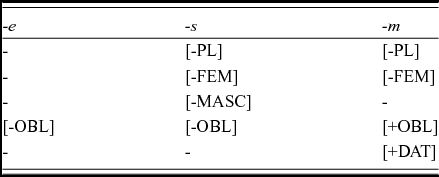
In most morphological frameworks, inflected variants of a single lexeme have been argued to be represented in inflectional paradigms mapping morphosyntactic feature information to morphological elements (i.e., inflected word forms or affixes) (e.g., Anderson, Reference Anderson1992; Aronoff, Reference Aronoff1994; Blevins, Reference Blevins, Stiebels and Wunderlich2000; Stump, Reference Stump2001; Wunderlich, Reference Wunderlich, Booij and van Marle1996; Reference Wunderlich, Diirscheid, Ramers and Schwarz1997; Zwicky, Reference Zwicky1985). The inflectional paradigm for German adjectival inflection exhibits massive syncretism, such that the same inflected variant is used in different morphosyntactic contexts (e.g., geheimem - [Dat.masc./neut.sg.]). To account for these instances of syncretism in more economic ways underspecified paradigm representations for German adjectival inflection have been proposed (e.g., Bierwisch, Reference Bierwisch1967; Blevins, Reference Blevins1995; Reference Blevins, Stiebels and Wunderlich2000; Wunderlich, Reference Wunderlich, Diirscheid, Ramers and Schwarz1997). In these accounts, morphosyntactic feature values are introduced as binary features with marked (= positive) and unmarked (= negative) feature specifications. A common assumption is that only positive feature values are directly specified, while negative features are introduced into the paradigm in opposition to a marked positive value on the same feature (Bierwisch, Reference Bierwisch1967; Blevins, Reference Blevins, Stiebels and Wunderlich2000; Wunderlich, Reference Wunderlich, Diirscheid, Ramers and Schwarz1997). For example, plural forms of German adjectives have been argued to be positively specified for number (i.e., [+PL]), while singular forms receive the unmarked singular interpretation (i.e., [-PL]). Gender is described by the [+/-MASC] and [+/-FEM] features, leaving neuter forms as unmarked. Case is instantiated by the features [+/-OBL], with [-OBL] for structurally assigned nominative and accusative case and [+OBL] for genitive and dative case inherently assigned by the verb, as well as by the [+/-DAT] feature. Underspecified paradigm representations are restricted to those feature specifications that are necessary to distinguish individual morphological elements from each other and to define the morphosyntactic contexts in which they can occur. Consider, for example, the German adjectival affix -e, -s, and -m (see Table 1):
Morphosyntactic feature specifications for -e, -s, and -m (Blevins, Reference Blevins, Stiebels and Wunderlich2000)

German adjective forms ending in -e can occur in nominative and accusative feminine singular as well as nominative and accusative plural contexts. This syncretism is captured by assigning the unmarked [-OBL] feature specification for nominative and accusative case that is structurally assigned by the verb, but not the gender and/or the number features [+FEM] or [+PL] which can only partly capture the -e affix' paradigmatic distribution. Hence, the -e affix exhibits the lowest level of paradigmatic specificity, followed by the -s affix carrying the features [-PL], [-FEM], [-MASC], and [-OBL]. The -m affix appearing in both dative masculine singular and dative neuter singular contexts comes out as the most specific form with its two positively specified feature values [+OBL] and [+DAT], restricting -m to the dative case.Footnote 1
Previous Research on L1 and L2 morphosyntactic processing
How are these different sets of morphosyntactic feature bundles processed and represented in the language user's mental lexicon? Some researchers argue against the role of inflectional paradigms in L1 language representation. In a set of unimodal visual delayed priming experiments, Schriefers, Friederici and Graetz (Reference Schriefers, Friederici and Graetz1992) found that inflected German adjectives, such as geheimes and geheimem, are sensitive to frequency differences in the same way as uninflected word forms are. Consequently, they proposed that inflected German adjectives exhibit associatively connected lexical representations on the basis of frequency differences without being paradigmatically represented.
On the other hand, several studies have presented evidence supporting inflectional paradigms in the L1 mental lexicon. A cross-modal priming experiment on -e, -s, and -m forms of German adjectives (Clahsen, Eisenbeiss, Hadler & Sonnenstuhl, Reference Clahsen, Eisenbeiss, Hadler and Sonnenstuhl2001) revealed slower target response latencies for -m than for -e and –s forms, which was taken to reflect the paradigmatic specificity of the feature content of the -m affix (i.e., [+OBL], [+DAT]). They also reported a priming asymmetry effect, with -s primes facilitating the recognition of -e targets as effectively as the corresponding identical controls, but -e primes facilitating -s targets less than identity pairs. These observed priming asymmetries were explained in terms of the paradigmatic feature representations of the -e and -s affixes. While in -e→-s item pairs morphosyntactic features of the -s target (i.e., [-PL,-FEM,-MASC]) remained unprimed when preceded by -e primes, there were no unprimed target features in -s→-e prime-target pairs since -e targets do not contain any morphosyntactic feature specifications that are not already available from -s primes. In this way, the paradigmatic feature representations of the individual affixes involved were argued to modulate observed priming patterns in Clahsen et al. (Reference Clahsen, Eisenbeiss, Hadler and Sonnenstuhl2001).
In their sentence matching study, Penke, Janssen and Eisenbeiss (Reference Penke, Janssen and Eisenbeiss2004) also argued for the influence of morphosyntactic feature specifications on the processing of inflected word forms. The authors reported an ungrammaticality effect reflected in a delay in sentence matching response times when the positively specified feature values of an inflected adjective (e.g., [+PL]) mismatched the sentential context (e.g., [-PL]). In contrast, the incorrect use of inflected adjectives with mismatching negative feature values (e.g., [-PL] in a [+PL] sentential context) did not yield an ungrammaticality effect as long as the positively specified feature values of the same adjectives matched the sentential context. These effects were taken as evidence for paradigmatically underspecified feature representations of morphological elements. Moreover, recent electrophysiological studies provide additional support for the previous behavioral findings. Opitz et al. (Reference Opitz, Regel, Müller and Friederici2013) reported a larger left anterior negativity (LAN) when the features of an attributive adjective conflicted with the morphosyntactic features carried by the following noun (e.g., ohne *besonderen [+masc,-fem] Detail [-masc,-fem]) than when morphosyntactic features of the adjective were incorrect, but compatible (e.g., ohne *besondere [] Detail [-masc,-fem]). The LAN is an ERP component that has often occurred in various morphosyntactic violation conditions (Friederici, Reference Friederici2002; Kotz & Friederici, Reference Kotz and Friederici2003; Friederici & Weissenborn, Reference Friederici and Weissenborn2007; Rossi, Gugler, Hahne & Friederici, Reference Rossi, Gugler, Hahne and Friederici2005). It has been assumed to reflect morphosyntactic structure building processes (e.g., Friederici, Reference Friederici2002; Rodriguez-Fornells, Clahsen, Lleo, Zaake & Münte, Reference Rodriguez-Fornells, Clahsen, Lleo, Zaake and Münte2001), detection of morphosyntactic agreement violation and violation of morphosyntactic expectancy (e.g., Opitz et al., Reference Opitz, Regel, Müller and Friederici2013; for a review, see e.g., Molinaro, Barber & Carreiras, Reference Molinaro, Barber and Carreiras2011). Opitz et al. (Reference Opitz, Regel, Müller and Friederici2013) reported that in their study, in neuter contexts, the amplitude of this component was modulated by the feature specifications of the involved inflectional markers. Amongst the incorrect forms, the feature-wise incompatible exponent /n/[+masc,-fem] (vs. /s/[-masc,-fem]) elicited the largest LAN, whereas the compatible (albeit incorrect) exponent /e/[] produced a smaller LAN. The authors suggested that the LAN indicated that morphosyntactic feature underspecification is involved in actual language processing. They also proposed that LAN effects might reflect sensitivity to morphosyntactic feature violation.
The studies and results reviewed above only concern L1 processing. However, the question of how late L2 learners represent and process an inflected word's morphosyntactic features is still controversial. Due to the vast diversity of psycholinguistic tasks used (from production to comprehension), the range of linguistic phenomena investigated (from sentences to words), and the varying proficiency levels of L2 learners included (from beginning to advanced) currently available evidence with respect to L2 morphosyntactic processing remains inconclusive. For instance, L2 processing of sentences and morphologically complex words – even at high proficiency levels – has been proposed to rely less on grammatical information than in L1 processing (Clahsen & Felser, Reference Clahsen and Felser2006a, Reference Clahsen and Felser2006b; Ullman, Reference Ullman and Sanz2005). Morphosyntactic phenomena spelled out through affixation have been identified as one of the key challenging areas for L2 language acquisition and processing (DeKeyser, Reference DeKeyser2005). Experimental production studies have shown that late learners have difficulties in reliably encoding morphosyntactic feature information (e.g., tense, case, person, number, and gender agreement). Namely, they seem to omit inflectional endings and to overapply unmarked word forms (e.g., bare adjectives, infinitives) (Dewaele & Véronique, Reference Dewaele and Véronique2001; Haznedar, Reference Haznedar2001; Ionin & Wexler, Reference Ionin and Wexler2002; Lardière, Reference Lardière1998; Meisel, Reference Meisel2011). Additionally, in comprehension and judgment tasks, L2 speakers have been shown to exhibit reduced sensitivity to morphosyntactic feature information (Chen, Shu, Liu, Zhao & Li, Reference Chen, Shu, Liu, Zhao and Li2007; Hahne, Mueller & Clahsen, Reference Hahne, Müller and Clahsen2006; Keating, Reference Keating2009; Ojima, Nakata & Kakigi, Reference Ojima, Nakata and Kakigi2005; Tokowicz & Warren, Reference Tokowicz and Warren2010).
However, there are recent studies arguing that L2 learners are indeed sensitive to morphosyntactic cues. For instance, longitudinal production data have shown that late learners of German correctly produced suppletive (highly irregular lexically represented) marked forms of auxiliaries, while regular inflectional affixes encoding tense and agreement on main verbs were still incorrect or absent (Dimroth, Reference Dimroth2008; Parodi, Reference Parodi2000). With respect to comprehension, Jackson (Reference Jackson2008), Jackson and Bobb (Reference Jackson and Bobb2009), and Jackson and Dussias (Reference Jackson and Dussias2009) reported that high-proficiency L2 learners of German revealed native-like sensitivity to case morphology. In several self-paced reading studies investigating subject-object ambiguities, an NP's case marking was used by the L2 participants as a disambiguation cue in the same way as by L1 German speakers. In an ERP investigation on subject-verb agreement violations in German, Tanner, Osterhout and Herschensohn (Reference Tanner, Osterhout, Herschensohn, Chandlee, Franchini, Lord and Rheiner2009) found qualitatively similar brain responses (P600) to ungrammaticalities in intermediate to advanced English L2 learners as in native speakers of German. Furthermore, some authors have suggested that L2 learners can reach native-like processing only when syntactic structures are similar in L1 and L2 (Sabourin & Haverkort, Reference Sabourin, Haverkort, van Hout, Hulk, Kuiken and Towell2003, Sabourin & Stowe, Reference Sabourin and Stowe2008), whereas others have proposed that L2 structures are more rapidly acquired and processing is more accurate when the features and/or grammatical rules of the L1 and L2 are dissimilar than when they are similar (e.g., Foucart & Frenck-Mestre, Reference Foucart and Frenck-Mestre2011; Reference Foucart and Frenck-Mestre2012; Tokowicz & MacWhinney, Reference Tokowicz and MacWhinney2005).
Due to these discrepant views on the results concerning the processing of morphosyntactic features, there is an essential need to investigate further the question of how inflected words are processed in real time in the L1 and the L2. What is the temporal sequencing of different sources of linguistic information in L1 and L2 processing? Are L2 learners sensitive to subtle morphosyntactic features even at the single word-level? The temporal dynamics of grammatical and lexical properties of morphologically complex words in L1 speakers of German have been examined by Leminen and Clahsen (Reference Leminen and Clahsen2014). They investigated inflected adjectives of German in two cross-modal ERP priming experiments, separately studying effects of lexical-semantic relatedness and morphosyntactically related affixes. The results revealed different brain responses for the lexical-semantic and the grammatical properties of inflected words during language comprehension. More specifically, lexical-level priming yielded a reduced (N400-like) negativity for lexically related primes and targets (relative to unrelated ones), which was most pronounced in the 300 to 400ms time window. In contrast, prime-target overlap with respect to morphosyntactic features revealed a reduced positivity, for prime-target pairs that overlapped with respect to their morpho-syntactic features, occurring in an earlier time window (200 to 300ms). The reduced early positivity was taken to reflect facilitation of grammatical processing effort in case of primed (relative to unprimed) morpho-syntactic target features, while the reduced later N400-like negativity signaled facilitation in lexical retrieval for primed (compared to unprimed) words. The amplitude of the N400 effect has been found to vary with ease of lexical access and/or integration processes (e.g., Kutas & Schmitt, Reference Kutas, Schmitt, Banich and Mack2003). Thus the N400 in Leminen and Clahsen (Reference Leminen and Clahsen2014) study was interpreted to reflect the degree of facilitation of lemma access for the target word, which was larger for the identity condition (due to complete prime-target overlap) than for the primed condition. There, the memory trace of the lemma formed by the prime word overlapped with that of the target (see also Münte, Say, Clahsen & Kutas, Reference Münte, Say, Clahsen and Kutas1999). Overall, the ERP findings by Leminen and Clahsen (Reference Leminen and Clahsen2014) were indicated differences in temporal sequencing between morpho-syntactic and lemma-level processing during language comprehension in L1 speakers, consistent with structure-first models of language processing.
Studies investigating the time-course of morphosyntactic processing in late L2 learners are very scarce and, to some extent, inconsistent. Some ERP studies have observed differences between morphosyntactic processing in L1 and L2 (e.g., de Diego-Balaguer, Sebastián-Galles, Diaz & Rodriguez-Fornells, Reference de Diego Balaguer, Sebastián-Gallés, Diaz and Rodriguez-Fornells2005; Weber & Lavric, Reference Weber and Lavric2008). For example, de Diego Balaguer et al. (Reference de Diego Balaguer, Sebastián-Gallés, Diaz and Rodriguez-Fornells2005) examined a repetition-priming paradigm with regular and irregular verbs of Spanish in highly proficient Spanish–Catalan bilinguals. They showed that regular verbs elicited the same centro-parietal N400 priming effect in L2 speakers as in L1 speakers. However, L2 speakers showed a reduced N400 priming effect for irregular morphology. Thus, differences in processing between L1 and L2 speakers were observed even in highly proficient early bilinguals when languages had very similar systems but differed in particular structures. The authors suggested that the similarity between languages might help for similar suffixations, but may interfere for dissimilar structures. Using a violation paradigm in sentences, Rossi et al. (Reference Rossi, Gugler, Friederici and Hahne2006) reported the LAN for (morpho)syntactic violations only in high- proficiency L2 speakers, whereas Hahne et al. (Reference Hahne, Müller and Clahsen2006) observed the LAN only for the morphological features, in which L2 learners were more proficient, such as violations of German participles but not plurals. Interestingly, however, Weber & Lavric (Reference Weber and Lavric2008) reported N400-like negativity in response to morphosyntactic violations in L2 (English). This effect was absent in the participants’ L1 (German) or a L1 control group (English). The authors suggested that weaker/slower morphosyntactic processes in L2 aggravated the pressures on the wrap-up semantic integration mechanism, leading to an N400 in the syntactic condition in L2. Overall, the results of these studies support, at least to some extent, the view that the L2 comprehension system employs real-time grammatical analysis less than the L1 system. Instead, it is more affected by non-structural, i.e., lexical and surface form properties (Clahsen & Felser, Reference Clahsen and Felser2006a). On the other hand, evidence for L1-like sensitivity to morphosyntax in an L2 is growing, i.e., some studies have shown late L2 learners are able to acquire morphosyntactic features, e.g., gender, and to process them online in their L2 (e.g., Foucart & Frenck-Mestre, Reference Foucart and Frenck-Mestre2012; Davidson & Indefrey, Reference Davidson and Indefrey2009). It has been claimed that L2 learners can process morphosyntactic features in a similar way to L1 speakers, but attaining native-like processing may be faster for structures that are unique in L2 and do not conflict with L1 structures (Foucart & Frenck-Mestre, Reference Foucart and Frenck-Mestre2012).
All in all, the varying results of L2 morphosyntactic processing, and the extremely scarce findings on morphosyntactic feature processing at a single word level call for further research on the issue of the online morphosyntactic processing in L2 learners. Therefore, using an extensive battery of behavioral and ERP data, the present study focuses on two major issues. Firstly, we will examine to what extent non-native language processing is informed by morphosyntax compared to native speakers of a target language. In particular, we will investigate the role of morphosyntactic feature information in the lexical entries of morphologically complex word forms in the non-native mental lexicon using a behavioral cross-modal priming experiment adopted from Clahsen et al. (Reference Clahsen, Eisenbeiss, Hadler and Sonnenstuhl2001). Due to the combination of auditory prime and visual target presentation, the cross-modal priming technique is less prone to reflect modality-specific access representations, but rather accesses abstract, implicit long-term memory (i.e., central-level) representations of lexical entries (Marslen-Wilson, Hare & Older, Reference Marslen-Wilson, Hare and Older1993). Implicit memory tasks have been argued to be influenced by the overlap between prime and target stimuli (e.g., Curran, Schacter & Galluccio, Reference Curran, Schacter and Galluccio1999). German inflected adjectives consist of stems and affixes (e.g., geheim-em ‘secret’). According to decompositional accounts of morphological processing, stems and affixes of regularly inflected word forms access their own mental representations. Hence, in an experimental design in which stems are identical but affixes and their morphosyntactic feature content vary across experimental items, we expect modulations of facilitation effects across conditions. Since targets are presented immediately at the offset of the prime, the cross-modal priming task is likely to tap online processes of morphological analysis, reducing the risk of obtaining episodic memory effects.
Secondly, by using ERPs we will investigate the nature of online L2 processing of inflected word forms focusing on the temporal dynamics of morphosyntactic feature access relative to lexical-semantic retrieval in late L2 learners. These data will be directly compared to previously obtained data from native speaker controls as reported in Leminen and Clahsen (Reference Leminen and Clahsen2014). ERPs provide a particularly useful method for examining morphosyntactic processing (e.g., Steinhauer, White & Drury, Reference Steinhauer, White and Drury2009 for review) since they allow tracking linguistic processes with a timescale of milliseconds. An early focused ERP response signaling morphosyntactic processing was reported for L1 speakers (cf. Leminen & Clahsen, Reference Leminen and Clahsen2014). An important question for this study is whether the same temporal priority of morphosyntactic processing relative to lexical-semantic retrieval is also obtained for late L2 learners.
The Present Study
We conducted two experiments with L2 learners with Russian as their native language using the same experimental setup as two previous L1 studies (Clahsen et al., Reference Clahsen, Eisenbeiss, Hadler and Sonnenstuhl2001; Leminen & Clahsen, Reference Leminen and Clahsen2014). Experiment 1 was a behavioral priming experiment. If L2 learners access morphosyntactic feature information during online language comprehension in native-like ways, we expect to find the same asymmetric priming patterns that Clahsen et al. (Reference Clahsen, Eisenbeiss, Hadler and Sonnenstuhl2001) reported for L1 speakers. Experiments 2a and 2b were ERP studies comparing morphosyntactic feature priming (experiment 2a) to lexical-semantic priming (experiment 2b) in L2 relative to already existing L1 control data (Leminen & Clahsen, Reference Leminen and Clahsen2014). There were two morphological test conditions compared to an identical control condition in experiment 2a (e.g., sanfte s - sanft e ; sanfte m - sanft e ‘soft’ vs. sanft e - sanft e ). If L2 learners process the morphosyntactic features of inflected adjectives in the same way as natives do, we should observe facilitated processing of the –s prime condition due to shared case features, as opposed to the –m prime condition, due to unshared case features in primes and targets, which should be reflected in a reduced early positivity for –s relative to –m primes. Experiment 2b investigated electrophysiological responses to the repeated activation of the same stem / lemma during lexical integration in L2 learners. To this end, a test condition of morphologically related forms (e.g., sanftes - sanft) was compared to identical repetition priming (e.g., sanft - sanft) and unrelated controls (e.g., frech - sanft). Again, if L2 processing is parallel to L1 processing, i.e., participants activate a repeatedly presented stem / lemma (as in the morphologically related and the identity conditions) more easily than newly introduced lemmas (as in the unrelated control condition), we expect to see a modulation of the N400 component similar to what Leminen and Clahsen (Reference Leminen and Clahsen2014) reported for L1 processing.
Methods
Participants (both Experiments 1 and 2)
The behavioral and the ERP experiments each involved 30 late learners of German with Russian as their L1. All of them were recruited from a large community of young Russians studying at one of the Potsdam and Berlin universities (see Table 2 for biographic details). Both experiments 1 and 2 were administered in two separate experimental sessions with the behavioral priming experiment being conducted in the first and the EEG experiment in the second session. Sixteen participants took part in both experiments 1 and 2. It was made sure that there was a time lag of six to eleven months between experimental sessions in order to minimize potential learning effects.
Biographic data and proficiency scores for experiments 1 and 2 (means; standard deviations and ranges in parentheses)

Participants were all right-handed, had normal or corrected-to-normal vision, were never diagnosed with any learning or other behavioral or neurological disorders, and none of them had ever experienced language or literacy-related difficulties. All participants voluntarily decided to take part in the present study, were unaware of its purpose, and received a small fee for their participation. All participants had acquired Russian from birth and received at least 12 years of schooling. They had first been exposed to German after the age of 5 in a classroom setting, and none of them considered himself/herself bilingual. All participants had been living in Germany for at least one year at the time of testing and were using German as well as Russian in their everyday lives. Their general proficiency in the German language corresponded to the C1/C2 levels on the Common European Framework of Reference for Languages (CEFR) with the exception of one non-native participant in experiment 1 who achieved B2 level. C1 and C2 represent the two highest levels labeled as ‘advanced’ or ‘effective operational proficiency’, as measured by the grammar subtest of the Goethe Institute Placement Test, a 30-item multiple choice cloze test with gaps participants had to fill in (http://www.goethe.de/cgi-bin/einstufungstest/einstufungstest.pl).
L1 control data for our ERP investigation in experiment 2 was obtained from 24 adult native speakers of German as reported in Leminen and Clahsen (Reference Leminen and Clahsen2014).
Experiment 1: Behavioral cross-modal priming, Methods and Results
Materials
The materials consisted of 72 German adjectives, 24 of which were taken from Clahsen et al. (Reference Clahsen, Eisenbeiss, Hadler and Sonnenstuhl2001). The remaining 48 experimental items were introduced to the item set in order to improve length and frequency matching. The low-frequency adjectives from the original study were replaced with more frequent items, to ensure that they were familiar to the L2 participants; see Appendix A for a complete item list.
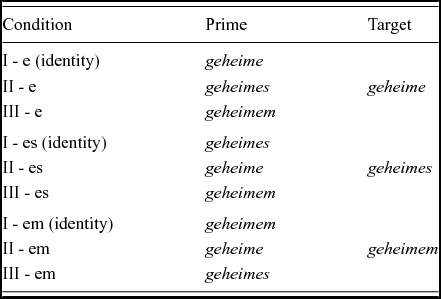
Each of these adjectives was presented in three morphological variants (-e, -s, and -m), both as primes and as targets, thus yielding prime-target pairs in nine different conditions (as shown in Table 3). Three identity conditions (e.g., I-e: geheime - geheime; II-es: geheimes - geheimes; III-em: geheimem – geheimem ‘secret’) provided the baseline for each of the three target versions. The identity condition should yield maximal (‘repetition’) priming for a given target word against which any potential effects of the morphological test conditions were measured. The morphological test conditions II and III combined paradigmatically related adjective forms as primes and targets representing different levels of morphological specificity. Compare, for example, conditions II-e (geheimes - geheime) and III-e (geheimem - geheime), in which -m primes in III-e represent paradigmatically more specific forms than -s primes in II-e. Response times were measured for these nine conditions, and processing costs for each morphological test condition relative to identical controls were calculated.
Experimental conditions for experiment 1

Morphologically related prime-target pairs shared the same adjective but differed with respect to their inflectional variant. Semantic, phonological, and orthographic overlap, as well as lemma frequencies, were matched. On average, all critical adjectives were 2 syllables long (range: 1–3) and had a stem/lemma frequency of 168.5 occurrences per million (range: 10–929) in the CELEX database (Baayen, Piepenbrock & van Rijn, Reference Baayen, Piepenbrock and van Rijn1993). Word-form frequencies of our critical items differed across adjectives inflected for –e, -s, and –m. According to the CELEX database, adjectives combined with the affix -m have the lowest word-form frequency (M = 2.86 per million). Adjectival forms ending in -s are more common than inflected adjectives with the affix –m (M = 5.82 per million), but still significantly less frequent than adjective forms inflected with -e (M = 33.31 per million). The critical prime-target pairs were distributed over nine experimental lists in a Latin Square design. A set of 108 word-word filler pairs and 180 word-nonword pairs were added to the set of 72 critical test items in each of the nine experimental versions, to make sure that half of the 360 targets were existing words of German and half nonwords. The set of 180 word-word pairs included the 72 critical prime-target pairs, 36 additional adjectival items made up of polymorphemic adjectives, such as mut-ig (‘brave’), as well as 72 verbal filler pairs in order to reduce the proportion of presented adjectives. The distribution of related and identical primes and targets in the 36 filler pairs with adjectives was parallel to that in the critical prime-target pairs. The 72 filler pairs with verbs consisted of half related and half identical prime-target pairs. The 180 word-nonword pairs comprised 72 seemingly critical prime-target pairs imitating the nature and fashion of German monomorphemic adjectives (e.g., rasantem - risuntes). Additionally, 36 seemingly polymorphemic adjectival prime-target pairs were included in the pseudoword trials (e.g., dreckig - dralkig ‘dirty’) as well as 72 pseudo-verbal word-nonword pairs (e.g., schlafen - schragen ‘(to) sleep’). Nonwords were created by exchanging at least two letters of an existing word's stem leaving the onset and the coda of each word intact. Across the whole experiment, participants only encountered inflected verbs and adjectives. The critical adjectival affixes, -e, -s, and -m, occurred on 24 items in each experimental version, while verbal endings, -en and -t, were encountered on 36 items on each experimental list. Critical items and fillers were pseudo-randomized, with critical prime-target pairs comprising 20% of the items per list.
Procedure
We followed the procedure of Clahsen et al. (Reference Clahsen, Eisenbeiss, Hadler and Sonnenstuhl2001). Participants first heard a spoken prime immediately followed by the presentation of a visual target. The experiment was programmed with DMDX reaction time software (Forster & Forster, Reference Forster and Forster2003). The primes were recorded by a female native speaker of Northern German in a sound studio, and digitized at a sampling rate of 48kHz (16 bit stereo). The auditory stimuli were presented via headphones. Immediately at the offset of the spoken prime words, the visual targets (font: Comic Sans; size: 28) were presented in the middle of a computer screen in black letters against a light grey background and remained there for 500ms. The onset of the target words marked the beginning of the RT measurement. Participants were asked to judge whether they saw a word or a non-word by pressing either the ‘YES’ or the ‘NO’ button on a Logitech Game Pad. After the disappearance of the target words, they were given a further 2000ms to respond before the next trial started with the presentation of the fixation cross (cf. Krause, Bosch & Clahsen, Reference Krause, Bosch and Clahsen2015). Two breaks were provided during the experiment. The whole experiment began with 20 practice trials including 10 word and 10 nonword targets. After the main experiment, participants indicated on an alphabetical list of the 72 critical prime-target pairs which items were unfamiliar to them. The experiment took approximately 30 minutes.
Data analysis
Three items had to be excluded from further analyses due to unusually low mean accuracy scores: feudal ‘feudal’ (66.7% correct), hiesig ‘local’ (52.8% correct), and verwegen ‘bold’ (52.7% correct). All trials including an unknown prime and/or target word (2.85%) as well as all time-outs (≥ 2500ms) and incorrect responses were removed from the dataset (3.03%). For the remaining data, responses with more than two standard deviations above or below the mean RTs for each participant per condition were removed. In addition, we followed Verissimo and Clahsen's (2009) procedure of data removal by introducing a maximal cut-off criterion of 1700ms in order to reduce the influence of potential outliers (total outliers removed: 3.2%).Footnote 2 In sum, 9.08% of the existing data points were excluded for RT analyses. Mean accuracy scores as well as mean RTs were submitted to repeated measures ANOVAs, one for participants (F1) and for items (F2), with the variables Prime Type (-e, -s, and -m) and Target Type (-e, -s, and -m). Although mean RTs are displayed in the tables, statistical analyses were performed on both log- and z-transformed data, and in the case of nonsphericity, p-values were Greenhouse-Geisser corrected. Aggregated proportions for accuracy scores were arcsine-square-root transformed (cf. Rao, Reference Rao1960) and subsequently submitted to ANOVAs as well.
Results
Mean reaction times (RTs) to, as well as accuracy scores about, visual targets in the nine experimental conditions for L2 speakers are presented in Table 4.
Mean reaction times (RT, in ms) and accuracy scores (in percent) for experiment 1 (standard deviations in brackets)

Accuracy scores were close to ceiling (all > 95%) with non-significant differences of maximally 2% between conditions (all p>.05). The mean lexical decision times on the three visual target forms -e, -s, and -m, however, showed significant between-condition differences. The overall ANOVA produced a significant main effect of Prime Type, however only in the subject analysis (F 1(2,58) = 3.467, p = .038; F 2(2,136) = 1.870, p = .158) as well as a significant main effect of Target Type (F 1(2,58) = 10.840, p < .001; F 2(2,136) = 11.103, p < .001), indicating that -m adjective targets produced significantly longer mean RTs and were thus more difficult to prime than the other two target affixes (-m vs. -e: t 1(29) = 4.671, p < .001; t 2(68) = 5.182, p < .001; -m vs. -s: t 1(29) = 2.971, p = .006; t 2(68) = 3.250, p = .002). In addition, the ANOVA revealed a significant Prime Type x Target Type interaction (F 1(4,116) = 11.246, p < .001, F 2(4,272) = 9.236, p < .001), showing that the response latencies to the different target forms were modulated by the properties of the respective prime words. The factors age of acquisition (AoA) as well as exposure time to German were added to the statistical analysis. This was done to account for the assumption that participants with an earlier age of acquisition and a longer exposure time might exhibit differences with respect to morphological processing from subjects with a later age of acquisition and shorter exposure time – despite a similar score in the Goethe institute placement test. Adding these factors, however, did not significantly modulate obtained effects (all p < .05).
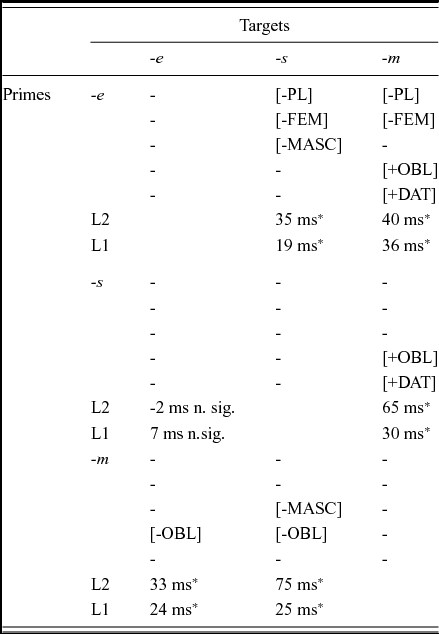
Table 5 presents the difference in response latencies of each experimental condition relative to the identical controls. These numerical differences were also tested statistically with matched post-hoc t tests. An asterisk marks a significant difference between identity and test conditions.
RT differences of test conditions relative to identity conditions in L2 (in experiment 1) and L1 (taken from Clahsen et al., Reference Clahsen, Eisenbeiss, Hadler and Sonnenstuhl2001: 525)

Considering -m targets in the prime-target pairs -e-m and -s-m, a significant reduction in priming was found for both of them (-e-m vs. -m-m: t 1(29) = 2.817, p = .009; t 2(68) = 2.712, p = .008; -s-m vs. -m-m: t 1(29) = 3.657, p = .001; t 2(68) = 3.909, p < .001). For -s targets, also both test conditions -e-s and -m-s yielded significant reductions in priming (-e-s vs. -s-s: t 1(29) = 2.841, p = .008; t 2(68) = 2.925, p = .005; -m-s vs. -s-s: t 1(29) = 6.451, p < .001; t 2(68) = 5.293, p < .001). For -e targets, however, we obtained an asymmetric priming pattern, such that only -m-e pairs yielded significantly reduced repetition priming, and in the subject analysis only (-m-e vs. -e-e: t 1(29) = 2.356, p = .025; t 2(68) = 1.749, p = .085). For -s-e items, in contrast, there was no significant reduction in priming (-s-e vs. -e-e: t 1(29) = 0.067, p = .947; t 2(68) = 0.097, p = .923). To sum up, the current L2 data revealed a significant reduction in priming for conditions in which the target forms' morphosyntactic features were either unprimed and / or mismatched with the features of the prime words. These effects will be interpreted in more detail in the General Discussion section.
Experiments 2a and 2b: ERPs, Methods and Results
Materials
The materials and procedures as well as the stimulus presentation files and sound files for the auditory primes were taken from Leminen and Clahsen (Reference Leminen and Clahsen2014).
For experiment 2a, 180 German adjective stems were used from the CELEX database (mean length: 2.07 syllables (range: 1 to 4); mean stem/lemma frequency: 43.1 per Million (range: 0 to 193)). A subset of 152 adjective stems from the materials of experiment 2b (see Appendix B) plus an additional new set of 28 adjective stems (see Appendix C1) were selected. From these stems, three priming conditions, representing a subset of the conditions tested in experiment 1, were constructed: The same target (e.g., satte) was combined with three different primes: ‘-m prime’ (sattem-satte), ‘-s prime’ (sattes-satte), and ‘identity prime’ (satte-satte), and the critical prime-target pairs were distributed over three experimental lists in a Latin Square design.
For experiment 2b, 200 adjective stems with a mean length of 2.0 syllables (range: 1 to 4) and a mean stem/lemma frequency of 50.6 per Million (range: 1 to 180) in the CELEX database (Baayen et al., Reference Baayen, Piepenbrock and van Rijn1993) were used to construct 150 prime-target pairs (see Appendices B and C2). Of the 200 adjective stems, 150 appeared as targets combined with three prime conditions. ‘Related’ prime-target pairs shared the lemma in prime and target forms with the prime bearing the affix –s for nominative and accusative, whereas the target was the bare uninflected stem form of the same adjective (e.g., neutrales-neutral). ‘Unrelated’ prime-target pairs made use of the 50 remaining adjective stems and did not share the same lemma (e.g., verbal-neutral). The unrelated primes had a mean stem/lemma frequency of 50.5 per Million and a mean length of 1.86 syllables; both of these means were not significantly different from those of the related primes (frequency: t > 1; length: t = 1.5, p = .14). The third condition consisted of ‘identical’ bare stems as primes and targets (e.g., neutral-neutral). Again, critical items were distributed across three experimental lists in a Latin Square design, such that targets only appeared once per list.
Procedure
Participants were tested individually, seated in a comfortable chair in a soundproof booth, facing a computer screen at a distance of 100 cm. Auditory primes were presented through headphones and target words were presented visually in lower case letters at the center of a 24 inch screen (font: Arial; size: 28). Each session started with a short training of 10 trials. Then, experiments 2a and 2b followed as two blocks, which lasted 10 minutes each; the order of both experiments was counterbalanced. Each trial started with a warning sound, followed by a fixation point at the center of the black screen for 250 ms and the presentation of the auditory prime. After the offset of the prime word and 300 ms of blank screen, the target word appeared for 300 ms at the center of the screen. The inter-trial interval was 1000 ms. Participants were asked to actively listen to the primes and read the target words. To keep participants attentive, the question ‘Were the auditory and visual words identical or not?’ appeared on the screen, 15 times in total per block, for each participant randomly after 5–15 trials. Participants responded by pressing one of two marked buttons on the keyboard (same or different). If there was a question, the next trial started after the participant gave the response. As for experiment 1, participants were asked to indicate on an alphabetical list of critical prime-target pairs which items were unfamiliar to them.
EEG recordings and ERP data analysis
The electroencephalogram (EEG) was recorded by means of 64 electrodes that were attached to an elastic cap according to the international 10–20 system (Brain Products actiCAP). Horizontal (F7 and F8) and vertical electrooculograms (EOG) were recorded to allow control for artifacts. One additional electrode was placed at the tip of the nose. Impedances were kept below 5 kΩ. The signals were recorded continuously with Vision Recorder software using a sampling rate of 500Hz and a recording bandwidth of 0.1–250 Hz. The FCz electrode served as the reference electrode and AFz as the ground electrode during the recording. Off-line the signal was re-referenced to the averaged mastoids and digitally filtered with a band-pass of 0.5 to 30 Hz.
Using Analyzer 2.0 (Brain Products, Germany), any bad channels were re-interpolated using the surrounding electrode sites (Bendixen, Prinz, Horváth, Trujillo-Barreto & Schröger, Reference Bendixen, Prinz, Horváth, Trujillo-Barreto and Schröger2008; Perrin, Pernier, Bertrand & Echallier, Reference Perrin, Pernier, Bertrand and Echallier1989). The independent component analysis (ICA) algorithm Infomax was applied to clean the data from muscle and eye movement artifacts. Additional muscle and other artifacts were removed automatically using a threshold of +/−100 μV.
Only artifact-free trials were averaged for each subject and condition, whereas the data were epoched with a pre-stimulus baseline of 200 ms for 1000 ms. The mean number of epochs per condition after the artifact rejection was 57 (SD = 2) out of 60 in experiment 2a and 48 (SD = 2) out of 50 in experiment 2b.
For the statistical analyses of the mean amplitudes, we selected two time-windows for each experiment, which captured the earlier and later ERP effects of interest. For experiment 2a, we chose an early time window of 200 and 350 ms in order to assess the earlier effect and of 350–450 ms to examine the modulation of the later effect. In addition, in order to directly compare our results to the ones observed in the L1 data (Leminen & Clahsen, Reference Leminen and Clahsen2014), we performed group-level analyses for the time-windows of 200–300 ms and 300–400 ms. For experiment 2b, we selected 200 to 300 ms and 300 to 400 ms time-windows, as these time-windows both captured the effects of interest best and were also directly comparable with the L1 effects observed in Leminen and Clahsen (Reference Leminen and Clahsen2014). Taking into account the topographical distribution of the effects (see Figures 1 and 2), we selected a grid of 15 electrodes for the statistical analyses (F7 F3 Fz F4 F8 T7 C3 Cz C4 T8 P7 P3 Pz P4 P8). They were assigned to different regions of interest (ROI), defining different scalp sites: ‘anterior’ (F3, Fz, F4), ‘central’ (C3, Cz, C4), ‘posterior’ (P3, Pz, P4), ‘left’: F7, T7, P7, ‘left-midline’ (F3, C3, P3), ‘midline’ (Fz, Cz, Pz), ‘right- midline’ (F4, C4, P4), and ‘right’ (F8, T8, P8). We used a repeated-measures analysis of variance (ANOVA) with the three-level within-subject factors Prime Type (experiment 2a: -s prime, -m prime, identity; experiment 2b: related, unrelated, identity), Anterior-Posterior (anterior, central, posterior), and Laterality (left midline, left, midline, right midline, right) and one between-subject factor Group (2 levels: L1, L2). Reported p-values were Greenhouse-Geisser corrected where appropriate. Significant main effects and interactions were followed up with the Least Significant Differences (LSD) post-hoc test.
A) Grand average ERPs for the L1 and L2 groups to the visual targets for three priming conditions in experiment 2a. The ’identity prime’ condition (solid black line) is plotted against the ’–m prime’ (blue line) and the ’-s prime’ (red line) condition. ERPs are time-locked to the onset of the visual target word; negative voltage plotted upwards. B) Topographic maps of the difference waveforms in experiment 2a for the L2 group at 250ms and 400ms after the onset of the visual target.

A) Grand average ERPs for the L1 and L2 groups to the visual targets for three priming conditions in experiment 2b. The ’unrelated’ condition (blue line) is plotted against the ’identity’ (red line) and the ’related’ (black line) condition. ERPs are time-locked to the onset of the visual target word; negative voltage plotted upwards. B) Topographic maps of the difference waveforms in experiment 2b for the L2 group at 250ms and 350ms after the onset of the visual target.

Results
Recall that Experiments 2a and 2b were ERP studies comparing morphosyntactic feature priming (experiment 2a) to lexical-semantic priming (experiment 2b). There were two morphological test conditions compared to an identical control in experiment 2a (e.g., sanft es - sanfte; sanft em - sanfte ‘soft’ vs. sanft e - sanfte). We expected that if L2 learners process the morphosyntactic features of inflected adjectives in the same way as natives do, we should observe facilitated processing of the –s prime condition due to shared case features, as opposed to the –m prime condition, due to unshared case features in primes and targets, which should be reflected in a reduced early positivity for –s relative to –m primes. Experiment 2b investigated repeated lemma-level priming effects in L2 speakers, comparing a test condition of morphologically related forms (e.g., sanftes - sanft) to identical repetition priming (e.g., sanft - sanft) and unrelated controls (e.g., frech - sanft). If L2 processing is parallel to L1 processing, we expected to see a reduced (N400-like) negativity for lexically related primes and targets (relative to unrelated ones). The reduced negativity for inflected words that share the same lemma would then purportedly signal facilitation in lexical retrieval relative to prime-target pairs with different lemmas.
Behavioral results of Experiments 2a and 2b
The L2 behavioral data revealed accuracy rates of 97% correct responses in experiment 2a and 99% correct responses in experiment 2b indicating that the L2 participants are familiar with the word forms tested. Figures 1 and 2 show the grand average L2 ERP responses of experiments 2a and 2b time-locked to the onset of the target word. The scalp distribution of both effects in both time windows are also illustrated in Figures 1 and 2.
ERP Results: Experiment 2a
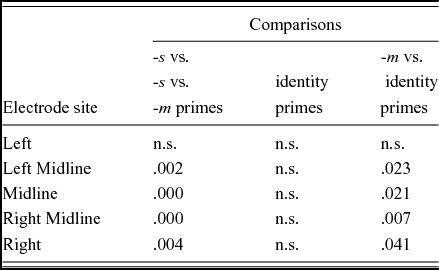
In the 200–300 ms time-window, we did not observe any significant group-level interactions between L1 data (from Leminen & Clahsen, Reference Leminen and Clahsen2014) and current L2 data. The ANOVA (across the whole dataset) only showed a significant interaction of Prime Type and Laterality [F(8,416) = 3.46, p = .007]. Post hoc tests showed that both the identity as well as –s prime conditions elicited reduced positivities relative to the –m prime condition at all but leftmost electrodes (all p < .05), Table 6.
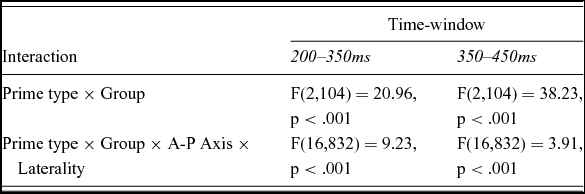
Group-level significant findings for experiment 2a in the 200–350 ms and 350–450 ms time-windows for different priming conditions.

In the 200–350 ms time-window, however, the statistical analysis of experiment 2a showed significant group-level effects (see Table 7).
Post-hoc test results (p-values) for experiment 2a in the 200–300 ms time-window for different priming conditions (no Group-level effects were observed in this time-window).

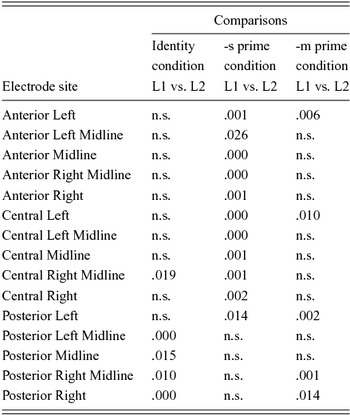
We found a significant interaction of Prime Type and Group [F(2,104) = 20.96, p < .001]. Post hoc tests following this interaction showed a significantly reduced positivity of the -s prime condition in the L2 group as compared to the L1 group. Additionally, we observed a four-way significant interaction of Prime Type × A-P Axis × Laterality × Group interaction [F(16, 832) = 9.23, p < .001]. According to post hoc tests, in the L2 group, the identity condition elicited a more pronounced positivity than in the L1 group at several ROIs (all p < .05). For the –s primes, the L2 group showed reduced positivities compared to the L1 group at most ROIs (all p < .05). For the –m prime condition, the L2 group showed reduced positivities in the left frontal and left central, as well as posterior right midline and posterior right ROIs as compared to the L1 group, see Table 8.
Post-hoc test results (p-values) for Group-level interactions in experiment 2a in the 200–350 ms time-window.

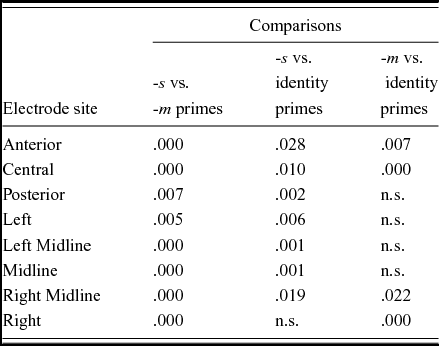
The overall ANOVA of the waveforms in the 300–400 ms time-window showed a significant Prime Type × A-P Axis [F(4, 208) = 9.36, p < .001] and Prime Type × Laterality [F(8, 416) = 3.91, p < .001] interactions. According to post hoc tests, the differences between the identity and the –s prime condition were significant at all but the rightmost electrodes (all p < .05). The –s prime condition showed a larger negativity than the –m prime condition at all but the parietal electrodes (all p < .05). The identity condition showed more negative responses than the –m prime condition at all but the leftmost electrode sites (all p < .05), see Table 9. There was only a trend towards Prime Type × A-P Axis × Laterality × Group interaction [F(16, 832) = 1.62, p = .058].
Post-hoc test results (p-values) for experiment 2a in the 300–400 ms time-window for different priming conditions (no Group-level effects were observed in this time-window).

However, significant group level effects were observed in the 350–450 ms time window. Here, there was a significant interaction of Prime Type and Group [F(2,104) = 38.23; p < .001]. Post hoc tests showed that there were differences between the L1 and L2 groups in the –s prime and identity conditions. More specifically, the L2 group elicited a reduced negativity relative to the L1 group for the identity condition (p = .037), but a more pronounced negativity for the -s prime condition (p < .001). There were no differences between the groups in the –m prime conditions. We observed a significant four-way interaction of Prime Type × A-P Axis × Laterality × Group [F(16, 832) = 3.91, p < .001]. According to post hoc tests, in the identity condition, the L2 group showed a reduced negativity compared to the L1 group particularly in the posterior ROI (all laterality sites, but also at right frontal and right central electrode sites (all p < .01)). In contrast, for the –s prime, the L2 group showed an increased negativity as compared to the L1 group at all other (all p < .01) but posterior left midline, midline and right posterior sites. There were also group differences in the –m prime condition, such that at the left frontal and left posterior sites the L2 group showed significantly more negative responses (p = .005), Table 10.
Post-hoc test results (p-values) for Group-level interactions in experiment 2a in the 350–450 ms time-window.

In sum, the responses in the earlier time-window were elicited at the same time as in the L1 group, but the effect was prolonged for approximately 50 ms in the L2 group. Importantly, the results in the earlier time-window demonstrated that the L2 group exhibited reduced positivities for the –m and –s primes as compared to the L1 group. In the later time-window, we found group differences for all priming conditions, including more pronounced negativities for both –s and –m prime conditions. These results suggest that it takes longer for the L2 learners to process the grammatical features and the processing is more laborious and less automatic than in the L1 speaker group. The findings will be discussed in more detail in the General Discussion section.
ERP Results: Experiment 2b
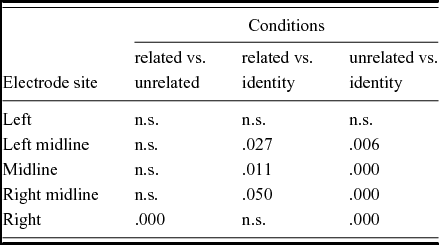
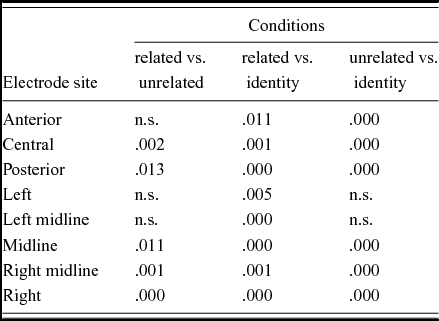
In experiment 2b, we did not observe any L1-L2 group-level interactions. Across the whole dataset, in the early time window (200–300 ms), there was a significant interaction of Prime Type and Laterality [F(8,416) = 7.43; p < .001]. According to post hoc tests, the identity condition elicited a larger positivity than the related condition at the left midline and midline electrode cites (all p < .05). The identity condition elicited a larger positivity than the unrelated condition at all but the leftmost electrodes (all p < .01). The related condition elicited a larger positivity than the unrelated condition at the rightmost electrodes (p < .001), see Table 11.
Post-hoc test results (p-values) for experiment 2b in the 200–300 ms time-window for unprimed vs. primed conditions (no Group-level effects were observed in this time-window).

The overall ANOVA of the mean amplitudes in the later time window (300–400 ms) revealed that there was also a significant interaction of Prime Type and AP-Axis [F(4, 208) = 2.99; p = .038]. According to post hoc tests, at all but frontal sites the unrelated condition elicited a larger negativity than the related condition (all p < .05). The unrelated condition elicited a larger negativity than the identity condition at all electrode sites (all p < .05). The identity condition elicited a smaller negativity than the related condition at all electrode sites (all p < .05). The ANOVA also showed a significant interaction of Prime Type and Laterality [F(8, 416) = 15.66; p < .001]. Post hoc tests revealed that the identity condition elicited a smaller negativity than the related condition at all laterality levels (p < .01). The identity condition elicited a smaller negativity than the unrelated condition at all laterality levels (all p < .01). The related condition elicited smaller negativity than the unrelated condition at all except left and left middle electrode sites (all other sites p < .05), Table 12.
Post-hoc test results (p-values) for experiment 2b in the 300–400 ms time-window for unprimed vs. primed conditions (no Group-level effects were observed in this time-window).

The results showed that there were no significant group-level interactions in any time-window, suggesting that lexical-semantic processing might be similar for the L1 and the L2 groups.
Discussion
In both a behavioral and an ERP priming experiment, the present study examined the representation as well as the temporal dynamics of fine-grained morphosyntactic feature information of inflected word forms in L2 language processing. In the following, we will discuss the results from these experiments, focusing on the temporal availability of morphosyntactic and lexical-semantic information in late L2 learners.
Our behavioral cross-modal priming results replicated for L2 learners Clahsen et al.’s (Reference Clahsen, Eisenbeiss, Hadler and Sonnenstuhl2001) findings for L1 speakers of German. We obtained (i) a paradigmatic specificity effect, with slower target response latencies for -m than for -e and –s forms, and (ii) an asymmetric priming effect, with -s primes facilitating the recognition of -e targets as effectively as the corresponding identity controls (-e→-e ≅ -s→-e), but -e primes facilitating -s targets less than identity controls (-s→-s < -e→-s). The first effect is likely to be due to the processing cost incurred by the specific feature content of the -m affix. The second effect is due to the fact that in –e →-s pairs the features [-PL, -FEM, -MASC] of the –s affix are not available from the prime, whereas in the –s→-e condition the target form does not contain any features that are not already available and pre-activated by the prime word. Since these subtle priming differences can be explained in terms of the affixes’ paradigmatic feature representations, our priming effects suggest that L2 learners – at least at high levels of proficiency – show native-like sensitivity to morphosyntactic feature information (for similar findings using other paradigms and methodologies, see e.g., Jackson, Reference Jackson2008; Osterhout, Poliakov, Inoue, McLaughlin, Valentine, Pitkanen, Frenck-Mestre & Herschensohn, Reference Osterhout, Poliakov, Inoue, McLaughlin, Valentine, Pitkanen, Frenck-Mestre and Herschensohn2008).
In order to assess how morphosyntactic feature information is represented in the L2 mental lexicon, we will first explore how associative models of the mental lexicon might explain our experimental results. Associative approaches to inflection claim that morphologically complex word forms are stored as full forms. Consequently, these models argue that word-form frequency patterns might determine potential priming effects. Remember that according to the CELEX database (Baayen et al., Reference Baayen, Piepenbrock and van Rijn1993), the critical adjectives inflected with -m have the lowest word-form frequency (M = 2.86 per million). Experimental adjectives combined with the -s affix (mean word-form frequency: M = 5.82 per million) are more common than adjectives ending in –m, but at the same time they are still significantly less frequent than adjective forms inflected with -e (M = 33.31 per million). Hence, adjectival forms ending in –m appear to have the lowest word-form frequency of the paradigm. Schriefers et al. (Reference Schriefers, Friederici and Graetz1992) argued that these frequency differences might be the determining factor for target response latencies, which would predict a gradual priming pattern corresponding to the graded word-form frequencies. Thus, adjectives with –m presented as targets should have elicited the slowest target responses followed by inflected adjectives ending in -s, and, finally, by adjectival forms with the affix -e. However, this prediction was not confirmed by our L2 data.
In addition to frequency, associative models of inflection suggest the degree of orthographic and phonological overlap between primes and targets to be a key source of potential priming patterns. For instance, one might argue that the non-significant difference between response latencies of the -s-e prime-target pairs compared to identical controls (2ms) might be triggered by the high degree of surface overlap as prime forms (e.g., geheimes) fully contain the target words (e.g., geheime). However, -m-e (e.g., geheimem - geheime) target pairs yielded significantly reduced priming effects despite the same degree of surface overlap as in -s-e items. Consequently, simple surface-based approaches to the representation of German inflected adjectives cannot fully explain the obtained facilitation effects.
However, a paradigmatic approach to German adjectival inflection is able to explain the observed priming patterns. We saw that -m target forms, the affix with the most specific morphosyntactic feature specifications, elicited reduced priming relative to less specific -e and -s adjective forms, demonstrating the same paradigmatic specificity effect as reported by Clahsen et al. (Reference Clahsen, Eisenbeiss, Hadler and Sonnenstuhl2001) for L1 German. This effect was triggered by the two positive morphosyntactic features [+OBL] and [+DAT] of the -m affix, which are not present in any of the other adjectival affixes. Hence, -m forms were harder to prime than -e and –s. This, in turn, resulted in an increased processing cost for -m targets. Likewise, the morphosyntactic feature content of -e and -s forms of German adjectives caused a priming asymmetry effect. That is, while -s forms prime an -e target form as effectively as an identical prime (-s-e = -e-e), -e adjective forms prime -s targets much less effectively than identical primes (-e-s > -s-s), again similarly to the results of the L1 study. While unprimed target features for number and gender (i.e., [-PL], [-FEM], [-MASC]) in the -e-s condition resulted in a significant reduction of priming relative to the identity condition, -s-e prime-target pairs did not elicit such reduced priming effects. This can be explained by the fact that -e targets did not contain any features that were not already available from -s primes. These behavioral findings suggest that highly proficient Russian L2 learners of German use morphological structure during inflectional processing and store morphosyntactic feature information in native-like inflectional paradigms with underspecified feature information.
These findings stand in opposition to the L2 priming patterns obtained by a number of previous reaction-time studies (e.g., Clahsen et al., Reference Clahsen, Balkhair, Schutter and Cunnings2013; Neubauer & Clahsen, Reference Neubauer and Clahsen2009; Silva & Clahsen, Reference Silva and Clahsen2008) These studies obtained no reliable L2 facilitation effects throughout their experiments, thus suggesting that L2 processing differs fundamentally from L1 processing. One potential explanation for this divergence in experimental findings might be the different experimental techniques used in the mentioned priming studies. Clahsen et al. (Reference Clahsen, Balkhair, Schutter and Cunnings2013), Neubauer and Clahsen (Reference Neubauer and Clahsen2009) as well as Silva and Clahsen (Reference Silva and Clahsen2008) made use of the masked priming paradigm, in which prime words are only presented for a very short period of time (typically between 30 and 60 ms). It might be the case that these masked priming conditions prevent L2 learners from properly assessing and analyzing the specific structural properties of the primes, thus leading to missing priming effects between morphologically related word forms.
In contrast, previous morphological priming studies with advanced L2 learners have shown that near-native L2 morphological processing is operative under overt priming conditions. Jacob et al.’s (Reference Jacob, Fleischhauer and Clahsen2013) cross-modal priming study, for example, revealed reliable (albeit reduced relative to L1) morphological facilitation effects for German -t and -n participles in highly-proficient Russian L2 learners of German. In addition, Basnight-Brown, Chen, Hua, Kostiç and Feldman (Reference Basnight-Brown, Chen, Hua, Kostić and Feldman2007) and Feldman, Kostic, Basnight-Brown, Filipovic Djurdjevic and Pastizzo (Reference Feldman, Kostic, Basnight-Brown, Filipovic Djurdjevic and Pastizzo2010) reported fully reliable cross-modal priming effects for regularly inflected English verbs (e.g., billed - bill) from their Serbian L2 learners of English. A similar contrast between overt and masked morphological priming in a group of highly-proficient Russian L2 learners of German has been demonstrated by Bosch and Clahsen (in revision). Taking the present dataset for adjectival -e, -s, and -m inflections of German as control data for a cross-experimental comparison between L2 overt and masked priming effects, they found a clear contrast between the present native-like modulations of repetition priming effects under overt priming conditions as opposed to no reliable facilitation effects under masked priming conditions. Hence, our behavioral L2 findings are in line with a set of previous experimental studies reporting L1-like sensitivity to morphological processing and morphosyntactic feature access.
While the results of experiment 1 indicate that highly-proficient L2 learners of German represent morphosyntactic feature information in the same way as native speakers do, it could still be the case that the time-course in which morphosyntactic and lexical-semantic information become available in L2 real time processing differs substantially from L1 language comprehension. While behavioral results provide a punctual measure of the online morphosyntactic and lexical-semantic processes, ERPs provide a direct millisecond scale evidence of the inflected word parsing. ERP processing effects for both morphosyntactic feature priming and lexical-semantic retrieval obtained from our L2 group were compared to the control L1 group (native speakers of German) obtained from Leminen and Clahsen's (Reference Leminen and Clahsen2014). Recall that Leminen and Clahsen (Reference Leminen and Clahsen2014) found differences in the temporal sequencing between morphosyntactic and lemma-level processing during L1 language comprehension, such that prime-target overlap with respect to morphosyntactic features revealed a reduced positivity for item pairs that overlapped with respect to their morphosyntactic feature content, occurring in an early (200 – 300 ms) time window, while lexical-semantic priming yielded a reduced negativity (N400-like) for lexically related primes in a later (300 – 400 ms) time window. This pattern was interpreted to be consistent with structure-first models of language processing. Findings from the present study with highly-proficient L2 learners of German demonstrated for the morphosyntactic feature priming experiment a reduced positivity for -s and identity prime conditions relative to the -m prime condition as early as starting from 200 ms. This effect is likely to reflect a decreased workload during feature evaluation in the -s and identity prime conditions as compared to the -m prime condition, due to the shared features of -s primes and -e targets (e.g., [NOM/ACC]) relative to mismatching features of –m primes and -e targets [+DAT vs. NOM/ACC]. While for L1 speakers this early positivity was centrally distributed, it showed a broad topographical distribution on the scalp in our L2 data. It is important to note, that although morphosyntactic feature priming effects are seen early in both L1 and L2 speakers, the processing time as such corroborates morphological priming effects observed in recent ERP masked priming studies (Lavric, Elchlepp & Rastle, Reference Lavric, Elchlepp and Rastle2012; Morris & Stockall, Reference Morris and Stockall2012; Morris, Grainger & Holcomb, Reference Morris, Grainger and Holcomb2008; Morris, Porter, Grainger & Holcomb, Reference Morris, Porter, Grainger and Holcomb2011). Thus, despite methodological differences between masked and cross-modal priming, the present findings support previously obtained morphological parsing effects, which can be observed even earlier than in the N400 time-window. In addition, in the 300–400 ms time-window, we observed effects of prime type, such that the –s prime condition showed a larger negativity than the –m prime and identity conditions These effects resemble the pattern observed in the earlier time-window, starting from 200 ms, and suggests a decreased workload during feature evaluation in the –s and identity conditions relative to the –m prime condition. This observation might be explained in terms of shared features of -s primes viz. -e primes and -e targets (e.g., [NOM/ACC]) relative to mismatching features of -m primes and -e targets [+DAT vs. NOM/ACC]. Moreover, in the 350–450 ms time-window we obtained group-level differences, such that the L2 group elicited a more pronounced negativity for the -s prime as well as the –m prime conditions than the L1 group. This pattern suggests a prolonged and a more laborious evaluation of morphosyntactic feature information in the L2 group as compared to the L1 group.
On the other hand, in Experiment 2b, L2 lexical-semantic priming yielded a reduced N400-like negativity for semantically related prime-target pairs (e.g., sanftes-sanft) relative to unrelated prime-target pairs (e.g., frech-sanft) in the same manner as in the L1 group (cf. Leminen & Clahsen, Reference Leminen and Clahsen2014). Interestingly, however, we did not observe differences between the previously tested L1 and the present L2 group in either early or late time-windows, suggesting that the temporal dynamics of lexical-semantic processing do not differ in both groups. The condition-specific differences, seen in both groups, showed that the identity condition elicited a smaller negativity than the related condition. The N400 effect has been suggested to vary with ease of lexical access and/or integration processes (e.g., Kutas & Schmitt, Reference Kutas, Schmitt, Banich and Mack2003). The amplitude modulation of the N400 component associated with the unrelated condition has been attributed to the degree of facilitation of lemma access for the target word (see e.g., Münte et al., Reference Münte, Say, Clahsen and Kutas1999). In other words, the N400 amplitude is more increased for the identity condition (due to complete prime-target overlap) than for the related condition. There, the memory trace of the lemma formed by the prime word fully overlaps with that of the target. In the case of related prime-target pairs (e.g., neutrales-neutral), the N400 is reduced as compared to lexically unrelated ones (e.g., verbal-neutral) but it is not fully overlapping with the prime-target lemmas due to the suffix, hence showing differences with respect to the N400 magnitude in the identity condition.
Taken together, these results show that our late learners of German are sensitive to both morphosyntactic feature information and lexical-semantic retrieval in online language comprehension. Thus, in general, our findings do support ERP results that show L2 learners’ ability to acquire and process subtle morphosyntactic features even when the L2 has been learned only later in life (e.g., Foucart & Frenck-Mestre, Reference Foucart and Frenck-Mestre2011; Reference Foucart and Frenck-Mestre2012; Davidson & Indefrey, Reference Davidson and Indefrey2009). However, we observed crucial differences with respect to the timing of grammatical processing between the L1 and L2 groups. This, in turn, corroborates our findings with those that L2 inflected word processing differs at least to some extent from L1 processing (e.g., de Diego Balaguer et al., Reference de Diego Balaguer, Sebastián-Gallés, Diaz and Rodriguez-Fornells2005; Weber & Lavric, Reference Weber and Lavric2008). Lexical-semantic processing in L2 was native-like with a long lasting effect across both the early and the later time windows. In contrast, the morphosyntactic priming effect is restricted to an early short time window between 200 ms and 300 ms in the L1 data, which Leminen and Clahsen (Reference Leminen and Clahsen2014) took as an indication of a temporal priority of grammatical parsing over lexical-semantic processing in the L1. In the L2 group, however, morphosyntactic priming effects set off at around 200 ms after the target onset, extended over the later time window as well, and even exhibited an increasing magnitude over time. Hence there seems to be no temporal priority of grammatical parsing over lexical-semantic processing in the L2 group. Instead, due to a prolonged grammatical analysis in the L2 relative to the L1 morphosyntactic and lexical-semantic information seem to become available in parallel during L2 language processing. How can these timing differences between L1 and L2 grammatical processing be explained? One proposal is that L2 processing is generally slower than L1 due to higher working memory and other cognitive resource demands (e.g., McDonald, Reference McDonald2006). It is true that our behavioral experiment 1 yielded overall longer lexical decision latencies for the L2 relative to the L1, but our ERP data from experiment 2 cannot be explained in these terms. Experiment 2 showed that the onsets of both the morphosyntactic and the lexical-semantic priming effects were early (i.e., around 200 ms) and parallel to those of the corresponding effects in the L1 group. Hence, the observed L1/L2 differences most probably cannot simply be attributed to a general delay of non-native language processing. Alternatively, consider the idea of more subtle and selective L1/L2 differences affecting particularly grammatical and less so lexical-semantic processing (cf. Clahsen & Felser, Reference Clahsen and Felser2006a). With respect to lexical-semantic processing, the current study revealed the same ERP pattern and timing for L2 learners as for L1 speakers. For morphosyntactic processing, by contrast, we found a temporally and spatially extended ERP response in the L2 group, relative to the L1 control group. We attribute this difference to the specific demands of morphosyntactic feature processing in a non-native language; see also Basnight-Brown et al. (Reference Basnight-Brown, Chen, Hua, Kostić and Feldman2007), Segalowitz (Reference Segalowitz, Doughty and Long2003) and for ERP evidence, Kotz, Schwartze and Schmidt-Kassow (Reference Kotz, Schwartze and Schmidt-Kassow2009). The more specific finding of prolonged processing of grammatical information in the L2 (relative to the L1) is also consistent with previous findings. Felser and Cunnings (Reference Felser and Cunnings2012), examining the processing of reflexives, especially exploring the interaction of binding principle A and discourse level factors, reported results from eye-movement data indicating that while native speakers apply the grammatical constraint (principle A) early, L2 learners take longer to establish a structure based on grammatical constraints. Instead, they rely more on discourse-based constraints from the very beginning.
Conclusion
The L2 cross-modal priming experiment showed that highly proficient Russian L2 learners are sensitive to the morphosyntactic feature content of German adjectival affixes. The ERP results demonstrated, however, that while the L1 data (Leminen & Clahsen, Reference Leminen and Clahsen2014) indicated an early temporal priority of grammatical processing supporting grammar-first models of language comprehension, our late L2 learners did not show any such temporal preference. Instead, morphosyntactic processing yielded temporally and spatially extended brain responses in the L2. Our results indicate that morphosyntactic processing is more demanding and less automatic, even in advanced L2 learners. Lexical-semantic processing seems, however, to be alike in both L1 speakers and highly proficient L2 learners.
Appendix A: Adjectives used in experiment 1 (n = 72)
abrupt ‘abrupt’, abstrakt ‘abstract’, absolut ‘absolute’, absurd ‘absurd’, aktuell ‘current’, amüsant ‘amusing’, angenehm ‘pleasant’, anonym ‘anonymous’, arrogant ‘arrogant’, bequem ‘comfortable’, berühmt ‘famous’, bitter ‘bitter’, brillant ‘brilliant’, brisant ‘pressing’, brutal ‘brutal’, delikat ‘delicate’, düster ‘dreary’, elegant ‘elegant’, exklusiv ‘exclusive’, falsch ‘wrong’, feucht ‘damp’, feudal ‘feudal’, finster ‘gloomy’, geheim ‘secret’; gemein ‘mean’, genial ‘ingenious’, gerecht ‘fair’, gering ‘little’, gesund ‘sane’, grotesk ‘grotesque’, heiter ‘bright’, hiesig ‘local’, hübsch ‘pretty’, kaputt ‘broken’, kompakt ‘compact’, komplett ‘complete’, konkret ‘concrete’, konstant ‘constant’, korrekt ‘correct’, liberal ‘liberal’, linear ‘linear’, markant ‘clear-cut’, maximal ‘maximal’, munter ‘alert’, neutral ‘neutral’, normal ‘normal’, parallel ‘parallel’, perfekt ‘perfect’, pikant ‘piquant’, populär ‘popular’, prägnant ‘concise’, relevant ‘relevant’, riskant ‘risky’, rustikal ‘rustic’, sauber ‘clean’, scharf ‘harsh’, schlank ‘slim’, schlau ‘smart’, schlecht ‘bad’, schlicht ‘plain’, schlimm ‘fatal’, schrill ‘shrill’, schräg ‘angular’, schwach ‘weak’, schwarz ‘black’, separat ‘separate’, spontan ‘spontaneous’, streng ‘severe’, stumpf ‘blunt’, verbal ‘verbal’, verwegen ‘bold, violett 'violet’
Appendix B: Adjectives used in experiment 2a and experiment 2b (n = 152)
abrupt ‘abrupt’, abstrakt ‘abstract’, absurd ‘absurd’, adrett ‘neat’, adäquat ‘adequate’, akkurat ‘accurate’, akut ‘acute’, albern ‘silly’, alpin ‘alpine’, ambulant ‘ambulant’, amüsant ‘amusing’, anonym ‘anonymous’, arrogant ‘arrogant’, attraktiv ‘attractive’, autonom ‘autonomous’, barock ‘baroque’, bitter ‘bitter’, bizarr ‘weird’, blank ‘bare’, blass ‘pale’, blechern ‘tinny’, braun ‘brown’, brisant ‘explosive’, brutal ‘brutal’, delikat ‘delicate’, dezent ‘discreet’, distinkt ‘distinct’, divers ‘diverse’, dreist ‘bold’, dumm ‘stupid’, dumpf ‘dull’, düster ‘dreary’, effizient ‘efficient’, eisern ‘iron’, elegant ‘elegant’, elend ‘miserable’, enorm ‘enormous’, exklusiv ‘exclusive’, explosiv ‘explosive’, fatal ‘fatal’, feist ‘fat’, fidel ‘jolly’, finster ‘gloomy’, flach ‘flat’, flau ‘dull’, flink ‘nimble’, frech ‘cheeky’, fromm ‘pious’, fundiert ‘informed’, galant ‘gallant’, geheim ‘secret’, gemein ‘mean’, generell ‘general’, gescheit ‘bright’, grandios ‘grand’, grau ‘grey’, grob ‘rough’, grotesk ‘grotesque’, hager ‘lean’, heiser ‘hoarse’, herb ‘harsh’, immens ‘immense’, immun ‘immune’, implizit ‘implicit’, imposant ‘impressive’, intakt ‘sound’, kahl ‘bare’, kaputt ‘broken’, karg ‘meagre’, kariert ‘chequered’, keck ‘brash’, keusch ‘chaste’, kokett ‘coquettish’, kompakt ‘compact’, kompetent ‘competent’, konform ‘conform’, korrupt ‘corrupt’, krass ‘crass’, krumm ‘twisted’, legal ‘legal’, legitim ‘legitimate’, linear ‘linear’, loyal ‘loyal’, lukrativ ‘lucrative’, mager ‘lean’, manuell ‘manual’, markant ‘clear-cut’, massiv ‘massive’, mobil ‘mobile’, morsch ‘rotten’, munter ‘alert’, naiv ‘naive’, nass ‘wet’, nervös ‘nervous’, neutral ‘neutral’, nüchtern ‘sober’, nuklear ‘nuclear’, optimal ‘optimal’, opulent ‘opulent’, ordinär ‘ordinary’, paradox ‘paradoxical’, partiell ‘partial’, perfekt ‘perfect’, plump ‘bearish’, polar ‘polar’, populär ‘popular’, primär ‘primary’, profan ‘profane’, prompt ‘prompt’, rasant ‘rapid’, relevant ‘relevant’, religiös ‘religious’, resolut ‘resolute’, riskant ‘risky’, robust ‘robust’, rustikal ‘rustic’, salopp ‘sloppy’, sanft ‘gentle’, satt ‘full’, schief ‘crooked’, schlaff ‘slack’, schlau ‘smart’, schroff ‘gruff’, seicht ‘shallow’, selektiv ‘selective’, separat ‘separate’, silbern ‘silvern’, simultan ‘simultaneous’, spontan ‘spontaneous’, stabil ‘stable’, steif ‘stiff’, steil ‘steep’, steril ‘sterile’, stramm ‘tight’, stumm ‘mute’, stumpf ‘blunt’, stur ‘stubborn’, subtil ‘subtle’, synchron ‘synchronous’, tapfer ‘brave’, töricht ‘foolish’, trist ‘dismal’, trivial ‘trivial’, verbal ‘verbal’, violett ‘violet’, visuell ‘visual’, vital ‘vital’, wacker ‘valiant’, wirr ‘confused’, zahm ‘tame’, zart ‘tender’, zivil ‘civil’
1) Additional adjectives used in experiment 2a (n = 28)
abstrus ‘abstruse’, desperat ‘desperate’, diffus ‘diffuse’, digital ‘digital’, dubios ‘dubious’, famos ‘splendid’, fesch ‘posh’, fragil ‘fragile’, frappant ‘striking’, frequent ‘frequent’, generös ‘generous’, glorios ‘glorious’, graziös ‘graceful’, harsch ‘harsh’, kess ‘perky’, kognitiv ‘cognitive’, lateral ‘lateral’, maritim ‘maritime’, monströs ‘monstrous’, obskur ‘obscure’, rigoros ‘rigorous’, ruinös ‘ruinous’, sensitiv ‘sensitive’, seriell ‘serial’, situiert ‘situated’, solvent ‘solvent’, sonor ‘sonorous’, transitiv 'transitive
2) Additional adjectives used in experiment 2b (n = 48)
analog 'analogous', apart ‘distinctive’, autark ‘autarkic’, bequem ‘comfortable’, bieder ‘unsophisticated’, blind ‘blind’, brav ‘well-behaved’, brillant ‘brilliant’, derb ‘coarse’, diskret ‘confidential’, doll ‘immense’, dominant ‘dominant’, exakt ‘exact’, feucht ‘damp’, genial ‘ingenious’, glatt ‘smooth’, global ‘global’, grell ‘blinding’, hold ‘dainty’, human ‘humane’, klamm ‘damp’, komplett ‘complete’, konfus ‘confused’, korrekt ‘correct’, kreativ ‘creative’, kurios ‘quaint’, labil ‘weak’, ledern ‘leathern’, liberal ‘liberal’, monoton ‘monotonous’, permanent ‘permanent’, pikant ‘piquant’, pompös ‘pompous’, prall ‘blazing’, primitiv ‘primitive’, pur ‘pure’, rabiat ‘violent’, regulär ‘regular’, resistent ‘resistant’, roh ‘raw’, sauber ‘clean’, schlank ‘slim’, schrill ‘shrill’, seriös ‘serious’, skurril ‘bizarre’, strikt ‘strict’, tolerant ‘tolerant’, virtuell ‘virtual’