1 Introduction
Through analyses of restrictions on the co-occurrence, location and ordering of laryngeal features in Aymara, this article argues both for modelling phonological patterning through the interaction of ranked, violable constraints, as in Optimality Theory (Prince & Smolensky Reference Prince and Smolensky1993), and for the significance of inventory shape and contrastively specified representations in shaping phonological patterning. The analysis presented here provides novel evidence for the theory of the contrastive hierarchy (Dresher Reference Dresher and di Sciullo2003, Reference Dresher, van Kempen and Baauw2004, Reference Dresher2009), according to which contrastive features are influenced both by the shape of the inventory and by language-particular feature hierarchies.
Aymara (Aymaran) has a three-way laryngeal contrast among stops, with voiceless stops, aspirates and ejectives. In Peruvian Aymara, multiple aspirates and ejectives are not permitted, and aspirates and ejectives are also barred from occurring with one another (1a). In forms with only a single laryngeally marked segment, that segment must be the leftmost stop in a form, although preceding fricatives and sonorants are permitted (1b).
(1)


Bolivian Aymara has similar restrictions, but the constraints on aspirates are less stringent than those of Peruvian Aymara. In Bolivian Aymara, multiple ejectives may not co-occur, but multiple aspirates can, as can combinations of aspirates and ejectives.
Laryngeal co-occurrence constraints have been analysed using a variety of theoretical mechanisms (see MacEachern Reference MacEachern1999, Rose & Walker Reference Rose and Walker2004, Gallagher Reference Gallagher2010, among others), and the particularly complex patterning of laryngeal restrictions in Aymara has received attention in previous analyses (MacEachern Reference MacEachern1999, Gallagher Reference Gallagher2010). In the analysis argued for here, restrictions on the ordering, location and co-occurrence of laryngeal features are motivated by constraints on the distribution of marked, contrastive feature specifications. If these restrictions are formalised as markedness constraints in Optimality Theory (OT), this approach, combined with a theory in which contrastive specifications are determined by feature ordering, is able to account for emergence of the unmarked effects which arise in Bolivian Aymara when laryngeal co-occurrence restrictions interact with segmental markedness constraints.
Although the relationship between phonological activity and phonemic inventories has been a central concern in theories of phonological representations (Kiparsky Reference Kiparsky1982, Steriade Reference Steriade1987, among many others), the explanatory role of the inventory is greatly reduced in OT, where inputs are free and inventory structure, like all language-specific phonological generalisations, results from the interaction of violable constraints on surface forms. This article shows not only that contrastive specifications can be achieved in OT, but also that doing so allows for analyses that capture the connection between contrast and phonological activity and benefit from OT's achievements in the analysis of typological variation and emergence of the unmarked phenomena.
Some aspects of this analysis relate to feature activity and segmental neutrality in ways that are familiar from literature on contrast and underspecification. Specifically, the fact that only stops and affricates are relevant to constraints on the ordering of laryngeal features follows in this analysis from the facts that there is no laryngeal contrast among sonorants or fricatives, and that these segments are unspecified for the relevant features. Facts similar to these have led to the general observation that there is a connection between phonological patterning and inventory shape. Such facts can be accounted for with the theory of the contrastive hierarchy, but are also compatible with other representational theories such as contrastive underspecification (e.g. Steriade Reference Steriade1987). More significantly, the analysis argued for in the following sections accounts for patterning not previously tied to theories of featural specification. The most complex data come from Bolivian Aymara, where aspirates and ejectives are permitted to co-occur and their sequence is affected by the place of articulation of the relevant segments. Analysis of these data depends on consequences of the theory of the contrastive hierarchy which do not follow from other representational theories, namely the fact that relationships between features are asymmetric, with some features taking scope over others. Asymmetry between features is inherent to the theory of the contrastive hierarchy, and is crucial in accounting for the interaction of place features and laryngeal features in Bolivian Aymara.
2 Theoretical background: contrastive hierarchies and constraint rankings
2.1 The contrastive hierarchy
The notion that the contrastive status of phonological features can be determined through hierarchical ordering has roots in work leading to early generative phonology (e.g. Jakobson & Halle Reference Jakobson and Halle1956, Halle Reference Halle1959). Dresher (Reference Dresher2009) provides empirical and theoretical arguments for the theory of the contrastive hierarchy, a theory of feature specification in which the contrastive status of features results from a series of binary divisions of the inventory. This model assumes an initial state in which segments have no contrastive feature specifications and hence are undifferentiated from one another. A feature is selected which divides the inventory into sets. Assuming binary features, the first division will be between segments specified with a positive value for the relevant feature and those specified with a negative value for that feature. Additional features are added in sequence, with each feature specification creating additional subsets of the inventory. This procedure continues until each member of the inventory is uniquely specified. After this point, no further contrastive features can be added.
This method of determining contrastive specifications results in differences of scope between features. At the point at which the first feature is added, no member of the inventory is distinguished from any other member. As a result, the highest-ordered feature will be contrastive for the entire inventory. Lower-ordered features will only be contrastive for those subsets which can be further differentiated by the feature in question. Crucially, the order of features in the hierarchy can vary between languages, resulting in representations which are influenced not only by the phonetic properties of segments, but also by language-specific facts about the grammar, specifically the shape of the inventory and the hierarchy of features.
The procedure for determining contrastive representations is formalised in (2) as the Successive Division Algorithm.
(2)
The application of the Successive Division Algorithm can be illustrated using a simplified example. Consider an inventory consisting of just three segments, /t d ɗ/. To uniquely specify each member of a set of three, two binary features will be needed. The set of segments under consideration share place and manner of articulation properties, so laryngeal features are necessary to differentiate members of the set. According to the theory of the contrastive hierarchy, segmental specifications depend not only on what the features are, but also on how the features are ordered. With two features, there are two possible orders. Using the features [voice] and [constricted glottis], the two possible contrastive hierarchies, and the feature specifications they produce, are illustrated in the tree diagrams in (3).
(3)
In the hierarchy in (3a), the feature [constricted glottis] is assigned first, and is contrastive for every member of the inventory. At this point, the /ɗ/ is uniquely specified, as it is the only [+constricted glottis] segment in the set. The segments /d/ and /t/, however, are both [−constricted glottis], and require an additional feature in order to be distinguished from each other. The feature [voice] is added next. /d/ is specified as [+voice] and /t/ is specified as [−voice]. At this point, each segment in the inventory is uniquely specified, and no further contrastive specifications are assigned.
The other possible ordering of these features is shown in (3b). With this ordering, the feature [voice] is assigned first, and all segments in the set are specified as [+voice] or [−voice]. /t/ is the only [−voice] segment in the set, and hence is uniquely specified once this feature is added. The feature [constricted glottis] is added next, and is only contrastive within the [+voice] set. /d/ and /ɗ/ are assigned the features [−constricted glottis] and [+constricted glottis] respectively. Once [constricted glottis] is assigned, each member of the set is uniquely specified.
As illustrated in (3), the theory of the contrastive hierarchy allows for contrastive specifications to differ between languages, depending on the order of features. Although the sub-inventories in (3a) and (b) are alike in the number of segments they contain, and in the phonetic realisation of those segments, we may expect these two systems to behave differently in the phonology. For example, in the system illustrated in (3a), /t/ and /d/ are partners which differ only in their specification for the feature [voice]. We may expect these segments to pattern as similar to each other, and to interact in phonological processes to the exclusion of /ɗ/. In the system in (3b), on the other hand, /d/ and /ɗ/ are partners differing only in [constricted glottis], and we may expect these segments to interact in processes which exclude /t/.
Evidence from phonological patterning suggests that such variation in laryngeal specifications does occur. In Ngizim, for example, voicing harmony bars voiced obstruents from occurring after voiceless ones within morphemes (Schuh Reference Schuh1971, Reference Schuh1997, Hansson Reference Hansson2001, 2004, 2010). Pulmonic obstruents participate in harmony (4a), but implosives are neutral, and occur freely following both voiced and voiceless obstruents (4b).
(4)
The patterning of voicing harmony in Ngizim provides evidence that the order of laryngeal features in this language is [constricted glottis] before [voice], as in the system illustrated in (3a). Crucially, Ngizim has a three-way laryngeal contrast among stops, with voiced, voiceless and implosive sets. There are no ejectives or other voiceless glottalised segments in the inventory. With this feature hierarchy, the implosive is uniquely specified as soon as the feature [constricted glottis] is added. It does not acquire contrastive specification for the feature [voice], and is therefore expected to be neutral with respect to phonological patterning referring to the feature [voice]. In Ngizim, /t/ and /d/ are partners which participate in phonological processes such as voicing harmony, to the exclusion of /ɗ/. Implosives also fail to interact with pulmonic obstruents in other processes involving the feature [voice], such as voicing agreement in consonant clusters (Schuh Reference Schuh1997) and local voicing assimilation across word boundaries (Schuh Reference Schuh1971).
In contrast to Ngizim, an example of a system like that in (3b) can be found in Hausa. Hausa has [constricted glottis] harmony that is parasitic on place of articulation (Newman Reference Newman2000). Although glottalised and plain obstruents with differing places of articulation may co-occur, homorganic glotttalised and non-glottalised obstruents may not. In the alveolar series, the voiced stop and the implosive are barred from co-occurring (5a). Voiceless /t/, on the other hand, does not participate in [constricted glottis] harmony, and occurs freely with implosives (5b).
(5)
In Hausa, [voice] is ordered above [constricted glottis]. The feature [voice] is contrastively specified for all members of the inventory, but [constricted glottis] is contrastive only within the [+voice] set. /d/ and /ɗ/ are partners which differ only in their specification for [constricted glottis], and interact in [constricted glottis] harmony to the exclusion of /t/. Because /t/ is uniquely specified as soon as the feature [voice] is assigned, it is not specified for any value of [constricted glottis], and does not participate in [constricted glottis] harmony.Footnote 1
The examples above illustrate central aspects of the theory of the contrastive hierarchy. First, the features which are active in phonological processes like [voice] harmony or [constricted glottis] harmony are those features which are designated as contrastive. This proposal is, in fact, adopted in a range of work on phonological specifications, and has been termed ‘the contrastivist hypothesis’ (Hall Reference Hall2007). Secondly, inspection of the inventory alone cannot determine contrastive specifications which also depend on language-specific feature hierarchies. While these aspects of the theory of the contrastive hierarchy have been explored in previous work (e.g. Hall Reference Hall2007, Dresher Reference Dresher2009), the discussion above illustrates an additional consequence of the theory which has received little attention. Specifically, the theory of the contrastive hierarchy requires that, if features are used to differentiate between a set of three, as in the example inventory /t d ɗ/, the relevant features must differ in scope. It is not possible for two features used to specify such a set to have equal status or to be designated as contrastive for an equal number of segments. One feature must take scope over another, and the lower-ordered feature cannot be contrastively specified for the entire set. This asymmetry between features is inherent to the theory of the contrastive hierarchy, and plays a crucial role in accounting for the patterning of laryngeal features in Aymara.
2.2 Contrastive specifications and Optimality Theory
The preceding section has illustrated the core principles of the theory of the contrastive hierarchy and some consequences that follow from them. In this section, I demonstrate that contrastive specifications, as defined by the theory of the contrastive hierarchy, can be achieved within the framework of OT through a ranking of markedness and faithfulness constraints. The analysis of laryngeal patterning in Aymara proposed in the following sections relies on the insights that OT provides in accounting for typological variation and emergence of the unmarked phenomena, as well as on contrastively specified representations. Yet the explanatory role accorded to contrastive representations has largely been rejected within Optimality Theory. According to the principle of Richness of the Base, there are no language-specific restrictions on the input. All linguistically significant generalisations, including apparently language-specific phonemic inventories, result from the interaction of universal constraints on output forms. While Richness of the Base does not eliminate the possibility of inputs with any degree of specification or underspecification, it does preclude any general principles of underspecification from restricting the set of inputs. Richness of the Base requires that any potential input map to some grammatical output. In those cases where multiple distinct inputs map to the same grammatical output, Lexicon Optimisation requires that the input representation which leads to the most harmonic input–output mapping be chosen as the underlying form. Lexicon Optimisation requires inputs and outputs to be maximally alike. If outputs are assumed to be fully specified, Lexicon Optimisation will require inputs to be fully specified, thus restricting the possibilities for underspecified representations and their potential explanatory power.
Underspecified representations have nonetheless received some attention within OT (e.g. Inkelas Reference Inkelas1995, Itô et al. Reference Itô, Mester and Padgett1995, Myers Reference Myers1998). Inkelas (Reference Inkelas1995) argues that Lexicon Optimisation permits, and in fact requires, underspecification in cases involving alternations in which the surface value of a given feature is entirely determined by context. Myers (Reference Myers1998) argues for phonetic underspecification of surface forms in cases where a phonetic property of some segment is dependent on phonetic properties of surrounding segments. The proposal which follows is similar to previous work, in that underspecified representations are achieved using central mechanisms of OT, and the principle of Richness of the Base is upheld. Unlike previous work, the following proposal demonstrates that constraint ranking is capable of deriving contrastive specifications that are consistent with the theory of the contrastive hierarchy, and that these specifications are crucial in accounting for phonological patterning.
The most essential principles of the contrastive hierarchy require that the number of features that enter into phonological processes is limited and is tied to the structure of the inventory. Phonemes must be sufficiently specified to be uniquely distinguished, and contrastive features are hierarchically ordered. The notion of a hierarchy of features is naturally compatible with the notion of constraint ranking in OT. A contrastive hierarchy of features can result from a hierarchy of classic OT faithfulness constraints referring to particular features. The limitation of feature specifications to segments which require such specifications to be uniquely specified can be achieved through markedness constraints that bar the co-occurrence of particular feature specifications within a segment.
The types of constraints used to achieve contrastive specifications are defined in (6). These constraint types have been used in previous work on OT and the contrastive hierarchy (e.g. Mackenzie & Dresher Reference Dresher, van Kempen and Baauw2004, Dresher Reference Dresher2009).
(6)
Constraints of type (6a) are familiar faithfulness constraints requiring feature values present in the input to be present in the output. Max constraints are used rather than Ident constraints. Because we are addressing issues of feature specification and underspecification, the relevant faithfulness constraints must evaluate the presence vs. absence of a given feature in input and output forms, as opposed to identity between input and output segments. Constraints of the form *[αF, Φ]seg, shown in (6b), are feature co-occurrence constraints. These constraints differ from conventional markedness constraints, such as *[+voice, −son], in that specification of either value, + or −, of the feature F is prohibited. In addition, the context in which such specification is barred may be a single feature value or some set of feature values represented by Φ. Ranking of these co-occurrence constraints and featural Max constraints is able to result in specifications consistent with a contrastive feature hierarchy.
The final constraint in (6), *[F], penalises all feature specifications. This constraint reflects a preference for phonological representations to be minimal.Footnote 2 All feature specifications, including contrastive specifications, lead to violations of this markedness constraint. Contrastive features are nonetheless specified, due to high-ranking faithfulness constraints. Faithfulness constraints referring to non-contrastive features, on the other hand, will be ranked below *[F].
Using the constraints discussed above, any contrastive hierarchy can be converted into a ranking of constraints according to the following algorithm.
(7)
This algorithm can be illustrated using the example of laryngeal features distinguishing a sub-inventory of three segments. In §2.1, we considered two possible feature hierarchies used to distinguish between voiceless stops, voiced stops and implosives. The contrastive hierarchy in (3a) can be converted into a constraint ranking using the algorithm in (7). Step (a) of the algorithm is a simple ranking of faithfulness constraints. The relative ranking of featural faithfulness constraints will mirror the order of features in a proposed contrastive hierarchy. As [constricted glottis] is the highest-ordered feature in the hierarchy in (3a), Max[cg] will be the highest-ranked featural faithfulness constraint. Step (b) requires a feature co-occurrence constraint which makes reference to features higher in the hierarchy to be ranked above the faithfulness constraint ranked in step (a). Because [constricted glottis] is the highest-ordered feature, there are no features above it in the hierarchy, and this step does not apply. Step (c) requires returning to step (a). At this point, [voice] is the highest-ordered feature for which the relevant faithfulness constraint has not yet been ranked. Step (a) requires Max[voice] to be ranked below Max[cg]. Step (b) again requires a markedness constraint to be ranked above this faithfulness constraint. In this case, the feature [voice] is excluded within the [+constricted glottis] set, as it does not serve to further differentiate members of this set. This is achieved by ranking the markedness constraint *[αvoice, +cg] above Max[voice], as required by step (b). At this point, there are no more contrastive features. Thus we proceed to step (d) and rank the constraint *[F] below Max[voice].
The constraint ranking discussed above is summarised in (8).
(8)
The tableaux below show that the ranking in (8) will map fully specified inputs to contrastively specified outputs consistent with the contrastive hierarchy in (3a). In addition to the features [voice] and [constricted glottis], the tableaux in (9)–(11) also include specifications for the feature [spread glottis]. Although [spread glottis] would not play a role in the hypothetical sub-inventory considered, and does not play a role in the analogous inventories in Ngizim and Hausa discussed above, a fully specified representation, complete with a feature value for [spread glottis], is nonetheless one of the possible inputs which must be considered, given the principle of Richness of the Base.
In the tableau in (9), the fully specified candidate is eliminated, due to three violations of *[F]. Candidate (b) is optimal. It is the contrastively specified candidate according to the given hierarchy of features. This candidate incurs only two violations of *[F]. It violates a faithfulness constraint, Max[sg], but this constraint is ranked below *[F], as are all other faithfulness constraints referring to features that are not deemed contrastive by the hierarchy. Candidate (c) is specified only for the feature [voice]. It is eliminated due to violation of high-ranking Max[cg]. Candidate (d) is specified only for [constricted glottis]. Although the high-ranked faithfulness constraint Max[cg] is satisfied, this candidate is eliminated due to a violation of Max[voice]. In the absence of a feature co-occurrence constraint, any feature whose faithfulness constraint is ranked above *[F] must be preserved.
(9)
The winning candidate in (9) is the contrastively specified candidate, not the fully specified one. The winning output thus maintains a level of abstraction with respect to the phonetics. The fact that a segment unspecified for [spread glottis] surfaces as a plain stop as opposed to an aspirate requires some default realisation of unspecified features at the level of phonetic implementation.
The tableau in (10) shows the evaluation of a fully specified implosive.
(10)
In this tableau, the faithful candidate is eliminated due to a violation of the markedness constraint *[αvce, +cg]. This violation is incurred because the candidate contains a value for [voice] in a segment that is specified as [+constricted glottis]. Candidate (b) is like candidate (a), except that its [−spread glottis] specification has been omitted. This candidate also violates the feature co-occurrence constraint, and is eliminated. The optimal candidate is candidate (c), which is specified for only the feature [constricted glottis]. This candidate violates Max[voice], but satisfies the higher-ranked markedness constraint prohibiting specification for any value of the feature [voice] in segments that are [+constricted glottis]. The final candidate considered in this tableau is specified only as [+voice]. Such a segment incurs a violation of the high-ranked faithfulness constraint Max[cg], and is eliminated.
These examples have shown that the algorithm in (7) results in constraint rankings which map fully specified inputs to contrastively specified outputs consistent with a contrastive hierarchy of features. In addition to ensuring contrastively specified outputs, constraint rankings determined by this algorithm will also ensure that non-occurring feature combinations will not surface. That is, the surface inventory is determined by the same ranking that ensures contrastive representations. Continuing with the example of the subinventory /t d ɗ/, the tableau in (11) shows how an aspirated segment in the input will be prevented from surfacing.
(11)
The faithful candidate satisfies all faithfulness constraints as well as the feature co-occurrence constraint. However, the faithful candidate violates *[F] three times, thus losing to candidate (b). Candidate (b) is specified only for the features [constricted glottis] and [voice]. It is not specified for [spread glottis], but, because the constraint Max[sg] is ranked below *[F], (b) is optimal. Candidate (b) is shown here as a plain voiceless stop, which is a member of the inventory, unlike the aspirated stop in the input. As discussed above, candidates must be somewhat abstract with respect to the phonetics, and a level of phonetic implementation is necessary to account for the fact that a form like candidate (b), which is unspecified for [spread glottis], surfaces as a plain stop rather than as an aspirate. Candidates (c) and (d) are eliminated due to violation of the high-ranking faithfulness constraints Max[cg] and Max[voice] respectively.
This discussion has demonstrated that contrastively specified representations may be achieved within a constraint-based framework. Fully specified inputs, as well as inputs containing feature combinations not found in the inventory, can be mapped to output forms which are contrastively specified and contain only members of the surface inventory. There is, however, one possible type of input which has not been addressed, namely inputs which are underspecified with respect to the theory of the contrastive hierarchy. As presented here, the algorithm in (7) will not be able to map massively underspecified representations to contrastively specified ones, because it contains no constraints which compel specification. Given the constraint ranking presented in the preceding examples, an input /t/ with no specifications for laryngeal features will surface faithfully. A faithful candidate will by definition violate no Max constraints, and a totally underspecified candidate will violate no feature co-occurrence constraints. Yet, for output representations to be consistent with the theory of the contrastive hierarchy, features designated as contrastive by the Successive Division Algorithm must be specified.
As discussed in Dresher (Reference Dresher2009), a set of Spec[F] constraints which require features to be specified can be added to the constraint set to ensure that underspecified inputs surface as contrastively specified outputs. Spec[F] constraints referring to all of the contrastive features can be ranked below all feature co-occurrence constraints of the form *[αF, Φ], and above the constraint *[F]. Such a ranking will ensure not only that non-contrastive features in input forms are eliminated in the output, but also that contrastive features which are absent in input forms will be present in the output. For a more detailed discussion of underspecified inputs, and for illustrative tableaux, see Dresher (Reference Dresher2009: 157). Although the addition of Spec[F] constraints adds an additional level of complexity to the algorithm in (7), the need for constraints to compel specification of underspecified inputs is not a consequence of the theory of the contrastive hierarchy. If the principle of Richness of the Base requires grammars to evaluate underspecified inputs, such constraints will be required in any implementation of OT. Without them, the nature of faithfulness and markedness constraints will always result in faithful mapping of underspecified inputs to underspecified outputs.
The algorithm in (7) provides a method for converting any contrastive hierarchy to an OT constraint ranking. Although not intended as a learning algorithm, (7) has certain commonalities with OT learning algorithms such as Error Driven Constraint Demotion (Tesar & Smolensky Reference Tesar and Smolensky1998). Specifically, learning algorithms such as Error Driven Constraint Demotion propose an initial state in which markedness constraints are ranked above faithfulness constraints. Similarly, the algorithm for converting a contrastive hierarchy to a constraint ranking in (7) proposes that markedness constraints exclude feature specifications except for those contrastive features which high-ranking faithfulness constraints demand be maintained. Conceptually, the Successive Division Algorithm in (2) and the algorithm for converting contrastive hierarchies to constraint rankings relate to learnability, in that an initial state of the learner is assumed in which contrastive, phonological representations are absent. The learner only assigns a contrastive feature when phonological evidence demands it. If we adapt this to the conception of learning algorithms in OT, the learner only demotes a featural markedness constraint, like *[F], below a relevant faithfulness constraint when phonological evidence requires it.
Although related to learnability issues, the theory of the contrastive hierarchy is not a theory of learnability. Rather, it is a theory of possible phonological representations. The theory claims that the number and nature of contrastive features for a given language is affected by the size and shape of the phonemic inventory, and that features are hierarchically ordered. The ranking algorithm in (7) merely ensures constraint rankings which map a rich base to outputs which conform to these claims about phonological representations. If these claims are correct, this provides a limit to the set of possible OT grammars. This proposal requires that only some constraint rankings are well-formed. While this may seem contrary to OT's principle of free ranking, limits on possible constraint rankings have been proposed since the earliest work in OT. For example, fixed markedness scales (e.g. Prince & Smolensky Reference Prince and Smolensky1993, Lombardi Reference Lombardi and Lombardi2001) have been proposed to account for implicational relations. The theory of the contrastive hierarchy and the algorithm in (7) propose additional limitations on the set of possible constraint rankings. These proposals make empirical predictions about phonological patterning. The analysis offered in the following sections provides evidence in support of these predictions. Further work on contrastive representations in OT must be carried out in conjunction with work on theories of learnability in order to determine how grammars that conform to these restrictions are acquired. A full examination of these issues is beyond the scope of this article.
2.3 Processes and representations
To this point, constraints responsible for contrastive representations have been shown in isolation, without any indication of how such constraints interact with constraints and rankings which motivate phonological processes. In order to draw the connection between inventory shape and phonological activity which is one of the major motivations behind the theory of the contrastive hierarchy, it is necessary to assume that constraints motivating phonological processes operate over contrastively specified representations. One way to ensure that only contrastive features are active in phonological processes is to use the constraint rankings capable of achieving contrastive representations, as outlined in the algorithm in (7), as a filter on the rich base. In such an approach, inputs are mapped to contrastively specified representations at one level of evaluation, and the output of that evaluation serves as the input to later levels of evaluation where phonological processes are determined. This assumes a multi-level implementation of Optimality Theory, and thus shares properties with theories of stratal OT (e.g. Kiparsky Reference Kiparsky2000, Reference Kiparsky, Féry and van de Vijver2003, Rubach Reference Rubach2000, Reference Rubach2003, Bermúdez-Otero Reference Bermúdez-Otero, Spenader, Eriksson and Dahl2003, forthcoming). Such an approach has been adopted in previous works on OT and contrastive specifications carried out within the framework of the contrastive hierarchy (e.g. Mackenzie & Dresher Reference Mackenzie and Dresher2004, Dresher Reference Dresher2009, Mackenzie Reference Mackenzie2009).
However, the need to limit the role of non-contrastive features in phonological processes does not necessarily require that contrastive representations be determined prior to all other phonological generalisations. In standard OT, markedness constraints which motivate phonological processes operate over output representations. This section has shown that contrastive representations consistent with the theory of the contrastive hierarchy can be achieved as outputs. Thus the role of non-contrastive features in phonological processes can be restricted even in a single level of evaluation and with Richness of the Base upheld. This is the approach taken in the following analysis of laryngeal co-occurrence restrictions in Aymara. Constraints which determine contrastive representations are integrated with constraints which enforce restrictions on the co-occurrence, ordering and location of laryngeal features.
Although the analysis of contrastive specifications and laryngeal co-occurrence restrictions are integrated into a single level of evaluation in this analysis, this is not intended as an argument against multi-level implementations of OT. Bermúdez-Otero (Reference Bermúdez-Otero2007) and Hall (Reference Hall2007) have argued that analyses which make crucial reference to contrastive features encounter ranking paradoxes when non-structure-preserving processes are considered. A detailed consideration of serial implementations of OT and the relationship between levels of evaluation and contrastive specification is beyond the scope of this article. However, it is worth noting that the restrictions on laryngeal features in Aymara all function as morpheme-structure constraints. In versions of Stratal OT which restrict levels of evaluation to the stem, word and phrase levels (e.g. Kiparsky Reference Kiparsky2000, Reference Kiparsky, Féry and van de Vijver2003), such restrictions are expected to operate at the stem level, along with the determination of the phonemic inventory and other restrictions on underlying forms. Thus, while the following analysis uses only a single level of evaluation, it is consistent with the theory of Stratal OT, according to which inventory structure and morpheme-structure constraints are determined together at the earliest level of evaluation.
3 Asymmetries in feature specification: restrictions on laryngeal features in Aymara
In addition to proposing that the set of contrastive features is dependent upon the shape of the inventory and language-specific feature hierarchies, the theory of the contrastive hierarchy also predicts that, within a particular language, there will be asymmetries between features. Because features are assigned according to a hierarchy, some features take scope over others. When a three-way distinction is made, as in the case of a three-way laryngeal distinction, two contrastive features are required, with one necessarily taking scope over the other. This asymmetry in feature specification plays a crucial role in accounting for the interaction of laryngeal ordering restrictions and segmental markedness constraints in two dialects of Aymara.
The analysis below also demonstrates that the connection between inventory shape and phonological activity that is central to theories of contrast and specification can be united with advantages of OT in the domain of typological implications and surface-motivated processes. In the case of Aymara, contrastive specifications are crucial in accounting for the patterning of ordering restrictions on laryngeal features, and constraint ranking and violability are crucial in accounting for an emergence of the unmarked phenomenon which results from the interaction of segmental markedness constraints and restrictions on the location of laryngeal features.
3.1 Peruvian Aymara
Aymara has a complex set of restrictions affecting the distribution of aspirated and ejective stops. These restrictions are described in MacEachern (Reference MacEachern1999). The details of the restrictions vary between dialects, and I follow MacEachern (Reference MacEachern1999) in referring to the two dialects considered here as Peruvian and Bolivian Aymara.
The Peruvian consonant inventory is given in (12).
(12)
Peruvian Aymara has a number of co-occurrence restrictions and ordering restrictions which affect the distribution of ejectives and aspirates. The following summary of these restrictions is based on MacEachern (Reference MacEachern1999), with data from MacEachern (Reference MacEachern1999) and Deza Galindo (Reference Deza Galindo1989).
With respect to co-occurrence restrictions, Peruvian Aymara allows only a single ejective within a morpheme (13).
(13)
Aspirates are similarly restricted, with only a single aspirate permitted within a morpheme, as in (14).
(14)
In addition to restrictions on multiple ejectives and multiple aspirates, ejectives and aspirates are also barred from occurring with one another (15).
(15)
Identical ejectives and aspirates may co-occur, as shown in (16), forming a systematic exception to the restrictions on multiple aspirates and ejectives described above. Morphemes with homorganic aspirated and plain stops and morphemes with homorganic ejective and plain stops are not allowed.Footnote 4
(16)
In addition to the restrictions on the co-occurrence of multiple laryngeally marked segments outlined above, Peruvian Aymara also has ordering restrictions which affect where ejectives and aspirates can occur in a given form. If a morpheme has an ejective, it will be the leftmost stop or affricate in a form (17a). If a morpheme has an aspirate, it will be the leftmost stop or affricate in a form (17b).
(17)
The analysis below accounts for the leftward orientation of aspirates and ejectives and the co-occurrence restrictions against forms with multiple ejectives, forms with multiple aspirates and forms containing both aspirates and ejectives. The fact that identical segments are exempt from the ban on forms containing multiple marked laryngeal features can be analysed as consonant harmony in laryngeal features which is parasitic on place of articulation. I do not provide an account of laryngeal harmony here. See Hansson (Reference Hansson2001, Reference Hansson2010), Rose & Walker (Reference Rose and Walker2004), Mackenzie (Reference Mackenzie2009) and Gallagher (Reference Gallagher2010) for analyses of laryngeal harmony in Aymara.
3.1.1 The contrastive hierarchy of Peruvian Aymara
Not all segments behave alike with respect to the ordering restrictions of Peruvian Aymara. The ordering restrictions require aspirates and ejectives to be the leftmost stop in a form. Unaspirated pulmonic stops and affricates act as interveners. When they stand between an aspirate or an ejective and the left edge of a form, ungrammaticality results. Unaspirated pulmonic fricatives and sonorants, on the other hand, do not act as interveners. Aspirates and ejectives occur freely to their right, without resulting in an unacceptable form. A model connecting phonological activity to contrastiveness is able to account for this pattern if the features [constricted glottis] and [spread glottis] are contrastive in the set of stops and affricates but redundant within the set of fricatives and sonorants.
Specifications in which [constricted glottis] and [spread glottis] are contrastive only within the set of stops can be achieved with a contrastive hierarchy in which the features [sonorant] and [continuant] are ordered above laryngeal features. This is shown in (18).
(18)
If the highest features in the contrastive hierarchy for Peruvian Aymara are [sonorant] and [continuant], as in in (18), the laryngeal features will not be contrastive for sonorants or fricatives. With the feature [sonorant] ordered first, all segments are contrastively specified as [+sonorant] or [−sonorant]. None of the segments in the [+sonorant] set is aspirated or glottalised. Hence the features [spread glottis] and [constricted glottis] will not differentiate members of this set from one another and are not contrastive in this set. Similarly, once the feature [continuant] is added, the fricative /s/ is uniquely specified. As the only [+continuant] obstruent, /s/ is a member of a set of one, and cannot acquire additional contrastive specifications for any other features, including the laryngeal features.
With this hierarchy of features, fricatives and sonorants are not contrastively specified for those features which are active in the co-occurrence constraints and ordering restrictions. These specifications are possible because the inventory of Peruvian Aymara does not include aspirated or glottalised fricatives and sonorants. In addition to this fact about the inventory, a particular hierarchy of features, one in which the features [sonorant] and [continuant] are higher than laryngeal features, is needed in order to achieve the contrastive specifications argued for above. The connection between inventory shape and phonological activity is modelled by showing that those segments which fail to participate in co-occurrence restrictions and fail to act as interveners in ordering restrictions also lack contrastive specification in the active features. The proposed contrastive hierarchy distinguishes between segments which act as interveners in ordering restrictions and segments that are neutral with respect to these restrictions.
While the hierarchy in (18) shows that only oral stops and affricates will be contrastively specified for laryngeal features, it does not propose an order for the laryngeal features themselves. The inventory of Peruvian Aymara stops is entirely symmetrical with respect to laryngeal features. All places of articulation have the same laryngeal contrasts. The relative order of place features will therefore have no impact on laryngeal specifications, and specifications for all places of articulation will be analogous.Footnote 5 (19) illustrates the laryngeal specifications for the labial stops with the order [spread glottis]>[constricted glottis].
(19)
I do not provide evidence here for this order relative to the other possible order, namely [constricted glottis]>[spread glottis]. For present purposes, the relevant point is that these features must be ordered, and that the order presented is able to account for the patterning we find in Aymara. Evidence for this order over the alternative will be presented when more complex data from the Bolivian variety of Aymara is discussed in the following section.
The specifications resulting from this order are summarised in (20).
(20)
The contrastive specifications in (20) result from a hierarchy of features in which [spread glottis] is ordered above [constricted glottis].
As discussed in the previous section, any contrastive hierarchy can be converted to an OT constraint ranking. The hierarchy of features discussed above includes ordering the features [sonorant] and [continuant] above the laryngeal features, resulting in representations in which only stops and affricates are contrastively specified for the laryngeal features. With respect to the laryngeal features themselves, [spread glottis] is ordered above [constricted glottis]. The following discussion shows how this partial contrastive hierarchy can be converted to an OT constraint ranking. A complete hierarchy of features for Peruvian Aymara has not been proposed. Additional place and manner features would be needed to achieve contrastive specifications for the inventory as a whole. As the following analyses are concerned exclusively with the patterning of laryngeal features, ordering and specification of place and manner features will not be considered.
Following the algorithm in (7), step (a) requires the Max[F] constraint referring to the highest-ordered contrastive feature be selected. [sonorant] is the highest ordered feature and Max[son] will be the highest-ranking constraint. Step (b) requires a contextual markedness constraint which makes reference to features higher in the hierarchy to be ranked above this Max[F] constraint. As [sonorant] is the highest-ordered feature, there are no features ordered above it in the hierarchy, and this step does not apply. Next, Max[cont] is ranked below Max[son]. Although there is a feature higher in the hierarchy than [continuant], [continuant] is nonetheless contrastive for all segments, and step (b) again fails to apply. The next feature in the hierarchy is [spread glottis], and the next constraint to be ranked is Max[sg]. In this case, the feature [spread glottis] is excluded within the [+sonorant] set, as it does not further differentiate members of this set. This is achieved by ranking the markedness constraint *[αsg, +son] above Max[sg], as required by step (b). [spread glottis] is also excluded within the set of [−sonorant, +continuant] segments, and step (b) also requires the constraint *[αsg, +cont] to be ranked above Max[sg]. Next, we proceed to the next contrastive feature, Max[cg], which is ranked below Max[sg]. Step (b) again requires contextual markedness constraints to be ranked above this constraint. In this case, the feature [constricted glottis] is excluded within the [+spread glottis] set. *[αcg, +sg] is thus ranked above Max[cg]. Like [spread glottis], [constricted glottis] is also excluded within the [+sonorant] and the [+continuant] sets. Step (b) therefore also requires the constraints *[αcg, +son] and *[αcg, +cont] to be ranked above Max[cg]. At this point, there are no more contrastive features. We proceed to step (d), and rank *[F] below Max[cg], and end. This constraint ranking is summarised in the Hasse diagram in (21).
(21)
Two tableaux illustrating the evaluation of fully specified input segments are presented below. (22) shows the evaluation of a fully specified sonorant in the input. Markedness constraints penalising specification of [spread glottis] and [constricted glottis] in segments specified as [+continuant] are not crucial here, and have been omitted for reasons of space.
(22)
The input in this tableau is a fully specified nasal segment. The faithful candidate, (a), violates the constraint barring specification for the feature [spread glottis] in [+sonorant] segments, and is eliminated. Candidate (b) is unspecified for [spread glottis] and thus satisfies the constraint which eliminated (a). However, it violates *[αcg, +son], a parallel constraint restricting specifications of [constricted glottis]. In addition, candidate (b) violates Max[sg]. Candidate (c) is specified only for [sonorant] and [continuant]. It is the contrastively specified candidate according to the proposed hierarchy, and is selected as optimal. Like (b), this candidate violates the faithfulness constraint Max[sg]. Candidate (c) is more harmonic than (b), however, due to (b)'s violation of *[αcg, +son]. Candidate (d) is specified only for [sonorant], and is eliminated due to violation of Max[cont]. Candidate (e) is a voiceless stop specified for all relevant features. Although it satisfies all the feature co-occurrence constraints, it violates the highest-ranked faithfulness constraint, Max[son], as the input is specified as [+sonorant] and (e) as [−sonorant]. Max[son] is therefore violated and the candidate is eliminated.Footnote 6
The following tableau shows the evaluation of a fully specified aspirated segment. This tableau focuses on laryngeal features. The features [sonorant] and [continuant] are not shown, although they will be required to surface faithfully by the constraint ranking. Although not considered in the previous discussion of laryngeal features in Aymara, the feature [voice] is included here, as it would presumably be present in fully specified representations.
(23)
In this tableau, the faithful candidate is eliminated due to a violation of the contextual markedness constraint *[αcg, +sg]. This violation is incurred because the candidate contains a value for [constricted glottis] in a segment that is specified as [+spread glottis]. Candidate (b) is like (a), except that its [−voice] specification has been omitted. This candidate also violates the contextual markedness constraint, and is eliminated. The optimal candidate is (c), which is specified for only the feature [+spread glottis]. This candidate violates Max[cg], but satisfies the higher-ranked markedness constraint prohibiting [constricted glottis] specifications in segments that are [+spread glottis]. The final candidate considered in this tableau is specified only as [−constricted glottis]. Such a segment incurs a violation of the high-ranked faithfulness constraint Max[sg], and is eliminated.
3.1.2 Analysis of ordering restrictions in Peruvian Aymara
The analyses of ordering and co-occurrence restrictions to be presented here depend crucially on the contrastive specifications argued for above. As in OT in general, the markedness constraints which motivate restrictions on laryngeal features are evaluated with respect to surface forms. It is therefore not necessary to restrict inputs to contrastively specified representations, since the constraint ranking given here ensures that outputs contain only contrastively specified forms. In the following analyses of laryngeal restrictions, most tableaux will show only the constraints relevant for determining the patterning of laryngeal restrictions, and output candidates are assumed to be specified in accordance with the proposed contrastive hierarchy. In cases where reference to contrastive features is particularly crucial, or where the contrastive representations argued for differ substantially from conventional assumptions about feature specifications, a greater range of potential input and output forms will be considered, and the constraint rankings motivating laryngeal co-occurrence restrictions will be integrated with relevant parts of the ranking which determines contrastive specifications. At no point in the following analyses are constraint rankings introduced which are inconsistent with the proposed constraint ranking for achieving contrastive representations.
As outlined in §3.1, and illustrated in the data in (13)–(17), if a form contains an ejective, it must be the leftmost stop in the form. Similarly, if a form contains an aspirate, it must be the leftmost stop in the form. If a morpheme is specified for the feature [+constricted glottis] or [+spread glottis], the location of that feature relative to the segmental string is completely predictable. In other words, differences in the location of aspiration in the input will have no effect on the location of these features in surface forms. For these reasons, the following account will use the faithfulness constraints Max[cg] and Max[sg] in order to maintain input specifications of laryngeal features in output forms.Footnote 7 These constraints have already been introduced in the discussion of the constraint ranking which establishes the contrastive specifications for Peruvian Aymara.
Unlike Ident constraints, Max constraints do not require that input and output segments share identical specifications, merely that features present in the input have correspondents in the output. Differences between which segment bears a feature in the input and the output clearly violate some constraints, either Ident constraints or Linearity constraints requiring identical sequencing of features in the input and output. Any such constraints referring to laryngeal features must be low-ranking in Aymara, as input structure has no bearing on the location of laryngeal features in output forms.
I propose the following markedness constraints to account for the leftward orientation of laryngeal features.
(24)
In addition to faithfulness constraints of the form Max[F], the following analysis also makes use of faithfulness constraints of the form Ident[F]. While Max[F] constraints are violated when feature values present in the input are absent from the output, Ident[F] constraints are violated if an input segment has a different specification for the feature [F] than does its output correspondent. The definition of Ident[F] is provided in (25).Footnote 8
(25)
The constraints in (24) will be violated by forms containing [+constricted glottis] or [+spread glottis] segments that are preceded by segments with the opposite specification. If these constraints are ranked above faithfulness constraints requiring input specifications to be identical to output specifications, glottalised and aspirated segments will only surface on the leftmost stop in a form.
The tableaux below illustrate how these constraints are able to determine the location of glottalisation. Identical facts for aspiration are not illustrated.
(26)
In (26), the faithful candidate contains an ejective segment preceded by a plain stop, and as a result fatally violates *[−cg][+cg]. In candidate (b), the [+constricted glottis] feature is realised on the initial stop. This candidate is optimal, as it satisfies both *[−cg][+cg] and Max[cg]. The optimal candidate does incur two violations of Ident[cg], because the [+constricted glottis] feature is realised on a different segment in the output than in the input. This constraint is ranked low, however, and does not affect the outcome of the evaluation. Candidate (c) has no glottalised segments. The input contains a [+constricted glottis] specification which is not present in the output, and this candidate is eliminated due to a violation of Max[cg].
(27)
In (27), glottalisation is present on the initial segment of the input. The faithful candidate satisfies the constraint *[−cg][+cg] and is thus optimal. These tableaux demonstrate that in forms with multiple stops the location of glottalisation in the input has no bearing on the location of glottalisation in surface forms. Glottalisation will be realised on the initial stop, regardless of its location in the input.
The above tableaux do not include the constraints required to achieve contrastive representations. The contrastive status of features, however, plays a crucial role in determining the patterning of restrictions on laryngeal features. In Peruvian Aymara, glottalisation is always realised on the leftmost stop, but this need not be the leftmost consonant. Sonorants and fricatives may precede a glottalised stop in a form. In the contrastive hierarchy analysis proposed earlier, this pattern is tied to the fact that sonorants and fricatives are not contrastively specified for laryngeal features. (28) below shows an input containing a glottalised stop that is preceded by the consonants /s/ and /r/. This tableau also includes relevant parts of the constraint ranking needed to achieve contrastive representations and specifications of the initial fricative and medial ejectives for the features [continuant] and [constricted glottis].
Recall that in the proposed contrastive hierarchy, the features [continuant] and [sonorant] are ordered above laryngeal features, leaving the features [spread glottis] and [constricted glottis] non-contrastive, and unspecified, in sonorants and fricatives. Tableau (28) shows a hypothetical input in which a fricative specified for [continuant] and [constricted glottis] precedes an ejective.
(28)
The faithful candidate violates the constraint which motivates the ordering restrictions, namely *[−cg][+cg], which crucially dominates Max[cg]. In candidate (b), the order of the ejective and plain segments is reversed. Such a reversal allows the constraint *[−cg][+cg] to be satisfied. In this case, however, the initial ejective /s'/ of (b) violates the constraint *[αcg, +cont], and the candidate is eliminated. Candidate (b) again illustrates that the constraints and rankings which achieve contrastive specifications, such as a lack of specification for laryngeal features for the fricative /s/, also determine the surface inventory, and prevent segments which are not members of the inventory, such as ejective /s'/, from surfacing. Candidate (c) is optimal. The initial segment in this candidate is a fricative specified for [continuant] but not for [constricted glottis]. Because the input contains a [−constricted glottis] specification that is absent in the output, this candidate violates Max[cg]. The lack of specification for [constricted glottis] for the /s/ not only gives us a representation consistent with the proposed contrastive hierarchy, but also eliminates any potential violation of the constraint *[−cg][+cg].
3.1.3 Analysis of co-occurrence restrictions in Peruvian Aymara
The constraints introduced above penalise distinct specifications of laryngeal features only when a negative value precedes a positive value. These constraints are able to account for the leftward orientation of laryngeal features, but are not able to account for the general ban on multiple aspirates and ejectives in Peruvian Aymara. In order to account for this pattern, a revision in the definition of the proposed constraints in (24) is given in (29).
(29)
These constraints specifically restrict the distribution of the positive or marked value of the relevant feature. A positive specification for a laryngeal feature must always be the initial specification for that feature. It may not follow a negative specification for the relevant feature or another positive specification. These constraints are able to rule out forms with multiple ejectives or multiple aspirates as well as forms with aspiration or glottalisation that is not on the leftmost stop.
(30)
Tableaux (30a) and (b) are identical to tableaux (26) and (27) above, with the reformulation of the markedness constraint. They simply demonstrate that the constraint penalising a positive laryngeal feature specification preceded by any specification of that feature will be violated by sequences of plain stops followed by glottalised stops, and can account for the leftward orientation of glottalisation and aspiration exactly as the earlier version of the constraint did.
(30c) shows the evaluation of an input that contains multiple ejectives. The faithful candidate violates *[αcg][+cg], because it contains a [+constricted glottis] specification preceded by a [+constricted glottis] specification. Candidate (iii) maintains glottalisation on the second stop in the form, and by doing so also incurs a fatal violation of *[αcg][+cg], due to the presence of a [+constricted glottis] specification preceded by a [−constricted glottis] specification. Candidate (ii) is optimal. In this candidate, glottalisation is maintained only on the initial stop in the form. The candidate violates Max[cg], but satisfies the higher-ranked constraint *[αcg][+cg]. In (iv), all stops in the output are plain. This candidate is eliminated, due to a gratuitous violation of Max[cg]. The faithfulness constraint is relatively low-ranked and can be violated. Nonetheless, the second violation in this candidate does nothing to improve the markedness of the candidate. *[αcg][+cg] can be satisfied with only a single violation of Max[cg], as in candidate (ii). The additional violation of Max[cg] here is therefore fatal.
3.1.4 Restrictions on the co-occurrence of ejectives and aspirates: a complication
The constraints introduced to this point are able to account for the leftward orientation of aspiration and glottalisation and the ban on multiple aspirates and ejectives. However, the ban on forms containing combinations of aspirates and ejectives must still be accounted for.
Hypothetical inputs of the form /C'…Cʰ/ will be ruled out with the constraints already introduced, and no additions to the analysis are required, as shown in (31).
(31)
Recall that the contrastive hierarchy of laryngeal features proposed for Peruvian Aymara is [spread glottis]>[constricted glottis]. With this ordering, the feature [spread glottis] is contrastive for all stops and, crucially, ejectives are specified as [−spread glottis]. The faithful candidate in (31) thus violates the markedness constraint *[αsg][+sg], and is eliminated in favour of a candidate with a single laryngeally marked segment on the left edge.
In the case of hypothetical inputs of the form /Cʰ…C'/, however, the analysis is not so straightforward. According to the theory of the contrastive hierarchy, features must be hierarchically ordered, and this order results in differences of scope among features. In the case of Peruvian Aymara, the order [spread glottis]>[constricted glottis] in the hierarchy of laryngeal features in (19) above results in unique specification of aspirated segments before the feature [constricted glottis] is added. Specifications consistent with this hierarchy of features are achieved through the constraint ranking introduced in §3.1.1. The proposed constraint ranking results in aspirates which lack contrastive specification in the feature [constricted glottis]. The markedness constraint *[αcg][+cg] is thus unable to prevent an input of the form /Cʰ…C'/ from surfacing. This is illustrated in (32), which includes relevant feature specifications for the stops as well as constraints needed to enforce contrastive specifications.
(32)
In (32), a fully specified input with an aspirated stop followed by an ejective is evaluated. The faithful candidate violates the high-ranking markedness constraints *[αcg][+cg] and *[αcg, +sg], and is eliminated. Candidate (b) is a contrastively specified candidate with an aspirate followed by an ejective. It satisfies *[αcg][+cg], because the initial aspirate is not specified for any value of [constricted glottis]. Candidate (c) contains an initial aspirate and a medial plain stop. Both (b) and (c) violate Max[cg], as (b) lacks the [−constricted glottis] specification in the input and (c) lacks the [+constricted glottis] specification. In (c), the [−constricted glottis] specification that is present in the input is realised on a different segment in the output, leading to a violation of Ident[cg]. As a result, (b) is optimal and wins out over the attested candidate (c). Candidate (d) contains a fully specified aspirate followed by a plain stop. This candidate is eliminated due to violation of the constraint *[αcg, +sg], which prevents aspirates from being specified for any value of [constricted glottis].
In order to prevent this result, I propose an additional constraint on the distribution of [+constricted glottis] specifications.
(33)
This constraint will be able to rule out forms in which an aspirate is followed by an ejective.
In tableau (34), the faithful candidate is eliminated, due to violation of the markedness constraints which motivate the co-occurrence and ordering restrictions. The contrastively specified candidate in (b), which won in the previous tableau, is now eliminated due to violation of *[αsg][+cg], and the attested form with a single aspirate in (c) is optimal.
(34)
As can be seen in tableau (34), and as is clear from the constraint definitions, any candidate which violates *[αcg][+cg] also violates *[αsg][+cg]. The addition of the constraint *[αsg][+cg] negates the ranking argument in (30a), as only one of *[αsg][+cg] or *[αcg][+cg] must be ranked above Max[cg] in order to eliminate forms containing ejectives followed by ejectives and forms containing plain stops followed by ejectives. The constraint *[αsg][+cg] is necessary to prevent forms containing aspirates followed by ejectives from surfacing and, as shown in (34), *[αsg][+cg] must at least be ranked above Ident[cg]. The relative ranking of *[αsg][+cg] and Max[cg], however, is unclear. The optimal, and actual, output competes most directly with candidate (b), the contrastively specified candidate containing an aspirate followed by an ejective. Both (b) and (c) violate Max[cg], meaning that (b)'s violation of *[αsg][+cg] is fatal, regardless of its ranking relative to Max[cg].
The introduction of an additional markedness constraint needed only to account for the absence of forms with aspirates followed by ejectives seems like an undesirable complication resulting directly from the assumption of contrastive specifications. However, the following section will provide an analysis of the distribution of ejectives and aspirates in a related dialect, Bolivian Aymara. In this case, differences in the mechanisms accounting for the absence of [Cʰ…C'] forms and [C'…Cʰ] forms will be crucial in giving a successful account of complex data involving the interaction of place features and laryngeal features.
3.1.5 Summary of the analysis of Peruvian Aymara
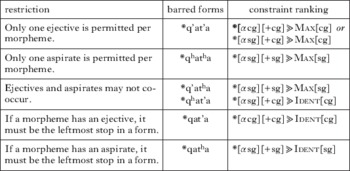
Table I summarises the basic facts on the distribution of aspirates and ejectives in Peruvian Aymara and the constraint rankings that account for them.
Summary of the analysis of Peruvian Aymara.

The constraint rankings needed to account for the restrictions on the location and co-occurrence of ejectives and aspirates in addition to the constraint rankings which ensure contrastive specifications are summarised in (35).
(35)
3.2 Bolivian Aymara
The consonant inventory of Bolivian Aymara is identical to that of Peruvian Aymara in all relevant respects. I also assume that the contrastive hierarchy and feature specifications are the same in the two varieties of Aymara. Although the constraints on the co-occurrence and location of ejective and aspirated stops are also similar in the two dialects, there are some differences. Most significantly, while the restrictions on ejectives in Bolivian Aymara are identical to those found in Peruvian Aymara, the distribution of aspirates is less restricted in the Bolivian variety. The co-occurrence constraints and ordering restrictions are summarised below, based on MacEachern (Reference MacEachern1999), with additional data from de Lucca (Reference Lucca1983, Reference Lucca1987).
As in Peruvian Aymara, there is only one ejective per morpheme, unless the ejectives are identical, as shown in (36).
(36)
Homorganic ejectives and aspirates are barred from co-occurring, as are homorganic aspirates and plain stops, and ejective and plain stops (37).
(37)
In Bolivian Aymara, as in the Peruvian variety, if a morpheme has a single aspirate or ejective, it must be the leftmost stop in the form.
The crucial difference between Peruvian Aymara and Bolivian Aymara is that Bolivian Aymara allows multiple non-identical aspirates (38a) and the co-occurrence of aspirates and ejectives (38b).
(38)
This can be accounted for with a simple reranking of the constraints *[αsg][+sg] and Max[sg] relative to the ranking found in Peruvian Aymara. With Max[sg] ranked over *[αsg][+sg], multiple aspirates will be able to surface, as in (39a), and aspirates will be able to surface following ejectives (39b).
(39)
The distribution of aspirates in Bolivian Aymara is much less restricted than the distribution of aspirates in Peruvian Aymara. As shown above, this results from the difference in the relative ranking of *[αsg][+sg] and Max[sg] in the two dialects. Nonetheless, the distribution of aspirates in Bolivian Aymara is not entirely free. If there is only a single aspirate within a form it must be the leftmost stop. This is achieved by the constraint *[αsg][+sg]. Although this constraint is ranked below Max[sg] in Bolivian Aymara, it plays a crucial role in determining the location of aspiration when there is only a single aspirate in a form.
In (40), an input with aspiration on a non-initial stop is evaluated.
(40)
Previous tableaux have shown that, unlike in Peruvian Aymara, the constraint *[αsg][+sg] is not ranked highly enough in Bolivian Aymara to rule out forms with multiple aspirates or combinations of aspirates and ejectives. Such forms will surface faithfully, due to high-ranking Max[sg]. In the case of an input with a single aspirate, however, there is a possible candidate that satisfies both *[αsg][+sg] and Max[sg]. In tableau (40), this is candidate (b), which has aspiration on the initial stop. This candidate violates only low-ranking Ident[sg], a constraint that has little impact on the distribution of aspirates and ejectives in Aymara.
The relative ranking of markedness and faithfulness constraints referring to the feature [constricted glottis] is the same as that of Peruvian Aymara, and forms with multiple ejectives will continue to be ruled out, as illustrated in (41).
(41)
3.2.1 Ordering restrictions and place of articulation
To this point, the patterning of co-occurrence restrictions in Bolivian Aymara can be accounted for using the same constraints proposed in the analysis of Peruvian Aymara, and a simple reranking of the constraints *[αsg][+sg] and Max[sg] is able to account for the differences between the two dialects.
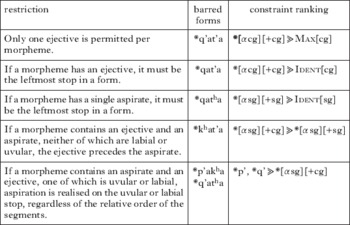
There is, however, a significant complication in the patterning of aspirates and ejectives in Bolivian Aymara. In forms that contain both an ejective and an aspirate, the place of articulation of stops affects the order of laryngeal features. If the initial stop is dental, postalveolar or velar, it will be ejective (42a). If the initial stop is labial or uvular, it will be aspirated (b).
(42)
The forms in (42a) can be derived given the constraint rankings used thus far. I follow MacEachern (Reference MacEachern1999) in considering the forms in (42b) to be the result of segmental markedness constraints penalising ejectives at the labial and uvular places of articulation. The markedness constraints in (43) are from MacEachern (Reference MacEachern1999).
(43)
The markedness constraints *p' and *q' are supported by cross-linguistic evidence. MacEachern reviews segment inventories and finds support for earlier claims by Greenberg (Reference Greenberg1970) and Fordyce (Reference Fordyce1980) that the presence of a labial ejective in a segment inventory implies the presence of coronal or velar ejectives. In addition, she shows that /q'/ is also dispreferred by demonstrating that languages with an ejective–plain contrast among stops will often lack an ejective only at the uvular (or labial) place of articulation.
Functional explanations for the relative markedness of labial and uvular ejectives can be found in the area of articulatory phonetics. Ejectives involve the creation of a high-pressure area in the supraglottal chamber by closing the vocal folds and raising the larynx while a closure is maintained farther forward in the vocal tract. The creation and maintenance of high air pressure in the supraglottal chamber will be most difficult with labial stops. The supraglottal chamber of labials is larger than that of other stops, leading to a weaker compressive effect when the larynx is raised. In addition, the supraglottal chamber of labials involves a large area of elastic cheek wall (Kingston Reference Kingston1985), making compression difficult.
The considerations that make /p'/ marked should favour the production of ejective uvulars. Uvulars have a very small supraglottal chamber, and do not involve any cheek surface. Uvular ejectives do pattern as marked, however, both in Aymara and cross-linguistically. MacEachern (Reference MacEachern1999: 53) speculates that this may result from the difficulty of maintaining a uvular seal during the production of ejectives, due to the softness of the relevant articulators (the tongue dorsum, uvula and velum).
The relative order of ejectives and aspirates in forms that contain both provides a classic case of the emergence of the unmarked (McCarthy & Prince Reference McCarthy and Prince1994). While the marked segments /p'/ and /q'/ are found in Bolivian Aymara in general, they are avoided just in those cases in which the features [constricted glottis] and [spread glottis] co-occur in a form. The following analysis accounts for the patterning of /p'/. The patterning of /q'/ is entirely parallel to that of /p'/, and I do not provide tableaux of forms with /q'/, as these would add nothing further to the analysis.Footnote 10
In order to motivate a ranking of *p' relative to the constraints introduced thus far I will focus on a crucial contrast between forms with an ejective and a plain stop and those containing an ejective and an aspirated stop. If a labial is initial in the form, it will surface as ejective in the first case (44a), but as aspirated in the second (44b). Also, the generalisation that ejectives precede aspirates in forms without labials or uvulars must be maintained (44c).
(44)
In order to account for the data in (44), *p' must be ranked low enough to allow ejective labials to be realised when there are no other laryngeally marked segments in a form, but high enough to get a reversal of the relative order of ejectives and aspirates in forms that contain both. The following tableaux integrate *p' into the ranking established to this point.
Tableau (45) shows that a [+constricted glottis] feature will be realised on the leftmost stop in a form with only one laryngeally marked segment, even if that leads to a violation of *p'. A candidate with [+constricted glottis] on the second stop violates the high-ranked constraint prohibiting [+constricted glottis] segments from following any segment with a specification for [constricted glottis]. A candidate in which all output stops are realised without glottalisation violates the constraint requiring that [constricted glottis] features in the input be present in the output.
(45)
Tableau (46) shows that an ejective labial will be avoided if an aspirate is present in the form.
(46)
In this case, the violation of *p' incurred by the faithful candidate is fatal. Candidate (b), in which the features of the two stops are reversed, is able to satisfy all constraints shown here except for the low-ranking faithfulness constraint Ident[sg]. Crucially, this candidate does not violate the constraint *[αcg][+cg], because the initial aspirated segment is not contrastively specified for the feature [constricted glottis].
The contrastive hierarchy of laryngeal features in Aymara from (19) is repeated in (47). Although only the labials are shown, all places of articulation have the same set of laryngeal contrasts among stops, so that the hierarchy of features and resulting specifications in (47) holds for all places of articulation.
(47)
The scope of the two features necessarily differs, with [spread glottis] being contrastive for all stops but [constricted glottis] being contrastive only in the set of stops that are [−spread glottis]. Contrastive specifications will necessarily be asymmetrical when used to establish a contrast between a set of three. In this case, the three-way distinction is between plain stops, aspirates and ejectives. The fact that one feature must take scope over another seemed to be a liability in the analysis of Peruvian Aymara. Because aspirates are not contrastively specified for the feature [constricted glottis], an additional constraint needed to be introduced to rule out forms with the shape [Cʰ…C']. However, the asymmetry in feature specifications is crucial in the analysis of ordering restrictions in Bolivian Aymara, and avoids a ranking paradox. If aspirates were specified for the feature [constricted glottis], the constraint *p' would need to be ranked above the constraint *[αcg][+cg] in order for glottalisation to be realised on the second stop in forms with an aspirate and an initial labial. But the constraint *p' must be ranked below *[αcg][+cg] in order for glottalisation to be realised on the initial labial in forms without any aspirates.
As shown throughout the preceding discussion, the analysis presented here crucially relies on contrastive specifications, and in particular on the asymmetric specifications shown in (47). However, I am assuming that inputs are free, and that contrastive specifications are a property of output forms determined by constraint ranking. To show that this approach is capable of accounting for the order of aspirates and ejectives in forms with initial labials, a tableau with an input candidate containing an ejective followed by an aspirate, as in (46), is given as (48). Unlike (46), however, (48) shows a fully specified input, and includes the constraints needed to achieve contrastive representations.
(48)
The input is a fully specified form, with an ejective /p'/ followed by an aspirate. Faithful candidate (a) is eliminated because it violates *[αcg, +sg], the constraint which bars specification for the feature [constricted glottis] in [+spread glottis] segments and which is one of the constraints which maintains contrastive specifications. According to the set of constraints shown, candidates (b) and (c) are equally optimal. In candidate (b), the input order of aspiration and glottalisation is reversed. Candidate (b) contains a contrastively specified aspirate followed by an ejective. This candidate violates Max[cg], because a [−constricted glottis] specification in the input is absent from the output. Candidate (c) is a contrastively specified candidate, with an initial aspirate followed by a plain voiceless stop. This candidate also violates Max[cg]. In this case, a [+constricted glottis] specification in the input is absent from the output. Unlike the input, both candidates (b) and (c) are attested output forms in the language. Although it is necessary for the form in which the labial aspirate precedes the ejective stop, candidate (b), to surface as an output of the grammar, it is not absolutely necessary for it to be optimal, given the input shown. Since both candidates (b) and (c) are attested surface forms with specifications consistent with the proposed contrastive hierarchy of features, either one would be a fine winner. Both violate Max[cg], and the winner between these two will be decided by constraints not shown here. However, if a contrastively specified input, identical to the output in (b), were considered, candidate (b) would not violate Max[cg] and would be optimal, as assumed in the evaluation of tableau (46). Since inputs are free according to the principle of Richness of the Base, an input with specifications identical to those of candidate (b) is expected as a possible input, and will surface faithfully. What is crucial here is that the form with the ejective /p'/ followed by an aspirate will not surface faithfully, regardless of input specifications. All other candidates are eliminated. Candidate (d) contains an ejective followed by a plain stop, and is eliminated due to a violation of Max[sg]. This violation is incurred because the input contains a [+sg] specification which is absent in the output form. Candidate (e), like the input, contains an ejective labial followed by an aspirate, but, unlike the input, contains only specifications consistent with the proposed contrastive hierarchy. This candidate violates Max[cg], as do the winning candidates in (b) and (c). However, (e) also violates *p', and is eliminated. Candidate (f) contains a fully specified aspirate followed by an ejective, and is eliminated due to violation of the high-ranking markedness constraint *[αcg][+cg].
Of course, forms in which ejectives follow aspirates must violate some markedness constraint in order to ensure the order ejective–aspirate in forms without labials or uvulars. The relevant constraint is *[αsg][+cg], introduced to rule out forms such as [Cʰ…C'] in the analysis of Peruvian Aymara. This independently needed constraint is able to get the correct default ordering between aspirates and ejectives, as shown in (49).
(49)
The constraint ranking shown above is able to capture the ordering of aspirates and ejectives in all forms. In the example shown here, an input in which an aspirate precedes an ejective is evaluated. The form does not contain labials or uvulars, so the constraints *p' and *q' will have no impact on the selection of the optimal form. The faithful candidate is eliminated due to a violation of *[αsg][+cg]. The inclusion of this constraint, in addition to *[αcg][+cg], captures the fact that ejectives have the most severe restrictions on their distribution. Constraints penalise the occurrence of [+constricted glottis] segments following plain stops, other [+constricted glottis] segments and [+spread glottis] segments. As a result, candidate (b) is optimal. In this candidate, the ejective is first in the form, and only a violation of the low-ranking constraint *[αsg][+sg] is incurred.
3.2.2 Summary of the analysis of Bolivian Aymara
Table II summarises the basic facts concerning the distribution of aspirates and ejectives in Bolivian Aymara and the constraint rankings that account for them.
Summary of the analysis of Bolivian Aymara.

The constraint rankings proposed in the analysis of Bolivian Aymara are shown in (50).
(50)
The differences between Bolivian Aymara and Peruvian Aymara result from a reranking of the constraints *[αsg][+sg] and Max[sg] in the two dialects. In addition, the fact that aspirates and ejectives can co-occur in Bolivian Aymara, and that their relative order is influenced by place of articulation, gives evidence for the ranking of the markedness constraints *p' and *q'. The account of the influence of place of articulation on the relative order of aspirates and ejectives also relies crucially on the constraint *[αsg][+cg], and on differences in the relative scope of features resulting from the contrastive hierarchy. While both of these aspects of the analysis seemed to offer unnecessary complications in the analysis of Peruvian Aymara, the more complex patterning of aspirates and ejectives in Bolivian Aymara requires a distinct ranking of *[αsg][+cg] and *[αsg][+sg], as well as reference to contrastive feature specifications consistent with the contrastive hierarchy.
4 Comparison with alternative analyses
In this section, I address alternative analyses of restrictions on laryngeal features in Aymara. The leftward orientation of glottalisation and aspiration resembles the leftward orientation of features in languages with regressive harmony, as well as the directionality of foot construction and stress assignment in metrical systems. Given this pattern, an immediately appealing possibility is an analysis of Aymara ordering restrictions using Align constraints like those used in analyses of other directional phenomena. The account of Aymara in MacEachern (Reference MacEachern1999) uses constraints equivalent to Align in the analysis of ordering restrictions. A different approach is taken in Gallagher (Reference Gallagher2010), which uses systemic markedness constraints in the framework of Dispersion Theory. I will argue that, unlike the constraints on marked and contrastive features introduced in this article, neither Align constraints nor Dispersion Theory are able to account for the distribution of ejectives and aspirates in Aymara.
Align constraints were introduced in McCarthy & Prince (Reference McCarthy and Prince1993) to account for the alignment of prosodic domains relative to morphological constituents. Constraints demanding alignment to morphological edges have since been extended to the analysis of feature spreading in harmony processes (e.g. Kirchner Reference Kirchner1993, Cole & Kisseberth Reference Cole and Kisseberth1994, Archangeli & Pulleyblank Reference Archangeli and Pulleyblank2002), as well as to requirements for particular features to be realised in initial position (e.g. Kager & Shatzman Reference Kager, Shatzman, Los and van Koppen2007). The leftward orientation of aspiration and glottalisation in Aymara appears intuitively amenable to an analysis using Align, and constraints which are functionally equivalent to Align constraints are used in MacEachern (Reference MacEachern1999).
MacEachern's cross-linguistic study of laryngeal co-occurrence constraints includes a detailed account of the restrictions on the distribution and ordering of laryngeally marked segments in the varieties of Aymara considered here. The preceding analysis relies on data from MacEachern's work, and follows her analysis in certain respects, particularly in the use of *p' and *q' when considering the interaction of place of articulation and ordering restrictions in Bolivian Aymara. MacEachern's general approach to the analysis of laryngeal co-occurrence restrictions involves the use of a family of Generalised Obligatory Contour Principle constraints. Constraints such as OCP[cg] and OCP[sg] motivate restrictions on the occurrence of multiple ejectives and aspirates within a given form.
MacEachern's analysis of ordering restrictions in Peruvian and Bolivian Aymara uses the additional constraints in (51) (1999: 124).
(51)
MacEachern's interpretation of these constraints relies crucially on her notion of ‘available host consonant’. Her analysis shows that these constraints are only violated when a plain stop or affricate intervenes between the laryngeally marked segment and the left edge of the word. MacEachern does not explicitly discuss the definition of ‘available host consonant’, but examination of her analysis makes clear that forms containing ejectives or aspirates preceded by sonorants or fricatives do not violate the Leftmost constraints, nor do forms containing ejectives or aspirates preceded by other ejectives or aspirates. One result of this interpretation is that the ranking of Leftmost[cg] and Leftmost[sg] cannot affect the relative order of ejectives and aspirates in forms that contain both. Because both the attested /t'akʰa/ and the ill-formed */tʰak'a/ satisfy Leftmost[cg] and Leftmost[sg], these constraints cannot choose between them. MacEachern proposes an additional constraint, EjectivesPrecedeAspirates, in order to account for the preferred order of laryngeal features. This is illustrated in (52), which is based on MacEachern (Reference MacEachern1999: 132).Footnote 11
(52)
MacEachern's use of Leftmost constraints entails a complication in the analysis of Aymara ordering restrictions when compared to the analysis advocated here. In the analysis argued for in this article, the constraints penalising multiple ejectives and aspirates are the same as the constraints requiring ejectives and aspirates to be realised at the left edge. In the case of ejectives, the constraint *[αcg][+cg] is violated by forms containing multiple ejectives, which necessarily contain a sequence of two [+constricted glottis] segments, as well as by forms in which an ejective is preceded by a plain stop, which contain a [−constricted glottis] … [+constricted glottis] sequence. In addition to the Leftmost constraints, MacEachern requires OCP constraints referring to [constricted glottis] and [spread glottis] in order to rule out forms with multiple laryngeally marked segments. If the co-occurrence and ordering restrictions on ejectives are motivated by the constraints on the distribution of marked and contrastive laryngeal features argued for here, a single constraint accounts for patterns which are motivated by multiple distinct constraints in MacEachern's analysis.
The advantage of the analysis proposed here is not simply that it requires fewer constraints. MacEachern's analysis also misses a significant insight. If a form contains more than one ejective, they cannot both be at the left edge of the form. There is therefore a conceptual link between the ordering restrictions and the ban on multiple ejectives that is overlooked in MacEachern's analysis. The markedness constraint used here, *[αcg][+cg], captures this link by requiring any [+constricted glottis] feature to be the first [constricted glottis] specification. A [+constricted glottis] specification preceded by another [+constricted glottis] specification will be penalised, ruling out forms of the shape /k'at'a/, and the same constraint penalises a [+constricted glottis] specification preceded by a [−constricted glottis] specification, ruling out forms of the shape /kat'a/. The use of the contrastive hierarchy and contrastive specifications is also able to capture MacEachern's notion of ‘available host consonant’ in a principled fashion. In the contrastive hierarchy analysis, an ejective preceded by a sonorant or fricative does not violate the constraint *[αcg][+cg], because sonorants and fricatives are not contrastively specified for any value of [constricted glottis].
One consequence of the theory of the contrastive hierarchy in the analysis above is that the constraint *[αsg][+cg] was needed to rule out forms with aspirates followed by ejectives in Peruvian Aymara. The need for this constraint was a direct result of the theoretical model of the contrastive hierarchy, and seemed like a liability in the analysis of Peruvian Aymara. However, this constraint served an independent and crucial function in accounting for the influence of place of articulation on the ordering of aspirates and ejectives in Bolivian Aymara. Furthermore, MacEachern, who does not assume any theory of contrastive specifications, is forced to propose a functionally equivalent constraint, namely EjectivesPrecedeAspirates, in her account of Bolivian Aymara.
While the notion of accounting for the relative order of aspirates and ejectives through the ranking of competing alignment constraints has some appeal, the relative ranking of these constraints does not, in fact, function to determine the order of aspirates and ejectives. In MacEachern's analysis the relative order of aspirates and ejectives is determined only on the basis of the markedness constraints *p' and *q' and the constraint AspiratesPrecedeEjectives, which is introduced solely for this purpose.
MacEachern's interpretation of Leftmost[cg] and Leftmost[sg] differs from most interpretations of Align constraints. Align constraints are traditionally interpreted gradiently, with violation marks being assessed on the basis of the number of intervening elements between the relevant feature and the relevant edge.Footnote 12 Although MacEachern suggests that such an interpretation is also true in her definitions of Leftmost[cg] and Leftmost[sg], the fact that only ‘available host consonants’ which intervene between the laryngeal feature and the left edge incur a violation means that the constraints are only violated in one set of circumstances, when a plain stop precedes an ejective or an aspirate. In addition, the fact that roots in Aymara are typically two syllables long means that specific forms violate the constraint at most once. This makes MacEachern's Leftmost constraints essentially categorical.
If, instead of MacEachern's Leftmost constraints, Bolivian Aymara is analysed using gradient Align constraints that incur a violation for every segment intervening between the laryngeal feature and the left edge, forms containing combinations of aspirates and ejectives and forms containing multiple aspirates and ejectives will incur a violation of Align. In such an analysis, the ranking of Align[+cg]-L and Align[+sg]-L can influence the order of aspirates and ejectives in Bolivian Aymara. This is illustrated in (53).
(53)
In (53), the faithful candidate is eliminated due to violation of Align[+cg]-L. This candidate satisfies the Max constraints referring to both laryngeal features and the constraint Align[+sg]-L. The constraint Align[+cg]-L is violated twice, however, once for each segment between the ejective and the left edge of the form. The first of these violations is fatal. The optimal candidate is (b). In this candidate, the order of laryngeal features is reversed with respect to their order in the input. The Align constraint referring to [+sg] is violated twice in this form. This constraint is ranked low, however, and (b) surfaces as optimal. Other potential candidates are eliminated due to violation of the Max constraints referring to laryngeal features.
Problems with Align arise when we consider those forms in which aspiration does precede glottalisation. As discussed above, aspirates precede ejectives in Bolivian Aymara forms with initial labials and uvulars. This reversal in the order of laryngeal features is argued here and in MacEachern (Reference MacEachern1999) to be triggered by phonetically motivated markedness constraints *p' and *q'. The tableau in (54) shows that if *p' is ranked above Align[+cg]-L, the actual output will be selected as optimal for forms with initial labials and a combination of ejectives and aspirates. Even though the input shown in (54) contains an ejective /p'/ followed by an aspirate, the faithful candidate is eliminated due to a violation of *p'.
(54)
This ranking fails, however, to correctly permit forms containing no aspirates to surface with initial ejective labials. The ranking in (54) is repeated in (55) with a candidate containing only a single ejective /p'/.
(55)
In Bolivian Aymara, ejective labials surface faithfully in forms that contain no other laryngeally marked segments. Yet ejective labials are avoided in forms that contain aspirates. In the analysis advocated in this article, these facts are accounted for by using constraints on the distribution of marked contrastive features to account for the location of aspiration and glottalisation. The constraints *[αcg][+cg] and *[αsg][+sg] specifically restrict the marked value of the laryngeal features, and militate against these marked laryngeal features surfacing following either positive or negative specifications for the same feature. These constraints do not require that ejectives and aspirates be at the left edge of a domain. The ranking paradox evident in the Align analysis is avoided in the analysis given here, because of the way in which contrastive specifications are designated in the theory of the contrastive hierarchy. Because aspirates are not contrastively specified for the feature [constricted glottis], sequences of aspirates and ejectives do not violate the same constraint that sequences of plain stops and ejectives violate. In the Align analysis, the ranking paradox cannot be avoided, regardless of one's assumptions about feature specification. If the markedness constraint *p' outranks Align[+cg]-L, initial /p'/ will fail to surface, even in forms without aspirates. Conversely, if Align[+cg]-L outranks *p', initial ejective labials are falsely predicted to surface in forms which contain a following aspirate.
An analysis of Aymara in the framework of Dispersion Theory (Flemming Reference Flemming2002, Reference Flemming, Hayes, Kirchner and Steriade2004) is provided in Gallagher (Reference Gallagher2010). Like MacEachern (Reference MacEachern1999), Gallagher provides analyses of laryngeal co-occurrence restrictions in a variety of languages. She argues that the patterning of laryngeal co-occurrence restrictions is motivated by constraints against perceptually weak contrasts. Work in Dispersion Theory (e.g. Flemming Reference Flemming, Hayes, Kirchner and Steriade2004) accounts for the structure of phonemic inventories by arguing that markedness is not evaluated over particular segments in isolation, but rather over entire inventories, with unmarked inventories being those in which all segments meet some threshold of perceptual distinctness from one another. Gallagher's analysis of laryngeal co-occurrence restrictions expands the notion of perceptual distance between forms by proposing that a particular phonetic contrast between segments may be more or less perceptible, depending on other properties of forms in which those segments occur. Specifically, Gallagher argues that contrasts in laryngeal properties, such as aspiration and glottalisation, are less distinct in forms that contain multiple aspirates or ejectives. For example, the contrast between a pair of forms which differ in that one has multiple ejectives and the other has a single ejective, such as /k'ap'i/–/k'api/, is less perceptually distinct than the contrast between a pair of forms that differ in that one has a single ejective and the other has no ejectives, such as /k'api/–/kapi/. The acoustic difference between the plain and ejective stops will be alike in both pairs of forms, yet the perceptibility of that difference is degraded when other ejectives are present. In addition to the effects of multiple aspirates or ejectives, Gallagher also argues that laryngeal contrasts are less perceptible in non-initial position than in initial position, meaning pairs such as /k'api/–/kapi/ are more distinct than pairs such as /kap'i/–/kapi/. These claims are formalised in Gallagher's analysis by using markedness constraints which penalise contrasts between forms that differ in the number or location of laryngeal features.
Gallagher argues that the specific features referred to by such constraints are auditory features such as [long VOT], [loud burst] or [creak] rather than articulatory features such as [constricted glottis] or [spread glottis]. The feature [long VOT] is used to account for the interaction of aspirates and ejectives in languages like Peruvian Aymara, where such segments pattern alike in ordering and co-occurrence restrictions. Gallagher proposes that both ejectives and aspirates in these languages are specified for [long VOT] and that the dissimilatory restrictions prevent the realisation of perceptually weak contrasts between forms with one [long VOT] segment and forms with two [long VOT] segments. In Bolivian Aymara, aspirates are not subject to the same restrictions as ejectives. Multiple aspirates can co-occur, as can combinations of aspirates and ejectives. In her account of Bolivian Aymara, Gallagher uses markedness constraints referring to the feature [loud burst], which is specified on ejectives but not on aspirates.
The major claims of Gallagher's survey are that laryngeal co-occurrence restrictions are motivated by constraints on the perceptual salience of contrasting forms and that these constraints are formulated over auditory features. The conceptual advantage of this approach is that assimilatory, dissimilatory and ordering restrictions all neutralise contrasts between forms that differ in the number or position of laryngeal contrasts. While this generalisation is appealing, the conceptual link between different types of restrictions on laryngeal features does not result in the use of a single constraint in the analysis of the variety of laryngeal restrictions. Restrictions on multiple ejectives and aspirates are motivated by constraints penalising a contrast between one and two instances of a laryngeal feature. Ordering restrictions are motivated by constraints penalising contrasts in the position of laryngeal features and the fact that ordering restrictions favour contrasts in initial position is determined by additional constraints which penalise non-initial contrasts. Thus the conceptual unity in Gallagher's approach does not result in a formal unity in the analysis. Such unity is achieved in the analysis argued for in this article, where restrictions on the occurrence of multiple ejectives and aspirates, as well as requirements for ejectives and aspirates to be the leftmost stop in a form, are motivated by the same constraints, namely the constraints *[αcg][+cg] and *[αsg][+sg].
Despite significant differences between Gallagher's (Reference Gallagher2010) approach to laryngeal co-occurrence restrictions and the Align analysis sketched above, when the interaction of place and laryngeal features in Bolivian Aymara is considered, Gallagher encounters the same ranking paradox as the Align analysis. If a constraint *p' were integrated into Gallagher's analysis, it would have to outrank the constraint requiring ejective contrasts to be in initial position in order to prevent initial ejective labials from surfacing in forms containing ejectives and aspirates. Gallagher (Reference Gallagher2010: 159) acknowledges that such a constraint ranking will also prevent labial ejectives from surfacing in forms without ejectives, erroneously preferring /pak'i/ to /p'aki/.
5 Conclusion
The analysis of laryngeal co-occurrence constraints in Aymara proposed here relies on a particular consequence of the theory of the contrastive hierarchy, namely that features differ in scope, which necessarily results in asymmetries between features. In Bolivian Aymara, differences in the relative scope of the laryngeal features [spread glottis] and [constricted glottis] are crucial in accounting for the interaction of place features and laryngeal features. Other aspects of the theory of the contrastive hierarchy also play a central role in the analysis. The size and shape of the phonemic inventory influence contrastive specifications, and only contrastive specifications are active in phonological processes. These aspects of the theory account for the neutrality of fricatives and sonorants in the ordering restrictions on laryngeal features. The connection between contrast and feature activity is a major motivation behind both the theory of the contrastive hierarchy and other theories addressing issues of feature specification (e.g. radical underspecification, contrastive underspecification), yet the asymmetric relations between features is a unique consequence of the theory of the contrastive hierarchy that allows for the analysis of the most complex data involving Aymara laryngeal restrictions.
This article follows Mackenzie & Dresher (Reference Dresher, van Kempen and Baauw2004) and Dresher (Reference Dresher2009) in demonstrating that contrastive specifications can be achieved within the framework of Optimality Theory. The algorithm for transforming contrastive hierarchies to constraint rankings shows that the principle of Richness of the Base can be upheld while contrastive specifications are attained as an output property of representations. In addition, the analyses given here have shown that restricting the role of redundant features does not require eliminating non-contrastive features from input forms. Constraints determining contrastive specifications can be integrated with constraint rankings which motivate restrictions on the location and co-occurrence of laryngeal features in a single level of evaluation.
The analysis of Bolivian Aymara relies crucially on formal mechanisms of both OT and the theory of the contrastive hierarchy. The fact that aspirates can occur both with one another and with ejectives in Bolivian Aymara, unlike in the Peruvian variety, is accounted for with simple constraint reranking; the relative order of *[αsg][+sg] and Max[sg] is reversed in the two dialects. The fact that the relative order of aspirates and ejectives is influenced by place of articulation is an emergence of the unmarked phenomenon. The existence of such phenomena is predicted by the architecture of OT, which allows low-ranked markedness constraints to play a role in determining output forms. Yet in Bolivian Aymara, the interaction of segmental markedness constraints and co-occurrence restrictions leads to an apparent ranking paradox. The ranking paradox is avoided here because the constraints enforcing restrictions on the location and co-occurrence of laryngeally marked segments interact with constraints requiring contrastively specified representations. The theory of the contrastive hierarchy requires an asymmetry between features, and it is this asymmetry in scope between the features [spread glottis] and [constricted glottis] that allows ejectives to precede aspirates in the general case, while the order is reversed when an initial labial or uvular is present. In the analysis as a whole, advantages of OT with respect to typological predictions and emergence of the unmarked phenomena are combined with a principled and explicit theory of contrast and a significant role for inventory structure in accounting for phonological generalisations.