I. INTRODUCTION
Nanoparticle-reinforced aluminum matrix composite is one of the most attractive materials to be used in the fields of automobile, high speed train, and aircraft industry in recent years due to their excellent combination of high performance and lightweight.Reference Su, Gao, Feng and Lu1–Reference Huang, Peng, Visic and Zak3 However, it is difficult to secondarily process the complex nanocomposite parts due to their lower plasticity. Thixoforming, which is one of the semisolid processes, has been proposed for the forming and processing of metal materials with poor formability.Reference Chen and Yan4,Reference Tang, Zhou, Fan, Zhang, Quan and Liu5 Generally, the liquid fraction, as well as morphology and size of grains, is a significant criterion to control the formability of the alloy during semisolid processing. When thixoforming the composites with a high solid fraction, low liquid phases distributed in the composites can serve as a lubricant at the interface to reduce the deformation forces and improve the thixoformability.Reference Chen and Yan4,Reference Birol6 However, large liquid fraction may lead to the liquid flow and low cohesion of the interface, hence resulting in a rapid collapse of solid skeleton.
Recently, strain-induced melt activation processing and recrystallization and partial remelting processing have been widely used to produce the billets for thixoforming.Reference Bolouri, Shahmiri and Kang7,Reference Rokni, Zarei-Hanzaki, Abedi and Haghdadi8 For the routes, the starting material suffers lager deformation followed by isothermally holding at a temperature in the semisolid range of alloys to prepare a globular microstructure with high solid fraction. Accordingly, there is a drive to develop a simple and effective route to prepare semisolid slurry for thixoforming. According to the previous literature,Reference Eskin9–Reference Yan, Rao and He12 it was shown that semisolid slurry with ultimately refined nondendritic structure could be produced by adjusting time and temperature of ultrasonic treatment during the solidification of the alloy. Thus, the use of this technology offers the simple production of billet for thixoforming possible, in which the influence of ultrasonic cavitation played an important role on the formation of globular grains. Nonetheless, the influence would decay due to the reduction of liquid phases when the temperature was decreased to obtain high solid fraction.Reference Liu, Zhai, Qi and Zhang13 Therefore, it is a challenging task to fabricate a microstructure with high solid fraction for thixoforming via the ultrasonic process.
Some research investigated nucleation kinetics during solidification of aluminum alloys and found that the nucleation process of individual grains was complete at a solid fraction of about 30%, irrespective of the cooling rate.Reference Iqbal, Dijk, Offerman, Moret, Katgerman and Kearley14 The result reveals that the grains will freely grow after the completion of the nucleation process, accordingly inducing the formation of coarse dendrites. Yan et al.Reference Yan, Rao and He12 prepared Mg2Si/AM60 composites with nondendritic structure by ultrasonic vibration, where the micron-sized Mg17Al12 and Mg2Si phases, with no changes in their types, were uniformly distributed in the liquid matrix. Whereas, the effect mechanisms of ultrasonic vibration on second phase evolution during solidification and second phase change on primary α-Al grain were not clear yet. Eskin et al.Reference Eskin9 pointed out that the presence of an excess amount of nucleation site in the melts could enhance nucleation and then, the nucleation rate was increased. Thus, when applying semisolid ultrasonic vibration (SSUV) under higher temperature, it is possible to produce semisolid slurry with high solid fraction for thixoforming via controlling the cooling rate and indirectly or directly introducing nuclei into the liquid phases.
Therefore, in the present research, the semisolid slurry of nanosized Al2O3 (Al2O3np)/Al7075 composites with a high solid fraction for thixoforming will be fabricated by specially made Al2O3np containing Mg powders and SSUV. The influence of SSUV technology on primary α-Al grain and second phase in the composites is investigated. Moreover, mechanisms involved in the development of the microstructure are discussed.
II. EXPERIMENTAL PROCEDURE
A. Materials
Nanosized α-Al2O3 (Al2O3np) was used as reinforcements in composites, which is 99.9% pure and has an average particle size of 80 nm (Guanye, Nanjing, China). Commercial wrought Al7075 alloy (0.22% Si, 0.22% Fe, 1.45% Cu, 0.30% Mn, 2.10% Mg, 5.23% Zn, 0.16% Ti, 0.23% Cr, Al balance; mass fraction) was used as the matrix (Chinalco, Beijing, China). Magnesium powders (99.9% pure, average particle size of 58–75 μm) were used as the wetting agent (Xilong Chemical, Guangzhou, China).
B. Preparation of semisolid Al2O3np/Al7075 composites
Scheil’s equation is generally used to estimate the variation of liquid fraction versus temperature for alloys. And yet, for high composition multiple aluminum alloys, it is difficult to determine its equilibrium distribution ratio. Thus the liquid fraction–temperature relationship of as-cast Al7075 was determined using differential scanning calorimetry (DSC, Dupont 910). Samples of about 3 mm diameter and 14.5 mg weight were cut, weighed, and then put into carbon bans with carbon lids in an argon atmosphere. The samples were heated to 700 °C at 10 °C/min and cooled to room temperature at the same rate. The result of the DSC analysis revealed that the solidus and liquidus temperatures of the as-cast Al7075 were 471.54 °C and 637.37 °C, respectively, and with respect to the test temperatures of 615 °C, 620 °C, 625 °C, and 630 °C, the corresponding liquid fractions were 0.587, 0.727, 0.853, and 0.948, respectively.
Al2O3np was specially made before fabrication of the composites, in which the particles were subjected to predispersion in an ultrasonic bath, drying, calcination, and then mixing with magnesium powders. Al2O3np processing was described in detailed in Ref. Reference Chen and Yan15. The equipment for preparing the semisolid Al2O3np/Al7075 composites mainly consists of an ultrasonic processing system, an electric resistance-heating furnace, and a slurry holder. Al7075 in a clay-graphite crucible was melted using a resistance furnace under a protective gas of argon. When the temperature was heated up to 800 °C, ultrasonic vibration was injected into the alloy melt, and simultaneously the specially made Al2O3np containing Mg powders were added into the melt. In the previous study,Reference Chen and Yan15 the detailed process can be found. The composite slurry after ultrasonic treatment was poured into a holder preheated to 550–600 °C. When the composite slurry held in the holder was cooled in a quiescent fashion to a temperature of 700 °C, the composite slurry was ultrasonically vibrated at different power levels (0.5 kW, 1 kW, and 1.5 kW) and a frequency of 20 kHz. During ultrasonic treatment, the composite slurry was cooled at various cooling rates (4 °C/min, 10 °C/min, 33 °C/min, and 117 °C/min) from 700 °C to 630 °C, 625 °C, 620 °C, and 615 °C, respectively. After SSUV, some slurries were extracted out by using a quartz tube with an inner diameter of 6 mm and quenched in water immediately. Samples with 1.5 wt% Al2O3np were fabricated. For comparison, the semisolid Al2O3np/Al7075 composites were prepared by the conventional stir casting technique.
C. Microstructural characterization
Microstructural examination was performed by optical microscopy (OM; Nikon eclipse MA-200, Nikon, Tokyo, Japan), scanning electron microscopy (SEM; Tescan, Brno, Czech Republic, Vega3), and transmission electron microscopy (TEM; Jeol, Tokyo, Japan, JEM-2100). All the quenched samples were prepared by the standard technique, etched by a 0.5 vol% hydrofluoric acid aqueous solution, and then examined using the metallographic microscope. To observe the second phase and interface structure, metallographic examinations were performed by SEM and TEM. Micrographs were taken from the center of the quenched rod in every case so as to obtain a reliable microstructure. The grain size and shape factor were measured by using image analysis software (Image pro-Plus6.0 software, Media Cybernetics, Rockville, Maryland). Average size and shape factor of the primary α-Al grains were expressed by using the following equationReference Yan, Rao and He12:
 $${D_{{\rm{eq}}}} = {{\sum\limits_1^n {\sqrt {{{4{A_n}} \over \pi }} } } \over n},\quad {S_{\rm{F}}} = {{\sum\limits_1^n {{{4\pi {A_n}} \over {P_n^2}}} } \over n}\quad ,$$
where A n and P n are the area and perimeter of a primary α-Al grain, respectively, and n is the number of primary α-Al grains. S F varies from 0 to 1, and when the value of S F is close to 1, the shape of the particle approaches a circle. More than 100 grains in each sample were measured to obtain the average size and shape factor of primary α-Al grains.
III. RESULTS AND DISCUSSION
A. Effect of the ultrasonic vibration process
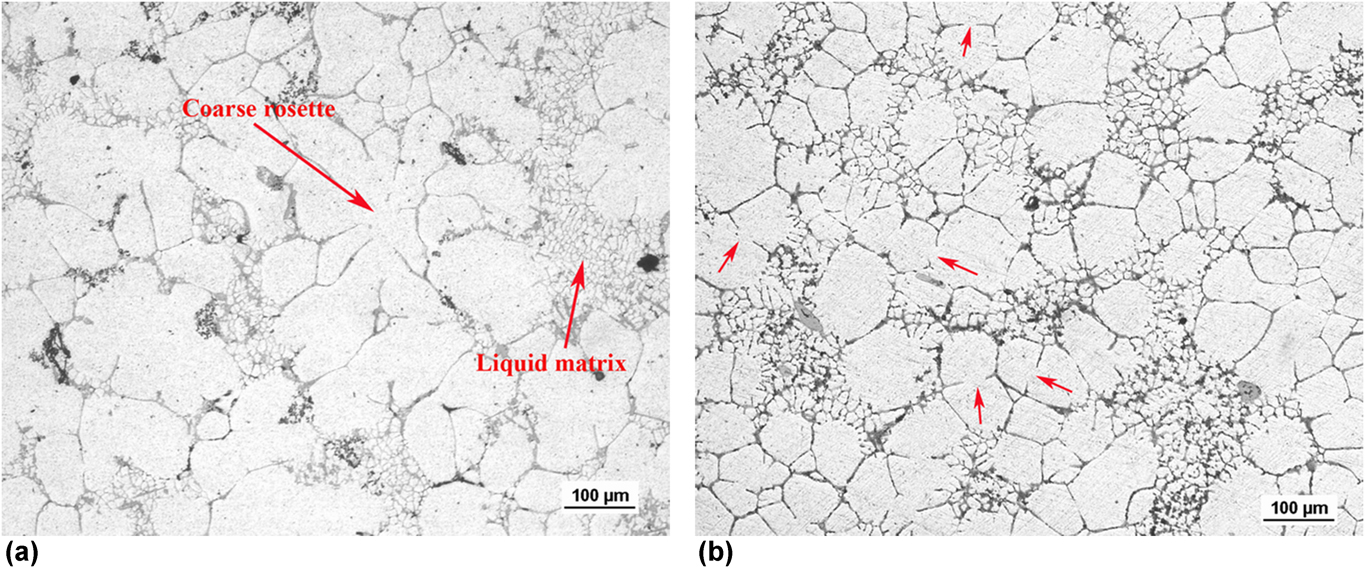
Figure 1 shows the microstructures of the semisolid Al2O3np/Al7075 composite slurry prepared without and with the ultrasonic vibration process at the cooling rate of 10 °C/min, and then quenched in water at 625 °C. It can be seen that the primary α-Al grains (light in the image) are distributed in the liquid matrix (gray in the image). The formation of the liquid matrix is due to the solidification of remaining liquid in the semisolid slurry during water quenching. Without the ultrasonic vibration process, the primary α-Al grains with coarse rosette-like and dendritic shapes were found in the semisolid slurry [Fig. 1(a)]. After SSUV in the range of 700 °C–625 °C, the primary α-Al grains became nearly globular and were uniformly distributed in the liquid matrix [Fig. 1(b)]. Thus it can be seen that SSUV influences significantly the size and morphology of primary α-Al grains.
Metallographs of the semisolid Al2O3np/7075 composite slurry prepared by different processes [(a) stir casting and (b) ultrasonic vibration] at the cooling rate of 10 °C/min and then quenched in water at 625 °C.

The refinement of primary α-Al grains depends mainly on the cavitation and acoustic streaming induced by ultrasonic vibration. Application of ultrasound leads to oscillation of liquid molecules about their mean position, i.e., mechanically vibrating wave. Periodic tension-pressure forces are created in the liquid medium by passage of these waves.Reference Liu, Zhai, Qi and Zhang13,Reference Taghavi, Saghafian and Kharrazi16 During the half cycle of tension, the tensile stresses above the cavitation threshold create numerous small cavitation bubbles at weak regions of the melt.Reference Sauter, Emin, Schuchmann and Tavman17 However, if there is in the half cycle of pressure during passage of these waves, the bubbles are forced to collapse rapidly. The energy of the collapse is transformed into high pressure pulses. Increased pressure causes an increase in melting point in the local zone of the melt and can be described asReference Yan, Rao and He12
 $${{\Delta {T_{\rm{m}}}} \over {\Delta P}} = {{{T_{\rm{m}}}\left( {{V_{\rm{L}}} - {V_{\rm{S}}}} \right)} \over {\Delta H}}\quad ,$$
where T m is the melting point of the alloy at ordinary pressure, P is the pressure, V L and V S are the specific volume of liquid and solid phases, respectively, and ΔH is the latent heat of fusion. On the other hand, during the growth of the bubbles, they will absorb the energy in the melt and lead to decreasing of their surface temperature.Reference Taghavi, Saghafian and Kharrazi16 The coupled effect of ultrasonic vibration finally makes supercooling to occur in the local zone. The violent reduction of temperature induces a mass of nucleation sites, accordingly refining the primary α-Al grains. In addition, the dissolved gases (mainly hydrogen) have a strong tendency to adsorb on the surface of Al2O3np,Reference Liu, Han, Li and Huang18 hence reducing the wettability between the Al2O3np and matrix alloy. And yet, the impulse force and cumulative jets induced by ultrasonic vibration can remove the gases from the particle surface, thereby accelerating heterogeneous nucleation.
Grain refinement is also related to the showering and propagation of fragmented dendrite arms. The equivalent impulse force, which is produced during the cavitation bubble collapsing, can be expressed by the following expressionReference Liu, Zhai, Qi and Zhang13:
 $$F = {I_{{\mathop{\rm int}} }}S\exp \left( { - 2\alpha x} \right){{{e_1}} \over c}\quad ,$$
where I int is the incident intensity, s is the area on which ultrasonic vibration is imposed, α is the attenuation coefficient, x is the transmitted distance, e 1 is a unit vector in the propagation direction of ultrasonic sound, and c is the speed of ultrasonic sound in the melt. The impulse force is exerted toward dendrite arms, finally leading to shearing or bending of dendrite arms and to fragmentation. Under the role of acoustic streaming, the fragmented dendrite arms are uniformly distributed into the whole melt and act as new sources of nucleation. Meanwhile, when a dendrite is fragmented, as a result of impulse force, fragmented dendrite arms encounter with the adjacent arms and cause more fragmentation of dendrite arms. In addition, dendrite arms have lower melting point because of solute concentration, which suggests that dendrite arms break off at the roots preferentially, resulting from the overheating temperature generated from bubble collapse. Thus, with the increasing of fragmented dendrite arms, the nucleation rate increases and more grain refinement is achieved, which is evident from Fig. 1(a).
B. Effect of the cooling rate
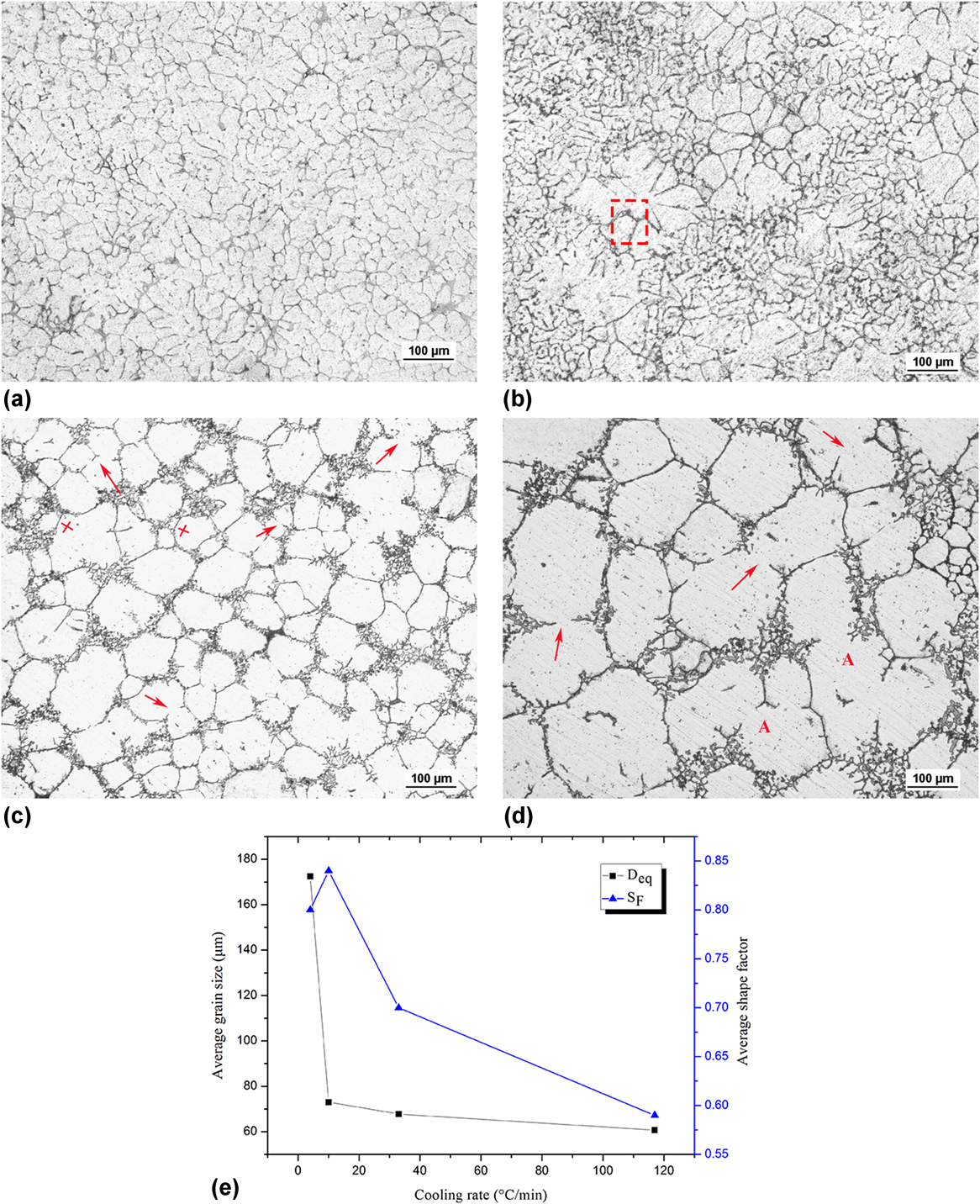
Figures 2(a)–2(d) show the quenched microstructures of the semisolid Al2O3np/Al7075 composite slurry treated by applying an SSUV of 1 kW from 700 °C to 620 °C at various cooling rates. In this experiment, different cooling rates were obtained by controlling the temperature of the slurry holder around. For a given temperature range, different cooling rates means different ultrasonic vibration times. For higher cooling rate (117 °C/min), the semisolid microstructure consists of liquid matrix and fine rosette-like primary α-Al grains [Fig. 2(a)]. When the cooling rate was 33 °C/min, a few coarse rosette-like grains and nearly globular grains were present in the semisolid slurry, and fragmented dendrite arms could be found [as indicated with red box in Fig. 2(b)]. When the cooling rate was decreased to 10 °C/min, the primary α-Al grains became more round and the liquid phases were uniformly distributed along the grain boundaries [Fig. 2(c)]. Further decreasing the cooling rate to 4 °C/min, the grains coarsened obviously [Fig. 2(d)]. Figure 2(e) depicts the effect of the cooling rate on the average size and shape factor of primary α-Al grains. It can be found from Fig. 2(e) that the good semisolid slurry with an average size of 73 μm and a shape factor of 0.84 could be obtained by applying SSUV under the cooling rate of 10 °C/min, and further increasing the cooling rate led to decrease in average size and shape factor of the primary α-Al grains. When the cooling rate was 117 °C/min, the average size of grains was 60.75 μm, but its shape factor was only 0.59.
Microstructure evolution of the semisolid Al2O3np/7075 composite slurry prepared by applying an SSUV of 1 kW from 700 to 620 °C with various cooling rates: (a) 117 °C/min, (b) 33 °C/min, (c) 10 °C/min and (d) 4 °C/min, and (e) average grain size and shape factor versus cooling rate in the temperature range.

A higher cooling rate means a shorter ultrasonic vibration time, which influences the growth of primary α-Al grains. When the cooling rate is high, the ultrasonic vibration time carried out on the semisolid Al2O3np/Al7075 composite slurry reduces so that the grains can grow freely. On the other hand, the shorter ultrasonic vibration time is not enough to distribute fragmented dendrite arms into the liquid matrix uniformly [Fig. 2(b)]. The presence of the fine globular grains, as shown in Fig. 2(c), can be mainly attributed to grain boundary wetting and SSUV. If the double solid–liquid interface energy (2γSL) becomes less than the summation of the grain boundary surface energy at the roots of dendrite arms (γgb) and the component of impulse force parallel to the γgb direction, liquid penetrates the grain boundary until dendrite arms are detached and then the grain boundaries of solid grains are completely wetted.Reference Doherty, Lee and Feest19 To minimize the solid grain/liquid interface energy, the primary α-Al grains become more round. In addition, under acoustic streaming, the solute and temperature distributions tend to uniformity ahead of solidification, accordingly hindering preferred growth of the primary α-Al grains, contributing to growth of globular grains. Thus, completely wetted grain boundary and uniformity depend on the using of low cooling rate.
Lower cooling rate also causes the primary α-Al grain coarsening. Coalescence phenomena were found in the semisolid microstructure [as indicated with the red arrow in Figs. 2(c) and 2(d)]. This may be because two grains share a common crystallographic orientation by grain rotating to obtain a low energy of grain boundary, when the liquid films present between the grains are relatively narrow.Reference Chaim20 In addition, Ostwald ripening also occurred in the semisolid microstructure with large grains growing at the expense of smaller ones [marked as ‘×’ in Fig. 2(c)]. When the cooling rate was further decreased, most of the coarse grains were observed in the microstructure [marked as ‘A’ in Fig. 2(d)]. Given grain shape, there are likely to have resulted from coalescence.
C. Effect of the ultrasonic vibration temperature range
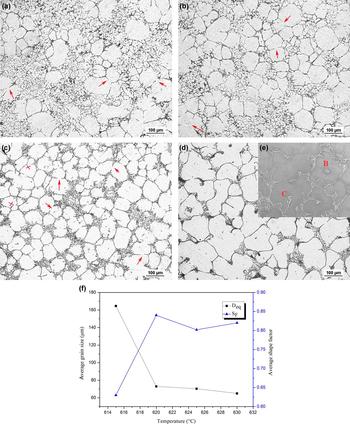
Figures 3(a)–3(e) show the microstructure evolution in the semisolid state for the Al2O3np/Al7075 composite treated by applying SSUV of 1 kW in different temperature ranges at the cooling rate of 10 °C/min. To avoid re-aggregation of the dispersed Al2O3np, the starting temperature of SSUV was selected at 700 °C. And the temperature range of SSUV is from 700 to 630 °C, from 700 to 625 °C, from 700 to 620 °C, or from 700 to 615 °C. Figure 3(f) depicts the effect of the SSUV temperature range on the average size and shape factor of primary α-Al grains. It can be seen from Fig. 3 that the solid fraction increases with the reduction of the ending temperature of SSUV. In addition, it is also clear that all the primary α-Al grains are relatively small in the semisolid microstructure treated by SSUV in the temperature ranges of 700–630 °C, 700–625 °C, and 700–620 °C (65–73 μm) and its shape factors are above 0.8 [Figs. 3(a)–3(c), and 3(f)]. When the ending temperature of SSUV was decreased to 615 °C, the grains became coarse (164.6 μm) and obviously irregular (0.63), which would have an adverse influence on the thixotropic behavior and the final mechanical properties [Figs. 3(d)–3(f)].
Microstructure evolution of the semisolid Al2O3np/7075 composite slurry prepared by applying an SSUV of 1 kW in different SSUV temperature ranges at the cooling rate of 10 °C/min: (a) 700–630 °C, (b) 700–625 °C, (c) 700–620 °C, and (d and e) 700–615 °C, and (f) average grain size and shape factor versus ending temperature of SSUV at the cooling rate.

The lower the ending temperature of SSUV is, the more the solid fraction is in the semisolid slurry, thereby weakening the effect of SSUV on the microstructure. In Figs. 3(a)–3(c), the average sizes and shape factors of primary α-Al grains in the three semisolid slurries are nearly the same, and the morphology of the grains becomes fine globular shape. The formation of globular grains can be mainly attributed to grain boundary wetting and SSUV. Higher ending temperature of SSUV indicates that there are more liquid fractions in the microstructure, contributing to grain boundary wetting of solid grains and giving full play to the SSUV effect. Meanwhile, it is noted that agglomerates of fine globular grains can be observed in Fig. 3(a). This is mainly related to shorter ultrasonic vibration time resulting from the selection of higher ending temperature of SSUV. The grains, thus, could not be dispersed fully. The higher solid fraction makes the intensity of forced convections induced by SSUV in the semisolid slurry weaker, so it is difficult to obtain the solute concentration and temperature uniformities in the residual liquid if the ending temperature of SSUV is much lower than the liquidus, accordingly causing the occurrence of the irregular grains resulting from preferred orientation growth. Grain coalescence and Ostwald ripening were also found in the microstructure.
Figure 3(e) shows the SEM micrograph of the semisolid slurry treated by applying SSUV from 700 to 615 °C at the cooling rate of 10 °C/min. Large pools of liquid were found in the coarse irregular grains [marked as ‘B’ and ‘C’ in Fig. 3(e)]. They may originate from melting of eutectic phases in the grains, which are caused by chemical segregation.Reference Bolouri, Shahmiri and Cheshemeh21 In addition, during spheroidization of rosette-like grains, the liquid may be wrapped in grains to become liquid pools when the migration velocity of liquid phases is less than that of spheroidization [marked as ‘C’ in Fig. 3(e)].Reference Manson-Whitton, Stone, Jones, Grant and Cantor22 The presence of intragranular liquid pools makes the actual liquid fraction become less compared to that predicted from the DSC curve. Meanwhile, when the ending temperature of SSUV is lower, the semisolid microstructure contains relatively low liquid phases. Thus, in the semisolid slurry, the liquid films present between the grains are narrow and then it is difficult to carry out successful thixoforming under this condition.
D. Effect of ultrasonic power
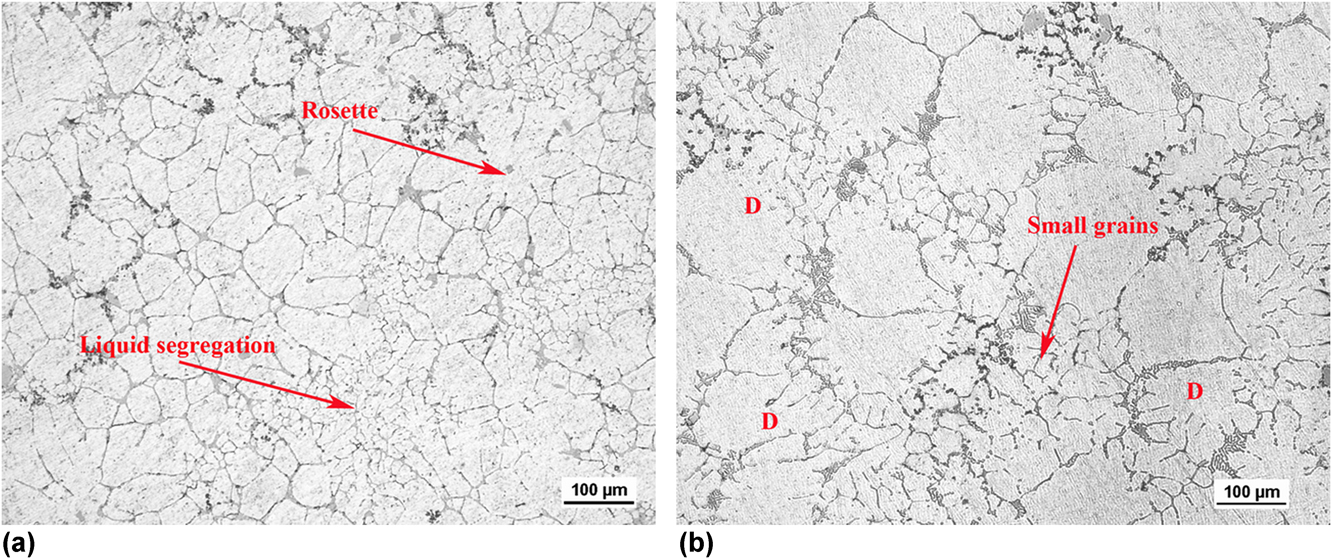
Figure 4 shows the semisolid microstructures prepared by applying SSUV with different ultrasonic powers from 700 to 620 °C at the cooling rate of 10 °C/min. For comparison, the ultrasonic powers of 500 W and 1.5 kW were carried out, respectively. It can be seen from Fig. 4(a) that aggregated nearly globular grains and liquid segregation are present in the microstructure because the forced convections caused by SSUV with low ultrasonic power are not enough to make the semisolid composite slurry uniform. Fine globular grains, large grains with a dendrite growth feature, and gas cavities can be observed in Fig. 4(b). When the ultrasonic power was high (1.5 kW), there were strong acoustic streaming and impulse force in the slurry. This contributes to fragmenting of dendrite arms and uniformly dispersing of solid grains in the residual liquid, which indicates that fine globular grains can be achieved in a short period of time. Nevertheless, it is difficult to control the processing because the time is too short. Meanwhile, SSUV with high ultrasonic power also triggers adverse effects. The high temperature induced by cavitation in the local zone causes remelting of the fine globular primary α-Al grains which makes large grains grow further. The SSUV of high power generates strong turbulent flow, finally causing fluctuation of the slurry, indicating capture of extra gas in the semisolid slurry, as shown in Fig. 4(b). The temperature field and solute distribution, which are in the equilibrium state, become unstable after a prolonged period of SSUV with high power,Reference Schultz, Ferguson and Rohatgi23 indicating preferred growth of the primary α-Al grains (marked as ‘D’ in Fig. 4). Thus, the ultrasonic power could not be too low or too high, and the appropriate ultrasonic power in this study is 1 kW.
Microstructures of the semisolid Al2O3np/7075 composite slurry prepared by applying an SSUV of (a) 500 W and (b) 1.5 kW, respectively, from 700 to 620 °C at the cooling rate of 10 °C/min.

In summary, the good semisolid Al2O3np/Al7075 composite slurry with an average grain size of 73 μm and a shape factor of 0.84 can be obtained by applying an SSUV of 1 kW from 700 to 620 °C at the cooling rate of 10 °C/min.
Size and shape factor of primary α-Al grains have great influence on semisolid processingReference Bolouri, Shahmiri and Kang7,Reference Rokni, Zarei-Hanzaki, Abedi and Haghdadi8,Reference Dong, Cui, Le and Lu24–Reference Qin, Zhao, Cong, Zhou and Xu27 and final mechanical properties of products. KirkwoodReference Kirkwood28 reported that the semisolid slurry with fine grains was suitable for processing and its samples possessed improved mechanical properties over those with coarse microstructure. During semisolid forming processes, samples with different grain sizes and shape factors present different semisolid behaviors. The shape factor of primary α-Al grains, however, has a large influence than grain size in semisolid behavior of the material.Reference Ashouri, Nili-Ahmadabadi, Moradi and Iranpour29 It is generally reported that if the shape factor is less than 0.5, the semisolid formability of materials is decreased.Reference Jiang, Wang and Atkinson30 If the grains are not sufficiently round, the grains interfere with each other when sheared, leading to a disappearance of thixotropic behavior.Reference Ji, Fan and Bevis31 Thus, the semisolid microstructures in the experimental conditions of this study (D eq = 73, S F = 0.84) is suitable for thixoforming compared to those obtained via the conventional process.
E. Second phases
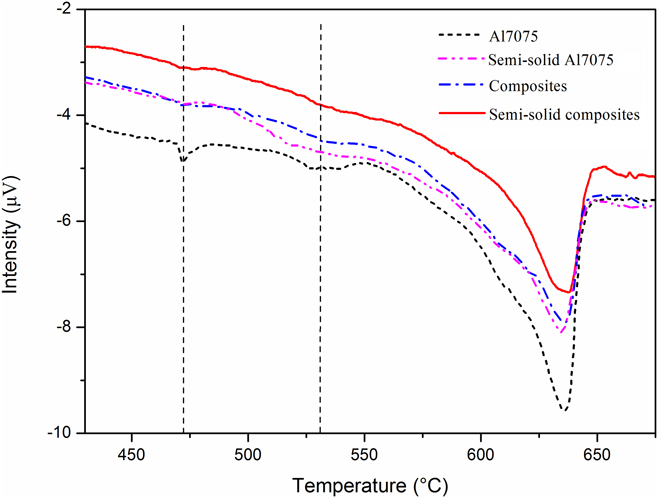
Figure 5 shows DTA curves of the Al7075 alloy and Al2O3np/Al7075 composites in different conditions with a heating rate of 10 °C/min. For the as-cast Al7075 alloy, it can be seen that two endothermic peaks are located at about 471 and 530 °C, which was due to the melting of multicomponent eutectic phases and binary precipitates, as shown by the dotted line in Fig. 5. The eutectic phases were first melted due to their lower melting point. However, for the semisolid Al7075 alloy, there are no obvious endothermic peaks induced by the eutectic melting. This may be attributed to dissolving of many alloying elements into the solid grains. The endothermic peaks of second phases cannot be clearly observed on the DTA curve of the as-cast composites, suggesting that the addition of Al2O3np may have affected the diffusion behavior of alloying elements in the melts and then lead to the change in the number and type of precipitates, for which the reason is not completely clear and further investigation is needed. Nevertheless, there are less obvious endothermic peaks for the semisolid composites compared to the as-cast composites. The reduction of coarse and continuously distributed eutectic phases along the grain boundaries contributes to achieving the composites with high performance. The changes in DTA curves have been attributed to the chemical homogeneity induced by applying SSUV in the semisolid temperature range. The occurrence of an exothermic peak at about 664 °C on the DTA curve of the semisolid composites may result from the interface reaction between Al2O3np and liquid Al.
DTA curves (10 °C/min) of different materials.

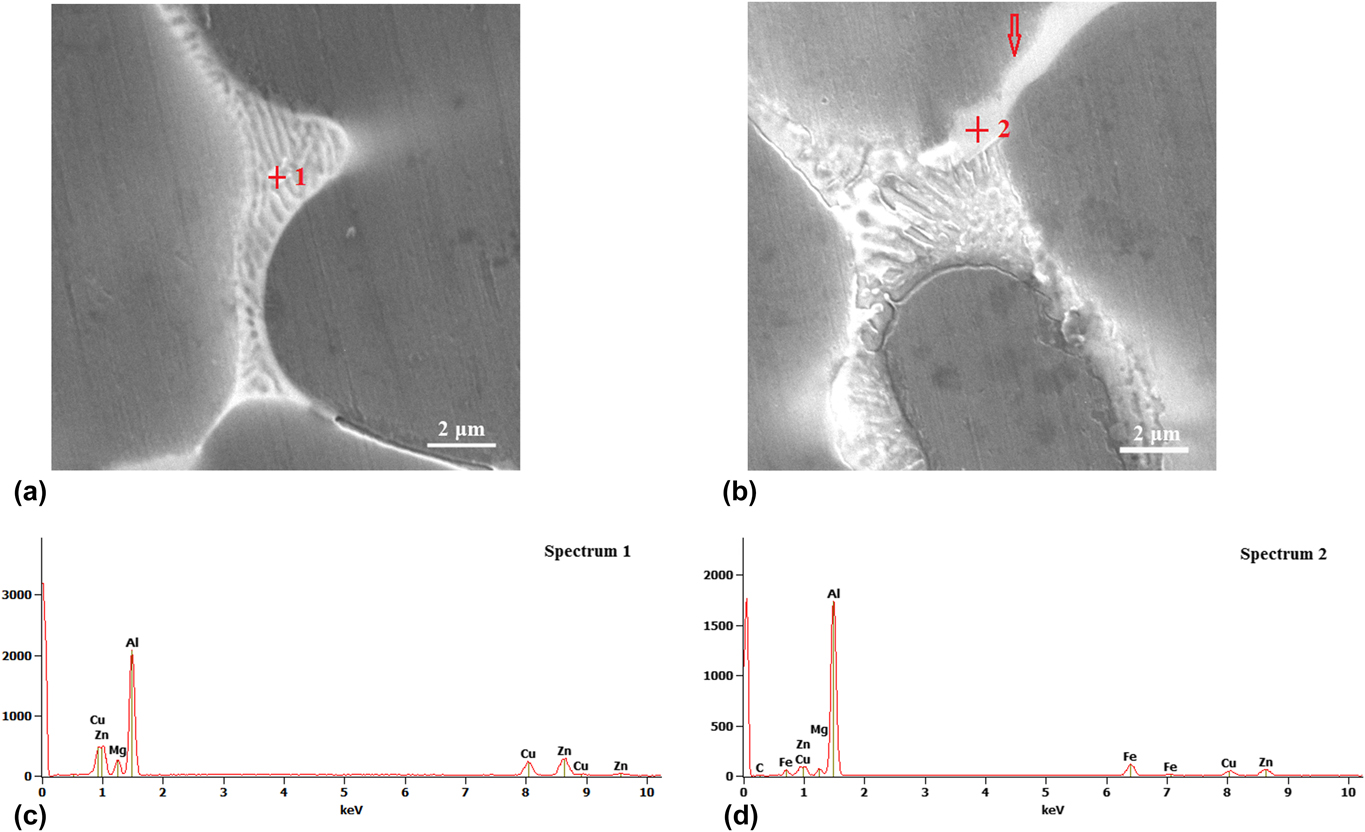
Figure 6 shows SEM images of the microstructure in the as-cast Al7075 alloy and EDS results of principal phases in the alloy. As indicated in Figs. 6(a) and 6(b), it can be seen that there are most of coarse Chinese script-type eutectic phases continuously distributed along the grain boundaries. The EDS result of the eutectic phase (69.30 at.% Al, 9.19 at.% Zn, 15.28 at.% Mg, 6.23 at.% Cu) is shown in Fig. 6(c). The result indicates that Cu and Al contents are higher than the average level of chemical composition in the Al7075 alloy. It is obvious that MgZn2 dissolved the Cu and Al elements and formed the Sigma-Mg(Zn, Cu, Al)2 phase.Reference Fan, Jiang, Meng and Zhong32 Meanwhile, square-like phases were found in the eutectic structure [indicated with the point 2 in Fig. 6(b)]. The EDS result (79.27 at.% Al, 3.86 at.% Zn, 3.01 at.% Mg, 7.54 at.% Cu, 4.18 at.% Fe, 2.13 at.% C) is shown in Fig. 6(d), which is close to the stoichiometric Al7Cu2Fe phase in composition. The results are in accordance with a study by Fan et al.Reference Fan, Jiang, Meng and Zhong32 In addition, low melting point T-Al2Mg3Zn3 phases appeared between the Chinese script-type eutectic phases, as arrowed in Fig. 6(b) (70.99 at.% Al, 11.45 at.% Zn, 13.89 at.% Mg, 3.66 at.% Cu).
(a and b) SEM images of the primary eutectic structure and coarse phase in as-cast Al7075 and (c and d) EDS results of point 1 and 2.

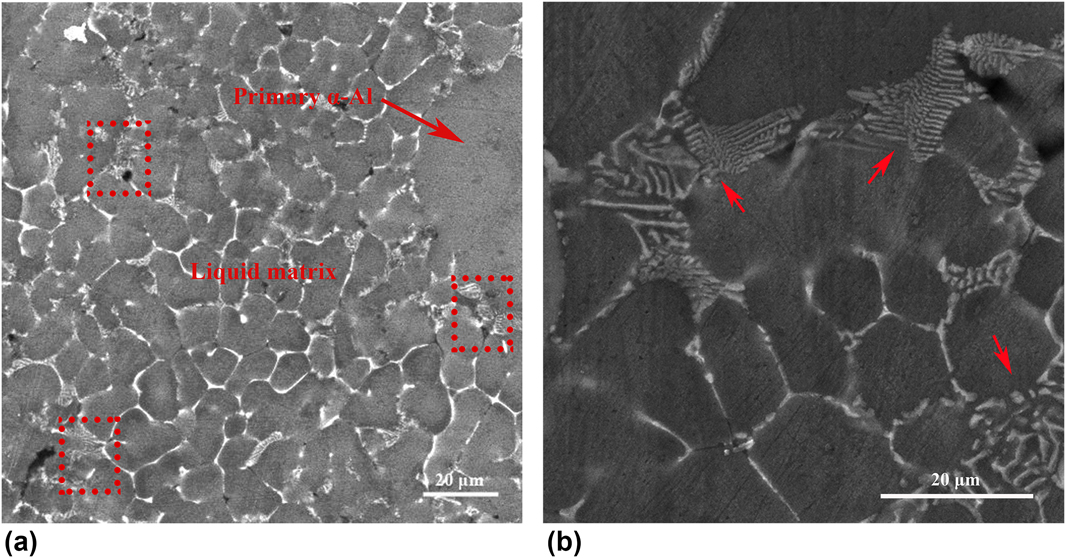
Figure 7 shows SEM images of the semisolid composite slurry treated by applying an SSUV of 1 kW from 700 to 630 °C at the cooling rate of 10 °C/min. It is noted that there are a mass of coarse second phases distributing at the primary α-Al grain/liquid interface [as indicated with red box in Fig. 7(a)]. From high magnification image of a red box, it can be found that the morphology of the coarse second phases is fishbone-like shape. According to the EDS result (93.36 at.% Al, 3.74 at.% Fe, 2.90 at.% Zn), the fishbone-like second phase is Fe-rich phase (Al13Fe4). The presence of the phases will be detrimental to final mechanical properties of materials. When the temperature was 630 °C, SSUV could be effectively applied due to higher liquid fraction existing in the semisolid slurry. Higher ending temperature of SSUV, however, indicates the decrease in ultrasonic vibration time so that alloying elements accumulated at the solid–liquid interface during solidification are uniformly distributed throughout the liquid Al. According to Du et al.Reference Du, Chang, Huang, Gong, Jin, Xu, Yuan, Liu, He and Xie33 and the Arrhenius equation, the diffusion coefficients of Zn, Mg, Cu, and Fe elements in liquid Al are 2.65 × 10⁻⁹ m2/s, 7.13 × 10⁻⁹ m2/s, 4.30 × 10⁻⁹ m2/s, and 2.20 × 10⁻⁹ m2/s, respectively. It clearly shows that the Fe element has the slowest rate of diffusion and Zn element comes second, indicating that Fe and Zn elements are aggregated at the solid–liquid interface, in accordance with the EDS results. This is in favor of formation of fishbone-like Al13Fe4 phases.
(a) SEM image of the semi-solid Al2O3np/7075 composite slurry prepared by applying an SSUV of 1 kW from 700 to 630 °C at the cooling rate of 10 °C/min and (b) a high magnification SEM image of (a).

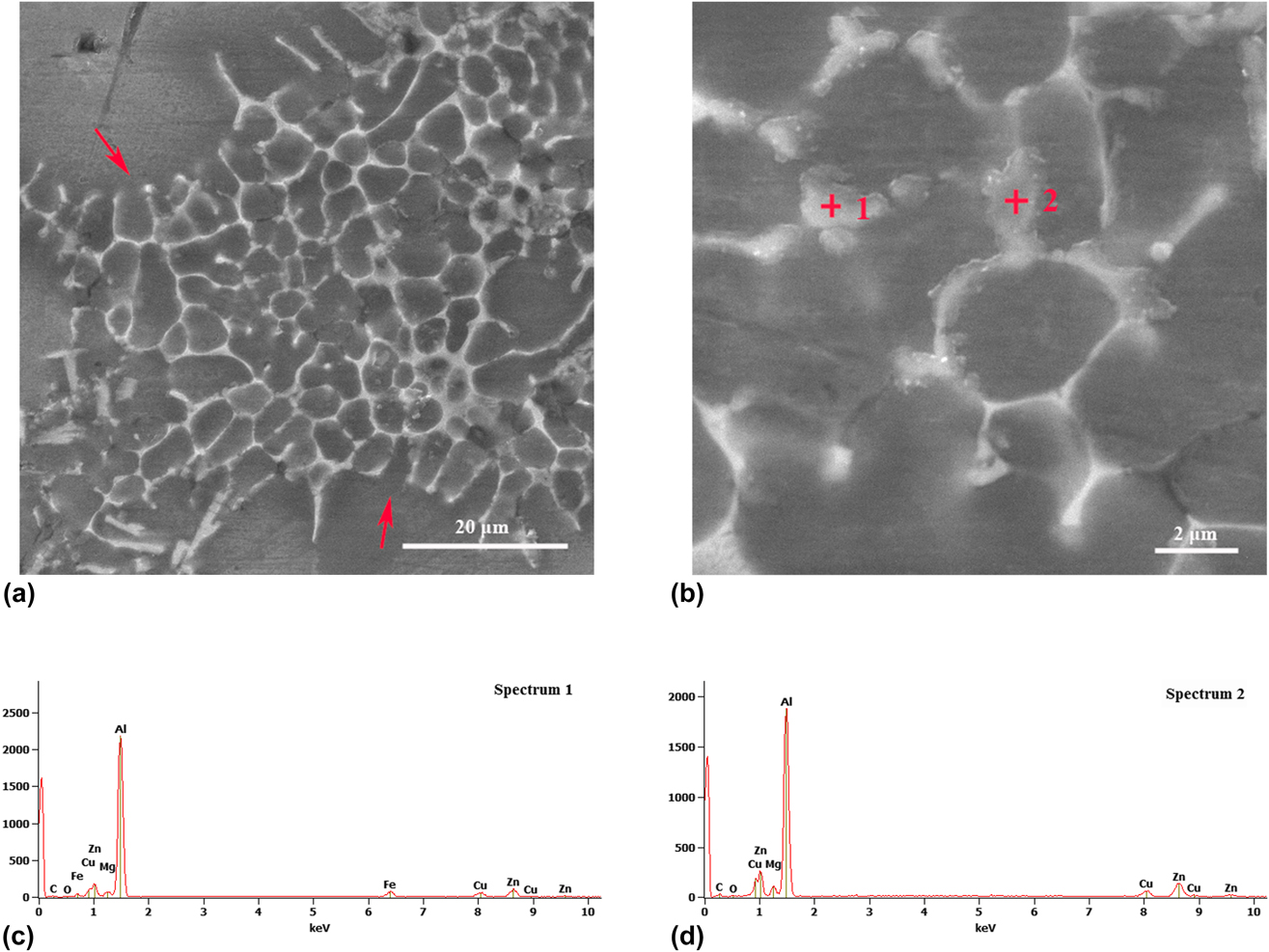
Figure 8 shows SEM images and EDS results of semisolid composite slurry treated by applying an SSUV of 1 kW from 700 to 620 °C at the cooling rate of 10 °C/min. It can be observed from Fig. 8(a) that coarse eutectic phases do not appear either at the primary α-Al grain/liquid interface, or inside the liquid matrix, which suggests that SSUV has enough time for uniformly dispersing alloying elements into the liquid Al, finally avoiding the formation of coarse eutectic phases. Meanwhile, it can also be found that “small grains” in the liquid matrix are much smaller than those in Fig. 7, which further proves that appropriate ultrasonic treatment accelerated nucleation of the α-Al phase. It is of interest to note that the microstructure seems to consist of cellular interface, as arrowed in Fig. 8(a). The pushed particles disturbed the temperature and solute gradient ahead of solidification front, leading to growth velocity difference between the interfaces with and without the particles, and finally promoting the formation of a cellular interface.Reference Chen and Yan15,Reference Dong, Cui, Le and Lu24 The formation of the cellular structure may also be the consequence of solidification of the liquid on the surface of globular primary α-Al grains during quenching.Reference Birol6,Reference Qin, Zhao, Cong, Zhou and Xu27 It also can be seen from the high magnification image of the liquid matrix [Fig. 8(b)] that the phases with an average particle size of 1–2 μm are distributed uniformly and discontinuously along the grain boundaries of the “small grains”. The EDS results in Figs. 8(c) and 8(d) reveal that the granular phases distributed in the liquid matrix mainly consist of Fe-rich intermetallic, AlZnMgCu eutectic, and Al2O3 particles (at point 1: 68.96 at.% Al, 2.47 at.% Zn, 1.99 at.% Mg, 7.17 at.% Cu, 3.72 at.% Fe, 10.64 at.% O, 5.05 at.% C; at point 2: 68.63 at.% Al, 5.94 at.% Zn, 4.21 at.% Mg, 2.48 at.% Cu, 8.71 at.% O, 10.03 at.% C). The carbon element in the clay-graphite crucible might diffuse into the melts during fabrication. Under applied stress, the granular phases discontinuously distributed in the liquid matrix act as an obstacle to dislocation movement, leading to dislocation pileups and enhancing the mechanical properties of thixoformed products of the composites.
SEM–EDS images of the semisolid Al2O3np/7075 composite slurry prepared by applying an SSUV of 1 kW from 700 °C to 620 °C at the cooling rate of 10 °C/min: (a) SEM image of the composite, (b) high magnification image of a liquid matrix region, and (c and d) EDS result of point 1 to 2, respectively.

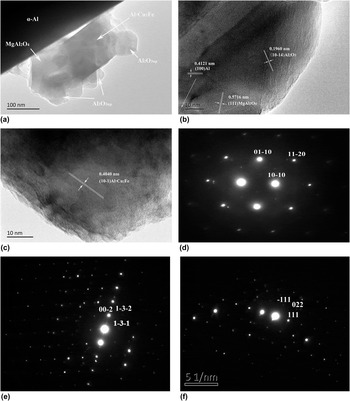
Figure 9 shows TEM images of the semisolid composite slurry treated by applying an SSUV of 1 kW form 700 to 620 °C at the cooling rate of 10 °C/min. Al2O3np and nanosized MgAl2O4 and Al7Cu2Fe phases were found to be uniformly distributed in the matrix, as shown in Fig. 9(a). It can be seen from the HRTEM image [Fig. 9(b)] that clean interfaces between the matrix and nanoparticles appear and there is no transition layer, indicating that no injurious interfacial reaction occurs. Al2O3np had been mixed with Mg powders before they were added into the melt. According to Ref. Reference Chen and Yan15, introducing Mg powders would result in the weakening and early rupturing of the Al2O3np surface, thus promoting wettability, or reacted with alumina directly, resulting in the formation of a spinel (MgAl2O4). SAD patterns in Figs. 9(d)–9(f) further verify the presence of Al2O3np and formation of nanosized MgAl2O4 and Al7Cu2Fe particles. According to the crystal structure of α-Al, Al2O3, MgAl2O4, and Al7Cu2Fe phases, it was confirmed that there are the well-defined crystallographic orientation relationships among the phases:  $\left( {200} \right){\left[ {010} \right]_{{\rm{Al}}}}//\left( {10\bar{1}4} \right){\left[ {40\bar{4}1} \right]_{{\rm{A}}{{\rm{l}}_2}{{\rm{O}}_3}}}$,
 $\left( {111} \right){\left[ {110} \right]_{{\rm{Al}}}}//\left( {111} \right){\left[ {110} \right]_{{\rm{MgA}}{{\rm{l}}_{\rm{2}}}{{\rm{O}}_{\rm{4}}}}}$, and
 $\left( {100} \right){\left[ {100} \right]_{{\rm{Al}}}}//\left( {10\bar{1}} \right){\left[ {10\bar{1}} \right]_{{\rm{A}}{{\rm{l}}_{\rm{7}}}{\rm{C}}{{\rm{u}}_{\rm{2}}}{\rm{Fe}}}}$, indicating that there is a good interfacial integrity between the particles and the matrix. The lattice misfits between Al2O3, MgAl2O4, and Al7Cu2Fe, and α-Al are listed in Table I. It is clear that the lattice misfits between the hard phases and α-Al are low. BramfittReference Bramfitt37 reported that the nucleation catalysts were effective in promoting nucleation when the lattice misfits between the lattice parameters of the substrate and the nucleating phase were less than 6%. The results as above, thus, justify the fact in which Al2O3, MgAl2O4, and Al7Cu2Fe particles can effectively act as potent sites for the nucleation of a-Al grains, finally improving the nucleation rate of primary α-Al grains.
TEM micrographs of the semisolid Al2O3np/7075 composite slurry prepared by applying an SSUV of 1 kW from 700 to 620 °C at the cooling rate of 10 °C/min: (a) bright field TEM image, (b) HRTEM image showing Al2O3np interface and MgAl2O4 formation at the interface of the Al7075 alloy with 1.5 wt% Al2O3np, (c) HRTEM image of the Al7Cu2Fe phase, and (d–f) SAD pattern of Al2O3, MgAl2O4, and Al7Cu2Fe phases, respectively.

Lattice misfits between Al2O3, MgAl2O4 and Al7Cu2Fe, and α-Al, where “S” stands for “substrate” and “N” for “nucleated phase”.

By comparing the microstructure of semisolid slurry with the DSC curve, it is found that the liquid fraction apparent in the micrographs is much less than the quantity derived from the DSC result. Again, it is found that the solid fraction in the semisolid slurry, treated by applying an SSUV of 1 kW from 700 to 620 °C at the cooling rate of 10 °C/min, is about 0.715 via image analysis software. Nucleation of primary α-Al grains was enhanced by means of the cavitation and acoustic streaming induced by SSUV, finally causing increased solid fraction. On the other hand, the enhanced heterogeneous nucleation in the Al7075 alloy due to the presence of Al2O3, MgAl2O4, and Al7Cu2Fe particles also helped in premature precipitation of primary α-Al grains and increasing of solid fraction.
For thixoforming, grain size and shape factor have to be balanced with liquid fraction. If the liquid fraction is high, the formability cannot be developed profitably because of the substantial amount of casting defects. If the liquid fraction is low, the deformation force increases and the slurry is not flow adequately to fill the die. Thus, applying an SSUV of 1 kW from 700 to 620 °C at the cooling rate of 10 °C/min can prepare a fine globular microstructure with high solid fraction [Figs. 2(c) and 3(c)], which is satisfactory for meeting the microstructural requirement of thixoforming. This microstructure is reasonably consistent with that successfully used to forge Al7075 alloy in the semisolid state.Reference Rokni, Zarei-Hanzaki, Abedi and Haghdadi8,Reference Wu, Lü, An and Nakae10
IV. CONCLUSIONS
(1) When applying SSUV, the primary α-Al grains became more globular and fine compared to those obtained by stir casting technique. Grain refinement is related to the occurrence of supercooling in the local zone and propagation of fragmented dendrite arms.
(2) The cooling rate, temperature range, and ultrasonic power have strong effect on growing and spheroidizing of primary α-Al grains. A good semisolid composite slurry with an average grain size of 73 μm, a shape factor of 0.84, and a solid fraction of 0.715 could be obtained using an SSUV of 1 kW from 700 to 620 °C at the cooling rate of 10 °C/min, which is suitable for thixoforming.
(3) SSUV affected largely the size and type of the second phase as well as growth and nucleation of primary α-Al grains. Nanosized second phases induced by SSUV promoted the premature precipitation of primary α-Al grains due to their well-defined crystallographic orientation relationships with α-Al, leading to increased solid fraction. Moreover, grain boundary wetting and SSUV resulted in uniformly distributed fine and globular grains in the liquid matrix.
ACKNOWLEDGMENTS
The authors express their gratitude to the National Science Foundation of China (51364035) and Science and Technology Program of Education Office of Jiangxi Province (GJJ171065) for financial support.