The global aging of the population has led to a significant increase in people affected by Alzheimer's disease (AD) and other dementias, especially in developed countries. In Italy, within a resident population of 60.656.000, 22% are over 65 years old, and more than 1 million individuals are affected by dementia – of which 600,000 have a diagnosis of AD (ISS, 2014), with an equivalent number of family caregivers playing a critical role in providing care to their family members.
Caring for a relative with dementia is recognized as a chronic stressful situation; in fact, caregivers face considerable demands and emotional strains during a long-time period (Vitaliano et al., Reference Vitaliano, Zhang and Scanlan2003). This chronic stressful situation leaves caregivers vulnerable to harmful psychological and health consequences, most frequently depression. Indeed, both cross-sectional and longitudinal studies have shown that prolonged burden and caregiver stress can raise the risk of developing a depressive symptomatology (O'Rourke and Tuokko, Reference O'Rourke and Tuokko2004; Epstein-Lubow et al., Reference Epstein-Lubow, Davis, Miller and Tremont2008). Different models about caregiving-related stress have been proposed (e.g. Pearlin, et al., Reference Pearlin, Mullan, Semple and Skaff1990; Vitaliano et al., Reference Vitaliano, Zhang and Scanlan2003) in which the caregivers’ personal resources, such as coping strategies and behavioral factors are hypothesized to mediate the influence of stressors on physical and mental health. Caregivers rarely are able to reduce the demands of their caring role, and the negative effects of caregiving on the caregivers’ health can interfere with their capacity to continue in their helpful role. Therefore, the identification of potentially modifiable subjective resources, which may help caregivers to cope more effectively with their demanding situation, is an important undertaking.
One of the most studied personal resources is self-efficacy, defined as people's beliefs about their capabilities to complete successfully specific tasks (Bandura, Reference Bandura1997). Considering caregivers, self-efficacy can be defined as the caregivers’ beliefs in their ability to successfully deal with the stressors and the challenges that characterize the caregiving process (Steffen et al., Reference Steffen, McKibbin, Zeiss, Gallagher-Thompson and Bandura2002). Caregivers with a high sense of self-efficacy are more likely to view the demands and tasks of caregiving as challenges to be mastered, while caregivers with low efficacy beliefs are more likely to see them as heavy distressing strains that exceed their capabilities, causing depressive thoughts, self-blaming, and self-rejection.
In a number of cross-sectional studies, different domains of caregiving self-efficacy have been shown to correlate negatively with depression, even after taking into account differences in the “objective” burden of caregiving (e.g. Zeiss et al., Reference Zeiss, Gallagher-Thompson, Lovett, Rose and McKibbin1999; Steffen et al., Reference Steffen, McKibbin, Zeiss, Gallagher-Thompson and Bandura2002; Gilliam and Steffen, Reference Gilliam and Steffen2006). Among the measures of caregiving self-efficacy, the Revised Scale for Caregiving Self-efficacy (Steffen et al., Reference Steffen, McKibbin, Zeiss, Gallagher-Thompson and Bandura2002) is the most widely used. This scale considers three domains, namely Self-Efficacy for Obtaining Respite (SE:OR), Self-Efficacy for Responding to Disruptive Behaviors (SE:DB), and Self-Efficacy for Controlling Upsetting Thoughts (SE:CT). In a number of studies, these domains have been reported to predict depressive symptoms in family caregivers of patients with dementia (e.g. Au et al., Reference Au2010; Cheng et al., Reference Cheng, Lam, Kwok, Ng and Fung2012).
More recently, the moderating role of the Revised Scale for Caregiving Self-efficacy domains has been investigated considering the relationship between caregiver burden and depressive symptoms. Romero-Moreno and colleagues (Romero-Moreno et al., Reference Romero-Moreno, Losada, Mausbach, Márquez-González, Patterson and López2011) reported that the effects of burden on depression, were higher in the family caregivers of patients with dementia who had lower levels of SE:CT compared to those caregivers who had higher levels of SE:CT. These results have been confirmed in a longitudinal study in which the authors found that higher scores in SE:CT were associated with reduced depression scores over time (Romero-Moreno et al., Reference Romero-Moreno, Márquez-González, Mausbach and Losada2012). Differently, Rabinowitz and colleagues (Rabinowitz et al., Reference Rabinowitz, Mausbach and Gallagher-Thompson2009), reported that only SE:DB significantly moderates the relationship between care-recipients’ memory and behavioral problems and the depressive symptomatology of their caregivers; this relationship was significant when SE:DB was low, while they did not find a significant moderation of SE:CT, nor of SE:OR.
The studies presented so far that analyzed the relationship between burden and depression suggest that caregiving self-efficacy domains play a moderating role. In other words, in presence of low levels of caregiving self-efficacy in one domain, the caregivers’ burden exerts a significant effect on their depression, whereas in presence of high levels of caregiving self-efficacy in another domain, caregivers seem to be protected from the consequences of stress on mental health. A further testable hypothesis is that the effect of caregiver burden on depressive symptoms is mediated by caregiving self-efficacy beliefs. Considering self-efficacy as moderator or mediator has different clinical implications. Establishing self-efficacy as a moderator helps in identifying who is more exposed and who is less exposed to health risks, such as depression. In this sense, the attention may be prompted toward caregivers with low levels of self-efficacy since these individuals seem to be more susceptible to the negative effects of burden on depression.
Mediational analyses, in contrast to moderation analyses, may help in understanding how and why the different caregiving self-efficacy domains act as protective factors on mental health. This may enable clinicians to acquire more knowledge of the particular paths through which perceived burden exerts an effect on depression and therefore to design more specific interventions, adding or removing certain intervention components to make the intervention either more efficacious or more cost-effective (Kraemer et al., 2002).
It is important to note, that the mediational hypothesis is not alternative to the moderation hypothesis, however, so far, it has received limited empirical support. In a recent study, Mausbach et al. (Reference Mausbach2012) tested cross-sectionally the effects of various mediators, including coping self-efficacy, and found a significant path between stress associated to caregiving, reduced sense of coping self-efficacy, and higher depressive symptoms. The authors also reported that both SE:CT and SE:DB serve as significant mediators of the stress-to-depression pathway when used in place of self-efficacy for using problem-focused coping. Despite this cross-sectional study, the long-term association between caregiver burden, caregiver self-efficacy, and depressive symptoms, remains still largely unexplored and various authors highlight the need of longitudinal studies (Rabinowitz et al., Reference Rabinowitz, Mausbach and Gallagher-Thompson2009; Romero-Moreno et al., Reference Romero-Moreno, Losada, Mausbach, Márquez-González, Patterson and López2011; Gallagher et al., Reference Gallagher2011) to evaluate whether different self-efficacy domains mediate the relationship between caregiving burden and depression.
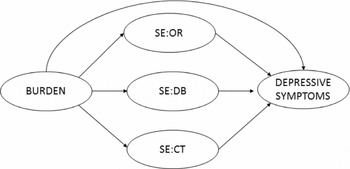
The present study aims to contribute to this issue testing the long-term relationship between caregiver burden and depressive symptoms through the mediation of different self-efficacy domains in an Italian caregiver sample. In testing the relationship between caregiver burden and depressive symptoms, we choose to simultaneously evaluate the specific contribution of each of the three domains of the self-efficacy scale developed by Steffen and coworkers (Reference Steffen, McKibbin, Zeiss, Gallagher-Thompson and Bandura2002): SE:OR; SE:DB; SE:CT. The hypothesized model, which includes the direct effect of caregiver burden on depressive symptoms (partial mediation model) is illustrated in Figure 1.
The hypothesized model.

Methods
Participants
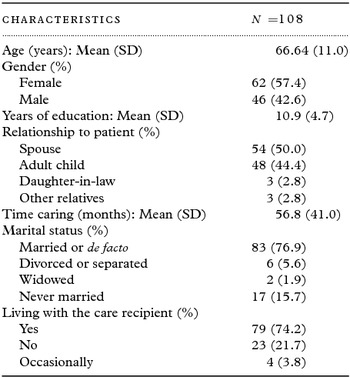
Participants were 170 caregivers of AD patients recruited through a variety of means, including contacts with general practitioners, medical and neurological clinics, senior service professionals, and Alzheimer family associations in the center of Italy. To be included in the study, caregivers had to meet the following criteria: (a) be at least 50 years old (similarly to the original study of Steffen et al., Reference Steffen, McKibbin, Zeiss, Gallagher-Thompson and Bandura2002); (b) be a primary informal caregiver of a family member with a physician confirmed diagnosis of dementia of Alzheimer's type; (c) dedicating more than 1 hour per day to caregiving tasks; (d) have been a caregiver for at least 6 months. The exclusion criteria included not being the primary caregiver, having a chronic or serious medical condition. Age, gender, education, relationship with the care-recipient, duration of care and other sociodemographic characteristics of the sample collected during the first assessment are reported in Table 1.
Sociodemographic characteristics of caregivers

Procedures
A three-wave design was used, with initial assessment and follow-ups three months later and one year later. After making an appointment with each caregiver, trained interviewers administered the questionnaires to each respondent as face-to-face interviews to ensure that respondents understood all the questions proposed. The interview took place in the caregivers’ home or in a clinic setting or at the Alzheimer family associations’ offices and took approximately 40 minutes to be completed. After the explanation of the aims of the study, participants signed an informed consent form to declare their voluntary agreement to participate in the study and to be contacted for the second and third interviews. After three months, and after one year following the first assessment, participants were contacted again and asked to participate in the second and in the third interview, respectively. The study was approved by the Ethical Board of the Department of Psychology of Sapienza University.
Measures
Caregiver burden
Caregiver burden was measured in the first assessment (T1), using the Italian version of the Screen for Caregiver Burden (SCB; Vitaliano et al., Reference Vitaliano, Russo, Young, Becker and Maiuro1991), a 25-item instrument created specifically for caregivers of care-recipients with AD. This measure was constructed to assess the objective prevalence of the care-recipient distressing behaviors and the level of subjective distress caregivers experience in response to the care-recipient behaviors. Caregivers were asked to report whether the statements were true, and to rate the distress associated with each statement with responses ranging from 1 (no occurrence or occurrence but no distress) to 4 (severe distress). The SCB summary score ranges from 25 to 100 with higher scores indicating higher levels of caregiver distress. Examples of items are “My relative got lost in the grocery store” or “My relative struck me on various occasions.” In the present study, the scale alpha coefficient was of 0.87.
Caregiver self-efficacy
After three months from the beginning of the study, during the second assessment (T2), caregiver self-efficacy was evaluated using the Revised Scale for Caregiving Self-efficacy (Steffen et al., Reference Steffen, McKibbin, Zeiss, Gallagher-Thompson and Bandura2002). More specifically, the Italian version of the scale was used (Grano et al., Reference Grano, Lucidi, Crisci and Violani2013). This is a 15-item questionnaire which assesses caregiver's beliefs about his or her abilities to successfully perform activities related to caregiving for a patient with AD or other dementias. The measure consists of three subscales with five items each: (1) Obtaining Respite (SE-OR), that measures caregiver's confidence to ask for assistance (e.g. “How confident are you that you can ask a friend/family member to stay with the care recipient for a day in which you feel the need for a break?”); (2) Responding to Disruptive Behaviors (SE-DB), that assesses the caregiver's SE for managing the care-recipient behaviors effectively (e.g. “When your family member asks you four times in the first hour after lunch when lunch is, how confident are you that you can answer him/her without raising your voice?”; and (3) Controlling Upsetting Thoughts (SE-CT), that evaluates caregiver's confidence to get rid of the negative thinking concerned with caregiving (e.g. “How confident are you that you can control thinking about unpleasant aspects of taking care of your family member?”). Caregivers were asked to rate their level of confidence on a scale ranging from 0% (I cannot do at all) to 100% (I certainly can do). In the present study, the alpha coefficients for the three subscales (SE-OR; SE-DB; SE-CT) were 0.86, 0.92, and 0.86, respectively.
Depressive symptoms
One year after the beginning of the study, in the third assessment (T3), depression symptoms were measured with the Italian version of the 30-item Geriatric Depression Scale (GDS; Yesavage et al., Reference Yesavage1983), a well-validated measure for assessing depressive symptomatology in the older adult population. Answers are reported on a yes/no scale; total score ranges from 0 to 30 where higher scores indicate more severe depression. An example item is: “Do you frequently feel like crying?” In the present study, the scale alpha coefficient was 0.86.
Statistical analyses
In order to examine whether participants in the first assessment differ or not from those who completed the second and the third assessment, one-way analyses of variance (ANOVAs) and χ 2 tests were used. Above considering perceived burden, participants were compared also on age, gender, years of education, relationship to patient, duration of care, marital status, and living arrangements.
We hypothesized that caregiver burden would be related to depression directly, and also indirectly by way of its relation to self-efficacy domains. We considered Caregiver Burden, SE-OR, SE-DB, SE-CT, and depression symptoms as latent variables. Therefore, we employed a latent variable approach and we relied upon multiple indicators for each construct of interest. For the caregiver burden and depression symptoms indicators, we used the principle of parceling to reduce the number of items and to arrive at a more parsimonious measurement model needed for testing our hypotheses. Item parceling consists in combining items into a smaller set of items in order to reduce the number of latent constructs and of parameters being estimated, resulting in more stable parameter estimates. Following this procedure, we created four caregiver burden scores by randomly grouping the items of the screen of caregiver burden and by averaging the item scores in each set. The same procedure was used to create the three scores of the GDS. Instead, for the self-efficacy subscales, considering the limited number of items which constitute each domain, all the five items of each subscale were used as measurement indicators of the respective latent variables SE:OR, SE:DB, and SE:CT.
We ran a confirmatory factor analysis to evaluate the construct validity of the measures and the factor correlations to support discriminant validity, followed by testing relations among the latent variables using a structural equation modeling (SEM) approach. SEM has the advantage of separating the common variance shared by a set of indicators (latent variable) from the error variance (measurement error variable) attributable to the measurement method, resulting in improved reliability. The model was estimated using Mplus, version 5.1. We evaluated the fit of the model using the Comparative Fit Index (CFI), the Tucker–Lewis Index (TLI), the χ 2 values, the Root Mean Square Error of Approximation, (RMSEA), and the Standardized Root Mean Square Residual.
Following recommended guidelines and cut-off values (Hu and Bentler, Reference Hu and Bentler1999; Muthén and Muthén, Reference Muthén and Muthén2007), values of the CFI and of the TLI above 0.90 were considered as indicative of adequate model fit, and values above 0.95 of good model fit (Hu and Bentler, Reference Hu and Bentler1999). Values lower than 0.08 and 0.06 for, respectively, the SRMR and RMSEA were considered indicative of good model fit (Hu and Bentler, Reference Hu and Bentler1999). Moreover, goodness of fit was evaluated using the χ 2/df ratio. This value should be between 1 and 3.
Results
Response rate and preliminary analyses
Of the initial sample of 170 caregivers who complete the first assessment interview (T1), 27 did not participated at the second assessment three months later (T2), and 35 did not completed the measure of depression after one year (T3), which left a final sample of 108 caregivers, resulting in a 63.5% participation rate in the entire study. Causes for not participating in the second and third assessment were: death of the care-recipient, death of the caregiver, institutionalization of the care-recipient or caregivers refusing to continue participating in the study.
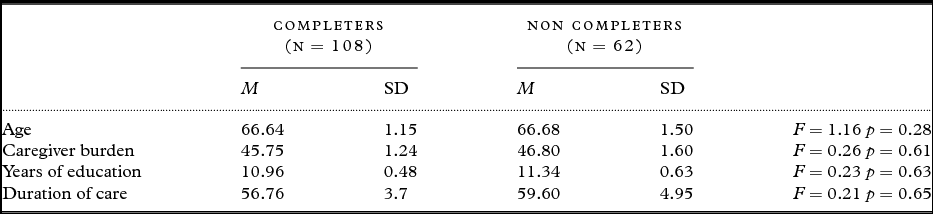
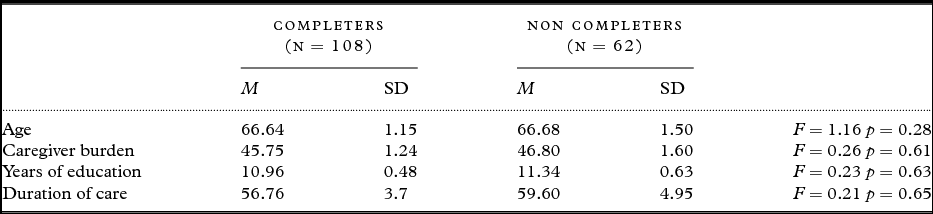
The analysis of the differences between those who participated only in the first assessment and those who completed the three waves of the study revealed no significant differences in the variables examined. More specifically, Anovas showed that means in caregiver burden, age, years of education, and duration of caregiving were not significantly different between the group who completed the three assessments waves and the 62 who did not. Descriptive statistics and results of these Anovas are reported in Table 2. In addition, χ 2 tests indicated that there were no significant differences for gender, marital status, relationship to patient, and living arrangements between the 108 caregivers who completed all three assessments and the 62 who did not.
Descriptive information for the caregivers who completed the three longitudinal assessments and those who did not
Measurement model
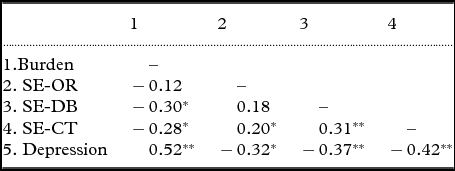
Before testing the full structural model, a measurement model was specified to assess reliability and validity of all model constructs. We, in particular, tested a measurement model which included the estimation of the factor loadings linking each indicator to its hypothesized latent construct and the estimation of the intercorrelations linking all the latent factors. Each scale proved sufficiently reliable, with coefficients ranging from 0.66 to 0.95. A significant χ 2 index was found (χ 2 = 300.05, df = 196), but evaluation of other fit indices indicated that the measurement model (CFI = 0.95, TFI = 0.94, RMSEA = 0.05, and SRMR = 0.06) adequately fit the data with respect to established criteria (Hu and Bentler, Reference Hu and Bentler1999). Table 3 reports the latent factor intercorrelations among the constructs considered in the model. As shown in the intercorrelation matrix, burden at T1 significantly correlates with depression at T3 (after one year). Burden at T1 negatively correlates with SE-DB and with SE-CT but not with SE-OR. The three self-efficacy scales are negatively and significantly correlated with Depression at T3.
Correlation matrix among caregiver burden, caregiving self-efficacy, and depressive symptoms
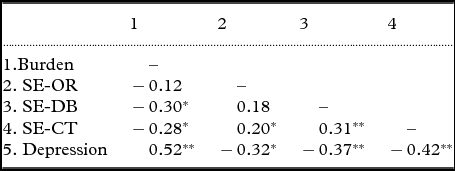
Note: *< 0.05; **p < 0.001.
SE-OR: self-efficacy for obtaining respite.
SE-DB: self-efficacy for responding to disruptive behaviors.
SE-CT: self-efficacy for controlling upsetting thoughts.
Full causal model
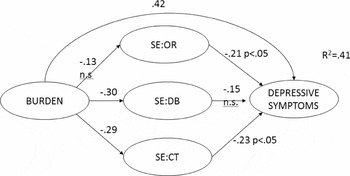
The most important analysis is the test of the full structural model illustrated in Figure 1 which explores the paths among caregiver burden, the three self-efficacy scales, and depressive symptoms. Considering this model, despite a significant χ 2 (χ 2 = 304.79, df = 198, p < 0.001), the other fit indices met the recommended cut-off criteria for adequate model fit [CFI = 0.95, TLI = 0.94, RMSEA= 0.056 (0.043–0.069), and SRMR = 0.07] (Hu and Bentler, Reference Hu and Bentler1999).
As can be observed in the Figure 2, burden at T1 significantly influences depression at T3 (after one year). Burden at T1 negatively correlates with SE:DB and with SE:CT but not with SE:OR. SE:OR and SE:CT negatively and significantly predict Depression at T3. These data indicate that the relationship between Burden at T1 and Depressive symptoms at T3, is partially mediated by SE:CT.
Latent relations among the constructs considered.

Discussion
Stemming from caregiving-related stress models (e.g. Pearlin et al., Reference Pearlin, Mullan, Semple and Skaff1990; Vitaliano et al., Reference Vitaliano, Zhang and Scanlan2003), the goal of the current study was to longitudinally and simultaneously evaluate the effects of caregiver burden on depression symptoms in family caregivers of patients with Alzheimer Disease, and to test whether three different self-efficacy domains, namely SE-OR, SE-DB, and SE-CT, would mediate this relationship, over a period of one year.
Extending previous literature (O'Rourke e Tuokko, Reference O'Rourke and Tuokko2004; Epstein-Lubow et al., Reference Epstein-Lubow, Davis, Miller and Tremont2008), the results of our longitudinal study support the existence of a direct and significant effect of perceived burden measured at T1 on depressive symptoms measured one year later, at T3.
Overall, the intercorrelations found between the latent factors show that caregiver burden measured at T1, is significantly and negatively correlated with two self-efficacy domains (SE:DB; SE:CT) measured three months later at T2, that caregiver burden significantly and positively correlates with depression symptoms measured one year later at T3, and that the three self-efficacy domains are negatively and significantly correlated with depression symptoms measured at T3. These results are in line with a number of previous studies (Steffen et al., Reference Steffen, McKibbin, Zeiss, Gallagher-Thompson and Bandura2002; Rabinowitz et al., Reference Rabinowitz, Mausbach and Gallagher-Thompson2009; Au et al., Reference Au2010; Romero-Moreno et al., Reference Romero-Moreno, Losada, Mausbach, Márquez-González, Patterson and López2011; Gallagher et al., Reference Gallagher2011; Mausbach et al., Reference Mausbach2012; Romero-Moreno et al., Reference Romero-Moreno, Márquez-González, Mausbach and Losada2012; Tang et al; Reference Tang, Jang, Lingler, Tamres and Erlen2015).
The main aim of our present study, was to test the mediational role of different self-efficacy domains. Our study findings indicate that self-efficacy partially mediates the relation between caregiver burden and depressive symptoms along a period of one year. However, it is important to note that the mediational effect is accounted by only one domain of self-efficacy, namely SE-CT. This finding highlights the importance of looking separately to different self-efficacy components, and confirms the specific mediational role of SE for Controlling upsetting thoughts in the stress-to-depressive symptoms pathway, reported in previous cross-sectional studies (e.g. Mausbach et al., Reference Mausbach2012) and provide additional evidence that, along a considerable length of time, the effects of caregiver burden on depressive symptoms can be explained by the caregivers’ efficacy beliefs in controlling upsetting thoughts related to the caregiving tasks. These results suggest that caregiver support programs aimed to enhance caregivers self-efficacy could focus more specifically on efficacy perceptions for controlling upsetting thoughts rather than considering the other self-efficacy components. In this way, they may better meet the need of carers.
Overall, these results are in line with Beck's classic cognitive model of depression which considers cognitive symptoms of depression as preceding the affective and mood ones. Evidence for the effectiveness of cognitive behavioral treatments for distress in family caregivers has been reported (Gallagher-Thompson and Coon, Reference Gallagher-Thompson and Coon2007).
Our study findings are also consistent with Bandura's view of efficacy beliefs as involved in the regulations of cognitions. In the caregiving context, previous studies have already shown the usefulness of treatments which increase self-efficacy beliefs in order to reduce caregiver stress (e.g. Tang and Chan, Reference Tang and Chan2015). Indeed, Tang and Chan (Reference Tang and Chan2015) in a review of psychosocial interventions on self-efficacy in caregivers of patients with dementia, reported that both individual and group-based psychosocial interventions were effective in enhancing self-efficacy beliefs.
Our findings indicating mediational role of SE:CT exerted in the stress-to-depression pathway, besides being of conceptual importance, have also practical implications. In fact, helping caregivers in enhancing their self-efficacy may help them in tackling their negative thoughts about their caregiving role, which in turn may lead to more effective emotion-regulation skills and behaviors, and to a better mental health. This ultimately, may influence the caregivers’ decision to persevere in their caregiving role.
Beyond our general hypotheses of mediation, also other considerations can be advanced. Although SE:OR and SE:DB do not exert a mediational effect in the stress to depression pathway, all the three self-efficacy domains are significantly and negatively correlated with depressive symptoms, in line with evidence from previous literature (Steffen et al., Reference Steffen, McKibbin, Zeiss, Gallagher-Thompson and Bandura2002; Au et al., Reference Au2010; Romero-Moreno et al., Reference Romero-Moreno, Losada, Mausbach, Márquez-González, Patterson and López2011; Cheng et al., Reference Cheng, Lam, Kwok, Ng and Fung2012). Overall, these results show that, in family caregivers of Alzheimer patients, being more effective in managing dysfunctional thoughts, and being more able to obtain respite asking to family members or friends to stay with the care-recipient, involves protective effects against depressive symptoms, nine months later.
Moreover, while the correlation between Caregiver burden and SE:OR is not significant, the correlation between Caregiver burden and SE:DB it is, suggesting that this last variable might have been a possible mediator. However, from the intercorrelations: SE:DB is also moderately correlated with SE:CT. For this reason, the mediation of SE:DB might be redundant with that of SE:CT. In fact, it is possible that if SE:CT and SE:DB had been tested independently, SE:DB would also have contributed to the mediation. On the other hand, considering the simultaneous contribution of the three self-efficacy variables allowed us to highlight which self-efficacy domain contributed more in explaining the relationship between caregiver burden and depressive symptoms. In line with previous literature (Rabinowitz et al., Reference Rabinowitz, Mausbach and Gallagher-Thompson2009; Romero-Moreno, Reference Romero-Moreno, Losada, Mausbach, Márquez-González, Patterson and López2011; Cheng et al., Reference Cheng, Lam, Kwok, Ng and Fung2012; Mausbach et al., Reference Mausbach2012; Romero-Moreno, Reference Romero-Moreno, Márquez-González, Mausbach and Losada2012), we can state that self-efficacy beliefs for controlling upsetting thoughts exerts a major role in the stress to depression model. Other explanations however are also possible. As previously noticed by other researchers (Romero-Moreno et al., Reference Romero-Moreno, Losada, Mausbach, Márquez-González, Patterson and López2011), it is also plausible that the mediating variables considered herein may play a different role in different points of the dementia caregiving process.
Importantly, it has to be noted that our findings reveal a partial mediation of SE:CT, indicating that SE:CT does not fully explain the relationship between caregiver burden and depressive symptoms. Other variables not considered herein (coping strategies, spirituality, social support, resilience, etc.) may potentially contribute in explaining the observed findings.
Also, future studies in which the constructs examined are manipulated would be needed in order to exclude alternative explanations and to prove causal ordering of the observed relations.
Even though the present study has a number of strengths, including its longitudinally feature with the inclusion of data from three different assessment moments and the simultaneous test of different self-efficacy domains, some limits need to be acknowledged.
First, we do not have a measure of the care-recipient memory and behavioral problems. Although this represent a limitation of the present study, other authors had reported that the effect of care-recipient behavioral and psychological symptoms (of dementia) on caregiver depressive symptoms are entirely mediated by the caregiver perceived burden (Cheng et al., Reference Cheng, Lam, Kwok, Ng and Fung2012).
Second, we only consider caregivers of patients with AD, thus the findings of the present study are not generalizable to family caregivers of patients with other illness (cancer, diabetes, frail older adults, etc.) or with other forms of dementia. Indeed, caregivers of patients with dementia seem to be more adversely affected by their role than cancer caregivers (Clipp and George, Reference Clipp and George1993), and lower levels of burden have been reported for AD caregivers when compared with caregivers of patients with Frontotemporal Dementia (Mioshi et al., Reference Mioshi2013).
Further, some concerns can be raised regarding the nature of the sample. Caregivers in the present study volunteered to participate and were recruited from different sites in the center of Italy, making it hard to generalize these results to the larger population.
In spite of these limitations, the results of the present study further sustain the specificity and multidimensionality of the caregiving self-efficacy construct indicating that SE:CT may be the most important efficacy belief for caregivers. Targeting SE for controlling upsetting thoughts in caregiver psychoeducation and counseling may be important not only in terms of preventing depressive symptoms, but also considering that SE:CT has been found to influence caregivers health behaviors, the use of psychotropic medication and their perceived physical health (Rabinowitz et al., Reference Rabinowitz, Mausbach, Thompson and Gallagher-Thompson2007; Au et al., Reference Au2010; George and Steffen, Reference George and Steffen2014). Moreover, modifying self-efficacy for controlling negative thinking about the caregiving role can result, through the prevention of caregiver depressive symptoms, in other important health and social outcomes both for the caregivers and the care-recipients. In fact, depressive symptomatology has been repeatedly associated with negative health outcomes, specifically with caregivers’ cardio-vascular diseases (Vitaliano et al., Reference Vitaliano, Zhang and Scanlan2003), as well as with the caregiver desire to institutionalize their care-recipient (Arai et al., Reference Arai, Sugiura, Washio, Miura and Kudo2001).
Conflict of interest
None.
Description of authors’ roles
C. Grano and F. Lucidi designed the study and wrote the paper. C. Grano supervised the data collection and carried out the statistical analyses. F. Lucidi worked on the study implementation. C. Violani assisted with writing the paper.
Acknowledgments
We are grateful to all the family caregivers who participated in the study.