Understanding parental perceptions of roles and responsibilities regarding their child with complex cardiac needs has potential to help care teams better support parents during medical encounters.Reference Feudtner, Walter and Faerber 1 – Reference October, Fisher, Feudtner and Hinds 3 Specifically, understanding how parents of children with complex cardiac conditions strive to parent well even in the perioperative timeframe may allow cardiac care teams to foster parental sense of role cohesion and familial resiliency. The concept of “being a good parent” has been recognised as a goal of parents in critical care settings and has been thoughtfully defined by parents of children with non-cardiac diagnoses.Reference Hinds, Oakes and Hicks 2 Children’s hospitals and pediatric care settings have been recognised as having a heavy maternal focus on opportunity to improve upon paternal inclusion.Reference Ware and Raval 4 , Reference Nicholas, Beaune, Barrera, Blumberg and Belletrutti 5
Paternal experiences in receiving a child’s diagnosis, prognosis, and in interacting with their ill child have been found to be uniquely different from maternal experiences.Reference Nicholas, Beaune, Barrera, Blumberg and Belletrutti 5 – Reference Schneider, Steele, Cadell and Hemsworth 9 Parental anxiety and stress in the first 24 hours after a surgery has gender predictors.Reference Scrimin, Haynes, Altoe, Bornstein and Axia 10 Mothers and fathers are recognised to experience the stress of CHD differently, with fathers in the United States reporting the stress of “not being able to protect their child from congenital heart disease and the associated surgeries/pain and from difficulties balancing employment with support for their partner and care of their congenital heart disease child in the hospital.”Reference Sood, Karpyn and Demianczyk 11 Fathers have been less likely to report the use of hospital-based support resources or CHD peer support as compared to mothers.Reference Sood, Karpyn and Demianczyk 11 A phenomenological study of fathers of neonates with CHD needing surgery in South Korea revealed significant paternal anxiety surrounding lack of ability to personally “fix” the child’s heart condition.Reference Kim and Cha 12 The fathers of children with congenital cardiac conditions depict high stress levels associated with balancing financial provider versus direct caregiver roles.Reference Woolf-King, Arnold, Weiss and Teitel 13 A qualitative study of parents of children with CHDs in Spain revealed paternal need for psychosocial support due to role distress in trying to provide for their family, while also feeling the need to be physically present for their hospitalised child.Reference Paramo-Rodriguez, Mas Pons, Cavero-Carbonell, Martos-Jimenez, Zurriaga and Barona Vilar 14 Prior investigation into parental stress response following cardiac surgery for an infant revealed that close to one-fifth of fathers experienced trauma symptoms consistent with a diagnosis of acute stress disorder.Reference Franich-Ray, Bright and Anderson 15
Due to low response rates (mean less than 40%) summarised in parental experience in caring children with congenital heart disorders, there has been a recent call to target fathers’ inclusion to improve understanding of their unique perceptions and needs.Reference Gregory, Prouhet, Russell and Pfannenstiel 16 Prior good parent papers did not robustly include fathers’ perspective due to lower paternal response rates: n = 5 (8.6%),Reference Hinds, Oakes and Hicks 2 n = 18 (42%),Reference October, Fisher, Feudtner and Hinds 3 and n = 60 (30%).Reference Feudtner, Walter and Faerber 1 To honor paternal voice and the unique care needs of fathers of cardiac surgical children; this study strove to understand how “being a good father to my critically ill child undergoing cardiac surgery” is defined by this cohort and how health care teams may then best support the self-defined role and resiliency strategies of fathers of critically ill children receiving cardiac care.
Materials and methods
The Institutional Review Board approved the Paternal Advice, Guidance, Education, and Support protocol. Study reports strictly followed COnsolidated criteria for REporting Qualitative research guidelines (Supplementary material 1).Reference Weaver, Baker, Gattuso, Gibson, Sykes and Hinds 17
Setting and sample
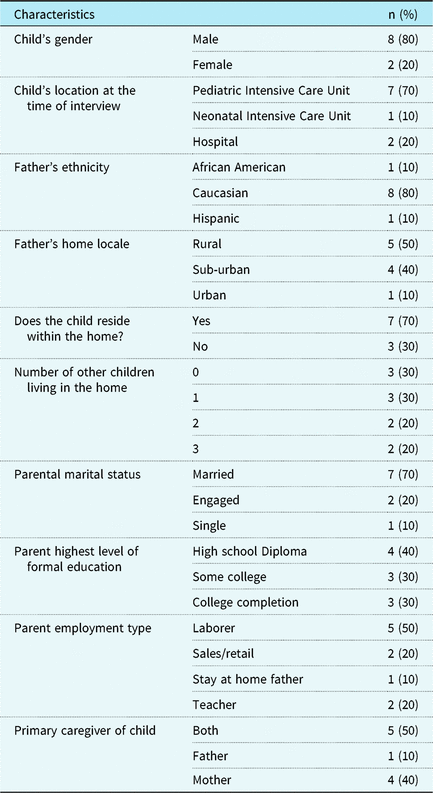
This study involved voice-recorded, in-person interviews with 10 fathers of children who had undergone cardiac surgery in the past 14 days in a free-standing children hospital in the Midwestern United States with a new palliative care referral. Semi-structured interviews are appreciated as the standard approach for cognitive interviewing targeted to conceptual definitions,Reference Beatty and Willis 18 thus semi-structured interviews were conducted from November 2018 to January 2019 using an interview guide (Supplementary material 2). Eligible participants, who received new palliative care consultations, were English-speaking fathers of children who had undergone cardiac surgery in the past 14 days. Exclusion criteria included lack of verbal or cognitive capacity for interview participation as determined by the primary cardiac service line team. Screening for eligibility was based on medical record search and referrals to the study team. There were 10 eligible participants during the study timeframe. Ten potential participants were approached based on convenience sampling with n = 10 enrolled (100% participation rate). Study group demographics are provided in Table 1.
Participant demographics.

Procedures
After introducing the study in detail, verbal informed consent was obtained. J.R., a male interviewer, conducted all interviews in-person in a private inpatient or outpatient hospital room. Mean interview time was 20 minutes. M.S.W. completed a “content check” with each participant after each interview to allow the interviewee to verbally process his interview experience.Reference Mays and Pope 19 Trained medical transcriptionists transcribed the interview content verbatim with a minimum of one study team member confirming accuracy. Study participants also completed a two-page, multiple-choice written survey instrument with questions on demographics and preference for information, resources, and support format as adopted from prior grandparent survey work.Reference Wakefield, Drew, Ellis, Doolan, McLoone and Cohn 21
Data analysis
Written survey instrument analyses were descriptive and univariate in nature. The study team utilised counts for categorical variable responses. Interview data were analysed using semantic content analyses.Reference Krippendorff 20 Every phrase spoken by the participant from each interview was entered into the qualitative software program. One member of the study team independently applied first-level codes to key phrases to capture their meaning. The interviewer created grouped classifications of phrases from the interview content to develop a code dictionary. The code dictionary contained the definition of each code and an example of use of the code. Another team member then used this grouped-specific codebook to review the content of the interview data.Reference Krippendorff 20 , Reference Kuper, Reeves and Levinson 22 After first-level codes were applied to all interview phrases, the codes were then grouped by overlapping meaning and co-occurrence into themes. The frequency of each theme was calculated. Conceptual definition was thus developed based on the interviewed fathers’ verbiage and the assessed paternal meaning.
Results
Study participants were 10 fathers of 8 males and 2 female cardiac surgical patients of mean patient age 19 months (age range from 7 months to 7 years). Heart condition was first diagnosed an average of 17 months before the interview (included gestational time). All interviews occurred within 2 weeks of a cardiac surgery. Eight children were still in the ICU at the time of their fathers’ interviews and two had transition to regular hospital floor. Family residence was an average of >300 miles from the pediatric hospital.
Paternal knowledge content and format preferences
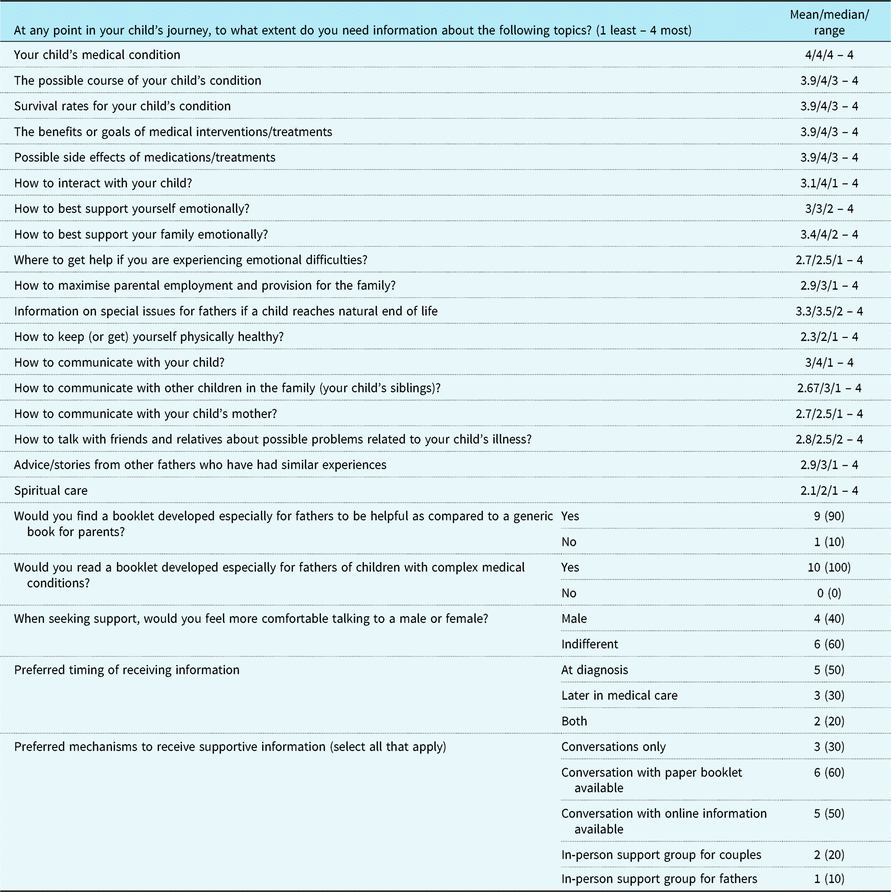
When asked to rank their preference on access to information regarding their child’s care on a Likert Scale with one representing passive knowledge need and five representing proactive knowledge need: all fathers ranked their knowledge need as 5/5. Highest ranked informational priorities for fathers included: the child’s medical condition to include prognostic course, survival rates, goals of intervention, and potential side effects for intervention (Table 2). Interviewed fathers consistently depicted interest in resources for their ability to economically and emotionally support their families higher than interest in their own personal physical, emotional, or spiritual needs (p<0.001). Provision of a written booklet with conversational support was noted to be the most preferred format of information sharing. All interviewed fathers reported that they would read a supportive booklet written specifically for fathers.
Knowledge content and format preference as reported by fathers.

Definition of paternal role and responsibilities in caring for a child with cardiac condition
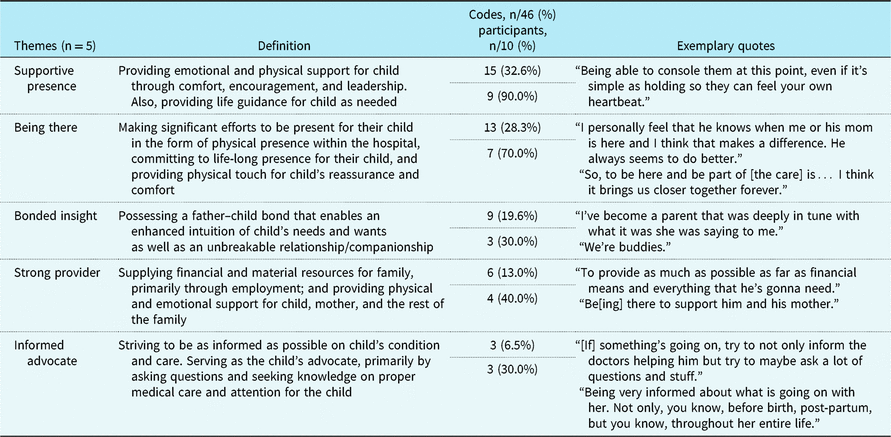
In defining “being a good father,” a total of 46 codes yielded six themes central to the fathers’ definition of this important role (Table 3): providing a supportive presence, being there, offering bonded insight, serving as strong provider, and acting as an informed advocate. When asked about their responsibilities in the role of “being a good father,” 49 codes were extracted from 34 responses that corresponded to five specific themes: being a supporter for the child, involved parent, child’s advocate, committed to fatherhood, and being the fun parent. Being a supporter for the child was the most commonly identified theme for how participants defined their responsibility with 80% of fathers referencing this theme and over 40% of total interview phrases corresponding to that theme. Theme content did not differ based on paternal demographics or age of the child.
Paternal definition of “being a good father to my child with a complex cardiac condition.”

Paternal growth through pediatric cardiac diagnosis
Of the 10 interview patients, 9 made statements of personal growth occurring as a direct result of their child’s cardiac condition. A total of 34 interview statements related to personal growth: 24 phrases reflected feelings of intrapersonal growth (statements of personal insight, growth, maturity, and self-awareness) and 10 phrases reflected interpersonal growth (statements about relationship impact). Growth was further categorised as: personal growth (14 statements), emotional, or spiritual growth (11 statements), cognitive growth (5 statements), aesthetic growth meaning the ability to appreciate beauty in new ways (4 statements).
The most repeated interview theme related to overall maturity or “growing up.” While their fathers’ experiences may have forced them into a new level of responsibility and maturity, participants were able to take pride in the fact they responded to the challenge in a positive way. As one father stated, “I’ve grown up quite a bit since he’s been here. Pretty well just growing up cause, like I said, I was, like, immature at first, but I’ve stepped up my game I guess you could say.” In addition to overall maturity, participants were able to identify how this experience has made them better fathers and brought their family closer together, revealing the intrapersonal growth resulting in inter-personal growth.
Regarding emotional and spiritual growth, participants described how they have grown in patience, compassion, and empathy, along with having increased faith. Although the specific word was not used, many of the participants described their emotional/spiritual growth as a discovery. As a result of their child’s cardiac condition and medical experiences surrounding heart care for their child, they “discovered” a level of patience, compassion, and empathy that had previously been underdeveloped. They also appeared to take pride in this discovery, often providing detailed descriptions of how this newfound awareness resulted in positive outcomes for themselves, their family, institutions, and their community. One paternal participant described discovering an entire new range and intensity of emotions as a result of his child’s heart condition diagnosed 5 months prior: “I’ve been more emotional in the last 5 months than I probably have for the last, well, I’m almost 30, so probably 20-some, well, I don’t know as a kid I guess, for at least the last 15 years.” While many participants were comfortable describing their growth in emotional terms, others preferred to identify their growth in cognitive terms. This group described their growth as a change in thinking or perspective. One participant expressed how he views the work of doctors and nurses differently with a new awareness of the sacrifices they make to take care of others. More than half of the participants described new academic knowledge about heart anatomy, cardiac processes, or practical knowledge. Paternal interviews captured the idea of aesthetic growth. In spite of the circumstances of extended stay in a critical care unit, one participant was able to appreciate the goodness and beauty of family life in a newfound way: “It kind of humbles me a little bit to now realize that we do have a really cool, good family.” In the midst of challenges and difficulty, this father came to a deeper appreciation of familial relationships he previously took for granted.
Advice for other fathers of children with cardiac conditions
When asked what advice they may share with other fathers of children with complex cardiac diagnoses, 8 of the 10 fathers shared their belief that they would advise other fathers to be the foundation of the family unit. Interviewees specifically used the term “be the rock” when depicting what advice they would offer others fathers (17 phrases), emphasizing the perceived need to remain emotionally strong for the child and family. Fathers universally spoke to the importance of clear communication with doctors and nurses with the guidance to “attend rounds” stated 16 times in the interviews. Respondents recommended that other fathers seek knowledge of their child’s heart condition through reading and asking questions (15 phrases). Participants also emphasised the paternal need to find personal support (seven phrases) in order to better support the family.
Paternal inclusion in care of child with cardiac condition
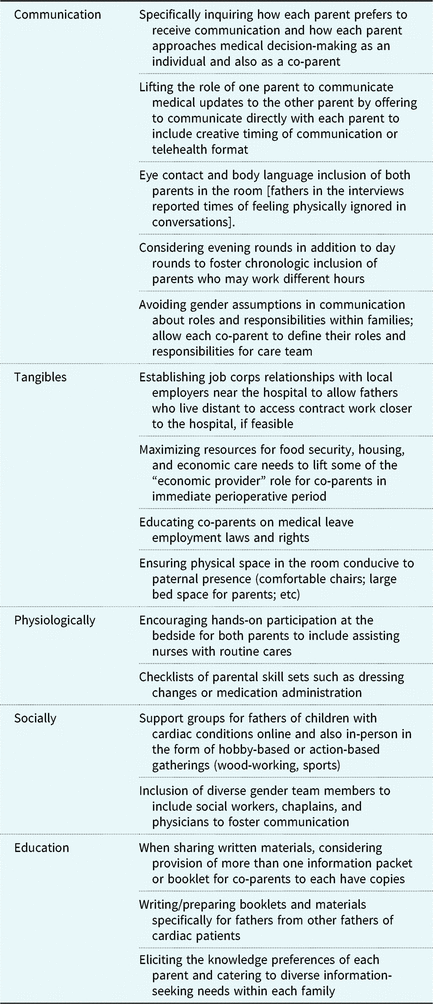
Four interviewed fathers depicted that they have never felt excluded in the care of their hospitalised child. Six fathers reported that they do feel more excluded than their co-parent is included, citing that this was a reflection of their employment or absence from the hospital to care for the child’s siblings or competing responsibilities. Interestingly, actions from healthcare staff cited as most inclusive of paternal role were not actions directed towards the father himself but actions of care directed towards the father’s child. When asked about how to best include fathers of cardiac patients, seven fathers actually replied with statements of staff investment in the child’s care and staff compassion towards the child rather than replying with statements of staff actions towards themselves as fathers. Tangible forms of paternal inclusion are provided as Table 4.
Inclusive staff actions.

Discussion
The fathers’ reflections provide important insight into the roles, responsibilities, growth, and inclusion needs of fathers of cardiac children from the paternal perspective. The quantitative and qualitative paternal responses reveal a certain altruism of perceived paternal role. Interviewed fathers ranked care for their family members higher on quantitative survey than care for self. When asked about the primary way to care for fathers of child cardiac patients, fathers replied that good care for their child is the best care of fathers.
Fathers described the challenges of parenting a child with complex cardiac condition in the hospital, as they defined their primary role as being a supportive and informed and even physically present to advocate for and comfort their child. And yet, throughout the interviews, fathers described themselves as the rock of the family unit to include economic, employment, and emotional security. The clashing reality is that the “good father” responsibilities described by the fathers were one of physical proximity to their child and a medically informed presence. And yet, the average distance from the hospital to home for these fathers was 310 miles (median 110 miles). In practicality, the majority of the interviewed fathers were balancing inclusion in their child’s day-to-day perioperative care needs with their perceived additional family stability responsibilities, which often required physical absence. Each father shared from the perspective of being placed into an unplanned medical experience with their child and the personal challenges that arose in trying to maintain a “good father” role, while living out multiple, sometimes conflicting, responsibilities such as being at their child’s side and also maintaining family income at a geographic distance.
Limitations of this study include small sample size at a single facility. The perspective of the included fathers should not be universalised to all fathers, as family structure (whether same-gender couples or single parents or co-parents), culture, tradition, and family identity individualise the paternal experience uniquely for each father. Clinicians are wise not to generalise these findings but instead to recognise the privilege of asking parents to self-identify their sense of “good parenting” and to learn from each family ways that medical teams can best care for that family within the context of individual values and shared goals.
Recent studies have revealed that small, non-medical initiatives for fathers such as “Father of the Day” cards, paternal skin-to-skin contact for neonates, and offering the opportunity for a father to auscultate his child’s heart sounds have shown improvement in paternal subjective report of the child’s physiological patterns as well as improved parental confidence and preparedness for care of the child.Reference Shorey, He and Morelius 23 , Reference Kow, Groot and Puthenparampil 24 Tangible actions such as a bead program with paternal inclusion for children with CHDs have been received by fathers as a form of inclusion.Reference Wilson and Chando 25
The shared themes of proactively supporting and inclusively communicating were pervasive amongst these men and speak to the wishes medical team members should strive to meet. Ensuring that fathers of children with complex cardiac conditions have access to education and knowledge, opportunities to connect with others, and space to express their hopes and goals for their child is vital. This study revealed that many fathers of cardiac patients view themselves as their family’s foundation, and thus strengthening the foundation may be a form of strengthening the overall family. The finding that the average interview lasted only 20 minutes allows the study team to recognise a role for offering the fathers of cardiac patients the opportunity to process and reflect even in clinical and hospital interactions with medical staff.
The data provide clinic staff a clear opportunity to empower fathers, strengthen the clinic–family relationship, and increase patient satisfaction. Taking a brief moment to acknowledge the presence of fathers, helping them identify and name their growth areas, and honoring that growth will result in increased respect, accountability positive attitudes, and cardiac service line excellence.
Supplementary material
To view supplementary material for this article, please visit https://doi.org/10.1017/S1047951119001586
Acknowledgements
The study team wishes to thank the Hand in Hand team for review of the interviews and manuscript.
Financial Support
Transcription costs were generously supported by a University of Nebraska Department of Pediatrics Mini-Grant.
Conflicts of Interest
None.
Ethical Standards
The authors assert that all procedures contributing to this work comply with the ethical standards of the relevant national guidelines on human experimentation to include the COnsolidated criteria for REporting Qualitative research guidelines and with the Helsinki Declaration of 1975, as revised in 2008, and has been reviewed by the University of Nebraska Institutional Review Board in the form of the Paternal Advice, Guidance, Education, and Support Qualitative Study Protocol.