

INTRODUCTION
On May 2, 2012, a procedural reform bill—widely known as the “National Assembly Advancement Act” or guk'hoi'seon'jin'hwa'beob—that strictly limits the procedural power of the majority party passed with the support of a bipartisan coalition during a “lame duck session” of the 18th South Korean National Assembly, even after the ruling majority party, Saenuri Party, regained its majority status (see Kim, Reference Kim2014). During the second half of the 18th National Assembly, legislators from the governing and opposition parties formed a bipartisan coalition to reform procedural rules in order to prevent violent gridlocks within the legislature (see e.g., Park Reference Park2012; Chung Reference Chung2013; J. Kim Reference Kim2014; Han Soo Lee Reference Lee2014; Hyunchool Lee Reference Lee2014; Jeon Reference Jeon2015; S. Lee Reference Lee2015). The procedural reform bill had provisions that limit (enhance) the powers of the majority (minority) party. The bill passed with 127 Yeas and 47 Nays, with 17 abstentions and 101 absentees. Of the 127 who voted for the reform, 61 members were, surprisingly, members of the Saenuri Party, the ruling majority party at the time.
This case brings attention to the following theoretical question in comparative perspective: who structures the procedural rules of the legislature? The conventional wisdom suggests that procedural rules reflect the interests of the majority party. The Cartel Theory predicts that procedural rules are designed to reflect the interests of the majority party and thus procedural rules changes are determined by the majority party (see e.g. Cox and McCubbins Reference Cox and McCubbins1993, Reference Cox and McCubbins1997, Reference Cox and McCubbins2005). Specifically, the majority party seeks to retain its majority status and effectively cartelizes the legislative procedure via negative agenda control in order to prevent “party-splitting” issues from reaching the floor vote (Cox and McCubbins Reference Cox and McCubbins1993, Reference Cox and McCubbins2005). Moreover, the majority party maintains the cartel arrangement through credible punishments of defectors to prevent the rank-and-file from defecting the party line, especially on procedural votes (or votes that affect the legislative procedure) (see e.g. Cox and McCubbins Reference Cox and McCubbins1993, Reference Cox and McCubbins2005; Jenkins, Crespin, and Carson Reference Jenkins, Crespin and Carson2005). The conditional party government theory also emphasizes the role of the majority party in shaping the procedural rules but predicts that the majority party can shape procedural rules only when the majority party is homogenous and when parties’ median preferences are distant (Aldrich and Rohde Reference Aldrich and Rohde1998).
On the contrary, some of the literature emphasizes non-partisan influence in procedural rules changes (Binder Reference Binder1996, Reference Binder1997; Schickler and Rich Reference Schickler and Rich1997a, Reference Schickler and Rich1997b; Binder and Smith Reference Binder and Smith1998; Schickler Reference Schickler2000; Fink Reference Fink2000). Schickler and Rich (Reference Schickler and Rich1997a, Reference Schickler and Rich1997b) argue that the balance of power on the floor affects procedural rules changes. Specifically, they predict that if the number of defectors within the majority party is sufficient to form a permanent majority coalition with the minority party, the majority party may not dictate the procedural rules changes. The non-partisan model, however, does not explain why majority-party defectors choose to defect from party line. In other words, changes in the balance of power on the floor is simply a condition that lowers the cost of defection, but this says nothing about the defectors’ expected utility by defecting from their co-partisans in the first place.
In this article, I further build on the non-partisan model of procedural rules changes by incorporating the logic of “presidentialization.” I argue that presidentialization may bolster non-partisan influence on a procedural rules change. Under presidentialism, there is an inherent principal-agent problem. Although presidential candidates are internally selected within the party to represent the party, the presidential candidate may engage in agent opportunism due to the lack of a mechanism to deselect the candidate (Samuels and Shugart Reference Samuels and Shugart2010). So the candidate may deviate away from the preferences of his or her party without being held accountable within the party. The presidential candidate, who seeks to represent the national constituency, sometimes cannot afford to play favorites among partisan lines even on salient issues, and there is little (if any) that the party can do to prevent the candidate from deviating from the party's preference (see Samuels Reference Samuels2002; Samuels and Shugart Reference Samuels and Shugart2010). In addition, the close associates of the presidential figure, which I term the “presidential faction,” may choose to side with their candidate over their own party because affiliation with the presidential faction may lead to significant rewards such as privileged access to national resources or cabinet appointments once their faction leader wins the presidency. This constitutes the expected utility of the defectors. Furthermore, since the presidential candidate is the de facto leader of the party, affiliation with the presidential faction may provide a safeguard against possible punishment for defecting from the party line, lowering the cost of defection.
The remainder of this article will proceed as follows. In the next section, I provide a brief description of the procedural reform bill that passed the National Assembly on May 2, 2012. In the following section, I provide some descriptive evidence of presidentialized party politics in the South Korean context. Next, I incorporate the logic of presidentialization and develop an alternative mechanism of the non-partisan model of procedural rules change. In the subsequent section, I describe the method of case selection. I then present the evidence to support my hypotheses. Finally, in the last section, I conclude with some theoretical implications.
OVERVIEW OF THE NATIONAL ASSEMBLY ADVANCEMENT ACT AND THE PUZZLE
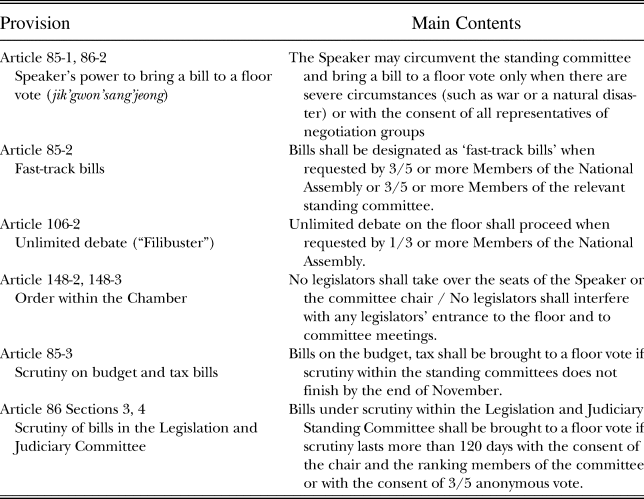
In this section, I provide a brief overview of the procedural reformed bill or the National Assembly Advancement Act that passed the floor of the South Korean National Assembly on May 2, 2012. Table 1 shows the main contents of the procedural reform bill.
Summary of the National Assembly Advancement Act

Note: Bill accessed from the National Assembly Bill Archive (eui'an'jeong'bo'system). Summarized and translated from Korean to English by the author.
As shown in Table 1, the procedural reform bill contains provisions that significantly limit the powers of the majority party. For instance, the majority party exerted its power of agenda control through the Speaker's power to circumvent the committee scrutiny and to bring a bill to a floor vote (see e.g., I-Y. Kim Reference Kim2015). The procedural reform bill, however, strictly limited this power. In addition, designating fast-track bills or circumventing scrutiny under the Legislation and Judiciary Committee requires a 3/5 consent in the procedural reform bill.
The procedural reform bill, despite the limits it imposes on the majority party, passed the floor vote with the support of a bipartisan coalition. This outcome contradicts the predictions of the partisan theory of procedural rules change and conforms to the expectations of the non-partisan theory of procedural rules change. This is puzzling, because one would expect to observe partisan influence on procedural rules change in the South Korean context due to the cohesiveness of parties (see e.g., Moon Reference Moon2011; Shin and Lee Reference Shin and Lee2017). The non-partisan theory, however, fails to explain the motivations of the majority-party defectors. Why would majority-party members defect from their party line to support a procedural reform that would impose limits on their privileged status as members of the majority party? What do the defectors gain or seek to gain by defecting from the party line?Footnote 1
In this article, I argue that in a system where parties are presidentialized, procedural rules change is affected by presidential electoral incentives, and majority-party members may defect from their party line if doing so conforms to the interests of the presidential figure. In the subsequent section, I provide some descriptive evidence of presidentialized party politics in South Korea.
PRESIDENTIALIZATION OF PARTY POLITICS IN SOUTH KOREA
Presidentialization is mostly found under (semi-) presidential systems and it refers to the parties’ incentive dilemma that exists in presidential systems. Specifically, party leaders, who seek to win the presidency, are more likely to be affected by presidential electoral incentives rather than their parties’ collective incentives (Samuels Reference Samuels2002; Samuels and Shugart Reference Samuels and Shugart2010). Presidentialization contradicts the traditional responsible party government model because the presidential candidate may deviate away from the preferences of his or her party without being held accountable internally (Samuels Reference Samuels2002; Samuels and Shugart Reference Samuels and Shugart2010). Hence, I argue that in a system where parties are presidentialized, procedural rules changes may not reflect the interest of the majority party when the presidential candidate's interest is at odds with the majority party's interest. Specifically, I hypothesize that members of the presidential faction may defect from the majority party's preference in order to vote with the presidential candidate when voting on procedural rules changes, even if it undermines the powers of the majority party.
South Korea is well-known for its underdeveloped party politics, with weak party organizations, frequent mergers and splits, party switching, and changes in party labels (see e.g., Park Reference Park2010; Shin Reference Shin2013; Jaung Reference Jaung2015). One of the main reasons for this underdevelopment is presidentialization. Presidentialization refers to how “institutions of presidentialism generate incentives for parties to behave differently than under parliamentarism” (Samuels Reference Samuels2002, 478). In this section, I provide descriptive evidence on how party politics in South Korea is presidentialized.
In South Korea, new parties emerge, merge and/or split prior to or right after presidential elections. For instance, President Roh Moo Hyun, who had just won his presidency on December 19, 2002, left the ruling New Millennium Democratic Party to form a new party, the Uri Party, on November 11, 2003. This split was led by President Roh Moo Hyun and his progressive followers (see e.g., Lee and Lee Reference Lee and Lee2015). The split of the Grand National Party in 2008 is an example of a party split right after a presidential election. Just prior to the 18th National Assembly, in 2008, the incumbents of the Pro-Park Geun Hye faction left the Grand National Party (GNP) due to an intra-party conflict that arose during the GNP's presidential primaries in 2007. At the time, the GNP members split into two factions—the Pro-Lee Myung Bak faction (chin'yi'gye) and the Pro-Park Geun Hye faction (chin'bak'gye). Lee won the nomination and was elected president. After Lee's victory, the Pro-Lee faction led the so-called “nomination massacre” (gong'cheon'hak'sal) in which the GNP's Secretary-General Lee Bang Ho, a core member of the Pro-Lee faction, refused to nominate dozens of key Pro-Park members for the upcoming National Assembly election in 2008. As a result, Pro-Park incumbents who did not receive the nomination left the GNP to run as independents or to run as the candidates of the Pro-Park Geun Hye Alliance, a new party formed by some of the Pro-Park faction members.
Another piece of evidence on presidentialized party politics in South Korea is that legislators’ loyalty to parties is based on the selective benefits granted by the president rather than their parties’ programmatic platforms. For example, Shin (Reference Shin2013) provides empirical evidence that legislators switch parties to side with the president and gain access to national resources. Moreover, the regional party system in South Korea is a pork-centric system where legislators stay loyal to their parties in order to gain access to pork, and legislators affiliated with the president's party tend to stay more loyal to their party (e.g., Shin and Lee Reference Shin and Lee2017).
PRESIDENTIALIZATION AND AN ALTERNATIVE THEORY OF NON-PARTISAN INFLUENCE ON PROCEDURAL RULES CHANGE
In this section I incorporate the logic of presidentialization in suggesting an alternative mechanism of the non-partisan model of procedural rules change and generate testable hypotheses.
The common prediction in the existing literature is that the majority party provides its members with disproportional procedural advantage within the legislature and in exchange the majority-party members delegate significant power to their leaders. The majority-party leaders cartelize the procedural rules to favor the majority party and punish the defectors in order to maintain the cartel arrangement.
In presidentialized parties, however, this may not be the case. Presidentialized parties face a dilemma of incentives that parliamentary parties do not face. Due to the separation of origin and survival of presidential candidates, there is an inherent principal-agent problem in presidentialized parties (Samuels Reference Samuels2002; Samuels and Shugart Reference Samuels and Shugart2010). Specifically, presidential candidates are internally selected within the party to represent their party but the presidential candidates may engage in agent opportunism and deviate away from the preferences of their party without being held accountable within the party (Samuels and Shugart Reference Samuels and Shugart2010). This is because the party values the presidency as the ultimate political prize under presidentialism, which makes the presidential candidate de facto party leader; and it is extremely difficult to control its presidential candidate due to lack of a mechanism to deselect the candidate. Then, how does presidential incentive affect the preference of the presidential party on procedural rules change?
The presidential candidate, who seeks to represent the national constituency, sometimes cannot afford to play favorites among partisan lines even on salient issues (see Samuels Reference Samuels2002; Samuels and Shugart Reference Samuels and Shugart2010). The presidential incentive is thus a centripetal force that drives the party's preference closer to the median voter rather than the partisan median. In a presidentialized party, therefore, the party is more likely to prefer to produce legislative outcomes that appear bipartisan in order to appeal to the median voter. This logic applies to the party's preference on procedural rules change. A significant change in procedural rules changes the mode of power distribution within the legislature, benefiting one party at the cost of another. In the partisan perspective, the majority party would prefer to steer the outcome to strengthen the majority cartel arrangement. In a presidentialized party, however, the centripetal force induced by presidential electoral incentives leads the party's preference towards a bipartisan compromise on procedural rules change. This tendency would be more predominant close to a presidential election especially when the election is competitive.Footnote 2
Despite the party leaders’ influence over shaping the procedural rules, the consent of the rank-and-file members of the majority party is required to change the procedural rules. Legislators, however, may have different incentives. In general, the majority-party members are more likely to prefer to maintain the majority cartel arrangement regardless of their leaders’ preference in order to maintain their privileged status within the legislature. In a presidentialized context, the presidential candidate's interests may be at odds with the majority party's interests. Close associates of the presidential candidate or members of the presidential faction may defect from the party line to side with their leader so that they can gain privileged access to presidential resources, such as the national budget or cabinet appointments, after their leader wins the presidency.
Additionally, punishing defectors is a crucial mechanism that sustains the majority cartel arrangement. In a system where parties are presidentialized, however, majority-party defectors are not always punished for defecting from their party line. Specifically, if some members defected from the majority party in order to vote with the presidential candidate, who is de facto the party leader, those defectors are less likely to be punished afterwards. This is because, while punishing those defectors may be beneficial in maintaining the majority cartel arrangement, it would not be beneficial for maintaining the presidential faction. Moreover, the non-defectors of the majority party will not be able to punish the defectors. This is because the presidential faction is likely to be highly cohesive due to the common interest they share and thus the presidential faction may threaten to move closer to the minority party to form a stable bipartisan coalition if they were to be punished, which would result in a greater loss for the non-defectors (see e.g., Schickler and Rich Reference Schickler and Rich1997a, Reference Schickler and Rich1997b).
In sum, in a system with presidentialized parties, the majority party's preference is affected by a centripetal force induced by the presidential incentive, and its ability to shape procedural rules and to punish defectors is nullified by the effects of presidentialization. Hence, I generate the following hypotheses.
Hypothesis 1.1. In a presidentialized party, party leaders’ decisions on procedural rules changes are affected by presidential (electoral) incentives rather than the (majority) party's incentives.
Hypothesis 1.2. In a presidentialized party, members of the presidential faction within the majority party are more likely to defect from the majority party's preference in order to vote with the presidential candidate when voting on procedural rules change.
Hypothesis 2. In a presidentialized party, majority-party defectors who voted with the presidential candidate are not likely to be punished for their defection.
METHOD AND CASE SELECTION
SINGLE-CASE STUDY METHOD
The dependent variable of interest in this article, procedural rules changes, is not a phenomenon that happens often. In short, the “N” is bound to be small, which may limit the generalizability of findings. Eckstein (Reference Eckstein, Greenstein and Polsby1975), however, provides a solution to the “small-N” problem. He argues that selecting either the “most-likely” or “least-likely” case may allow us to generalize findings from small-N or even from a single-case analysis. Specifically, testing (or refuting) a hypothesis in a context where it is highly unlikely (or likely) to be valid would allow us to determine the validity of the hypothesis (Eckstein Reference Eckstein, Greenstein and Polsby1975). Similarly, King and his colleagues (Reference King, Keohane and Verba1994) also state that the strength of inference depends on the difficulty of the test that the theory passes or fails. How would we then determine whether a case is most-likely or least-likely? Press (Reference Press2005) provides a useful criterion for determining most-likely or least-likely case, stating that reliable prior knowledge about the conditions (or assumptions) of a given theory will allow us to determine whether the case is most-likely or least-likely.
The theories at stake in this article are partisan and non-partisan models of procedural rules changes. The former focuses on substantial majority-party influence on procedural rules changes whereas the latter focuses on the absence of such influence. Hence, if we have reliable prior knowledge on the assumptions of the partisan model, we will be able to determine whether a certain case is a most-likely (or a least-likely) case for partisan (or non-partisan) theory. Fortunately, Cox and McCubbins (Reference Cox and McCubbins1997) clearly state the following assumptions about the partisan model:
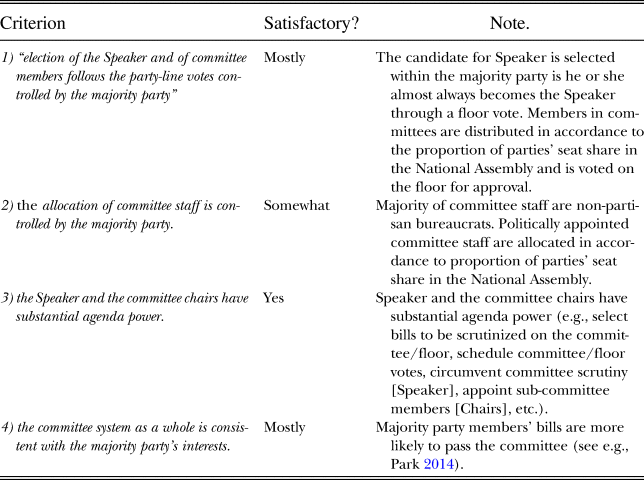
1) election of the Speaker and of committee members follows the party-line votes controlled by the majority party, 2) allocation of committee staff is controlled by the majority party, 3) the Speaker and the committee chairs have substantial agenda power, 4) the committee system as a whole is consistent with the majority party's interests (Cox and McCubbins Reference Cox and McCubbins1997, 1379).
SOUTH KOREAN NATIONAL ASSEMBLY AS THE LEAST-LIKELY (OR MOST-LIKELY) CASE OF NON-PARTISAN (OR PARTISAN) THEORY OF PROCEDURAL RULES CHANGES
The most reliable prior knowledge that we can observe in regard to the assumptions of the partisan model of procedural rules changes can be found in statutory institutions and institutional practices.
The first criterion is whether the election of the Speaker and of committee members follows the party-line votes controlled by the majority party. Empirical studies have shown that party-line votes are very strict in the South Korean National Assembly (e.g., Moon Reference Moon2011; Shin and Lee Reference Shin and Lee2017). In principle, the Speaker, Vice Speaker, and Committee Chair candidates are internally selected within the party and the candidates are later confirmed on the floor, usually by a unanimous vote (Moon and Lee Reference Moon and Lee2016). In practice, however, the majority party almost always controls the Speakership and the distribution of committee chairs is also favorable to the majority party.Footnote 3 The Speaker candidate of the majority party is, with a very few exceptions, mostly elected on the floor. Article 48 of the National Assembly Act specifies that distribution of committee seats (including chairs) are to be determined through a consultation process between major parties and committee chairs are distributed in accordance to the proportion of seats controlled by each party. Hence, the majority of the committee chair seats are allocated to the majority party. Additionally, the majority party almost always controls key committees such as the Committee on House Steering, Committee on National Policy, and Special Committee on Budget and Accounting.Footnote 4
The second criterion is whether the allocation of committee staff is controlled by the majority party. Committee staff in the South Korean National Assembly are not necessarily controlled by the majority party because most staff are non-partisan bureaucrats affiliated with the National Assembly Secretariat. Provisions of Article 34 of the National Assembly Act does specify that some staff may be politically appointed but the number of such staff is limited.
The third criterion is whether the Speaker and the committee chairs have substantial agenda power. The procedural rules of the South Korean National Assembly grants significant agenda powers to the Speaker and the committee chairs. The National Assembly Act grants the Speaker the power to schedule and preside over plenary sessions. The Speaker also has the power to circumvent committee scrutiny on certain bills and may schedule a floor vote (see e.g., Park Reference Park2016). Committee chairs also have significant agenda powers such as selecting the legislative agenda within the committee, scheduling committee votes, forming sub-committees, and so forth.
The last criterion is whether the committee system as a whole is consistent with the majority party's interests. The last criterion is tricky because whether the committee system is consistent with the majority party's interest is not a phenomenon that can be easily captured empirically. Hence, for the last criterion, the alternative method is to rely on the empirical findings of existing studies. For instance, Park (Reference Park2014) analyzes bill passage in committees during the 17–18th National Assembly and finds that bills sponsored by majority (governing) party members are more likely to pass the committee.Footnote 5 Additionally, Park (Reference Park2014) also finds that bills under scrutiny in committees where the majority party controls the committee chair are more likely to pass. These findings demonstrate that affiliation with the majority party leads to higher legislative productivity in committees and this may be an indirect evidence to support the last criterion.
South Korean National Assembly as a Most-Likely (Least-Likely) Case for Partisan (Non-Partisan) Model of Procedural Rules Change

Close examination of the reliable prior knowledge of the South Korean case in regard to the assumptions of the partisan theory of procedural rules changes reveals that the South Korean case, in most part, is fit to be considered as the least-likely (most-likely) case to test the inferential strength of non-partisan (partisan) theory of procedural rules changes.
CASE STUDY ANALYSIS: THE 2012 PROCEDURAL REFORM IN THE SOUTH KOREAN NATIONAL ASSEMBLY
MAJORITY PARTY'S INCENTIVES VERSUS PRESIDENTIAL INCENTIVES (HYPOTHESIS 1.1)
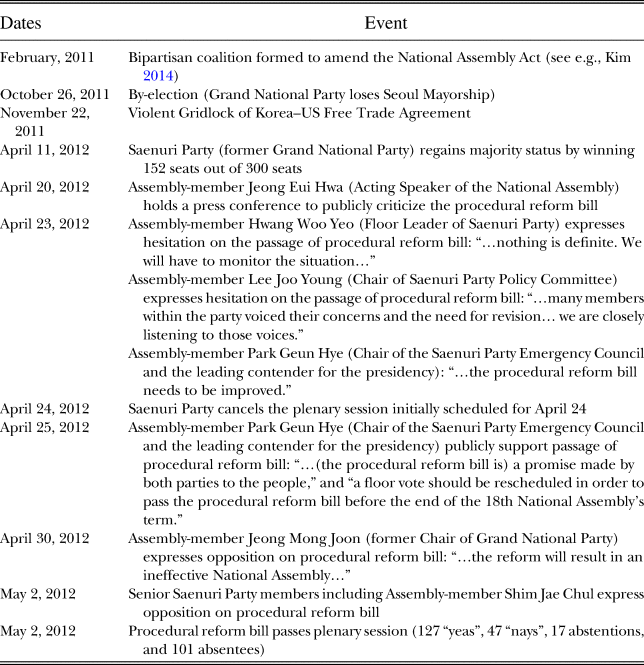
Debate on procedural reform within the National Assembly was initiated in response to the growing public discontent about the violent gridlock in the National Assembly (see e.g. Park Reference Park2012; Kim Reference Kim2014). Thus, a bipartisan coalition consisting of legislators from the ruling and opposition parties formed in February, 2011. In addition, the ruling Grand National Party (later renamed Saenuri Party) lost the Seoul mayoral by-election which was held on October 26, 2011. This election heightened the intensity of electoral competition between two major parties—the ruling Grand National Party and the leading opposition Democratic Party (later renamed Democratic United Party)—for the upcoming 19th National Assembly election on April 11, 2012. On November 22, 2011, the violent gridlock that occurred during the passage of the Korea-U.S. Free Trade Agreement Ratification bill on the floor heightened public discontent of the National Assembly (Kim Reference Kim2014). Thus, a bipartisan movement for procedural reform gained momentum and neither of the major parties could appear hesitant on the reform of the National Assembly, which was a high-profile political issue at the time (see e.g, Park Reference Park2012; Kim Reference Kim2014). As a result, the two major parties came to a consensus on a bipartisan procedural reform bill and the GNP made a public pledge to pass the procedural reform bill despite the fact that the procedural reform greatly undermines the power of the majority party.
Surprisingly, however, the ruling Saenuri Party, which controlled 165 seats out of 299 seats just prior to the election, won 152 seats out of 300 seats and regained its majority status. After regaining the majority status, the leadership of the Saenuri Party started to voice concerns about the procedural reform bill publicly. Among those, Acting Speaker of the National Assembly Jeong, Eui Hwa of Saenuri Party publicly criticized the supermajority clause in the procedural reform bill. Specifically, he held a press conference and stated,
the bill puts a limit on the Speaker's power to schedule floor votes (without committee scrutiny) and includes a procedure to designate fast-track bills but there is a 3/5 requirement (of the chamber or the committee) to designate fast-track bills … there has been no incidents where the majority party controlled 3/5 of the seats and this clause contradicts the constitutional principle of “majority rule”.Footnote 6
Floor Leader of the Saenuri Party Hwang, Woo Yeo, who was supportive of the bill prior to the election, stated that “nothing is definite. We will have to monitor the situation” and Chair of Saenuri Party Policy Committee Lee, Joo Young also stated in an interview that “many members within the party voiced their concerns and the need for revision … we are closely listening to those voices.”Footnote 7 On April 23, Assembly-member Park Geun Hye, the Chair of the Saenuri Party Emergency Council and the leading contender for the presidency, also stated during her visit to Pyeongchang that the procedural reform bill “needs to be improved.”Footnote 8 Initially, Saenuri Party and the Democratic United Party agreed to hold the floor vote to pass the procedural reform bill during a plenary session scheduled on April 24, 2012, but as opposition grew on the procedural reform bill within the Saenuri Party, the Saenuri Party decided to cancel the plenary session.Footnote 9 The Saenuri Party's decision to cancel the floor vote on the procedural reform bill was harshly criticized by the opposition and by the general public.Footnote 10 The leadership of the Democratic United Party criticized the ruling Saenuri Party for changing their stance on the procedural reform bill after regaining the majority status.Footnote 11 In addition, there were 59 pending policy bills to be voted on April 24, 2012, and cancelling the plenary session would lead to killing all those bills, because this session was meant to be the final session of the 18th National Assembly before the end of its term on May 31, 2012.Footnote 12 The Saenuri Party's actions can be interpreted as the majority party's exercise of negative agenda control in order to preserve the cartel arrangement. Clearly, it was a partisan move.
Park Geun Hye quickly responded by making a statement during her visit to Saenuri Party's North Chungcheong Province Office, saying that the procedural reform bill was “a promise made by both parties to the people” and that “a floor vote should be rescheduled in order to pass the procedural reform bill before the end of the 18th National Assembly's term.”Footnote 13 Park, who was the leading presidential candidate of the Saenuri Party, had to change her position and support the procedural reform because “changing horses” on a salient political issue only two weeks after the National Assembly election would lead to political gridlock and be met with serious criticism (see e.g., Kim Reference Kim2014). Yet, senior members of the Saenuri Party still expressed their concerns about the procedural reform bill even after Park's statement. Assembly-member Shim Jae Chul, a senior member of the Saenuri Party, stated in an interview that the procedural reform bill should not be passed.Footnote 14 Assembly-member Jeong Mong Joon, former Chair of the ruling Grand National Party, also expressed his opposition to the reform because the reform would result in an “ineffective National Assembly.”Footnote 15 Nevertheless, Park's public support for the procedural reform led to the quick re-scheduling of the plenary session to vote on the procedural reform bill, and the bill passed the floor on May 2, 2012 along with the pending policy bills. Hence, the passage of the procedural reform bill was a case in which presidential electoral incentives prevailed over majority party's incentives to preserve the cartel arrangement. In theoretical terms, this change was induced by the centripetal forces of presidential incentives. With the presidential election only seven months away, Park could not appear to play favorites at the cost of killing a bipartisan agreement on the procedural reform along with other pending policy bills.Footnote 16
Next, we will look into more detail on how Saenuri Party members casted their vote on the procedural reform bill.
Timeline of Events

THE PRESIDENTIAL FACTION AND VOTING DEFECTION (HYPOTHESIS 1.2)
On May 2, 2012, the procedural reform bill was passed with 127 “yeas,” 47 “nays,” 17 abstentions, and 101 legislators who did not attend the vote. Within the Saenuri Party, 61 voted “yea,” 38 voted “nay,” 12 abstained, and 54 did not attend the vote. Since the procedural reform bill was a controversial and salient bill, not attending the vote or abstaining can be considered the same as expressing their opposition to the bill (e.g., Moon Reference Moon2011; Shin and Lee Reference Shin and Lee2017). Thus, the majority of the Saenuri Party legislators (104 out of 165) opposed or at least did not actively support the procedural reform bill and 61 legislators defected from the majority. Then, who were those defectors? Of the 61 defectors, 30 were the core members of Assembly-member Park Geun Hye's faction.Footnote 17 As stated, Park's public statement in favor of the procedural reform was a cue for her faction members and it was an indirect order to pass the reform. As a result, most Pro-Park faction members voted for the reform bill while the majority of the ruling-party members voted against the same bill. Hence, Pro-Park faction members constituted a significant portion of the majority-party defectors.
In order to test whether Pro-Park faction members were significant defectors of GNP, I conduct an empirical analysis. I use the roll-call votes on the procedural reform bill as the dependent variable. My main explanatory variable is Pro-Park Faction. The Pro-Park faction (chin'bak'gye) is the faction that is associated with Assembly-member Park Geun Hye, the leading presidential candidate of the Saenuri Party. Factions are informal groups and there are no clear rules on how to identify faction members. In the 18th National Assembly, however, there were significant incidents that revealed faction affiliations. First, those legislators who left the Grand National Party (Saenuri Party) during the 18th National Assembly election and were elected as Pro-Park independents or as candidates of Pro-Park Geun Hye Alliance are clearly categorized as members of the Pro-Park faction. Second, the floor vote on Sejong City Amendment bill (se'jong'shi'soo'jeong'an) also revealed the faction affiliation within the GNP. This is because the bill was highly controversial. President Lee Myung Bak proposed the bill and Assembly-member Park Geun Hye publicly opposed it. The bill did not pass due to the defection of the Pro-Park faction, and this vote record is widely considered as an official categorization of factions within the GNP.Footnote 18
For the analysis, I use an ordered logistics model because vote choices are clearly in an ordered manner. I code “Yea” as “2.” But the problem is ordering “Nay,” “Abstain,” and “Absent.” As mentioned above, an active abstention is the same as voting “Nay” in this context so I code “Nay” and “Abstain” as “0.” I code “Absent” as “1” because even though not appearing to vote at all on a salient bill is similar to actively opposing the bill, it is a less active way to express opposition. For robustness, I also run a binary logistic regression model where the dependent variable is coded “1” if a legislator voted “Yea” and coded “0” otherwise.
The variable of interest in this article are Majority Party and Pro-Park Geun Hye Faction. Majority Party is a binary variable and was coded “1” if the legislator is affiliated with the majority party and “0” otherwise. The expectation is that Majority Party will be negatively correlated with the dependent variable. Pro-Park Geun Hye Faction is a binary variable and was coded “1” if a legislator is affiliated with the Pro-Park Faction and coded “0” otherwise. The expectation is that Pro-Park Geun Hye Faction will be positively correlated with the dependent variable. As for the controls, Returning Member, Yeongnam Party, Honam Party, Party List, and Capital are included. Returning Member indicates that the member was re-elected in the 19th National Assembly election and this control was included. Returning members would be more likely to support the procedural reform bill because they may be under pressure from the constituents and/or the party to support the reform (Kim Reference Kim2014).
Yeongnam Party and Honam Party were included as controls because we would expect members elected in regional strongholds (Saenuri Party in Yeongnam region, Democratic United Party in Honam region) to be more loyal to their party in the regional party system (Shin and Lee Reference Shin and Lee2017). Since the Saenuri Party is expected to be divided internally, I cannot predict the direction of Yeongnam Party’s correlation with the dependent variable. Honam Party, however, is expected to be positively correlated with the dependent variable because the Democratic United Party would benefit from the reform.
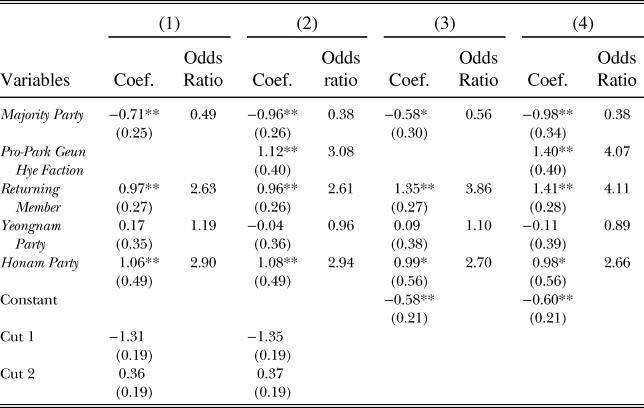
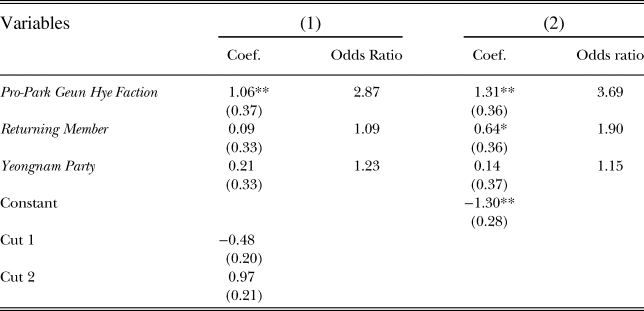
Table 4.1 shows the results of the analysis. As you can see, the Majority Party is negatively correlated to the dependent variable. This result shows that the majority-party members were in fact less likely to support the procedural reform bill. On the contrary, the Pro-Park Faction is positively correlated with the dependent variable. This means that members of the Pro-Park faction defected from the majority preference of their party. The result implies that affiliation with the Pro-Park faction is a significant factor that explains the variance of vote choice on the procedural reform within the majority party. I also re-run the same models with only Saenuri Party members included in the sample and present the results in Table 4.2. Moreover, as you can see the split within the majority party, this was a case where presidential electoral incentives nullified the majority party's negative agenda control on party-splitting bills from reaching the floor vote.
Vote Choice on the Procedural Reform Bill

Notes: n = 293; *=p < 0.10, **=p < 0.05. Robust standard errors are in parentheses.
Models 1–2 are results of ordered logistic regression and Models 3–4 are results of binary logistic regression.
Returning Member is a binary variable and was coded “1” if the legislator was reelected to the 19th National Assembly and “0” otherwise. Yeongnam Party is a binary variable and was coded “1” if the legislator is affiliated with the Saenuri Party and elected in the Yeongnam region and “0” otherwise. Honam Party is a binary variable and was coded “1” if the legislator is affiliated with the Democratic United Party and elected in the Honam region and “0” otherwise.
Vote Choice on Procedural Reform Bill (Saenuri Party only)

Notes: n = 165; *=p < 0.10, **=p < 0.05. Robust standard errors are in parentheses.
Models 1 is the result of ordered logistic regression and Model 2 is the result of binary logistic regression.
Returning Member is a binary variable and was coded “1” if the legislator was reelected to the 19th National Assembly and “0” otherwise. Yeongnam Party is a binary variable and was coded “1” if the legislator is affiliated with the Saenuri Party and elected in the Yeongnam region and “0” otherwise
To get a better sense of the substantive effects of party (Majority Party) and faction (Pro-Park Faction) affiliation on members’ vote choice on the procedural reform bill, I use Clarify to calculate simulated probabilities in Table 4.3 (see Tomz, Wittenberg, and King Reference Tomz, Wittenberg and King2003). When all covariates are at mean values, the change of Majority Party from ‘0’ to ‘1’ leads to a 23-percentage point decrease in the probability of voting “Yea” on the procedural reform bill. On the contrary, the change of Pro-Park Faction from “0” to “1” leads to a 27-percentage point increase in the probability of voting “Yea” on the same bill.
Simulated Changes in Probability of Vote Choice on Procedural Reform Bill

Some of the control variables also deserve some attention. Returning Member is significantly positively correlated with the dependent variable in all models. This demonstrates that returning members are more sensitive to political pressures when voting on a salient issue than non-returning members who will no longer be in office. Yeongnam Party is not statistically significant. Null finding on Yeongnam Party was predictable because we would expect the Saenuri Party to be internally divided on this vote.
CREDIBILITY OF PUNISHING MAJORITY-PARTY DEFECTORS (HYPOTHESIS 2)
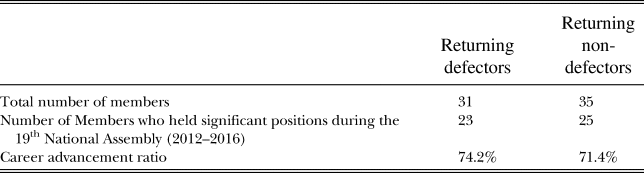
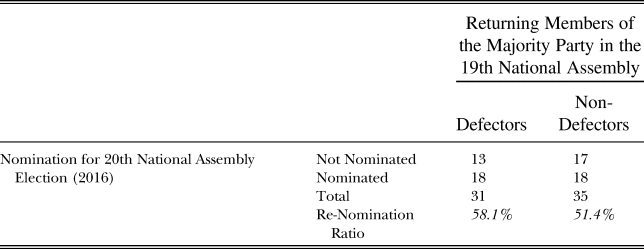
Lastly, I test whether the majority-party defectors were punished for their defection on the procedural reform bill. Empirical testing of intra-party punishment is difficult because punishment can mean different things. In this section, I operationalize punishment as follows. First, career advancement after the defection would be a valid indicator of punishment. Those who are punished for defection should be less likely to advance in their careers during their term. Second, re-nomination to the subsequent election would also be a valid indicator, because nominating candidates to public offices is one of the core powers of the party. If the defectors are punished, they would be less likely to receive nominations for the subsequent National Assembly election.
Tables 5.1 and 5.2 show these results. As you can see, there are no significant differences between the defector group and non-defector group. In fact, the defector group's career advancement ratio and re-nomination ratio were slightly higher than the non-defector group. This means that those defectors are indeed not punished for their defection as predicted in Hypothesis 2.
Career Advancement Ratio

Note: Significant positions refer to the following: 1) Minister-level positions in the central government, 2) Mayor/Governor of province-level local governments, 3) Key positions within the party (Party Chair, Members of Party High Council, Floor Leader, Deputy Floor Leader, Chair of Policy Committee, Deputy Chair of Policy Committee, Secretary General, Deputy Secretary General, Spokesperson, City/Province Party Office Chairs) or in the National Assembly (Speaker, Vice Speaker, Committee Chairs).
Re-Nomination Ratio

DISCUSSION
In this article, I develop an alternative mechanism of non-partisan procedural rules changes by incorporating the logic of presidentialization, and I test the claims by conducting a case study analysis of the procedural reform in the South Korean National Assembly on May 2, 2012, which provides a least-likely (most-likely) case setting for non-partisan (partisan) theory of procedural rules changes. The partisan theory of procedural rules changes (Cox and McCubbins Reference Cox and McCubbins1993, Reference Cox and McCubbins1997, Reference Cox and McCubbins2005) predicts that the majority party designs the procedural rules to suit its interests. In presidentialized parties, however, presidential electoral incentives may be in conflict with the majority party's incentives when voting on procedural rules changes, and the threat of punishing majority-party defectors is not credible when those defectors vote with the presidential candidate. A case study analysis of the 2012 Procedural Reform in the South Korean National Assembly reveals that the centripetal force induced by presidential incentives led the Saenuri Party's leading presidential candidate Park Geun Hye to support a bipartisan compromise on procedural reform and the members of the Pro-Park Geun Hye faction defected from the majority party during a floor vote on the procedural reform bill that undermines the majority cartel arrangement. The defectors, however, were not punished after Park Geun Hye won the presidency.
This finding has implications on theoretical debates on procedural rules changes. First, this article demonstrates how legislative procedural rules are endogenous institutions that reflect the interests of politicians. Although the idea that politicians’ incentives influence institutions is not new, the contribution of this article is that it examines how politicians’ incentives shape internal rules of the legislature in a relatively unexplored context, South Korea. Second, this article demonstrates how procedural rules changes occur in a system with presidentialized parties. Specifically, it shows how presidential incentives undermine the incentives of the majority party to maintain the cartel arrangement. Thus, the findings of this article imply that the incentives induced by presidential institutions affect parties’ incentives in structuring procedural rules. Third, the theoretical mechanism of procedural rules changes generated in this article may be expanded to explain party's preference on legislative outcomes in general in a presidentialized setting. Specifically, future studies should focus on whether the centripetal force induced by presidential incentives affect legislative outcomes in general or whether the influence of presidential incentives change depending on other environmental factors such as presidential electoral cycle. Lastly, this article also has some implications about Korean politics. While it is commonly known that the president is a dominant figure in Korean politics, most studies only focus on the influence of the president on policy outcomes (see e.g., Kwon Reference Kwon2005; Horiuchi and Lee Reference Horiuchi and Lee2008) and relatively neglect how parties are affected by electoral incentives of presidential candidates in producing legislative outcomes. This article attempts to fill in that missing link by incorporating the logic of presidentialization to parties in the South Korean National Assembly. The legislative outcomes induced by presidential electoral incentives paired with the uncertainty induced by a single five-year term limit for the presidency may provide an explanation for why South Korean parties have difficulties in building longstanding programmatic (and partisan) platforms.