Congenital long QT syndrome is an inherited disorder in which prolonged ventricular repolarisation confers increased risk for potentially lethal ventricular tachyarrhythmias.Reference Jervell and Lange-Nielsen 1 The most common is type 1 long QT syndrome, accounting for ~30–35% of all long QT syndrome.Reference Tester and Ackerman 2
Type 1 long QT syndrome results from loss-of-function mutations within the KCNQ1-encoded Kv7.1 potassium channel that contributes to phase 3 repolarisation of the ventricular myocytes.Reference Ackerman 3 Exercise and exertion are known arrhythmogenic triggers in long QT syndrome, particularly in patients with type 1 long QT syndrome. Epinephrine-mediated, paradoxical QT prolongation is characteristic of type 1 long QT syndrome and has been used to test the integrity of the Kv7.1 pathway.Reference Ackerman, Khositseth, Tester, Hejlik, Shen and Porter 4 Although the relationship is less well understood, it is hypothesised that increased sympathetic activity during high emotional stress may precipitate sudden cardiac events.Reference Schwartz, Zaza, Locati and Moss 5 We describe a case of acute, profound QT accentuation secondary to significant emotional distress.
Case report
A 15-year-old girl was diagnosed with long QT syndrome by a screening electrocardiogram obtained after her brother was found to have long QT syndrome. She was then referred to our long QT syndrome clinic for further evaluation, risk stratification, and treatment.
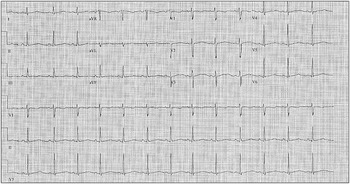
Her first electrocardiogram demonstrated marked prolongation with a QTc of 570 ms (Fig 1). During stress testing, the QTc was 570–580 ms before exercise and extended to 607 ms at 1 minute of exercise. On Holter monitoring, her average heart rate was 54 beats per minute with 60% of the total beats <60 bpm. Following these results, the patient was started on 10 mg of nadolol daily and referred to our long QT syndrome clinic.
Diagnostic ECG (average QTc=570 ms).

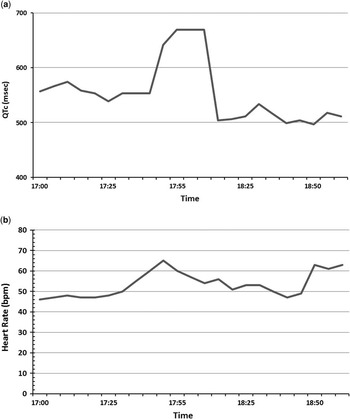
With genetic test results pending, the patient was admitted for continuous QTc monitoring given a history of a possible long QT syndrome-triggered event and her degree of QT prolongation at rest. Her average QTc was 520 ms. During a discussion with her long QT syndrome specialist (M.J.A.) regarding her diagnosis and treatment including the potential need for an implantable cardioverter defibrillator, she became emotional and tearful. Concurrently, her QTc dynamically increased to>650 ms in <5 minutes with a maximum QTc of 669 ms (Fig 2a). Her heart rate remained 54–60 bpm throughout the episode (Fig 2b). The QTc remained prolonged for 10 minutes until she regained composure. An ECG tracing during the time of prolongation was not available, but ECGs just before the episode and subsequently did not show T-wave abnormalities.
( a ) Continuous QTc monitoring during emotional distress. ( b ) Continuous heart rate monitoring during QT prolongation.

This patient was deemed at high risk for a sudden cardiac event. β-Blocker dosing was unable to be increased because of significant bradycardia. After declining left cardiac sympathetic denervation surgery, an implantable cardioverter defibrillator was placed and low-dose nadolol continued. After 6 weeks, her testing returned positive for type 1 long QT syndrome with frameshift mutation, Arg192fs, in the KCNQ1-encoded Kv7.1. The patient is now 1 year post-implantable cardioverter defibrillator placement and is doing well without any recurrences or defibrillator discharges thus far.
Discussion
Exercise and strong emotions have been associated with sudden cardiac events in patients with type 1 long QT syndrome.Reference Aziz, Wieand and Ganley 6 In the International LQTS Registry comprising over 2000 patients with long QT syndrome, 58% of patients reported an episode of syncope associated with intense emotion.Reference Moss, Schwartz, Crampton, Locati and Carleen 7 It has been hypothesised that these events are related to catecholamine release, which triggers early after depolarisations with the potential to degenerate into ventricular tachyarrhythmias.Reference Ali, Zareba and Moss 8 , Reference Liu, Choi and Ziv 9
This is the first case of a precipitous increase in QTc temporally associated with emotional distress in a patient with type 1 long QT syndrome captured during continuous QTc monitoring. Notably, it appears that intrinsic repolarisation was affected directly as heart rate did not increase during the episode, which would be expected with increased sympathetic activity.
Published studies indicate that events are higher among women with type 2 long QT syndrome compared with their male counterparts.Reference Lane, Zareba, Reis, Peterson and Moss 10 However, the risk of aborted cardiac arrest/sudden cardiac death was similar for men and women with type 1 long QT syndrome. It is not clear whether the female gender may have contributed to the dramatic QTc shift for this patient.
Currently, there have been limited prospective studies evaluating the link between emotions and long QT syndrome. Lane and colleagues noted that “high arousal negative” affects – that is anxious, angry – were associated with shortening of the QT interval possibly related to decreased vagal tone during high arousal states.Reference Migdalovich, Moss and Lopes 11
These changes are seen in normal controls, but are unexpected for patients with long QT syndrome given previous evidence of their paradoxical response to catecholaminesReference Ackerman, Khositseth, Tester, Hejlik, Shen and Porter 4 . In our case, the patient had a “high arousal negative” affect but experienced lengthening of the QT interval rather than attenuation. The authors hypothesised the paradoxical data may be because they evaluated low-level daily emotions over a 3-day period missing high stress situations, which could precipitate sudden cardiac events. These data illustrate the complexity of emotional effect on cardiac conduction with interplay between sympathetic stimulation and baseline vagal tone.
Schwartz et al published a case series and literature review in 1991 in Circulation, which documented several cases of patients with long QT syndrome who were noted to have arrhythmias associated with sudden emotional eventsReference Schwartz, Zaza, Locati and Moss 5 . They described the case of a 5-year-old girl with long QT syndrome who was frightened and, on repeat ECGs performed over a 10-minute period, developed T-wave alternans and subsequently died shortly afterward. She did not have lengthening of the QT interval, although she did appear to have an increased heart rate consistent with increased sympathetic activity.
These data along with the case presented here demonstrate the complexity of the effect of emotional state on cardiac risk and suggest that episodes of emotion-triggered events are the result of sympathetic activity, as well as other less-well defined mechanisms.
Conclusion
This case, along with prior studies, demonstrates the complexity of the heart–brain interaction. Although the effect of exercise on QT length has been studied extensively, limited data exist regarding emotional effects on QT prolongation. The presented case demonstrates the relationship between emotional stressors and lengthening of the QTc in patients with long QT syndrome. Prior studies have suggested that prolongation of the QTc and increased risk of cardiac events may be related to increased sympathetic activity with emotional distress.
However, this report suggests that there are other factors involved, given that our patient’s heart rate did not increase in conjunction with prolongation of her QTc. Further research is needed to expand the current understanding of the mechanisms causing QTc prolongation and the risk of sudden cardiac events in relation to emotional stress.
Acknowledgements
None.
Financial Support
None.
Conflicts of Interest
Dr Michael J. Ackerman, MD, PhD, is a consultant for Boston Scientific, Gilead Sciences, Medtronic, St. Jude Medical Inc, and Transgenomic (FAMILION). He owns intellectual property and receives royalties from Transgenomic (FAMILION).
Ethical Standards
The authors assert that all procedures contributing to this work comply with the ethical standards of the relevant national guidelines on human experimentation and with the Helsinki Declaration of 1975, as revised in 2008, and has been approved by the institutional committees at Mayo Clinic.