Introduction
There has been a growing interest in the influence of helping others on well-being and life satisfaction among older adults (Bonhote, Tomano-Egan and Cornwell Reference Bonhote, Tomano-Egan and Cornwell1999; Brown, Consedine and Magai Reference Brown, Consedine and Magai2005; Chappell et al. Reference Chappell, Dlitt, Hollander, Miller and McWilliam2004; Dunlin and Hill Reference Dunlin and Hill2003; Poortinga Reference Poortinga2006; Warburton and McLaughlin Reference Warburton and McLaughlin2005). This work has been framed by the literature in gerontology on activity and role theory, which argues that successful adaptation to ageing processes necessitates role replacement to maintain the level of activity and to enhance well-being (Havighurst and Albrecht Reference Havighurst and Albrecht1953). A recent contribution conceptualises roles as resources for action and agency (Piliavin, Grube and Callero Reference Piliavin, Grube and Callero2002). Providing assistance to others in the form of volunteer activities and informal support of neighbours are the key forms of helping behaviour understood to be based on a sense of altruism and assumed to have positive effects on the helper's emotional well-being. Additionally, these types of giving have been shown to strengthen a sense of belonging to one's community, an aspect of social capital, which in turn can have a positive effect on health (Brown, Consedine and Magai Reference Brown, Consedine and Magai2005; Dunlin and Hill Reference Dunlin and Hill2003; Lomas Reference Lomas1998). Associations among altruism, social capital and positive health outcomes may help us understand how social and subjective dimensions of behaviour make us healthier in old age under different social and economic circumstances (Brown, Consedine and Magai Reference Brown, Consedine and Magai2005; Statistics Canada 2004).
An extensive literature has connected psychological well-being and various aspects of social-network functioning (Garcia-Martin, Gomex-Jacinto and Martimportugues-Goyenechea Reference Garcia-Martin, Gomex-Jacinto and Martimportugues-Goyenechea2004; Goodwin, Cook and Yung Reference Goodwin, Cook and Yung2001; Kellen Reference Kellen2003; Quails Reference Quails2005). Evidence indicates that the socially active consistently report higher levels of well-being (Quails Reference Quails2005). Increased social interaction has been linked to increased altruistic behaviour (Okun, Pugliese and Rook Reference Okun, Pugliese and Rook2007), and helping others has been shown to have a positive impact on an individual's emotional state and to raise life satisfaction (Yuen Reference Yuen2002). Furthermore, a growing body of research has established that people with stronger social capital experience health benefits as a result of community connectedness (for reviews seePoortinga Reference Poortinga2006; Statistics Canada 2004). There is nonetheless a need to extend our understanding about which social activities have the most influence on health, how they inter-relate, and how they affect individuals at different stages of the lifecourse, not least at older ages when social roles tend to change. To extend our understanding of healthy ageing, this paper specifically examines the relationship between altruistic behaviour and social capital, and the associations of the two with key subjective dimensions of well-being – life satisfaction and perceived happiness among older adults. The data were drawn from the 2003 Canadian General Social Survey, Cycle 17 (GSS-17) (Statistics Canada 2004).
Theoretical foundations
Altruism is commonly thought of as unselfish concern and actions for the welfare of others, which fosters personal psychological growth and increases an individual's ability to connect with others (Yalom and Leszcz Reference Yalom and Leszcz1995). In this study, the concept of generativity is coupled with role-identity theory to understand how altruistic behaviour, manifested through volunteerism, may enhance well-being in old age. The concept of generativity was proposed by Erik Erikson (Reference Erikson1985) and is based on a typology of psychosocial developmental tasks that take place over the late lifespan. It is the seventh of Erikson's eight phases of middle to late adulthood and refers to sustained acts of responsibility (such as community building and leadership) that contribute to the growth and well-being of others, including future generations (Piliavin, Grube and Callero Reference Piliavin, Grube and Callero2002). Generativity involves the ability to guide and care for others in old age without any expectation of reciprocity, as with volunteer work, and is thought to create intrinsic rewards (Vaillant Reference Vaillant and Post2007).
As reported by Bradley (Reference Bradley1997), older adults sustain cultural symbols and traditions through generativity, modelling their values for future generations. Through their efforts in caring for others, volunteers renew the self as well as their community. Drawing from early developers of symbolic interaction approaches, such as George Herbert Mead and Herbert Blumer, role-identity theory elucidates the importance of social roles and social networks in defining the self or multiple selves. Sheldon Stryker (Reference Stryker1980) proposed ‘identity theory’ to capture the ways in which individuals use personal agency to shape roles within organisational structures that enable an individual to build a sense of self (Piliavin, Grube and Callero Reference Piliavin, Grube and Callero2002). Adopted positions, such as volunteer roles, can be thought of as symbolically defined within a larger organisational structure, with potentially positive outcomes for well-being (Morrow-Howell et al. Reference Morrow-Howell, Hinterlong, Rozario and Tang2003). Volunteering provides opportunities to increase self-esteem and well-being through role adoption, while cultivating generativity (Narushima Reference Narushima2005).
In examining well-being as a concept, Piliavan and Siegl (Reference Piliavin and Siegl2007) distinguished between hedonic well-being and eudaimonic well-being. Hedonic well-being entails feeling good about one's situation in life, captured in measures such as happiness, whereas eudaimonic well-being is defined in terms of meaning and self-realisation, reflected in a sense of satisfaction that one is serving society, as through volunteering roles (Piliavin and Siegl Reference Piliavin and Siegl2007). In this framework, altruistic behaviour in the form of volunteerism or helping others may affect well-being on different levels. From another perspective, Reissman (Reference Reissman1965) introduced the ‘helper principle’, that helping those in need leads to self-validation and increased feelings of self-worth, which is analogous to the placement of altruism high on Maslow's hierarchy, where some individuals as they age put aside self in favour of the greater good (Koltko-Rivera Reference Koltko-Rivera2006; Reissman Reference Reissman1965) to support their community (McPherson and Wister Reference McPherson and Wister2008).
Altruistic behaviour, social capital and well-being
Many older adults are involved with volunteering or helping others in ways that provide benefits for both the volunteer and the receiver of the benefits. As noted by Warburton and McLaughlin (Reference Warburton and McLaughlin2005), however, volunteers do not usually account for their altruistic behaviours and often the volunteering is not acknowledged or noticed. Altruism also takes many forms – from small acts of kindness for a neighbour to volunteering time for international charities. But is all helping altruistic? Definitions and operationalisations of the term are controversial, particularly using giving or support to others as a proxy for altruism. It is difficult to ascertain the non-material benefits gained by helping others, since some contend that there is virtually always some form of reward in giving (Brown, Consedine and Magai Reference Brown, Consedine and Magai2005). There is also difficulty in identifying ‘altruistic purpose’ in giving, since motivations to help others are multi-dimensional, and a question remains as to whether altruism is an innate trait or linked to prior behaviour (Barber Reference Barber2004). These issues confirm the need to examine specific types of giving in different contexts in order to link them more closely to altruistic behaviour and positive health outcomes.
There is also uncertainty about whether and to what extent altruistic behaviour affects individuals at different points in the lifecourse. One perspective is that altruistic behaviour is particularly beneficial for older people, since they are more vulnerable to age-related illness, health risks, and stressors linked to role change. Many older people experience stress associated with life changes, including loss of social roles, loss of life-long companions, and loss of physical and mental abilities (Thomas Reference Thomas1996). All such losses have a potentially negative influence on well-being and an older individual's activity level. Thus, not only might older adults benefit more from altruism, but they may find such behaviour more difficult for the same reasons.
It is likely that not all types of helping activities have the same influence on older people and that merely increasing the amount of participation in any social activity will not necessarily result in an increase in well-being. One might speculate that participation in specific altruistic activities have more influence on these feeling states than general social activities, such as interacting or even helping family and friends (Gorski Reference Gorski2000). This may be because different sets of expectations and intrinsic benefits associate with purely altruistic helping behaviour, such as volunteering, when compared with more routine and normative social activities, such as babysitting a grandchild. For the purposes of this study, altruistic behaviour is defined as any helping that has costs in time, effort or goods connected with the act of being concerned for the welfare of others that does not include helping family and friends (Bonhote, Tomano-Egan and Cornwell Reference Bonhote, Tomano-Egan and Cornwell1999). It is argued that assisting family members, friends or neighbours may be an obligatory role and as such does not result in the same intrinsic benefits (Thoits and Hewitt Reference Thoits and Hewitt2003).
Many studies have suggested a link between health and volunteering (Brown, Consedine and Magai Reference Brown, Consedine and Magai2005; Erikson, Erikson and Kivnick Reference Erikson, Erikson and Kivnick1986; Gorski Reference Gorski2000; Thoits and Hewitt Reference Thoits and Hewitt2003; Väänänen et al. Reference Väänänen, Buunk, Kivimäki, Pentti and Vahtera2005; Warburton and McLaughlin Reference Warburton and McLaughlin2005). For example, a large study of American community-dwelling older adults found that greater giving versus receiving associated with reduced morbidity, even after controlling for the person's capacity to give (Brown, Consedine and Magai Reference Brown, Consedine and Magai2005). In another comparison of the effects of giving versus receiving help, it was found that the benefit for well-being was 7.5 times greater, as measured by depression, anxiety, satisfaction and happiness (Schwartz and Sender Reference Schwartz and Sender1999). Using Wisconsin Longitudinal Study data, however, Piliavin and Siegl (Reference Piliavin and Siegl2007) found evidence that the relationship between volunteering and psychological well-being was moderated by level of social integration. Further research is clearly needed to elucidate these patterns.
Drawing from the theoretical framework, apart from the more intrinsic emotional processes, it is possible that engaging in altruistic behaviour may foster an increased sense of belonging and connectedness to one's community. As Lomas (Reference Lomas1998: 1182) reflected, ‘individuals (and their ill-health) cannot be understood solely by looking inside their bodies and brains; one must also look inside their communities, their networks, their workplaces, their families and even the trajectories of their life’. Those with stronger connections to their community tend to report better health, income, housing and happiness, even as they move into the latter stages of the lifecourse (Kritsotakis and Gamarnikow Reference Kritsotakis and Gamarnikow2004; Poortinga Reference Poortinga2006; Statistics Canada 2004; Yip et al. Reference Yip, Subramanian, Mitchell, Lee, Wang and Kawachi2007).
Despite the growing literature on volunteering, the connections among altruistic behaviour, social capital and health have not been studied to date, except at the theoretical and conceptual levels, although many studies see the connections as important. For example, a recent Australian qualitative study concluded that essential social dimensions of social capital and altruism intrinsic to volunteering among older persons are critical to the well-being of a sustainable community (Warburton and McLaughlin Reference Warburton and McLaughlin2005). We therefore hypothesise that altruistic behaviour is associated with social capital, and furthermore that altruistic behaviour with its anticipated health benefits may be mediated by the broader influence of social capital on health and well-being, which is embedded within community. These hypotheses will be examined by means of an exploratory analysis of data drawn from the GSS-17, which contains information on helping patterns.
Methods
The Canadian General Social Survey data
The General Social Survey was established in 1985 by Statistics Canada and is conducted by telephone with a different theme each year. Data for the current study were drawn from the 2003 survey (GSS-17), a representative national cross-sectional sample (Statistics Canada 2004). The target population were those aged 15 or more years resident in Canada, excluding the Yukon, Northwest Territories and Nunavut, and excluding full-time residents of institutions. Cycle 17 was dedicated to the topic of social engagement and included information on well-being (perceived happiness, life satisfaction), social and civic participation, sense of belonging, main activity of respondents, health status, as well as social networks and other characteristics. The data were collected over 11-months from February 2003 until December 2003 by computer-assisted telephone interviewing. The total number of participants in Cycle 17 was 24,951. The GSS-17 includes several questions that target issues such as helping behaviours and life satisfaction pertinent to the current analysis. The non-response rate was 22 per cent, and people in the lowest income households were slightly under-represented (Statistics Canada 2004). Statistics Canada did not provide detailed information about non-responders, so there is a possibility of other bias.
Current study sample and characteristics
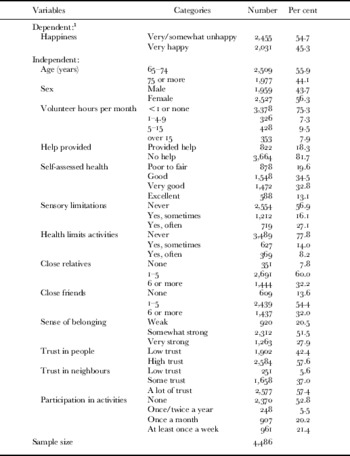
The sub-sample used in this study was 4,486 people aged 65 or more years. Weights to account for sampling error by age, sex and geographical region were used, and the weighted sample was rescaled to the original sample size to facilitate meaningful statistical analyses. Of the sample, 56.3 per cent (2,527) were female and 43.7 per cent (1,959) male. Although almost three-quarters of the sample reported that their health was ‘good’ to ‘excellent’, 16.1 per cent (1,212) experienced activity limitations some of the time, as with hearing, seeing, communicating, walking, climbing stairs, bending, leaning or doing any similar activities, and 27.1 per cent (719) stated they often had difficulty with these tasks. In addition, 14 per cent (627) stated that a physical, mental or health condition sometimes reduced the amount or kind of activity that was undertaken, and 8.2 per cent (369) stated that these health conditions often reduced the kind or amount of activity undertaken. These sample characteristics are similar to other large national surveys of older persons. Although there tends to be a higher non-response rate for those with more health limitations, health status was statistically controlled in the analyses.
Dependent variables: perceived happiness and life satisfaction
Two separate measures of well-being were used as dependent variables: ‘perceived happiness’ and ‘self-reported life satisfaction’. While happiness and life satisfaction are empirically correlated and have been grouped by some researchers (Veenhoven Reference Veenhoven1995), they have also been considered as separate constructs (Cummins Reference Cummins1998; Tepperman and Curtis Reference Tepperman and Curtis1995). It is useful to separate these concepts since their temporal references differ. Cummins (Reference Cummins1998) noted that ‘life satisfaction’ has a reflective quality that implies a review and judgement of the quality of the life one has experienced, whereas ‘happiness’ is an assessment of life at the present time: it is often studied separately. Psychological well-being is often measured using a multiple-item scale that captures several constructs, but in this study we use only the two described.
Perceived happiness was measured using responses to the question: ‘Presently, would you describe yourself as … (select from) very unhappy, somewhat unhappy, somewhat happy and very happy?’ Because among people aged 65 or more, many subjective measures are positively skewed, as was the case with the GSS-17 measures, we collapsed ‘very unhappy’, ‘somewhat unhappy’ and ‘somewhat happy’ into one category (=1) and made ‘very happy’ another (=2). This dichotomy warrants comment, particularly the rationale for combining ‘somewhat happy’ and ‘somewhat unhappy’. Veenhoven (Reference Veenhoven1984) noted that the condition of happiness denotes a degree of well-being; that is, more or less of something. A person can evaluate their life more favourably than unfavourably, and saying that one is ‘somewhat happy’ likely refers to elements of unhappiness as well as happiness, but not necessarily elements of being ‘very happy’. That said, it is not possible to know exactly what the respondents in this study had in mind with the subjective appraisal of their happiness. With the new coding, 54.7 per cent (2,455) of the respondents indicated that they were ‘very unhappy – somewhat happy’ and 45.3 per cent (2,031) that they were ‘very happy’.Footnote 1 This dichotomy was used in the logistic regression analysis.
Life satisfaction was measured using responses to the question: ‘How do you feel about your life as a whole right now?’ (responses from 1 ‘very dissatisfied’ to 10 ‘very satisfied’). Older Canadians on the whole rate their life satisfaction as quite high. The mean score was 7.86 (standard deviation 1.85). This skewed distribution is typical in studies of well-being among older persons (Diener and Diener Reference Diener and Diener1996). Ordinary least-squares (OLS) regression was used to model this dependent variable.
Independent variables
The socio-demographic factors of interest were age and sex. It has been reported that as age increases, social motivation increases (Okun and Schultz Reference Okun and Schultz2003). The GSS-17 public-use sample tape coded age in 10-year groups, and the age variable for analysis had two groups (65–74 and 75+ years). Piliavin and Siegel's (Reference Piliavin and Siegl2007) literature review suggested that being female is one of the strongest predictors of volunteering, so gender was included as an independent variable. For measures of altruistic behaviour, four questions from the GSS-17 survey were used to create two measures. The four questions were: ‘In the past year, did you do unpaid volunteer work for any organization? If yes, on average, about how many hours per month did you volunteer? Did you provide help to a neighbour on a regular basis? Did you provide help to another person [not including family or friends] on a regular basis? The responses to the first two questions were combined to create a ‘volunteer hours’ measure, and those to the last two questions were combined to create a ‘help provided’ measure (not including family and friends). These two variables are good indicators of altruistic activities, since they focus on helping unrelated individuals and neighbours rather than family and friends, and also they specify the amount of help given.
The research literature provides abundant evidence of associations between health status, social support and life satisfaction (Gorski Reference Gorski2000; Kritsotakis and Gamarnikow Reference Kritsotakis and Gamarnikow2004; Poortinga Reference Poortinga2006). Since the analysis sought to determine the influence of altruistic behaviour and social capital on life satisfaction and perceived happiness in older adults, the health status of the respondents needed to be taken into account. Self-assessed health is often used by researchers as a general but robust measure of health status in older adults (Zimmer et al. Reference Zimmer, Natividad, Lin and Chayovan2000). Self-assessed health has been shown to be predictive of changes in life satisfaction (Berkman and Kawachi Reference Berkman and Kawachi2000; Larson Reference Larson1978). For the analysis, we used three health measures from the GSS-17. The first was a global self-assessment: ‘In general would you say your health is … (select from) poor-fair, good, very good, or excellent?’ The second question was about physical functioning: ‘Do you have any difficulty hearing, seeing, communicating, walking, climbing stairs, bending, leaning or doing any similar activities?’ The third question was whether the respondent had a limiting health condition: ‘Does a physical condition or mental condition or health problem reduce the amount or the kind of activity you can do?’Footnote 2 There are no other health-related questions in the GSS-17.
Social support
There is evidence of strong links between individual social networks and health outcomes (Poortinga Reference Poortinga2006). For the purposes of this article, social support will be defined as individual social relationships with family and friends that provide a sense of emotional support. Two questions with preset ordinal response sets in the GSS-17 have been used to measure social support: (a) How many relatives do you have who you feel close to, that is, who you feel at ease with, can talk to about what is on your mind, or call on for help? (none, one to five relatives, six or more relatives); (b) How many close friends do you have, that is, people who are not your relatives, but who you feel at ease with, can talk to about what is on your mind, or call on for help? (none, one to five friends, six or more friends).
In a study examining the health effects of social capital, Poortinga (Reference Poortinga2006) used both personal levels of social networks, support and trust as well as participation in community activities and organisations. Social capital at a community level involved a combination of social trust, participation in activities and a place where neighbours looked out for one another. Here, four questions from the GSS-17 were used to capture similar dimensions of social capital:
1. ‘How would you describe your sense of belonging to your local community?’, with the available responses being ‘very weak’, ‘somewhat weak’, ‘somewhat strong’ and ‘very strong’.
2. ‘Generally speaking, would you say that most people can be trusted or that you cannot be too careful in dealing with people?’, with the available responses being ‘people can be trusted’, ‘(one) cannot be too careful in dealing with people’.
3. ‘How much do you trust people in your neighbourhood?’, with the available responses being that they ‘cannot be trusted at all’ or ‘can be trusted a lot’.
4. ‘Altogether, about how often did you participate in group activities and meetings?’, with the pre-coded responses ‘not in the past year’, ‘once or twice a year’, ‘once a month’, ‘a few times a month’ and ‘at least once a week’.
These questions capture the components of social capital reported by Poortinga (Reference Poortinga2006). Question 1 on sense of belonging directly reflects sense of bonding to the community; Questions 2 and 3 on trust in people generally and trust in neighbours reflects sharing and trust (general and specific to neighbours); and lastly, Question 4 on participation in group activities and meetings reflects involvement in community groups. Thus, social capital is conceptualised as a social resource that benefits those willing and able to access it.
Results
Altruistic behaviour and social capital
Of the total sample, 1,220 (27.7%) did unpaid volunteer work for an organisation. No information was available on why those who did not volunteer did not do so. Of those who did volunteer, 326 (7.3%) volunteered 1–4 hours per month and 428 (9.5%) volunteered 5–15 hours per month. In addition, 822 (18.3%) reported that they regularly provided unpaid help to neighbours or others. Turning to social capital, 2,312 or over one-half (51.5%) of the respondents indicated a ‘somewhat strong’ sense of belonging to their community and 1,263 (27.9%) reported a ‘very strong’ sense. Over one-half (2,577 or 57.4%) felt their neighbours were ‘trustworthy’ and 961 (21.4%) took part in ‘group activities’ at least once a week. Table 1 provides frequency distributions for all the variables.
Frequency distribution for dependent and independent variables

Notes: 1. The mean and standard deviation for the interval life satisfaction variable were 7.86 and 1.85. The tabulated frequency distributions are those entered in the multivariate analysis.
Source: Canadian General Social Survey, Cycle 17 (Statistics Canada 2004). For details see text.
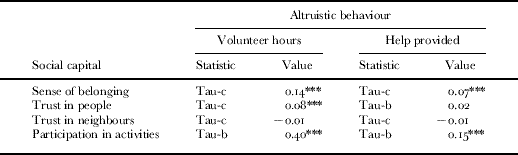
We begin with the bivariate relationships between the measures of the two primary independent variables in the analysis, altruistic behaviour and social capital. ‘Sense of belonging to the community’ had a weak positive association with ‘volunteer hours’, as well as a weak relationship with ‘providing help to neighbours and others’ (Table 2 has the test statistics). ‘General trust in people’ had a weak positive association with ‘volunteer hours’ but no significant relationship with ‘help provided to neighbours’. Similarly, no relationship was found between ‘trust in neighbours’ and either measure of altruistic behaviour. However, a moderate positive relationship was found between a respondent's ‘participation in community activities’, our measure of social capital, and ‘volunteering hours’, and had a weak association with ‘help provided to neighbours and others’ as a form of altruistic behaviour (Tau-b=0.15, p<0.001). Most of the associations between the social capital and altruistic behaviour measures were either weak or not supported, the exception being the association between ‘involvement in community activities’ and ‘volunteering hours’.
Bivariate analysis of altruistic behaviour and social capital
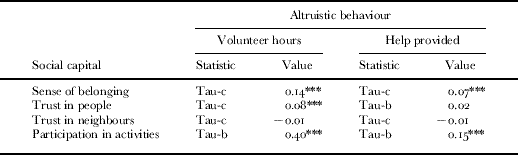
Note: Sample size 4,486.
Significance level: *** p<0.001.
The factors influencing perceived happiness
A hierarchical logistic regression model was used to examine sequential sets of predictors of perceived happiness. In the order examined, these included variables for: socio-demographic attributes, altruistic behaviour, health status, social support and social capital. Although health status may also affect altruistic behaviour, given the considerable evidence for their association it was decided to include altruistic behaviour prior to health status. Schwartz (Reference Schwartz and Post2007) recognised this dilemma for altruism research: she found that the participants in her study did not need to be physically healthy to benefit from altruistic behaviour – many had disabilities. It is possible, however, that those who volunteer are better off physically. With this in mind, demographic and altruistic behaviours were considered to precede health variables. Social capital was placed in the final model in order to examine its mediating effect on altruism. The correlations among the independent variables did not show significant multi-colinearity.
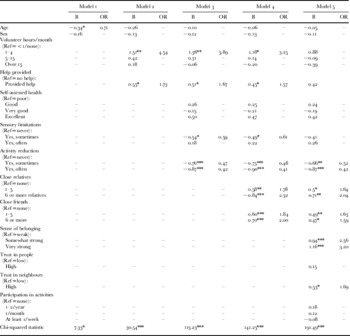
All five logistic regression models were statistically significant. The Model 1 predictors were the demographic variables age and sex (χ2=7.31, degrees of freedom (df)=2, p<0.05); Model 2, altruism (model χ2=30.5, df=6, p<0.001); Model 3, health status (model χ2=113.2, df=13, p<0.001); Model 4, social support (model χ2=141.3, df=17, p<0.001); and Model 5, social capital (model χ2=191.5, df=25, p<0.001).
As shown in Table 3, Model 1, the probability of reporting being happy (as compared to being unhappy) was lower among people aged 75 or more years compared to those aged 65–74 years. Sex was not statistically significant. In Model 2, a strong association was found for altruistic behaviour and perceived happiness. The odds of being happy increased for those who volunteered 1–4 hours per month, as compared to those who volunteered less than one hour per month (e.g. a few hours per year) or none. Also, the probability of being happy increased for those who provide regular help to their neighbours or others (not including family and friends) compared to those who provide no help. Age was not statistically significant in this model.
Logistic regression models of happiness among older Canadians

Notes: Dependent variable: happiness. Sample size 4,486. OR: odds ratio. Ref: reference category. A fuller table with standard errors of B is available from the author.
Significance levels: * p<0.05, ** p<0.01, *** p<0.001.
In Model 3, self-reported health status was not statistically significant. The odds of being happy (as compared to being unhappy) decreased for those that sometimes experience difficulties doing activities (e.g. due to problems with vision or hearing); for those with a physical or mental condition or health problems that sometimes reduces the kind or amount of activity they do; and for those with a physical or mental condition or health problems that often reduces the kind or amount of activity they do. Moreover, the relationships for altruistic behaviour and perceived happiness found in the previous model were replicated, with only slight reductions in their respective odds ratios.
In Model 4, several associations were found for social support measures and perceived happiness. The likelihood of being happy (as compared to being unhappy) increased for those with one to five close relatives compared to those with no close relatives, and for those with six or more relatives. Also, the odds of being happy increased for those with one to five close friends compared to those with no close friends, and for those with six or more close friends. All other associations were replicated, again with only sight reductions in strength.
In the final Model 5, several associations for the social capital measures were supported. The odds of being happy (as compared to being unhappy) increased for those with a somewhat strong sense of belonging to their community (compared with those who have a weak sense of belonging), and for those with a very strong sense of belonging to their community. Also, the likelihood of being happy (as compared to being unhappy) increased for those with higher levels of trust in their neighbours. The two variables measuring altruistic behaviour, volunteering and helping neighbours and others (‘help provided’) no longer met the criterion for statistical significance once the social capital block of variables was entered into the regression. This suggests a mediating effect of social capital on the relationship between altruistic behaviour and perceived happiness. Similarly, the very weak finding for persons experiencing difficulties in doing activities (compared to none) also became not statistically significant. All other associations were replicated.
OLS regression of life satisfaction
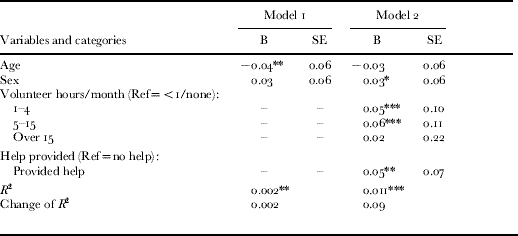
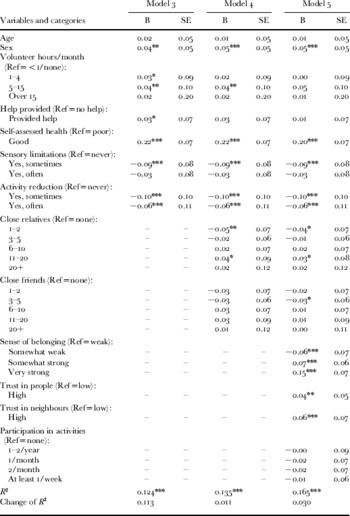
The hierarchical OLS regression modelling for life satisfaction is similar in some ways to the perceived happiness regression (see Table 4). The model as a whole explained 17 per cent of the variance in life satisfaction. Furthermore, as Table 4 shows, all five models were statistically significant. In Model 1, the demographic block explained 0.2 per cent of the variance in life satisfaction (R change=0.002, R 2=0.002, p<0.01); inclusion of the altruism variables in Model 2 explained an additional 0.9 per cent of the variance (R change=0.009, R 2=0.011, p<0.001); the health status variables in Model 3 explained an additional 11.3 per cent of the variance (R change=0.113, R 2=0.124, p<0.001); the social support variables in Model 4 explained an additional 1.1 per cent of the variance (R change=0.011, R 2=0.135, p<0.001); and inclusion of social capital in Model 5 explained an additional 3 per cent of the variance in life satisfaction (R change=0.030, R 2=0.165, p<0.001).
Ordinary least-squares hierarchical regression model for life satisfaction in older Canadians
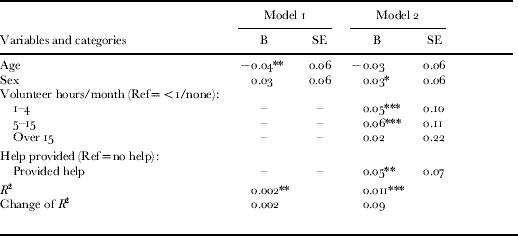

Notes: Dependent variable: life satisfaction. Sample size 4,486. Ref: reference group. SE: standard error of B.
Significance levels: * p<0.05, ** p<0.01, *** p<0.001.
Model 1 revealed a weak inverse relationship between age and life satisfaction, indicating that life satisfaction was slightly lower among those aged 75 or more years than those aged 65–74 years. This age association did not remain statistically significant in subsequent models. While sex was not statistically significant in the first model, it was supported in the remaining ones – being female was weakly associated with lower levels of life satisfaction compared to men. In Model 2, volunteering was associated with life satisfaction. Volunteering 1–4 hours per month (compared to less than once/none) was found to be a significant predictor of life satisfaction; as well as volunteering 5–15 hours per month. There was also a weak positive association for helping others (not including family and friends).
In Model 3, incongruent with the previously noted findings for happiness, perceived health was found to be a significant predictor of life satisfaction. Good perceived health (compared to poor) resulted in a moderate positive association. These findings support the contention that happiness and life satisfaction should be considered as separate constructs. Sensory limitations (e.g. vision problems) were weakly inversely associated with life satisfaction, as expected. Similarly, both contrasts measuring activity reduction were supported – sometimes/never and often/never. Model 4 shows support for two of the three contrasts measuring closeness to relatives, but in opposite directions. For 1–2/none there was a weak inverse association; whereas for 11–20/none we observed a weak positive association. The associations in the earlier models were replicated.
Finally, in Model 5, support was found for social capital measures. A weak inverse association was found for those reporting a somewhat weak sense of belonging to the community (compared to weak). Stronger positive associations with life satisfaction were uncovered for a somewhat strong sense of belonging to the community; and in particular, a very strong sense of belonging to the community, compared to weak. Weak positive associations with life satisfaction were also found for trust in people and trust in neighbours, but the association between volunteer hours and life satisfaction was not statistically significant in this model. Overall, the OLS regression results provide weak support for the hypothesis that altruism leads to higher life satisfaction. We did find, however, that the association between altruism and life satisfaction is mediated by the addition of the social capital measures.
Discussion
The goal of this study was to examine the inter-relationship between altruistic behaviour and social capital among older adults, and to investigate the associations of these attributes with the ‘perceived happiness’ and ‘life satisfaction’ dimensions of well-being. Since previous research had showed that social capital and altruistic behaviour share some conceptual elements, we began by examining the associations between these important psycho-social constructs. While most of the bivariate associations among the measures of social capital and altruistic behaviour were found to be weak or not statistically significant, we did uncover one moderate positive association, between participation in community organisations and the number of volunteer hours, suggesting that these two constructs were associated. This is not surprising, given that participation in organisations is very often voluntary. These findings lend some support to the theory of reciprocal altruism and generativity, in that older adults appear to be conscious of the need for exchange in resources and the need to invest in and to support their community and future generations (Trivers Reference Trivers1971). It was surprising, however, that the other associations between the measures of altruistic behaviour and social capital were not strong. While altruistic behaviour may lead to some increase in social capital, it does not necessarily do so. We conclude that these concepts contain distinctive social dimensions with potentially different outcomes on health and well-being.
Turning to the multivariate analyses, the measures of altruistic behaviour had statistically significant associations with perceived happiness and life satisfaction after controlling for the demographic, health status and social support variables. Given the extensive literature on the importance of role identity and replacement among older adults, it was expected that altruistic behaviour would be associated with well-being, but once measures of social capital were entered into the final model, altruistic behaviour was no longer statistically significant. On the other hand, measures of social capital tended to demonstrate more robust associations with both measures of well-being. When one already feels a strong sense of community, it would appear that volunteering maintains or supports that connection, but does not necessarily increase perceived happiness or life satisfaction. This could explain, in part, why altruistic behaviour was no longer statistically significant when the measures of social capital were entered into the model. Furthermore, while volunteerism as a form of altruistic behaviour resulted in increased positive affect, the existence of social capital appeared to mediate its association with psychological well-being. That is, the hedonic and eudemonic benefits of altruistic behaviour appear to be shaped by the more general dimensions of social capital.
An alternative interpretation of the results is that altruistic behaviour and social capital co-vary; that is, the two constructs overlap significantly. For example, by volunteering in an organisation a volunteer may develop friendships that in turn results in a wider social network and an increased sense of belonging to their community (Omoto and Synder Reference Omoto and Synder2002). It is suggested that sense of community in turn increases the likelihood of volunteering in older adults (Okun and Michel Reference Okun and Michel2006) and reduces the sense of social isolation (Schwartz Reference Schwartz and Post2007). However, sense of belonging as an independent factor in the well-being of older adults should not be under-estimated. Indeed, an Australian study of suicide in older adults aged 61–95 years found that a higher sense of belonging predicted more reasons to live (Kissane and McLaren Reference Kissane and McLaren2006). More research is needed using additional indicators to elucidate the complexity of these key constructs including the possibility of reciprocal associations.
Although the research literature indicates that self-reported altruistic activity is predictive of increased well-being (Brown, Consedine and Magai Reference Brown, Consedine and Magai2005; Gorski Reference Gorski2000; Yuen Reference Yuen2002), not all older adults have a need to be altruistic (Cipriani Reference Cipriani2007) and not all forms of altruism are beneficial (Kaplan Reference Kaplan2000). It is important to examine other measures of altruism, and their inter-relationships with social capital, as well as other factors that may affect well-being in later life. Turning to the latter, in the reported analysis perceived health status remained the strongest predictor of life satisfaction. This is consistent with some previous research that has indicated that health is an important factor for life satisfaction among older adults (Berkman and Kawachi Reference Berkman and Kawachi2000; Hillerås et al. Reference Hillerås, Jorm, Herlitz and Winblad2001; Larson Reference Larson1978), but it is noteworthy that health status was not a statistically significant predictor of perceived happiness. This was an unexpected finding but is consistent with Piliavin and Siegl's (Reference Piliavin and Siegl2007) American longitudinal study, which found no relationship between volunteering and self-reported health. The differential findings for life satisfaction and happiness may arise from the constructs. The reflective quality of life satisfaction implies a review of quality of life experienced to date, whereas perceived happiness is a current assessment. Although this interpretation is open to debate, the results confirm our contention that it is useful to separate the constructs of perceived happiness and life satisfaction. It is also possible that this non-finding derives from the crude dichotomy used to measure happiness.
Turning to the socio-demographic variables, sex was a predictor of life satisfaction but not of perceived happiness, with older women reporting lower levels of life satisfaction than men. This is likely due to the higher prevalence of health problems that older women experience. As might be expected, sensory limitations (as with vision or hearing), were weakly associated with reduced life satisfaction. Furthermore, those who found that health problems limited their participation in activities also reported a decrease in life satisfaction. As expected, in comparing those aged 75 or more with those aged 65–74 years, our findings suggest a slight decrease in both happiness and life satisfaction for the older cohort, but these associations did not remain statistically significant after controlling for altruistic behaviour, health, social support and social capital. This replicates the findings of Okun and Schultz (Reference Okun and Schultz2003). They suggested that as both older and younger volunteers become more committed and involved in an organisation, the differences in their motivations around altruism and generative concern lessen (Okun and Schultz Reference Okun and Schultz2003). Although very weak associations were found for closeness to friends and relatives and well-being, social interactions and contact with friends were significantly associated with altruistic activities. This supports previous findings, and indicates that friends are often the contacts that lead older adults to take on volunteer work (Okun, Pugliese and Rook Reference Okun, Pugliese and Rook2007). Numerous studies have shown that social interactions and taking part in social programmes and activities are linked to well-being (Baker et al. Reference Baker, Cahalin, Gerst and Burr2005; Tomaka and Thompson Reference Tomaka and Thompson2006; Wang, Mittleman and Orth-Gomer Reference Wang, Mittleman and Orth-Gomer2005). The results merit further investigation.
Limitations of the analysis
This analysis has four main limitations. First, given that it was based on cross-sectional data, there is the possibility of reciprocal relationships. Just as altruistic behaviour or dimensions of social capital may affect happiness or life satisfaction, the converse may apply. It is difficult to assess causation with cross-sectional data, for which longitudinal data are more conducive. Second, it may be that the variables used in this study are not the best possible measures of altruism or of social capital. Previous research, however, provides a solid foundation for the measures used. Third, it is possible that the single-item dependent variables were not the most accurate and reliable measures of psychological well-being. Also, since the categories of variables were different for the two analyses, it is difficult to compare them. The use of a multiple-item scale with more sensitivity could influence the results. Fourth, these results cannot be generalised to other age groups, countries or sub-groups, such as ethno-cultural groups, for which further study is needed.
Conclusions
Despite the limitations, this study has provided a base upon which future investigations of the effect of altruism and social capital on the well-being of older Canadians can be built. In recent years, there has been a shift away from the stereotypical portrayal of older adults as passive recipients of care to active contributing members of society (De Jong Gierveld and Dykstra Reference De Jong Gierveld and Dykstra2008). There is a corresponding need for empirical research to address the questions of to whom and under what context older adults provide help, and what consequences these behaviours exert on individuals' lives. Specifically, our key findings suggest that those with a strong sense of community are not only likely to be happier but also to experience increased life satisfaction. Sense of belonging to one's community has been linked to both loneliness and to depression (Choenarom, Williams and Hagerty Reference Choenarom, Williams and Hagerty2005; Hagerty and Patusky Reference Hagerty and Patusky1995; Kissane and McLaren Reference Kissane and McLaren2006) as well as to health (Wister and Wanless Reference Wister and Wanless2007). Thomas (Reference Thomas2006: 51) wrote, ‘through their words and their deeds, our elders teach us that dohavkee – belonging or “oneness” might be the closest English term – lies at the heart of a life worth living’. The findings highlight the importance of extending the research into the relationships between social capital and altruistic behaviour among older volunteers.
Further understanding of these important linkages would have implications for other valuable outcomes such as economic growth and innovation, educational achievement and community development (Woolcock Reference Woolcock2001). According to Schwartz (Reference Schwartz and Post2007), the cultural, technological and socio-demographic changes over the past few decades impact on the daily lives of older adults, for example by not being able to keep up with rapidly changing technology. As suggested by Narushima (Reference Narushima2005), Canadian governments need to provide concrete structural supports for older volunteers with opportunities for learning rather than viewing them as unpaid workers. Providing them with social roles allows them to be active contributing members of society. From a health promotion perspective, establishing volunteerism in older adults as a public health issue may be an vital step towards promoting healthy ageing (Hirschfelder and Reilly Reference Hirschfelder, Reilly and Post2007).
Communicating the benefits of volunteering for the well-being of older adults to the professional community through better policy and practice and research is an important emerging issue. As posited by Stryker (Reference Stryker1980) Stryker (Reference Stryker1980), roles play a significant part of forming new identities in later life. If society could commit to and support newer identities for older adults by developing interactional networks, it would reform the current image of our elders and support their well-being (Stryker Reference Stryker1980). Hirschfelder and Reilly (Reference Hirschfelder, Reilly and Post2007: 133) made innovative suggestions along these lines, and noted that clinicians are actively engaged in supporting volunteer networks in medicine: ‘volunteer for two hours and call me in the morning’. A study of dispositional and organisational influences on sustaining volunteers suggested that organisations maximise the volunteers' involvement and thus their role identity and commitment (Penner Reference Penner2002). Penner also claimed that bringing volunteers into the organisational structure increased their positive attitude towards it. New policies and programmes based on the research that has focused on the productive contributions of the older generation are needed. As proposed by Piliavin et al. (Reference Piliavin, Grube and Callero2002), non-profit organisations can emphasise the prestige of the volunteer roles as a motivator. Erikson, Erikson and Kivnick (Reference Erikson, Erikson and Kivnick1986) argued that society has a responsibility to broaden the vision of elders and to include their vital, active involvement. Given the broad implications of social engagement for public health and the well-being of this rapidly increasing population, further development of this line of research will be potentially fruitful.