





Impact statement
This study revealed how local news media in intermediate-sized cities, such as Guwahati, India, influence governance priorities and resource allocation within constrained time frames and capacities. Analyzing 50 years of newspaper coverage highlights media’s role in amplifying certain risks, such as water supply, over others like flooding and pollution.
Plain language summary
In Guwahati, India, limited resources make water risks difficult to manage. Our study found that local newspaper coverage, especially on water supply, flooding and river pollution, shapes which issues receive attention and funding, showing media’s influence on local governance responses.
Introduction
Intermediate citiesFootnote 1 in Asia and Africa are defined by national urban classifications and typically hosting populations from 50,000 to 5 million. They are growing faster and are more numerous than large metropolitan centers. Yet, there is limited understanding of how risks, particularly water-related ones, are governed in these contexts (Birkmann et al., Reference Birkmann, Welle, Solecki, Lwasa and Garschagen2016; Nagendra et al., Reference Nagendra, Bai, Brondizio and Lwasa2018). Water risks account for over 74% of global disaster-related damage (WMO, 2021) and are particularly challenging in intermediate cities due to rapid and often unplanned urban growth frequently overwhelming administrative and financial capacities (Birkmann et al., Reference Birkmann, Welle, Solecki, Lwasa and Garschagen2016). Decision-making in such settings is shaped by available information, perceived priorities, political will and external influences, such as media, that frame public and institutional perceptions of risk (Rayner et al., Reference Rayner, Lach and Ingram2005; Varma and Mishra, Reference Varma and Mishra2017). These decisions are rarely isolated intersecting with broader agendas like economic development, environmental sustainability and national urban policies (De Loe et al., Reference De Loe, Rob and Patterson2017). However, little is known about what drives governance choices around water risk mitigation in intermediate cities and how local media may influence these choices (Cruz et al., Reference Cruz, Rode and McQuarrie2019; Ghosh and Boykoff, Reference Ghosh and Boykoff2019).
Local newspapers serve as a platform to share local events and shape public understanding of water risks by balancing information and perceptions to construct a relatable story (Tewksbury and Scheufele, Reference Tewksbury, Scheufele, Oliver, Raney and Bryant2019; Feezell et al., Reference Feezell, Glazier and Boydstun2019). Although citizens also access information through social media and television, local newspapers are viewed as a legitimate information source to obtain news and governance perspectives (Rinne and Nygren, Reference Rinne and Nygren2016). Through daily and repeated coverage, local newspapers build legitimacy and familiarity with repeated terms and phrasings, influencing beliefs about risks and policy preferences of decision-makers (Crow et al., Reference Crow, Berggren, Lawhon, Koebele, Kroepsch and Huda2017; Ghosh and Boykoff, Reference Ghosh and Boykoff2019). Examples of such preferences can include an inclination toward specific large infrastructures or insufficient attention to daily operations and maintenance activities that may not be as visible as infrastructure developments (Bohensky and Leitch, Reference Bohensky and Leitch2014; Adekola and Lamond, Reference Adekola and Lamond2018; Aerts et al., Reference Aerts, Botzen, Clarke, Cutter, Hall, Merz, Michel-Kerjan, Mysiak, Surminski and Kunreuther2018).
Local newspapers play a key role in shaping public understanding of water risks by constructing relatable narratives (Feezell et al., Reference Feezell, Glazier and Boydstun2019; Tewksbury and Scheufele Reference Tewksbury, Scheufele, Oliver, Raney and Bryant2019). Through daily repetition, they build legitimacy and familiarity, influencing risk perceptions and policy preferences among decision-makers (Crow et al., Reference Crow, Berggren, Lawhon, Koebele, Kroepsch and Huda2017; Ghosh and Boykoff, Reference Ghosh and Boykoff2019). These preferences may favor visible infrastructure projects over less visible but essential operations and maintenance activities (Bohensky and Leitch, Reference Bohensky and Leitch2014; Adekola and Lamond, Reference Adekola and Lamond2018; Aerts et al., Reference Aerts, Botzen, Clarke, Cutter, Hall, Merz, Michel-Kerjan, Mysiak, Surminski and Kunreuther2018).
This study asks: When faced with multiple risks and decision options, what drives governance priorities for mitigating water risks and how does local media influence these priorities? It examines Guwahati, an intermediate city in Northeast India, focusing on inadequate domestic water supply, urban flooding and river pollution. Guwahati aspires to become a “world-class” smart city (Hemani et al., Reference Hemani, Das and Chowdhury2017), yet it faces persistent gaps in planning, finance and human resources (Pawe and Saikia, Reference Pawe and Saikia2018). These challenges are common across intermediate cities in the Global South (Dempsey et al., Reference Dempsey, Jayaraj and Redmond2017; Cook, Reference Cook2018). The paper begins with a literature review linking media and governance, followed by a theoretical framework and methodology for analyzing media framing of water risks. The results focus on three risks in Guwahati, and the discussion explores implications for urban water governance. The conclusion reflects on the relevance of these findings for other intermediate cities, acknowledges limitations and suggests future research directions.
Literature review: Understanding media framing in urban water governance
Local newspapers serve as consistent and pervasive information outlets for urban residents, often acting as the primary source of local policy coverage and civic engagement (Crow, Reference Crow2011; Barbehön and Münch, Reference Barbehön and Münch2016). In many intermediate cities, especially in the Global South, local news media connect citizens with governance processes, making specific issues more visible and relatable. However, this visibility is not neutral. News content is curated through journalistic choices, reflecting subjective perspectives that shape public understanding of policy issues (Gillet et al., Reference Gillet, McKay and Keremane2014; Keller et al., Reference Keller, Hase, Thaker, Mahl and Schäfer2020).
This study draws on media framing theory focusing on emphasis framing to examine how local newspapers construct narratives around water risks. Media framing focuses on how issues are reported and interpreted, linking problems with actors, outcomes and value-laden connotations (Jönsson, Reference Jönsson2011; Cacciatore et al., Reference Cacciatore, Scheufele and Iyengar2016; Feezell et al., Reference Feezell, Glazier and Boydstun2019). Unlike agenda-setting or gatekeeping theories, media framing theory’s emphasis framing explores how stories are structured to influence perception and priority setting (Cacciatore et al., Reference Cacciatore, Scheufele and Iyengar2016). It also considers valence, whether issues are framed positively, negatively or neutrally, and how these associations affect both public and political responses (Goffman, Reference Goffman1986; Adekola and Lamond, Reference Adekola and Lamond2018). Additionally, studies in mass communication and public policy have demonstrated the power of repetition and frequency in news framing to mediate public and political will (Lecheler et al., Reference Lecheler, Keer, Andreas and Hänggli2015; Rinne and Nygren, Reference Rinne and Nygren2016; Crow et al., Reference Crow, Berggren, Lawhon, Koebele, Kroepsch and Huda2017; Enke, Reference Enke2020).
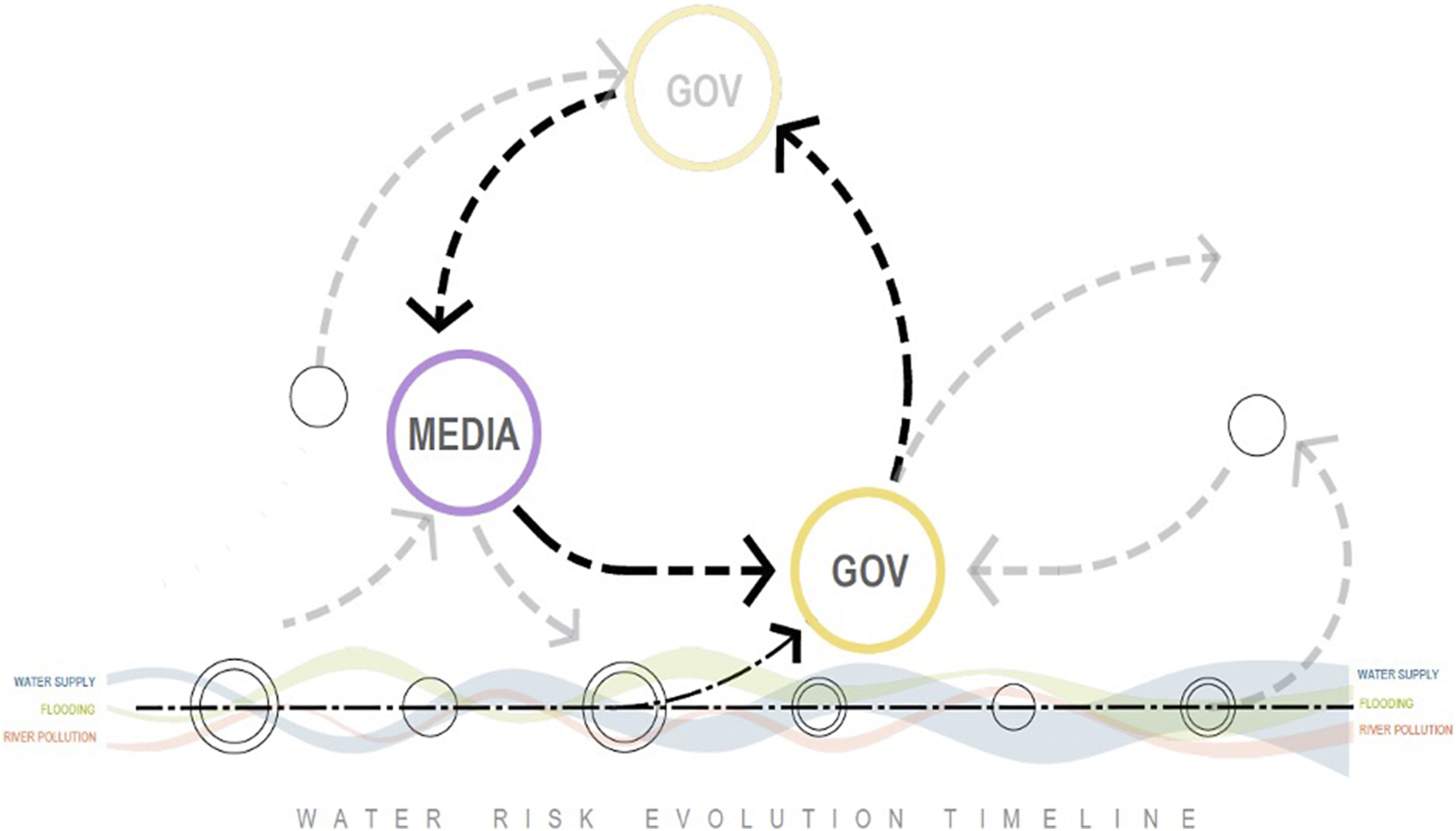
In the context of water risks, media framing involves the repeated emphasis of specific aspects, shaping visible choices and creating a feedforward dynamic – distinct from feedback loops (Figure 1) (Reese, Reference Reese2007). This dynamic illustrates how repeated framing influences future decision-making, highlighting the cumulative impact on institutional priorities. It intersects with agenda-setting, priming and the availability heuristic, showing how visibility and frequency in media coverage precondition governance responses, especially in resource-constrained intermediate cities (Scheufele, Reference Scheufele1999; Kahneman, Reference Kahneman2011; Ghosh and Boykoff, Reference Ghosh and Boykoff2019; Kahneman and Tversky Reference Kahneman, Tversky, Kahneman and Tversky2000).
Conceptual visualization of evolving media and governance. Governance is shaped by feedforward and feedback mechanisms driven by the visibility of specific water risks (lower colored waves). The gray and black dotted lines represent a cycle of feedforward and feedback influence, in which water risks contribute to media coverage, extensive media coverage pushes governance decisions, and these decisions subsequently generate new actions that are again reflected in the news. Among the water risks, domestic water supply receives the most attention, flooding receives intermittent attention, while river pollution – previously neglected – has recently gained prominence. Additional influences on water risk governance are indicated by smaller single lined empty circles, reflecting factors beyond media coverage. The double lined empty circles depict times of peak risk coverage in news. Diagram made by authors.

Figure 1 conceptually illustrates this dynamic, showing how sustained media attention on issues like water supply (blue curved line in Figure 1) contrasts with intermittent coverage of flooding (green curved line in Figure 1). Emerging concerns, such as river pollution (orange curved line in Figure 1), are episodically visible. Empty circles in the diagram represent other influencing factors in water risk governance. This visual showcases how media framing both reflects and shapes governance priorities. Kahneman’s phrase “what you see is all there is” (Kahneman, Reference Kahneman2011, 86) encapsulates this dynamic, where repeated visibility dominates attention and marginalizes alternatives. Within existing path dependencies and resource constraints, frequently repeated framings become preferred by decision-makers (Rayner et al., Reference Rayner, Lach and Ingram2005; Enke, Reference Enke2020).
Urban water governance involves evolving institutional arrangements, actors and decision-making processes (Cruz et al., Reference Cruz, Rode and McQuarrie2019; Brown et al., Reference Brown, Dayal and Rio2012). It extends beyond infrastructure management to navigating competing priorities and socio-political dynamics. Ideally, governance includes cycles of problem identification, agenda-setting, policy formulation, implementation and evaluation, shaped by institutional capacity and political will (Cruz et al., Reference Cruz, Rode and McQuarrie2019). In practice, these processes are fragmented, constrained by limited budgets and overlapping mandates across municipal, regional and national bodies (Chu et al., Reference Chu, Anguelovski and Roberts2017; Westman et al., Reference Westman, Castán and Huang2019), resulting in inconsistent responses to risks like flooding, pollution and water shortages.
Media framing critically influences these fragmented processes (Lecheler et al., Reference Lecheler, Keer, Andreas and Hänggli2015; Henrique and Tschakert, Reference Henrique and Tschakert2019). By repeatedly highlighting certain risks and under-reporting others, media coverage shapes perceptions of urgency and accountability (Oliver et al., Reference Oliver, Raney and Bryant2020). Figure 1 illustrates how framing interacts with governance through feedforward and feedback mechanisms, where visibility drives prioritization, and governance responses shape future narratives.
Local newspapers not only report water risks but also assign responsibility and signal accountability (Bohensky and Leitch, Reference Bohensky and Leitch2014; Feezell et al., Reference Feezell, Glazier and Boydstun2019). These narratives influence public perceptions of governance legitimacy. In intermediate cities, where institutions are often overstretched, such framing can significantly shape political will and public expectations (Crow, Reference Crow2010; Lecheler et al., Reference Lecheler, Keer, Andreas and Hänggli2015). Despite its influence, most studies focus narrowly on public opinion and risk perception (Chong and Druckman, Reference Chong and Druckman2007; Wachinger et al., Reference Wachinger, Renn, Begg and Kuhlicke2013; Tewksbury and Scheufele Reference Tewksbury, Scheufele, Oliver, Raney and Bryant2019). Research linking media coverage of water risks to governance trends often centers on urban floods (Bohensky and Leitch, Reference Bohensky and Leitch2014; Rinne and Nygren, Reference Rinne and Nygren2016; Adekola and Lamond, Reference Adekola and Lamond2018). When multiple risks are examined alongside policy and practice, local newspapers can reveal which issues reach decision-makers and how responsibility is assigned, especially in intermediate cities with overlapping and stretched governance responsibilities.
Methodology
This research applies media framing theory (Scheufele, Reference Scheufele1999; Tewksbury and Scheufele Reference Tewksbury, Scheufele, Oliver, Raney and Bryant20 Reference Crow19) through content analysis (Matthes and Kohring, Reference Matthes and Kohring2008) to understand how differences in water risk framing can impact perceptions and decision-making. The study draws on the most prominent and oldest local daily newspaper – Assam Tribune – to trace changes in water risk framing by examining the terms associated with water risks, frequency of publication, the solutions listed and the attribution of responsibility. To address potential bias inherent in a single media source, the study supplements and triangulates insights with policy documents and peer-reviewed research (Angst, Reference Angst2019). Additionally, it connects with complementary research conducted in the region (Fanaian and Fanaian, Reference Fanaian and Fanaian2023) to cross-verify government shifts and priorities.
The analysis centers on three key water risks arising from the urban–riverine interface: water supply, urban flooding and river pollution. These risks are framed and analyzed based on visibility, repetition and attribution, as conceptualized in the feedforward dynamic discussed earlier.
Case study
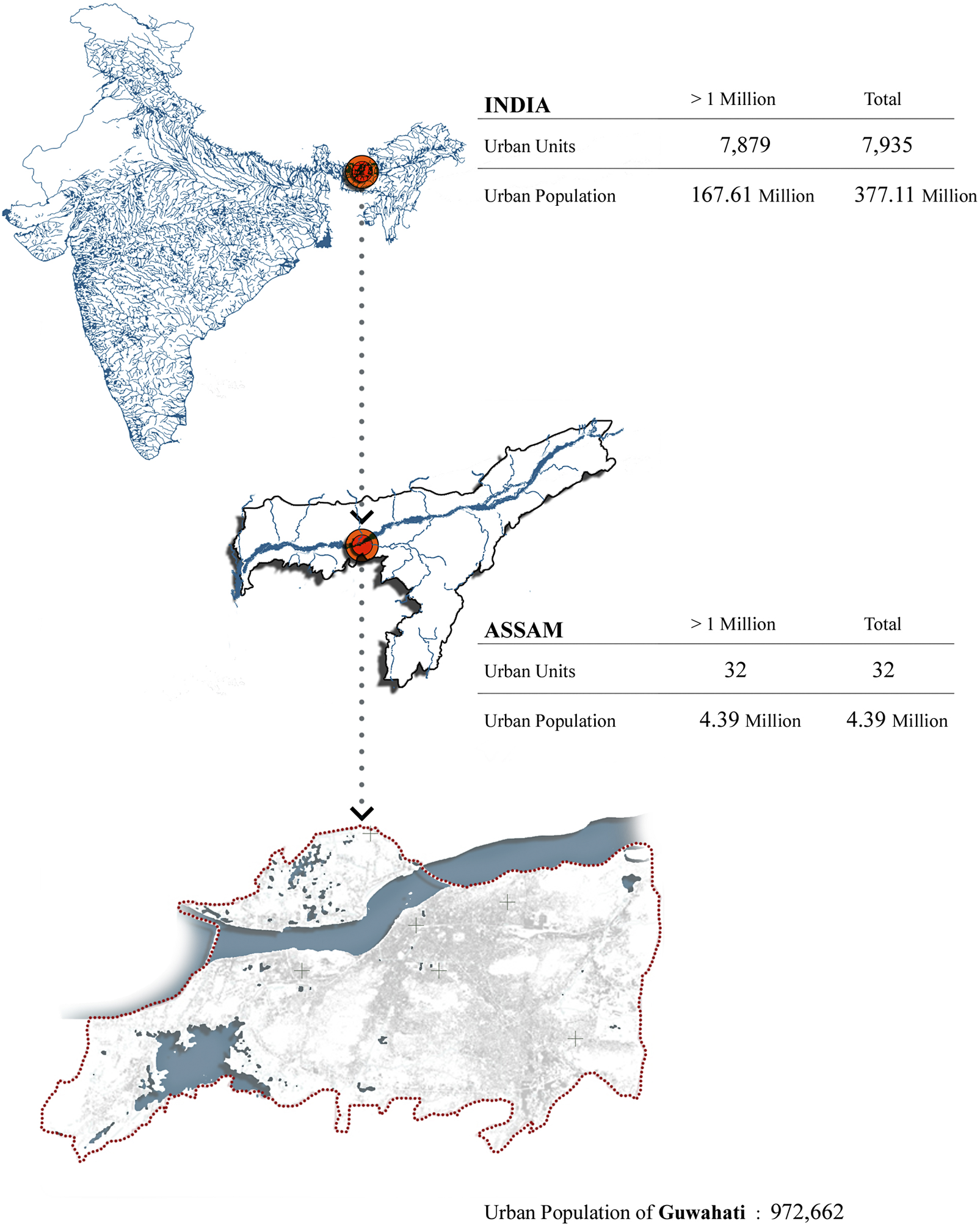
This study used the case of Guwahati, the capital city of Assam, as an example of an intermediate riverine city facing multiple water-related risks and resource-constrained governance. Although it is the largest city in Assam, with a population exceeding 1 million (Figure 2), Guwahati is classified as a second-tier or intermediate city within the Indian urban hierarchy.
Location of Guwahati and Brahmaputra river (statistics from Census of India 2011). Map made by authors.

Guwahati was designated the capital of Assam in 1970 and officially assumed the role in 1974, triggering urban expansion through increased investment in housing and infrastructure (Bora, Reference Bora2008; Nastar, Reference Nastar2014). This shift also led to the creation of governance institutions like the Guwahati Municipal Corporation (Fanaian and Fanaian, Reference Fanaian and Fanaian2023), making 1970 a pivotal starting point for this study.
The analysis focuses on urban-riverine risks flowing from city to river – such as river pollution from urban waste, flooding and those rising from river to city flows such as inadequate domestic water supply. These risks are managed amid resource constraints, overlapping mandates and political contestation (Hemani and Das, Reference Hemani and Das2016). Although physical aspects of these risks have been studied such as river restoration, flood dynamics, and water supply improvements, implementation remains inconsistent (Tahal Group, 2010; Sarma et al., Reference Sarma, Sarma and Singh2013; Chakraborty and Singh, Reference Chakraborty and Singh2016).
Risk governance in Guwahati is fragmented, with limited coordination among municipal and state-level actors, leading to jurisdictional overlaps and ambiguous policies (Sarmah and Das, Reference Sarmah and Das2018). The absence of integrated planning and data-driven decision-making hampers effective responses. Short-term political priorities often override long-term resilience, leaving vulnerable communities exposed (Fanaian and Fanaian, Reference Fanaian and Fanaian2023). This underscores the need for inclusive, adaptive and multiscalar governance approaches in the region (Hemani et al., Reference Hemani, Das and Chowdhury2017; Pawe and Saikia, Reference Pawe and Saikia2018; Fanaian and Fanaian, Reference Fanaian and Fanaian2023).
Content analysis and thematic coding
This study applies content analysis and thematic coding to news articles to explore how local media shapes governance priorities around water risks (Matthes, Reference Matthes2009). It examines the evolution of media frames and identifies which aspects of water risk gain prominence and potentially influence decision-making processes.
Content analysis is a widely used method for examining media framing, combining qualitative and quantitative approaches (Adekola and Lamond, Reference Adekola and Lamond2018). The qualitative aspect involves identifying thematic patterns coded by the researcher (Neuendorf, Reference Neuendorf2017). However, interpreting texts to fit expectations, or selectively extracting content can result in biased analysis (Matthes, Reference Matthes2009). To address these risks, the study follows the recommendations of Matthes and Kohring (Reference Matthes and Kohring2008) and Matthes (Reference Matthes2009), which enhance the validity and reliability of framing analysis.
Three key considerations guide bias mitigation. First, a media frame is defined as the selection and emphasis of aspects of reality to promote a specific problem definition, causal interpretation, moral evaluation and/or treatment recommendation (Matthes and Kohring, Reference Matthes and Kohring2008, 264). Second, the study outlines transparent criteria for selecting issue-specific articles. Third, it focuses on recurring framing elements – problem definition, causal interpretation, moral evaluation and treatment recommendation – coded individually to identify patterns and dominant frames (Matthes, Reference Matthes2009).
Additionally, to reduce interpretive bias, the study codes individual elements rather than entire frames. Problem definition describes risks; causal interpretation assesses interventions as successes or failures; and treatment recommendation proposes solutions. These elements are central to framing and relevant to the research question (Matthes, Reference Matthes2009; Cacciatore et al., Reference Cacciatore, Scheufele and Iyengar2016). Responsible actors mentioned in the framing are also included for context.
The coded elements are clustered by thematic similarity into “pattern frames” during manually coding; frames were also ranked by frequency and compared across articles (Matthes and Kohring, Reference Matthes and Kohring2008). This approach delays interpretation until after extraction, reducing single-coder bias. The resulting insights help trace trends and test whether frequent framing influences political will and prioritization of specific risks and responses. The water-risk related trends and themes emerging in the articles were intuitively clustered into phases based on repetition and rising or tapering frequency observed in articles (Creswell and Creswell, Reference Creswell and Creswell2017). Additionally, the current analysis draws on Fanaian and Fanaian (Reference Fanaian and Fanaian2023), which used process tracing to map institutional decisions and governance processes across the same period in Guwahati, to inform the bidirectional relationship between media and governance examined in this paper.
Data sources
The media framing data set was sourced from the Assam Tribune (AT) archive from 1970 to 2019. The core corpus comprises 170,395 microfilm images representing full page-wise photos of the newspaper from 1970 to 2015. Articles from 2016 to 2018 were only available online and retrieved from AT’s online archives.
Several media houses operate within Guwahati, with the AT being the most prominent English-language daily in Northeast India. Established in 1939, AT’s circulation exceed 3 million (Tonsing, Reference Tonsing2022). Other major newspapers in the region include The Sentinel (established in 1983) and The Telegraph (established in 1982).
AT’s selection is methodologically justified as it was the only consistent newspaper available for the period required. It is also one of Northeast India’s oldest and most circulated English dailies, headquartered in Guwahati; it offers consistent coverage of regional issues and policy developments. Its prominence ensures access to dominant narratives relevant to the city and region. While AT is listed as a controversial newspaper (Tonsing, Reference Tonsing2022), its political orientation remains unclear due to multiple changes in government and actors over five decades. Although using a single newspaper may raise concerns about bias, to strengthen analytical robustness, findings were triangulated with local policy documents (i.e., urban master plans, city development plans) and peer-reviewed literature (Barbehön and Münch, Reference Barbehön and Münch2016; Angst, Reference Angst2019), ensuring contextual depth and validity.
Moreover, the single newspaper microfilm archive provides a rare, comprehensive data set for longitudinal analysis. The 170,395 images (each file corresponds to a newspaper page) enable historical framing research over nearly five decades. Given limited digitization and archival access for other newspapers, AT presents the most viable and rigorous source.
Data sorting and analysis
The data set was derived from microfilm images of newspaper pages, converted to text using Optical Character Recognition (OCR) software. Due to the limitations of OCR, only broad page-wise digitization was possible, and individual article extraction was not feasible. The digitized content was organized into a dated, page-wise database using R (Version 3.4.1) (R and R Development Core Team, 2009), enabling structured analysis of temporal trends and sentiment in media coverage (Figure 4).
To isolate water risk-related content, a two-level keyword filtering process was employed. The first filter used Boolean operators to identify pages referencing “Gauhati” (old spelling) AND “Guwahati,” narrowing the corpus to city-specific articles. A preliminary review of over 100 articles informed the development of a second filter, targeting water risk keywords:
Water supply: “water supply” OR “water tanker” Floods: “flood” AND “bharalu” OR “inundation” AND “bharalu” River pollution: “Assam pollution control board” AND “river” AND “water” OR “river” AND “sewage.”
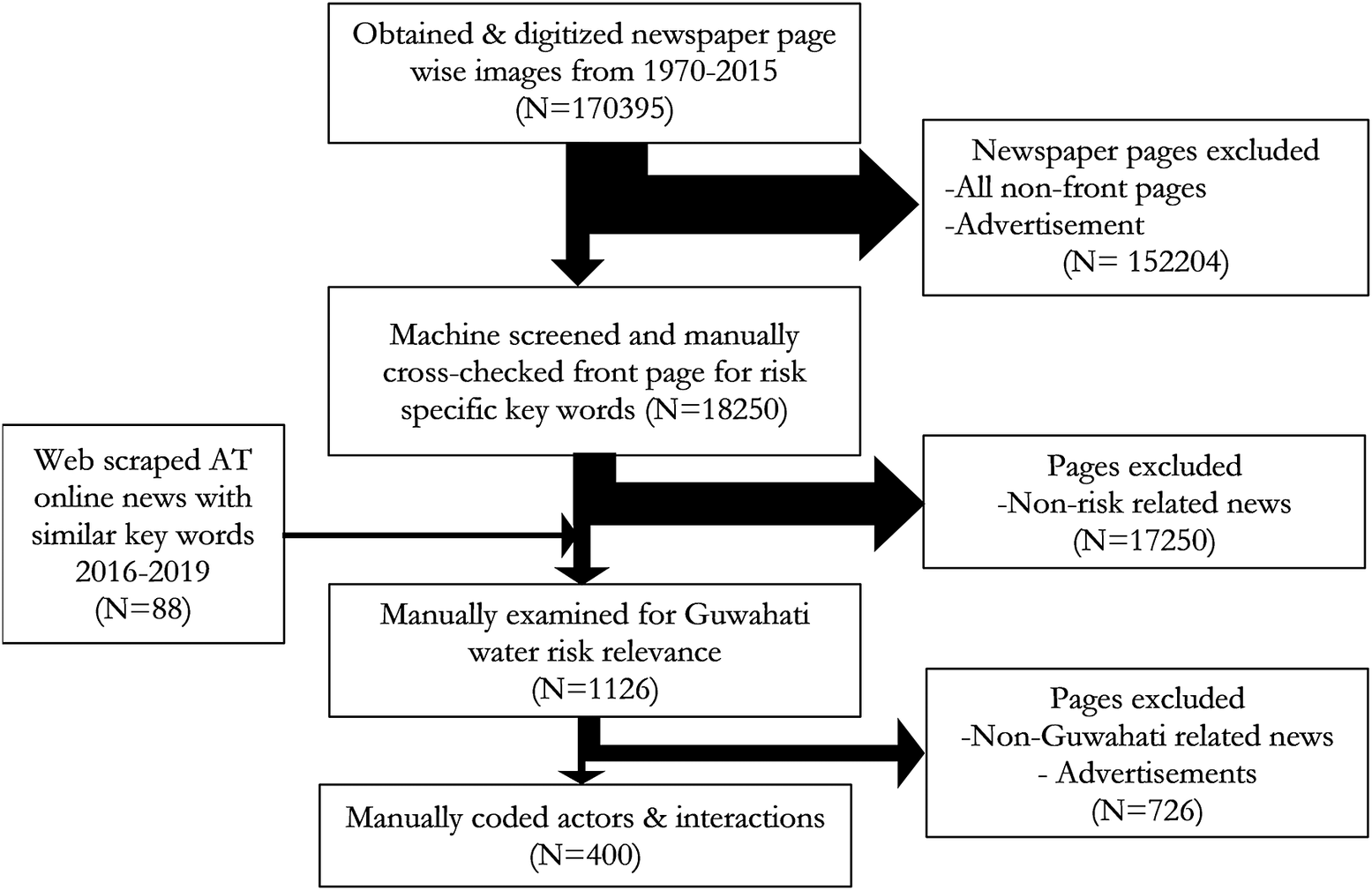
The followings structured approach allowed a systematic method to narrow down the relevant articles to be studied (Figure 3).
-
1. Assessment is limited exclusively to the front page, which has the most important, frequently read and visible news (Boydstun and Glazier, Reference Boydstun and Glazier2013; Trilling et al., Reference Trilling, Dubèl, Kiddle, Kroon, Lin, Simon, Vermeer, Welbers and Boukes2024). This brings the total number of relevant files to 18,250.
-
2. Water risk–specific files were extracted through selected keywords using the program R, for example, inundation, river pollution, sewage and water supply. The remaining news articles were web scraped from 2015 to 2019 based on similar keywords (N = 88). Total files are 1,126.
-
3. The 1,126 files were manually cross-checked for relevance using the following criteria: risk information was about Guwahati; if the article continued onto inside pages, information from inside pages was also included; advertisements were not included. Results narrowed to 320 articles.
-
4. Manually coded 320 articles (400 files) for responsible actors and governance themes, of which 227 articles had consistently mentioned risk themes, solutions, actors and interactions. Finally, 227 news articles were included in this research.
Flow chart illustrating the newspaper article selection process, progressing from the full corpus of newspaper files (one file = one newspaper page) through filtered sets to the final coded sample.

The final selected articles were cross-referenced to the actual newspaper images for qualitative assessment. This digitized content was also organized into a dated, page-wise database using R (Version 3.4.1) (R and R Development Core Team, 2009), enabling structured analysis of temporal trends and sentiment in media coverage (Figure 4).
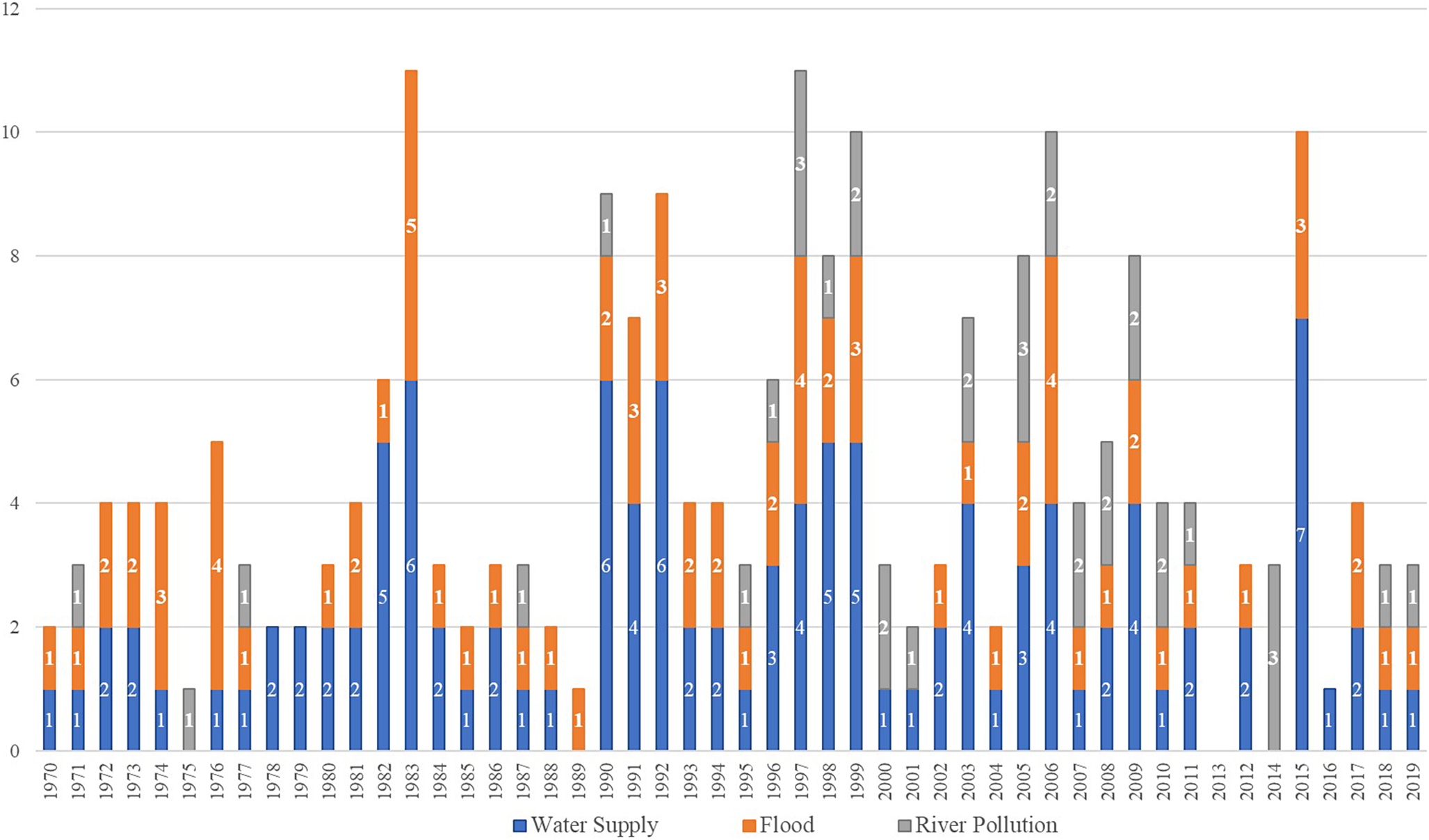
Water risk-related articles examined in Assam Tribune per year. Water supply linked articles – 113, floods – 77, and river pollution – 37.

Manual coding using the original newspaper article image was conducted to examine media framings, guided by three questions: (i) How are specific water risks framed? (ii) Who is assigned responsibility (e.g., local government, NGOs, academics, state/national authorities, private companies)? (iii) What solutions are proposed? The coding based on these questions was conducted by a single researcher following a predefined framing protocol; the criteria were reviewed with colleagues, and examples of each framing category are provided in Annex 1 to support transparency and consistency. Article frequency relevant to each risk was also recorded as a proxy for issue salience and perceived importance (Kahneman, Reference Kahneman2011). Because some news articles covered more than one risk within the same article, instances where multiple risks were addressed (e.g., water supply issues caused by flooding in Guwahati) were coded separately for risk framing, problem definition and proposed solutions.
In addition to qualitative thematic coding, the risk-specific structured database was analyzed using a natural language processing approach focused on sentiment, specifically identifying positive and negative language used in the articles. Sentiment analysis was conducted in R (Version 3.4.1) (R and R Development Core Team, 2009) using a lexicon-based method, applying the General Inquirer (GI) sentiment dictionary (Taboada et al., Reference Taboada, Brooke, Tofiloski, Voll and Stede2011). This approach compares the words in each article against predefined lists of positive and negative terms (e.g., good = positive, corrupt = negative), generating a composite Sentiment GI score that reflects the overall tone of the article (Neuendorf, Reference Neuendorf2017; Pröllochs et al., Reference Pröllochs, Feuerriegel and Neumann2018; Lennox et al., Reference Lennox, Veríssimo, Twardek, Davis and Jarić2020). Sentiment trends were used to complement framing analysis, offering insights into how emotional tone may influence public perception and governance priorities.
Results: Evolution in media framing of water risks
The temporal categorization of media descriptions for each water risk is based on frequently repeated content derived through inductive analysis. Given the distinct nature of each water risk, the urgency and tone of news articles vary accordingly. Therefore, the analysis of media framing for each water risk follows a unique temporal trajectory, guided by thematic shifts in coverage based on problem framing, responsibility attribution and solution framing for each risk. (see Supplementary Appendix Table S1 for a summary).
River pollution
River pollution has received the least media attention, with only 37 articles published over a span of 50 years, averaging fewer than one article per year. This limited coverage may be attributed to relatively low pollution levels in the 1970s and 1980s, with reporting increasing as pollution escalated by 2019 (Figure 4).
“Sometimes cause inconveniences” (1970–1980)
In 1971, although the master plan for sewerage, drainage and water supply (1971–2001) proposed an extensive sewage network and treatment plants, implementation was minimal. Only one drainage lane was constructed by 1985, and most domestic wastewater was discharged directly into local rivers and wetlands, eventually reaching the Brahmaputra River (AT, June 01, 1971).
Concerns during this period primarily focused on industrial pollution, particularly from the Gauhati Refinery. Citizen complaints highlighted incidents such as a “floating fire” on the Bharalu River caused by refinery waste (AT, July 23, 1977). These complaints were followed by assurances that future pollution risks from refinery effluents would be eliminated (AT, September 10, 1977). Responsibility for addressing pollution was largely attributed to urban citizens and industry.
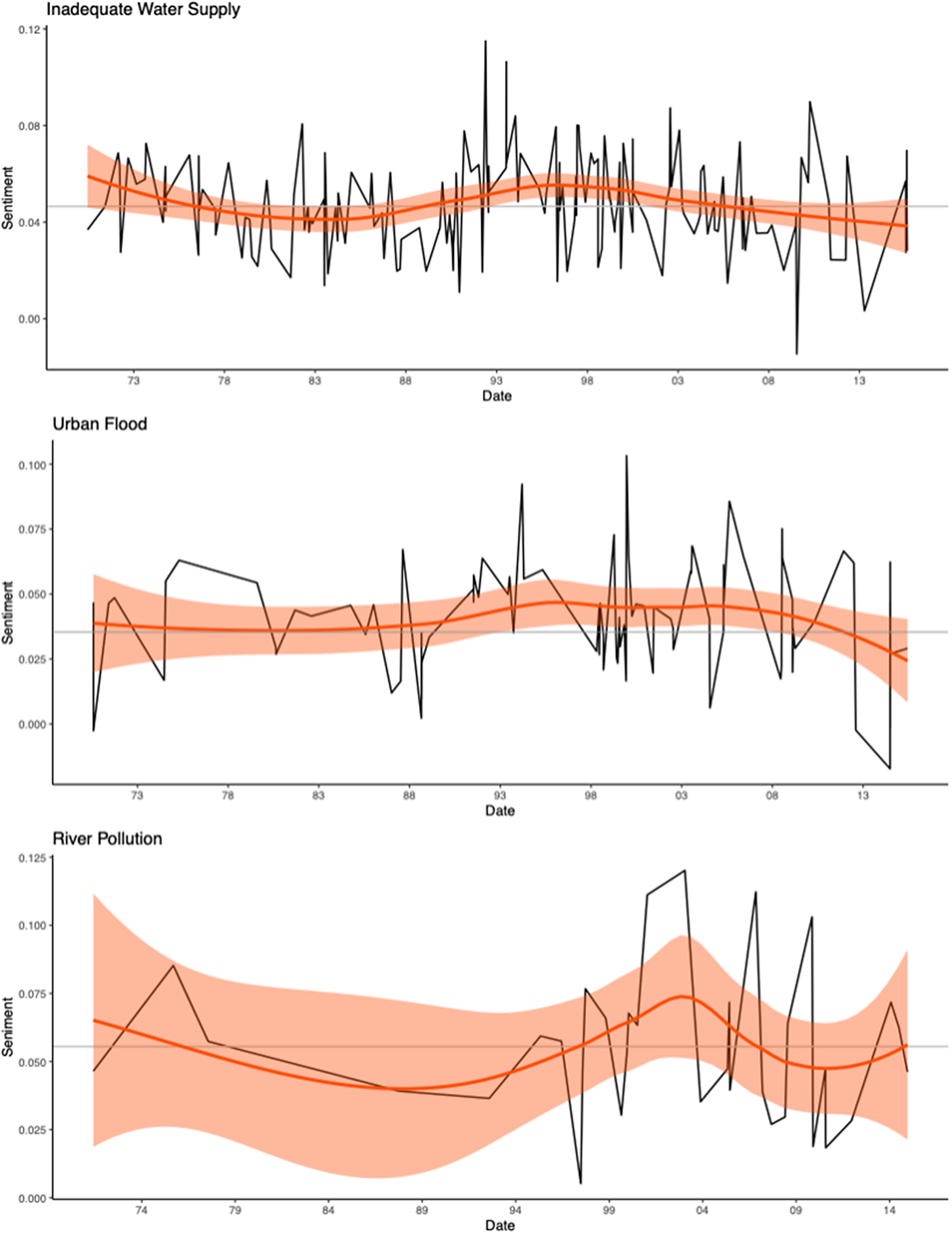
“Heading for disaster” (1980–2005)
The tone of media framing during this period shifted toward portraying river pollution as a looming disaster, as seen with the dip in trend line toward negative sentiments (Figure 5). Residents, citizen forums and academics raised concerns about pollution in the Bharalu River and local wetlands, stemming from household waste, refinery discharge and hospital effluents. Although pollution in the Brahmaputra River was acknowledged, it was often downplayed by references to the river’s “self-purifying” qualities (AT, June 24, 1997).
The three graphs illustrate temporal changes in sentiment – defined by the prevalence of positive or negative word associations – within newspaper reporting on three distinct water-related risks (inadequate water supply, urban floods, river pollution). In each graph, the gray horizontal line serves as a baseline, representing the average sentiment across all articles. Data points positioned below this line indicate a predominance of negative sentiment, while those above suggest a predominance of positive sentiment. This visualization enables the tracking of how public discourse, as reflected in media coverage, has evolved in its emotional tone regarding each water risk over time.

A diverse range of actors were mentioned in relation to river pollution, including NGOs (21%), academics (26%), hospitals (37%), judiciary (16%), private industries (16%) and various government departments and committees (10–12 departments). The Pollution Control Board Assam (PCB), established in the 1980s, emerged as the dominant actor, appearing in over 60% of related articles. Additionally, more than 80% of wastewater was reported to flow untreated into rivers and adjacent water bodies, with the Guwahati Municipal Corporation (GMC) cited in 37% of articles for its failure to provide adequate sewage infrastructure.
Solutions were proposed in over 60% of articles, ranging from awareness campaigns and judicial interventions to sewage treatment plans and integrated approaches. Academics frequently advocated for comprehensive strategies, including removal of encroachments on riverbanks and wetlands, relocation of solid waste dumping sites, waste segregation, construction of sewage treatment plants, expansion of urban green cover and stricter regulatory enforcement (AT, June 10, 1996; July 30, 1997; June 23, 1997; December 12, 1999).
“Cesspool of filth” (2005–2015)
Around 2005, media framing shifted from describing river pollution as a pending disaster to depicting it as a severe and urgent crisis (Figure 5). Terms such as “pollution at alarming levels” and “cesspool of filth” became common. By 2011, the Bharalu River was listed among the most polluted rivers in India, and the Brahmaputra River near Guwahati was deemed unfit for swimming.
Pollution in Guwahati’s wetlands also gained attention, with framing linked to ecological degradation and impending disaster. NGOs increasingly called for conservation and stricter enforcement of environmental regulations. In response, the PCB initiated a project to revive the Bharalu River, including funding for sewage treatment plant construction (AT, July 26 and July 31, 2010). These efforts led several hospitals and oil refineries to install treatment facilities, although no comprehensive urban wastewater treatment infrastructure was developed (AT, July 31, 2010).
“Blatant lack of urgency” (2015–2018)
Despite limited front-page coverage (five articles), the framing during this period emphasized urgent calls for action and highlighted the failure to address river pollution effectively.
The Bharalu River was again cited as one of India’s top 10 most polluted rivers (AT, May 03, 2017). A court case was filed with the National Green Tribunal due to continued inaction, prompting the PCB to announce plans for river rejuvenation (AT, June 01, 2019). Additionally, Guwahati secured funding under the Government of India’s Smart Cities Mission, which included proposals for sewage treatment plants, riverfront development and restoration of the Bharalu and Mora Bharalu Rivers, as well as local wetlands (AT, November 11, 2019). Proposed solutions narrowed in focus, primarily emphasizing the removal of encroachments and the construction of sewage treatment plants. However, media coverage continued to criticize the state’s inaction, using phrases such as “… blatant lack of urgency and utter failure to tackle environmental pollution” (AT, May 16, 2019).
Although the PCB remained a prominent actor, responsibility for solutions increasingly shifted to local entities such as the GMC, Guwahati Smart City Pvt. Ltd., and the District Administration. From 2015 onward, the range of actors expanded to include private consultancies, the National Green Tribunal and international stakeholders.
Urban floods
A total of 77 news reports were linked to urban flooding in Guwahati between 1970 and 2018. Over 50% of these reports were published during the monsoon period between April and August, with the frequency of coverage directly proportional to the intensity and severity of flood events. Severe floods typically appeared on the front page, whereas minor incidents – such as single-day inundations – were relegated to later pages (e.g., AT, August 02, 1977, page 06). Articles concerning flood policy and infrastructure planning were distributed throughout the year.
“Inundated by the Brahmaputra” (1970–1991)
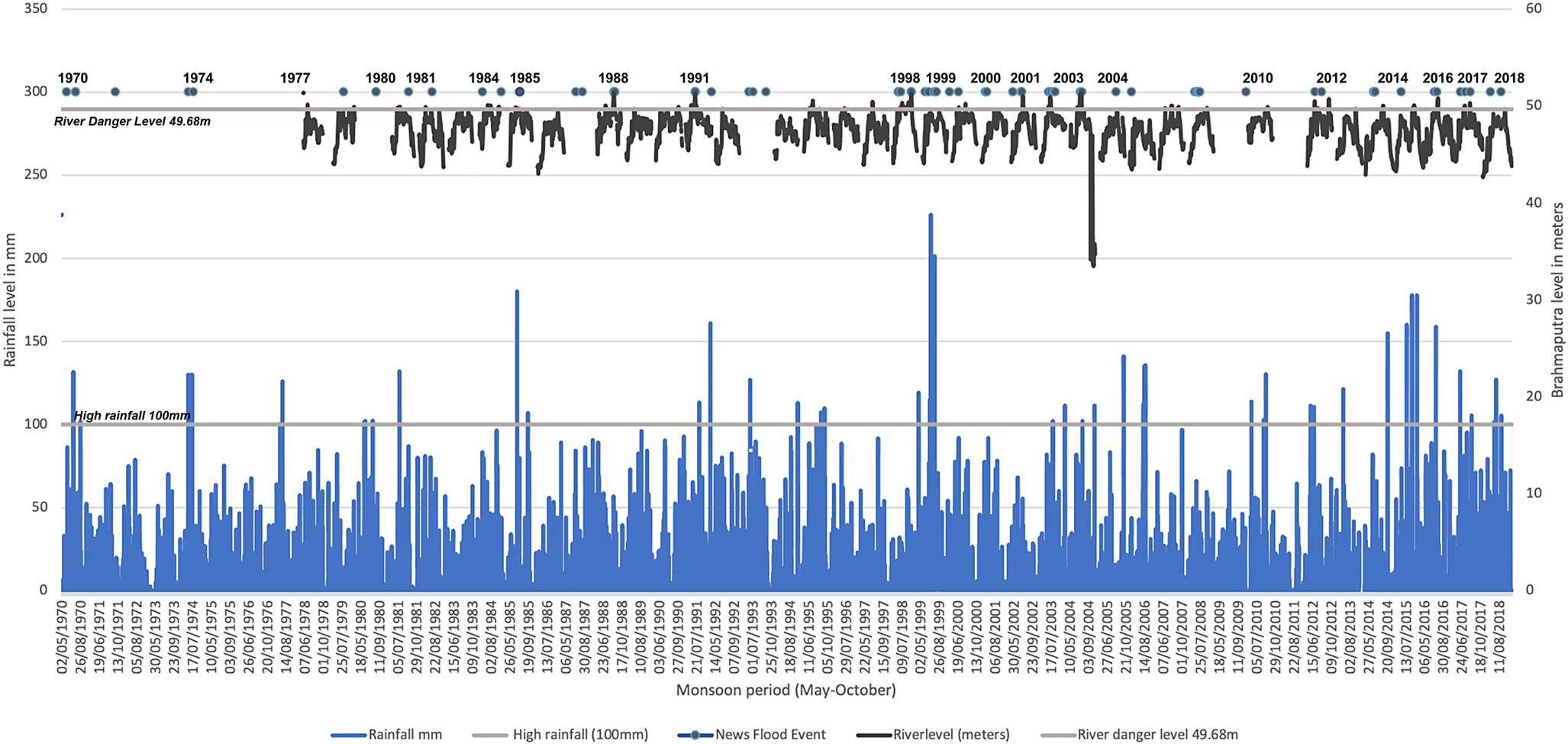
Front-page coverage of urban floods occurred in 1970, 1974, 1980, 1981, 1984, 1985, 1988 and 1991. Of these eight events, five (1970, 1974, 1980, 1988 and 1991) were attributed to rising water levels in the Brahmaputra River, compounded by heavy rainfall, which led to backflow and inundation of the city (AT, July 27, 1970; AT, June 21, 1974; AT, August 20, 1980; AT, August 20, 1988; AT, July 11, 1991). These events were framed as “worst ever” or “unprecedented floods,” with all such reports linked to high rainfall and elevated river levels (Figure 6).
Daily rainfall (blue lines), Brahmaputra River level (black lines) and news reporting (dots) linked to Guwahati floods. The rainfall data are for the monsoon season May–October from 1970 to 2018. The dot with the year mentioned indicates reported flood events, whereas just dots are news on flood-related policy and infrastructure.

Approximately 40% of articles proposed infrastructure-based solutions, including sluice gates, drainage schemes, river diversion, construction works and pumping systems, with a dominant framing around “controlling” floods. Government departments were cited in 90% of articles, while NGOs were mentioned in fewer than 7%, primarily in relation to capacity building and flood aid. Among government actors, the District Administration was most frequently referenced (35%), followed by the Brahmaputra Flood Control Department (28%), with the remaining mentions distributed across 10–11 local, state and national agencies.
“Problem of chronic water logging” (1992–2002)
During this period, articles linked to flood events (1998, 1999, 2000 and 2001) (Figure 6) predominantly framed the issue as “water logging”. Over 60% of articles attributed flooding to encroachment, poor urban planning and rapid urban growth. Other contributing factors included heavy rainfall, lack of funding and limited institutional capacity to manage urban floods.
Solutions focused on infrastructure drainage schemes, particularly storm water drains (80%), with 20% of articles highlighting financial constraints and the need for improved access to funding. Actor representation shifted notably: 60% of articles referenced citizen forums demanding accountability and flood mitigation. Newly established municipal bodies, Guwahati Municipal Corporation (GMC), Guwahati Municipal Development Authority (GMDA) and Guwahati Development Department (GDD), were mentioned in 80% of articles. In contrast, references to the District Administration declined to under 20%. As infrastructure projects expanded, mentions of the Town and Country Planning Department and the Public Works Department increased, while the Brahmaputra Flood Control Commission was rarely cited.
“City flash floods become more acute” (2003–2018)
Although narratives around water logging and encroachment persisted, the term “flash floods” became dominant across nearly all related articles. While previously mentioned, “flash floods” had not featured prominently in earlier framing. Flood events occurred in 2004, 2005, 2012, 2014, 2016, 2017 and 2018 (Figure 6). Of these, only the 2012 flood was linked to rising Brahmaputra River levels and heavy rainfall; the others were attributed solely to intense precipitation.
Citizen forums remained active, appearing in approximately 70% of articles. Local authorities such as GMC and GDD were mentioned in 50%, while the Water Resources Department and District Administration featured in 30%.
Solutions continued to center on infrastructure such as storm water drainage schemes (80%), but increasingly included maintenance, removal of encroachments and upkeep of existing drainage infrastructure (20%). Additional measures involved reducing plastic and solid waste dumping in rivers. Encroachment on wetlands and riverbanks was cited in 30% of articles as a contributing factor to urban flooding. The 2014 flood, which resulted in eight fatalities (AT, June 28, 2014), prompted a week-long campaign to remove encroachments along riverbanks (AT, July 03, 2014). Plans were also announced in 2017–2018 for “Mission Flood Free Guwahati.”
Inadequate water supply
There were roughly 113 news articles around water supply issues. Among the three risks, the highest reporting intensity is for water supply. The high frequency and negativity tone of articles were more pronounced during the summer season (March–April) and averaged during the rest of the year (Figure 5). From 1970 to 2018, the news framing linked to water supply mostly alternated between complaints of shortage or lack of water supply (>85% of total articles) and announcements of a plan or inauguration of a new water supply scheme, interspersed with institutional failures and corruption charges.
“Erratic (water) Supply” (1970–1980)
As a master plan for the drainage, sewerage and water supply was drawn up in 1972, it was found that the water supply schemes, while treating enough water, had networked piped systems connected to only 10% of the urban population (AT Apr12, 1972).
Among the articles on domestic water supply, more than 80% of problem framing was around irregularities or lack of water supply or quality, followed by institutional challenges such as lack of funds or human resource (16%) and corruption (3%). When mentioning water supply problems, more than 50% of the solutions suggested were linked to new infrastructure projects such as water treatment plants, deep tube wells and piped water extensions. Other solutions included institutional strengthening and operation and maintenance of existing infrastructure.
Responsibility attribution was only within the government domain involving more than 19 organizations ranging from the local authorities to the Government of India (GOI). The most popular and often named being the Gauhati Municipal Corporation (GMC) (50%), followed by the Public Health and Engineering Department (PHED) (16%), the Government of Assam (GOA) (16%) and others. Within these 10 years, two instances of corruption were linked to water supply infrastructure attributed to ministers, legislative assembly members and concerned authorities (AT, July 27, 1976; July 07, 1977).
“Adequate water supply in city from winter” (1980–2007)
While erratic or shortages of water supply were still an underlying theme (among 72 news articles), more than 45% were centered on commissioning new water supply schemes. These new schemes aimed for “adequate water supply” for all. At this point, approximately 40% of the urban population had access to the public water supply (AT, August 03, 1991). Even election manifestos highlighted drinking water for Guwahati as one of the big-ticket promises “The party would also take up schemes for the expansion of the existing water supply schemes…” (AT, May 05, 1995). But shortage of water supply was a recurring problem, especially during summers. There were also references to institutional failure linked to the three institutions tasked with water-supply GMC, Assam Urban Water Supply and Sewerage Board (AUWSSB) and Public Health and Engineering Department (PHED). With more emphasis on the failures of the GMC.
New supply schemes dominated the solution landscape (around 45%). Funding sources were highlighted in about 21% of the articles with most funds being from different schemes from the Government of India. The articles also mentioned international aid agencies, such as the Japanese government, the Asian Development Bank, World Bank and other international agencies. The supply schemes ranged from large treatment plants with piped networks to decentralized water tankers. Another solution introduced was private water supply. However, the references to accessing private water supply were negatively framed, such as “taxpayers are forced to buy water at exorbitant rates from the private water tankers” (AT, May 15, 1998).
Among the three institutions involved in domestic water supply, the GMC was referred to in 69% of articles, and the PHED and AUWSSB were mentioned in only 19% and 13%, respectively. The elected representatives (primarily Minister of Municipal Administration or Guwahati Mayor) were mentioned in more than 40% of the articles. However, the link to ministers were ceremonial in reference to an inauguration ceremony of the water supply schemes (15%) and announcements on securing funding (21%). International aid agencies (9%) like the World Bank and the Japanese Bank were also involved. The taxpayer was also mentioned (19%) as an actor bearing the brunt of water shortage without much agency. Two protests in the city demanded regular water supply (AT, May 29, 1997; May 15, 1998) and one corruption case linked to water supply (AT, April 23, 1994).
“Round the clock water supply in the city by 2010” and “water scam of 2010” (2008–2018)
The framing moved from adequate delivery to promises for round-the-clock, complete city coverage with 24/7 public water supply. But along with these promises, multiple mentions of corruption linked to water supply infrastructure also emerged. The primary framing alternated between funding 24/7 large new water supply schemes (38%) and corruption news (30%). The large water supply schemes were funded by GOI and international aid agencies such as the Asian Development Bank and the Japanese International Cooperation Agency.
The problem framing continued to be around gaps or lack of water supply (46% of articles) and an increasing and undesirable (based on the tone of framing) (Figure 5) shift in private water supply due to a shortage in the public water supply. While the solution narrative involved a 24/7 round-the-clock water supply, the associated timeline of completion and delivery kept changing.
Discussion
The results reveal differential trends in how media frames three key water risks – river pollution, urban flooding and water supply – and their implications for governance priorities. Three core insights emerge: (1) frequency of framing signals political priority; (2) infrastructure-based solutions are increasingly becoming dominant and (3) framing contributes to accountability through responsibility attribution. These findings are situated within broader discourses on media framing focused on emphasis framing, particularly its role in shaping public understanding, institutional responses and policy agendas.
Frequency of risk framing signals priority for action
News repetition and frequency reflect perceived urgency for action, as seen with water supply receiving the most consistent coverage, followed by urban floods, while river pollution received the least (Figure 6). This hierarchy of attention reinforces existing biases and the problem’s visibility to influence perception and agendas of related actors (Cacciatore et al., Reference Cacciatore, Scheufele and Iyengar2016). In Guwahati election, manifestos and policy documents mirror media language and frequency, with promises for regular water supply appearing since the 1990s (Fanaian and Fanaian, Reference Fanaian and Fanaian2023). Flood mitigation efforts gained political attention in the early 2000s as flooding intensity and news attribution to governments’ inaction grew. In contrast, river pollution news surfaces episodically, often linked to urban flooding or drainage issues, limiting its visibility and political attention. River pollution-related episodic framing tends to assign responsibility to specific events or actors, rather than fostering broader accountability across institutions and citizens.
This pattern aligns with framing theory, which posits that the salience and repetition of issues in media coverage influence public and political priorities (Scheufele, Reference Scheufele1999; Bohensky and Leitch, Reference Bohensky and Leitch2014; Cacciatore et al., Reference Cacciatore, Scheufele and Iyengar2016). The feedforward dynamic is observed whereby repeated risk framing shapes future governance responses, extending existing theory by highlighting how media visibility can precondition institutional action in resource-constrained settings.
The growing dominance of infrastructure-based solutions
Approximately 75% of articles not only highlight problems but also propose solutions. Initially, solution framing was diverse, encompassing regulatory, educational and ecological approaches. However, since the mid-1980s, infrastructure-based solutions have become dominant across all three risks. For water supply, nearly 70% of articles focus on funding and construction of centralized schemes, with corruption linked to several projects. Flood mitigation shifted from ecological and regulatory strategies, such as wetland conservation and building regulation to engineering interventions like dredging, flood walls and sluice gates by the late 2000s (Fanaian and Fanaian, Reference Fanaian and Fanaian2023).
River pollution framing followed a similar trajectory. Early coverage included diverse solutions: construction norms, waste management, judicial action and public education. Since the early 2000s, Sewage Treatment Plants (STPs) have become the default solution. Despite consistent financial allocations since 1970s (Fanaian and Fanaian, Reference Fanaian and Fanaian2023), low news reporting may reflect low prioritization that could have contributed to continued neglect. This trend suggests that perceived priority and not funding limitations, are a key barrier to action (Millington and Scheba, Reference Millington and Scheba2020).
Additionally, this narrowing of solution framing reflects broader critiques in media studies that highlight how media often favor technocratic and infrastructure-heavy narratives, sidelining systemic or behavioral approaches (Lecheler et al., Reference Lecheler, Keer, Andreas and Hänggli2015; Henrique and Tschakert, Reference Henrique and Tschakert2019). Such framing can reinforce path dependencies in governance, where visible, capital-intensive projects are prioritized over less technical but equally critical interventions.
Assigning responsibility and engendering accountability
Over 90% of articles attribute responsibility, shaping public and institutional perceptions of accountability, a trend also seen in other media-based studies (Feezell et al., Reference Feezell, Glazier and Boydstun2019). Between 1980 and 2000, the Guwahati Municipal Corporation (GMC) was the primary actor cited for water provision (69%). However, by the 2000s, media narratives increasingly associated GMC with failure and inefficiency. By 2015, its attribution dropped to 8%, and new government agencies were established to expand its role.
From the mid-2000s, citizen forums emerged as influential actors, with over 50% attribution in flood-related coverage. These coalitions, amplified by media and triggered by severe hazard events, catalyzed policy shift, such as the Government of Assam’s adoption of flood mitigation measures in 2016 (Fanaian and Fanaian, Reference Fanaian and Fanaian2023). Citizen-led concerns about river pollution date back to 1976, with complaints about refinery waste, and re-emerged in 2018 through court action and media coverage of the Bharalu river.
This feedforward dynamic reflects the media’s role in constructing narratives of accountability and legitimacy. As noted in framing literature, media not only inform but also shape perceptions of who is responsible and what constitutes effective governance (Crow, Reference Crow2010; Sadath et al., Reference Sadath, Kleinschmit and Giessen2013). In intermediate cities, where governance is often fragmented and overstretched, such framing can significantly influence political will, accountability and public expectations.
Conclusion
This study demonstrates how local news media framing reflects and influences governance priorities for water risks in an intermediate city of the Global South, such as Guwahati. Among the three risks analyzed, water supply received sustained media attention and policy response, while river pollution remained marginalized despite long-standing plans for action. Although direct causality between media framing and policy action cannot be confirmed, the evidence suggests that media visibility contributes to a feedforward effect that can shape political will and trigger institutional responses.
By examining the frequency and framing of coverage, this research highlights how local media can signal urgency, assign responsibility and influence perceptions of risk. Such framing processes offer valuable insights into what is considered essential by both citizens and decision-makers. In data-scarce contexts of the Global South, local newspapers provide a rich source of historical and institutional information that is often absent from formal policy documents or technical data sets.
This approach also reveals how media narratives help identify key actors and governance dynamics, making visible the informal coalitions and alternate arenas that influence decision-making. While the media landscape is evolving, with increasing reliance on digital platforms, local newspapers continue to offer contextual depth, granularity and continuity that are critical for understanding long-term governance trajectories.
The news media also provides a lens into local priorities, institutional responses and solution preferences, elements that are instrumental for understanding priorities that shape adaptive and inclusive policies in intermediate cities of the Global South. Despite limitations such as bias and selective reporting, local news media remain a valuable resource for analyzing decision priorities in local water governance.
Open peer review
To view the open peer review materials for this article, please visit http://doi.org/10.1017/wat.2026.10025.
Supplementary material
The supplementary material for this article can be found at http://doi.org/10.1017/wat.2026.10025.
Acknowledgments
I would like to thank the following for supporting the research paper: The Assam Tribune for providing access to their newspaper archives. Dr. Dustin Garrick for providing research ideas and supervision, Dr. Hita Unnikrishnan for detailed feedback and comments, Mr. Farnoosh Fanaian for his support in shaping the conceptual diagram, and Ms. Janet Fanaian, Dr. Iqball Bhalla and Ms. Emmra Metge for their editorial support. Late Mr. Simon Abele and Mr. Stefan Velev for aiding with the digitization of the newspaper data set.
Author contribution
The paper was drafted, written and conceptualized by the main author.
Funding statement
The author received a research fellowship from the Oxford-Indira Gandhi Scholarship from the Oxford India Centre for Sustainable Development, Somerville College, University of Oxford. The fieldwork and newspaper data acquisition were supported by the Catherine Hughes Fund for Development and the National Geographic Society grant number NGS-62131R-19.
Data Availability Statement
The raw data used in this study consist of articles obtained from local news papers. Some sources are available through publicly accessible online archives, while others were retrieved from local physical archives. The underlying source materials can be accessed through the respective newspaper archives and repositories cited in the manuscript. Specific data from this study is available from the corresponding author upon reasonable request.
Competing interests
The authors declare none.
Ethics and approvals
The research meets all ethical guidelines, including adherence to the legal requirements of the study country. All information used is publicly available.
AI statement
AI tools were used in this paper to check written grammar, identify errors in writing and ensure consistency throughout the text. Machine learning was used in digitization of the physical photos of the newspapers from the newspaper archives. AI was not used for data analysis, nor for the preparation of graphs or images. All data analysis and visual content were generated manually through independent research.


 Open access


Comments
Dear Editors,
I am pleased to submit my original research article entitled “Framing decision priority: The relationship between newspapers and urban water governance” for consideration by Cambridge Prisms: Water.
This paper examines the impact of local media on governance priorities in addressing urban water risks in intermediate-sized cities of the Global South. Using Guwahati, India, as a case study, the research analyzes 50 years of newspaper reporting to understand how urban decision-makers respond to competing water risks, namely, inadequate water supply, urban floods, and river pollution. The findings indicate that differential media attention influences institutional engagement and resource allocation, with sustained coverage of water supply issues, a seasonal focus on floods, and episodic mentions of pollution.
The study presents a novel approach to understanding decision-making in data-scarce contexts by utilizing media framing as a proxy for public concern and governance responses. It contributes to interdisciplinary discussions on urban resilience and water governance, aligning with the journal’s focus on sustainable and inclusive water futures.
An earlier, longer version of this paper formed part of my PhD manuscript. However, this submission is a substantially revised and standalone article that has not been published elsewhere and is not under consideration by any other journal. There are no conflicts of interest to disclose.
As I am affiliated with the Australian National University, I am eligible for the open-access publication agreement. Please let me know if there are any issues or if any additional steps are needed to confirm this eligibility.
Thank you for considering this submission.
Yours sincerely,
Safa Fanaian