Introduction
In India, previous research has showed a consistent pro-rich pattern in antenatal, delivery and postnatal care, and also in other maternal and child health indicators (Mohanty & Pathak Reference Mohanty and Pathak2009; Pathak et al., Reference Pathak, Singh and Subramanian2010; Chalasani, Reference Chalasani2012; Mohanty, Reference Mohanty2012; Singh et al., Reference Singh, Padmadas and Mishra2012; Kumar et al., Reference Kumar, Kumari and Singh2014). Little is known about the extent of economic inequality in the use of family planning services and its association with whether services are obtained from public or private health sectors. It has been suggested that an increasing contribution of the private sector to family planning provision may reduce access to contraceptives among poor people (Rosen & Conly, Reference Rosen and Conly1999). Moreover, evidence from developing countries has shown that economic inequality is higher when contraceptive services are obtained from the private sector than from the public sector (Agha & Do, Reference Agha and Do2008). There is a lack of such evidence in the Indian context, despite the fact that the private sector is increasingly providing family planning services in the country, particularly in high-population states (Jain et al., Reference Jain, Chauhan and Talwar2016).
India was the first country to adopt a family planning programme, in 1952, and family planning continues to be a key priority for the Government of India, and is an integral component of various national population policies and reproductive and child health programmes. Over time, various approaches, such as a coercive target approach and then a policy articulating a reproductive health and rights paradigm, contraceptive-specific incentives, and a family planning camp approach, have been adopted to scale-up the use of family planning services in the country (Jain & Bruce, Reference Jain, Bruce, Sen, Germaine and Chen1994; MOHFW, 1996, 2000; Pachauri, Reference Pachauri and Srinivasan1996, Reference Pachauri2014). As a result, the use of any contraceptive prevalence rate (CPR) has quintupled over the past five decades in India – increasing from 11% in 1970 to 54% in 2016 (IIPS, 2010; IIPS & ICF, 2017). However, this progress is uneven across the states and skewed towards specific contraceptive methods (IIPS & ICF, 2017). According to a recent estimate, in 2015, about 5 million pregnancies were unplanned, indicating a huge number of women with unmet need for contraceptive services (Singh et al., Reference Singh, Shekhar and Acharya2018).
In India, family planning programmes are conceptualized and strategized by central government but implemented and managed by state governments. Family planning programmes are primarily sponsored and financed by the Government of India. Family planning services are mainly provided through a hierarchical system of public health facilities at subsidized rates, aiming at universal access to services, particularly among rural and marginalized women. Community health workers such as Auxiliary Nurse Midwives (ANMs), Accredited Social Health Activists (ASHAs) and Anganwadi workers link women to public health facilities by facilitating use of various health care and family planning services. In recent family planning programmes, the Government of India accredited the increase in the number of private sector health facilities, and the resulting increase in provision base, for their success (MOHFW, 2016). The encouragement of the private sector to provide family planning services might be due to the challenges of physical distance, long waiting times and the unavailability of doctors in public health facilities.
Engaging the private sector in providing health care services, including family planning services, is perceived to be associated with client motivation and uptake of services (Jain et al., Reference Jain, Chauhan and Talwar2016). There is evidence that the private sector’s strategy for contraceptive access influences the adoption of family planning services by different socioeconomic groups (Bertrand et al., Reference Bertrand, Hardee, Magnani and Marcia1995). However, private sector interventions may increase inequality in contraceptive use if they contribute to increasing contraceptive access among higher socioeconomic groups without similar increases among lower socioeconomic groups (Agha & Do, Reference Agha and Do2008). The cost of family planning services charged to clients in the private sector may influence economic access, with high prices discouraging poor women from using such services (Jensen et al., Reference Jensen, Kak, Satjawinata, Wirawan and Nangoy1994; Ciszewski & Harvey, Reference Ciszewski and Harvey1995). The effect that private sector contraceptive supply ultimately has on economic access is likely to depend on how high the prices are in relation to income (Harvey, Reference Harvey1994). Moreover, private sector intervention usually increases the number of outlets in urban areas, which are mainly only accessible to women in the highest wealth group, so increased use of contraceptives in urban areas may expand overall inequality unless it is counter-balanced by increased contraceptive use in rural areas (Levin et al., Reference Levin, Amin and Rahman1999; Agha & Do, Reference Agha and Do2008; Karen et al., Reference Karen, Karra and Pandit-Rajani2010).
While previous studies have clearly shown that private sector interventions may contribute to increased economic inequality in the use of contraceptives, this is unexplored in the Indian context. Generating such evidence will have important policy implications for achieving Sustainable Development Goal 3.7, which calls for universal access to family planning services to ensure healthy lives and well-being (Derek et al., Reference Derek, Amy and Farooq2015). This study, therefore, examined trends in economic disparity in the use of modern contraceptive methods in the Indian context. It also examined the pattern of disparity by public and private health sectors, and across rural–urban place of residence.
Methods
Data
The study used data from multiple rounds of the National Family Health Survey (NFHS) of India conducted in 1992–93, 1998–99, 2005–06 and 2015–16. The NFHS is a large-scale household survey conducted across the states and union territories of India which covers more than 99% of the population of the country. The multiple rounds of the survey are conducted by the International Institute for Population Sciences (IIPS), Mumbai, with collaborative assistance from several national organizations and development partners. The surveys aimed to provide estimates on fertility and family planning, infant and childhood mortality, nutritional status of children and use of maternal and child health care (MCH) services, at the national and state level. However, the NFHS 2015–16 also provides estimates of some of the indicators at the district level. All rounds of the surveys adopted multi-stage sampling designs across rural and urban areas. The NFHS data were collected using a household schedule and eligible women/individual schedule. Details of the sampling design, sample size estimation and response rates are given in reports of various rounds of the NFHS (IIPS & ICF, 2017; IIPS & ORC Macro, 1995, 2000, 2007).
Outcome variable
The outcome variable was Modern Contraceptive Prevalence Rate (mCPR) – a global indicator of family planning used to track family planning progress across and within countries. This is defined as the proportion of currently married women aged 15–49 years using any modern method of contraception at the time of survey. This outcome was estimated based on two questions addressed in the survey. First, currently married women were asked ‘Are you currently doing something or using any method to delay or avoid getting pregnant?’ Those who responded ‘yes’ were further asked ‘Which method are you using?’ Women who responded that they/their husbands were using female sterilization, male sterilization, an intrauterine/post-partum contraceptive device, male/female condoms, oral contraceptive pills, injectables, diaphragm or the Standard Days method were considered to be using a modern method of contraception.
Independent variables
Household wealth was the key predictor in the study. Household wealth index was used as a proxy for household’s economic status. The wealth index was computed from economic proxies such as housing quality, household amenities, consumer durables and size of land holding (Montgomery et al., Reference Montgomery, Gragnolati, Burke and Paredes2000; Filmer & Pritchett, Reference Filmer and Pritchett2001; Rutstein & Johnson, Reference Rutstein and Johnson2004; Vyas & Kumaranayake, Reference Vyas and Kumaranayake2006; Gwatkin et al., Reference Gwatkin, Rutstein and Johnson2007; O’Donnell et al., Reference O’Donnell, Doorslaer, Wagstaff and Lindelow2008). The third and fourth rounds of the NFHS computed a wealth index using principal component analysis (PCA) and the index was divided into five quintiles: poorest, poorer, middle, richer and richest. However, the first two rounds of the survey computed a standard of living index based on arbitrary scoring of economic proxies, and the index was divided into three categories: low, medium and high. Moreover, number of household goods and assets used in computing standard of living index or wealth index continuously increased in each survey round and was in line with the changing economic context over time. Therefore, in this study, for all four rounds of the survey, a separate wealth index was computed based on a common set of variables available in all survey rounds, using principal components analysis. This was done to make the wealth index comparable over the survey years. The index was divided into five quintiles (20% each): poorest, poorer, middle, richer and richest.
Using the household wealth index, economic disparity was analysed at the aggregate level, by public and private source of family planning services, and by rural–urban place of residence. The pattern of economic disparity in family planning by public–private health sectors by rural–urban place of residence was also examined. Source of family planning services was defined based on a question asked of all currently married women who were using any contraceptive at the time of survey: Where did you obtain current method of family planning the last time? Based on the response to this question, source of contraceptive at last use was categorized as ‘public’ if contraceptives were received from any government hospital/health facility or government doctor/health services provider or community health worker, and as ‘private’ if received from a private hospital/clinic or doctor or pharmacy/drug store. If a woman got contraceptives from a shop, her husband, a relative/friend, non-government organization or trust hospital/clinic, she was excluded from the analysis. Confounders such as parity, desire for more children, women’s education, women’s age, area of residence, media exposure, caste, religion and state of the country were included in the study. All these variables have been found to be associated with the use of family planning services in previous studies (UNFPA, 2012; Thyagarajan et al., Reference Thyagarajan, Reji and Viswan2014; Valekar et al., Reference Valekar, Chawla, Tukaram, Fernandez and Kalra2017).
Statistical analysis
Bivariate analysis was used to understand the level and trends in use of modern contraceptives from the public and private health sectors over the time, and to examine differences in modern contraceptive use across household wealth quintiles at the aggregate level, by public–private source and rural–urban place of residence.
The concentration index (CI) was used as a measure of wealth-related disparity in mCPR. The CI for mCPR is defined with reference to the concentration curve, which plots the cumulative percentage of currently married women aged 15–49 years using mCPR on the y-axis against cumulative percentage of women ranked by household wealth, starting with the poorest and ending with the richest quintile, on the x-axis. When all currently married women, irrespective of their economic status x, have exactly the same value of y, the concentration curve will be a 45-degree line (line of equality), running from the bottom left-hand corner to the top right-hand corner. If y takes lower values among the poorer women, the concentration curve will lie below the line of equality. The opposite will be true if y has a higher value. The greater the distance of the curve from the line of equality, the greater the economic inequality in y (O’Donnell et al., Reference O’Donnell, Doorslaer, Wagstaff and Lindelow2008).
With reference to inequality, the CI is defined as twice the area between the concentration curve and the line of equality (Wagstaff & Doorslaer, Reference Wagstaff and Doorslaer2004). The CI varies between –1 and +1. A concentration index of 0 indicates a complete lack of wealth inequality, while a value deviating from 0 indicates the presence of wealth inequality, and the greater the deviation, the higher the extent of inequality. A positive CI indicates that use of modern contraceptives is higher among wealthier than poorer women and a negative CI indicates the opposite situation. The aforesaid methodology was used to estimate the CI for all four rounds of the NFHS.
Multivariate analysis was used to understand the effect of household wealth on use of family planning services within the public and private sectors by rural–urban place of residence. The outcome measure of the study, i.e. use of a modern contraceptive, is binary in nature (1=using modern contraceptives; 0=otherwise), so binary logistic regression analysis was used. The regression analysis was run on pooled data from all four rounds of the survey to adjust for the survey time periods. In the regression analysis, household wealth was considered as the key predictor. The analysis was also adjusted for other background variables that are empirically associated with contraceptive use. The analyses were carried out in STATA 13.0. All analyses are restricted to currently married women aged 15–49 years. As the NFHS used a multistage sampling design, all the values reported in the study were estimated after applying appropriate weighting.
Results
Trends in use of modern contraceptives
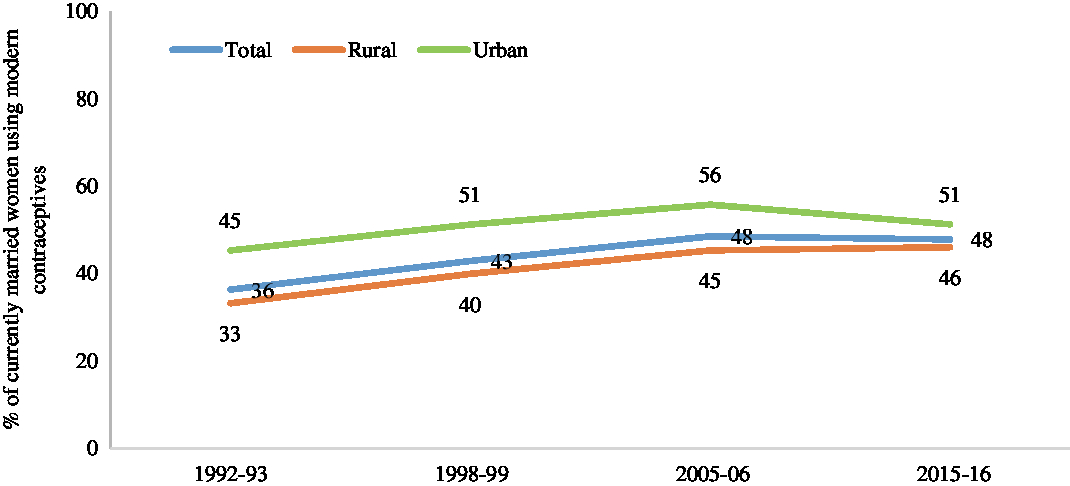
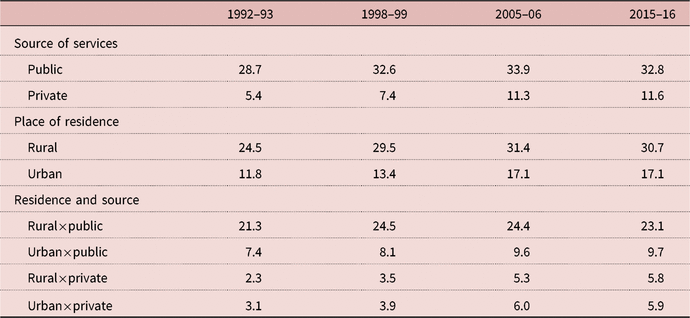
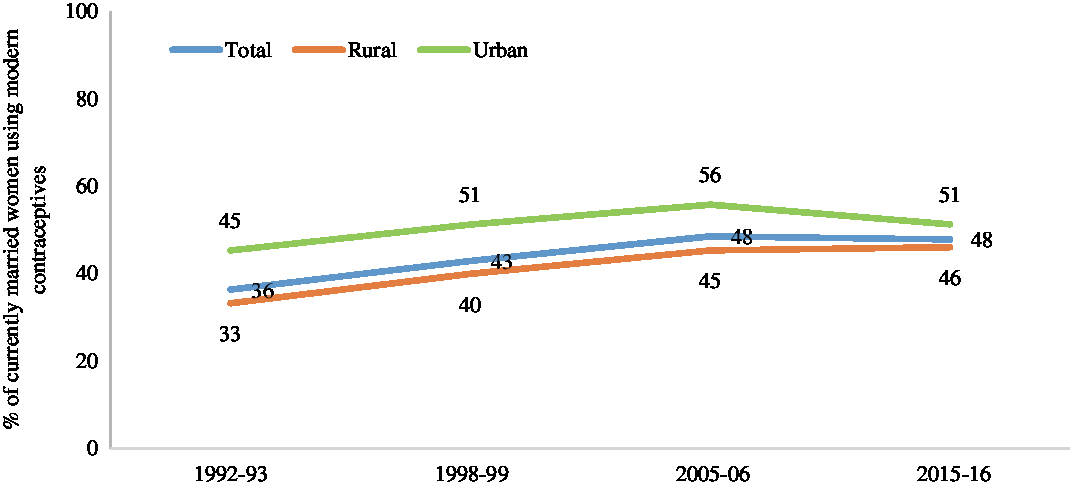
In India, mCPR increased from 36% in 1992–93 to 48% in 2015–16 (Fig. 1). A similar trend was observed in rural and urban areas. During the period, the mCPR increased from 33% to 46% in rural area, and from 45% to 51% in urban area. The public sector remained the prime source of contraceptives supplier over time (Table 1). For instance, in 2015–16, the contribution of the public sector to the total mCPR was 33% and the contribution of the private sector was 12%. However, the contribution of the private sector increased from 5% in 1992–93 to 12% in 2015–16. The contribution of the private sector to providing family planning services was higher in urban than in rural area. For instance, in 2015–16, of the contribution of urban areas (17%) to the total mCPR, about 6% was contributed by the private sector (equating to about 35% of the total mCPR of urban areas), whereas of the contribution of rural area (31%) to the total mCPR, only 6% was contributed by the private sector (equating to about 19% of the total mCPR of rural area).
Trends in modern contraceptive prevalence rate among currently married women aged 15–49 years by rural–urban place of residence, India, 1992–2016.
Percentage distribution of modern contraceptive use among currently married women aged 15–49 years by public–private source of family planning services and rural–urban residence, India, 1992–2016

Adding public and private sector contributions will not equate to the actual total mCPR, because some of the sources, such as shop, husband, friend/relative, NGO/trust hospital/clinic, were not included in the analysis.
Differences in the mCPR by household wealth
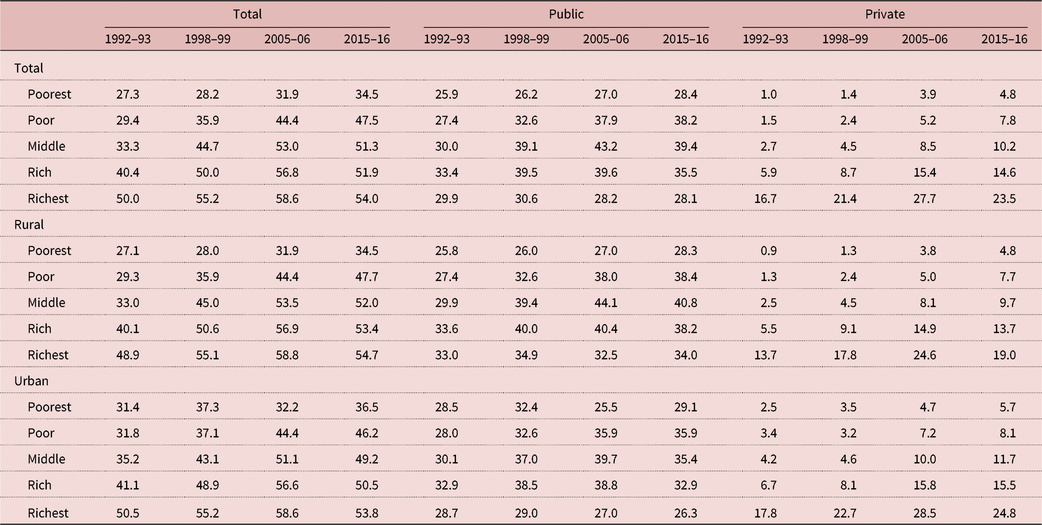
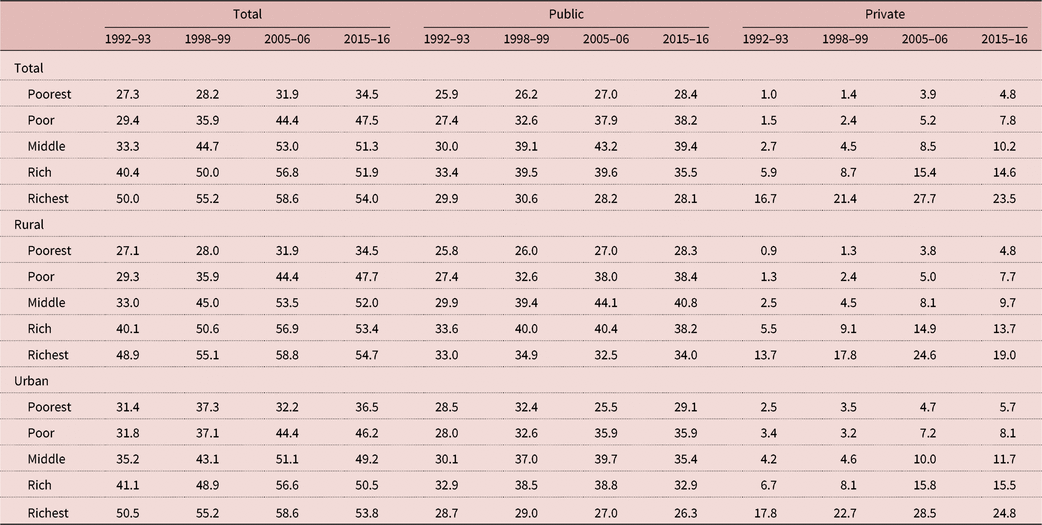
Differences in the mCPR by household wealth at the aggregate level, by rural–urban place of residence and across public and private health sectors are presented in Table 2. Use of modern contraceptives increased with improved household wealth status. For instance, in 2015–16, the mCPR was 35% among women from the poorest households compared with 54% among those from the richest households. However, this economic gap reduced over time. For instance, in 1992–93 the mCPR was 27% vs 50% (a difference of 23 percentage points) and in 2015–16, the mCPR was 35% vs 54% (a difference of 19 percentage points) for women from the poorest versus richest households, respectively. The pattern of the economic differences were similar across rural–urban place of residence. For instance, in 2015–16, the mCPR was 35% among women from the poorest households compared with 55% for those from the richest household in rural areas; and 37% for the poorest compared with 54% for the richest in urban areas. The economic differences between the public and private health sectors indicate that a higher proportion of poor women were obtaining contraceptives from the public sector and a higher proportion of rich women were obtaining them from the private sector. For instance, in 2015–16, among women who obtained family planning services from the private health sector, the mCPR was 5% among women from the poorest households compared with 24% among women from the richest households. The pattern was similar across rural–urban place of residence.
Difference in percentage modern contraceptive use among currently married women aged 15–49 years by household wealth, public–private source of family planning services and rural–urban residence, India, 1992–2016
Trends in economic disparity in mCPR
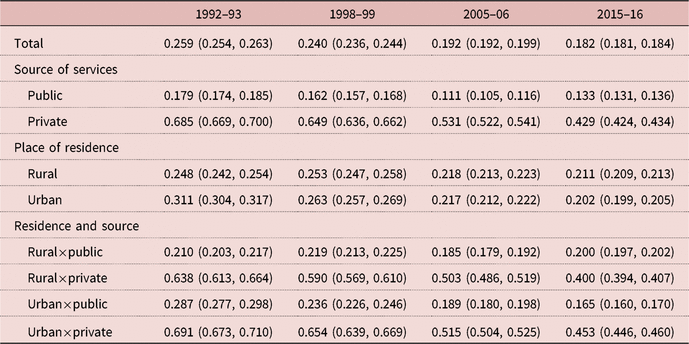
Trends in economic disparity – measured using the concentration index – in modern contraceptive use by public and private health sectors and by rural–urban place of residence are presented in Table 3. Economic disparity reduced over time at the aggregate level and across the public and private health sectors, but the gap between the public and private sectors is pervasive. For instance, in 2015–16, the CI was 0.133 when women obtained contraceptives from the public sector compared with 0.429 when they obtained them from the private sector. This pattern holds true within rural and urban areas. For instance, in rural areas the CI was 0.200 for the public sector and 0.400 for the private sector, and in urban areas it was 0.165 in the public sector and 0.453 in the private sector during 2015–16.
Trends in economic disparity (as measured by concentration index) in use of modern contraceptives by public–private source of family planning services and rural–urban residence, India, 1992–2016
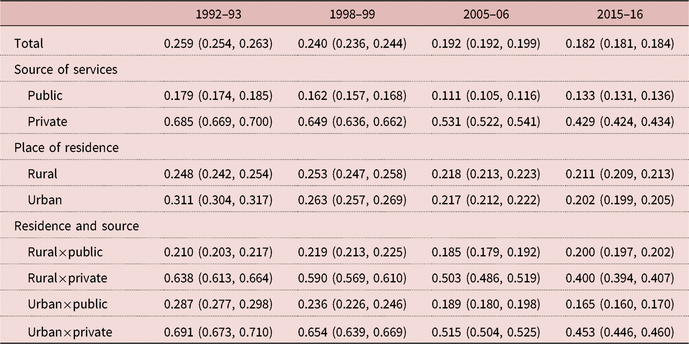
Figures in parentheses are 95% of confidence intervals.
Results of the multivariate analysis
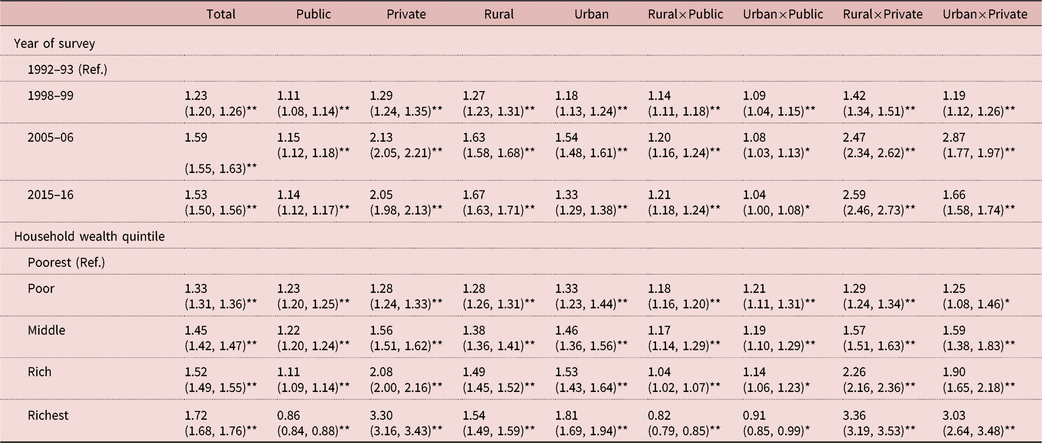
Results of the binary logistic regression analysis based on pooled data for all four rounds of the survey are presented in Table 4. It is clear from the analysis that the effect of household wealth on the use of family planning services is strong when the services are obtained from the private sector. For instance, the odds ratio of using modern contraceptives from the public sector was 1.23 (p<0.001), 1.22 (p<0.001), 1.11 (p<0.001), and 0.86 among poor, middle, rich and richest households respectively. On the other hand, when family planning services were obtained from the private sector, the odds ratio was 1.28 (p<0.001), 1.56 (p<0.001), 2.08 (p<0.001), 3.30 (p<0.001) among women belonging to the poor, middle, rich and richest wealth quintiles respectively. This pattern was consistent across rural–urban place of residence.
Odds ratios (95% of confidence intervals) obtained from binary logistic regression showing effect of household wealth on use of modern contraceptives by public–private source of family planning services and rural–urban residence, India, 1992–2016

Ref., reference category.
Odds ratio are adjusted for women’s education, age, number of children ever born, caste, religion, exposure of family planning message through media, desire for more children and states of the country.
**p<0.001; *p<0.05.
Discussion
This study examined the pattern of economic disparity in the modern contraceptive prevalence rate over the last 25 years in India. Economic disparity in modern contraceptive use – measured using the concentration index – has decreased significantly over time in India, but the pro-rich situation still persists. The decline in the economic disparity in the mCPR is associated with a greater increase in contraceptive use among women belonging to the lowest wealth quintile households. The reducing economic gap is a good news for India’s family planning programmes and suggests that those of the early 2000s (MOHFW, 2000) increasingly benefited women from the poorest households. Apart from the programme influence, other factors might have also contributed to this success, ranging from improved health care facilities, increased average education among women, increased awareness of family planning methods and the importance of using family planning services, and extensive mass media compaigns. The economic disparity in use of modern contraceptives has also declined across the public and private sectors, but the extent of the disparity remains consistently higher when contraceptive services are obtained from the private sector. This could be due to higher private sector service utilization by women in urban areas, belonging to the richest households. This is similar to the findings of an earlier study about economic disparities in service utilization from the private sector by affluent households (Campbell et al., Reference Campbell, Benova and Macleod2015). This study highlights that the effect of household wealth was significant and much greater among those who obtained services from the private sector compared with the public sector.
Over time, the modern contraceptive prevalence rate has increased in the country. However, only about half of the currently married women were using any modern contraceptive method. The low use of family planning services might be associated with several supply-and-demand-side factors, such as availability of limiting methods, poor accessibility and poor quality of care – factors that have been identified in many previous studies (RamaRao et al., Reference RamaRao, Lacuesta, Costello, Pangolibay and Jones2003; Campbell et al., Reference Campbell, Sahin-Hodoglugil and Potts2006; Hamid & Stephenson, Reference Hamid and Stephenson2006; Chaurasia, Reference Chaurasia2014; Mehata et al., Reference Mehata, Paudel and Dotel2014). In India, the public sector has remained the primary provider of family planning services, but the contribution of the private sector has increased rapidly over time. The switch from the public to the private sector for obtaining family planning services has been observed in many developing countries (Hotchkiss et al., Reference Hotchkiss, Godha and Do2011). This might be because of women’s expectation of respectful treatment, shorter waiting times, the advantages of convenience, efficiency and privacy and higher satisfaction if services are obtained from private providers (Jain Reference Jain1989; Hutchinson et al., Reference Hutchinson, Do and Agha2011; Keesara et al., Reference Keesara, Pamela and Cynthia2015).
Modern contraceptive use remained considerably lower for poorer women than for the richest women over the time period. Though the difference decreased over the study time period, it still persists. This finding is in line with those of other multi-country studies which have shown persistent inequalities in access to family planning services and modern contraceptive use by wealth quintile: the poorest women have less access to, and use of, family planning services than wealthier women (Gakidou & Vayena, Reference Gakidou and Vayena2007; Gillespie et al., Reference Gillespie, Ahmed, Tsui and Radloff2007). According to an estimate from developing countries, the contraceptive prevalence rate is 52% among the wealthiest and 35% among the poorest women (Creanga et al., Reference Creanga, Gillespie, Karklins and Tsui2011). The wealth differences in mCPR were more stark when women obtained services from the private rather than the public sector. This indicates that more rich women are obtaining contraceptive services from the private sector, while the public sector is the primary source for the poorest women.
The findings of this study need to be interpreted with caution in light of certain limitations. First, the study used cross-sectional survey data, which can only reveal association rather than causal effects between outcomes and covariates. Second supply-side factors were not accounted for in the analysis as this information was not collected in the surveys. Third, other sources of family planning service, such as shops, husbands, friends/relative, NGOs or trusts hospitals/clinics, were excluded from the analysis. However, as only a very small proportion of currently married women obtain modern contraceptives from these sources, excluding these did not significantly affect the overall results. Fourth, the total mCPR declined slightly between the NFHS 2005–06 and 2015–16, and this happened across many Indian states, which requires further research. However, given the past trends and current low level of family planning use, this will have no significant effect on the pattern of economic disparity. Fifth, the study assumed that use of modern contraceptives should be equal across wealth quintiles. However, if fertility desire is not equal across wealth quintiles, the mCPR disparity may reflect differing needs rather than differing levels of access to contraceptives. Therefore, the analysis was also extended to measure disparity in demand for family planning satisfied with modern methods (this indicator captures extent of family planning access among women who have demand for family planning) and the results (not shown) confirm a similar pattern of disparity across public and private sectors, indicating that the assumption of equal need for modern contraceptives across wealth quintiles would not alter the conclusions drawn in the study.
In conclusion, the study’s findings show that economic disparity in modern contraceptive prevalence rate has declined at the aggregate level and across public and private sectors. However, despite the decline, the disparity is consistently wide among contraceptive users utilizing services from the private sector. With the recent expansion of the family planning programme in India to engage the private sector in its many states, this study’s findings have several important policy implications. Most importantly, the engagement of the private sector in states with low mCPR should focus on addressing the family planning needs of women from the poorest households. Until the contribution of the private sector increases to expected levels, the public sector should continue to attempt to further reduce economic disparity. As long as the public sector remains the primary source of family planning services for poor and rural women, even a high level of economic disparity in the private sector is unlikely to affect the overall disparity in use of family planning services in the country. In the long run, to achieve the SDG 3.7 universal access to family planning services, in both the public and private sectors, needs to be pro-poor.
Author ORCIDs
Arupendra Mozumdar 0000-0002-2170-2656
Funding
This research received no specific grant from any funding agency, commercial entity or not-for-profit organization.
Conflicts of Interest
The authors have no conflicts of interest to declare.
Ethical Approval
The four rounds of the National Family Health Survey (NFHS) were conducted under the supervision of the International Institute for Population Sciences (IIPS), Mumbai, India, which serves as a regional institute for training and research in population studies for the ESCAP region. The institutional review board of ORC Macro (for the first three rounds of the NFHS) and ICF (for the fourth round of the NFHS) approved the data collection procedures. Formal written consent was obtained from the respondents and ethical issues were resolved before the respondents were interviewed. This study is based on anonymous public-use datasets with no identifiable information about the survey participants. Survey data were available upon request on the official website of the institute at: http://rchiips.org/nfhs/data1.shtml.