One of the principal accomplishments of the last 40 years of work on language change has been the discovery of strong generalizations—“principles” in Labov's writing—governing vocalic changes (see especially Labov, Reference Labov1994). How these generalizations can be modeled in psychological terms has not been addressed extensively, but the robustness of Labov's principles as descriptive generalizations is amply supported in the literature and well accepted in the field. A second advance in recent work has been a more sophisticated understanding of how social meanings of variation attach to linguistic practice. In particular, a line of research led by Eckert and colleagues has shown that language change in communities is conditioned by locally rooted social meanings (see, e.g., Eckert, Reference Eckert2000; Johnstone, Reference Johnstone and Fought2010). Despite the explanatory importance of these two lines of research, rather less work has focused on the relative contribution of these two kinds of factors in explaining vowel change. This is especially so in the context of British English (although, see Watt, Reference Watt2000; and more generally Labov, Reference Labov2010).
We address this issue by focusing on two paired vocalic changes in the northern English city of York—goat/goose fronting and face/goat diphthongization. We present detailed acoustic data, including analysis of the full trajectory of vowel formants. In addition, we also present quantitative and qualitative data as controlled measures of subjects' attitudes to linguistic variation. In light of these data, we argue that meanings of place shape individual speakers' use of face/goat monophthongs in a very different way from goat/goose fronting. The current wave of fronting appears to be an example of “off the shelf” change (Milroy, Reference Milroy, Cain and Russom2007): vigorous and with a wide currency, facilitated by a lack of local social-symbolic anchoring. Diphthongization, by contrast, conforms to Milroy's “under the counter” definition, with clear evidence of local social indexing. An earlier wave of goat fronting in the north of England, however, has led to fronted variants of this vowel (but not those of goose) acquiring social evaluation. As such, goat fronting would also appear to be an under the counter change. The participation of goat in two separate sound changes simultaneously presents a highly unusual scenario, bringing into sharp focus the relative contributions to change of the internal pressures exerted by the vowel system and the social forces at play in the community.
Our discussion is organized as follows. We first discuss previous work on change in face/goat and goat/goose, particularly in northern English dialects. After describing our data and methods, we present results on face/goat monophthongization and goat/goose fronting, respectively. We conclude by summarizing the main consequences of our findings.
FACE/GOAT DIPHTHONGIZATION AND GOAT/GOOSE FRONTING IN NORTHERN ENGLAND
face/goat diphthongization in northern England
Over the past two decades, the literature on sound change and dialect contact in the United Kingdom has been dominated by discussion of a set of innovations spreading outward from southeast England. Several of the sound changes described from this perspective include /t/-glottaling (Docherty & Foulkes, Reference Docherty, Foulkes, Foulkes and Docherty1999; Foulkes & Docherty, Reference Foulkes and Docherty2006; Kerswill & Williams, Reference Kerswill and Williams2005; Llamas, Reference Llamas2007; Milroy, Milroy, Hartley, & Walshaw, Reference Milroy, Milroy, Hartley and Walshaw1994; Watson, Reference Watson2006), /θ, ð/-fronting (Milroy, Reference Milroy1996; Richards, Reference Richards2008; Trudgill, Reference Trudgill1988; Williams & Kerswill, Reference Williams, Kerswill, Foulkes and Docherty1999), labiodental /r/ (Foulkes & Docherty, Reference Foulkes and Docherty2000), and changes in constraints on was/were variation (Britain, Reference Britain2002; Cheshire & Fox, Reference Cheshire and Fox2009; Richards, Reference Richards2008; Tagliamonte, Reference Tagliamonte1998). Most accounts of these changes have focused on local speakers' understandings of linguistic variants as indices of place, and their overlap with other meanings related to age, gender, class, and ethnicity (Cheshire & Fox, Reference Cheshire and Fox2009; Llamas, Reference Llamas2007; Richards, Reference Richards2008). The present study focuses on variation between monophthongal and diphthongal realizations of the face and goat lexical sets, a principal shibboleth of northern English speech.
The most extensive study of variation in mid-vowels in northern English dialects is provided by Watt's work in Newcastle upon Tyne, based on auditory analyses of word-list and conversation data collected in the mid-1990 s (Watt, Reference Watt1998, Reference Watt2000, Reference Watt2002; Watt & Milroy, Reference Watt, Milroy, Foulkes and Docherty1999). Watt distinguished several variants including: (i) front and back closing diphthongs [eɪ] and [əʊ], similar to forms found in standard southern English; (ii) “pan-northern” monophthongs [eː] and [oː], variants with wide currency across northern England (with some variation in height); and (iii) “localized” centering diphthongs [ɪə] and [ʊə], found among conservative speakers in Newcastle and some surrounding communities, but not elsewhere in northern England. In addition, for the goat lexical set, Watt distinguishes a fronter monophthong, [ɵː]. The apparent time evidence from the Newcastle study suggests gradual loss of the localized centering diphthongs. There is some increase in the use of southern closing diphthongal variants, particularly among middle-class speakers, but, much more importantly, an increase in pan-northern monophthongs. Watt and Milroy (Reference Watt, Milroy, Foulkes and Docherty1999) interpreted these results as suggesting a process of regional dialect leveling, shaped by different kinds of meaning attaching to the different variants. Centering diphthongs are associated with older industrial working-class life. By contrast, monophthongs accommodate a less marked identity as northerners, but “modern Northerners” (Watt, Reference Watt1998:7). That is, the fact that Newcastle speakers do not tend more strongly toward southern diphthongs is a consequence of the emblematic status of these features as markers of northernness, and local speakers' indexing of these meanings through speech. No controlled attitudinal data or systematically collected qualitative data were obtained in support of these claims, however.
To test the claim that patterns of face/goat monophthongization are strongly shaped by identities of place, we present controlled data examining whether the same community members who express strong allegiance to the local community best conserve the local monophthongal forms. We do so with data from another northern city, York. We compare attitudinal effects for face/goat with those for goat/goose fronting, which, as we discuss next, the literature suggests has no particularly strong indexical meanings.
goat/goose fronting as a global process of diffusion
There is abundant evidence demonstrating the prevalence of fronting of goose, or goat and goose together, in English dialects across the globe. This includes dialects in the United Kingdom (Bauer, Reference Bauer1985; Hawkins & Midgley, Reference Hawkins and Midgley2005; Henton, Reference Henton1983; Hughes, Haddican, & Foulkes, Reference Hughes, Haddican and Foulkes2012; Jansen, Reference Jansen, Calamai, Celata and Ciucci2010; Kerswill & Williams, Reference Kerswill and Williams2005; Trudgill, Reference Trudgill2001; Watt & Tillotson, Reference Watt and Tillotson2001), North America (Baranowski, Reference Baranowski2008; Clarke, Elms, & Youssef, Reference Clarke, Elms and Youssef1995; Fridland, Reference Fridland2008; Hall-Lew, Reference Hall-Lew2009; Thomas, Reference Thomas2001), South Africa (Mesthrie, Reference Mesthrie2010), Australia (Cox, Reference Cox1999), and New Zealand (Easton & Bauer, Reference Easton and Bauer2000). Two properties make this variable of particular interest for theories of diffusion: fronting is spreading very quickly, and in many contexts, fronted variants seem to lack strong indexical links to local social distinctions (Fridland, Reference Fridland2008). As Fridland (Reference Fridland2008) noted for North American dialects, fronting has diffused into speaker groups that often do not participate in sound changes anchored to local social factors. In particular, goose fronting has been reported among African American speakers in several communities (Fridland & Bartlett, Reference Fridland and Bartlett2006), Chicano speakers in Los Angeles (Fought, Reference Fought1999), and Asian Americans in San Francisco (Hall-Lew, Reference Hall-Lew2009).
Within the United Kingdom, goose fronting has been described for dialects in both northern and southern England, including received pronunciation (RP). A cross-dialectal acoustic study by Ferragne and Pellegrino (Reference Ferragne and Pellegrino2010), with fairly small samples of word-list data, indicated evidence of goose fronting in 9 of 13 dialects examined from the United Kingdom and Ireland. Fronting of goat has in turn been described for RP (Gimson, Reference Gimson1970; Trudgill, Reference Trudgill2001; Wells, Reference Wells1982), Reading and Milton Keynes (Kerswill & Williams, Reference Kerswill and Williams2005; Williams & Kerswill, Reference Williams, Kerswill, Foulkes and Docherty1999), Newcastle (Watt & Milroy, Reference Watt, Milroy, Foulkes and Docherty1999), Manchester (Hughes et al., Reference Hughes, Haddican and Foulkes2012), and some Scottish dialects (Jones, Reference Jones and Jones1997). The fronting patterns found elsewhere in Yorkshire are of particular interest for the present study. York is situated approximately midway between the cities of Hull (54 km to the southeast) and Leeds and Bradford (35 and 50 km to the southwest, respectively). In these cities, fronting to a central variant, close to [əː] and overlapping with nurse, has been reported (Williams & Kerswill, Reference Williams, Kerswill, Foulkes and Docherty1999; Watt & Tillotson, Reference Watt and Tillotson2001). There is some suggestion that the fronted variants are more typical of East Yorkshire (i.e., Hull) and thus that they are spreading westward (Watt & Tillotson, Reference Watt and Tillotson2001).
The literature suggests some phonetic differences between the processes of goose/goat fronting within North American dialects, and between North American and U.K. varieties, which raises the question of whether the different patterns of change described are the “same change” (Baranowski, Reference Baranowski2008; Koops, Reference Koops2010; Thomas, Reference Thomas2001). Most notably, in most U.S. dialects, fronting of goose is mainly in the nucleus (Hall-Lew, Reference Hall-Lew2009; Koops, Reference Koops2010), whereas the whole vowel fronts in the United Kingdom (Kerswill & Williams, Reference Kerswill and Williams2005). In the case of goat, fronting has been reported more in the off-glide in both North American and U.K. studies (Kerswill & Williams, Reference Kerswill and Williams2005). A second possible difference between fronting in the United States and United Kingdom concerns Labov's generalization that goat fronting is parasitic on goose fronting (Labov, Reference Labov1994:208). Specifically, Labov observed that goose fronting typically precedes goat fronting and is further advanced in the vowel space in dialects where both vowels front. Nevertheless, goat fronting in the absence of goose fronting is reported in Newcastle (Watt, Reference Watt2000) and Bradford (Watt & Tillotson, Reference Watt and Tillotson2001). Watt (Reference Watt2000:95), in fact, described the vowel in Newcastle goose as among the closest to cardinal /u/ found in modern English. Watt's (Reference Watt2000) results suggested the possibility that northern English dialects are more generally exceptional in flouting Labov's (Reference Labov1994) generalization. We will address this suggestion next.
DATA AND METHODS
The City of York
Participants in our study were all native speakers of English from York (population 198,000, U.K. Census, 2011).Footnote 1 Variation in morphosyntactic, lexical, and consonantal features of this dialect have been reported extensively by Tagliamonte and colleagues (Tagliamonte, Reference Tagliamonte1998; Tagliamonte & Baayen, Reference Tagliamonte and Baayen2012; Tagliamonte & Roeder, Reference Tagliamonte and Roeder2009; Tagliamonte & Smith, Reference Tagliamonte and Smith2002, Tagliamonte, Smith, & Lawrence, Reference Tagliamonte, Smith and Lawrence2005; Tagliamonte & Temple, Reference Tagliamonte and Temple2005).
Unlike most other cities in Yorkshire and northern England, York's economy is not based principally on industry but rather on tourism. York is known for its well-preserved Roman and medieval architecture, including its minster (cathedral) and ramparts surrounding the city. York is also more economically advantaged than many surrounding communities are, with a considerably lower unemployment rate than the rest of the surrounding regions including Bradford and Hull. In a 2012 survey by a leading national real estate firm, York ranked second in a list of desirable cities to live in the United Kingdom.Footnote 2 Several participants in our study cited the history and architecture of York as well as its relative economic advantages as reasons for enjoying living in the community and for wishing to stay there. Comments such as those in (1) typify the way that some speakers value perceptions of the community by outsiders, especially its “poshness.”
(1) Brendan and Sean Footnote 3
Brendan: I really like York and I really like the fact that I come from York as well, because if you—if you say like, you're talking to your friends from down south and whatever they're all like, “Where you from?” And then you're like, “Up north.” And they're all, “What? Like Birmingham?” or like—.
Sean: Birmingham up north?
Brendan: Yeah that's north to them, innit? You know, or like, you know some scabby place like Grimsby.
Sean: Middlesbrough.
Brendan: You're like, “No, I'm from York.” And, “Ooh the posh place.” And everyone goes, “Ooh from York, oh it's really nice.”
Sean: “Oh yeah, York. York's nice. I've been on holiday, yeah.”
Brendan: “It's really nice there.” And it's like, “Yeah it is.” That's really cool.
Sean: I live there, mate.
We focus more on participants' perceptions of the community and different groups within it shortly.
Sampling and recording procedures
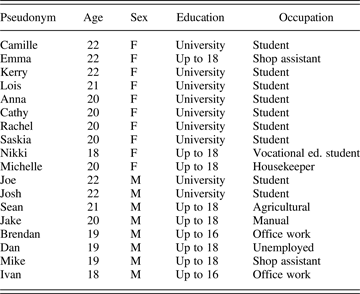
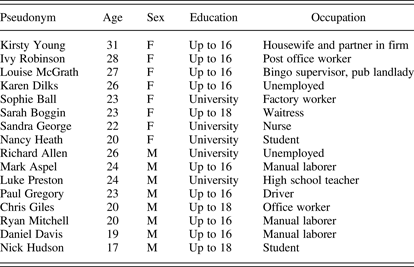
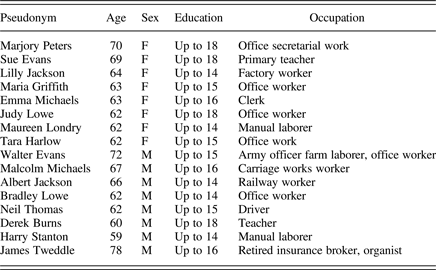
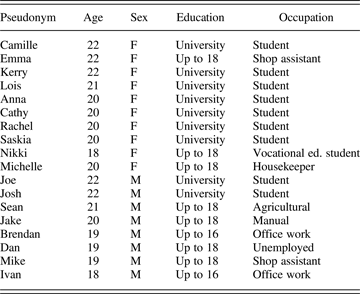
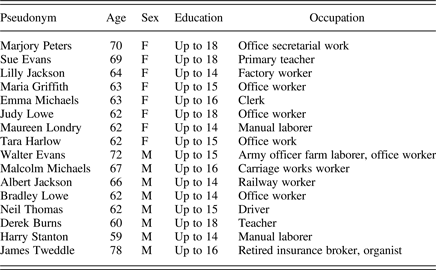
Our data come from two sources. One dataset, which we call the 2008 sample, was gathered from 2008 to 2011. It consists of 18 speakers, 18 to 22 years old at the time of recording. To examine the possibility of change in real-time, we compare data from this sample with data from a 32-speaker subsample of Tagliamonte's York corpus gathered around 1998 (Tagliamonte, Reference Tagliamonte1996–1998). The 1998 subsample was constructed to match as faithfully as possible the sex, educational, and occupational profiles of speakers in the 2008 sample. To gauge evidence of change in real time within the 1998 sample, we separated it into younger (17–31) and older (59–78) groups. We summarize the sampling in Table 1. Details on speakers' age, sex, educational attainment, and occupation are provided in the Appendix. Social class was not explicitly investigated in Tagliamonte's (Reference Tagliamonte1996–1998) sample. Speakers were all judged to be from the upper working or lower middle class, based on the insider knowledge of the fieldworker and demographic information given in interview. We adopted the same methodology for the 2008 sample, with no attempt at formal classification of social class.Footnote 4
Sampling summary

M = mean.
The 1998 recordings were sociolinguistic interview data (see especially Tagliamonte, Reference Tagliamonte1996–1998). The length of interviews varies, but each generally lasts approximately 45 min per speaker. The 2008 recordings comprise three types of material. First, adapting Milroy, Milroy, and Docherty's (Reference Milroy, Milroy and Docherty1994–1997) procedure, we recorded participants speaking in pairs, usually of the same sex. To facilitate conversation in this context, we provided conversational prompts modeled on traditional sociolinguistic interview topics—childhood narratives, school, community, etc. The fieldworker, who was present but did not usually participate in the conversations, explained that the prompts outlined topics that subjects could choose to discuss if they wished to, but they were not required to do so. This portion of the session lasted approximately 45 min. The researcher facilitating the data collection sessions was a native speaker of Yorkshire English.
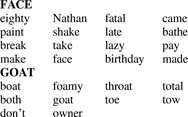
Following the conversation task, each participant was recorded reading a 200-item word list, containing 10 goat items and 16 face items. Unfortunately, no goose items were included in the word list as this variable was not identified as a point of focus at the outset of the project.
Finally, an ethnographic interview was held with each pair, lasting about 20 min. The total set of ethnographic interview data was just over 3 hr 10 min. The interview focused on participants' perceptions of ways the local community was changing and their perceptions of different accents in the local community. As part of this task, participants were asked the questions in (2). We then assigned a value to each answer on a 3-point scale: 1 for a positive answer, –1 for a negative answer, and 0 for a neutral response. Scores were combined into an index, intended to measure identification with the local community. The possible range for this index is therefore –4 to +4.
(2)
a. Do you like living here in York?
b. Do you plan to settle here in York?
c. Do you like the York accent?
d. Are you proud to be from York?
We note that asking questions in paired interviews allows for carryover effects in that one interviewee's answers to these questions may influence that of the other interviewee. Nevertheless, we chose this technique for its ability to stimulate revealing debate among participants about meaningful differences in language use in the community. The combination of quantitative data afforded by the index and the qualitative data from the interviews is used as the basis for our analysis of attitudes. Reducing complex matters such as attitude to a single metric is far from straightforward, and the qualitative data were used to better interpret the information gleaned from the quantitative measure.
For acoustic analysis, we extracted approximately 35 tokens per vowel per speaker from the conversational data and all relevant word-list tokens. We did not extract tokens from the ethnographic interviews, part of which focused explicitly on attitudes toward language use. For each token, we took nine time-normalized F1 and F2 measurements using a Praat script and then hand-corrected the output (McDougall, Reference McDougall2004, Reference McDougall2006). We normalized the data using Watt and Fabricius's modified procedure (Fabricius, Watt, & Johnson, Reference Fabricius, Watt and Johnson2009) using the Vowels package for R (Kendall & Thomas, Reference Kendall and Thomas2012) with reference vowels fleece, start, and thought, for which measurements were taken at the vowel midpoint only. (See Fabricius et al., Reference Fabricius, Watt and Johnson2009; Flynn, Reference Flynn2011; Flynn & Foulkes, Reference Flynn, Foulkes, Lee and Zee2011, on evidence that Watt and Fabricius's modified procedure is best suited to sociophonetic analysis.) Five tokens per speaker were measured for reference vowels.
We measure goat fronting by comparing age group data for the seventh time-normalized measurement point for F2 and goose fronting at the fifth time-normalized measurement point for F2. These points correspond to the points of the formant trajectory, which showed the greatest cross-age-group difference. To measure face and goat diphthongization, we took for each token the Euclidean distance between onset and offset using the first and ninth normalized values for F1 and F2 (Fabricius, Reference Fabricius2007).
FACE/GOAT MONOPHTHONGIZATION
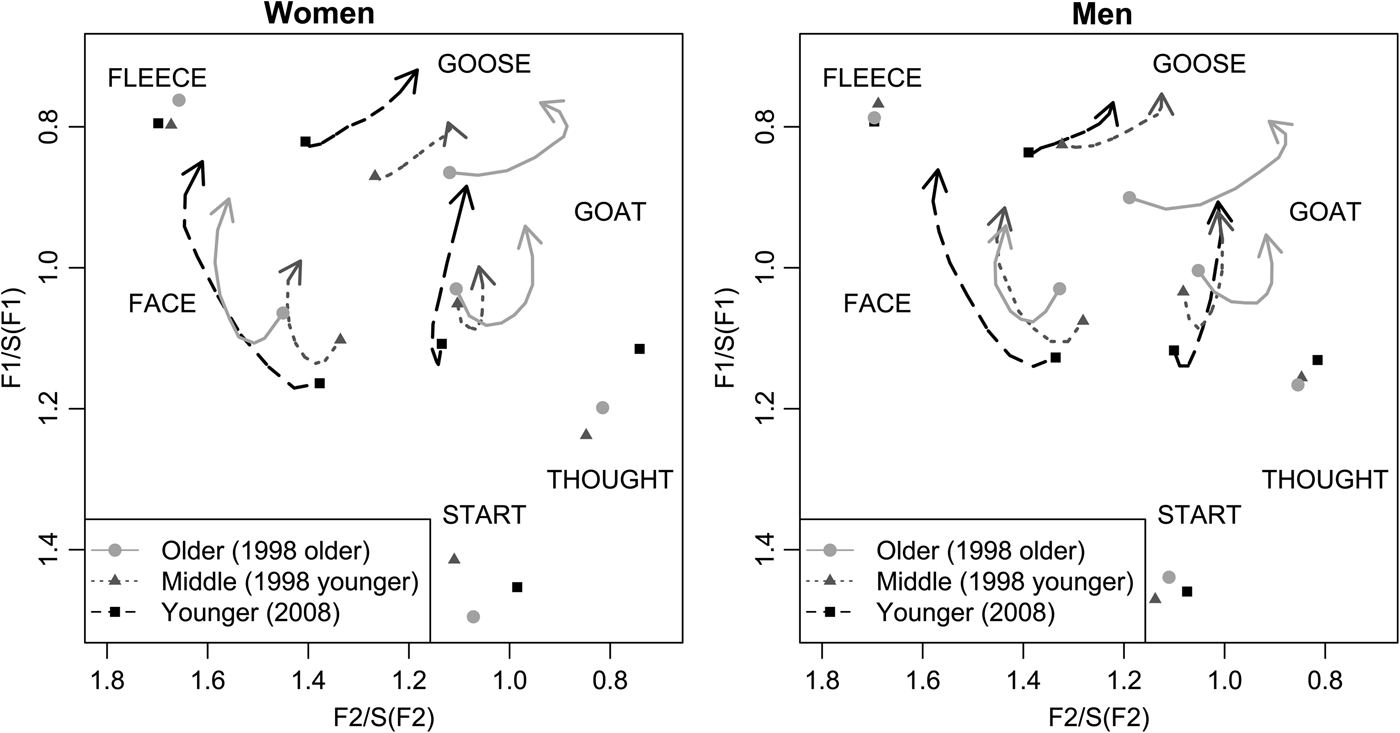
We begin by plotting normalized mean F1 and F2 values by sex and age group. Figure 1 plots mean F1 and F2 values for reference vowel midpoints and mean values for each of the time-normalized measurement points for face, goat, and goose.Footnote 5 The data shown are from spontaneous speech.
Mean normalized F1 and F2 values by lexical set and age group for women and men.

Figure 1 suggests two findings of particular relevance. First, the plots show, on average, greater acoustic movement in goat and face in the 2008 sample than in the older samples. The differences between the two 1998 samples is less dramatic, and indeed, among women, the older 1998 speakers appear to show more diphthongal realizations for goat and face than the younger speakers in the 1998 subsample did. We will return to these facts shortly. Second, Figure 1 shows that the 2008 speakers differ from their elders in showing fronter realizations of goat, particularly in the offset, and fronter onsets and offsets for goose. Among men, the 2008 sample does not show dramatically fronter realizations of goat offsets and goose, but, in all cases, the older 1998 speakers show the backest realizations for goat and goose. We consider these differences further in light of the dynamic formant analysis of F2 presented in the following sections.
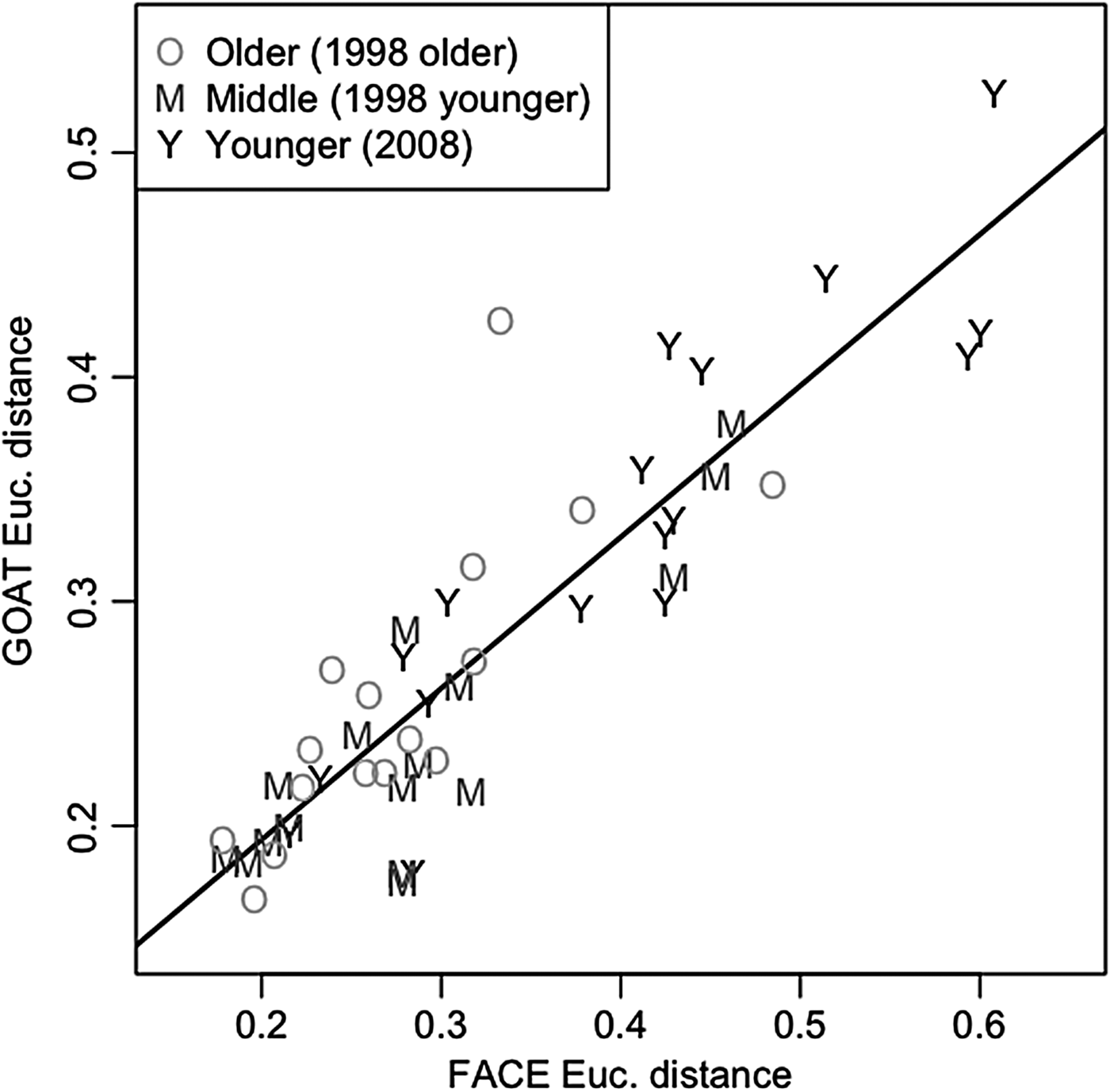
Figure 2 plots mean Euclidean distance values by speaker for face and goat, again showing conversational data only. Lower values indicate more monophthongal realizations. It shows a very tight cross-speaker correlation in Euclidean distance values for face and goat (Spearman's rho = .90, p < .0001). These results are similar to results reported by Watt (Reference Watt2000) for Newcastle, suggesting that the same speakers who diphthongize face also diphthongize goat. They thus align with predictions that sound change applies to phonological features—[-high, -low] vowels in this case.
Mean Euclidean distances for goat and face by speaker.
Despite the apparent motivation for treating face and goat diphthongization as a single process of variation and change, we treat the two vowels separately in the analyses to follow, because coarticulatory effects have different consequences for these two vowels. For example, a following velar might be expected to favor backer offsets for both goat and face. However, in the case of face, where the tongue body is in anterior position, coarticulation with a following velar requires a greater degree of movement than for goat, where the tongue body is already back. Thus, a following velar generates a more diphthongal realization for face, but not for goat. In addition, realizations of goat may be conditioned in part by individual speakers' realizations of goose, whereas face is, by hypothesis, insensitive to the realization of goose (Baranowski, Reference Baranowski2008; Labov, Reference Labov1994). We therefore fit separate models for goat and face.
goat diphthongization
We examined linguistic and social effects on diphthongization by fitting a series of linear mixed effects regression models, with normalized Euclidean distance measurements of face and goat tokens as the dependent variable and random intercepts for speaker and lexical root. The analysis was conducted using the lmer() function in the lme4 package in R (Bates, Maechler, & Bolker, Reference Bates, Maechler and Bolker2011).Footnote 6 The fixed social predictors tested were the speaker's attitudinal index score, style, speaker sex, and speaker age group. Because the 1998 corpus did not include word-list or attitudinal score data, these predictors were excluded in models with all three age groups and included in separate models with only the 2008 data. We treated the attitudinal score as a continuous variable with possible values ranging from –4 to +4 (though in practice the scores ranged from 0 to +4). Style and sex were factors with two levels each: word list versus conversation and male versus female respectively. The age factor had three levels: 1998 older, 1998 younger, and 2008. The fixed linguistic predictors tested were the natural log of vowel duration (Klatt, Reference Klatt1973),Footnote 7 and following and preceding voicing, manner, and place of articulation. Coda-/l/ was coded as a velar, whereas onset /l/ was coded as a coronal. In a few cases, values for following and preceding voicing, manner, and place of articulation are recoded in different ways in the different models summarized herein for reasons that will be explained.
Variables were selected using a step-up procedure similar to that employed in Goldvarb (Sankoff, Tagliamonte, & Smith, Reference Sankoff, Tagliamonte and Smith2012) and Rbrul (Johnson, Reference Johnson2012).Footnote 8 Fixed predictors improving the model significantly (α = .05) were added level by level. We then used this same step-up procedure to evaluate two-way combinations of variables where plotting suggested a possible interaction. The analysis revealed no significant interactions with >2 predictors.
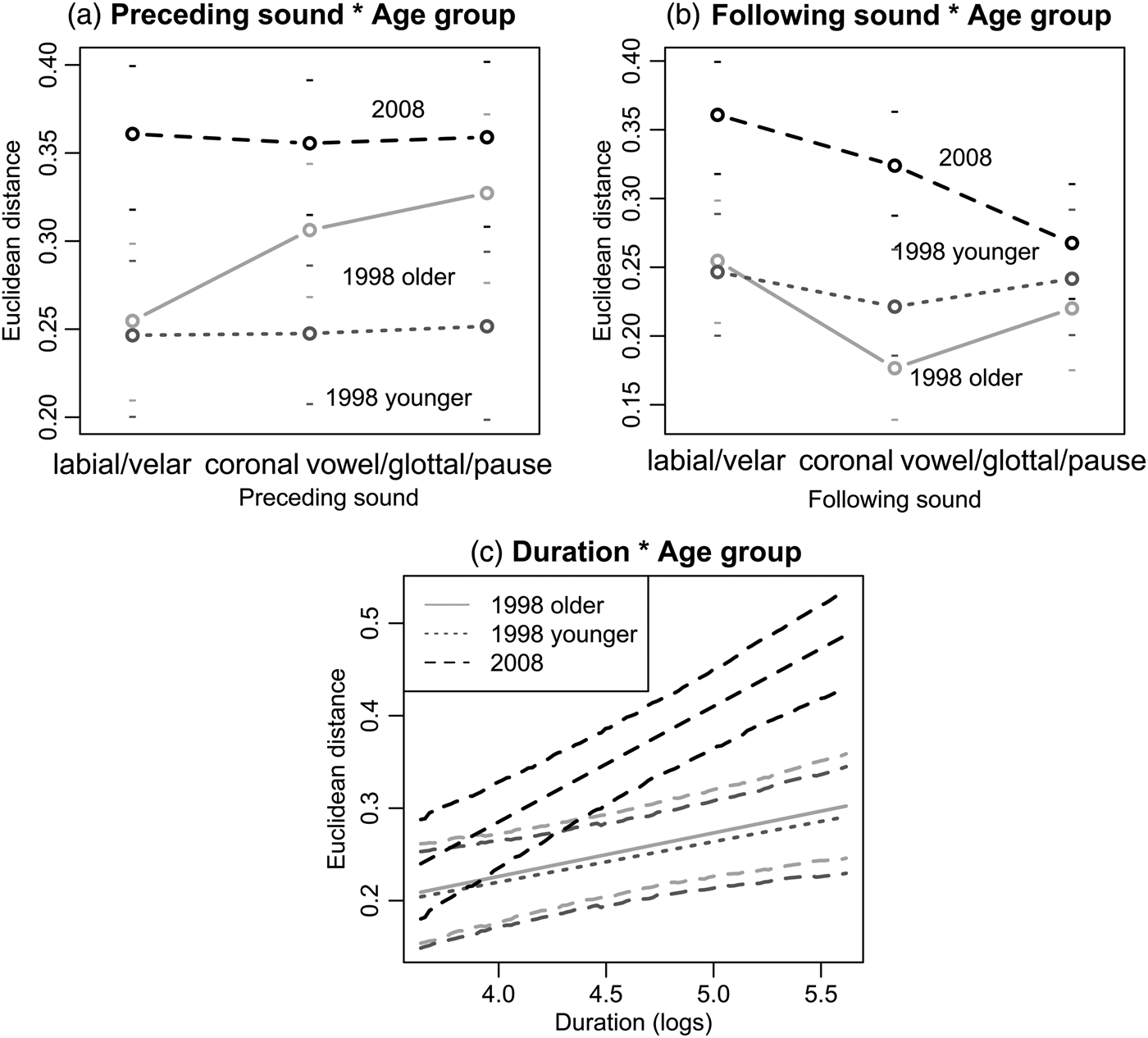
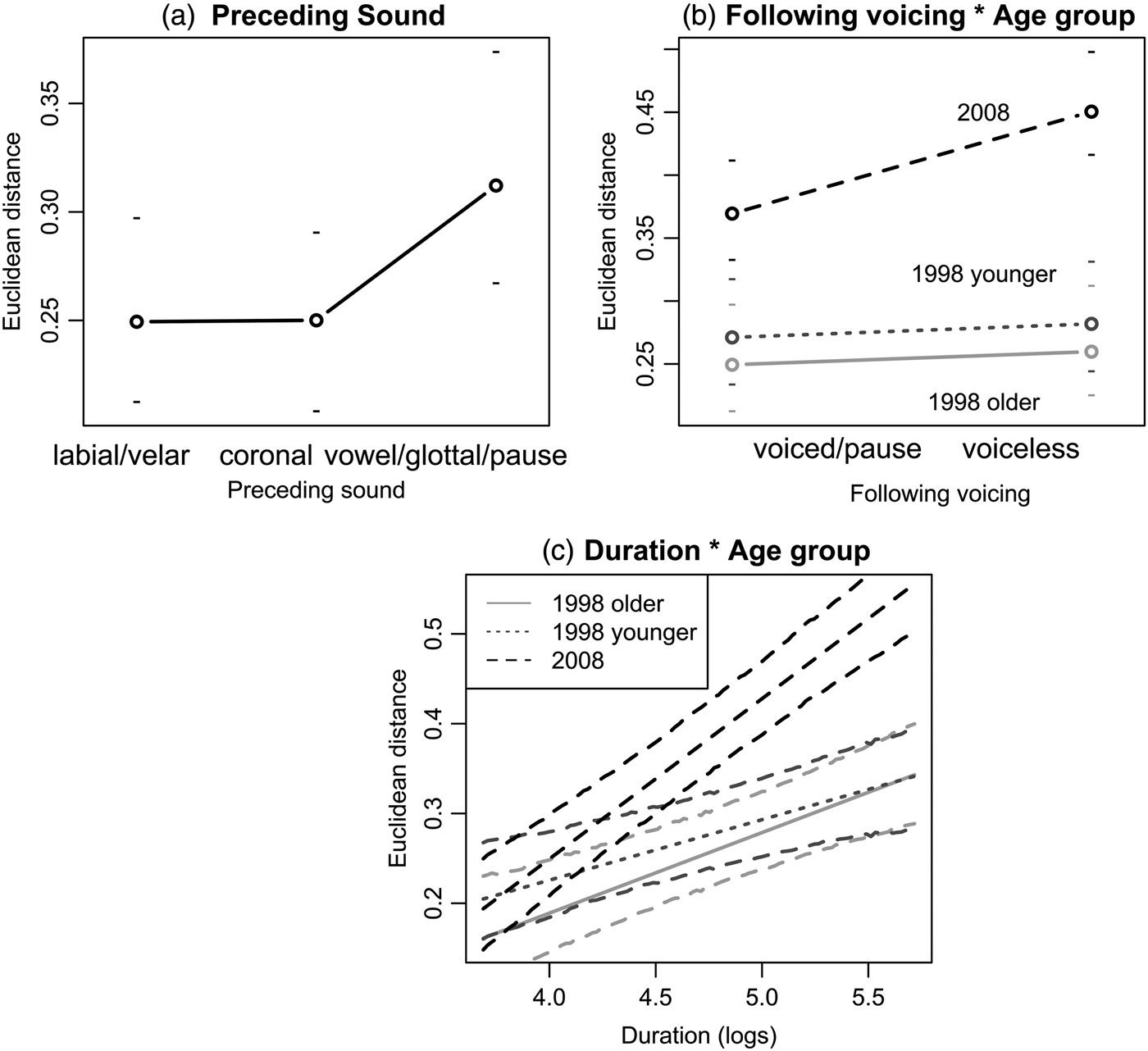
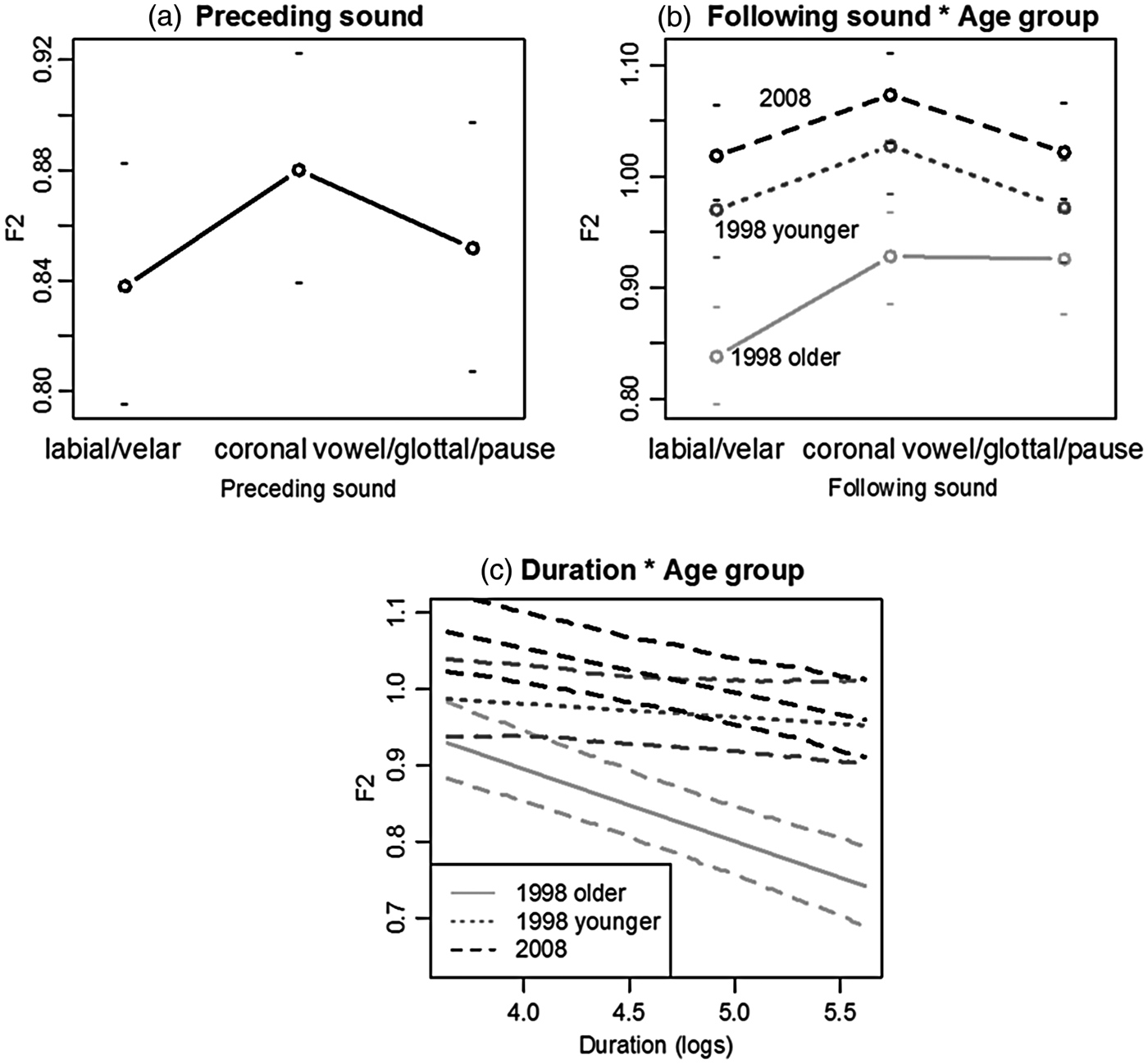
We begin by describing a model of goat diphthongization, with all three age groups (n = 1,712, r-squared = .40). The step-up procedure selected interactions for preceding sound*age group, following sound*age group, and log-duration*age group. The analysis revealed no significant main effects or other interactions. We illustrate the selected fixed effects in the partial effects plots in Figure 3, which also shows 95% Bayesian confidence intervals, estimated by MCMC-sampling (10,000 samples) using the LanguageR package in R (Baayen, Reference Baayen2011).
Partial effects for a model of goat diphthongization.
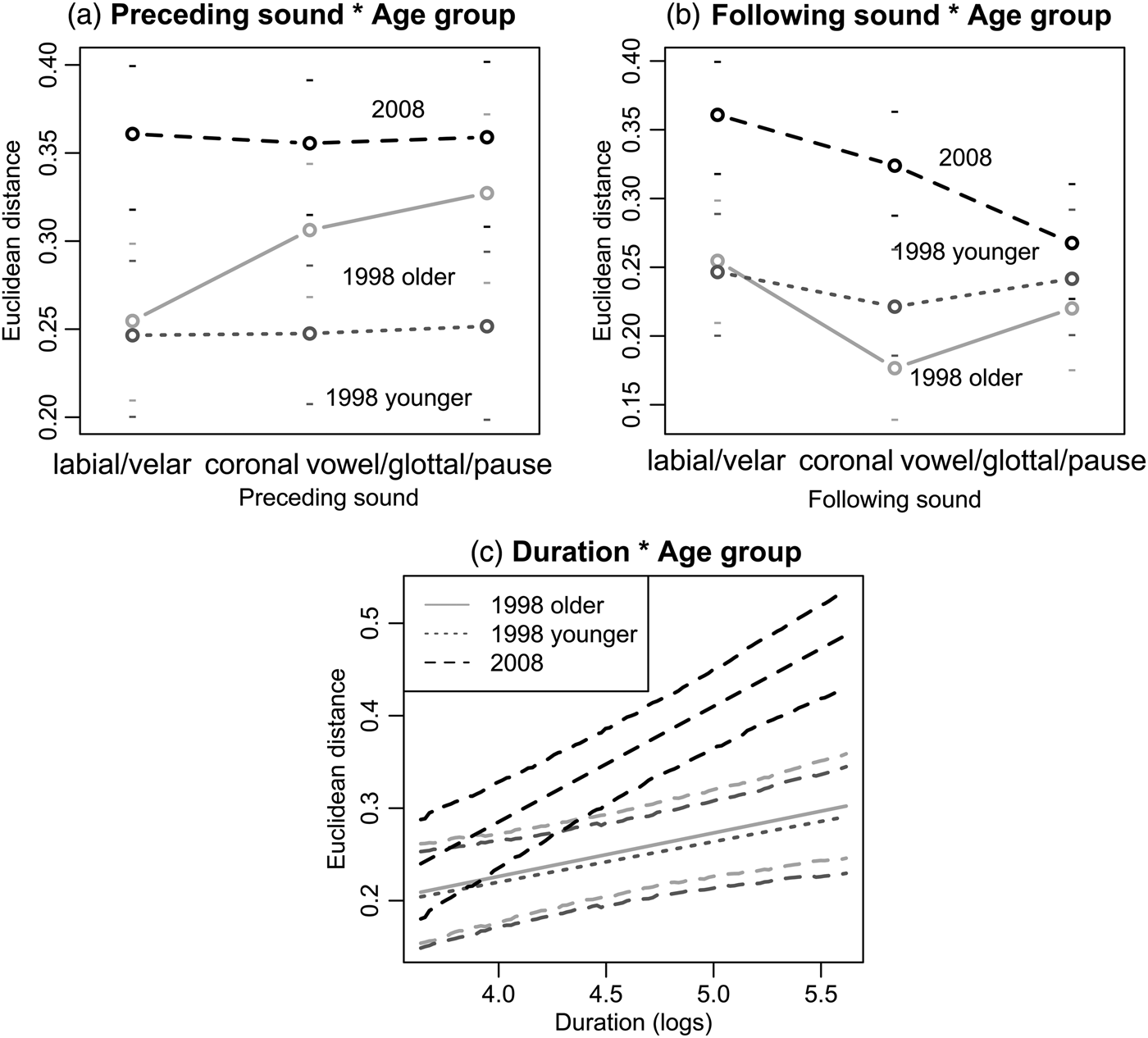
Figure 3a plots partial effects for the interaction between preceding sound and age group. It shows that the 2008 subsample favors longer Euclidean distances, whereas both 1998 subsamples tend toward shorter Euclidean distances. The preceding sound effect is not constant across age groups, however; preceding labials and velars favor shorter Euclidean distance measurements vis-à-vis coronals and vowels/glottals/pauses, but only for the 1998 older speakers. This effect plausibly reflects well-known coarticulatory effects of labials and velars together with the somewhat exceptional shape of goat formant trajectories for the 1998 older speakers. Coarticulation of the onset of goat vowels with a preceding velar or labial will yield lower formant values. In the former case, the onset will have a backer realization; in the latter case, lip-rounding and protrusion co-occurring with labials will extend the vocal tract and produce lower formant values (Stevens, Reference Stevens, Hardcastle and Laver1997:474, Reference Stevens2001:292). Figure 1 shows that the 1998 older speakers have fairly horizontal goat formants, unlike the two younger groups. For this reason, coarticulation of goat onsets with preceding labials and velars will therefore shorten the Euclidean distance between onset and offset for the 1998 older speakers to a greater extent than for the younger speakers.
Similar effects are shown in Figure 3b, which plots the interaction between age group and following sound. For both the 2008 and 1998 younger speakers, labials and velars favor longer Euclidean distance values for goat, whereas coronals favor shorter measurements. Among the 1998 older age group, however, this effect is much stronger. We again relate this to well-known coarticulatory effects of these sounds together with flatter formant trajectory for goat for the 1998 older speakers. That is, for the 1998 older speakers, coarticulation of a goat offset with a following labial/velar stretches the Euclidean distance measurement to a greater extent than it does for the younger speakers, who show more vertical trajectories.
Finally, Figure 3c shows partial effects for the interaction between vowel duration and age group. This plot shows, again, that Euclidean distance values for the 2008 sample are higher than those for the 1998 samples, which differ very little. The different slopes for these age groups, however, show that the effect of vowel duration on Euclidean distance is much stronger for the 2008 sample than for the 1998 samples, though the slope is positive for all three groups. We take this interaction to reflect articulatory undershoot. Where duration is short, the articulators have less time to make the lingual gesture, resulting in abbreviated gestures and shorter Euclidean distance measurements. For the 1998 subsamples, which are more monophthongal, the duration effect is weaker because the lingual gesture required is shorter.
face diphthongization
Analysis of face diphthongization yielded similar results. We again fit a model for all three age groups using the procedure described for goat diphthongization. The analysis revealed a significant main effect for preceding sound and significant interactions for log-duration*age group and following voicing*age group, illustrated in Figure 4 (n = 1,862, r-squared = .56). The analysis revealed no significant main effects or other interactions.
Partial effects for a model of face diphthongization.
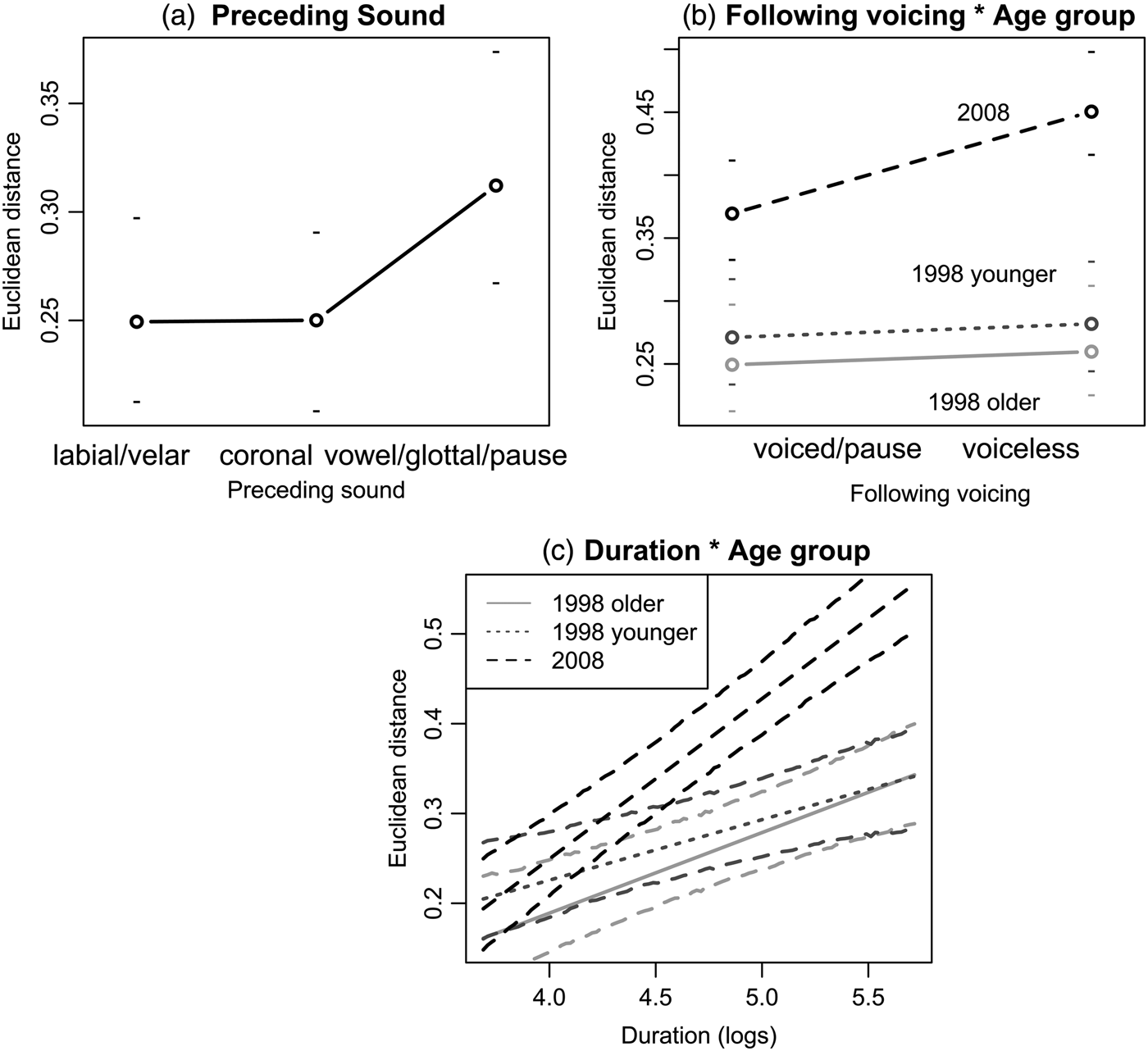
Figure 4a shows effects for preceding sound similar to those described for goat; a preceding vowel, glottal, or pause favors longer Euclidean distance measurements. The plots in the upper right and lower panels show the two significant interactions. Both plots show that, as with goat, the 2008 speakers show higher Euclidean distance values than the 1998 subsamples. (This is also evident in Figure 1.) Figure 4b shows that among the more diphthongal 2008 speakers, but not among the more monophthongal 1998 subsamples, following voiceless sounds favor longer Euclidean distance measurements vis-à-vis following voiced sounds and pauses. This voicing effect for diphthongs is reminiscent of well-known following voicing effects on price monophthongs in several North American and U.K. dialects (Moreton & Thomas, Reference Moreton, Thomas, Cole and Hualde2004; Orton, Sanderson, & Widdowson, Reference Orton, Sanderson and Widdowson1978; Trudgill, Reference Trudgill1999:72) dialects. We know of no previous literature reporting following voicing effects for face.
Finally, Figure 4c shows the duration*age group interaction similar to that for goat. The effect of duration is much greater for the 2008 than for the 1998 samples, whose slopes are similar. We again take this to be a simple undershoot effect. That is, the duration effect is greater among the 2008 speakers, because they are more diphthongal, and duration consequently has a greater effect on the realization of the tongue body gesture during production of the diphthong.
The data presented so far provide some real-time evidence of change toward diphthongal realizations of face and goat, with York speakers from the 2008 sample showing longer Euclidean distance values than speakers from the 1998 samples do. The 1998 data, however, suggest little evidence of an apparent time difference. The contrast between the 2008 and the 1998 samples, however, is in keeping with findings from Newcastle, where upgliding diphthongal realizations of face and goat were more frequent among younger speakers, suggesting a gradual increase in these variants in the community over apparent time (Watt, Reference Watt2000, Reference Watt2002; Watt & Milroy, Reference Watt, Milroy, Foulkes and Docherty1999). A question raised by the real-time results, then, is how to explain this change in the community. We consider these issues in the following section in view of evidence on stylistic and attitudinal correlates of face/goat diphthongization.
Attitude toward the community and style as correlates of face/goat diphthongization
As we have already discussed, Watt (Reference Watt2000) and Watt and Milroy (Reference Watt, Milroy, Foulkes and Docherty1999) explained conservation of northern monophthongal forms in Newcastle as reflecting dialect loyalty. In the ethnographic interview portion of our 2008 recordings, participants volunteered metalinguistic comments about the use of diphthongal versus monophthongal realizations of face/goat in the community in five of nine interviews, thus demonstrating overt awareness of the indexical potential of these vowels. In most cases, the comments consisted of a participant citing evidence that given community members have “broad” local accents. face/goat monophthongs, were in fact one of the most frequently invoked kinds of evidence for a given community member having a “York” or “Yorkshire” accent, together with definite article reduction (another stereotypical feature of Yorkshire speech; Tagliamonte & Roeder, Reference Tagliamonte and Roeder2009). One such example is shown in (3) where Dan and Mike are discussing whether each has a “Yorkshire accent.”
(3) Dan and Mike
Mike: You definitely have a Yorkshire accent.
Dan: Yeah I've pr— —I do.
Mike: But I don't really have one I don't think.
Dan: Well I used to think that it was just in the way that I would say like, say if I said like, “Dave,” [dɛːv] it would just have like an [ɛː].Footnote 9
Mike: “Dave” [mimicking] Yeah, [ɛː].
Similarly, in (4), Kerry notes Camille's pronunciation of the vowels in post and coat as examples of a “broad Yorkshire” accent.
(4) Kerry and Camille
Interviewer: Ok. What accent would you say that you had? How would you describe it?
Camille: Broad Yorkshire [laughs].
Kerry: You're a lot broader than I am.
Camille: Yeah.
Kerry: You've got your “post” [pɔːst].
Camille: Yeah.
Kerry: And your “coat” [kɔːt]…
In (5), Lois laughs about a roommate who “goes broad” (uses more Yorkshire accent features) when talking on the telephone with her grandfather from West Yorkshire and cites her pronunciation of the vowel in no in doing so.
(5) Lois
Well I said to her, “Were you talking to somebody in your family?” And she said, “Yeah.” It was her granddad. And I said, “Is— is he really broad Yorkshire, by any chance?” “Yeah he is.” I said, “I can tell cos you changed completely. And you went so broad.” It was kind of, “No” [nɔː]. All that sort of going on.
Finally, in (6), Nikki offers an imitation of a Yorkshire accent with the phrase off down the road, with a monophthong in road.
(6) Michelle and Nikki
Interviewer: So if you had to pick one word to describe it like, York, or Yorkshire or northern or, something else, what— which one would you pick— do you think most fits what you think your accent sounds like?
Nikki: I'd say northern.
Interviewer: Northern (0.5) mm, okay.
Nikki: Probably Northern yeah, to me.
Interviewer: How about you Michelle?
Michelle: Yorkshire. [laugh]
Interviewer: You'd say Yorkshire.
Nikki: “Off down [ʔ]Footnote 10 road”[ɹɔːd]
In addition, in three of our nine interviews, monophthongal productions were linked with another kind of social identity in the community, namely “chavs.” This is a generally pejorative term for a type of young person in York and elsewhere in contemporary Britain (Hayward & Yar, Reference Hayward and Yar2006).Footnote 11 For several of the participants in our study, the label chav seemed to have class connotations, as chavs were described as people typically living on council estates (means-tested public housing). Other participants described what a chav is in terms of ways of dressing, often used by other groups of young people in urban areas: expensive athletic shoes, “trackie” athletic trousers with trouser legs tucked into socks, gaudy jewelry, and baseball caps turned backward. Girl chavs were described in one interview as teens who have babies and wear big hoop earrings, hair gel, and have dyed hair with conspicuous roots. Other practices associated with chavs by our participants included petty criminality such as vandalism and drug use and rude comments to or intimidation of strangers in public spaces. Other participants also associated chavs with a rejection of schools and defiance toward older community members.
When asked how chavs typically speak, the most frequently mentioned feature was profanity. However, in three of the nine interviews, participants associated chav speech with local accent features, noting that chavs often tend to speak with “strong” or “broad” Yorkshire accents. Excerpts (7) and (8) exemplify this, with explicit reference to monophthongal variants of face and goat.
(7) Dan and Mike
Dan: I think- I think that like chavs might talk in a Yorkshire accent.
Mike: They swear loads.
Dan: Yeah.
Mike: Chavs generally swear really [inaudible].
Dan: Yeah and they use loads and loads of slang. Well like, chav slang, like “banging.”
Mike: Yeah. (1.0) “You got two [inaudible] that you can like effing lend me mate?” [mɛːʔ]
(8) Josh and Joe
Joe: Basically the (1.5)— I don't know about dropping letters of the end of words, cos I tend to do that as well.
Josh: Yeah I do that quite a bit. They [chavs] do it more and er (1.4) instead of saying “road” [ɹəʊd] it'd be “road” [ɹəːd].
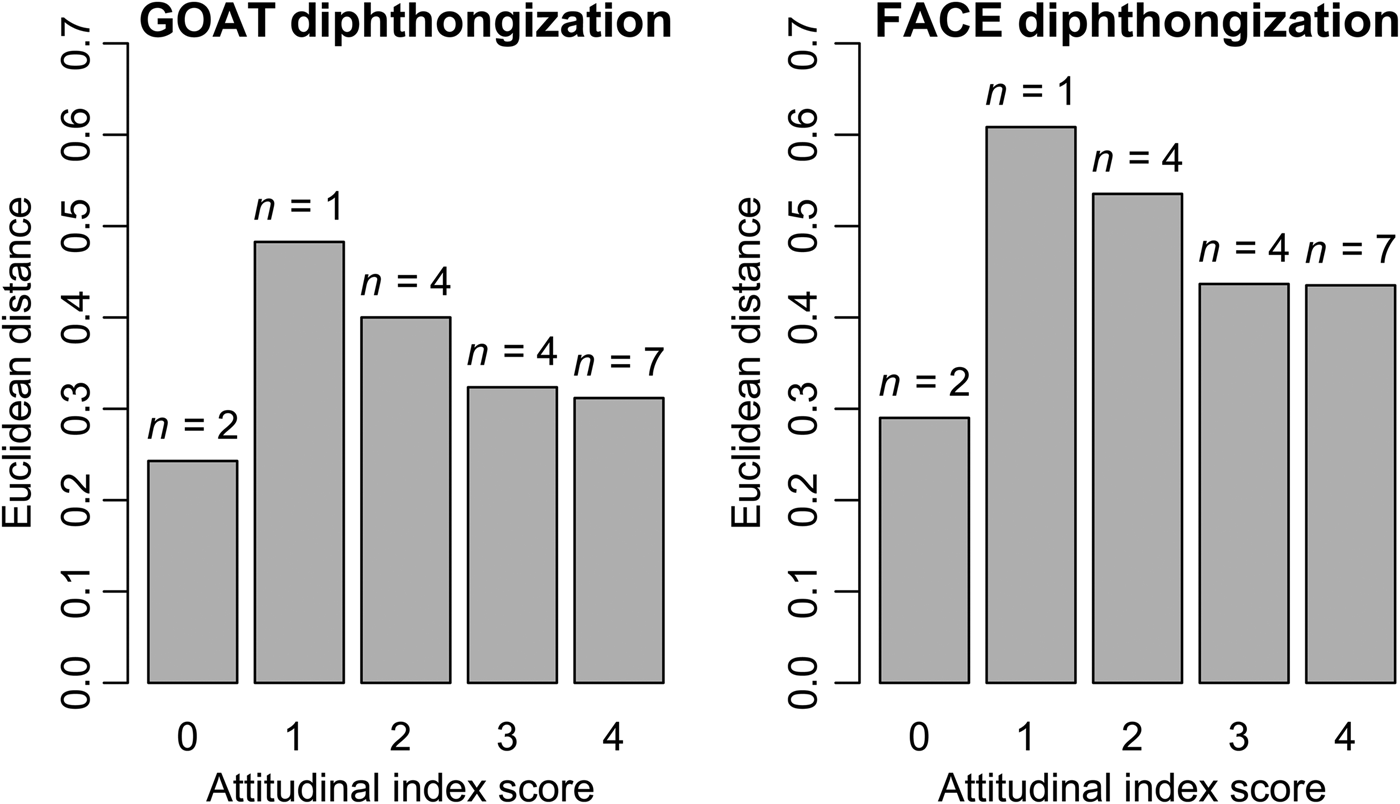
We return shortly to the possible importance for our analysis of perceptions of chav speech. To examine the relationship between individuals' attitudes toward the local community and use of diphthongal versus monophthongal realizations of face/goat, we correlate participants' mean Euclidean distance values for face and goat, with their attitudinal index scores. Figure 5 illustrates the results. The number of speakers for each score (e.g., n = 1) appear over each bar.
Mean Euclidean distance measurements by attitudinal index score.
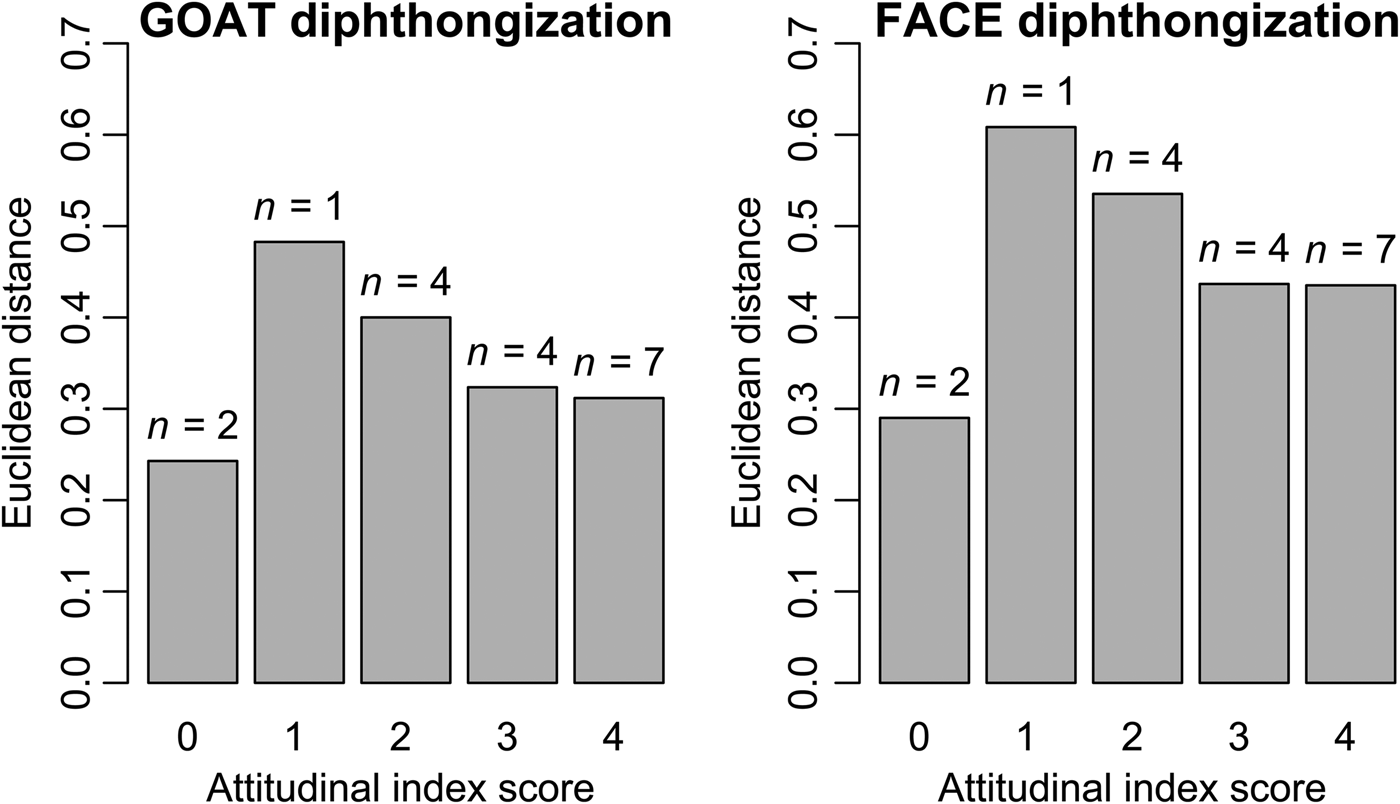
The two panels show a similar pattern, with slightly higher Euclidean distance values for face than for goat. This similarity reflects the fact that diphthongization of face and goat correlate closely across speakers in the sample (Figure 2). The two panels indeed show clear evidence of a negative correlation between mean Euclidean distance and attitudinal index scores, with the exception of the two speakers to the left with 0 values for the attitudinal index and low Euclidean distance scores. For the remaining 16 participants the plots show that more realizations that are monophthongal correlate with positive attitudes toward the community and dialect.Footnote 12
The two speakers on the left edge of the plots with 0 values were friends recorded together, Michelle and Nikki. The qualitative evidence provided by their interviews revealed that these two were exceptional not only in their disaffection with the community, but also in their way of expressing attitudes toward the community. In particular, Nikki is the only participant to use profanity during the interview other than in imitation of a chav (Who the fuck d'you think you are? [addressing an absent community member]) and was flippant in answering several interview questions, including that in (9).
(9) Michelle and Nikki
Interviewer: Have either of you got anything else you want to add about what it's like to live in York or what you think of Yorkshire people, Yorkshire speaking.
Michelle: No.
Nikki: Kill the tourists and I'll be happy. I'm a very depressing child.
Michelle and Nikki explicitly identified as nonchavs in their interview. (No participant, in fact, self-identified as a chav.) However, throughout their interview, they displayed a casual toughness and defiance often associated with chavs in the community, whose speech, in our interview data, is also stereotyped as involving monophthongal realizations of face and goat. Thus, monophthongal realizations of face and goat may be associated with more than one way of orienting toward the local community.Footnote 13 The speaker comments suggest that for these and other young speakers in York, face and goat monophthongization can mean something other than a strong identification with the community, including youthful defiance, toughness, and disaffection. For 16 of the 18 participants, however, monophthongal variants correlate well with allegiance to the local community, based on the index of questions in (2).
We examined further the possible relationship between attitudes toward the community and face/goat monophthongization by including attitudinal index scores as a predictor in separate models of the face and goat data (for the goat model, n = 632, for face, n = 849). We also included in these models a style factor (word-list versus spontaneous speech) to test evidence for style shifting, as reported by Watt (Reference Watt2000) for Newcastle. We excluded the 1998 data, for which there is neither attitudinal data nor word-list data. Because we have only one observation per speaker for the attitudinal index data, we did not fit a by-speaker random intercept in these models. We also excluded Nikki and Michelle's data for the reasons just discussed.
For the sake of space, we do not discuss in detail all of the main effects and interactions contributing significantly to these models, which do not differ substantially from those for the three age group models. For both the face and goat models, however, the attitudinal index score contributed significantly (p < .0001 for both models),Footnote 14 correlating negatively with Euclidean distance, as illustrated in Figure 5. In addition, with log-duration as a covariate in the models, style was selected in our face model (p = .02), but not in the model for goat (p = .18). For face, the word-list context favored more diphthongal realizations, suggesting that more standard, less local forms appeal to speakers in more formal styles.
To summarize, the results support two main conclusions about face/goat diphthongization in York. First, the real-time comparison suggests evidence of change toward diphthongal realizations. Second, evidence from ethnographic interview data provides support for the hypothesis that variation between diphthongal and monophthongal realizations of face/goat correlates with speakers' identification with the local community (cf. Watt, Reference Watt2000, Reference Watt2002; Watt & Milroy, Reference Watt, Milroy, Foulkes and Docherty1999). For most speakers in our 2008 sample, variation in face/goat diphthongization correlated with attitudes toward the community expressed in an ethnographic interview. Two speakers, however, showed different patterns, which we take to indicate different kinds of meaning that face/goat monophthongs can have in the community. We consider these issues further in light of data on goat/goose fronting in York, which we discuss in the next section.
GOAT/GOOSE FRONTING
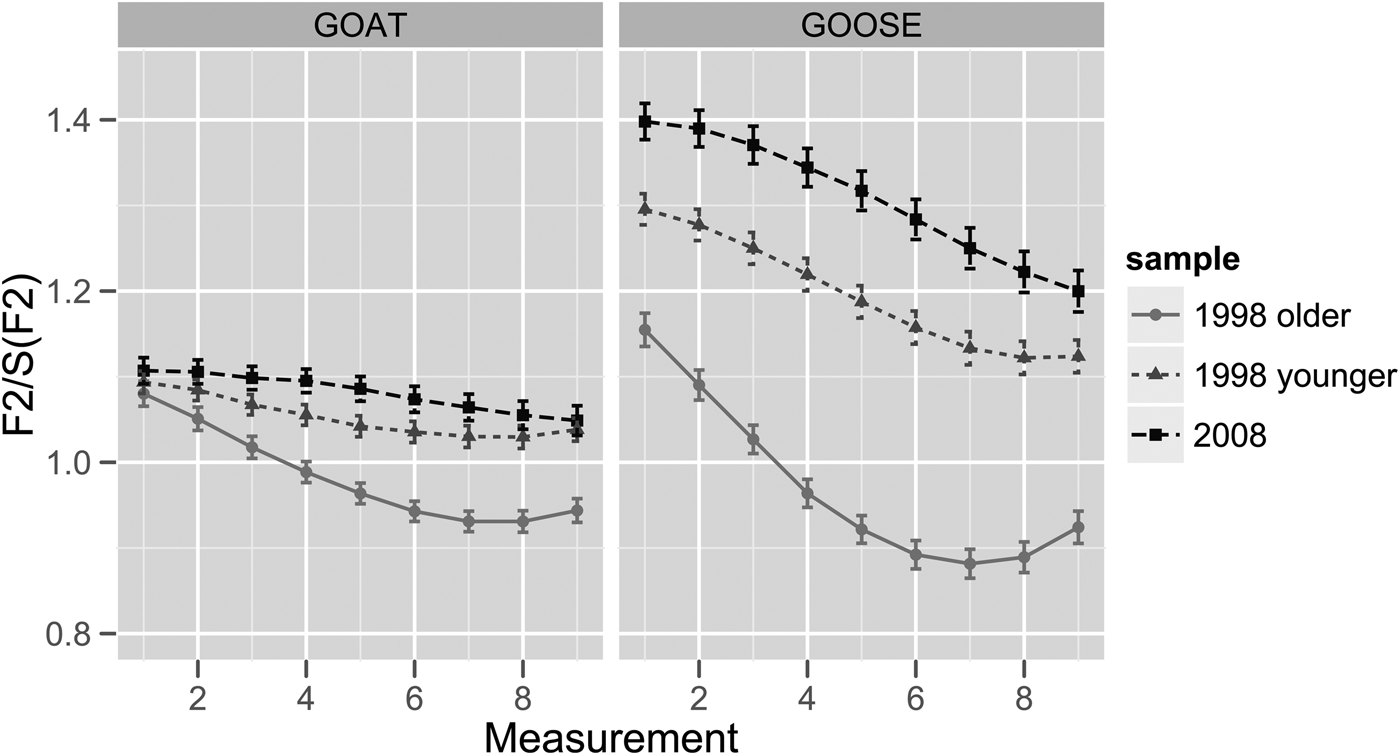
Figure 1 showed clear evidence of fronting of goat and especially goose. For goose, Figure 1 suggests that the whole vowel is fronting, whereas for goat, the greatest difference appears to be in the offset. To examine the patterns of fronting in more detail, we now turn to quantitative acoustic data taken from the whole vowel. Figure 6 shows mean normalized values and 95% confidence intervals for F2 measurements by age group across the whole trajectory, showing each of the nine time-normalized measurement points. As with Figure 1, the data are drawn from spontaneous conversation.
Mean F2s and 95% confidence intervals by measurement point and sample.
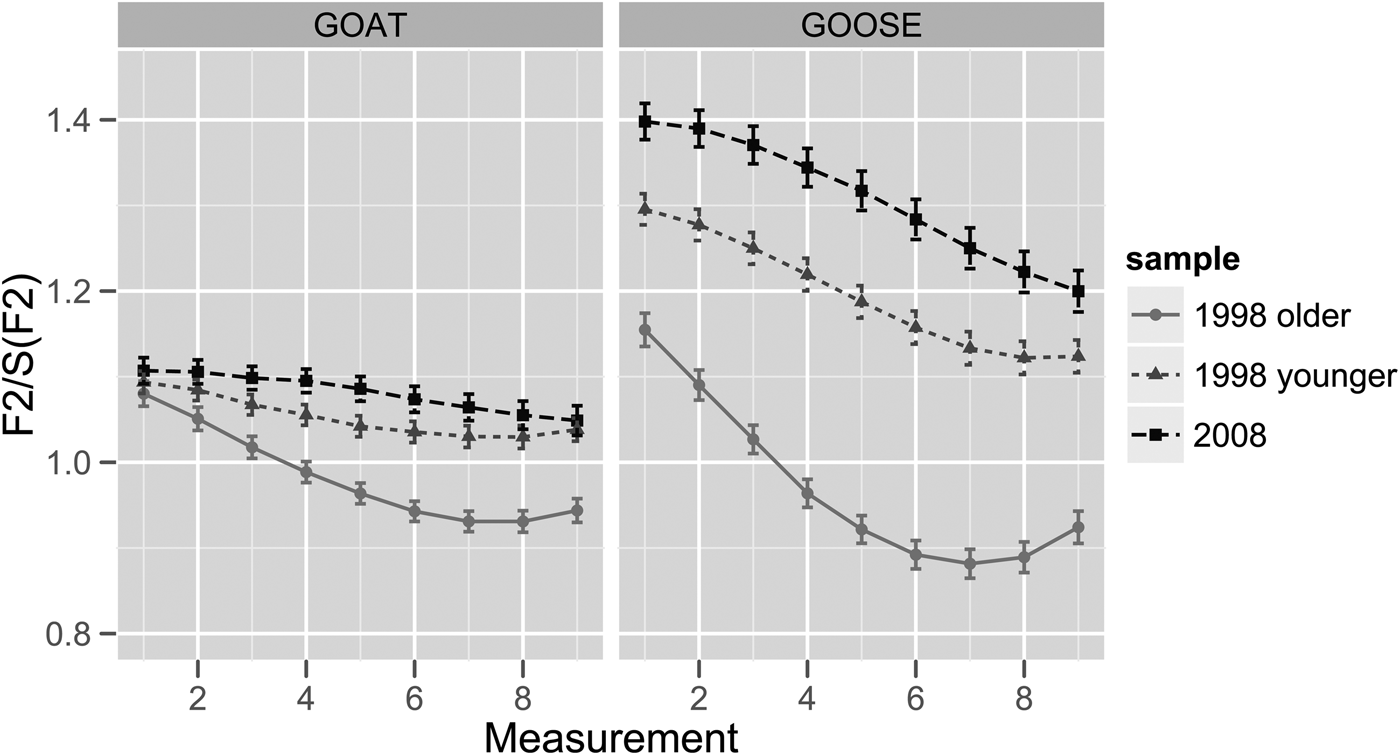
The left panel of Figure 6, showing trajectory shapes for goat, indicates that the greatest difference in mean F2s between the 2008 sample and the 1998 older sample is toward the end of the vowel. Closer to the onset there is little difference in mean F2 across the three samples. These data therefore align with Kerswill and Williams' (Reference Kerswill and Williams2005) auditory analysis of goat in Milton Keynes, suggesting that fronting of goat is located in the off-glide.
The right panel of Figure 6 shows plots for goose, where the age group differences are greater. As Fridland (Reference Fridland2008) noted in discussing similar results in Nevada English, this difference between goat and goose may, in part, reflect the fact that toward the top of the vowel space there is less proximity to other vowels (especially long vowels) and therefore more freedom for variation without overlapping potential phonological competitors. The difference between the age groups is considerable across the trajectory but greatest around the midpoint. Among the oldest speakers, the mean trajectory is somewhat bow shaped, indicating that the vowel retracts steadily from its start point before fronting slightly again. By contrast, the trajectories are straighter and less steep among younger groups, suggesting a steady retraction with less overall movement than the oldest group and with no terminal fronting. These dynamic data therefore differ from descriptions of goose fronting in some U.S. English dialects where fronting is mainly in the nucleus (Hall-Lew, Reference Hall-Lew2009; Koops, Reference Koops2010). In York, fronting is across the vowel trajectory and greatest around the midpoint. In the statistical analyses of goat and goose fronting, we use as our dependent variable the fifth F2 measurement for goose and the seventh measurement for goat, because these measurements correspond to the portion of the formant trajectory with the greatest age group difference.
We note that these plots reveal nothing direct about articulatory differences across speaker groups in implementation of goat and goose. In particular, the difference in F2 visible between the older and younger groups in Figure 6 may partly reflect unrounding, an issue so far not considered in detail in sociophonetic work on goat and goose fronting. (Hughes et al., Reference Hughes, Haddican and Foulkes2012, offered a brief discussion of these issues, suggesting unrounding as a correlate of fronting.)
We turn now to the cross-speaker correlation between goat and goose fronting, a focus of much of the recent literature on fronting across English dialects (Baranowski, Reference Baranowski2008; Hall-Lew, Reference Hall-Lew2004, Reference Hall-Lew2009; Hughes et al., Reference Hughes, Haddican and Foulkes2012; Labov, Reference Labov1994; Watt, Reference Watt2000). Labov's (Reference Labov1994) generalization about high back tense vowels is that goat fronting is parasitic on goose fronting. That is, fronting of /u/ in a community is predicted to be temporally before fronting of /o/, and the former is always further forward in the vowel space in processes of change. As noted earlier, however, some British dialects display fronting of goat only. This raises the question of whether northern U.K. English dialects are more generally exceptional from the perspective of Labov's (Reference Labov1994) discussion of fronting and, if so, why?Footnote 15
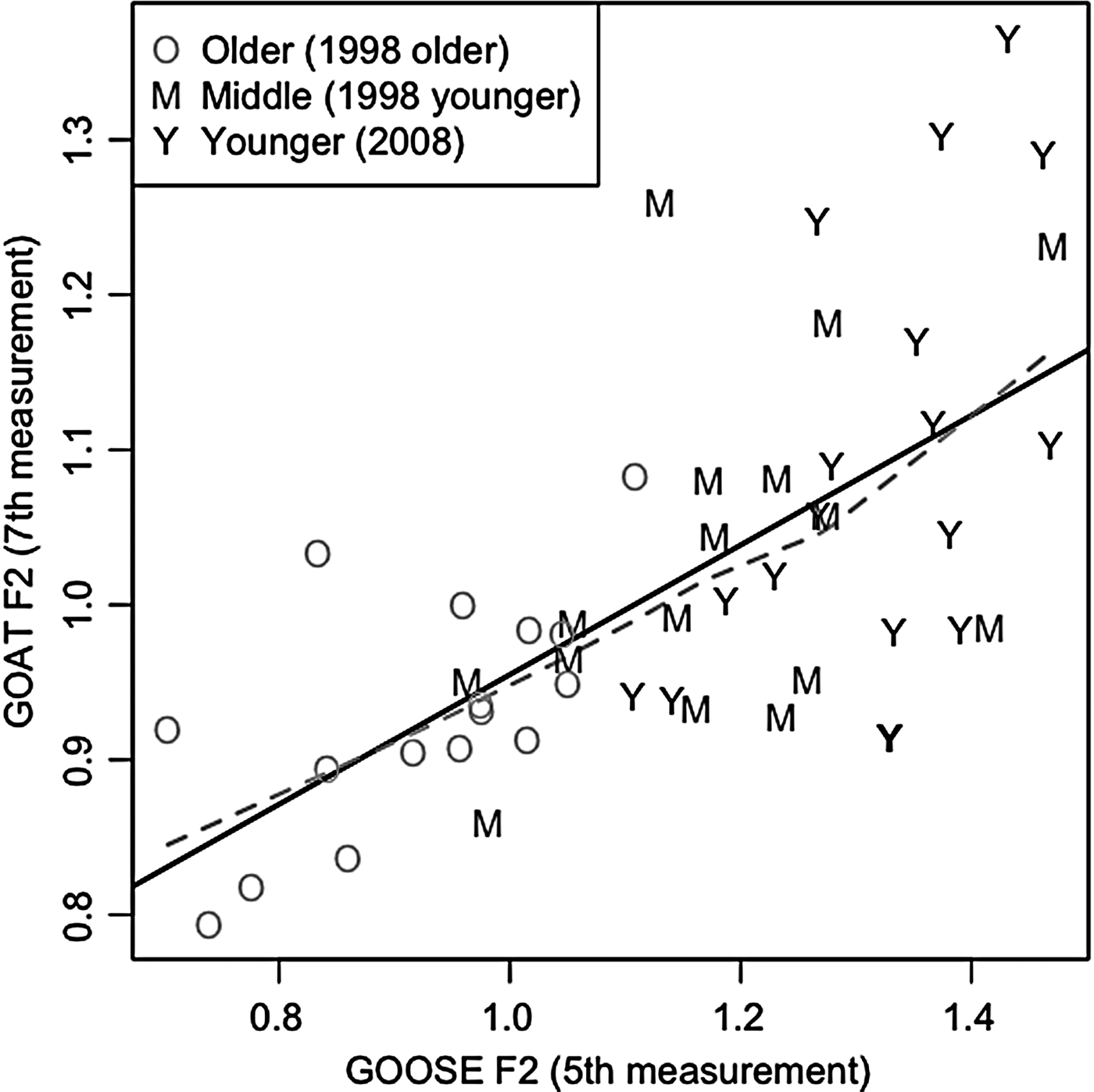
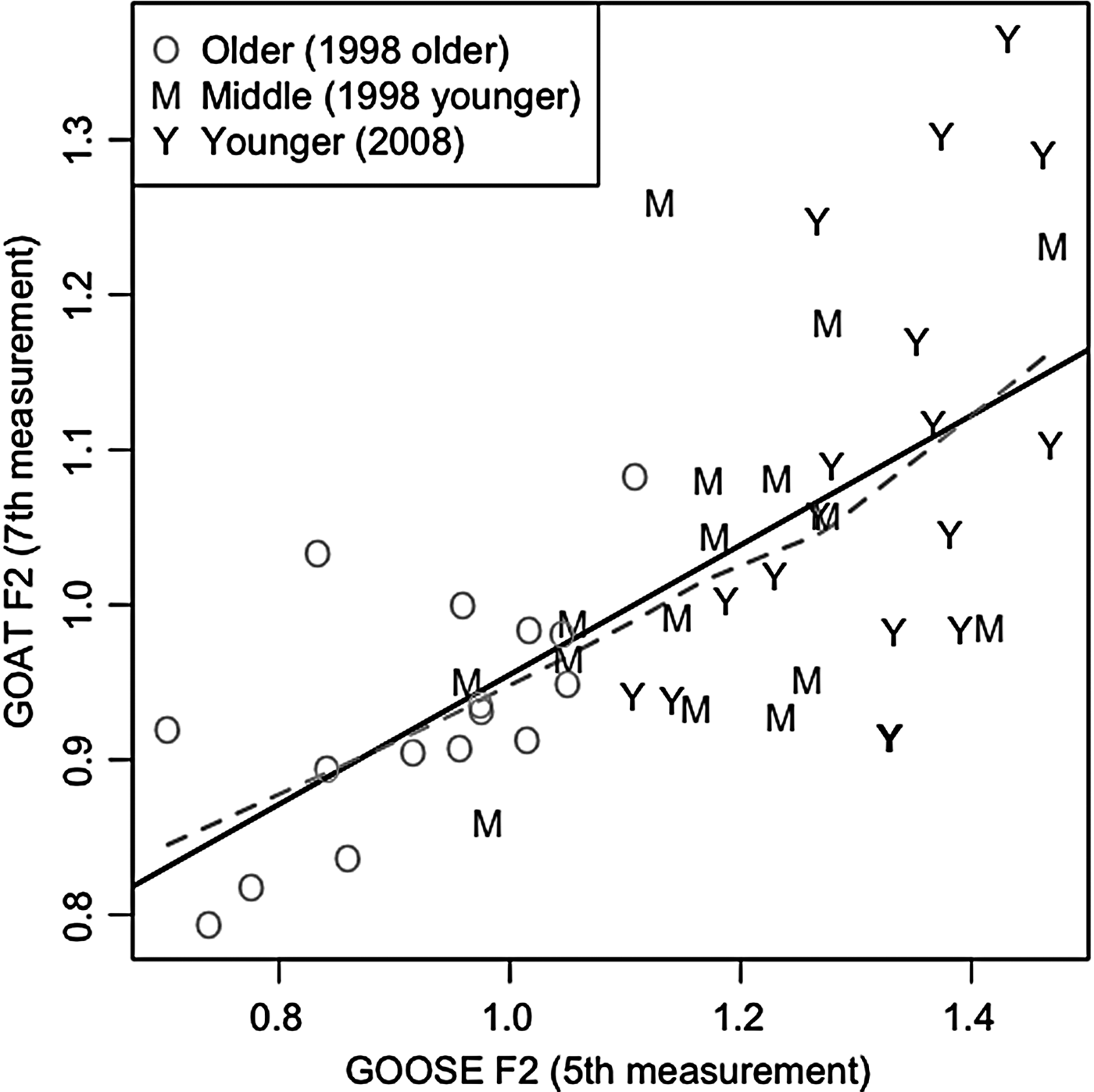
Figure 7 plots mean F2 values for goat, by speaker, against those for goose, using the measurement point of maximum difference between age groups. The figure shows a positive correlation (Spearman's rho = .67, p < .0001) in F2s for the two vowels, again suggesting evidence of related processes of change.Footnote 16 Note, again, that F2 values for goose are higher for those for goat, in keeping with Labov's (Reference Labov1994) generalization. The smoother line (dashed) shows no pronounced curvature, suggesting no evidence of a generational lag in goat fronting vis-à-vis goose fronting. (Linear models with quadratic and cubic terms did not improve model fit over a simple linear term.)
goat and goose mean F2 by speaker.
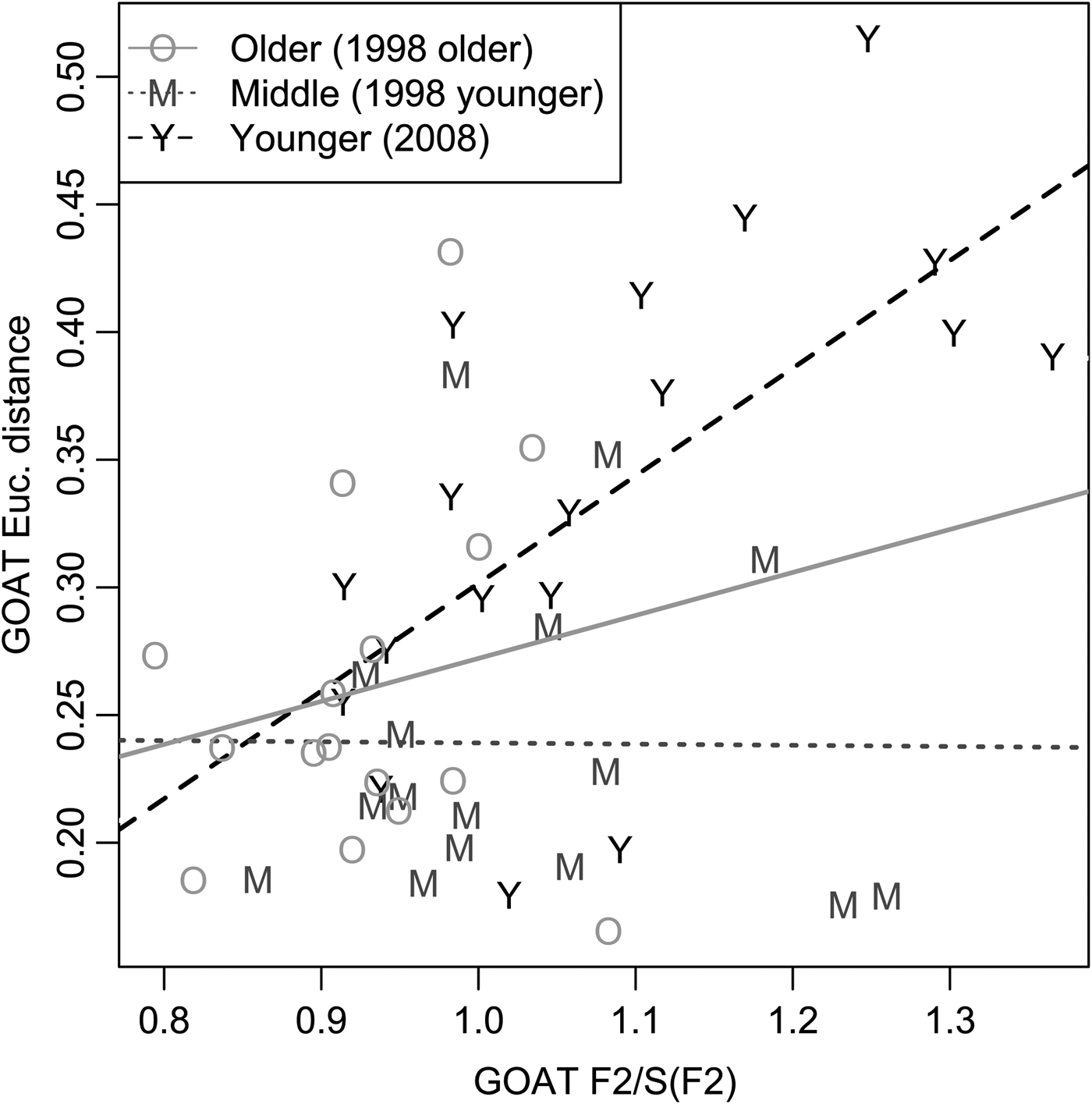
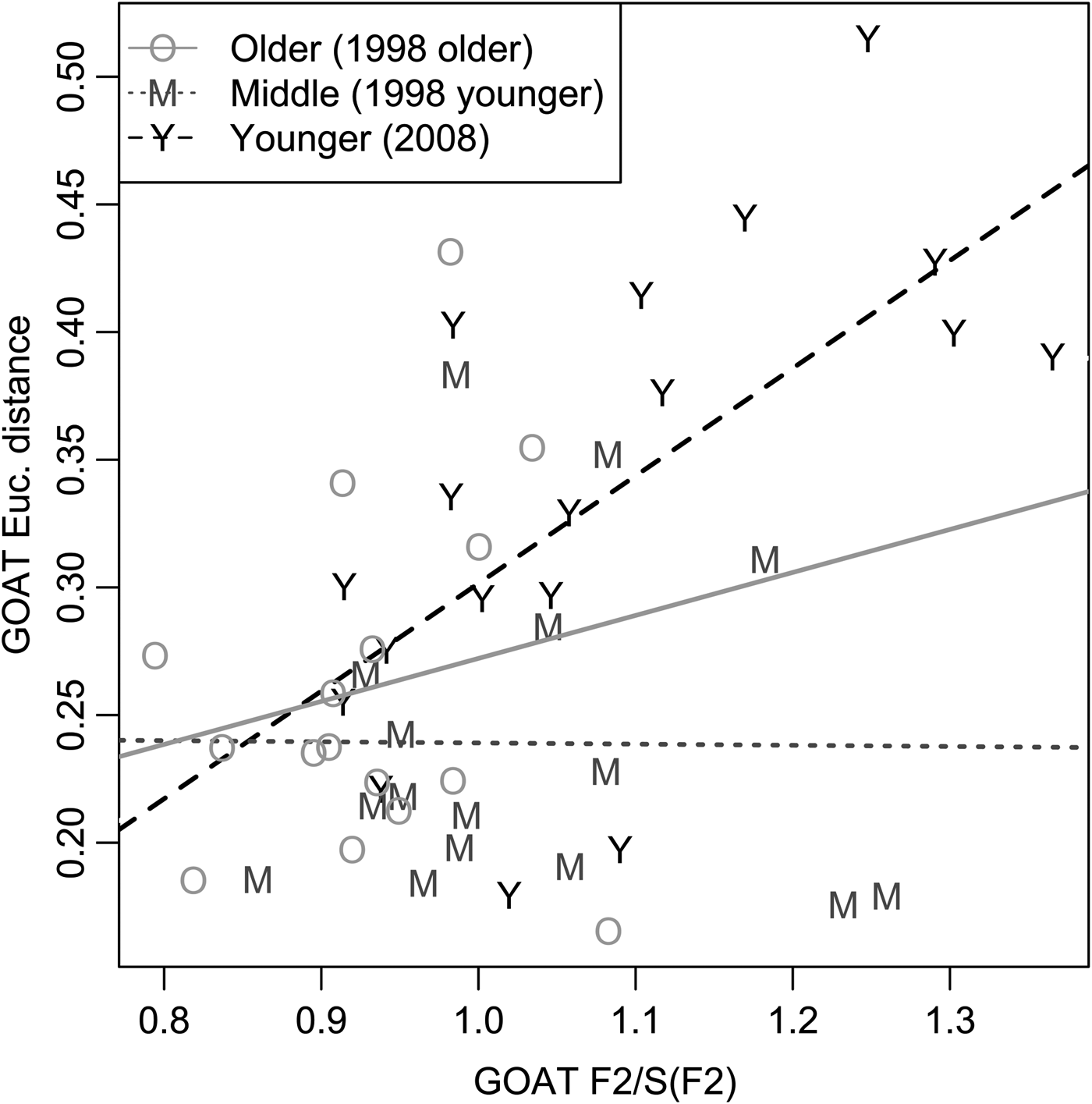
The correlation between goat and goose fronting in Figure 7 is nevertheless somewhat weaker than that for face and goat (Figure 2). This fact may be related to another issue carefully procrastinated in the discussion so far, namely the relationship between goat fronting and goat diphthongization. In particular, Figures 1 and 6, showing that fronting of goat is mainly in the offset in York, suggest the possibility that goat fronting and goat diphthongization may be at least partially unified processes of change, with fronting of the offset contributing to the greater Euclidean distances among younger speakers. Figure 8 plots by-speaker mean Euclidean distance values for goat against mean F2 values for goat. The plot shows a weak positive correlation between the two vectors (Spearman's rho = .29, p = .044). The degree to which these two variables correlate, however, varies by age group. In particular, the correlation is fairly weak for both 1998 groups. These speakers are generally monophthongal, but some among them have fairly fronted (monophthongal) realizations for goat as well as other, backer realizations. Among 2008 speakers, on the other hand, the relationship is clearly much stronger. Whether a 2008 speaker tends toward diphthongal realizations is closely related their degree of fronting of goat.Footnote 17 We return to this fact shortly, after discussing social and phonetic effects on goat and goose fronting.
Correlation of mean goat Euclidean distance values and mean goat F2s by speaker.
goat fronting
We begin by describing models for goat fronting using all three age groups. Variables were again selected using the procedures described in the discussion of diphthongization, and only conversational data were used. The analysis revealed significant main effects for preceding sound and significant interactions for age group*duration and age group*following sound (n = 1,703, r-squared = .63). Figure 9 plots partial effects for these terms. The analysis revealed no significant main effects or interactions for speaker sex, nor for preceding or following manner of articulation or voicing.
Partial effects for a model of goat fronting.
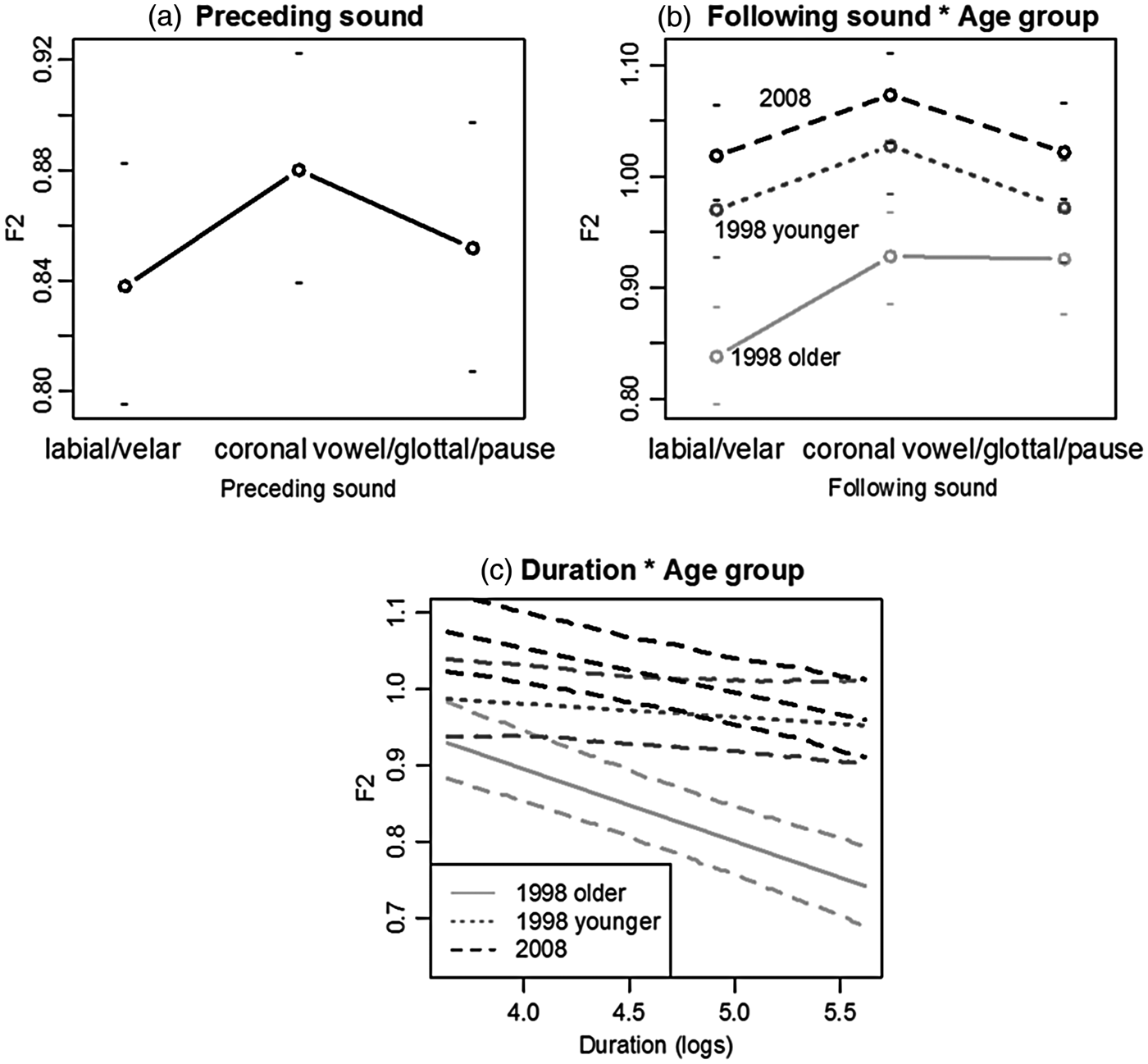
Figure 9a shows familiar effects of the preceding sound. Coarticulation with a preceding coronal yields higher F2 values, whereas coarticulation with a preceding labial or velar yields lower F2, as already discussed (Flemming, Reference Flemming2003). Preceding vowels, glottals, and pauses pattern between these two classes.
Figure 9b shows an interaction between following sound and age group. Among the 1998 older speakers, the difference between the effect of following coronals and labials/velars is stronger than among the two youngest samples.Footnote 18 These facts suggest that among the two youngest groups, goat fronting is expanding into contexts that for the oldest age group strongly inhibit fronting. In addition, this plot shows the age group effect also apparent in Figure 1; the 2008 speakers have the highest F2 values, followed in turn by the 1998 younger and older speakers.
Finally, Figure 9c shows a somewhat surprising interaction between age group and duration. For all age groups, log-duration is inversely correlated with F2, but the slope is steeper for the 2008 and 1998 older speakers than for the 1998 younger speakers. We relate this to the different trajectories for goat among these three age groups, as shown in the F1 ~ F2 plots in Figure 1. Like the 1998 older speakers, the 1998 younger speakers are fairly monophthongal, but like the 2008 speakers, the vowel offset is somewhat fronted, so the trajectory is mainly vertical. Overall F2 difference between onset and offset is therefore smallest for the 1998 younger group and greater for the 1998 older and 2008 groups. Consequently, undershoot in short duration tokens has a relatively stronger effect on F2 for these latter groups and a weaker effect on the 1998 younger group.
goose fronting
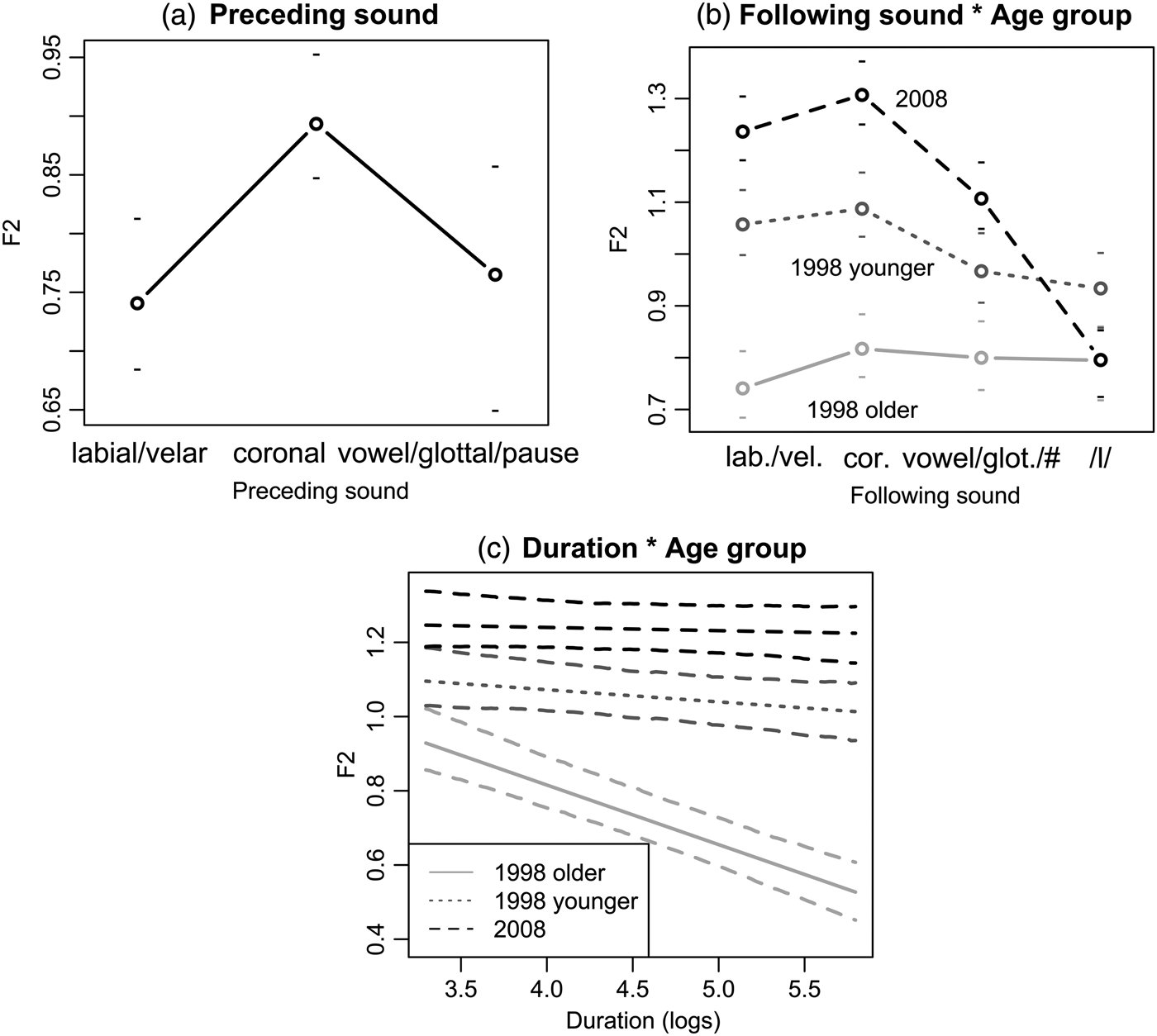
Similar effects emerged in our model of goose fronting with all three age groups. As in our model of goat fronting, the analysis revealed a fixed main effect for preceding sound, and interactions for following sound*age group and duration*age group (n = 1901, r-squared = .78). For this dataset, a greater number of following [ɫ] tokens (205) allowed us to treat this environment as a separate level. We illustrate the findings in the partial effects plots in Figure 10. The analysis revealed no other significant main effects or interactions, including effects for speaker sex. The absence of sex effects in our data contrasts with findings from other communities that women are leading back vowel fronting (Baranowski, Reference Baranowski2008; Hall-Lew, Reference Hall-Lew2004; Watt & Milroy, Reference Watt, Milroy, Foulkes and Docherty1999).
Partial effects for a model of goose fronting.
Figure 10a shows that, as with goat, preceding coronals strongly favor higher F2 values. Figure 10b illustrates the interaction between following sound and age group. It shows that the effect of a following [ɫ] differs across age groups. Among the 2008 speakers, [ɫ] strongly disfavors fronting. The effect is weaker for the 1998 younger speakers and even weaker for the older speakers. The figure therefore suggests, unsurprisingly, that the following-[ɫ] effect is strongest among speakers who have the greatest degree of fronting (Ash, Reference Ash, Arnold, Blake, Davidson, Schwenter and Solomon1996; Flynn, Reference Flynn2012; Hall-Lew, Reference Hall-Lew2004). Among older speakers, for whom goose is already realized fairly back, the inhibitory effect of a following [ɫ] is weaker.
Finally, Figure 10c shows an interaction between duration and age group. As with goat, for all three age groups, F2 correlates negatively with log-duration. However, for the older 1998 speakers this effect is stronger than for the two youngest groups. Again, as with goat fronting, we suggest that this negative correlation reflects an abbreviation of the tongue-backing gesture in goose vowels (Figure 1). In particular, note that the 1998 older speakers have somewhat more diphthongal realizations for goose than the younger speakers do. Consequently, shorter durations for goose tokens among the 1998 older speakers have a stronger effect in raising F2.
Attitude toward the community and style as correlates of change
The data presented in the previous two subsections indicate change toward fronted variants of goat and goose in York. From the perspective of the stylistic and attitudinal data presented in the discussion of face/goat diphthongization, a question that arises is whether cross-speaker differences in fronting are related to attitudes toward the local community, as we suggested in the discussion of face and goat variants.
Analysis of the ethnographic interviews revealed that none of the participants connected any local practices or meanings to realizations of goose. This contrasts sharply with participants' observations about monophthongal realizations of goat and face, which as we showed earlier were frequently linked with either “typical York/Yorkshire” speech or chav speech.
Our interview data featured only one instance of a participant invoking goat fronting in describing different ways of speaking in the community. In excerpt (8), Joe imitates a chav saying road, with a fronted monophthong, [əː] (F2 ~1500 Hz, F3 ~2500 Hz). His comments furthermore indicate an overt association between fronted monophthongs and chav speech. We speculate that such perceptions, if they are more general, may be related to an issue raised earlier. Despite the presence of fronted goat in York and neighboring dialects (visible for some older speakers in Figure 8), none of the younger speakers in our 2008 sample produced markedly fronted monophthongs with any regularity. The absence of fronted variants for the youngest speakers is surprising given the evidence on perceptions of goat monophthongs as well as the evidence that goat/goose fronting are most advanced among younger speakers. Specifically, fronted monophthongs would seem to offer younger speakers a way to participate in a phonetic practice associated with young people—back vowel fronting—while conserving local monophthongal forms. Joe's comments in (8), however, suggest that such forms may in fact be associated with chav speech, a way of talking unanimously condemned in our sample. If so, the fact that few 2008 speakers tend toward these forms may reflect these speakers' efforts not to sound “chavvy.” Future work might usefully explore perceptions of these variants in greater detail, in particular how they index group or social class within York, and also whether York speakers associate them with neighboring areas such as Hull and East Yorkshire.Footnote 19
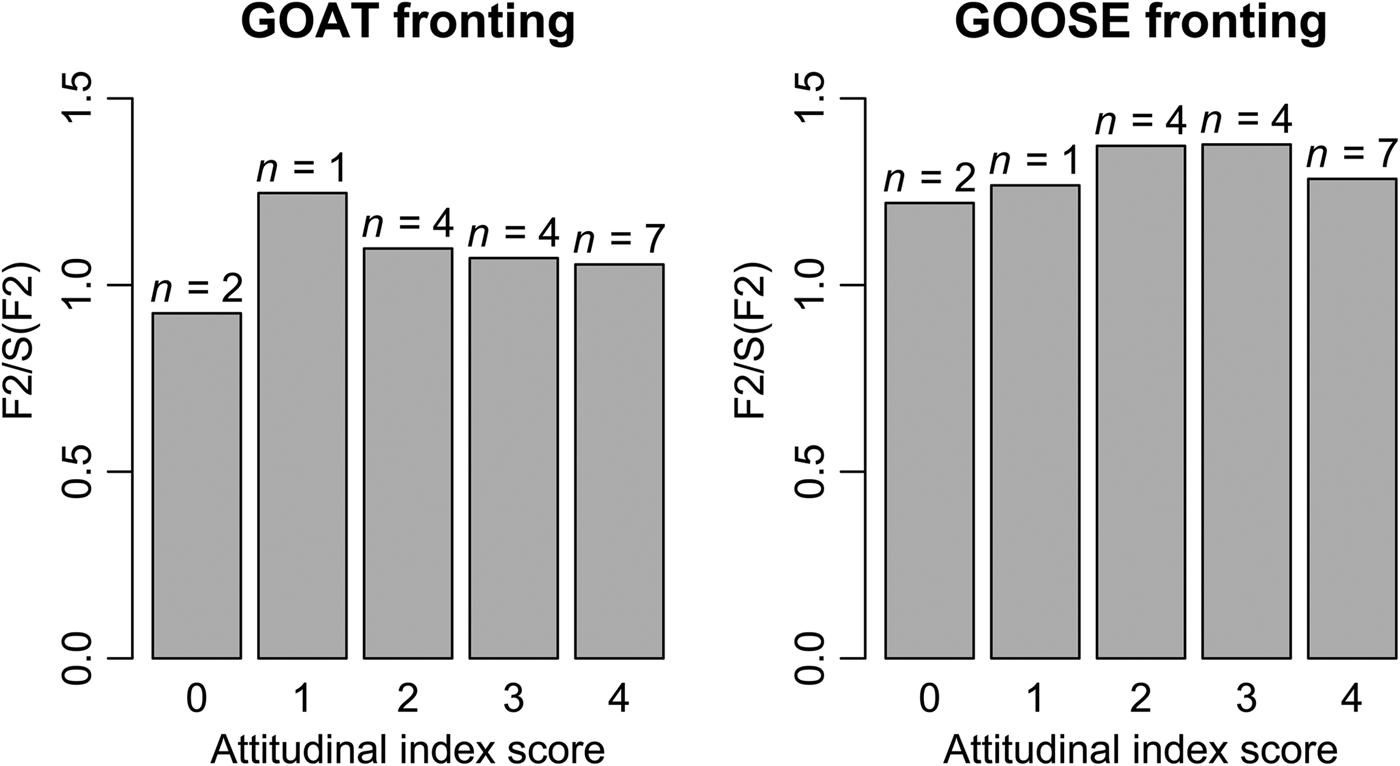
To assess further the relationship between attitudes and fronting, we correlated mean F2s for goat and goose with attitudinal index scores, following the procedure explained in our discussion of monophthongization. The left and right panels of Figure 11 plot these correlations for goat and goose, respectively.
Mean normalized F2s for goat and goose by attitudinal index score.

The left panel shows a pattern similar to that for goat diphthongization in Figure 5, which stands to reason given the correlation between goat fronting and goat diphthongization among younger speakers (Figure 8). The two speakers with 0 values for the attitudinal index, Michelle and Nikki, again show the lowest mean values in the sample for F2. Excepting these two speakers, the left panel suggests a negative correlation between the attitudinal index score and F2. That is, leaving aside Michelle and Nikki, the more positively speakers oriented toward the community, the lower their mean F2. The right panel in Figure 11 shows little clear difference across the speaker groups with respect to goose, although Michelle and Nikki's F2 values are again the lowest, and the seven participants with the most positive index scores (+4) also show lower mean F2s.
We tested the correlations by fitting separate linear mixed effects models to the 2008 data with each speaker's attitudinal index score as a predictor, following the procedure described in 4.3, with Michelle and Nikki omitted (for goat,n = 632; for goose,n = 603). Both models revealed significant negative effects for the attitudinal index predictor, though more weakly for goose (p = .04) than for goat (p < .00001). In addition, as in the case of goat diphthongization, the goat fronting model with the 2008 data revealed no significant style effect.
To summarize, the data show strong evidence of fronting of both goat and goose in the community. Fronting of both goat and goose has been reported across a wide range of U.K. dialects particularly in the south (Bauer, Reference Bauer1985; Hawkins & Midgley, Reference Hawkins and Midgley2005; Henton, Reference Henton1983), but increasingly also in the north (Jansen, Reference Jansen, Calamai, Celata and Ciucci2010; Watt & Tillotson, Reference Watt and Tillotson2001). For both goat and goose, there is evidence of a negative correlation between speakers' identification with the local community and fronting. For many community members, these features nevertheless appear to be much less emblematic of “traditional” local speech than monophthongal forms of face/goat.
CONCLUSIONS
The goal of this paper has been to provide an analysis of two paired vocalic changes in the city of York. In particular, the data support three sets of conclusions.
Change toward diphthongal realizations of FACE/GOAT and fronting of GOAT/GOOSE
Comparisons across the three age groups show ongoing changes involving diphthongization of face/goat and fronting of goat/goose. In the case of goat/goose fronting, evidence for change comes from both the apparent time comparison between the two 1998 samples and the real-time comparison between the 2008 and 1998 samples. The phonetic conditioning of fronting is similar to that described in previous work on U.K. and North American dialects, and, from this perspective, it appears to be a similar process of change to those described in many other English dialects (Baranowski, Reference Baranowski2008; Flemming, Reference Flemming2003; Fridland, Reference Fridland2008; Thomas, Reference Thomas2001). Unlike in North American varieties, however, goose fronting is across the formant trajectory and not principally in the nucleus (Koops, Reference Koops2010). In this way, goat/goose fronting resembles the diffusion of be like, varying somewhat in linguistic conditioning from locale to locale (Buchstaller, Reference Buchstaller2008; Buchstaller & D'Arcy, Reference Buchstaller and D'Arcy2009).
For face/goat diphthongization, analysis revealed a real-time difference between the 2008 and 1998 samples, but little apparent time difference between the 1998 samples. These facts may indicate a somewhat slower rate of change for face/goat diphthongization than for goat/goose fronting, which we attribute to the very strong links that community members make between diphthongal versus monophthongal variants of face/goat and different local social categorizations. These findings align with Watt's (Reference Watt2000) auditory results of face/goat in Newcastle, suggesting incipient change toward southern diphthongal realizations in York. The present York data also revealed a following voicing effect akin to that reported for price diphthongization in many dialects of English, whereby following voiceless sounds favor more diphthongal realizations of face.
Different social evaluations of the changes
Both processes of change examined here are “external” changes, in that the innovative forms are well-established diffusions from outside the community. Nevertheless, two sets of facts suggest that these two changes differ in their social conditioning. A first concerns participants' evaluations of different accents in the community. In interview sessions, participants frequently identified monophthongal realizations of face/goat as typifying York or Yorkshire dialects. In addition, some participants also linked monophthongal face/goat with chavs. In contrast, in just over 3 hr of ethnographic interview data, none of our participants' descriptions of differences in ways of speaking within the community focused on goose fronting. These data indicate that variation between monophthongal and diphthongal forms of face/goat are socially anchored in the community in a way that goat/goose fronting is not.
Second, in our 2008 sample, differences across individuals in face/goat diphthongization correlated strongly with how individuals oriented to the community. Speakers who expressed the strongest allegiance to the community tended toward conservative monophthongal variants, whereas those who identified less strongly with the community produced more diphthongal forms. A by-speaker index of scores for attitudes toward the community correlated with face and goat monophthongization. This index also correlated negatively with goose fronting but much more weakly.
The interaction of linguistic and social constraints on change
The contrast between the fronting and diphthongization changes speaks to the more general issue, central to variationist sociolinguistics, of how linguistic and social constraints interact to shape vowel change. We noted that the situation examined here is highly unusual, with goat participating in two widespread changes simultaneously. The potential outcome for goat could be fronting, diphthongization, or a combination of the two. If our data had showed goat to be fronting, the observable facts could be interpreted as the outcome of change driven largely by the internal pressure of the vowel system, as captured in Labov's (Reference Labov1994) principle III of vowel change (leaving aside the issue of how this pressure is conceived in cognitive terms). On the other hand, had we observed diphthongization only, the social indexing of the variants involved in the change would appear crucial to explain the outcome. Principle III could still be invoked to account for the fronting of goose, with a possible interpretation that goat is not yet at the stage of being swept by the same forces into a partial chain shift. What we see in practice, however, is a combination of the two processes: some fronting of goat, lagging behind goose, with concurrently a much more marked diphthongization emerging for younger speakers. We should also bear in mind that the current fronting change represents a second wave of goat fronting in the region. Central variants are well-established in neighboring cities of Bradford and Hull and are easily observable in the city of York even if not in abundance in our dataset. The first wave of fronting has operated without the participation of goose and is thus another exception to principle III offered by northern British dialects (cf. Watt, Reference Watt2000; Watt & Tillotson, Reference Watt and Tillotson2001).
To understand this outcome, it is necessary to examine in detail the indexical values associated with the competing variants, especially in respect of the way that external borrowings are interpreted locally. Even though the dialect of York has historically been monophthongal with respect to face/goat, diphthongal realizations have long been familiar to community members through contact with southerners, whose speech, associated with the more affluent and culturally more influential south, has long been more prestigious than northern dialects have been (Milroy, Reference Milroy2000). The temporal stability of this sociolinguistic distribution is plausibly one factor explaining the strong symbolic link between face/goat monophthongs and meanings of place in northern communities. In contrast, the current wave of goat/goose fronting is a much more recent process of change in the community and in U.K. Englishes more generally. Fronted variants of goose are not strongly associated with any particular social distinction except, perhaps, being young. Fronted variants of goat may have a similar association, but they may also be indexical of either a chav subgroup to the community, or varieties external to the immediate community. In this way, goose fronting can be classified as an off the shelf variable—a feature without strong local symbolic anchoring and, as such, a readily available resource for stylistic appropriation (Fridland, Reference Fridland2008; Milroy, Reference Milroy, Cain and Russom2007). The best example of such changes may be diffusion across Englishes of be like quotatives (Buchstaller, Reference Buchstaller2008; Buchstaller & D'Arcy, Reference Buchstaller and D'Arcy2009), though other such cases are also discussed in Milroy (Reference Milroy, Cain and Russom2007) and Meyerhoff and Niedzielski (Reference Meyerhoff and Niedzielski2003). By contrast, goat fronting and the diphthongization changes affecting both goat and face appear to be under the counter changes (Milroy, Reference Milroy, Cain and Russom2007). The apparent resistance of our speakers to goat fronting, and their participation in diphthongization, demonstrate the critical contribution of social forces in shaping the outcomes of change.
APPENDIX A
Sampling information
2008 sample
1998 sample younger speakers
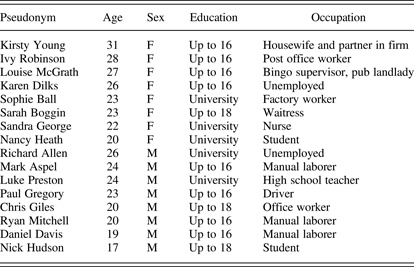
1998 sample, older speakers
APPENDIX B
Word-list items