The purpose of this paper is to provide an analytical review of social science scholarship on guanxi 关系, the Chinese expression of interpersonal connections. The focus of this review is on the prevalence and the increasing significance of guanxi during China's post-1978 shift towards a market economy. The pre-reform redistributive system is a logical point of departure for this review; social scientists have established a good understanding of how guanxi altered Chinese people's lifestyles in a society under rigid bureaucratic control and how it affected their life chances in a shortage economy under Mao. As the post-1978 reforms gradually relaxed certain bureaucratic controls and subsequently turned the shortage economy into a market/non-market mixed system of abundance and growing inequalities, researchers conducted a wide range of observations, in-depth interviews and large-scale surveys, which have generated diverse views and conflicting conclusions about the fate of guanxi in transitional China. These have generated longstanding controversies and debates on what guanxi actually means to Chinese people both then and now, how it has been adaptive to ongoing institutional transformations, and why its influence in economic, social, and political spheres can stabilize, increase or decrease alongside market reforms and economic growth. A synthesis of these controversies and debates becomes necessary before a constructive framework can be proposed in order to understand the dynamics of guanxi during and after market reforms.
The organization of this review is as follows. First, I synthesize the controversies and debates as reflected in the published works of anthropologists, sociologists and management scholars. This is then followed by an evaluation of how guanxi has been defined by different researchers, and I offer my elaboration of the term, with a social network analysis approach towards guanxi research. Following this elaboration, I use a theoretical model on the dynamics of guanxi to guide the presentation of survey findings on the increasing use of guanxi in labour markets from 1978 to 2009. Finally, I discuss the complex meanings of guanxi and propose a five-level scheme in an attempt to advance scholarship on guanxi in China's fast-changing society.
Empirical Controversies and Theoretical Debates
Sociologists and anthropologists have offered a standard understanding, with little disagreement, of the significance of guanxi during the Mao era and the 1980s.Footnote 1 Then, state planning created a series of bureaucratic controls over valued resources and opportunities of access in the resulting shortage economy. Consequently, factory managers turned to their personal connections with state planners and local officials for favourable treatments of resource allocation,Footnote 2 and village heads looked to local cadres for favourable harvest assessments and non-agricultural projects to help their villages survive the widespread poverty.Footnote 3 Ordinary citizens used their personal connections to access an array of life's necessities, consumer goods and services that were allocated through urban work units (danwei 单位) and rural people's communes.Footnote 4
Personal connections were necessary to gain access to controlled resources because bureaucrats at various levels of the party-state hierarchy had discretional powers to allocate them one way or another.Footnote 5 In the assignment of state jobs, for instance, urban youths with similar levels of education and vocational training were assigned to work units which offered jobs and collective benefits of varying quality. Under these circumstances, favour exchange was key as officials tasked with allocating jobs assigned good jobs as personal favours to those with whom they had direct or indirect connections.Footnote 6 In the same logic, favouritism ties with the gatekeepers were important for obtaining lean meat, travel permits, train tickets, hotel reservations, timely marriage certificates, rationed household appliances, labour quotas for job reallocation, and all other scarce goods and services within a “gift-economy.”Footnote 7 Andrew Walder argues that Mao's China operated within a system of Party clientelism and organized dependence, in which “instrumental particular-ties” with authorities were essential for day-to-day survival and politicized opportunities.Footnote 8
Did the logic of favouritism fade away with the rise of a market/non-market mixed economy in reform-era China? The theory of market transition seems to imply a positive answer. Victor Nee argues that the transition from redistribution to market, regardless of how gradual the process, will necessarily transfer power and incentives from state redistributors to direct producers (i.e. entrepreneurs, professionals, skilled workers and peasants), causing a fundamental change in stratification mechanisms, from which two predictable patterns emerge: the decreasing values of political power and political capital, and the increasing values of entrepreneurship and human capital.Footnote 9 For Nee, market transition implies the rise of horizontal ties among direct producers and the decline of vertical ties that characterize the previous patron–client relationships of state distributors and organizational entities under their jurisdiction.Footnote 10
In line with Nee's market transition theory, Doug Guthrie learned from Shanghai state enterprise managers that guanxi no longer counted in their decisions about hiring, partnerships, choice of suppliers and sellers, and the allocation of incentives within the enterprises, state or non-state.Footnote 11 The conditions under which such guanxi-free behaviour occurred, Guthrie assumed, were that state enterprises, like private firms, had transformed from state-subsidized work units into independent economic entities. As a result, both state and non-state employers faced “hard budget constraints,” causing them to become profit driven, economically calculative, and rationalized.Footnote 12 Guthrie summarized these interpretations in his widely circulated hypothesis on the declining significance of guanxi: China's growing market economy will become increasingly rationalized, thus eliminating guanxi favouritism, an irrational behaviour, from economic decision making.Footnote 13
Two labour-market studies seem to lend partial support to Guthrie's thesis. Amy Hanser found that guanxi had little significance for first-time job seekers in the 1990s, in both the rising market sector and the reformed state sector.Footnote 14 Xianbi Huang interviewed college-graduate job seekers in Shenzhen and was informed that close personal ties provided limited access to useful information; job seekers in fact needed to demonstrate ability rather than guanxi in order to impress prospective employers.Footnote 15
While these studies are based on anecdotal evidence from small, nonprobability samples, representative household surveys show a fairly consistent pattern of the existence, persistence, and perhaps increase, of guanxi in China's labour markets in the reform era. First, a 1999 five-city survey of wage earners showed that jobs found through personal contacts generated better job–worker matches and higher pay than those found through formal channels, and such patterns did not vary between the 1980s and 1990s.Footnote 16 Second, the 2003–2008 Chinese General Social Surveys showed that the number of people using personal contacts to find jobs increased by 20 per cent in the first three decades of the reform era.Footnote 17 Users of social ties were more likely to land good jobs, move to higher positions when they changed jobs with the help of personal contacts, and receive higher pay.Footnote 18 Finally, a 2006 national sample survey showed that diverse personal contacts generated greater opportunities for status attainment in 21st-century China.Footnote 19
In a broader scope of empirical inquiry, researchers have continually found that guanxi prevails in the increasingly marketized, privatized and globalized Chinese economy. Nan Lin argues that China has not moved towards a neo-economic ideal type of market economy, but is instead moving towards “centrally managed capitalism,” in which economic activities are heavily embedded in all kinds of guanxi networks.Footnote 20 Kinship networks are at the core of the governance structure in township and village enterprisesFootnote 21 and function well in the absence of property rights laws.Footnote 22 Barriers to entry motivate Chinese entrepreneurs to build their own networks of suppliers and distributors, and to develop competitive advantages in self-organized industrial clusters in which close-knit groups of like-minded people establish reliable business norms for the emerging private economy.Footnote 23 Ties to government officials, on the other hand, are the key channels through which to acquire economic resources,Footnote 24 operate business groups,Footnote 25 govern relational contracts,Footnote 26 and systematically increase the economic performance of all types of enterprises.Footnote 27 Vertical and horizontal ties to different economic entities are adaptive and beneficial to the creation of new firms,Footnote 28 valuable opportunities flow through symbiotic ties created and maintained between state officials and entrepreneurs,Footnote 29 and politically embedded ties function effectively, for good or bad, in the legal professionFootnote 30 and among publicly listed enterprises.Footnote 31 One consensus is that China is considered a model of “network capitalism,” a system of governance and transaction in which guanxi networks are utilized to transmit “uncodified information”Footnote 32 and manage economic uncertainties.Footnote 33 In the social and political spheres, the emerging forms of guanxi are the ties of generalized particularism,Footnote 34 purposive network behaviour,Footnote 35 and obligatory social exchange.Footnote 36
Anthropologist Mayfair Yang, a pioneering and accomplished researcher on guanxi, has made a thorough assessment and a powerful critique of Guthrie's thesis on the declining significance of guanxi.Footnote 37 In her view, Guthrie too narrowly focused on a small number of large state enterprises in Shanghai, accepted at face value the answers from managers interviewed, and oversimplified his conclusion about the decline of guanxi. Much of Yang's critique is also on the problematic methodology adopted by Guthrie: “If Guthrie was hoping to catch any act of guanxi practice that would check against what the managers were telling him about the decline of guanxi, it would hardly take place in public on the factory grounds, but at the managers’ homes, at business banquets, or at nightclubs and scenes of evening business entertainment.”Footnote 38 Although guanxi usage may have declined in its pre-reform context of consumer goods, which are now easily available from the market, Yang finds that owing to market deficiencies and continued hierarchical controls by a durable party-state, there has been a rise in the use of guanxi to obtain new forms of scarce resources; these emerging forms of guanxi practice mostly occur in business circles, an area where Guthrie believes there has been a decline in guanxi. Reiterating the position laid out in her Gifts, Favors, and Banquets,Footnote 39 a prize-winning book on the art of guanxi, and incorporating new findings from other ethnographers and social surveyers, Yang rejects Guthrie's approaches that “treat guanxi as a fixed essentialized phenomenon which can only wither away with the onslaught of new legal and commercial regimes,” and forcefully argues that guanxi is “resilient as it is adapting to new institutional arrangements with the introduction of capitalism.”Footnote 40
Emerging from the Yang–Guthrie debate are qualitatively different views on how guanxi practice and guanxi influence in China's fast-changing economy should be understood and conceptualized. Guthrie, influenced by neoclassical institutionalism, offers a market-as-rational-institution view. He sees guanxi as favouritism-laden relations and believes that guanxi practice and guanxi influence will be reduced to a minimum when markets and legal systems develop to maturity.Footnote 41 In sharp contrast, Yang, coming from a long tradition of cultural anthropology, proposes a guanxi-as-cultural-repertoire view. She considers “resilient” guanxi to be deeply rooted in Chinese culture and adaptive to institutional changes as it constantly creates and recreates new forms of behavioural manifestations. As such, guanxi influence will persist, if not increase, during and after market reforms.Footnote 42
Among others, sociologist Kuang-chi Chang supports Yang's view and goes one step further to theorize guanxi as purposive network behaviour.Footnote 43 She argues that guanxi is a set of network strategies for accessing scarce resources, bridging social relationships of power, and embedding trust and reciprocity. To her, guanxi is institutionally adaptive and therefore dynamic, and its change is affected by exogenous (historical and cultural factors) and endogenous (instrumental behaviour and outcomes) processes. In her view, guanxi will never disappear, which fits with Charles Tilly's concept of repertories of contention: forms of guanxi are changed and culturally adjusted, and the new forms are legitimized in the changing institutional contexts.Footnote 44 The prevalence of guanxi, Chang predicts, varies with the degree of institutional uncertainty; the greater the uncertainties in resource allocation, information transmission and market competition, the greater the significance and instrumental utilities of guanxi.
A Social Network Approach towards Guanxi Research
Chang's theoretical rethinking of guanxi is ambitious, but her definition of the term as purposive network behaviour is unnecessarily narrow.Footnote 45 This definition overlooks the relational bases of guanxi. To social network analysts (and a great majority of guanxi researchers), relational forms and network structures are the antecedents to predictable patterns of behavioural outcomes, purposive or non-purposive. Without an adequate specification of these antecedents, any theoretical effort will lose sight of social structure and ease of methodological reductionism.Footnote 46
In social network analysis, Mark Granovetter's theory on the strength of weak ties is a powerful example of the structural analysis of network purposive behaviour, with a case study of job-search processes and outcomes.Footnote 47 Weak ties, he argues, connect different social circles and transmit non-redundant information about job openings across social groups and other structural boundaries, thus leading to a wider search for jobs with higher prestige or pay.Footnote 48 Nan Lin extends this theory by arguing that weak ties link people of different social ranks; network-embedded power, wealth and status, not just information, become the social resources and social capital whose lifting powers help weak-tie users obtain jobs with higher prestige or higher pay.Footnote 49 Ronald Burt elevates these theories from interpersonal ties to network structure, arguing that an ego's position in a network of otherwise disconnected alters gives the ego the information and control benefits that are generated by “structural holes” for entrepreneurial opportunities in competitive arenas.Footnote 50 All these theories clearly specify relational bases for, and imply predictable patterns of, purposive behaviour, and they have encouraged fruitful empirical studies in market and non-market systems.Footnote 51
What are the core relational forms of guanxi that are likely to generate predictable patterns of social behaviour in China's fast-changing society? I identify several important, although not exclusive, relational dimensions of guanxi: role type, tie strength, tie-multiplexity, route of connectivity, and embedded resources. Each is elaborated in turn.
Role type
To students of Chinese culture and society, guanxi “is not a term which can adequately be expressed by an English-language equivalent of one word, the concept is too culture specific.”Footnote 52 A central cultural meaning of guanxi is that it originates in familial ties of sentiment and obligation within kinship networks,Footnote 53 but it goes beyond kinship boundaries to dictate social interactions in society at large through the norms of face, favour and reciprocity.Footnote 54 In one definition, guanxi is referred to as “a dyadic, particular, and sentimental tie that has the potential of facilitating favor exchange between the parties connected by the tie.”Footnote 55
Several elaborations of this definition are in order. First, guanxi is a particular tie combining familial sentiments and obligations. Any blood or marital relationship qualifies; persons connected by a non-kin tie can develop guanxi among themselves if they repeatedly foster and strengthen family-like sentiments and, at the same time, build up obligations to each other, making the tie a pseudo-kin tie.Footnote 56 Second, the degree of particularism in both kin and pseudo-kin ties is fortified by the gradual accumulation of personalized obligations (renqing 人情), face (mianzi 面子), and emotional attachment (ganqing 感情), which jointly impose relational constraints by exerting social and psychological pressure on the favour granter and favour receiver.Footnote 57 Finally, guanxi facilitates favour exchange. A favour in the Chinese context means substantial help that leads to decisive outcomes or influences others to get things done.
These elaborations imply a tripartite role-type measure of guanxi. The first is kin ties, including parents, spouses, children, extended family ties, close kin ties and distant kin ties. The second is pseudo-kin ties, including dyads of teachers and students, masters and apprentices, supervisors and subordinates, colleagues, classmates, comrades-in-arms, neighbours, hometown folks and close friends. One qualification of whether or not non-kin ties are close enough to have become pseudo-kin ties is that the parties in the ties have developed a good deal of family-like sentiments, so much so that they address each other in kinship terms, such as brothers, sisters, aunts and uncles. The third and last role type is other non-kin ties, through which people recognize each other as shuren 熟人. These three role types can be termed in a structured questionnaire as kin ties, pseudo-kin ties, and other ties.
Tie strength
Tie strength is a theory-informed and empirically quantifiable concept of interpersonal connections. It refers to the totality of several dimensions of social interactions between an ego and his/her alters: frequency of interaction, degree of intimacy, degree of emotional attachment and extent of resource exchanges.Footnote 58 While each dimension can be quantified without ambiguity of measurement, the four dimensions are empirically correlated with one anotherFootnote 59 to allow for a single, composite variable of tie strength to be used in empirical studies in and beyond Western contexts.Footnote 60
How are the culture-specific meanings of guanxi reflected in the social science concept of tie strength? One of the central cultural meanings of guanxi is relational particularism. This notion points to a social world of what the late Chinese sociologist and anthropologist Fei Xiaotong describes as the “mode of differential associations” (cha xu ge ju 差序格局), or in social network analysis terms, “the overlapping of egocentric networks.”Footnote 61 In this mode, Fei contends, a person builds his/her egocentric network of close and distant alters through repeated sentimental and instrumental exchanges. Strategic efforts at network building are made by the ego to increase the degree of particularism (shortening social distances) with resourceful alters and decrease the degree of particularism (lengthening social distances) with less-resourceful alters. These elaborations of guanxi are consistent with what social network analysts call “strong ties” rather than weak ties.Footnote 62 Note that Fei did not deny the possibility of transforming weak ties into strong ties in Chinese society; instead, his theory allows for variation in particularism to be a function of sentimental and instrumental exchanges between the ego and his/her alters.
Ming-Cheng Lo and Eileen Otis observe an emerging form of “generalized particularism” in transitional China.Footnote 63 This term is defined as the tendency for guanxi to be increasingly applied beyond the confines of primordial relationships. The driving force for this tendency, they argue, is the quiet and speedy expansion of civil society in which networks of autonomous associations emerge and grow beyond the state and the family. According to this view, tie strength in the Chinese context reflects a full continuum of particularism, and one's core guanxi ties are strong ties distributed on the right side of the weak–strong continuum.
Tie-multiplexity
Tie-multiplexity refers to the multiple functions and channels which a tie offers to connected parties. Substantively, it is “the overlap of roles, exchanges, or affiliations in a social relationship,”Footnote 64 and structurally, it is a “multi-stranded tie” that connects two actors in multiple, however redundant, channels, from which arise fall-back opportunities, as in “old boy networks.”Footnote 65
Chinese guanxi ties are characteristically multiplex ties, which mix qualitatively different norms of exchange, namely expressive with instrumental, social with economic, symbolic with material, personal with public, friendship with business, or familial with collegial. The habitus of norm mixing is exemplified in the Chinese notion of face (mianzi), a term the very meaning of which is against differentiation of exchange logics.Footnote 66 Guanxi operates according to the relational logic of asymmetrical exchange, because at each exchange, the receiver gains a substantial favour and the granter increases his/her prominence, gains network centrality, and creates the obligation for future favour returns.Footnote 67 It is little wonder that many Chinese entrepreneurs conduct business with friends, comrades-in-arms, former classmates, hometown folks, or relatives.
Route of connectivity
A fundamental value of social networks is the transmission and diffusion of social ties across structural boundaries. Social network analysts have thus studied not only direct ties but also indirect ties. The theory of six degrees of separation predicts that anyone is connected to any other person around the world through six or fewer relationships; the theory's mathematical proof and empirical findings from “small world” studies have entered standard texts of social network analysis.Footnote 68
In the Chinese context, an individual's web of guanxi is a mixture of direct and indirect ties. This is reflected in both the theory of the mode of differential associationsFootnote 69 and the notion of generalized particularism.Footnote 70 In the pre-reform era, for example, “wait-for-assignment” youths had to reach out to job-assigning officials through direct and indirect ties, and strong-tie intermediaries were mobilized to link the job seeker as the favour receiver and the respective helper as the favour granter.Footnote 71 In the post-reform era, this scenario has been examined again and the same pattern is revealed.Footnote 72 Yang observes many new forms of guanxi practice in business circles, a great majority of which involve the simultaneous presence and working of direct and indirect ties.Footnote 73
Embedded resources
Network-embedded resources are the social capital to enhance expressive and instrumental actions.Footnote 74 These are the resources that can be accessed and mobilized through networks of ongoing social relationships.Footnote 75 There are numerous forms of tangible and intangible resources, all of which can be conceptualized into two kinds of network-embedded resources: information and influence of power.Footnote 76 This distinction allows for a direct test of the Yang–Guthrie debate.
However defined, guanxi is commonly understood to facilitate favouritism. In a granter–receiver dyad, the granter does a favour for the receiver, and the receiver repays the granter with a different form of favour either immediately or later. The first part of this favour exchange is fundamental because without it the exchange would not have started. What is the main form of favours involved in this first part of the exchange? It is the influence of power, not merely information, that is possessed and exercised by the granter. The sources of this power are associated with the granter's position, status, wealth and network centrality, and the influence of power is felt and effective when it is used to help the receiver of the favour. If this is what dictates guanxi practices in reform-era China, then it is evidence in support of Yang's guanxi-as-cultural-repertoire view.
Information is another resource that is widely available in social networks. Unlike guanxi favouritism in China and the “old boy networks” in the United States and elsewhere,Footnote 77 obtaining and spreading information through social networks is considered to be ethical. Social contacts who relay information about job openings, write letters of recommendation, or voluntarily offer referrals to prospective employers are socially acceptable and institutionally legitimized in many advanced countries. The social network studies in Western market societies are mainly about the extent to which network-transmitted information reduces market deficiencies.Footnote 78 For reform-era China, while Guthrie believes in the decline of guanxi favouritism, he does not reject the rise of social networks that function as information conduits in the economy. This means that the existence and rise of information ties, rather than favouritism ties, would not be a falsification of Guthrie's declining significance of guanxi thesis.
A Theoretical Model on the Dynamics of Guanxi
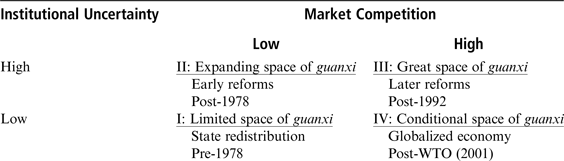
How do we theorize about the dynamics of guanxi in China's shift towards a market economy? Table 1 presents a typology, borrowed from Yanjie Bian and Lei Zhang, in which the transition from a redistribution economy to a market economy is considered to occur in a two-dimensional space of changing degrees of institutional uncertainty and market competition.Footnote 79
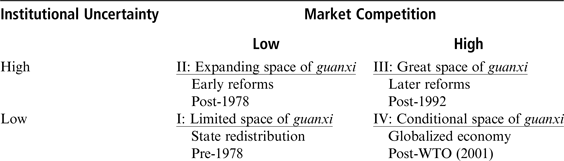
In economic theory, uncertainty arises when economic actors lack sufficient knowledge and consequently anticipate unmeasurable, uncodifiable or non-quantifiable risks about the future status of their economic actions.Footnote 80 Douglas North considers institutional uncertainty to be a set of economic rules and operational regulations that contain the characterizations of ambiguity, non-transparency and incompatibility.Footnote 81 Institutional uncertainty is low when economic rules and operational regulations are specific, transparent and compatible with one another, and it is high when the rules and regulations are instead ambiguous, non-transparent and incompatible with one another. Market competition, on the other hand, is low when entry to market is monopolized by the state or non-state oligarch, and market competition is high when entry is open to multiple competitors.
From 1956 to 1978, China's socialist redistributive economy operated with lower degrees of institutional uncertainty and market competition. Then, state planning was the single source of formal institutional arrangements through which to coordinate the allocation of material, financial and labour resources for production, distribution and consumption. This was made possible by a one-for-all public ownership in which all enterprises and institutions were put under the jurisdiction of government, leaving little space for economic activities of a private nature. As transactions between economic entities were managed through administrative fiats, market competition was minimal. Labour allocation, for example, was controlled through state job assignments, and labour mobility was kept extremely low through the system of household registration (hukou 户口) and the work-unit ownership of workers.Footnote 82
Post-1978 reforms largely improved China's economic environment, but the reform strategies increased institutional uncertainty. Three reform strategies in particular are on point. The first is “reform without design,” which has meant that market institution building has lagged behind emerging market activities, creating institutional non-transparency.Footnote 83 The second is the strategy of piecemeal, gradual reform, which has allowed the coexistence of incompatible institutions, both market and redistributive, for decades and continues even today, creating enormous opportunities for official corruption and illicit business operations.Footnote 84 And the third is the strategy of trial-and-error reform experiments, which gives local governments the powers to act in their own interests, increasing both institutional ambiguity and implementation variations across localities.Footnote 85
These reform strategies all come from central government, China's ultimate source of institutionalization. Every five years, the Communist Party Congress makes regulative adjustments to minimize the institutional uncertainties generated by the reform measures that were experimented with in the previous five years. In the meantime, however, fast market growth generates new activities, to which the three reform strategies are to apply, and institutional uncertainty therefore builds to new levels. This pattern of reform-generating uncertainties continued as market reforms deepened during the 1990s, even beyond China's entry into the World Trade Organization (WTO) in December 2001. An international source of regulation and institutionalization, the WTO's reach and influence have been limited by China's large size and enormous interregional variations. At present, in those localities and industries in which market activities have matured and WTO influence has been felt, institutional uncertainty is expected to be on the decline; in other localities and industries in which new developments are concentrated under mixed institutional arrangements, institutional uncertainty is persistent or rising.
Since 1978, the degree of market competition in China has increased, mostly as a result of reforms. In the first decade, this was mainly a result of the decentralization of economic decision-making, and experimentation with the household responsibility system in villages and manager responsibility system in factories.Footnote 86 A product market emerged and state industrial quotas shrank in great numbers, ultimately to nil. In the second decade, the labour control policy was replaced by a two-way selection policy in which employers and prospective employees had the freedom to choose each other.Footnote 87 Migrant peasant labour flooded into the cities, but a large number of state workers lost their jobs, becoming unemployed or taking on unprotected wage work in the non-state sector. In the third decade, property rights reforms finally were implemented, and a “grab the big and release the small” (zhua da fang xiao 抓大放小) policy let many state factories privatize, although the state retained the largest industrial and commercial companies under a reformed state ownership.Footnote 88 While the state has regained its monopoly on industries of strategic importance, the post-WTO Chinese economy raises the level of market competition on a global scale.
The increasing degrees of institutional uncertainty and market competition matter for the relevance and activeness of guanxi. An economy of increasing institutional uncertainty is one that is full of information asymmetries, is lacking formal institutions to ensure trust between economic actors, and is weak in legal enforcements to punish illicit behaviour. These institutional gaps and holes tend to be plugged with guanxi practicesFootnote 89 and are the ultimate reasons for the rise of patron–client ties between the state officials and entrepreneurs who engineered China's economic take-off under the models of local state corporatism,Footnote 90 communist commercialism,Footnote 91 or network capitalism.Footnote 92 On a micro-level, guanxi gives economic actors a competitive edge because of its bonding and bridging values within and between these actors; such values are needed and appreciated more when an economy becomes increasingly competitive.Footnote 93 With regard to China's transitional economy, two propositions can be forwarded here. First, the higher the institutional uncertainty, the greater the role guanxi plays in maintaining economic actors’ comparative advantage. Second, the higher the degree of market competition, the greater the propensity to use guanxi to strengthen that comparative advantage.
The interaction between these two propositions offers four empirical testable hypotheses, depicted in Table 1. The lower left cell represents China's pre-reform economy, with both institutional uncertainty and market competition at lower levels. This means that the pre-reform economy had a relatively smaller space in which guanxi played a role (Hypothesis 1).
Moving up vertically, the upper left cell represents the initial reform period, during which institutional uncertainty grew rapidly owing to the three reform strategies reviewed above. During this period, market competition began to increase, albeit on a small scale, in the forms of small commodity markets, incentive wages in state factories, and household farming and family businesses. The role of guanxi is expected to be more relevant, more active and on the rise in the initial reform period (Hypothesis 2).
Moving horizontally, the upper right cell represents the later reform period following Deng Xiaoping's 邓小平 Southern China Tour in 1992. This period saw the implementation of a whole raft of reform measures that opened labour markets and financial markets, attracted foreign direct investment, and allowed for private companies to grow independently. This is a period when guanxi should have a rising and significant role in resource allocation and business operations (Hypothesis 3).
Moving downward, the lower right cell represents the post-WTO era, during which time the Chinese economy became competitive on a global scale. Institutional uncertainty is expected to remain persistent, and perhaps rising, in localities and industries where the reach of WTO influence is limited; in other localities and industries, the WTO becomes increasingly effective at reducing institutional uncertainty. Thus, the significance of guanxi is conditional upon the effectiveness and influence of post-WTO institutionalization in this period (Hypothesis 4).
The Increasing Significance of Guanxi in Labour Markets
The research hypotheses described above can guide a series of empirical tests in different domains of reform-era China. We have learned that guanxi plays an important and sometimes decisive role in political appointmentsFootnote 94 and military promotions,Footnote 95 in Chinese entrepreneurship and business development,Footnote 96 in organizational management,Footnote 97 in the legal profession,Footnote 98 and in official corruption.Footnote 99 Most of these citied conclusions come from cross-sectional, snap-shot studies, but a valid test of the hypotheses requires time-series data on the dynamics of guanxi within a specific domain of research. For this purpose, I have chosen the well-studied domain of labour market research. I have combined several large-scale surveys, which I have conducted, to create a longitudinal dataset of 8,300 randomly selected employee-respondents in order to depict trends in job-search networks in China from 1978 to 2009. Jobs are one of the key resources in any market economy, and job competition has been increasing in transitional China since the 1980s.Footnote 100 Therefore, an analysis of job-search networks is a good representation of the core domains of research that are most relevant to the guanxi debates.Footnote 101
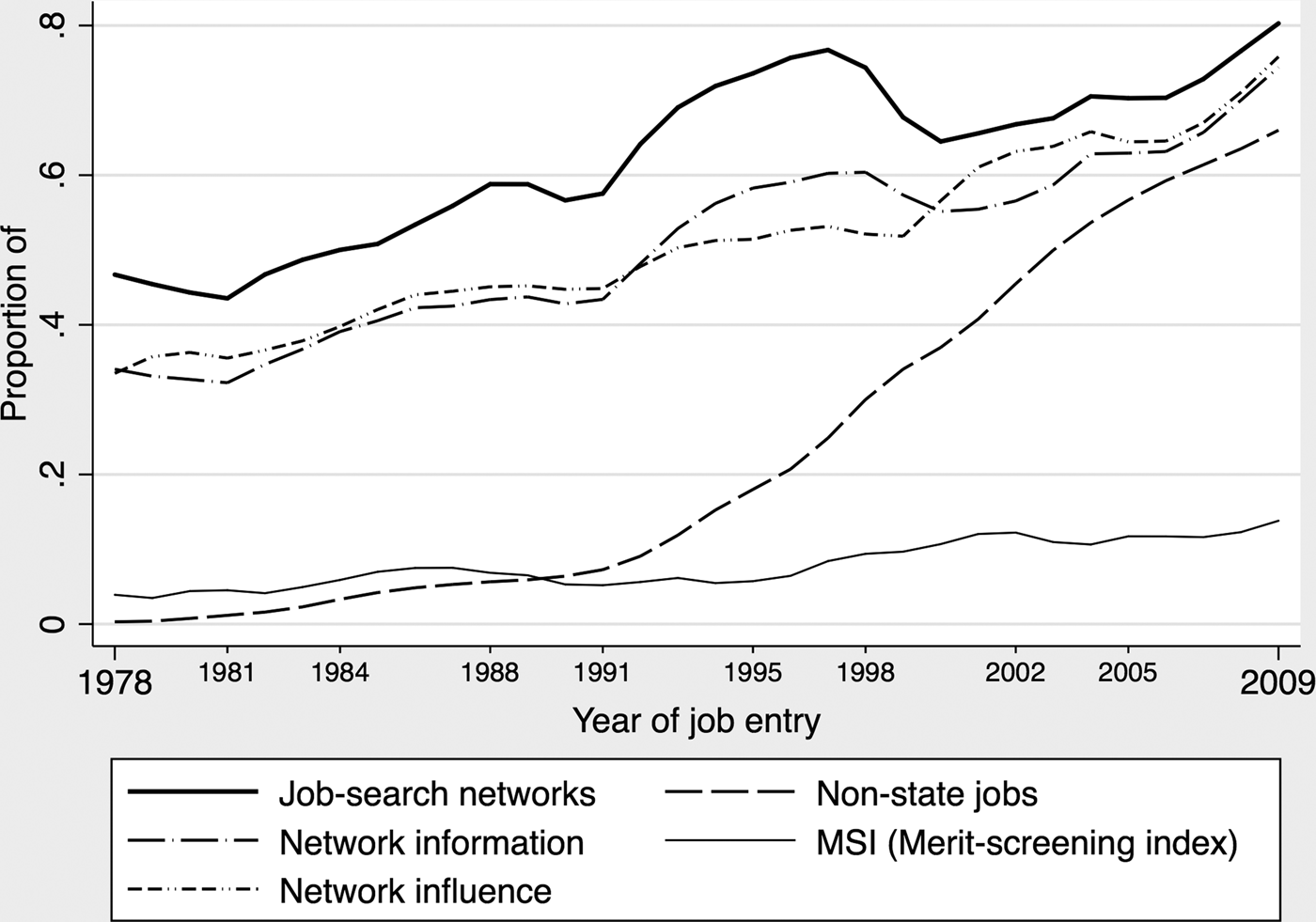
Figure 1 plots several curves. The top curve shows that year-specific proportions of jobs found through social contacts nearly doubled over the studied period. In 1978, the first year of market reforms, 46 per cent of jobs were found through social contacts; in 2009, the last year of survey data available, this had risen to 80 per cent. This increasing trend remained rather steady in the first two decades, as Maoist lifelong employment and state job assignments gave way to term contracts and labour markets.Footnote 102 After a brief fall between 1996 and 2000, when the restructuring of state-owned enterprises resulted in a large number of layoffs, the trend resumed in 2001, and rose to its highest level in later years.
Trends of Job-Search Networks

Two theoretical explanations can be used to interpret this remarkable increase in job-search networks. The first explanation points to the role of social contacts in transmitting information between job seekers and prospective employers, parties who are otherwise unconnected because of information asymmetries in labour markets. The Chinese surveys under analysis here list the different forms of assistance offered to job seekers by their social contacts. These are categorized into network information (“tell me about a job,” “help to prepare a job application”) and network influence (“deliver my job application,” “contact authorities on my behalf,” “solve concrete problems,” “provide any other substantial help”). The second curve from the top in Figure 1 shows that network information increased over the 32 years; this trend implies that China's emerging labour markets were increasingly characterized by the problems of information asymmetry or information uncodification.Footnote 103
The second explanation comes from the research on guanxi. As outlined above, favouritism is key in guanxi practices. In labour markets, the logic behind guanxi favouritism is that the acquisition of powerful social contacts can bear influence on hiring decisions. From a job seeker's perspective, prior to the market reforms, network influence could help to generate a good job assignment or avoid a bad job assignment by the state; in the post-reform era, it meant gaining an advantage in the increased competition for jobs. The third curve in Figure 1 shows the increasing trend of network influence, similar to the trends of network information and overall job-search networks.
A great majority of the Chinese respondents in the surveys used multiple social contacts (an average of three), from whom they obtained both network information and network influence. This is why each year's sum of the proportions of users accessing information and influence exceeds the overall proportions of social contact users. Over time, job-search networks are increasingly used for channelling both information and influence, with roughly equal effectiveness, a finding that supports the guanxi-as-cultural-repertoire view and disproves the declining significance of guanxi thesis.
Markets do not always rationalize since they also respond to political, social and cultural forces in any given society.Footnote 104 This implies that formal institutionalization under a rational market image, such as the screening of job applicants through meritocratic rules, may not grow proportionally with markets, leaving room for network information and network influence to affect labour market competition. Figure 1 presents initial evidence for this argument. Non-state jobs, a key indicator of China's marketization and labour market competition, increased from less than 1 per cent in 1978 to about 65 per cent in 2009. At the same time, however, the merit-screening index (MSI), which measures the extent to which job applicants are screened by the formalized rules of meritocracy,Footnote 105 slowly improved during the 32 years, from a mere 4 per cent of jobs that were screened under formal rules of meritocracy in 1978 to 14 per cent in 2009. The greatest increase of MSI occurred in the period 1996–2002, during which a drop rather than an increase in job-search networks was concurrently observed. During that period, the Chinese government carried out the bold reforms of “grabbing the big, releasing the small,” a measure aimed at downsizing the state sector to allow for greater privatization in preparation for China's entry to the WTO in December 2001.
Table 2 presents a further test of Hypotheses 1–4. It shows the changing significance of guanxi in the acquisition of jobs in four sectors of varying degrees of institutional uncertainty and market competition. The lower left cell represents a sector of low institutional uncertainty and low market competition. In this sector, guanxi influence is set at an index of 1.00. In reference to this sector, the sector in the upper left cell has an increased degree of institutional uncertainty, and its guanxi influence increases to an index of 1.87. This means that job seekers in this sector are 87 per cent more likely to get jobs through guanxi than their counterparts in the reference sector. The upper right cell shows a much higher index of 3.61 for guanxi influence. This means that the increases in both market competition and institutional uncertainty combine forces to greatly magnify the influence of guanxi on job acquisition. But the magnitude of guanxi influence decreases to a 1.87 level in the lower right cell, in which institutional uncertainty drops to a low level. Overall, Table 2 presents strikingly impressive results of statistical analysis in support of Hypotheses 1–4.
Changing Degrees of Guanxi Influence in the Acquisition of Jobs, N = 3,590

Note: This table is generated from the author's dataset (Bian et al. Reference Bian, Huang and Zhang2015). The guanxi influence figures are logistic coefficients of whether or not jobs are obtained with the assistance of guanxi contacts. The models were estimated separately for the four sectors, and each model consists of a large number of control variables. Detailed results are available from the author upon request.
Concluding Remarks
While lacking time-series data on the dynamics of guanxi in business development and political domains, we are fortunate to have such data on job-search networks over a long span of 32 years of reform in China. This valuable dataset has helped us to establish a good empirical understanding about the increasing significance of guanxi in the acquisition of jobs, one of the most important resources whose allocation is at the core of China's reforms. Simply put, the steady increase in the number of jobs that are allocated through the use of information exchange, and favouritism ties especially, is a direct test of the Yang–Guthrie debate. The outcome supports Yang's guanxi-as-cultural-repertoire view and negates Guthrie's thesis on the declining significance of guanxi.
The market-as-rational-institution view that is behind Guthrie's decline of guanxi thesis is not totally falsified. We find partial evidence for this view from both aggregate and individual-level analyses. On the aggregate level, rules of meritocracy gradually increased from 1978 to 2009, although at much slower rates than the growth of the non-state sector, a critical measure of the market economy. As the number of non-state jobs increase, so does the influence of guanxi on the acquisition of these jobs; but at the same time, when merit-based screening becomes stronger, guanxi influence gets weaker. Furthermore, individual-level analyses also confirm that guanxi influence is stronger when both market competition and institutional uncertainty increase but is indeed reduced substantially when institutional uncertainty diminishes to a low degree as a result of the institutionalization of merit-based screening of job applicants. The question still remains to be answered in regard to the kinds of state enterprises Guthrie studied in Shanghai. Nonetheless, the lesson from our data analysis of labour markets is about the contingencies of guanxi influence. These contingencies at least include the interplay between market competition and formal institutionalization. Market competition is, in Karl Marx's terms, a natural-historical phenomenon: we may study its logic but we will never be able to alter it without consequences, if not human disasters. Yet, institutionalization is something policymakers and laypeople surely can do a lot about it, for better or worse. To be sure, no market or non-market economy is free of institutional uncertainty, no matter how institutionalized the economy is. Logically, guanxi influence will persist.
To what extent do the cultural norms and the informal institution of guanxi operate independently of formal institutionalization and market development? If guanxi is always adaptive to new institutional changes, as argued by Yang and Chang, it would be true that “the final word about guanxi can never be concluded.”Footnote 106 This, I believe, depends on how we understand the complex meanings of guanxi, both culturally and structurally. With a forward-looking attitude, I have constructed a five-level scheme aimed at advancing future research on guanxi and its influence in China's rapidly changing society.Footnote 107
Level one
Guanxi is understood as a tie of connectivity (versus dis-connectivity), and its embedded resources are mutual recognition and communication among members of a shared community. This is the most basic meaning of guanxi and it is, to social network analysts, constant across cultures and societies.Footnote 108 No human can be totally isolated, and all of us are connected with one another within the communities to which we belong. In the information age, our connectivity increases in scope and is less structurally constrained than ever before. China is no exception.
Level two
Guanxi is a sentimental tie, and its embedded resources are human affections – sympathy, care, trust, love – and a sense of altruistic, not reciprocal, help to the people one is socially connected to. This level of guanxi should form the greater part of everyday life in any given society, not just China, but its cross-cultural, cross-national, and cross-regime variations need to be empirically studied.Footnote 109 The greater the amount of this level of guanxi there is in everyday life, the nicer our social worlds would be. Is reform-era China in the process of reducing this level of guanxi proportionately to the rise of a rationalized and yet uncertain and sometimes disastrous market economy?
Level three
Guanxi is a sentiment-driven instrumental tie, and its embedded resources are substantial help with reciprocal implications and expectations. This level of guanxi is consistent with my elaborations of kin ties and pseudo-kin ties. The mobilization of these embedded resources is the unintended consequences of good guanxi keeping and interpersonal trust.Footnote 110 Their very logic is against the deliberate guanxi building aimed at instrumental purposes.Footnote 111 Is the rise of a market economy with Chinese characteristics creating external conditions that oppose the development of this level of guanxi in favour of overt favouritism and naked favour exchange?
Level four
Guanxi is an instrumental particular-tie, and its embedded resources vary hugely in forms, but the norms of reciprocity, face and favour are primary.Footnote 112 This is the widely understood meaning of guanxi in the guanxi scholarship I have reviewed, and is also reflected in the Yang–Guthrie debate.Footnote 113 The relational bases of this level of guanxi vary, but the degree of particularism is a positive signal to begin a possible favour exchange between guanxi parties.Footnote 114 Nevertheless, the norms of reciprocity, besides anything else, are deterministic about the continuation or termination of a guanxi tie. To what extent do these kinds of guanxi ties grow or decline in proportion to the rise of the market economy in China, and under what conditions?
Level five
Guanxi is an obligational tie and a well-understood informal contract. Its embedded resources are specific, the generated behaviours are highly patterned, but the relational origins, bases or forms vary randomly. Care, trust and altruism are no longer relevant to these kinds of obligational ties, which conceivably have grown tremendously in business circles and political spheres among the new rich.Footnote 115 Obligational ties of this nature facilitate land allocations and real estate developments, lubricate construction projects, and contribute to illicit services and dealings, official corruption, and money-for-power-influence exchanges.Footnote 116 These are the ugly faces of guanxi and the dark side of guanxi capital. Have these kinds of guanxi practices and guanxi influences remained within business circles and political confines? Or are they spreading to all economic and social spheres in an increasingly marketized China?
Acknowledgement
The author is grateful for the helpful comments of the editor of The China Quarterly and two anonymous referees. Some of the material in this paper was presented in PPT form to “The field of guanxi studies” conference, held at UC-Berkeley, 6–7 March 2015. Comments from Jack Barbalet, Tom Gold, Heather Haveman, Tianshu Pan, Yang Su, David Wank, Yunxiang Yan, Mayfair Yang, Xueguang Zhou, and other conference attendants are much appreciated. Lei Zhang constructed Figure 1 and Xianbi Huang prepared the data used to assess the coefficients presented in Table 2. Grants from Hong Kong (HKUST6052/98H, CA03/04.HSS01) and China (13&ZD177) financed the collection of data presented in this paper.
Biographical note
Yanjie Bian is professor of sociology at the University of Minnesota, and director of the Institute for Empirical Social Science Research at Xi'an Jiaotong University. An author of numerous books and articles on China's social networks and social stratification, he is currently leading a panel study about the causal role guanxi plays in employment and career mobility in Chinese cities.