Implications
Excessive amounts of high-intensity training and the use of starch-rich diets can both cause serious health problems in racehorses and are therefore an animal welfare issue, as well as being costly for the horse industry. Use of a forage-only diet and reduced training distance has the potential to lower the incidence of these health problems. However, data on the response to forage-only diets and different training regimes in growing horses in race training are scarce. Therefore this study evaluated a restricted training programme and use of a forage-only diet for growing horses in race training.
Introduction
Excessive amounts of high-intensity training may cause serious health problems in racehorses, so decreasing the amount of high-intensity activities may be advantageous. Swedish Standardbred racehorses are generally trained with the goal of starting their harness racing career at 2 or 3 years of age, meaning that training will start while the horses are still growing. Fast, qualitatively good growth is probably crucial for performance in racehorses and it has been shown that performance capacity increases with height of the horse in Swedish Standardbreds (Thafvelin, Reference Thafvelin1990). Moreover, body composition seems to be important for performance capacity, while body fat content may affect performance and velocity at a blood lactate concentration of 4 mmol/l (VLa4) (Lawrence et al., Reference Lawrence, Jackson, Kline, Moser, Powell and Biel1992; Kearns et al., Reference Kearns, McKeever, Kumagai and Abe2002; Leleu and Cotrel, Reference Leleu and Cotrel2006; Fonseca et al., Reference Fonseca, Kenny, Hill and Katz2013). It has also been suggested that the size of the m. longissimus dorsi has a positive relationship with performance (Dobec et al., Reference Dobec, Borger and Neal1994).
To meet the high-energy requirements of racehorses, starch-rich concentrates are most commonly used (Jansson and Harris, Reference Jansson and Lindberg2013), even though this practice is associated with various health problems. Recently, the use of high-energy forage has been suggested as an alternative feeding strategy that might even contribute to improved performance (Jansson and Lindberg, Reference Jansson and Harris2012). We have previously shown that Standardbred yearlings in training can grow well and maintain moderate body condition when fed a high-energy, forage-only diet (Ringmark et al., Reference Ringmark, Roepstorff, Essen-Gustavsson, Revold, Lindholm, Hedenstrom, Rundgren, Ogren and Jansson2013). However, the training of yearlings is not as intense as that of 2- to 3-year-old horses and thereby not as energy consuming. It could be speculated that 2- to 3-year-old horses in race training would not be able to meet their energy requirements on a forage-only diet, due to a longer feed intake time compared with concentrates (Meyer et al., Reference Meyer, Ahlswede and Reinhardt1975) and/or to a lowered appetite caused by exercise (Gordon et al., Reference Gordon, McKeever, Bokman, Betros, Manso Filho, Liburt and Streltsova2006b). If so, such diets would negatively affect body condition and perhaps also growth, unless the training level, and accordingly the energy requirements, were reduced.
A possible limitation (Lacombe et al., Reference Lacombe, Hinchcliff, Geor and Baskin2001) to the use of forage-only diets for horses performing rigorous exercise could be the lower levels of muscle glycogen observed compared with a starch-rich diet (Jansson and Lindberg, Reference Jansson and Harris2012). However, it remains to be confirmed whether the reduced muscle glycogen content observed by Jansson and Lindberg (Reference Jansson and Harris2012) was due to a true limitation in the storage capacity or simply a prolonged recovery period after training. As far as we know, no previous study has investigated muscle glycogen content in 2- to 3-year-old horses in race training on a forage-only diet.
The aim of this study was to document feed intake, growth, body condition and muscle glycogen content in 16 2-year-old Standardbred horses fed a forage-only diet and allocated to either a control training programme or a training programme in which the high-intensity training distance was reduced by 30% until the age of 4. An additional aim was to study a possible correlation between VLa4 and body composition and to record all nutrition-related health problems. The hypothesis was that the two training programmes would result in differences in growth, body condition and muscle glycogen content between training groups.
Material and methods
In total, 16 Standardbred geldings, born 2009, were studied from January in the year they turned 2 years until December in the year they turned 3. The study is a continuation of that by Ringmark et al. (Reference Ringmark, Roepstorff, Essen-Gustavsson, Revold, Lindholm, Hedenstrom, Rundgren, Ogren and Jansson2013) on the same horses as 1-year olds and, for some parameters, data from that period were used as a starting point in the present study. The study was conducted at the Swedish National Trotting School, Wången, and the experimental protocol was approved by Umeå Local Ethics Committee (A 90-10, 2010-09-14) according to Swedish animal welfare regulations.
Horses and training
The horses mainly had an American pedigree, but eight horses also had some (<27%) French ancestry.
The horses were cared for and trained by high school students under the supervision of professional trainers. The goal for all horses was to pass a qualification race (2140 m, >11.8 m/s, an official requirement to ensure that horses are fit for true races) at the age of 3 years and also to start competing in official races as 3-year olds. Performance goals and a training programme were established together with a reference group consisting of four professional trainers with international experience. From early September as 1-year olds until mid-March as 2-year olds, all horses followed the same conventional training programme (Ringmark et al., Reference Ringmark, Roepstorff, Essen-Gustavsson, Revold, Lindholm, Hedenstrom, Rundgren, Ogren and Jansson2013 and Reference Ringmark, Lindholm, Hedenstrom, Lindinger, Dahlborn, Kvart and Jansson2015). In March as 2-year olds, the horses were divided into two groups balanced with respect to parameters known to affect performance (Ringmark et al., Reference Ringmark, Lindholm, Hedenstrom, Lindinger, Dahlborn, Kvart and Jansson2015), including height at withers, age (days), sire and breeder. One group was allocated to a control training programme (C-group) and the other to a reduced training programme (R-group) until December as 3-year olds. The training programmes aimed to resemble common practice in the Swedish Standardbred racing industry, but with some reduction in the high-intensity training distance in the R-group. All training expected to cause a heart rate (HR) >180 beats per minute (bpm) was reduced by ~30% of the distance in the R-group compared with the C-group (Ringmark et al., Reference Ringmark, Lindholm, Hedenstrom, Lindinger, Dahlborn, Kvart and Jansson2015). In total, five times between May and December in 2012 as 3-year olds, a test of individual lactate threshold (VLa4, velocity at blood lactate concentration of 4mmol/l) was performed (Ringmark et al., Reference Ringmark, Lindholm, Hedenstrom, Lindinger, Dahlborn, Kvart and Jansson2015). VLa4 was used to study correlations between body characters and aerobic capacity. The mean weekly planned high-intensity training was 6.3 and 4.4 km for horses in groups C and R, respectively.
Diet and management
Horses were stabled individually in boxes for ~16 h/day 4 to 5 days/week and spent the rest of the time in an outdoor paddock with access to shelter. Wood shavings were used as litter in both shelters and boxes. Water was offered from two 20-l buckets in the box that were refilled twice a day and in the paddock from a large tub that was heated during wintertime. Faecal samples were collected in spring and autumn each year and analysed by microscope for occurrence of strongyloid (Cyathostominae) eggs. Horses were dewormed twice per year (spring and autumn) with Cydectin® vet/Cydectin comp vet (Zoetis Manufacturing & Research Spain, S.L, Girona, Spain).
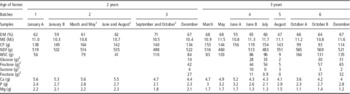
Horses were fed grass haylage ad libitum as described by Ringmark et al. (Reference Ringmark, Roepstorff, Essen-Gustavsson, Revold, Lindholm, Hedenstrom, Rundgren, Ogren and Jansson2013) in the box and provided from three feeding stations in the paddock (two stations during spring as 3-year olds due to damage to one station). New haylage was delivered once a day in the box and every 3 to 4 days in the paddock. From the end of April until October, some grass was available in the paddock. The haylage mainly consisted of meadow fescue, timothy and ryegrass and was harvested in Enköping, Sweden (59°37.8′N; 17°04.5′E). During the study, a total of six batches of haylage were used and samples of each batch were collected in connection with feed intake recordings and on a change to a new batch, and analysed for nutrient content (Table 1). Both first and second cut forage was used. The first cut was fertilised with 120 kg N in spring and the second cut with 75 kg N after the first cut was harvested. In March when the horses were 3 years old, a smell of butyric acid from the silage was detected so a feed sample was analysed for microbiological activity (SVA laboratories, Sweden) but this failed to detect any deviations.
Forage nutrient content in six batches of forage fed ad libitum to 16 2- to 3-year-old Standardbred horses in training. Content per kilogram of dry matter (DM)

DM=dry matter content, ME=metabolisable energy; WSC=water-soluble carbohydrates.
1 Samples were collected in both months and then mixed before analysis.
2 Analysed only in periods when muscle biopsies were sampled and when horses were active in racing.
The diet was supplemented with 0.25 to 1.0 kg (depending on haylage nutrient content) of a pelleted lucerne product (95% lucerne, 5% molasses; Krafft AB, Falkenberg, Sweden) to enhance mineral supplement intake and meet the CP requirements (National Research Council Committee (NRC), 2007). A commercial mineral supplement was used to meet the vitamin and mineral requirements (50 to 150 g of Miner Röd, content/kg: Ca 110 g, P 17 g, Mg 60 g, NaCl 125 g, Cu 1200 mg, Se 15 mg, vitamin A 200 000 IU, vitamin D3 10 000 IU, vitamin E 15 000 mg; or 150 g of Miner Vit, content/kg: Ca 55 g, P 65 g, Mg 60 g, NaCl 125 g, Cu 900 mg, Se 15 mg, vitamin A 100 000 IU, vitamin D3 10 000 IU, vitamin E 5000 mg; Krafft AB). This was supplied throughout the study except between September as 2-year olds and May as 3-year olds, when the only supplement used was a selenium and vitamin E product (Protect E-Selen; Lantmännen Lantbruk, Malmö, Sweden), due to sufficient content of Ca, P and Mg in haylage during this period. Salt was always provided as salt blocks in boxes and, from September as 2-year olds, 15 g of NaCl were also added to the diet due to expected increased sweat losses.
Nutrient intake
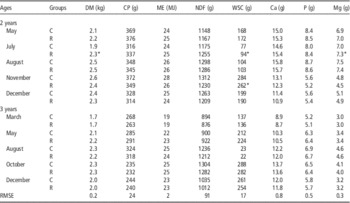
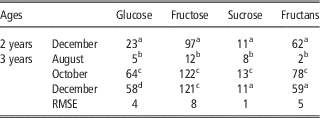
Voluntary feed intake was recorded on ten occasions during 3 consecutive days, as described by Ringmark et al. (Reference Ringmark, Roepstorff, Essen-Gustavsson, Revold, Lindholm, Hedenstrom, Rundgren, Ogren and Jansson2013). During these days, horses were kept in their boxes except during training (if training was scheduled), or otherwise exercised in a walker for ~1 h. Ad libitum was defined as a minimum of 2.0 kg of haylage left-overs per 24 h. Feed samples were dried (60°C for 24 h and 103°C for 16 h) and individual dry matter (DM) intake was calculated. Calculations of nutrient intake were based on the individual DM intake per 100 kg BW including lucerne supplement (Tables 2 and 3). Analysis of nutritional composition of forage samples was performed by NIRS (FOSS, Hilleröd, Sweden) that was calibrated for airtight stored forage with DM contents of 35% to 65% and hay with DM contents of 75% to 85%. Before calibration analysis, feed samples were dried to 95% DM. Inductively coupled plasma–atomic emission spectroscopy (Spectro Flame; SPECTRO Analytical Instruments, Kleve, Germany) were used for analysis of mineral content. Analysis of water-soluble carbohydrate (WSC), glucose, fructose, sucrose and fructans was carried out according to Larsson and Bengtsson (Reference Larsson and Bengtsson1983) using enzymes from Roche Diagnostics GmbH (Mannheim, Germany). Lucerne content was analysed from a sample collected in December as 1-year olds and was assumed to be valid for the rest of the study due to the standardised production and low feeding level.
Daily nutrient intake per 100 kg BW based on individual feed intake recorded during 3 consecutive days on ten occasions (least squared means)

DM=dry matter; ME=metabolisable energy; WSC=water-soluble carbohydrates; C=control training programme; R=reduced training programme; RMSE=root mean square error.
*Significant difference between groups within occasion, P<0.05.
Intake of sugars – glucose, fructose, sucrose and fructans (g/100 kg BW and day, least squares means)

RMSE=root mean square error.
a,b,c,dDifferent superscript letters indicate a significant difference between observations (P<0.05).
Muscle glycogen content
Muscle biopsies were taken at a standardised depth in the m. gluteus medius as described by Ringmark et al. (Reference Ringmark, Roepstorff, Essen-Gustavsson, Revold, Lindholm, Hedenstrom, Rundgren, Ogren and Jansson2013) in December as 2-year olds (after >48 h of rest (=no high-intensity training)) and in November as 3-year olds (seven horses (C-group 3, R-group 4) after 48 h of rest, eight horses (C-group 5, R-group 3) after >48 h of rest, one horse was eliminated). Biopsies were stored at −80°C until analysed for glycogen content according to Lowry and Passonneau (Reference Lowry and Passonneau1973).
Body development and plasma leptin concentration
Horses were weighed weekly (weight indicator U-137; UNI Systems and Vågspecialisten, Skara, Sweden) and individual 4-week mean BW was calculated. Measurement of m. longissimus dorsi, rump fat at croup (site 1) and 15 cm caudal from this (site 2), height at withers, height at croup, body length, shinbone circumference and body condition score (BCS) assessment (scale 1 to 9) were performed as described by Ringmark et al. (Reference Ringmark, Roepstorff, Essen-Gustavsson, Revold, Lindholm, Hedenstrom, Rundgren, Ogren and Jansson2013). Fat-free mass was calculated using the equation by Westervelt et al. (Reference Westervelt, Stouffer, Hintz and Schryver1976) for estimation of body fat content. A blood sample (Li-hep, vacutainer technique) was collected from the jugular vein in March, before the division into two groups, and in May in the horses as 2-year olds and analysed for plasma leptin concentration with a radioimmunoassay kit (Millipore Corporation, Billerica, MA, USA) where only samples with an intra- and inter-assay CV of <10% were used.
Statistical analysis
All statistical analyses were performed in Statistical Analysis Systems package 9.3 (SAS Institute Inc., Cary, NC, USA). Differences were considered significant at P<0.05. Values presented are least squares means and root mean square error (RMSE).
For statistical analyses, a mixed model where the residuals follow an autoregressive (AR(1)) structure was used, with the effect of individual as repeated measurements and with start values included as a covariate
 $$Y_{{ijkl}} {\rm\, {\equals}\, }\mu {\rm {\plus}}a_{i} {\rm {\plus} }\beta _{j} {\rm {\plus} }y_{k} {\rm {\plus} }\left( {\beta y} \right)_{{jk}} {\rm {\plus} }\delta _{{\rm l}} {\rm {\plus} }e_{{ijkl}} $$
where Y ijkl is the observation, µ the mean value, a i the effect of individual, β j the effect of group, γ k the effect of period, (βγ) jk the interaction of group and period, δ l the effect of start value and e ijkl the residuals. For analysis of differences in BW between groups, data on BW in the last 4-week period before the different training programmes started were used as a start value. For analysis of the change in BW over time in all horses, the mean BW for the last 4 weeks in December as 1-year olds was used as a start value. The change in BW was also calculated as a percentage of the start value.
Analysis of differences in muscle glycogen content between groups and sampling occasions was performed using the same model as described above, including values of muscle glycogen content in December in the horses as 1-year olds as a covariate. One analysis was also performed including the values from when the horses were 1-year olds as a variable. Only horses that were rested for >48 h before sampling as 3-year olds (n=7) were included in this analysis. The same model was used for analysis of differences between groups of plasma leptin, using the samples from March as 2-year olds as a covariate.
For analysis of differences between groups in terms of nutrient intake (except for separate sugar fractions for which the start values were excluded), muscle thickness, s.c. rump fat thickness, fat-free mass, height at croup and withers, body length and BCS, a mixed model was used. It included the values recorded in March as 2-year olds – that is, at the start of the different training programmes – as a covariate
 $$Y_{{ijkl}} {\rm\, {\equals}\, }\mu {\rm {\plus}}a_{i} {\rm {\plus} }\beta _{j} {\rm {\plus} }y_{k} {\rm {\plus}}\left( {\beta y} \right)_{{jk}} {\rm {\plus} }\delta _{{\rm l}} {\rm {\plus} }e_{{ijkl}} $$
where Y ijkl is the observation, µ the mean value, a i the effect of individual, β j the effect of group, γ k the effect of period, (βγ) jk the interaction of group and period, δ l the effect of start value and e ijkl the residuals, with a spatial power correlation structure between periods.
For analysis of changes over time in all horses, the same model with the effect of group excluded, and including values recorded in December as 1-year olds as a covariate, was used.
In all the above analyses, if the overall effect of interaction between group×occasion was <0.1, a separate analysis with the interaction excluded was run. If no overall effect of interaction is presented, the P-values for effect of group reported originate from this analysis.
Pearson’s correlation test was used to study correlations between the individual mean VLa4 and individual mean values of all body measurements performed as 3-year olds and also between muscle glycogen content and nutrient intake, s.c. fat, muscle thickness and BCS.
Results
Body development
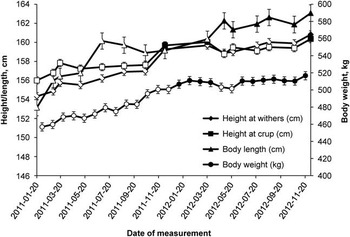
There was no difference between training groups in weight gain rate per 4-week period, calculated as percentage of start weight (C-group 0.46%, R-group 0.44%, RMSE=1.5), or in absolute weight in December in the horses as 3-year olds (C-group 508 kg, R-group 508 kg, RMSE=32, P>0.05). For all horses, BW and body length increased until week 4 in January as 3-year olds (Figure 1) with a small decrease during May to June the same year. In total, mean BW increased by 60 kg (RMSE=11).
Body weight, height at withers, height at croup and body length. Unfilled dots are significantly different from the last value in December as 3-year olds.

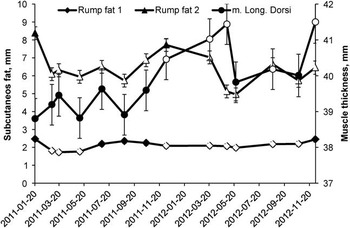
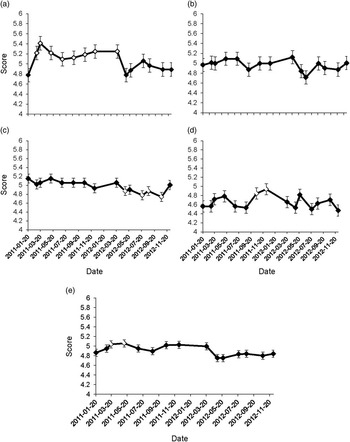
There was no effect of training programme on height at withers, height at croup, body length, shinbone circumference, m. longissimus dorsi thickness, rump fat at site 1, site 2, fat-free mass, BCS at any measurement site (back, neck and shoulders, ribs, tailhead) or total BCS. Shinbone circumference in all horses measured in March and December both as 2-year olds and 3-year olds was 21.6, 21.6, 21.7 and 21.5 cm (RMSE=0.7, P<0.01), respectively. During the study period, mean height at withers, height at croup and body length in all horses increased by 6, 4 and 10 cm, respectively (Figure 1) and continued to increase in the last measurement obtained in December as 3-year olds. Compared with the start value in January as 2-year olds, the thickness of the m. longissimus dorsi was larger in December as 2-year olds and in the following months with the exception of May and October as 3-year olds (Figure 2). Fat thickness at sites 1 and 2 at the croup in all horses showed a variation of <1 mm at site 1 and 3.5 mm at site 2 (Figure 2). Mean BCS in all horses varied between 4.8 and 5.1 during the study period (Figure 3). There was no effect of training group on plasma leptin concentration (C-group 1.1 ng/ml, R-group 1.2 ng/ml, RMSE=0.4).
Thickness of the m. longissimus dorsi (circles), s.c. rump fat 1 (diamonds) and rump fat 2 (triangles). Unfilled dots are significantly different from the first dot in January as 2-year olds.

Body condition score for the areas back (a), neck and shoulders (b), ribs (c) and tailhead (d) and mean score for all four areas (e). Unfilled dots are significantly different from the first dot in January as 2-year olds.

Individual mean VLa4 in the horses as 3-year olds was negatively correlated with rump fat at site 1 (R=−0.58, P=0.03), BCS back (R=−0.71, P=0.004), BCS tailhead (R=−0.62, P=0.02), BCS neck and shoulders (R=−0.65, P=0.01) and BCS total (R=−0.65, P=0.01).
Muscle glycogen content
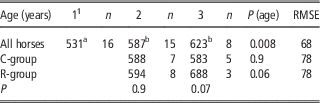
There was no difference between groups in muscle glycogen content in the horses as either 2- or 3-year olds (Table 4). In 3-year olds that rested for 48 h before sampling, muscle glycogen content was 497 mmol/kg dry weight (DW), whereas in 3-year olds that rested >48 h before sampling it was 620 mmol/kg DW (RMSE=77, P<0.01). In horses that rested >48 h before sampling, muscle glycogen content was higher in 2- and 3-year olds than in 1-year olds (Table 4). There were no differences in glycogen content in horses rested for >48 h between the age of 2 and 3, but in horses exercised 48 h before sampling as 3-year olds, muscle glycogen content was lower than in these horses as 2-year olds (497 v. 585 mmol/kg DW, respectively, RMSE=77, P<0.05). Glycogen content was positively correlated to intake of fructans/100 kg BW (R=0.31, P=0.04), BW (R=0.47, P=0.002) and fat-free mass (R=0.47, P=0.003), but no correlations were found with BCS, s.c. fat, calculated body fat percentage, muscle thickness or intake of any other nutrient component.
Muscle glycogen content (mmol/kg dry weight, least squares means)

RMSE=root mean square error; C=control training programme; R=reduced training programme.
a,bDifferent superscript letters indicate a difference (P<0.05) within a row.
Nutrition-related health
During the whole study period (24 months), only one horse suffered from colic, in a single episode that happened a couple of hours after a gastroscopic examination (for another study), when the horse had been fasted for 12 h and sedated. Besides that, no nutrition-related health disorders or stereotypic behaviours were observed during the 24 months of the study.
Discussion
This paper reports a longitudinal evaluation of the effect of training intensity on energy balance, growth and muscle glycogen content in young Standardbred horses fed a forage-only diet during a period of 2 years. As the concept of feeding a forage-only diet to racehorses is novel, this paper also contributes new information about the function of such diets to growing horses in training.
The results showed that a difference of 30% in high-intensity training did not affect feed intake, growth, body condition or muscle glycogen content in 2- to 3-year-old Standardbred horses fed a forage-only diet ad libitum. Moreover, the data indicated that feeding a forage-only diet to young horses in training seemed to promote good nutrition-related health and appeared to pose no limitation to body development or muscle glycogen concentration at rest.
Feed intake, body condition and growth
Surprisingly, there were no differences in feed intake between the training groups. Moreover, although horses in R-group consumed a similar amount of feed as horses in C-group but exercised less, BCS, rump fat and BW were not different between the groups. One explanation for this may be that horses in R-group showed less cardiovascular adaptation to training (Ringmark et al., Reference Ringmark, Lindholm, Hedenstrom, Lindinger, Dahlborn, Kvart and Jansson2015) and, as a consequence, displayed higher HR both in response to exercise and at rest (about 5 bpm increase in HR 10 min post-exercise and ~4 bpm higher HR at rest). This indicates greater energy consumption (Coenen, Reference Coenen2005) and could explain the lack of difference in BCS between training groups. It is also possible that the methods used were too imprecise to detect small differences in feed intake and body composition. However, the lack of difference in plasma leptin concentration also indicates that the horses did not differ substantially in body fat content (Buff et al., Reference Buff, Dodds, Morrison, Whitley, McFadin, Daniel, Djiane and Keisler2002) and/or that the exercise programmes were not sufficiently different to cause altered appetite and plasma leptin levels as previously observed post-exercise in horses fed concentrate (Gordon et al., Reference Gordon, McKeever, Bokman, Betros, Manso-Filho, Liburt and Streltsova2006a). The lack of difference in feed intake in the present study, despite a training difference of 30%, is interesting. Further studies are needed to evaluate whether the feeding strategy with high-energy forage ad libitum promotes good appetite.
Horses in both groups maintained a BCS between 4.8 and 5.1, which is in agreement with an earlier report on Standardbreds in training (Gallagher et al., Reference Gallagher, Leech and Stowe1992) and implies that energy intake was sufficient to match energy output. Feed DM intake on the ten measurement occasions varied between 1.7% and 2.5% of BW in all horses, which corresponded to an estimated energy intake of 19 to 27 MJ metabolisable energy(ME)/100 kg BW. According to NRC (2007), this is similar to the requirements of horses performing ‘heavy to very heavy exercise’ (comparison made after converting net energy to ME by factor 0.87 (NRC, 2007)).
Body weight increased on average by 120 g/day as 2-year olds and 27 g/day as 3-year olds and horses appeared to reach their mature BW in January as 3-year olds, which is similar or earlier than estimated from a report by Bigot et al. (Reference Bigot, Trillaud-Geyl, Jussiaux and Martin-Rosset1987) on horses of light breeds. Further reports on the age at which adult BW is reached in light horses and where feeding level has been controlled for are scarce. No quantifiable fattening occurred, with the exception of rump fat 1 in December when the horses were 3-year olds, which could be related to a decrease in days with training during October to December in both groups as 3-year olds (Ringmark et al., Reference Ringmark, Lindholm, Hedenstrom, Lindinger, Dahlborn, Kvart and Jansson2015). Body condition score also showed a small variation, whereas rump fat 2 varied rather like BCS tailhead, which is logical as these sites are close to each other. Although BW gain ceased in January in the horses as 3-year olds, height at withers and at croup still increased up to December, which implies that mature height was not reached before 4 years of age.
In conclusion, the findings of maintained body condition, constant s.c. fat thickness and high-growth rate indicate that a forage-only diet may not inhibit body development in young Standardbred horses in training for races. However, in spring 2012 as 3-year olds, signs of a negative energy balance were observed (drop in BCS (−0.2 points), rump fat 2 (−30%), BW (−2%) and m. longissimus dorsi thickness (−4%)), probably related to the decreased DM intake observed in March. The reason for this is not clear, but was most likely multifactorial. Causes might have been decreased hygienic quality of the forage which may have affected palatability negatively, although the microbiological analysis failed to show any deviations, eruption of a second molar tooth, the loss of one feeding station (so all 16 horses had to share only two feeding stations possibly causing more competition for feed) and high occurrence of strongyloid (Cyathostominae) eggs (11 horses with >700 eggs/g faeces). Horses recovered after deworming and provision of a third feeding station, but these findings highlight factors that can affect the ability to maintain body condition on a forage-only diet.
Muscle glycogen content
In this study, age and exercise ⩽48 h before sampling seemed to have a greater impact on muscle glycogen content than a reduction in the high-intensity training distance, as there was no difference between groups but an indication that glycogen was not fully replenished in horses sampled 48 h after training. The latter conclusion is supported by the fact that muscle glycogen content in horses rested for only 48 h (eight individuals as 3-year olds) decreased compared with the values obtained as 2-year olds (when rest was longer than 48 h), whereas there was no difference in the horses that rested >48 h both as 2- and 3-year olds. This proves the importance of several days of rest for the recovery of glycogen stores in horses in training. Slow recovery has been reported previously in experimental studies on horses fed concentrates (Snow et al., Reference Snow, Harris, Harman and Marlin1987; Lacombe et al., Reference Lacombe, Hinchcliff, Kohn, Devor and Taylor2004), but to our knowledge our study is the first to show that it is also detectable in true Standardbred race training. In horses rested for >48 h, muscle glycogen content increased with age (from 1 year onwards), which might reflect an increased level of fitness and/or age (Lindholm and Piehl, Reference Lindholm and Piehl1974).
Lower glycogen levels and slower glycogen repletion have been reported in horses fed a high-fibre and high-fat diet compared with a diet rich in non-structural carbohydrates (Pagan et al., Reference Pagan, Essen-Gustavsson, Lindholm and Thornton1987). However, the present study showed that a forage-only diet still resulted in muscle glycogen content within the range reported previously in adult, trained Standardbred horses fed starch, which extends from 546 mmol/kg DW (Palmgren-Karlsson et al., Reference Palmgren-Karlsson, Jansson, Essen-Gustavsson and Lindberg2002) to 644 mmol/kg DW (Jansson and Lindberg, Reference Jansson and Harris2012). The glycogen content also seemed to be higher than that reported in 2- to 3-year-old Standardbred horses (426 mmol/kg DW) by Lindholm and Piehl (Reference Lindholm and Piehl1974). However, 40 years of selective breeding since that study may have changed muscle characteristics and it is unclear how those horses were fed and rested before sampling. Interestingly, at least two individuals in the present study were able to store >740 mmol/kg DW (743 and 748 mmol/kg DW, respectively). High glycogen levels (630 mmol/kg DW) in horses fed a forage-only diet have been observed previously in a study by Essen-Gustavsson et al. (Reference Essen-Gustavsson, Connysson and Jansson2010), where adult horses were fed forage with 16.6% CP, resulting in CP intake of 319±31 g/100 kg BW. This intake is similar to that in the present study in December in the horses as 2-year olds, but higher than that in December as 3-year olds. It is possible that the content of both WSC and CP (Essen-Gustavsson et al., Reference Essen-Gustavsson, Connysson and Jansson2010) in forage affects glycogen stores, but that could not be confirmed in the present study, probably due to the horses being fed the same diet, resulting in a small variation in nutrient intake. We concluded that a forage-only diet appears to be no limitation to achieving high-muscle glycogen levels, although time of replenishment may be >48 h. This needs further investigation.
Performance capacity
In Standardbred horses, VLa4 is highly correlated to race performance (Leleu et al., Reference Leleu, Cotrel and Courouce-Malblanc2005). In the present study, there were no differences in VLa4 between the groups, but the negative correlation between VLa4 and BCS is in accordance with earlier findings (Leleu and Cotrel, Reference Leleu and Cotrel2006). The importance of lean body mass for performance is well-documented in human athletes and also in horses (Kearns et al., Reference Kearns, McKeever, Kumagai and Abe2002). This is probably because extra weight increases the workload, but probably also because more anabolic conditions alter energy metabolism during exercise. A conclusion from this study is therefore that ad libitum feeding of a high-energy forage cannot be recommended for all individuals in race training, as some may get ‘too fat’.
The cross-sectional area of m. longissimus dorsi has previously been related to performance in Standardbred horses (Dobec et al., Reference Dobec, Borger and Neal1994) and is also reported to increase with training (D’Angelis et al., Reference D’Angelis, Mota, Freitas, Ferraz, Abrahao, Lacerda Neto and Queiroz Neto2007). However, in the present study the area was not associated with training group, VLa4 or race qualification ability, as all horses but one qualified for races.
Nutrition-related health
The forage-only diet seemed to promote good nutrition-related health. A study on the feeding regime of racehorses in training revealed that they are fed 4 to 11 kg of concentrates per day (Jansson and Harris, Reference Jansson and Lindberg2013). This increases the risk of colic by five to sixfold compared with no concentrate at all (Tinker et al., Reference Tinker, White, Lessard, Thatcher, Pelzer, Davis and Carmel1997a). Based on the reported prevalence of colic (8 to 11 cases/100 horses per year (Tinker et al., Reference Tinker, White, Lessard, Thatcher, Pelzer, Davis and Carmel1997b; Hillyer et al., Reference Hillyer, Taylor and French2001)), rhabdomyolysis (6 to 9 cases/100 horses per year (Isgren et al., Reference Isgren, Upjohn, Fernandez-Fuente, Massey, Pollott, Verheyen and Piercy2010; Auletta et al., Reference Auletta, Greco, Lamagna, Navas, Uccello, Fatone and Pasolini2011)) and stereotypic behaviours (1% to 9% of horses (Redbo et al., Reference Redbo, Redbo-Torstensson, Odberg, Hedendahl and Holm1998)), in the present study three to four cases of colic, two to three cases of rhabdomyolysis and one horse showing stereotypic behaviour could have been expected. However, none of these problems occurred under normal management conditions, so we suggest that horses fed a forage-only diet may experience fewer nutrition-related health problems than reported in concentrate-fed horses. The case of colic that did occur during the study was related to unusual experimental practices (fasting and gastroscopy), and therefore most likely not related to the diet.
The conclusion reached in this study is that a 30% difference in high-intensity training distance does not affect feed intake, growth, body condition or muscle glycogen content in horses fed a forage-only diet. Earlier findings that an increased amount of body fat content can affect VLa4 negatively were confirmed. It can be concluded that it is possible to train Standardbred horses fed a forage-only diet to race condition as 3-year olds, while having a muscle glycogen content, growth and body condition within the normal range of athletic horses, and that a high-energy forage-only diet could be recommended for horses in training for races, as it promotes good nutrition-related health. However, horses may need >48 h of rest post-exercise for muscle glycogen replenishment.
Acknowledgements
The authors thank all staff and students at Wången. Special thanks to Ulf Hedenström and the trainers Roger Persson and Lars-Åke Swärdfeldt. Thanks also to the reference group of trainers, Stig H Johansson, Thomas Uhrberg and Jan Halberg, for help with designing the training programmes. Great thanks to Trioplast AB, Dow Chemicals, the Swedish Trotting Association, the Swedish Horse Racing Totalisator Board and the Swedish Horse Council Foundation for financial support and to Scandivet for lactate analyses and Thermobar AB for sponsoring with thermobars.