Background
Around 20% of the world's children and adolescents are estimated to have mental disorders or problems. About half of mental disorders begin before the age of 14, and similar types of disorders occur across cultures (WHO, 2014a). Of particular interest in this article is the mental health of young people living in Malta. In an international comparative study, 43% of 11-year-old females and 30% of 11-year-old males in Malta reported feeling stressed by school work (Currie et al., Reference Currie, Gabhainn, Godeau, Roberts, Smith, Currie and Barnekow2008). The 2008 European Health Interview Survey (Department of Health Information and Research, 2010) indicated that in the Maltese 15–24 age group, a relatively low percentage of males reported chronic anxiety (<1%). However, almost 4% of females reported chronic anxiety, and approximately 1% of males and 2% of females reported chronic depression.
Such statistics are of concern to policy makers and communities. Internationally, a strategic response has been to recognise the role that schools can play in early intervention and health promotion. Health promoting schools are founded in the contemporary social-ecological perspective that protective factors reside in each person's psychological world, family contexts (e.g., effective parenting), and environments (e.g., communities and schools) (Graetz et al., Reference Graetz, Littlefield, Trinder, Dobia, Souter, Champion and Cummins2008; WHO, 2014b). School-based mental health promotion initiatives similarly recognise that mental health is determined by biological, socioeconomic and environmental factors. Such initiatives typically seek to promote informed decision making and personal empowerment (WHO, 2014b, 2015).
Examples of school-based mental health promotion initiatives include KidsMatter Early Childhood, KidsMatter Primary, and MindMatters secondary school initiatives in Australia (KidsMatter, 2013), the Social and Emotional Aspects of Learning (SEAL) in the United Kingdom (Department for Children, Schools and Families, 2009), and the Collaborative for Academic, Social and Emotional Learning (CASEL, 2014) initiatives in the United States. The Maltese National Curriculum Framework (Ministry of Education, Employment and the Family, 2012) mandates the development of children's wellbeing and self-esteem as one of the functions of mainstream education. In Malta, a subject called Personal and Social Development is taught in secondary schools and in some junior primary schools. Circle Time, which is a universal intervention for social and emotional learning, and Nurture Groups, which are a specialist provision for students at risk of mental health difficulties, have been introduced to a number of Maltese primary schools over the past decade (Cefai & Cavioni, Reference Cefai and Cavioni2014).
Research studies, feedback from school leaders and teachers, and assessments of students show that school-based mental health promotion initiatives, when well designed and well implemented, can positively influence students’ mental health and a range of other goals of schooling such as personal development and academic success (Elias, Reference Elias, Elias and Arnold2006; Greenberg, Reference Greenberg2010; Lendrum & Humphrey, Reference Lendrum, Humphrey and Askell-Williams2015; Roeser, Eccles, & Strobel, Reference Roeser, Eccles and Strobel1998; Roeser, vanderWolf, & Strobel, Reference Roeser, vanderWolf and Strobel2001; Weare & Nind, Reference Weare and Nind2011; Wells, Barlow, & Stewart-Brown, Reference Wells, Barlow and Stewart-Brown2003). The World Health Organization (2014b, p. 1) recommends:
mental health promotional activities in schools (e.g., programmes supporting ecological changes in schools and child-friendly schools) . . . [that] Engages health and education officials, teachers, teachers’ unions, students, parents, health providers and community leaders in efforts to make the school a healthy place.
By way of example, the KidsMatter (n.d.) primary school and early childhood mental health promotion trial initiatives in Australia explicitly specified four core components for active school-based intervention, namely: (1) building a positive school community; (2) frequently scheduled social and emotional learning education for all students; (3) parenting information and support; and (4) early intervention for students experiencing social, emotional or behavioural difficulties.
It is increasingly recognised that school mental health promotion models, which are based upon knowledge, empowerment and participation, necessarily require active collaboration from parents (Onnela, Vuokila-Oikkonen, Hurtig, & Ebeling, Reference Onnela, Vuokila-Oikkonen, Hurtig and Ebeling2014). This approach is aligned with the well-known importance of involving parents to support their child's development across diverse areas, such as school belonging, engagement with learning, and academic achievement (Adi, Killoran, Janmohamend, & Stewart-Brown, Reference Adi, Killoran, Janmohamend and Stewart-Brown2007; Comer & Haynes, Reference Comer and Haynes1991; Epstein, Reference Epstein1987; Grolnick, Benjet, Kurowski, & Apostoleris, Reference Grolnick, Benjet, Kurowski and Apostoleris1997; Pressley, Gaskins, Solic, & Collins, Reference Pressley, Gaskins, Solic and Collins2006; Shucksmith, Summerbell, Jones, & Whittaker, Reference Shucksmith, Summerbell, Jones and Whittaker2007). As noted by Weare (Reference Weare2010, p. 5), good practice in mental health promotion in schools requires ‘teamwork between the appropriate agencies including parents and students’. Indeed, parent involvement can be considered an essential component of successful mental health promotion programs (Adi et al., Reference Adi, Killoran, Janmohamend and Stewart-Brown2007).
However, in general, health promotion initiatives have found difficulties with parent involvement. For example, a study by Santiago et al. (Reference Santiago, Pears, Baweja, Vona, Tang and Kataoka2013) explored parent engagement in a school-based program called Cognitive Behavioural Intervention for Trauma in Schools, finding extensive outreach and relatively good parent engagement in some schools, while in other schools, efforts to engage parents were not as consistent.
Cox (Reference Cox2005) stressed the need to treat parents as equals in a two-way flow of information. However, Slee et al. (Reference Slee, Lawson, Russell, Askell-Williams, Dix, Owens and Spears2009) reported, from their evaluation of the KidsMatter initiative, that parents and teachers held different views about the ease of discussing children's social and emotional wellbeing. Whereas about two thirds of teachers strongly agreed that parents could discuss such matters, only about one half of parents felt they could do so. Weare (Reference Weare2010) also noted that there may be difficulties from the perspectives of parents. For example, Weare suggested that the language used in schools, such as ‘social and emotional learning’ and ‘emotional literacy’, may not be meaningful, and even may be interpreted as precious and alienating by parents. Indeed, parents and teachers view school-based activities from different angles, which might lead to quite different interpretations of the same events. For example, Ahtola et al. (Reference Ahtola, Turunen, Björn, Poikonen, Kontoniemi, Lerkkanen and Nurmi2015) found limited concordance between parents and teachers on a range of issues related to young children's transition from preschool to school. Similarly, a recent review by Shute (in press) found extensive evidence of difficulties experienced by teachers in communicating with parents, especially with disengaged parents.
Whole-school initiatives may involve not only parent engagement, but also parenting education. The perceived need to include parenting education programs in school initiatives implies that the designers of such programs believe that parents, or at least some parents, require such education. This belief seems reasonable, given that a number of studies have reported impacts of poor quality parenting upon students’ developmental outcomes (Coombes, Allen, & McCall, Reference Coombes, Allen and McCall2012; Dishion & McMahon, Reference Dishion and McMahon1998; Scott, Reference Scott2012; Spoth, Randall, & Shin, Reference Spoth, Randall and Shin2008; Webster-Stratton, Reference Webster-Stratton1993). However, a study by the World Health Organization (Baltag & Levi, Reference Baltag and Levi2010) in the European region found that only 35% of 37 participating member states’ school health services offered parenting skills support as part of their health promotion activities.
Parenting education by schools can be problematic. In a study in New Zealand about children's nutrition and physical activity, Clelland, Cushman, and Hawkins (Reference Clelland, Cushman and Hawkins2013) found that school principals and teachers agreed on the importance of schools and parents promoting the same healthy behaviours. However, there was a lack of agreement between principals and teachers about the role of school staff in educating parents. The authors recommended that parental involvement be encouraged and supported so that schools and families could achieve consistency in health promotion practices across both school and home environments.
Meanwhile, in two evaluation studies, Slee and colleages (Reference Slee, Lawson, Russell, Askell-Williams, Dix, Owens and Spears2009, Reference Slee, Murray-Harvey, Dix, Skrzypiec, Askell-Williams, Lawson and Krieg2012) found that the KidsMatter trial schools found parenting education and support to be the most difficult component to implement. Slee et al. reported that some teachers indicated that parenting education was beyond their professional role requirements, and that they lacked professional education in this field. It is notable that the ongoing KidsMatter initiatives have made modifications to the initial design of their initiatives in order to better address the parenting support component. For example, KidsMatter Component 4, ‘Parenting Information and Support’, has been renamed to ‘Working with Parents and Carers’, and appears to adopt a less transmissionist, more collaborative and consultative approach to parenting education (KidsMatter, n.d.).
Other studies have reported more successful outcomes. For example, Coombes et al. (Reference Coombes, Allen and McCall2012) described a case study from the north of England, where the Strengthening Families Program (SFP10–14: UK) was implemented. This 7-week school-based prevention program was aimed at families with young people aged 10–14 years. It included specific activities designed, inter alia, to help parents learn nurturing skills that can support young people and teach parents how to effectively discipline and guide young people. The content of the SFP10–14: UK program, like the KidsMatter program mentioned above, attends to:
• building protective factors (e.g., good stress management, positive future orientation, supportive family, positive parent–child affect, clear expectations, emotional management, interpersonal and social skills and peer refusal skills), and
• reducing risk factors (e.g., challenging behaviour, poor communication, harsh discipline, poor parental monitoring, and poor school performance).
Coombes et al. (Reference Coombes, Allen and McCall2012) reported observable positive changes in the attitudes and behaviours of their vignette of a participating student, as well as positive parent feedback.
Although parent engagement has been proposed as an essential element in the design of school-based mental health promotion initiatives, parents have not typically been a focus during evaluations of such programs. There are some reports about parents’ involvement in school-based programs to improve academic achievement (e.g., Jeynes, Reference Jeynes2007). Also, some reports from evaluations of mental health promotion programs have included analyses of parents’ responses to specific programs (e.g., Lendrum & Humphrey, Reference Lendrum, Humphrey and Askell-Williams2015; Slee et al., Reference Slee, Lawson, Russell, Askell-Williams, Dix, Owens and Spears2009; Slee et al., Reference Slee, Murray-Harvey, Dix, Skrzypiec, Askell-Williams, Lawson and Krieg2012). However, as Shute (in press) noted recently, relatively little evidence has emerged, from the parents’ perspectives, about their child's school's initiatives with respect to promoting students’ wellbeing and mental health.
Taking the abovementioned literature together, three things become apparent:
1. Systemic, whole-school approaches to mental health promotion are considered preferable to isolated programs.
2. Systemic, whole-school approaches would typically include parent engagement, and might include parenting education and support.
3. Engaging parents in such initiatives has sometimes proven difficult.
Leading from point 3 above, it would be useful to know more about whether parents with different levels of parenting capabilities interpret and respond differently to their schools’ initiatives to promote students’ mental health. One possible hypothesis is that if parents are not well disposed towards schools’ mental health promotion initiatives, then they may show less engagement with those initiatives. Therefore, the study reported in this article set out to investigate the following questions:
• What are parents’ perspectives of their child's school's initiatives to promote students’ mental health?
• Are parents’ self-assessed levels of parenting capabilities differentially related to their perspectives of their child's school's initiatives to promote students’ mental health?
Findings from these research questions will contribute knowledge about whether schools’ endeavours to promote student mental health, such as building positive school communities, teaching social/emotional capabilities, and providing parenting education, are likely to find support (such as parent engagement, confirmation, replication and reinforcement) in students’ home environments. Parents’ perspectives about schools’ work in this area can provide useful feedback to schools to support growth and renewal of school programs.
Method
Ethics
Ethics approvals were obtained from Flinders University and University of Malta Research Ethics Committees, the Maltese Education Directorate, the College Principal and Heads of Schools within the College. Participation was informed, voluntary and anonymous.
Sampling Design
Heads of Schools of the four primary schools and three secondary schools comprising one of Malta's 10 state district colleges agreed to their schools participating in the study. Each school provided a de-identified (numerical codes) enrolment list of students aged from 10 to 15 years.Footnote 2 This identified that there were 1,465 students (and for the purposes of the study reported in this article, the students’ parents) in the sampling frame. Using SPSS, a stratified random sample of 40 students was initially selected from each school's enrolment list. Next, as the school student populations were of different sizes, a stratified random sample of 6% of the remaining students in each school was selected. (In co-educational schools, the random sampling was stratified so that equal numbers of boys and girls were selected.) The researcher gave the list of selected identification codes to a contact person in each school who matched the codes to student names. The students’ names were not disclosed to the researcher. Questionnaires were delivered to the parents of the students via the school contact person and returned in anonymous, sealed envelopes to the school and then to the researcher. Based upon the original stratified random sampling procedure, the instructions to parents included advice about which child to keep in mind while completing the questionnaire (in case they had more than one child at the school).
Questionnaire Items
The questionnaire was organised into three sections. The first section was about their child's school's support and engagement with promoting students’ wellbeing and mental health. The second section was about their own child's positive mental health and mental health difficulties. The third section was about parents’ self-assessment of their own capabilities for parenting. The questionnaire was purpose designed, drawing where possible from existing sources such as the KidsMatter Primary Schools mental health promotion initiative evaluation questionnaire (Slee et al., Reference Slee, Lawson, Russell, Askell-Williams, Dix, Owens and Spears2009), the five core social and emotional competencies detailed by CASEL (2013), and indicators of mental health difficulties (Beyondblue, 2015; SANE, n.d.). Responses to each question were on Likert scales, with 7-point scale anchors of very strongly disagree (1) to very strongly agree (7).
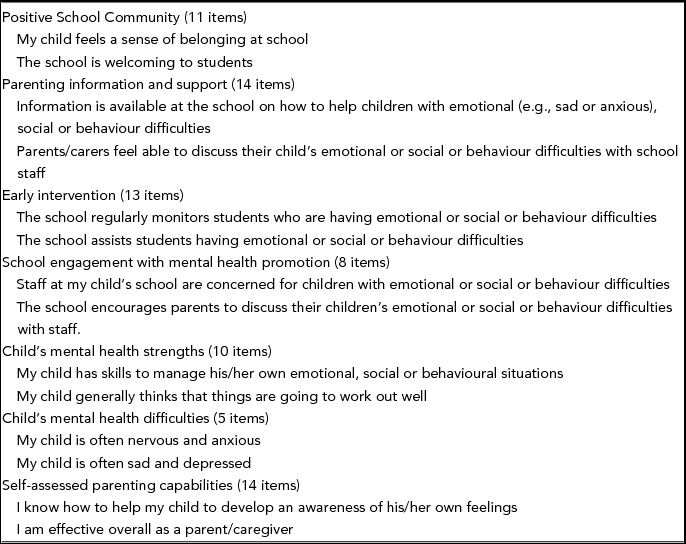
The questionnaire was translated from English into Maltese by a principal translator and then independently verified against the English version by two Maltese/English speaking teachers. Minor changes were made following verification, until all three translators agreed upon the final translation. Table 1 provides examples of questions in each of the conceptualised factors in the questionnaire.
Sample Questionnaire Items

Results
Of the 360 questionnaires delivered to parents, 287 were returned (145 from parents of primary school students; 142 from parents of secondary school students), giving a response rate of 80%. There were 136 female and 151 male respondents.
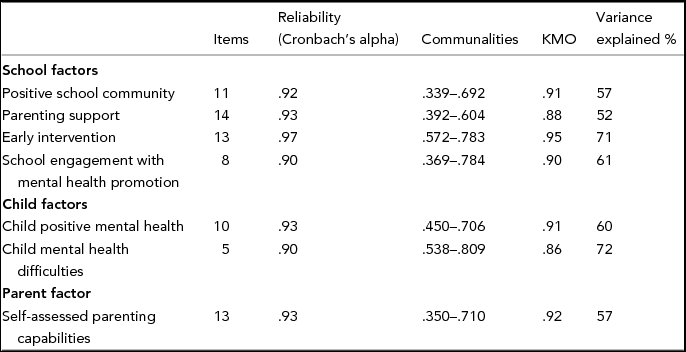
Principal components analysis and reliability analysis routines were run on the thematic groups of questionnaire items, with the results confirming the original conceptual design of the seven factors. From Table 2 it can be seen that scale reliabilities were high, communalities were within acceptable ranges, and KMOs were also high. The proportions of variance explained within each factor ranged from 52% for Parenting Support, to 72% for Child Mental Health Difficulties.
Diagnostic Statistics From the Principal Components Analysis
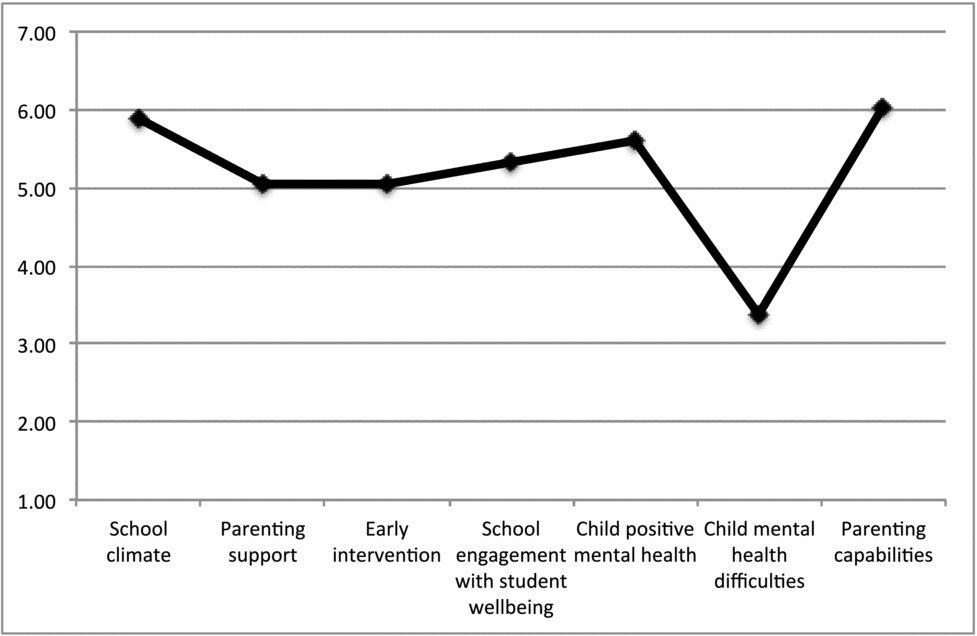
Figure 1 displays parents’ responses (raw means) on each of the seven factors listed in Table 1. Parents’ responses to the School factors ranged from 5.04 for Early Intervention to 5.89 for Positive School Community. Parents’ self-assessed Parenting Capabilities achieved a high average score of 6.01. Parents’ average rating for their child's Positive Mental Health was 5.6, and for Mental Health Difficulties was 3.38.
Overall mean scores of seven factors rated by all parents.
Notwithstanding the relatively positive picture painted by the mean scores shown in Figure 1, such averaging of data may mask important variations. Therefore, the next step in the analysis was to identify subgroups within the 287 parent respondents. It was predicted that a productive avenue of enquiry would be to consider parents’ perceptions of their own parenting capabilities in relation to their evaluations of their child's school's initiatives, as reflected in Research Question 2.
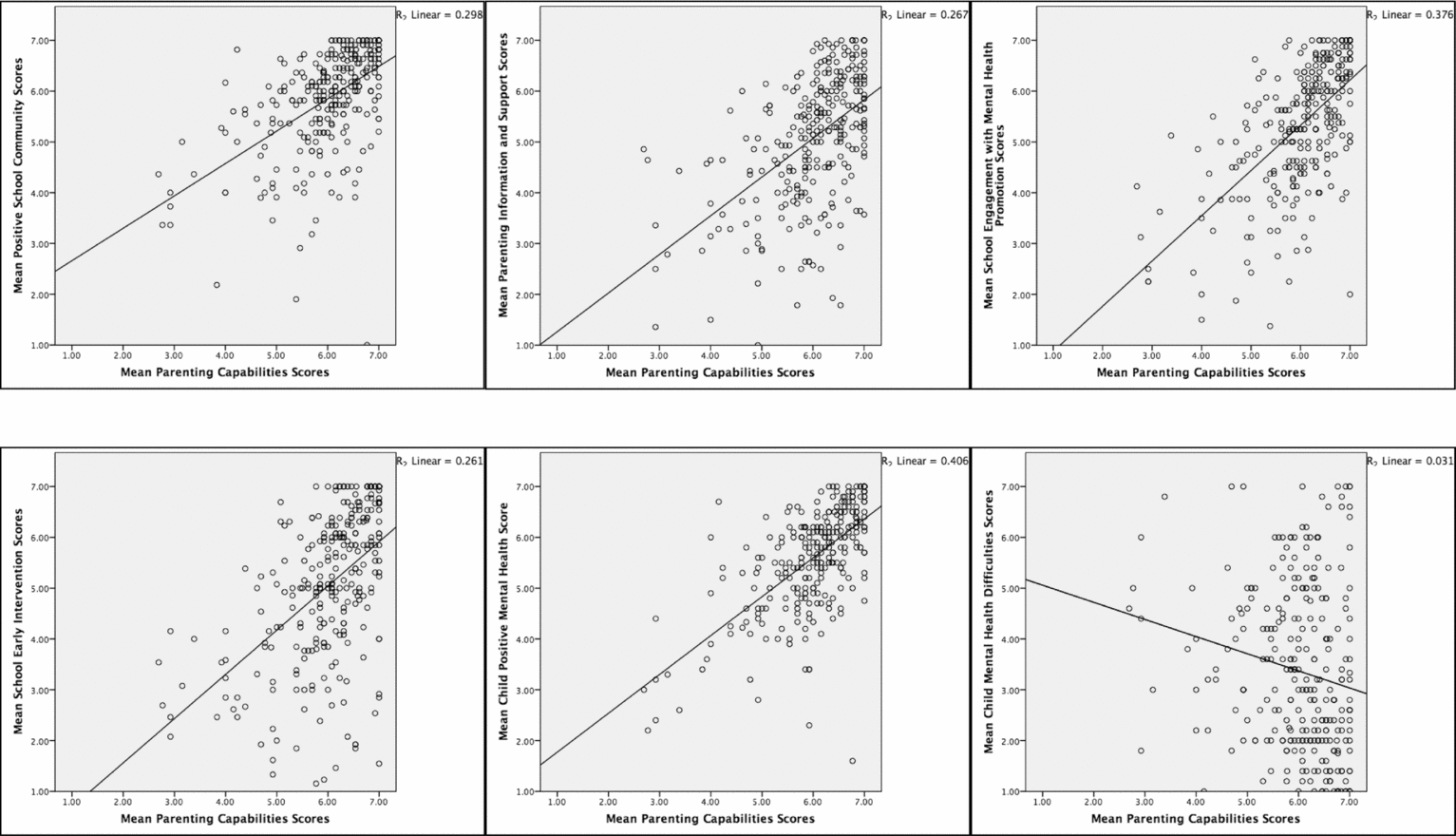
The more finely nuanced subgroup analysis began by preparing visual displays of the raw data in order to gain a general picture of how the parents’ responses were distributed. Figure 2 shows scatterplots of the mean scores for parents’ perceptions of the four School factors on the Y-axes, in conjunction with parents’ assessment of their Parenting Capabilities on the X-axes. The lines on each scatterplot indicate linear relationships between each pair of factors. From Figure 2 it can be seen that correlations between Self-Assessed Parenting Capabilities and the four school factors are relatively high, ranging from .511 for Early Intervention to .613 for School Engagement. From these scatter plots, it appeared that parents’ perceptions of schools’ mental health promotion initiatives did show a relationship to their perceptions of their own parenting capabilities. In addition, Figure 2 shows scatterplots of mean scores for Self-Assessed Parenting Capabilities with Child Mental Health Strengths (r = .637) and Child Mental Health Difficulties (r = -.176). From these latter two scatter plots it appeared that parents’ perceptions of their child's mental health were also related to parents’ perceptions of their own parenting capabilities.
Scatter plots of mean scores of Self-Rated Parenting Capabilities and six variables.
Following the inspection of the scatterplots, the next step in the analysis was to classify parents’ responses according to their self-assessed parenting capabilities. There was a small amount of missing data which was replaced using Expectation Maximisation in SPSS.Footnote 3 Data on all variables were skewed, and were transformed using Log10. Six of the seven scaled variables achieved a skew value of less than 2.58 (at which p is <.01). The variable Mental Health Difficulties was still slightly skewed following Log10 transformation, with a value of -2.74. However, this skewed distribution of mental health difficulties in a school-based, non-clinical population is expected, and the transformed data were considered suitable for further analysis, being still below a cut-off point of 3.29 (at which p is <.001).
The parents’ scores were classified into three groups (33.33% each) labelled low, medium and high Parenting Capabilities, with 93, 102 and 92 respondents respectively.Footnote 4, Footnote 5 The Pearson correlations between all dependent variables were inspected and found to range from 0.51 to 0.78, with most correlations in the 0.5 to 0.6 range. Accordingly, a MANCOVA was conducted to test the hypothesis that there would be one or more mean differences between parents’ perceptions of their parenting capabilities and their perceptions of their child's school's mental health promotion initiatives.Footnote 6 The MANCOVA included:
• Self-Assessed Parenting Capabilities (low, medium, high) as the predictor variable;
• two covariates, namely Child Positive Mental Health and Child Mental Health Difficulties; and
• four School factors as outcome variables, namely Positive School Community, Parenting Information and Support, Early Intervention, and School Engagement with Mental Health Promotion.
The results from the MANCOVA showed that the covariate Child Positive Mental Health was significantly related to the outcome variable, Pillais’ Trace = .172 F(4, 279) = 14.452, p < .001, with a multivariate effect size of .172 (17.2%). The covariate Child Mental Health Difficulties was significantly related to the outcome variable, Pillais’ Trace = .046 F(4, 279) = 3.351 p < .05, but with a relatively small multivariate effect size of .046 (4.6%). After controlling for the effects of the two covariates, a statistically significant effect was obtained, Pillais’ Trace = .204, F(8, 560) = 7.946, p < .001. The multivariate effect size was estimated at .102, which implies that 10.2% of the variance in the canonically derived outcome variate was accounted for by parents’ ratings of their Parenting Capabilities.
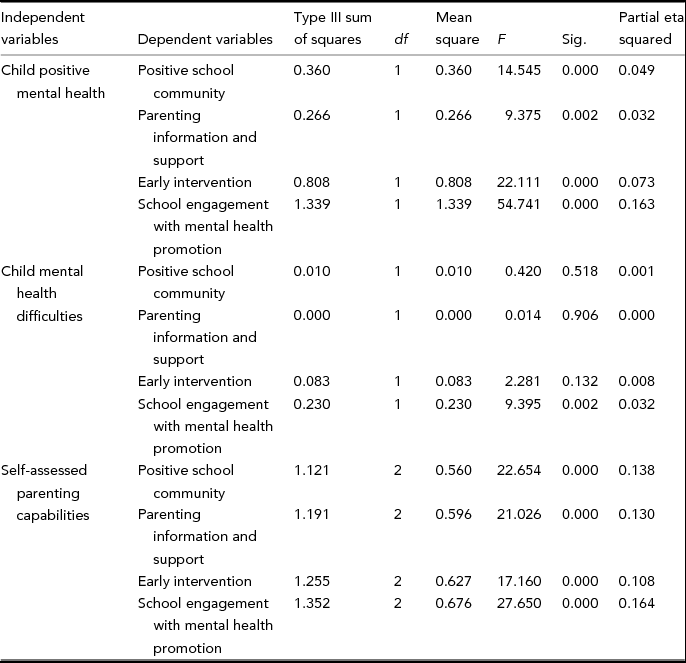
Next, a series of one-way ANOVAs on each of the four School factors were conducted as follow-up tests to the MANCOVA.Footnote 7 As can be seen in Table 3, the ANOVAs for Child Positive Mental Health were all statistically significant, with effect sizes (partial η2) ranging from a low of .032 (Parenting Information and Support) to a high of .163 (School Engagement). The ANOVA for Child Mental Health Difficulties was only significant for School Engagement, with a relatively small effect size (partial η2) of .032. The ANOVAs for Parenting Capabilities were all statistically significant, with effect sizes (partial η2) ranging from a low of .108 (Early Intervention) to a high of .164 (School Engagement). For an additional perspective, as recommended by Field (Reference Field2006), a Discriminant Function Analysis (DFA) was conducted to investigate how the dependent variables discriminated the three Parenting Capabilities groups. The first discriminant function was statistically significant, Λ = .542, χ2(12, N = 287) = 172.34, p < .001, but the second was not, Λ = .982, χ2(5, N = 287) = 5.125, p = .401. This suggests that the group differences shown by the MANCOVA could be explained in terms of one underlying dimension. A possible interpretation of this underlying dimension is that it represents a positive Parent-Child-School relationship.Footnote 8
One-Way ANOVAs on Each of the Four Dependent Variables
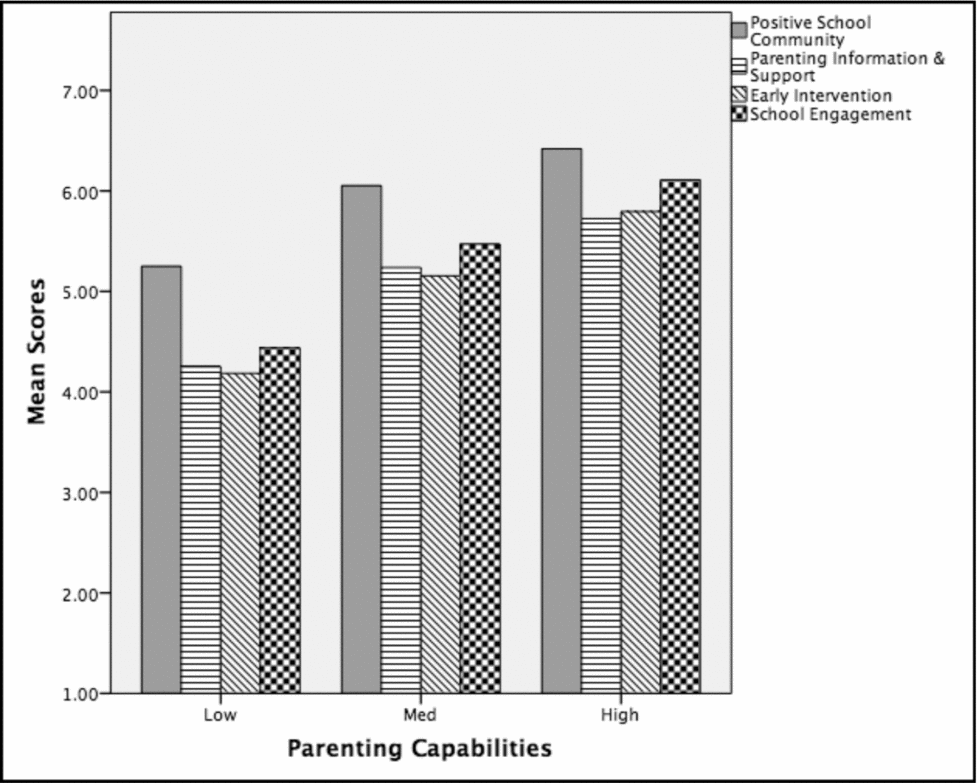
The abovementioned use of Log10 scores for managing the skewed data, although statistically useful, makes the practical interpretation of the results difficult. Therefore, for ease of interpretation, Figure 3 illustrates the mean scores for each School factor according to Parenting Capability group. It can be seen from Figure 3 that parents who rated themselves as low on parenting capabilities rated their schools significantly lower on all four School factors, namely, Positive School Community, Parenting Information and Support, Early Intervention for Students with Mental Health Difficulties, and School Engagement with Mental Health Promotion. This descriptive representation is supported by the more nuanced findings of the MANCOVA, ANOVAs and DFA reported above.
Mean scores of four dependent variables according to self-rated parenting capabilities group.
Limitations
The design of this study is subject to the limitations of self-report bias and blind spots with respect to the parenting component of the questionnaire, as discussed by Muijs (Reference Muijs2006). Future studies could obtain independent assessments of parenting capabilities. The study canvassed parents of students in the 10–15 age group and was located in a specific cultural and geographic setting. Caution should be observed if generalising these findings to other populations and settings. One possibility, raised by a reviewer of this study, is that parents with a generally pessimistic point of view might give relatively low responses to all questionnaire items used in this study. This possibility needs further investigation. A recommended approach is to use the findings from this study as one possible lens for enquiring about phenomena in other settings. This study identified relationships, but did not identify causal directions.
Discussion
The first research question addressed in this article was, ‘What are parents’ perspectives of their child's school's initiatives to promote students’ wellbeing and mental health?’ The findings show that a stratified random sample of 287 Maltese parents with children attending seven schools indicated generally positive perceptions of schools’ mental health promotion activities.
The second research question was, ‘Are parents’ self-assessed levels of parenting capabilities differentially related to their perspectives of their child's school's initiatives to promote students’ mental health?’ Preliminary correlational analyses showed that as parents’ perceptions of their parenting capabilities increased, their rating of their child's positive mental health increased, while their rating of their child's mental health difficulties decreased. The causal direction of these relationships is not determined in this study. That is, whether children with less strong mental health led parents to feel that they are less capable at parenting, whether less capable parents provide environmental triggers for children's mental health difficulties, or whether both directions of influence are at play, is not identified by these data. These interactions between parenting capabilities and children's mental health are documented in the literature (e.g., Scott, Reference Scott2012). The present study provides an additional source of evidence about the existence of a subgroup of parents who may particularly benefit from nuanced mental health promotion initiatives that include parenting information and support.
A MANCOVA of data grouped into three categories of self-rated Parenting Capabilities (low, medium, high) showed that parents’ perceptions of schools’ initiatives were significantly influenced by their perceptions of their own parenting capabilities (controlling for the effect of parents’ ratings of their children's mental health). This main finding from this study is concerning with respect to the potential implications for parents who rate themselves, and their schools, at relatively low levels. Such parents may be less likely to value school initiatives, and therefore less likely to avail themselves of parenting support and child mental health promotion. Arguably, based upon the relationships between self-assessed parenting capabilities and child mental health described above, such parents might be most in need of such initiatives.
An even more complicated scenario was described by Tammariello et al. (Reference Tammariello, Gallahue, Ellard, Woldesemait and Jacobsen2012), who demonstrated a three-way relationship between parents’ involvement with their children, school truancy, and children's overall poor mental health. It is possible that low-efficacious parents who perceive schools’ work unfavourably may be less involved, or unproductively involved, with the school-child interface. This in turn could lead to parents being less involved with their children, thus leading to the three-way interaction that Tammariello et al. observed.
An alternative perspective is that parents’ perceptions of school initiatives may be informed by their prior experiences with the school, or ill informed due to prior lack of engagement. However, for the subgroup of parents holding relatively poor perceptions of their school's initiatives, those perceptions, however formed, may lead to future poor engagement. Additional research is needed to more fully investigate such potential causal pathways.
The World Health Organization (Baltag & Levi, Reference Baltag and Levi2010) called for more active involvement of families and teachers in school-based health promotion programs. However, as Clelland et al. (Reference Clelland, Cushman and Hawkins2013) noted, school-family partnerships are influenced by the way that schools promote such partnerships, which, the authors argued, often follows a similar pattern for all parents — irrespective of parental needs. For example, typical parent communications include newsletters, take-home materials, and parent meetings (Lendrum & Humphrey, Reference Lendrum, Humphrey and Askell-Williams2015). Clelland et al. argued that schools need to be empathetic to the diverse needs and world views of parents. The implications of the present study are that schools may need to interact with different parents in different ways. Parents who are struggling with parenting might require different approaches and types of support to encourage their initial engagement with schools’ endeavours to promote their children's mental health. Cautious and sensitive preliminary enquiries about students’ mental health and parents’ perceptions of their parenting capabilities might alert schools to needs for differentiated approaches to children, as well as to their parents, when engaged in whole school mental health promotion.
The findings of this study also have implications for preservice and in-service teacher education. Concerns about teacher-parent engagement have recently been raised following a survey of newly graduated teachers by the Australian Institute of Teaching and School Leadership (AITSL, 2014). Analysis of survey responses found that graduates of secondary programs found their preservice education was least helpful in the area of involving parents in the educative processes, thus indicating that recent graduates felt generally unprepared for this aspect of their work. Furthermore, as mental health promotion is a relatively new area of responsibility in schools, in-service teachers are unlikely to have received professional education in this area. For example, Askell-Williams and Cefai (Reference Askell-Williams and Cefai2014) reported that in-service Maltese teachers self-reported relatively low capabilities for providing support to parents for promoting children's mental health. The additional complexities of working with parents who express low efficacy for parenting, and who may hold unfavourable attitudes towards the work of schools, needs particular attention in both preservice and in-service teacher education programs.
Conclusion
Working productively with parents is a key component of whole school mental health promotion initiatives. This study has addressed parents’ perceptions of school initiatives and has described concerning relationships between low levels of parenting efficacy and parents’ evaluations of schools’ work. This suggests that parents and their families who might be most in need of engagement, information and support might be least disposed to avail themselves of such supports. Traditional parent engagement strategies such as newsletters and parent-teacher evenings may not be sufficient to engage such parents. This study suggests that, for whole school mental health promotion initiatives to engage with the diverse parent community, approaching parents with low-parenting efficacy needs creative re-attention.
Acknowledgments
The author sincerely thanks Professor Carmel Cefai of the University of Malta and Dr Frank Fabri of the Directorate of Education, Malta, for their invaluable assistance with access to schools and enabling data collection.
Financial Support
This study was supported by an Australian Academy of Science Researcher Mobility Grant (2011) and a European Commission FP7 Marie Curie Researcher Mobility Grant (2011-2013).
Conflicts of Interest
None.