I. INTRODUCTION
Due to attractive characteristics such as low density and excellent mechanical properties, aluminum alloys have been increasingly used in various industrial applications for light weighting in recent years,Reference Schoenitz and Dreizin1–Reference Živković and Anzulović4 especially in the automotive and transportation sectors.Reference Miller, Zhuang, Bottema, Wittebrood, De Smet, Haszler and Vieregge5–Reference Sakayama, Naito, Miyazakki, Nose, Murayma, Saita and Oikawa7 Traditionally, arc welding or resistance welding techniques are used in joining Al alloys,Reference Kumar and Sundarrajan8–Reference Zhang, Pan and Male11 some new welding methods such as friction stir welding and laser welding are gradually used in recent decades.Reference Thomas and Nicholas12–Reference Sánchez-Amaya, Delgado, González-Rovira and Botana15 Nowadays, laser welding is becoming more and more popular owing to its advantages such as high power density, large weld depth-to-width ratio, narrow heat affect zone, high welding speed, and high production rate.Reference Okon, Dearden, Watkins, Sharp and French16–Reference Jia, Yang, Ni and Bai18 Nevertheless, some problems may occur during the laser welding process, such as hot cracking, cavities, and porosity.Reference Haboudou, Peyre, Vannes and Peix19–Reference Behler, Berkmanns, Ehrhardt and Frohn21 Among them, hot cracking is one of the crucial defects that easily occurred.Reference El-Batahgy and Kutsuna22 This is especially true for Al–Mg–Si alloys, in which the amount of Si or Mg content drives the alloys vulnerable to hot cracking during fusion welding processes. Many researchers have focused on different aspects on laser welding of Al alloys, such as mechanical properties, microstructure, and formability.Reference Akhter, Ivanchev and Burger23–Reference Nagelberg25 Some research work was carried out on the hot cracking in laser welding of Al alloys. LuijendijkReference Luijendijk26 investigated gas tungsten arc welding (GTAW) of dissimilar Al alloys of the series 5000 and 6000 plates in butt joint, where filler materials had to be used to avoid hot cracking. The chemical composition of weld joint played an important role in reducing the hot cracking sensitivity. Katayama et al.Reference Katayama, Kawahito and Mizutani27 found that cracking was easily formed at higher welding speeds in thicker plates of Al alloys. Sánchez-Amaya et al.Reference Sánchez-Amaya, Delgado, González-Rovira and Botana15 researched the influence of experimental variables on the sizes and properties of the butt weld beads of Al alloys, which showed that the welding speed played a more important role in the size of the weld bead. The increase of laser power and decrease of welding speed could avoid the cracking. Cicala et al.Reference Cicală, Duffet, Andrzejewski, Grevey and Ignat28 discovered that the welding speed and composition of filler wire were the two most influential factors on cracking in laser welding of Al–Mg–Si alloys. The presence of filler wire and proper wire feed rate could sufficiently modify the chemical composition of the molten pool so that hot cracking can be reduced and low welding speed was preferred to prevent hot cracking. Although there are many hot cracking researches regarding laser welding of Al alloys, most of them are based on butt joint or welding of two same material sheets. Unfortunately, little information on hot cracking behavior in dissimilar alloy welding is available, especially in joints of dissimilar Al alloys. On the other hand, welding of dissimilar Al alloys becomes more and more popular in automotive manufacture, where hot cracking is potentially a big issue.
This study focuses on the hot cracking behavior in laser welding of dissimilar Al alloy overlap joints with no filler wire. Joints of AA5754 and AA6013 in different orders of stacking were welded. The effects of process parameters on hot cracking behavior were investigated. The chemical composition, microstructure, fusion ratio, and fracture morphology of the weld joint were further examined to understand cracking mechanism and provide guidance for hot cracking prevention.
II. EXPERIMENTAL PROCEDURE
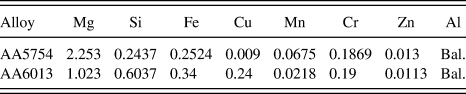
The base materials being welded were 2 mm thick AA5754 and 2 mm thick AA6013 with dimensions being 150 mm in length and 100 mm in width, which were covered with plastic film to prevent contamination. The plastic film was removed and the sheets were cleaned with acetone before welding to eliminate any complications due to surface contamination. The chemical compositions of two Al alloys are given in Table I.
Chemical composition of Al alloys used in the present study (wt%).
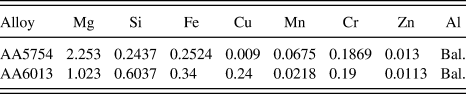
Actually, Al alloys vary a lot in sensitivity to hot cracking due to the different chemical compositions,Reference Kou29 former researches show that Mg and Si play an important role, Al alloys have the highest hot cracking susceptibility when chemical compositions of Mg and Si are around 0.86 and 0.62 wt%, respectively.Reference Cicală, Duffet, Andrzejewski, Grevey and Ignat28,Reference Cao and Kou30 Based on the chemical compositions shown in Table I, AA6013 is highly susceptible to hot cracking, AA5754, on the other hand, is relatively less susceptible to hot cracking.
The laser system used in the test was a 10 kW fiber laser (Ytterbium laser system-10000) with an emission wave length of 1070 nm, focused beam with a diameter of 0.6 mm and focal length of 300 mm. Its shorter wave length promoted the absorption by Al alloys.Reference Quintino, Costa, Miranda, Yapp, Kumar and Kong17 The laser welding head was hold by a robot (KUKA) with the capability of moving in a three-dimensional work space.
Figure 1(a) illustrates the laser welding setup including the work-pieces, laser beam, shielding gas, and welding direction. Argon was chosen as shielding gas with a flow rate of 15 L/min supplied by a nozzle of 8 mm inner diameter. By changing the angle between the shielding gas and the horizontal plane during welding, it was found that better protecting effect can be achieved at an angle of 22°. To prevent the laser light's reflection from the work piece back to the lens, the laser beam deviated from the vertical direction at an angle of 9°. The clamping system is shown in Fig. 1(b), where L, W, and T denote the work-piece length, width, and thickness, respectively. Besides, D S is introduced here as the overlap width and D L is the distance from the weld centerline to free edge. During welding, the laser beam focal position was on the top surface of work piece.
The schematic of welding equipment layout and the clamped system: (a) welding equipment layout and (b) work-piece clamping system.

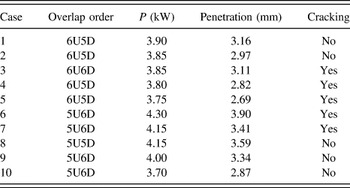
A series of experiments were carried out to investigate the influence of welding process parameters on hot cracking behavior. To examine the effects of stacking order, tests were conducted on both cases: AA6013 on top of AA5754 (6U5D) and AA5754 on top of AA6013 (5U6D). In consideration of obtaining fine weld appearance and good productivity in practical engineering application, the welding speed of 3 m/min was suitable. To discuss the effects of fusion ratio (R) on hot cracking, various laser powers (P) were used. In addition, the distance from the weld centerline to free edge D L was considered, too. A close-to-edge welding could easily lead to hot cracking in Al sheet,Reference Andersson and Karlsson31,Reference Hernandez and North32 here, a D L of 5 mm was tested in our study and the weld was at the middle of the overlap width. The welding parameters taken in the experiment are listed in Table II.
Parameters and cracking determination of the laser welding joints.

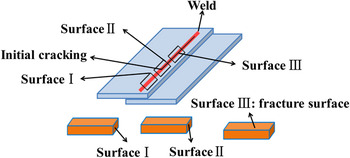
After welding, the welded specimens were cut, mounted, polished, and etched with Keller reagent, consisting of 1% HF, 2.5% HNO3, 6.5% HCl, and 90% H2O, for 20–25 s. Before being examined, the mounted specimens were ultrasonically cleaned for 10 min in an ethanol bath to remove any residual Keller reagent. The weld bead shape including the weld width and depth was measured using stereomicroscopy equipment (Stem 2000), and metallurgical observation was conducted using optical microscopy (OM) equipment (ImageA1m). And, the fracture surface of hot cracking was investigated by a scanning electron microscopy system (SEM-JSM7600F, Japan). Figure 2 shows the specific locations of weld cross-sections with respect to the hot cracking location in surface, where the cross-section ahead of cracking (surface I) and cracking starting point (surface II) was prepared for OM examination and the fracture surface (surface III) was prepared for SEM study.
Location of the specimens for OM and SEM examination.

III. RESULTS AND DISCUSSION
A. Experimental results
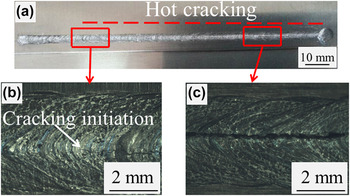
By changing the laser power and stack up order, different experiments were carried out and the results are shown in Table II. An image of top view of a welded specimen is exhibited in Fig. 3(a), where a long cracking occurs along the weld centerline. Figures 3(b) and 3(c) show the magnified images of the hot cracking in the weld top surface. It can be observed that the hot cracking initiates in the weld and propagates along the weld center to the end.
Images of the typical surface of weld with cracking generated at 3.85 kW, 6U6D: (a) whole weld bead, (b) cracking initiation location, and (c) middle section of the hot cracking.

1. The influence of laser power on hot cracking in 6U5D condition
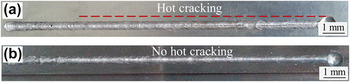
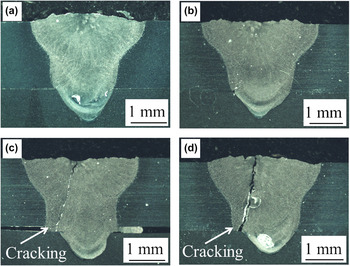
In the premise of fine weld appearance and proper penetration, the laser power was changed gradually, producing the weld free from hot cracking and with cracking. For the overlap joints in the condition of 6U5D, the laser power varies from 3.75 to 3.90 kW. As shown in Table II, at the laser power of 3.90 and 3.85 kW, there is no visible hot cracking in the weld. When the laser power is lower than or equals to 3.80 kW, hot cracking appears, details are shown in Fig. 4.
Typical top view of the specimens, (a) case 4, P = 3.80 kW, 6U5D, a long cracking in surface; (b) case 2, P = 3.85 kW, 6U5D, no cracking visible.

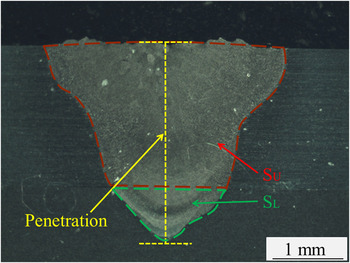
Figure 5 displays the weld cross-section perpendicular to the weld line captured by stereomicroscopy. Weld penetration and fusion ratio are measured on the cross-section, and also the dashed line helps distinguish the weld metal in upper and lower sheets. The fusion ratio is defined as volumetric percentage of melted lower sheet with respect to the whole weld bead, given as,
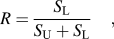 $$R = {{{S_{\rm{L}}}} \over {{S_{\rm{U}}} + {S_{\rm{L}}}}}\quad {\rm{,}}$$
where S U is the fusion area of the upper sheet and S L is the fusion area of the lower sheet. Figure 6 presents the weld cross-section of 6U5D at different parameters, where the penetration and fusion ratio can be measured. Also, the hot cracking can be identified clearly from cross-section. It should be pointed out that the porosities are also the defect existed in the weld illustrated in Fig. 6 which always appears in Al alloys' welding,Reference Haboudou, Peyre, Vannes and Peix19,Reference Ahmed, Wells, Maijer, Howes and van der Winden33 yet it is another point that would be discussed in the future.
Typical cross-section, upper sheet, and lower sheet were welded together, and penetration and fusion ratio were measured through the cross-section.

Cross-section in 6U5D condition: (a) case 1, P = 3.90 kW; (b) case 2, P = 3.85 kW; (c) case 4, P = 3.80 kW; and (d) case 5, P = 3.75 kW.

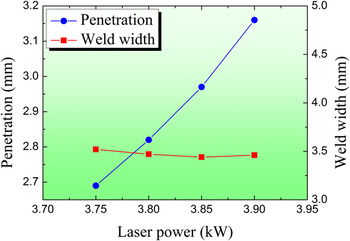
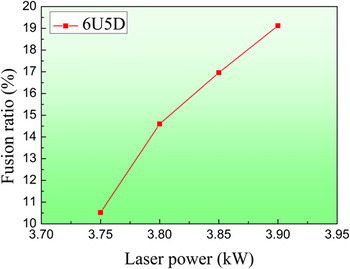
The influence of laser power on penetration and weld width for this stack up is presented in Fig. 7. Increasing the laser power directly results in deeper penetration, but produces little influence on the weld width. The influence of laser power on the fusion ratio is shown in Fig. 8. The fusion ratio increases from 10.52 to 19.12% when the laser power changes from 3.75 to 3.90 kW.
Influence of laser power on the penetration and weld width in 6U5D condition.

Influence of laser power on the fusion ratio in 6U5D condition.

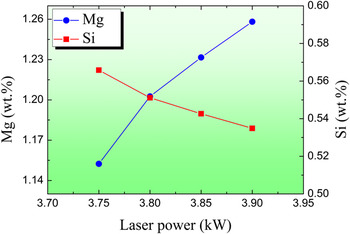
Generally, the thermal tension in the weld increases as the laser power increases and therefore leads to larger deformation which induces hot cracking.Reference Cicală, Duffet, Andrzejewski, Grevey and Ignat28,Reference Cao and Kou34,Reference Huang and Kou35 However, for dissimilar Al alloys, the chemical composition of weld bead varies with the laser power. As the elemental contents of Mg and Si change with the fusion ratio, it directly affects the weld's hot cracking susceptibility.Reference Cicală, Duffet, Andrzejewski, Grevey and Ignat28,Reference Cao and Kou30,Reference Zhang and Wang36 In the joints of 6U5D, although the thermal tension caused by increasing laser power increases, which positively affects the hot cracking occurrence, however, the test results show that hot cracking disappears as the laser power increases. This can be explained by the change in fusion ratio. With the increase in the laser power, the fusion ratio increases, and this causes elemental contents of Mg and Si within the weld metal to vary from cracking sensitive values to nonsensitive ones. Figure 9 exhibits the changing average contents of Mg and Si in the weld when the laser power changes. It is calculated as follows:
 $${C_{\rm{X}}} = R \times {C_{{\rm{XL}}}} + (1 - R) \times {C_{{\rm{XU}}}}\quad {\rm{,}}$$
where C X is the average content of element X, R is the fusion ratio, and C XL and C XU are the content of element X in lower sheet and upper sheet, which are given in Table I, respectively. It clearly shows that with the increase in laser power, the contents of Mg and Si in the weld seam change away from the content with the highest hot cracking susceptibility (Mg: 0.86 wt%, Si: 0.62 wt%). Actually, the distribution of element content fluctuates within different areas. In this study, the average content is applied, it can be concluded that when the fusion ratio is more than 17% (laser power is more than 3.85 kW), the hot cracking does not appear although with larger thermal tension. Therefore, hot cracking can be effectively prevented as the fusion ratio is over 17% for welding joints of 6U5D.
Influence of laser power on the average content of Mg and Si calculated using Eq. (2) in weld bead in 6U5D condition.

2. The influence of laser power on hot cracking in 5U6D condition
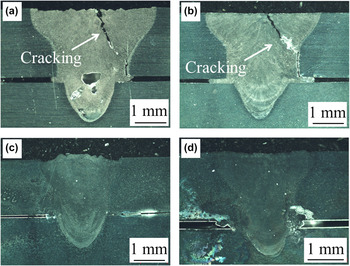
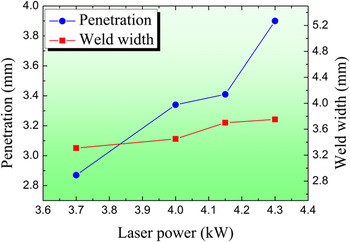
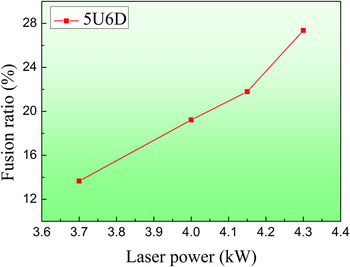
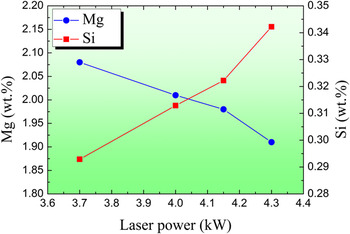
Another set of welding experiments were conducted in 5U6D condition. All the welding parameters were kept the same except the laser power. When the laser power varied from 3.70 to 4.30 kW, the weld without hot cracking and that with cracking were acquired. Figure 10 presents the cross-sections after welding. At the laser power of 3.70 and 4.00 kW, there is no visible hot cracking after welding. However, when the laser power is over 4.15 kW, hot cracking occurs. The change of weld penetration and width with the increase in laser power is exhibited in Fig. 11, where penetration increases from 2.87 to 3.90 mm as the laser power increases, while the weld width varies a little. The fusion ratio increases from 13.66 to 27.36% as the laser power increases, as shown in Fig. 12. And the average contents of Mg and Si in the welds are calculated using Eq. (2) and presented in Fig. 13. For the stack up of 5U6D, as the laser power increases, more thermal tension is resulted, and the contents of Mg and Si also change from less cracking sensitive values to more cracking sensitive values. The occurrence of hot cracking is the result of these changes. Therefore, decreasing laser power is an effective way to prevent hot cracking for the 5U6D stack up, here, the laser power of 4.00 kW is found to be safe value.
Cross-section in 5U6D condition: (a) case 6, P = 4.30 kW; (b) case 7, P = 4.15 kW; (c) case 9, P = 4.00 kW; and (d) case 10, P = 3.70 kW.

Influence of laser power on the penetration and weld width in 5U6D condition.

Influence of laser power on the fusion ratio in 5U6D condition.

Influence of laser power on the average content of Mg and Si calculated using Eq. (2) in weld bead in 5U6D condition.

3. The influence of different Al alloys overlap order on hot cracking
To investigate the effect of fusion ratio caused by dissimilar Al alloys on hot cracking, several kinds of experimental tests were carried out. As shown in Table II, comparison of 6U5D and 6U6D, 5U6D and 5U5D was taken to discuss the results of 5000 fusing into 6000 and the 6000 fusing into 5000 keeping the same welding parameters, respectively. For cases 2 and 3, welded at a laser power of 3.85 kW, both of them have similar penetration and fusion ratio, and the average contents of Mg and Si in the weld bead are calculated as 1.23 and 0.54%, respectively, for case 2, and 1.02 and 0.60%, respectively, for case 3. Therefore, the chemical composition in the weld of case 3 is more sensitive to hot cracking. This explains why cracking occurs in case 3, yet not in case 2. In addition, for cases 7 and 8, the average contents of Mg and Si in the weld bead are calculated as 1.99 and 0.32%, respectively, for case 7, and 2.25 and 0.24%, respectively, for case 8. The chemical composition in case 8 indicates less hot cracking sensitivity compared to case 7. In the test, case 8 shows no visible cracking while hot cracking is observed in case 7 at the same laser power. This contrastive experiment proves clearly that the chemical composition of AA6013 is more sensitive to hot cracking than that of AA5754. The participation of AA5057 will reduce hot cracking susceptibility, on the contrary, AA6013 will increase the hot cracking susceptibility.
B. Microstructural analysis
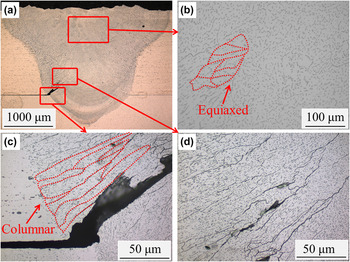
Figure 14 shows a typical micrograph of laser-welded overlap joint of dissimilar Al alloys. As illustrated in Fig. 14(a), the overlap joint consists of equiaxed and columnar grains, this structure of laser welds is often observed in Al alloys mainly because of the high-speed welding process in which heat is transferred rapidly to base metal.Reference Shi, Zhong, Li, Gong and Chen37 It could be observed that cracking initiation occurs at the fusion line between the upper and lower sheets, and cracking propagates toward the center of weld top surface. Figures 14(c) and 14(d) confirm that the cracking begins from the fusion line and then propagates along columnar grains toward the weld centerline. In this case, the deformation of free edge due to thermal shrinkage leads to the cracking initiation, and the cracking stops propagation due to the chemical composition of the weld not sensitive to hot cracking.
The typical microstructure of laser-welded overlap joint of aluminum alloys without cracking in the surface. Case 1: laser power of 3.90 kW. (a) Overall view of weld cross-section; (b) equiaxed grains in the weld; and (c–d) enlarged views of the weld cross-section with cracking.

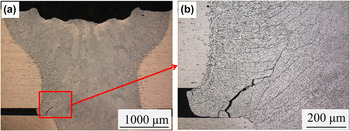
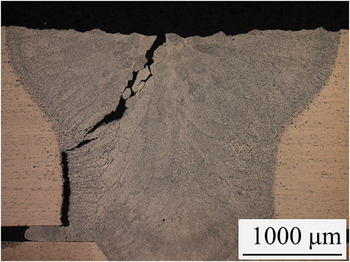
Figures 15 and 16 display the cross-section of specimen in case 3, hot cracking is visible in the weld. For the specimen with hot cracking, two cross-sections, surfaces I and II, have been prepared. Figure 15 reveals the microstructure of surface I, cracking initiation led by the deformation of free edge due to thermal shrinkage could be observed at the weld interface. Figure 16 shows the microstructure of surface II, where the cracking begins from the weld interface, and propagates along the fusion line first, then into the weld and toward the weld centerline on the top surface. In this case, the chemical composition in the weld is sensitive to cracking, hence the cracking does not stop half way.
The typical microstructure of laser-welded overlap joint in surface I of specimen with cracking: (a) overall view of weld cross-section; (b) cracking between upper sheet and lower sheet.

The typical microstructure of laser-welded overlap joint in surface II of specimen with cracking.

C. SEM observation
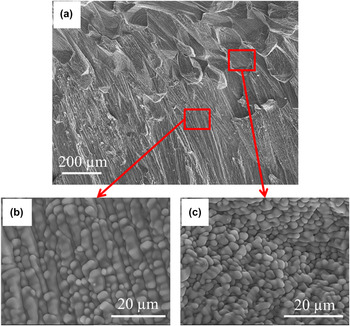
The fracture surfaces of hot cracking are observed by the SEM system, shown in Fig. 17. Because of the various cooling rates during the weld solidification process, different grain structures and sizes occur in the weld. In the upper region of Fig. 17(a), the grain morphology is small and has a large angle from vertical direction. In the lower region of the weld, the grain morphology is long and has a small angle from vertical direction. This is mainly because the cooling rate is larger in the lower weld region than that in the upper weld region. Columnar grains are formed in the lower part due to the high cooling rate, and equiaxed grains appear in the upper part. Figures 17(b) and 17(c) show magnified views of regions marked in Fig. 17(a), typical solidification cracking is exhibited here. The smooth surface of grains indicates that the hot cracking occurs at high temperature.
SEM micrograph of fracture surface: (a) overall view of fracture surface; (b–c) micrograph of enlarged location.

IV. CONCLUSIONS
This study examines the effects of stacking order and laser power on the hot cracking sensitivity of laser welded dissimilar Al alloy joints. The hot cracking susceptibility can be reduced by changing the chemical composition of weld joint, the fusion ratio is used to explain the cracking behavior. The following conclusions can be obtained:
(1) For the stack up of AA6013 up and AA5754 down, as the laser power increases, the hot cracking sensitivity reduces. On the contrary, the hot cracking occurs with increasing laser power for the stack up of AA5754 up and AA6013 down.
(2) For the stack up of AA6013 up and AA5754 down, the fusion ratio of AA5754 determines the hot cracking sensitivity. Fusion ratio over 17% prevents hot cracking. For the stack up of AA5754 up and AA6013 down, decreasing laser power could reduce the fusion ratio of AA6013 and hence prevent hot cracking.
(3) In the overlap welding, the cracking initiation begins adjacent to the fusion line between the upper and lower sheets due to deformation of free edge and propagates to the weld centerline at the top surface.
ACKNOWLEDGMENTS
The authors gratefully acknowledge the financial support by the National Natural Science Foundation of China (Grant No. 51204109) and the Open Project of Shanghai Key Laboratory of Modern Metallurgy and Materials Processing (SELF-2011-01).