Antibiotic formulary restriction with preauthorization is guideline-recommended practice for antibiotic stewardship programs (ASPs) proven to moderate antimicrobial use (AU), reduce cost, and improve clinical outcomes. Reference Barlam, Cosgrove and Abbo1 “Strict” preauthorization is labor intensive, requiring real-time, 24-hour staffing. Some institutions allow the administration of restricted antibiotics overnight until evaluation the following day (ie, overnight dose free). 2,Reference Anderson, Watson and Moehring3 Overnight dose free policies may result in negative behavioral adaptations, such as “stealth dosing,” in which new orders occur shortly after the time when relaxed restriction begins. Reference LaRosa, Fishman, Lautenbach, Koppel, Morales and Linkin4
Recurring pages and overnight awakenings negatively impact quality of life for infectious diseases (ID) physicians responsible for restriction approvals, at a time when physician well-being is a high priority for healthcare systems. Reference Thomas, Ripp and West5,Reference Melia, Paez and Reid6 ASPs must advocate for policies that enhance clinician well-being while maintaining optimized antibiotic use. We assessed whether relaxing an overnight restriction policy resulted in a higher number of overnight antimicrobial orders compared to strict preauthorization.
Methods
Our longstanding ASP has utilized a combination of “strict” overnight preauthorization staffed by infectious disease (ID) fellows and postprescription review by ID pharmacists and physicians. In October 2019, Duke University Hospital (DUH) implemented a process change from strict preauthorization to allow initiation of 2 restricted agents between 11 p.m. and 7 a.m. without telephone approval. Fellows reviewed orders the following morning to approve ongoing use. Other agents remained under strict preauthorization restriction. Meropenem and micafungin were chosen for 2 reasons: (1) These were the most commonly requested agents resulting in sleep-disruption based on fellow feedback and paging logs, and (2) requests were infrequently refused because clinical scenarios involved empiric treatment of critical illness in high-risk populations. Paging logs indicated that meropenem and micafungin approvals resulted in 4–5 overnight pages per week. We performed an interrupted time series (ITS) linear regression analysis to evaluate the phase shift and change in trend in the number of new starts per week before (January 1, 2019 through October 2019) and after the change (October 2019 through March 1, 2021). We defined a “start” as the first antimicrobial order for meropenem or micafungin associated with a unique patient encounter. We fit a Gaussian distribution function to the number of starts per hour of day to estimate the percentage of starts initiated overnight (11 p.m. to 7 a.m.) and during day and evening hours (7 a.m. to 11 p.m.) before and after the process change. Length of therapy (LOT) distributions were compared using the Mann-Whitney U test.
Results
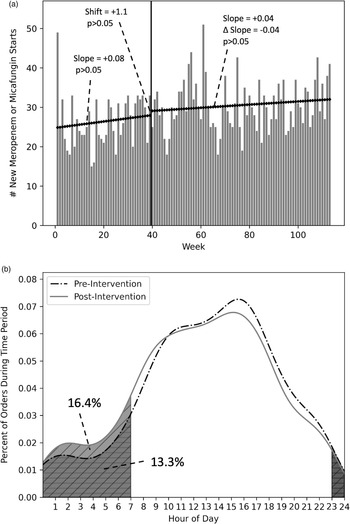
Our analysis included 1,617 meropenem and 1,674 micafungin starts over a 113-week period, with an average of 29 new starts per week. The number of starts was constant between January 2019 and October 2019 (+0.08 starts per week; 95% confidence interval [CI], −0.11 to 0.27) (Fig. 1A). The phase shift during the first week of the policy change was not significant (+1.1 starts per week; 95% CI, −4.07 to 6.29). The trend in the number of starts per week did not change after October 2019 (change in trend: −0.04 starts per week; 95% CI −0.24 to 0.16).
Overnight meropenem and micafungin approvals as (A) cumulative starts by week and (B) percentage of starts by hour of day.

The percentage of total meropenem and micafungin starts that occurred between the hours of 11 p.m. to 7 a.m. increased from 13.3% to 16.4% after the policy change (Fig. 1B). There was no increase in “stealth dosing” starts identified immediately after 11 p.m.
The distribution of length of therapy per targeted antimicrobial admission did not change for meropenem (P = .51) or micafungin (P = .88). The proportion of short course durations (length of therapy ≤ 3 days) was similar (35.1% vs 35.6% for meropenem and 38.0% vs 37.1% for micafungin).
The change received positive feedback from ID fellows.
Discussion
We observed no significant immediate change or change in trend in total prescribing of meropenem or micafungin after a policy change to relax antimicrobial restriction overnight. Instead of “stealth dosing,” in which providers waited to enter restricted antibiotic starts until evening hours, we observed a small increase in antimicrobial starts in early morning hours when our team would have been awakened from sleep to answer approval calls. Facility-level rates of antibiotic use for meropenem and micafungin in days of therapy per 1,000 patient days were stable (data not shown).
Prior literature suggests that clinical decision support systems that require reasoning for a clinical decision (ie, discussion with an infectious disease expert) are more successful than those without this requirement. Reference Roshanov, Fernandes and Wilczynski7 Clinicians may also be more inclined to order restricted antimicrobials without the social stigma of waking somebody up. Thus, we hypothesized that the policy would be associated with increases in use of the restricted agents; however, this trend was not observed. We detected no significant change in distribution of length of therapy for either agent after the policy change and no increases in overall use. An increase in short course administrations would be expected if clinicians were ordering antimicrobials inappropriately and then were cancelled following the postprescription review. The lack of difference implies that additional antimicrobial starts initiated in the early morning hours were continued following postprescription review and may represent antimicrobial starts that would have otherwise occurred later in the day.
Although we detected no overall change in new starts for meropenem and micafungin in the transition from a strict preauthorization to an overnight dose free model, timing of order entry may have shifted slightly to earlier morning hours. The early COVID-19 pandemic period (March–April 2020) limited our analysis due to decreased hospital admissions (ie, low-risk elective surgeries) but did not seem to alter patterns in total antibiotic use for these 2 agents (data not shown). This study has demonstrated a quality-of-life process change that resulted in no significant impact on antimicrobial use. Further studies should focus on the long-term effect on total days of therapy for hybrid restriction policies. Meanwhile, antimicrobial restriction approaches must adapt to personnel resources and well-being for antimicrobial stewards.
Acknowledgments
Financial support
No financial support was provided relevant to this article.
Conflicts of interest
All authors report no conflicts of interest relevant to this article.