Introduction
There is a rich literature on the role of informal relations in the development of traditional economies. Kin-based ties and ethnic identity have been shown to serve as functional substitutes for enforceable contract law (Carr and Landa Reference Carr and Landa1983; Landa Reference Landa1981); clientelism and patronage are used to manage market uncertainty and resolve principal-agent problems (Adams Reference Adams2005; Cohen Reference Cohen1969; Geertz Reference Geertz1978; Greif Reference Greif2006); and interlocking constellations of distinct relational patterns have been shown to provide the basis for the development of institutional forms central to sustained economic development (Padgett and McLean Reference Padgett and McLean2006; Van Doosselaere Reference Van Doosselaere2009; White Reference White1981, Reference White2008).
In addition to affecting the rate of economic development, informal relational-based practices can impact rates of inequality. For example, Avner Greif shows investment or divestment in information networks between overseas traders can lead to different distributions of wealth across populations (Greif Reference Greif2006: 269–304). Thus patterns of informal economic relations can affect the trajectory and shape that development takes, as well as speed up or hinder the process of economic growth.
In this manuscript, we are interested in how informal social practices in early modern trade, specifically the transfer of information between peers, in this case between ships docked at a common harbor, impacted the pattern of overseas trade by channeling ships to more or less heavily trafficked ports. Thus the inequality we are interested in is differences in trade volume between ports, rather than individuals. Trends in the development of overseas trade in this period are of particular interest because of the impact of foreign trade on short- and long-term commercial development, European colonial presence, and institutional development (Acemoglu and Robinson Reference Acemoglu and Robinson2001; Magee and Thompson Reference Magee and Thompson2010; Mahoney Reference Mahoney2009).
We are interested in how the informal transfer of information across ships influenced rates of English trade at eastern ports. In order to model this, we consider the impact of the informal exchange of information between ships on the rate of traffic at destination ports—that is, did exposure to information about ports through social ties lead to travel to ports with higher or lower average rates of traffic? This strategy allows us to evaluate whether peer-to-peer interactions facilitated travel to less frequently or more frequently traveled ports.
It is an event-based approach to information diffusion, similar in concept to works that consider the effects of interactions in specific settings for the creation of ties (e.g., Kossinets and Watts Reference Kossinets and Watts2006; Sorenson and Stuart Reference Sorenson and Stuart2008) and the exchange of strategic information during event coparticipation (e.g., Wang and Soule Reference Wang and Soule2012). Our data covers the early modern trade in Asia during the period leading up to and encompassing the beginning of European imperialism, from 1600 to 1833.
Context
The data we use are drawn from the voyages of the English East India Company, an early modern overseas trade organization, which existed as a government-sanctioned monopoly from 1601 to 1833. The English Company mainly exported silver bullion in exchange for a number of goods, which included both exotic luxuries, such as diamonds, rose attar, and elephant tusks, as well as bulk goods, such as pepper, coffee, cotton, chinaware, and tea. The captains, officers, and crew often traded spirits, guns, and mechanical trinkets in exchange for a variety of regional goods. Company ships docked at more than 270 ports, spanning from the Cape of Good Hope to Nagasaki and ranging in political and social organization from centralized bureaucratic states to kin-based villages.
Early modern East Indies ports had varying amounts of traffic, but did not operate at harbor capacity, as is sometimes the case in contemporary circumstances; thus, high traffic rates did not act as a limit. However, rates of traffic at ports were linked to commercial prospects. Markets were sensitive to demand and a large number of English ships seeking the same good at one port could significantly raise prices (Chaudhuri Reference Chaudhuri1978: 136). Similarly, a large influx of English goods could lower the price of that good (Sutton Reference Sutton1981: 83). Less trafficked ports that still retained sufficient market capacity could provide more lucrative opportunities for trade because of reduced competition.
The English Company had an unusual organizational structure, which combined monopoly and free trade practices as well as elements from joint-stock and regulated company forms, where employees of the Company traded both on behalf of the organization and conducted a private trade of their own. The two forms of trade were intermixed in complex ways. As a result, English Company captains regularly diverted their ships while en route to official destinations in order to pursue private trade opportunities (Adams Reference Adams1996; Anderson, McCormick, and Tollison Reference Anderson, McCormick and Tollison1983; Barlow and Lubbock Reference Barlow and Lubbock1934; Erikson and Bearman Reference Erikson and Bearman2006; Furber and Rocher Reference Furber and Rocher1997; Marshall Reference Marshall1993). Thus the captains were the relevant decision makers as they ultimately decided the course of their ships, fulfilling their duty to the Company but also pursuing additional commercial opportunities.
Social networks were an important, if informal, part of the conduct of trade in the English Company (Erikson Reference Erikson2014; Mentz Reference Mentz2005; Ogborn Reference Ogborn2007; Sutton Reference Sutton2010: 22). The journals and diaries of company servants indicate that commercially valuable information was often transferred between Company employees while at port and that they used that information to direct their travels. For example, Nicholas Buckeridge reported that “A friend of mind tould me that A little after I went last from Mosambiq hee made A voyage for ye late governer Alvora de Sousa into ye Bay of Larenzo Marques in 25½ degrees So. And brought thence: 90 Bahars Ivory, importing by estimacion Starling 8460 - 300, ounces Amber grece—600, lb: 9060 [sic]” (Jenson Reference Jenson1973: 54). Buckeridge then attempted to travel to the Bay of Larenzo Marques, but was prevented from doing so by weather conditions (Jenson Reference Jenson1973: 63). William Larkin, first mate of the Durrington, had a similar experience at dinner with the factors of Anjengo, where he “learned what price he would get in ports up the coast for his fine Bengal silks, what Anjengo pepper and fine cloth and betelnut would fetch at Surat and the rate of exchange of the great variety of coins used in the trade” (Sutton Reference Sutton2010: 59). Existing research, however, has not determined how social networks impacted the distribution of trade across ports, despite the potential importance for understanding the developmental trajectories of ports, and more generally the conduct of early modern overseas trade.
In the period under consideration, the English Company represented the overwhelming majority of English trade to Asia. Exceptions to the rule included short-lived English competitors, such as the Courteen Association, illegal interlopers, legitimate country trade of the English Company employees not undertaken on English Company ships, and a small number of independent English merchants. The English Company competed with several other European national organizations, the largest of which was the Dutch East India Company (Vereenigde Oost-Indische Compagnie). The Dutch and English trade overlapped at some but not the majority of Asian ports. The Dutch Company trade was larger than the English Company trade until the late eighteenth century. Other European organizations operating in the East were significantly smaller and shorter-lived than the Dutch or English companies, with the exception of the Portuguese Estado in the first decades of the seventeenth century. Thus the data we use reveal much about patterns of English trade in Asia, which was also a significant proportion of the total intercontinental trade between Europe and Asia.
In 1757 the English Company took de facto territorial control over Bengal, beginning a gradual transition from commercial power to colonial rule. By the early nineteenth century, the Company was largely under the control of the British government acting as an arm of the British Empire. The relationship was formalized in 1848 after the dissolution of the Company, which had long ceased acting as a commercial body, and the installation of the British Raj. Thus the trading patterns of the English Company had a direct impact on patterns of colonial settlement and rule in Asia.
Social Ties and Novel Information
A number of articles have shown that social networks in the twentieth and twenty-first centuries had a significant impact on international trade flows (Epstein and Gang Reference Epstein, Gang, Foders and Langhammer2006; Feenstra and Hanson Reference Feenstra and Hanson2004; Rauch Reference Rauch2001). This impact derives in large part from the ability of social networks to reduce, overcome, or circumvent the informational barriers present in overseas transactions. In the literature on global entrepreneurship, it has repeatedly been found that social networks, defined as long-term, collaborative relationships, increase a firm's ability to locate and act on international market opportunities (Coviello and Munro Reference Coviello and Munro1997; Egan and Mody Reference Egan and Mody1992; Ellis Reference Ellis2000; Harris and Wheeler Reference Harris and Wheeler2005; Komulainen, Mainela, and Tähtinen Reference Komulainen, Mainela and Tähtinen2006; Sharma and Blomstermo Reference Sharma and Blomstermo2003). In these articles social networks are conceptualized as conduits providing firms with novel information. A related line of research, with closer ties to the discipline of economics, has provided strong evidence that immigrant ties increase bilateral trade flows (Combes, Lafourcade, and Mayer Reference Combes, Lafourcade and Mayer2005; Gould Reference Gould1994; Wagner, Head, and Ries Reference Wagner, Head and Ries2002). Rauch and Trindade (Reference Rauch and Trindade2002) estimated that ethnic Chinese networks increased bilateral trade in differentiated products by as much as 60 percent. These articles conceptualize the central role of networks as relational mechanisms for decreasing contractual uncertainty by increasing trust, the transfer of information about potential partners, and the possibility of informal sanctioning.
Despite the positive impact of peer networks on firms’ abilities to expand globally, network theory provides a mixed picture as to the type of opportunities likely to be presented to firms using the route of social network ties. First, networks are necessarily restricted to information that is already present among the set of interacting actors as they are vehicles for the transfer of information, not sources of truly new information—novelty is always a positional quality in this research, not a system-level quality (Burt Reference Burt2004). Opportunities, resources, partners, and locations unknown to the set of connected peers will not become known to actors using network mechanisms, such as referral, whereas they may be discovered by chance or through formal collations of knowledge, that is, databases, classifieds, or phone books (Ellis Reference Ellis2011). Second, because networks restrict information to connected alters (a subset of the total population), they also potentially lower the total transfer of information at the macrolevel (DiMaggio and Garip Reference DiMaggio and Garip2011, Reference DiMaggio and Garip2012; Rauch and Cassella Reference Rauch and Casella2003).
Third, at the level of the actor—which is the level of observation we focus on—social network ties are associated with exposure to redundant information and novel opportunities (Burt Reference Burt1992; Centola and Macy Reference Centola and Macy2007; Erickson Reference Erickson1996; Granovetter Reference Granovetter1973; Lin Reference Lin2001; and others). The classic distinction made by Mark Granovetter between the two, and which has in many ways withstood the tests of time, rests on the structural position of actors, where a position within a dense cluster provides redundant information and bridging positions are associated with access to novel information. Over time, however, other researchers have stressed the benefits of strong ties for information transfer (White and Houseman Reference White and Houseman2002). Sinan Aral and Marshall Van Alstyne (Reference Aral and Van Alstyne2011) measured the content of e-mail exchanges and showed that strong ties, that is, ties within dense clusters, can provide more novel information than bridging ties depending on environmental conditions, most specifically information overlap, rate of change in information, and the size of the universe of relevant information.
The problem has further dimensions when we consider that individuals do not just receive information, but selectively interact with specific network alters as well as prefer to act on information from specific alters, and that these preferences may vary with context. For example, Peter Wong and Paul Ellis (Reference Wong and Ellis2002) show that more information flows through weak ties, but partner selection in international joint venture is more likely to follow from strong tie recommendations. This tendency may be due to the uncertainty associated with international commerce. A number of studies show that individuals prefer activating preexisting relations (or strong ties) when faced with uncertainty (DiMaggio and Louch Reference DiMaggio and Louch1998; Kollock Reference Kollock1994; Lawler and Yoon Reference Mizruchi and Stearns1996; Mizruchi and Stearns Reference Mizruchi and Stearns2001; Molm, Takahashi, and Peterson Reference Molm, Takahashi and Peterson2000; Podolny Reference Podolny1994; Sorenson and Waguespack Reference Sorenson and Waguespack2006; Yamagishi, Cook, and Watabe Reference Yamagishi, Cook and Watabe1998). Because repeated or strong ties are associated with clustering and/or restricted informant pools, this risk-mitigation strategy is generally understood to reduce the diversity of information available to actors. Indeed, Paul Ellis has also shown that, in a contemporary setting, network ties provide information about new opportunities to entrepreneurs, but the opportunities presented through social ties are likely to be constrained by geographic, cultural, psychic, and linguistic considerations. The end result is that network ties provide information, but the novelty and diversity of the information suffers in comparison with extra network information (Ellis Reference Ellis2011).
Thus in a given empirical context (characterized, e.g., by greater or lesser degrees of uncertainty), one may wonder (1) whether the social network ties lead actors to search out novel opportunities or channel them along common paths of behavior and (2) whether those novel opportunities and common behaviors are linked to the differentiated routes of strong and weak ties. These outcomes, and the influence they have on actors’ behaviors, may be expected to vary given the type of tie as well as environmental conditions.
Expectations for Social Ties in the English East India Company
We assume that given adequate market conditions, captains would prefer to take their ships to low-traffic ports, in order to avoid competition and increase profit. Active peer networks should have increased the information available to captains about commercial opportunities, thereby expanding the set of ports they considered viable destinations. Thus we expect that the use of social networks could have led captains to travel to low-traffic ports. However, as suggested by the network literature reviewed in the preceding text, uncertainty and the strength of ties reduce information flow across networks, which we expect to translate into a reduced capacity to direct ships to low-traffic ports.
Individuals faced with uncertainty tend to select a smaller pool of alters as trustworthy, restricting the set of ports about which they have high-content information. The result is a decrease in the likelihood of travel to low-traffic ports—as individuals are less likely to be exposed to information about a large range of ports likely to include low-traffic options. Similarly, relying on relationships with high tie strength reduces the pool of alters, thus we expect the use of strong network ties to lead to higher-traffic ports, but consider the possibility that strong ties had the capacity to direct individuals to low-traffic ports because of increased information flow (in terms of the information about any one port). Finally, we expect uncertainty and tie strength to have a reduced tendency to guide more experienced captains to higher-traffic ports, as their experience should increase their capacity to sift through information in order to identify and explore commercial opportunities.
Information Environment, Transmission, and Content
Information in the premodern world was a scarce commodity, particularly for Europeans trading in the East. Although network mechanisms offered information about a restricted set of ports, there were few other sources offering more comprehensive information. Published accounts of voyages did appear in the seventeenth century, but were not common and contained extremely dated information. Compendiums and calendars describing eastern ports, such as William Milburn's Oriental Commerce, did not begin to appear until the late eighteenth and early nineteenth century, and the information upon publication was both dated and incomplete. There were no technologies for broadcasting information and alternative sources of timely information about market opportunities were either rare or difficult to access (e.g., information transferred within other merchant communities was rarely shared with out-group individuals). If captains relied upon their own past travels to choose future destinations, that is, those ports at which they had previously experienced the greatest commercial success, this would also have restricted their travels to a small subset of the total possible ports. And finally, the Company did on occasion direct captains to new ports; however, formal explorations of this nature were generally the product of major (and potentially costly) shifts in strategy and occurred infrequently. Thus in an information-scarce environment, captains were likely to opportunistically draw upon network connections in order to increase their knowledge of viable commercial opportunities.
Because information about ports was valuable, there is reason to suspect that English Company employees may have hoarded information to prevent increased competition; however, the context in which employees from various ships encountered each other makes any one individual's control over the flow of information between ships unlikely. Captains, officers, and crew of the East India Company ships were in extremely close contact with each other when docked at port. They lived in small, relatively isolated communities, often bound by local law to reside within the walls of the Company factory, which was a combination of overseas warehouse, headquarters, dormitory, and dining hall (Cotton Reference Cotton1949). Unloading and loading the ships took weeks and additional time was often spent waiting for additional goods, customs inspections and negotiations, and good weather. During these weeks or months, captains and crew lived together in close quarters, eating meals, sleeping, attending religious services, and socializing with each other. Holden Furber describes Bombay in the 1720s as a “tiny English community” (Furber Reference Furber1965: 2); John Keay describes Company existence in the Surat factory as a “constricted and collegiate experience” (Keay Reference Keay1994: 134); K. N. Chaudhuri refers to the settlements as “enclaves” (Reference Chaudhuri1978: 51). And the close quarters enjoyed by overseas employees seemed to have translated into feelings of lasting camaraderie. East India Company servants often spent significant amounts of social time together after their return to England (Bowen Reference Bowen2007). Thus time spent and space shared, a common organizational affiliation, and a common ethnicity would have all contributed to the flow of information between Company employees.
Additionally, the full set of Company employees were exposed to the history of their ships’ routes. For example, the captain of the ship, who inevitably had the greatest share of private trade, may have had a significant interest in hiding information about a profitable and relatively unknown port. In order to hide this information he would have had to control the conversations of his officers and crew, usually consisting of upward of 100 men at the onset of a voyage. In this period, captains had an extremely difficult time keeping their men from mutinying, deserting, fighting, undercutting the Company in private trade, or drunkenly scaling the castle walls of the local sovereign's residence (Jenson Reference Jenson1973). Control over informal conversations would have been difficult to achieve. Thus we assume that basic information about the past history of the route of any ship, particularly the ports visited, was transferred between ships while they sat in harbor together—and their officers and crew shared quarters in the local factory. However, the level of detail communicated about the different ports is more likely to have varied.
In ports such as Madras (now Chennai), local merchants were accustomed to accommodating Company trade and the informal private trade of employees. Experienced middlemen who made a career of assisting foreign traders were abundant and often actively searching for new trade partners (Mukund Reference Mukund1999). In less frequented ports, search costs for locating reliable middlemen would have been higher, and in some ports, there was no class of skilled brokers. Each port had unique geographical and cultural features, including distinct norms around customs officials, interaction with local authorities, prevalence of bribes, the existence of prestation rituals, as well as diverse languages. Knowledge of all of these elements could have a significant impact on the likelihood of a successful transaction as well as the potential profit margin.
Thus detailed information was important in this setting and the mechanisms that facilitated the flow of general port information between ships did not necessarily facilitate the flow of detailed local information about ports. The granularity of the information transferred about the port was subject to greater individual control. Although all able men aboard ship would have been exposed to the port, not all would have been involved in negotiating customs houses or managing successful relations with local authorities. Thus we assume that although the most basic information about the past travels of a ship would flow without restrictions between Company employees residing concurrently at a port, we expect that the total information content transmitted between actors about ports will have varied under different circumstances.
As a baseline we expect that the shared space, organizational affiliation, ethnic identity, and, in the case of captains, class background (Mentz Reference Mentz2005; Price Reference Price1989; Sutton Reference Sutton1981) would serve as the basis for the emergence of cooperative relations between some, but not all, employees residing concurrently at ports, where cooperation is conceived as the one- or two-way transmission of commercially valuable information. Uncertainty and weak tie strength would have been associated with a reduced likelihood of cooperation, where experience could have circumvented the need for cooperative relations because an experienced captain would have greater general knowledge and confidence, and therefore potentially less need for fine-grained information.
Social Ties
As outlined in our overview of network literature, tie strength has been associated with both low and high information diversity. However, in most previous research tie strength is associated with low information content because network clustering produces redundant pathways to the same information. In our context there are several possibilities. Past interactions indicate either another unobservable basis for cooperation that we pick up through strong ties and provide in and of themselves a basis for future cooperation. Strong ties are, however, a subset of all ties, therefore they narrow the range of information presented to individuals (i.e., the portfolio of possible destinations that captains receive sufficient information about). Thus individuals depending on strong ties may have been less frequently exposed to unique or rare opportunities—leading away from travel to low-traffic ports. Conversely, in this case, we would expect weak ties to lead captains to more diverse ports, that is, low-traffic ports. By contrast, it is possible that strong ties were necessary as a basis for the transfer of complex information that allowed for travel to new and potentially lucrative markets about which information was not widely shared, that is, low-traffic ports. In this case, it would also follow that weak ties were not a basis for travel to low-traffic ports.
We operationalize tie strength through a past history of peer network activation. We expect two mechanisms to foster the increased flow of information across these repeated ties. One, a history of past transactions increases actors’ knowledge of each other's capacities, interests, preferences, and skills facilitating the flow of complex information (Aral and Van Alstyne Reference Aral and Van Alstyne2011; Hansen Reference Hansen1999; Reagans and McEvily Reference Reagans and McEvily2003). Two, past exchange indicates that some prior basis for cooperative relations was established in the past, such as homophily, and is likely to be reactivated again at the next encounter. Although we cannot directly observe the attributes that would lead to cooperative exchange, we can use past exchange as a proxy. Thus we expect tie strength to provide a positive basis for increases in volume of information transferred across ties.
It is also possible that the status of alters could affect the operation of network ties. We expect that captains’ status may have had reputation effects that affected other captain's travel patterns. Previous research has demonstrated that individuals are more likely to adopt the actions of high-status alters (e.g., DiMaggio and Powell Reference DiMaggio and Powell1983; Hedström Reference Hedström, Hedström and Swedberg1998). In this case, individuals may have imitated the behaviors of high-status captains by traveling to ports to which high-status alters have already visited, with a lower threshold for necessary information content. If high-status captains are traveling to lower-traffic ports that offer greater commercial opportunity, other captains exposed to their travels may also choose to travel to those ports without necessarily gathering detailed information.
Uncertainty
As reviewed in the section on network literature, it is well established in network research that modern subjects tend to restrict their interactions to a smaller set of individuals in conditions of greater uncertainty. Joel Podolny (Reference Podolny1994: 459) outlined the reason in pioneering work on social relations and market uncertainty. Faced with uncertainty about the quality of goods (in this case the condition of the ports), actors cannot directly observe the goods in order to evaluate the information they are receiving. They respond instead by evaluating what is observable, namely the character of the individual transmitting the information. This reaction is evident among English Company employees. For example, Sir John Shore wrote to Henry Dundas in 1794 that he was desperately waiting on the arrival of his known and trusted acquaintance, Captain Light, for information on the state of Bencoolen (now Bengkulu)—despite already having received information about that port from another less trusted ship captain (Furber Reference Furber1933: 33).
We cannot observe which attributes of actors inspired increased trust; however, we can hypothesize the effect on information transfer. In uncertain conditions, individuals are likely be preoccupied with reducing risk, and therefore narrow their search to a smaller set of individuals. As with strong ties, restrictive sampling from the pool of possible informants is likely to decrease overall information content. Unlike strong ties, however, we have no expectation that a higher density of information would be transmitted in more uncertain times, thus we expect that uncertainty will lead to more heavily trafficked ports, and conversely, if network ties do lead to low-traffic ports, it will be in times of greater relative certainty.
Experience
We expect both of these effects to be mitigated by the experience of captains, with the expectation that more experienced captains are able to extract more useful information from their interactions, as well as cultivate and/or leverage useful interactions with a wider set of actors across all contexts. Experience and knowledge were extremely valuable in overseas voyages. Individuals with greater experience would have more valuable information to offer in return for timely reports of market conditions at different ports. Captains’ inexperience was also associated both with significant potential costs and risk aversion. Individuals usually went into debt in order to cover the expenses associated with acquiring a captaincy, expecting to make the money back through engagement in the private trade (Sutton Reference Sutton1981: 72–73).Footnote 1 Commercial missteps on the first voyage could ruin individuals financially and destroy prospects for future gain. In addition, knowledge of the trading world in Asia would be lower for individuals on their first captaincy. Thus more experienced captains should have been subject to less risk, and therefore less risk-averse strategies. We also expect that higher levels of experience would better equip captains to navigate unfamiliar circumstances, thus they would require less detailed information in order to travel to low-traffic ports.
Data
Our data comes from the 4,725 recorded voyages of the English East India Company (Farrington Reference Farrington1999). It includes the ship, captain, ports, and travel dates, to the day of arrival at each port, of each listed voyage. Our dataset encompasses several long periods of structural instability in the form of war between nations. The duration and eventfulness of the data facilitates the investigation of both global- and individual-level conditions of uncertainty. The continuous nature of the data allows for the observation of information conditions at the moment the decisions were made. Importantly, traffic rates at destination ports are not calculated over periods, but instead recalculated for each point at which captains were potentially exposed to information at ports. Traffic rates never include the focal port-to-port trip that composes the current observation.
Though captains had significant control over where their ships traveled in the East, they had little control over where other captains’ ships traveled, building in a significant random component to both whom they encountered at port and what kinds of information those other individuals carried. Thus homophilous selection bias is less problematic in this data than in many other network datasets.
Variables
Future traffic is the count of ships that visited the destination port in the five years after the focal ship's arrival. Travel to a port with high future rates of traffic meant that a captain was traveling to the same place as a large number of other English ships, thus increasing inequality in rates of English trade across ports. Conversely, if captains traveled to ports with low-traffic rates, inequality decreased as more ships were spread out over a larger number of ports. We use a five-year time frame because smaller periods do not capture representative variation between ports, particularly in the early years when traffic was lower; however, the same models using three-year periods produced similar results. We start the measure the year after the captain leaves the current port and hence the focal captain's own trip to a port is not counted in the traffic of that port. This is our dependent variable. It has one value for each port in each year and is the same across all captains traveling to that port or considering traveling to it.
We expect risk-averse behavior and a restricted network sampling process to lead to travel to ports with higher market density (i.e., higher rates of English ship traffic). Thus travel to heavily trafficked ports should be more likely when individuals were drawing from strong network ties and when they were operating under uncertain conditions, in this case wartime. One exception to this pattern of network use might occur when captains have greater levels of experience. Thus our independent variables are war, network use, and experience.
There were several wars between European powers during the period of the East India companies, as well as wars with Asian powers. The dummy variable we use, war, indicates whether Britain was at war with France, Holland, or both and excludes confrontations with Asian powers, which were confined to land battles and therefore had less impact on the passage of ships. The data was gathered from the Great Powers Wars dataset (Levy Reference Levy1994). In war, the actions of others are both unpredictable and threatening. Because the underlying probability of encountering an enemy ship was unknown to captains, we characterize this situation as one of uncertainty. The variable war has one value in any given year and is the same across all captains and ports.
The variable social network is a decision- and port-specific variable indicating whether a particular captain had information about another port through other ships when making the decision about which port to travel to next. That is, when the focal captain k in port i is considering the set of alternative next ports J, we define the dummy variable social networkijk for each j ∈ J to be one if the captain k had in port i encountered another ship that had earlier on the same voyage visited port j and zero otherwise. If the captain had information about a particular port from multiple other ships, we still give the variable the value one.
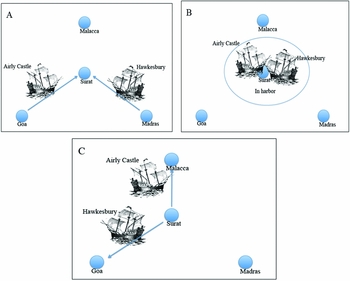
As an example, consider the hypothetical voyages of two ships, the Hawkesbury and the Airly Castle. Once around the Cape, the Airly Castle traveled to Goa, then to Surat, and finally to Malacca. The Hawkesbury traveled first to Madras, proceeded to Surat, where it overlapped with the Airly Castle for three weeks. The first legs of the travels of both ships are represented in figure 1A. While at Surat (figure 1B), the captains and crew ate meals, attended church services, and socialized together on a daily basis, often discussing commercial prospects in the different ports. Thus the Hawkesbury was exposed to recent information about market conditions at Goa while docked at Surat. The Airly Castle was exposed to recent information about Madras while at Surat. The Airly Castle then traveled to Malacca, and the Hawkesbury traveled to Goa (figure 1C). In this case the social networks variable is coded one for the Hawkesbury’s trip between Surat and Goa. All other trips, including the Airly Castle’s trip to Surat, and from Surat to Malacca, are coded zero.
Illustration of network transmission

We further break down the process of information transfer through social networks by considering strong and weak ties as well as the status of the alter captain. We consider a social network tie between the focal captain and another ship to be activated if the focal captain goes to a port about which he received information from that other ship. We then define strong tieijk as we do social networkijk but only consider information from another ship if the focal captain had previously activated the tie with that ship. That is, when the focal captain k in port i is considering the set of alternative next ports J, we define the dummy variable strong tieijk for each j ∈ J to be one if the captain k had in port i encountered another ship who had earlier on in the same voyage visited port j—and the captain k had earlier acted on information provided by that other ship. Again, if the captain had information about a particular other port from multiple ships, we still give the variable the value one. Similarly, we define weak tieijk by considering only other ships if the focal captain had never acted on information carried by them. If the focal captain received information about another port j through both strong and weak ties, then both strong tieijk and weak tieijk would get the value one.
An alternative operationalization of strong ties is measuring captain dyad's total overlap across different ports, that is, the amount of time they had previously spent together at different ports. Repeated exchange has a stronger theoretical background in the social exchange literature (Emerson Reference Emerson1972) and is the operationalization used in the literature on the negative effects of strong ties in organizational theory most relevant to our analysis (Mizruchi and Stearns Reference Mizruchi and Stearns2001; Sorenson and Waguespack Reference Sorenson and Waguespack2006). Thus we believe capturing past instances in which information was both transmitted and acted upon is the appropriate measurement strategy.
We define alter statusijk as we do social networkijk but consider the status of the other captains from which the information was received. When the focal captain k in port i is considering the set of alternative next ports J, we define the variable status tieijk for each j ∈ J to be the average voyage count of the other captains whom the focal captain encountered in port i and whom had been to port j previously.Footnote 2
The data systematically reports only arrival dates, so the exact overlap is unknown in most cases. The total number of completed trips over the history of the organization was 14,065. In 1,012 voyages additional notes in the data recorded the departure date of ships from one or more of the ports visited in the East Indies.Footnote 3 Out of a sample of 200 of these voyages, 72 trips had complete information. We used this information to estimate the time it took to travel between ports and the average stay in ports, which became the basis for our calculation of departure times.
Additionally we considered that factories could serve as repositories of information for ships because factors and other merchants and administrators employed by the East India Company held semipermanent residences at these stations. These actors could hold and transmit information between ships, even when port stays did not actually overlap—although the information would still have to be timely to be useful. We estimated that information stayed in ports for four months after the departure of a ship. The model results are robust to variations of this estimate. There was almost no change in results based on three- and five-month storage periods.Footnote 4 A small number of voyages originated in Asia. In these cases we estimated that they gathered in the port four months prior to departure to make preparations.
There are aspects of communication that are not captured by this measure. Most significantly, we can only infer the transfer of positive information about ports, whereas it is likely that positive and negative information about ports was communicated between interested parties. When positive information is transmitted, we can observe whether it had an influence by observing the decision to travel to a port; however, each time one port is chosen as a destination, multiple ports are not chosen. This inevitability makes it much more difficult to properly identify negative effects from exposure to information. Although we are observing a process in which, in all likelihood, negative and positive information about ports are transferred between captains, we capture only the net positive impact of social networks. The interpretation of the results should then be limited to reflecting on the positive influence of social networks.
Information may have also flowed through networks outside of the auspices of the East India Company. There is no systematic data on other merchants’ travels, so we cannot include this information in our models. In any case, mechanisms for contact with other merchants are much less clear than in the case of employees of the English East India Company, who housed together, dined together, or participated in the same social events. Additionally, antagonisms existed across cultural groups, decreasing the likelihood that traders within one Company would exchange information across organizational and national boundaries. Finally, the private trade carried on by servants of the English Company was composed of similar goods, which were also different from country trading concerns of merchants confined to the East. It follows that market information from other captains engaging in a similar trade would be particularly useful. If any peer networks were used in directing the paths of the East India Company ships, it is likely to have been intraorganizational networks of communication between ships; however, our results do not extend to other types of peer communication.
We operationalize inexperience in two variables. Unlike war, individuals with different levels of experience are working within the same system concurrently. First voyage is a binary variable that captures the first command voyage of the focal captain to the East Indies. While a cumulative measure of experience does not capture the more significant difference between first voyage as captain and subsequent increases in experience, we also present the models using voyage count, the sequential number of the current voyage in the career of the focal captain. Thus both experience variables have one value for each captain in each year and are constant across ports.
Control Variables
Current traffic is the count of ships that visited the port within the five years prior to the time at which the focal captain's ship arrives at that port. We include this variable to control for persistence in the traffic at ports, as we wish to capture how networks lead to changes in the traffic rate. This variable also effectively controls for the level of common knowledge among the captains about the port. It has one value for each port in each year and is the same across all captains traveling to that port or considering traveling to it.
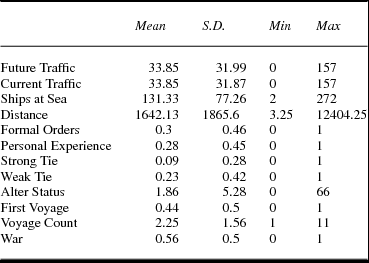
Although captains had a great deal of autonomy once at sea, they were issued orders to visit certain ports on each voyage. We use the dummy variable formal destination to capture these ports. We also expect that personal experience would have an independent effect on captain's decisions. Captains would both gain information about ports on prior visits, and also form potentially useful commercial relationships. We therefore control for personal experience, which is a dummy variable and captures whether the focal captain had traveled to a given port in his past voyages. Because the level of activity of the Company varied substantially over the two centuries during which the East India Company was commercially active, we included the control variable ships at sea, defined as the count of the number of ships that had left England in the prior five years. We also control for the distanceij between the current port i and the destination port j. Table 1 presents summary statistics for all the variables.
Summary statistics

Count Model
In order to model the relationship between social ties and port traffic, we compare the choices captains made with and without strong and weak ties across different conditions of uncertainty using a negative binomial regression. The dependent variable is the rate of traffic at those ports chosen as destinations in the five years after the target voyage. We chose the five-year period post voyage to avoid the potential for causal effects traveling from the dependent to the independent variables. The unit of analysis is travel from port i to port j, and we compare the outcome, namely the future rate of traffic at port j.
The dependent variable future traffic counts the number of ships at a port, indicating that a count model is appropriate. Both the standard models for count data, the negative binomial and Poisson, have the attractive feature that the conditional expectation of the outcome variable is equal to:
 \begin{equation*}
E\left({{y_i}{\rm{|}}{{\bf{x}}_{\bm i}}} \right) = \ {e^{{{\bf{x}}_{\bm i}}{\bm{\beta }}}}
\end{equation*}
where yi is the ith observation of the dependent variable, x i is the ith vector of explanatory variables, and β is the vector of coefficients. However, while the Poisson distribution implies that the conditional variance is equal to the conditional mean, the negative binomial distribution allows the conditional variance to be larger:
 \begin{equation*}
Var\left({{y_i}{\rm{|}}{{\bf{x}}_{\bm i}}} \right) = \ {e^{{{\bf{x}}_{\bm i}}{\bm{\beta }}}}\left({1 + \alpha {e^{{{\bf{x}}_{\bm i}}{\bm{\beta }}}}} \right)
\end{equation*}
where α > 0 is the dispersion parameter. Thus, when the data in question is overdispersed, when α > 0 and thus the conditional variance is larger than the conditional mean, the negative binomial model is the appropriate choice. We used the negative binomial distribution as the data showed evidence of overdispersion—although the results of these models were substantively very similar.
The models include a dummy for each captain to control for the different trade patterns and period effects that each captain encountered. These dummies address the concern that estimates may be biased by some captains having systematically visited more or less heavily trafficked ports based on innate preferences, commercial interests, or simply the time period when they were active. We also added a dummy for the prior port, port i, to control for the range of options available from that port. Otherwise the estimates could be biased if some ports i were systematically linked with more frequently trafficked destination ports than other ports.
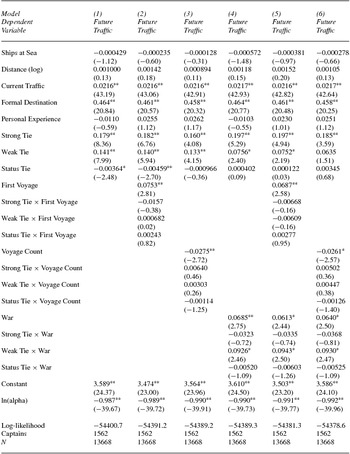
Table 2 presents the results. Model (1) presents the baseline regression with the control variables. Model (2) introduces our first measure of experience, first voyage, and Model (3) introduces our second operationalization of experience, voyage count. Model (4) introduces our measure of uncertainty, war. First voyage and voyage count cannot be included in the same model, so Models (5) and (6) display the results for each combined with war.
Negative binomial regression of future rate of traffic at chosen port

Captain dummies, and previous port dummies included but not reported. Robust standard errors clustered by captain. t-statistics in parentheses. * p < 0.05, ** p < 0.01.
Model (1) indicates that, consistent with the existing literature, the use of both strong and weak ties is associated with travel to more heavily trafficked ports, and, indeed, strong ties are associated with a greater increase in expected rates of port traffic than weak ties. Substantively, this means that strong ties are associated with travel to ports with 20 percent higher rates of traffic, whereas weak ties are associated with travel to ports with 15 percent higher rates of traffic. Status tie is not significant. Both strong and weak ties have smaller coefficients than formal destination, that is, orders to travel to a port, where a captain's personal experience of travel to a port insignificant. The significant association between weak ties and increased port traffic disappears when war and its related interaction terms are introduced in Models (4), (5), and (6)—suggesting that the use of weak ties during times of war is where the strength of this association lies. In the same models, the coefficient for strong ties declines only slightly and retains its significance.
First voyage and voyage count work as we expected, where inexperienced captains are more likely to travel to ports with increasing popularity and increasing experience allows for travel to ports with lower rates of traffic. However, none of the interactions between the different types of ties and our measures of experience are significant.
War drives ships to ports with increased traffic rates. The interaction between strong tie and war is insignificant; whereas the interaction between weak tie and war is positive, significant, and larger than the direct effect of war—so that in periods of war, weak ties largely guided individuals to ports with higher traffic rates. By means of comparison, the coefficient for weak ties without war translates into travel to ports with 8 percent higher traffic rates and 18 percent higher traffic rates during war. Status tie is not significant.
Despite allowing for the effects of tie strength, status, uncertainty, and experience, we do not see evidence that network ties diversified travel to ports. Specifically there is never a negative coefficient indicating that social ties led ships to low-traffic ports. Instead, weak and strong ties have a similar kind of influence on trade patterns. Strong ties are consistently associated with travel to ports with higher traffic rates, and this effect is largely unaffected by experience or uncertainty. Weak ties, traditionally associated with the exploration of opportunity, are also associated with higher traffic rates. This effect seems to be accounted for by individuals relying on weak ties in times of war.
Discussion
The results suggest that network ties—when they have an association with port traffic—led to increasing traffic at already heavily frequented ports. Of the ports they traveled to, captains were more likely to go to higher-traffic ports when exposed to information about those ports through strong ties even when the previous five years of port traffic are controlled for. This initial finding is in line with our expectations about weak ties—we did not expect weak ties to direct captains to less trafficked ports as they were less likely to transmit information of sufficient complexity to support such endeavors. However, we did believe that it was possible that strong ties could direct ships to lower-traffic ports. This possibility was not borne out. Although it does seem as though strong ties are transmitting complex information—enough to influence the paths of ships—they do not seem to have overcome the redundancy and reduced scope of information built into a smaller sampling pool. Instead, the results indicate that a smaller number of connections translated into a smaller choice set, leading to less travel to more varied ports.
Individuals were exposed to weak ties more frequently than strong ties, although strong ties were not uncommon. Thus the set of weak ties that captains were exposed to carry more diverse information than strong ties. This follows from the fact that all the trips of the ships concurrently docked at a single harbor would have supplied weak tie information, while only a subset—if any—would qualify as strong ties. The lack of significant coefficients for weak ties can be interpreted in more than one way. It can mean that weak ties did not provide a sufficient basis for cooperative relationships and thus did not have a consistent impact on driving ships to one type of port or another. However, one may also compare the coefficients of strong and weak ties and come to the conclusion that in times of peace (i.e., when war is controlled for) weak ties, relative to strong ties, directed ships to lower-traffic ports. The effect is insignificant, but this may mean that weak ties directed ships to average-traffic ports, whereas strong ties directed ships to higher-traffic ports. This second interpretation seems unlikely, however, given the circumstances. A more plausible explanation is that in war, information about destinations was considered an even greater necessity; captains did not always encounter individuals with whom they had previously interacted. Thus in times of war they were forced to use some other selection criteria to choose potentially trustworthy individuals—or rely on spottier information. We must also entertain the possibility that greater social cohesion arose in times of war, facilitating more information exchange; however, if there was simply more information transfer in times of war, each captain should have received a larger pool of information, which should have resulted in captains traveling to less trafficked ports to pursue greater commercial opportunity.
Thus the results run somewhat orthogonal to weak tie theory, as the information diversity provided by weak ties does not translate into heterogeneous outcomes, although the expectation that strong ties lead to homogenous outcomes is supported. The results are far from being entirely inconsistent with Mark Granovetter's classic weak tie theory; however, they certainly suggest that uncertainty is an important factor mediating the relationship between weak ties and heterogeneous outcomes in this setting. They also suggest that the density of information content plays an important role, otherwise we cannot explain why weak ties are insignificant when war is controlled for, why they have less of an impact than strong ties, and why they never are associated with travel to less trafficked ports. Thus the findings are consistent with Sinan Aral and Marshall Van Alstyne's emphasis considering the type and content of information transferred between ties (Aral and Van Alstyne Reference Aral and Van Alstyne2011). Our findings are also consistent with previous literature on uncertainty and network use, although the association between more homogenous outcomes (in this case heavily trafficked ports) is not produced by the underlying structural pattern assumed in much of that literature, but instead on rates of exposure to network ties.
In terms of the larger impact of social networks on early modern chartered trade, it is important to compare the coefficients estimating the effect of network ties with formal orders. Social networks led to travel to more heavily trafficked ports, but the effect is much smaller than that of formal orders. While peer networks concentrated trade on a smaller set of ports than captains operating without the guidance of peer networks, they did channel captains to a more diverse set of ports than formal orders. Finally, social networks guided captains to ports with higher traffic, controlling for current traffic rates. This suggests that networks led to a turnover in rates of trade at ports, so that while homogeneity was built in at one moment, over time network use may have led to more heterogeneity—burstiness in port popularity.
Finally, we consider to what extent this reveals how social ties were used in early modern trade. The analysis is limited to the employees of the English East India Company and within organization ties. The company type was a new form of economic organization and although there were other European counterparts, the organizational type was not used or readily adopted by Asian merchants of the time. It is possible that the formal organizational apparatus would have led employees to potentially place more trust or less trust in each other than they would in nonemployees—organizations may have provided a basis for generalized trust, increasing the rates of cooperative behavior relative to what occurred outside the organizational boundaries. The results indicate that cooperation regarding travel to ports increased with previous interactions.
The question remains how generalizable these results are to early modern trade more broadly conceived. Ultimately this is an empirical question; however, there were many Asian trading groups formed around shared ethnic identity, for example, Armenian merchants and the Chinese diaspora in the Indonesian Archipelago. The Company infrastructure was important in providing a central site for English employees to interact with each other, but other merchant groups were also organized into natios—merchant ghettos—in many eastern ports. Face-to-face interaction and transfer of information was central to informal organization of related merchants (Sood Reference Sood2007). Thus although there were many cultural differences, it is not entirely unlikely that these patterns would also appear among other ethnically organized trading groups. It may be less likely that the informal transfer of information impacted trade patterns in other European companies as compared to other Asian merchant groups because there was not the same amount of autonomy granted to captains over the course of their ships’ travels.
Conclusion
This article analyzes how social ties impacted the distribution of English trade across Asian ports in the early modern period, spanning from 1600 to 1833. We broke down social ties into strong, weak, and status-ordered ties in order to identify whether they had different outcomes in terms of producing clustered or diverse outcomes, that is, travel to more or less heavily trafficked ports. We also considered whether uncertainty and experience increased or decreased the relationship between port traffic and the use of network ties. We found that both strong and weak ties were associated with travel to more heavily trafficked ports. We understand this association to lead to increased concentration of ship traffic at the system level, at a reduced rate, but similar to the overall tendency of rich-get-richer found in systems of preferential attachment. However, ships relying on strong and weak ties tended to travel to less heavily trafficked ports than they would have if they had simply followed the formal orders issued by the organization. The results particularly illuminate the importance of tie strength in the transfer of information in this early modern setting. They also provide the beginning of a basis for understanding how network use changes or persists over time. Finally, they indicate that social networks played a role in shaping rates of development across ports as well as patterns of early modern global trade.