Introduction
In order to enjoy open spaces similar to their original habitats, wild ruminants captive in zoological parks tend to be kept on green paddocks, which contributes to appropriate welfare and nourishing. Because animals are always kept in the same enclosures, supplementation consisting of hay is provided when pasture scarcity, and concentrate is frequently given for the same purpose (Palomero et al., Reference Palomero, Hernández, Cazapal-Monteiro, Balán, Silva, Paz-Silva, Sánchez-Andrade and Vázquez2018). This regime can become a risk of infection by certain parasites as gastrointestinal nematodes, owing to free-living stages developed from eggs shed in the feces of infected individuals are able to survive in areas with herbage and humidity (Santos et al., Reference Santos, Silva and Amarante2012). Infection by gastrointestinal helminths belonging to the order Strongylida has been reported among antelopes, gazelles and giraffids kept at two zoos in Belgium (Goossens et al., Reference Goossens, Dorny, Boomker, Vercammen and Vercruysse2005), as well as giraffes and camels from zoological gardens in Poland (Maesano et al., Reference Maesano, Capasso, Ianniello, Cringoli and Rinaldi2014; Nosal et al., Reference Nosal, Kowal, Kornaś, Wyrobisz, Skotnicki, Basiaga and Plucińska2016) or antelopes, bison and deer in Italy (Fagiolini et al., Reference Fagiolini, Lia, Laricchiuta, Cavicchio, Mannella, Cafarchia, Otranto, Finotello and Perrucci2010).
Because many parasitic infections are subclinical, detection occurs too late and important harmful has already been caused, which can lead to the death of animals (Maesano et al., Reference Maesano, Capasso, Ianniello, Cringoli and Rinaldi2014). Control of parasites focuses on the administration of chemical dewormers two to three times per year at least, but they become infected shortly due to moderate to high levels of environment contamination by parasites can be attained when animals are maintained in restrained zones, despite feces are regularly collected from the ground (Citino, Reference Citino, Fowler and Miller2003). As a consequence, useful measures to prevent infection by parasites among captive animals are required, aiming to interrupt the development and/or survival of parasitic stages in the environment; nevertheless, helpful actions often advised on livestock as pasture rotation cannot be easily applied in zoos (Arias et al., Reference Arias, Cazapal-Monteiro, Valderrábano, Miguélez, Rois, López-Arellano, Madeira de Carvalho and de Gives2013).
There has been reported the presence of natural antagonists of parasitic stages in the ground. Certain filamentous fungi (Mucor circinelloides, Pochonia chlamydosporia and Trichoderma spp.) are able to attach to the eggshells of trematodes, ascarids or trichurids, penetrate and destroy the inner embryo (Arroyo et al., Reference Arroyo, Hernández, Cazapal-Monteiro, Pedreira, Sanchís, Romasanta, Sánchez-Andrade, Paz-Silva and Arias2017; Hernández et al., Reference Hernández, Cazapal-Monteiro, Arroyo, Silva, Palomero, Paz-Silva, Sánchez-Andrade and Arias2018c; Thapa et al., Reference Thapa, Thamsborg, Wang, Meyling, Dalgaard, Petersen and Mejer2018). Other fungal species (Duddingtonia flagrans, Monacrosporium thaumasium and Arthrobotrys oligospora) characterize by the elaboration of traps to immobilize the larvae of some nematodes (i.e. strongyles) and finally destroy them (Braga et al., Reference Braga, Carvalho, Araujo, Silva, Araújo, Lima, Tavela and Ferreira2009; Hernández et al., Reference Hernández, Arroyo, Suárez, Cazapal-Monteiro, Romasanta, López-Arellano, Pedreira, de Carvalho, Sánchez-Andrade, Arias, de Gives and Paz-Silva2016; Mendoza-de Gives et al., Reference Mendoza-de Gives, López-Arellano, Aguilar-Marcelino, Olazarán-Jenkins, Reyes-Guerrero, Ramírez-Várgas and Vega-Murillo2018). To date, there have been scant studies involving the administration of fungal spores to captive animals in zoological gardens for conducting biological control of these parasites. With the purpose of reducing the risk of infection by strongyles among wild captive equids, Arias et al. (Reference Arias, Cazapal-Monteiro, Valderrábano, Miguélez, Rois, López-Arellano, Madeira de Carvalho and de Gives2013) performed an assay consisting of the administration of a pre-mixture feed containing spores of D. flagrans. Recently, the usefulness of an integrated control strategy against strongyles in wild equids captive at a zoological park has been reported, based on the commercial manufacturing of pelleted feed with spores of M. circinelloides and D. flagrans (Palomero et al., Reference Palomero, Hernández, Cazapal-Monteiro, Balán, Silva, Paz-Silva, Sánchez-Andrade and Vázquez2018). In the current field trial, the helpfulness of providing commercial pellets enriched with the spores of these two parasiticide fungi was assayed for a 3.5-year period on wild ruminants (family: Bovidae) kept at a zoological garden.
Materials and methods
Zoological park
Marcelle Natureza is a private zoological park located in the Northwest of Spain (Outeiro de Rei, Lugo; 43°4′14.71″N, 7°37′53.50″W), where about 2000 animals belonging to 200 wild species of mammals, birds and reptiles are maintained in different areas (Arias et al., Reference Arias, Cazapal-Monteiro, Valderrábano, Miguélez, Rois, López-Arellano, Madeira de Carvalho and de Gives2013). There are fenced parcels provided with herbage where herbivorous can exercise and feed on almost all the year; visitors are allowed to enjoy the zoo daily from March to November, and specific programmes are available for scholars. No public funds are received, and active collaborations for the preservation of Iberian wolf (Canis lupus signatus), Eurasian lynx (Lynx lynx lynx), Cuvier's gazelle (Gazella cuvieri), Dama gazelle (Nanger dama), Brown bear (Ursus arctos) and Marshbuck (Tragelaphus spekii gratus) are actually running.
Attending to aesthetic reasons, the fecal pats are eliminated periodically from the plots prior to the visitors enter the park.
Captive ruminants
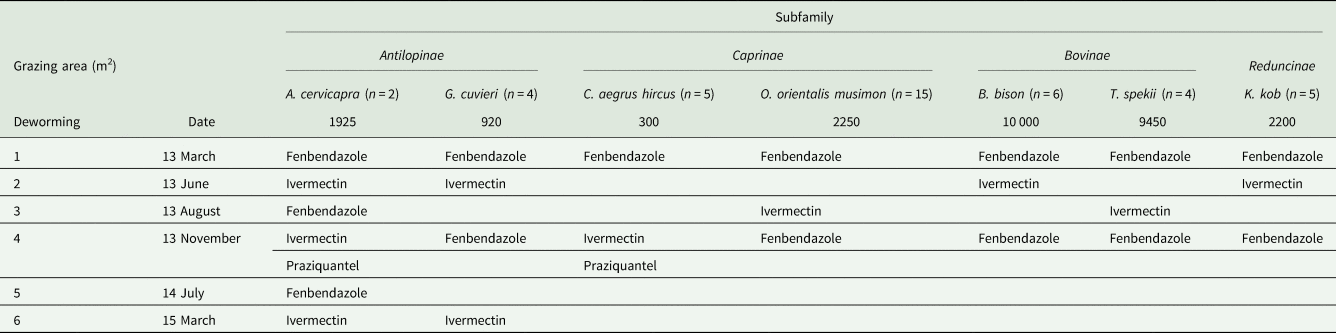
The present trial was carried out on wild bovids belonging to the subfamilies Antilopinae (6), Caprinae (20), Bovinae (10) and Reduncinae (5) (Table 1). These are herbivore species grazing plots composed of red clover (Trifolium pratense), perennial ryegrass (Lolium perenne) and orchard grass (Dactylis glomerata); water is available ad libitum. Hay is provided when pasture scarcity, and the animals are also supplemented with pelleted feed every 2 days.
Deworming programme in wild bovids captive in a zoological park between March 2013 and May 2017

Control of parasites
Before 2011, anthelmintic treatment was administered periodically to all the animals in the zoo, every 3–4 months, and those individuals exhibiting signs compatible with parasitic infection received additional deworming. Since that year, the COPAR Research Group (GI-2120) belonging to the University of Santiago de Compostela (Spain) is responsible for analysing feces collected regularly (monthly) from the ground, and after treatment has been administered to the animals also. Accordingly, deworming of herbivores is advised if counts of 300 eggs per gram of feces (EPG) are exceeded. The anthelmintics administered are summarized in Table 1.
Manufacturing of pelleted feed with fungal spores
Two filamentous fungi with proven activity against eggs (M. circinelloides) and larvae of helminths (D. flagrans) were added during the mixing phase of the elaboration of pelleted feed in a local manufacture. For this purpose, a quantity of 104–105 spores of each fungus was introduced per kg meal before the pelleting phase (Palomero et al., Reference Palomero, Hernández, Cazapal-Monteiro, Balán, Silva, Paz-Silva, Sánchez-Andrade and Vázquez2018).
Experimental design
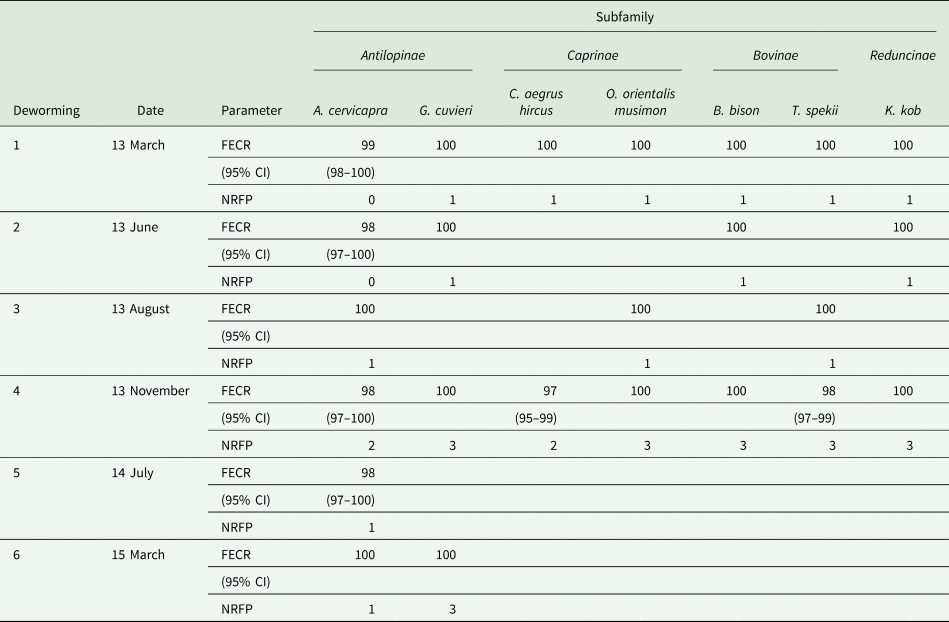
All animals were initially dewormed at March 2013. Additional treatments were considered when EPG counts were >300 (Tables 1 and 2). From November 2013 until the end of the trial (May 2017), all the animals were given nutritional pellets enriched with spores of M. circinelloides and D. flagrans every 2 days.
Effect of anthelmintic treatment on strongyles affecting wild bovids captive in a zoological park

Coprological analyses
Due to fecal samples cannot be collected individually from each ruminant, the apical portion of freshest feces was taken from the ground, to avoid contamination with free-living organisms (Maesano et al., Reference Maesano, Capasso, Ianniello, Cringoli and Rinaldi2014). By considering the impossibility to establish a correspondence between each fecal sample and the respective ruminant, it was decided to take a quantity double the total number of individuals in each slot, assuming that some individual could be represented via two samples (Arias et al., Reference Arias, Cazapal-Monteiro, Valderrábano, Miguélez, Rois, López-Arellano, Madeira de Carvalho and de Gives2013; Palomero et al., Reference Palomero, Hernández, Cazapal-Monteiro, Balán, Silva, Paz-Silva, Sánchez-Andrade and Vázquez2018). Feces were analysed by means of the sedimentation [sensitivity (Se) = 30 EPG] and flotation tests (Se = 30 EPG or OPG, oocysts per gram of feces) (Hernández et al., Reference Hernández, Sánchez-Andrade, Cazapal-Monteiro, Sanchís, Arroyo, Paz-Silva and Arias2018a), and results expressed as the numbers of eggs/oocysts per gram of feces.
Identification of nematode genera was performed according to van Wyk and Mayhew (Reference Van Wyk and Mayhew2013), by preparing pools of 10 g feces taken at the beginning of the study and incubating at 25°C for 18 days.
Evaluation of the control of helminths
The efficacy was assessed by examining their feces 14 days later and expressed as the percentage of fecal egg count reduction (FECR):

Successful deworming was considered when FECR ⩾ 95%.
The time interval (months) between the last administration of a successful deworming and the appearance of eggs again in the feces of the treated individuals was also established to assess the period that feces did not represent a risk for contamination of the soil (NRFP, non-risky feces period).
Side-effects
Since November 2013, special attention was paid to the digestive and the respiratory functions, as well as to the skin. It was also established if the pellets with fungal spores were refused at any moment.
Statistical analyses
The egg-output kinetics was represented as the mean ± 2 s.e. (standard error). The Levene test showed that variances were unequal (statistic = 10.365, P = 0.001) and the Kolmogorov–Smirnov test indicated that the values of egg-output were not normally distributed (Z = 5.545, P = 0.001). Consequently, these data were analysed by means of the non-parametric Friedman probe (α = 0.05). All tests were performed using SPSS for Windows (v. 22.0; SPSS Inc., Chicago, IL, USA).
Results
Coprological analyses
Eggs of strongyles were detected in the feces of the ruminants involving the genera Trichostrongylus, Nematodirus, Chabertia and Haemonchus. Oocysts of Eimeria spp. and eggs of pinworms (Trichuris spp.) were occasionally detected throughout the assay; hence these data were not included in the current study.
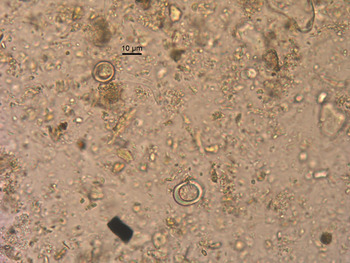
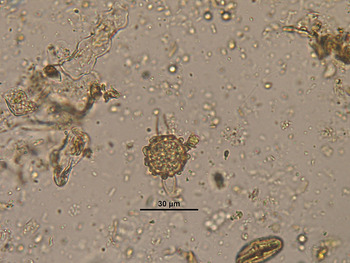
Chlamydospores of M. circinelloides and D. flagrans were observed in the feces of all bovids (Figs 1 and 2).
Chlamydospores of M. circinelloides in the feces of blackbucks (A. cervicapra) captive in a zoological garden (Marcelle Natureza, Outeiro de Rei, Lugo, NW Spain).

Chlamydospores of D. flagrans in the feces of marshbucks (T. spekii) captive in a zoological garden (Marcelle Natureza, Outeiro de Rei, Lugo, NW Spain).

Efficacy of deworming
The efficacy of the deworming administered throughout the trial oscillated from 97 to 100% (Table 2). No significant differences regarding the anthelmintic were obtained (P > 0.05).
From March to August 2013, the values of NRFP were 0–1 months for the blackbucks (Antilope cervicapra), and 1 month for the gazelles (G. cuvieri), goats (Capra aegrus hircus), mouflons (Ovis orientalis musimon), bison (Bison bison), marshbucks (T. spekii) and kobs (Kobus kob) (Table 2). Since November 2013, these values increased to 1–2 months for the blackbucks and goats, and to 3 months for the rest of ruminants.
Kinetics of strongyles
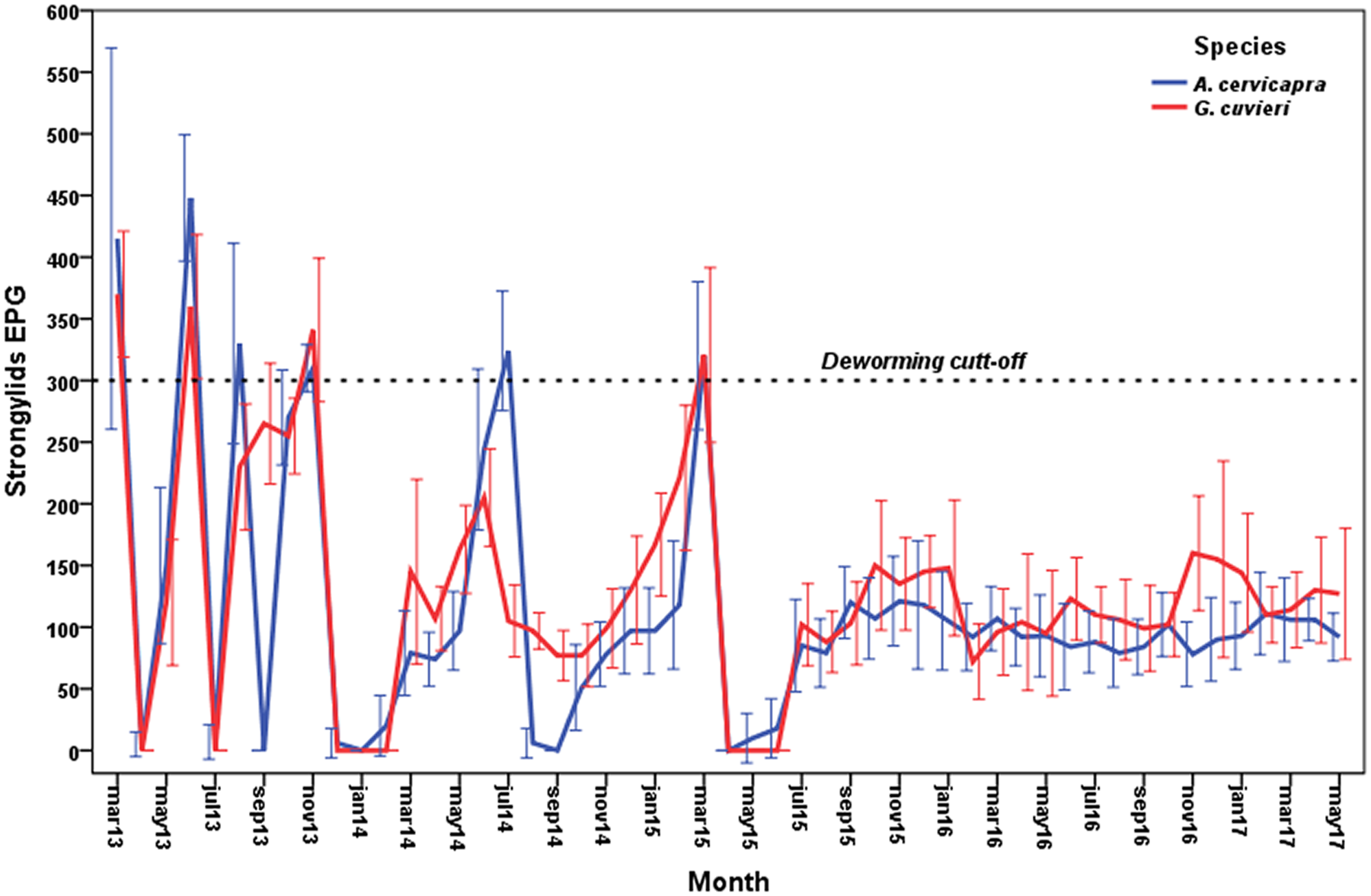
Until November 2013, the counts of strongyles egg-output in the Antelopinae (blackbucks and gazelles) were higher than 300 EPG by four times (blackbucks) and three times (gazelles) (Fig. 3). From November 2013 until March 2015, the cut-off point was exceeded two times (blackbucks) and one time (gazelles). Since that month, egg-output values around 100–150 EPG were recorded.
Kinetics of strongyles egg-output in Antelopinae (blackbucks, A. cervicapra; gazelles, G. cuvieri) captive in a zoological park (Marcelle Natureza, Outeiro de Rei, Lugo, NW Spain). Points mean the average value and error bars 2 s.d.

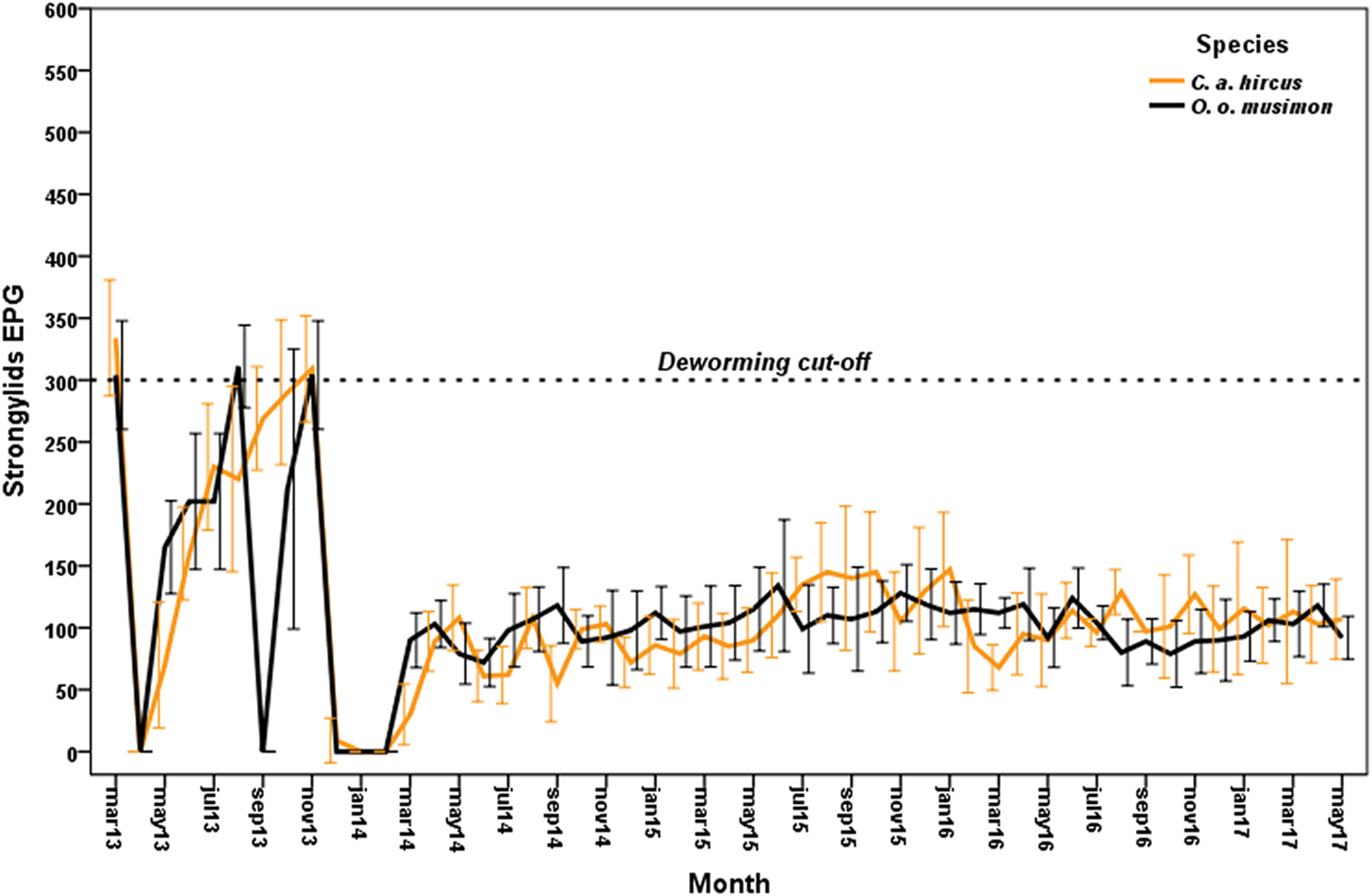
The values of eggs of strongyles in the feces of Caprinae are shown in Fig. 4. Values of strongyles EPG exceeding the deworming cut-off point were observed in goats (one time) and mouflons (two times) until November 2013. From December 2013 to the end of the trial the numbers of eggs of strongyles maintained at 80–120 EPG in the feces of Caprinae.
Kinetics of strongyles egg-output in Caprinae (goats, C. aegrus hircus; mouflons, O. orientalis musimon) captive in a zoological park (Marcelle Natureza, Outeiro de Rei, Lugo, NW Spain). Points mean the average value and error bars 2 s.d.

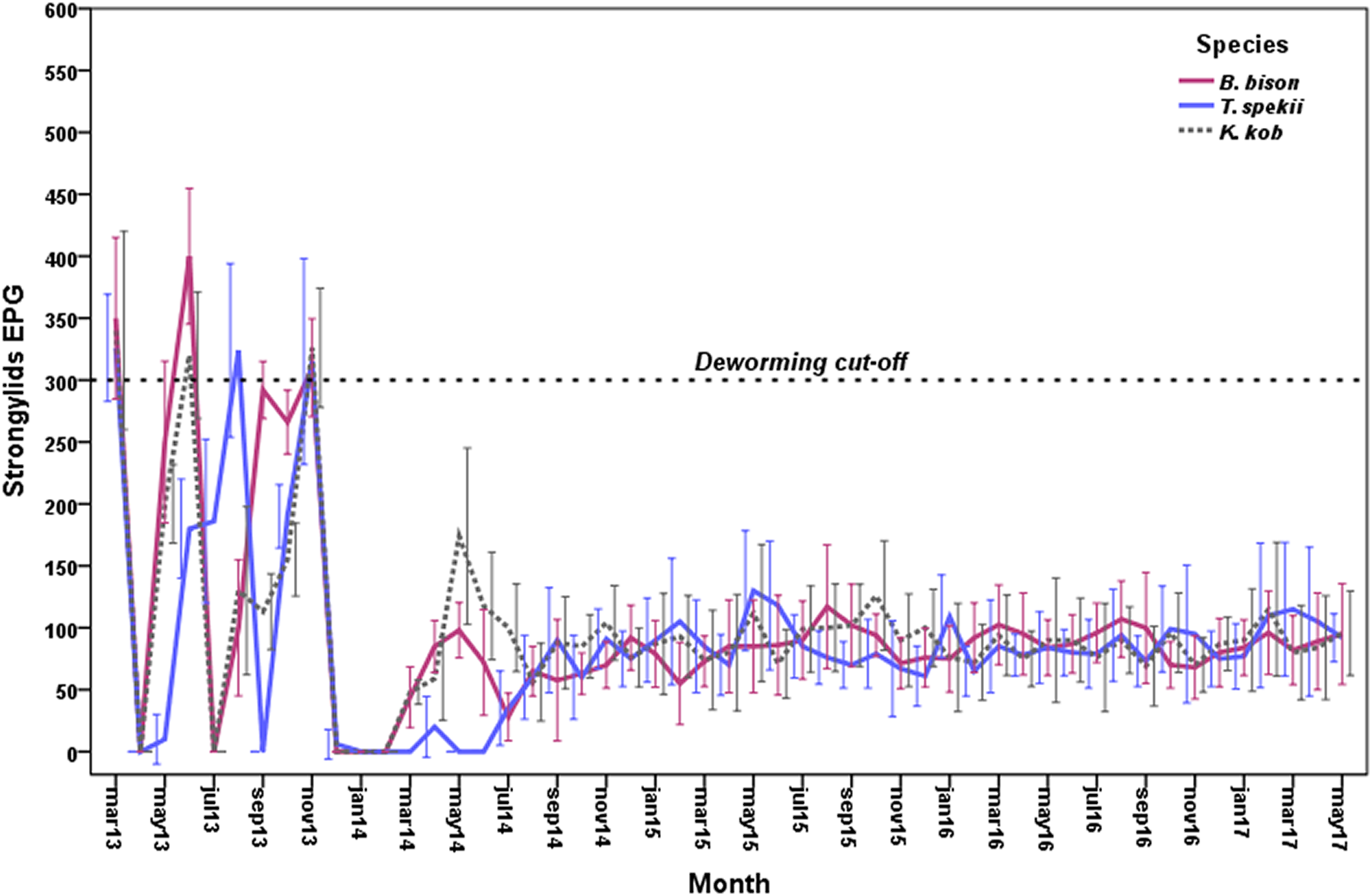
As presented in Fig. 5, numbers of strongyles EPG higher than 300 were recorded three times until November 2013 in the feces of Bovinae (bison and marshbucks) and Reduncinae (kobs), then remained between 50 and 110 until the end of the study.
Kinetics of strongyles egg-output in Bovinae (bison, B. bison; marshbucks, T. spekii) and Reduncinae (kobs, K. kob) captive in a zoological park (Marcelle Natureza, Outeiro de Rei, Lugo, NW Spain). Points mean the average value and error bars 2 s.d.

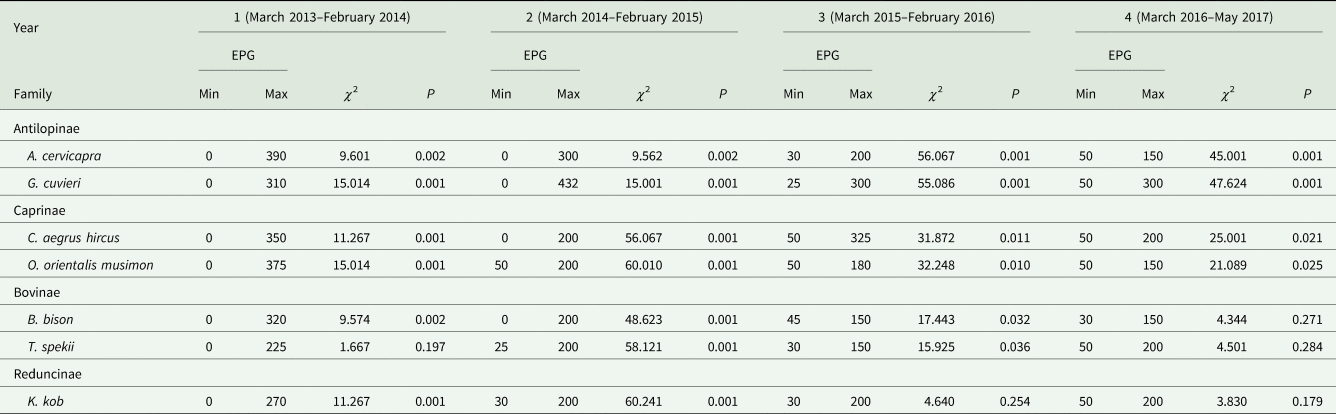
Table 3 summarizes that statistical difference was observed in the strongyles EPG throughout the research in all the captive species, mainly during the first 2 years.
Statistical analysis of the strongyles egg-output of wild bovids captive in a zoological park

Adverse effects
No adverse effects on the digestive or respiratory system were detected in the wild bovids receiving pellets enriched with fungal spores. The absence of skin lesions was also confirmed, whereas refusal to take the pellets was never observed.
Discussion
Wild captive animals maintained in zoological parks provided of paddocks with herbage are frequently infected by strongyles, and their control often lies in the administration of chemical dewormers (Panayotova-Pencheva, Reference Panayotova-Pencheva2016). In the current trial, the administration of anthelmintics (fenbendazole, ivermectin or ivermectin + praziquantel) to wild bovids captive in a zoological garden was effective against the strongyles, in agreement with Abaigar et al. (Reference Abaigar, Ortiz, Cano, Martinez-Carrasco, Albaladejo and Alonso1995) and Ortiz et al. (Reference Ortiz, De Ybañez MR, Abaigar, Goyena, Espeso, Cano and Alonso2001). However, the captive blackbucks required a total of four dewormings through a 9-month period, and the rest of bovids received three treatments during that interval. These results point that the frequent administration of anthelmintic treatments is needed when control programmes do not include preventive measures, due to the development of infective phases in the soil is responsible for an unceasing risk throughout the year. It has been shown that the strategies relying only on deworming result in the diminution of the parasiticide efficacy, which can lead to the development of anthelmintic resistance (Goossens et al., Reference Goossens, Dorny, Boomker, Vercammen and Vercruysse2005). Besides this, deworming of wild species entails some problems, based on little information available regarding proper dewormers, dosages, frequency or side-effects. In this situation, the need to lessen the risk of infection among grazing individuals appears critical.
Transmission of strongyles occurs in a simple way through the ingestion of third-stage larvae, without the participation of intermediate hosts. These infective stages origin from eggs passed in the feces of parasitized individuals, which once in the soil give rise to a first-stage larva (L1) develops inside the egg and hatches, feeding on organic matter in the feces and moulting to a second-stage larva which feeds also and reaches the third-stage larva (Smith and Sherman, Reference Smith and Sherman2009). Consequently, limiting the presence and/or survival of the infective stages in the soil looks very helpful to prevent the infection by these nematodes. Besides anthelmintic treatment focuses on parasites inside the final hosts, the ovicidal effect of fenbendazole has been stated on eggs of horse strongyles (Daniels and Proudman, Reference Daniels and Proudman2016), but this activity has not yet been demonstrated with ivermectin.
In view of the usefulness of certain soil filamentous saprophytic fungi to significantly reduce the presence and viability of the infective phases of some helminths in the feces and/or the ground (Campos et al., Reference Campos, Araújo, Guimarães and Dias2009; Hiura et al., Reference Hiura, Del Carmen Garcia Lopes, da Paz, Gava, Flecher, Colares, de Freitas Soares, da Fonseca, Lacerda, de Araújo and Braga2015; Vieira et al., Reference Vieira, Oliveira, Campos and Araújo2019), in the current research wild captive bovids were successfully dewormed and then provided spores of a blend of parasiticide filamentous fungi with ovicide (M. circinelloides) and larvicide activity (D. flagrans) every 2 days during 3.5 years. This approach resulted in the numbers of strongyles lower than 120 EPG in the feces of captive Caprinae (goats and mouflon), Bovinae (bison and marshbucks) and Reduncinae (kobs); therefore, according to a 300 EPG cut-off point established at the beginning of the trial, anthelmintic treatment was not required throughout this period. Prior studies pointed that the spores of M. circinelloides develop into hyphae in the presence of eggs of helminths as trematodes and ascarids, penetrating and destroying them (Hernández et al., Reference Hernández, Cazapal-Monteiro, Sanchís, Sánchez-Andrade, Paz-Silva and Arias2018b). The ability of D. flagrans to elaborate traps for catching larvae originated from eggs of strongyles has been widely reported (Mendoza-de Gives et al., Reference Mendoza-de Gives, López-Arellano, Aguilar-Marcelino, Olazarán-Jenkins, Reyes-Guerrero, Ramírez-Várgas and Vega-Murillo2018).
One unexpected observation in the current study comprises data collected among the Antelopinae. Despite the administration of pelleted feed enriched with parasiticide fungal spores, blackbucks required two anthelmintic treatments during a period of 16 months, and gazelles one application. The lack of information regarding the level of contamination in the soil makes difficult to explain this, but it seems to reinforce the difficult to minimize the risk of infection. Goossens et al. (Reference Goossens, Dorny, Boomker, Vercammen and Vercruysse2005) pointed that anthelmintic treatment in a zoological park failed due to residual or permanent contamination of the paddocks by nematode larvae, which could survive winter.
Control of parasites in wild captive bovids involves a serious trouble, because of the difficulties to perform preventive measures. Domestic herbivores are often maintained in plots with vegetation to ensure they receive appropriate nourishing; when grass is sparse, animals are taken to other grassland, in a rotational pasturing regime (Flack, Reference Flack2016). The observation of a resting period where the grassland remains without feeding animals has been helpfully advised for preventing infection by helminths (Undersander et al., Reference Undersander, Albert, Cosgrove, Johnson and Peterson2002). In the case of wild captive species, maintenance in plots with vegetation serves to offer wild animals an environment close to the original, with possibilities to feed forage, interact and enjoy nature. As opposed to livestock farms, rotation of plots cannot be considered in zoological parks because of the worries to manage the animals without stress and to have a high number of plots, thus a resting period is not possible. This appears to explain the animals in the current study did attain high numbers of strongyle egg-output 2 or 3 months after the administration of efficient deworming, and underlines the requirement of safe environments to ensure animal health and welfare (Maesano et al., Reference Maesano, Capasso, Ianniello, Cringoli and Rinaldi2014). Other proposals to limit pasture contamination in zoological parks comprise limitation of pasturing by later turn-out, by overnight stabling, or by grazing on sandy to rocky enclosures (Goossens et al., Reference Goossens, Dorny, Boomker, Vercammen and Vercruysse2005).
Prior investigations demonstrated the efficacy of an integrated programme for the control of strongyles among pasturing horses, both under continuous or rotational regimes (Hernández et al., Reference Hernández, Arroyo, Suárez, Cazapal-Monteiro, Romasanta, López-Arellano, Pedreira, de Carvalho, Sánchez-Andrade, Arias, de Gives and Paz-Silva2016, Reference Hernández, Sánchez-Andrade, Cazapal-Monteiro, Sanchís, Arroyo, Paz-Silva and Arias2018a). The administration of pellets with spores of M. circinelloides and D. flagrans to wild captive equids resulted to be highly beneficial for the control of strongyles during a 3-year period (Palomero et al., Reference Palomero, Hernández, Cazapal-Monteiro, Balán, Silva, Paz-Silva, Sánchez-Andrade and Vázquez2018).
Finally, no side-effects were observed among the bovids feeding the pellets with spores, and none of them refused to take this kind of feed throughout the investigation. These results are in concordance with previous information collected in horses and dogs (Hernández et al., Reference Hernández, Sánchez-Andrade, Cazapal-Monteiro, Sanchís, Arroyo, Paz-Silva and Arias2018a, Reference Hernández, Cazapal-Monteiro, Arroyo, Silva, Palomero, Paz-Silva, Sánchez-Andrade and Arias2018c).
Conclusion
Data obtained in the current trial point the usefulness and innocuousness of giving wild captive bovids spores of M. circinelloides and D. flagrans to maintain low strongyles egg counts shedding. The industrial manufacturing of pellets with spores of parasiticide fungi offers a viable and easy way to develop a preventive action against the infection by strongyles among wild captive bovids, valuable to reduce the frequency of administration of anthelmintic treatment.
Acknowledgements
We thank the Head of ‘Granja Gayoso Castro’ (Deputación Provincial de Lugo, Spain) for the valuable cooperation in producing fungal spores, and ‘Marcelle Natureza’ Zoological Park for helping us with the fecal sampling.
Financial support
This work was supported by the Research Project CTM2015-65954-R (Ministerio de Economía y Competitividad, Spain; FEDER). Dr M.S. Arias is recipient of a Ramón y Cajal contract (MINECO, (Spain) and FEDER). Dr CF Cazapal-Monteiro is recipient of a post-doctoral fellowship from the Xunta de Galicia (Spain).
Conflict of interest
The authors declare no conflicts of interest.
Ethical standards
The authors assert that none of the procedures contributing to this work involved animal experimentation, thus the ethical standards are not applicable.