

Introduction
The global economy is undergoing an unprecedented process of geopoliticization. As argued in the introduction to this Special Issue, geopoliticization refers to the process through which geopolitical considerations gain increasing importance, relative to other political and economic considerations, in shaping how both state and non-state actors formulate their preferences and pursue their objectives in the global economic arena.Footnote 1 Through this process, activities that were traditionally governed primarily by considerations of economic efficiency—including trade, foreign investment, and the organization of global value chains (GVCs)—are increasingly interpreted and governed through the lenses of strategic competition, national security, and economic sovereignty. Geopolitical tensions represent one of the principal triggers of this broader process, altering both governments’ policy choices and non-state actors’ strategic calculations.
Several developments have generated this transformation. The intensification of strategic rivalry between China and the United States, Russia’s invasion of Ukraine, growing concerns over the weaponization of economic interdependence, and heightened awareness of vulnerabilities embedded in globally fragmented production networks have fundamentally altered the environment in which states, firms, and other non-state actors operate.Footnote 2 As a result, the internationalization of trade, production, and distribution systems centered around GVCs that has emerged as a key defining feature of the global political economy in the last thirty yearsFootnote 3 and has affected international phenomena as diverse as economic sanctions,Footnote 4 trade disputes,Footnote 5 and civil war mediation,Footnote 6 is likely to be reconfigured in significant ways.
Firms occupy a pivotal position in this evolving geopoliticized landscape. While governments initiate many of the policies associated with geopoliticization, whether and how GVCs are ultimately reconfigured depends crucially on firms’ responses to these changing political and economic conditions. Existing research has shown that geopolitical tensions have contributed to rising protectionism,Footnote 7 the proliferation of restrictions on foreign direct investment,Footnote 8 and growing concerns over supply-chain resilience.Footnote 9 Yet surprisingly little is known about whether firms actually respond by restructuring their international production networks. Although firms increasingly report heightened concern about geopolitical risksFootnote 10 and there are signs that these risks affect firms’ sourcing strategies,Footnote 11 empirical evidence of widespread relocation or divestment from China remains limited.Footnote 12 Consequently, one of the central questions raised by the current wave of geopoliticization is whether—and under what conditions—firms reduce their exposure to geopolitical rivals.
Answering this question requires recognizing that firms operate in an environment shaped by multiple political forces that may produce similar behavioral outcomes. Geopolitical tensions constitute one important consequence of geopoliticization, but they are unlikely to be the only factor influencing firms’ investment decisions. On the one hand, governments increasingly deploy trade, investment, and industrial policy instruments to influence firms’ location choices.Footnote 13 Policy initiatives such as the Inflation Reduction Act, the European Chips Act, the Investment Screening Mechanism, the Foreign Subsidies Regulation, and the Anti-Coercion Instrument illustrate the growing strategic use of economic policy to reshape production networks and reduce strategic dependencies.Footnote 14 These policies may encourage firms to relocate production by altering the economic costs and benefits associated with maintaining operations in geopolitically sensitive countries.
On the other hand, firms operate against the backdrop of persistent domestic backlash against globalization. Across advanced democracies, citizens increasingly express dissatisfaction with the perceived distributive consequences of international economic integration.Footnote 15 At the same time, geopolitical considerations increasingly shape public attitudes toward trade, foreign investment, and industrial policy.Footnote 16 These developments may generate reputational and political pressures that independently encourage firms to reduce their presence in countries perceived as strategic rivals.
This coexistence of multiple political drivers creates an important problem of observational equivalence. Similar outcomes—such as firms reducing their ownership stakes in Chinese subsidiaries—may reflect responses to geopolitical tensions, government policy interventions, reputational pressures arising from domestic political backlash, or combinations thereof. Without distinguishing among these competing mechanisms, it is difficult to determine whether observed changes in firms’ international investment strategies should genuinely be interpreted as consequences of geopoliticization or instead reflect other political dynamics unfolding simultaneously.Footnote 17 As emphasized in the introduction to this Special Issue, advancing research on the relationship between geopoliticization and GVCs requires research designs capable of disentangling these competing explanations.
This article addresses precisely this challenge. Our analysis relies on a novel firm-level dataset covering ownership relationships between European firms and their Chinese subsidiaries between 2009 and 2022. We examine whether European firms reduce their ownership exposure in China and distinguish among three political mechanisms through which geopoliticization may influence firms’ investment decisions. First, we investigate whether firms respond directly to geopolitical tensions, operationalized as increasing geopolitical distance between firms’ home countries and China. Second, we assess whether governments’ policy instruments—including both incentives encouraging relocation (“carrots”) and regulations increasing the costs of operating in China (“sticks”)—independently shape firms’ investment decisions. Third, we examine whether domestic backlash against globalization generates reputational pressures that similarly encourage firms to reduce their ownership stakes in Chinese subsidiaries. By jointly examining these mechanisms, our empirical strategy is explicitly designed to address the problem of observational equivalence that has so far limited empirical research on the relationship between geopoliticization and the reconfiguration of GVCs.
Our focus on European firms is particularly appropriate for three reasons. First, Europe occupies a pivotal position in the contemporary global economy and has become one of the principal nodes of GVCs, making the responses of European firms especially consequential for understanding whether geopoliticization is reshaping patterns of international production.Footnote 18 Second, the European Union has emerged as one of the principal laboratories of the recent geoeconomic turn. A growing body of scholarship documents how the EU has increasingly incorporated geopolitical considerations into its trade, investment, and industrial policies.Footnote 19 Yet, remarkably little is known about whether European firms themselves have adjusted their international investment strategies in response to these developments. Third, because existing evidence on firms’ responses to geopolitical fragmentation focuses predominantly on the United States, examining European firms provides an important opportunity to assess the broader generalizability of existing findings and reduces the risk of drawing conclusions about the future of GVCs from evidence derived primarily from the U.S. experience.Footnote 20
More broadly, the article contributes directly to the research agenda developed in this Special Issue by specifying one of the principal micro-level causal pathways through which broader processes of geopoliticization reshape GVCs. While existing scholarship has primarily examined geopoliticization at the macro level by analyzing governments’ trade, investment, and industrial policies,Footnote 21 we examine whether European firms actually translate these broader geopolitical developments into observable adjustments of their international production networks. In doing so, we complement other contributions to this Special Issue that examine how geopoliticization reshapes firms’ preferences and political mobilization: CezarFootnote 22 shows how sectoral exposure and firms’ integration into GVCs condition business support for geopolitically motivated supply-chain resilience measures, while van OmmerenFootnote 23 examines how the reconfiguration of GVCs induced by geopolitical conflict generates heterogeneous firm interests and, in turn, political mobilization and policy responses in third countries. By distinguishing among geopolitical tensions, government policy interventions, and domestic backlash against globalization, we illuminate one of the key causal pathways linking macro-level processes of geopoliticization to firm behavior while explicitly addressing the problem of observational equivalence highlighted in the introduction to this Special Issue.
Overall, we find little evidence of a generalized withdrawal of European firms from China. Instead, both firm-level and sector-level heterogeneity emerge. At the firm level, greater geopolitical distance and stronger anti-globalization sentiment are associated with lower ownership stakes in Chinese subsidiaries. At the sector level, by contrast, geopolitical tensions and public attitudes primarily matter through their interaction with government policy instruments. These findings suggest that firms’ responses to geopoliticization are neither uniform nor driven by a single political mechanism. Rather, geopolitical tensions, public opinion, and government policy jointly shape firms’ investment decisions. The article demonstrates that understanding how geopoliticization transforms GVCs requires opening the micro-level “black box” of firms’ strategic behavior while carefully distinguishing among the competing political mechanisms that may produce similar patterns of international investment behavior. In doing so, it provides some of the first systematic micro-level evidence on how geopoliticization translates into observable changes in firms’ behavior.
Geopoliticization and European firms: what do we know?
The European Union has experienced what a growing literature describes as a geopolitical or geoeconomic turn in its external economic relations. Illustratively, in December 2019, Ursula von der LeyenFootnote 24 took office vowing to lead a “geopolitical” Commission that would proactively use economic tools to pursue strategic objectives. Five years later, in outlining the agenda for her second term, she reiterated that “in today’s world geopolitics and geoeconomics go together. Europe’s foreign and economic policy must do the same.”Footnote 25 These developments illustrate how the broader process of geopoliticization has increasingly reshaped European external economic policymaking by encouraging policymakers to deploy economic instruments more strategically and blurring the traditional boundary between economic and security policies.
This transformation has received considerable scholarly attention.Footnote 26 Collectively, these studies have substantially advanced our understanding of different dimensions of the broader process of geopoliticization. First, they have shown how rising geopolitical tensions and concerns over weaponized economic interdependence have encouraged European governments to rethink the vulnerabilities associated with economic openness.Footnote 27 Second, they have expanded the empirical scope of a literature on geopoliticization that had previously focused primarily on the United States and China. Third, they have systematically documented the growing range of geopolitically motivated trade, investment, and industrial policy instruments adopted by the European Union. Finally, they have advanced competing explanations for why geopolitical considerations have become increasingly important in European external economic policymaking.
Yet one important dimension of the broader process of geopoliticization remains comparatively underexplored: its consequences for firms’ investment decisions. While existing scholarship has greatly improved our understanding of how geopoliticization has reshaped European policymaking, we know considerably less about whether and how firms—the actors whose decisions ultimately determine whether GVCs are reconfigured—respond to these same developments.
The emerging literature on firms has developed along two main lines. One stream examines the preferences and patterns of political mobilization of firms and business organizations with respect to geopolitically motivated EU policy initiatives.Footnote 28 These studies considerably improve our understanding of firms’ role in the broader process of geopoliticization, but they tell us relatively little about whether firms subsequently adjust their international investment strategies.
A second stream investigates one possible micro-level consequence of geopoliticization by examining whether geopolitical developments affect European firms’ investment choices. However, this literature leaves two important questions unresolved. First, the empirical evidence remains inconclusive. While some reports document European firms leaving the Chinese marketFootnote 29 and show that firms are increasingly aware of mounting geopolitical risks,Footnote 30 others find little evidence of widespread relocation or divestment and instead point primarily to strategies of diversification.Footnote 31 Similarly, the European Chamber of Commerce in China reports that although European firms have become increasingly cautious about further investment and are acutely aware of the political risks associated with operating in China, only a small minority have actually decided to leave the country.Footnote 32 Evidence from individual European member states is equally mixed. Stentoft et al,Footnote 33 for example, estimate that around 10 percent of Danish firms reshored production, whereas Dachs et al.Footnote 34 find reshoring rates of only around 4 percent among Austrian, German, and Swiss firms between 2013 and 2014. Similarly, evidence from Spain and Italy ranges from 7 to 2.6 percent, respectively.Footnote 35
Second, and more fundamentally, existing studies rarely address the problem of observational equivalence. Firms’ investment decisions may reflect not only responses to geopolitical tensions, but also governments’ policy interventions, reputational pressures associated with domestic backlash against globalization, or other contemporaneous political and economic developments. As Simon EvenettFootnote 36 aptly observes, “national economies and regions of the global economy have been hit by a series of disruptive events […] Not all these events were caused by ‘geopolitics’ […] Empirical study seeking to identify impacts of this nature will have to control for other disruptive events.” Consequently, although the existing literature provides valuable evidence on firms’ investment behavior, it remains difficult to identify the specific mechanisms driving observed changes in firms’ international production strategies.
The drivers of European firms’ divestment from China: geopoliticization, policy instruments, or public backlash?
How does the broader process of geopoliticization influence firms’ decisions to pull back investments from foreign countries? Although geopoliticization is widely regarded as an important driver of divestment—either in the form of reshoring or nearshoring—the mechanisms through which it affects firms’ investment decisions are rarely specified explicitly. Firms weigh the costs and benefits of domestic versus offshore production when deciding both whether to move production abroad and whether, once production has been offshored, to divest from a foreign country. Producing abroad reduces marginal costs due to access to cheaper factors of production but, at the same time, entails additional shipping, communication, and tariff costs alongside fixed costs associated with establishing local supply chains, reorganizing production processes, ensuring contract enforcement, and setting up local networks.Footnote 37 Firms therefore offshore production as long as the marginal cost savings outweigh these fixed and operational costs. By the same logic, firms’ decisions to divest from a given country can be understood as the result of factors that erode the cost advantages that motivated offshoring in the first place.Footnote 38
Importantly, firms’ investment decisions are shaped by multiple forces that may produce similar behavioral outcomes. One such force is the broader process of geopoliticization, which we argue affects firms primarily through the intensification of geopolitical tensions and the resulting increase in firms’ perceptions of geopolitical risk, uncertainty, and strategic vulnerability. However, firms may also respond to political forces that are conceptually distinct from this channel. Governments may alter firms’ incentives directly through trade, investment, and industrial policy interventions, while domestic backlash against globalization may generate reputational and political pressures associated with maintaining operations in politically sensitive countries. Although analytically distinct, these three mechanisms may reinforce one another in shaping firms’ divestment decisions, and may therefore generate observationally equivalent outcomes. Understanding firms’ (d)investment strategies consequently requires distinguishing the effects of the geopolitical channel associated with geopoliticization from those of government policy interventions and domestic societal pressures.
In the remainder of this section, we develop these three mechanisms in turn. We begin with the geopoliticization channel, which operates through rising geopolitical tensions and firms’ assessments of geopolitical risk. We then consider two additional political mechanisms that may independently influence firms’ investment decisions: government policy interventions and domestic backlash against globalization. While each may encourage firms to diversify, localize, or restructure their production networks, our focus is on the conditions under which they independently or jointly induce firms to reduce their investment exposure to China. For each mechanism, we derive specific hypotheses.
Geopolitical tensions
One important mechanism through which the broader process of geopoliticization affects firms is the intensification of geopolitical tensions. These tensions alter firms’ assessments of the political and economic risks associated with operating abroad, thereby affecting investment decisions. We therefore conceptualize this mechanism as operating primarily through their anticipatory risk calculations: firms in countries whose governments are more distant from China in their foreign policy orientations face a more hostile political environment for their Chinese operations and are therefore more likely to perceive those operations as strategically exposed.
This dynamic operates not through direct government coercion—which we capture separately through the policy instruments channel—but through the broader geopolitical context in which firms make long-term investment decisions under conditions of uncertainty and sunk costs.Footnote 39 As a result, firms are highly sensitive not only to current economic conditions, but also to expectations regarding the future political and economic environment in which production networks operate.
Recent geopolitical developments—including the Russia–Ukraine war, the intensification of U.S.–China strategic rivalry, the conflict involving Iran and recurrent threats to shipping through the Strait of Hormuz, and growing episodes of economic coercion—have increased the salience of geopolitical risk in the global economy.Footnote 40 Existing work on fragmentation of the global economy and “weaponized interdependence” suggests that firms increasingly operate in an environment in which economic linkages themselves may become sources of strategic vulnerability.Footnote 41 Under these conditions, firms may reassess the long-term viability of maintaining operations in politically sensitive markets such as China even in the absence of direct government pressure to disengage. Such reassessment is significantly influenced by the geopolitical position of the firm’s home country: firms headquartered in countries whose governments are more distant from China are more likely to anticipate adverse future developments—sanctions, regulatory tightening, retaliatory measures—and to incorporate those expectations into their investment-divestment decisions.
Three distinct mechanisms connect geopolitical tensions to firms’ divestment decisions. First, heightened geopolitical tensions increase firms’ exposure to political and economic risk. Firms may anticipate future sanctions, export restrictions, regulatory tightening, retaliatory measures, or disruptions to critical trade routes that could undermine production or market access. In this sense, geopolitical tensions raise the expected future costs associated with maintaining operations in strategically sensitive locations.Footnote 42 Firms therefore respond not only to existing policies, but also to the possibility of future policy reversals, supply-chain disruptions, and deteriorating interstate relations. The further a firm’s home government is from China in its revealed foreign policy preferences, the more credible these anticipated costs become.
Second, geopolitical tensions generate substantial uncertainty, complicating long-term planning and investment decisions. Existing work shows that uncertainty stemming from volatile political relations, concerns over market access, disruptions to transportation corridors, or instability in exchange rates undermines firms’ ability to assess foreign production costs and reduces incentives for irreversible investments abroad.Footnote 43 Importantly, many of the risks associated with geopolitical conflicts are difficult to insure against. Wars, sanctions, export controls, and disruptions to strategically important maritime chokepoints often generate systemic and highly uncertain contingencies for which private insurance markets provide only limited or prohibitively costly coverage.Footnote 44 Firms in countries with greater geopolitical distance from China face a more uncertain operating environment for their Chinese subsidiaries—one in which the range of plausible adverse scenarios is wider, and the costs of long-term commitment are correspondingly higher. When such geopolitical uncertainties are perceived as persistent rather than temporary, firms are especially likely to reconsider offshore commitments and reduce exposure to politically contested environments.Footnote 45
Third, geopolitical tensions expose the strategic vulnerabilities associated with globally fragmented production networks. Recent geopolitical shocks have revealed the fragility of supply chains dependent on geopolitical rivals or vulnerable maritime chokepoints, including disruptions to logistics, shortages of critical inputs, spikes in transportation and insurance costs, and risks associated with technological dependence and intellectual-property leakage.Footnote 46 As firms reassess the resilience of their production networks, the expected benefits of offshoring may diminish relative to the strategic risks associated with operating in geopolitically sensitive markets. For firms headquartered in countries with greater geopolitical distance from China, the likelihood of supply-chain disruption, technology-transfer restrictions, or retaliatory regulatory action is higher—making the strategic case for maintaining deep exposure to China correspondingly weaker.
We acknowledge the possibility that geopolitical tensions may, under some conditions, push firms in the opposite direction, incentivizing them to “double down” and expand their FDI exposure in China—for instance to preserve market access, circumvent trade barriers, or secure access to critical technologies and research ecosystems—rather than divest from it. Importantly, as discussed in the following Data and Methods section, our empirical strategy allows us to capture both reductions and increases in firms’ ownership stakes in Chinese subsidiaries. Nonetheless, because these dynamics are likely to apply primarily to specific sectors and firms characterized by particularly strong dependence on the Chinese market, we expect that, on average, greater geopolitical distance between a firm’s home country and China will increase firms’ perceptions of risk, uncertainty, and strategic vulnerability, thereby making reductions in firms’ exposure to China more likely. Considering these arguments, we derive the following hypothesis:
H1: Divestment from China is more likely when geopolitical distance between a firm’s home country and China increases.
Policy instruments
At the same time, firms face various policy instruments that either increase the benefits of investing in Europe or decrease the cost advantages of offshoring in China. Such instruments subsequently incentivize a critical re-evaluation of their operations abroad and may lead to divestment and relocation. While these policies may themselves be the byproduct of geopolitical concerns, they potentially exert independent effects on firms’ decisions. This is because policy instruments operate through a distinct mechanism—directly altering the material cost–benefit calculus of firms—rather than through the anticipatory risk assessments that characterize the geopolitical tensions channel. A firm may respond to a subsidy or tariff regardless of whether it perceives China as a geopolitical threat, and conversely may perceive geopolitical risk without any policy instrument compelling it to act. The two channels are therefore analytically separable, even if correlated.
Policies can thus be categorized into two broad types. First, there are instruments and incentives designed directly to encourage companies to relocate production operations from geopolitical rivals. These instruments are often deployed with the aim of mitigating perceived supply chain risks and encouraging diversification.Footnote 47 Given the evolving nature of the policy landscape, no comprehensive list of such policies has been compiled yet. But, in the European context for instance, notable examples include the EU’s Chips Act and the Important Project of Common European Interest, Italy’s tax credits to companies that return to domestic production, and the Netherlands recently allocated €2.5 billion in its “Operation Beethoven” to retain chipmaker ASML. This first group of policies acts as “carrots,” as they affect the cost–benefit calculus of firms by increasing the benefits associated with relocation, often rewarding investment in Europe and disengagement from China.
A second group of policies works in the opposite direction, incentivizing relocation by adding to the costs associated with offshoring in a given country. Trade policy provisions such as import tariffs, quotas, anti-dumping measures, countervailing measures for instance, critically affect firms’ strategic calculus by raising the costs of intra-firm trade.Footnote 48 Recent EU initiatives, such as the Foreign Subsidies Regulation (2023) or the Anti-Coercion Instrument (2023), clearly fit in this category: driven by geopolitical tensions, these instruments can change the costs of European firms’ operations abroad. The policies in this second group act as “sticks,” as they affect the cost–benefit calculus of firms by increasing the costs of offshoring, thus incentivizing relocation. Considering these arguments, we derive the following two hypotheses:
H2a: Divestment from China is more likely in the presence of policy incentives for investments in the EU.
H2b: Divestment from China is more likely in the presence of policy disincentives for investments in China.
Backlash against globalization
Furthermore, firms’ operations abroad develop against the backdrop of a persistent backlash against globalization, defined as widespread popular discontent with the perceived negative externalities of economic globalization.Footnote 49 A large and growing body of work in this stream of research indicates that those who perceive themselves as having been left behind by the economic effects of globalization in a city or a region embrace economic nationalism and self-sufficiency.Footnote 50
Such public antipathy is key to determining the degree of what we call firms’ liability of China exposure, referring to the additional reputational costs that European firms incur in their home countries as a direct consequence of their operational presence in China. Building on the sister concepts of liability of foreignnessFootnote 51 and liability of origin,Footnote 52 liability of China exposure refers to costs that are not about competing with local firms in China nor about unfamiliarity with the Chinese market—but more about what a firm’s China presence signals to audiences back home.
The underlying mechanism of this logic operates as follows. The so-called “China shock” literature documents how import competition from China has generated economic dislocation and sustained political resentment across European regions.Footnote 53 In relation, and perhaps as a consequence, consumer animosity toward firms associated with Chinese production has increased, as exemplified by the “made in China” effect.Footnote 54 Recent work has clearly shown that public support for reshoring out of China specifically has steadily increased in the last few years and is linked to attitudes on economic self-interest.Footnote 55
In addition, concerns over human rights violations in China—such as those in the Xinjiang region against the Uyghur population—have further concentrated public hostility on China as a production location. As China has become a political target in European public and political discourse,Footnote 56 firms with operational presence there have a greater chance of experiencing the guilt-by-association dynamic.Footnote 57 This means that reputational costs accrue to firms regardless of their actual conduct in China, driven instead by the political meaning that China production carries in European public discourse.
Lastly, in the face of higher liability, disengaging from China can enhance companies’ perceived value. Existing work shows that firms can capitalize on the positive market responses to divestment as exiting a market can increase home-country consumers’ perceived value of company offerings.Footnote 58 In other words, firms can be “champions” of their local and regional economies if they return, especially from a politicized location such as China.
We measure the intensity of this reputational pressure using country-level anti-globalization sentiment. The logic is straightforward: in countries where a larger share of the public expresses discontent with economic globalization, the pool of consumers—as well as other stakeholders—likely to penalize firms for their China presence is correspondingly larger. Firms headquartered in high(er)-backlash environments therefore face stronger incentives to reduce their China exposure—not because of any direct policy pressure, but because the reputational cost of maintaining that exposure is higher. This leads us to the following hypothesis:
H3: Divestment from China is more likely when anti-globalization sentiment in the firm’s home country is higher.
Data and methods
We examine the relationship between investment, geopolitics, national policy, and attitudes toward globalization using data on investment in Chinese firms across 29 European countries.Footnote 59 This initial database spans the time period from 2000 to 2025. The data originate from a novel firm-level dataset constructed by the authors, building on Bureau van Dijk’s ORBIS database.Footnote 60 The dataset covers all recorded equity ownership links between European-headquartered firms and their Chinese affiliates over this time period.Footnote 61 The underlying data thus measure adjustments in ownership shares rather than discrete sales or transfers of companies, which means while we are not able to capture relocation dynamics—e.g., reshoring as a separate category—in detail, the data still offer a meaningful window onto the scaling-down of European firms’ operations in China. Ownership shares are tracked annually and matched with firm-level NACE sector codes and country identifiers. Our dependent variable is the percent ownership of Chinese firms by firms headquartered in the EU (& EFTA). We assess this at two different levels of analysis. We begin by looking at the firm-partner-year level, where an observation is an EU parent firm, a Chinese subsidiary, and a year. The initial variable of interest is the percentage of the subsidiary owned by the EU parent. We then aggregate to the sector level, where an observation is a sector, as defined by the first two digits of the firm’s Statistical Classification of Economic Activities in the European Community (NACE) code, in a given country, in a given year. At this level, we average Chinese firm ownership across all firms in a given country, sector, and year. Thus, our dependent variable at this level is an average percentage. In both cases, in order to avoid issues of simultaneity or endogeneity, and because changes in investment strategy are not instantaneous, we lead this variable by one year. Thus, firm ownership in year t + 1 is explained by the covariates from year t.
Figure 1 plots average equity ownership of Chinese firms by European firms across four different panels. The top left panel averages over all firms and sectors. At this highly aggregated level, ownership levels remain steady throughout the entire period, including during the COVID outbreak in 2020, with a very modest post-COVID dip that is likely to be pandemic-related, rather than evidence of a generalized withdrawal of European firms from China. We investigate this in greater detail in the remaining three panels, looking at sector-specific trends in some of Europe’s largest countries and most economically and geopolitically salient industries: German motor vehicles, French transport equipment, and Italian chemicals. In the German case, we see an upward trend until about 2020. Following the Coronavirus outbreak, there is a substantial drop, but levels remain consistent with the levels seen over the previous 10–15 years. This suggests that the German motor vehicle sector remains mostly steady over this time period. The same is not true of the other two sectors. French transport equipment shows significantly more volatility than German motor vehicles, even in the early years. However, we do not see the rebound effects around 2024–2025 that are apparent in German motor vehicles or across all firms on average. Rather, French transport equipment falls after 2020 and continues to decline. Our final example, Italian chemical manufacturing, lies somewhere in between the previous two. While investment was high prior to 2015—EU firms tended toward total ownership of Chinese firms—it dropped afterward and showed a much larger and more precipitous drop in 2020 than the other sectors we observe. However, like the German automotive sector, Italian chemicals show a large rebound after 2024. While all of the depictions in Figure 1 are purely descriptive, the variety of different responses suggest that firms may adjust their exposure to China in highly uneven and concentrated ways. Understanding these responses requires a more detailed and disaggregated analysis.
Average ownership levels of European enterprises in Chinese firms.
Source: Authors’ calculations using firm-level ownership data from ORBIS.

Figure 1. Long description
Panel A: A line graph titled ‘All Firms’ shows average ownership percentages on the vertical axis and years on the horizontal axis. The data ranges from 2010 to 2025, with ownership percentages fluctuating between 90 percent and 94 percent. Panel B: A line graph titled ‘German Motor Vehicles’ displays average ownership percentages from 2010 to 2025, with values ranging from 80 percent to 92 percent. Panel C: A line graph titled ‘French Other Transport Equipment’ illustrates average ownership percentages from 2010 to 2025, with values ranging from 70 percent to 100 percent. Panel D: A line graph titled ‘Italian Chemical Manufacturing’ shows average ownership percentages from 2010 to 2025, with values ranging from 50 percent to 100 percent.
To address our three sets of hypotheses, we include four indicators. The first is the geopolitical distance between the EU firm’s home country and China. We treat this as the observable manifestation of underlying geopolitical tensions: the further a firm’s home government is from China in its revealed foreign policy preferences, the more salient and credible the risks associated with maintaining operations in China become. We measure this using Bailey et al.’s United Nations ideal point data.Footnote 62 For each European country and year, we identify all final passage resolutions where the US and China voted differently—the votes where countries are forced to pick a side—and calculate how often the European country sided against China on those resolutions. We follow the literature in terms of scoring convention:Footnote 63 voting opposite to China scores 1, voting the same scores 0, and abstention scores 0.5. Higher values indicate greater geopolitical distance from China. By restricting to votes where the US and China disagree, we focus on geopolitically salient decisions and avoid contaminating the measure with procedural or uncontested votes.Footnote 64 Within our data set of European countries between 2000 and 2022, this distance ranges from a minimum of 0.233 to a maximum of 0.616. We use this as a proxy for geopolitical distance, as it captures measurable geopolitical misalignment between governments. This is our measure of Geopolitical Distance.
Our second set of independent variables concerns policy instruments. We distinguish between incentives designed to encourage investment in Europe (Carrots) and measures that increase the costs of maintaining operations abroad (Sticks). Relying on raw data from Global Trade Alert’s, we constructed an original dataset of 379 unique national and EU-level policy measures enacted between 2008 and 2023. The dataset was manually compiled by the authors to retain only policies directly relevant to offshoring, reshoring, and firms’ operations abroad. Each policy is classified as either a “stick” (e.g., trade defense instruments and export controls) or a “carrot” (e.g., grants, subsidies, tax credits, loans, and investment incentives), using binary indicators.Footnote 65 The dataset includes 2,081 observations by coding each policy’s application across affected countries and economic sectors. EU-level policies are treated as applicable to all member states, while national policies are coded for the implementing country only. Each policy is linked to sectors using the UN Central Product Classification (CPC 2.1) and crosswalked to NACE Rev. 2 to ensure compatibility with firm- and sector-level data. It is important to note that these measures are binary. For each firm or sector in each year, we include a count of the number of applicable carrots or sticks. Both types of policy instruments are relatively uncommon, with 84.1% of firm-years experiencing zero carrots and 73.73% experiencing zero sticks. At the sector level, we calculate the count of exposure by averaging across the counts for all firms in that sector in a given year.
Our final key independent variable involves European citizens’ attitudes toward trade and globalization, which we refer to interchangeably as Anti-Globalization Sentiment throughout the empirical analysis, as we capture the same underlying phenomenon of public skepticism toward economic openness. We account for these attitudes by using data from several waves of the Eurobarometer, administered between 2001 and 2022.Footnote 66 In each case, we search through all Eurobarometer surveys administered in a given year, looking for questions regarding globalization. Unfortunately, there is not a single question that is administered across all surveys concerning this topic. However, we were able to find many surveys with compatible questions. In general, we looked for a question that asked about the benefits of globalization (the most frequently asked question was whether respondents agreed that globalization represents “an opportunity for economic growth”). We then coded the proportion of respondents who answered in the negative, suggesting that they do not view globalization as an opportunity, as something that enhances quality of life, or more generally, something that is positive. Finally, for each year, we average over all relevant responses to construct our measure of anti-globalization sentiment.Footnote 67 This measure is generally significant but relatively low, with a minimum of 0.27 in 2021 and a maximum of 0.60 in 2005. While heterogeneous in question wording, this measure serves as a reasonable yearly proxy for backlash against globalization identified in our theoretical framework. This operationalization is appropriate for our theoretical framework because the political backlash against firms is not limited to explicit opposition to trade policy. Rather, firms are likely to consider whether globalization is publicly understood to be a phenomenon that enhances growth and opportunity or whether it fails to deliver upon its promises. While some respondents may recognize the potential benefits to growth but still worry about distributional or environmental consequences, opposition to the idea of globalization as an opportunity captures a core component of anti-globalization politics: skepticism toward the very argument that is often used to advance such policies.
While we evaluate the effect of each of these four variables, we maintain an awareness that their effects may not operate solely independently of one another. Therefore, we also include two-way interactions between all of our key variables (except for Carrots and Sticks together). This allows us to determine whether the impact of, for example, geopolitical distance from China depends upon anti-globalization sentiment.
In addition to our primary variables, we control for other factors that might confound our hypothesized relationships. We include the log of GDP (in constant EUR) at the Nomenclature of Territorial Units for Statistics regional (NUTS2) level for the European firm’s country in a given year (or for the relevant country at the sector level), drawn from the Eurostat database.Footnote 68 We account for Chinese economic cycles using the country’s annual logged GDP in constant USD, taken from the World Bank’s World Development Indicators.Footnote 69, Footnote 70 In order to address changing exposure to technological development, which might affect attitudes toward investment abroad, we include automation intensity using a proxy by calculating gross fixed capital formation in ICT-related assets per worker, by sector and country. This measure captures the level of capital investment in digital and automation technologies relative to employment and is logged to account for skewness. The data were compiled by using the EU KLEMS data set on ICT investment and sectoral employmentFootnote 71 and matching observations to firms’ and sectors’ two-digit NACE Rev. 2 codes. This variable approximates sectoral exposure to automation-related technological change. Unfortunately, the EU KLEMS data are only available through 2021. To remedy this, we extend the series through 2024 using Eurostat ICT investment growth rates. For country-sector-years in which Eurostat reports sector-specific ICT investment, we apply sector-specific annual growth rates to the 2021 EU KLEMS sector value. For those observations for which Eurostat reports only country-level growth, we apply the aggregate country-year growth rate uniformly across all sectors in that country-year. Analyses of the data set without this extension reveal substantively consistent, though less precise, results.
While we account for carrots and sticks, these are EU policies; they do not capture Chinese policy incentives. Therefore, we include a separate indicator for Chinese policies that impact EU investment. These data come from Global Trade Alert and capture the number of policies relevant to a sector and a firm in a given year. Like EU carrots and sticks, these policies are relatively uncommon, with approximately 75percent of firm-years and nearly 80% of sector-years experiencing no Chinese policy incentives.
Finally, firms operating in strategically sensitive sectors may face distinct pressures to divest. Sectors closely tied to national security attract heightened regulatory scrutiny and political attention during periods of geopolitical tension, potentially accelerating divestment decisions. We therefore include a binary indicator for whether a firm operates in a strategic sector. Following EU-level policy designations, we define a sector as strategic if it falls under the scope of major EU legislative acts targeting economic security—including the EU Defense Directive (2009/81/EC), the Critical Infrastructure Directive (2008/114/EC), the EU Chips Act (2021), the REPowerEU Plan (2022), and the EU Economic Security Strategy and Critical Raw Materials Act (2023). Crucially, this variable is time-varying: a sector is coded as strategic from the year of the relevant legislative proposal onward, reflecting that firms respond to policy signals rather than formal enactment. We provide the entire list in the online appendix.
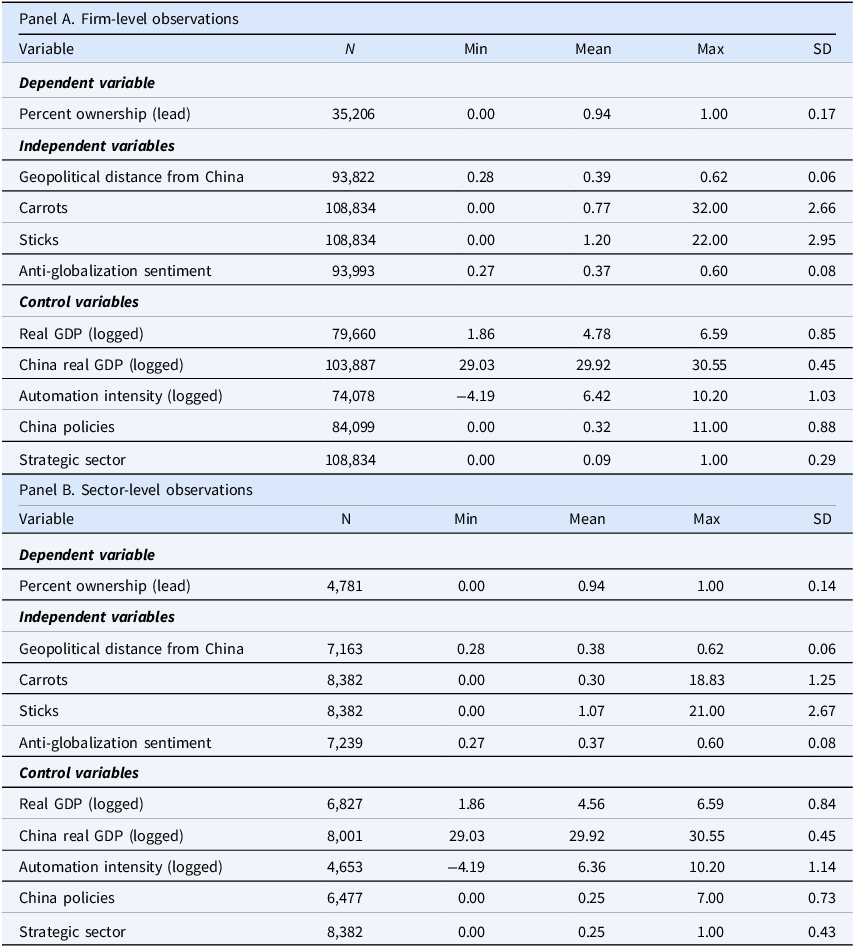
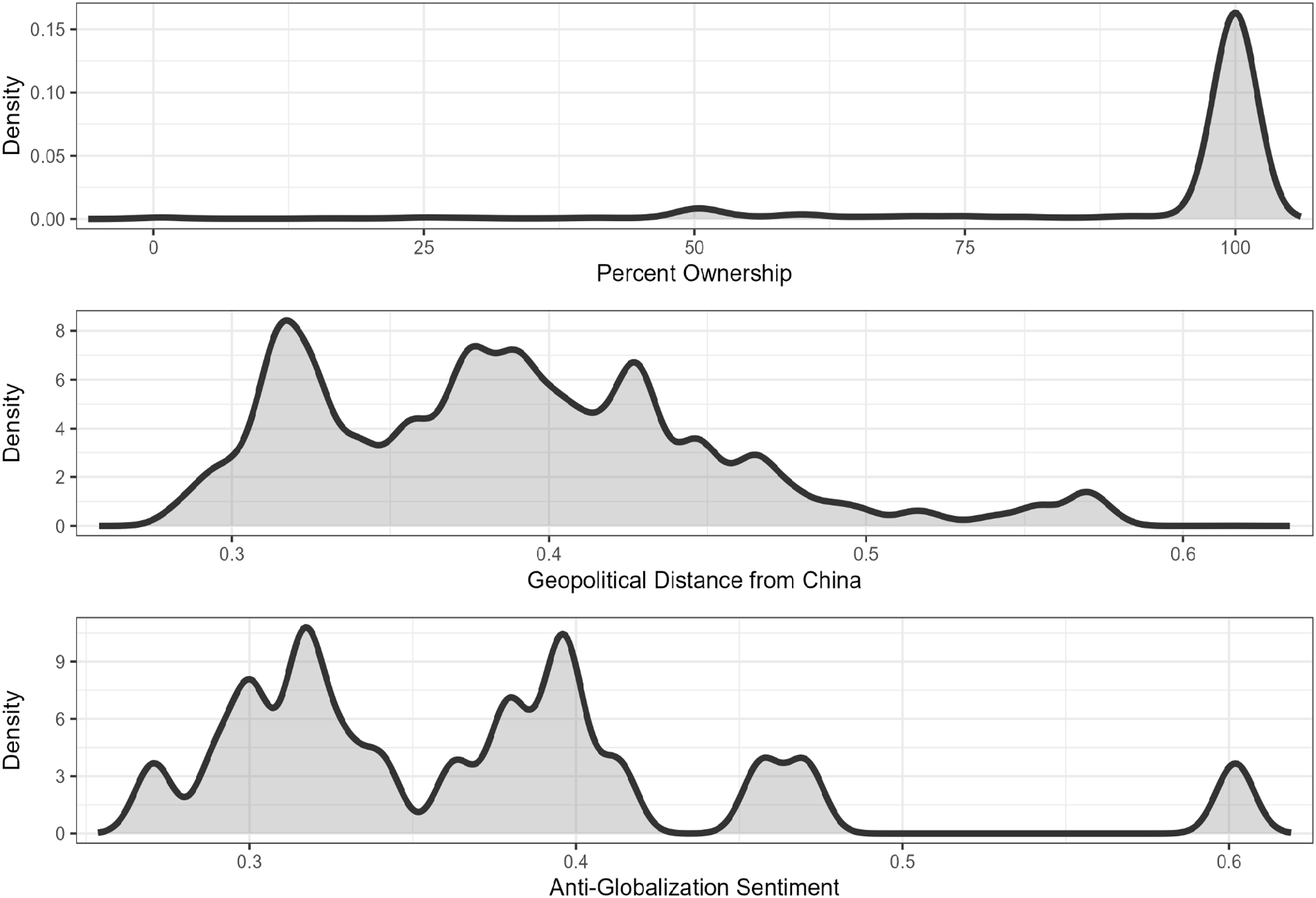
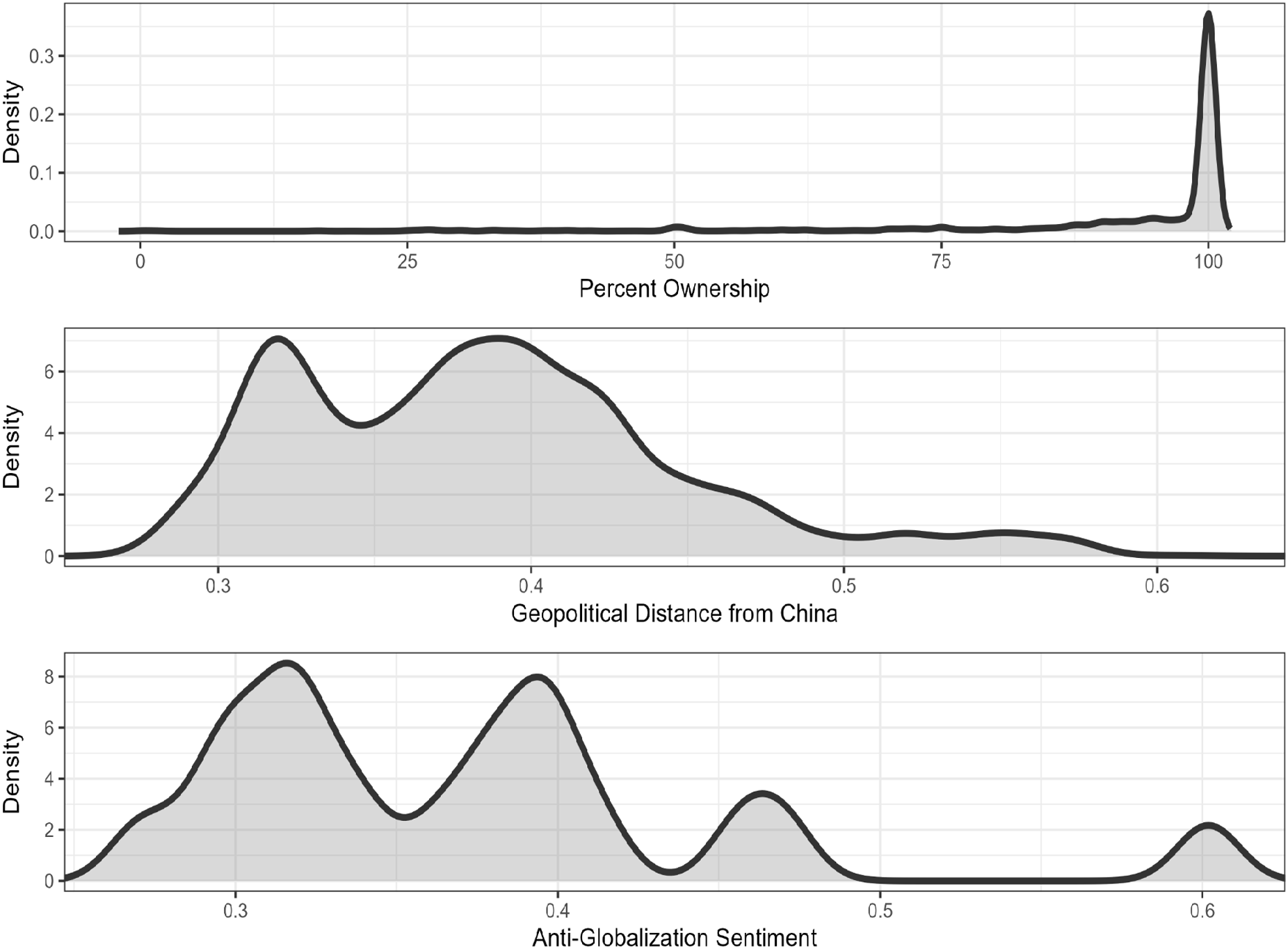
Summary statistics are provided in Table 1 above. Across both levels of analysis, the key political variables—geopolitical distance and anti-globalization sentiment—exhibit broadly similar distributions, which is to be expected. Firm-level units display greater heterogeneity in policy exposure, with carrots, sticks, and Chinese policies appearing more frequently than at the sector level. As expected, sector-level economic indicators vary across wider absolute ranges due to aggregation, while firm-level ownership rates show tighter dispersion. While summary statistics can reveal information, they tell only part of the story. In order to understand the data that we analyze; it is useful to examine the distribution of our variables graphically. Therefore, we plot kernel densities for our dependent variable and our two continuous independent variables at both levels of analysis.
Summary statistics

Table 1. Long description
A table comparing summary statistics for firm-level and sector-level observations. The table has two panels: Panel A for firm-level observations and Panel B for sector-level observations. Each panel includes variables such as percent ownership, geopolitical distance from China, carrots, sticks, anti-globalization sentiment, real GDP, China real GDP, automation intensity, China policies, and strategic sector. Panel A has 10 rows and 6 columns, while Panel B has 10 rows and 6 columns. Each row lists the variable name, number of observations (N), minimum value, mean, maximum value, and standard deviation (SD). Notable trends include the broader range of economic indicators at the sector level due to aggregation and tighter dispersion in firm-level ownership rates.
Depicts kernel density plots of our key variables at the firm level. The top plot shows our dependent variable, firm ownership. What stands out most from this figure is the clustering of the variable around 100%. Nearly 83% of observations involve full ownership of a Chinese subsidiary by a European firm. There is greater variation in our independent variables. Geopolitical distance tends to be around 0.4 but exhibits fairly wide variance. Anti-globalization sentiment clusters primarily in the 30–40percent range, though it extends out further.
Provides kernel density plots for our variables at the sector level. Interestingly, the top plot seems to exhibit a stronger convergence around 100%. However, in relative terms, fewer observations are clustered at the extreme. In this case, fewer than 65% of country-sector-years average full ownership. However, ownership tends to be high on average, with 90% of observations at 78% ownership or higher. In terms of our key independent variables, distributions are similar to the firm level, but smoother.
At both levels of analysis, our dependent variable is a percentage, theoretically ranging between 0 and 100. However, an important insight from Figures 2 and 3 is that observations tend to mass around 100%. Since our variable is not only bounded but also clustered near one of the extremes, classical linear regression models run the risk of improperly estimating the results. This concentration reflects the strong baseline tendency of European firms to hold majority or full ownership of their Chinese subsidiaries, rather than an absence of meaningful variation; our fractional logit specification is designed explicitly to accommodate this distributional feature. Therefore, we rescale the dependent variable to the unit interval and estimate a series of fractional logit models, which allow us to account for the fractional nature of firm ownership in the presence of extreme values.Footnote 72 We address unobserved heterogeneity by including country-level fixed effects and clustering standard errors at the firm or sector level, as appropriate. Unfortunately, not all of our data are complete across the period under analysis. Once we include all of our covariates and account for fixed effects, we are left with 18,915 firm-year-level observations, covering 11 countries over the period 2009–2022. At the sector level, we retain 2,263 observations across 11 countries over the same time period after dropping those with missing data.
Density plots of key variables at firm level.

Density plots of key variables at sector level.

Figure 3. Long description
Panel A: A density plot shows the distribution of percent ownership. The x-axis is labeled ‘Percent Ownership’ and ranges from 0 to 100. The y-axis is labeled ‘Density’. The plot shows a peak near 100 percent ownership, indicating a high concentration of data points at this value. Panel B: A density plot displays the distribution of geopolitical distance from China. The x-axis is labeled ‘Geopolitical Distance from China’ and ranges from approximately 0.3 to 0.6. The y-axis is labeled ‘Density’. The plot exhibits multiple peaks, suggesting varied distances with notable concentrations around 0.35 and 0.45. Panel C: A density plot illustrates the distribution of anti-globalization sentiment. The x-axis is labeled ‘Anti-Globalization Sentiment’ and ranges from approximately 0.3 to 0.6. The y-axis is labeled ‘Density’. The plot shows several peaks, indicating different levels of sentiment with significant concentrations around 0.35, 0.45, and 0.55.
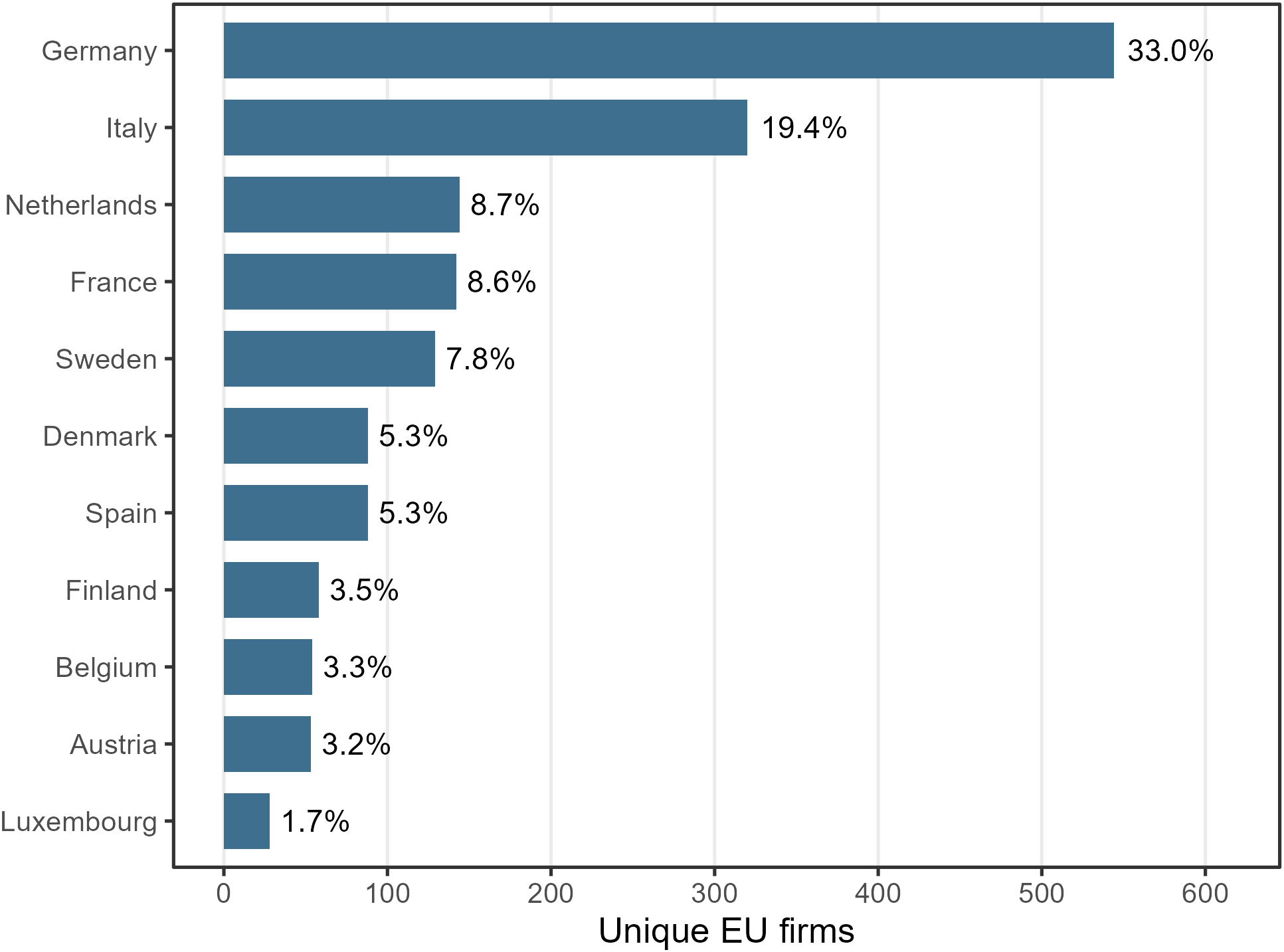
Before moving to the analysis, it is useful to look at the origins of the firms remaining within the final data set. Figure 4 depicts the distribution of firms with respect to the eleven EU countries that remain in the final firm-level regression data set. As is clear from the figure, the majority of firms come from either Germany (approximately one-third) or Italy (just under one-fifth). The Netherlands, France, and Sweden collectively make up approximately the next fourth of the firms, and the remaining six countries constitute the last quarter. While German firms clearly make up the plurality of our observations, this is not simply a story about Germany; other countries are well represented within the data.
Distribution of firms by European country.

Results
For each of our levels of analysis, we run three sets of models. The first is a baseline model, which includes main effects for our independent variables of interest, along with controls. The second includes an interaction between Geopolitical Distance and Anti-Globalization Sentiment. The third includes interactions with Carrots and Sticks.
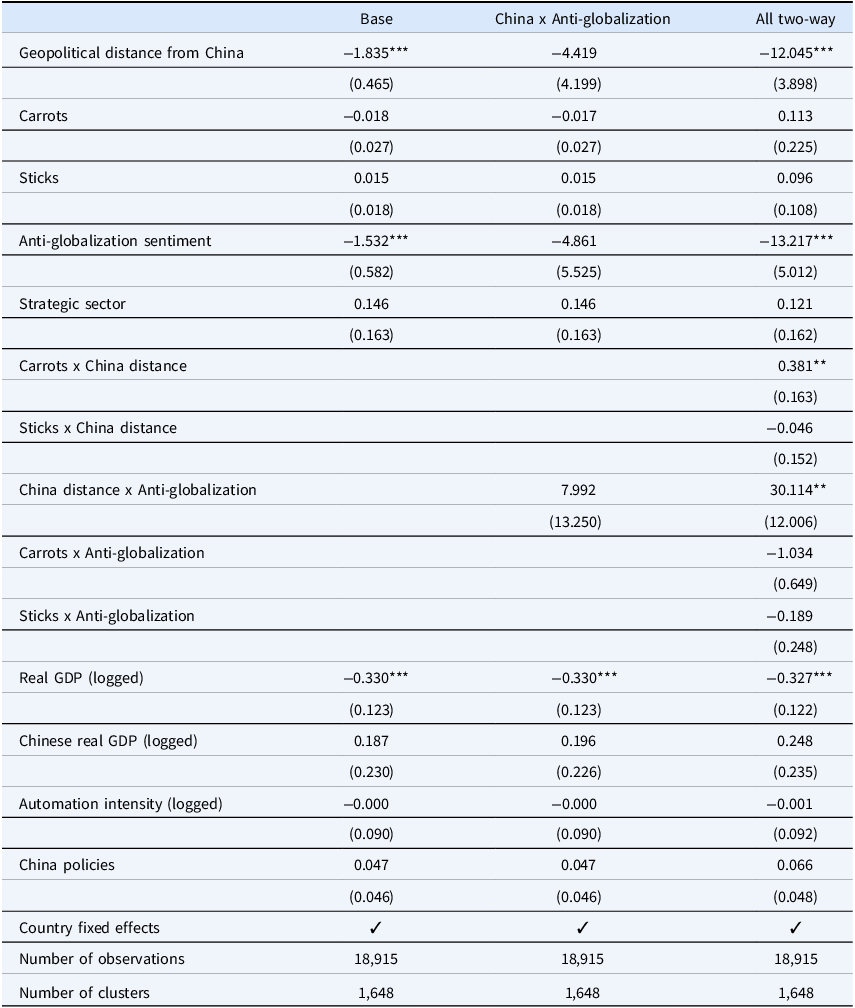
In Table 2 above, we provide the results from our regression at the firm-year level of analysis. Because our fractional logit is a non-linear probability model, coefficients are not directly interpretable as marginal effects. In addition, the effects are complicated by the interactions in Models 2 and 3. Therefore, we include graphical depictions of marginal effects for our variables of interest below. However, we can interpret both sign and significance from the estimated coefficients alone.
Firm-level fractional logit results

Table 2. Long description
The table presents regression results for firm-year level analysis with three models: Base, China x Anti-globalization, and All two-way. It includes 18,915 observations and 1,648 clusters. Key variables include Geopolitical distance from China, Carrots, Sticks, Anti-globalization sentiment, Strategic sector, and interactions among them. Notable coefficients include significant negative values for Geopolitical distance from China and Anti-globalization sentiment in the Base model. The table also lists coefficients for Real GDP, Chinese real GDP, Automation intensity, and China policies across all models.
*p < 0.1, **p < 0.05, ***p < 0.01. All tests are two-tailed tests.
Across our first and third models, geopolitical distance (H1) and anti-globalization sentiment (H3) both exhibit consistent effects with respect to firm ownership. The estimated main effects for the two are negative in both models, suggesting that distance and public opinion are associated with lower levels of investment in China. The coefficients on both variables are also negative in the second model, though not significant at conventional levels. Notably, the interaction between the two is positive. Moreover, because the observed range of both variables is strictly positive (i.e., we never observe either regressor take a value of zero), this interaction effect will be relevant.
In the model with all interactions, the simple marginal effect of geopolitical distance is negative for values of anti-globalization sentiment below approximately 0.40, and positive above it.Footnote 73 Meanwhile, the marginal effect of opposition to trade is negative when geopolitical distance is low (below about 0.44), and positive above this level. Notably, referring back to Figure 3, much of the density for both variables seems to be below these thresholds, suggesting that the effect is in the expected direction much of the time. Indeed, these values are around the 80th and 70th percentiles of their respective variables. This suggests that the marginal effect of each variable is negative for the vast majority of cases.
However, the positive sign on the interaction is still worth noting. One possible interpretation of the estimated effect is that geopolitical distance and anti-globalization sentiment may function as partially substitutable signals of risk for firms. When firms already perceive a substantial geopolitical rift with China, additional public skepticism toward globalization may provide limited new information regarding the desirability of maintaining offshore operations. Conversely, when anti-globalization sentiment is already highly salient domestically, further increases in geopolitical distance may have diminishing effects on firms’ strategic assessments. It is also possible that this pattern could suggest the presence of threshold effects—or at least, a form of non-linear updating—whereby firms respond once political or geopolitical pressures surpass a certain level rather than continuously adjusting exposure in a linear fashion. More broadly, these findings point to the possibility that firms process geopolitical and societal pressures in conditional and non-additive ways.
Of course, given the complexity of the models estimated here, we cannot discuss the exact effect or its level of significance without considering its non-linearities or calculating standard errors specifically for the marginal effect of the interaction.Footnote 74 Those results are presented below, alongside sector-level substantive effects. It is also important to note that neither “carrots” nor “sticks” exhibit significant main effects once interactions are included, and the only significant interaction associated with them is between geopolitical distance and the number of EU carrots. Chinese policy instruments also show no significant effects in any of the firm-level models and do not alter the estimated relationships between the other variables and ownership.
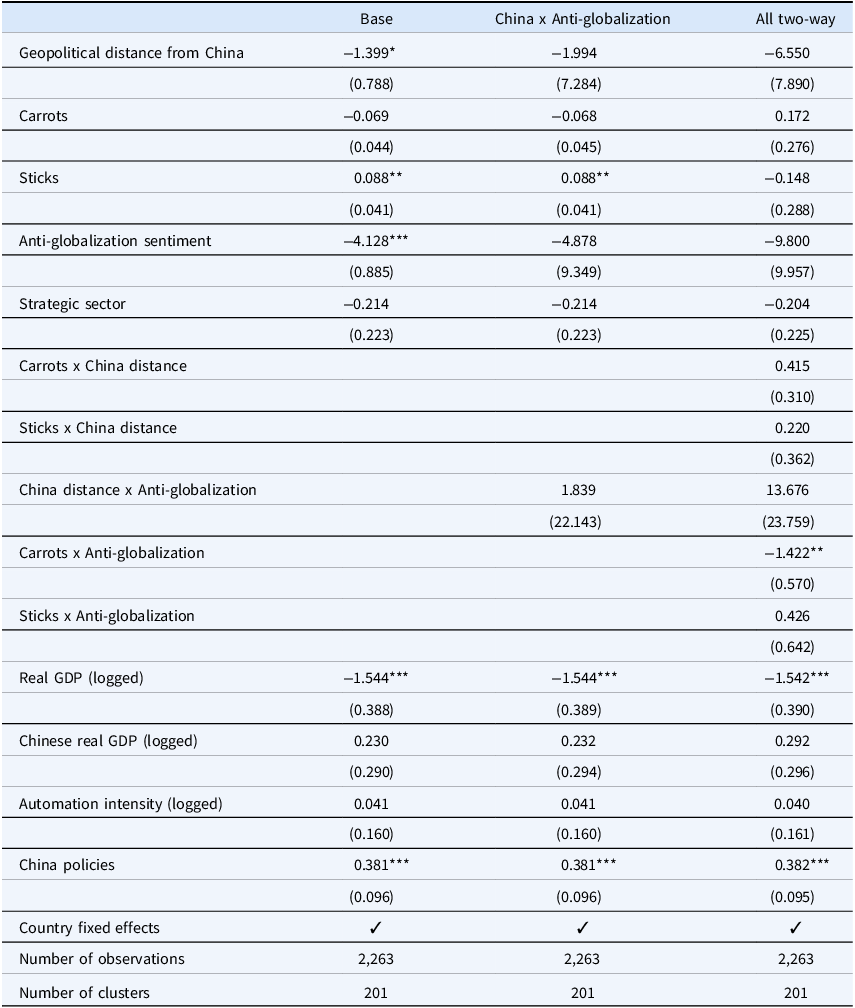
Table 3 above depicts the results from the regression at the country-sector-year level. These sector-level results are quite different from those at the firm level. Here, we find effects for geopolitical distance, anti-globalization sentiment, and sticks in the baseline model, and only the interaction between sentiment and carrots in the interaction model. Additionally, while Chinese policies did not affect firm-level ownership, we find a consistent positive and significant relationship at the sector level. Wald tests suggest that, unlike the firm level, interactions do not improve the models at the sector level. Computation of the root mean squared error with fivefold cross-validation indicates likewise, though the differences are very small. Given these results, the baseline model is the preferred version, providing some support for H1 and H3, but running directly against H2b.Footnote 75
Sector-level fractional logit results

Table 3. Long description
A table with three columns and multiple rows comparing sector-level fractional logit results. The columns are labeled Base, China x Anti-globalization, and All two-way. The rows include variables such as Geopolitical distance from China, Carrots, Sticks, Anti-globalization sentiment, Strategic sector, Carrots x China distance, Sticks x China distance, China distance x Anti-globalization, Carrots x Anti-globalization, Sticks x Anti-globalization, Real GDP (logged), Chinese real GDP (logged), Automation intensity (logged), China policies, Country fixed effects, Number of observations, and Number of clusters. Each row contains values corresponding to the columns, with some values in parentheses indicating standard errors. Notable trends include significant values for Geopolitical distance from China, Sticks, Anti-globalization sentiment, Real GDP (logged), and China policies in the Base model.
*p < 0.1, **p < 0.05, ***p < 0.01. All tests are two-tailed tests.
In general, our models suggest some support for the effect of anti-globalization attitudes and geopolitical tensions across our various models. We find mixed support for the role of carrots at different levels. Ultimately, however, it is difficult to understand exactly what the effect is simply by looking at the coefficients in these two tables. Therefore, we also calculate and plot estimated marginal effects for both variables of interest. In both cases, we use the models with all interactions. For the firm-level results, we plot the marginal effects of geopolitical distance against both anti-globalization sentiment and EU carrots. We also plot the firm-level effect of anti-globalization sentiment against values of geopolitical distance. At the sector level, we plot the marginal effect of anti-globalization sentiment against the average number of EU carrots for that sector’s firms. For continuous interacted variables (distance and sentiment), we plot from the fifth to ninety-fifth percentile in the empirical data; for policy incentives, we plot from zero to the ceiling of the ninety-fifth percentile. In all four cases, we obtain marginal effects by averaging over observed values for other covariatesFootnote 76 and include the 90% confidence interval, which we calculate using a cluster bootstrap with 1,000 draws.
Marginal effect plots.

Figure 5. Long description
Panel A: A line graph shows the effect of geopolitical distance on average marginal effect at the firm level. The x-axis represents anti-globalization sentiment, and the y-axis represents average marginal effect in percent. The line shows an upward trend. Panel B: A line graph shows the effect of geopolitical distance on average marginal effect at the firm level. The x-axis represents policy incentives for investment in the EU, and the y-axis represents average marginal effect in percent. The line shows an upward trend. Panel C: A line graph shows the effect of anti-globalization sentiment on average marginal effect at the firm level. The x-axis represents geopolitical distance, and the y-axis represents average marginal effect in percent. The line shows an upward trend. Panel D: A line graph shows the effect of anti-globalization sentiment on average marginal effect at the sector level. The x-axis represents policy incentives for investment in the EU, and the y-axis represents average marginal effect in percent. The line shows a downward trend. Panel E: A line graph shows the effect of policy incentives on average marginal effect at the firm level. The x-axis represents geopolitical distance, and the y-axis represents average marginal effect in percent. The line shows an upward trend. Panel F: A line graph shows the effect of policy incentives on average marginal effect at the sector level. The x-axis represents anti-globalization sentiment, and the y-axis represents average marginal effect in percent. The line shows a downward trend.
Depicts the estimated marginal effect for our key independent variables at both levels of analysis. The top row shows the effect of geopolitical distance, as both anti-globalization sentiment and number of carrots increase. Both effects are consistent with the positive estimated effects on our interaction terms. At relatively low levels of sentiment and number of policy instruments—around 0.35 and three carrots, respectively—greater geopolitical distance from China is associated with a reduction in ownership of Chinese firms. Above these values, there is no significant effect, even when the estimated marginal effect crosses the zero line and becomes positive.
Anti-globalization sentiment also shows a negative relationship with firm ownership. At the firm level, when geopolitical distance is below about 0.45, greater anti-globalization sentiment is associated with less EU ownership of Chinese subsidiaries. At the sector level, the interaction with carrots is significant, though it does not appear to have much of an effect. The impact of sentiment is consistently negative, and while the interaction between the two is also negative, the increase in magnitude is marginal.
Finally, the bottom row of Figure 5 examines the effect of EU policy incentives (i.e., carrots). At the firm level, there is a positive interaction with geopolitical distance. However, the marginal effect of these incentives is still negative so long as distance is below approximately 0.50 (which is true for over 90% of observations). At the sector level, the interaction moves the other way, with no effect for carrots in many observations (about 42%), but a negative effect when anti-globalization sentiment is above approximately 0.33.
Thus, our estimated effects provide some additional support for the hypotheses that we test here. In general, they suggest that both public skepticism about globalization and geopolitical distance with China are associated with divestment. In addition, firms seem to respond to policy instruments. Both carrots and sticks, in conjunction with geopolitical distance and anti-globalization responses respectively, are associated with reduced levels of investment in China.
Conclusion
In this article we leveraged a novel database of European firms’ ownership position in China over a 13-year period (2009–2022) to assess whether geopolitical tensions, policy incentives, and public opinion matter in shaping European firms’ decision to divest from China. We conducted analyses at both the firm and sector levels. These analyses provide an interesting set of results. In general, our results provide some support for the effect of both anti-globalization attitudes and geopolitical tensions. At the firm level, we find that geopolitical distance, our measure of geopolitical tensions, and anti-globalization sentiment are both associated with greater divestment from China. However, quite surprisingly, the interaction between the two is positive: geopolitical distance matters only at low levels of anti-globalization sentiment and these latter attitudes play a role only below a certain threshold of geopolitical distance (though the majority of observations fall below these thresholds). We do not find that policy incentives play a significant role in shaping divestment decisions at the level of individual firms. At the sector level, we observe a significant effect of geopolitical distance and public sentiments in the statistically-preferred baseline model, and an effect for anti-globalization sentiment when interacted with carrots in our interaction model.
We would like to conclude by highlighting two important implications of our findings. First, the positive interaction term between geopolitical distance and anti-globalization sentiment in our firm-level analysis suggests that these pressures do not operate in a simply additive fashion. While one might intuitively expect the probability of divestment to increase when firms face both high geopolitical distance and strong anti-globalization sentiment simultaneously, our results indicate a more conditional relationship. One possible interpretation is that geopolitical and societal pressures function as partially substitutable signals of risk. When firms already perceive a substantial geopolitical rift with China, additional public skepticism toward globalization may provide limited new information regarding the desirability of maintaining offshore operations. Conversely, when anti-globalization sentiment is already highly salient domestically, additional increases in geopolitical distance may have diminishing effects on firms’ strategic calculations.
A second possible interpretation concerns threshold effects in firms’ responses to political uncertainty. Rather than continuously recalibrating investment positions in response to incremental changes in geopolitical or societal pressures, firms may respond once perceived risks surpass a sufficiently salient threshold. Once firms internalize geopolitical or reputational risks as materially relevant to their operations, additional increases in either type of pressure may no longer substantially alter investment decisions. More broadly, these findings may also reflect limits in firms’ ability to process multiple sources of political uncertainty simultaneously. In highly uncertain environments, firms may rely on particularly salient signals—such as either sharp geopolitical distance or intense domestic backlash against globalization—when evaluating offshore exposure, rather than systematically incorporating all available sources of political risk into a single calculation. Taken together, these interpretations suggest that firms’ responses to geopoliticization may be more conditional, non-linear, and strategically selective than existing accounts of economic de-risking often assume. Understanding how firms prioritize and interpret different forms of geopolitical and societal pressure therefore represents an important avenue for future research on geopolitics, political risk, and global production networks.
Second, our findings also point to differences between the firm and sector levels of analysis. While individual firms do not seem to systematically respond to policy incentives in their divestment decisions, such incentives appear to play a more consequential role at the sector level. One possible interpretation is that firm-level investment decisions are constrained by substantial sunk costs, long investment horizons, and deeply embedded production networks that cannot easily be reorganized in response to short-term policy changes. By contrast, sectors—where firms share supplier networks, technological standards, and competitive pressures—may adjust more collectively to policy environments,Footnote 78 suggesting that interventions can reshape broad sectoral investment patterns even when individual firms appear less responsive in isolation. This difference in responsiveness across levels of analysis warrants further attention in the growing literature on geopolitics, GVCs, and collective business responses to economic fragmentation.Footnote 79
Our findings consequently suggest that firms’ responses to geopoliticization are neither uniform nor purely additive. Rather than producing straightforward economic decoupling, geopolitical tensions, policy interventions, and domestic political pressures reshape firms’ investment strategies through complex and multi-level processes. At the firm level, investment decisions reflect conditional and non-linear responses to geopolitical and societal risk signals, while at the sector level these effects are more direct. These findings complement other contributions to this Special Issue showing that firms’ responses to geopoliticization vary systematically across sectors and according to their position in GVCs, shaping both business preferences and political mobilization.Footnote 80 More broadly, our findings underscore the importance of unpacking how firms respond to the interaction between geopolitical tensions, government policy incentives, and domestic backlash against globalization. Rather than operating in isolation, these mechanisms appear to jointly reshape firms’ investment strategies through complex and multi-level processes that this article has only begun to uncover.
Indeed, our findings should also be read alongside several constraints that bound what we can claim. Our measure of ownership change cannot distinguish whether a given reduction reflects reshoring, relocation to third countries, or restructuring through new minority partners; disentangling these distinct strategic responses would require firm-level qualitative evidence or destination-specific investment data beyond the scope of this study. Changes in China’s foreign investment regime over this period, including the gradual relaxation of joint-venture requirements in some sectors, may also have shaped the ownership patterns we observe in ways our data cannot fully disentangle. In addition, our estimation window ends in 2022, as data availability constraints prevent us from extending the analysis to more recent years. This means our results do not yet capture the more recent period of EU-China relations, and we encourage future work to revisit these findings as more recent ownership data become available. Similarly, while an absolute-investment measure—for instance, the share of a firm’s total assets held in China—would help distinguish declining ownership shares from divestment, underlying data are not presently available. Our measures of anti-globalization sentiment and policy instruments carry comparable constraints: the Eurobarometer series is necessarily compiled from heterogeneously worded survey items rather than a single consistent question, and our carrot and stick indicators are binary, capturing the presence of a policy rather than its intensity or scale. We view all such constraints as important directions for future research, as both firm-level data on China-based operations and more granular measures of public sentiment and policy intensity continue to improve.
Supplementary material
The supplementary material for this article can be found at https://doi.org/10.1017/bap.2026.10029
Data availability statement
The replication package for the analyses reported in this article is available at Harvard Dataverse: https://doi.org/10.7910/DVN/ORZICT. The package includes all code and aggregated data required to reproduce the reported results. The underlying firm-level ownership data are drawn from Bureau van Dijk’s ORBIS/Moody’s DataHub under a proprietary license and cannot be made publicly available.
Competing interests
The authors declare none.
Artificial intelligence statement
The authors used Claude Sonnet 4.5 (Anthropic, accessed via claude.ai) and GPT-5.6 Luna (OpenAI, accessed via ChatGPT) between November 2025 and September 2026 for general writing assistance and language polishing. All AI-assisted text was reviewed, edited, and verified by the authors, who take full responsibility for the accuracy and integrity of the manuscript’s content.



 Open access

