Introduction
Disasters are events that, by definition, overwhelm infrastructure and put a strain on resources. While it may not be possible to prevent a disaster from occurring, the ability of a health care system to mitigate loss of life and limb is related to its level of preparedness.Reference Abir, Jan, Jubelt, Merchant and Lurie 1 - Reference Teperman 3 Hospitals are required to have emergency response and disaster management plans; however, many of these plans are just general “guidelines” and do not offer information on appropriate practice and decision making.Reference Brevard, Weintraub and Aiken 4 - 6 Furthermore, these plans are often general and may fail to consider needs of specific patient populations. One such population includes patients with ventricular assist devices (VADs). This article will assess the specific needs of the VAD population and hazards they may face in a disaster situation in hope that it may become the first step in disaster planning for VAD patients.
Mitigation is the first phase of the disaster response cycle and involves assessment and planning. Mitigation includes risk assessment, assessment of needs, and the creation of plans and protocols.Reference Beach 7 A formal risk assessment begins with a hazard vulnerability analysis (HVA) to produce a catalog of potential threats and subsequent preparatory needs.Reference Moore, Geller and Clark 8 While HVAs typically are evaluated based on the geographical location of the hospital/facility/city, the scope of this article will evaluate risks based on factors and circumstances that pose threats to the VAD patient population.
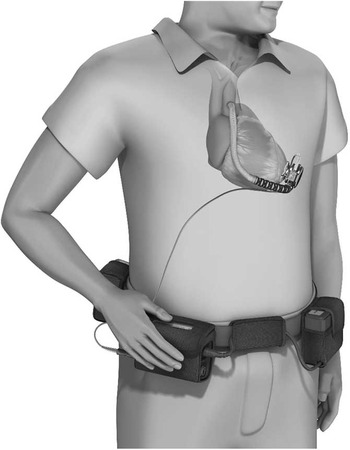
Ventricular assist devices are a form of Advanced Life Support used for bridge to transplantation and bridge to recovery. The use of VADs has increased following the Food and Drug Administration (FDA; Silver Spring, Maryland USA) approval of select devices in the early 2000s for use as bridge to destination therapy in patients who are likely to neither recover cardiac function nor be transplantation candidates. Despite these advancements, there is a void in the literature regarding the care of these patients during disaster scenarios. Even the manufacturer instructions for use do not address operation in extreme or disaster conditions. 9 - 13 There are several different devices that operate as a VAD, but all have common needs of electrical power sources and functional electronic controllers (Figure 1). 9 - 13 These patients also require adequate anticoagulation, other medications (for example for blood pressure control), protection from infection, and adequate hydration. 9 - 13 Newly post-operative patients may be on ventilators, nitric oxide, and/or balloon pumps; however, care requirements for VAD patients with these additional therapies are out of the scope of this current article.
Carrying Case High. Note: Used with permission by HeartWare International Inc (Framingham, Massachusetts USA).

Report
Electrical Power Source
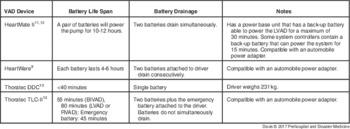
Ventricular assist devices require a continuous power source to function. This can be an Alternating Current/AC (wall power) or Direct Current/DC (battery power) source. Battery life depends on the model of VAD and how much power it draws, and whether the VAD is providing assistance to one or both ventricles. A fully charged battery can last as little as 40 minutes, in the case of Thoratec (Thoratec Corporation; Pleasanton, California USA) Paracorporeal Ventricular Assist Device (PVAD), and as long as four to six hours (dual batteries), as in the case of HeartMate II (Thoratec Corporation) Left Ventricular Assist Devices (LVADs; Table 1). 10 , 11 Patients with VADs are issued multiple batteries, as well as a back-up controller. The number of spare batteries a patient owns will likely vary between device brand and health care institution. The estimated number is likely less than ten, as the Thoratec HeartMate II manual requires one set of four batteries to be provided to each patient. 11 An exception to this would be patients who are connected to a Thoratec Dual Drive Console (DDC) PVAD. This device has an internal battery that lasts less than 40 minutes and cannot be easily changed. 10 In the event of a power failure, or a failure of the Thoratec DDC or TLC-II driver, only the Thoratec PVAD has the ability to be maintained by hand-pumping (if hand pump is available); however, this method delivers an immeasurable cardiac output and will only continue as long as individuals are available and able to manually pump the device. 10 , 13
VAD Devices and Battery Information

Abbreviations: DDC, Dual Drive Console; LVAD, Left Ventricular Assist Device; VAD, ventricular assist device.
One of the major complications from a disaster is the disruption of electrical power. City power is rendered defective almost instantly in the majority of natural disasters, leaving hospitals to be fueled by back-up electrical generators.Reference Brevard, Weintraub and Aiken 4 Despite the requirement for hospitals to have back-up generators, the amount of fuel to store for preparation is not standardized or regulated.Reference Schatz, Wolcott and Fairburn 14 There have also been recent events in which these generators have failed.Reference Fink 15 Even though patients will have back-up devices and batteries, the power that they provide may not be sufficient to last the duration of a power outage in a catastrophe. It was previously suggested that disaster preparations should be sufficient to last 72 hours; however, with analysis of disaster response post-Hurricane Katrina (Gulf Coast USA; 2005), it is now established that seven days is a more accurate time frame for the resumption of essential resources. 5
Anticoagulation
Ventricular assist device patients require anticoagulation to prevent blood clots. 9 - 13 The suggested therapeutic International Normalized Ratio range for a Thoratec PVAD is 2.5 to 3.5, and HeartMate II and HeartWare (HeartWare International Inc.; Framingham, Massachusetts USA) both is 2.0 to 3.0. 9 , 12 , 16 Before or while a patient is being transitioned to warfarin therapy, the patient will be on heparin therapy or another intravenous anticoagulation therapy, titrated to a Partial Thromboplastin Time 1.2-1.5 times the control. 9 , 12 , 16 Anticoagulation therapy poses risks of its own, but these risks would be augmented if monitoring levels could not be conducted, whether due to the laboratory not being available or due to an evacuation process.Reference Lister 17 If anticoagulation levels cannot be titrated, VAD patients may be at-risk for clots, stroke, or bleeding. There is also a chance that it will be difficult to retrieve medications, including heparin or warfarin, from the pharmacy or that heparin therapy may not be able to be maintained through the evacuation process.Reference Zong, Clark, Hou, Zang and FitzGerald 18 Accurate dosage of heparin infusion will likely require the use of an intravenous pump with a functioning battery.
Additionally, other departments may not be available for monitoring and treating blood clots and bleeds. A computed tomography/CT scanner may not be available to assess for pulmonary embolus, retroperitoneal bleeds, or stroke: all potential VAD complications. In the case of a thrombus within the VAD itself, there would be a risk that the effects of the disaster would cause decreased access to thrombolytic therapy or an operating room and team to exchange the VAD pump.
Volume Status and Blood Pressure
In disaster situations, supplies often run low, and at times, some therapies are discontinued in order to allow staff to focus efforts on other areas, such as managing the influx of new patients, evacuation procedures, and to cover larger number of patients while other staff rotate breaks and sleeping.Reference Fink 15 During Hurricane Katrina, the combination of therapy discontinuation, rationing of supplies, and high heat and humidity caused many patients to become hypovolemic.Reference Fink 15 Ventricular assist device patients must have adequate fluid-volume circulation. Devices like the HeartMate II and the HeartWare will continue to circulate blood at a fixed speed despite a decrease in blood volume, causing a “suction event” where the pressure from the pump can cause the left ventricle to begin to collapse on itself. 9 , 12 , Reference O’Shea 19 Another consequence of dehydration may be electrolyte imbalance. Both suction events and electrolyte imbalances may lead to harmful arrhythmias. 9 , 12 , Reference O’Shea 19
Ventricular assist device patients are also at-risk of the adverse effects of hypertension, specifically stroke, edema, and inefficacy of the VAD to maintain adequate cardiac output.Reference Givertz 20 In a sustained disaster, patients may not get their normal medications at regular intervals or may miss doses.Reference Zong, Clark, Hou, Zang and FitzGerald 18 As a result, to conserve and ration health care providers, vital signs of “stable” patients may not be taken as frequently.Reference Fink 15 However, not all patients can tolerate this reduction in hypertension treatment; elevated blood pressure may cause a decrease in blood flow through the pump and cardiac output. Additionally, VAD patients require extra equipment to observe these indicators, such as dopplers and sphygmomanometers for blood pressure, and electrical monitors that display pump flow and power (workload). All of these factors, as well as the stress of the event, could place VAD patients at-risk for inadequate blood pressure management and subsequent adverse effects.
Infection
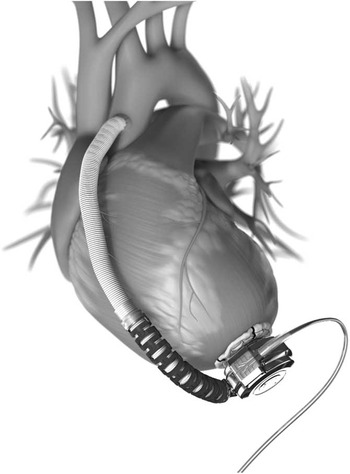
Another common adverse effect that VAD patients encounter is infection, particularly via the driveline exit site. 9 , 12 , 13 , Reference Givertz 20 The driveline connects the internal components of the device to the external controller and power source (Figure 2). The driveline is tunneled under the skin from the abdomen to pump in the heart and provide additional stability and infection barrier. Infection at these sites can be a severe complication. The exit site is typically covered with a sterile dressing and kept dry and clean. The VAD driveline needs to be anchored to the patient’s body and kept secure from pulling and manipulation, which may occur in an urgent evacuation. Certain scenarios of a disaster could predispose VAD patients to infection, such as exposure to a harsh environment, exposure to pollutants, or decrease in normal dressing changes due to decreased supplies, rationing of health care workers, or environmental conditions.
Full Heart and Pump-High. Note: Used with permission by HeartWare International Inc (Framingham, Massachusetts USA).

Evacuation
Depending on the type of disaster and if it provides an adequate forewarning, the strategy of pre-evacuation of resource-intensive patients should be used. This strategy was adopted following Hurricane Katrina for the purpose of preventing high-risk and high-acuity patients from being stranded without water or power, and to avoid evacuating these patients in worse conditions during or after the disaster. 21 Patients with VADs may have difficulty during evacuations due to the nature of the equipment. The DDC is large and heavy, measuring 76.2 cm x 59.7 cm x 129.5 cm and weighing 231 kg. 10 The DDC is used in the acute post-operative period to closely monitor pressures before transitioning to the more portable (33 cm x 34 cm x 13 cm; 8 kg) TLC-II driver. 10 , 13 Patients with these devices may need to be transitioned to the TLC-II in order to be evacuated with less inconvenience. There are some rare occasions in which a patient may not be able to be successfully converted from the DDC to the TLC-II driver. These instances include intra-aortic thrombus and cardiac output requiring high pressures that are unable to be maintained by the TLC-II. In these cases, patients on the DDC will be extremely difficult to evacuate vertically or from a building without working elevators, lift equipment, and a supplemental power source. This difficultly was a reality during Hurricane Katrina, when a 15-year old boy with cardiomyopathy requiring biventricular support via a Thoratec DDC needed to be evacuated from Tulane University Hospital (New Orleans, Louisiana USA) to Texas Children’s Hospital (Houston, Texas USA) due to the hospital having no electrical power. Tremendous effort was needed as a TLC-II driver was unavailable, the patient required a gasoline-powered generator, modifications to the structure of the DDC were needed to fit it onto the helicopter, and the patient had to be manually hand-pumped during transfer from the seventh floor of the hospital to the helicopter pad.Reference Owens, Morales and Braham 22
Health care providers who are specially trained on the devices, device alarms, and clinical significance care for patients with VADs while they are in acute care settings. In a disaster situation, there may be a shortage of these personal, or they may be in the facility but deferred to areas of greater need. There may be situations where VAD patients need to be evacuated, but a VAD-trained provider is unable to accompany them.
Extreme Environmental Conditions
Another potential hazard exists in a severe weather event. The devices are all electrical and none are waterproof. All manuals note that the device should not come in contact with water and general liquids. 9 - 13 Ventricular assist device patients will be at a significant risk of controller fault or electrocution if they are exposed to water from flooding or precipitation. 12 Some devices have “Shower Kits” that contain equipment to protect the controller and batteries from liquid, which may be helpful protecting the patient should they be readily available. 9 , 11 , 12 Additionally, device manuals also warn of electrical safety, such as shock hazard, static interference, and the need for a grounded electrical source. 9 - 13
Most of these manuals also specify that the VAD controllers should have an operating range of 20oC-40oC. 9 - 13 The manuals also state that the VADs should not function in an environment with humidity greater than 90%. 9 - 13 Functionality could be at-risk in extreme weather conditions, as in the case of Hurricane Katrina when temperatures rose to greater than 43oC with a humidity of 100%, or in the event of a snowstorm.Reference Bailey 23 , Reference Taylor 24 Battery life can also be effected by extreme high or low temperatures. Moreover, the Thoratec DDC and TLC-II devices require a clean, dry air supply, which may be endangered in the case of debris due to an earthquake or acts of terrorism. 10 , 13 Lastly, the Thoratec DDC should not be exposed to flammable gases, which may be present in the event of a broken gas line. 9 - 13
Discussion
One lesson gained from the Hurricane Katrina disaster response is that difficult questions should be asked and answered before they could be played out in a disaster.Reference Beach 7 , Reference Holt 25 The risks identified above give rise to several questions, both practical and ethical. In the event of a catastrophe, the hospital may have extra VAD batteries that they could distribute to the patients. How will the batteries, and any resource, be distributed? Should they go to whoever has the least number of fully charged batteries of their own? The VAD patient who is the sickest? Or should they be given to a patient who is bridge to transplant verses one who is bridge to destination? Which patients should be evacuated first? Which patients require VAD-trained personnel during evacuation transport? Should an evacuated patient’s extra equipment go with them or should it be distributed to the other remaining VAD patients? Should time and money be spent organizing preparedness kits of the resources a VAD patient would need in a disaster? Is the staff adequately trained to handle this equipment in extreme conditions (for example, do they know how to properly operate and maneuver a VAD during flooding to minimize risk to themselves and the patient)? Should time and money be spent training staff members to care for and evacuate VAD patients during a disaster? Should staff members be educated on these risks and how to answer these difficult questions? What protocols are in place to help the staff with these difficult situations and decisions, and what protocols need to be created?
Conclusion
This article explores the considerable risks that VAD patients could endure in a disaster situation. Health care providers will need to determine strategies for overcoming these obstacles in order to care for these patients. Now that these hazards have been identified, further work is needed to develop preparedness measures.