1 Introduction
Language documentation has received increasing attention within linguistics in recent years. A major impetus is the rapid decline in the number of languages being spoken (e.g. Hale et al. Reference Hale, Krauss, Watahomigie, Yamamoto, Craig, Jeanne and England1992, Nettle & Romaine Reference Nettle and Romaine2000); indeed, the number of language families that are threatened is quite large as well (Whalen & Simons Reference Whalen and Simons2012). Phonetic documentation is a part of that effort, but it is one that has not received widespread attention. The phonetic structure of a language, as with any other linguistic level, is dauntingly complex, but documentation efforts are still worthwhile. Flemming, Ladefoged & Thomason (Reference Flemming, Ladefoged and Thomason2008: 465) expressed their aim as ‘to demonstrate how current techniques of phonetic investigation can be applied so as to be able to construct a basic, but reasonably comprehensive, set of materials for an archive of the sounds of an American Indian language’. They further add that ‘the failure to be able to provide everything does not mean that we should not try to provide as much as we can’ (ibid.). The present paper presents a preliminary survey of what has been done in a portion of the English-language peer-reviewed literature in terms of phonetic documentation.
The details of what constitutes ideal, or even adequate, documentation has also received attention (e.g. Himmelmann Reference Himmelmann1998, Woodbury Reference Woodbury2003, Austin Reference Austin2014). To a certain extent, conceptions of adequacy of documentation change as technology changes. For millennia, a written transcription was all that was available, leading to debate about whether language change was based on letters or sounds (e.g. Robins Reference Robins1968: 186). With the advent of recorded sound, far more detailed documentation became possible, especially for phonetic aspects of language. Many recordings were made of minority languages on Edison cylinders (Bauman Reference Bauman2011, de Graaf Reference de Graaf, Fishman, David Singleton and Aronin2013), and some of those have been restored for current use (Haber Reference Haber2014). As recording technology improved and storage capacity increased, expectations for the amount of material also increased. Although no language will ever be fully documented, the boost in capacity has certainly made it possible to study phonetics in greater detail.
The articulatory aspects of speech are equally important in understanding phonetics, and the history of the shift due to technology is similar to that for acoustics. Introspection has provided substantial information about the physical basis for the sounds that are perceived, even from our earliest linguistic records (Kemp Reference Kemp, Koerner and Asher1995, Kiparsky Reference Kiparsky and Asher1995). As with sound, devices that make a more permanent record and allow for more quantitative analysis have enhanced our ability to gain deeper insight. Early studies included not only examinations of majority languages (e.g. Rousselot Reference Rousselot1897–1908, Viëtor Reference Viëtor1898) but field studies as well (Goddard Reference Goddard1905). Although numerous physiological studies are performed currently (including those outside the laboratory; Whalen & McDonough Reference Whalen and McDonough2015), articulatory data are not yet a standard component of language documentation.
Indeed, the specifics of phonetic documentation in general have received only sparse attention (e.g. Ladefoged & Maddieson Reference Ladefoged and Maddieson1996a, Ladefoged Reference Ladefoged2003, Bhaskararao Reference Bhaskararao2004), and there has been no comprehensive list of phonetic features that should be expected in a documentation project. Prior to establishing such a list, it is advisable to determine which features have been included in existing studies. To that end, we examined three relevant collections: Articles in the Journal of Phonetics (JPhon), the Illustrations of the IPA in the Journal of the International Phonetic Association (JIPA), and the various ‘phonetic structures’ articles written by Peter Ladefoged, Ian Maddieson, and their colleagues in the Sounds of the World’s Languages project (SOWL; funded by the US National Science Foundation). The first two sources are not exclusively concerned with quantitative phonetic documentation, of course, but nonetheless there is substantial material there. In addition, there are many articles in JIPA that are not part of the Illustrations of the IPA series but which qualify as phonetic descriptions. We restricted our attention to the Illustrations of the IPA because they are attempts at describing all of the relevant phones of a language or dialect, at a minimum via transcription. However, acoustic measurements can be included, and the coverage can be seen as an indication of what measurements are typical and/or expected. The SOWL collection, which appeared in a number of venues, provides a comparison in that these articles were primarily intended to provide greater descriptive phonetic coverage; being journal articles, however, they were necessarily restricted in scope, and the scope that was selected can be compared with the other collections.
It might seem inappropriate to examine two collections that are not devoted to the topic at hand – phonetic documentation – but there are no journals that specialize in that domain. Each of the journals chosen does, as we will see, include phonetic documentation in some of their articles, even if such documentation is not the main purpose for either journal. For the Journal of Phonetics, theoretical issues are more central to the articles that are published. With the Illustrations of the IPA, the main goal is to show the segmental (and possibly suprasegmental) inventory of a language or dialect. Completeness in the description of phonetic attributes is neither expected nor encouraged. The instructions for the Illustrations of the IPA at one time stated: ‘In general, a submission to this section of JIPA should be relatively brief and not a fully-fledged article on the phonetics of the language’. In response to changing expectations for phonetic research in the field at large, this has now been changed to: ‘Although submissions to this section of JIPA can be relatively brief, fully-fledged articles on the sound system of the language described, providing additional detail (including supporting evidence from acoustics, articulation or perception), are strongly encouraged’ (https://multimediafluids.uam.elogim.com/core/services/aop-file-manager/file/575ac14dcc7317902c964bdd/IPA-ifc.pdf, accessed on 15 June 2020). Illustrations are expected to provide a translation of the story ‘The North Wind and the Sun’ or another short representative text as spoken by one native speaker of the language described. Despite the historical focus on the IPA, quantitative analyses have appeared in an increasing number of Illustrations over the years. One motivation for the quantitative analyses is to provide some evidence demonstrating the accuracy of the phonetic transcription chosen for the language.
Finally, we will compare documentation coverage from these three collections to a few book-length phonetic studies in English. These do not constitute a collection, being separately published, but the expectation is that they would have greater coverage and thus be a point of comparison to the collections.
1.1 Collections
Our three main collections were limited to publications in English, in order to make the survey feasible with our resources and appropriate in size to the exploratory nature of the study. There are examples of collections in other languages, such as publications in Spanish covering indigenous languages of Latin America (e.g. http://repositorio.ciesas.edu.mx and http://repositorio.pucp.edu.pe/index/) and in Chinese covering various languages (http://navi.cnki.net/knavi/JournalDetail?pcode=CJFD&pykm=ZYUB). Dissertations and theses (in English as well as other languages) often include documentation, but they were beyond the scope of this study as well. Future work on phonetic ontologies should include assessment of these additional resources as well.
Our first collection was the Illustrations of the IPA. The first of these appeared in 1989 (though ‘specimens’ had appeared in Le Maître Phonétique; see Hirst Reference Hirst2010). We have taken these articles as our defining collection because they are intended to provide a sketch of the sound system of the language. Being the outlet for the IPA itself, the transcription is the primary objective. Nonetheless, acoustic measurements have accompanied many of the Illustrations, and we take the types of measurements made and more general classes of phonetic aspects of the languages as our first pass at a set of ‘categories’ that one might expect in the phonetic documentation of a language. Categories were largely types of acoustic measurements, but some of them were more inclusive (see next section, ‘Method’, for more details).
The second collection was selected from the Journal of Phonetics. Although this journal was first published in 1973, the earliest of that journal’s articles that we included appeared in 1984. This journal has a largely theoretical approach to phonetics, and thus documentation is usually incidental (though see SOWL examples in the next paragraph). We limited our analysis to the categories derived from the Illustrations of the IPA collection. This meant that some of the features that received a fair amount of attention in the Journal of Phonetics, such as voice quality, sex differences, and coarticulation, do not fit neatly into the categories we chose. For each of those categories, it can be argued that they remain on the ‘theoretical research’ end of the spectrum rather than the ‘documentation’ end. The relevant measures for voice quality are still debated, and very few attempts have been made to provide a single acoustic metric for coarticulation. Until those important aspects of speech yield to more systematic and widely used measures, we would argue that nondistinctive voice quality measures should continue to be counted as theoretical research rather than documentation. Distinctive voice quality, at a minimum, should ultimately be included, as it was in many of the SOWL publications.
The third collection was the Sounds of the World’s Languages. The first SOWL phonetic structures article appeared in 1993. There were 25 published studies in all, most of which appeared in peer-reviewed journals (six appeared only in the UCLA Working Papers in Phonetics). Two of them appeared in the Journal of Phonetics and are counted twice in our statistics. As expected, these articles provided more coverage of our phonetic categories than the other two collections because it was their intent to provide such coverage.
2 Method
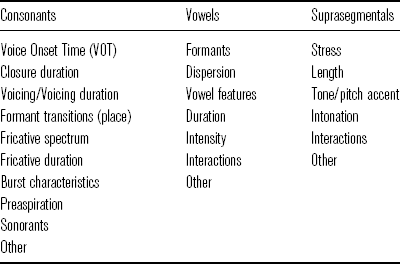
We surveyed the Illustrations of the IPA to extract a set of emergent categories. These are listed in Table 1. Categories were selected, with the aim to be a starting point for further discussion, in two stages. First, we discussed what kinds of features would be reasonable for phonetic sketches to include (VOT, vowel formant measures, etc.). Following this, we analyzed a preliminary sampling of selected sketches from the Illustrations series, working on the assumption that if some sketch included a particular phonetic measure, it would be a reasonable starting place to ask if others also included it. The final categories had to occur in more than one article, but there was no attempt to make them conform to a hierarchy. While many of the categories are self-evident, specific ones emerged in the analysis of the different articles. For instance, ‘interactions’ for either Vowels or Suprasegmentals indicated that the author(s) examined how two of the self-evident categories interacted, e.g. the relationship between vowel duration and dispersion or the relationship between tone and intonation. The category ‘vowel features’ was used as a general grouping for analyses of vowel features like phonation, ATR, and nasalization. Thus some of the categories overlap, and some are open to interpretation. We will discuss limitations and future directions in Section 4, ‘Discussion’, below.
Phonetic categories surveyed.

We assigned a value of 0, 0.5 or 1 to each category in each paper. The extreme values represent no (0) or good (1) representation of the category in the acoustic measurements. If only partial results were presented, such as measuring formants for only a few vowels rather than the whole inventory, or discussing the VOT of different consonant types without presenting any actual measurements, a value of 0.5 was assigned.
The interpretation of the number values assigned to these categories varied slightly for each of the collections. If an article within the JIPA collection included either a spectrogram or some brief measurements for a particular category, e.g. contrastive vowel length, the category was assigned a value of 1. However, owing to the greater analytical depth in the JPhon and SOWL collections, the inclusion of a spectrogram for a particular category would garner a value of 0.5. A value of 1 for a category in these collections necessitated the inclusion of a table of observed measurements or a figure illustrating a set of averaged values. We believe that each of the collections should be evaluated on their own terms for present purposes, although a unified approach is desirable for the future.
As indicated earlier, this set of categories was derived from the Illustrations, not from first principles. They are not a completely coherent set. The category ‘sonorants’, for instance, could include formant, duration and/or intensity measurements, but in fact, sonorant consonants were seldom measured at all. Our intent was to see how often the most common categories were used, and allow them to determine a rough estimate of coverage. If we included categories for every possible combination of duration, frequency and intensity, there would be many ‘0’ cells for every description we examined. That might be useful at some future time, but it was deemed counterproductive for this initial survey.
Some categories with zeroes should not count against a study, of course. If the target language does not have preaspiration or tone, one would not expect them to be measured. Neither is it appropriate to give credit for them, say, by giving a 1 if the language lacked the feature. In any event, we did not have the resources to track down which gaps occurred in the languages studied, so a lack of documentation of a non-existent category is currently counted as a lack of documentation, and future studies should address how to deal with such gaps. For instance, is phonetic documentation more complete if one examines only formant values for a language with a common, average size vowel inventory (e.g. /i e a o u/) than for a language with additional vocalic features, e.g. /i iː e eː a aː o oː u uː/?
Each collection was surveyed by one of the authors. Because the categories are provisional, only one judge was used. If the categories were agreed upon by the community at large, multiple judges would have been used to allow assessment of agreement. Indeed, the two articles that were included in two collections (JPhon and SOWL) revealed differences even there. Disagreements about coverage can be expected to remain even after better criteria are developed, and methods for accounting for discrepancies have been proposed (e.g. Banerjee et al. Reference Banerjee, Capozzoli, McSweeney and Sinha1999, Kottner et al. Reference Kottner, Audige, Brorson, Donner, Gajewski, Hróbjartsson, Roberts, Shoukri and Streiner2011). Because of the preliminary nature of the present categories, a systematic assessment of degrees of disagreement was deemed premature. If a more definitive set of categories emerges, validation across raters would clearly be called for.
3 Results
3.1 Journal of the International Phonetic Association (JIPA)
The Journal of the International Phonetic Association began publication in 1971 as a continuing publication of the International Phonetic Association. Two previous journals, The Phonetic Teacher (which began in 1886) and Le Maître Phonétique (1889–1970, with some years suspended), were other organs for the association. In 1989, a series of articles was begun under the rubric ‘Illustrations of the IPA’, with Peter Ladefoged (anonymously) commencing with American English, embedded within the article known as the Kiel report (International Phonetic Association 1989). This report, substantially updated the IPA, and so the intent of the new series was that the ‘IPA should be illustrated by transcriptions in a range of languages. For each language there should be a word list, with English glosses, illustrating all the major surface phonetic contrasts that occur in the language, and a connected text’ (p.77). The transcription was meant to represent what was recorded, and not an idealization. It was noted at the time that ‘[a] recording of all this material should be available’ (ibid.), but ‘available’ was left unspecified. Many of the Illustrations have accompanying online recordings (https://richardbeare.github.io/marijatabain/ipa_illustrations_all.html). The story ‘The North Wind and the Sun’ was suggested as a means to save space, since no translation would need to be included. Further, each Illustration was to include notes on allophony not obvious from the transcription, lexically relevant suprasegmental detail (e.g. tone or unpredictable stress), the example passage in the original orthography (revealing a subtle bias toward languages with written traditions), and an audio recording (International Phonetic Association 1989: 77–78). Because the IPA is a transcription tool, it is unsurprising that most of the discussion has been about how to transcribe a language. Nonetheless, acoustic aspects have been and continue to be reported.
As of the end of 2018, the series has published 161 sketches, with a lull in the mid-to-late 1990s, and a burst in the past five years (see Figure 1). To examine trends in this corpus, we divided the corpus into three decade-long periods: 1989–1998, 1999–2008, and 2009–2018.
Number of Illustrations published in JIPA, by year.

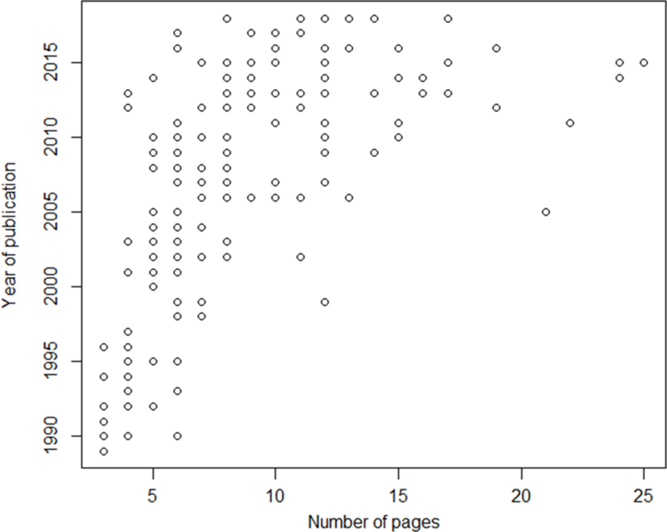
The original sample sketch of American English was a little under three pages long, and Illustrations of that length were common over the next several years. Since then, they have continually trended upward in both length and phonetic detail. For example, there were no sketches over seven pages in length in the first decade of the series, and the average page length in each period is 4.1, 7.2, and 11 pages, respectively. The longest Illustration in our survey’s time span is on Ersu (Chirkova et al. Reference Chirkova, Wang, Chen, Amelot and Antolík2015), at 25 pages. Figure 2 shows a scatterplot of Illustration length by publication year.
Coverage was calculated as the percentage of articles studied that reported data for each category; articles that received a rating of 0.5 (see Section 2 above) were thus counted as half a reference. Values for the various categories ranged from 0% to 56.5%, with a mean of 11.6% across all 23 with a standard deviation of 9.3%; see Table 2 for a breakdown by category. VOT (11.8%) and voicing (15.9%) are the most commonly reported consonantal categories; formants (33.7%) and dispersion (26.0%) for the vowels; and stress (25.7%) and tone/pitch accent (24.1%) for the suprasegmentals. There is a slight tendency for coverage to increase across the three decades (1990s, 8.9%; 2000s, 10.7%; 2010s, 12.7%), but there is a great deal of variability here. Many Illustrations continue the tradition of containing few or no acoustic measurements at all.
Coverage by category for JIPA.

Plot showing the increase in page length of Illustrations in JIPA in recent years.

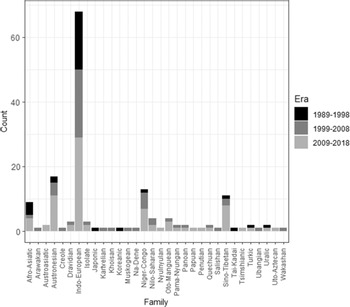
The representation by language family is heavily skewed toward Indo-European (see Figure 3), accounting for 40% of all Illustrations published. This includes seven dialects of English, which is not unexpected for a research community for whom that is the most common native language. We had expected that this Indo-European overrepresentation would decrease over time, but, as can be seen in Figure 3, the proportions have hardly changed over the decades. Illustrations are not commissioned, and they do tend to reflect the proportion of phonetic research in the world’s language families.
Distribution of Illustrations by language family and decade. Note that the most recent decade is on the bottom of each bar.

3.2 Journal of Phonetics (JPhon)
The Journal of Phonetics has been published since 1973, generally with four issues per year. It has always had a theoretical and experimental emphasis. One of the 12 topics that are currently listed on the journal’s website as example research areas is ‘[d]escriptive phonetics pertaining to individual languages’. Phonetic documentation is thus not excluded from the journal, but it is also not prominent. Nonetheless, it is one of the major journals in the field and constitutes one of our three samples of practice in phonetic documentation.
Of the approximately 1,560 articles published, 110 were deemed to be potentially relevant to our study on the basis of the title and abstract. These were examined in more detail by two of the authors for a judgment of whether the article could count as documentation, and initial disagreements were discussed until a decision was made. Measurements of at least an entire category in the phonemic inventory were necessary at a minimum, e.g. the vowels or nasal consonants of the language. The amount of material and coverage needed was not fixed, and the decisions necessarily rested on multiple considerations. The number of speakers and tokens measured was one feature, with larger numbers, naturally, making it more likely that a ‘yes’ judgment would be made. Measurements of a single aspect of a distinction (such as perturbations of fundamental frequency (f0) by stop voicing) were generally insufficient, while more global (and common) measures such as voice onset time (VOT) would be sufficient. It is always possible to examine the interactions between different phonetic distinctions, but if such interactions were the primary goal of the article, it was excluded from consideration. For instance, a description would ideally contain measurements for all members of a particular phonological category, e.g. all stops, all nasals, or all coronal consonants. Those articles specializing on a small subset of the phonetic contrasts in a series were excluded. The presence or absence of a theoretical conclusion was not taken into account; most of the articles did indeed make a theoretical point. Articles that dealt exclusively with perception were excluded; see the ‘Discussion’ section for further considerations about perception.
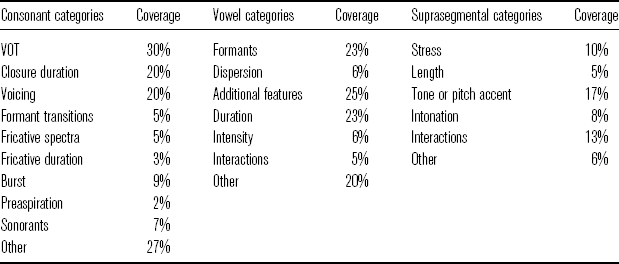
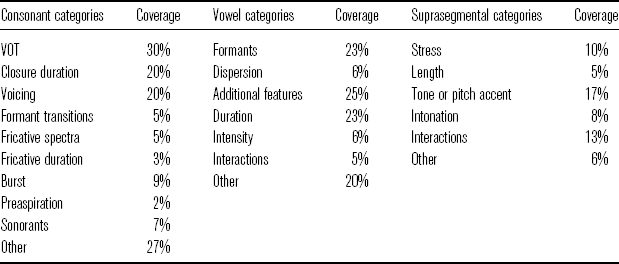
Coverage for the categories ranges from 2.2% to 39.1%, with a mean of 12.5% and a standard deviation of 7.4%; see Table 3 for a breakdown by category. VOT (29.7%) and both closure duration and voicing (each 20.3%) were the most commonly reported consonantal categories; ‘vowel features’ (25.0%) and formants (22.7%) for the vowels; and tone/pitch accent (17.2%) and interactions (12.5%) for the suprasegmentals. There was an uptick in coverage between the 1990s (7.4%) and the first decade of the 2000s (16.1%), but then a slight decline in the 2010s (13.1%). As with JIPA, there is a great deal of variability in each of those ranges.
Coverage by category for JPhon.
3.3 Ladefoged, Maddieson and colleagues, Sounds of the World’s Languages (SOWL)
Largely funded by the US National Science Foundation, Peter Ladefoged, Ian Maddieson and colleagues spent decades recording and describing the phonetics of as many languages as they could. The studies involved students and senior colleagues, ultimately including about 40 co-authors. Most of the resulting studies appear in the UCLA Working Papers in Phonetics (WPP), where they continue to be archived and freely accessible. Of the 25 phonetic structures articles in the UCLA WPP, 19 were published in journals as well, and they were a major source for Ladefoged & Maddieson (Reference Ladefoged and Maddieson1996b).
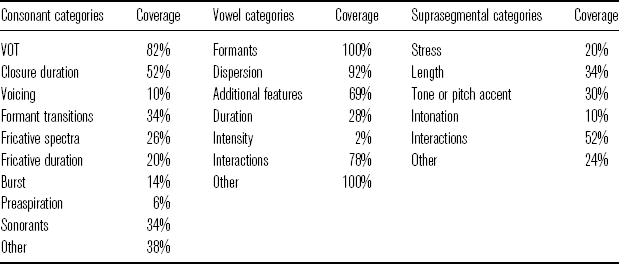
As might be expected, these studies examined a substantially higher proportion of phonetic categories than those in the other two collections. On average, they covered 40.9% of our categories. They ranged from 18.2% to 68.2%, with a standard deviation of 12.9%. The most common consonantal categories were again VOT (82.0%) and closure duration (52.0%). For vowels, formants (100%) and dispersion (92.0%) were most common. For the suprasegmentals, interactions (52.0%) and length (34.0%) predominated. For two of the languages missing VOT as a category (Amis (ISO 639-3: ami) and Sele (ISO 639-3: snw)), the languages lack voicing distinctions, so, measuring VOT might seem unnecessary; indeed, descriptions of Australian languages, which typically lack a voicing distinction, do not report extensive VOT measures (e.g, Butcher Reference Butcher, Adrian and Pätzold1996, Bowern, McDonough & Kelliher Reference Bowern, McDonough and Kelliher2012). However, VOT measures in several languages without a voicing distinction reveal an equal number of realization patterns (Kakadelis & Whalen Reference Kakadelis and Whalen2018). Table 4 shows the rates of coverage for each category.
Coverage by category for SOWL.
Across the board, phonetic investigations into suprasegmental categories were less represented than work on segmental categories. Within the consonantal categories, VOT and closure duration were analyzed in many studies, but burst acoustics and voicing (here, degree of voicing during closure) were absent in most studies. Within the vocalic categories, most studies included an analysis of formants and vowel dispersion, but fewer studies included data on vowel duration or intensity.
Even though the sketches were designed to be as comprehensive as feasible in an article-length format, some of the studies did in fact focus on a particular aspect of the language, such as vowels (Maddieson & Gordon Reference Maddieson and Gordon1996) or clicks (Sands, Maddieson & Ladefoged Reference Sands, Maddieson and Ladefoged1996). Overall, the coverage of our categories in these articles is fairly good, considering that they are similar in magnitude to those of book-length studies (see next section).
The SOWL program addressed endangered languages, covering an impressive 20 families in the 25 papers reviewed. In addition, the only Indo-European language was Scottish Gaelic, a language that has received scant attention in the phonetics literature. The typological coverage within this collection was much greater than that which was observed in the other collections. We return to this point in the ‘Discussion’ section below.
3.4 Books
There is no ‘collection’ of books of phonetic description, but our expectation was that book-length phonetic studies, or books that contain substantial amounts of acoustic phonetic description, would have a larger degree of coverage than the articles in the three collections. We were only able to find four phonetic book-length studies written in English: for Navajo (ISO 639-3 nav; McDonough Reference McDonough2003), Witsuwit’en (ISO 639-3 bcr; Hargus Reference Hargus2007), Shipibo (ISO 639-3 shp; Elías-Ulloa Reference Elías-Ulloa2010), and English (ISO 639-3 eng; Olive, Greenwood & Coleman Reference Olive, Alice and Coleman1993). The Witsuwit’en study is not exclusively about phonetics, but its more than 200 pages that are devoted to phonetics represent a greater length of description than any of the articles we have considered.
The coverage for the four books, calculated the same way as for the articles, was 56.5% for Navajo, 45.7% for Witsuwit’en, 67.4% for Shipibo, and 26.1% for English; see Table 5 for a breakdown by category. The English number is quite low because most of the covered categories received a 0.5 rating due to the lack of tables giving means and standard deviations. The authors did not intend this volume as a record in that sense; their aim seemed to be more to present a set of examples of the kinds of phonetic effects that exist in English and how they can be measured acoustically.
Coverage by category for books.

Coverage for suprasegmentals is lower than for segments. McDonough (Reference McDonough2003), for example, explicitly excluded prosody from her analysis of Navajo. If we exclude our suprasegmental category from our calculations, the percentages rise to 81.3% for Navajo, 84.4% for Shipibo, and 37.5% for English, but they fall to 40.6% for Witsuwit’en, which had extensive coverage of the effects of stress.
It is not surprising that the coverage in books was greater than that in articles, on average, but the difference is not as large as one might expect. The existence of only one book for English is, we would say, surprising. Because it is based on one (or sometimes two) speaker(s), its limitations are greater than the 26.1% coverage would suggest. If, at some future time, the numbers are weighted by the number of speakers measured, the result would be a further reduction in the coverage. Again, however, coverage of the type quantified here did not seem to be the aim of that book.
It is worth noting that documentation/description is often divided across individual, peer-reviewed articles. Thus, it is easy to find several studies of English vowels, others on English stops and still others on English fricatives. Taken together, one can make a general statement about the phonetics of English; however, none of those articles is individually comprehensive. Nonetheless, there is little effort towards assembling disparate findings in a cohesive book. Such a book would be well-cited as a reference across fields (Communication Disorders, Linguistics, TESOL), so it probably could be published, but it is hard to imagine the project of assembling these different findings as being well-funded. Further, for a well-described language, the expectations for the number of speakers and tokens would be quite high, making a systematic monograph a major undertaking. Even making use of existing acoustic corpora would require substantial effort. It seems that it has been too sizable a task to elicit such a book.
4 Discussion
The types of acoustic measurements reported in the literature have grown in number over the years, but this growth is rather organic, in that there is no published source for what one might consider a comprehensive phonetic description. As such, measurements that are both useful and readily determined from acoustics alone, such as VOT and vowel formants, are well-represented. Aspects that are less accessible, such as formant transitions, or extremely complicated, such as intonation, are naturally less commonly addressed.
The Illustrations of the IPA series set the stage for greater acoustic detail in phonetic descriptions by exemplifying the use of the much-expanded post-Kiel IPA. Even though coverage through the first decade of sketches was sparse in phonetic detail by modern standards, the Illustrations series marks a significant step forward in phonetic documentation, using the IPA as a common character set that allowed better comparisons across languages. Integrating phonetic measures that have since become more commonplace was a natural progression. Transcription has always been acknowledged to have limitations, of course, but it is often the case that those limitations are ignored once the transcription is available (e.g. Errington Reference Errington2007: 8–9). Greater mismatches are felt by many current approaches to phonetics and phonology or in cases of ‘covert contrasts’ (Munson et al. Reference Munson, Edwards, Schellinger, Beckman and Meyer2010). The range of variation that exists cannot be captured if the transcriptions do not represent it, and current approaches are more likely to take the variation as necessary for a full understanding of the phonetics of a language (e.g. Hay & Drager Reference Hay and Drager2007; Ladd Reference Ladd2014).
The boundary between documentation and theoretical research is ill-defined, and it always will be. We can expect that the boundary will shift toward including more aspects as ‘documentation’ as the relevant measures become more agreed upon, but there will remain aspects of phonetics that will only yield to experimentation and thus should not be expected to be part of a documentation effort. Most importantly, the categories need to be hierarchically arranged, so that aspects of each category (such as duration) can be seen separately (rather than being separated for some categories (e.g. vowels) and not others (e.g. resonants)). The numerical scoring needs further improvement as well. We have already mentioned that it is unfair to penalize a documentation article for not describing a non-existent aspect of a language (e.g. implosives or pre-aspirates). Even stronger variants of the numerical assessments could be obtained by weighting them by the number of talkers and the number of tokens per talker. We believe that concerted effort in standardizing the categories, and thus promoting consistency in phonetic documentation, is the only way to move forward.
Perception of phonetic aspects was excluded from our survey, but that should not blind us to its importance and urgency. We can measure every millisecond of every recording ever made of a language and still not be sure whether the native speakers paid attention to what we measured. For example, formant frequencies generally covary with distinctive vowel length, but speakers of Japanese, for example, do not use that information perceptually (Lehnert-LeHouillier Reference Lehnert-LeHouillier2007). When languages become endangered, the remaining speakers can generally produce the phonemes and texts they learned from childhood onwards, but decrements may occur due to misremembering, hearing loss, and interference from a later-learned but more commonly used language. Therefore, assessing the perceptual value of phonetic properties in endangered languages with some younger speakers is, in some ways, more urgent than the documentation of other aspects. Perception, however, also tends to be on the ‘theoretical research’ side of the theoretical research/documentation continuum, and the number of perceptual effects that have been found is quite large, making choices about which perceptual tests to run highly problematic. Several of the surveyed papers in JPhon (Beddor, Harnsberger & Lindemann Reference Beddor, Harnsberger and Lindemann2002, Gerfen & Baker Reference Gerfen and Baker2005, Kirby Reference Kirby2014) did indeed perform perception studies to address issues raised by their measurements. Other JPhon papers that were excluded (Harnsberger et al. Reference Harnsberger, Svirsky, Kaiser, Pisoni, Richard and Meyer2001, Lehnert-LeHouillier Reference Lehnert-LeHouillier2007, DiCanio Reference DiCanio2012) were primarily concerned with perception. (The DiCanio article’s acoustic measurements were for coarticulation, which we excluded from our list of documented effects, as noted above). Because perceptual studies have not resulted in a standard set of measures (as acoustic measures barely have), it may be some time before consensus on the tests that would be needed for perceptual documentation can be agreed upon. However, the need exists, and, for many languages, it is urgent.
A similar set of concerns applies to voice quality and to physiological measures. Some acoustic measurements of voice quality have had fairly wide-spread use (see the studies reviewed in Kreiman & Sidtis Reference Kreiman and Sidtis2011), but they have generally been employed to study linguistically distinctive use of voice quality rather than making an assessment of voice quality across all languages. Should those measurements be made more generally? Doing so could add valuable insight into previously unexamined aspects of languages, but it could also add a daunting amount of work to what is already a labor-intensive process of documentation. Physiological measures have also generally been used for relatively narrow theoretical questions, but measurement devices are becoming more widely available and portable. At what point do these improvements in efficiency merit their inclusion in a phonetic documentation standard?
Two aspects of speech that have received a great deal of attention in JPhon, coarticulation and domain-initial strengthening (e.g. Cho & Keating Reference Cho and Keating2001), were excluded from this survey as being still within the realm of theoretical research rather than documentation. Given their importance and universality, it is desirable that they be included in documentation at some point. This would require decisions about how to quantify both domains; this has yet to be accomplished. Again, this is an aspect of documentation that will need elaboration in the future, as theoretical research methods move into the documentation domain.
The recent increase in the rate at which languages are falling silent due to loss of speakers has led many communities to establish revitalization efforts of many sorts (e.g. Hinton Reference Hinton1994, Hinton & Hale Reference Hinton and Hale2001, Hinton, Huss & Roche Reference Hinton, Huss and Roche2018). Some of these efforts entail recovering languages that have lost the continuity of typical language transmission, thus requiring the use of historical records and comparative methods (Amery Reference Amery1995, Baldwin & Olds Reference Baldwin, Olds, Daniel and Fowler2007, little doe baird Reference little doe baird and Hinton2013). As Bird & Kell (Reference Bird and Kell2017: 539) point out, ‘[m]ost Indigenous language revitalization programs in Canada … currently emphasize spoken language. However, we still know very little about second language (L2) learning in the context of Indigenous language revitalization … particularly with respect to pronunciation’. Nonetheless, phonetics is seldom mentioned in the revitalization literature. One collection contains almost no mention of phonetics (Coronel-Molina & McCarty Reference Coronel-Molina and McCarty2016). Another mentions phonetics as one of the gaps in the written representation which would be augmented somewhat by audio recordings (Spence Reference Spence, Hinton, Huss and Roche2018: 183). Even audio recordings, while immensely valuable to language learners, generate sounds that are not produced by speakers in the flesh, leading one language activist to label them products of ‘zombie linguistics’ (Perley Reference Perley2012). A few projects have examined the usefulness of using phonetic material other than just audio in the service of language revitalization. A study of Cherokee tone, with emphasis on the usefulness of the analysis to language maintenance, has appeared (Herrick et al. Reference Herrick, Berardo, Feeling, Hirata-Edds and Peter2015). Visualization via ultrasound has proven effective in improving pronunciation in indigenous languages (Bliss et al. Reference Bliss, Bird, Cooper, Burton and Gick2018). The success of these studies indicates that better phonetic documentation would be useful in devising aids for revitalization programs.
One surprising aspect of this survey was the extent to which English-language research focusing on the phonetics of Indo-European languages (including multiple dialects of languages like English) has continued to comprise an equivalent percentage of descriptive phonetic work over the decades. Despite several funding initiatives (e.g. the Hans Rausing Endangered Language Project, the U.S. National Science Foundation’s Documenting Endangered Languages (now Dynamic Language Infrastructure) program, and the Endangered Language Fund) that have sought to highlight research on endangered and minority languages, the phonetics of most of the world’s languages remain vastly unexplored. This bias in language area distorts not only which aspects of speech and their patterns that we consider worthy of investigating in greater detail, but it also underreports the true range of diversity in human language. For instance, many languages lacking phonetic descriptions altogether have substantial dialectal diversity, but given the number of studies focusing on English phonetics, a reader might falsely conclude that variation in English is inherently more relevant for phonetic analysis. This survey suggests that greater phonetic research on a variety of language families is sorely needed.
5 Next steps
No language has ever been fully documented, and it seems impossible for that to happen. Guidelines for doing documentation do exist, of course, acknowledging that good documentation is better than perfect-but-nonexistent documentation (Ladefoged Reference Ladefoged2003, Woodbury Reference Woodbury2003, Bhaskararao Reference Bhaskararao2004). The categories chosen here were based largely on aspects covered in the Illustrations of the IPA. We do not claim that these are the best categories; they are focused on acoustics, while articulation and perception are important and increasingly-addressed aspects as well. We believe that a larger survey of phoneticians as to what would constitute nearly complete documentation is in order. Future surveys should include research published in languages other than English, of which there are many. Of particular interest will be phonetic measures that are prominent in non-English publications that are rare or absent in English-language ones. In any literature, features tend to begin as theoretical research topics, and, once they are better understood, they can move into documentation; this process is bound to continue, so the list will never be static. In addition, it would be desirable to have a better algorithm for calculating amount of coverage than the one we used here. A report should not be penalized for not measuring an aspect that the language lacks, such as preaspiration or tone; our rough, first pass does so. The algorithm should presumably be weighted so that the number of speakers reported is taken into account. We did attempt to determine the number of speakers consulted from the Illustrations series, but often it is not explicitly reported, or reported in vague terms. Nearly half of all Illustrations (71 of 161, 44%) report data from a single speaker. Having an inventory and addressing the issue of the number of speakers would, we believe, be of use to researchers who might not have thought to measure certain aspects of a language that they could, with greater or lesser effort, measure. For example, most surveys neglect sonorants altogether, even though they could be measured. Even if completeness is unattainable, knowing how close a description comes to completeness is worthwhile. We hope that, in the not too distant future, a catalog of desirable measurements will be agreed upon.
Acknowledgements
This work was supported by NSF-DEL grant #BCS 0966411 to Haskins Laboratories and NIH grant R01 DC-002717 to Haskins Laboratories. Any views, findings, conclusions, or recommendations expressed in this publication do not necessarily reflect those of the National Science Foundation. The content is solely the responsibility of the authors and does not necessarily represent the official views of the National Institutes of Health. The authors thank the editors, three anonymous reviewers, Laura Koenig, Christine Shadle and Rory Turnbull for helpful comments.
Appendix. Articles in each collection
Illustrations of the IPA (JIPA)
Adamou, Evangelia & Amalia Arvaniti. 2014. Greek Thrace Xoraxane Romane. Journal of the International Phonetic Association 44(2), 223–231. doi: 10.1017/S0025100313000376.
Anonby, Erik John. 2006. Mambay. Journal of the International Phonetic Association 36(2), 221–233. doi: 10.1017/S0025100306002635.
Anonby, Erik John. 2011. Kumzari. Journal of the International Phonetic Association 41(3), 375–380. doi: 10.1017/S0025100311000314.
Arvaniti, Amalia. 1999a. Cypriot Greek. Journal of the International Phonetic Association 29(2), 173–178. doi: 10.1017/S002510030000654X.
Arvaniti, Amalia. 1999b. Standard Modern Greek. Journal of the International Phonetic Association 29(2), 167–172. doi: 10.1017/S0025100300006538.
Ashkaba, John Abraha & Richard Hayward. 1999. Kunama. Journal of the International Phonetic Association 29(2), 179–185. doi: 10.1017/S0025100300006551.
Asu, Eva Liina & Pire Teras. 2009. Estonian. Journal of the International Phonetic Association 39(3), 367–372. doi: 10.1017/S002510030999017X.
Avelino, Heriberto. 2018. Mexico City Spanish. Journal of the International Phonetic Association 48(2), 223–230. doi: 10.1017/S0025100316000232.
Babel, Molly, Michael J. Houser & Maziar Toosarvandani. 2012. Mono Lake Northern Paiute. Journal of the International Phonetic Association 42(2), 233–243. doi: 10.1017/S002510031100051X.
Baird, Louise. 2002. Kéo. Journal of the International Phonetic Association 32(1), 93–97. doi: 10.1017/S0025100302000178.
Baker, Adam. 2016. Dari (Afghan Persian). Journal of the International Phonetic Association 46(2), 229–234. doi: 10.1017/S0025100315000390.
Barbosa, Plínio A. & Eleonora C. Albano. 2004. Brazilian Portuguese. Journal of the International Phonetic Association 34(2), 227–232. doi: 10.1017/S0025100304001756.
Bauer, Laurie, Paul Warren, Dianne Bardsley, Marianna Kennedy & George Major. 2007. New Zealand English. Journal of the International Phonetic Association 37(01), 97. doi: 10.1017/S0025100306002830.
Bennett, Wm G., Maxine Diemer, Justine Kerford, Tracy Probert & Tsholofelo Wesi. 2016. Setswana (South African). Journal of the International Phonetic Association 46(2), 235–246. doi: 10.1017/S0025100316000050.
Bertinetto, Pier Marco & Michele Loporcaro. 2005. The sound pattern of Standard Italian, as compared with the varieties spoken in Florence, Milan and Rome. Journal of the International Phonetic Association 35(2), 131–151. doi: 10.1017/S0025100305002148.
Bhaskararao, Peri & Arpita Ray. 2017. Telugu. Journal of the International Phonetic Association 47(2), 231–241. doi: 10.1017/S0025100316000207.
Bowden, John & John Hajek. 1996. Taba. Journal of the International Phonetic Association 26(1), 55–57. doi: 10.1017/S0025100300005326.
Bowern, Claire, Joyce McDonough & Katherine Kelliher. 2012. Bardi. Journal of the International Phonetic Association 42(3), 333–351. doi: 10.1017/S0025100312000217.
Breen, Gavan & Veronica Dobson. 2005. Central Arrernte. Journal of the International Phonetic Association 35(2), 249–254. doi: 10.1017/S0025100305002185.
Brown, Jason, Henry Davis, Michael Schwan & Barbara Sennott. 2016. Gitksan. Journal of the International Phonetic Association 46(3), 367–378. doi: 10.1017/S0025100315000432.
Brown, Jason & Kara Tukuitonga. 2018. Niuean. Journal of the International Phonetic Association 48(1), 117–128. doi: 10.1017/S0025100317000500.
Carbonell, Joan F. & Joaquim Llisterri. 1992. Catalan. Journal of the International Phonetic Association 22(1–2), 53–56. doi: 10.1017/S0025100300004618.
Carlson, Barry F. & John H. Esling. 2000. Spokane. Journal of the International Phonetic Association 30(1–2), 97–102. doi: 10.1017/S0025100300006708.
Carlson, Barry F., John H. Esling & Katie Fraser. 2001. Nuuchahnulth. Journal of the International Phonetic Association 31(2), 275–279. doi: 10.1017/S0025100301002092.
Chasaide, Ailbhe Ní. 1995. Irish. Journal of the International Phonetic Association 25(1), 34–39. doi: 10.1017/S0025100300000189.
Chen, Yiya & Carlos Gussenhoven. 2015. Shanghai Chinese. Journal of the International Phonetic Association 45(3), 321–337. doi: 10.1017/S0025100315000043.
Chirkova, Katia & Yiya Chen. 2013a. Lizu. Journal of the International Phonetic Association 43(1), 75–86. doi: 10.1017/S0025100312000242.
Chirkova, Katia & Yiya Chen. 2013b. Xumi (part 1): Lower Xumi, the variety of the lower and middle reaches of the Shuiluo river. Journal of the International Phonetic Association 43(3), 363–379. doi: 10.1017/S0025100313000157.
Chirkova, Katia, Yiya Chen & Tanja Kocjančič Antolík. 2013. Xumi (part 2): Upper Xumi, the variety of the upper reaches of the Shuiluo river. Journal of the International Phonetic Association 43(3), 381–396. doi: 10.1017/S0025100313000169.
Chirkova, Katia, Dehe Wang, Yiya Chen, Angélique Amelot & Tanja Kocjančič Antolík. 2015. Ersu. Journal of the International Phonetic Association 45(2), 187–211. doi: 10.1017/S0025100314000437.
Clynes, Adrian & David Deterding. 2011. Standard Malay (Brunei). Journal of the International Phonetic Association 41(2), 259–268. doi: 10.1017/S002510031100017X.
Coloma, Germán. 2018. Argentine Spanish. Journal of the International Phonetic Association 48(2), 243–250. doi: 10.1017/S0025100317000275.
Connell, Bruce, Firmin Ahoua & Dafydd Gibbon. 2002. Ega. Journal of the International Phonetic Association 32(1), 99–104. doi: 10.1017/S002510030200018X.
Cox, Christopher, Jacob M. Driedger & Benjamin V. Tucker. 2013. Mennonite Plautdietsch (Canadian Old Colony). Journal of the International Phonetic Association 43(2), 221–229. doi: 10.1017/S0025100313000121.
Cox, Felicity & Sallyanne Palethorpe. 2007. Australian English. Journal of the International Phonetic Association 37(3), 341–350. doi: 10.1017/S0025100307003192.
Cruz-Ferreira, Madalena. 1995. European Portuguese. Journal of the International Phonetic Association 25(2), 90–94. doi: 10.1017/S0025100300005223.
Dankovičová, Jana. 1997. Czech. Journal of the International Phonetic Association 27(1–2), 77–80. doi: 10.1017/S0025100300005442.
Dawd, Abushush & Richard J. Hayward. 2002. Nara. Journal of the International Phonetic Association 32(2), 249–255. doi: 10.1017/S0025100302001068.
Deterding, David & Ishamina Athirah. 2017. Brunei Malay. Journal of the International Phonetic Association 47(1), 99–108. doi: 10.1017/S0025100316000189.
DiCanio, Christian T. 2010. Itunyoso Trique. Journal of the International Phonetic Association 40(2), 227–238. doi: 10.1017/S0025100310000034.
Donohue, Mark. 1994. Tukang Besi. Journal of the International Phonetic Association 24(1), 39–41. doi: 10.1017/S0025100300005004.
Eades, Domenyk & John Hajek. 2006. Gayo. Journal of the International Phonetic Association 36(1), 107–115. doi: 10.1017/S0025100306002416.
Eaton, Helen. 2006. Sandawe. Journal of the International Phonetic Association 36(2), 235–242. doi: 10.1017/S0025100306002647.
Edmondson, Jerold A., John H. Esling & Lama Ziwo. 2017. Nuosu Yi. Journal of the International Phonetic Association 47(1), 87–97. doi: 10.1017/S0025100315000444.
Edwards, Owen. 2016. Amarasi. Journal of the International Phonetic Association 46(1), 113–125. doi: 10.1017/S0025100315000377.
Elliott, A. Raymond, Jerold A. Edmondson & Fausto Sandoval Cruz. 2016. Chicahuaxtla Triqui. Journal of the International Phonetic Association 46(3), 351–365. doi: 10.1017/S0025100315000389.
Engstrand, Olle. 1990. Swedish. Journal of the International Phonetic Association 20(1), 42–44. doi: 10.1017/S0025100300004060.
Evans, Nicholas & Julia Colleen Miller. 2016. Nen. Journal of the International Phonetic Association 46(3), 331–349. doi: 10.1017/S0025100315000365.
Fleischer, Jürg & Stephan Schmid. 2006. Zurich German. Journal of the International Phonetic Association 36(2), 243–253. doi: 10.1017/S0025100306002441.
Fougeron, Cécile & Caroline L. Smith. 1993. French. Journal of the International Phonetic Association 23(2), 73–76. doi: 10.1017/S0025100300004874.
Gilles, Peter & Jürgen Trouvain. 2013. Luxembourgish. Journal of the International Phonetic Association 43(1), 67–74. doi: 10.1017/S0025100312000278.
Gordon, Matthew, Pamela Munro & Peter Ladefoged. 2001. Chickasaw. Journal of the International Phonetic Association 31(2), 287–290. doi: 10.1017/S0025100301002110.
Grønnum, Nina. 1998. Danish. Journal of the International Phonetic Association 28(1–2), 99–105. doi: 10.1017/S0025100300006290.
Guerin, Valerie & Katsura Aoyama. 2009. Mavea. Journal of the International Phonetic Association 39(2), 249–262. doi: 10.1017/S0025100309003958.
Gussenhoven, Carlos. 1992. Dutch. Journal of the International Phonetic Association 22(1–2), 45–47. doi: 10.1017/S002510030000459X.
Gussenhoven, Carlos. 2018. Zwara (Zuwārah) Berber. Journal of the International Phonetic Association 48(3), 371–387. doi: 10.1017/S0025100317000135.
Gussenhoven, Carlos & Flor Aarts. 1999. The dialect of Maastricht. Journal of the International Phonetic Association 29(2), 155–166. doi: 10.1017/S0025100300006526.
Hamann, Silke & Nancy C. Kula. 2015. Bemba. Journal of the International Phonetic Association 45(1), 61–69. doi: 10.1017/S0025100314000371.
Hanulíková, Adriana & Silke Hamann. 2010. Slovak. Journal of the International Phonetic Association 40(3), 373–378. doi: 10.1017/S0025100310000162.
Hargus, Sharon & Virginia Beavert. 2014. Northwest Sahaptin. Journal of the International Phonetic Association 44(3), 319–342. doi: 10.1017/S0025100314000218.
Harry, Otelemate G. 2003. Kalabari-Ijo. Journal of the International Phonetic Association 33(1), 113–120. doi: 10.1017/S002510030300121X.
Harry, Otelemate G. 2006. Jamaican Creole. Journal of the International Phonetic Association 36(1), 125–131. doi: 10.1017/S002510030600243X.
Hayward, Katrina & Richard J. Hayward. 1992. Amharic. Journal of the International Phonetic Association 22(1–2), 48–52. doi: 10.1017/S0025100300004606.
Heijmans, Linda & Carlos Gussenhoven. 1998. The Dutch dialect of Weert. Journal of the International Phonetic Association 28(1–2), 107–112. doi: 10.1017/S0025100300006307.
Hillenbrand, James M. 2003. American English: Southern Michigan. Journal of the International Phonetic Association 33(1), 121–126. doi: 10.1017/S0025100303001221.
Howson, Phil. 2017. Upper Sorbian. Journal of the International Phonetic Association 47(3), 359–367. doi: 10.1017/S0025100316000414.
Hualde, José Ignacio, Oihana Lujanbio & Juan Joxe Zubiri. 2010. Goizueta Basque. Journal of the International Phonetic Association 40(1), 113–127. doi: 10.1017/S0025100309990260.
Hualde, José Ignacio & Mahir Şaul. 2011. Istanbul Judeo-Spanish. Journal of the International Phonetic Association 41(1), 89–110. doi: 10.1017/S0025100310000277.
Ido, Shinji. 2014. Bukharan Tajik. Journal of the International Phonetic Association 44(1), 87–102. doi: 10.1017/S002510031300011X.
Ikekeonwu, Clara I. 1991. Igbo. Journal of the International Phonetic Association 21(2), 99–101. doi: 10.1017/S0025100300004473.
International Phonetic Association. 1989. Report on the 1989 Kiel Convention. Journal of the International Phonetic Association 19, 67–80.
Jassem, Wiktor. 2003. Polish. Journal of the International Phonetic Association 33(1), 103–107. doi: 10.1017/S0025100303001191.
Kanu, Sullay M. & Benjamin V. Tucker. 2010. Temne. Journal of the International Phonetic Association 40(2), 247–253. doi: 10.1017/S002510031000006X.
Kasstan, Jonathan Richard. 2015. Lyonnais (Francoprovençal). Journal of the International Phonetic Association 45(3), 349–355. doi: 10.1017/S0025100315000250.
Keane, Elinor. 2004. Tamil. Journal of the International Phonetic Association 34(1), 111–116. doi: 10.1017/S0025100304001549.
Khan, Sameer ud Dowla. 2010. Bengali (Bangladeshi Standard). Journal of the International Phonetic Association 40(2), 221–225. doi: 10.1017/S0025100310000071.
Khan, Sameer ud Dowla & Constanze Weise. 2013. Upper Saxon (Chemnitz dialect). Journal of the International Phonetic Association 43(2), 231–241. doi: 10.1017/S0025100313000145.
Khatiwada, Rajesh. 2009. Nepali. Journal of the International Phonetic Association 39(3), 373–380. doi: 10.1017/S0025100309990181.
Kirby, James P. 2011. Vietnamese (Hanoi Vietnamese). Journal of the International Phonetic Association 41(3), 381–392. doi: 10.1017/S0025100311000181.
Kleine, Ane. 2003. Standard Yiddish. Journal of the International Phonetic Association 33(2), 261–265. doi: 10.1017/S0025100303001385.
Kohler, Klaus [J]. 1990. German. Journal of the International Phonetic Association 20(1), 48–50. doi: 10.1017/S0025100300004084.
Kohler, Klaus J. 1990. Comment on German. Journal of the International Phonetic Association 20(2), 44–46. doi: 10.1017/S002510030000428X.
Kruspe, Nicole & John Hajek. 2009. Mah Meri. Journal of the International Phonetic Association 39(2), 241–248. doi: 10.1017/S0025100309003946.
Lamuwal, Abd-El-Malek & Adam Baker. 2013. Southeastern Pashayi. Journal of the International Phonetic Association 43(2), 243–246. doi: 10.1017/S0025100313000133.
Landau, Ernestina, Mijo Lončarić, Damir Horga & Ivo Škarić. 1995. Croatian. Journal of the International Phonetic Association 25(2), 83–86. doi: 10.1017/S002510030000520X.
Laufer, Asher. 1990. Hebrew. Journal of the International Phonetic Association 20(2), 40–43. doi: 10.1017/S0025100300004278.
Lee, Hyun Bok. 1993. Korean. Journal of the International Phonetic Association 23(1), 28–31. doi: 10.1017/S0025100300004758.
Lee, Wai-Sum & Eric Zee. 2003. Standard Chinese (Beijing). Journal of the International Phonetic Association 33(1), 109–112. doi: 10.1017/S0025100303001208.
Lee, Wai-Sum & Eric Zee. 2009. Hakka Chinese. Journal of the International Phonetic Association 39(1), 107–111. doi: 10.1017/S0025100308003599.
Lesho, Marivic. 2018. Philippine English (Metro Manila acrolect). Journal of the International Phonetic Association 48(3), 357–370. doi: 10.1017/S0025100317000548.
Liljegren, Henrik & Naseem Haider. 2009. Palula. Journal of the International Phonetic Association 39(3), 381–386. doi: 10.1017/S0025100309990193.
Liljegren, Henrik & Afsar Ali Khan. 2017. Khowar. Journal of the International Phonetic Association 47(2), 219–229. doi: 10.1017/S0025100316000220.
Mahanta, Shakuntala. 2012. Assamese. Journal of the International Phonetic Association 42(2), 217–224. doi: 10.1017/S0025100312000096.
Majidi, Mohammad-Reza & Elmar Ternes. 1991. Persian (Farsi). Journal of the International Phonetic Association 21(2), 96–98. doi: 10.1017/S0025100300004461.
Makasso, Emmanuel-Moselly & Seunghun J. Lee. 2015. Basaá. Journal of the International Phonetic Association 45(1), 71–79. doi: 10.1017/S0025100314000383.
Marlett, Stephen A., F. Xavier Moreno Herrera & Genaro G. Herrera Astorga. 2005. Seri. Journal of the International Phonetic Association 35(1), 117–121. doi: 10.1017/S0025100305001933.
Martnez-Celdrn, Eugenio, Ana Ma Fernndez-Planas & Josefina Carrera-Sabat. 2003. Castilian Spanish. Journal of the International Phonetic Association 33(2), 255–259. doi: 10.1017/S0025100303001373.
Masaquiza, Fanny Chango & Stephen A. Marlett. 2008. Salasaca Quichua. Journal of the International Phonetic Association 38(2), 223–227. doi: 10.1017/S0025100308003332.
McGill, Stuart. 2014. Cicipu. Journal of the International Phonetic Association 44(3), 303–318. doi: 10.1017/S002510031400022X.
Merrill, Elizabeth D. 2008. Tilquiapan Zapotec. Journal of the International Phonetic Association 38(1). doi: 10.1017/S0025100308003344.
Miotti, Renzo. 2002. Friulian. Journal of the International Phonetic Association 32(2), 237–247. doi: 10.1017/S0025100302001056.
Mokari, Payam Ghaffarvand & Stefan Werner. 2017. Azerbaijani. Journal of the International Phonetic Association 47(2), 207–212. doi: 10.1017/S0025100317000184.
Monroy, Rafael & Juan Manuel Hernández-Campoy. 2015. Murcian Spanish. Journal of the International Phonetic Association 45(2), 229–240. doi: 10.1017/S0025100314000231.
Mooney, Damien. 2014. Béarnais (Gascon). Journal of the International Phonetic Association 44(3), 343–350. doi: 10.1017/S002510031400005X.
Moosmüller, Sylvia, Carolin Schmid & Julia Brandstätter. 2015. Standard Austrian German. Journal of the International Phonetic Association 45(3), 339–348. doi: 10.1017/S0025100315000055.
Mott, Brian. 2007. Chistabino (Pyrenean Aragonese). Journal of the International Phonetic Association 37(1), 103. doi: 10.1017/S0025100306002842.
Muñiz-Cachón, Carmen. 2018. Asturian. Journal of the International Phonetic Association 48(2), 231–241. doi: 10.1017/S0025100317000202.
Nabirye, Minah, Gilles-Maurice de Schryver & Jo Verhoeven. 2016. Lusoga (Lutenga). Journal of the International Phonetic Association 46(2), 219–228. doi: 10.1017/S0025100315000249.
Namboodiripad, Savithry & Marc Garellek. 2017. Malayalam (Namboodiri Dialect). Journal of the International Phonetic Association 47(1), 109–118. doi: 10.1017/S0025100315000407.
Nihalani, Paroo. 1995. Sindhi. Journal of the International Phonetic Association 25(2), 95–98. doi: 10.1017/S0025100300005235.
O’Rourke, Erin & Tod D. Swanson. 2013. Tena Quichua. Journal of the International Phonetic Association 43(1), 107–120. doi: 10.1017/S0025100312000266.
Ohala, Manjari. 1994. Hindi. Journal of the International Phonetic Association 24(1), 35–38. doi: 10.1017/S0025100300004990.
Okada, Hideo. 1991. Japanese. Journal of the International Phonetic Association 21(2), 94–96. doi: 10.1017/S002510030000445X.
Olson, Kenneth S. 2004. Mono. Journal of the International Phonetic Association 34(2), 233–238. doi: 10.1017/S0025100304001744.
Padayodi, Cécile M. 2008. Kabiye. Journal of the International Phonetic Association 38(2), 215–221. doi: 10.1017/S0025100308003496.
Pallesen, A. Kemp & Craig [D.] Soderberg. 2012. Central Sama. Journal of the International Phonetic Association 42(3), 353–359. doi: 10.1017/S0025100312000229.
Parker Jones, ‘Ōiwi. 2018. Hawaiian. Journal of the International Phonetic Association 48(1), 103–115. doi: 10.1017/S0025100316000438.
Pearce, Mary. 2011. Kera. Journal of the International Phonetic Association 41(2), 249–258. doi: 10.1017/S0025100311000168.
Peters, Jörg. 2006. The dialect of Hasselt. Journal of the International Phonetic Association 36(1), 117–124. doi: 10.1017/S0025100306002428.
Peters, Jörg. 2010. The Flemish-Brabant dialect of Orsmaal-Gussenhoven. Journal of the International Phonetic Association 40(2), 239–246. doi: 10.1017/S0025100310000083.
Pickett, Velma B., María Villalobos Villalobos & Stephen A. Marlett. 2010. Isthmus (Juchitán) Zapotec. Journal of the International Phonetic Association 40(3), 365–372. doi: 10.1017/S0025100310000174.
Pompino-Marschall, Bernd, Elena Steriopolo & Marzena Żygis. 2017. Ukrainian. Journal of the International Phonetic Association 47(3), 349–357. doi: 10.1017/S0025100316000372.
Regueira, Xosé L. 1996. Galician. Journal of the International Phonetic Association 26(2), 119–122. doi: 10.1017/S0025100300006162.
Remijsen, Bert, Otto G. Ayoker & Timothy Mills. 2011. Shilluk. Journal of the International Phonetic Association 41(1), 111–125. doi: 10.1017/S0025100310000289.
Remijsen, Bert & Caguor Adong Manyang. 2009. Luanyjang Dinka. Journal of the International Phonetic Association 39(1), 113–124. doi: 10.1017/S0025100308003605.
Ridouane, Rachid. 2014. Tashlhiyt Berber. Journal of the International Phonetic Association 44(2), 207–221. doi: 10.1017/S0025100313000388.
Riehl, Anastasia K. & Dorothy Jauncey. 2005. Tamambo. Journal of the International Phonetic Association 35(2), 255–259. doi: 10.1017/S0025100305002197.
Roach, Peter. 2004. British English: Received Pronunciation. Journal of the International Phonetic Association 34(2), 239–245. doi: 10.1017/S0025100304001768.
Rogers, Derek Luciana d’Arcangeli. 2004. Italian. Journal of the International Phonetic Association 34(1), 117–121. doi: 10.1017/S0025100304001628.
Sadowsky, Scott, Héctor Painequeo, Gastón Salamanca & Heriberto Avelino. 2013. Mapudungun. Journal of the International Phonetic Association 43(1), 87–96. doi: 10.1017/S0025100312000369.
Schuh, Russell G. & Lawan D. Yalwa. 1993. Hausa. Journal of the International Phonetic Association 23(2), 77–82. doi: 10.1017/S0025100300004886.
Sebastián, Rittma Urquía & Stephen A. Marlett. 2008. Yine. Journal of the International Phonetic Association 38(3), 365–369. doi: 10.1017/S0025100308003356.
Shosted, Ryan K. & Vakhtang Chikovani. 2006. Standard Georgian. Journal of the International Phonetic Association 36(2), 255–264. doi: 10.1017/S0025100306002659.
Šimáčková, Šárka, Václav Jonáš Podlipský & Kateřina Chládková. 2012. Czech spoken in Bohemia and Moravia. Journal of the International Phonetic Association 42(2), 225–232. doi: 10.1017/S0025100312000102.
Soderberg, Craig [D.], Seymour A. Ashley & Kenneth S. Olson. 2012. Tausug (Suluk). Journal of the International Phonetic Association 42(3), 361–364. doi: 10.1017/S0025100312000230.
Soderberg, Craig D. 2014a. Cocos Malay. Journal of the International Phonetic Association 44(1), 103–107. doi: 10.1017/S0025100313000364.
Soderberg, Craig D. 2014b. Kedayan. Journal of the International Phonetic Association 44(2), 201–205. doi: 10.1017/S0025100314000061.
Soderberg, Craig D. & Kenneth S. Olson. 2008. Indonesian. Journal of the International Phonetic Association 38(2), 209–213. doi: 10.1017/S0025100308003320.
Šuštaršič, Rastislav, Smiljana Komar & Bojan Petek. 1995. Slovene. Journal of the International Phonetic Association 25(2), 86–90. doi: 10.1017/S0025100300005211.
Szende, Tamás. 1994. Hungarian. Journal of the International Phonetic Association 24(2), 91–94. doi: 10.1017/S0025100300005090.
Tabain, Marija & Andrew Butcher. 2014. Pitjantjatjara. Journal of the International Phonetic Association 44(2), 189–200. doi: 10.1017/S0025100314000073.
Tabain, Marija & Birgit Hellwig. 2015. Goemai. Journal of the International Phonetic Association 45(1), 81–104. doi: 10.1017/S0025100314000243.
Tabain, Marija & Anthony Jukes. 2016. Makasar. Journal of the International Phonetic Association 46(1), 99–111. doi: 10.1017/S002510031500033X.
Tench, Paul. 2007. Tera. Journal of the International Phonetic Association 37(2), 227–234. doi: 10.1017/S0025100307002952.
Teo, Amos. 2012. Sumi (Sema). Journal of the International Phonetic Association 42(3), 365–373. doi: 10.1017/S0025100312000254.
Ternes, Elmar & Tatjana Vladimirova-Buhtz. 1990. Bulgarian. Journal of the International Phonetic Association 20(1), 45–47. doi: 10.1017/S0025100300004072.
Thelwall, Robin & M. Akram Sa’Adeddin. 1990. Arabic. Journal of the International Phonetic Association 20(2), 37–39. doi: 10.1017/S0025100300004266.
Tingsabadh, M. R. Kalaya & Arthur S. Abramson. 1993. Thai. Journal of the International Phonetic Association 23(1), 24–28. doi: 10.1017/S0025100300004746.
Tuttle, Siri G. & Merton Sandoval. 2002. Jicarilla Apache. Journal of the International Phonetic Association 32(1), 105–112. doi: 10.1017/S0025100302000191.
Uguru, Joy Oluchi. 2015. Ika Igbo. Journal of the International Phonetic Association 45(2), 213–219. doi: 10.1017/S0025100315000067.
Urua, Eno-Abasi E. 2004. Ibibio. Journal of the International Phonetic Association 34(1), 105–109. doi: 10.1017/S0025100304001550.
Valenzuela, Pilar M. & Carlos Gussenhoven. 2013. Shiwilu (Jebero). Journal of the International Phonetic Association 43(1), 97–106. doi: 10.1017/S0025100312000370.
Valenzuela, Pilar M., Luis Márquez Pinedo & Ian Maddieson. 2001. Shipibo. Journal of the International Phonetic Association 31(2), 281–285. doi: 10.1017/S0025100301002109.
Verhoeven, Jo. 2005. Belgian Standard Dutch. Journal of the International Phonetic Association 35(2), 243–247. doi: 10.1017/S0025100305002173.
Verhoeven, Jo. 2007. The Belgian Limburg dialect of Hamont. Journal of the International Phonetic Association 37(2), 219–225. doi: 10.1017/S0025100307002940.
Watkins, Justin W. 2001. Burmese. Journal of the International Phonetic Association 31(2), 291–295. doi: 10.1017/S0025100301002122.
Watson, Kevin. 2007. Liverpool English. Journal of the International Phonetic Association 37(3), 351–360. doi: 10.1017/S0025100307003180.
Watt, Dominic & William Allen. 2003. Tyneside English. Journal of the International Phonetic Association 33(2), 267–271. doi: 10.1017/S0025100303001397.
Williamson, Paul. 2017. Munji. Journal of the International Phonetic Association 47(2), 213–218. doi: 10.1017/S0025100316000256.
Yanushevskaya, Irena & Daniel Bunčić. 2015. Russian. Journal of the International Phonetic Association 45(2), 221–228. doi: 10.1017/S0025100314000395.
Zee, Eric. 1991. Chinese (Hong Kong Cantonese). Journal of the International Phonetic Association 21(1), 46–48. doi: 10.1017/S0025100300006058.
Zimmer, Karl & Orhan Orgun. 1992. Turkish. Journal of the International Phonetic Association 22(1–2), 43–45. doi: 10.1017/S0025100300004588.
Journal of Phonetics (JPhon)
Aronson, L., J. Rosenhouse, G. Rosenhouse & L. Podoshin. 1996. An acoustic analysis of modern Hebrew vowels and voiced consonants. Journal of Phonetics 24, 283–293. doi: 10.1006/jpho.1996.0015.
Beddor, Patrice Speeter, James D. Harnsberger & Stephanie Lindemann. 2002. Language-specific patterns of vowel-to-vowel coarticulation: Acoustic structures and their perceptual correlates. Journal of Phonetics 30, 591–627. doi: 10.1006/jpho.2002.0177.
Cao, Jianfen & Ian Maddieson. 1992. An exploration of phonation types in Wu dialects of Chinese. Journal of Phonetics 20, 77–92. doi: 10.1016/S0095-4470(19)30255-4.
Caramazza, Alfonso & Grace H. Yeni–Komshian. 1974. Voice onset time in two French dialects. Journal of Phonetics 2, 239–245. doi: 10.1016/S0095-4470(19)31274-4.
Chen, Yiya. 2008. The acoustic realization of vowels of Shanghai Chinese. Journal of Phonetics 36, 629–648. doi: 10.1016/j.wocn.2008.03.001.
Cho, Taehong, Sun-Ah Jun & Peter Ladefoged. 2002. Acoustic and aerodynamic correlates of Korean stops and fricatives. Journal of Phonetics 30, 193–228. doi: 10.1006/jpho.2001.0153.
Cho, Taehong & Peter Ladefoged. 1999. Variation and universals in VOT: Evidence from 18 languages. Journal of Phonetics 27, 207–229. doi: 10.1006/jpho.1999.0094.
Clumeck, Harold. 1976. Patterns of soft palate movements in six languages. Journal of Phonetics 4, 337–351. doi: 10.1016/S0095-4470(19)31260-4.
Coetzee, Andries W. & Rigardt Pretorius. 2010. Phonetically grounded phonology and sound change: The case of Tswana labial plosives. Journal of Phonetics 38, 404–421. doi: 10.1016/j.wocn.2010.03.004.
Davidson, Lisa. 2016. Variability in the implementation of voicing in American English obstruents. Journal of Phonetics 54, 35–50. doi: 10.1016/j.wocn.2015.09.003.
Davis, Katharine. 1994. Stop voicing in Hindi. Journal of Phonetics 22(2), 177–193. doi: 10.1016/S0095-4470(19)30192-5.
DiCanio, Christian T. 2012. Coarticulation between tone and glottal consonants in Itunyoso Trique. Journal of Phonetics 40, 162–176. doi: 10.1016/j.wocn.2011.10.006.
DiCanio, Christian T., Hosung Nam, Jonathan D. Amith, D. H. Whalen & Rey Castillo García. 2015. Vowel variability in elicited versus running speech: Evidence from Mixtec. Journal of Phonetics 48, 45–59. doi: 10.1016/j.wocn.2014.10.003.
Esposito, Christina M. 2012. An acoustic and electroglottographic study of White Hmong tone and phonation. Journal of Phonetics 40, 466–476. doi: 10.1016/j.wocn.2012.02.007.
Flemming, Edward, Peter Ladefoged & Sarah G. Thomason. 2008. Phonetic structures of Montana Salish. Journal of Phonetics 36, 465–491. doi: 10.1016/j.wocn.2007.10.002.
Gandour, Jack. 1974. Consonant types and tone in Siamese. Journal of Phonetics 2, 337–350. doi: 10.1016/S0095-4470(19)31303-8.
Garellek, Marc, Amanda Ritchart & Jianjing Kuang. 2016. Breathy voice during nasality: A cross-linguistic study. Journal of Phonetics 59, 110–121. doi: 10.1016/j.wocn.2016.09.001.
Gerfen, Chip & Kirk Baker. 2005. The production and perception of laryngealized vowels in Coatzospan Mixtec. Journal of Phonetics 33, 311–334. doi: 10.1016/j.wocn.2004.11.002.
Gordon, Matthew. 2008. Pitch accent timing and scaling in Chickasaw. Journal of Phonetics 36, 521–535. doi: 10.1016/j.wocn.2006.10.003.
Gordon, Matthew & Latifa Nafi. 2012. Acoustic correlates of stress and pitch accent in Tashlhiyt Berber. Journal of Phonetics 40, 706–724. doi: 10.1016/j.wocn.2012.04.003.
Grabe, Esther, Brechtje Post, Francis Nolan & Kimberley Farrar. 2000. Pitch accent realization in four varieties of British English. Journal of Phonetics 28, 161–185. doi: 10.1006/jpho.2000.0111.
Guion, Susan G., Jonathan D. Amith, Christopher S. Doty & Irina A. Shport. 2010. Word-level prosody in Balsas Nahuatl: The origin, development, and acoustic correlates of tone in a stress accent language. Journal of Phonetics 38, 137–166. doi: 10.1016/j.wocn.2009.03.006.
Guion, Susan G., Mark W. Post & Doris L. Payne. 2004. Phonetic correlates of tongue root vowel contrasts in Maa. Journal of Phonetics 32, 517–542. doi: 10.1016/j.wocn.2004.04.002.
Hamzah, Mohd Hilmi, Janet Fletcher & John Hajek. 2016. Closure duration as an acoustic correlate of the word-initial singleton/geminate consonant contrast in Kelantan Malay. Journal of Phonetics 58, 135–151. doi: 10.1016/j.wocn.2016.08.002.
Han, Mieko S & Kong-On Kim. 1974. Phonetic variation of Vietnamese tones in disyllabic utterances. Journal of Phonetics 2, 223–232. doi: 10.1016/S0095-4470(19)31272-0.
Helgason, Pétur & Catherine Ringen. 2008. Voicing and aspiration in Swedish stops. Journal of Phonetics 36, 607–628. doi: 10.1016/j.wocn.2008.02.003.
Henton, Caroline. 1990. One vowel’s life (and death?) across languages: The moribundity and prestige of /ʌ/. Journal of Phonetics 18, 203–227. doi: 10.1016/S0095-4470(19)30402-4.
Jesus, Luis M. T. & Christine H. Shadle. 2002. A parametric study of the spectral characteristics of European Portuguese fricatives. Journal of Phonetics 30, 437–464. doi: 10.1006/jpho.2002.0169.
Jha, Sunil Kumar. 1986. The nasal vowels in Maithili: An acoustic study. Journal of Phonetics 14, 223–230. doi: 10.1016/S0095-4470(19)30664-3.
Kang, Yoonjung. 2014. Voice Onset Time merger and development of tonal contrast in Seoul Korean stops: A corpus study. Journal of Phonetics 45, 76–90. doi: 10.1016/j.wocn.2014.03.005.
Khan, Sameer ud Dowla. 2012. The phonetics of contrastive phonation in Gujarati. Journal of Phonetics 40, 780–795. doi: 10.1016/j.wocn.2012.07.001.
Kirby, James P. 2014. Incipient tonogenesis in Phnom Penh Khmer: Acoustic and perceptual studies. Journal of Phonetics 43, 69–85. doi: 10.1016/j.wocn.2014.02.001.
Kirkham, Sam & Claire Nance. 2017. An acoustic-articulatory study of bilingual vowel production: Advanced tongue root vowels in Twi and tense/lax vowels in Ghanaian English. Journal of Phonetics 62, 65–81. doi: 10.1016/j.wocn.2017.03.004.
Ladefoged, Peter & Zongji Wu. 1984. Places of articulation: An investigation of Pekingese fricatives and affricates. Journal of Phonetics 12, 267–278. doi: 10.1016/S0095-4470(19)30883-6.
Laniran, Yetunde O. & G. Nick Clements. 2003. Downstep and high raising: Interacting factors in Yoruba tone production. Journal of Phonetics 31, 203–250. doi: 10.1016/S0095-4470(02)00098-0.
Li, Qian & Yiya Chen. 2016. An acoustic study of contextual tonal variation in Tianjin Mandarin. Journal of Phonetics 54, 123–150. doi: 10.1016/j.wocn.2015.10.002.
Lippus, Pärtel, Eva Liina Asu, Pire Teras & Tuuli Tuisk. 2013. Quantity-related variation of duration, pitch and vowel quality in spontaneous Estonian. Journal of Phonetics 41, 17–28. doi: 10.1016/j.wocn.2012.09.005.
Maddieson, Ian & Peter Ladefoged. 1985. “Tense” and “lax” in four minority languages of China. Journal of Phonetics 13, 433–454. doi: 10.1016/S0095-4470(19)30788-0.
McDonough, Joyce M. & Valerie Wood. 2008. The stop contrasts of the Athabaskan languages. Journal of Phonetics 36, 427–449. doi: 10.1016/j.wocn.2007.11.001.
Miller, Amanda L. 2007. Guttural vowels and guttural co-articulation in Ju|'hoansi. Journal of Phonetics 35, 56–84. doi: 10.1016/j.wocn.2005.11.001.
Miller, Amanda L. 2016. Posterior lingual gestures and tongue shape in Mangetti Dune !Xung clicks. Journal of Phonetics 55, 119–148. doi: 10.1016/j.wocn.2015.12.001.
Remijsen, Bert & Leoma Gilley. 2008. Why are three-level vowel length systems rare? Insights from Dinka (Luanyjang dialect). Journal of Phonetics 36, 318–344. doi: 10.1016/j.wocn.2007.09.002.
Riney, Timothy James, Naoyuki Takagi, Kaori Ota & Yoko Uchida. 2007. The intermediate degree of VOT in Japanese initial voiceless stops. Journal of Phonetics 35, 439–443. doi: 10.1016/j.wocn.2006.01.002.
Ringen, Catherine & Kari Suomi. 2012. The voicing contrast in Fenno-Swedish stops. Journal of Phonetics 40, 419–429. doi: 10.1016/j.wocn.2012.02.010.
Ringen, Catherine & Wim A. van Dommelen. 2013. Quantity and laryngeal contrasts in Norwegian. Journal of Phonetics 41, 479–490. doi: 10.1016/j.wocn.2013.09.001.
Rosner, Burton S., Luis E. López-Bascuas, José E. García-Albea & Richard P. Fahey. 2000. Voice-onset times for Castilian Spanish initial stops. Journal of Phonetics 28, 217–224. doi: 10.1006/jpho.2000.0113.
Silber-Varod, Vered, Hagit Sagi & Noam Amir. 2016. The acoustic correlates of lexical stress in Israeli Hebrew. Journal of Phonetics 56, 1–14. doi: 10.1016/j.wocn.2016.01.003.
Solé, Maria-Josep, Larry M. Hyman & Kemmonye C. Monaka. 2010. More on post-nasal devoicing: The case of Shekgalagari. Journal of Phonetics 38, 604–615. doi: 10.1016/j.wocn.2010.09.002.
Suomi, Kari, Einar Meister, Riikka Ylitalo & Lya Meister. 2013. Durational patterns in Northern Estonian and Northern Finnish. Journal of Phonetics 41, 1–16. doi: 10.1016/j.wocn.2012.09.001.
Suomi, Kari, Juhani Toivanen & Riikka Ylitalo. 2003. Durational and tonal correlates of accent in Finnish. Journal of Phonetics 31, 113–138. doi: 10.1016/S0095-4470(02)00074-8.
Tabain, Marija. 2012. Jaw movement and coronal stop spectra in Central Arrernte. Journal of Phonetics 40, 551–567. doi: 10.1016/j.wocn.2012.03.003.
Tabain, Marija. 2016. Aspects of Arrernte prosody. Journal of Phonetics 59, 1–22. doi: 10.1016/j.wocn.2016.08.005.
Tabain, Marija & Gavan Breen. 2011. Central vowels in Central Arrernte: A spectrographic study of a small vowel system. Journal of Phonetics 39, 68–84. doi: 10.1016/j.wocn.2010.11.004.
Tabain, Marija & Andrew Butcher. 1999. Stop consonants in Yanyuwa and Yindjibarndi: Locus equation data. Journal of Phonetics 27, 333–357. doi: 10.1006/jpho.1999.0099.
Tabain, Marija & Andrew Butcher. 2015. Lexical stress and stop bursts in Pitjantjatjara: Feature enhancement of neutralized apicals and the coronal/velar contrast. Journal of Phonetics 50, 67–80. doi: 10.1016/j.wocn.2015.02.004.
Tabain, Marija, Janet Fletcher & Andrew Butcher. 2014. Lexical stress in Pitjantjatjara. Journal of Phonetics 42, 52–66. doi: 10.1016/j.wocn.2013.11.005.
Taff, Alice, Lorna Rozelle, Taehong Cho, Peter Ladefoged, Moses Dirks & Jacob Wegelin. 2001. Phonetic structures of Aleut. Journal of Phonetics 29, 231–271. doi: 10.1006/jpho.2001.0142.
Tiede, Mark K. 1996. An MRI-based study of pharyngeal volume contrasts in Akan and English. Journal of Phonetics 24, 399–421. doi: 10.1006/jpho.1996.0022.
Traill, Anthony & Michel T. T. Jackson. 1988. Speaker variation and phonation type in Tsonga nasals. Journal of Phonetics 16, 385–400. doi: 10.1016/S0095-4470(19)30517-0.
Wagner, Karl Olaw Christian & Wendy Baker–Smemoe. 2013. An investigation of the production of ejectives by native (L1) and second (L2) language speakers of Q'eqchi' Mayan. Journal of Phonetics 41, 453–467. doi: 10.1016/j.wocn.2013.08.002.
Wayland, Ratree & Allard Jongman. 2003. Acoustic correlates of breathy and clear vowels: The case of Khmer. Journal of Phonetics 31, 181–201. doi: 10.1016/S0095-4470(02)00086-4.
Yang, Byunggon. 1996. A comparative study of American English and Korean vowels produced by male and female speakers. Journal of Phonetics 24, 245–261. doi: 10.1006/jpho.1996.0013.
Yeni-Komshian, Grace H., Alfonso Caramazza & Malcolm S. Preston. 1977. A study of voicing in Lebanese Arabic. Journal of Phonetics 5, 35–48. doi: 10.1016/S0095-4470(19)31112-X
Yu, Alan C. L. 2008. The phonetics of the quantity alternation in Washo. Journal of Phonetics 36, 508–520. doi: 10.1016/j.wocn.2007.10.004.
Sounds of the World’s Languages (SOWL) documentation project
Abuov, Zhoumaghaly. 1994. The phonetics of Kazakh and the theory of synharmonism. UCLA Working Papers in Phonetics 88, 39–54.
Blankenship, Barbara, Peter Ladefoged, Peri Bhaskararao & Nichumeno Chase. 1993. Phonetic structures of Khonoma Angami. Linguistics of the Tibeto-Burman area 16(2), 69–88.
Flemming, Edward, Peter Ladefoged & Sarah G. Thomason. 2008. Phonetic structures of Montana Salish. Journal of Phonetics 36, 465–491. doi: 10.1016/j.wocn.2007.10.002.
Gordon, Matthew. 1996. The phonetic structures of Hupa. UCLA Working Papers in Phonetics 93, 164–187.
Gordon, Matthew & Ayla Applebaum. 2006. Phonetic structures of Turkish Kabardian. Journal of the International Phonetic Association 36(2), 159–186. doi: 10.1017/S0025100306002532
Gordon, Matthew & Ian Maddieson. 1999. The phonetics of Ndumbea. Oceanic Linguistics 38(1), 66–90.
Gordon, Matthew, Jack B Martin & Linda Langley. 2015. Some phonetic structures of Koasati. International Journal of American Linguistics 81(1), 83–118. doi: 10.1086/679043.
Gordon, Matthew, Pamela Munro & Peter Ladefoged. 2000. Some phonetic structures of Chickasaw. Anthropological Linguistics 42, 366–400.
Gordon, Matthew, B. Potter, J. Dawson, Willem de Reuse & Peter Ladefoged. 2001. Phonetic structures of Western Apache. International Journal of American Linguistics 67, 415–448. doi: 10.1086/466470.
Ladefoged, Peter, Jenny Ladefoged & Daniel Everett. 1997. Phonetic structures of Banawá, an endangered language. Phonetica 54, 94–111. doi: 10.1159/000262213.
Ladefoged, Peter, Jenny Ladefoged, Alice Turk, Kevin Hind & St. John Skilton. 1998. Phonetic structures of Scottish Gaelic. Journal of the International Phonetic Association 28, 1–41. doi: 10.1017/S0025100300006228.
Lawyer, Lewis C. 2015. Patwin phonemics, phonetics, and phonotactics. International Journal of American Linguistics 81, 221–260. doi: 10.1086/680310.
MacEachern, Margaret R., Barbara Kern & Peter Ladefoged. 1997. Wari' phonetic structures. Journal of Amazonian Languages 1, 3–28.
Maddieson, Ian, Heriberto Avelino & Loretta O’Connor. 2009. The phonetic structures of Oaxaca Chontal. International Journal of American Linguistics 75, 69–101. doi: 10.1086/598205.
Maddieson, Ian & Matthew Gordon. 1996. Notes on the phonetics of Sele, with particular attention to vowels. UCLA Working Papers in Phonetics 93, 149–163.
Maddieson, Ian, Ramazan Rajabov & Aaron Sonnenschein. 1996. The main features of Tsez phonetics. UCLA Working Papers in Phonetics 93, 94–110.
Maddieson, Ian, Caroline L. Smith & Nicola Bessell. 2001. Aspects of the phonetics of Tlingit. Anthropological Linguistics 43, 135–176.
Maddieson, Ian, Siniša Spajic, Bonny Sands & Peter Ladefoged. 1993. Phonetic structures of Dahalo. Afrikanistische Arbeitspapiere 36, 5–53.
Maddieson, Ian & Richard Wright. 1995. The vowels and consonants of Amis: A preliminary phonetic report. UCLA Working Papers in Phonetics 91, 45–66.
Sands, Bonny, Ian Maddieson & Peter Ladefoged. 1996. The phonetic structures of Hadza. Studies in African linguistics 25, 171–204.
Shalev, Michael, Peter Ladefoged & Peri Bhaskararao. 1993. Phonetics of Toda. UCLA Working Papers in Phonetics 84, 89–126.
Shyrock, Aaron, Peter Ladefoged & Kay Williamson. 1995. Phontic structures of Defaka. UCLA Working Papers in Phonetics 91, 89–109.
Silverman, Daniel, Barbara Blankenship, Paul Kirk & Peter Ladefoged. 1995. Phonetic structures in Jalapa Mazatec. Anthropological Linguistics 37, 70–88.
Taff, Alice, Lorna Rozelle, Taehong Cho, Peter Ladefoged, Moses Dirks & Jacob Wegelin. 2001. Phonetic structures of Aleut. Journal of Phonetics 29, 231–271. doi: 10.1006/jpho.2001.0142.
Wright, Richard & Peter Ladefoged. 1994. A phonetic study of Tsou. UCLA Working Papers in Phonetics 87, 67–92.