


If the misery of our poor be caused not by the laws of nature but by our institutions, great is our sin. (Charles Darwin quoted in Gordon Reference Gordon2015: 286)
Introduction
In 1861, there was a considerable number of well-educated, wealthy and influential individuals in Lagos. Some of them had been educated in British schools, Fourah Bay College, Sierra Leone, or Achimota College in Ghana. The majority were returnees and descendants of returnee slaves and were settling down in the city. University education, traditional authority, money, vocation and recognition of the Christian faith determined social status (Mann Reference Mann1977: 59–104). Among the returnees, descent played a role in strengthening relations with the indigenous people and with the places to which they eventually laid claim in Lagos and in other places in south-western Nigeria (Adelusi-Adeluyi Reference Adelusi-Adeluyi2016: 149–88).
Many of these individuals embodied a value system that would determine the social identity of many generations of men and women to come who would play leading roles in governance and nationalist movements in colonial and early postcolonial Nigeria (Adebanwi Reference Adebanwi2004: 34).Footnote 1 Patriarchs in such families as Macaulay, Doherty, Williams, Turner, Blaize, Bailey, Payne, Cole, Taylor, Johnson, Willoughby and Rhodes and the various Brazilian families including Da Souza, Wright, Thomas, Da Costa and Da Rocha were revered in social circles that linked them to the Europeans and the traditional elite. This was possible because early challenges in these relationships were overcome (Sawada Reference Sawada2011: 108–16). Although family life among these returnees followed a European style, in some cases marital challenges (i.e. infidelity resulting in illegitimate children) created a defective family structure that required courage and resilience from those who, although part of that structure, were ‘marginal members’ because of the circumstances surrounding their birth. This article tells the story of Adunni, a girl born into a large and celebrated family of lawyers in colonial Lagos but who, due to her extramarital birth, faced formidable psychological, emotional and financial challenges in her bid to avoid poverty. This article covers the period 1930–60, navigating Adunni’s birth, teenage years and early adult life. Her ancestry connects with members of the elite in colonial Lagos. The daughter of a revered lawyer, she remains completely absent from any literature on the colonial city and was not documented in any form. Those known to the public included her elder brother – the famed Judge John Idowu Conrad Taylor, an Oxford graduate who was appointed following a statement from the Queen of England via the colonial office that he become a judge at the High Court of Western Nigeria. He eventually became a judge of the Supreme Court of Nigeria and the first chief justice of Lagos State at its creation in 1967.Footnote 2 Adunni now lives in England and was ninety-one years old in 2021. This historical, living, figure is examined here as a significant symbol of a neglected aspect of Lagos history. In particular, the article attempts to answer the following questions: what significance do Adunni’s personal experiences hold for Lagos history? And in what ways can subjective evidence enrich the historical study of Lagos? By answering these questions, this study occupies a significant place within the existing and extensive body of literature that interrogates how personal stories and life narratives contribute fundamentally to the historicity of colonial urban life in Africa and other regions. It admits, however, its weakness in terms of its inability to capture in greater detail the life experiences of Adunni, given the paucity of Adunni’s recollections as a result of failing memory and minimal contact with the author for research purposes. A more substantial examination would have been possible if there had been intensive and sustained interaction earlier. However, this study hopes to rescue this rusted, nearly forgotten, neglected but fundamental piece of history as enshrined in the life of Adunni before she passes on; and it is by attaining this objective that the article hopes to place this everyday, yet historical, figure at the centre of discourse on colonial Lagos history.
Family background, birth and early life
Adunni was born Rosamond Adunni Taylor on 19 October 1930 to Christiana Ayaba RhodesFootnote 3 and Eusebius James Alexander Taylor, who was born on 13 April 1876 (Mann Reference Mann1977: 230).Footnote 4 E. J. Alex-Taylor was born into a family of Monrovian descentFootnote 5 and, according to some records, went to school in Port Novo, Sierra Leone, and Lagos.Footnote 6 Although not much is known about his background as a child, he was a famous lawyer in the then Lagos colony, fondly known in legal circles in Lagos as ‘the Cock of the Bar’, and he was an influential member of the new elite (ibid.: 230). E. J. Alex-Taylor was a contemporary of Herbert Heelas Macaulay, Henry Carr, Eric Moore, Candido Da Rocha, Kitoyi Ajasa, Adeyemo Alakija, and many others who were also members of the high elite (ibid.: 223–9). According to Kristin Mann, his father was probably Samuel Josephus Taylor (Senior) who was born about 1850 and died in 1920; his elder brother was David Augustus Taylor, who was born about 1868 and died in 1932 (ibid.: 230). E. J. Alex-Taylor studied law and was called to the bar in 1905. In 1930, when Adunni was born, Alex-Taylor was fifty-four years old and had been married to Agnes Remilekun Williams since 1911 (Mann Reference Mann1983).Footnote 7 According to Kayode Eso’s account, E. J. Alex-Taylor inspired a generation of aspiring lawyers and was a sight to behold in the courtroom (Eso Reference Eso1996: 140). According to Eso, ‘[Alex-Taylor] had the habit of holding a gold watch with a gold chain, which he continuously waved and rolled around one of his fingers as he pressed on with pungent questions in the cross-examination of witnesses’ (ibid.: 50). From 1937 to 1953, Alex-Taylor, along with his son J. I. C. Taylor, defended Zik Enterprises (which included the newspaper West African Pilot) during court cases in Lagos (Azikiwe Reference Azikiwe1970: 321, 323, 353). Adunni was born at Igbosere in a house belonging to S. B. Rhodes on Lagos Island.Footnote 8 S. B. Rhodes was uncle to Christiana (Adunni’s mother). Christiana was born of a Sierra Leonean father and was fondly called ‘Sister Ga’.Footnote 9 Her sister was called ‘Sister V’ and lived in Takoradi, Ghana. Aunty Ga, another of Christiana’s sisters (whose first son was Olu), lived in Nigeria until her death.Footnote 10 Christiana married Mr Johnson (a Togolese who worked as an accountant with the Nigerian Railways) and had two children: Asan Johnson (a son) and Victoria Awusuba Johnson (called ‘Iya Agba’).Footnote 11
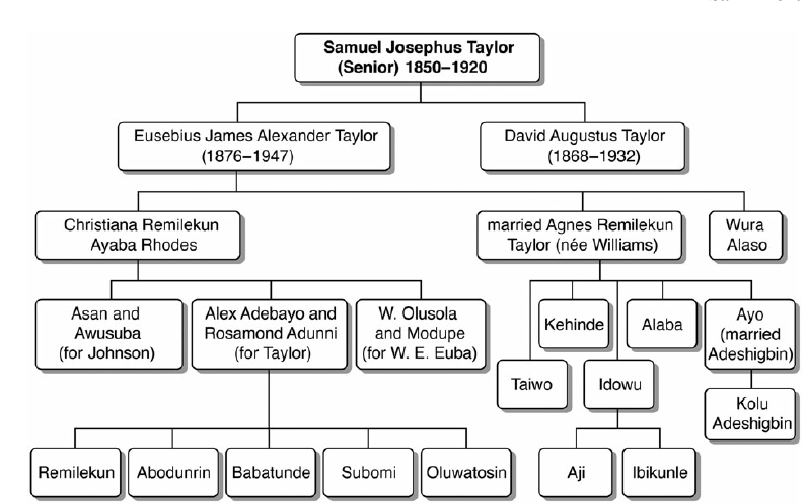
Eventually, Christiana left Mr Johnson to live alone, and she met Eusebius James Alexander Taylor. Christiana became Alex-Taylor’s mistress and had two children with him: Alex Adebayo and Adunni. Bayo left for England at a young age while Adunni remained with her mother.Footnote 12 Christiana later met W. E. Euba (lawyer and later magistrate), son of the late Reverend William Benjamin Euba – classmate of J. E. Casely-Hayford at the Wesleyan Boys High School in Cape Coast (Paracka Reference Paracka2004: 88), former principal of the Methodist Boys High School and founder of Eko Boys High School – and had two children: Olusola Euba (known as ‘Mama Nike’) and Modupe Euba (‘Iya Shina’).Footnote 13 Since Christiana had left Mr Johnson and was not married to Alex-Taylor, Magistrate Euba often called at Christiana’s residence, acting as a father figure to Asan and Awusuba (Johnson’s children) as well as to his own children – Sola and Modupe.Footnote 14 The children resulting from Alex-Taylor’s marriage to Agnes Remilekun were Ayo (fondly called ‘Aunty Ayo’), Taiwo, Kehinde, IdowuFootnote 15 and Alaba (who died earlier than the rest). (Ayo later married Mr Adeshigbin and became known as Mrs Ayo Adeshigbin, and she gave birth to Kolu Adeshigbin.) Among the siblings, Idowu was closest to Adunni, and on different occasions met with her after she returned from Ghana. Prior to his marriage to Agnes Remilekun, Alex-Taylor fathered two children with a woman known as Wura Alaso (see Figure 1).Footnote 16
Adunni’s family tree.
Methodology
The primary method of data collection used for this study was non-structured interview sessions with Adunni conducted in Coulsdon, Croydon, between 2016 and 2020. In total, I spent twelve months living with Adunni over this four-year period – October to December 2016, January to March 2019 and October 2019 to March 2020 – while on postdoctoral fellowships in London and Oxford. The sessions were not time structured in the sense of setting specific appointments for interaction. The interviews were conducted in the afternoon, in the evening and at night – in effect, whenever ninety-year-old Adunni felt like speaking! This takes us to the next element of the interview sessions: memory. At ninety, Adunni’s memory often wavered between forgetfulness and remarkable recollection of events that could be verified immediately by confirmation sessions with other interviewees and, interestingly, sometimes through secondary literature. I remember a certain morning when Adunni told me to open the window of my room slightly so that some fresh air could filter into the room while I was away in Oxford for my postdoctoral research. I did as she told me. A day after my return a week later, she reminded me to close the window she had told me to open! This kind of interaction repeated itself in other forms throughout the time I spent with her. This I find interesting because it reveals a memory that is still active and dependable to an appreciable extent. Interestingly, she vividly recollected her experiences in the 1940s as if the events were happening to her while she was speaking. Also, she repeated those recollections several times, with each recollection ‘verified’ by its repetitions with slight differences, or, in most cases, with each version being the same as the first. Hence, the recollections made in the first instance are confirmed and reconfirmed by their repetition. However, at ninety, Adunni had forgotten a substantial part of her life – so much so that I had to remind her of things she had told me and my siblings when we were younger.
Instructively, Adunni often made more startling revelations about her life as a younger girl than as an adult. In fact, the repeated recollection of her teenage years was a major inspiration for writing this article. Although she told me a fascinating story of the then theatre legend Hubert Ogunde coming to the door of her mother’s house to request that Adunni join his cast (which I found interesting at the time), it was her constant rendition of her teenage history that prompted further interrogation of her life. In the repeated recollections, I was able to draw out specific issues relating to significant events in her life. Furthermore, Adunni’s memory was awakened haphazardly and at different times, so I always had to have my smartphone because I never knew when memories would be sparked by a television show or a letter or a casual conversation. I realized that I was able to get deeper reflections from her if she were not prompted by deliberate questioning. So, during most of the time I spent with her, I engaged her in very ‘unimportant’, casual issues. Sometimes, as we sat together watching the television, and without any prompting, she began to recall events. One particular midnight, I was half-asleep when she called me to help her arrange the curtains in her room, after which she embarked on a revealing hour-long discussion. It was about ten minutes into this ‘interview’ that I remembered to bring in my smartphone for the recording. This was the pattern of the interview sessions with Adunni that provided the primary source of data.
In addition to those with Adunni, there were interview sessions conducted with my siblings – but in a slightly different manner. This time, the interviews were conducted to confirm certain recollections Adunni had told me, either recently or decades earlier – events that Adunni herself had to be reminded of while I was in discussion with the family. Hence, I am able not only to confirm Adunni’s recollection, but also add accounts that provided further reflections on Adunni’s primary data. Furthermore, since I had conducted research on social life in colonial Lagos over the last sixteen years, I had a background in the pattern of social life in the period Adunni often remembers, sometimes so vividly. Also, this article draws on insights from secondary sources on colonial Lagos history to complement the description of the general social conditions that Adunni repeatedly emphasized. What is instructive is the fact that Adunni dictated the terms of ‘data gathering’: the appointments, the time, the duration, the form and the depth of the interview sessions. I had to disguise parts of the information revealed as it would have directly affected families whose descendants are alive. In particular, some phenomena described in secondary literature play out in Adunni’s accounts: for example, Adunni’s recollection of her mother’s social status in the 1900s. Although Mann did not mention Adunni or Adunni’s mother in her monumental book Marrying Well: marriage, status and social change among the educated elite in colonial Lagos (1985) or in any of her other publications, she accounted for the social conditions that produced Adunni, albeit outside matrimony. Interestingly, too, Abosede George, in her book Making Modern Girls: a history of girlhood, labor and social development in colonial Lagos (2014), discussed the experiences of girls as hawkers on colonial Lagos streets. Again, the experiences of girls in George’s account played out significantly in Adunni’s teenage history. However, as stated earlier, Adunni was not recorded in any form in literature dealing with colonial Lagos, nor was she ever interviewed by either of these two scholars or by anyone else.
Literature review
Kristin Mann’s 1977 PhD thesis provides a background to the evolution of extramarital affairs among members of the new elite in colonial Lagos and the fact that they threatened the institution of marriage and the security of women who feared competition to their status as ordinance wives (Mann Reference Mann1977: 186–7). Beyond this, the personal family lives of the elite have often been attached to grand phenomena such as nationalism, wealth accumulation, business growth, confrontations with the colonial state and pioneering trends that subsequently determined the direction of the postcolonial state. Meanwhile, Mann’s thesis also pointed towards opportunities to consider the consequences that elitism had as a result of dysfunction within its structure (Mann Reference Mann1983). The backdrop to the challenges included not only the legal frameworks for matrimonial relationships established by colonial ordinances but also the moral connotations attributed to monogamous relations (ibid.: 42–3). Thus, the conflict between convictions about monogamy and polygamy among elite males pitched matrimonial relationships against society’s pressure on the male to head ‘responsible’ households. In that context, a ‘double standard maintenance’ of the marriage institution was inevitable.
Caught between male social status and extramarital desires, concubinage became a trend. Further results of this dysfunction have been largely ignored in the literature, partly because historians’ focus on girls has been directed towards the experiences of girls from poor homes or in circumstances that were unrelated to the extramarital affairs of elite families. As a subject of historical interrogations in relation to colonial Lagos, the female child has been examined through key issues such as identity in legal frameworks, social welfare, sexuality, the colonial state and trafficking (George Reference George2006; Reference George2011; Reference George2014; Aderinto Reference Aderinto2012a; Reference Aderinto2012b). Consequently, the girl child has been examined as being enmeshed in the modernity that evolved at a very fast pace and that she had to come to terms with, as quickly as her emotions and psychological make-up allowed. Essentially, these studies have shown that many girls from poor homes were emotionally and physically less able to face the challenge of confronting fast-paced modernity in ‘healthy’ ways because the odds were naturally against them – danger could come from nuclear families to members of extended families, from kidnappers to sex-trade traffickers. Instructively, girls were victims of the ‘social state’ first and foremost as the state moved into the political and economic spheres. Scholars who have written about child poverty have argued that such environments have the tendency not only to affect the genes of children raised in such conditions, but also to cause permanent damage to the child’s lifecycle (Chang Reference Chang2015: 263).Footnote 17 Hence, attention has often been directed towards girls in the lower classes whose identities and social roles were caught up in the larger configuration of state and society. This article narrows this focus and examines the thirty-year span of a girl in colonial Lagos whose experiences highlighted defects in the highly revered social status of elite families in the city. It unveils and expatiates the often hurriedly referenced personal experiences of individual girls in colonial Lagos, with particular emphasis on the marginality of Adunni as a result of factors beyond her control and that, according to Lockhart (Reference Lockhart2008) and Chang (Reference Chang2015), children like her had to contend with – in Adunni’s case, until early adulthood. Thus, this article aspires to fill the gap that has existed in the literature with regard to the comprehensive nature of personal narratives about life as lived by one of the most vulnerable groups in colonial Lagos society: girls – and in this case Adunni.
Role modelling: Christiana and Adunni
Adunni was greatly influenced by her mother Christiana, who herself lived in a milieu that took its toll on her as a person. According to available oral accounts, Christiana had no formal relationship after her first union with Johnson. Although ordinance marriage proved attractive, given the rights that accrued to women, Christiana enjoyed her independence and oral accounts indicate that she was reluctant to accumulate wealth despite this freedom. Even if it meant experiencing poverty, and despite her elite background, Christiana was unwilling to trade her independence for matrimonial submission.Footnote 18 As Mann suggests: ‘[T]he independent, resourceful and calculating, educated Yoruba women of the present have not emerged from a historical vacuum. They have been shaped by the experiences of their forebears, as well as by contemporary realities’ (Reference Mann1983: 38). The fact that Christiana had been born into the Rhodes family gave her psychological leverage. When approached by a group of landowners in Surulere (a suburb in mainland Lagos) who tried to persuade her to conduct a traditional rite for a piece of land, she was unmoved partly because of pride: given her background, she believed that she could earn more than what the landowners had offered, and also she did not see wealth accumulation as an immediate priority.
Evidently, Christiana was one of the earliest women in Nigeria to begin to understand womanhood outside ‘ordinance-ordained’ marriages. Given her elite background, she was at an advantage in contracting such a marriage. However, the accounts show no evidence as to why her union with Johnson was not sustained. To be contracted in marriage in nineteenth- and early twentieth-century Lagos was considered a high point within Christiana’s social circles and, like other women from such a background, she experienced some pressure to maintain a certain level of social status (Mann Reference Mann1983). Additionally, she enjoyed an independent lifestyle early enough to be selective with regard to further suitors and also to consider any man below her social class unworthy of her. What can be deduced from accounts is that her union with Johnson informed her distrust of emotional connections in ‘ordinance-motivated’ relationships. As a result, she was not prepared to personally teach her female children on the subjects of adolescence, sex and marriage. The changes in Lagos society itself affected Christiana and she had to combine an understanding of Victorian Lagos with her background and the role she was expected to play in ‘entrenching’ Victorian principles of marriage and social status. Educating her children on this complexity was challenging. The difficulty of understanding the milieu and measuring up to its expectations was overwhelming, because it did not facilitate a strong relationship between Christiana and her daughters that could have engendered a more comprehensive understanding (on the part of her daughters) of expected female roles in terms of contracting ordinance marriage on the one hand and the options and consequences of not marrying on the other. The second option was the most attractive to Adunni and her siblings: none of them contracted ordinance marriage; rather, they explored the alternative of seeking relationships that were not ordained by the marriage ordinance. Since Christiana’s lack of emotional attachment with Johnson, Alex-Taylor and Euba prevented Adunni and her sisters from having a wholesome understanding of what matrimony truly meant, their confusion as young females left them with very few options.
The questions that Adunni and her siblings could have asked their mother’s ‘husbands’ were further constrained given the ‘non-availability’ of these men in the lives of the girls, the ‘commitment’ these men had towards their ‘ordinance wives’ and the men’s understanding of the limits of their roles as well as their responsibilities. According to an early oral account given by Victoria Awusuba to Adunni, whenever Christiana wanted to punish Awusuba when Magistrate Euba visited, she would urge him to beat Awusuba for her many wrongdoings while Euba was absent. Euba was uncomfortable with this and, to please Christiana, would enter the room with Awusuba and pretend to beat her, making the right noises and instructing Awusuba to cry out loudly and weep to deceive Christiana. When Awusuba reflected on this later with her younger siblings, she revealed that Magistrate Euba was uncomfortable about the prospect of being charged in court with beating the children of ‘alarede’ (i.e. children born of ‘holy matrimony’).Footnote 19 Although these men showed some interest, it was minimal in the lives of these girls whom Christiana eventually had to raise singlehandedly. Thus, Christiana was ‘disturbingly visible’ to the curiosity of her young girls and their absentee fathers on the one hand, and ‘virtually invisible’ to the fathers of the young girls and their ordinance wives on the other. Since Adunni was particularly quiet and afraid of her mother, her case was further complicated. Questions that could have been addressed were instead answered through real-life experiences.
Meanwhile, Christiana hid her hurt and disappointment in the proclaimed and celebrated sincerity of these men whose social status and elevated roles in social circles were admired greatly. This informed her disdain for the ‘uninvited suitors’ who visited her apartment in search of her girls. One of these was a young man called Nnamdi (Azikiwe – who later became Nigeria’s governor general) who was threatened and told to stay away from Awusuba.Footnote 20 And because Adunni and her suitors were afraid of Christiana, they kept their relationships secret. Eventually, their opportunities to meet reduced and the relationships ended. Sola Fairley, the most consistent of Adunni’s suitors, was disliked by Christiana and Adunni had to abandon the relationship – there was no other suitor at the time. Adunni’s oral accounts indicated that Christiana was unwilling to educate her girls on the subject of Christian marriage, given the insincerity of those who professed to be role models for such marriages. And although Christiana had some relationships with indigenous Yoruba men, she did not enlighten her girls on Yoruba cultural principles about marriage.
Pre-teenage, teenage and early adult years
From age seven to eighteen, Adunni lived a life of innocence and naivety, and she respected her mother to the point of fear. At age seven she went to live with the family of Justice S. Bankole Rhodes,Footnote 21 the Nigerian lawyer who was appointed along with Sir Adeyemo Alakija to membership of the Colonial Governor’s Executive Council in 1943 (Coleman Reference Coleman1958: 153), when Adunni was thirteen years old. Thus, Adunni moved to Aba in eastern Nigeria, where Rhodes served as one of the nominated African members of the Nigerian Legislative Council (Dixon-Fyle Reference Dixon-Fyle1999). While living with the Rhodes family, Adunni took care of the home while family members were away on routine daily engagements. She engaged in house cleaning, dish washing and other chores, under the supervision of Mabel Jones Rhodes, the wife of Justice Rhodes. For seven years, while serving as maid to the Rhodes family, Adunni was enrolled in a school in Aba but she did not attend school regularly. So disturbed were the teachers by Adunni’s attitude to schooling that one of them decided to visit her at home to inquire about her and the reasons why she often failed to attend school. Adunni’s predicament was that she was fully engaged in household chores and sometimes she was locked up in a room for hours – probably when she was stubborn. In Adunni’s account, Mrs Rhodes gave her so many household chores that she was prevented from attending school. In 1944, at the age of fourteen, Adunni was taken from Aba by her mother and she returned to Lagos.
On her return, she was enrolled in Elizabeth Fowler Memorial School, a privately owned school on Wakeman Street, Ebute Metta; she stayed there for a brief period while her mother was able to pay her school fees. In Adunni’s recollections, Christiana was always looking for opportunities to collect money from Alex-Taylor and often used Adunni as an excuse to obtain funding from the lawyer. Hence, at the request of Alex-Taylor, Christiana allowed Adunni to meet with her father sometimes at 9 Victoria Street (later Nnamdi Azikiwe Street), where Alex-Taylor lived at the time. The relationship between Christiana and Alex-Taylor was sour, and Alex-Taylor reportedly was often angry with Christiana over issues concerning Adunni and her brother Adebayo, who eventually travelled to England and never returned to Nigeria. So disturbing did Christiana’s relationship with Alex-Taylor become that it severed any relationship between the two children and their father.
In those days, given the social status occupied by the elite, the children of their mistresses were abhorrent to their ordinance spouses. Under pressure from home and society, the men had to ensure that they maintained their matrimonial home by paying less attention to any children born out of wedlock. Various reasons prevented a close relationship between Alex-Taylor and Christiana. First, Alex-Taylor was married to Remilekun Williams when he was having an affair with Christiana, who was herself married to Johnson. Although the relationship was kept secret in its early stages, it was revealed later, at which point Remilekun – Alex-Taylor’s wife – would have had no option but to acknowledge the extramarital affair (Mann Reference Mann1985: 91).Footnote 22 Second, as already noted, Alex-Taylor was a man of high social standing and from a Christian background who found keeping two wives undesirable. Additionally, Christiana and her husband Johnson eventually separated, and Alex-Taylor considered intensifying his relationship with a divorcee untenable, particularly in an era when the status of spouses of members of the elite was a serious issue of social standing (ibid.: 180–1). Although Christiana herself was from a well-known elite family, no account points to her wanting to become a well-educated woman or a ‘submissive’ housewife (i.e. staying at home as a seamstress), which would have attracted a permanent marriage with a man of Alex-Taylor’s stature.
After ending her married life with Johnson, Christiana could no longer afford a permanent relationship, and this affected her financial status. Even when she had children with Euba, this was not the result of a marriage. Although the connections with the men in her life through the children she bore occasionally improved her financial status, Christiana could not maintain this status for a sustained period. She opted to take up trading and other activities that could provide for her children. Thus, funding them to further their studies was an option she could not take, much less maintain. The money she collected from her men could secure only the everyday necessities. It is not clear whether her own father opted to send her to school beyond the minimal education she received at standard school level. Kristin Mann noted the paucity of data on the fathers of women like Christiana (Mann Reference Mann1985: 30) but explained that the social standing of elite families meant that husbands preferred their wives to be dependent partners rather than financially independent spouses (ibid.: 49–50). With her trading activities and the gradual demonstration of her financial independence, albeit meagre, Christiana could not have attracted any suitor in a situation where men (and their immediate families) disdained their spouses trying to be ‘in competition’ with them.
Gradually, Christiana received less money from Alex-Taylor for Adunni’s upkeep as the relationship continued to deteriorate.Footnote 23 Soon, Adunni’s school fees suffered. One day, Adunni, afraid of being beaten by Mrs Fowler, ran away from school and did not return.Footnote 24 Eventually, she was registered as a student at Ladi-Lak Institute in Yaba (a public school), where she completed junior standard. During this period, Adunni had no transport costs as she commuted to school while living with her mother near Loco bus stop, on what is now Murtala Mohammed Road, Ebute Metta, in Lagos. Christiana eventually left Loco to reside on Agunbiade Street in Surulere. After leaving Ladi-Lak, Adunni stayed at home, hawking bread for her mother in Surulere and helping with other household chores. Adunni and her sisters, Olusola Euba and Modupe Euba, assisted their mother in baking bread and running errands. At age seventeen, on one of these errands, Adunni menstruated for the first time on her way back home.Footnote 25 Noticing blood coming out of her body, Adunni’s fear of what her mother would say overwhelmed her. On reaching home, Adunni stayed for a time behind the windows of her mother’s room, wondering about this strange development. Eventually summoning the courage to enter, Adunni told Christiana, who laughed at her daughter for being scared.Footnote 26 At that point, Adunni was relieved and was told that it was a normal cycle in a girl’s life.
For a long period, Adunni and her two younger sisters stayed with their mother, working in the bakery and hawking. During this time, the girls often noticed the regard in which some members of the community of elders held their mother. Recognized as an elite, Christiana was pestered into acquiring land in the community. Sometimes, she was goaded by the community elders to stand in one point and throw a stone in any direction she wished and claim the piece of land covering that distance in exchange for a bottle of gin, an offer Christiana rejected.Footnote 27 This was similar to Alex-Taylor’s offer to give Christiana a building on Herbert Macaulay Way in Yaba, Lagos, which she also rejected. Being girls, Adunni and her sisters attracted ‘unwelcome’ visitors to their mother’s apartment in Surulere. Adunni was often visited by Sola Fairley (mentioned above), who lived at Wakeman Street, Ebute Metta, with his mother, a woman of Liberian descent. Eventually, Adunni became pregnant and gave birth to a girl – Oyinda.Footnote 28 Christiana was angered by this development and warned Adunni that if she went ahead and married Sola, she would disown her. Adunni heeded her mother’s warning and prompted Sola to stop his visits. Eventually, Adunni stopped assisting with the sale of bread to take care of Oyinda. Christiana made arrangements for Adunni to leave for Ghana to stay with her own sister, fondly called Sister V by members of the family. Eventually, Adunni left Lagos for Takoradi and stayed with Sister V for a brief period, while taking care of Oyinda, who eventually died.Footnote 29 Adunni returned to Lagos after Oyinda’s death, at age twenty, and again stayed in Surulere.
When Adunni returned in the early 1950s, the Lagos town council had destroyed the local bakery run by her mother. Adunni had also stopped schooling and had to stay at home idle for a long period before she eventually saw an advert for Hubert Ogunde’s theatre group.Footnote 30 She located the group and applied to be one of the stage performers. Ogunde visited Adunni’s mother, who asked about the status of the girls who performed with the group; Ogunde told Christiana that he had to marry some of the girls who worked for him because he found that, after being trained in theatre, they often left the group, leaving him with the challenge of training another set of girls.Footnote 31 Adunni eventually joined the group and travelled frequently, along with other women, to perform on stage between 1950 and 1960. Adunni’s intimacy with the theatre group increased, eventually leading to her becoming pregnant by the theatre maestro. Although she was encouraged by one of Ogunde’s wives to keep the child, Adunni decided to have an abortion. While in the group, Adunni trained with very articulate and smart girls, quickly learning the dances and acts. Adunni recalls that one of Ogunde’s stage dancers – Sumbo – was so incensed that she snapped at a male artist, giving him a slap in return for his unhealthy advances during a rehearsal. Eventually, Sumbo left Ogunde’s group after a show in London. Adunni was a stage dancer and singer and performed at Lisabi Hall in Lagos and in Takoradi in Ghana. She performed in ‘S’Eranko, S’Eniyan’ (‘Bread and Bullet’, which she referred to as ‘Enugu Miners’) and ‘The Prodigal Son’.Footnote 32 She frequently performed at Mapo Hall in Ibadan, as well as in Ijebu Ode, Aba and Enugu. Throughout her stage career with Ogunde, Adunni lived with the family along with other performers, learning the dances, the acts and the scripts as written and directed by the theatre icon.
It was while Adunni was with the theatre group that she had another opportunity to visit Ghana while on tour. This time, she decided to stay and not return with the group. While in Takoradi, Adunni socialized enough to find a place to live temporarily while she used the little money she had to start a trade in Ghanaian food stuff. This she did for a number of years. During this period, she had an affair with a Ghanaian police officer who beat her up whenever he visited.Footnote 33 Finally, Adunni reported him to his superior officer at the police quarters. The superior officer assisted Adunni, assuring her that he would take up the matter with the man, and that no such incident would recur. Eventually, Adunni lost contact with him and built a relationship with Mr Jonah, a locomotive inspector with the Ghanaian Railways in the 1950s.Footnote 34 Adunni’s relationship with Jonah reflected a trend that had begun in the late nineteenth century whereby women became attached to railway workers for financial reasons (Byfield Reference Byfield1996: 40–1). Adunni’s relationship with Jonah lasted long enough for her to become pregnant, and she bore a daughter whom she named Remilekun (named Esi by her father); previously, Adunni had given birth to a son – Ayo – but he died long before Esi was born. Earlier, Adunni had been so emotionally attached to Oyinda that, when she died, Adunni bought a beautiful casket and robed the little child in beautiful clothing before burying her. She was about to do the same for Ayo when she was advised by an old man not to do so. His advice stemmed from the belief that such children were abiku – the type who, in Yoruba mythology, die before the age of puberty. Unless such children were buried unceremoniously, they would return to repeat the cycle. She eventually buried Ayo quietly and as instructed – putting him in the ground with only a minimal demonstration of emotional attachment. Thus, Esi was a prized child. However, her birth confirmed to Adunni that Mr Jonah was already married without Adunni having a clue about it! Friends and associates confirmed that Mr Jonah’s wife knew about the relationship and had interacted with Adunni at one point without revealing her identity.Footnote 35 Not long after Esi’s birth, Mr Jonah was transferred by the railway authority to Kumasi.Footnote 36 Eventually, they lost contact. During that period, Adunni was preoccupied with trading and taking care of Esi. Later, Adunni met Mr Mensah, a civil servant with the Ghanaian government, with whom she became pregnant. After eleven years in Ghana, Adunni eventually returned to Nigeria with Esi and pregnant with Robert in the mid-1960s. One of the things she had to do was re-establish contact with her relations. On one of those occasions, she met John Idowu Conrad Taylor, who advised her to return Robert and Esi to their fathers in Ghana, advice she did not heed. However, Adunni’s story suggests that other members of the Creole elite, as well as other returnees, had relations with one another along the West African coast during this period (1940–60). The fact that Christiana could urge Adunni to live with her sister in Takoradi and with her uncle in Aba gives us an indication that others like Christiana would have retained some communication as well.
In effect, it was the distortions in the understanding and practice of a major social phenomenon – marriage and matrimony – that were foregrounded in Adunni’s experience and selfhood as a young girl. Hence, she became representative of those whose conception of womanhood was distorted by the dishonest practices of Christian principles of marriage and the inability of Yoruba traditions of matrimony to confront Western ideals when faced with the great competition posed by the imposed Christian option. Thus, Adunni and her siblings were faced with a reality that challenged their understanding because of the psychological implication of realizing that they were offspring of respected members of the Lagos elite but were prevented from leveraging the emotional and material benefits of such blood relationships. Adunni’s teenage experience was significant because, unlike some of her counterparts on the streets of Lagos who struggled with everyday livelihoods, she faced two challenges: the struggle for a livelihood on the one hand; and, on the other, knowing that she was the daughter of a father with high social status yet was unable to access the benefits attached to that social identity. This knowledge, added to the everyday life she confronted, engendered disappointments that led to her desperation as a teenager. Furthermore, she represented children at the crossroads of civilizations. If Adunni’s mother had contracted an ordinance marriage with Alex-Taylor, Adunni’s life would have turned out differently. However, her actual story is instructive in the sense that children who live through transformations at the meeting points between cultures are often silenced by those who uphold such cultures and ignored by the scribes of such eras – even more so if they are marginal figures. The fact that they were marginal, however, does not mean that their experiences do not speak to societal dislocations and the crises of modernity. Adunni’s teenage experiences exposed the lacunae that even the various women’s associations in Lagos at the time were arguably unaware of. While some expressed and demonstrated commitment to the plight of the girls, this ‘silent conspiracy’ between those who were like Adunni’s mother and the men who were desperate to suppress the hypocrisy of their positions resulting from the birth of children like Adunni led to serious social identity crises among young people. This is more instructive if we consider that many such children did not document their experiences and that their history may never be written if historians continue to focus on either the life experiences of the offspring of the rich or the challenges experienced by children of the poor. Adunni’s case is a hybridization of the two – a sort of ‘cusp phenomenon’ that oscillates between binaries. Adunni’s life story is thus a social identity crisis that resonates with marginal voices such as LGBT movements, indigenous peoples and certain sections of the very poor. It points us to the need to trace the dislocations of such groups in modern societies – in this case, Lagos. It presents the example of those who become victims of social changes; they are often ‘extracted’ by researchers for the purpose of data gathering but not for the intrinsic value these individuals possess in themselves. This value is what this article has attempted to unveil.
The reason why an examination of individuals such as Adunni is important is because, for instance, the near century of life as lived by Adunni has implications for those who live after her – for the way in which they perceive and perform reality, as Pollio, Henley and Thompson (Reference Pollio, Henley and Thompson1997: 13) have argued. Again, the reason why even the first seven years of Adunni’s life are important for those who live in the present is because psychologists have told us, after several decades of research, that it is during this first seven-year period that the physical, social, cognitive, representational, narrative and cultural selves are formed (and harmonized), preparing the self-identity that Adunni (and others like her in the era in which they lived) used to engage society in all the forms in which it appeared to and affected her (Nelson Reference Nelson, Fivush and Haden2003: 3–28). What is even more instructive is that Adunni’s children lived with her for over half a century without considering her background to be of much value. Although Adunni always told stories about her background, her offspring did not give much weight to it, much less considered it of any historical significance. It took almost a lifetime for her children to truly situate Adunni’s past in context. The fact that Adunni lived with them every day for half a century did not constitute, for these children, enough evidence to engage the suggestion that Adunni’s life had been lived in one of the most remarkable times in Nigerian and African history. By implication, the ‘living archives’ among us are considered ‘dead’ even before they are, physically. By implication also, what Adunni (or men and women of her type) could have revealed about the past (for the reasons of history) and the future (so psychologists, sociologists and therapists can better interpret society) is ‘locked up’, neglected or totally abandoned in a process that Pollio, Henley and Thompson (Reference Pollio, Henley and Thompson1997: 12–13) call the figure/ground conception of reality, whereby the figure (or the foreground) consciously seen by Adunni’s children obliterated the background (the ‘unimportant’) – the exact location where Adunni’s significance lies! In other words, it was Pollio, Henley and Thompson’s ‘focal’ (i.e. Adunni’s children’s engagements as regards living) that preoccupied Adunni’s children for most of the time, while the background (Adunni’s past) did not provide much meaning to life.
Anything that Adunni’s past life could have revealed regarding the challenges of life that her children went through while ‘doing their own living’ was considered of little or no relevance for the present in which they were so involved individually and collectively. Thus, it is only by examining these ‘endangered archives’ (such as Adunni) that historians and other professionals who use other methods to arrive at their research conclusions can appropriate life as lived and perceived subjectively in order to advance the hidden knowledge of the past or applied knowledge to proffer solutions for the present. Adunni’s case reveals how one of the many crises of modernity – marriage and matrimony – affected self-identity in a society in flux. For the purposes of historical scholarship alone, this particular phenomenon is important, a historical reality to which historians of colonial Lagos have made only passing reference. While they have considered other phenomena, such as prostitution, street hawking, kidnapping, trafficking and arms, individuals have not been identified as evidence of the effects or implications of history. In recent times, Shoichi Yokoi, a Japanese soldier who hid in caves in Guam after World War Two and was not discovered until 1972, emerged as a living archive of what transpired during the war (Hatashin Reference Hatashin2009). Subjective as this may be, the stories of these ‘living legends’ bear testimony to facts and truths about society as it was experienced at the time; this has significant implications for historians who have unconsciously ignored such lives as unimportant sources of information. Thus, histories ‘excavated’ from such individuals become a sort of ‘artefact’ that must be preserved for ‘History’ as an academic discipline. Biographies and autobiographies have repeatedly called our attention to these issues, but with little success. Yet historians proceed with their trade and their skills and with a perception that biographies and autobiographies are ‘sentimental scholarship’. This article rejects this notion. Perhaps, as I have suggested elsewhere (Decker Reference Decker2021), a ‘selfographic’ approach could further advance the advocacy of biographical and autobiographical studies. Consequently, historians would have to develop a methodology that would move between history, anthropology, phenomenology, sociology and forensic linguistics.
Adunni lived in colonial Lagos, saw colonial Lagos and experienced colonial Lagos first hand. In Pollio, Henley and Thompson’s (Reference Pollio, Henley and Thompson1997) argument, these are the things needed for Adunni to reveal to us the nature of human experience in this historical city in a state of flux. As they have shown, Adunni’s experience is imbued with perception (i.e. what counts as the figure/ground perspective of reality): in other words, the things that Adunni experienced (albeit subjectively) as different from what the extant literature or any other individual counts as reality. The subjective nature of this experience for Adunni is not to make a point or take a stand or depend on certain expectations on the part of her hearers, but simply to narrate her life as she lived it. Following Pollio, Henley and Thompson’s ( Reference Pollio, Henley and Thompsonibid.) account, Adunni experienced colonial Lagos selectively – identifying what was ‘important’ and what was not. The implication is that her childhood experience with Christiana loomed large in her estimations and conclusions about life, affecting the way she lived thereafter and the choices she eventually made. Christiana, Alex-Taylor and the defective institution of matrimony provided and entrenched the narrative by which Adunni lived for the rest of her life. Interestingly, Adunni did not connect with any one of these three factors as they all eluded her understanding of the larger picture.
The phenomenological importance of Adunni’s experience is the fact that she lived in a reality that was perceptively, yet authoritatively, hers. This article has revealed her perspective on her experience as it emerged from the interviews. This is what counts as phenomenological. The reality of colonial Lagos is thus examined primarily from her perspective. In its pure form, it is unapologetically undiluted and aims to do nothing more than reveal the nature of her experience. The fact that some form of analysis emerges from Adunni’s experience in this article is absolutely not her business – nor, indeed, should it be the business of this study either. Although the article examines the importance of her experience in Lagos as a colonial city, the nature of that experience is what is really important, and not its links to the expectations of scholarly examination. Hence, this study only underscores Adunni’s experience. In sum, what this study counts as important is her perception, her subjectivity, her life as it was lived, and not how it should or ought to have been lived. This is important because the certainty of anyone’s past relates to the present and the future; the meaning of the present is often embedded in such individuals’ past. Hence, the aim of this article has not been to find meaning in Adunni’s past but to show that Adunni’s past grants meaning to the present; this, more than anything else, is what Pollio, Henley and Thompson (Reference Pollio, Henley and Thompson1997: 31) regard as phenomenological. Such pasts, as phenomenologically presented by anyone like Adunni (i.e. anyone who lived in a colonial city as she did, or anyone in the present who will live in a future that is yet to come), should attract great curiosity and interest from historians of the past and of the future. Although Adunni’s lived experience has been ‘modified’ by time, age, memory and cumulative experiences and perceptions, her consistent referencing of her experiences as a teenager and young adult, as well as the consequences of that period in her life, together with their implications for historical scholarship reiterate the historical significance of her life story.
Adunni is one of the last surviving matriarchs among black Atlantic returnees who lived in Lagos for most of the twentieth century, and she indicates why these returnees have almost disappeared from the present crop of the Nigerian elite. Although the socio-political and economic roles of these returnees from Liberia, Sierra Leone, Brazil and Cuba in colonial Lagos were remarkable given their links to Western education, artisanship and Christianity, their descendants gradually began to compete with the increasing number of indigenous Yoruba and Igbo in the city, who themselves became interested in Western education and travelled to England and the USA to acquire university degrees in law, political science, medicine, journalism, nursing, surveying and other subjects. Importantly, these Nigerians eventually emerged as the most politically active figures from 1960 onwards. Although descendants of returnees were present in Lagos’s socio-economic and political circles before and after 1960, indications in oral accounts and the literature suggest that very few of the later generations of these returnees remained visible in elite circles. For Afro-Brazilian returnees, daughters of their descendants changed their names after marriage, while some returned to Brazil and Cuba where they had retained strong diasporic connections (Fagunwa Reference Fagunwa2022). Additionally, some of the Saro and the Afro-Brazilians became apprehensive about their ‘returnee’ status in Lagos and were anxious to underplay their historical attachments to this status (ibid.). It is ironic that the same status that had played a significant role in their rise in Lagos during the colonial period became something that stigmatized these once remarkable Lagosians. Recent research also shows that descendants of some of the later generations of returnees fought over property rights (ibid.) – an indication that succeeding generations were not as ambitious as their forebears, leading to a gradual reversal of the status quo and of the elite standards pursued by their ancestors. Probably, many also experienced the same conditions as Adunni, with damaging effects on their offspring. This is an opportunity for further research. However, Adunni often recalls her roots and insisted, despite challenges, that her children must ascend to elite status through Western education.Footnote 37 This she achieved significantly, having raised a tax inspector with the UK Home Office, a risk management consultant in Lagos, a university professor in Ibadan, a sculptor and painter with the Society of Nigerian Artists in Abeokuta, and a businessman living in Lagos.
Conclusion?
Intensely personal and subjective, Adunni’s story reflects the depth of lived experience conserved in the memory of her peers; this is often glossed over by historical studies, but, in our case, it points to the intersection between modernity, marginality, marriage, girlhood and family. Adunni’s example is an indication that many such accounts are not adequately reflected in the literature and should be salvaged before the last of her peers are lost completely. Instructively, Adunni did not set out to write the story of her life; nor did she set out to make a point or to offer reasons for her failures in life. Her stories are muddled and singularly inconclusive; many of them she told repeatedly. The ‘conclusion’ that can be reached from our considerations so far is that her story is similar to those of young boys and girls of her age in the Lagos colony. What then is new? Adunni’s recollections animate some of the historical records that have been locked up in the vaults of archival documents: in the ordinances of colonial government that aimed to institutionalize a welfare system for young people, in the newspaper reports that sought to explain the reality of young people in flamboyant language, in the records of elite women’s associations on their interventions in the plight of girls and boys, in the writings of the children and young adults themselves, and in the Colonial Welfare Office’s bureaucratic routine of managing the welfare of these vulnerable people in a fast-changing modern society. In Adunni’s recollections, we confront a self-narrative that speaks for others whose stories are considered inconsequential, even by their own offspring, and thus may be lost permanently if not extracted in good time.
Acknowledgements
Research for this article was funded by the Urban Studies Foundation during a postdoctoral fellowship at the African Studies Centre, University of Oxford, 2019–20. This is gratefully acknowledged. I thank Wale Adebanwi, Miles Larmer and David Pratten of the African Studies Centre for their valuable comments.
Tunde Decker is Associate Professor in the Department of History and International Studies, Osun State University, Osogbo, Nigeria. He is author of Matrix of Inherited Identity: a historical exploration of the underdog phenomenon in Nigeria’s relationship strategies 1960–2011 and A History of Aviation in Nigeria 1925–2005. His articles have appeared in History in Africa, Journal of Asian and African Studies and Vestiges: Traces of Record.



