There is a significant gender divide in American public opinion regarding homosexuality that mirrors and even extends the broader political gender gap in the United States. Since the 1980s, women have emerged as more liberal than men on a range of political issues — most typically issues pertaining to social welfare concerns (Kaufmann Reference Kaufmann2004; Kaufmann and Petrocik Reference Kaufmann and Petrocik1999; Trevor Reference Trevor1999). Although Americans across the board have become less willing to view homosexuality as immoral or to advocate restricting the civil rights or liberties of gays and lesbians since the late 1980s (Brewer Reference Brewer2003; Pew Forum 2004; Loftus Reference Loftus2001), research has established that women are substantially more tolerant of homosexuality than men.Footnote 1 While public opinion on cultural issues such as abortion and school prayer do not elicit significant gender differences, the gap between men and women on gay rights is large, significant, and growing.Footnote 2
Despite the general trend of increasing tolerance, religion continues to shape attitudes about homosexuality, with highly religious people most likely to view it as sinful (Pew Forum 2004). Views on homosexuality among religious people are by no means monolithic, however: Jews and liberal mainline Protestants espouse the most tolerant attitudes; Catholics and middle-of-the-road mainline Protestants hold moderate attitudes; evangelical Protestants have the most conservative attitudes.Footnote 3
American clergy on both the left and the right have played particularly important roles in structuring debates about homosexuality (Coulmont Reference Coulmont2005; Olson and Cadge Reference Olson and Cadge2002). They have spoken from the pulpit and in other public forums for and against gay rights, and they have supported groups on both sides of the ideological spectrum that deal with homosexuality-related issues. Clergy have moral leadership roles through which they have the capability to affect public opinion on a wide variety of matters,Footnote 4 including homosexuality, in their congregations — and given the large percentage of the American population who spend time in the pews, it is realistic to think that clergy can shape public opinion at large. A recent survey by the Pew Forum (2004) confirms that the messages people hear about homosexuality in their congregations influence their opinions about the issue. Clergy's political influence also often extends beyond their congregations (see, e.g., Crawford and Olson Reference Crawford and Olson2001), both through their involvement in denominational deliberations regarding homosexuality, and through their work for or against particular gay rights policies at the local, state, and national levels. Therefore, clergy must be perceived as potential opinion leaders (Katz and Lazarsfeld Reference Katz and Lazarsfeld1955) around this deeply contentious issue. Americans' views on homosexuality are tied powerfully to their perceptions of the limits of morality, so clergy's potential to affect public opinion on gay rights issues ought not to be underestimated.
Of particular note on this front are mainline Protestant clergy.Footnote 5 Because of their generally high levels of theological and political progressivism, mainline Protestant denominations (such as the Episcopal Church and the United Methodist Church) have been embroiled in more internal, private debates about homosexuality than any other religious family. These debates span diverse questions including individual rights, societal and personal morality, and issues of church polity such as ordination, marriage and societal witness.Footnote 6 Denomination-wide debates about homosexuality no doubt spill over into the ranks of mainline Protestant clergy and laity. Clergy themselves are divided both about gay rights and about whether and when it is appropriate to voice their attitudes about such matters to their congregations, and to the public at large.Footnote 7 Mainline laypeople likewise hold a wide variety of views about homosexuality, both in general and as it regards aspects of their church life (Olson, Cadge, and Harrison Reference Olson, Cadge and Harrison2006; Presbyterian Panel Reference Presbyterian1996). And congregations often become fertile breeding grounds for political socialization; attending religious services and otherwise participating in congregational life can have a meaningful effect on the way people view the political world.Footnote 8 We therefore contend that mainline Protestant churches constitute an environment in which attitudes about this highly contentious issue actually take shape. As such, we must understand the ways in which mainline clergy perceive — and take action around — the issue of homosexuality.
Few studies have examined clergy's attitudes and actions concerning gay rights. Nor have scholars explored the impact of gender on clergy's approaches to homosexuality. It is especially important to consider gender in this context, both on account of the striking gender gap in public opinion on gay rights, and the growing percentage of women among the ranks of American clergy. Using data from a national survey of clergy, we compare male and female mainline Protestant clergy's attitudes toward homosexuality, and the extent to which they are willing to speak publicly on homosexuality-related matters. Does the gender gap on gay rights carry over from the general population to clergy? Moreover, do male and female clergy differ in their willingness to engage in prophetic leadership around the issue of homosexuality? Because of the uniformity of their support for gay rights, women clergy have the potential to exercise prophetic leadership in support of gay people. However, they might not be well positioned to live up to this potential if they do not feel comfortable articulating their views to their congregations. It is essential to understand the factors that might bolster or inhibit these potential opinion leaders from communicating their views on the controversial issue of homosexuality to their congregations, and to the broader public.
MAINLINE PROTESTANTISM, CLERGY AND HOMOSEXUALITY
Mainline Protestant clergy have long been involved and interested in politics. Their most prominent political work in the 20th century involved them in the civil rights movement, the nuclear-freeze movement, and the sanctuary movement (Findlay Reference Findlay1993; Friedland Reference Friedland1998; Hertzke Reference Hertzke1988; Smith Reference Smith1996). Today, many mainline clergy express particular concern about disadvantaged and marginalized members of society, including gays and lesbians.Footnote 9 Involvement by the faithful to address the injustices of the broader society is not just tolerated in mainline Protestant circles, but is encouraged and expected.
Not all mainline clergy find it easy or even possible to involve themselves in politics, however. Relatively few mainline Protestants in the pews endorse the liberal political outlook that often accompanies the mainline theology that clergy learn in seminary.Footnote 10 Consequently, since the 1960s, dividing lines have been drawn between many mainline clergy and the moderate-to-conservative people in their pews (Djupe and Gilbert Reference Djupe and Gilbert2003; Guth et al. Reference Guth, Green, Smidt, Kellstedt and Poloma1997; Quinley Reference Quinley1974; Wuthnow Reference Wuthnow1988). This division is particularly vivid for women clergy, who are even more uniformly liberal than their male counterparts (Olson, Crawford, and Deckman Reference Olson, Crawford and Deckman2005; Olson, Crawford, and Guth Reference Olson, Crawford and Guth2000). Many clergy are especially hesitant to speak about issues that have the potential to rip their congregations apart, because doing so might undercut their ability to minister to the congregation, or even threaten their job security. Thus, even very liberal clergy who would like to be vocal advocates for gay and lesbian rights might feel constrained from doing so out of concern for their congregational tenure and legitimacy.
On the other hand, mainline Protestantism does have an undeniably long tradition of supporting prophetic social witness. Recent studies of mainline clergy provide evidence that mainline clergy may feel more compelled to speak when they feel their voices are most needed (Djupe and Gilbert Reference Djupe and Gilbert2002; 2003). Research also shows that mainline Protestant women clergy find numerous ways to advocate for controversial policy positions despite concerns about how their congregations will react (Olson, Crawford, and Deckman Reference Olson, Crawford and Deckman2005). Studies show that clergy whose congregations support them are most able to engage in political activity (Coffin Reference Coffin, Jo Bane, Coffin and Higgins2005; Djupe and Gilbert Reference Djupe and Gilbert2003). However, the clergy-laity gap per se and the security of a minister's position (as measured by length of tenure) rarely appear to drive clergy's willingness to engage in political leadership.Footnote 11 Congregational opposition (or freedom from congregational pressures), then, is just a part of the story rather than the predominating predictor of mainline Protestant clergy's political activism.
We are left with the question of what factors do drive political activism among clergy. One variable that performs well in many models of clergy activism is (perhaps not surprisingly) political interest (Guth et al. Reference Guth, Green, Smidt, Kellstedt and Poloma1997; Smidt Reference Smidt2004). Ministers with a strong interest in politics are usually more active in politics. We expect to find that ministers who express high levels of interest in politics will be more likely to speak out on homosexuality.
A second set of useful predictor variables measures clergy's political principles, or normative commitments to particular policy views or political strategies. We are especially interested in the ways in which clergy connect their theology to their views of the appropriate role of church in society (i.e., social theology); clergy's attitudes toward the absolute moral authority of scripture (orthodoxy); and their perceptions of the appropriate role of clergy in politics.Footnote 12 On the whole, mainline clergy embrace a social theology and norms of appropriate behavior that encourage political activity. They are also not particularly orthodox in their views of the authoritativeness of scripture. Therefore, mainline clergy tend to value a rational, discursive give-and-take to sort out views on issues much more than clear-cut, morally absolutist teaching about either theology or politics.
Nonetheless, there is still variance among mainline clergy that influences their political activism. We expect to find that clergy who (1) espouse a social theology that emphasizes social justice, (2) strongly approve of the principle of clergy speaking out on public issues, and (3) display low levels of scriptural orthodoxy will be most likely to speak out on homosexuality. Clergy who are deeply invested in social justice concerns should be expected to view gay rights as a crucial component of this rubric in today's society. Those who believe it is acceptable for clergy to speak out on public issues should be expected to have little compunction about voicing their views on homosexuality. Mainline clergy who distance themselves from scriptural orthodoxy also should be expected to speak out on homosexuality, because they are most likely to be open to dialogue, which is about the only way one can approach homosexuality in mainline circles today. Ideology may serve as another important gauge of clergy's overall political principles. Mainline clergy overall are more liberal than the public at large and women clergy are quite a bit more liberal than even their liberal male counterparts (Deckman et al. Reference Deckman, Crawford, Olson and Green2003).
Another set of variables that we expect to play an important role in structuring clergy's attitudes and actions on homosexuality fall into a general category that may be labeled pressures. This category includes congregational support (which, as noted above, tends to increase clergy's political involvement), length of congregational tenure, and perceptions of denominational support for one's political position. We expect congregational support and length of tenure to matter, but again, not to be dominant. The perception that one's denominational hierarchy is supportive should also play a weak role in bolstering clergy's willingness to speak out about homosexuality.
A final set of variables, which we lump together under the label politics, refers to aspects of the political context in which a minister works. Of particular importance are factors that might make an issue more or less salient; factors that might make activism seem more or less necessary (Djupe and Gilbert Reference Djupe and Gilbert2002; 2003); and factors that might make activism more or less difficult and risky. Identification with a particular political group is one mechanism that might make political activism simultaneously easier and more salient for a minister. We expect ministers who say they feel close to gay rights groups to be more likely to take political action on homosexuality-related issues. (Feelings of closeness to more conservative groups, such as Focus on the Family, could also be hypothesized to promote political action against gay rights initiatives.) We might also expect there to be more opportunities for clergy to become active in political efforts concerning homosexuality if they serve in urban settings, where there might be a larger number of gay people in the population.
Finally, gender is a critical predictor variable in our analysis. As noted above, public opinion polls in the United States show that women more strongly favor gay rights than men. The 2000 American National Election Study (ANES), which was conducted at nearly the same time as the clergy survey we utilize here, found that women are 15% more likely than men to “strongly favor” efforts to reduce job discrimination against homosexuals (47% of women compared to 32% of men). The 2000 ANES results also show that women are 11% more likely than men to “strongly favor” the right of gay couples to adopt children (50% compared to 39%). We examine whether the gay rights gender gap among mainline Protestant clergy reflects (or perhaps exceeds) the baseline gender gap on this issue in the American public. We also expect to observe higher levels of activism on this issue among women clergy. In-depth interviews with women clergy reveal that many women clergy make a strong cognitive connection between the debate over gay rights and earlier debates over women's rights (including women's ordination). This connection results in strong commitments on the part of some women clergy to speak out on this particular issue (Olson, Crawford, and Deckman Reference Olson, Crawford and Deckman2005).
We approach our analysis with seven specific expectations: (1) Mainline clergy will be divided in their attitudes about homosexuality, but the majority will support gay rights; (2) Women clergy will have stronger pro-gay rights views than their male counterparts; (3) Women clergy will be more active in speaking on behalf of gay rights; (4) Variables that measure congregational constraints on clergy activism will predict levels of clergy activism, but other variables will out- perform this measure; (5) “Principle” variables will be especially strong predictors of activism on gay rights; (6) Political interest will also strongly predict activism; (7) Connections to particular political groups and the size of the minister's community will both be positively associated with activism on gay rights.
DATA AND METHODS
We rely on data from a survey of a national random sample of more than 3,200 (N = 3,208) clergy who serve in six mainline Protestant denominations: the American Baptist Churches, the Christian Church (Disciples of Christ), the Evangelical Lutheran Church in America, the Reformed Church of America, the Presbyterian Church (U.S.A.), and the United Methodist Church.Footnote 13 The data come from the Cooperative Clergy Project (headed by Corwin Smidt at Calvin College; see Smidt Reference Smidt2004) that was designed to study the political attitudes and behavior of clergy in 20 different religious traditions during the 2000 election cycle.Footnote 14 The same basic questionnaire was sent to clergy in all 20 religious traditions, which included mainline Protestants, evangelical Protestants, Roman Catholics, and Jews. We rely on the mainline Protestant sub-sample because we wish to discern women clergy's orientation toward homosexuality; very few women serve in any of the other religious traditions surveyed. Among the six denominations under study here, the United Methodist data contain an over-sample of women clergy. In the analysis that follows, we weight the data to correct for this over-sample. In the sub-sample we use, 17% (N = 559) of respondents are female and 83% (N = 2649) are male.
The analysis begins with simple cross-tabulations designed to identify basic gender patterns in public speech about gay rights, support for gay rights, and identification with interest groups that deal with gay rights. These cross-tabulations allow us to assess our expectation that women clergy will stand out as more active around and more supportive of gay rights. We then turn to multivariate analysis of gender's effect on whether clergy choose to speak out on gay rights. Is gender still a significant predictor of public speech on gay rights in models that control for political interest, principles, pressures, and context? What gender patterns lie behind variables that most strongly predict gay rights speech? Finally, do political interest, principles, pressures, and context operate differently if we model men and women separately? The analysis concludes with a brief look at a multivariate model for gay rights speech for mainline clergy who oppose gay rights to see if similar findings hold.
FINDINGS
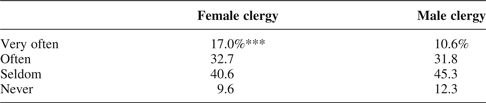
Table 1 shows the frequency with which ministers make their views known on gay rights and homosexuality. As expected, we find that women clergy are more likely to speak out about gay rights and homosexuality (17% of women speak out “very often,” compared to 10.6% of men), but a similar percentage of women and men claim to speak “often” (32.7% and 31.8%, respectively).
Frequency of Public Speech on Gay Rights

Source: Cooperative Clergy Study, 2000.
*** p < 0.001 (Chi-square test).
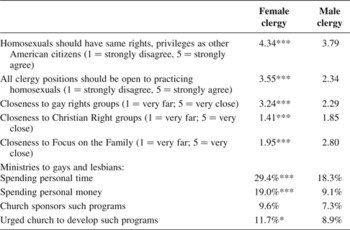
Table 2 shows clergy support for gay rights, both generally, and in the context of whether practicing homosexuals should be ordained. In both instances, the gender divide is striking. The mean level of support for women for allowing homosexuals all the same rights and privileges as other American citizens is 4.34 compared with 3.79 for men clergy (on a scale were 1 = strongly disagree to 5 = strongly agree). In terms of percentages, 56.5% of women clergy “strongly agree” that homosexuals should have equal rights and privileges, compared to only 32.9% of male clergy (data not reported). This gap clearly exceeds the 10–15% gap between men and women in the general population documented by the 2000 ANES. On this issue, male clergy mirror the male population at large rather than standing out as more liberal, despite the fact that mainline Protestant clergy overall tend to espouse relatively liberal political attitudes. Roughly 30% of men in both the 2000 ANES and clergy samples respond that they strongly support the general concept of gay rights. The gender gap also manifests itself when we ask about the more specific matter of gay rights within religious institutions. Clergymen are much less likely than their female counterparts to support the ordination of practicing homosexuals, as indicated by their mean score of 2.34 compared with the mean score of 3.55 for clergywomen.
Differences among Female and Male Clergy: Support for Gay Rights, Gay Ordination, Closeness to Interest Groups, and Ministries to Gays and Lesbians

* p < 0.05, **p < 0.01, ***p < 0.001; Difference of means test for first five variables; Chi-square test for Ministries question.
The clergy survey asks respondents to indicate how “close” they feel to various interest groups. The response set ranges from “I feel very far” (coded as 1) to “I feel very close” (coded as 5). Table 2 reports the mean level of closeness respondents feel toward “gay rights groups,” “Christian Right groups,” and Focus on the Family, a well-known socially conservative group that opposes gay rights. On average, women had higher average closeness scores than their male counterparts regarding gay rights groups. Very few mainline Protestant ministers, whether male or female, felt particularly close to the Christian Right (which is not surprising; the Christian Right is the primary province of evangelical Protestantism), although men registered lower closeness scores than did women. The responses are similar but more muted for the specific Christian Right group, Focus on the Family.
Finally, Table 2 displays the extent to which male and female clergy are involved in ministries aimed at gays and lesbians. More than 29% of women clergy indicated that they spend personal time with a ministry geared toward gay people, compared with just 18.3% of male clergy. Women were also more than twice as likely as men to say they spend their personal funds on such ministries. While there is no significant difference between men and women clergy when it comes to serving in churches that support ministries for gay people, women were more likely to say they have “urged” their congregations to develop such programs.
As we turn to the multivariate analysis of gay rights speech, it becomes important to distinguish pro-gay rights activism from anti-gay rights activism, since variables such as ideology and closeness to Christian Right groups might operate differently around different kinds of activism. The measure of gay rights speech summarized in Table 1 captures the frequency with which ministers speak out about homosexuality, but does not indicate either the direction or content of the speech. In other words, we do not know from examining Table 1 whether clergy are speaking in favor of gay rights or in opposition to gay rights.
Table 3 shows a breakdown of the frequency with which ministers speak out about homosexuality crossed with their personal attitudes toward gay rights. Among those clergy who speak out about homosexuality very often, 77% are supportive of gay rights. The dominant direction of homosexuality-related speech among these mainline ministers, then, appears to be in favor of gay rights. Much more often than not, it will be correct for us to assume that mainline clergy who speak out frequently are speaking for the advancement of gay rights. Consequently, we focus most of our attention here on pro-gay rights speech. Since we are most interested in establishing what propels ministers to speak in favor of gay rights and whether gender is an important factor in this calculus, we begin by considering only those ministers who agree or strongly agree with gay rights. Ministers who are neutral about gay rights or disagree (or strongly disagree) will be considered later in the analysis. Among our original sample of 3,208 respondents, 71% (2,301 clergy) agree or strongly agree with gay rights. Only these 2,301 clergy with pro-gay rights attitudes are included in the gay rights speech models presented below. We assume that these clergy speak about homosexuality in a way that reflects overall support for gay rights.
Speaking out about Gay Rights by Support for Gay Rights

Source: Cooperative Clergy Study, 2000.
We now turn to a multivariate model of gay rights speech, using a dependent variable that we assume to reflect a minister's frequency of speech in favor of gay rights (1 = never speaks; 2 = seldom speaks; 3 = speaks often; 4 = speaks very often). Our model tests whether gender is a significant factor in the decision to speak out for gay rights while controlling for other independent variables. The model also examines how political interest, principles, pressures, and context structure gay rights speech. In addition to gender (1 = women; 0 = men), we consider several political variables in our multivariate model, including interest in politics (coded here as 1 = not at all interested in politics; 7 = very interested). We also include a control for party identification (1 = strong Democrat; 7 = strong Republican).
The model includes several variables that measure various principles that may shape clergy's involvement in the discourse about homosexuality, beginning with political ideology (1 = extremely liberal; 7 = extremely conservative). We expect that the more liberal the minister is, the more likely s/he will be to speak out in favor of gay rights. The model also examines several theological principles that should bear a relationship to a clergyperson's decision to speak out about controversial issues. One variable assesses the minister's views about the appropriate role of religious communities in society; respondents were asked to rate (on a scale of 1 to 5) the extent to which religious communities should work to foster social justice (1) or emphasize individual morality (5). The lower the respondent's score, the more they prefer working for social justice, so the more likely they should be to speak out in favor of gay rights. We also included a measure of the minister's orthodoxy regarding scriptural authoritativeness. Adopting a scale used by Guth et al. (Reference Guth, Green, Smidt, Kellstedt and Poloma1997), ministers were asked to what extent they agreed that: “the devil actually exists,” “the Bible is the inerrant Word of God,” and “there is no other way to salvation but through belief in Jesus Christ.” The individual variables were coded so that strongly disagree = 1 and strongly agree = 5, resulting in an orthodoxy scale that ranges from 3 to 15 (with the highest score indicating the highest level of religious orthodoxy). Cronbach's alpha for this additive scale is 0.82. We hypothesize that as ministers' orthodoxy increases, their willingness to speak out in favor of gay rights decreases. The final theology measure considers the extent to which ministers view civic speech by clergy as appropriate. We created a scale that combines ministers' approval of five different types of civic speech: publicly taking a stand on a political issue (but not while preaching); taking a stand on a political issue while preaching; delivering a sermon on a controversial social or political topic; publicly taking a stand on a moral issue (but not while preaching); and taking a stand while preaching on some moral issue. With each individual variable coded so that 1 = strongly disapprove and 5 = strongly approve, the values for the overall approval measures range from 5 to 25, with the highest score indicating the highest level of support for clergy civic speech that touches on either political or moral issues, including from the pulpit. Cronbach's alpha for this additive scale is 0.74. We expect to show that the more clergy approve of the general concept of such speech, the more likely they will be to speak out about homosexuality-related matters.
Two variables in our models test for the influence of congregational pressures on clergy speech. A clergyperson's willingness to speak out in favor of something as controversial as gay rights could be colored by the reaction s/he will likely face from her or his current congregation or from individuals whom s/he would like to recruit as new congregation members. As noted above, there is often a strong assumption that mainline clergy may face stiff opposition to liberal political action. If ministers do not wish to offend their current or potential members, they may be reluctant to take up the mantle of gay rights. Alternatively, if their congregations expect their clergy to be politically active, ministers might feel comfortable, or even pressured into speaking out in favor of gay rights. We include two congregational pressure measures in our model: the extent to which the attitudes of the congregation or the reactions of potential members greatly encourage (coded as 5) or greatly discourage (coded as 1) ministers' involvement in public affairs. Another factor that could affect a minister's willingness to speak out on gay rights is whether the minister's views on social issues (generally speaking) differ from those of congregation members. Although the original coding allowed clergy to state whether their own positions on social issues were “much more conservative” (coded as 1) to “much more liberal” (coded as 5) than those of their congregation members, we recoded this variable to compare clergy who perceive themselves as having “somewhat more liberal” or “much more liberal” views than their congregations with those who think their views are similar to or more conservative views than those of their congregation. In general, we expect to find that ministers whose views are more liberal than those of their congregations (i.e., those who face a palpable clergy-laity gap) hesitate to speak out about gay rights.
Finally, we turn to measures of political context. These measures examine the ways in which activism may become easier or more salient for some ministers. We expect that the larger the community in which a congregation is located (1 = farm or rural community; 6 = very large city or suburb of very large city), the more opportunities clergy encounter to speak out in favor of gay rights. Although we measure closeness to interest groups as an attitudinal measure, we expect it to operate as a measure of likely external organizational mobilization (Rosenstone and Hansen Reference Rosenstone and Hansen1993). Therefore, we place closeness to gay rights groups and closeness to Focus on the Family in the political context category. Our model tests the willingness of clergy to speak out in favor of gay rights, so we include only “closeness to gay rights groups” in this iteration of the model; we substitute “closeness to Focus on the Family” in a later analysis to measure external organizational mobilization for anti-gay rights speech.
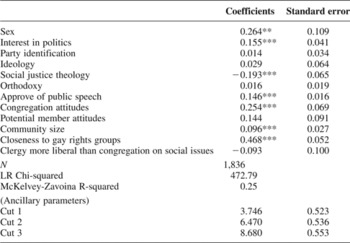
Table 4 shows the results of a regression analysis with a dependent variable measuring willingness to speak out in favor of gay rights. We utilize an ordinal logistic model because our dependent variable has four ordinal possibilities: ministers who speak never, seldom, often, or very often. Similar to binary logistic regression, in which the dependent variable is made up of just two possible outcomes, the ordinal logistic model is non-linear. Instead of estimating the probability of an event occurring or not occurring, though, ordinal logistic models estimate the probability that a case will fall in the “next highest” category of the dependent variable, by estimating “cut-points” or thresholds between each value of the dependent variables (which replace the constant in the model). The cut-points and the coefficients, neither of which have a clear substantive interpretation, are listed in Table 4. The coefficients cannot be interpreted directly, but they do indicate both the direction of the relationship between the independent variable and the dependent variable and whether or not the relationships are statistically significant.
Ordinal Logistic Regression: Willingness to Speak Out About Gay Rights (Clergy who support gay rights only)

Source: Cooperative Clergy Study, 2000.
* p < 0.05; **p < 0.01; ***p < 0.001.
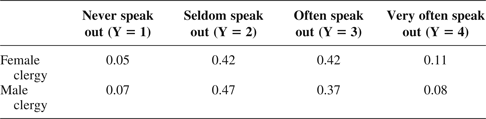
As expected, gender is statistically significant in the predicted direction: women clergy are more likely than their male counterparts to speak out in favor of gay rights. Even when controlling for the various ways in which gender patterns may reflect differences in principles, pressures and political context, a positive independent bump for women remains. Table 5 shows the gender gap in terms of the probability that male or female clergy will speak with a particular level of frequency (never, seldom, often, very often) when all other variables are held at their mean value. The results show that, with all else being equal and near the mean values, women clergy who favor gay rights are slightly more likely to speak out often or very often (0.53), whereas men who favor gay rights are less likely to speak out often or very often (0.45). Something beyond the effects of the principles, pressures, and politics that we model must be pushing women clergy who favor gay rights to a higher probability of speaking than their male colleagues with similar base attitudes. In-depth interviews with women clergy (Olson, Crawford, and Deckman Reference Olson, Crawford and Deckman2005) suggest two likely explanations behind this gender gap, both of which could be described as issue salience effects. The most direct view of the gendered nature of issue salience here comes from women's own explanations of why gay rights issues matter so much to them. Several women clergy told us about how they feel a special connection to the question of gay rights because they perceive a parallel between the embattled position of gay people today and their own experiences working to secure rights and acceptance as women clergy. Another important experience that likely drives the salience of gay rights for women clergy here is the strong feminist socialization many of these women experience in seminary (Carroll et al. Reference Carroll, Wheeler, Aleshire and Long Marler1997; Zikmund, Lummis, and Chang Reference Zikmund, Lummis and Chang1998). The intensity of women clergy's pro-gay rights attitudes (over half of them fall into the “strongly agree” category) lends credence to these gendered salience explanations of the gay rights speech gap we observe here.
Estimated Probability of Speaking Out on Gay Rights (Clergy who support gay rights only)

Source: Cooperative Clergy Study 2000.
Note: All other variables are held at their mean values; probability estimates derived using Stata; Due to rounding errors, row values may not always sum to 100.
When we model the frequency of gay rights speech among mainline clergy with key independent variables that influence the activism of men and women in general, we find that the simple gender dichotomy remains statistically significant, with women predicted to exhibit higher levels of civic speech on this issue, all else being equal. However, we suspect that because of specific gender dynamics within the clergy profession, all else is not equal. Gender-based experiences may very well shape principles, pressures, and politics for clergy. Therefore, it is essential to recognize that gender influences clergy's willingness to voice pro-gay rights views in ways that go beyond the direct independent effects captured by the gender variable (Table 4). This possibility raises the question of how gender operates through the other independent variables in Table 4 that influence gay rights speech to create the gender difference we observe.
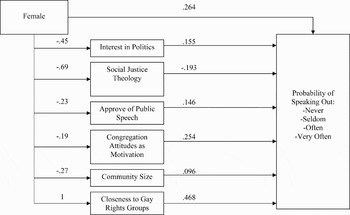
To determine how gender shapes the other factors that influence predicted levels of gay rights speech by mainline clergy who support gay rights, we analyze the relationship between gender and each of the statistically significant independent variables. Since each of these variables is an ordinal measure, we use ordinal logistic regression. Figure 1 maps out the ordinal regression coefficients for gender's direct influence on the probability of speaking out alongside the coefficients for gender's indirect effect on each of the variables that subsequently influence the probability of speaking out. As in the previous analyses, we include only those clergy who support gay rights. The coefficients on the right side of Figure 1 are simply those from Table 4. The coefficients on the left side indicate the influence of gender on each independent variable; all are significant at the p < .05 or higher.
Willingness to speak out about gay rights (Clergy who support gay rights only).

Two general patterns are most striking in these results. First, gender is significantly related to all six significant predictors of gay rights speech. So, in addition to having a direct, independent effect, gender also influences gay rights speech indirectly through its strong intervening effect on variables that influence gay rights speech in our original model. Second, it is striking that women clergy stand out as being more involved in gay rights speech despite the fact that they are predicted to have lower political interest, and lower approval of civic speech — two factors that encourage higher rates of gay rights speech in our previous models. This finding makes the strong relationships between women and gay rights groups and women and social justice-oriented theology all the more important in understanding why women clergy speak up on this issue so much more than their male counterparts. Their commitment to social justice and their affiliation with gay rights groups both push women to speak out more around gay rights despite disadvantages stemming from a relative lack of interest in, and approval of, political speech.
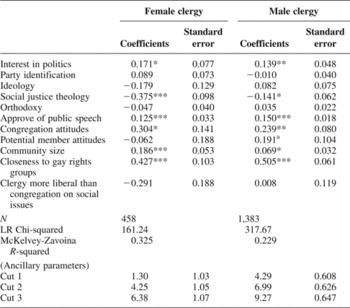
Our analyses of gender up to this point assume that the same basic model holds for men and women. To test this assumption, we run the same ordinal logistic regression analysis (minus gender) for men and women clergy separately; Table 6 presents the findings.Footnote 15 The same factors are significant predictors of gay rights advocacy for both men and women and all of the significant variables operate in the same direction for both men and women. Feeling close to gay rights groups and personal approval of political speech by clergy are both positive and highly significant factors predictors of mobilization for both men and women. The most striking gender difference between the two models appears for the “social justice principles” variable, where the results reinforce our earlier analysis of this variable's special importance for mobilizing women clergy. The results also suggest that the clergy-laity gap demobilizes women — but not men, which may be due to the fact that women clergy often feel additional professional vulnerability. In interviews, women clergy also express concern about being perceived as “radical feminists” by their congregations (Olson, Crawford, and Deckman Reference Olson, Crawford and Deckman2005). This result fails to attain statistical significance, however, so it appears that analysis of gender primarily through its independent and indirect effects on gay rights speech is appropriate.
Ordinal Logistic Regression: Willingness to Speak Out About Gay Rights (Female and male clergy who support gay rights only)

Source: Cooperative Clergy Study, 2000.
* p < 0.05; **p < 0.01; ***p < 0.001; ap < 0.07.
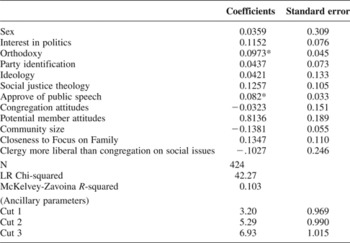
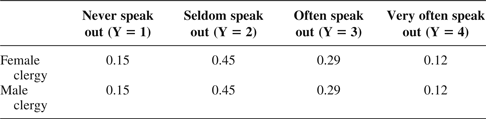
Given that there is some diversity among mainline Protestant clergy's attitudes about gay rights, it is possible to examine whether a similar model would emerge for clergy who oppose gay rights. Table 7 includes only those clergy who said they were opposed or strongly opposed to gay rights and again uses the level of gay rights speech as the dependent variable. This model includes fewer clergy and many fewer women clergy. We use the same variables here as we used in the full model for pro-gay rights speech except that the external organizational mobilization variable has changed from feelings of closeness with gay rights groups to feelings of closeness with a conservative interest group, Focus on the Family. Results are reported in Table 7.Footnote 16 Gender is not a significant predictor in this model; in fact, as Table 8 shows, when examining the predicted probabilities of both men and women clergy in terms of speaking out about gay rights (and in this instance we are assuming they are speaking out against gay rights), we observe identical probabilities. In other words, when all other variables are held at their mean values, male and female clergy who oppose gay rights are just as likely to never speak out about the issue as they are to speak out often. Returning to Table 7, the congregational pressure variables that appeared to matter in earlier models are not significant for anti-gay rights ministers. Instead, principles stand out as the strongest motivators for these clergy, with theological orthodoxy (as opposed to social justice commitment) emerging as a strong influence. Personal approval of civic speech by clergy also matters in this model.
Ordinal Logistic Regression: Willingness to Speak Out About Gay Rights (Clergy who do not support gay rights only)

Source: Cooperative Clergy Study, 2000.
* p < 0.05, **p < 0.01, ***p < 0.001.
Estimated Probability of Speaking Out on Gay Rights (Clergy who do not support gay rights)

Source: Cooperative Clergy Study 2000.
Note: All other variables are held at their mean values; probability estimates derived using Stata; Due to rounding errors, row values may not always sum to 100.
SUMMARY
To summarize our key findings, we return to our list of expectations and add a brief comment on the findings for each.
(1) Mainline clergy will be divided in their attitudes about homosexuality, but the majority will support gay rights. Well over half, but not most, mainline clergy support gay rights in general. However, fewer than half of male clergy and only half of female clergy strongly agree with a standard statement favoring gay rights. So, although mainline Protestantism is often characterized as comparatively supportive of gay rights, it would be a mistake to assume that strong unified support for gay rights exists among mainline clergy.
(2) Women clergy will have stronger pro-gay rights views than their male counterparts. This is true. The gender divide is most distinct when we observe the “strongly agree” category. The cleavage there clearly exceeds the corresponding gap between men and women in the general population. This may be explained in part by the fact that women clergy fall into several demographic categories generally associated with increased liberalism (they are highly educated, economically independent, and more likely to be single or divorced) (Zikmund, Lummis, and Chang Reference Zikmund, Lummis and Chang1998). However, women clergy's support for gay rights likely also reflects cognitive links that women make between this issue and women's own struggles with discrimination that make the issue come to life for them.
(3) Women clergy will be more active in speaking for gay rights. This expectation is borne out in the cross-tabulations that show greater activism among women than men, as well as in the significance of the gender variable in our full model. Our results show that women clergy are more likely than their male counterparts to be outspoken about gay rights because of their more liberal political orientation, their commitment to social justice, their feminist orientation, and, especially, their minority status within the profession, which is consistent with our findings elsewhere (Olson, Crawford, and Deckman Reference Olson, Crawford and Deckman2005). Moreover, women clergy routinely have high levels of formal education. Having a master's degree or doctorate in theology, particularly as it is earned in a setting where being inclusive is a stated goal and message, is likely to prompt high levels of gay rights activism among clergy. Studies show that seminary experience is different for men and women (Carroll et al. Reference Carroll, Wheeler, Aleshire and Long Marler1997; Zikmund, Lummis, and Chang Reference Zikmund, Lummis and Chang1998); our findings showcase how those different experiences can have relevance for politics. Considering all of these factors, it is little wonder that women clergy are more outspoken on gay rights than men clergy.
(4) Variables that measure congregational constraints on clergy activism will predict levels of clergy activism, but other variables will out perform this measure. Congregational pressure does affect clergy's willingness to engage in pro-gay rights speech, although a measure of the clergy-laity gap does not. In the full model, congregational support for political engagement ranks right up there with social justice principles and political interest as a highly significant predictor. It makes sense that this factor would emerge as more important here than it typically does in studies of clergy activism given the highly controversial nature of homosexuality. Women clergy are less likely to perceive congregational encouragement and may be more affected by political gaps between themselves and their congregations, but they are more active in gay rights speech despite these challenges.
(5) “Principle” variables will be especially strong predictors of activism on gay rights. Social justice commitment and approval of civic speech stand out as particularly strong principles encouraging gay rights speech. Meanwhile, orthodoxy and approval emerge as strong predictors of anti-gay rights speech.
(6) Political interest will also strongly predict activism. Political interest is a significant predictor of both pro- and anti-gay rights speech.
(7) Connections to particular political groups and the size of the minister's community will be positively associated with activism on gay rights. All of the clergy in our sample serve congregations. Thus, any political activity must be balanced with the often overwhelming load of congregational ministry responsibilities. This constraint easily can limit the time that ministers have available for broader moral leadership via activities such as public speech on political issues like gay rights. Previous research documents the fact that mainline women clergy frequently cite a lack of time as a major constraint on their activism (Olson, Crawford, and Deckman Reference Olson, Crawford and Deckman2005). Moreover, the issue of gay rights has to compete with many other social justice causes that also might be important to busy mainline clergy. Consequently, it is no surprise that closeness to gay rights groups emerges as such a powerful predictor, nor is it surprising that clergy who serve in urban areas (and are thus likely to have more opportunities to engage in civic speech and more exposure to larger populations of gay people) speak more. Ministers who feel close to gay rights groups are more likely to make themselves available to recruitment and more likely to seek and receive information about specific challenges to gay rights. We tested for the possibility that the closeness measure might just be a proxy for activity in gay rights groups. We found that while measures of closeness to gay rights groups correlate with reported membership in gay rights groups, the correlation is not overwhelming (less than 0.5), so closeness does appear to measure a propensity for recruitment rather than actual activity (data not reported).
CONCLUSION
In recent years, debates about homosexuality have figured prominently at the state and local level, especially in the form of ballot initiatives and litigation. Like any issue that falls under the “culture wars” (Hunter Reference Hunter1991) rubric, political, and social elites today pay abundant attention to homosexuality. Thus, it is especially important to understand how religious leaders approach this issue, and the extent to which they feel compelled to speak publicly about it. Congregations constitute political contexts of their own right (Djupe and Gilbert Reference Djupe and Gilbert2006; Gilbert Reference Gilbert1993; Huckfeldt, Plutzer, and Sprague Reference Huckfeldt, Plutzer and Sprague1993; Wald, Owen, and Hill Reference Wald, Owen and Hill1988, Reference Wald, Owen and Hill1990; Welch et al. Reference Welch, Leege, Wald, Kellstedt, Leege and Kellstedt1993) and clergy are the leading opinion leaders within these contexts (Djupe and Gilbert 2003). Thus, it is essential to know whether, when, and how clergy feel comfortable exercising prophetic leadership around moral issues, as their leadership may have a meaningful effect on American public opinion. Understanding the dynamics that shape religious leaders' views on gay rights also may shed light on the more general phenomenon of how professionals in any context might approach combining political action with their everyday professional responsibilities.
Our analysis also illuminates the striking gender gap characterizing American attitudes toward homosexuality. Given the evident difference between male and female elites in terms of their orientation to the issue of gay rights, it becomes all the more important to understand how and why women professionals approach politics differently from their male counterparts, as well as how and why the two genders have such strikingly different attitudes toward gay rights. Women clergy now account for more than 10% of all American clergy — and most serve mainline Protestant denominations. It is also no longer uncommon for women to outnumber men in mainline seminaries. While they still constitute a numerical minority, the steadily growing influence of women clergy will continue to influence the teachings and policies of mainline Protestant denominations — as well as the messages people hear in the pews — on gay rights. The results here confirm arguments made by others (e.g., Hunter and Sargeant Reference Hunter and Sargeant1993) that as increasing numbers of women enter the ministry, mainline Protestant denominations will likely move even further to the left politically and theologically, which can have a real impact on both the shape and nature of those denominations in the future, as such denominations have had to worry about dwindling numbers of members in their pews. Women clergy do speak “in a different voice” (Gilligan Reference Gilligan1982) on a full range of matters, including the place of minority groups in American society. Women clergy are poised, then, to alter the terms of political dialogue in the United States, especially as the general public and both political parties have begun to rethink religion's relationship with politics — particularly the Democratic party, which has begun to reconsider how it can reach religious voters (Dionne Reference Dionne2008; Sullivan Reference Sullivan2008). The influence of women clergy should be expected to shape mainline Protestant — and indeed, American — debates about homosexuality even more in decades to come.