Personality and stressful life events feature prominently in models of the development and course of depression (Kendler et al., Reference Kendler, Gardner and Prescott2002; Hammen, Reference Hammen2005; Klein et al., Reference Klein, Kotov and Bufferd2011). Personality traits are appealing candidates for developmental models because they exhibit some plasticity and are particularly susceptible to environmental stressors prior to adulthood (Roberts and DelVecchio, Reference Roberts and DelVecchio2000; Durbin and Hicks, Reference Durbin and Hicks2014). The trait that is most robustly associated with depression is neuroticism (Kotov et al., Reference Kotov, Gamez, Schmidt and Watson2010). In a separate literature, there is strong evidence that stressful life events predict depression (Brown and Harris, Reference Brown and Harris1978; Kessler, Reference Kessler1997; Kendler et al., Reference Kendler, Karkowski and Prescott1999). Additionally, depression itself may lead to stressful events, contributing to maintenance or relapse (Hammen, Reference Hammen2005; Liu and Alloy, Reference Liu and Alloy2010).
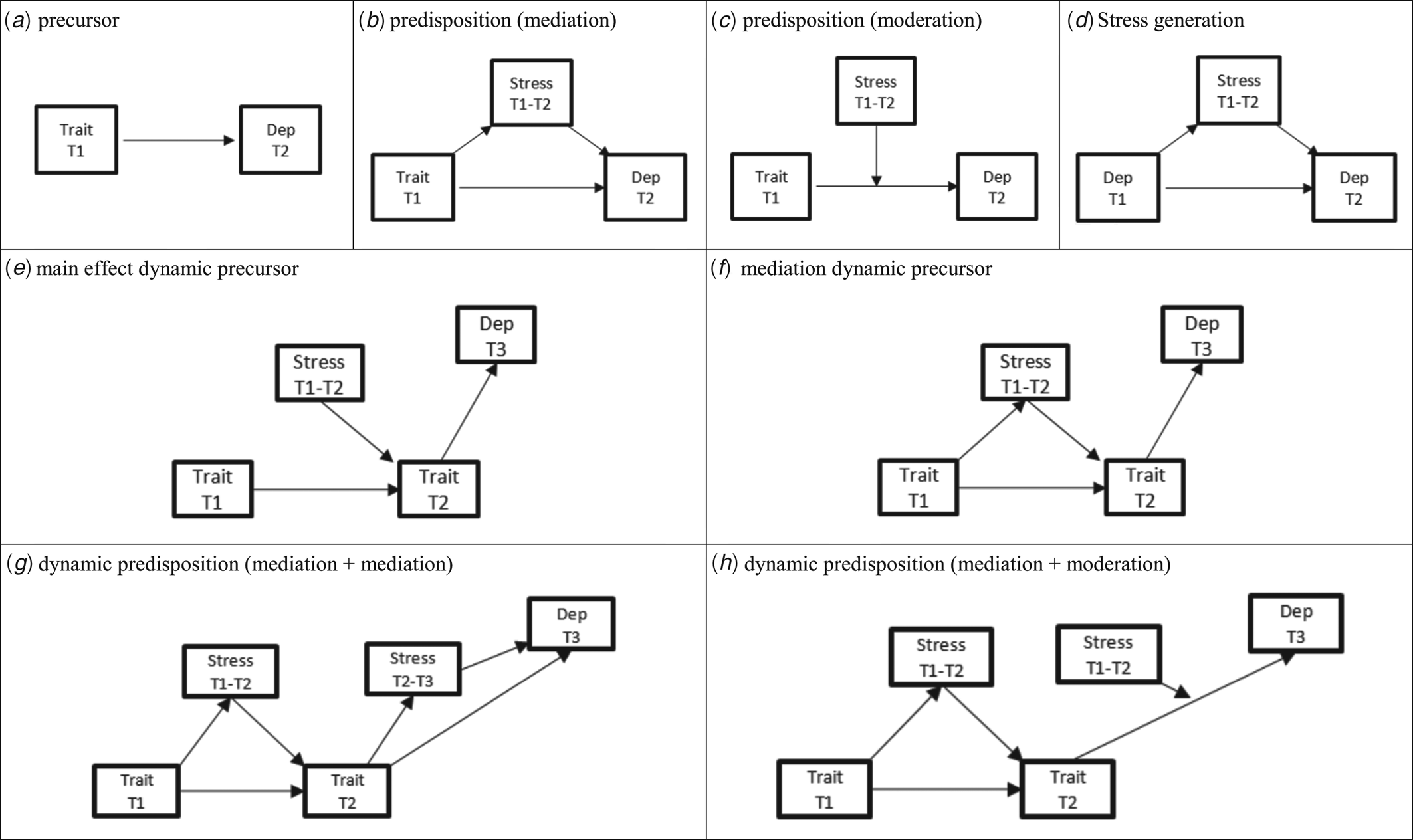
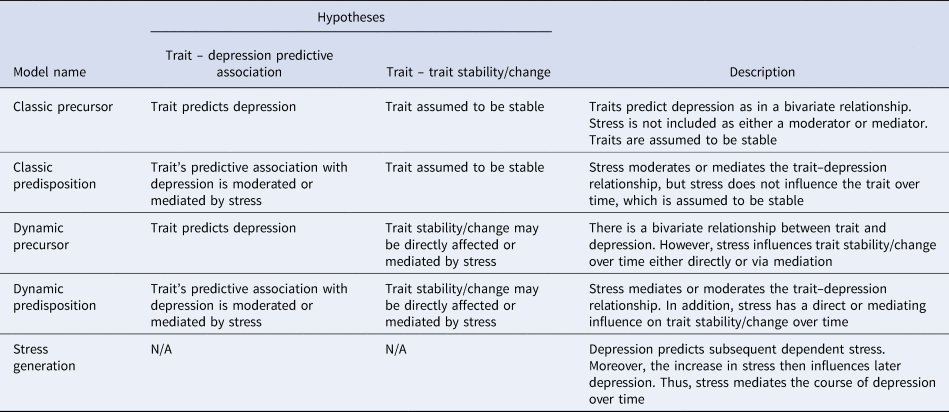
Trait vulnerability and stress models are rarely tested together, which is necessary to determine if one perspective is superior or if the two approaches are complementary (Hammen, Reference Hammen1991; Krueger and Tackett, Reference Krueger and Tackett2003; Klein et al., Reference Klein, Kotov and Bufferd2011; Ormel et al., Reference Ormel, Jeronimus, Kotov, Riese, Bos, Hankin, Rosmalen and Oldehinkel2013; Wichstrøm et al., Reference Wichstrøm, Penelo, Rensvik Viddal, de la Osa and Ezpeleta2018). The goal of this investigation was to test a set of prominent and emerging conceptual models of depression using neuroticism as the focal trait in conjunction with stressful life events. We first review the simplest trait vulnerability models (precursor and predisposition), followed by complex models that incorporate trait variability (dynamic vulnerability models), and conclude with stress generation. Table 1 summarizes the hypotheses from each conceptual model (also depicted in Fig. 1).
Theoretical models. (a) precursor, (b) predisposition (mediation), (c) predisposition (moderation), (d) Stress generation, (e) main effect dynamic precursor, (f) mediation dynamic precursor, (g) dynamic predisposition (mediation + mediation), (h) dynamic predisposition (mediation + moderation). Several paths included in each model have been removed to improve the clarity of the theoretical models. Each analytic model also includes depression symptoms from previous waves and autoregressive paths to control for prior symptoms. All models include stability paths for each variable and correlations between traits and depression within each assessment wave.

Definitions of models

Classic conceptual models: precursor and predisposition
The two most commonly tested models are the precursor and predisposition models (Klein et al., Reference Klein, Kotov and Bufferd2011), which we refer to as classic trait theories. The precursor model states that traits predict subsequent depression (Fig. 1a). This model is consistently supported in child, adolescent, and adult samples, as high neuroticism predicts later depression symptoms and onsets (Kendler et al., Reference Kendler, Gatz, Gardner and Pedersen2006; Dougherty et al., Reference Dougherty, Klein, Durbin, Hayden and Olino2010; Hakulinen et al., Reference Hakulinen, Elovainio, Pulkki-Råback, Virtanen, Kivimaki and Jokela2015; Jeronimus et al., Reference Jeronimus, Kotov, Riese and Ormel2016).
The predisposition model holds that traits predict later depression, but other factors, such as stressful life events, are necessary as mediators or moderators. In studies where stress is a mediator, the trait-disorder path is partially explained by life events (Fig. 1b). In several studies of adolescents, stressful life events mediated the effect of neuroticism on later depression symptoms (Kercher et al., Reference Kercher, Rapee and Schniering2009; Wetter and Hankin, Reference Wetter and Hankin2009). However, one study examining life stress as a mediator of the neuroticism–depression relationship was not significant, perhaps because it used an older adult sample (Ormel et al., Reference Ormel, Oldehinkel and Brilman2001).
Alternatively, stress may function as a moderator interacting with traits to predict depression as in a diathesis-stress model (Fig. 1c). For instance, Kendler et al. (Reference Kendler, Kuhn and Prescott2004) and van Os and Jones (Reference Van Os and Jones1999) both reported interactions such that the combination of more stressful life events and higher neuroticism predicted greater depression. However, some have not found a significant interaction between life events and neuroticism in predicting depression (Spinhoven et al., Reference Spinhoven, Roelofs, Hovens, Elzinga, van Oppen, Zitman and Penninx2011).
Dynamic precursor and predisposition models
The precursor and predisposition models assume that personality traits are relatively fixed. However, the rank-order stability of personality traits varies over the life span, with the greatest changes occurring at younger ages (e.g. stability correlations in adolescence of 0.43 compared to 0.74 in adulthood; Roberts and DelVecchio, Reference Roberts and DelVecchio2000). This suggests the need to view vulnerability as dynamic, rather than static. Dynamic vulnerability models (DVM; Figs 1e–h) posit that other variables, such as life stressors, influence traits so that an individual's level of vulnerability changes over time (Ormel et al., Reference Ormel, Oldehinkel and Brilman2001; Klein et al., Reference Klein, Kotov and Bufferd2011).
DVMs can be divided into two segments. The first segment describes how traits are influenced over time. In its most basic form, the DVM suggests that life events have a main effect on the trait (Fig. 1e); however, it is also conceivable that stress mediates the stability of the trait over time (Figs 1f–h). The second segment is similar to the trait–depression relationships posited in the precursor and predisposition models. Indeed, the classic models are nested within the DVM.
As there are several variants of the DVM (Klein et al., Reference Klein, Kotov and Bufferd2011), it is useful to conceptualize each model by examining the type of relationship hypothesized in each segment. Combining different types of associations in each of the two segments gives rise to a variety of distinct models. In testing these DVMs, support for the second component, the trait–depression association, is provided by the same studies testing the precursor and predisposition models reviewed above; therefore, we focus next on the first component, trait stability, in describing each version of the DVM.
The simplest DVM is the main effect dynamic precursor model where traits are influenced by a main effect of stress and there is also a main effect of the trait on depression (Fig. 1e). With regard to the trait stability component, studies have consistently found that stressful life events predict subsequent increases in neuroticism (e.g. Vaidya et al., Reference Vaidya, Gray, Haig and Watson2002; Jeronimus et al., Reference Jeronimus, Riese, Sanderman and Ormel2014). Alternative models include the mediation dynamic precursor model, where the trait-to-trait relationship is mediated by stress (Fig. 1f), the mediation + mediation dynamic predisposition model where both trait-to-trait and trait-to-disorder segments are mediated by stress (Fig. 1g), and the mediation + moderation dynamic predisposition model, in which stress mediates the trait-to-trait association, but stress moderates the trait-to-depression association. In the first segment of each of these DVM variants, neuroticism should predict subsequent stress, which in turn should predict later neuroticism. Indeed, several studies have supported each leg of this sequence, although prior studies have not directly examined stress as mediating neuroticism over time (e.g. Headey and Wearing, Reference Headey and Wearing1989; Magnus et al., Reference Magnus, Diener, Fujita and Pavot1993; Vaidya et al., Reference Vaidya, Gray, Haig and Watson2002; Stroud et al., Reference Stroud, Sosoo and Wilson2015).
Stress generation
The theoretical models discussed so far focus on traits (with or without stressful life events) in the etiology of depression. A large, and generally separate, literature examines the influence of depression on stress, referred to as stress generation (Fig. 1d). The stress generation model posits that symptoms of depression and related behavior evoke stress, which leads to maintenance, worsening, or recurrence of depression (Hammen, Reference Hammen1991). The stress generation effect is widely replicated in children, adolescents, and adults (Rudolph et al., Reference Rudolph, Hammen, Burge, Lindberg, Herzberg and Daley2000; Liu and Alloy, Reference Liu and Alloy2010). As the model posits that individuals contribute to the events they experience, most studies focus on events that could potentially be influenced by the individual's behavior, termed ‘dependent’ events. Notably, theoretical descriptions often suggest that additional constructs including personality traits such as neuroticism, may be important for generating subsequent stressors (Hammen, Reference Hammen1991). The stress generation model has important implications for the DVM. As described above, some DVMs posit that traits influence the chance of experiencing life stressors, but the stress generation model suggests that it may actually be depression symptoms that are responsible for generating stress, rather than traits. These two theories may not be mutually exclusive, in that both traits and depression could generate stress. Only a few studies have examined the role of neuroticism in generating stressful life events within the context of the stress generation model (Uliaszek et al., Reference Uliaszek, Zinbarg, Mineka, Craske, Griffith, Sutton, Epstein and Hammen2012; Kushner et al., Reference Kushner, Bagby and Harkness2017), and one reported that neuroticism partially explained the effect of stress generation (Uliaszek et al., Reference Uliaszek, Zinbarg, Mineka, Craske, Griffith, Sutton, Epstein and Hammen2012). Therefore, a rigorous test of the DVM should include the possibility that stress generation is driven by depression rather than traits, and a comprehensive test of depression stress generation should examine whether stressful life events are driven by neuroticism as opposed to depression. It is also noteworthy that although the stress generation model posits that the increased stress engendered by depression symptoms predicts future depression symptoms, only a small handful of studies have used mediation analyses to formally test whether depression generates events that lead to later depression. These studies support the full stress generation model, reporting that depression predicts stressful life events, which then predict later depression (Davila et al., Reference Davila, Hammen, Burge, Paley and Daley1995; Hankin et al., Reference Hankin, Kassel and Abela2005; Holahan et al., Reference Holahan, Moos, Holahan, Brennan and Schutte2005).
The current study
Although there is some empirical support for many of the conceptual models discussed above when examined separately, these models contain many overlapping features, and can therefore be tested in the same sample using a common set of analytic models. The current study tested the precursor, predisposition, dynamic vulnerability, and stress generation models. We first examined each conceptual model independently using path analysis, compared fit indices (e.g. AIC and BIC), and then combined the best-fitting trait models with stress generation. The study used data from a community sample of 550 adolescent females with no history of depression – the demographic group at highest risk for depression (Salk et al., Reference Salk, Hyde and Abramson2017). The study included five assessments over 3 years, so longitudinal relationships could be explored and each theoretical model could be tested over multiple intervals within the same analysis. We focused on neuroticism and dependent stressful life events to test these models.Footnote †Footnote 1
Method
Participants
The Adolescent Development of Emotions and Personality Traits (ADEPT) sample consists of 550 adolescent females from 13.5 to 15.5 years of age who were followed at 9-month intervals for 3 years (Nelson et al., Reference Nelson, Perlman, Klein, Kotov and Hajcak2016). Participants were recruited primarily from Suffolk County, New York using commercially-available mailing lists, school presentations, flyers, and word of mouth. As ADEPT was designed to identify predictors of first onsets of depressive disorders, participants with a history of major depressive or dysthymic disorder were excluded. Potential participants were administered the Patient Health Questionnaire (Cannon et al., Reference Cannon, Tiffany, Coon, Scholand, McMahon and Leppert2007) by phone and excluded if they met criteria for a lifetime depressive disorder. Exclusion criteria for depression were further evaluated at the baseline assessment using a semi-structured diagnostic interview (Kaufman et al., Reference Kaufman, Birmaher, Brent, Rao, Flynn, Moreci and Ryan1997). Adolescents with difficulty reading/understanding questionnaires or indications of an intellectual disability were excluded. At least one biological parent was required for teen participation. The average age at the baseline visit was 14.38 years (s.d. = 0.63). In total, 80.5% of the sample was non-Hispanic White, 5.1% Black, 8.4% Latinx, 2.5% Asian, 0.4% Native American, and 3.1% identified as another race/ethnicity. For 33.6% of the teens, both parents held a college degree or higher. Participants were monetarily compensated for each visit they attended. The symptom and personality measures were obtained concurrently with the diagnostic and stress interviews.
All 550 participants provided some data at all five time points. In total, 82.4% of (N = 453) had no missing data at any of the five time points. The remaining participants (N = 97) provided some data at all five time points and many of them had complete data at most time points. Specifically, 58 participants had complete data at four assessments, 11 had complete data at three assessments, 16 had complete data at two assessments, and 11 had complete data at one assessment. One participant provided only partial data for each assessment. Those with any partial data did not differ from those with complete data with respect to race/ethnicity, parental education, age at study entry, or neuroticism at any assessment wave.
Measures
Depressive symptoms
Kiddie Schedule for Affective Disorders and Schizophrenia for School-Age Children, Present and Lifetime Version (K-SADS-PL; Kaufman et al., Reference Kaufman, Birmaher, Brent, Rao, Flynn, Moreci and Ryan1997). The K-SADS-PL is a widely used semi-structured diagnostic interview for youth, and has good convergent validity with self-, parent-, and clinician-ratings (Dougherty et al., Reference Dougherty, Klein, Olino, Hunsley and Mash2018). We used the DSM-IV version, and administered it to the adolescent only. Each depression symptom was rated (absent, subthreshold, present) without skip-outs, for both current (past month) and lifetime time-frames. The K-SADS captured depressive symptoms using 13 items assessing depressed mood, irritability, anhedonia, suicidal thoughts, suicide attempts, sleep disruption, fatigue, concentration difficulties, indecisiveness, appetite change, psychomotor changes, inappropriate guilt, and worthlessness, yielding a score ranging from 0 to 26. Interviews were conducted by trained raters and supervised by doctoral-level psychologists. The K-SADS was completed in-person at W1, W3, and W5, and by phone for W2 and W4. Research suggests phone and face-to-face interviews yield comparable results (Rohde et al., Reference Rohde, Lewinsohn and Seeley1997). An independent rater made diagnoses from 48 video-recorded interviews to establish interrater reliability. The κ were 0.73 for major depressive disorder, 0.85 for dysthymia, and 0.81 for any depressive disorder. For this paper, current symptoms were summed and treated as a continuous variable.
Inventory of Depression and Anxiety Symptoms (IDAS-II; Watson et al., Reference Watson, O'Hara, Simms, Kotov, Chmielewski, McDade-Montez, Gamez and Stuart2007, Reference Watson, O'Hara, Naragon-Gainey, Koffel, Chmielewski, Kotov, Stasik and Ruggero2012). The IDAS-II is a self-report inventory assessing internalizing symptoms during the past 2 weeks. The General Depression scale consists of 20 items capturing the range of depression symptoms. Teens are asked how much they have felt or experienced each item on a five-point scale with options ranging from 1 (not at all) to 5 (extremely). The General Depression scale correlates 0.83 with the Beck Depression Inventory (Watson et al., Reference Watson, O'Hara, Simms, Kotov, Chmielewski, McDade-Montez, Gamez and Stuart2007).
K-SADS and IDAS scores were moderately correlated at each wave (mean r = 0.55, range = 0.48–0.64). We aggregated the K-SADS and IDAS by z-scoring each scale and averaging them. Internal consistency of the depression aggregate was excellent, with a mean α of 0.91 (range = 0.90–0.91) across waves.
Personality traits
Big Five Inventory (BFI; John and Srivastava, Reference John, Srivastava, Pervin and John1999). The BFI was designed to measure the Big Five trait dimensions. For this study, we used the eight-item neuroticism scale. Items are rated on a five-point scale with options from 1 (disagree strongly) to 5 (agree strongly).
Faceted Inventory of the Five Factor Model (FI-FFM; Watson et al., Reference Watson, Nus and Wu2019). The FI-FFM was designed to measure the facets of Big Five traits. For this study, we selected FI-FFM scales for neuroticism based on previous evidence regarding factor structure and relevance for depression. Neuroticism facets included depressivity (loneliness, sadness, and pessimism) and anxiousness (worry and apprehension). The 10 items per facet measure are rated on a five-point scale (strongly disagree to strongly agree). Scales show good convergent validity with other measures of Big Five traits (Watson et al., Reference Watson, Nus and Wu2019).
The average correlation of the BFI and the combined values from the FI-FFM neuroticism facets across waves was 0.73 (range 0.72–0.74). We aggregated the BFI and FI-FFM scales by z-scoring each scale and averaging them. The composites had excellent internal consistency – the mean α for the neuroticism aggregate was 0.94 (range = 0.94–0.95).
Stress
Stressful Life Events Schedule for Children and Adolescents (SLES; Williamson et al., Reference Williamson, Birmaher, Ryan, Shiffrin, Lusky, Protopapa and Brent2003). The SLES is an interview-based assessment of stressful life events. It has good convergent validity with other interview and self-report measures of life events (Williamson et al., Reference Williamson, Birmaher, Ryan, Shiffrin, Lusky, Protopapa and Brent2003). Each event is rated separately for objective threat and behavior dependence. Objective threat refers to the degree to which an event could be expected to impact a typical individual given the particular circumstances surrounding the event. Behavior dependence refers to the degree to which a person's own behavior could have contributed to the event's occurrence. Objective threat is rated from 1 (little or no effect) to 4 (great effect); behavior dependence is rated from 1 (totally independent) to 4 (totally dependent). Following SLES procedures, participants first completed an electronic screener listing each event in the interview, and events endorsed by the participant were assessed by the interviewer. The SLES was administered by phone for W2 and W4, and in-person at W3 and W5. Each interview assessed only the events that occurred in the interval since the previous wave.
Following Brown and Harris (Reference Brown and Harris1978), ratings were derived in team meetings where interviewers and raters were trained to emphasize the context in which an event occurs and ignore the respondent's affective response. Only events scored three and above (probably or definitely dependent) on behavioral dependence are considered. Following Swartz et al. (Reference Swartz, Williamson and Hariri2015), the threat ratings of dependent events were squared and then summed to give greater weight to rare, severe events.
Data analyses
Participants with at least one measure per aggregate were included in the analyses. The primary statistical approach was an extension of autoregressive cross-lagged panel analysis conducted using Mplus version 8 (Muthén and Muthén, Reference Muthén and Muthén2017). Models were estimated using full maximum likelihood and bootstrapped 5000 times to produce asymmetric confidence intervals. Trait models and stress generation were tested in a pure form before being combined. In addition to the specific pathways hypothesized by each conceptual model, every path model included stability paths for all variables and cross-sectional covariances between neuroticism and depression (see Fig. 1 for schematics of the pure models with the stability and cross-sectional paths removed for simplicity). The classic precursor model also included stress and stress to subsequent depression paths so that all path models that included traits would have an equivalent number of variables, allowing for equivalent comparisons across the conceptual models. In path models involving mediation, the magnitude of indirect effects was computed by dividing the indirect pathway (a × b) by the total effect (c). We examined whether models could be more parsimonious by constraining equivalent pathways across waves to be equal (e.g. stress at time N on depression score at time N + 1 were all constrained to be equal), but χ2 difference testing found these models had worse fit. Thus, we report unconstrained models.
We first compared the models using AIC and BIC and then examined objective fit indices using conventional cut-offs for RMSEA of <0.08 and CFI ⩾0.95 (Hooper et al., Reference Hooper, Coughlan and Mullen2008). Given the number of analytic models, only summary fit statistics are presented for poorly fitting models (online Supplementary Appendix B shows complete output for every model).Footnote 2 The final analytic model was selected using a combination of fit indices and examination of whether paths hypothesized in the relevant theoretical model reached statistical significance (Loehlin, Reference Loehlin1998). Thus, we sought a model with adequate fit statistics and hypothesized paths that were consistently significant across waves.
After finding the best solution, we explored modification indices to improve fit. These indices suggested the need to add correlated residuals for each construct depending on whether the assessment was in-person or by phone. These correlated residuals were added to every model so that we would not erroneously reject simpler models due to poor fit attributable to method factors. A list of these additional method paths is provided in online Supplementary Appendix A.
Results
Cross-sectional and stability correlations
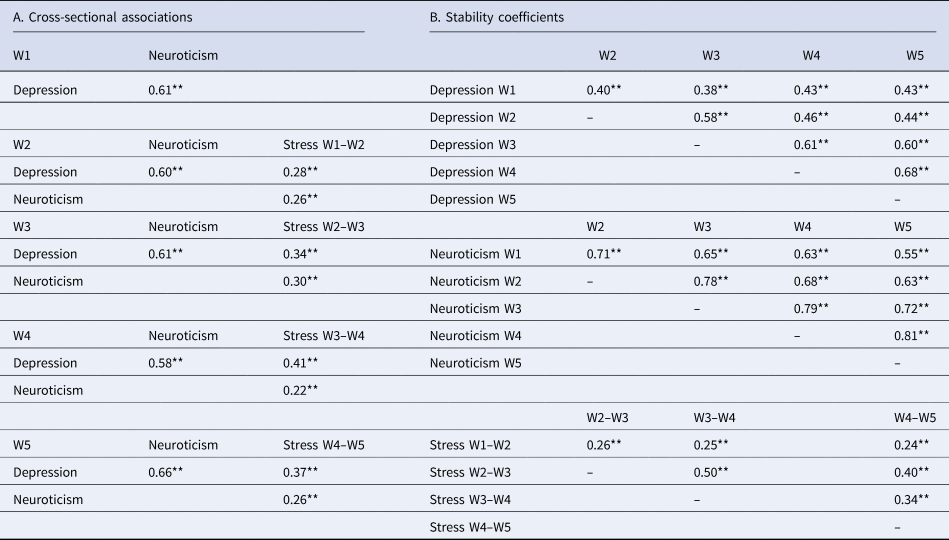
Table 2 reports cross-sectional associations and stability correlations among study variables. Cross-sectional and stability effects were generally moderate-large in magnitude and were always in the expected directions. Depression was cross-sectionally associated with neuroticism and stressful events, and life events were associated with neuroticism (additional descriptives and correlations among measures within aggregates are listed in Appendix B).
Cross-sectional associations and stability coefficients of major study variables

Part A contains correlations between study variables at the time they were assessed. Note that the stress measure covers events that occur between intervals, such that stress W1–W2 was given determined at wave 2. Part B contains stability coefficients for each of the primary variables. W = assessment wave. **p < 0.01.
Separate models for trait theories and stress generation
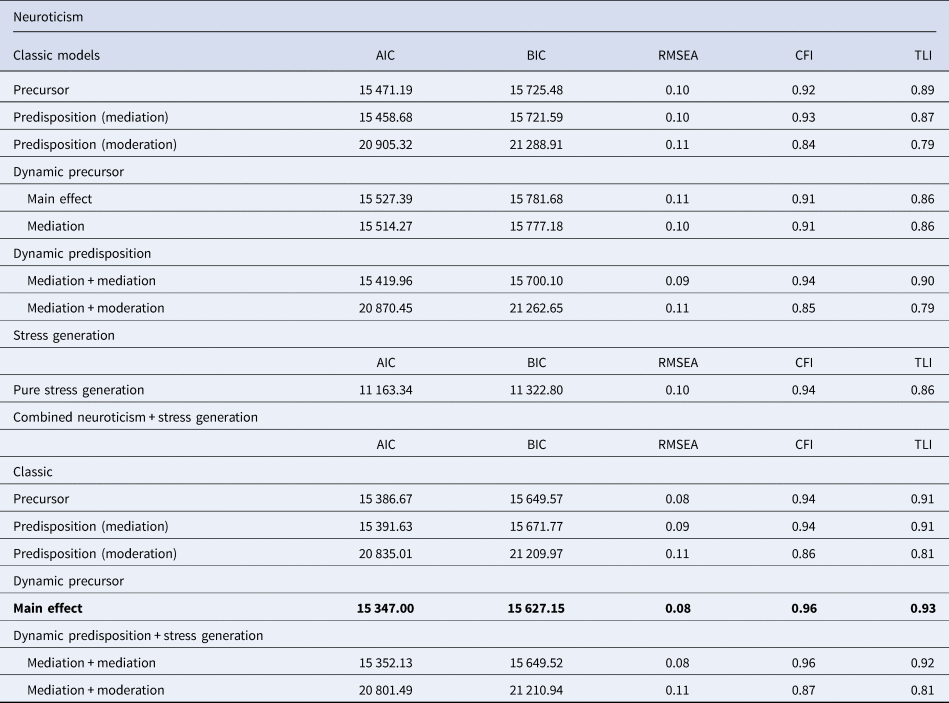
Fit statistics for the pure models are shown in Table 3. The models did not meet conventional fit benchmarks for RMSEA, CFI, or TLI. As a result, we only briefly describe the models that most closely approached adequate fit (for parameter estimates see online Supplementary Appendix B). The best-performing pure models were the classic mediation version of predisposition and mediation plus mediation dynamic predisposition models. Many of the hypothesized paths in these models were significant, including neuroticism predicting later stress, stress predicting later neuroticism, and neuroticism predicting later depression (see online Supplementary Appendix B).
Summary fit statistics for pure neuroticism models, stress generation, and combined models

Best fitting model in bold.
The stress generation model cannot be directly compared to the trait-based models using AIC or BIC as it includes fewer variables. Regardless, the pure stress generation model also fit poorly according to RMSEA, CFI, and TLI, despite the fact that all of the paths from depression to subsequent life events and life events to later depression were significant (online Supplementary Appendix B).
Integrative models
To determine if fit could be improved by integrating theories, and to test whether trait and stress generation theories complement one another, we next tested models combining stress generation with each variant of the trait vulnerability models. Fit statistics for the combined trait vulnerability and stress generation models are presented in Table 3. Overall, combining trait and stress generation models outperformed the pure models on AIC and BIC.
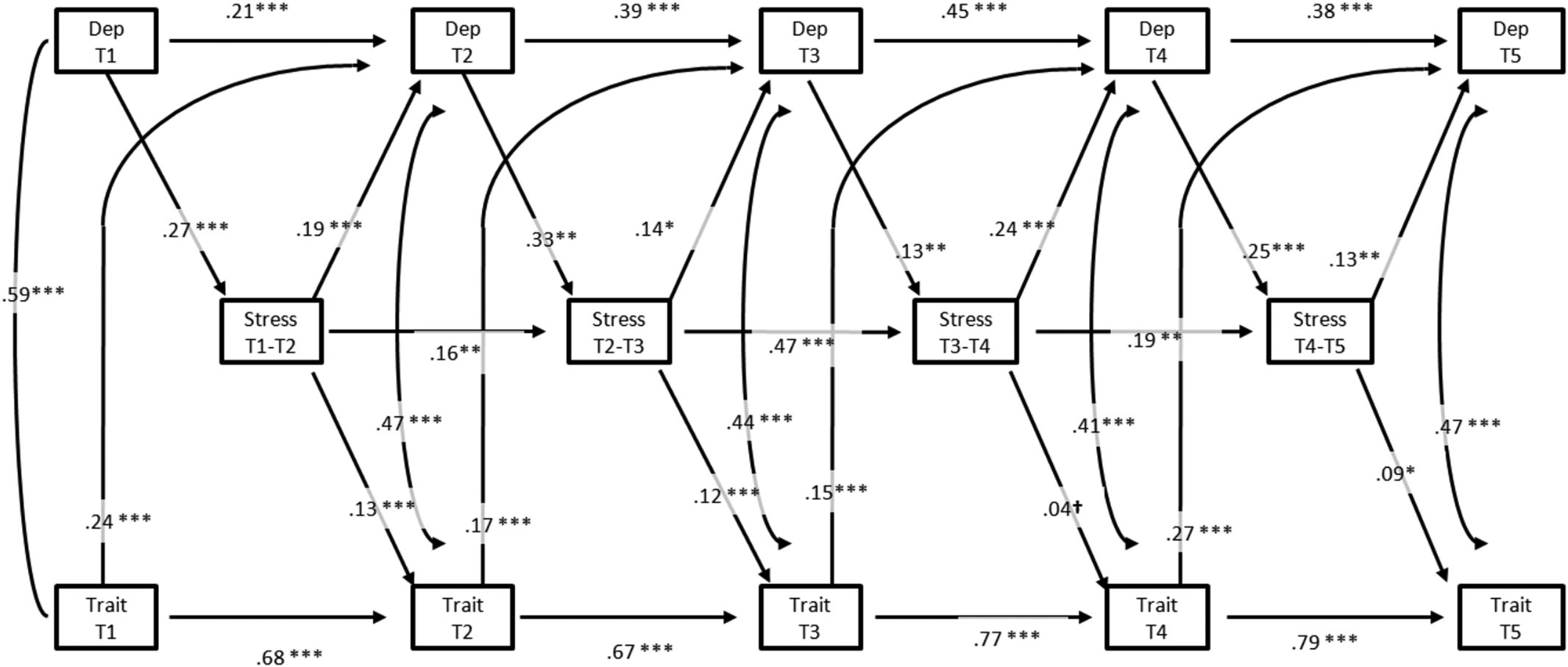
The main effect dynamic precursor with the stress generation model had the lowest AIC and BIC while also meeting conventional cut-offs for RMSEA and CFI. Just as importantly, almost all the key pathways hypothesized in this integrative model reached significance (Fig. 2). Neuroticism significantly predicted depression in the subsequent wave across each follow-up interval (the precursor trait–depression component of the DVM). In addition, stressful life events significantly predicted subsequent neuroticism at three of the four intervals, with a trend (p = 0.08) for the fourth interval (the dynamic trait component of the DVM). Moreover, consistent with stress generation, depression significantly predicted life events across all waves. Finally, life events exhibited a significant indirect effect on depression over time, accounting for 20, 11, 7, and 8% of the total effect for the W1–W2, W2–W3, W3–W4, and W4–W5 intervals, respectively (95% asymmetrical CIs did not include 0).
Neuroticism: main effect dynamic precursor model with stress generation.

Discussion
The aim of this paper was to simultaneously examine and compare several theoretical models of depression in adolescent females, a particularly important population for understanding the development of depression. We compared several types of models that are rarely tested together, including classic trait-based theories (precursor and predisposition), several variants of the DVM, and stress generation, which we applied to neuroticism, the trait with the best-established association with depression. Importantly, this is one of the first papers to provide a comprehensive test of the DVM, and to attempt to integrate trait models with stress generation.
The main effect dynamic precursor with the stress generation model had the best fit and the hypothesized parameters were consistently significant across study waves. In particular, stressful life events predicted significantly higher neuroticism at three of four intervals, with a trend for the fourth interval (the dynamic main effect component), and neuroticism predicted subsequent depression at all four intervals (the precursor component). Additionally, we consistently observed a significant indirect effect of stressful life events on depression over time such that depression predicted higher levels of dependent events, which then predicted higher levels of depression at the subsequent wave (stress generation). We also observed that dependent stressful life events had variable stability across study waves. We suspect that the higher stability from waves 3 to 4 is a result of a more stable environment, as these intervals generally corresponded to the second and third years of high school for the majority of participants, whereas the assessments marking the transition to starting high school (interval 1–2) or ending high school (interval 4–5) were associated with lower stability.
Our findings are generally consistent with prior research. Many studies report that neuroticism predicts subsequent depression (consistent with the classic precursor model; e.g. Naragon-Gainey et al., Reference Naragon-Gainey, Gallagher and Brown2013; Jeronimus et al., Reference Jeronimus, Kotov, Riese and Ormel2016) and stressful life events predict later neuroticism (consistent with a main effect dynamic component; Headey and Wearing, Reference Headey and Wearing1989; Magnus et al., Reference Magnus, Diener, Fujita and Pavot1993; Vaidya et al., Reference Vaidya, Gray, Haig and Watson2002; Jeronimus et al., Reference Jeronimus, Ormel, Aleman, Penninx and Riese2013). However, there is also evidence suggesting that life events mediate or moderate the neuroticism–depression relationship (e.g. Kendler et al., Reference Kendler, Kuhn and Prescott2004; Kercher et al., Reference Kercher, Rapee and Schniering2009; Wetter and Hankin, Reference Wetter and Hankin2009). Indeed, the pure models did find evidence for stress as a mediator or moderator of the neuroticism–depression relationship for several intervals, although the overall fit of these models was poor (see online Supplementary Appendix B).
This study contributes to the literature in several ways. As the first comprehensive empirical examination of the DVM, our results show that widely accepted models like the classic precursor and predisposition models are clearly improved by incorporating the effects of stress on traits. Researchers have long known that traits fluctuate over time, but the field has lagged in incorporating these findings, along with the factors that may influence temporal variability of traits, into trait-based etiological models of depression (Durbin and Hicks, Reference Durbin and Hicks2014). Our results indicate that stressful life events influence neuroticism, even after adjusting for prior trait levels. These findings raise the possibility of expanding DVMs to other risk factors, such as laboratory measures of cognitive bias and neural reactivity to emotional stimuli, to examine dynamic processes in vulnerability at multiple units of analysis.
Our multi-wave design provided the opportunity for repeated tests of each theoretical model, serving as within-study replications. Even simple classic precursor and predisposition models are rarely tested across several time points in a given study.
This study also integrated trait and stress generation literature within the same analytic models. In doing so, we found that the main effect dynamic precursor and stress generation models are complementary and comprise separate pathways to depression. By including both conceptual models in the same analytic model, we provided a more rigorous test of both theories, ruling out the possibility that one accounts for the other. Additionally, testing both theories together produces a richer and more comprehensive account of depression. Finally, this study extended the stress generation literature by formally testing stress as a mediator of depression symptoms over time which has been done in only a small handful of studies (Davila et al., Reference Davila, Hammen, Burge, Paley and Daley1995; Hankin et al., Reference Hankin, Kassel and Abela2005; Holahan et al., Reference Holahan, Moos, Holahan, Brennan and Schutte2005).
Nevertheless, this study had limitations. First, while there was strong justification for restricting the sample to never-depressed adolescent females, the findings may not generalize to other populations (e.g. males, adults, clinical samples). Second, the analyses did not examine other Big Five Traits or facets. Third, we did not explore particular characteristics of life events (e.g. milder v. more severe, and interpersonal v. achievement, events) or other types of stress (e.g. chronic stressors). We also did not include independent life events because stress generation and trait mediation models imply that events are dependent on the individual's behavior. However, this may have underestimated the effects of stress moderation, as both independent and dependent stressors can play a moderating role. Fourth, although we used a prospective, longitudinal design with frequent follow-ups, life stress over the prior 9 months was assessed at the same time as neuroticism and current symptoms. Hence, we cannot be entirely confident that life events assessed in each wave always preceded the symptoms and traits assessed in that wave. Fifth, we did not include paths from depression to traits, also known as the consequences, or scar, model, as this model has received little support in the literature (Klein et al., Reference Klein, Kotov and Bufferd2011).Footnote 3 Sixth, we focused on depression symptoms, rather than diagnoses, and therefore did not examine the onset of depressive episodes or distinguish between clinical and subthreshold levels of symptoms. However, it is likely that depression is continuous in nature and is better captured by a dimensional approach (Ruscio, Reference Ruscio2019). Finally, although we tested a wide and comprehensive set of models, other models that were not tested may provide as good or better fit.
Overall, this study reveals new insights into the etiology of depression as an integrative model, including DVM and stress generation, best characterized the relationships between neuroticism, stress, and depression. The strong support for including stress generation within trait-based models suggests the benefits of unifying these two literatures. However, the DVM has rarely been tested and requires replication and extension. While stress and neuroticism were the focus of the current project, they are merely one example of the DVM. It is possible that other factors besides life events (e.g. chronic stressors, pubertal development) may influence neuroticism in ways that subsequently impact depression. Similarly, it is possible that other risk factors, such as cognitive and neural vulnerabilities fit within a DVM framework. It will require much more work to elucidate the etiology of depression, but new approaches such as the DVM and formal analytic models that integrate multiple theoretical perspectives can make an important contribution.
Supplementary material
The supplementary material for this article can be found at https://doi.org/10.1017/S0033291719002927.
Financial support
This work was supported by the National Institute of Mental Health (R.K., grant number RO1 MH093479).
Conflict of interest
The authors do not have any conflicts of interest.