The triangle model of word reading (Seidenberg & McClelland, Reference Seidenberg and McClelland1989) emphasizes the interconnections among orthography, phonology and semantics in the process of word reading. Depending upon the transparency of a given orthography, the connections among the three dimensions can be arbitrary or fixed (Ziegler & Goswami, Reference Ziegler and Goswami2005). Nevertheless, the basic principles of making sense of a word meaning for different orthographies go in general along two pathways: One is a direct mapping from orthography to semantics; the other goes from orthography to phonology to semantics (Seidenberg, Reference Seidenberg2005). Both English and Chinese are relatively opaque orthographies. For example, the mapping between orthography and phonology is rather irregular for English (Ziegler, Bertrand, Tóth, Csépe, Reis, Faísca, Saine, Lyytinen, Vaessen & Blomert, Reference Ziegler, Bertrand, Tóth, Csépe, Reis, Faísca, Saine, Lyytinen, Vaessen and Blomert2010) and even more arbitrary for Chinese (Shu, Chen, Anderson, Wu & Xuan, Reference Shu, Chen, Anderson, Wu and Xuan2003). Nevertheless, phonological processing (phonology), visual and visual orthographic processing (orthography), and oral language (semantics) all uniquely contribute to learning to read words in both, respectively, as first languages (e.g., Bialystok, McBride-Chang & Luk, Reference Bialystok, McBride-Chang and Luk2005; Comeau, Cormier, Grandmaison & Lacroix, Reference Comeau, Cormier, Grandmaison and Lacriox1999; Grainger & Jacobs, Reference Grainger and Jacobs1996 for a review; Hu & Catts, Reference Hu and Catts1998; Siok & Fletcher, Reference Siok and Fletcher2001; Sprenger-Charolles, Siegel, Béchennec & Serniclaes, Reference Sprenger-Charolles, Siegel, Béchennec and Serniclaes2003; McBride-Chang & Kail, Reference McBride-Chang and Kail2002; Wagner & Torgesen, Reference Wagner and Torgesen1987; Ziegler & Goswami, Reference Ziegler and Goswami2005 for a review); they also have been identified as important for learning to read English as a second language (e.g., Gottardo, Chiappe, Yan, Siegel & Gu, Reference Gottardo, Chiappe, Yan, Siegel and Gu2006; Tong & McBride-Chang, Reference Tong and McBride-Chang2009). However, comparatively little research attention has been given to the component skills involved in learning to read Chinese as a second language, especially among young children. The present study aims to examine some of the core skills needed in learning to read Chinese words among second language young readers.
Phonological processing skills in word reading
Phonological processing skills are essential for both English (e.g.,Wagner & Torgesen, Reference Wagner and Torgesen1987) and Chinese word reading (e.g., Chow, McBride-Chang & Burgess, Reference Chow, McBride-Chang and Burgess2005; Hu & Catts, Reference Hu and Catts1998). Universally, we rely on phonological processing skills in making connections between spoken languages and writing systems (Perfetti, Reference Perfetti2003; Ziegler et al., Reference Ziegler, Bertrand, Tóth, Csépe, Reis, Faísca, Saine, Lyytinen, Vaessen and Blomert2010). Phonological processing skills entail phonological awareness skills, phonological processing speed, and phonological working memory (Wagner, Torgesen & Rashotte, Reference Wagner, Torgesen, Rashotte and a.1994). Phonological awareness skills can be tapped at the syllable, lexical tone, onset-rime, and phoneme levels (see Ziegler & Goswami, Reference Ziegler and Goswami2005 for a review; e.g., McBride-Chang, Cheung, Chow, Chow & Choi, Reference McBride-Chang, Cheung, Chow, Chow and Choi2006; Shu, Peng & McBride-Chang, Reference Shu, Peng and McBride-Chang2008). Lexical tones are unique to the Chinese language for many non-native Chinese learners, especially those whose first language is an Indo-European language. Tone awareness is significantly associated with learning to read Chinese words among native speakers (e.g., Lin, McBride-Chang, Shu, Zhang, Zhang, Aram & Levin, Reference Lin, McBride-Chang, Shu, Zhang, Li, Zhang, Aram and Levin2010; McBride-Chang, Tong, Shu, Wong, Leung & Tardif, Reference McBride-Chang, Tong, Shu, Wong, Leung and Tardif2008). Native Chinese-speaking children normally begin to formally acquire Putonghua tones through the Pinyin system when they are in the first grade of primary school. The learning of Pinyin is throughout the first two years of primary school due to the intensity of Pinyin learning (Li & Ping, Reference Li and Ping2010) Training in Pinyin has a strong facilitation on children's syllable and tone awareness (e.g., Leong, Cheng & Tan, Reference Leong, Cheng and Tan2005; Lin et al., Reference Lin, McBride-Chang, Shu, Zhang, Li, Zhang, Aram and Levin2010; Shu, Peng & McBride-Chang, Reference Shu, Peng and McBride-Chang2008; Siok & Fletcher, Reference Siok and Fletcher2001; Yin, Li, Chen, Anderson, Zhang, Shu & Jiang, Reference Yin, Li, Chen, Anderson, Zhang, Shu and Jiang2011). Previously as a teacher of native English-speaking children learning Chinese as a second language, the first author observed these children's great difficulty in mastering the lexical tones. It is possible that since this phonological element is missing in second language learners’ native languages, they find it difficult to relate to this phonological phenomenon in learning Chinese as an L2. Yet very little research has examined this phenomenon in young learners of Chinese as a foreign language (CFL learners). However, research shows that adult CFL learners also experience a great challenge in differentiating different Chinese lexical tones when acquiring the language (Hao, Reference Hao2012; Liu, Wang, Perfetti, Brubaker, Wu & MacWhinney, Reference Liu, Wang, Perfetti, Brubaker, Wu and MacWhinney2011; McGinnis, Reference McGinnis1997; Tsai, Reference Tsai2011). Research on both native Chinese young children (Shu et al., Reference Shu, Peng and McBride-Chang2008) and adult CFL learners (Liu et al., Reference Liu, Wang, Perfetti, Brubaker, Wu and MacWhinney2011) suggested that Chinese phonological awareness skills should entail tone component awareness as well as awareness of phonological segments at the syllable and phoneme levels. Despite potential for difficulties in tone sensitivity in Chinese, it is plausible that young CFL learners might thrive with other Chinese phonological skills (e.g., syllable awareness and phoneme awareness) as they may have rich experiences with these skills in their first languages through literacy instruction that emphasizes print-sound mapping rules (e.g., Connor, Morrison & Slominski, Reference Connor, Morrison and Slominski2006; Rayner, Foorman, Perfetti, Pesetsky & Seidenberg, Reference Rayner, Foorman, Perfetti, Pesetsky and Seidenberg2001). We, therefore, tested awareness of lexical tone, syllable, and phoneme onset in Chinese in the present study.
Apart from phonological sensitivity measures, rapid automatized naming (RAN) and working memory are component skills that tend to be strongly associated with word reading in both English and Chinese (e.g., Liao, Georgiou & Parrila, Reference Liao, Georgiou and Parrila2008). These two component skills are heavily language dependent. RAN assesses a reader's speed of accessing lexical items that are in high frequency of use (e.g., numbers, colors) in a language. Performance on this task not only reveals the speed of naming but also oral proficiency of the language. In this study, we examined children's RAN skills in both English and Chinese so as to compare the performances on the tasks in two languages in native and non-native Chinese speaking children.
Working memory (WM) is important for reading because it enables the reader to manipulate sounds as well as visual information. Given the nature of phonological manipulation, many research studies examining phonological WM in relation to word reading apply the forward digit recall task, which taps phonological short-term memory within Baddeley's WM model (Alloway, Gathercole & Pickering, Reference Alloway, Gathercole and Pickering2006). Backward digit recall, which assesses the integrated storage capacity and manipulation of both phonological and visuo-spatial information in working memory, is seldom examined in Chinese reading research (e.g., Chan, Ho, Tsang, Lee & Chung, Reference Chan, Ho, Tsang, Lee and Chung2006; McBride-Chang & Ho, Reference McBride-Chang and Ho2000). Recoding Chinese characters or words into sound-based representations perhaps involves not only phonological working memory but also visuo-spatial working memory. A study of Chinese–English adult bilinguals (Cole & Pickering, Reference Cole and Pickering2010) found that compared to monolingual English speakers, Chinese–English bilinguals applied both phonological and visuo-spatial strategies in picture object working memory tasks. In the present study, we included tasks tapping both phonological working memory span as well as central executive functioning of the working memory system for both languages. Again, we aimed to compare how native and non-native Chinese speaking children perform on this task in both English and Chinese.
Visual and orthographic skills in word reading
Visual and visual orthographic skills have been relatively rarely examined in English word reading, perhaps because such visually-oriented abilities seem to have a less prevalent role, at least compared to phonological processing skills, in English word reading. However, for Chinese word reading, research has demonstrated that basic visual skills as well as visual-orthographic skills are important stepping stones in learning to read Chinese characters and words (e.g., Huang & Hanley, Reference Huang and Hanley1994; Li, Shu, McBride-Chang, Liu & Peng, Reference Li, Shu, McBride-Chang, Liu and Peng2012; McBride-Chang, Chow, Zhong, Burgess & Hayward, Reference McBride-Chang, Chow, Zhong, Burgess and Hayward2005; Siok & Fletcher; Reference Siok and Fletcher2001; Tong, McBride-Chang, Shu & Wong, Reference Tong, McBride-Chang, Shu and Wong2009; Yang, Guo, Richman, Schmidt, Gerken & Ding, Reference Yang, Guo, Richman, Schmidt, Gerken and Ding2013). For example, Perfetti and colleagues studied adult English speakers learning Chinese as a foreign language and found that learning to read Chinese requires learners to accommodate a visual workload that is less important in alphabetic reading (e.g., Perfetti, Liu, Fiez, Nelson, Bolger & Tan, Reference Perfetti, Liu, Fiez, Nelson, Bolger and Tan2007; Wang, Perfetti & Liu, Reference Wang, Perfetti and Liu2003). Wang et al. (Reference Wang, Perfetti and Liu2003) found that visual-orthographic skills played an important role in the early stage of Chinese reading for adult learners. Later, a neuroimaging study also demonstrated that learning to read Chinese demands the recruitment of neural processes that are essential for reading Chinese but less for alphabetic reading, again for adults (Perfetti et al., Reference Perfetti, Liu, Fiez, Nelson, Bolger and Tan2007). The finding that both occipital-temporal and middle frontal areas are involved in reading Chinese suggests the importance of visual processing in reading Chinese. Shen (Reference Shen2005) also found that the most common strategy adopted by CFL adult learners centers on using Chinese orthographic knowledge (e.g., understanding of radicals and parts of radicals) as the cues to encode Chinese characters.
Although it appears that adult learners of Chinese make strong use of orthographic knowledge, but not pure visual skills, in reading Chinese characters (e.g., Kim, Reference Kim2010), at least for native Chinese-speaking children, pure visual skills are also significant correlates of Chinese character reading at the early stages of literacy learning (Huang & Hanley, Reference Huang and Hanley1994; Siok & Fletcher, Reference Siok and Fletcher2001; Yang et al., Reference Yang, Guo, Richman, Schmidt, Gerken and Ding2013). Interestingly, Kim's studies (Reference Kim2010), comparing L2 adult learners of Chinese and L1 Chinese children in learning to read Chinese, demonstrated that L2 adult learners of Chinese bypassed the visual stage of character acquisition. In fact, basic visual skills tend to be associated with early reading development across scripts (e.g., Brunswick, Martin & Rippon, Reference Brunswick, Martin and Rippon2012; Ellis & Large, Reference Ellis and Large1988; Gabrieli & Norton, Reference Gabrieli and Norton2012; Ho & Bryant, Reference Ho and Bryant1999; Vellutino, Tunmer, Jaccard & Chen, Reference Vellutino, Tunmer, Jaccard and Chen2007). In addition, some studies have found that children may develop stronger visual skills if they must learn to read a visually complex orthography initially. For example, Chinese children exposed to Chinese exhibit better visual spatial skills than children learning to read an alphabetic orthography such as Greek or English (Demetriou, Kui, Spanoudis, Christou, Kyriakides & Platsidou, Reference Demetriou, Kui, Spanoudis, Christou, Kyriakides and Platsidou2005; McBride-Chang, Zhou, Cho, Aram, Levin & Tolchinsky, Reference McBride-Chang, Zhou, Cho, Aram, Levin and Tolchinsky2011). In the present study, one focus was on whether visual skills would be the same or different for L1 and L2 Chinese young learners; another was on the role of visual skills in Chinese word reading for L2 Chinese young learners.
Apart from pure visual skills, we additionally examined orthographic skills across groups. Chinese orthographic skills are important correlates of native Chinese children's reading acquisition (Anderson, Ku, Li, Chen, Wu & Shu, Reference Anderson, Ku, Li, Chen, Wu and Shu2013; Luo, Chen, Deacon & Li, Reference Luo, Chen, Deacon and Li2011; Luo, Chen, Deacon, Zhang & Yin, Reference Luo, Chen, Deacon, Zhang and Yin2013; Tong et al., Reference Tong, McBride-Chang, Shu and Wong2009; Tong & McBride-Chang, Reference Tong and McBride-Chang2010). The majority of Chinese characters are those with multi-components. Those components can be meaningful radicals that sometimes provide phonological and/or semantic cues to the characters (e.g., the character 溜-līu-meaning slip– in English contains a semantic radical indicating ‘water’ on the left, and the phonetic radical 留liu on the right), but are often easily visually confusable for novice learners (e.g., the character 潘-pān-is a family name in Chinese). Children's memory for and awareness of the characteristics (e.g., position, functions) of these phonological and semantic radicals are stepping stones to Chinese character recognition. Whereas native Chinese-speaking children are typically exposed to or instructed in identifying these radicals through home literacy as well as school experiences, non-native Chinese-speaking children normally will have many fewer such experiences. Therefore, the importance of non-native Chinese speaking children's orthographic skills in learning to read Chinese was another central focus of the present research study.
General language skills in word reading
Oral language skills assess a speaker's understanding and use of a language. Usually, oral language skills such as vocabulary knowledge allow a child to build connection between semantics and phonology of a word before he or she can associate it with the print of the word. Oral language skills are the foundation of literacy (e.g., Swanson, Rosston, Gerber & Solari, Reference Swanson, Rosston, Gerber and Solari2008). The dynamics of the relationship of oral language and literacy development may differ for L1 and L2 learners since, very often, literacy and oral language are introduced at the same stage of Chinese language acquisition for second language learners. There has been research showing that general language skills such as vocabulary knowledge contribute substantially to children's word reading development.
Indeed, previously it was found that L1 Chinese children's vocabulary knowledge was strongly associated with word reading (Ho, Wong, Yeung, Chan, Chung, Lo & Luan, Reference Ho, Wong, Yeung, Chan, Chung, Lo and Luan2011; Liu, McBride-Chang, Wong, Tardif, Stokes, Fletcher & Hua, Reference Liu, McBride-Chang, Wong, Tardif, Stokes, Fletcher and Hua2010; Pan, McBride-Chang, Shu, Liu, Zhang & Li, Reference Pan, McBride-Chang, Shu, Liu, Zhang and Li2011), possibly because decoding Chinese words at either the one-character or multiple-character level accesses meaning representation to a great extent. Strong vocabulary knowledge provides joint links between semantics and phonology for the Chinese language. For another example at the word level, knowing a word “zao3shang4” orally does not directly lead one to print ‘早上’ (meaning morning) through phonological awareness either at the syllable or tone levels. Orthographically, the two characters can provide certain meaning cues to this word. In this case, 早 can be seen as the sun climbing up on to a tree twig; 上 attached to the first character does not have much meaning on its own in this case. However, individually, 上 means the direction above. In this case, the semantics may connect the phonology and orthography together. Not all Chinese characters provide direct semantic cues to the word. For example for the word 新聞, one has to know both characters, i.e., 新 meaning ‘new’ in English, and 聞meaning ‘hearing’ in English, to make an educated guess as to the meaning of this word (news). Either way, the connection between vocabulary knowledge and word reading perhaps largely lies in the semantics. In the present study, we were interested in examining second language children's Chinese vocabulary performance as compared to that of their native Chinese speaking peers, and the role of Chinese vocabulary knowledge in Chinese word reading in these children.
The present study
Taken together, based on existing research, we asked several questions related to understanding children learning Chinese as a second language. First, among several basic skills related to reading development identified primarily for those learning in their L1, what skills play the most important role in learning to read Chinese words in L2 young learners? For example, what are the roles of phonological processing skills and general language skills in Chinese word reading for second language young learners? More specifically, given lexical tones as a phonological feature that is absent in many languages, especially alphabetic languages, how well can L2 Chinese young learners whose L1 is an alphabetic language acquire this particular aspect of phonological skill? Based on the psycholinguistic grain size theory (Ziegler & Goswami, Reference Ziegler and Goswami2005) that proposes that developmentally children master syllable and onset-rimes skills before phoneme skills and syllable/onset-rime skills exist in nearly all languages, it is reasonable to predict that L2 Chinese learners can make a smooth transfer in phonological skills at the syllable and onset-rime levels given that transfer effects have been observed in Chinese L1–English L2 young learners (e.g., McBride-Chang et al., Reference McBride-Chang, Tong, Shu, Wong, Leung and Tardif2008; Wang et al., Reference Wang, Perfetti and Liu2003). However, Mandarin lexical tones might remain a challenge for L2 Chinese young learners. One group suggested that, developmentally, it would take Chinese children 6 to 7 years to master a high level of Mandarin lexical tone skills including a year of concentrated training of the phonological coding system (i.e., Pinyin) at the first grade of primary school (Shu et al., Reference Shu, Peng and McBride-Chang2008). We therefore hypothesized that L2 Chinese young learners would perform equally well as compared to native Chinese speakers on phonological awareness skills at the syllable, onset, and rime levels. In contrast, we expected that L2 Chinese learners would perform much less well on Chinese lexical tone awareness.
Several previous studies on bilingualism and biliteracy acquisition have shown that it usually takes children about two to three years to reach native levels of language and literacy proficiency in a bilingual immersion setting (e.g., Genesee, Reference Genesee1983; Lambert, Genesee, Holobow & Chartrand, Reference Lambert, Genesee, Holobow and Chartrand1993). However, it is unknown how children in a bilingual setting for which Chinese is taught as a second language might perform on basic language and literacy skills. Up until now, very little research has investigated L2 Chinese young learners’ oral language skills in an immersion setting. The present study is among the first to address this issue. Due to the linguistic distance of Chinese and English and the specific difficulties of the Chinese orthography per se (Koda, Reference Koda2007), coupled with the limited exposure and use of Chinese as a home language (Dixon, Wu & Daraghmeh, Reference Dixon, Wu and Daraghmeh2012; Luk & Bialystok, Reference Luk and Bialystok2013), we hypothesized that children with Chinese as a second language would not be able to achieve the native Chinese learners’ Chinese language and literacy level, even in an immersion educational setting. We also hypothesized that L2 Chinese young learners would not perform as well as the native speakers on other phonological processing skills including RAN and working memory tasks in Chinese, as these tasks are heavily dependent on oral language skills.
Visual skills can be relatively language-free and “pure,” however. Previous studies have found that children with early Chinese literacy exposure were more likely to excel in basic visual skills than children learning alphabetic languages at the same age (McBride-Chang et al., Reference McBride-Chang, Zhou, Cho, Aram, Levin and Tolchinsky2011). The present study aimed to examine basic visual skills in children with second language Chinese exposure and to use and compare those with visual skills in native Chinese speaking children. Such a comparison would help us to answer the question as to whether nonnative and native Chinese speaking children's visual skills are at a comparable level given the possible effect of reading Chinese on visual skills (McBride-Chang et al., Reference McBride-Chang, Zhou, Cho, Aram, Levin and Tolchinsky2011). In light of how orthographic skills affect Chinese reading, we additionally examined Chinese visual orthographic memory in this study. Previous studies have mostly focused on readers’ sensitivity and knowledge of Chinese orthographic rules as they tend to be strongly and significantly associated with children's levels of reading skills (e.g. Ho, Yau & Au, Reference Ho, Yau, Au, McBride-Chang and Chen2003; Li et al., Reference Li, Shu, McBride-Chang, Liu and Peng2012; Luo et al., Reference Luo, Chen, Deacon and Li2011; Tong et al., Reference Tong, McBride-Chang, Shu and Wong2009; Qian, Song, Zhao & Bi, Reference Qian, Song, Zhao and Bi2015). Our task of orthographic skill focused on testing Chinese orthographic visual memory apart from Chinese orthographic awareness. Our task was especially designed to tap visual-orthographic skills even in those who are novices to Chinese print. Given the complexity and quantity of Chinese orthographic features, we hypothesized that non-native Chinese speaking children may not be as strong as native Chinese speaking children on Chinese orthographic visual memory. Similarly they may also lack Chinese orthographic awareness skills comparing to native-Chinese speaking children.
This study examined these questions with children learning in a dual-language (i.e., Chinese–English) setting; in this particular environment, children are provided with fairly equal exposure, input, and possible use of both languages at school. By first comparing native and non-native Chinese speaking children in this context on their Chinese and English reading related skills, we hoped to obtain an overview of how non-native Chinese-speaking children perform on each domain of reading related skills in comparison with their native-Chinese-speaking peers given the same instruction and years of schooling. We then sought to determine if these reading-related skills were associated with Chinese word reading in similar or different ways for native and non-native Chinese speaking groups.
Method
Participants
The participants were 102 children, 54 (27 boys and 27 girls) third graders (Mean age: 92.65 months, SD:4.7) and 48 (23 boys and 25 girls) fourth graders (Mean age: 104.92 months, SD:4.1) from a Chinese–English bilingual international school in Hong Kong. This school follows the International Baccalaureate curriculum and students used Chinese approximately 40% of the time and English 60% of the time at school, at the time of testing. The school makes use of a dual language curriculum in which children begin with 50-50% input of both languages across different school subjects by native-speaking teachers from kindergarten onwards. The children in the present study had been learning English and Chinese formally in the same school for at least 4 years at the time of testing. They learned Chinese through the Pinyin system and a traditional version of the characters.
Procedures
A consent form and a questionnaire regarding children's language background were sent out to the parents. The children were then tested individually for Chinese-language and English-language related tasks in two separate sessions at a quiet area in their school. The test administrators were native Mandarin and English-speaking psychology students, respectively, trained specifically prior to the research. Pinyin knowledge was the only task that was carried out within groups of 9–10 children. The order of Chinese and English language versions of the tasks was randomized, so some children were tested in Chinese first, followed by English. Other children were tested in English first and then in Chinese. The administrators were randomly assigned to carry out assessments with the children individually, but both Chinese and English versions of the tasks were administered by native-speaking testers.
Measures: Raven's non-verbal intelligence
Raven's Coloured Progressive Matrices A-E (Raven, Raven & Court, Reference Raven, Raven and Court1995) was used to tap children's non-verbal reasoning. The children were presented with a series of geometric symbols which were presented on a sheet, with one section missing. They were asked to choose one option from 6 to 8 symbols listed at the bottom of each page. They were encouraged to make a guess when they said that they did not know the answer. Each correct answer was worth one point and the maximum score across all 5 sets comprising the test was 60. Cronbach's alpha for the test was .86.
Measures: Chinese Phonological awareness
The Chinese phonological awareness task included syllable deletion and phoneme deletion (e.g., Chow et al., Reference Chow, McBride-Chang and Burgess2005). In order to increase the difficulty level of this task such that it could be challenging for 3rd and 4th graders in Chinese, we designed items in which children were asked to delete not only the onset but also the middle or final syllable from an item comprised of either 3 or 4 syllables. In the phoneme deletion section, we also created multi-syllable items, from which the children were asked to delete the onset phonemes from all three or four syllables and say aloud the rest of the syllables. There were five items in the syllable deletion section and 15 items in the phoneme deletion section. Children were allotted 1 point for each item produced correctly; there were a total of 20 points possible for this task. Cronbach's alpha for the 15 Chinese phonological awareness items was .82.
Measures: English Phonological awareness
The English Phonological awareness task was adopted from the Elision task of the CTOPP (Wagner et al., Reference Wagner, Torgesen and Rashotte1999). There were in total 20 test items. Children were asked to delete either the first or middle phoneme from one-syllable words. This task ultimately revealed a ceiling effect for the children; over 60% of the children scored 18 out of 20 items. This ceiling effect reflected the emphasis on English phonics instruction at the school. Cronbach's alpha for this task was .72
Measures: Chinese and English working memory tasks
Forward digit recall and backward digit recall tasks from Pickering and Gathercole's (Reference Pickering and Gathercole2001) working memory battery were adopted to examine children's phonological working memory and central executive working memory skills, respectively. While forward digit recall taps storage and manipulation of the phonological loop only, the backward digit recall task taps the general central executive working memory, which accesses both the phonological loop and the visuo-spatial sketchpad. For both tasks, the children were asked to listen to a voice reciting a series of digits in Chinese starting from 2 digits. Then the children were asked to repeat these digits in exactly the same order in which they heard the items for the forward digit task, but also to repeat the digits backwards for the backward digit recall task. The task stopped when a child failed to recall two items within the same digit span. All the digits were recorded by a native English speaker for English and a native Mandarin speaker for Chinese; both speakers were female. One point was awarded for a correct response to each item. In total there were 27 points for each forward and backward digit recall task.
Measures: Rapid number naming in Chinese and English
The rapid number naming task was taken from the Comprehensive Test of Phonological Processing (CTOPP–Wagner et al., Reference Wagner, Torgesen and Rashotte1999). Children were asked to name aloud a sequence of numbers on an A4 page in Chinese and English, respectively. The children were asked to read aloud the numbers twice and the average time spent for both oral readings was calculated. Two versions of the task were administered in Chinese and English separately. The length of time in seconds of each trial was recorded.
Measures: Chinese Pinyin knowledge
An additional phonological variable to include in the present study of children learning Chinese as L2 was Pinyin, the phonological coding system used to teach Chinese in Mainland China and widely used to teach Chinese to foreigners, both adults and children. Recent research has also demonstrated that Chinese children's early Pinyin knowledge can be an effective way of examining Chinese phonological awareness (Lin et al., Reference Lin, McBride-Chang, Shu, Zhang, Li, Zhang, Aram and Levin2010; Yin et al., Reference Yin, Li, Chen, Anderson, Zhang, Shu and Jiang2011). There is strong consensus that phonological coding systems such as Hanyu Pinyin and Zhu-Yin-Fu-Hao tend to improve children's phonological awareness of Chinese and have a strong impact on children's word reading skills (e.g., Huang & Hanley, Reference Huang and Hanley1997; Lin et al., Reference Lin, McBride-Chang, Shu, Zhang, Li, Zhang, Aram and Levin2010; Siok & Fletcher, Reference Siok and Fletcher2001; Yin et al., Reference Yin, Li, Chen, Anderson, Zhang, Shu and Jiang2011). A Pinyin syllable is composed of an onset, a rime, and a lexical tone. Pinyin knowledge is usually assessed through a Pinyin reading task (Siok & Fletcher, Reference Siok and Fletcher2001; Yin et al., Reference Yin, Li, Chen, Anderson, Zhang, Shu and Jiang2011). This way of tapping children's Pinyin knowledge focuses on holistic skills. Such an approach makes it difficult to pinpoint which aspects of Pinyin knowledge the children have mastered or have weaknesses in. Recent research (Lin et al., Reference Lin, McBride-Chang, Shu, Zhang, Li, Zhang, Aram and Levin2010) examined children's Pinyin knowledge through an invented Pinyin spelling task. Young Mainland Chinese children, with varying knowledge and sensitivity to Pinyin, were asked to write a few Chinese syllables and tones using this transcription system. Their spelling of syllables and tones were rated through a multi-level coding scheme that aimed to tap children's sensitivity to syllables as well as to lexical tones. This task uniquely predicted reading skill longitudinally, even with previous character knowledge statistically controlled. The current study adopted a similar task and coding scheme. However, since it was adapted for older children, it incorporated the role of onset, rime and lexical tone spelling separately within the Pinyin knowledge construct.
We extended the task of Pinyin from Lin et al. (Reference Lin, McBride-Chang, Shu, Zhang, Li, Zhang, Aram and Levin2010) to tap children's sensitivity to speech sounds in Pinyin. Children were asked to listen to and write down ten 2-syllable words in Chinese. There were in total 20 Pinyin syllables. The task was explained with practice trials first, before the dictation was administered. All the stimuli were recorded by a female voice in standard Mandarin speech and played to the children with a pause in between words. The results were coded separately for onset (3 points), rime (3 points), and tone (3 points), and onset-rime orders (1 point); for each syllable the total score was 10 points. This task elicited no ceiling or floor effects. Cronbach's alphas for the 20 onset-rime items and 20 lexical tones were .83 and .94, respectively.
Measures: Chinese Vocabulary knowledge
In order to cover a wide range of vocabulary knowledge, our tasks of vocabulary included both receptive and expressive items together. The Chinese vocabulary knowledge task was designed to match the children's English vocabulary knowledge task. Children's textbooks were consulted before the items were chosen. In the receptive vocabulary section, there were in total 30 items. The children were asked to listen to a Chinese word and point to one of the four pictures indicating the meaning of the word they heard. They were encouraged to guess the word if they said that they did not know it. Following these, in the expressive vocabulary section, there were 20 items and the children were asked to name each picture they were shown in Chinese. All the pictures were single-line-drawn pictures. For the receptive vocabulary portion of the test, one correct answer counted as one point, but for the expressive vocabulary part, children's answers were coded based on a 2-point scale. One point was awarded for an answer that was related but not accurate as the standard answer and 2 points were given if the answer was accurate. The total points possible for this task was 70. The Cronbach's alphas for the 30 items of the Chinese receptive vocabulary task and 20 items of expressive vocabulary task were .90
Measures: English Vocabulary knowledge
For the English version of this vocabulary task, there were in total 36 items tapping receptive vocabulary and 20 for expressive vocabulary. All the items were chosen from age-equivalent items and above based on the Peabody Picture Vocabulary Test (Dunn & Dunn, Reference Dunn and Dunn1997). Scoring for this task was the same as it was for the Chinese vocabulary knowledge task; the total points for this task was 76. The Cronbach's alpha for the 36 items of English receptive vocabulary and 20 items of English expressive vocabulary task was .90.
Measures: Chinese word reading
The Chinese word reading task consisted of single (n = 31 items) and two-character (n = 57 items) Chinese words. These words were chosen from children's Chinese textbooks and storybooks. Both simplified and traditional forms of the Chinese characters were presented because we did not want children to be handicapped by knowing one script better than the other. Hong Kong itself makes use of the traditional Chinese script, but those from Mainland China uniformly use simplified script. Therefore, parents and teachers teaching Chinese in Hong Kong sometimes teach one or the other based on a given textbook they are using and also based on their own (teaching) background. Children were asked to name each word one by one. Scores were based on the number of characters they named correctly. The total score for this task was 145. If a child failed to name 10 item words consecutively, the testing was stopped. We created this ceiling based on pilot-testing. Cronbach's alpha for the 88 items of the Chinese word reading task was .91.
Measures: English word reading
For the English word reading task, we chose a total of 70 English words arranged in order of increasing difficulty level. Children were asked to read words one by one in a loud voice. One point was given for each word that was correctly pronounced. This measure revealed a ceiling effect as over 55% of the children scored 65 out 70 items. Most children were able to decode four or five syllable words even when they did not know the meaning of the word. Cronbach's alpha for the 70 items of this English word reading task was .87.
Measures: Visual spatial relations
The Spatial Relations task from the Woodcock Johnson III Test of Cognitive Abilities (Woodcock, McGrew & Mather, Reference Woodcock, McGrew and Mather2001) was administered to measure pure visual skills. In this task, children were asked to identify the subset of parts needed to form a complete shape. For each part the child selected correctly, the child earned one point. There were in total 33 items and the total score for this task was 81. Cronbach's alpha for the 33 items of this task was .83.
Measures: Chinese orthographic awareness
In previous research, Tong and McBride-Chang (Reference Tong and McBride-Chang2010) found that children's sensitivity to radicals or parts of characters in the Chinese orthography was a developmentally important factor in Chinese character reading in native-speaking Chinese children. This task involved 50 real and fake radical parts and one point was awarded for each item, so 50 points was the highest possible score for this task. The fake radical parts were created by addition, deletion or alteration of direction of real radical parts. For this task, children were asked to indicate whether the character part presented was real or fake. We replicated this task in examining children's visual orthographic sensitivity to Chinese characters for the present study. Cronbach's alpha for the 50 items of the visual orthographic configuration task was .66.
Measures: Chinese orthographic memory
Our task of visual orthographic memory was designed in light of Gardner's visual memory task (Gardner, Reference Gardner1996). However, instead of visual geometric symbols, which are used in Gardner's pure Visual Memory task, this task was designed to tap children's orthographic memory for Chinese character parts. This task was designed such that those with no knowledge of Chinese could complete it. In total, 36 Chinese semantic radicals were chosen to be the target memory items and one point each was awarded to the correct response. These radicals included 50% single characters that serve as radicals in compound characters and another 50% of radical parts that do not have individual sounds. Children were asked to view a Chinese radical in the middle of an A4 page for 3 seconds before searching for the radical embedded in one of the four compound characters on the next page. Among four Chinese characters, except for the targeted character, the other characters were chosen based on the fact that all of them have similar character structures. These characters were visually similar but contained different radical parts from the target radical that the children were asked to search for. Therefore, this task examined children's sensitivity to the orthographic details of Chinese radicals and visual memory for Chinese radical parts. Cronbach's alpha for the 36 items of the task was .58.
Results
The analysis of the questionnaire administered to the parents revealed a clear preference of English over Chinese in this sample. Although the school emphasized the learning and use of both languages, more than 63% of the families reported that English was the language most often spoken at home. Among the 29.4% of the families who reported speaking Chinese frequently at home, half of them spoke Cantonese and the other half spoke Mandarin or other Chinese dialects apart from Cantonese at home. In general, parents reported that almost all of the children had much more exposure to English-speaking media than to Chinese-speaking media. About 81.4% of the children were reported to be reading English language books often, most of the time or always; about 44% of the children were reported to read Chinese language books often or most of the time. None were reported to have always read books in Chinese. The children were reported to speak English to their peers most of the time. About 69% of the parents viewed their children as native level English users and 45% of the parents rated their children similarly for Chinese. Our face to face assessments of their language abilities in Chinese and English showed that all children were fluent in spoken English and Chinese.
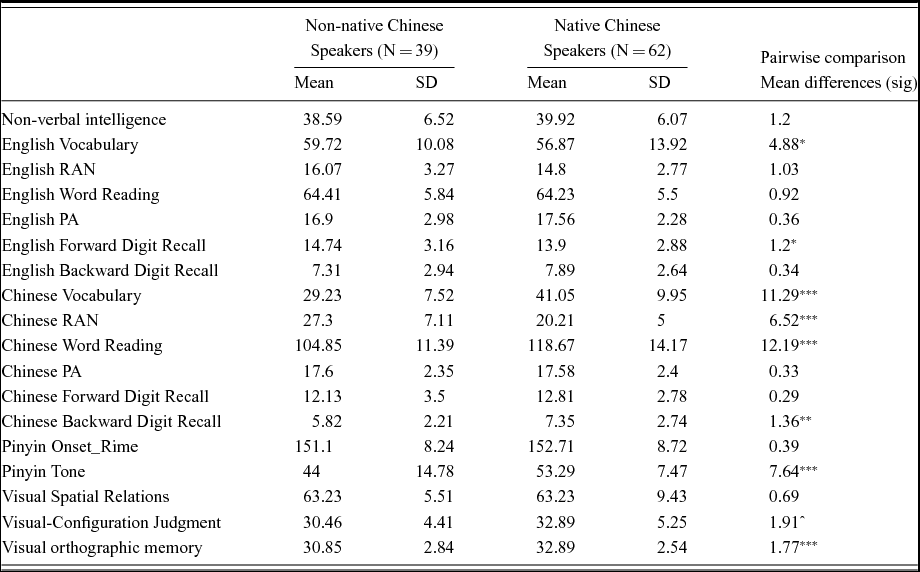
We divided the students into native and non-native Chinese speaking groups based on their mother's reported native language since mother tongue has a significant contribution to children's first, second and even third language and literacy development (e.g., Butzkamm, Reference Butzkamm2003; Deckner, Adamson & Bakeman, Reference Deckner, Adamson and Bakeman2006; Abidogun & Adebule, Reference Abidogun and Adebule2014; Quiroz, Snow, Zhao, Falqueto, Vaz-de-Mello & Schoereder, Reference Quiroz, Snow, Zhao, Falqueto, Vaz-de-Mello and Schoereder2010; Swain et al., Reference Swain, Lapkin, Rowen and Hart1990). With this grouping method, there were 40 children (19 girls and 21 boys) in the non-native Chinese-speaking group (Mean age: 97.18 months, SD: 7.78 months), among which 24 children were from Grade 3 and 16 from Grade 4. Sixty-two children (32 girls and 29 boys) were in the native Chinese speaking group (Mean Age: 99.23 months, SD: 7.39months); of these, there were 30 children from Grade 3 and 32 children from Grade 4. Means and standard deviations for predictor and criterion variables are presented in Table 1. In order to further confirm the grouping for native and non-native Chinese speaking groups, independent T-tests were carried out to compare the Chinese and English language use and exposure in the two groups. According to the parents’ reports, the native Chinese speaking group had significantly more exposure and use of Chinese language at home than the non-native Chinese speaking group, either through television (t (97) = 4.71, p<.001), music (t(94) = 3.37, p<.01), or talking to friends in Chinese (t(97) = 5.00, P<.001) . At the same time, however, the two groups reported having similar exposure to Chinese language books and the Internet at home. In addition, parents of native Chinese-speaking children reported helping with their children's Chinese home work more frequently than the parents of non-native Chinese speaking group (t (99) = 4.04, p<.001). The results confirmed that the native Chinese-speaking group had stronger oral Chinese language exposure and use at home than the non-native Chinese group did, although the two groups read similar amounts of Chinese through media. Comparatively, the non-native Chinese speaking group had significantly more exposure and use of English at home compared with the native-Chinese speaking group, either through TV (t(98) = 3.13, p<.01), internet (t(98) = 2.11, p<.05), music (t(93) = 4.67, p<.001), books (t(98) = 2.6, p<.05) or talking to friends (t (97) = 3.36, p<.01).This gives some support to the idea that our groupings by Chinese or non-Chinese mother tongue had some validity, an important point, given that the children were attending the same school for Chinese–English bilingual education.
Group comparison on linguistic, cognitive and literacy tasks after controlling for grades and non-verbal intelligence.

Note. *p<.05, **p<.01, ***p<.001
MANCOVA analysis was first carried out to examine if there were any grade effects and an interaction between language group and grade. If any interaction between language group and grade was found, that would establish that the two language groups performed differently at different grades, making it unreasonable to combine together the data from the two grades. However, a lack of interaction between language group and grade would suggest that the two language groups from the two grades performed similarly on those tasks. With Raven's nonverbal intelligence statistically controlled, the MANCOVA results showed that there was a significant language group effect, F(17, 80) = 5.18, p < .001, partial η2 = .52, as well as a grade effect, F (17,80) = 2.13, p = .01, η2 = .31, on the combined dependent variables, but no interaction between language group and grades emerged. We, therefore, combined together data from the two grades due to the limited sample size.
Combining the two grades together, among the 40 non-native Chinese speaking group with alphabetic language backgrounds, there were speakers of English (67.5%), Korean (10%), Japanese (5%), Portuguese (2.5%), Spanish (2.5%), Italian (2.5%), French (2.5%), Dutch (2.5%) and Catalan (2.5%). Among the 62 native-speaking Chinese children, 40.3% came from a Cantonese-speaking background, 1.6% spoke Shanghainese, 19.4% spoke Mandarin, and 38.7% did not specify further their Chinese language background. The heterogeneous of the non-native Chinese speaking group is not ideal for such grouping; however, it is ecologically valid for Hong Kong and hopefully provides a starting point for this line of research.
Further ANCOVAs were carried out to examine the group differences on different tasks after accounting for the effects of grade and non-verbal intelligence. In general, the two groups of children performed similarly on several English language related tasks including English word reading, English phonological awareness, English Rapid Automatized Naming and English backward digit recall. However, there was a significant group effect for English vocabulary F (3, 97) = 4.52, p < .05, η2 = .05 and English forward digit recall task, F (3,97) = 4.37, p < .05, η2 = .04 with alphabetic language speakers showing clear advantages on both. These results were in line with previous studies of bilingual children showing that native speaking children have an advantage in vocabulary and fluency (e.g., Bialystok, Reference Bialystok2007; Bialystok et al., Reference Bialystok, McBride-Chang and Luk2005; Uchikoshi & Marinova-Todd, Reference Uchikoshi and Marinova-Todd2011). However, weaker vocabulary knowledge in Chinese speaking children did not impede them in developing their word reading skills in English. They also manifested English phonological awareness skills that were similar to their alphabetic language-speaking peers.
On the Chinese language related tasks, the two groups differed significantly on Chinese vocabulary knowledge, F (3, 97) = 38.33, p < .001, η2 = .29, rapid automatized naming in Chinese, F (3,97) = 29.64, p < .001, η2 = .24 Chinese word reading, F (3, 97) = 28.14, p < .001, η2 = .23, Chinese backward digit recall, F(3,97) = 7.72, p < .01, η2 = .07 and tone production on the Pinyin writing task, F (3, 97) = 13.66, p < .001, η2 = .13, with the native Chinese-speaking group showing a clear advantage on these tasks. However, the two groups did not differ on the Chinese phonological awareness or Pinyin production tasks at the syllable level.
The groups were also compared on their general visual and Chinese visual orthographic skills. They did not differ on the visual-spatial tasks but the native speakers outperformed the non-native Chinese speaking group on the two Chinese visual-orthographic tasks, i.e., visual-configuration, F (1, 98) = 3.74, p = .056, η2 = .05 and visual-orthographic memory, F (1,98) = 13.40, p < .001, η2 = .12.
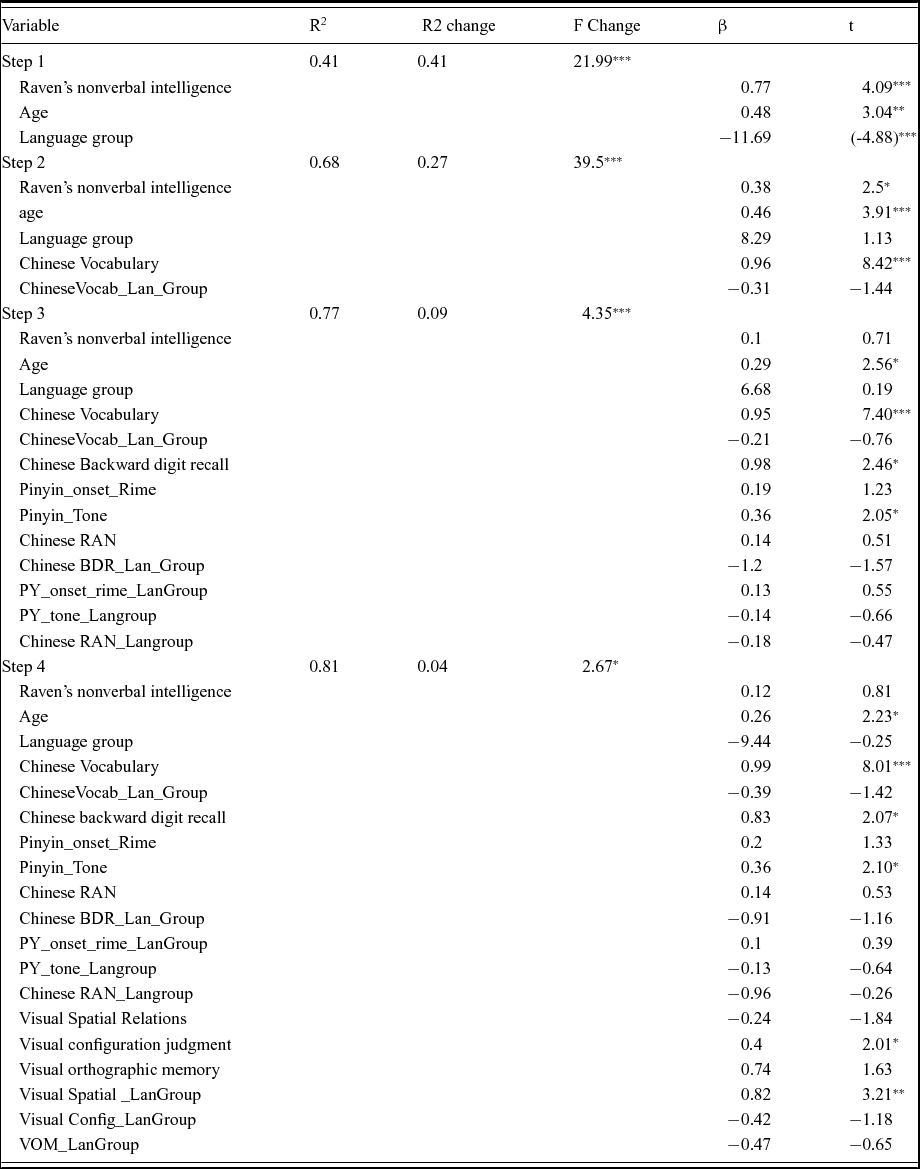
Another research question we explored focused on what skills contribute to Chinese word reading for native and non-native Chinese speaking children. In order to increase statistical power, data for the two groups were combined. One outlier was identified through initial regression analysis. Based on the regression model, the Chinese word reading of the outlier from the native Chinese-speaking group was (65) significantly lower than the predicted value (93.25). We therefore removed this outlier from further analyses. Hierarchical regression analyses were then carried out with Raven's nonverbal intelligence, Chinese vocabulary and language group variables statistically controlled in the first step. At step two, Chinese phonological processing skills entailing backward digit recall, and Chinese Pinyin production at both the onset-rime and tone levels, were entered, in addition to the interaction between these variables and the dummy variable language group, with the native Chinese-speaking group set up as the reference group. Forward digit recall was not added in the model as it did not have a significant correlation with Chinese word reading for the non-native Chinese-speaking group. We included these phonological sensitivity variables before the visual and visual-orthographic skills given the primacy of phonological processing for early reading development across cultures (Ziegler & Goswami, Reference Ziegler and Goswami2006). At the final step, visual orthographic skills including visual–spatial relations, visual-configuration judgment, and visual orthographic memory, together with the interaction variables of these variables and the dummy language group, were included in the regression analysis.
Results from the hierarchical regression analysis are presented in Table 3. The overall regression models predicting Chinese word reading were significant. The variables together accounted for 81% of the variance in Chinese word reading. In the first model, the control variables, age, language group, and nonverbal intelligence explained 41% of the variance in Chinese word reading, F = 21.99, p < .001. Adding Chinese vocabulary knowledge and an interaction between Chinese vocabulary and language group in the second model improved the variance explained by 27%, Fchange = 7.6, p < .001. Chinese vocabulary knowledge contributed significantly to Chinese word reading for both groups.
In the third model, in addition to the interaction variables between dummy group and phonological skills, variables tapping Chinese phonological processing skills, including Pinyin production skills at the onset-rime and tone levels, were added. These variables explained an additional 9% of the variance in Chinese word reading. In this model, children's age, Pinyin production skills at the tone level, and Chinese working memory skill, all contributed significantly to Chinese word reading. Chinese vocabulary knowledge remained a strong correlate in this model as well. Importantly, with all of these other variables included, group status was no longer a unique correlate of Chinese word reading in the model.
In the final model, all of the variables tapping visual and visual orthographic skills and their interactions with group variables were included. This explained another 4% of the variance in Chinese word reading. While Chinese vocabulary knowledge, Chinese working memory, Chinese Pinyin tone production, and visual configuration judgment were significantly associated with Chinese word reading for both groups, there was an interaction between visual spatial skills and group, with this variable having a significant association for the non-native Chinese speaking group only. This suggests that non-native Chinese speaking children at this stage rely on their visual spatial skills as well their Chinese visual-orthographic skills in learning to read Chinese words.
Discussion
The present study examined Chinese word reading-related skills in L2 young Chinese learners. The group comparison results revealed that even though these L2 Chinese learners acquired Chinese language in a dual language immersion school where English and Chinese are equally emphasized and distributed in the school curriculum, L2 Chinese young learners’ Chinese reading related skills were significantly weaker than those of native Chinese speakers, especially when looking into L2 English young learners’ English reading-related skills in comparison with those from non-Chinese-speaking families. The comparative results have reflected some of the major difficulties in learning to read Chinese as a second language in young children. Chinese vocabulary knowledge, phonological awareness at the lexical tone level, Chinese orthographic awareness/orthographic memory, Chinese general working memory (backward digit recall), and RAN were among the significant difficulties the young L2 Chinese learners in this study experienced. However, the two groups did not significantly differ on English related-reading skills. Perhaps this result is attributable to the orthographic difficulties in reading Chinese, or preference over learning English in general as indicated by parents in the questionnaire.
Chinese vocabulary knowledge, Chinese general working memory, Chinese lexical tone sensitivity, and Chinese orthographic awareness were the strongest correlates of Chinese word reading. In addition, the regression model revealed that pure visual skills did not contribute to Chinese word reading in native Chinese speakers but had significant weights for word reading of non-native Chinese speaking children. Taken together, these results suggest that, even though these children had been learning Chinese as a second language in a dual-language learning environment for four years, non-native children showed a significant lag in acquiring Chinese reading skills when compared with native-Chinese learners. The strongest links of reading related skills to learning of Chinese as a foreign language were Chinese vocabulary knowledge as a foundation, phonological awareness skills, especially at the lexical tone level, and both pure visual and orthographic skills of Chinese.
Oral language skills in word reading
One of the significant findings of this study was that for both native and non-native Chinese young learners, vocabulary knowledge was a key correlate of Chinese word reading. Consistent with previous longitudinal studies (Zhang, Tardif, Shu, Li, Liu, McBride-Chang, Liang & Zhang, Reference Zhang, Tardif, Shu, Li, Liu, McBride-Chang, Liang and Zhang2013) showing that vocabulary knowledge longitudinally predicted children's subsequent reading skills five years later, the present research also suggested the crucial role of vocabulary knowledge in Chinese literacy development. For first language Chinese learning, early language skills not only lay a good foundation for typically developing readers (Zhang et al., Reference Zhang, Tardif, Shu, Li, Liu, McBride-Chang, Liang and Zhang2013) but also for children with reading difficulties (Liu et al., Reference Liu, McBride-Chang, Wong, Tardif, Stokes, Fletcher and Hua2010). It is therefore essential for L2 Chinese learners to develop their oral language skills prior to and at the same time as they develop reading skills. For a bilingual learner of English–Spanish or French–English, one can make use of cognates in the languages and phoneme-grapheme mappings in some learning. However, an English-speaking child learning Chinese as a second language, will need to start to establish a new system of meaning representations. The nature of the Chinese orthography does not easily help with learning of these new meaning representations, even though most second language learners acquire Pinyin as a support for reading from the start. Perhaps the reliance on Pinyin in most ways helped with their learning of oral language but limited a direct mapping between oral language and characters. This is one possible reason that despite four years of immersion in the Chinese language environment, they were still significantly behind their native-speaking Chinese in Chinese learning. As the data demonstrated, the stronger the oral language skills they had, the better their reading skills had developed.
Phonological processing skills in learning to read Chinese
Phonological processing skills have long been regarded as a corner stone of English word decoding. Mastering phonological awareness skills in English allows children the ability to self-teach in learning to decode new words. Fast RAN speed and a large phonological working memory span enable children to access phoneme-grapheme connections quickly from their long term memory and eventually to figure out the sound, and possibly the meaning of the word as well. The role of phonological processing skills in Chinese character/word recognition can be similar. However, instead of phoneme-grapheme mapping, the simplest syllable-character mapping cannot easily rely on phonological awareness skills at the syllable level alone. In this study, L2 Chinese young learners were able to achieve a native level of phonological awareness skills at the syllable and onset-rime levels. At the same time, they struggled greatly on lexical tones, which may be confusing for learners in acquiring Chinese words, given that an alteration of lexical tone can change the meaning of a character/word completely. Pinyin may have facilitated the L2 learners’ word recognition skills in allocating the syllable of a character. Nevertheless, L2 learners may need a longer time to fully master the lexical tones of Chinese, particularly when their native language does not make use of tones. In addition, the present research was also aligned with previous research on L1 Chinese word reading showing that Chinese lexical tones serve a robust role in word recognition for both native and non-native Chinese speaking groups. It is worth mentioning that lexical tones have to attach to a syllable to present a meaning unit. Our study coded children's performance on the Pinyin knowledge task to identify the significance of lexical tones in word recognition. This demonstrated the importance of learning Pinyin in helping with children's Chinese word reading skills. However, as previously mentioned for vocabulary learning, although Pinyin learning can be seen as a support for acquiring Chinese characters, using Pinyin as a “crutch” in word reading may also inadvertently cause children to extend the learning phase of syllable-character mapping in a way which does not happen with L1 Chinese learners.
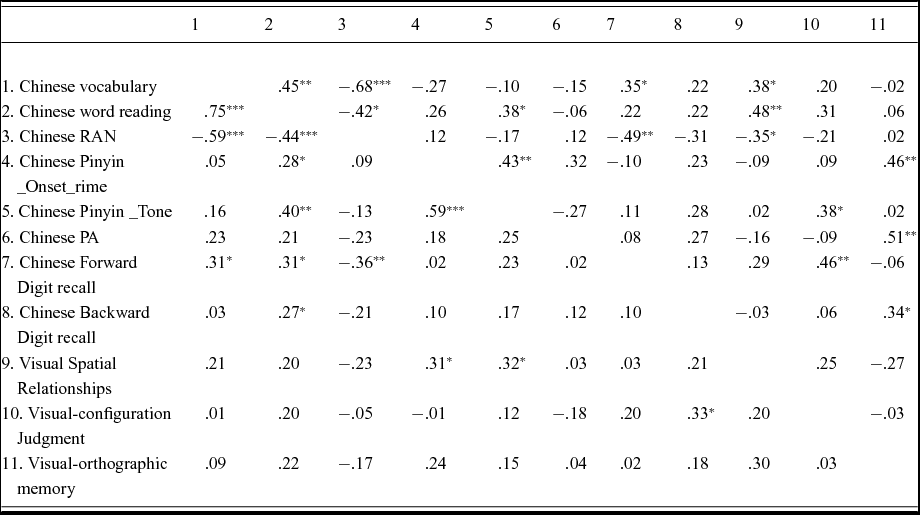
The slower speed of Chinese RAN in L2 Chinese young learners can also be seen as a reflection of relatively slow access to syllable-character mapping. Interestingly, however, it was not associated significantly with Chinese word reading for either group. The syllable-character mapping is arbitrary for Chinese. There are literally very few cues to rely on to name a Chinese word if a learner does not know the meaning of the word. Thus, perhaps Chinese RAN is a reflection of general language ability for Chinese word reading (Pan et al., Reference Pan, McBride-Chang, Shu, Liu, Zhang and Li2011. In fact, in this study for both groups, Chinese RAN performances were also highly associated with their vocabulary knowledge as indicated in Table 2.
Partial correlation after controlled for age and Raven's nonverbal intelligence for both groups (Native Chinese speaking group_Left bottom up/Non Native Chinese speaking group_ right corner down).

Note. *p<.05, **p<.01, ***p<.001
Hierarchical regression predicting Chinese word reading for 8- and 9 year old native and nonnative Chinese speaking children.

Note. *p<.05, **p<.01, ***p<.001
As a third component of phonological processing skills, phonological working memory allows one the capacity to maintain and manipulate sequences of phonological information for English word reading. This study proposed to examine general working memory skills, which tap both phonological and visual-spatial information of word reading, in addition, since we argued that reading Chinese orthographically recruits visuo-spatial information heavily as well. The present research found that non-native Chinese children performed as well as the native Chinese speaking children on the forward digit recall task which aimed to tap phonological working memory. However, these children were significantly weaker than native Chinese speakers on the backward digit recall task which taps general working memory skills. This general working memory was also strongly associated with Chinese word reading for both groups. These results demonstrate the importance of utilizing the possible double workloads of both phonological and visual-spatial information in decoding Chinese words. They reflect the process of Chinese word recognition, which typically appropriates visuo-spatial working memory skills.
Visual and Chinese orthographic skills in Chinese word reading
Visual and orthographic skills were major focuses of the present study. We focused on two questions: First, are non-native Chinese young learners able to achieve the same level of visual and orthographic skills as their native-speaking peers? Second, what is the importance of visual and orthographic skills in Chinese word reading for young second language learners? In previous studies, native English (e.g., Huang & Hanley, Reference Huang and Hanley1994), Spanish- and Hebrew-speaking emergent readers (McBride-Chang et al., Reference McBride-Chang, Zhou, Cho, Aram, Levin and Tolchinsky2011) were found to have weaker pure visual skills than native Chinese emergent readers. However, in the present study, L2 Chinese learners performed equally well as native Chinese speakers on pure visual skills. We cannot infer that L2 young Chinese learners’ visual skills were due to Chinese literacy acquisition, but this result raises an important question as to whether learning of Chinese literacy would train children's visual skills (McBride-Chang et al., Reference McBride-Chang, Zhou, Cho, Aram, Levin and Tolchinsky2011). Alternatively, perhaps such visual skills have matured by the ages of 8 or 9 despite orthography differences. Nevertheless, consistent with previous research (Ho & Bryant, Reference Ho and Bryant1999; McBride-Chang, Zhong, Burgess & Hayward, Reference McBride-Chang, Chow, Zhong, Burgess and Hayward2005; Siok & Fletcher, Reference Siok and Fletcher2001; Yang et al., Reference Yang, Guo, Richman, Schmidt, Gerken and Ding2013), it is important to note that early pure visual skills are important indicators in Chinese word reading even for L2 Chinese young learners.
Orthographic awareness skills were salient for understanding Chinese word recognition for the native Chinese young learners. Equally, orthographic awareness skill also significantly correlated with Chinese word reading for L2 young Chinese learners. However, both Chinese orthographic awareness skills and Chinese orthographic memory in the L2 learners were significantly weaker than in the L1 learners. These results suggested that while L2 Chinese young learners were at a stage that focused on both basic visual skills and orthographic skills in Chinese word recognition, L1 Chinese young learners were more skillfully applying their orthographic skills in learning to read.
Taken together, the present study is among the first to examine non-native Chinese speaking children's L2 reading of Chinese. Our findings indicate that although L2 Chinese young learners were able to acquire Chinese as an L2 in a dual-language environment together with native Chinese speaking children who learn English as an L2 in the same environment, their Chinese oral and literacy related skills lagged behind native Chinese learners significantly. This suggests that L2 Chinese learners may need extensive time to acquire Chinese in order to achieve a native level. Our findings of the high associations of vocabulary knowledge, tone awareness, visual and Chinese orthographic skills with word reading in the present study may be particularly helpful in considering how best to teach the increasingly large population of children worldwide who are learning to speak and read Chinese as a second language.
One important implication of the present study is that the L2 Chinese learning classroom could emphasize the salient roles of oral language skills, particularly lexical tone sensitivity, as well as visual and orthographic skills, in Chinese word acquisition. Oral language provides young children with a semantic background; lexical tone awareness allows them to be more tuned in Chinese word pronunciations, and the gradual move from relying on pure visual skills to orthographic knowledge affords children the chance to have a balanced acquisition of Chinese words.
An important limitation of this study was that the non-native Chinese speaking group constituted a heterogeneous linguistic group. This may have affected our results in ways that remain unclear. For example, perhaps certain language groups have stronger or weaker sensitivities to particular phonological aspects of Chinese. This may be an interesting focus for a research line in future research. It should be noted that we could not get a more homogeneous sample for the present study given the constraints we had on a limited age range of developing readers being educated in the same school. Despite weaknesses in our sample, a great strength of it was the focus on children who attend the same Chinese and English classes but have had either Chinese or non-Chinese family backgrounds. This is a good focal point from which to build future research on the burgeoning area of learning Chinese as a foreign language.
In addition, the current research has focused mainly on Chinese language-related cognitive and linguistic skills in learning to read Chinese words. Future research should further investigate how a non-native group's L1 linguistic and metalinguistic skills can contribute to Chinese word reading. In addition, this group of non-native speaking children was relatively proficient in both English and Chinese. There is a larger population that only learns Chinese as a foreign language. Perhaps the linguistic and cognitive correlates that are important for literacy development may be different in such groups.
Despite these challenges, however, the present study has begun shedding light on how non-native Chinese speaking children learn to read Chinese as a foreign or second language. We have shown not only that such children struggle to keep up with their Chinese peers on many literacy skills but also that they tend to rely on pure visual skills for literacy learning. Vocabulary knowledge, fluency, and accurate processing of lexical tones can all help facilitate Chinese word recognition in young non-Chinese readers learning Chinese as well.