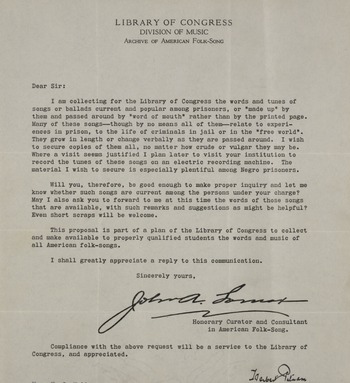
Late in 1934, a letter made its way into the mailboxes of wardens at prisons and reformatories all over the United States and Canada. It bore an official letterhead and a signature from the Library of Congress, but contained what must have been, at least on a first read, a slightly peculiar request. John A. Lomax, the Library's Honorary Curator and Consultant in American Folk-Song, was calling on the letter's addressees to survey the institutions they managed and to determine whether the people imprisoned in them knew any folk music. Addressees were asked to provide Lomax with information about such music, so he could decide if it would be worth taking a trip to make phonograph recordings for the library's recently founded but rapidly expanding Archive of American Folk Song.Footnote 1
Lomax's letter (Figure 1) made some stipulations. He was asking for information about vocal music: “songs or ballads current and popular among prisoners or ‘made up’ by them and passed around by ‘word of mouth’ rather than by the printed page.” As for topics, Lomax offered a general directive. “Many of these songs, though by no means all of them,” he wrote, “relate to experiences in prison, to the life of criminals in jail or in the ‘free world.’” Also, while he suggested some songs might have shocking or immoral content, he was adamant in his request: “I wish to secure copies of them all, no matter how crude or vulgar they may be.” At the end of his paragraph of instructions, Lomax also stated that, in his estimation, this material was “especially plentiful” among Black prisoners. Although not phrased as a mandatory feature of the music he was soliciting, this supposition was revealing of the impetus behind Lomax's letter and of his interest in prison music more generally.
John Lomax's circular letter to prisons and reformatories. October, 1934. American Folklife Center, Library of Congress, John A. Lomax and Alan Lomax papers, 1932–1968.

The idea for the letter came to John Lomax a year after he first traveled with his son Alan to prisons in Texas, Louisiana, and Mississippi.Footnote 2 While there, John—a seasoned folklorist—and Alan—a budding one, with a rich career ahead—made recordings of field hollers, work songs, and blues music. The performances they recorded featured Black men almost exclusively. After the end of their trip, the Lomaxes sought ways for this project to continue. And continue it did. In subsequent years, the father-and-son duo made many recordings behind bars and, after John's death in 1948, Alan continued to do so on his own. Since then, the songs collected by the Lomaxes in prisons have reached audiences through songbooks and commercial recordings and have become important documents of the heritage of the United States.Footnote 3 At the same time, they raise important issues about prison labor, the profits and practices of ethnography, and the racial politics amplifying both these issues, given that they were collected by white folklorists in segregated prisons.
The Lomaxes were motivated to pursue this project because they were under the conviction that the survival of Black American folk music in the U.S. South was threatened due to several influences (desegregation, northern migration, and the radio, among them) and they saw Southern prisons—segregated institutions where white wardens and guards exacted vile punishments on Black prisoners—as some of the only remaining repositories of Black American folksong.Footnote 4 Because of this, scholars have often turned a critical eye toward the Lomaxes’ prison work, their tendency to romanticize folkloric isolation, and their capitalization on white fascination with “authentic,” uncommercialized Black music.Footnote 5 The Lomaxes’ choice to root their prison project in the music of Southern Black men to the near exclusion of women has likewise elicited critique.Footnote 6
In the context of this extensive and widely discussed project, John Lomax's 1934 letter might seem a mere stepping-stone. I argue, however, that it is much more than that. The wide circulation of the letter, sent to 350 carceral institutions in the United States and Canada, brought the Lomaxes into contact with correspondents from institutions incarcerating people of many races, ethnicities, genders, and ages. Through their replies—some obliging the request for information about songs, others declining or ignoring it—these correspondents delimited the corpus of prison music the Lomaxes could access. In turn, through their reactions to some of the obliging responses, the Lomaxes also set boundaries for their project. From a few correspondents they received varied materials: union songs, European folk songs, and children's game songs. On occasion, such materials elicited interest. Ultimately, however, most of the diverse music addressed in these letters was not recorded.Footnote 7 The Lomaxes continued to site their prison work in the South and, with the exception of a few recordings of Black women, they focused their project on Black men.Footnote 8
From a present-day vantage point we can look at the moment surrounding John Lomax's letter as a point in time at which the purview of the Lomax prison project could have taken several routes but a single pathway forward was selected. The project had reached what institutional historians have called a “critical juncture.” This term is perhaps best elucidated in the writing of sociologist James Mahoney.Footnote 9 As he puts it, critical junctures are moments “characterized by the selection of a particular option … from among two or more alternatives.”Footnote 10 The choices available during critical junctures are defined by “antecedent historical conditions,” and, in turn, these choices set off events that influence “the creation of institutional or structural patterns that endure over time.”Footnote 11 While the term “critical juncture” has mostly been applied to analyses of political policies, it is equally relevant to the discussion at hand. Choices made by the Lomaxes’ correspondents (whether to respond to the initial letter and, if so, in what manner to respond) and by the Lomaxes themselves (whether to express further interest in the songs described by correspondents and, ultimately, whether or not to record and publish them), were influenced by a series of conditions. Chief among these were contemporaneous perceptions of the role of music in relation to the entangled categories of criminality, imprisonment, reform, race, and gender. These perceptions caused the Lomaxes and their correspondents to define the boundaries of the Lomax prison project and to solidify its focus. This article centers on the critical juncture represented by John Lomax's 1934 letter, on the conditions that affected decisions made by the respondents and by the Lomaxes, and on some of the large-scale repercussions of these decisions.
I first examine the responses to Lomax's letter and argue that in the process of determining whether or not to share material, the writers of these responses—almost exclusively white wardens and supervisors of penal institutions—acted as de facto curators of the material the Lomaxes could access. Their letters suggest their “curatorial” decisions stemmed from assumptions about the type of music Lomax sought, about what type of prisoner might know this music, and about the relationship between knowing and singing this music and a prisoner's ability to be reformed. Often latent in these assumptions are understandings of the relationships between race, gender, and criminality.
In the final part of the article, I also study the Lomaxes’ interactions with a few correspondents who furnished information about folk songs. These songs diverge from the type of prison music on which the Lomaxes focused. They therefore offer a counternarrative to popular representations of folk music and incarceration during this period and bespeak a time when the limits of the well-known Lomax prison song collection were defined.
Prison Administrators as Curators of the Lomax Archive
Responses to John Lomax's letter started arriving in November of 1934, many of them dismissing the request in a polite but terse manner. “Sorry, but have nothing we can send,” wrote J. J. Sullivan, the warden of the Minnesota State Farm.Footnote 12 Mary B. Harris, the superintendent of the federal Institution for Women in Alderson, Virginia reported similar findings: “There are no such songs in this institution.”Footnote 13 From the Industrial School for Boys in Topeka, Kansas, Lomax received a return copy of his own letter, with only the word “open” scribbled at the bottom.Footnote 14
As it appears, some of the administrators who received Lomax's request had little time or care for it. They were, after all, in charge of Depression-era prisons and were likely more interested in maintaining day-to-day operations in their crowded facilities and retaining financial solvency than in helping conduct a song collection venture.Footnote 15 And yet, not all the responses were brief or dismissive. Out of the over 100 prison administrators who wrote to Lomax, a significant number were not ungenerous with their responses. While most of these respondents still rejected Lomax's request, they provided ample justifications for their inability to comply. Thus, their letters—now held in collections at the Library of Congress's American Folklife Center and the University of Texas at Austin—constitute an archive laden with information about musical life in prisons during the 1930s.Footnote 16 In their rejections, the authors of these letters reveal understandings of the type of prison songs Lomax sought and of music's role in reforming prisoners. Because it is such understandings that led administrators to decline to contribute information about songs, the letters also show evidence of an instance in which actors who were not involved in the Lomaxes’ project as either song collectors or musicians shaped their archive. Both by governing musical practices in their institutions and controlling the information available about such practices, prison officials set boundaries for the material the Lomaxes could access. As such, they acted as gatekeepers and, consequently, as de facto curators of their archive.
What is particularly interesting here is that the impetus behind the Lomax prison project has historically been explained by describing the reluctance of another set of gatekeepers. The source for this explanation dates to a funding proposal made by Alan Lomax to the Carnegie Foundation for the initial 1933 prison travels.Footnote 17 In this proposal, Lomax criticizes Black cultural leaders for what he understood as attempts to suppress folk culture in their communities. He argues that these cultural leaders exerted a strong and deleterious force on what he construed as the average Black American by “broadening his concepts and thus making him ashamed or self-conscious of his own art,” by “turning away from revival songs, spirituals and informal church services to hymns and formal church modes,” by “ranting against any song that has to do with secular subjects,” and by “sneering at the naiveté of the folk songs and unconsciously throwing the weight of their influence in the balance against anything not patterned after white bourgeois culture.”Footnote 18
The aversion toward the type of material the Lomaxes sought, although here reflected through the interpretation of a white folklorist, has been widely documented. Some of the resistance came from religious Black Americans who were concerned by what they saw as an immoral element in the blues and secular music more broadly.Footnote 19 In addition, although folk music was a central topic of concern among many artists and members of the Black intelligentsia and middle class—particularly in the wake of the Harlem Renaissance, which drew heavily on the expressive possibilities of the blues—trepidation persisted. Many were troubled not so much by the lyrics’ perceived immorality, but rather by contradictions between the beauty and moral value of Black secular folklore and the identity of the performers of this music: farmers, prisoners, and other members of the Black working class.Footnote 20 In addition, the matter of two white folklorists forging representations of Black working-class men through their work brought forth uncomfortable reminiscences of the stereotyping present in blackface minstrelsy.Footnote 21
Largely due to the latter concern, the intertwined implications about folk culture, social mobility, class, and race in Lomax's Carnegie proposal have not escaped the attention of scholars.Footnote 22 The proposal has often been quoted and analyzed by those interested in the manner in which the two white folklorists’ understanding of Black music and its relationship with class and morality rubbed against that of Black American cultural gatekeepers and influenced the locations in which they worked, the people they recorded, and the music they collected. According to these scholars, because Black cultural leaders guarded their communities from the Lomaxes, their search for Black folk music was redirected to Southern prisons, where such gatekeepers were not present, where white wardens had no stake in safeguarding the cultural production and image of the Black people incarcerated in their facilities and were therefore less resistant to the Lomaxes’ request.
While such arguments have brought light to the racial dynamics of the Lomaxes’ project, what remains underexplored is the way that parallel ideas about the entanglements of whiteness, class, and morality also shaped the Lomaxes’ work. It is for this reason that the letters written in response to John Lomax's 1934 request represent such an important archival resource. They show that the Lomax prison song collection was not only influenced by the reluctance of Black cultural leaders to provide material from their communities, but also by another set of cultural leaders: white prison officials.Footnote 23 While the singers the Lomaxes recorded in prisons had many motivations of their own for putting their voice on tape, the crucial role that wardens and prison officials in the U.S. South played in allowing their archive to be constructed is evident. Officials from a number of segregated Southern penitentiaries allowed the Lomaxes access to the Black prisoners incarcerated in their institutions. Meanwhile, administrators who managed either exclusively white-populated institutions or integrated ones with high proportions of white prisoners were often unwilling to assist. When it came to members of their own race, white wardens and supervisors seem to have behaved similarly to the Black cultural leaders criticized in Lomax's Carnegie Foundation proposal. In their letters, they position themselves as guardians tasked with controlling the information available to outsiders like the Lomaxes about musical life behind bars. Their reluctance to assist the Lomaxes shows how their racialized understandings of the role of music in prisoner reform, along with their desire to protect the image of their institutions, determined the songs available to the Lomaxes and influenced the constitution of their archive.
The responses to Lomax's letter have garnered little scholarly attention. Some of them are quoted in Miller's Segregating Sound, but the only letter that has been explored in detail is one sent by M. F. Amrine from the Federal Jail in New Orleans.Footnote 24 Writing with the authority of observations gathered over his fifteen-year employment in prisons, Amrine bristled against what he understood to be the reasoning behind Lomax's request, namely “the idea that prisoners, as a class, are different from the general run of humanity in regard to musical taste.” Amrine countered: “People in prison are a cross-section of society” and therefore “they have such songs as have the people outside of prisons, and for the same general reasons.”Footnote 25 Amrine's letter shows his opinion that the Lomaxes’ delineation between musical life on the “inside” and on the “outside” was imagined and offers up an alternative to the Lomaxes’ conception of isolated musical authenticity. As such, he is a valuable contemporaneous witness whose testimony can be used by scholars both to critique the Lomaxes and to observe that such a critique is not anachronistic.
While Amrine's letter shows that some wardens considered incarcerated people, and their musical practices, to be congruent with those “on the outside,” many responses evince a different opinion. Their authors suggest that they, like the Lomaxes, thought of prisoners as having core differences from non-incarcerated people. However, in their role as prison administrators, their aims were of course fundamentally different from those of folklorists. This shaped the ways in which the two groups viewed the distance between prisoners and the rest of society. The Lomaxes saw the distance as a productive force, as it suggested that an isolated musical community could conserve folklore behind bars. Meanwhile, most of the prison administrators who wrote to the Lomaxes imply they understood the distance between incarcerated people and society to be the root cause of criminality and they saw their institutions as places where this distance would be erased through re-education.
This understanding is a key part of the context that led many administrators to reject the Lomaxes’ request. Their perspective was inherited from the earlier Progressive era. As historian David J. Rothman has shown, the increased interest in the social sciences during the period precipitated a desire to “understand and cure crime, delinquency, and insanity through a case-by-case approach.”Footnote 26 Regimented and brutal prisons came to be seen as old-fashioned and reformers advocated for a new style of prison, which replicated the features of the “outside” world on a small, controlled scale. By being immersed in a micro-society, these reformers maintained, incarcerated people could be taught to function among others and would be gradually prepared to re-enter society. As Rothman puts it, by the end of the Progressive era “prison adjustment had become social adjustment—the good inmate, the good citizen.”Footnote 27 The persistence of similar ideals into the Depression is evidenced by Lomax's respondents who often suggest they considered themselves tasked with the re-education of the people in their institutions and thought this re-education could only be accomplished if society was replicated behind prison walls. As their letters reveal, these administrators believed music played an important role in the process of social replication and in the transformation of prisoners into “good inmates” and, consequently, “good citizens.”
This focus on re-education and reform has been described by Michel Foucault as part of a move, starting in the eighteenth century, toward a system with “less cruelty, less pain, more kindness, more respect, more ‘humanity’,” a system that works “not to efface the crime, but to transform a criminal.”Footnote 28 However, particularly in the U.S. context, scholars of incarceration have pointed out that the shift toward reform was not evenly applied and that the category of “good citizen,” as well the possibility of its attainment, was never available to all. Angela Davis, while agreeing with Foucault that “the locus of the new European mode of punishment shifted from the body to the soul,” has noted a crucial difference: “Black slaves in the U.S. were largely perceived as lacking in the soul that might be shaped and transformed by punishment.”Footnote 29 As the racial and racist ideologies of slavery were transferred into the prison after the Civil War, ideas about who could and could not be reformed were perpetuated. The arguments about the relationship between race, imprisonment, and reform, developed by Davis, have been expanded upon by Khalil Gibran Muhammad who has argued that, in the Progressive era, rehabilitation was construed through the lens of whiteness and was usually not applied to Black Americans, whom reformers positioned as “a distinct and dangerous criminal population.”Footnote 30 As Muhammad argues, this paradigm affected systems of incarceration and perceptions of criminality throughout the twentieth century and continues to do so today.
Thus, while statements about race in the letters of Lomax's correspondents are rarely explicit, it is important to remember the racial lines along which ideas about reform and rehabilitation were conceived, given that they played a part in the constitution of the Lomax collection. Wardens of segregated prisons in the South were sometimes (although not always) receptive to the Lomaxes and allowed them to access and record the Black men and women incarcerated at these institutions. Meanwhile, the responses that bristled at Lomax's request came from majority white-populated prisons across the country and from carceral institutions in the North, where institutions focused in large part on the rehabilitation of white prisoners. The refusals of wardens from such institutions helped exclude musical depictions of white prisoners, and consequently, of white criminality from the Lomax archive.
Administrator rejections of Lomax's request for songs often rest on the argument that prisoners at their institution knew no such songs because they were in the process of being rehabilitated, as we will see later. Through such statements, these authors imply a connection between musical behavior and one's ability to be reformed. Furthermore, while surviving documentation leaves the concrete influences of many of Lomax's correspondents obscured, their letters echo contemporaneous thought about not only criminal rehabilitation, but also the role of music in prisons. Wardens in Southern plantation-style prisons often appear to have understood music in their institutions as an outgrowth of the antebellum period: prisoners sang as they worked, which sped up their labor. At other times, they sang and performed for the pleasure of white prison officials, much as their enslaved ancestors had.Footnote 31 Meanwhile, both in their substantial descriptions of musical life in their institutions and in their rejections of Lomax's request, wardens and supervisors of majority-white institutions aligned with popular Progressive- and Depression-era ideas on the intersections between music, imprisonment, reform, and social readjustment. Before turning to the letters, let us acquaint ourselves with some of those ideas first.
Music, Reform, and Readjustment in Carceral Institutions during the 1920s and 1930s
In the first decades of the 1900s, the effect of music on incarcerated people was an increasingly frequent topic of discussion. Some of the most substantial contributions appeared in the work of Willem van de Wall, a Dutch-born community music educator.Footnote 32 In 1924, after researching and working in prisons and mental health hospitals in New York State, Van de Wall published a sixty-seven-page pamphlet titled The Utilization of Music in Prisons and Mental Hospitals: Its Application in the Treatment and Care of the Morally and Mentally Afflicted.Footnote 33
Both the fact that incarcerated people are discussed in the same publication as patients of mental health institutions (albeit in different sections) and their characterization as “morally afflicted” makes the pamphlet a testament to Progressive-era understandings of crime. In his belief that criminal behavior is caused by a moral affliction that can be cured in prison, Van de Wall aligns himself with a particular school of thought, the tenets of which were later synthesized in Foucault's Discipline and Punish.Footnote 34 As Foucault puts it, in the late eighteenth century, the penal system shifted its attention away from judging crimes and toward “the soul of the criminal.”Footnote 35 Although he places the beginning of this process more than 150 years before Van de Wall's time, the questions he claims the penal system asked after this shift—“Where did [this crime] originate in the author?” and “How do we see the future development of the offender?”—are at the heart of Van de Wall's work.Footnote 36
Van de Wall opens The Utilization of Music in Prisons and Mental Hospitals by rejecting the term “penal institution” as outdated and claims such institutions should be substituted for “humane, scientific and restorative” ones.Footnote 37 He argues this shift from a penal to a reformative model can be best effectuated through music. In the remainder of his text, he positions music as a valuable tool that can be used in prison management for the accomplishment of two objectives: greater discipline and an increased focus on the personhood and individuality of incarcerated people.
A passage from the introduction illustrates how Van de Wall thought these objectives might be achieved. After offering a description of a hypothetical prisoner in a “typical” penal institution, he paints an evocative scene in which music transforms both the prisoner and the institution:
…music floats in as a stream of divine energy and love, and embraces and caresses with the same impartial tenderness and fullness and glow all these encaged convicts, barred by steel, stone and the penal system from human tenderness and loving human self-expression. And at once the evil cage-beast dissolves and the repressed better man wakes up, touched by the divine kiss, Music. He listens to the tunes, chimes in with them; the beautiful strains awaken corresponding harmonious feelings and thoughts, and a craving to express his better self drives him to participate. After the music he is desirous of talking about the people he loves most in the world—he unburdens his soul. He is willing to do and to obey any kind of order for the sake of being allowed to enjoy the music-making or listening once more.Footnote 38
Here, music turns the prisoner from a dejected non-individual, part of an indiscernible mass of “criminals,” into someone ready to participate in society. It humanizes, all while being a method for control: the criminal-turned-individual is keen to keep this newfound status and is therefore “willing to … obey any kind of order.”Footnote 39
While this scenario is hypothetical, Van de Wall uses a florid style and evocative imagery even when describing ostensibly real situations.Footnote 40 As such, the wording in this passage is not incidental. The description of music as something that “floats in as a stream of divine energy and love” suggests Van de Wall's understanding of its purpose in prisons. He conceived of it as something important, but not inherent, to the carceral space, as something that is introduced into this space not by incarcerated people themselves, but from without.Footnote 41 While in the passage quoted above music appears to “float in” on its own, Van de Wall goes on to address the processes through which the artform should be introduced into prisons by qualified educational professionals such as himself.
Van de Wall's emphasis on didacticism through musical performance places his work at odds with that of folklorists like the Lomaxes who sought isolated musical communities. In addition, while the musical creativity of incarcerated people interested the Lomaxes, Van de Wall was often ambivalent about any inherent creativity they might possess prior to the involvement of qualified professionals. His ideas on the matter are elucidated in a passage from his 1936 monograph Music in Institutions wherein he argues some prisoners have a propensity for creativity, but pathological tendencies come through in their art:
Since subconscious preparation is a component of most creative work, it is evident that in the spontaneous creations of many inmates subconscious psychic elements will be discovered. It should not be overlooked that these psychisms are often symptoms of a weak or unhealthy mind rather than of a strong and sound one. Most of the spontaneous so-called “art” productions of mental patients and of prison inmates have nothing to do with art in the technical and cultural sense of the term. In their odd ornamentation and superficial treatment of a subject they show a lack of sound observation and intelligent workmanship.Footnote 42
In this passage, Van de Wall does not position the music instructor as somebody who needs to introduce music into the prison. The instructor's role, however, is no less didactic. For Van de Wall, the management of prisoners’ musical creativity necessitates careful redirection away from art that is symptomatic of “a weak or unhealthy mind” and into healthy, “normal” artistic production.Footnote 43
By the early 1930s, Van de Wall's ideas had entered the general parlance of individuals involved with music in correctional settings. His 1922 address at the Congress of the American Prison Association reached a wide audience of administrators and his work appeared in the popular press and trade journals.Footnote 44 By the early 1930s, many talks at the Congress echoed his ideology: Music was an important tool for criminal reform and should therefore be applied with care by a knowledgeable professional.Footnote 45
Prison Reform and the Censure of White Incarceration from the Lomax Prison Project
Let us now return to the responses to Lomax's 1934 letter and consider how the antecedent conditions set by thinkers like Van de Wall, along with wider contemporaneous conceptions of crime and readjustment, affected decisions made by Lomax's correspondents. Many rejections seem to have been motivated by their authors’ belief that songs like those sought by Lomax would only be present in an institution like that described at the beginning of Van de Wall's The Utilization of Music in Prisons and Mental Hospitals: one seeking to punish rather than to reform. This view appears to have been particularly popular with respondents from juvenile institutions, variously billed as training schools, state schools, or industrial schools.Footnote 46 Among them was Margaret Hutton Abels, the superintendent of the Wisconsin Industrial School for Girls, which held mostly white “delinquent” girls under eighteen.Footnote 47 Abels sent her regrets to Lomax; she could provide no material, since the institution she managed was “educational and correctional but not penal.” To this she appended an explanation. Thanks to the efforts of a dedicated music teacher who led a chorus and an orchestra, the school's music was “of very high grade both as to subject and rendition.” Thelma Bradford from the State School for Girls in Randolph, Arizona was in charge of managing an institution similar in demographics and mission to Abels’s and her response suggests a comparable opinion. Bradford wrote Lomax a lengthy letter asserting the girls at her institution “do not seem to be interested in ‘prison ballad,’ as they do not feel that this is a prison.” Instead, Bradford described the institution as “a home” where the girls were “taught accordingly” through instruction on “some classical pieces, popular music, and folk-songs that all children love to sing.”Footnote 48
Letters from many other juvenile institutions offered a similar response. According to Paul S. Blandford, the superintendent of the Virginia Industrial School for Boys, he had no songs to offer.Footnote 49 Blandford justified this through the demographics of his institution—white boys under the age of eighteen—and concluded his letter with a forceful statement: “Our boys are too young to have learned these ballads, and we hope they never will.” Blandford's brief letter provides little information about musical life at the school, but suggests that, like other respondents from juvenile institutions, he considered the songs requested by Lomax to be known by a certain type of person housed in a particular type of institution. He understood his mission to be to ensure that his school would not become such an institution and that the boys under his supervision would not become such people.
Two themes emerge from this small but representative sample of responses from juvenile institutions. First, the correspondents show that they aimed to mimic non-penal settings (the school and the home) in their institutions. They suggest this mimicking relied in part on music and resulted in an atmosphere that did not allow the type of song they understood Lomax to be requesting. Second, they assert the importance not of musical activity of any kind, but of careful musical instruction. When Thelma Bradford wrote to Lomax that the adolescents at her school were “taught accordingly,” this was no mere accident of wording. Like many of the other respondents from juvenile institutions, she was echoing contemporaneous ideas about the importance of musical didacticism to the transformation of individuals from ones inclined to criminal activity into “good,” law-abiding citizens.
Respondents from schools and reformatories were adamant about their inability to provide prison songs and placed emphasis on instructional musical practices largely because they were writing from institutions that were only a few decades old and were still establishing their reputations. Throughout the nineteenth century children had been housed with adult offenders, but between 1899 and 1928 nearly all states established separate juvenile courts.Footnote 50 While this shift was instrumental in the establishment of juvenile institutions, the newfound interest in adolescent well-being led to such institutions being heavily scrutinized by the public and the media. Thus, administrators took care to portray their institutions as focused on re-education and divorced from brutal nineteenth-century-style adult prisons.Footnote 51
Yet this shift in the practices of juvenile justice did not have equal effects on all minors. The carceral system tended to prioritize the rehabilitation of white boys and girls, while Black adolescents were subjected to what Geoff Ward has called “Jim Crow juvenile justice”: they were frequently charged and incarcerated alongside adults, with the exception of rare cases in which separate facilities for Black children were built, oftentimes after persistent efforts by Black reformers and activists.Footnote 52 This inequality is reflected in the letters of Lomax's respondents. Most of them were written by individuals who were in charge either of institutions that admitted only white children or of integrated ones with an overwhelming white majority. They rarely make direct statements about race, but when they do so it is in order to explain the absence of “prison songs.” As an example, we can turn to a letter by M. O. T. Bezanson, the superintendent of the State Industrial School for Girls in Tecumseh, Oklahoma. She rejected Lomax's request and stated that the girls at her institution have “composed” no songs because, due to their young age, they “have had little opportunity to develop very much originality.” After this, Bezanson goes on to explain the absence of such songs as a result of the non-penal nature of the school and its demographics: “Then too, the inmates are white girls,” she states, “and the atmosphere not penal. We are endeavoring to make it a training school, indeed, with an atmosphere of home life is [sic] so far as we can grant it.”Footnote 53
The application of the juvenile justice system's principles differed not only when it came to race, but also along gender lines. This comes through in the letters as well. Responses from institutions for boys tended to provide significantly less information about music. This is likely due to the larger size of such institutions, but it can also be explained through gendered ideas about juvenile incarceration during the period. While many juvenile institutions emphasized a reformative atmosphere, those for boys often described their grounds as a campus, while reformatories for girls were modeled after the home.Footnote 54 The musical activities to which respondents from institutions for boys referred—glee clubs, bands, orchestras—are evocative of an educational setting. Meanwhile, respondents from girls’ institutions tended to emphasize group singing and music-making of a domestic nature.Footnote 55 This difference is present because, as Mary Odem has argued, girls’ reformatories aimed “to train girls to become good housewives and mothers, to channel their misguided sexual energy into preparation for marriage and motherhood.”Footnote 56 In the home-like settings of these institutions, music was part of a program that trained girls in skills valued in the domestic sphere. In addition, because “misguided sexual energy” was often framed as a key cause of female juvenile delinquency, musical education was seen as a way to channel this energy into a more socially acceptable activity.Footnote 57
All in all, the refusals of many correspondents from juvenile institutions highlight the ways that intersecting ideas about race, class, gender, and age came to delimit the music available to the Lomaxes. The desire to present training schools, industrial schools, and reformatories in a positive light motivated officials to reject Lomax's request. Suggesting that they understood him to be seeking songs that inhabited punitive institutions, they argued that they could be of no help: despite being part of the carceral system, their institutions were not the types of places which would interest Lomax, they felt. They were modern schools whose purpose was not to maintain, but to erase the distance between their wards and the rest of society. By claiming their institutions were not prisons, these respondents safeguarded their image and, despite not aiding the project in any way, nevertheless shaped the Lomaxes’ collection. Music from such institutions never entered the Lomax archive and, as a consequence, the mostly white boys and girls incarcerated in them were never musically depicted as prisoners.
Such claims were more difficult and often undesirable for respondents from adult facilities to make. As Ethan Blue has detailed, the harsh economic climate of the Depression increased incarceration rates and caused prisons to become overcrowded.Footnote 58 Consequently, wardens were faced with a dilemma. While the tenets inherited from the Progressive era dictated that carceral institutions should aspire to the rehabilitation of (white) prisoners, wardens sought to demonstrate that they had the situation in their overcrowded facilities under control. The letters that Lomax received from adult institutions—despite being less numerous and shorter—show the ways wardens and supervisors of adult prisons used music to deal with this dilemma. In their rejections, correspondents tend to give weight either to one or, often, both of the following two factors: (i) the use of music for rehabilitation and reform and (ii) the close eye they kept on the musical behaviors of incarcerated people.
Among the respondents who placed high value on the surveillance of musical practices at their institutions was Louis E. Kunkel, the warden at the Indiana State Prison. Kunkel emphasized the absence of music in the institution he managed: “Singing is not allowed in any part of the prison with the exception of the Chapel where hymns are sung for Sunday services and occasionally popular songs for entertainments which are given.”Footnote 59 Meanwhile, although the letter received from the New Jersey State Prison did not feature such a negative outlook toward music, it similarly suggested an atmosphere of surveillance. George L. Selby, the prison's warden, seems to have been reacting to Lomax's request for songs “no matter how crude or vulgar they may be” in writing that “vulgar documents of any nature are immediately destroyed” at the prison and “such communications are not permitted to come into the institution or go out, and any inmate indulging in same is subject to disciplinary action.”Footnote 60
Some respondents from adult prisons reported on didactic musical practices that were occurring along similar lines as those in juvenile institutions. The warden of the Charlestown State Prison in Massachusetts emphasized institutional singing: “We have our trained choir, but their practice is confined to religious music, which is selected for them.”Footnote 61 The response of J. A. Roswell from the Naval Prison at Portsmouth is a variation on a similar theme. The letter describes the reformative goals of the institution: “to make men forget as far as possible that they were completely [set] aside from the world” and “to restore self-respect and self-confidence and to better equip the men to take an honorable place in society when released.”Footnote 62 Its text shows, as well, that the restoration of self-respect and self-confidence in the prison population at Portsmouth relied on a strict schedule and music at the institution took place during discrete (and brief) time blocks.Footnote 63 Roswell, who had recently completed a stint in the prison's management, writes:
The routine there called for assembly in the auditorium three nights per week three quarters of an hour in advance of the showing of sound pictures. On Tuesdays and Fridays the men sang the popular songs of the day. On Sunday evening they sang the old-time religious songs, and this latter type were sung with very evident devotion.Footnote 64
Finally, an interesting letter came from the director of the Department of Musical Instruction of the Michigan State Prison, E. McFate, who expressed familiarity with the Lomaxes’ earlier publications of prison music, a familiarity that convinced him that there was little of interest he could offer. McFate explains that reading music was a necessity for the men involved in the prison's many ensembles—its military band, its orchestra, its church choir, its “colored dance or rhythm orchestra,” and its “Hill-Billy group of 7 real hill-billies, who play all the old time barn tunes”—and the music at the institution “therefore [has] little to do with to [sic] the American Prisoner Folk Song as is done by the prisoners on the Southern plantations where of necessity music must be improvised.”Footnote 65
The line that McFate's letter draws between the literate musical production at the Northern institution where he worked—which was majority-white, even if it did feature musical ensembles populated by people of many races—and the oral practices of Black Southern prisoners is representative of a similar racial bifurcation among Lomax's respondents. The reluctant responses of officials from majority-white institutions in the North and across the country suggests they perceived a tension between “prison songs” and the modern institutions they were trying to run, and they thought the type of music sought by Lomax to be antithetical to their reformative goals.
For wardens in the Southern segregated prisons who were receptive to the Lomaxes’ request, the term “prison song” seems to have presented little cause for consternation. It is important to note that the two folklorists did not receive a universally warm welcome in such institutions. In Adventures of a Ballad Hunter, John Lomax quotes the hostile reaction of a South Carolina warden: “if I should let the convicts know that ‘the man from Washington’ had come, and then permit you to walk across the prison yard, a riot would be on in five minutes. I couldn't be responsible for what would happen. You get away from this place at once, and don't tell anyone else who you are. And go quickly.”Footnote 66 On the other hand, however, the receptivity with which the Lomaxes were met by other wardens of Southern segregated prisons—as well as the fact that, as the case of the South Carolina warden shows, rejections often had more to do with the maintenance of carceral order than with questions about the relationship between music and reform—stands in stark opposition to the rest of the responses discussed so far.
The reasons behind this variation are manifold. One of the main causes was likely the fact that, as suggested earlier, white wardens in segregated prisons did not see themselves as moral and cultural guardians of Black prisoners to the same degree as administrators who managed prisoners of their own race. Much like the Black cultural leaders criticized in Alan Lomax's Carnegie Foundation proposal, many officials at majority-white institutions guarded the communities of which they were in charge. They resisted attempts to meddle in these communities and rejected suggestions that their charges might know “crude and vulgar” songs.
The variation in response can also be attributed to the contrasting ways in which ideas about incarceration had coalesced in the North and in the South by the 1930s. While in the North the “modern” carceral institution was influenced by the rehabilitative ideas discussed in the preceding pages, the Southern segregated institutions the Lomaxes visited were shaped by the model of plantation slavery and the people they incarcerated were subjected to brutal labor and corporal punishment. While this difference often leads to an understanding of Northern prisons as “modern” and Southern institutions as antithetical to modernity, Alex Lichtenstein has brought light to the fact that Southern segregated prisons were conceived of in no less “modern” terms than their Northern counterparts.Footnote 67 Lichtenstein has argued that, since the carceral model of the chain gang came about as a result of the abolition of the convict lease system, it was positioned as a less overt mode of punishment and “a model of regional reform and progress.”Footnote 68 Because of this, and because road work performed by chain gangs was crucial to modernizing the region, Southern segregated penitentiaries were increasingly viewed as “the embodiment of penal humanitarianism, state-sponsored economic modernization and efficiency, and racial moderation” in the region.Footnote 69 Lichtenstein's work situates the chain gang among other vicious and marginalizing realities—“segregation, disenfranchisement, lynching, peonage, poverty, and racism”—that are thought of as signs of backwardness, but were often positioned as central to regional “progress” and formed a central part of “modern” life.
A similarity emerges, therefore, between officials who rejected Lomax's request and those who allowed recordings to be made. All sought to represent their institutions in a manner consistent with a contemporaneous conception of a “modern” prison. The differences in this conception, established along both regional and racial lines, shaped the Lomax collection into an archive replete with recordings of Black incarcerated men, while silencing the musical evidence of white incarceration and, consequently, excluding representations of white criminality from the archive.
Defining Carceral Spaces, Defining Carceral Musics
Let us now turn to replies to Lomax's 1934 letter that did contain information about folk practices. The most content-rich among these came from three institutions: the Ohio State Penitentiary, the Reformatory for Women in Framingham, MA, and the Vocational School for Girls in Tullahoma, TN. The geographical distance between these three prisons was compounded by disparities in the types of people they incarcerated. The Ohio State Penitentiary could house adults of all races and, typically for the national prison population in the 1930s, was made up predominantly of white male prisoners.Footnote 70 The Reformatory for Women in Framingham held adult women of many races, and the Vocational School for Girls in Tullahoma housed white girls under eighteen.Footnote 71 These differences contributed to variations in the types of materials sent from each institution. From Tullahoma, the Lomaxes received the text of a children's game song. The letter from Framingham referred to songs from Southern and Eastern Europe and the correspondent from Ohio alerted the Lomaxes to folk songs from several genres (with a strong focus on union songs and “hobo” songs). Ultimately, however, the letter trails of all three correspondents ran dry and the Lomaxes never recorded in the prisons in Tullahoma, Framingham, or Ohio.
Let us look at the correspondence with these prisons in turn. In contrast to the letters that rejected Lomax's request, the exchanges with these institutions offer few clues about why the music addressed was never made part of the Lomax prison project. What they suggest, however, is the existence of a broader range of folk music practices in U.S. Depression-era prisons than is present in the Lomaxes’ published work. This shows the curated nature of the Lomaxes’ prison project and offers a counternarrative to the representations of American incarceration the folklorists presented to audiences.
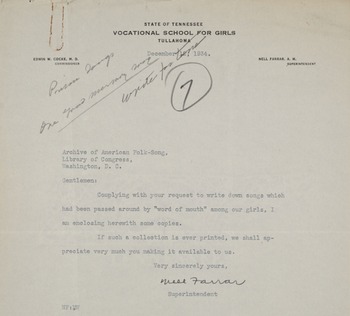
On December 12, 1934, Lomax received a response from Nell Farrar, the superintendent of the Correctional School for Girls in Tullahoma (Figure 2).Footnote 72 Farrar's letter contains little information about musical practices. It provides evidence, however, that she forwarded what she calls “some copies” of songs. These copies have, in the meantime, been detached from the letter and Farrar's text, which does not provide their titles, is of little help in their identification. The only clues come from pencil markings at the top of the letter, seemingly from a later date, in John Lomax's hand. An encircled “7” at the center top may refer to the number of songs attached. Further pencil markings in the upper left corner show Lomax did classify some of what Farrar sent as “prison songs,” but what seems to have interested him was something he underlined in his inscription as “one good nursery song.” Underneath, Lomax added a reminder: “write for tune.” This appears to have precipitated a second point of contact between Lomax and Farrar. In November 1937, he wrote to ask for the tune to the song “Among the Little White Daisies,” the words to which he claimed to have received with Farrar's original letter.Footnote 73 Although Lomax's letter does not indicate the purpose of his request, he likely wrote to Farrar not because he wanted to record in Tullahoma, but rather for comparison purposes: a variant of this song had been recorded a month earlier by Alan and Elizabeth Lomax in Kentucky.Footnote 74
Nell Farrar's letter to John Lomax, December, 1934. American Folklife Center, Library of Congress, John A. Lomax and Alan Lomax papers, 1932–1968.

The correspondence from the Ohio State Penitentiary came from John Leslie. Unlike the intended recipients of Lomax's letter, Leslie was an incarcerated man employed at the penitentiary's library, rather than a warden or a supervisor. His writing showed a level of knowledge about American folk music that must have intrigued Lomax and the two men entered into a brief correspondence, over the course of which Leslie provided texts or notated versions of twelve songs.Footnote 75 While Leslie's texts and notations have been detached from his letters and I have been unable to locate them, his letters state that he sent the following songs:
The first seven songs concern the woes of laborers, unionists, and so-called “hoboes.” The next two are humorous ballads, while the last three are songs I have not been able to identify by title alone. Leslie also suggested additional founts for folk songs. “A fruitful source for some of the authentic songs of prisons,” he wrote, “are the various prison publications: the Bulletin of San Quentin, Good Words of Atlanta, The News of this penitentiary and The Mirror of Stillwater Minnesota.”Footnote 76 Like newspapers in the “free world,” these publications sometimes published the texts of folk songs as broadside ballads, assuming readers could supply the tunes from memory. Leslie's assertion links to the Lomaxes’ understanding of musical practices under incarceration in interesting, yet contradictory ways. On the one hand, the printing of songs as text-only versions confirms the Lomaxes’ belief that some prisoners held a large amount of folk music material in their memories. On the other, however, Leslie's description of prison newspapers across the country indicates that many prisoners had access to print sources through which to supplement musical practices and did not solely rely on oral traditions. This puts into question the Lomaxes’ understanding of carceral isolation by giving evidence of a flow of information between prisons.Footnote 77
The response from the Reformatory for Women in Framingham also offered rich materials. On December 28, 1934, Miriam Van Waters, the reformatory's superintendent, wrote to Lomax:
We have a strong International Club here, composed of all foreign-born women. It is under the direction of a woman trained in anthropology, Miss Helen Adams.
A good deal of interesting folk song and folk lore material has come to light. Would you be interested in this material in foreign languages, particularly Russian, Portuguese, and Lithuanian? We have, too, a few doggerel ballads of the traditional sort.Footnote 78
Lomax seems to have never responded, so we cannot know exactly what Van Waters might have eventually sent. However, an article in the Radcliffe Quarterly written by Helen Smith, an intern at the reformatory, provides clues about the International Club's activities and suggests parallels between the Lomaxes’ prison work and goings on at Framingham.Footnote 79 Smith explains that the woman mentioned in Van Waters’ letter, Helen Adams, was a graduate student at Radcliffe College and an intern at the reformatory. At the end of 1934, Adams helped the International Club stage a play based on a folk legend and, for this purpose, she embarked upon a prison folk song-collecting project. Along with another intern, the musician Alice Freeman, Adams met with members of the International Club and transcribed songs they remembered from their home countries. According to Helen Smith's article, these included “some lovely Russian melodies, an unusual [Romani] tune, and interesting Portuguese and Polish songs and dances.”Footnote 80 It is almost certainly this collection of songs Van Waters was offering to Lomax. Although these songs were never published, it appears that the musical knowledge of these incarcerated women offered up a living archive of folk song along the same lines as the singers recorded by the Lomaxes.
Thus, despite containing promises of musical material, the letters of these three correspondents did not lead to recordings or other contributions to the Lomaxes’ published work. In each of the three cases, there is a valid explanation for this absence. The songs addressed by John Leslie appeared in prison newspapers and this likely deterred the Lomaxes: as was typical of folklorists of their time, they focused on oral traditions. Meanwhile, the foreign-language materials offered by Van Waters did not fit with the rest of the Lomaxes’ work, which had focused on English-language songs. Finally, as Alan and Elizabeth Lomax's Kentucky recording of “Among the Little White Daisies” shows, songs like the ones sent by Nell Farrar could be easily acquired in non-carceral settings.
Because of this, information about the musical lives of prisoners in Ohio, Framingham, and Tullahoma has survived in the Lomax archive only in written materials, such as the letters from the prisons’ administrators. These materials, however, point to the existence of rich musical communities in the three institutions. Although these communities differed from the ones the Lomaxes studied, they were also populated by people who were often targets of the carceral system in the 1930s. The “hoboes,” laborers, and unionists described in the songs from John Leslie's letters were considered closely related in the United States of the early twentieth century, when the term “hobo” was not only a term for people experiencing homelessness, but a word associated with itinerant laborers who populated unions across the country.Footnote 81 The concerns of these laborers were frequently the topic of songs written by union leaders. After World War I, with fears of communism on the rise in the United States, union members experienced high rates of incarceration.Footnote 82 While few of them remained in prison into the 1930s, as Leslie's letter suggests, their songs continued to be circulated among prisoners from a variety of ethnicities and backgrounds. Meanwhile, the International Club at Framingham was well-populated, because working class women from South and Eastern European countries were frequently imprisoned on charges of promiscuity and prostitution, but also a had a higher chance of being housed in a reformatory like Framingham, while Black women tended to be sentenced to hard labor in federal and state facilities.Footnote 83 Finally, the Vocational School in Tullahoma housed preteen and teenage girls, many of them from the working class, who were often vilified for a range of behaviors—insubordination to authority and broadly defined sexual misconduct among them. They were placed in vocational schools to be re-educated in so-called “proper” modes of behavior.Footnote 84
Children's songs, European folk songs, and union songs are not the genres that typically come to mind when audiences think of music from American prisons, as they contrast with the musical representations of incarceration popularized by the Lomaxes and the folklorists who followed in their footsteps.Footnote 85 While we cannot expect that even the most prolific song collectors record all material available, we must acknowledge that, despite the diversity of folk music in Depression era prisons, the Lomaxes made choices that shaped narratives about who sang “prison songs,” who populated American prisons and, therefore, who could be seen as a prisoner and criminal. Further, their decision to focus so strongly on Black male prisoners was made during a period when the identities addressed in the songs they chose not to record—union members, foreign-born women, and young working-class girls—were decreasingly associated with crime. While people bearing these identities continued to be subject to legal discrimination, the carceral system began turning its eye away from them. In particular, as Khalil Gibran Muhammad has argued, it is in this period that Black men were unjustifiably stereotyped into what would become, in his words, “the most enduring and potent symbol of criminality in modern American history.”Footnote 86
Conclusion
It is important to remember that the materials published by the Lomaxes are only the front-facing portion of a much richer archive. This archive has missing pieces and lost trails, but it nevertheless yields an understanding of a wider range of folk music practice in Depression-era U.S. prisons. At the same time, there is a crucial difference between the objects discussed here (letters which refer to music, but are essentially silent) and the well-known materials that the Lomaxes’ published (notated songs in printed collections and recordings that can be sounded, respectively, by a performer or a machine). I argue, however, that these silent archival objects can be used to suggest the existence of a lost world of sound, which can inform our understanding of the Lomaxes’ collection of popular, published, sounding materials and what they chose to leave out. In this final section, let us briefly turn to some of these sounding materials.
In 1933, “Lightnin’” Washington and an unnamed group of men incarcerated at Darrington State Prison Farm performed the work song “Great God Almighty” for the Lomaxes.Footnote 87 The text of the song depicts a scene typical of Depression-era segregated prisons in the U.S. South. While at work, a group of prisoners sees a guard approaching. They beg for mercy and try to work faster to avoid punishment. Like many of the songs that incarcerated people performed for the Lomaxes, “Great God Almighty” is skillful, harrowing, provocative, and defiant in the face of hardship. This fact did not escape the folklorists’ attention. In his 1947 autobiography Adventures of a Ballad Hunter, John Lomax reminisced about the first time he heard “Lightnin’” Washington perform:
Lightnin's eyes blazed as he sang … His color was deep black … Lightnin’ was still young—not yet thirty—serving his second term. His strong, graceful body swayed with the rhythm and fervor of the signing. Lightnin’ was leading a song describing the days when convicts were leased by Texas to owners of large cotton and cane plantations, sometimes to be driven under the lash until they fell from exhaustion; many, according to rumor, dying from sunstroke amid the sun-baked rows of corn and cane … The song pictures what went on in the minds of a gang of field workers, one of whom they thought was about to be punished.Footnote 88
In another passage, Lomax describes the reaction this performance provoked among others at the recording site:
The listeners in the room grew tense as the four strong voices blended in the terrible sweep of the song … Even outside, in the adjacent iron-barred dormitory the chatter and clamor of two hundred black convicts became stilled into awed and reminiscent silence as the song swept on, growing in power to the end, while Lightnin’, blue-black, vivid, poised as if for flight, leaned forward and sang with his three comrades, ‘Great Godamighty!’Footnote 89
Lomax combines an exoticized description of Lightnin’ Washington's body and, in particular, his skin tone, with a vivid characterization of the sound that Washington and his quartet made as a “terrible sweep.” With these words, he positions the performance as rare, awe-inspiring, and capable of stilling those who hear it. Crucially, he draws a contrast between the sound of the prisoners’ voices and the silence it inspired in its audience. The interaction between sound and silence, palpable in this passage, also reverberates in many facets of the Lomax prison song collection. In fact, it was an anxiety about silence that spurred the Lomaxes’ interest in prisons. They sought to preserve what they understood to be a dying tradition and saw Southern prisons as some of the only spaces where songs like “Great God Almighty” were not dissolving into silence.
At the same time, like all folklorists, the Lomaxes had to make choices. They had to decide which songs to record and preserve as sounding archival objects and which ones to leave unrecorded and under risk of dissolving into silence. This curation has increased the prestige and reach of the recordings by positioning them as rare objects. As Jonathan Sterne has pointed out, historical sound recordings gain cultural value only if most objects of their kind are lost. In Sterne's words, “the interplay between a bit of access and large sections of inaccessibility is precisely what makes the past intriguing, mysterious, and potentially revelatory.”Footnote 90 If we follow this logic, we can conclude that the Lomax prison recordings have acquired their worth largely as remnants of a lost and silent past: they preserve only a few among the many voices of early twentieth-century prisoners.
Nevertheless, the selective nature of these recordings has also shaped ideas about both race and gender in the United States. The Lomaxes only preserved the voices of Southern Black prisoners as sonic objects, thus keeping the music of many others who populated early twentieth-century U.S. prisons silent. The resultant focus of this collection has influenced the public's racialized and gendered ideas about who is incarcerated and what kinds of music they tend to perform. The manner in which narratives about race have been shaped through the Lomaxes’ interactions with Black prisoners has received ample analysis.Footnote 91 However, little attention has been given to their dealings with prisoners of other races, with women, and with the many folk practices in prisons across the country. Due to the limited nature of such interactions, John Lomax's 1934 circular letter is an important and unique source. The letter and its responses provide information about musics, identities, and lived realities that the Lomaxes did not include in their published materials and therefore help bring further light to the delimited nature of their well-known recordings. Reading these responses alongside the recordings the Lomaxes did make can help focus our attention on the arbitrary and shifting lines along which criminality is constructed, on the plight of a range of people incarcerated in Depression-era prisons, and on the unique and undue hardships faced by the Black men recorded by the Lomaxes. Most importantly, it can change the way we understand the nature of the Lomaxes’ song collection and the ways in which the Lomaxes’ popular but often contentious recordings have profoundly shaped perceptions of prison life.