Introduction
The preservation of cultural heritage has long been a subject of scholarly and political concern, but in the twenty-first century, its deliberate targeting by terrorist organizations and during armed conflicts has repositioned it within the framework of securitization theory. Rooted in the Copenhagen School, securitization theory explains how particular issues come to be framed as existential threats through discursive practices, thereby legitimizing the use of extraordinary measures.Footnote 1 Cultural heritage, when subjected to this process, is no longer perceived solely as a casualty of violence but as a referent object in its own right.Footnote 2
Scholarship on cultural heritage and security has largely followed two analytical trajectories. The first, heritage in security, focuses on the protection of cultural property in armed conflict settings, where heritage is seen as an object in need of safeguarding. The second, heritage as security, views heritage as an instrument through which security agendas are pursued, elevating it to an active component of political and strategic frameworks.Footnote 3 Several studies have analyzed the second discourse, often through the lens of the Copenhagen School’s framework.Footnote 4 These contributions have advanced our understanding of how cultural heritage is framed as a security concern, whether in the context of international diplomacy,Footnote 5 museum politics,Footnote 6 United Nations Educational, Scientific, and Cultural Organization (UNESCO) leadership rhetoric,Footnote 7 or examples of local or national practices.Footnote 8 However, most of these works focus on specific actor discourses, selected case studies, or isolated dimensions of securitization. Few offer a systematic comparative analysis of institutional texts using an integrated model that combines both Buzan, Wæver, and de Wilde’s tripartite typologyFootnote 9 (referent object, threat, and sector) and Roe’s two-stage distinctionFootnote 10 (identification and mobilization) between discursive articulation and policy mobilization.
Guided by these gaps in the literature, this study addresses the following research questions: How has cultural heritage been constructed as a security object in institutional discourse, and to what extent have these securitizing moves translated into concrete policy measures? This study seeks to fill that gap by mapping securitizing discourse across a corpus of key documents using a dual-theoretical framework issued by UNESCO and the United Nations Security Council (UNSC). In this study, institutional discourse is understood through a set of key UNESCO and UNSC documents, treated as the main textual outcomes through which these institutions publicly articulate security concerns. Through close textual analysis, it identifies how cultural heritage has been discursively constructed as a security object across different sectors, scales, and referent levels. While the last text dates from 2017, the analytical framework developed here remains applicable to more recent contexts, including the cultural heritage dimensions of conflicts in Ukraine, Sudan, and Gaza as well as digital heritage threats. For example, in Gaza, a more recent case, widespread destruction of cultural heritage sites has been documented by UNESCOFootnote 11 and raised before the International Court of Justice in South Africa v. Israel, underscoring the continuing relevance of the normative and securitization framework.Footnote 12
Methodology
This study adopts a qualitative, theory-informed approach grounded in the securitization framework of the Copenhagen School. Building on Roe’s two-stage model,Footnote 13 identification and mobilization, it integrates both discourse-oriented and practice-centered perspectives in securitization theory.Footnote 14 The objective is to map how cultural heritage has been discursively framed and mobilized as a security issue and whether such framings led to the adoption of extraordinary institutional measures.
In defining its empirical scope, this study treats institutional discourse as the authoritative textual outcomes of UNESCO and the UNSC, including declarations, resolutions, and conference reports. These sources are the most accessible and verifiable traces of how institutions publicly frame security concerns. While they do not encompass the full range of internal deliberations, negotiations, or informal exchanges, they crystallize the positions that are formally communicated to international audiences. Accordingly, the analysis approaches these texts as the final codified expressions of institutional discourse, with the recognition that they condense more complex political and administrative processes. However, the selected texts differ in character. While UNSC resolutions are formal and legally binding instruments that express a unified institutional position, UNESCO conference reports often capture a multiplicity of voices, including experts, state representatives, and civil society actors. As such, conference documents tend to contain broader discursive variation, whereas UNSC resolutions reflect a narrow and consensus-based framing. This difference in character is inevitable, given the distinct institutional mandates and decision-making logics of the two bodies.
This study employed an open-ended, systematic keyword-based scan of the official online archives of UNESCO and the UNSC. The purpose of the search was to empirically identify all institutional documents that explicitly link cultural heritage to the domain of security. To this end, the following keywords were used in combination with “cultural heritage” and “cultural property”: “threat,” “security,” “terrorism,” and “protection.” The search aimed to locate policy texts, declarations, resolutions, or conference reports in which the cultural heritage–security nexus was explicitly articulated. Documents were included only if they met these criteria:
-
1. Cultural heritage was addressed not solely as a preservation or development issue but as an object of threat or a component of international (in)security.
-
2. The document contained direct language invoking danger, threat, protection, terrorism, or crisis in relation to heritage.
-
3. The text was published by either UNESCO or the UNSC.
This search process resulted in the identification of seven documents, three from UNESCO and four from the UNSC, between 2003 and 2017 that clearly met the inclusion criteria. The cut-off point reflects the empirical limits of data collection. Using the selected keywords, relevant documents were identified from 2003 up to 2017, during which securitization discourse expanded across key UNESCO and UNSC documents. After 2017, no comparable texts matching the search parameters were retrieved.
The documents were subjected to qualitative content analysis, designed to detect securitizing moves across these core dimensions: securitizing actors, referent objects, and security sectors and levels. In the Copenhagen School’s conceptualization, securitizing actors initiate and shape the discourse that frames a referent object as existentially threatened.Footnote 15 A threat is not an objective condition but a discursively constructed danger to a specific entity, known as the referent object, “that which is seen to be existentially threatened and has a legitimate claim to survival.”Footnote 16 Referent objects can be broken down into sub-referent objects, allowing analysts to trace more granular constructions of threat. Securitization theory also introduces five distinct sectors, each serving as a lens through which threats are framed and perceived, and each sector defines security in terms of a specific referent object and form of existential threat. The military sector centers on threats to state sovereignty and territorial integrity, typically through armed violence. The political sector focuses on threats to institutional stability, ideological legitimacy, or governance structures. The economic sector deals with the viability of economic systems and access to resources. The societal sector emphasizes collective identity, cultural survival, and social cohesion, while the environmental sector concerns threats to ecosystems, natural resources, and planetary sustainability.Footnote 17 Threats may operate across different levels: micro, middle, and macro.Footnote 18 The micro level refers to individuals and local communities, where cultural heritage is often linked to identity, dignity, and everyday social life. The middle level includes nations, religious traditions, or civilizational groups, where heritage destruction may be framed as a threat to national unity, cultural continuity, or historical legitimacy. The macro level pertains to global humanity or the international system as a whole, where heritage loss is portrayed as a threat to collective memory, peace, or international stability. It is important to note that securitization theory does not evaluate whether securitization is desirable or necessary; rather, it focuses on the process through which issues become framed as security concerns.
The coding process combined theory-driven and text-driven strategies. On the one hand, securitization theory provided a deductive framework, guiding the identification of three core elements in each document: specific threat language (e.g., “cultural cleansing,” “crime against humanity,” “threat to international peace”), implied or explicit referent objects, and proposed or enacted extraordinary measures that exceed routine policy. On the other hand, an inductive reading of the texts allowed for the recognition of additional themes that emerged organically from the documents themselves. For instance, some referent objects, such as human dignity, cultural diversity, and post-conflict reconciliation, were not explicitly anticipated by the initial theoretical model but were repeatedly invoked as entities under threat. Similarly, abstract concepts like collective memory and shared humanity surfaced as symbolic targets across several texts. These inductive insights expanded the analytical scope and ensured that the typology captured both theory-based and document-specific constructions of security.
Each referent object was categorized according to the sectoral and scalar framework of the Copenhagen School, but the application of these categories was further refined in light of recent scholarship that has translated abstract securitization theory into the empirical field of cultural heritage. For instance, Legnér conceptualizes cultural heritage not merely as a material asset but as a repository of identity and collective memory, thereby justifying its classification within the societal security sector.Footnote 19 Similarly, Puskás analyzes UN discourse and frames the destruction and trafficking of cultural property as a form of geopolitical destabilization, aligning such framings with the military sector at the macro level.Footnote 20 Christensen contributes a detailed sectoral mapping of heritage discourse, showing how actors such as museums and international agencies frame referent objects like “cultural diversity” or “the unity of human culture” within the societal–macro spectrum.Footnote 21 Drawing on these contributions, the present study applies a sectoral and scalar lens not only based on theoretical abstraction but through engagement with how these categories have been operationalized in real-world discourse. This cross-referencing ensures that coding decisions reflect both conceptual clarity and empirical validity.
The application of this analytical framework is illustrated subsequently through selected examples from the dataset, demonstrating how specific institutional texts were categorized across sectoral and scalar dimensions. To illustrate the logic of classification, consider two examples drawn from the dataset. In UNESCO’s 2014 conference report, the phrase “the art of living together” was coded as a societal-sector, macro-level referent object, as it frames cultural heritage destruction as an attack on human coexistence and global cultural diversity. In contrast, UNSC Resolution 2199 includes the statement that “ISIL … [is] generating income from looting and smuggling of cultural heritage items … to carry out terrorist attacks,” which was coded as a military-sector, macro-level referent object.Footnote 22 These examples reflect how institutional discourse constructs different threat logics: one grounded in identity and global social cohesion, the other in terrorism and global stability.
By combining these two dimensions, thematic sectors and analytical scales, the study builds a matrix that captures the multiscalar and cross-sectoral nature of cultural heritage securitization. This approach allows for a nuanced comparison of how different actors frame threats, identify referent objects, and justify extraordinary measures. Although the coding was conducted by a single author, consistency was ensured through the use of a structured coding rubric, repeated document reviews, and cross-referencing with established categories in securitization literature.
Before proceeding to the analysis, each document is briefly described in order to situate it in its institutional and political context. This step is necessary because the documents vary in nature, ranging from legally binding UNSC resolutions to multivoiced UNESCO conference reports, and were produced for different purposes. Providing this background makes it possible to interpret the language of securitization within its proper setting and to avoid treating heterogeneous texts as directly comparable. These descriptions therefore serve as a contextual foundation for the subsequent discourse analysis.
The construction of the discourse on the securitization of cultural heritage
According to the Copenhagen School, securitization occurs when an issue is framed as an existential threat that justifies exceptional measures.Footnote 23 Roe further distinguishes two phases in this process: identification of the threat and mobilization of extraordinary responses.Footnote 24 Without both components, securitization remains discursive rather than operational.
In the context of cultural heritage, this discursive transformation intensified in the twenty-first century, especially after the destruction of the Bamiyan Buddhas (2001) and ISIL’s (Islamic State of Iraq and the Levant) attacks on Palmyra and the Mosul Museum (2015).Footnote 25 These events marked a turning point, framing heritage not merely as collateral damage but as a strategic target in modern conflict. The symbolic resonance of these attacks helped position cultural heritage as a referent object in its own right,Footnote 26 amplifying global calls for protection.
These developments laid the groundwork for a new security narrative, positioning cultural heritage not just as a passive casualty but as a symbolic referent object. The analyzed texts show how securitizing language evolved into structured discourse, embedding heritage within broader security frameworks and paving the way for its early legal codification in the 2003 UNESCO Declaration.
Early criminalization: 2003 UNESCO Declaration
Following the Taliban’s 2001 destruction of the Bamiyan Buddhas, which introduced the language of “cultural terrorism” and “crimes against the common heritage of humanity,”Footnote 27 UNESCO issued the 2003 Declaration Concerning the Intentional Destruction of Cultural Heritage. The declaration stated that:
cultural heritage is an important component of the cultural identity of communities, groups and individuals, and of social cohesion, so that its intentional destruction may have adverse consequences on human dignity and human rights. [emphasis added].Footnote 28
While not legally binding, the declaration reframed heritage destruction as a normative violation rather than collateral damage. It identified cultural identity and human dignity as referent objects under threat from intentional destruction, framing the issue within the societal security sector, emphasizing cohesion and rights over violence or armed conflict. The scale remained micro to middle, focusing on communities rather than global stability. Although it proposed no extraordinary measures, the text marked the first discursive articulation of heritage as a security concern.
The 2003 declaration did not emerge in the absence of legal precedent. Earlier instruments of international humanitarian law, such as the 1954 Hague Convention, its 1977 Additional Protocols, the statutes of the International Criminal Tribunal for the former Yugoslavia (ICTY), and the Rome Statute of the International Criminal Court (ICC), had already criminalized the deliberate targeting of cultural property during armed conflict. UNESCO had also addressed the destruction of heritage during the Yugoslav Wars, notably through General Conference Resolution 27 C/134Footnote 29 and Executive Board Decision 139 EX/7.5.Footnote 30 These texts condemned mass killings, ethnic cleansing, and the destruction of cultural and religious monuments, framing them as grave violations of international humanitarian law and as threats to cultural diversity. By contrast, none of the UNSC resolutions adopted between 1991 and 1995 concerning the conflicts in the former Yugoslavia or Bosnia and Herzegovina, including those following the deliberate bombing of the UNESCO World Heritage site of Dubrovnik’s Old City and the destruction of the historic Mostar Bridge, made any reference to cultural heritage or cultural property. In sum, there is no securitization language in the documents produced before 2003. What makes 2003 a turning point is the introduction of a securitization discourse that had been absent from earlier documents, marked by the explicit definition of referent objects and security levels for the first time. Nevertheless, its policy impact was limited,Footnote 31 and cultural heritage remained absent from formal security discourse until its later integration into UN frameworks.
Military integration: 2013 UNSC Resolution 2100
UNSC Resolution 2100 (S/RES/2100), adopted on 25 April 2013, marked a turning point in institutionalizing heritage protection by listing cultural destruction alongside grave human rights violations and mandating the UN peacekeeping mission in Mali (MINUSMA) to safeguard cultural sites in coordination with UNESCO.Footnote 32 This unprecedented move operationalized heritage protection within the military security sector, representing the first integration of cultural heritage into peacekeeping mandates.Footnote 33 Although the referent object remains implicit, the resolution frames cultural sites as threatened by armed conflict and war crimes. The scale aligns with the middle level, focused on state-level instability (in Mali), and reflects a shift from normative discourse to the initial mobilization of security structures.
Escalation and framing: 2014 UNESCO Conference
UNESCO’s 2014 conference Heritage and Cultural Diversity at Risk in Iraq and Syria marked a significant discursive escalation in the securitization of cultural heritage. The final report declared that the destruction of heritage and persecution of minorities were “not merely a cultural emergency, but a political and security imperative for which adequate responses at the political and humanitarian levels are needed.”Footnote 34 The conference urged the integration of culture into “security, peacebuilding, humanitarian aid and development strategies,” framing cultural protection as a cross-sectoral security issue.
The report introduced cultural cleansing as “an intentional strategy that seeks to destroy cultural diversity through the deliberate targeting of individuals identified on the basis of their cultural, ethnic or religious background, combined with deliberate attacks on their places of worship, memory and learning” and “to destroy the legitimacy of the other to exist.”Footnote 35 It also emphasized the connection between heritage looting and terrorism financing, calling for “measures to counter the illicit trafficking of cultural property, thereby reducing an important financial resource for terrorist groups,” and for the prosecution of such acts as “war crimes and, under certain conditions, as crimes against humanity.”Footnote 36
This framing linked cultural heritage destruction to both international crime and armed conflict, aligning with the broader securitization trend.Footnote 37 The panel Protecting Cultural Heritage in Iraq and Syria: A Security Imperative crystallized this shift from cultural diplomacy to strategic security discourse.
Key figures reinforced this reframing. UNESCO Director-General Irina Bokova emphasized that heritage protection was not only a cultural matter but “a political and security necessity.” She described a “premeditated cultural cleansing strategy” and linked illicit trafficking to the funding of terrorism. UN Secretary-General Ban Ki-moon similarly called cultural protection a “political and security imperative” and urged its inclusion in peacebuilding, conflict resolution, and humanitarian policy.Footnote 38 Bokova’s repeated invocation of terms like “cultural terrorism,” “war crimes,” and “crimes against civilization” amplified the criminalization of heritage destruction.Footnote 39 Her tenure marked a discursive shift in UNESCO from its traditional human rights focus toward framing cultural heritage within the language of global security.Footnote 40
This conference identified cultural diversity and collective memory as referent objects under threat from cultural cleansing and terrorism financing. The framing spans the societal and political sectors at the macro level, linking heritage destruction to global instability. It marks both discursive escalation and policy-oriented mobilization. This escalation redefined heritage as both a symbolic target and a strategic tool in conflict,Footnote 41 setting the stage for UNSC’s formal securitization in 2015.
Formalization: 2015 UNSC Resolution 2199
UNSC Resolution 2199 (S/RES/2199), adopted on 12 February 2015, formally linked heritage looting to terrorism financing, stating that ISIL and its affiliates were “generating income from … looting and smuggling of cultural heritage items … in Iraq and Syria” to fund recruitment and terrorist attacks.Footnote 42 This marked a significant turning point in securitization. First, a claim initially voiced at UNESCO’s 2014 conference, that heritage trafficking supports terrorism, was codified in binding international law. Unlike earlier resolutions focused on arms or narcotics, this was the first to include cultural property.Footnote 43 Second, heritage destruction was now framed as a threat to international peace and security, legitimizing potential extraordinary responses.Footnote 44 In UNSC Resolution 2199, international peace and security emerges as the referent object, with terrorism financing through heritage looting framed as the key threat. The resolution operates in the military and political sectors at the macro level, marking the first binding mobilization of securitizing language in international law.
Shortly after acceptance of the resolution, ISIL released footage of the Mosul Museum’s destruction.Footnote 45 In response, Bokova labeled the act “an issue of major security” and urged the Security Council to convene an emergency meeting.Footnote 46 Although no military action followed, her appeal reflected UNESCO’s increasing alignment with security institutions and its readiness to escalate protective discourse.
Humanitarian threat: 2015 UNESCO Executive Board Decision 196 EX/29
In May 2015, UNESCO adopted Decision 196 EX/29, Culture in Conflict Areas: A Humanitarian Concern and a Safety Issue. The decision reaffirmed that heritage destruction in Iraq and Syria constituted war crimes and emphasized its broader impact as “damage to the cultural heritage of humanity as a whole.”Footnote 47 By framing the threat as humanitarian and global rather than regional, UNESCO aligned its discourse with the UNSC’s evolving counterterrorism agenda, particularly within the broader “global war on terrorism” context.Footnote 48 The decision also reiterated the connection between heritage looting and terrorist financing, reinforcing the securitization logic and expanding the earlier criminalization framework within a multilateral security architecture.Footnote 49
This decision frames humanity’s shared heritage as the referent object threatened by war crimes and global cultural loss. The securitization occurs within the societal and humanitarian sectors at the macro level, reinforcing earlier criminalization while aligning with counterterrorism discourse. But mobilization remains rhetorical.
Global threat: 2015 UNSC Resolution 2249
UNSC Resolution 2249 (S/RES/2249), adopted on 20 November 2015, identified ISIL’s attacks on cultural heritage as a “global and unprecedented threat to international peace and security.”Footnote 50 This was the first time international peace and security were explicitly designated as the referent object, marking a clear shift to macro-level threat construction. Beyond discourse, 2015 also saw global actors such as UN Office on Drugs and Crime and INTERPOL (International Criminal Police Organization) align with UNESCO’s security framing. This convergence is reflected in shared language and cooperative mechanisms, especially in targeting illicit trafficking routes and information-sharing frameworks.Footnote 51 Simultaneously, the UNSC began shifting from reactive protection to proactive prevention.Footnote 52 This institutional convergence and discursive escalation paved the way for the formalization of cultural heritage securitization in 2017.
This resolution designates international peace and security as the referent object threatened by ISIL’s systematic attacks on heritage. Framed within the military and macro-level context, it consolidates heritage as part of global security concerns. It advances discursive generalization but still lacks direct mobilization.
Peak and generalization: 2017 UNSC Resolution 2347
Adopted on 24 March 2017, UNSC Resolution 2347 (S/RES/2347) marked the discursive apex of cultural heritage securitization. It described terrorism as “one of the most serious threats” to peace and asserted that protecting cultural heritage is a “primary responsibility” of the Council.Footnote 53 It also emphasized that “the unlawful destruction of cultural heritage, and the looting and smuggling of cultural property … can fuel and exacerbate conflict and hamper post-conflict national reconciliation.” While echoing prior themes, Resolution 2347 was the first to generalize heritage protection beyond specific cases.Footnote 54 Cultural heritage was framed as a global security issue with relevance across conflict zones, reinforcing UNESCO’s normative agenda.Footnote 55 The resolution also stressed the role of the illicit antiquities trade in terrorism financing and supported future cultural peacekeeping missions.Footnote 56 Described by UNESCO as “the first resolution to focus exclusively on cultural heritage and its role for the maintenance of peace and security,”Footnote 57 it marked a turning point. Heritage emerged not only as a target of violence but as a securitized referent object. However, despite rhetorical elevation, implementation lagged. No new operational mandates were issued, revealing a gap between discursive commitments and practical enforcement.
This resolution generalizes cultural heritage as a securitized referent object tied to conflict, terrorism, and reconciliation. It operates across military, societal, and political sectors at the macro level. While discursive framing peaks, mobilization remains symbolic, with no new enforcement mechanisms.
Post-2017 decline
Since the adoption of UNSC Resolution 2347 in 2017, neither the Security Council nor UNESCO has issued new texts advancing the securitization of cultural heritage. This decline may reflect ISIL’s waning visibility, shifting institutional agendas, or UNESCO’s selective responses: While nonstate attacks drew strong condemnation, state-led heritage destruction has largely gone unaddressed.Footnote 58 Another factor may be the leadership transition from Irina Bokova to Audrey Azoulay, under whose tenure securitizing rhetoric has notably diminished.Footnote 59 Bokova, director-general from 2009 to 2017, actively promoted the securitization agenda, framing cultural destruction as “cultural cleansing” and war crimes, engaging the Security Council and advocating for stronger international enforcement.Footnote 60 Her departure marked a decline in securitizing discourse, highlighting her personal influence. Notably, Bokova’s 2016 candidacy for UN secretary-general underscores her active engagement in high-level diplomacy.Footnote 61 In contrast, Azoulay has steered UNESCO toward a depoliticized heritage framework, prioritizing dialogue, education, and resilience over security discourse. In her first major heritage policy speech, Azoulay emphasized social cohesion and multilateralism, omitting references to terrorism or exceptional measures.Footnote 62 The 2018 launch of the Revive the Spirit of Mosul initiative further illustrates this shift: Rather than invoking security threats, it framed heritage recovery as a community-driven peacebuilding effort.Footnote 63 While consistent with UNESCO’s broader humanistic mission, this rhetorical turn diluted the momentum behind securitization and weakened coordination with UNSC priorities. This redirection also has been codified institutionally. UNESCO’s Medium-Term Strategy for 2022–2029 (41 C/4) no longer lists “security” among its strategic priorities, favoring themes such as sustainability, inclusion, and digital innovation.Footnote 64 This marks a significant departure from Bokova’s era, which had seen active lobbying, cross-agency alignment, and high-level debate. In effect, Azoulay’s tenure has repositioned UNESCO as a diplomatic rather than a securitizing actor, helping to explain the post-2017 decline.
No securitization discourse has been identified in the documents produced after 2017. In texts such as the Letter of Intent signed between UNESCO and the ICC in 2017Footnote 65 and the ICC’s Policy on Cultural Heritage adopted in 2021,Footnote 66 damage to cultural heritage is addressed as a war crime and a crime against humanity. Nevertheless, these documents do not employ a securitization discourse.
The process of securitization of cultural heritage: The identification stage
Within the Copenhagen School framework, a securitizing move requires three core components: the securitizing actor, the referent object, and the functional actor. Together, these elements form the foundation of any effective securitization move and must be analyzed in tandem.
Securitizing actors
In the case of cultural heritage, UNESCO and the UNSC have emerged as primary actors.Footnote 67 Although UNESCO’s founding mission emphasized peace through education and culture, it has increasingly assumed a strategic role in international security, extending its activities into peacekeeping, legal mechanisms, and heritage protection.Footnote 68 As “the only UN agency with a mandate on culture,”Footnote 69 its contributions have included raising awareness at the political level and shaping UNSC Resolution 2347: “inspired by the constant efforts that we [UNESCO] have deployed since April 2015.”Footnote 70
A key figure in this shift was Bokova, whose leadership exemplified how individual agency can catalyze institutional securitization. Bokova bridged UNESCO’s normative agenda with UNSC’s security logic by framing heritage destruction as war crimes, ethnic cleansing, and crimes against humanity.Footnote 71 Her case illustrates how securitizing actors may not only be institutions but also individuals with institutional authority, whose framing power bridges normative and security discourses.Footnote 72
Three distinctions define UNESCO and the UNSC as securitizing actors. First, their levels of discourse differ: UNESCO operates through leadership-level speech acts, while the UNSC acts institutionally. Second, their capacities diverge: Despite initiatives like UNESCO’s 2016 Military Manual, it lacks enforcement tools, whereas the UNSC can authorize binding measures.Footnote 73 Third, their framing diverges. Both link heritage destruction to terrorism,Footnote 74 but UNESCO emphasizes local cultural rights and intergenerational continuity, while the UNSC frames heritage as a universal value tied to global stability.Footnote 75 Accordingly, UNESCO’s discourse belongs more to the sociopolitical security sector, whereas the UNSC’s approach aligns with the military sector. This divergence in framing is reflected in their respective referent objects (see Table 1).
Mapping the securitization of cultural heritage across sectoral and scalar dimensions

Referent object and security sectors
In applying securitization theory to the cultural heritage securitization discourse, a clear taxonomy of referent objects, sectors, and levels emerges. Table 1 summarizes the security framing across seven key documents, showing how each document constructs cultural heritage as a security object by mapping these variables together. This comparative matrix allows us to trace shifts in securitization logic, how the threat perception evolved, which sectors became dominant, and how the scale of the referent object expanded from local communities to global peace and security.
To better capture the analytical implications of this framing, it is necessary to delve into the discursive trajectories of select referent objects. For instance, the unity of human culture, introduced in UNESCO’s 2014 conference report, signifies a macro-level referent object rooted in the societal sector. It conceptualizes cultural heritage not simply as a collection of artifacts but as the fabric of civilizational continuity. In this framing, attacks on heritage, particularly in multiethnic sites like Palmyra or Timbuktu, are portrayed as assaults on a shared global inheritance. The report’s invocation of cultural cleansing and the art of living together further elevates the discourse, emphasizing how heritage destruction fractures the principles of coexistence and erodes the foundational bonds of humanity.Footnote 76 This logic is echoed in Bokova’s statements and eventually integrated into S/RES/2347, which warns that heritage destruction can “exacerbate conflict and hamper post-conflict reconciliation,”Footnote 77 thereby connecting symbolic harm with material insecurity.
Another pivotal referent object is the financing of terrorism, which first emerged in S/RES/2100 in 2013 in the context of Mali and gained prominence through S/RES/2199 in 2015. In these documents, illicit trafficking of antiquities is explicitly linked to terrorist networks like ISIL and Al-Nusra Front. This construction moves heritage from a cultural or humanitarian concern into the heart of military security. The discourse transforms heritage into a functional node in the global security architecture: Its looting becomes not only vandalism but a strategic act that funds violence, recruitment, and geopolitical destabilization.Footnote 78 This framing is reinforced in S/RES/2249 and reaches full maturity in S/RES/2347, where the UNSC defines such actions as a global and unprecedented threat to international peace and security. By positioning heritage within the military sector at the macro level, these resolutions justify counterterrorism mechanisms, border control strategies, and security cooperation under the rubric of cultural protection.
By contrast, the 2003 UNESCO Declaration frames cultural heritage destruction as a violation of human dignity and human rights, invoking the societal sector at a middle level. This early discourse signals an important normative departure: Heritage is not simply material but is embedded in identity, memory, and community cohesion. The notion that attacks on cultural sites threaten the legitimacy of others to exist and the fundamental right of expression appears repeatedly in the 2014 UNESCO Conference report, highlighting the interdependence between cultural rights and broader human rights regimes.
Several referent objects are situated at the intersection of societal and political security, such as post-conflict reconciliation and stability. These concepts are invoked in both UNESCO and UNSC texts to argue that heritage protection plays a functional role in sustaining peace and preventing relapse into violence. For example, UNESCO’s Executive Board Decision 196 EX/29Footnote 79 asserts that attacks on heritage not only constitute war crimes but also destabilize the “cultural heritage of humanity as a whole.” Similarly, S/RES/2347 connects heritage preservation with sustainable development and peacebuilding. Referent objects such as cultural rights and plurality of identities frame heritage as a vehicle for social inclusion and intercommunal dialogue, situating the threat within the societal sector at the middle level. In the same vein, post-conflict reconciliation functions as a strategic referent object that links cultural protection to peacebuilding, particularly in fragile or transitional societies where memory and symbolic restoration play key roles in rebuilding trust.
Across all seven documents, a distinct asymmetry is observable in how institutions construct security threats. UNESCO, grounded in cultural diplomacy and soft power, emphasizes societal and political referent objects (e.g., pluralism, memory, coexistence), often at the middle level but extending into macro-level concepts like our common heritage. The UNSC, on the other hand, focuses on military and macro-level threats, with international peace and security emerging explicitly as a referent object only in S/RES/2249 and thereafter reinforced in S/RES/2347. This divergence reflects not only institutional mandates but also the political imaginaries each body is embedded within: UNESCO speaks the language of identity and community, while the UNSC articulates heritage destruction as a threat to geopolitical stability.
The totality of referent objects in these documents can be grouped into four overarching categories: (1) human rights and fundamental freedoms, (2) cultural rights, (3) societal peace and stability, and (4) international peace and security. These categories illuminate how securitization of cultural heritage is layered: It operates at symbolic, social, legal, and strategic levels. The underlying logic can be summarized as follows: Attacks on cultural heritage deny identity, erase memory, and destabilize societies, leading to long-term insecurity, radicalization, and global threats. Looted antiquities are not merely lost treasures; they are converted into financial assets that fuel war, insurgency, and terrorism.
In sum, the referent object framework demonstrates how cultural heritage has been strategically mobilized across multiple security sectors and scales. The analytical lens provided by the Copenhagen School, when combined with empirical document analysis, reveals a process of securitization that is both diffuse and institutionally uneven. This typology reveals how securitization discourses reframed heritage destruction not only as symbolic loss but also as a legal violation, such as a war crime or a crime against humanity, and ultimately as a driver of international insecurity.
Functional actors
Functional actors, though not security actors themselves, significantly influence the success of securitizing moves by amplifying discourse and guiding audience perception.Footnote 80 Media, in particular, plays a central role.Footnote 81 In the case of cultural heritage, ISIL’s staged destruction videos became powerful tools of media spectacle, reinforcing securitizing discourse. These widely broadcast images, reminiscent of 9/11 coverage, rendered the threat tangible and immediate, triggering emotional and cognitive reactions from global audiences.Footnote 82
The European Union functioned as a political amplifier, endorsing the UNSC’s securitization agenda through the actions of its high representative and institutions.Footnote 83 While not originating the discourse, the EU contributed to its diffusion across Europe.
Heritage professionals including archaeologists, curators, and museum experts also played a key role.Footnote 84 Their participation in UNESCO’s 2014 conference echoed institutional framing, with references to “danger for all humankind,” “unity of human culture,” and “crimes against humanity.”Footnote 85 Such language closely mirrored that of UNESCO and the UNSC, reinforcing the perceived severity of the threat.
Finally, scholars working on heritage and security contribute epistemically to the discourse, legitimizing securitization by producing academic analyses of heritage-related risks.Footnote 86 Their analyses not only legitimized institutional narratives but also helped translate symbolic claims into strategic concerns.
The widespread adoption of securitization discourse by actors such as the USA, Russia, the UAE, the EU, and NATO, alongside states like France and Italy, which created dedicated heritage protection unitsFootnote 87, demonstrates the success of the identification stage.
The process of securitization of cultural heritage: Mobilization stage
The second stage of the securitization process, mobilization, asks whether the discursive framing of cultural heritage as a security threat resulted in extraordinary measures. In securitization theory, successful mobilization involves moving beyond rhetoric to concrete action that deviates from “normal politics.”Footnote 88 Accordingly, this section assesses which exceptional measures, if any, were implemented in the aftermath of securitizing moves by UNESCO and the UNSC.
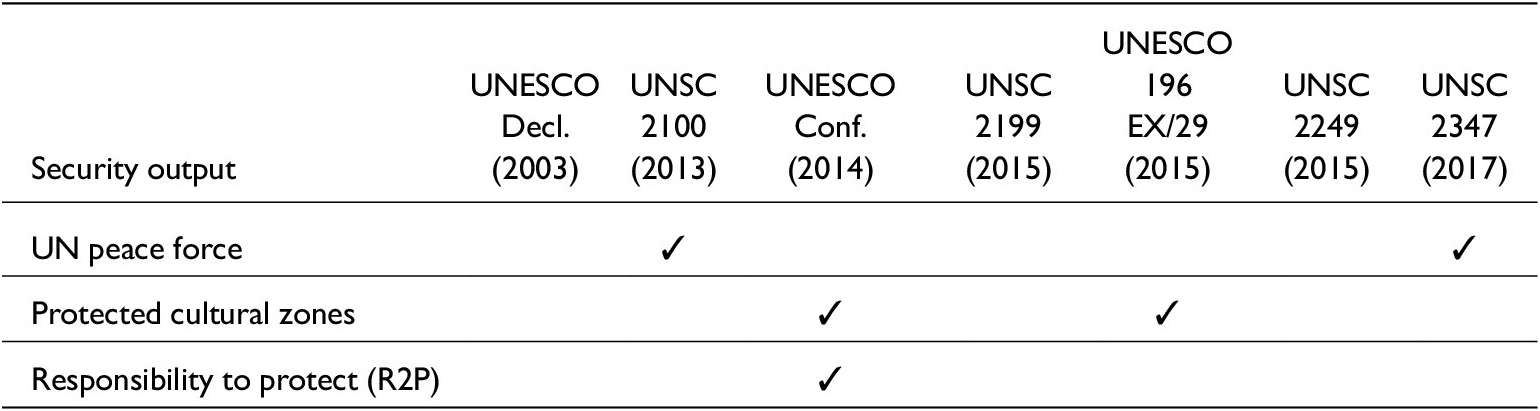
Table 2 outlines the proposed security measures in the seven key documents. Only one, UNSC Resolution 2100’sFootnote 89 mandate for MINUSMA, was implemented. This highlights a key limitation in the securitization of cultural heritage: Rhetorical commitments were not followed by concrete action. Although UNESCO’s 2014 and 2015 texts suggested mechanisms like protected cultural zones and invoked the Responsibility to Protect (R2P), these remained at the discussion stage.
Proposed security measures for cultural heritage protection

The absence of broad mobilization stems from multiple factors: UNESCO’s limited enforcement capabilities, dependency on voluntary funding, and the UNSC’s selective interest based on political alignments, and even institutional leadership shift in UNESCO. On this last one, the mobilization gap is not merely a failure of institutional capacity or UNSC indifference; it reflects a deliberate institutional repositioning within UNESCO itself. Indeed, the fading of securitization discourse coincided with leadership change and policy reorientation of UNESCO, beside a broader international fatigue with post-2015 counterterrorism narratives.
Still, mobilization has occurred in national and regional settings, albeit unevenly. In the United States, the Safeguard Cultural Heritage During Armed Conflict Act and other legal frameworks have integrated heritage protection into national security policy, reflecting uptake of international discourse.Footnote 90 European countries like France and Italy institutionalized heritage protection units under civil security departments rather than military command, signaling a hybrid model of securitization.
In sum, while the identification stage of cultural heritage securitization was robust, mobilization remained institutionally fragmented and politically uneven, raising questions about the durability of securitization when not backed by sustained enforcement or inter-organizational consensus.
Discussion and conclusion
This study has mapped the securitization of cultural heritage through the theoretical lens of the Copenhagen School, offering a document-based investigation of how UNESCO and the UNSC constructed cultural heritage as a matter of global security. By examining seven key documents issued between 2003 and 2017, it traced how the discourse evolved from normative condemnation to security framing, revealing both the discursive momentum and the operational limitations of this process.
The analysis identifies a two-stage transformation. The first phase, which followed the destruction of the Bamiyan Buddhas in 2001, established a foundation of criminalization. Cultural heritage loss was gradually framed not merely as symbolic damage and a war crime and crime against humanity but as a violation of international norms, particularly human rights, cultural identity, and collective dignity. This discourse laid the groundwork for securitization by linking heritage destruction to war crimes and crimes against humanity. The second phase, beginning with UNESCO’s 2014 conference on Iraq and Syria and culminating in UNSC Resolution 2347 at 2017, marked the discursive peak. Cultural heritage was now framed as a target of terrorism and a threat to international peace and security. However, despite this rhetorical convergence, the securitization process stalled at the mobilization stage.
The first major contribution of this study lies in its systematic mapping of the securitizing actors, referent objects, security sectors, and threat levels present in institutional discourse. The findings show a clear divergence in how UNESCO and the UNSC constructed cultural heritage as a security issue. UNESCO primarily invoked referent objects rooted in the societal sector such as human dignity, cultural diversity, and coexistence, emphasizing local and mid-level threats to community cohesion and identity. The UNSC, by contrast, positioned heritage destruction within the military and political sectors at the macro level, associating it with terrorism, organized crime, and threats to global security. This divergence reflects not only institutional mandates but also differing audiences and response capacities. It is also important to recall that the character of the documents themselves partly shaped these findings: UNESCO’s conference reports, with their multiplicity of voices, generated a broader set of referent objects, while UNSC resolutions reflected a narrower but more authoritative framing. This asymmetry reinforces the conclusion that institutional discourse on heritage securitization is both uneven and conditioned by the format through which it is articulated.
Second, the study identifies the main limitations in the mobilization stage. Among the numerous measures proposed, including protected cultural zones, enhanced sanctions, and discussions around R2P, only one, the deployment of MINUSMA with a heritage protection mandate in Mali,Footnote 91 was implemented. Despite high-level endorsements and repeated references to cultural cleansing and war crimes, proposals such as R2P remained legally and politically contested and were not translated into action. This striking gap between discourse and implementation underscores a central weakness in the securitization process: Strong rhetorical commitment was not matched by institutional capacity or political consensus.
Multiple factors explain this outcome. UNESCO’s limited enforcement mandate, dependency on voluntary funding, and the political selectivity of the UNSC all constrained operational follow-through. A less explored but critical factor is the leadership transition at UNESCO. Institutional repositioning of UNESCO, together with the waning visibility of ISIL’s iconoclastic violence, diminished the urgency that had previously sustained the securitization momentum.
Despite this institutional stall, securitization has not vanished entirely; it has taken on new forms at national and regional levels. Still, national-level responses suggest that securitization can unfold asymmetrically. In the United States, for example, legislation has criminalized the trafficking of cultural property linked to terrorism financing.Footnote 92 In Europe, countries such as France and Italy have established specialized heritage protection units.Footnote 93 These cases indicate that securitization can persist even without multilateral mandates, shaped by domestic political logics and legal instruments.
Theoretically, this study contributes to securitization literature by highlighting the layered and uneven nature of cultural heritage securitization. It shows how securitizing moves travel across institutional levels and national contexts, shaped by varying capacities, narratives, and political interests. The analysis also integrates identity-based and nonmaterial forms of threat perception into the Copenhagen framework, challenging the assumption that existential threat must always derive from physical violence. In sum, the securitization of cultural heritage remains incomplete, discursively powerful, but operationally limited.
Ultimately, this study demonstrates that the securitization of cultural heritage was a historically bounded process that peaked between 2003 and 2017 and gradually evolved into legal and normative frameworks of protection. The analysis reveals how cultural heritage was framed through distinct referent objects, such as identity, social cohesion, and cultural diversity, that continue to shape how institutions understand and respond to heritage-related threats. These referent objects indicate what aspects of heritage are rendered visible, prioritized, or neglected in global governance, offering analytical insights for both policymakers and scholars. For policymakers, the findings suggest that heritage protection would benefit from being integrated into peacebuilding and post-conflict recovery mandates, while for scholars, they open pathways for further research into how heritage securitization is adapted, resisted, or institutionalized across different geopolitical settings. Overall, understanding this process is crucial for recognizing both the limits and the lasting influence of the securitization framework in global cultural policy.
Disclosure statement
The author declares that there are no relevant or material financial interests that relate to the research described in this article.
Acknowledgement of AI Assistance
ChatGPT (OpenAI, 2025) was used solely for language editing and stylistic refinement. All ideas, analyses, and interpretations are entirely the author’s own.