Lake Urmia is located in the northwest of Iran and is the second largest saline lake in the world. Altitude of the lake is about 1276 m, and the salt amount varies from 185 to 220 g/liter. Lake Urmia regulates the temperature and humidity of the district and offers an appropriate place for agricultural activities.
During the last decade, images show a quick and distinct shrinking pattern in the lake area, especially in the eastern and southern parts,Reference Turgut, Hacioglu, Emmungil, Turgut and Keskin1 and this leads to the appearance of 1800 km2 salt marsh on the adjacent lands.Reference Hoseinpour, Fakheri Fard and Naghili2 The main reasons for water surface slump of the lake include excessive groundwater extraction, lack of efficient water management, climate changes, dam constructions, and devoting uncontrolled water sources to agricultural, industrial, and domestic uses.Reference Hoseinpour, Fakheri Fard and Naghili2 , Reference Garousi, Najafi, Samadi, Rasouli and Khanaliloo3
The Lake Urmia drought could result in health, ecological, and social problems. Appearing as a salt desert with a huge area of more than 5000 km2 and carrying out these salts and chemicals deposited in the lake basin to adjacent areas with wind will impair agricultural lands, pollute the ecosystem, and cause a variety of diseases in adjacent urban and rural areas. The similar procedure occurred in the nearly dried Aral Lake where salt and transformed chemicals caused respiratory diseases, malnutrition, and anemia.Reference Hoseinpour, Fakheri Fard and Naghili2 , Reference Haldiya, Mathur, Sachdev and Saiyed4 , Reference Kulmatov and Soliev5 Dried Lake Ebinur in China is another example. It is estimated that 4.8 billion tons of salty dust is being carried from the dried surface of this lake every year.Reference Abuduwaili, Gabchenko and Junrong6 Also, raised dust storms from the basin of Lake Owens in California, United States, contained elements like sodium sulfate, sulfur, arsenic, chrome, cobalt, nickel, lead, and so on, and caused allergy and respiratory diseases, asthma, sinus infection, headache, ear infection, bronchitis, eye pain, sore throat, cough, fatigue, lung cancer, and cardiovascular diseases.Reference Ono, Hardebeck, Parker and Cox7
Currently, there are no data available regarding the possible health consequences of Lake Urmia drying. Therefore, this paper investigates the effects of a shrinking Lake Urmia on some health parameters in adjacent urban and rural areas.
METHODS
Patient and Public Involvement
In this population-based cross-sectional study, the age range of the target population was 15 to 64 years. These people were living in urban and regional areas of districts adjacent (Bonab, Oskou, Ilkhichi) to Lake Urmia and districts (Mianeh, Varzegan, Khodafarin) far from (at least 400 km) the lake. This study was conducted by probability proportional to size multistage stratified cluster sampling through which 26 clusters were selected from each region. In this type of sampling, the selection probability for each component is set to be proportional to its size measure. The sampling frame was based on the postal code setting of the national post office, which is updated annually. The clusters were selected in this system based on postal code. Each address in this system was summarized in a 10-digit postal code number. In urban areas, clusters included 1 to several blocks or parts of blocks. Blocks were usually attached buildings. After determining the cluster start point, enrollment and data collection were started. In each cluster, 20 participants (10 male and 10 female) with the age of 15–65 years were enrolled (a total of 1040 participants: adjacent areas [520] and regions far from the Lake [520]). This begins from the household at the cluster start point and continues toward the other houses until the required numbers of participants are enrolled. Consecutive households were selected based on the geographical location of buildings to the right-hand side of each building. Research survey and examination teams visited households according to previously agreed arrangements. The large sample size and the sampling design and framework mean that the sample was representative of the whole study population. In this project, adults ages 15–64 years were included. Adults with severe chronic illnesses requiring bedrest, subjects with communication barriers, and pregnant women were excluded.
All procedures performed in this study were in accordance with the ethical standards of the Ethics Committee of Tabriz University of Medical Sciences, as well as the 1964 Helsinki Declaration and its later amendments or comparable ethical standards. Also, an informed consent letter was obtained from all individual participants included in the study.
Data were collected based on interviews, physical assessments, and anthropometric and biochemical measurements by a team of health experts.
Sociodemographic Status
This questionnaire included questions concerning the sociodemographic characteristics such as age, gender, educational level, marriage status, employment status, family size, and residential area.
Angina
The history of any chest pain was assessed using the Persian translated Rose questionnaire. Rose angina had been designed for participants who had chest pain during exertion. Rose questionnaire data were interpreted according to previously published guidelines.Reference Rose, McCartney and Reid8
Cigarette Smoking Status
Different categories of cigarette smoking status were defined according to WHO advice.9 A person who “smokes cigarettes at least once a day” is defined as a daily smoker; “who smokes cigarettes but not every day” is known as an occasional smoker; an ex-smoker is defined as somebody who “formerly smoked daily or occasionally but is not a smoker now”; and a non-smoker is defined as somebody who “is not smoking now and has never smoked in the past.”
Physical Activity Levels
The International Physical Activity Questionnaire (IPAQ) was used for determining physical activity levels. The validity of the translated form of this questionnaire was tested in a previous study on Iranian subjects.Reference Vasheghani-Farahani, Tahmasbi, Asheri, Ashraf, Nedjat, Kordi and Persian10 Physical activity levels were also classified into 3 categories: inactive, minimally active, and health-enhancing physically active, according to the scoring system provided by the IPAQ.11
Dietary Assessment
A dietary assessment was performed by means of quantitative food frequency questionnaires (FFQ), which were completed through face-to-face personal interviews by expert dietitians. The reported frequency of each food item was converted into a daily consumption and the mean intakes of 26 main food groups were calculated and used to establish dietary patterns by a principal component analysis.
Anthropometric Measurements
Body mass index (BMI) was calculated from height and weight data as kg/m2. Overweight was defined as BMI ≥ 25, and obesity was defined as BMI ≥ 30 kg/m2. Body-weight was measured to the nearest 0.1 kg on a Seca digital weighing scale, and a stadiometer was used for measuring height to the nearest 0.1 cm with bare feet. Waist circumferences (cm) were measured in duplicate while the subjects were wearing light clothing with an anthropometric tape. Waist circumference was measured at the minimum circumference between the iliac crest and the rib cage and conicity index was calculated.
Blood Pressure Measurement
After a 5-minute rest, the blood pressure was measured 2 times in each arm in sitting position by a trained nurse using a mercury sphygmomanometer (Richter, Germany). After 2 measurements, blood pressure was measured a third time if there was a difference of more than 10 mmHg in systolic readings and/or 5 mmHg in diastolic readings, and the 2 readings with the least difference were documented. According to the Seventh Report of the Joint National Committee on Prevention, Detection, Evaluation, and Treatment of High Blood Pressure, having either a systolic blood pressure (SBP) of 120 to 139 mmHg and/or diastolic blood pressure (DBP) of 80 to 89 mmHg was considered prehypertension in persons who were not on antihypertensive medication.Reference Chobanian, Bakris, Black, Cushman, Green and Izzo12 Hypertension was defined as SBP ≥ 140 and/or DBP ≥ 90 mmHg or current use of antihypertensive medication for the management of hypertension, at the time of interview.
Biochemical Measurements
A blood sample was taken after an overnight fast. FBS, total cholesterol, LDL-C, HDL-C, TG, hemoglobin (Hb), ferritin, and serum vitamin D were measured. The levels of serum TC, HDL-C, and TG were measured by enzymatic colorimetric methods with a commercially available kit (Pars Azmone, Tehran, Iran) on an automatic analyzer (Abbott, model Alcyon 300, USA). Serum LDL-C was calculated by the Friedewald equation.Reference Friedewald, Levy and Fredrickson13 Chemiluminescent immunoassay technology was used for the quantitative determination on 25(OH) D and other hydroxylated metabolites in human serum (DiaSorin, Saluggio, Italy). An automated counter (SYSMEX, Japan) was applied for measuring the levels of Hb. Serum ferritin levels were measured by an ELISA test kit (Biochek Inc., India).
Urinary Salt Excretion
The first-morning spot urine sample was collected from first voided morning urine. The sodium concentration was measured by an ion-selective electrode method (Modular DPE chemistry; Roche Diagnostics, Mannheim, Germany). Creatinine levels were measured by the Jaffe reaction (Kinetic colorimetric assay; Roche Diagnostics). Kawasaki’s formula was used to estimate urinary salt excretion over 24 hours.Reference Rhee, Kim, Shin, Gu, Nah and Hong14 No additional data are available to share.
Statistical Analysis
Data were analyzed using SPSS (version 18; IBM Corp, Armonk, NY). The normality of distribution of the continuous variables was examined using histograms and Kolmogorov-Smirnov test.
Mean values and SDs were calculated for continuous variables, and proportions were calculated for categorical variables. Between-group comparisons were made using an independent t-test and chi-square test. P values less than 0.05 were considered as significant.
RESULTS
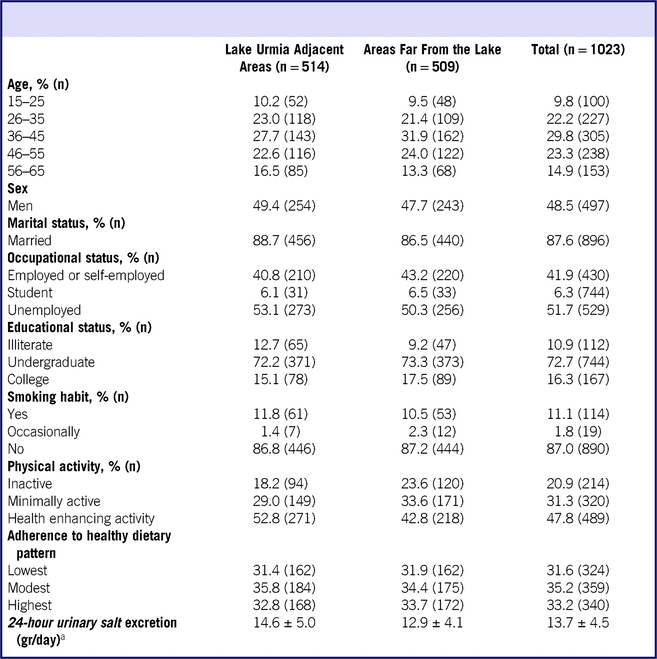
Table 1 shows the demographic characteristics of participants stratified by region. About 48.5% of participants were male. The mean age of participants was 42 ± 12.4 years, and the mean BMI was 27.82 ± 5.3 kg/m2. About 21% of males and 1% of females were a current smoker, and 47.8% of the population had health-enhancing physical activity. The rates of age, sex, educational and physical activity status, dietary pattern, and smoking habit were not significantly different in Lake Urmia’s adjacent areas and control ones (P > 0.05). The amount of 24-hour urinary salt excretion was significantly high in Lake Urmia’s adjacent areas compared with the control ones.
General Characteristics of Participants in Urban and Regional Areas

a (P < 0.05); differences tested by an independent t-test.
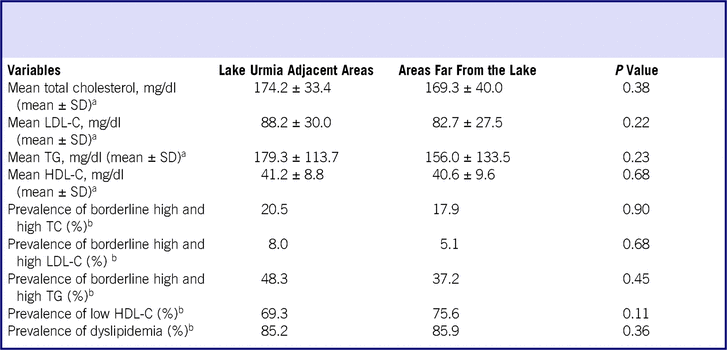
The comparison of high total cholesterol, high LDL-C, high TG, low HDL-C, and dyslipidemia prevalence in Lake Urmia’s adjacent areas and control ones is presented in Table 2. The mean serum total cholesterol, LDL-C, HDL-C, and TG were not significantly different in Lake Urmia’s adjacent areas and control ones (P > 0.05). Also, no significant difference was observed in the prevalence of high total cholesterol, high LDL-C, high TG, low HDL-C, and dyslipidemia in both groups (P > 0.05).
The Comparison of High Total Cholesterol, High LDL-C, High TG, Low HDL-C, and Dyslipidemia in Case and Control Areas

a Differences tested by an independent t-test.
b Differences tested by a chi-square test.
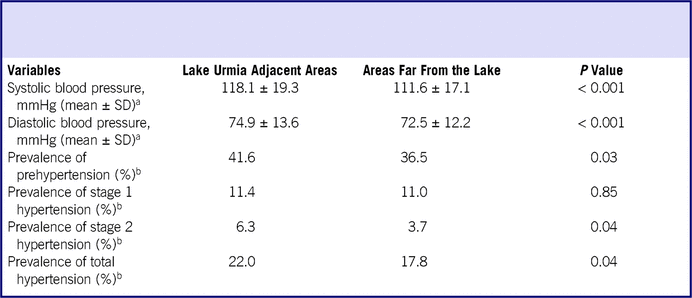
Table 3 represents the comparison of prehypertension, stage I and stage II hypertension, and overall hypertension prevalence in both regions. The mean systolic (119.44 ± 15.37 vs 117.59 ± 17.67 mmHg) and diastolic (77.92 ± 10.51 vs 76.33 ± 11.66 mmHg) blood pressures in Lake Urmia’s adjacent areas were significantly higher than the other regions (P < 0.05). Moreover, in regions near Lake Urmia, the prevalence of total hypertension (24.3% vs 21.1%), prehypertension (13.9% vs 13.3%), and stage II hypertension (5.8% vs 5.1%) was significantly higher than the regions far from the lake (P < 0.05).
The Comparison of Prehypertension, Stage I and Stage II Hypertension, and Overall Hypertension Prevalence in Case and Control Areas

a Differences tested by an independent t-test.
b Differences tested by a chi-square test.
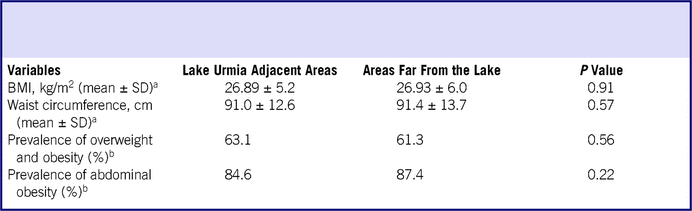
The mean of BMI and waist circumference and the prevalence of overweight/obesity and abdominal obesity was not significantly (P < 0.05) different in both regions (Table 4).
The Comparison of BMI and Waist Circumference, and the Prevalence of Overweight/Obesity and Abdominal Obesity in Case and Control Areas

a Differences tested by an independent t-test.
b Differences tested by a chi-square test.
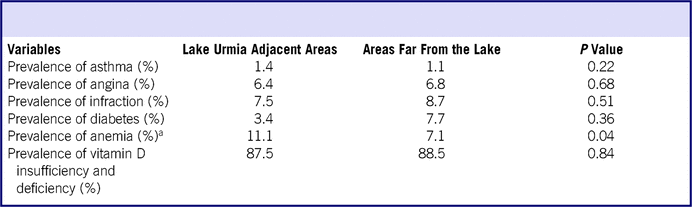
Table 5 illustrates the comparison of non-communicable diseases prevalence in both areas. The prevalence of anemia was significantly higher in regions near Lake Urmia in comparison with regions far from the lake (P = 0.04). However, no significant differences were observed in the prevalence of asthma, angina, infraction, diabetes, and vitamin D insufficiency and deficiency between the 2 districts (P > 0.05).
Comparison of Non-Communicable Diseases Prevalence in Case and Control Areas

a Differences tested by a chi-square test.
DISCUSSION
The shrinking of Lake Urmia in the northwest of Iran is considered one of the instances of damaging human activities that destroy ecosystems and may have lots of health consequences. The results of this study showed that this shrinking process had harmful health effects on people living in the areas adjacent to the lake. Based on the results of this study, in regions near Lake Urmia, the prevalence of total hypertension, prehypertension, and stage II hypertension was significantly higher than that of the regions far from the lake. Some major confounders such as age, employment status, education level, smoking, dietary pattern, physical activity status, and obesity/abdominal obesity were not different in both regions. It seems that salt storms raised from the lake.Reference Abbaspour, Javid, Mirbagheri, Givi and Moghimi15 may be a reason for the higher prevalence of hypertension among people living in the adjacent areas to the lake. The wind can cause salt particulates migration in the region. This would cause an increase in the salt content of the soil in the whole region, which can cause environmental and health problems.Reference Garousi, Najafi, Samadi, Rasouli and Khanaliloo3 Also, the results of Haldiya et al. showed that the prevalence of hypertension and blood pressure was found to be higher in non-brine salt workers occupationally exposed to salt particles in the air of the breathing zone.Reference Haldiya, Mathur, Sachdev and Saiyed4 This is in line with the hypothesis that salt may be absorbed from the respiratory tract after being inhaled.Reference Boucher16 , Reference Knowles and Boucher17 or the mucociliary current may transport it to the pharynx, where it is swallowed and can be absorbed from the gastrointestinal tract. Subsequent increases in plasma sodium may be responsible for increases in the blood pressure.Reference He and MacGregor18 Conforming to the previous hypotheses, the results of this study showed that 24-hour urinary salt excretion was significantly high in the Lake Urmia adjacent areas compared with the control ones.
In addition, the results of this study showed that the prevalence of anemia was significantly higher in regions near Lake Urmia in comparison with regions far from the lake (P = 0.04).
The results of previous studies showed that heavy metals may induce changes in the metabolism of essential metals like Fe and consequently result in anemia.Reference Turgut, Hacioglu, Emmungil, Turgut and Keskin1 , Reference Järup19 , Reference Rondó, Carvalho, Souza and Moraes20
Unfortunately, there are no data available on the environmental consequences of Lake Urmia shrinking; however, a similar study on the case of the Aral Sea shrinking showed that organic substances (the dissolved organic substances, benzene, xylene, and phenol) and heavy metal (nickel, lead, mercury, and zinc) contents in the air and water resources of a residual Aral reservoir had been increased.
In this study, no significant differences were observed in the prevalence of obesity, dyslipidemia, asthma, angina, infraction, diabetes, and vitamin D insufficiency and deficiency between the 2 groups. Studies in the Aral Sea basin showed that the rates of tuberculosis, anemia, respiratory infections, kidney and liver diseases, cancer, and allergies had been increased. An analysis of specific non-infectious morbidity dynamics in the Aral Sea area inhabitants indicates that the increasing trend of the morbidity by such pathologies as cardiovascular (blood vessel) diseases and diseases of the urogenital system (reproductive system) was noted in recent years. Taking into account the results of studies on the Aral Sea, it seems that, in the case of Lake Urmia, if the drying pattern continues, more prevalence of the communicable and non-communicable diseases would be expected.Reference Kulmatov and Soliev5
Strengths and Limitations of This Study
The main strength of the current study was the large sample size from different urban and regional areas that provides new data regarding the impact of Lake Urmia drying on some health parameters. Various potential confounders were accessible, and the results could be interpreted regarding the confounders. One of the main limitations of this study is the cross-sectional design that restricts examining causal associations.
CONCLUSION
In conclusion, the results of this study showed that the drying of Lake Urmia has serious health effects such as hypertension and anemia. We hope that this article would increase awareness for this serious disaster and capture the attention of international and national health organizations. Additionally, more longitudinal and well-designed studies are desired to investigate the environmental consequences of Lake Urmia shrinking such as water and air pollution.
Acknowledgments
The authors wish to thank the East Azerbaijan Provincial Health Center, Tabriz Health Services Management Research Center at Tabriz University of Medical Sciences, and Eastern Azerbaijan Governor General for financial support.
Author Contributions
JST designed and directed the project, and contributed in interpreting the results; MF and LN developed the theoretical framework and drafted the manuscript; HA and ZN manufactured the samples, characterized them, and performed the analysis. EE edited the final version of the manuscript and contributed in interpreting the results. All authors provided critical feedback and helped shape the research, analysis, and manuscript.
Conflict of Interest Statement
The authors have no conflicts of interest to declare.