ETHNOGRAPHIC BACKGROUND
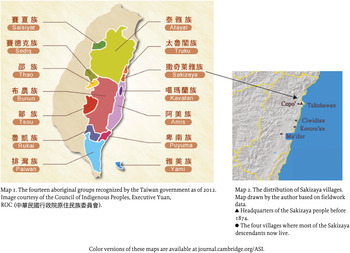
At a reception held at the Executive Yuan on January 17, 2007, the Premier officially announced the Sakizaya as the Thirteenth Aboriginal Group of Taiwan. At that time, the following twelve Austronesian peoples had already been recognized by the government:Footnote 1 the Atayal, Saisiyat, Bunun, Tsou, Rukai, Paiwan, Puyuma, Amis, Yami, Thao, Kavalan and Truku (see Map 1). During the celebration at the Executive Yuan, the Sakizaya wore “traditional” costumes and received the blessings of the Amis and society in general. This moment symbolized the achievement of a preliminary goal in the Sakizaya's new ethnic group movement.
Maps 1 and 2

After the Nationalist Party (Kuomintang or KMT) of China succeeded the Japanese colonial government in Taiwan in 1945, officials continued to apply the then-current method of categorizing the Taiwanese aborigines into nine groups. However, since the 1980s, many aboriginal groups have launched Name Rectification Campaigns; for example, the Thao, Kavalan, and Truku all called for “independence” from their originally designated groups.Footnote 2 This phenomenon indicates that the officially recognized categorization of Taiwanese aborigines differs vastly from how they categorize or distinguish themselves. When trying to explicate the reasons for a group name rectification, many scholars (e.g., Chan Reference Chan1998 and Pan Reference Pan2008) point out that the old system of categorization obscures originally complex ethnic relationships, and the primary reason lies in how the state has historically manipulated the ways aborigines have categorized themselves. The occurrence of various name rectification campaigns not only sheds light on the inadequacies of the old system of categorization, but it also reflects the rise of the aborigines' own awareness. The Sakizaya's Name Rectification Campaign can thus be observed in this context.
The social atmosphere in Taiwan has grown more and more receptive to aboriginal movements over the past twenty years. On July 15, 1987, after more than thirty-eight years, martial law was lifted. In 1996 the central government set up the Council of Indigenous People, elevating aboriginal affairs to the national level. Further, in 2000 the Democratic Progressive Party (DPP) won the presidential election, which encouraged many aborigines to devote more time and energy to ethnic movements.
Dutch records in the seventeenth century identify the Sakizaya as a distinct people, different from the Amis (Kang Reference Kang1999).Footnote 3 Nevertheless, historical documents since then have not provided sufficient information about the culture of the Sakizaya and the nature of their relationship with the Amis. According to local legends, the Sakizaya, now mainly scattered across eastern Taiwan, all originated from Takobowan, which is now near the Si-Wei High School in Hualien City (see Map 2). Villages were formed due to an increase in population and a need for more farmland during the rule of the Qing Dynasty in the late nineteenth century. At that time, the Kavalan had just migrated to the Hualien plain from the Yilan plain to escape persecution by Chinese settlers. Documents further show that the Sakizayas, like the Amis in this region, had a very active relationship with the Dutch and Chinese during their historic occupations.
The decline of the Sakizaya was initiated by the Jia-Li-Wan uprising. In 1874, an incident in southern Taiwan alarmed the Qing government and caused them to tighten their control over the aborigines in eastern Taiwan. To prevent eastern Taiwan from falling victim to foreign powers, the Qing government started to build roads to eastern Taiwan and lifted its restrictions on traveling there, which allowed many Chinese people to migrate and interact with the aborigines in that area. In 1875, the Qing ruling powers officially entered eastern Taiwan, and in March and April of 1878, the Kavalans of Jia-Li-Wan united with the Sakizaya in a battle against the Qing government. This resistance, called the Jia-Li-Wan Incident (Jialiwan shijian 加禮宛事件) in historical documents,Footnote 4 failed and their villages were broken up, forcing the Kavalan and the Sakizaya into exile. To escape persecution, the Sakizaya obscured their identities by mixing themselves among the Amis, thus vastly decreasing their size and power. As a result of the Treaty of Shimonoseki, the Japanese took over Taiwan from the Qing government. When the Japanese started their ethnographic research in the early twentieth century, the Sakizaya had become relatively “Amis-ized,” and were regarded as a sub-branch of the Amis for both academic and official purposes.
The Sakizaya's new ethnic group movement was initiated in 1990, when the now-deceased Tiway Sayion, known in Chinese as “Headmaster Lee Lai-Wang,” a former primary school principal, called upon his fellow people to hold an ancestral worship ritual. In May 2005, the “Sakizaya New Ethnic Group Campaign League” was founded, and on October 13 of that year, the league officially presented its name rectification petition to the Council of Indigenous People at the Executive Yuan. On July 1, 2006, the first Fire God Ritual (Palamal, or huoshen ji 火神祭 in Chinese) was held at the original Takobowan site and later, on January 17, 2007, as a result of the cultural-political momentum initiated by the Fire God Ritual and by other developments of the movement, the Sakizayas officially became the Thirteenth Aboriginal Group in Taiwan.
According to the estimate by the core members in the ethnic group movement, the population of the Sakizaya was between 5,000 and 15,000 in 2006.Footnote 5 However, even core members admit that it is very difficult to distinguish the Sakizaya from the Amis, not only in terms of bloodline, but also in terms of culture.Footnote 6 Furthermore, almost all Sakizaya descendants now speak the Amis language. Although some recent studies identify the Sakizaya language as being significantly different from the Amis language,Footnote 7 the Sakizaya language is only spoken fluently among a few elderly people over seventy years of age. How the Sakizaya ethnic group movement emerged under these conditions attracted my attention. This article will focus on the role that cultural construction plays in this new ethnic group movement.
THEORETICAL FRAMEWORK
Just as in many other ethnic group movements, the Sakizaya's Name Rectification Campaign is very complex and can be viewed from several different angles. However, it must be emphasized that this article does not intend to discuss issues such as “can the Sakizaya be considered as an ethnic group,” or “should the Sakizaya be separated from the Amis ethnic group.” In other words, this article will not deal with the aspect of ethnic group “identification.” How ethnic groups are viewed by official powers, and what criterion they hold for establishing the Sakizaya as an individual ethnic group, are obviously important research concerns, but are not the focus of this article. This article also will not directly discuss questions of “what is ethnic group/ethnicity”; instead, it is concerned with how ethnic group campaigners act in order to satisfy official demands and to achieve their goal of rectification. More specifically, this article views the Sakizaya's Name Rectification Campaign as an ethnic group movement, and it focuses on the actions of core members within the movement to understand the meanings of various phenomena during the process of name rectification, especially the importance of cultural construction. This method of interpretation is closely connected with the following basic presumptions.
A review of anthropological literature shows that debate on primordialism and circumstantialism sets the basic premise for early ethnic group theories, with many discussions on the relationship between the two.Footnote 8 Primordialism emerged in Europe quite early on, and emphasizes the inherent elements of ethnicity. In the days when social and cultural perspectives were more static, ethnicity was often viewed as coupled with specific and unique cultural traits. In other words, early research on ethnicity was inclined towards hypothesizing about ethnic groups with a shared culture. However, after World War II, the research of Edmund Leach in Burma and Michael Moerman in Thailand found that no clear relationship existed between ethnic group boundaries and cultural elements.Footnote 9 The study of ethnic cultures shifted from emphasizing objective indicators to subjective focuses. This perspective helped shape the boundary theory proposed by Fredrik Barth, and circumstantialism began to flourish. Political and economic causes became important factors for understanding the development of ethnicity.
In the book edited by Barth in Reference Barth1969, Ethnic Groups and Boundaries: The Social Organization of Cultural Difference, ethnic groups were seen as types of social organizations. The book emphasized that ethnic groups cannot be differentiated from each other according to shared traits or cultural commonalities. Rather, many social exclusion and incorporation processes are at work, and individuals come and go within an ethnic group, with many acquired factors causing changes to the constitution of a group. It also stressed that if research on ethnicity excessively emphasizes notable cultural traits, the results will more closely resemble cultural analyses, and not research on the organization of an ethnic group. Barth made vital academic contributions by redirecting research on ethnic identity from a focus on “content” to an emphasis on “boundary,” and placing value on what the actors themselves deem as significant. Although anthropologists today have produced some criticisms and revisions on boundary theory,Footnote 10 in the case of the Sakizaya, Barth's boundary theory can still be a point of departure for research.
Apart from Fredrik Barth's boundary theory, some viewpoints held by Rogers Brubaker also correspond with the analytical perspective of this article. Brubaker is a professor in the Department of Sociology at the University of California, Los Angeles (UCLA). Since 1998 he has produced eight papers, alone or with other scholars (such as Mara Loveman, Peter Stamatov, Fredrick Cooper, and David Laitin), which were published together in the book Ethnicity without Groups. In the paper “Ethnicity as Cognition,”Footnote 11 the authors reviewed the development of cognition concepts, from stereotype and social categorization to schema. They also proposed that ethnicity should not be viewed as “things or entities in the world,” rather, it should be “ways of seeing” or a kind of “perspective on the world.” Thus, for Brubaker, the foremost agenda in ethnicity research is to explore “everyday ethnicity.” His stance emphasizes not the “substance” of an ethnic group, but the “process” of its formation. In this situation, there would not necessarily be a corresponding group for study when seeking to understand ethnic group phenomena. Rather, how the group was formed under subjective and objective circumstances, that is, the process of “group making,” should be the focus of inquiry.
Anthropologist Francisco J. Gil-White continued this line of thought by expressing that academia should relinquish the concepts of “ethnic group” and “nation,” as both connote “groupness.”Footnote 12 Or in his own words: “… ethnic group is a misleading misnomer – there are not ‘groups’ but categories.”Footnote 13 He further advocated that, with regard to research on ethnicity, academic research should define the difference between the “ethnie” concept, which exists in the human mind, and the “nationalist,” which is a type of person existing in everyday life. This article follows this theoretical hypothesis, and the term Sakizaya is regarded as “ethnie,” and not necessarily as an ethnic group. On the other hand, the “core members” and “leaders” mentioned in the article are regarded as the “nationalists” defined by Gil-White. Although the cry for autonomy and self-governance is not obvious as of yet in the Sakizaya ethnic group movement, I believe this dynamic does exist.
In this analytical framework, neither ethnie nor ethnicity are static and invariable, but each has its own dynamics and aspects of negotiation. In short, an individual living in a society has his/her own initiatives, and those objectives and strategies should not be ignored when trying to understand social action. However, individual initiatives are still restricted by the society's cultural structure. Thus, although ethnic group campaigners have their own agency for redefining their ethnic status and culture, many other social forces, such as the state, and the Amis, are also at work, and must be met for dialogue and negotiations. This article attempts to focus on the core members' construction of ethnic culture within the aforementioned framework, and Joane Nagel's research findings provide an excellent reference.
In the paper “Constructing Ethnicity,” Nagel pointed out that identity and culture are the two foundations of ethnic consciousness. Identity accentuates the aspect of “who I am” through an ethnic boundary, and culture highlights “what I am” through the production of meaning. The term “culture” used by Nagel is not much different from others, yet she stresses that in the process of ethnic movements, the formation and development of certain cultures are related to the people's initiatives, and have certain social objectives, such as creating shared meanings, strengthening solidarity, and providing symbolic foundations for mobilization.Footnote 14 This is the theoretical basis of the current article, which observes the Sakizaya's Name Rectification Campaign through the concept of cultural construction.
This viewpoint had already started to develop in the 1980s. In the essay collection The Invention of Tradition published in 1982, Eric Hobsbawm pointed out in the theoretical introduction that much of what we now view as “tradition” actually was an “invention” in a certain historical period. What matters for him is not if the traditions of the present are the same as the traditions of the past, rather, “what traditions did we invent, and why?” For many scholars (e.g., Wagner and Hobsbawm), “invention” refers to the continuing manipulation of symbols to create new meanings.Footnote 15 However, others (e.g., Hanson) argue that “invention” implies de novo creation or even falsity and fabrication.Footnote 16 Following this consideration, Linnekin proposed the use of the more neutral word “construction” to replace “invention.”Footnote 17 Based on this development, Robert Norton presented a theory on cultural construction of group identity. In his usage, construction included three aspects, namely invention or reinvention, opposition, and objectification. He further specified the effect cultural construction has on ethnic identity: that ethnic identity is the product of a process, and that ethnic groups selectively use cultural elements to formulate and claim their difference with oppositional others. Culture is the process of objectification that seeks to strengthen identity construction.Footnote 18 This viewpoint decidedly assists the understanding of certain phenomena in the Sakizaya's Name Rectification Campaign. In short, the concept of cultural construction is the main axis of this article, through which I explicate the relationship between cultural and ethnic construction in the Sakizaya's Name Rectification Campaign.
HISTORICAL MEMORY AND THE DIFFICULTY OF SEPARATING FROM THE AMIS
The incorporation of the Kavalan and the Sakizaya into the Amis was a significant phenomenon in the history of eastern Taiwan. Before the Jia-Li-Wan uprising, the three were independent and distinct categories of people, but during Japanese rule, the Kavalans and Sakizayas ceased to be individual units, at least in the population census. Although they were both considered a branch of the Amis, the Kavalans had started their name rectification campaign as early as the 1980s, and were successfully recognized as the Eleventh Aboriginal Group in 2002. The question posed here is: with the rise of Aboriginal campaigns in the 1980s, why did the Sakizaya's Name Rectification Campaign come so much later than the Kavalan's?
It is difficult to answer this question based on objective criteria; in terms of population, the Sakizaya outnumber the Kavalan; in terms of language, the Sakizaya have also preserved their native tongue to a greater degree than their neighbors. The Sakizaya's greatest obstacle lies not in the conditions of their population and language, but perhaps in a lack of political determination: they have deferred independence to avoid offending the Amis.Footnote 19 To put it briefly, the Amis consider the Kavalan to be different from them, yet they consider the Sakizaya a branch of their own. Moreover, not only do many of the Amis consider the Sakizaya as part of their own fellow people, some of the Sakizaya also identify themselves as part of the Amis, thus complicating and slowing the campaign's progress. In other words, although by objective criteria the Sakizaya may be more qualified than others to be designated a new group, the divergent self-identifications among the Sakizaya make their name rectification campaign more difficult to put into action than the Kavalan's. What they need to overcome are no longer identification qualifications such as population and language. Two obstacles still must be surmounted. First, they must persuade those Sakizaya who have long identified themselves as Amis of the importance of being recognized as a new group. Second, they must delineate themselves from the Amis, while gaining support without offending or creating hostility.
When the Sakizaya's campaign was initiated there were indeed some doubts expressed by Sakizaya descendants. Toko Sayion,Footnote 20 a key organizer behind the campaign, said in an interview:
People are afraid that name rectification may hurt the Amis, since during their nurturing, the Amis genuinely looked after them. So if the Sakizayas successfully separated and gained more resources, which are then only shared among the Sakizayas, that may be seen as an ungrateful gesture toward the Amis.Footnote 21
These words reveal the instrumental aspect of the Sakizaya ethnic group movement. In fact, in an open talk Toko Sayion stated three objectives for the movement: name rectification for the short term, cultural revival as the next phase, and group self-governance as a final goal.Footnote 22 Various objectives in this movement and the motivation to improve the conditions of the Sakizaya have been common themes among Taiwanese aboriginal movements in general.
Toko Saiyon's words touch upon an additional historical experience: after the Jia-Li-Wan uprising, many of the Sakizaya, fleeing persecution by Qing soldiers, scattered into hiding among the Amis villages, where they were taken in and sheltered. For this, Headmaster Lee, the most prominent leader of the Sakizaya movement, felt indebted to the Amis, and passed on that historical memory to his eldest son, Toko. Concerns about intermarriage have also factored in the decision to separate from the Amis, since presently, it is difficult to find a Sakizaya descendant whose parents and grandparents are of “pure” Sakizaya blood.Footnote 23 In most cases the Sakizaya have Amis relatives who have married into the family. Thus, if separation from the Amis results in unfavorable consequences, that may also cause irreparable damage to many single families in both peoples. This factor regarding emotional attitudes toward family and toward the Amis has been the greatest obstacle in their campaign.
Interestingly, although many of the Sakizaya are afraid of fragmenting their solidarity with the Amis, Toko emphasizes that: “The elders have a great need for name rectification, as they wish to achieve this goal to gain approval from their ancestors when they ‘return’.” We may say that, their fear of harming relationships notwithstanding, the Sakizaya, or at least the promoters of the campaign, have a desire to establish an ethnic identity, which reflects the descendants' obligation and promise to commemorate their ancestors. Of course, consideration must be given not only to the Sakizaya's desire for group recognition but also to the Amis' view of that objective. In a press release given by the Sakizaya on January 17, 2007 during the reception at the Executive Yuan, one section states:
After the battle, the Qing General, fearing that the Kavalans and Sakizayas would regain strength later, forced the villages to disperse. After the Sakizayas were exiled, most were assimilated by the Amis, and only a minority talked to each other in the Sakizaya language in public. Most Sakizayas didn't dare confess that they were Sakizayas, yet the Amis clearly distinguished them as different, always referring to them, saying, “They are the Sakizayas.”Footnote 24
The campaign leaders, contending that the Amis have clearly differentiated the Sakizaya from the Amis, have used that as a rallying call to strengthen their campaign.Footnote 25 However, in a more conciliatory tone, they also honor the Amis for providing support and protection after the Jia-Li-Wan uprising. For the Sakizaya, these conflicting sentiments of differentiation from and gratitude toward the Amis have resulted in misgivings that have weakened the campaign.
Nevertheless, the Sakizaya have managed to become an officially recognized independent group, and the way they have balanced their need for name rectification and sentiments toward the Amis is as follows:
The Sakizayas for all future generations must remember the blood and tears shed at Takobowan.… Most importantly, the Amis' generosity and courage must be kept in our hearts for all time, honoring them as the Sakizaya's “eternal mother group.”Footnote 26
To regard the Amis as the Sakizaya's “eternal mother”Footnote 27 not only appeases the Ami's feelings, and maintains their friendship, but also achieves a successful political balance to sustain the campaign. When and how the Sakizaya created this balance requires further investigation, but certainly without it, the campaign would not have been as effectively set in motion. The search for this balance took the Sakizaya a long time, so their campaign did not start out as decisively as the Kavalan's.
“Traditional” Costume and the Construction of a New Ethnic Boundary
As with other aboriginal groups in Taiwan, it is nearly impossible to differentiate the Sakizaya, Amis, and Han Chinese by their daily clothing alone. Yet as a common cultural symbol, clothing can be an important factor in creating a boundary between other groups and one's own, especially during a ceremonial event. For the leaders of the Name Rectification Campaign, creating “costumes representative of their ethnic characteristics” from an obscure historical memory has been a challenging task because those costumes are no longer worn in daily life, nor even during annual harvest rites, which could occasionally provide an opportunity for traditional costumes to be worn. Furthermore, traditional Sakizaya costumes have been heavily influenced by the Amis.
According to the “Forgotten Sakizayas” website, as the Sakizaya have become gradually assimilated into Amis society, clothing used in village rites has become essentially the same as that of the Amis. Therefore, the Sakizaya have had to search for clues to traditional costumes from historical documents. According to Li Xiu-Lan, Toko Sayion's wife, who took part in this effort:
The prototype for our traditional costume was found in an old photo, which took a long time to find. We showed the photo to many Amis elders to determine if it was traditional Amis clothing or not, in order to deduce that it may belong to the Sakizayas. The largest groups active on the Hualien Plain at that time were the Sakizayas and the Amis, which is why we decided to use this as our traditional clothing. Because the photo is in black and white, we couldn't determine the original colors, so we had a meeting and by discussion chose the colors for the clothing.
In other words, the costume worn at the name rectification reception had been “invented”: the style was redesigned following the style of clothing from earlier times, and the chosen colors were given new meanings. There are seven colors present in the costume, including mud-gold, dark red, dark blue, blackish green, black, brown, and pearl white. Mud-gold represents a return to the land, which holds both a calling and the gold itself. Dark red represents dried blood or the sacrifice of ancestors, reminding descendants to commemorate their forefathers. Dark blue represents the memory of Amis friendship. Blackish green is for the pricked bamboo representing the age-set group system and ethnic spirit. Black is for the village and ancestral spirits. Brown is a reminder not to forget the hardship the forefathers endured when they were in exile. Pearl white represents tears, to remember the suffering of living with a hidden identity.Footnote 28
The use of costumes for drawing ethnic boundaries can be understood through the concept proposed by Robert Norton.Footnote 29 Simply speaking, when an ethnic group wants to intensify its differences with other groups, certain inventions must be made. The Sakizayas not only redesigned the style and colors of their costume, but also allocated specific meanings for each color. This kind of invention is a move to create an opposition with its others, and to highlight the group's self-characteristics, in order to attain the goal of objectification. In other words, the Sakizaya “traditional” costume is a culture “‘objectified’ in an ‘oppositional’ process of affirming identity.”Footnote 30 Through this traditional costume, the Sakizayas express both their historical memory and their hopes for the future. Costumes also play an important role in marking boundaries in two ways. First, costumes distinguish them from the Han Chinese, and second, or more importantly, mark their differences from the Amis.
In a meeting before the name rectification reception, the participants came to the rehearsal wearing newly made bright-yellow costumes that were different from the original concept designs. This caused one leader to emphasize to the participants again:
The main color of our clothing is yellow, dark yellow to symbolize our land. We shouldn't use bright yellow because it is too much like the sun, and in the Amis' headdress the feathers represent the sun. So we must keep the distinction clear. Our red is dark red, which is also different from the Amis' bright red. Their red represents passion, but ours means dried blood. Our bloodline was cut before, but now we will continue to pass on the Sakizaya's legacy.
From this statement we can see that not only do they need to differentiate themselves from the Han Chinese, they also need an effective boundary between to justify their group's separation. Thus, costumes serve as symbolic boundaries for ethnic groups, not in the sense of “persistence” but “creation”.Footnote 31 Yet owing to the aforementioned sentiments, the Sakizaya cannot overemphasize their differences and destroy their bond with the Amis. In another meeting, a leader remarked upon the relationship between the Amis and the Sakizaya, using clothing as a metaphor: “We are neither blue nor green, we are red like the Amis, but they are bright red, and we are dark red.”Footnote 32 This reflects again the complex and nearly inseparable bond between the Sakizaya and the Amis.
In fact, this costume that “represents the characteristics of the ethnic group” is a product of “tradition” and “invention.” More importantly, it is obvious that the complex relationship between the Sakizaya and the Amis played a pivotal role in this process of cultural construction. On one hand, they needed to emphasize their differences from the Amis in order to legitimize their cause for name rectification, yet on the other hand, they could not overemphasize the differences and risk tarnishing their respectful relationship with the Amis.
AN ANALYSIS OF THE FIRE GOD RITUAL
The process of producing the “traditional” costume is a case of cultural construction, yet during the process of the Sakizaya's Name Rectification Campaign, the Fire God Ritual is the most important cultural construction thus far. The Fire God Ritual, a worship ceremony for commemorating ancestors, was held at a streamside park beside the Te-Shin baseball stadium in Hualien City, the site of the Sakizaya's original village, Takobowan, on July 1, 2006, 128 years after the Jia-Li-Wan uprising. In other words, it initiated a journey of reconstructing the past for the Sakizaya, whose unity had been destroyed by the Qing government nearly one hundred years earlier.
Historical Memory in Rituals
In How Societies Remember, Connerton wrote about how memories focus on two special social activities: commemorative ceremonies and bodily practices. Connerton argued that “images of the past and recollected knowledge of the past are conveyed and sustained by (more or less ritual) performances.”Footnote 33 Also, “if the ceremonies are to work for their participants, if they are to be persuasive to them, then those participants must be not simply cognitively competent to execute the performance; they must be habituated to those performances.”Footnote 34 In other words, collective social memory must have commemorative ceremonies and bodily practices in order to be remembered from generation to generation. The Fire God Ritual may be understood from this perspective.
The first paragraph of the Fire God Ritual's proposal states “the origin of the plan.”Footnote 35
Before 1878, the Sakizayas lived on the Hualien plain in six main villages: Takobowan [around Ci-Ji Hospital and Si-Wei High School], Nabakowan [around the old Hualien train station and Nan-Jing Street], Cipawkan [around the area of De-An, Hualien city], Tamasaydan [around Bei-Bin Street, Hualien city], Toapon [around Hua-Dong Road beside Hualien Bay], and Pazik [beside Mei-Lun Hill]. At that time there were five leaders in Takobowan, who were the political leaders that planned and decided everything for the village.Footnote 36
This situates the Sakizaya in the time and place just before the Jia-Li-Wan uprising. Moreover, the following reveals: “Because the Sakizayas lived on the best part of the plain, they were often attacked by other ethnic groups.”Footnote 37 In this sentence the writer takes for granted that the Sakizaya are a distinct ethnic group. Further, the document describes the interaction between the Kavalan from the Yilan plain and the Sakizaya after they moved to Hualien. At first, there was some conflict over their areas of control, then the Kavalan settled in the area of Jia-Li-Wan, fostering their interaction with the Sakizaya on the Hualien plain: “The two groups got on well, and had together fought the Trukus from the mountains.”Footnote 38 However, this relationship changed vastly after the Chinese peoples entered and overran the Hualien plain. At that time, the Sakizaya fought the newcomers, culminating with the Jia-Li-Wan uprising. In the proposal, the uprising is described as follows:
In March and April of 1878, the Kavalans of Jia-Li-Wan formed an alliance with the Sakizayas to fight against the Qing army, because of Chen-Hui-Huang's deceit,Footnote 39 oppression and humiliation of Kavalan women in buying land.Footnote 40
In fact, this interpretation of the Jia-Li-Wan uprising and the earlier history of the Sakizaya primarily came from colonial historical documents. Also, the historical development of the Sakizaya after the event, and the “historical truths” they wrote about, came from these documents. Of course, among those “historical truths” are many subjective interpretations made by the Sakizaya: for example, their view of themselves as an “ethnic group,” which is not clearly stated in the historical documents.
In addition, in the reconstruction of historical memory, narrations made by Sakizaya elders were equally important. For example, the following shows the view of the Sakizaya, why they lost and how they dispersed themselves into hiding: “In the past, the Sakizayas used pricked bamboos between the new railway station to the Sakura Cemetery to bridge out intruders.”Footnote 41 According to the narrative folk stories of the Sakizaya at that time, the Qing army could not intrude because of the pricked bamboos placed around the village of Takobowan. However afterwards, the Vaguais (probably a sub-group of Truku), who lived at Cikasowan and who did not get along with the Sakizaya, betrayed the location of the entrances of the Sakizaya village to the Qing army: the first entrance was by Bazaiwan (near the Mei-Lun River); the second was near Si-Wei High School. The Qing army attacked the entrance near Si-Wei High School but was defeated by the Takobowan upon arrival, resulting in a large pile of dead soldiers. Afterwards, the Qing army attacked with fire, burning down the pricked bamboos and straw houses by lighting the heads of arrows and shooting them into the village. In order to avoid complete destruction, the five Takobowan leaders decided to surrender.
After the war, Komod Pazik, the most important Takobowan leader, and his wife, Icep Kanasaw, were put to death. Afterwards:
Owing to the war, villagers had no place to settle down, and the bodies of Komod Pazik and Icep Kanasaw were not buried, thus preventing descendants from worshiping them. However, the story of their sacrifice lived on among the descendants.Footnote 42
The purpose of the Fire God Ritual is to remember this part of history. Not only did handbooks and posters at the 2006 Fire God Ritual note that history, but the host of the ceremony used different languages to communicate that message. More importantly, ritual organizers tried to create a feeling of “going back into that historical time and place.” For example, the entrance was decorated with pricked bamboos beside straw houses, which represented traditional houses. Also, those who participated were asked “to wear old clothes, shoes (black if possible) or traditional costumes; and to bring backpacks, knives and old pots, bowls and cups to the worshipping area.” In addition, the core members of the movement all wore the new invented “traditional” costume.
Thus, the Fire God Ritual may be seen as a commemorative ceremony that promotes a shared historical memory through songs, dances, and worshipping activities, fostering a sense of participant identity as a Sakizaya member.
Joane Nagel points out that the innovative reinterpretation of historical materials can serve for contemporary political purposes, and ethnic movements can also reconstruct their own culture and history.Footnote 43 The use of historical materials and oral history told by elders in the Sakizaya's Name Rectification Campaign portrays the Sakizaya as an independent ethnic group, and created a brand new Fire God Ritual, an event which not only forged solidarity among the followers, but also demonstrated to outsiders their unique ethnic culture. All these affirm the intimate relationship between cultural construction and ethnic group movements.
The Meaning of “Fire” and “Rebirth”
Undoubtedly, the Fire God Ritual conjures historical memories. However, this ritual has also been used to create those historical memories for use today. In memorial rituals, apart from bodily movements, symbolic objects play an important role. The Fire God Ritual contains many symbolic objects. In the Fire God Ritual, starting at 5 p.m., a fire is lighted that lasts from the beginning of the ritual to the end. In a change from traditional ancestor worshipping, the Sakizaya have elevated the status of Komod Pazik and Icep Kanasaw from that of “humans” to “gods,” naming them “Fire God” and “Fire God's Wife,” and naming the entire ritual the “Fire God Ritual.”Footnote 44 Why do they use fire as a symbol for their ancestors? In the handbook, it is written:
After discussion, it was decided that we should stand up from where we fell; fire brought us near to extinction, but also lit the path for our people to hide and run, allowing us to survive under such circumstances. Therefore, we decided to deify Komod Pazik as the Fire God and Icep Kanasaw as the Fire God's Wife, at the same time worshipping all ancestors that made sacrifices in the course of the ritual; thanking them and asking them to protect all their descendants.Footnote 45
After welcoming the gods, praying for good fortune, worshipping, and remembering, the highlight of the Fire God Ritual is the setting fire to the worshipping stage – a symbolic coffin – by five representatives with torches. The ritual does not end until the stage has completely burned down. For the participants, this is a very important part of the ceremony, which symbolizes the transition from one stage to another, the passage from extinction to rebirth. In other words, there are two reasons for the use of fire in the ritual; the first is the Qing's use of fire, which nearly destroyed the Sakizaya; the second is the new path, which the fire has led the group to today. The Fire God Ritual is not only an ancestral worshipping activity, but also an event that facilitates a reconnection with their history, leading to a new stage in their development.
In their interpretation, the Fire God Ritual symbolizes that the Sakizaya gain rebirth through the act of recalling their past. In other words, the ritual is not only an event for worshipping ancestors, but also a way of reclaiming self-ethnicity. It symbolizes the Sakizaya's movement from their old plight to a new phase.
The Fire God Ritual and the Cohesion of Sakizaya Consciousness
Toko Sayion, an important movement activist behind the organization of the Fire God Ritual event, said in an interview:
We felt a need to organize an ancestral worship event for the Sakizayas, especially after the Great Ancestral Worship Ceremony in 1990. Every year we hold an ancestral worship ceremony, but none as grand as the Fire God Ritual, which is held especially for the Sakizaya people.
This passage suggests that the Fire God Ritual is an extended version of the preexisting ancestral worship ritual. Yet from another point of view, one might argue that the Fire God Ritual is an “invented” ritual. Not only are the Fire God and the Fire God's Wife new cultural components, but many parts of the ritual are new additions as well. Nevertheless, the Fire God Ritual is held to emphasize the possession of their own ancestors and historical experiences in support of their evident declaration as an independent ethnic group.
At the beginning of the Name Rectification Campaign in 1990, since most of the Sakizaya had not yet developed a strong personal or collective incentive for independence and since many had misgivings about potential opposition from the Amis, I speculate that only those with a very strong ethnic awareness of the Sakizaya community attended public events for the movement, thus, due to small participant numbers, curtailing the promotion of the campaign by leaders. It was in 2003, following the death of Headmaster Lee – which had aroused a sense of regret in the community and a desire for change – and as objective factors (such as costumes and rituals) were taking shape, that the movement entered a new phase. With the establishment of the Sakizaya New Ethnic Group Campaign League in May 2005, and the issuance of the official petition in October, the Name Rectification Campaign was officially set in motion, greatly increasing the number of supporters.
In the process of signing the petition, the core members of the campaign traveled to all geographical areas where the Sakizaya had migrated, such as Copo', Ma'ifor, and Ciwidian (see Map 2). Core members tried to establish a consensus for the campaign among those communities. In the end, the arrangement and procedures for the Fire God Ritual resulted from a general agreement among descendants from different places.
In the proposal for organizing the Fire God Ritual, four main objectives for the ritual included: 1) to commemorate ancestors and martyred heroes; 2) to worship and honor Komod Pazik as the Fire God and Icep Kanasaw as the Fire God's Wife; 3) to reclaim the Sakizaya's name and past glory; and 4) to recommence their own solemn rituals. In light of those objectives, one may argue that the seemingly simple ancestral worship ceremony is actually an act of establishing (or creating) common ancestors, as well as a declaration of differences or distinction from the Amis. It is also clear that this event successfully marks ethnic boundaries, as well as the social and cultural position of their group. These conditions resulted in an increased response from different villages, which helped boost the morale of the campaign.
The Fire God Ritual is not just for worshipping the lost ancestors of 1878, but more importantly, the ritual is utilized for the proclamation of an ethnic identity. Some actions are worship-related, while others and their symbolic meanings have been created to accommodate the ritual. These meanings urge participants toward a new identity and announce the phase they are in. The “Introduction to the Sakizayas” states:
There are five colored heralds – red, green, blue, white and black – in the Fire God Ritual, designed to pray for good fortune for the participants. The white herald represents the Fire God's light; in lighting a torch, the ancestors' legacy is passed on, and a bright future shines for the Sakizayas. The red herald paints a red flower on the forehead to open the soul's eye, greeting the Fire God, and passes on wisdom; the green herald pats participants on the head, body, and feet with green pricked bamboo to get rid of bad luck. The black herald makes himself invisible with black coal to keep evil away; and the blue herald uses wine and water to quench the Sakizaya's thirst of heart and mind. During the ritual, the priest moistens banana leaves with wine for the participants' protection, and asks the participants to circle the ritual grounds with burning torches, to reenact their ancestors' plight, and to embrace the Sakizaya's birthplace.Footnote 46
In the ritual, the Sakizayas pass on their ancestors' traditions, as well as create a new future. Symbolic elements are given multiple meanings through their passing from one generation to the next; the pricked bamboo symbolizes the age-set group, yet in the ritual, its function is to get rid of bad luck. Coal black represents invisibility, thus shielding one from evil spirits. The four wings of the windmill in the ritual represent the gods of heaven, earth, right, and left, and they are used to bring forth wind and spirits.
In the handbook for the 2006 Fire God Ritual, the Sakizayas voice their feelings over this matter:
Since the Takobowan village was burnt to the ground in 1878, we have lived in exile for 128 years. During that time, we hid our identities among the Amis, afraid to speak our own language and acknowledge our distinction.Footnote 47
The Fire God Ritual is an event that allows the Sakizaya to speak their language and acknowledge their group identity openly. Thus, in addition to invoking shared historical memories for the participants, the ritual also creates a sense of community among group members, establishing ethnic identity, and raising group awareness. Through the carefully designed ritual orientation and through ritual body movements, the participants express their ethnic awareness in the act of commemorating a painful historic event.
A COMPREHENSIVE OBSERVATION OF EVENTS AFTER NAME RECTIFICATION
The Sakizaya's Name Rectification Campaign started in 1990 when Headmaster Lee Lai-Wang appealed to his fellow people to hold an ancestral worship ritual, setting the campaign in motion.Footnote 48 He was the core figure in the early phase of the campaign, and focused its work on cultural reconstruction, without a concrete organization. It was not until the year Reference Lin2000, shortly before the presidential election, that a Hualien County Sakizaya Takobowan Cultural Reconstruction Society was founded through the efforts of Tiway Sayion and others. There were forty-five members from Hualien County. In the first members' assembly of the second term on July 10, 2004, the society was renamed the Hualien County Sakizaya Development Council, and a group that cared for the demands of the Sakizaya as a whole was officially established. This was the predecessor of the Sakizaya New Ethnic Group Campaign League, which was founded in May 2005, and subsequently started a petition to demand the establishment of a new ethnic group. On October 13 of the same year, the league members formed the core of delegates that submitted the name rectification petition document to the Council of Indigenous People at the Executive Yuan. In April 2007, shortly after the successful name rectification, the Sakizaya Self-Governing Commission was established, and became the most important policy decision-maker in the ethnic group. In addition, the core members also founded the Hualien County Tiway Sayion Art and Culture Legal Foundation in 2007, in order to hold events, apply for funding, and work on cultural reconstruction following name rectification. These two groups are presently the main ethnic group movement organizations, and many members participate in both of them, especially Toko Sayion, the eldest son of Tiway Sayion. The Sakizaya Self-Governing Commission is supposed to be the group's highest decision-making organization. Its composition is more complicated, including opinion leaders from different villages. However, although many significant decisions are discussed there, due to the fact that it is not yet officially recognized, the real decisions are made by the Tiway Sayion Art and Culture Legal Foundation, with Toko Sayion playing the key role especially.
The Fire God Ritual after the Success of Name Rectification
The second Fire God Ritual was held in the streamside park beside the Te-Shin baseball stadium, Hualien City, at the circular riverbank park on July 7, 2007. This event was the first Fire God Ritual following the success of the Name Rectification Campaign, and the focus was not only on worshipping ancestors but also on transmitting culture. The ritual was divided into two main parts: cultural tours in the daytime and ancestral worshipping at night. With the help of cultural tour passports that admitted participants to twenty-five themed activities, which included educational billboards, the tours provided a chance for visitors and all descendants to learn more about the history and culture of the Sakizaya. Of course, ancestral worship was still at the core of the ritual, but allowing visitors and descendants to connect with the Sakizaya and their culture was an especially important aspect that year.
Due to the influence of the Name Rectification Campaign and the goal of distinguishing their clothing from the Amis, the 2007 Fire God Ritual featured an overall consistency in clothing. The number of participants also increased.Footnote 49 Furthermore, the previous year's experience enabled the ritual's core organizers to be well prepared with background information for reporters and to maintain a secure control of the local environment. The success of the activities was also due to effective work distribution and a consensus generated among members. After the previous year's Name Rectification Campaign, committee members met frequently, which fostered a deeper understanding of the Fire God Ritual and aided in the preparations.
However, although the activities went more smoothly and the ritual was more widely promoted than the previous year, unexpected events occurred. First, apart from people living in and around Hualien city, such as Copo', who did not need transportation, the organization committee arranged for three buses to go to Ciwidian, Karoro'an, and Ma'ifor, places where many other Sakizaya people lived, in order to pick up those wishing to participate in the ritual. However, fewer people than expected showed up, particularly in Ciwidian, where only five people boarded a bus which could have seated nearly fifty. Second, the committee wanted parents to bring their children, with the hope that the cultural tours would deepen their understanding of their own culture. However, few children participated. This phenomenon suggests that beneath their united appearance, this newly independent ethnic group faces many challenges ahead. Here I will elaborate on one important aspect: the differences in their current religions.
Like other aborigines in Taiwan, the Sakizaya primarily practice Christianity, with Catholicism, Presbyterianism, and the Holiness Church as the most dominant denominations.Footnote 50 The Presbyterian and the Holiness Church started giving sermons in the 1930s during Japanese colonial rule; however, due to restrictions imposed by the Japanese government, mass conversions did not occur until 1945 when the KMT government assumed power. Catholicism also spread to eastern Taiwan at this time.
Headmaster Lee, the leader of the Sakizaya's Name Rectification Campaign during the early stages, was from Ciwidian; he argued against Christianity's influence on aboriginal society and cultures. In a paper he wrote twenty years ago, he said:
From 1946 to 1950, many Western churches were established in Amis villages. In Ciwidian alone, there were five churches: the Catholic Church, the Presbyterian Church, the Holiness Church, the True Jesus Church and the Seventh-day Adventist Church. The different churches each had their own influences. Only 13 out of 120 households did not join church activities. Although every church had a different belief, they all were against their followers' participation in age-set organizational activities and any traditional ceremonies.Footnote 51
Headmaster Lee refused to participate in any Christian activities because he believed that the churches were cultural intruders. His eldest son, Toko, a later key member in the Name Rectification Campaign, shared his father's belief in traditional religions. When planning the Fire God Ritual, Toko faced many challenges. The Amis' traditional religion had nearly vanished as a result of the influence of Christianity and the Han religions, not to mention the traditional religion of the Sakizayas who lived among the Amis. The invention of many parts of the Fire God Ritual may have been an inevitable outcome intended to satisfy the government's requirements for achieving official recognition as an ethnic group, yet it also suffered criticism from their fellow members. This criticism was expressed in the form of two major concerns. The first is the authenticity of the content of the invented rituals. For example, some people think that the designs of the “traditional” costumes are different from the costumes they remember from the past. The second and greater concern is the attitude of several churches, which remain skeptical about the nature of the rituals.
Apart from those members who maintain traditional beliefs, Catholics (and some of the Han religion followers) have accepted the cultural invention of the Fire God Ritual more than Protestant group members have. For example, in Ma'ifor, a village whose members possess a strong cultural awareness, many Presbyterian followers there are active in the Name Rectification Campaign. However, one priest in that village says that he is opposed to the worshipping of ancestors because he thinks that that kind of worship is akin to superstition belonging to an obsolete past. Therefore, their followers participated in the Fire God Ritual's activities, but would not join in the final part of the ritual, which consists of holding torches and setting fire to the symbolic coffin of the Fire God and the Fire God's Wife. Also, they would not let their children attend several themed activities in the cultural tour where participants might receive blessings from ancestors, via the symbolic actions of heralds, because that activity is against their religion. The Holiness Church maintains a similar stand to the Presbyterians. In this context, to some extent, we can understand why participation in the Fire God Ritual from Ciwidian is so low. In contrast, a higher percentage of people in Copo' and Karoro'an, where Catholicism (or Chinese religion) is dominant, attend the event.
New “Traditions” and Movement Strategies
After the Fire God Ritual of 2007, this ritual became forged as the Sakizaya's most important calendar event. In 2008, it was held on the same site, then moved to the Copo' in 2009, and Karoro'an in 2010. During this time, group members reached a consensus through discussions in the Sakizaya Self-Governing Commission set up in 2008: as the government deems that every ethnic group should have one national holiday in a year, they selected the first Friday of October as the Sakizaya's National Day, and decided that the Fire God Ritual would take place on the day following. The ritual would be held yearly, alternately in each village on a small scale for three years, then on the fourth year it would be held on a far bigger scale, just as it was in the ancestral land of Takobowan. Thus, on October 8, 2011, the Fire God Ritual returned to the streamside park of the Te-Shin baseball stadium. The ritual structure remained basically the same, but with an increased number of participants. At this phase of the proceedings, the Fire God Ritual has formally become incorporated as a part of the Sakizaya tradition.
Before the success of name rectification, ethnic costumes and the Fire God Ritual were the two most important cultural constructions introduced by the core members of the ethnic movement. They were also the media through which the social public (especially official powers) recognized them as having a “unique” ethnic identity, and consolidating an ethnic group consciousness. The ethnic costume was commissioned by core figures such as Toko Sayion to be designed by Siku. Siku grew up in seaside Karoro'an, learned clothing design, and started her own business in Taipei. Then she returned to Hualien in 1994 and opened a studio in a suburb in 1999, gaining a name for herself on the indigenous clothing design circuit. During the Name Rectification Campaign, she completed the Sakizaya's costume design according to the core movement members' concepts and color schemes. This costume is rated differently among the group members. Some members actively identify with the Sakizaya, and praise the costume as beautiful and as replete with meaning. They gladly wear it for public occasions; some even feel that it is as the traditional costume should be. Yet there are also many that reject it. Some with a less Sakizaya-inclined consciousness are not willing to wear or even talk about it. Some people with a stronger sense of Sakizaya consciousness even feel that the costume is different from the traditional costumes they remember, and so they dismiss it. However, as the Sakizaya have become recognized more and more as an ethnic group, an increasing number of group members have registered as Sakizaya, the result of which is that this costume has become more visible at public events such as the Fire God Ritual and the Harvest Ritual (fengnian ji 豐年祭) of some villages; more people can be seen wearing it and it now seems to have become an indispensable part of Sakizaya traditional culture.
Just as the members of the movement predicted, the name rectification was only an initial step, and the real challenges lie after it. As society, including government officials, comes to expect each ethnic group to have its unique culture, the Sakizaya constantly need to respond to this issue, otherwise their similarity to the Amis will be questioned. Their response strategy includes several aspects. The first is a series of planned rituals based on the Fire God Ritual, all named some kind of “X God Ritual,” such as the Wood God Ritual (mushen ji 木神祭), Sea God Ritual (haishen ji 海神祭), and so forth, so that the name immediately conveys its association with the Sakizaya. So far, the Wood God Ritual has been held once in July 2008 in Copo', with around thirty student attendees. It is held in part to show gratitude for the giant tree, which saved their ancestors' lives, and also acts as an initiation rite for teenagers. The results of this ritual are not yet clear. Moreover, they also tried to transform the baihai (normally translated as Sea Ritual, hai ji 海祭, or Fishing Ritual, buyu ji 捕魚祭 in Chinese) – which had been held annually on a day in March in Karoro'an – into the Sea God Ritual. Not only were the participants requested to wear the newly designed ethnic costume, but a “Fire God Herald” was present to bless the locals. These changes caused wide dissent among the locals, so this ritual re-structuring plan was abandoned the following year.
The second strategy is to add special objects to the rituals, such as the spinning top, windmill, and slingshot. They emphasize that these are unique objects in the Sakizaya's past, and thus can differentiate them from the Amis in this respect. According to my present observations, these objects are not only used in the Fire God Ritual, but also appear in recent years in the Harvest Ritual of Copo' and Karoro'an in August, thus apart from the costumes, the objects are also of significance in establishing a difference.
The third strategy attempts to uncover their traditions – such as house building and special customs held in places of collective Sakizaya residences – through fieldwork investigation. Activists have so far made the most progress in respect to music and dance; many teams are studying the Sakizaya's music and dance traditions, supported by various research funding. The music and dance teaching materials project conducted by Professor Hong Qing-Yi, born in Karoro'an with a strong Sakizaya identity, is the most complete, and includes songs, dance contents, as well as a narration of Sakizaya history. This teaching material expresses the core figures' historic and ethnic conceptions, and because of its wide distribution among group members, some locals have even begun to use this source for responding to questions from outside visitors.
CONCLUSION
This article observes the Sakizaya through the ethnie concept proposed by Francisco J. Gil-White.Footnote 52 In other words, Sakizaya is a category that exists in the human mind, and it is not a preset group. From this point of departure, I accept Brubaker's views: that we should not be bound to assume a corresponding group for study when seeking to understand an ethnic group phenomenon. Rather, we should inquire into how the group was formed under subjective and objective circumstances. The process of “group building” should be the focus of inquiry.
In my reading of the Sakizaya's new ethnic group movement, the influences of the greater society play an important role. In other words, in the past two decades, Taiwanese society as a whole has provided many resources and has encouraged aboriginal groups to strive for ethnic identification. In December 1, 1996, the Council of Aboriginal Affairs in the cabinet was established. In March 25, 2002, this institution changed its English name to the Council of Indigenous Peoples. At the same time, its Chinese title changed from Yuanzhumin Weiyuanhui 原住民委員會 to Yuanzhu Minzu Weiyuanhui 原住民族委員會. This extra character zu 族 shows that the government is not only concerned about personal rights of indigenous peoples, but also with the collective rights of each ethnic group.Footnote 53 The Sakizaya's new ethnic group movement has followed this trend, and their Name Rectification Campaign is only the first of many steps to come. Furthermore, considering the Sakizaya's Name Rectification Campaign itself, their petition of willingness to be independent and the objectification of their linguistic differences are government requirements in designating a new ethnic group.Footnote 54 I suggest that the creation of the Sakizaya's “traditional” costume and the Fire God Ritual may be understood within this perspective. It seems to me that cultural constructions like these are primarily shaped by the pressures and forces of mainstream society in this particular context.
Before the Sakizaya started the Name Rectification Campaign, their clothing, language, and cultural traditions went almost unnoticed. It was only after the Name Rectification Campaign began that their “traditions” were recognized. In other words, what remains of their history and culture has been sporadically sustained over time with some Sakizaya having more knowledge of what their ancestors did, and others preserving more parts of their ancestors' cultural heritage. However, it was not until the 1980s, with the developing trend of Name Rectification Campaigns among the aborigines, that those historic memories of ancestors and the differences between the Sakizaya and Amis languages and culture were made obvious, something that has played an important part in the Sakizaya's Name Rectification Campaign.
The aforementioned shows that core figures, as described by Brubaker and Gil-White, were undoubtedly present in the process of the Sakizaya movement. They actively aroused the passion of the crowd and emphasized the collective characteristics of their ethnicity in order to form a united group. However, not all members of the same ethnie (or category) share the same experiences and ethnic consciousness, thus they also differ in the level of participation. When looking at the Sakizaya's new ethnic group movement, we find that the leaders are confronted with two problems: 1) how to persuade Sakizaya descendants to subjectively separate themselves from the Amis; and 2) how to objectively present cultural characteristics so as to differentiate themselves from the Amis.
After more than one hundred years of intermarriage, it can be said that the Sakizaya's culture has been nearly subsumed by the Amis' culture. However, some people with strong Sakizaya identity attempt to use language as evidence of their differentiation from the Amis. They further insist that their ancestry is different from that of the Amis. It appears that these arguments have not yet convinced the majority of Sakizaya descendants, let alone the Amis, to advocate the campaign. Therefore, for the sake of timing, leaders of the movement decided to pursue the goal of name rectification first. Consequently, cultural construction has become an inevitable outcome in navigating the requirements of government and the wider society. An obvious example is the costume worn at the reception at the Executive Yuan. That costume, which “represented the characteristics of their group,” was actually an “invented” tradition.
It was mentioned before that the Sakizaya's relationship with the Amis is difficult to change, making the Name Rectification Campaign more difficult to accomplish.Footnote 55 This subjective concern lends a dual tone to the cultural construction behind the campaign itself. On one hand, the Sakizaya need to emphasize their differences from the Amis to justify their campaign, but on the other hand, they cannot overemphasize their differences lest they damage their strong relationship with the Amis people. This phenomenon is explained in the discussion of their “traditional” costume as an example of cultural construction.
According to current law, all citizens that officially have an indigenous identity can register as Sakizaya. The latest household census shows that in April 2011, 569 persons have registered, far fewer than the expectations of core figures. It has been pointed out earlier in this article that the difference between the Sakizaya and Amis has become increasingly unclear due to marriage and living proximity. Research has also shown that a person who genetically possesses the Sakizaya bloodline is often also mixed with the Amis bloodline, thus their identity is inclined towards hybridism and ambivalence.Footnote 56 As the Amis are the largest ethnic group in Taiwan, many aborigines with the Sakizaya bloodline, although they do not deny their Sakizaya identity in everyday life, choose to be Amis when registering in the census as they believe it is better to side with the majority. This is likely to be the main reason why the registered Sakizaya numbers cannot increase drastically.
Returning to the focus of this article, I think Joane Nagel has provided an excellent observation on the relationship between cultural construction and ethnic group movement. She points out that cultural construction can create shared meaning, strengthen solidarity, and provide tools for ethnic group mobilization.Footnote 57 This observation is clearly visible in the Sakizaya costume and the Fire God Ritual. In any case, all those who have registered as Sakizaya may not entirely accept the costumes and the Fire God Ritual, but most tend to, and are more willing to cooperate with the core figures' plans to bring the spotlight onto Sakizaya culture. These observations reflect some of the effects of cultural construction, and the future trend of those effects merits continuing observation.