

Introduction
Romantic jealousy is a complex emotion that may serve adaptive functions by signaling potential threats to valued relationships [Reference Mingi and Harris Christine1]. In some people, however, jealousy becomes excessive, intrusive, persistent, and uncontrollable [Reference Marazziti, Di Nasso, Masala, Baroni, Abelli and Mengali2]. This pattern, often referred to as morbid or obsessional jealousy, is characterized by recurrent and ego-dystonic thoughts about a partner’s infidelity, accompanied by compulsive behaviors such as checking, reassurance seeking, surveillance, and sometimes confrontational actions including accusations, interrogations, or controlling behavior [Reference Åhlén, Bjureberg, Lenhard, Wahlund, Linde and Mataix-Cols3]. The result is not only personal distress and impairment but also significant strain on relationships and, at times, risk of aggression and violence [Reference Foran and O’Leary4].
The inclusion of obsessional jealousy under Other Specified Obsessive-Compulsive and Related Disorders in the DSM-5 (page 264) [5] acknowledges that it can present as a clinically significant problem, but the absence of formal diagnostic criteria has important implications for both research and clinical practice [Reference Mataix-Cols and Åhlén6]. In fact, virtually no systematic research has been conducted on obsessional jealousy, reflecting the conceptual and nosological uncertainty surrounding it. The lack of standardized criteria hampers efforts to identify affected individuals, compare findings across studies, or develop and test targeted interventions. Clinically, it leaves practitioners without clear guidance on how to distinguish pathological jealousy from normal emotional responses or from other conditions, such as obsessive-compulsive disorder (OCD), psychotic disorders, or personality disorders. In the absence of evidence-based treatment options, practitioners must rely on untested approaches [Reference Mataix-Cols and Åhlén6].
We have previously argued that operationalizing obsessional jealousy could stimulate research and eventually help alleviate jealousy when it causes significant suffering or impairment [Reference Mataix-Cols and Åhlén6]. However, recognition of this phenomenon should not be construed as an attempt to pathologize normal human experience or to expand psychiatry indiscriminately. For this reason, it is essential to determine if obsessional jealousy meets established definitions of “mental disorder” according to DSM-5 and ICD-11, and to ensure that it can be clearly differentiated from both normal variations in jealousy and existing psychiatric diagnoses.
Building on the existing DSM-5 description of obsessional jealousy, we developed provisional research criteria and field-tested them in individuals who self-identified as experiencing problematic jealousy. We characterized the clinical features, natural history, and prior help-seeking of participants who met these criteria using a best-estimate diagnostic procedure [Reference Leckman, Sholomskas, Thompson, Belanger and Weissman7], and refined the criteria based on acceptability and feasibility observed during the field trial. Importantly, these criteria are proposed not as a clinical diagnosis, but as an initial operational framework to facilitate empirical investigation of a putative construct whose validity, boundaries, and clinical relevance remain to be established.
Methods
This study follows a pre-registered study protocol (https://doi.org/10.17605/OSF.IO/MQT65) and was approved by the Swedish Ethical Review Board (reference 2024–02572-01). A previous version of this manuscript was posted as a preprint on PsyArXiv (DOI: https://doi.org/10.31234/osf.io/xzu3s_v1).
Participants and procedures
Participants were recruited via paid advertisements on various social media platforms. The advertisement sought adults self-identifying as experiencing time-consuming, distressing, or impairing obsessional jealousy. Interested individuals were directed to a website hosted by the university (Karolinska Institutet), where they received detailed information about the project and could register for participation. Registration required digital informed consent and completion of four screening questions addressing: (1) recent experiences of jealousy, (2) whether jealousy consumes time and energy, (3) any negative impact on daily life, and (4) perceived need for support. Next, a researcher conducted a brief screening interview over the phone to confirm eligibility. At this stage, applicants were excluded if they did not experience distress and/or impact on daily functioning. Eligible participants were provided with a secure web link to complete an online battery of self-administered questionnaires and were also scheduled for two interviews.
The first interview was with one of three licensed psychiatrists (two of them with PhD degrees) with extensive clinical experience and who were blinded to the participant’s initial information from the telephone screening. The psychiatrists conducted formal diagnostic interviews to ascertain the presence of any current psychiatric and personality disorders (see Instruments below), including the provisional research criteria for obsessional jealousy. They also administered a clinician version of the Obsessional Jealousy Severity Scale (OJSS) [Reference Ahlen, Ghaderi, Boyaci and Mataix-Cols8].
The second interview was with one of three experienced clinical psychologists (two with PhD degrees, one PhD student), aimed at understanding the individual’s jealousy from a learning theory perspective and developing a cognitive-behavioral model. The results of these psychological interviews will be published separately. All interviews were conducted and audio-recorded using an online meeting tool (Zoom Workplace software).
Instruments
Clinician rated
The Mini International Neuropsychiatric Interview (MINI version 7.0.1) was administered to ascertain the most common mental disorders according to the DSM-5 [Reference Sheehan, Lecrubier, Sheehan, Amorim, Janavs and Weiller9]. Personality disorders were conceptualized according to ICD-11, emphasizing their dimensionality. For participants scoring above a prespecified threshold (see self-reported measures below) on the Standardized Assessment of Severity of Personality Disorder (SASPD, [Reference Olajide, Munjiza, Moran, O’Connell, Newton-Howes and Bassett10]), clinicians conducted a brief semi-structured interview focusing on the ICD-11 core components of personality disorder: impairments in self-functioning and interpersonal functioning, as well as the five maladaptive personality trait domains (negative affectivity, detachment, dissociality, disinhibition, and anankastia) [Reference Adler11].
The OJSS [Reference Ahlen, Ghaderi, Boyaci and Mataix-Cols8] is inspired by the Yale-Brown Obsessive Compulsive Scale [Reference Goodman, Price, Rasmussen, Mazure, Fleischmann and Hill12] and is divided into two sections (jealous thoughts and jealous behaviors). Each of these sections includes a symptom checklist and a 5-item severity scale measuring frequency, impairment, distress, resistance, and control during the past week. The total score ranges from 0 to 40, with higher scores denoting higher severity. In this study, the OJSS was adapted for use as a semi-structured interview.
The clinicians then rated the presence/absence of each of the provisional research criteria for obsessional jealousy together with the insight specifier. The provisional criteria (Table 1, left panel) were developed by the team based on the existing DSM-5 text in the Other Specified Obsessive-Compulsive and Related Disorders section, page 264 (text in the Supplementary Materials). Next, the psychiatrists made a clinical judgement to decide if the participants would meet the current definition of a mental disorder according to DSM-5 and ICD-11 (see definitions in the Supplementary Materials). Answers were coded as yes/no.
Provisional research criteria for obsessional jealousy evaluated in this study (left column) and refined criteria after the study (right column)

Table 1. Long description
The table consists of two columns. The left column lists provisional research criteria, and the right column lists refined criteria after the study.
* Section A: Provisional criteria focus on persistent preoccupations with perceived infidelity without evidence. Refined criteria expand this to include a partner’s previous intimate relationships and clarify that preoccupations may apply to previous partners if the individual is not currently in a relationship.
* Section B: Both columns state that preoccupations lead to repetitive behaviors or mental acts in response to infidelity concerns.
* Section C: Provisional criteria note that behaviors are time-consuming or cause distress in social or occupational areas. Refined criteria specify distress or impairment in romantic or intimate relationships specifically, alongside other areas of functioning.
* Section D: Provisional criteria list O C D, G A D, delusional disorder, paranoid personality disorder, or substance use as exclusions. Refined criteria provide detailed examples for these exclusions, such as delusional conviction in delusional disorder, intrusive thoughts in O C D, and add borderline personality disorder and mood disorder episodes to the list.
* Insight Specifications: Both columns include identical specifiers for insight levels: good or fair insight (recognizes preoccupations may not be justified), poor insight (thinks they are probably justified), and absent insight or delusional beliefs (completely convinced they are justified).
Self-rated
The web-based survey included questions on sociodemographic characteristics, onset, duration, and course of their current and previous jealousy, past and current perceived need of help and support for jealousy, and/or other psychiatric conditions. Additional questions included relationship status, length of relationship, relationship quality, and experience of infidelity in current and past relationships. The following widely used questionnaires were administered online:
The SASPD [Reference Olajide, Munjiza, Moran, O’Connell, Newton-Howes and Bassett10] is a 9-item self-report measure designed to capture the five maladaptive personality trait domains proposed in the ICD-11 framework (negative affectivity, detachment, dissociality, disinhibition, and anankastia), as well as their impact on social functioning and potential harm to oneself or others. Items are rated on a four-point scale ranging from 0 to 3. The total score also serves as an indicator of overall personality disorder severity. The SASPD has excellent test–retest reliability, and a cut-off point of 8 has good predictive ability for detecting mild (AUC =0.86) personality disorder. In the present study, this cut-off was used as a screening threshold to signal when clinicians should conduct a more detailed assessment of possible personality pathology.
The Generalized Anxiety Disorder-7 (GAD-7) is a 7-item questionnaire developed to measure anxiety and worry during the past 2 weeks. Scores range from 0 to 21. Scores of 10 points or higher denote clinically significant anxiety [Reference Spitzer, Kroenke, Williams and Löwe13]. The GAD-7 has shown good reliability and evidence of convergent validity [Reference Spitzer, Kroenke, Williams and Löwe13].
The Patient Health Questionnaire-9 (PHQ-9) is a 9-item self-rated questionnaire of depression based on the DSM-IV criteria for major depression. Scores range from 0 to 27. Scores of 10 points or higher denote clinically significant depression [Reference Kroenke, Spitzer and Williams14]. The scale has shown good reliability and evidence of construct validity [Reference Kroenke, Spitzer and Williams14].
The Obsessive–Compulsive Inventory-12 (OCI-12) is a 12-item self-rated questionnaire that measures the severity of common OCD symptoms, including washing, checking, ordering, and obsessing. Scores range from 0 to 48. Scores above 11 points denote clinically significant symptoms [Reference Abramovitch, Abramowitz and McKay15]. The OCI-12 has demonstrated good internal consistency of scale scores, and evidence of convergent and divergent validity [Reference Abramovitch, Abramowitz and McKay15].
The Work and Social Adjustment Scale (WSAS) [Reference Mundt, Marks, Shear and Greist16] is a 5-item self-rated questionnaire measuring functional impairment. For this study, the instructions were slightly modified to specifically refer to impairment caused by jealousy. The questions cover impairment in five different areas: Work, home management, social leisure activities, private leisure activities, and close relationships. Each item is scored on a 9-point Likert scale, and total scores range from 0 to 40. Scores of 10–20 indicate significant functional impairment, and scores of 20 or above reflect severe functional impairment [Reference Mundt, Marks, Shear and Greist16]. The WSAS has shown good internal consistency and evidence of convergent and divergent validity [Reference Mundt, Marks, Shear and Greist16].
The Alcohol Use Disorders Identification Test – Alcohol Consumption Questions (AUDIT-C) [Reference Bush, Kivlahan, McDonell, Fihn and Bradley17] is a validated 3-item instrument used to screen for harmful alcohol consumption. Each item is scored from 0 to 4, and total scores range from 0 to 12.
Violent behavior related to jealousy was captured by three questions developed by the research team covering verbal, physical, and sexual violence, rated on a Likert scale ranging from 0–3 (0 = never, 3 = almost always).
Participants’ attitudes toward a potential future diagnosis were evaluated through five questions developed by the research team, enquiring about the perceived positive and negative aspects associated with a provisional diagnostic framework (see Supplementary Materials).
Best estimate diagnosis procedure
The best estimate procedure was used to derive a clinician-informed reference classification for obsessional jealousy [Reference Leckman, Sholomskas, Thompson, Belanger and Weissman7]. The multidisciplinary research team, comprising experienced academics and clinicians, reviewed all available evidence from the recorded interviews, questionnaire scores, and other available information, reaching a consensus regarding the participants’ classification with respect to the proposed construct of obsessional jealousy, including endorsement of individual research criteria and the insight specifier. The psychiatrists who conducted the initial interviews attended the meetings but did not reveal their original diagnostic decisions; they only provided additional information and clinical impressions when requested by the consensus team. This procedure was intended to provide a conservative, clinician-informed reference classification rather than an independent gold-standard diagnosis.
Statistical analyses
Sensitivity (proportion of true positives) and specificity (proportion of true negatives) of the construct of obsessional jealousy and each individual criterion were established by tabulating consensus classifications derived from the best-estimate procedure against the classifications independently assigned by the psychiatrists. Other data are presented descriptively.
Results
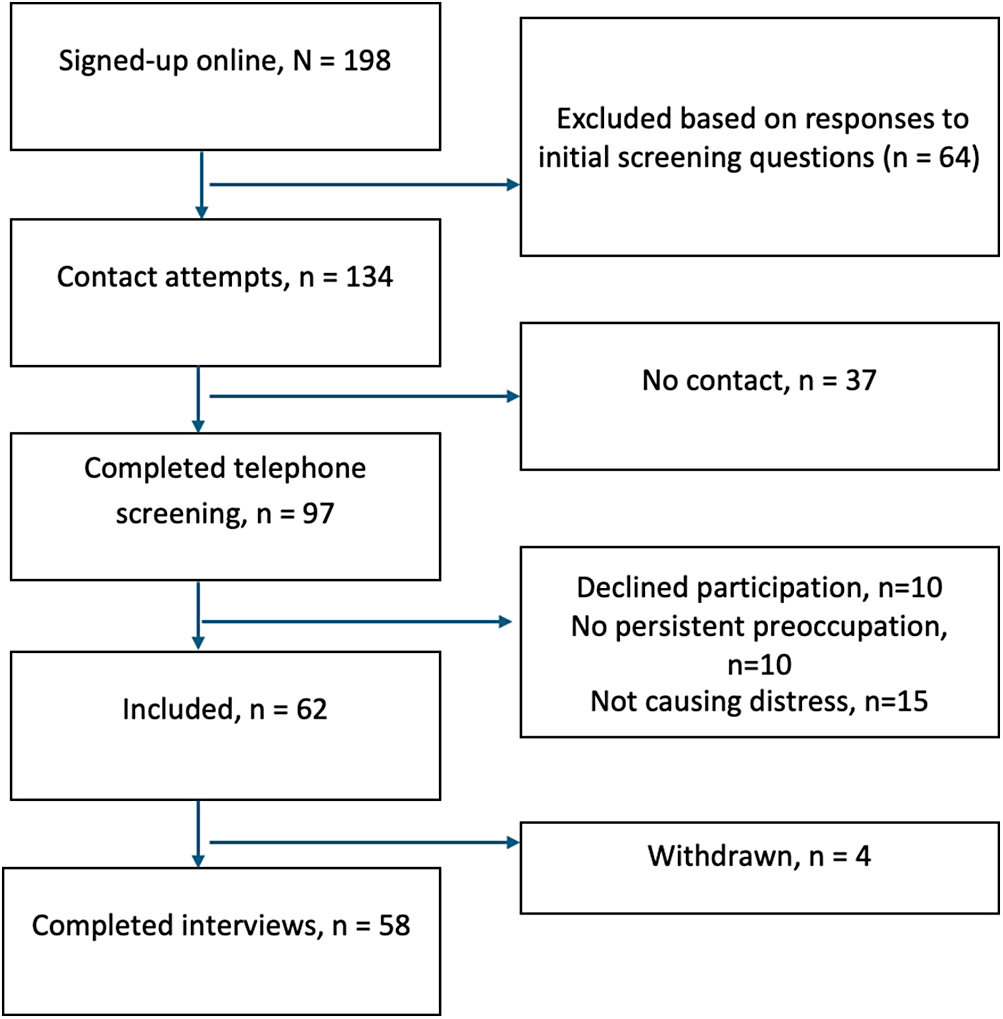
A total of 198 individuals expressed interest in the study during the 6-week advertisement period. Of these, 64 individuals were excluded at the screening stage, 37 could not be contacted and 97 completed the telephone screening. Of these, 35 individuals did not meet inclusion criteria or declined participation, resulting in 62 included participants. Four participants withdrew from this study at this point, resulting in a final sample of 58 individuals who participated in the interviews ( Figure 1 ).
Participant flowchart.

Figure 1. Long description
The flowchart consists of a central vertical column of five boxes connected by downward arrows, with four horizontal arrows pointing to exclusion boxes on the right.
* At the top, the first box is Signed-up online, N = 198. An arrow points right to Excluded based on responses to initial screening questions (n = 64).
* The main path continues down to Contact attempts, n = 134. An arrow points right to No contact, n = 37.
* The main path continues down to Completed telephone screening, n = 97. An arrow points right to a box containing three exclusion reasons: Declined participation, n = 10; No persistent preoccupation, n = 10; and Not causing distress, n = 15.
* The main path continues down to Included, n = 62. An arrow points right to Withdrawn, n = 4.
* The final box at the bottom of the main path is Completed interviews, n = 58.
Best estimate diagnoses
According to the best estimate procedure, 34 (59%) of the 58 interviewed participants were considered to meet strict research criteria for obsessional jealousy. The main reasons for not meeting diagnostic criteria were, in descending order: 16 participants did not meet Criterion A (it could not be clearly confirmed that their jealousy was sufficiently persistent, intrusive, or disproportionate to the actual relationship context). Seven participants did not meet Criterion C (their preoccupation or behaviors were not sufficiently time-consuming or did not cause clinically significant distress or impairment). One participant did not meet Criterion D (their symptoms were better explained by another psychiatric disorder). Illustrative clinical vignettes of cases meeting versus not meeting research criteria are shown in Box 1.
Illustrative vignettes (these participants have reviewed and approved the text and provided written consent for publication. The names are fictional).
Daniel – Meets Research Criteria.
Daniel was a man in his mid-40s who presented with long-standing, intrusive jealous thoughts focused on his spouse, accompanied by repetitive behaviors that he described as dominating his daily life. He reported problematic jealousy since his late teens, affecting all previous relationships. The thoughts were typically triggered by minor cues (e.g., notifications on his partner’s phone, overheard conversations, or her plans to meet friends) and rapidly escalated into vivid and distressing scenarios of infidelity, accompanied by anxiety, irritability, and a sense of loss of control. He described the thoughts as intrusive and difficult to dismiss, despite recognizing them as unfounded.
In response, Daniel had developed compulsive jealous behaviors, some of which had become habitual and occurred without identifiable triggers. These included repeatedly checking his wife’s social media accounts for signs of communication with other men (up to 15–20 times per workday) and persistently questioning her about her activities or phone calls in a manner she experienced as accusatory. Attempts to resist or delay these behaviors resulted in marked anxiety, physical tension, and racing thoughts. Although he acknowledged that the behaviors were excessive and irrational, he described a compelling urge to perform them, followed by guilt and self-reproach.
The symptoms consumed substantial time and mental energy, interfered with occupational functioning, and caused marked interpersonal distress. Marital conflicts were frequent, and his spouse had considered separation. Daniel expressed a strong desire to change these patterns but reported minimal improvement despite repeated help-seeking, including contacts with health care services and participation in a men’s support group.
Daniel did not report typical OCD symptoms, such as obsessions involving fears of harm or contamination, or compulsions commonly associated with the disorder. He had a history of recurrent major depressive episodes beginning in his mid-20s and met criteria for a current episode at assessment. He had also previously been treated for attention-deficit disorder and depression. These conditions were judged insufficient to account for the chronicity and severity of his jealousy symptoms.
Anna – Does Not Meet Research Criteria.
Anna was a woman in her mid-50s who had been in a long-term relationship with her husband since adolescence and described the relationship as historically close and trusting. Her husband’s work had long involved frequent travel, which she had previously tolerated without distress. She emphasized that jealousy had not been a feature of the relationship earlier in life.
With no prior psychiatric history, Anna experienced her first major depressive episode approximately 3 years before assessment, in the context of multiple life stressors, including children leaving home, hormonal changes, and emerging physical health problems. During this period, she became increasingly depressed and fatigued and began to ruminate about her identity and role after many years as the primary caregiver.
Within the depressive episode, she began to revisit memories of her husband’s past work-related travel and to worry about his interactions with female colleagues. Over time, even routine work departures triggered distressing and difficult-to-control fears of emotional or sexual infidelity. These thoughts were accompanied by rumination, anxiety, and sleep disturbance. She developed behaviors such as repeatedly questioning her husband – at times in an interrogative manner – and monitoring his location using digital applications. Attempts to resist these behaviors increased her anxiety.
Anna recognized these behaviors as excessive and irrational and reported significant shame and guilt. The symptoms placed strain on the relationship, and her husband expressed sadness about the erosion of trust. Clinical assessment concluded that Anna’s depressive symptoms remained insufficiently treated and were the primary driver of the jealous thoughts and behaviors. Consequently, criterion D was considered unmet.
The sensitivity for the obsessional jealousy construct, and each of the individual criteria and the insight specifier were excellent, whereas their specificity was modest (Table 2). In general, the best estimate diagnosis was more stringent than that of the individual assessors. In all cases meeting obsessional jealousy criteria, the psychiatrists agreed that these individuals met the DSM-5 and ICD-11 definitions of mental disorder.
Sensitivity and specificity of obsessional jealousy and of each individual criterion and insight specifier, according to the best-estimate diagnosis procedure (n = 58)

Table 2. Long description
The table presents diagnostic data for 58 subjects across seven columns. The columns are: Diagnostic Category, Evaluator, Status, Best-estimate diagnosis Present, Best-estimate diagnosis Absent, Sensitivity, and Specificity.
* O J (Obsessional Jealousy): When present, 32 cases were confirmed and 7 were false positives. When absent, 2 were false negatives and 17 were true negatives. Sensitivity is .94 and Specificity is .71.
* Criterion A: When present, 41 cases confirmed and 11 false positives. When absent, 1 false negative and 5 true negatives. Sensitivity is .98 and Specificity is .31.
* Criterion B: When present, 40 cases confirmed and 10 false positives. When absent, 2 false negatives and 6 true negatives. Sensitivity is .95 and Specificity is .38.
* Criterion C: When present, 34 cases confirmed and 11 false positives. When absent, 1 false negative and 12 true negatives. Sensitivity is .97 and Specificity is .52.
* Criterion D: Matches the values of O J with 32 confirmed cases, 7 false positives, 2 false negatives, and 17 true negatives. Sensitivity is .94 and Specificity is .71.
* Insight specifier (n = 34): Compares Good or fair insight against Poor insight. For Good or fair, 33 cases were present and 1 was absent. Poor insight recorded 0 in both categories. Sensitivity and Specificity are listed as N E (not estimable).
Abbreviation: NE, not estimable.
Characteristics of individuals meeting diagnostic criteria (n = 34)
Most participants were Swedish-born, identified as heterosexual, were highly educated and currently employed (Table 3). The mean age at the time of participation was 41.8 (SD = 10.1; range: 28–63). The majority were currently in a relationship, and only a minority had experienced their own and/or a partner’s infidelity.
Demographic and clinical characteristics of individuals meeting research criteria for obsessional jealousy according to the best estimate procedure (n = 34)

Table 3. Long description
The table is divided into several sections:
* Demographic Data: 56% female (n=19), 44% male (n=15). 74% are heterosexual, 88% were born in Sweden, and 76% are in a committed relationship.
* Jealousy History: 41% reported both themselves and previous partners were unfaithful. 38% reported being ‘Often’ or ‘Always’ jealous in previous relationships. 71% currently need help for jealousy.
* Clinical History: 85% have sought professional help for other mental problems; 71% have used psychotropics. 68% have a current comorbidity, with Anxiety Disorders (32%), A D H D (26%), and Affective Disorders (26%) being the most common.
* Violence and Conflict: 82% reported never having jealousy-related physical or sexual violence, though 32% reported ‘Often’ having verbal conflicts.
* Onset: Median age for first feeling jealous is 16.5 (I Q R 14 to 21); median age when jealousy became a problem is 21.5 (I Q R 18 to 39).
* Self-administered Measures (Mean and S D): P H Q 9 (10.3, 5.2), G A D 7 (10.0, 4.3), O C I 12 (12.2, 8.4), A U D I T (3.5, 2.7), S A S P D (8.1, 3.5), O J S S Self-rated (19.8, 4.9), O J S S Clinical-rated (18.9, 5.3), and W S A S (18.6, 7.3).
a ADHD status required participant confirmation of a recorded diagnosis or current ADHD medication; MINI-based classification alone was not considered sufficient.
Phenomenology of jealousy
Around two-thirds of the participants meeting criteria expressed feeling jealous in most of their previous relationships, whereas only 12% said they had never been jealous in previous relationships. The median age of the first experience of obsessional jealousy was reportedly around 16 years of age, and it first became a significant problem around 20 years of age. The most endorsed jealous thoughts and behaviors from the OJSS checklist are listed in Table 4. Jealousy-related verbal conflicts were reported by most participants at least sometimes, whereas physical/sexual violence was reported more rarely (Table 3).
Most endorsed thoughts and behaviors on the OJSS symptom checklist (n = 34)

Table 4. Long description
The first table lists 17 Jealous thoughts. The highest endorsed items are: Item 2, ‘I suspect or worry that X is hiding things from me’ at 94 percent; Item 5, ‘I suspect or worry that X is attracted to someone else’ at 91 percent; and Item 1, ‘I suspect or worry that X meets, or will meet, someone who they will fall in love with’ at 88 percent. The lowest endorsed item is Item 7, ‘I suspect or worry that X has created a dating account’ at 21 percent.
The second table lists Behaviors categorized into three groups:
1. Investigative Behaviors (13 items): The most endorsed are Item 2, ‘I Ask X where she/he has been’ and Item 6, ‘I keep track of X on social media,’ both at 74 percent. The least endorsed is Item 12, ‘I check X’s underwear’ at 9 percent.
2. Controlling Behaviors (11 items): The most endorsed is Item 22, ‘I ask X not to have contact with previous partners’ at 53 percent. The least endorsed is Item 14, ‘I threaten to hurt X or myself if she/he leaves me’ at 3 percent.
3. Accusatory Behaviors (8 items): The most endorsed is Item 32, ‘I ask X to assure me that they is not unfaithful’ at 59 percent. The least endorsed are Item 25, ‘I accuse X of being unfaithful’ and Item 29, ‘I accuse X of spending too little time with me,’ both at 24 percent.
Psychiatric comorbidity
The most common psychiatric comorbidities were mood and anxiety disorders (Table 3). Twenty-six percent had confirmed ADHD and 18% met criteria for substance use disorder. Overall, 26.5% of participants were judged to have a possible personality disorder, of whom 20.6% were classified as mild and 5.9% as moderate in severity. No participants were assessed as having a severe personality disorder.
Help-seeking behavior
Over half of the participants (56%) reported having previously sought help for their jealousy problems, whereas all the participants reported currently needing or potentially needing support for their jealousy (Table 3). The majority expressed preference for psychological interventions. The majority (85%) had previously or were currently receiving treatment for their general mental health, including pharmacological and psychological support.
Acceptability of a potential new disorder
Most respondents (91%) agreed that a hypothetical new diagnosis would entail both potential benefits and risks. When asked to weigh these considerations, 41% of participants reported that the perceived benefits outweighed the risks, 35% considered the benefits and risks to be of equal importance, and 24% indicated that the potential risks were more significant than the benefits.
A large proportion of participants (76%) reported that a diagnosis could make it easier for affected individuals to access help or treatment within healthcare services. Most respondents (74%) indicated that a diagnosis could facilitate greater understanding of the individual’s difficulties among partners and/or other close relatives. An equally high proportion (74%) highlighted the potential for a diagnosis to reduce feelings of guilt or shame among individuals experiencing problematic jealousy.
The most frequently endorsed concern was the risk that a diagnosis could be used to avoid personal responsibility, for example by excusing behaviors that may harm others (79%). In addition, 62% of respondents expressed concern that a diagnosis could be used to assign blame to the individual (i.e., be used against the person), and an equal proportion (62%) highlighted the risk of unnecessary pathologization, whereby common or normative feelings of jealousy might be reclassified as a mental disorder.
Discussion
We developed and field-tested a set of provisional research criteria for obsessional jealousy, based on the existing DSM-5 description under Other Specified Obsessive-Compulsive and Related Disorders. We recruited an unselected sample of individuals self-reporting jealousy problems, with no formal exclusion criteria.
The proposed criteria excellently detected obsessional jealousy but were less suited to detect true negatives, as reflected by modest specificity. This was likely explained by the fact that the best-estimate diagnosis procedure was deliberately conservative to avoid over-pathologizing normal variation in behavior. While this may have mistakenly excluded “true cases,” the group reasoned that the threshold for meeting criteria should be high.
In all 34 cases meeting the provisional research criteria for obsessional jealousy, the psychiatrists agreed that these individuals also met the current DSM-5 and ICD-11 definitions of mental disorder. Both definitions emphasize the presence of clinically significant distress or impairment in personal, family, social, or other important areas of functioning. Based on the lessons learned during this project, we have further refined the research criteria (Table 1, right panel). Note that criterion A considers the possibility that the preoccupation may be “retroactive,” that is, about a partner’s previous romantic/sexual relationships, a phenomenon that was described by several of our participants alongside current preoccupations.
For the first time, we report on the clinical characteristics of a group of individuals meeting research criteria for obsessional jealousy. Several previously unknown findings emerged. First, most individuals had experienced jealousy multiple times since their very first romantic relationships, indicating that this tends to be a recurrent problem rather than being circumscribed to specific relationships. Second, participants reported first experiencing jealousy around 16 years of age and described their symptoms as becoming clinically significant around 20, suggesting that obsessional jealousy has an early onset. This is in stark contrast with the psychotic jealousy literature, which reports much later onsets. For example, in a US sample of 20 delusional jealousy cases, the average age of onset of psychosis was 28 years and delusional jealousy began an average of 10 years later [Reference Silva, Ferrari, Leong and Penny18]. We also provide the first comprehensive list of thoughts and behaviors that are characteristic of obsessional jealousy (Table 4). While most individuals acknowledged having jealousy-related verbal arguments with their partners, only a handful admitted resorting to physical or sexual violence.
Nosologically, it is interesting that less than 20% of the participants had a comorbid OCD-related disorder and none of the differential diagnoses revolved around OCD. Our participants did not endorse the classic obsessions and compulsions typical of OCD, further supported by their average OCI-12 scores hovering around the “clinically significant” cut-offs [Reference Abramovitch, Abramowitz and McKay15]. It is noteworthy that we did not find any cases of psychosis (delusional jealousy) that could better explain the clinical presentations. Instead, our participants had good insight into their problems and a more “neurotic profile” with frequent comorbidity with mood and anxiety disorders. Similarly, we did not identify any serious cases of personality pathology, with most identified cases classed as having mild personality problems, typically consisting of emotional instability.
A substantial proportion (26%) of the sample had a pre-existing diagnosis of attention-deficit/hyperactivity disorder (ADHD), and some were receiving treatment for it at the time of assessment. Based on detailed diagnostic interviews, we judged that ADHD did not adequately account for the core phenomenology of obsessional jealousy. However, many participants exhibited prominent ADHD-related traits and/or features of emotional instability, suggesting that such temperamental characteristics may function as vulnerability factors rather than primary explanatory diagnoses. Importantly, similar temperamental profiles are typically observed across a range of psychiatric presentations, indicating that these traits likely reflect transdiagnostic liabilities rather than features specific to obsessional jealousy.
Despite the self-referred nature of the sample, most participants had previously sought and received help for psychiatric problems in general, and 56% had sought help specifically for jealousy. Importantly, participants indicated a substantial degree of jealousy-related functional impairment (WSAS scores well above the clinically relevant threshold) and a strong desire for help with their jealousy. The majority expressed a preference for psychological interventions. This clearly indicates that this is a functionally impaired group with unmet treatment needs.
Respondents expressed mixed views regarding the putative introduction of a jealousy disorder diagnosis, with perceived benefits and risks often closely balanced. While potential gains included improved understanding, access to care, and reduced shame, concerns were raised about misuse of the diagnosis to excuse harmful behavior, assign blame, or pathologize normative jealousy. Clear diagnostic thresholds are therefore essential to ensure the diagnosis functions as an explanatory rather than exculpatory framework. These findings underscore the importance of well-defined boundaries and meaningful stakeholder involvement in any future consideration of formal inclusion in diagnostic systems.
The results should be interpreted considering the study’s modest sample size and recruitment strategy, based on self-referral, rather than clinical referral. This likely attracted relatively well-functioning individuals with good insight into their problems, which may not be representative of all individuals experiencing impairing jealousy. Future studies should recruit more widely from both community and psychiatric settings to capture a wider range of psychopathology. Our findings regarding verbal and sexual violence and substance use need to be interpreted cautiously as there is a risk of underreporting. Future studies would benefit from including partner perspectives, validated intimate partner violence measures, and risk assessment procedures. Our results are based on a single country and may not generalize to other cultures and communities with different norms around relationships, fidelity, and acceptable jealousy. Transcultural research will be needed to examine whether the proposed criteria will be helpful across different cultural contexts and relationship norms. Our “best estimate diagnosis” procedure should be interpreted as agreement with a clinician-informed best-estimate classification rather than as independent criterion validation, as the reference classification was not fully independent of the clinical information and conceptual framework underlying the proposed criteria. Finally, the specificity estimates should be interpreted cautiously, as they were derived from a self-selected sample enriched for problematic jealousy and without comparison groups defined a priori. Thus, these findings provide only a preliminary, sample-dependent assessment of specificity and do not conclusively establish that the proposed criteria can reliably distinguish obsessional jealousy from other forms of pathological or normative jealousy. Future studies using appropriate clinical and non-clinical comparator groups will be needed to conclusively establish the discriminative validity of the proposed criteria.
In sum, we have identified a group of individuals who experience pervasive and recurrent obsessional jealousy that is both distressing and impairing, and whose symptoms do not seem to be readily explained by other existing diagnostic categories. These individuals meet the accepted definitions of mental disorder according to both DSM-5 and ICD-11 and perceive a need for psychological support. The proposed research criteria are provisional and should be further refined and tested in more representative samples of both community and psychiatric populations, but they provide a starting point for research and treatment development in this neglected field.
Supplementary material
The supplementary material for this article can be found at http://doi.org/10.1192/j.eurpsy.2026.12263.
Data availability statement
The dataset is not publicly available due to Swedish and EU legislation but can be made available upon reasonable request on a case-by-case basis, according to the current legislation and ethical permits.
Financial support
This work was supported by the Swedish Research Council for Health, Working Life and Welfare (grant no. 2024–01952).
Competing interests
Prof Mataix-Cols receives royalties for contributing articles to UpToDate, Wolters Kluwer Health and is a part owner of Scandinavian E-Health AB, all outside the submitted work. All other authors report no potential conflicts of interest.



 Open access


Comments
No Comments have been published for this article.