INTRODUCTION
Neobythites Goode & Bean 1885 (Ophidiiformes: Ophidiidae) is a genus of deep-sea benthopelagic fish (Uiblein & Nielsen, Reference Uiblein and Nielsen2005) distributed mostly on the lower shelf and upper slope of subtropical and tropical waters except the east Atlantic (Nielsen, Reference Nielsen and Wolff2002). Among the 50 valid species of Neobythites, 39 have a body pigmentation consisting of ocelli, dark spots and bars on fin margins. Whereas 15 species have prominent ocelli on the dorsal fin, ocelli found in species of Neobythites consist of a dark spot surrounded by a white ring (Uiblein & Nielsen, Reference Uiblein and Nielsen2005).
Twelve species of Neobythites have been reported from the western Indian Ocean (Nielsen, Reference Nielsen1995), three of which are known to occur in Indian waters: N. steatiticus from Bay of Bengal (Alcock, Reference Alcock1893), N. alcocki off Andaman coast and N. multistriatus from the Arabian Sea (Kurup et al., Reference Kurup, Cubelio, Joseph and Venu2010). Neobythites andamanensis is reported from the Andaman Sea (Nielsen, Reference Nielsen and Wolff2002) but that record is outside India's exclusive economic zone.
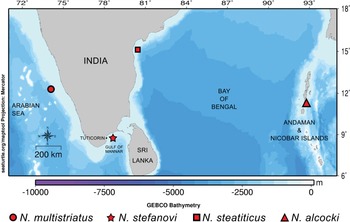
On 22 February 2010, two specimens of N. stefanovi (Figure 1) were acquired at the Tuticorin fisheries harbour, south-east coast of India, in by-catch landed by a deep-sea trawler. Specimens were captured at approximately 50 km east of Tuticorin harbour (8°44′46″N 78°37′24″E) in the Gulf of Mannar in a depth of 200–250 m, and were identified as N. stefanovi based on descriptions provided by Nielsen (Reference Nielsen1995). Those specimens represent the first record of the species in Indian waters (Figure 2).
Lateral view of Neobythites stefanovi caught in the Gulf of Mannar: (A) close view of elongated ocellus on the dorsal fin; (B) close view of dark anal and caudal fin.

Collection site of Neobythites stefanovi in the Indian exclusive economic zone (location of the occurrence of three other Neobythites species recorded from Indian waters is also indicated).

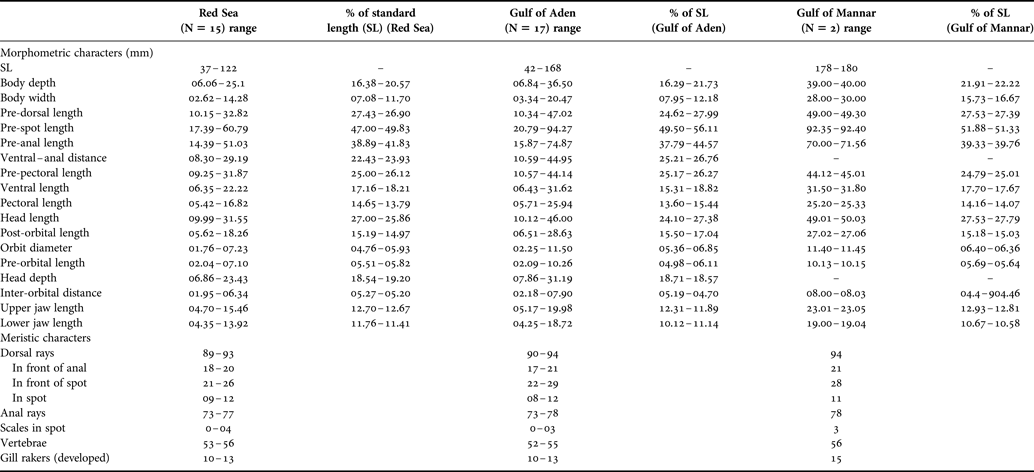
The depth of capture of the two specimens landed at Tuticorin harbour is relatively shallow, and as such, they were consequently undamaged. Measurements were taken to the nearest mm using a digital caliper according to Masuda et al. (Reference Masuda, Amaoka, Araga, Uyeno and Yoshino1984). Morphometric and meristic characters are presented in Table 1. In the following section, a brief morphological description of the specimens collected is provided.
Morphometric and meristic characters of Neobythites stefanovi from Red Sea, Gulf of Aden and Gulf of Mannar—Red Sea and Gulf of Aden data from Uiblein (Reference Uiblein1995).

RESULTS
SYSTEMATICS
Order OPHIDIIFORMES (Cohen & Nielsen, 1978)
Suborder OPHIDIOIDEI (Cohen & Nielsen, 1978)
Family OPHIDIIDAE (Rafinesque, 1810)
Subfamily NEOBYTHITINAE (Radcliffe, 1913)
Genus Neobythites (Goode & Bean, 1885)
Species Neobythites stefanovi (Nielsen & Uiblein, Reference Nielsen and Uiblein1993)
DESCRIPTION
Body relatively short, head length more than 50% of pre-anal length. Mouth terminal to sub-terminal. Snout rather blunt, shorter than horizontal diameter of orbit, maxilla ends behind the eye. Body covered by cycloid scales. Horizontal diameter of eye equal to, or slightly shorter than snout length. Adult with a conspicuous ocellus, its diameter more than twice as long as the horizontal diameter of the eye. Opercular spine strong and straight, posterior margin of preopercle with a single spine. Two median basibranchial tooth patches. Lateral line distinct and pale. Dorsal-fin rays 94, origin of dorsal fin at the vertical through vertebra 4. Pectoral fin below preopercle. Pelvic fin with two rays. Length of ocellus is 21 mm. Width is 4 mm. Outer margin of anal fin black.
DISCUSSION
In the western Indian Ocean, Neobythites stefanovi has been previously reported from deep waters of the Red Sea, Gulf of Oman and Gulf of Aden (Nielsen, Reference Nielsen1995). Neobythites stefanovi is similar to Neobythites steatiticus, which is another species of the same genus recorded in the Bay of Bengal (Nielsen et al., Reference Nielsen, Cohen, Markle and Robins1999). Those species can be distinguished by the colour pattern of the dorsal, caudal and anal fins, which is dark in N. stefanovi vs pale or transparent in N. steatiticus. In addition N. steatiticus has broad, irregular, dark, vertical bars on the body which are absent in N. stefanovi (Uiblein et al., Reference Uiblein, Nielsen and Klausewitz1994). Both species have an ocellus on the dorsal fin. However, the ocellus of N. stefanovi is more than twice as long as the diameter of the orbit (Nielsen & Uiblein, Reference Nielsen and Uiblein1993), and extends through 8–12 dorsal-fin rays (rays 22–39). In N. steatiticus, the dorsal-fin ocellus is located in a region markedly behind the vertical through to the anus, and extends through 6–8 dorsal-fin rays (rays 24–37). The diameter of the orbit of N. stefanovi is 6.36–6.40% whereas that of N. steatiticus is 4.8–5.9% the standard length. The specific function of the ocellus of N. stefanovi is not yet fully understood, but it has been proposed that it might have an anti-predator function (Uiblein et al., Reference Uiblein, Nielsen and Klausewitz1994).
The depth distribution of N. stefanovi inferred from collection data of specimens from the Red Sea ranges from 434 to 804 m, whereas in the Gulf of Aden the probable depth distribution of the species ranges between 80 and 549 m (Nielsen, Reference Nielsen1995). Specimens of N. stefanovi from the Gulf of Mannar are more similar to specimens of the Gulf of Aden in terms of morphology and meristics (Table 1). The depth distribution of N. stefanovi collected in the Gulf of Aden and in the Gulf of Mannar is also more similar.
ACKNOWLEDGEMENTS
The authors thank the Director, Central Marine Fisheries Research Institute (CMFRI), and Scientist in Charge (SIC), of Tuticorin Research Centre (TRC) of CMFRI for providing facilities and encouragement. The first author acknowledges the support of Dr J.A. Johnson, Scientist Wildlife Institute of India, Dehradun during manuscript preparation. The online GIS program MAPTOOL, provided by SEATURTLE.ORG is also acknowledged.