


Introduction
In 2020 and 2021, the entire world grappled with the outbreak and persistence of the SARS-CoV-2 pandemic. The mass media focused on depicting life and survival during this challenging time. It is not surprising, therefore, that for Poles, the pandemic became the most significant event of those years. However, in the summer of 2021, a new and distinctly different issue began to emerge, which captured the attention of the media and emotionally engaged the citizens of Poland, i.e., the migration crisis at the Polish–Belarusian border, which was recognized as the second most important issue in 2021 (Pankowski, Reference Pankowski2022). It became part of a broader migration crisis that has affected the borders of the European Union since 2015 (UN News, 2021). In this case, it involves the organized smuggling of citizens from the Middle East and Africa across the border between Belarus and the European Union. This crisis is not only a concern for Poles but also for Lithuanians and Latvians. Therefore, it is worth noting that this type of problem, which Italians and Greeks have long been grappling with, is an entirely new situation on the eastern border of the European Union.
The world has been grappling with a migration crisis for a long time. It is also probable that, due to armed conflicts and ongoing climate change, this issue will only get worse, as Pope Francis is well aware. However, due to the situation on the border with Belarus, this problem has ceased to have a purely theoretical character for the Polish people. For the first time in modern history, Poles have had to confront the sight of the “other” and reflectively consider what it means to be a Catholic and what obligations toward others it involves. This is why this crisis has drawn the attention of the media and emotionally engaged the citizens of Poland, with media outlets beginning to report on and explain the situation to their audience in various ways, with the image of refugees/migrants attempting to illegally enter the EU was presented from different perspectives. This article aims to showcase how the Polish Catholic media described the situation and to confront the depiction of the situation and the image created of refugees with the teachings of Pope Francis. This approach allows us to examine the extent to which the discourse of the Polish Catholic press is consistent with his teachings and whether this discourse leans more toward the theological or political context.
Yet the key insights derived from the discourse analysis extend far beyond the specificity of the Polish context. Drawing on an analysis of the major Catholic weeklies, the article reveals the mechanisms through which religious authority is mediated, the political positioning of faith-based media, and the construction of threat narratives in denominational media. These elements enrich broader academic and public debates, particularly in light of Gerbner’s cultivation theory, Pope Francis’s teachings, and the dynamics of populist discourses across Europe and beyond. The analysis demonstrates how religious media negotiate tensions between theology and politics, demonize the “other,” or foster solidarity—findings with implications not only for understanding the migration crisis at the Polish border but also for comprehending parallel crises in the United States, Australia, and at the EU’s external borders (such as the Greco-Turkish frontier).
Research on the issue of the other—refugees/migrants
A refugee is defined as a person who leaves their place of habitual residence due to persecution based on their constitutive characteristics (e.g., sexual orientation or race) or ideological beliefs (religion or political views) and is at risk of losing their freedom, health, or life (Runge and Runge, Reference Runge and Runge2008, 344–345). This definition is also regulated by the United Nations’ Convention relating to the Status of Refugees, to which Poland committed itself from November 26, 1991. The most interesting element is the reference to the status of refugees and their rights, including the principle of non-refoulement formulated in Article 33. This principle prohibits sending refugees back to the country where they faced danger related to their reason for fleeing (UNHCR, 1951).
A term closely related to “refugee” is “emigrant,” which refers to any person who leaves their place of residence and settles in another place or country (Runge and Runge, Reference Runge and Runge2008, 80). Despite the clear distinction between the terms “emigrant” and “refugee” in the English language (the former refers to an individual who chooses to leave their home for economic or personal reasons, while the latter pertains to an individual who has been forced to leave their country to escape war, persecution, or natural disaster), in the Polish language, the designations of these words overlap. Therefore, in Polish press discourse, these concepts are often used interchangeably, sometimes with the aim of exerting a specific influence on the reader. In the case of refugees at the Polish–Belarusian border, it is presumed that they are refugees for geopolitical reasons, although individuals from the Middle East and Africa may attempt to “get to Europe” for strictly economic reasons, seeking a better life for their families. Piotr Jakubowski states that the term “refugee” has undergone a semantic transformation from denoting a real victim to connoting a threat. Currently, it is used as a synonym for a terrorist, idler, or sexual deviant (Jakubowski, Reference Jakubowski2017, 91).
Observing world events dominated by the “migration crisis,” Zygmunt Baumann concluded that the end of the way of life we know and like is imminent. The mass media and politicians dehumanize “others” and place them in the realm of abstraction. Their lives “mean less;” they are on the move, with an uncertain destination; they are “wasted lives” (Bauman, Reference Bauman2004). Refugees, as strangers, those who are unknown to us, are treated with distrust. Fearful attitudes toward refugees are exploited by populist politicians who channel societal fears toward the “others” while concurrently creating their own image as defenders. Such actions only deepen social divisions and aversion toward the “others,” who are perceived as incarnations of evil. The strangers begin to be perceived as potential terrorists who are beyond the reach of any compassion. This leads to the adiaphorization of the “migration problem,” excluding refugees from any moral judgment. This legitimizes the rise of aggression and hatred that, under normal circumstances, would evoke widespread condemnation (Bauman, Reference Bauman2016, 94–95).
In September 2021, the Center for Public Opinion Research (CBOS) conducted a survey, from which it emerged that Poles were divided in their opinions regarding their obligations to accept refugees from countries affected by armed conflicts. Almost half of the respondents (48 per cent) were against such actions, while 41 per cent agreed to help refugees. However, 33 per cent of those respondents conditioned their support on the duration of the conflict. Negative attitudes were correlated with right-wing views, older age, lower education, and economic status. Religiously engaged individuals also showed more reluctance toward accepting refugees (Feliksiak, Reference Feliksiak2021).
In 2018, research on the statements of mayoral candidates about migrants was conducted by Agnieszka Mikulska-Julles. Her analysis revealed that often, under the guise of assistance, the view of “appropriate help” was formulated, stemming from a Christian duty. However, it would be conducted beyond the borders of Poland (Mikulska-Jolles, Reference Mikulska -Jolles2018, 8–10).
A specific type of research involves studies on hate speech. Jeremy Waldron (2021) considers the following as expressions of hostility: [1] showing hostility toward individuals or groups through actions, gestures, or speech; [2] presenting one’s own group as having consistent opinions and attitudes, thereby building its coherence; [3] rationalizing hate speech; and [4] strengthening the belief in the rightness of one’s own group. All these mechanisms lead to an easy division between “us” and “them,” facilitating the determination of who is with us and who is against us.
Hostility can also take a more aggressive form, although nowadays, it may manifest in more refined ways. For example, aggression in press discourse can take the form of verbal attacks (hurtful words, incitement to violence, suggestions of violent solutions), physical attacks, symbolic attacks (exclusion), or discursive attacks (stigmatization to make a particular group provoke moral aversion) (Jakubowski, Reference Jakubowski2017, 91). Therefore, it is not surprising that refugees often become the target of hate speech.
Rabenda Derman’s analysis of hate speech on YouTube reveals that the strongest emotions among users are stirred by Muslim refugees. She identified three types of discourse of fear: [1] portraying refugees as sexual criminals (committing rape, engaging in bestiality, promoting polygamy); [2] portraying them as criminals and terrorists; [3] stating that they pose a threat to Christianity and European values (Rabenda Derman, Reference Rabenda Derman, Graszewicz and Wszołek2016, 145).
The Church and Pope Francis’s teachings on refugees and migration
The issue of accepting refugees has been examined in the discourse of Polish bishops by Kamil Kaczmarek, who analyzed the statements of church priests in 2015, the year of presidential elections in Poland. Bishops emphasized the need to address the root causes of migration and provide assistance to refugees, especially “in their countries of origin.” The active involvement of the Catholic Church in providing financial support in the countries of origin was highlighted, acknowledging simultaneously that the matter of helping refugees in Poland falls within the purview of the authorities, and in this regard, the Church will not act independently. According to Kaczmarek, the Polish Episcopate remained silent on the issue of inviting refugees to Poland, and there was a lack of evangelization of the faithful in the spirit of assisting refugees (Kaczmarek, Reference Kaczmarek, Borowik, Grotkowska and Stawiński2018). Therefore, it can be concluded that this problem has been marginalized, deemed insignificant, or defined as solvable by someone else (Czyżewski et al., Reference Czyżewski, Dunin and Piotrowski2010). According to Kaczmarek, bishops acknowledge there is a problem in the mentality of Poles who are reluctant to accept refugees and that, in this regard, the Church has a specific role to fulfill (Kaczmarek, Reference Kaczmarek, Borowik, Grotkowska and Stawiński2018).
As noted by Wang (Reference Wang2021), charismatic leaders (such as Pope Francis) shape people’s attitudes and behaviors through media communication. Deiana et al. (Reference Deiana, Mazzarella, Meroni and Pezzoli2023, 75–95) also write about such an effect in the context of the impact of Francis’ messages on the migration crisis. Therefore, it is worthwhile to consider the Pope’s teaching on this issue. This article primarily focuses on the Encyclical “Fratelli Tutti,” where Pope Francis calls for love beyond borders, directed toward every rejected individual (Francis, 2020, paragraph 85Footnote 1 ). The position of the head of the Catholic Church on the issue of refugees is explored in this study. Pope Francis does not make a distinction between migrants and refugees. These individuals constitute a broader category for him, namely, the “poor and suffering,” “brothers,” who should be embraced with care and concern. The Pope emphasizes the need to welcome and provide protection for migrants, especially those fleeing wars, natural disasters, or economic hardships [38–40]. Assistance to migrants should involve the creation of humanitarian corridors, facilitating visa approvals, and preparing for a dignified life in Western countries. The Pope also underscores the need for integration and ensuring religious freedom [129–132].
Francis emphasizes the connection between the uneven distribution of wealth and the issue of migration [5]. People escaping from a less fortunate world seek to enter a better one. Unfortunately, this gives rise to the need for defense. Once again, walls (both physical and metaphorical) emerge, leading to increasingly challenging interactions between cultures. This results in closing oneself off to the foreign and a form of self-ghettoization, as the experience of diversity is lacking [27, 41]. The Pope concludes that the construction of walls serves the interests of the West, which “does not see” children and adults affected by hunger and poverty ([27], Francis, 2019, 6). The globalized West “elegantly looks the other way,” acting under the guise of political correctness and ideological trends [76]. Meanwhile, the stranger, originating from a different culture, is a gift that enriches the human community [133].
The reflections above lead the Pope to conclude that beyond the right to migrate, it is crucial to realize the right to remain in one’s own land [38]. However, as long as this is not possible, it is necessary to provide those in need with a place where they can satisfy their basic needs and fully realize their subjectivity, as well as their cultural and religious identity [129].
The Pope states the significant role of the media, including the Internet and Catholic media, in spreading fanaticism, of which migrants also become victims [46]. He says that the suffering is often observed “without touching them” in live broadcasts, and beneath the guise of political correctness, indifference is hidden [76]. Immigrants are frequently perceived as useless or even dangerous [141].
The Pope sees a substantial role for the Church in shaping positive attitudes toward migrants. In his view, the Church fulfills a public role that goes beyond its caregiving or educational activities and serves to promote human beings and universal brotherhood [276].
This study examines how Polish Catholic media outlets navigate the tension between papal moral authority and domestic political interests. Rather than assuming that Catholic media uniformly transmit papal teachings, the analysis demonstrates that editorial choices—including selective citation, rhetorical framing, and strategic silences—reveal how media institutions mediate, reinterpret, and sometimes subordinate papal authority to align with national political contexts.
While this analysis focuses on Polish Catholic weeklies, the mechanisms examined—mediation of religious authority, political subordination of theology, and threat construction—appear in faith-based media across diverse national and religious contexts. US Catholic media have navigated comparable tensions between papal humanitarian teachings and alignment with partisan political interests (Deiana et al., Reference Deiana, Mazzarella, Meroni and Pezzoli2023; Wang, Reference Wang2021). Australian evangelical outlets demonstrated similar variation in threat narratives depending on institutional positioning during offshore detention debates. Central European Orthodox media have invoked competing understandings of national sovereignty and universal Christian principles in parallel ways. By developing a framework through the Polish case, I create conceptual tools applicable to understanding how faith-based media globally mediate religious authority when competing with political imperatives.
Methodology
The presented reflections and outlined social context allowed me to formulate the following research questions:
-
1. Does the Catholic press create a negative image of refugees/migrants, including spreading hate speech against refugees at the Polish–Belarusian border?
-
2. Does the Catholic press discourse reflect a readiness to accept refugees/migrants at the Polish–Belarusian border?
-
3. Is the refugee issue exploited for political purposes in the Catholic press discourse?
-
4. Is the discourse of the Catholic press in line with the teachings of Pope Francis?
In this article, I relied on Gerbner’s schema of media messages, which proposed four dimensions for analysis (Gerbner, Reference Gerbner and van Dijk2011). Gerbner’s cultivation theory provides a particularly valuable analytical framework for examining how faith-based media navigate tensions between universal religious teachings and particularistic political alignments (Gerbner et al., Reference Gerbner, Gross, Morgan, Signorielli, Bryant and Zillmann1994). While Gerbner originally developed his approach to analyze television’s cultivation of fear, his analytical schema proves especially productive for religious media, which simultaneously claim fidelity to moral authority (papal teachings) while operating within political fields. Gerbner’s four dimensions are particularly useful for faith-based media: (1) The existence dimension reveals what outlets choose to represent; (2) The priority dimension (operationalized through the Mean World Index) reveals whether outlets cultivate threat or solidarity; (3) The values dimension exposes what moral or political justifications outlets invoke; and (4) The relationship dimension illuminates how these elements interconnect to construct coherent worldviews (Gerbner Reference Gerbner and van Dijk2011). For denominational media, this framework reveals not merely what is emphasized but, crucially, how religious authority is selectively cited and rhetorically framed to align with institutional and political interests. By examining how outlets construct divergent threat narratives about identical events while claiming fidelity to identical papal teachings, Gerbner’s approach illuminates the mechanisms through which universal religious principles are mediated and sometimes subordinated to political projects (Gerbner et al., Reference Gerbner, Gross, Morgan, Signorielli, Bryant and Zillmann1994).
The first step in my analysis was to select newspaper headlines for qualitative analysis. I chose three of the most widely read Catholic weekly publications, which present their content in both print and online formats, aiming to choose those periodicals that reach the widest audience. The analysis covered “Gość Niedzielny” (“Sunday Guest.” In further analyses, I will refer to it as “GN”), “Niedziela” (“Sunday”;—in further analyses, I will refer to it as “N”), and “Tygodnik Powszechny” (TP) (“Universal Weekly”—in further analyses, I will refer to it as; “TP”).
“GN” is a national weekly with a socio-cultural profile and a conservative-Catholic orientation. It ranks second in readership among opinion weeklies (after “Polityka”), with a circulation of 96,061. The gosc.pl website, associated with “GN,” was the third most visited website (after Niedziela.pl and polityka.pl), with a monthly visitor count exceeding 900,000 (eKAI, 2022). “N” is a socio-cultural weekly that is also perceived as a traditional, conservative source of information. It is associated with the Redemptorist Father Rydzyk, the founder of the very conservative and influential “Radio Maryja.” The print version sells over 100,000 copies weekly, with an additional 30,000 distributed in churches during Masses. Moreover, the niedziela.pl website, where the online version of the weekly can be read one week after its print release, is the most visited news website, with over 1.33 million visits (eKAI, 2022)
“TP” also focuses on socio-cultural issues, but it is perceived as a progressive, intellectual, and liberal source of Catholic thought. It publishes works by great intellectuals who are not exclusively Catholic. It has a circulation of 24,355, ranking it 6th among opinion weeklies (Kozielski, Reference Kozielski2022). It is also available online, but free editions appear with a delay of a few weeks.
Catholic media in Poland are often assumed to transmit religious authority uniformly. The three weeklies examined—Gość Niedzielny (GN) and Niedziela (N), both church-controlled, and TP, rooted in Catholic tradition but editorially autonomous—were selected to test whether institutional affiliation alone determines discourse. GN and N’s conservative orientation suggests they may align more readily with Poland’s ruling Law and Justice party (PiS), while TP’s liberal-progressive stance may enable critical distance from both ecclesiastical and political authorities. This deliberate variation in institutional positioning was designed to test a central research question: whether Catholic media function as unified transmitters of papal authority or whether institutional positioning, editorial autonomy, and political alignment shape interpretations of religious teaching. The selection of weeklies across the ideological spectrum enables examination of the conditions under which Catholic media transmit, reinterpret, negotiate, or subordinate papal moral authority in relation to domestic political alignments. For the same purpose, I chose a longer time perspective from August 2021, when the crisis on the Lithuanian–Belarusian border began, until the end of 2021, when the crisis on the Polish–Belarusian border was most intensely covered in the media. This made it possible to observe whether the discourse around the refugee problem on the Polish–Belarusian border has changed.
The next step in preparing the analysis was to find articles containing the words “migrant,” “migration,” “refugees,” or “refugee crisis” in the title, subheadings, or content. I then selected those articles that directly relate to the situation on the Polish–Belarusian border. During the analysis, a total of 101 articles were collected, with over half (54) found in “TP,” 24 in “GN,” and 23 in “N.” This distribution is illustrated in Chart 1.
Timeline of narrative dynamics and Mean World Index (MWI) by Gerbner. Quantitative analysis, results visualization.

Chart 1. Long description
Three sets of graphs depict the narrative dynamics and Mean World Index (MWI) by Gerbner for three Polish newspapers: Gość Niedzielny GN, Niedziela N, and Tygodnik Powszechny TP. Each set includes two graphs: a combination of line and bar graphs on the top and a line graph on the bottom. Panel A: Gość Niedzielny GN. The top graph shows the mean keywords count for Threat and Solidarity, with Threat in red and Solidarity in blue, and the articles count in grey bars. The x-axis represents the timeline from August 2021 to December 2021, and the y-axis on the left shows the mean keywords count, while the y-axis on the right shows the articles count. The bottom graph shows the Gerbner Index with the x-axis representing the timeline and the y-axis representing the Gerbner Index. Panel B: Niedziela N. The top graph shows the mean keywords count for Threat and Solidarity, with Threat in red and Solidarity in blue, and the articles count in grey bars. The x-axis represents the timeline from August 2021 to December 2021, and the y-axis on the left shows the mean keywords count, while the y-axis on the right shows the articles count. The bottom graph shows the Gerbner Index with the x-axis representing the timeline and the y-axis representing the Gerbner Index. Panel C: Tygodnik Powszechny TP. The top graph shows the mean keywords count for Threat and Solidarity, with Threat in red and Solidarity in blue, and the articles count in grey bars. The x-axis represents the timeline from August 2021 to December 2021, and the y-axis on the left shows the mean keywords count, while the y-axis on the right shows the articles count. The bottom graph shows the Gerbner Index with the x-axis representing the timeline and the y-axis representing the Gerbner Index.
Discourse of support for government policy in “Gość Niedzielny”
The texts presented in GN are concise and can typically be read within a few minutes. They are written in simple, accessible language and often exhibit a high degree of modality and emotionality. Within this discourse, the terminology used for those involved, not only refugees but also the residents of the borderland and the border guards, has been extended:
We care deeply about the services that cooperate with us: ‘It is important to see that our soldiers, our Border Guard, our police officers are often those close to us,’ added Fr. Krzysztof Andryszak, the parish priest of the Parish of Divine Providence in Michałowo. ‘ In many cases, it is my parishioners who find themselves in a very difficult situation. On the one hand, they serve Poland on the border, and on the other hand, they take the blame for something they did not do’ (Jałowiczor, Reference Jałowiczor2021).
The refugees themselves are presented in various ways. Naming strategies refer to their origin (“Afghans,” “Iraqis,” “foreigners”), reasons for being at the border, with an emphasis on their legal status (“refugees,” “economic migrants,” “illegal immigrants”), and victims of the generated conflict (“victims of Lukashenko,” “bargaining chips,” “living shields”). The phraseology also includes terms describing migrants in the language of Pope Francis: people on the road, poor people, good people. Such opinions are typically presented by the borderland community and priests:
Forest areas, quite wild. It was still warm, so newcomers were careful not to be capture by Polish services. One of the residents, from the nearby colony precisely, fearing an attack at night, placed a pot of cooked pasta with tomato sauce in front of her house. Everyone likes pasta. Indeed, the next morning, the pasta had disappeared, along with the pot. In return, the woman found… a hundred dollars (Puścikowska, Reference Puścikowska2021).
In the discourse of “GN,” there is often a distinction made between two types of migrants: the legal ones from Afghanistan, brought in by the Polish government, and the illegal ones, who appear at the Polish–Belarusian border. The former are often portrayed as pregnant women and medical students (presumably to legitimize the assistance offered to them), while the latter are usually depicted as young men exploiting women and children and as wealthy individuals, indicated by their branded clothing. These observations are often supported by the opinions of experts, typically associated with the ruling PiS at that time or the editors of “GN” themselves. Marcin Przydacz, the Deputy Minister of Foreign Affairs in 2021, commented on immigrants:
We are aware that ordinary people suffer in this whole operation. Often women and children, although the vast majority are young men. There is a recording where one of the aggressive migrants holds a child under his arm, hoping to use it as a shield. They are sad images reflecting these individuals (Jałowiczor and Przydacz, Reference Jałowiczor and Pietrzak2021). Ourselves, touring the surrounding villages [editors’ note], we find on the edge of the forest, near the village of Słoja, two sets of abandoned, branded clothes, as if someone had changed clothes in a hurry. Next to them – packaging from Russian chewing gum, as well as cigarette packs and Turkish tissues’ (Babuchowski, Reference Babuchowski2021).
Interestingly, numerous presuppositions and implicatures in “GN” reveal negative opinions about refugees, including that there may be terrorists, thieves, and fraudsters:
We are not able to determine whether someone is involved in mafia or terrorist activities. This is the role of state services. Therefore, their officials should gather information about each person crossing the so-called green border. (…) (Łoziński and Guzdek, Reference Łoziński and Guzdek2021).
Migrants are often presented as passive individuals, victims, who succumb to their situation: “Someone promised them that they would be in the West” (Jałowiczor and Pietrzak, Reference Jałowiczor and Pietrzak2021); “Migrants are being smuggled across the border” (Puścikowska, Reference Puścikowska2021). However, when they are active, they exhibit aggressive behavior, and some opinions show an understanding of such behaviors. These behaviors are believed to result from frustration—the inability to achieve the intended goal (which is in line with the principles of frustration–aggression theory), namely, entering Western Europe or entering Poland. Perceiving certain behaviors as aggressive may also result from cultural differences and a lack of understanding of the newcomers:
These are people of a different culture, [who were] also deceived, [and are] traumatized and tired. And it is even difficult to blame them for behaving aggressively or showing a lack of respect towards us. However, I warn against idealizing these people, [I also caution against a lack of] common sense and being naive,” says Paweł Mikłasz, who, with a group of residents, prepares hot meals (Puścikowska, Reference Puścikowska2021).
The above analyses indicate that the discourse in “GN” is heterogeneous. On the one hand, there are statements indicating a high level of empathy and a thorough understanding of Pope Francis’s teachings; on the other hand, there are expressions that can be considered to be promoting hate speech in Waldron’s (Reference Waldron2012) sense.
The discourse in “GN” often focuses on protecting the government and border guards’ decisions and actions. Specific groups are identified as wanting to harm it, e.g., the opposition, hostile media, nongovernmental organizations, or the Russian regime and its propaganda:
Emotions sometimes take away the ability to make an objective judgment about reality. This is exactly the case with the attitude of some of the opposition towards the ruling camp regarding the protection of the eastern border. They hate PiS [the Law and Justice Party] so much that they are willing to act against Poland (Jałowiczor, Reference Jałowiczor2021). “The beginning of internal dispute in Poland was the case of a group of several dozen refugees who were brought by Belarusian services to the border near the village of Usnarz Górny. Not allowed into Poland, they started camping on the Belarusian side. Our [then] opposition believed that the government should let these refugees in. After that, politicians and the media, as well as members of non-governmental organizations, started going to the border and announcing to the whole world that the Polish government and Border Guard do not allow humanitarian aid to be provided to those in need. (…) Meanwhile, the case of these children became an opportunity to attack the government during the parliamentary debate on the extension of the state of emergency. The speech of the Minister of Internal Affairs, Mariusz Kamiński, was constantly interrupted by opposition politicians. ‘Shame’, ‘You’re lying’, ‘Taking children to the forest’, ‘Where are the children’, ‘How are we different from Lukashenko?’, ‘Aren’t you ashamed?’, ‘People are dying’ – these are just some of the shouts coming from the opposition benches” (Łoziński, Reference Łoziński2021). Footnote 2
Regarding the dimension of values presented in “GN,” the most important issue is the assistance provided to migrants. Throughout the pages of the weekly, there are numerous examples that indicate the support of the local community and the Church for refugees, as well as for border guards. In this context, the role of Caritas (a Polish charity) is mentioned. The standpoint that the Border Guard and the Polish government actively support refugees is also given:
Caritas Polska has provided the Border Guard with special packages for exhausted and cold individuals. Border Guard officers will carry “help packs” with them. Sets will also go to parish priests from border parishes. Before October 10, the Border Guard received the first four shipments of gifts (Jałowiczor, Reference Jałowiczor2021).
In justifying the need to help refugees, journalists from “GN” refer to statements from the Polish Episcopal Conference (“KEP”) on Migration, the Bible, and the teachings of Pope Francis (Biuro prasowe KEP 2021). All of these emphasize the duties of a Christian but also, more broadly, of a human being:
In the 25th chapter of the Gospel of Matthew, alongside the hungry, thirsty, sick, those in prison, and homeless, Jesus also speaks about strangers. In Greek, it refers to “foreigners” (xenos) – “I was a stranger, and you welcomed me.” This is crucial because without a merciful and solidarity-based approach to those in need, we can find thousands of reasons not to engage in helping people, as Pope Francis says, those who are excluded (Łoziński and Zadarko, Reference Łoziński and Zadarko2021).
One of the more interesting aspects that indicate a lack of coherence in “GN” regarding assistance to refugees is the reference to the principle of ordo caritatis. Some statements suggest that this principle should take precedence in offering assistance. Others, however, suggest it has been misunderstood:
Saint Thomas spoke about a situation in which one should primarily help those closest to them, their family, when everyone is in the same difficult situation, for example, [through] poverty or being refugees. (…) Today, many who wield this rule as a justification for reluctance to help migrants reject its second part, which distorts the entire ‘ordo caritatis’. If we were consistent in interpreting ‘ordo caritatis’ in this way, we should not allocate any resources to help victims of war in Syria, Iraq, now in Afghanistan, or the earthquake in Haiti because one could always say that in Poland, we have unemployed, hungry, homeless, poor people, and these resources should be allocated to them first. After all, it’s absurd, the ideological use of St. Thomas (Łoziński and Zadarko, Reference Łoziński and Zadarko2021).
“GN” often explains actions that may raise ethical concerns. For example, regarding the ethical dilemma described using the principle of ordo caritatis, it relativizes certain behaviors and actions, such as the construction of a wall at the border, border guards’ aggression toward migrants, yielding to Lukashenko’s blackmail, and consequently legitimizing non-assistance. Despite the bishops’ appeal to politicians, border guards, and the general public to demonstrate ethical behavior, there are bishops who relativize the need for assistance:
Politicians responsible must sometimes make bad decisions to prevent a greater evil (Legutko, Reference Legutko2021). Archbishop Guzdek: Poland is known for its hospitality. However, can we call a guest someone who, under the cover of night or using force, breaks into our house? Everyone thinking rationally will consider how to secure their home in the future to prevent a repeat break-in (Łoziński and Guzdek, Reference Łoziński and Guzdek2021).
The discourse on providing assistance to migrants within the Church, as presented in “Niedziela”
The texts presented in “N,” like those in “GN,” are concise and can be read in a few minutes. Again, they are written in simple, accessible language, and they generally exhibit low modality, adopting a reportorial style. Analyzing this discourse, it is impossible to escape the impression that, regardless of the contents of the articles, they all seem to arrive at one conclusion—the Church actively helps migrants:
Providing assistance to ‘people on the move,’ as Pope Francis describes refugees, is an act of mercy, and for us, it is part of our mission, reminds Father Marcin Iżycki, director of Caritas Polska. How does the largest Catholic charitable organization in Poland cope with the migration crisis? (Woynarowska, Reference Woynarowska2021, 26).
However, this does not mean that the discourse does not focus on the refugees themselves. Various naming strategies appear in the articles. Some point to the economic and legal status of people at the border, sometimes with adjectives describing their situation (“migrants,” “refugees,” “foreigners,” “migrant campers,” “unwitting runaways,” or “poor migrants”). Some terminology refers to their origin (“Iraqis,” “Afghans,” “Lebanese”) or being victims of Lukashenko’s regime (“Lukashenko’s hostages,” “Lukashenko’s guests,” “Lukashenko’s living shields,” “Lukashenko’s political tools,” “Lukashenko’s meat”). Expressions indicating sensitivity and concern, characteristic of the language of Pope Francis, appear most frequently: “those who have literally lost everything; freezing, hungry people; people in a tragic situation, poor refugees, the conscience of us all.” Negative nominations (“depraved economic migrants”) occasionally appears, including in the form of presuppositions (“criminals,” “potential terrorists”), but more often in the form of quoting others’ opinions.
The profile of refugees presented in “N” differs slightly from that in “GN.” Descriptions of migrants indicate that those discussing them show a high level of empathy and compassion. Interestingly, as in “GN,” an example is provided of refugees who, under cover of night, ate the offered pasta with sauce and left a one-hundred-euro banknote in return (Kasjanowicz, Reference Kasjanowicz2021a, 11). It is often mentioned that young men are among the refugees, but attention is more frequently drawn to the fact that there are entire families, including women with small children, at the Polish–Belarusian border. However, it is often stated that children can become a tool of manipulation for refugees, a form of emotional blackmail:
They kept bringing these children found in the woods. I couldn’t get the thought out of my head. The internet, television – everywhere the same. And the nurse kept saying what was happening all the time. A little child – 9 years old – spent the whole night in the woods. What will happen when winter comes? (…) The translator who is regularly brought in has a whole ward of little foreigners under his care (Kasjanowicz, Reference Kasjanowicz2021a, 10). “Tonight, attempts were made to cross the border in Dubicze Cerkiewne and Czeremsze. Children here serve as an emotional cover, it’s not about them,” notes Fr. Krzysztof Domaraczeńko, the parish priest of Our Lady Queen of Poland in Czeremsze. “They are supposed to evoke universal compassion” (Kasjanowicz, Reference Kasjanowicz2021a, 11).
In the discourse of “N,” attention is drawn to the deteriorating physical and mental condition of refugees, causing people to fear them. Significant concerns also arise about the impending winter and its potential impact on people at the border:
Residents of border areas fear almost equally the armed development of the situation and what they may encounter when life returns to normal—the sight of bodies found during walks in the forest long after the end of the Polish–Belarusian conflict (Kasjanowicz, Reference Kasjanowicz2021b, 14).
The discourse focuses on the assistance provided by the church to all those in need, including migrants. A considerable amount of space is dedicated to the aid provided by Caritas. One might get the impression that it is a “special operations unit.” The church also proposes specific solutions aimed at helping migrants. In “N,” there are repeated suggestions (following Pope Francis) to open humanitarian corridors for refugees from the Polish–Belarusian border:
Caritas is reliable in crisis situations. It appears first and disappears last. It is similar with refugees and migrants. The scale of assistance is evidenced by specific numbers (Woynarowska, Reference Woynarowska2021, 26). The Catholic Church in Poland declares its readiness to join in the search for the best solutions (…). Therefore, I would like to appeal for consent to launch humanitarian corridors, which Caritas Poland has declared its readiness to coordinate since 2016. This mechanism, which has already been tested in other countries, makes it possible to provide concrete help to the neediest victims of wars and persecutions in a safe and fully controlled way (Press Office of the Polish Bishops’ Conference, 2021. 04.10).
Referring to the teachings of Pope Francis, “N” sees a special role for the Church in building a better world:
The Church must go out of itself. It must go to the peripheries, whatever they may be, but it must go out – these well-known words of Pope Francis are mentioned at the beginning, not without reason. (…) This thought is also reiterated by Warsaw Metropolitan Cardinal Kazimierz Nycz in this issue of Niedziela, saying: The Church is sent to everyone. To everyone… (Grabowski, Reference Grabowski2021a, 3).
In the context of the values presented, the most significant issue discussed in “N” is assisting refugees. As in “GN,” emphasis is placed on the obligations that arise from being a Christian, as well as the essence of fundamental rights that result from being a human being. Texts on assistance often take on a sermon-like form:
The Catholic Church cannot stop reiterating that the words of Jesus, ‘I was a stranger, and you welcomed me’ (Mt 25:35), remain valid at all times and in every historical circumstance. Sensitivity to the fate of people coming to our country, as well as medical and humanitarian aid for migrants, should become a priority for both state and non-governmental institutions, including churches and religious communities. (…) Humanitarian sensitivity is an expression of our humanity (Press Office of the Polish Bishops’ Conference, 2021. 04.10). We are not and cannot be indifferent to what is happening on our eastern border. Regardless of whether we believe it is a humanitarian or military crisis, or whether we think we are dealing with poor refugees, depraved economic migrants, or unwitting fugitives who have become “cannon fodder,” as Professor Grzegorz Górski believes (Grabowski, Reference Grabowski2021b, 3).
While the editors who write for “N” are well aware of the societal resistance to helping refugees, expressing this sentiment in their texts, they do attempt to explain and change such attitudes:
Everything is blamed on individualism. Has the attitude of the merciful Samaritan become outdated in our times? (…) Brotherhood, not the declarative kind but the real, concrete kind, is a clear sign of faith in Christ (Grabowski, Reference Grabowski2021a, 3). It seems that especially the words “cultivate the spirit of love and solidarity within oneself” should become a message for us, modern people, so deeply divided today, unfortunately also on the issue of refugees (Grabowski, Reference Grabowski2021b, 3).
Similar to the case of “GN” in this discourse, it is evident that residents of the border areas and border guards are involved in the situation at the border. However, more often, they are presented as helpers rather than victims of attacks from the “enemies” of the ruling PiS:
Although this action was an initiative by Father Zbigniew, in practice, many people decided to express their gratitude “sweetly,” not only to the police officers. Border guards and the military also received words of thanks. The youngest residents of the border areas showed solidarity with the uniformed services. Preschoolers from Hajnówka and toddlers from the municipal nursery made cards with wishes for the defenders of Polish borders. The action was voluntary. For people living so close to the conflict zone, this was a natural act, and no one sought political intentions in this initiative (Kasjanowicz, Reference Kasjanowicz2021b, 14).
Within the pages of “N,” there is a recognition of a moral dilemma associated with the need to protect the borders of the Polish state and support migrants. It is also noticeable that among Polish Catholics, there are those who invoke the principle of ordo caritatis to resolve this dilemma on theological grounds. However, “N” follows the path of Pope Francis’s teachings and assumes that, in reality, there is no dilemma:
Therefore, important values stand side by side today – the defense of the country’s sovereignty and the safety of citizens, as well as “support for those who have become victims of this difficult situation.” The bishops stated that there is no need to choose only one value and bypass the other. This is the most important summary of the discussion. (…) You can and should do “both.” (…) Speaking evangelically: you have to do both. It is possible to be a good patriot and a good Christian. These attitudes can be unified in the current situation. You can defend the homeland and bear witness to the love of your neighbor. One does not exclude the other, although we know that we must demand more of ourselves (Musiał, Reference Musiał2021, 25).
Discourse of the child’s drama and government guilt presented in the pages of “Tygodnik Powszechny”
The texts presented in “TP” are decidedly longer than those written for “N” or “GN.” They are often written in complex, scholarly language that requires careful reading. The contents are characterized by a high degree of modality. Similar to the previous discourses, attention is drawn to the fact that it is not only refugees who are victims of the migration crisis. In “TP,” however, emphasis is placed on the idea that both refugees and local residents, including border guards, are victims due to inappropriate government actions:
Officially, the state of emergency is a well-planned logistical operation. The police sleep in four-star hotels in Białowieża, inaccessible to tourists now. (…) However, the government’s narrative has no place for what the forest is increasingly whispering: that people placed by the state on the border are running on fumes. Border Guard employees have it the worst. (…). It’s no wonder that some guards can’t take it anymore and end up on sick leave or flee” (Rabij, Reference Rabij2021). Reports from witnesses about Border Guards detaining foreigners (and then taking them to “unknown places”, vans dispersing in several directions to confuse journalists, the illegal pushing back of people to the border) before September 2 give cause for concern that behind the curtain of the state of emergency, harm is being done to people on the border who were previously exploited by Belarus (Żyła, Reference Żyła2021b).
Like the previous discourses, the descriptions of migrants involve naming strategies indicating their economic and legal status (also with clear reference to Article 33 of the United Nations’ Convention—“refugee,” “migrant” —none is “illegal,” “although there are those who attempt to enter our country illegally”), or their origin (“Afghans”; “our Afghans”; “Iraqis”; “Kurds”; “Kurds and Yazidis,” “members of groups that are currently not persecuted in this country”) (Żyła, Reference Żyła2021a). Statements that are more metaphorical and closer to the terminology used in Pope Francis’ teachings are also found (“wanderers seeking a path,” “our brothers,” “our sisters,” “those in need”). Very often, instead of the terms migrant or refugee, there are phrases that indicate greater subjectivity: people (“people on the border,” “men,” “women,” “children”). References indicating the reason for being on our eastern border also appear (“political argument,” “victims of Lukashenko”).
In comparison to other weeklies, “TP” more often mentions that the victims of this crisis are vulnerable individuals, often women and children (including Poles). In the case of Polish children, “TP” points out that young people’s perception of the current situation is significantly influenced by their parents and their upbringing:
I took her to the dentist in Hajnówka, and suddenly my daughter says that we should go through the forests of Werstok and Orzeszkowo, not the main road to Dubicze Cerkiewne. I ask why, and she says that she is scared of these checks, and police cars with flashing lights. Especially after dark. (…) Karolcia is old enough to pick up fear from adult conversations (Rabij, Reference Rabij2021). Recently, near Arhelan, (…) two guys who used to go to school with my daughter were bragging that they found a boy with a broken leg in the woods near the border. The Belarusians arranged him like this, tossing him over the fence. And they threw him back over that fence to Belarus. I was about to ask if their mother taught them that, but I thought they might just be making it up. The military was standing nearby, [so] they might have wanted to impress them (Rabij, Reference Rabij2021). Kamila: Such a scene. On the floor at home, I divide children’s clothes by size. My 3.5-year-old son comes. He asks who I’m doing it for. “For children who don’t have a home,’ I reply (…). ‘And do they have toys?’. A moment later, my son brings his favorite dinosaur. He says he will give it to a boy without toys. ‘I like it, so maybe that boy will like it too,’ he says (Żyła, Reference Żyła2021d). (…) To which she replied: ‘Yes, and I had a miscarriage.’ That’s when we started talking about which month it was and how it happened. According to the journalists from OKO.press, our border guards smuggled her across the border, and that’s when she had a miscarriage (Bownik and Rumieńczyk, Reference Rumieńczyk2021).
Aneta Strawińska highlighted the issue of using the image of a child in her article, considering it a tool of political struggle used to manipulate the audience’s emotions. Appealing to the innocence, purity, naivety, and helplessness of children generates a need to protect their overall physical and mental well-being (Reference Strawińska2018, 160). According to my analysis, the motif of children appears frequently, although, in my opinion, it is not intended to manipulate the readers (which would imply malicious intentions). In the “TP” discourse, it serves to present the factual situation and sensitize the reader to the fact that children, like adults, are at the Polish–Belarusian border.
“TP” is the only weekly that openly and critically writes about the pushbacks, considering them unacceptable. Often, the situation of people at the border is compared to the Holocaust:
Because we are arranging a mass grave in the forests on the border and we don’t know what to do with ourselves, I escape, like others, into Netflix. Because everything is associated: the forest, refugees who are hungry and freezing in the forest, citizens reporting on them, uniformed officers only fulfilling their duties… (Radzik, Reference Radzik2021). First, they often write only: ‘Please, help.’ (…) The Polish Border Guard has so far pushed them back, most often without providing food or drink. It was only families with children who they treated better. (…) I get the impression that the Border Guard is already trying to operate according to procedures that will be legalized by the amendment to the Foreigners Act in a few days – those who are detained are brought to the unit, provided with a meal, they are given a check-up, and then they are taken away. The situation is changing rapidly. Until recently, refugees and migrants told us that on the Belarusian side of the border, they are treated better than by the Polish authorities (Złonkiewicz and Żyła, Reference Złonkiewicz and Żyła2021).
There is a discussion within the pages of “TP” about the image of migrants perceived as criminals. They state that such opinions result from a stereotypical and distorted narrative constructed to discourage Poles from helping, with frequent references to the ill intentions of public television and those in power:
We see families with children, and then we hear that they are young men. We see people running out of fear at the sight of a car, and TVP says they threaten us, I read in a message from a resident of Krynki who does not want to agree to a longer interview. (…) The media dehumanized refugees, as if they were puppets thrown across the border (Rumieńczyk, Reference Rumieńczyk2021).
The discourse in “TP” revolves around the political game concerning the issue of refugees on the Polish–Belarusian border, and the government’s indifference and actions that are contrary to international law are highlighted. However, it is suggested that this is convenient for Western European countries, so they turn a blind eye. Pushbacks are particularly strongly criticized, as is the imposition of a state of emergency in the border zone or the ban on entry for humanitarian organizations and the press:
Polish authorities have not presented a single sensible argument so far to contradict the thesis that the state of emergency introduced on September 2nd in the border zone with Belarus serves a purpose other than to get rid of witnesses to how state services treat people trying to enter our country illegally (Żyła, Reference Żyła2021b). Behind the curtain of a state of emergency, tragedies unfold, and the ruling camp – which once gained popularity by playing on fear and hatred towards refugees and migrants – has meager legitimacy to decide what should or should not be shown to us from beyond the border. The death of three people, who probably died due to hypothermia on Polish soil, is a sad prognosis for the coming cold days (Żyła, Reference Żyła2021c).
Like other discourses, “TP” encourages assistance to refugees based on values that they present, referring to the Bible and the teachings of Jesus; thus, it often comes across as sermon-like. There are frequent references to the encyclical Fratelli Tutti, duties that arise from being a Catholic, and simply being a decent human being:
The forest, a group of frozen, miserable people, men and women, old and young, children – this is an image that many of us associated with the Belarusian border. Them – freezing and hungry; us – in a warm home, having dinner. That was until last Monday. We remembered that God said, “The foreigner residing among you must be treated as your native-born. Love them as yourself, for you were foreigners in Egypt. I am the Lord your God!” (Boniecki, Reference Boniecki2021).
The pages of “TP” also contain criticism of the misunderstood principle of ordo caritatis:
If a populist says: I am protecting us from the other person, it is not the thinking of a Christian. Similarly, if he divides people into categories and says: you deserve my love, but the other one does not. You cannot be a Catholic, a Christian, and a racist or nationalist at the same time. It goes against our faith. Hooligans of faith seek identity. A Christian seeks faith, a relationship with God. And that’s it (Schnabel and Przewrocka-Aderet, Reference Schnabel and Przewrocka-Aderet2021).
However, in the “TP” discourse, there is an understanding of the moral dilemma of the need to protect borders while simultaneously providing assistance to migrants at the border: Those who say that accepting a group of people from Usnarz Górny would have cost Poland nothing are right. Those who claim that Belarus would exploit more people following their footsteps are also right (Żyła, Reference Żyła2021a).
Like “N” and “GN,” “TP” sees a significant role for the church in improving the situation of migrants. However, unlike those magazines, the discourse in “TP” is characterized by greater criticism of the Catholic Church. It points to the lack of concrete actions or responsiveness within the church community:
The Primate, responding nicely and with his characteristic intricacy, concludes: “Joint actions are needed. Let’s not allow our neighbors to suffer and die at our borders.” Any specifics on how? Any clarification on who constitutes the “we” that cannot allow this? (Radzik, Reference Radzik2021). Nobody listens to our appeals: neither the government nor society, the bishops said. Let’s add: not even the priests, who largely boycotted the bishops’ announced collection of money to help immigrants. It’s hard to find a more bitter summary of the role of the Church in contemporary Poland (Augustyn, Reference Augustyn2021).
Qualitative analysis summary
The discourse in “GN” can be said to be heterogeneous. The discourse on migrants shows signs of perpetuating stereotypes and prejudices against migrants from the Middle East, which may have characteristics of spreading hate speech. However, within the pages of the magazine are texts that indicate the need to help fellow human beings who are refugees, although the magazine relativizes this need by invoking the principle of ordo caritatis. The discourse is politicized, exhibiting a strong inclination to protect politicians of the ruling PiS and their actions by highlighting harmful actions presented by real and imagined opponents of power. The texts also include information about actions taken by the Catholic Church to demonstrate assistance to those in need. However, the selection of elements from the teachings of Pope Francis is done skillfully, mentioning only those things that align with a more selective, subjective understanding of the “order of assistance.”
Analyzing the discourse in “N,” it is evident that it focuses on the theological dimension of the border crisis. This discourse avoids creating a negative image of refugees or spreading hate speech against them. It often mentions the duties and responsibilities that arise from being a Christian, highlighting the need to help our neighbor, in this case, the refugee/migrant. The discourse is not politicized. Instead, it devotes significant attention to the active role of the Church in assisting those in need. Ultimately, it can be said that this discourse is consistent and based on the teachings of Pope Francis.
The discourse presented in “TP” is sensitive to the needs of migrants, emphasizing that the most vulnerable, especially children, are the victims, both among migrating and Polish children. The discourse focuses on the teachings of Pope Francis regarding actions taken toward migrants, holding the ruling in 2021 PiS responsible for any irregularities in this area, and criticizing their indifference toward humanitarian efforts. Therefore, this discourse is politicized. “TP” underscores that the Church must be actively involved in helping migrants. However, it also acknowledges that the Church itself lacks consistency in its stance and is losing social credibility. Despite this, the Church is seen as crucial, as the attitudes of Poles toward refugees and their problems are far from those expected by Pope Francis.
Quantitative analysis
The above qualitative analyses are complemented with quantitative examinations, presented in Chart 1. Analysis was performed using Python (v3.12.7). The pandas and matplotlib libraries were employed for data extraction, keyword frequency analysis, and data visualization, respectively. Natural Language Processing (NLP) tasks, specifically lemmatization, relied on the spaCy library utilizing the pl_core_news_md model. The Perplexity AI assistant was utilized for code optimization and visualization support. Finally, the script was validated using a synthetic dataset containing a controlled frequency of keywords.
Three columns of Chart 1 present, respectively, three weeklies analyzed. The Upper row of Chart 1 depicts the dynamics of two dominant narratives for analyzed weeklies in the form of average keyword count per article (vertical left axis): the sense of “threat” posed by migrants (red line) and “solidarity” with them (blue line). On the same graphs, bar charts with a corresponding vertical right axis indicate the number of articles in which, in a given month, the migration-related narrative prevailed. The lower row presents the Mean World Index (MWI), which captures how frequently threat-laden content appears in media coverage.
The left column, representing the “GN” narrative, shows the highest threat index among all analyzed weeklies, peaking in September 2021 (MWI = 0.5460) and accompanied by high variability of perceived threat (SD = 2.38). At the same time, the solidarity index (blue line) also reaches relatively high values, with its maximum in December 2021. The elevated threat index suggests that the “GN” discourse strongly foregrounds elements of danger allegedly stemming from migrants and, in line with Gerbner’s cultivation theory, may reinforce the belief in a “mean world.” Yet the even higher solidarity scores indicate the parallel construction of a solidarity- and support-oriented narrative, which is reflected in numerous articles describing assistance provided to migrants by “Caritas.”
The graphs relating to “N,” middle column of Chart 1, indicate moderate values for both indices, although the discourse of social solidarity is clearly dominant. The texts frequently invoke solidarity and Christian duty. The peak of the threat narrative appears in November 2021, while the average MWI score (0.0306) is the lowest of all weeklies under study, and the variability of perceived threat is also low (SD = 1.35). This pattern points to a stable and relatively balanced presentation of both risks and the normative imperative of solidarity. In this case, it is known that the narrative is explicitly grounded in the teachings of the Church and Pope Francis.
The graphs for “TP,” Chart 1 left column, reveal a narratively balanced pattern. As in “N,” the mean MWI remains low (0.3100), and threat variability is limited (SD = 1.46), although both indicators are slightly higher than in “N.” The threat index stays at a relatively low level, with only a modest increase in November 2021. As in the other weeklies, the solidarity indicators are clearly higher and reach their peak in December 2021.
It is noteworthy that while the quantitative and qualitative analyses conducted within Gerbner’s framework exhibit substantial consistency, the same cannot be said for the discourse of the Catholic press itself.
In summary, the quantitative analyses reveal that the narrative of social solidarity predominates across all weeklies, albeit in varying contexts. Whereas in “GN” the agent of solidarity comprises those providing aid (numerous texts concerning Caritas), in “TP” it centers on the migrants themselves as recipients of support. By contrast, “N” emphasizes the theological and moral obligations stemming from the teachings of the Catholic Church and Pope Francis himself.
All three weeklies demonstrate convergence in the number of articles devoted to this issue in November 2021, which may reflect the so-called resonance effect—a situation in which media content aligns with contemporaneous real-world social events. This was precisely when the migration crisis reached its peak: on 8 November, Belarusian services directed the largest group of migrants (approx. 4000 persons) to Kuźnica, where they established a camp and initiated riots by attacking the border guards. Concurrently, all three weeklies exhibit alignment in solidarity indicators during December 2021. This can be regarded as a convergence of narratives at that particular societal juncture.
Conclusions
Returning to the research questions outlined in the methodology section, the conducted analyses reveal differences in the construction of social reality perceptions. On one hand, the discourse occasionally portrays refugees/migrants negatively, which may be interpreted as spreading hate speech against them (“GN”); on the other hand, it stresses the need for empathy toward arrivals at the border (“TP,” “N”)—(reference to research question 1).
All discourses demonstrate a strong willingness to assist refugees/migrants (research question 2), though interpreted differently. “GN” invokes the principle of ordo caritatis while distorting its meaning; “TP” stresses urgent aid at the border and criticizes pushbacks; “N” advocates robust support alongside “humanitarian corridors” for migrants heading to Western Europe.
The refugee issue is exploited for political purposes (research question 3) in two of the three analyzed weeklies. “GN” strongly backed the ruling PiS at the time, whereas “TP” used the migrant issue to critique the government.
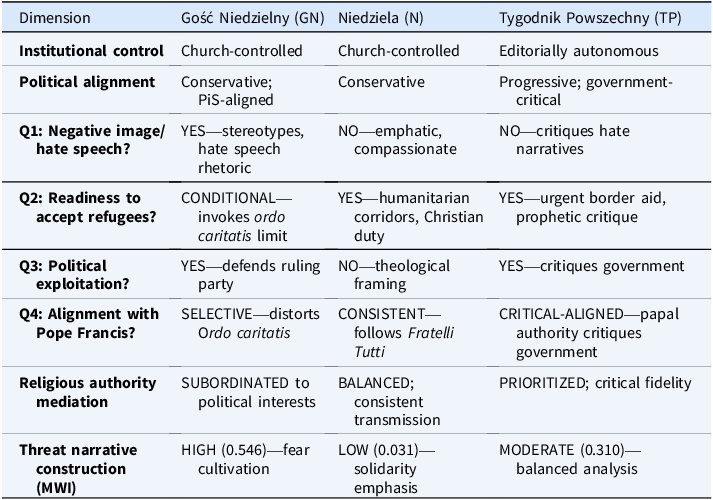
The analyses indicate that the discourse aligns loosely with Pope Francis’s teachings (research question 4). References appear most frequently in “N” and “TP,” while “GN” draws selectively from them. A summary of the conducted analyses is presented in Table 1.
Institutional positioning and research question responses: Gość Niedzielny (“GN”), Niedziela (“N”), and Tygodnik Powszechny (“TP”)

Table 1. Long description
The table compares three publications: Gość Niedzielny (GN), Niedziela (N), and Tygodnik Powszechny (TP) across several dimensions and research questions. It has 8 rows and 4 columns. The columns are labeled Dimension, Gość Niedzielny (GN), Niedziela (N), and Tygodnik Powszechny (TP). The rows are labeled Institutional control, Political alignment, Q1: Negative image/hate speech, Q2: Readiness to accept refugees, Q3: Political exploitation, Q4: Alignment with Pope Francis, Religious authority mediation, and Threat narrative construction (MWI). Each cell contains specific details about the publications’ stances or characteristics. For example, under Institutional control, GN and N are church-controlled, while TP is editorially autonomous. Under Q1, GN has stereotypes and hate speech rhetoric, N emphasizes compassion, and TP critiques hate narratives. The table provides a detailed comparison of the publications’ positions on various issues.
Notably, all discourses exhibit a degree of consistency. Qualitative analyses indicate that all of the magazines state that the issue at the border is not solely a refugee problem. They also mention the problems it creates for borderland residents and the border guards themselves. All three discourses equally identify the causes of the crisis, attributing responsibility for the situation to Lukashenko and Putin. All of the magazines apply similar discursive strategies, relying on statistical data and experts (who are selected to authenticate their narrative). This reliance on statistical data and expert authority—deployed by all three weeklies—exemplifies Gerbner’s insight on narrative normalization through authority and repetition. Despite editorial divergence, all three employ identical discursive strategies to authenticate their contrasting interpretations. Gerbner’s framework reveals that media power operates not through content uniformity but through shared mechanisms of narrative authentication. Each week selects experts aligned with its institutional position, yet the strategy itself remains universal.
The analysis reveals three findings with implications extending beyond the Polish case. First, religious authority is mediated, not passively transmitted. The three weeklies invoked Pope Francis selectively depending on institutional positioning and political alignment. GN cited papal teachings while prioritizing government protection; N consistently referenced papal authority; TP deployed papal teachings to critique government policy. This demonstrates that denominational media do not uniformly transmit religious teaching but strategically mediate it.
Second, faith-based media subordinate theology to political interests. Discourse differences between outlets reflected institutional positioning and political alignment, not differences in access to papal teachings.
Third, threat narratives are constructed through editorial choice. Despite covering identical events, outlets generated MWI scores ranging from 0.031 (N) to 0.546 (GN)—variation reflecting political positioning, not objective reality.
Similar mechanisms operate in US Catholic media navigating partisan interests; Australian evangelical outlets diverging on offshore detention; Central European Orthodox media invoking national sovereignty. These are structural features of how religious authority operates in contemporary faith-based media when religious moral imperatives conflict with political projects. Understanding these mechanisms is essential for comprehending the role of denominational media in democratic discourse on migration, cultural identity, and belonging.
The presented analysis documents what Catholic weeklies communicate about migrants but cannot explain why. Questions remain unanswered: What funding structures shape GN’s high-threat narratives (MWI 0.546)? Who owns these publications? What reader constituencies drive editorial choices? Media economics, audience analysis, and institutional interviews are necessary to explain the discourse variation documented here. Both dimensions are required for comprehensive understanding of how faith-based media mediate religious authority under political pressure.
Finally, each of the weeklies employs astute strategies to predict the development of the situation on the eastern border of the European Union. Concerns were raised that actions on the Polish–Belarusian border could be the beginning of more significant problems generated by the Russian Federation. Unfortunately, these concerns were reflected in reality. On February 24, 2022, Russia initiated a bloody military invasion of Ukraine, forcing millions of Ukrainians to flee their country. Almost two and a half million escaped through the border with Poland alone, with 1.3 million remaining in Poland. This situation has generated a new phase of the migrant crisis, which forms part of the ongoing hybrid war on the European Union’s eastern flank. The current response of Poles and the Polish government to these parts of the crisis seems different; further research would be needed to confirm this conclusion.
Acknowledgments
The author wishes to thank Dr. Piotr Domagalski for his valuable assistance with Python programing, and is deeply grateful to the reviewers and editors whose thoughtful and constructive comments were instrumental in improving this article.
Barbara Ober-Domagalska, Ph.D., is a sociologist, psychologist, and an assistant professor. She is a researcher and lecturer employed at the Department of Sociology of Politics and Morality at the University of Łódź in Poland. Her research focuses on the sociology of morality and religion, with particular emphasis on the challenges and dilemmas facing the contemporary Catholic Church as reflected in religious discourse.


 Open access

