Primary cardiac tumours are rare in children, with Beghetti and colleaguesReference Beghetti, Gow and Haney1 reporting an incidence of 0.32% in a total of 27,640 patients with cardiac disease. The diagnosis has increased in the last decade due to the improvement in non-invasive imaging techniques. Of these tumours, papillary fibroelastomas are rare and benign, accounting for less than one-tenth of all primary cardiac tumours,Reference Georghiouo, Erez and Vidne2 but still representing the commonest tumour afflicting the cardiac valves.Reference Sankar, Odayan and Morris3 In children, however, there are only sporadic reports. The patients are usually asymptomatic, and the lesions are often diagnosed incidentally in the process of cardiac investigation for an unrelated problem, at necropsy, or during cardiac surgery.Reference Gallas, Reardon and Reardon4 We describe here an asymptomatic lesion involving the tricuspid valve, discovered incidentally in the process of cardiac investigation of an otherwise healthy child.
Case report
A 6-year-old asymptomatic boy was referred to our department for diagnosis and treatment of a mass involving the tricuspid valve. His past medical history was not relevant. One year previously, an echocardiographic evaluation had been performed because of discovery of a heart murmur during a routine examination. The investigation disclosed a dysplastic tricuspid valve, with redundant localized thick tissue, albeit in an otherwise normal heart. A repeat echocardiogram performed one year after the first revealed an echo dense tumour arising from the septal leaflet of the valve, with moderate tricuspid regurgitation.
On examination, he had a soft pansystolic heart murmur, graded at 2 from 6, and best heard at the third and fourth left intercostals space at the sternal border.
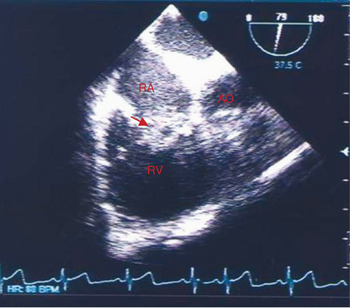
For a more accurate assessment, we performed a transoesophageal echocardiogram, which revealed a very mobile mass with multiple papillary fronds, 18 millimetres in diameter, attached by a stalk to the atrial aspect of the tricuspid valve and projecting into the right outflow tract. The study confirmed the presence of moderate tricuspid valvar regurgitation (Fig. 1).
The transoesophageal echocardiography revealed a very mobile mass of multiple papillary fronds, arranged on a stalk: Abbreviations AO: aorta; arrow-tricuspid mass; RA: right atrium; RV: right ventricle.

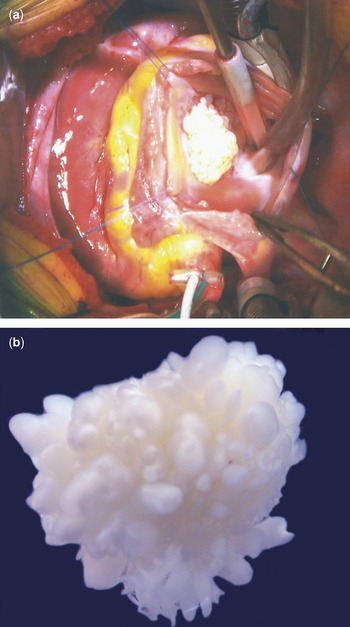
Because of its mobility, and the risk of embolisation, the mass was surgically removed. Histopathologic examination provided the diagnosis of papillary fibroelastoma (Fig. 2). The postoperative recovery was uneventful, and after six months of follow up, the child remains asymptomatic, with no recurrence of the tumour.
The tricuspid tumour was confirmed at surgery (a) to be composed of the multiple papillary fronds, and immersion is saline (b) revealed its resemblance to a sea anemone.

Discussion
Cardiac tumours are rare at all ages, and are even less common in infants and children. Cardiac papillary fibroelastomas are the least frequent of all benign cardiac tumours found in childhood. These tumours, however, occur at all ages, albeit being more frequent in adults, particularly between the 5th and 8th decades of life. Their pathogenesis remains unclear, although several possible explanations have been proposed, such as previous mechanical damage to the endothelium, an unusual endocardial response to infection or haemodynamic trauma, hamartomatous origin, or organized embolisation. There is evidence that iatrogenic factors, such as previous cardiac surgery, could play a role in their development.Reference Kurup, Tazelaar and Edwards5
The majority of the cases present as solitary masses, but there are examples of multiple tumours reported in the literature.Reference Eslami-Varzaneh, Brun and Sears-Rogan6 The surface of the valvar leaflets is the predominant location of this tumour, usually on the left side of the heart, involving the aortic valve in just under half the cases, the mitral in one third, the tricuspid valve in one-sixth, and the pulmonary valve in less than one-tenth.Reference Gowda, Khan and Nair7 The atrial endocardial aspect is most frequently when the papillary fibroelastomas arise from the atrioventricular valves. When the arterial valves are involved, both sides of the leaflets can be affected. Nonvalvar sites of attachment have also been reported, most frequently in the left ventricle.
Morphologically, papillary fibroelastomas resemble a sea anemone when viewed under a saline solution, with multiple papillary fronds attached to a short pedicle of dense connective tissue covered by hyperplastic endothelial cells. They can measure from 0.1 to 3 centimeters in diameter, reaching a maximum of 5 centimeters. Patients with this type of tumour can present in several ways. In the majority of cases, the tumours are found incidentally during the process of cardiac investigation for an unrelated problem, or else they are discovered at necropsy. It is well recognised that cardiac tumours are great mimics of other forms of cardiac disease. The most common clinical presentation is an embolic event to the cerebral, systemic, or coronary arterial circulations. Some patients present in cardiac failure, while others have died suddenly. Embolisation may occur from the fragile papillary fronds, or some times these tumours may provide a nidus for aggregation of platelets and fibrin, which leads to subsequent embolisation.Reference Sun, Asher and Yang8 Recently, a case was reported with symptomatic thrombocytopenia, which improved after removal of the tumour. At present, conventional transthoracic echocardiography and transoesophageal echocardiography are the gold standard for diagnosis. Transthoracic echocardiography is a useful tool for initial evaluation, but transoesophageal echocardiography is frequently required for a more comprehensive and accurate assessment, its better resolution permitting location of the central collagenous core of the tumour, and distinguishing it from the rest of the mass by its bright echocardiographic appearance. If clearly identified, this central echo dense contrast should allow differentiation of this tumour from other intracardiac masses, especially myxomas, but also vegetations, mural thrombus, valvar calcifications, and Lambl’s excrescences.
Surgical treatment depends on the size, location, mobility, and potential or strength of association of the tumour with symptoms. Surgery is indicated for isolated right-sided lesion only when they are large and mobile, including those that result in obstruction or embolisation. The presence of a patent oval foramen with a sizeable right-to-left shunt is an additional consideration for surgical removal of right-sided lesions. Surgery is also indicated for left-sided lesions when they are bigger than 1 centimeter in size and are mobile. Conservative treatment should be reserved for asymptomatic patients with small non-mobile tumours. Although recurrence after surgical excision is at yet unknown, careful follow-up is warranted.Reference Stiller, Hetzer and Meyer9, Reference Grinda, Couetil and Chauvaud10
Acknowledgments
We express our gratitude to Prof. José Fragata, of our Cardiothoracic Surgical Department, to Dr Eugénia Pinto, from the Pathology Department, and to Dr Luisa Branco, Cardiology Department, for the helpful technical assistance.