Corporate defaults and bankruptcies are a persistent feature of Western liberal market economies. The “workout” of corporate defaults has historically been undertaken through acquisition of bankrupt or defaulting companies by competitors, or via liquidation and sale of assets. Corporate default episodes since the 1980s have taken place under conditions of financial market deregulation, increased size and depth of capital markets, financial product innovation, and interrelated international finance markets. New actors—distressed asset investment firms—have emerged as part of a global asset management industry, raising capital from sophisticated investors in specialist investment vehicles, with the aim of acquiring the debt and equity of distressed companies in order to undertake financial (balance sheet) and organizational restructuring. These firms have been integral players in some of the largest corporate defaults and restructurings over the last thirty years: Sunbeam-Oster, Samsonite, and National Gypsum in the junk bonds crisis of 1990–1991; large financial institutions in East Asia in the Asian crisis of 1997–1998; Regal Cinemas, MCI Communications, and Marconi during the dot-com crisis of 2001–2002; and more recently, General Motors, Chrysler, Wind Hellas (Greece), Countrywide (United Kingdom), and Nine Entertainment (Australia).
This article examines the emergence and growth of distressed asset investment firms and their role in corporate default episodes. It complements research in business history, financial economics, and legal studies on the emergence and role of financial intermediaries and the development of bankruptcy law and corporate restructuring. Business historians have examined the role of leveraged buyout firms in facilitating corporate growth and restructuring since the 1980s. It is argued that these “financial capitalists” possess a set of resources that add value to companies in which they invest. Leveraged buyout firms help their companies improve productive efficiency, governance and accountability, and strategic development.Footnote 1 Alternatively, leveraged buyout firms have been characterized as financial actors that expropriate value from other stakeholders and encourage an “economy of permanent restructuring.”Footnote 2 Financial economists have examined the financial and economic effects associated with corporate distress, in particular the 1980s takeover wave and the junk bond crisis.Footnote 3 Legal scholars in the United States have debated the changes made in the late 1980s and early 1990s to bankruptcy law and process, and their impact on the operation of Chapter 11 and the restructuring of financially and operationally distressed firms.Footnote 4
We examine the emergence of distressed asset investment firms and their role in corporate distress episodes in the United States, Western Europe, and Asia during the late twentieth century. We analyze the leading firms' formation and growth including their investment focus and geographic and product expansion strategies. We argue that regulatory changes, financial market developments, and new case law provided the institutional preconditions for the emergence of the new asset management firms. The junk bond crisis and rise in corporate defaults in 1991 and 1992 increased the investment opportunity set for investors seeking to acquire, and restructure, distressed or bankrupt firms. Contemporaneously, changes in the legal processes of workouts favored investment firms that specialized in working at the intersection of law, finance, and corporate/operational restructuring. The early movers created legal and transactional precedents by leading landmark transactions and introducing new forms of financing to the bankruptcy process. As distressed asset firms increased the number of completed transactions, they were seen by senior lenders and equity holders as legitimate buyers of assets. Throughout the 1990s distressed asset firms were at the forefront of legal and financing developments that have subsequently been found to have increased the efficiency of the bankruptcy process, especially in the United States.
The article is organized as follows. In section one we examine the emergence of distressed asset investment firms during the junk bond crisis of the early 1990s. Section two describes how corporate defaults in Asia in 1997–1998 and during the dot-com crisis of 2001–2002 resulted in new entrants into the industry. Section three examines the growth strategies of the industry's early movers with a focus on scale and product diversification. In section four we provide some observations on why the industry emerged in the early 1990s. Conclusions follow.
Junk Bonds, Defaults, and the Rise of Distressed Asset Investment Firms
The United States takeover wave of the 1980s has attracted substantial academic interest. The rise of merger and acquisition activity during this decade has been explained through the lens of corporate governance failures, market disappointment with the performance of conglomerates, and the rise of shareholder power facilitated by a new institutional investor class.Footnote 5 There is widespread agreement that the 1980s takeover wave was distinct from earlier takeover periods in the U.S. economy. Industry restructuring remained at the heart of the merger and acquisition process, with activity prevalent in the stone, clay, glass, and textile and apparel industries. However, the takeover of large public corporations, hostile bids, and the involvement of leveraged buyout firms have been identified as distinct features of the 1980s.Footnote 6 The development of the junk bond market by firms such as Drexel Burnham Lambert provided corporate raiders (for example, T. Boone Pickens, Carl Icahn, Saul Steinberg, and Sir James Goldsmith) and leveraged buyout firms (KKR, Forstmann Little & Co.) with debt finance to bid for and acquire large corporations. Investment banks developed specialist units to advise on mergers and acquisitions and to help arrange financing for hostile takeovers. Between 1977 and 1986 over $70 billion (and over 740 separate issues) was raised in the junk bond market, representing 15 percent of the total corporate bonds outstanding.Footnote 7 While there is no doubt that managerial capitalism in the United States was made more accountable, the hostile climate led to an increase in antitakeover tactics, political opposition, and a decline in corporate creditworthiness.Footnote 8
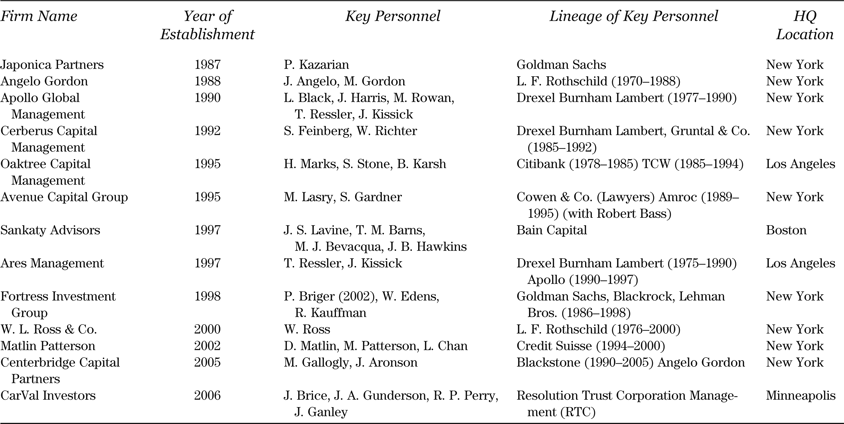
The junk bond crisis began in 1990 with the emergence of defaults in high-yield bonds supporting leveraged buyout transactions. Investors had already withdrawn support for new junk bond issuances in 1989, and the ensuing rerating of high-yield positions, declining asset quality, and impact on the balance sheets of savings and loan institutions resulted in forced sell-offs and a collapse of the secondary market.Footnote 9 It has been estimated that more than half the defaults between 1989 and 1991 involved companies with overleveraged balance sheets.Footnote 10 It was in such conditions that a new type of investment manager emerged—“vulture capitalists”—specializing in the purchase of the debt securities (senior, subordinated, and/or speculative/high-yield) of distressed and defaulting companies.Footnote 11Table 1 lists the early mover firms founded during the junk bond crisis and subsequent years.
Early Mover Firms in the United States Distressed Asset Investment Industry
Sources: Company reports, company websites, and investor presentations.
The founders of the new distressed asset firms, like leveraged buyout partnerships, gained experience in restructuring and investment activities within the confines of investment banks, bond underwriting firms, proprietary desks, and legal firms. Paul Kazarian established Japonica Partners in 1987, as some of the earlier, highly levered transactions were starting to falter. His background as a trusted advisor to Fortune 500 companies while at Goldman Sachs placed him at an important intersection between distressed corporations and the requirements for restructuring and new financing. Leon Black, Joshua Harris, Marc Rowan, and colleagues founded Apollo Global Management after serving as senior executives of the mergers and acquisition group of Drexel Burnham Lambert (Leon Black headed the group and was a long-serving employee, 1977–1990). Their background and work history provided a deep understanding of the intricacies of junk bond financing and the most efficient methods of restructuring firms with highly leveraged balance sheets. Steve Feinberg had also spent time in the 1980s at Drexel Burnham Lambert before managing pools of capital for individual investors, including investment bank Gruntal & Co. In 1992 he founded Cerberus (with William Richter) to invest in “troubled situations.”Footnote 12
John Angelo and Michael Gordon resigned from the arbitrage department at L. F. Rothschild to form Angelo, Gordon & Co. They left behind Wilbur Ross, who was to craft an “illustrious career” as a turnaround specialist at Rothschild (1976–2000) before establishing his own firm.Footnote 13 On the West Coast, Howard Marks and Sheldon Stone had managed high-yield bonds and convertible securities at Citicorp and the Trust Company of the West (TCW). They were joined in 1988 by Bruce Karsh to manage one of the largest pools of capital (at the time) dedicated to distressed investing. In 1995 they set up Oaktree Capital Management; many of their clients from TCW invested capital in the new Oaktree funds. Avenue Capital Group was established the same year, by Marc Lasry and Sonia Gardner, following an initial period managing a $100 million distressed debt partnership in association with Robert M. Bass Group.Footnote 14
The clustering of new firms around the junk bond crisis was due to several factors. All major players had extensive experience in investment banks, securities firms, and advisors. They had typically managed capital on a full discretion basis for their employers, at the forefront of analyzing, investing, and trading new debt securities created during the period of financial innovations in the 1980s. They were witness to the leveraged buyout boom and activities of corporate raiders, but their vantage point was typically as a member of the debt syndicate rather than as equity holders. As default rates rose and companies entered bankruptcy, a steady flow of corporate restructuring investment opportunities presented themselves. The new distressed investment firms financed their investment activities from the same sources of capital that were earlier supporters of leveraged buyout partnerships—pension funds, family offices, and to a lesser extent, financial institutions.Footnote 15 The limited partnership investment vehicle, pioneered for use in alternative asset management by KKR in the 1980s, was the preferred financing structure clearly delineating the distressed investment firm as the fund manager (general partner) managing third-party capital for investors (limited partners). Finally, all early mover firms were privately owned by their founders (this also applies to firms founded later, in the 1990s).
The early mover advantages for firms such as Angelo Gordon, Apollo, Cerberus, Oaktree, and Avenue extended beyond their ability to organize experienced personnel into investment firms and to raise capital from third parties. These skills alone have been sufficient for investment firms to create barriers to entry through brand, investment reputation, and scale economies. Distinctive investment capabilities were developed during the junk bond crisis through initiating and investing in landmark corporate restructuring transactions that tested the boundaries of legal and financial institutions.Footnote 16
The opportunity was made possible by reform to the bankruptcy code and the increased use of Chapter 11 of the Bankruptcy Reform Act of 1978. As Michael Jensen has noted, out-of-court settlements post-1990 decreased in favor of bankruptcies being resolved through a more formal Chapter 11 court process.Footnote 17 Distressed investment firms were involved in some of the largest bankruptcies of the junk bond crisis and created legal and transaction precedents by introducing new financing and investment techniques.Footnote 18 Allegheny International was an industrial conglomerate with strong market positions in household appliances (Sunbeam-Oster), air-pollution control (John Zink), and bathroom scales (Hanson Scales). The company filed for bankruptcy in February 1988 under Chapter 11 and, in November 1989, was presented with a takeover offer from Japonica Partners. Japonica purchased multiple classes of debtor claims and, after a prolonged court battle, took control of Allegheny, restructured the corporation, and floated the revived business as Sunbeam-Oster. The Allegheny case set a precedent for how proactive acquisition of claims could be used in bankruptcy and corporate restructuring.Footnote 19
Apollo was also at the forefront of distressed investment technology. In the 1990s it had purchased junior debt securities in Salant Corporation, a garment manufacturer founded in 1919. Salant had emerged from Chapter 11 bankruptcy in 1987 (following a filing in 1985), only to embark on a highly levered acquisition of Manhattan Industries (a company with three times Salant's annual volume). In 1990 the company filed again, and presented a reorganization plan to the courts that gave existing shareholders a 40 percent stake in the reorganized firm. Junior debt holders, such as Apollo, argued that the plan grossly overvalued the company and eventually sought judgment in their favor. Apollo assumed a 44 percent ownership of the new entity and set about reorganizing the business through a focus on core competences in the menswear sector. Apollo was to again create legal precedence when it successfully outmaneuvered Carl Icahn in a reorganization of E-II Holdings, a diversified business owning Samsonite luggage as well as water treatment systems and clothing. Icahn had alleged that Apollo had “materially understated” the value of the company in order to reduce his claim through junior bonds. Apollo's reorganization plan was approved by the court, which initiated a “cram down” of Icahn's claims, forcing him to accept defeat. Other key transactions during this period included Revco Discount Drugs (1988); Walter Industries (Apollo, 1989); National Gypsum (Goldman Sachs, Fidelity, and TCW, 1990); and Federated Department Stores (1990).Footnote 20
The Resolution Trust Corporation (RTC) provided the second set of landmark transactions from which the distressed asset investment firms created competitive advantages in specialist knowledge. The RTC was established in 1989 to manage the sale of assets of savings and loan institutions declared insolvent. The RTC's equity partnership programs provided a means by which private sector entities could acquire, restructure, and sell a portfolio of assets. The new distressed asset firms saw the RTC program as an opportunity to acquire distressed corporations as well as real estate portfolios. Apollo acquired a range of assets and, in 1993, launched a separate real estate group within the firm. CarVal Investors, a division of the conglomerate Cargill, was able to achieve “critical mass” in their investment operations by managing RTC portfolios; the experience allowed the division to develop “an expertise in managing investments in performing, sub- and nonperforming loan portfolios.”Footnote 21 Lone Star, a leading distressed real estate investment firm, was also founded out of the RTC experience.
By the mid-1990s distressed asset investment firms had created a niche industry at the intersection of law, finance, and corporate restructuring. Landmark transactions were important for the “demonstration effects” they brought the industry. They were also important for the early movers in creating a sustainable competitive advantage. Landmark transactions helped define the legal road map for future transactions and provided templates on how balance sheet and organizational restructuring could be efficiently implemented.Footnote 22 They also demonstrated the importance of investment tactics and the value to an investment firm of developing human capital that understood how to locate the “fulcrum security”—the “best” debt security to purchase that maximized control in a bankruptcy but minimized investment cost. Finally, the investment returns from landmark transactions entered industry folklore. Returns were rarely publicly available, whether on a transaction basis or as a composite for investment vehicles. The publication of investment returns was guarded by the distressed asset investment firms, creating barriers to entry associated with experience, track record, and specialization.
New Entrants: Asia and the Dot-Com Crisis
Distressed asset investment firms based in the United States possessed distinct advantages to exploit the opportunities to invest in distressed corporations in the late 1990s and early 2000s. The early mover firms were led by experienced individuals with backgrounds in leveraged loans and investment banking who had invested through economic and business cycles. They had extensive personal networks, which placed them at an advantage in navigating the legal and financial aspects of distressed investing. Their firms had developed several core competences in transaction capabilities, which gave them a leading market position. However, the growth of asset management firms depends on successfully executing strategies that produce returns for investors and increasing assets under management. While the restructuring of companies following the junk bond crisis continued into the mid-1990s, corporate default rates in the United States fell below 2 percent per annum, and the number of new distressed investment opportunities decreased. The next set of investment opportunities was located in the Asian crisis (1997–1998) and the dot-com crisis (2001–2002). These distressed debt episodes delivered a new set of investment challenges associated with language, business culture, operation of the legal system, bankruptcy regimes, and new stakeholders. The process of corporate restructuring in the United States was relatively efficient, facilitated by Chapter 11 and reorganization plans. Corporate distress in South Korea, Japan, or Southeast Asia—and later in continental Europe—required negotiation with a range of stakeholders, including banks, business groups, family conglomerates, court-appointed administrators, unions/employees, and the political establishment. Due to these complexities many of the leading firms held back on geographic expansion until after the flow of corporate distress opportunities from the dot-com crisis in the United States had subsided. Those firms that invested in corporate distress during the Asian crisis possessed a different set of skills and industry networks.
The East Asian crisis in 1997 was located primarily in South Korea, Indonesia, Malaysia, the Philippines, and Thailand. While the effects of the crisis were economy-wide, corporations in particular were affected, with default rates rising above 9 percent per annum—higher in industries exposed to the negative impact of rapidly devaluing currencies. The resolution of financial distress in Asian corporations during the 1997–1998 crisis was facilitated by government institutions, bank relationships, and the nature of corporate governance structures.Footnote 23 Legal institutions and bankruptcy codes did not encourage prompt resolution, with management (and equity holders) incentivized to prolong debt repayments and operational restructuring. These conditions led government to increase its involvement in the restructuring process, by initiating bankruptcy reform and acting as a buyer of distressed assets.Footnote 24
Several leading distressed asset firms sought a role in restructuring corporations during the Asian crisis. Avenue and Cerberus were active purchasers of nonperforming loans in East Asia in the later 1990s and established offices in the region to facilitate acquisitions and the workout of their portfolios. Avenue specialized in analyzing portfolios of nonperforming loans with a particular focus on Indonesia (and later China and India). In addition, the firm provided new debt to companies requiring recapitalizations. Such strategies were profitable once the “stressed” corporation recovered from its short-term liquidity issues.Footnote 25 Cerberus found attractive investments in loan portfolios sold by banks in financial distress, including substantial opportunities in Japan.Footnote 26 These firms were joined by Lone Star (and later Ripplewood), which was willing to make large, single-asset investments (especially in financial institutions) and play a role in restructuring particular sectors. Lone Star had substantial real estate experience from managing portfolios under the RTC scheme in the United States. In 1998 the firm extended operations into Asia, acquiring a 32 percent stake in financially distressed Korea Exchange Bank. Lone Star set about restructuring the bank's nonperforming loans portfolios, before increasing its equity position to 55 percent in 2003.Footnote 27 Lone Star was also prominent in distressed real estate in South Korea and Japan. Ripplewood was a relative newcomer, led by experienced Goldman Sachs investment banker Christopher Flowers. The firm made several landmark transactions in the late 1990s in Asia, including the acquisition of Shinsei Bank in 2000.Footnote 28
Distressed asset investment firms faced competition in the Asian crisis from global investment banks willing to use proprietary capital to acquire distressed assets. Indeed, firms such as Goldman Sachs, Morgan Stanley, Lehman Brothers, Citigroup, Deutsche Bank, and J. P. Morgan had a history of operating in Asian markets and were well placed to originate transactions in the region. These firms were often advisors to companies and governments, and they maintained strong financial and banking industry networks, which ensured their place at the forefront of portfolio sales or corporate restructuring opportunities. Several of these proprietary investment teams were to spin out from their parent organizations to form the next group of distressed asset firms in Asia postcrisis.Footnote 29
The dot-com crisis of 2001–2002 proved to be a more attractive opportunity than the Asia crisis for U.S. distressed asset investment firms to pursue strategic growth. The end of the dot-com boom and the rise in corporate defaults in 2001 and 2002 in the United States and Europe provided a series of new, large bankruptcies. Many of these investment opportunities were related to overcapitalization in the telecommunications industry; others were the result of overleveraged buyout transactions, which make capital structures unable to withstand declining revenue and earnings. Furthermore, this crash affected businesses operating in major economies in Western Europe as well as in the United States as economic growth slowed, equity markets contracted, and banks reduced credit availability.
The early mover firms were at the forefront of large distressed investment transactions during this period. Oaktree, Cerberus, Avenue, Apollo, and Angelo Gordon successfully raised large investment pools (several in excess of $1 billion in size) to have the financial capability to acquire large companies out of bankruptcy. These transactions included the acquisition by Oaktree and other investors of Regal Cinemas, the largest theater chain in the United States, from a private-equity syndicate in 2001 and Loews Cineplex Entertainment, the largest publicly traded movie theater chain, in 2001 (by Oaktree with Onex Corporation). Bankruptcies in the telecommunications industry were also targeted: Avenue's investment in MCI Communications, the recapitalization of Dutch broadband communication company United Pan-European Communications, and the workout of Marconi (by firms including Cerberus and Angelo Gordon).Footnote 30
The investment opportunities created by the dot-com crisis allowed a number of new firms to enter the distressed asset investment industry. Prior to 2001 Bain Capital had established Sankaty Advisors (1997) as an affiliate to invest in credit and “special situations opportunities” arising out of market dislocations (see Table 1). Two firms had been formed through spinouts from proprietary desks and incumbent firms. Wesley Edens and Robert Kauffman had worked together at Blackrock and Lehman Brothers before founding Fortress Investment Group in 1998. Similarly, Ares Management was established in 1997 by two former Apollo executives, both of whom had started at Drexel Burnham Lambert. The increased flow of investment opportunities, the legitimacy of distressed asset investing created by the aftermath of the junk bond crisis, and the increase in size of pension plans (and other institutional investors) created favorable conditions for experienced professionals to leave their employers and start new firms. Indeed, an important feature of the lineage of the new entrants was that the senior investment personnel could trace their history back to early movers. The specialist investment capabilities required for distressed investing combined with cumulative experience were prerequisites for each new firm. A differentiating feature of the new firms, however, was their ability to raise large pools of capital at inception. David Matlin, Mark Patterson, and Lap Chan started Matlin Patterson in 2002 with $2.2 billion, after spinning out from Credit Suisse First Boston.Footnote 31 W. L. Ross left Rothschild in 2000 with an initial $440 million but grew rapidly to claim more than $9 billion in assets by 2012. In 2005, Centerbridge Capital Partners was started with $3 billion in a first fund. The partners, Mark Gallogly and Jeffrey Aronson, had come from careers at Blackstone and Angelo Gordon.Footnote 32 In each case, entry into the distressed asset industry was predicated on the key individuals of each firm possessing specific human capital.
By the mid-2000s the market leaders in the distressed asset industry had created substantial asset-management firms. They had invested in corporate distress since the early 1990s and in some cases had led the industry into new geographies. In the next section, we examine whether first movers were able to capture economic rents (in this case, superior performance) and how they used their market position and scale to diversify geographically and into related alternative asset classes.
Scale, Product Differentiation, and Niche Players
The global asset management industry grew rapidly during the early and mid-2000s due to strong equity market performance, credit availability, and the outsourcing of investment management by pension funds and sovereign wealth funds. Investment in alternative asset classes, such as hedge funds and private equity, became a core component of an institutional investor's portfolio allocation. Hedge funds and private equity firms raised substantial pools of capital and participated in the financing and acquisition of large corporations around the world.Footnote 33 In addition, new financial market instruments were devised that led to the development of new products and investment strategies—for example, collateralized debt obligations (CDOs), credit default swaps, and synthetic portfolios of CDOs.
The distressed asset investment industry was not immune to wider financial market developments. Between 2000 and 2010 the number of active firms operating in the distressed market grew from fewer than thirty (globally) to over one hundred firms. Fundraising per annum increased four-fold between 2003 and 2007 (from $10 billion, by twenty funds, to $45.2 billion, by thirty-five funds), with a further $43.1 billion raised in 2008 (by twenty-three funds). Average fund size increased from $540 million in 2005 to $1.9 billion in 2008.
The increase in capital inflows to the industry facilitated new entrants, which differentiated themselves by geography (Europe, Asia) and/or by strategy (e.g., investing in smaller enterprises). By 2010 the distressed asset investment industry comprised over one hundred fund managers, of which over 60 percent were located in the United States. Seventy percent of the U.S.-based firms focused solely on investing in the United States, while eighteen managers executed global investment mandates. By this time, thirty-two firms (approximately 30 percent) were located in Europe, with twenty-eight firms stating that they invested solely in Europe either on a regional basis or specializing in a country or economic area (e.g., Germany, Austria, and Switzerland; Scandinavia). Distressed investment firms in Asia were the largest group within the “rest of the world” category. The increase in the number of firms and capital flows into the distressed asset industry had the potential to change the demand-supply dynamics during corporate distress periods and lower investment returns. The first-mover firms led the industry in the number of funds and amount of capital raised. In order to examine whether the first movers were able to maintain performance leadership, Table 2 shows data on the proportion of first movers' funds that were located in the first and second quartiles of funds for the distressed industry. Angelo Gordon, Apollo, and Cerberus delivered top quartile performance for their first funds, suggesting that they were able to convert their early market presence into superior performance. Oaktree (post-TCW) and Avenue did not capture economic rents in terms of superior performance. Over time, however, the first movers were not able to deliver consistently top quartile performance, although in most cases their funds were in the top half of industry performance.
Relative Performance of Industry Early Movers

Sources: Company annual financial reports, investor presentations, limited partner financial reports, and Preqin database (see www.preqin.com).
Note: Oaktree performance reflects the first fund raised independently (i.e., post-TCW). Performance is measured as the internal rate of return of the investment fund (based on reported cash flows to/from investors) from its inception (its first year of investment) to June 30, 2013 (or final liquidation).
The industry early movers dominated capital raising in spite of declines in relative performance. The top-ten firms raised 67 percent of total capital raised for distressed debt investment between 2002 and 2012, with a further 20 percent raised by the next ten firms. Of the fifty companies raising $186 billion, Oaktree, Avenue, Cerberus, Centerbridge, and Fortress were the most successful at gathering assets, solidifying their ability to undertake large restructuring transactions as well as support new areas of growth.Footnote 34 The success of the leading firms in raising large pools of capital resulted in an increase in market concentration. The four-firm and eight-firm market concentration ratios (46.4 percent and 59.6 percent, respectively) for the period indicate a reasonable level of firm concentration. However, the success of a number of companies raising capital together with new entrants meant that concentration measures taking the relative size of firms into account showed a monopolistically competitive market (i.e., a Herfindahl index of 0.07 and an equivalent number of firms of 15).
The benefits of scale in assets under management allowed leading firms to diversify their businesses through investment geography and product. Table 3 shows the top-ten firms as measured by historic assets under management. We have shown for each firm key organizational features (assets under management, employees, location of offices) as well as areas of product expansion. We have also measured the proportion of assets under management in each firm's core product area (distressed) and newer products. We note a strong correlation between the early mover firms of the early 1990s and the top ten; indeed, only one firm (Centerbridge) was established post-2000.
Scale, Geographic, and Product Expansion Strategies

Sources: Company annual financial reports, investor presentations, and Preqin database (see www.preqin.com).
Note: Historical assets under management (AuM) as of June 30, 2012. Early movers—firms established in 1995 or earlier—are denoted by an asterisk (*). Percent of AuM measures the percentage of assets under management in strategies other than distressed asset investing.
Several features of the top-ten firms are worth considering. First, most (if not all) firms expanded geographically during the 2000s beyond their country of origin (the United States in all cases) to locate investment in human capital in Europe and Asia.Footnote 35 Firms such as Oaktree, Angelo Gordon, Apollo, Avenue, and Fortress developed large investment and support teams, in most cases as part of geographic expansion. This required firms to introduce systems and policies for managing personnel across multiple time zones, functions, and responsibilities.
The head office centralized key functions such as information technology, accounting (including fund back office accounting), and human resource management. The Asian and European offices were predominantly staffed by specialist investment personnel responsible for sourcing and executing transactions. The leading firms incentivized investment personnel across offices by allocating a share of performance fees to each senior transactor. Often such performance fees would be used to “bind together” investment teams, by basing performance pay on fund performance in total (e.g., globally) rather than solely on the investments made by the local offices. The expansion of offices into Europe and Asia alongside global investment mandates facilitated the transfer of investment knowledge and technology. Prior to these firms achieving scale, few were willing to embark on investments in Asia (1997–1998) and Europe (2001–2002) no matter how attractive the distressed asset investment opportunities appeared.
A second feature of the strategic behavior of the largest firms was product expansion. The junk bond crisis and the RTC provided distressed investment opportunities in real estate assets as well as in companies. Firms such as Apollo established real estate investment capabilities relatively early. However, the most common product expansion strategy during the late 1990s and 2000s was private lending in the high-yield, convertible securities, and senior loan markets. Oaktree, Angelo Gordon, Sankaty, and CarVal Investors managed pools of capital in performing private loans in addition to their distressed asset investment activities. A benefit of product expansion into performing credit was the stable revenue and earnings streams available to the asset management firm. Distressed investing was cyclical, resulting in disjointed growth in assets under management and earnings. Alternative asset products in the fixed income area were a larger part of an institutional investor's portfolio than distressed investments. By the mid-2000s all top ten firms (except Centerbridge) had established private loan capabilities, with four particular firms gathering assets under management in excess of $40 billion. Apollo, Oaktree, Ares, and Fortress expanded their asset management product suite to include fixed income, distressed assets, and private equity. Indeed, product expansion contributed to a larger proportion of assets under management than distressed assets for each firm (Oaktree is the exception; distressed assets under management contributed 56 percent of total assets under management). The early mover firms remained among the ten largest distressed assets firms by size, but their success varied in raising capital outside of distressed assets. Cerberus and Avenue were less successful in increasing assets under management by product expansion as compared with Apollo, Oaktree, and Angelo Gordon.
Product expansion was executed by organic strategies, transferring key individuals from within a firm and hiring from the financial labor market. Organic growth was possible due to the complementarities between performing and nonperforming loan investing. The skills involved in sourcing, analyzing, and investing in well-performing private companies were similar to those required for distressed investment. In addition, the lineage of most firms derived from capital markets lending in the 1980s.
Two firms—Apollo and Fortress—augmented organic growth with acquisitions. While acquisitions in financial services were not new—the consolidation of the investment banking industry in the 1980s and 1990s is one example—the financial capacity of an alternative assets firm to acquire another firm was a signal that the industry was moving beyond a niche segment into mainstream financial services. In 2009, Fortress acquired Logan Circle Partners, a specialist fixed income asset management business with approximately $18 billion under management.Footnote 36 In 2011, Apollo completed a similar acquisition through the purchase of Stone Tower Capital (an $18 billion credit manager) and Gulf Stream Asset Management (a corporate credit manager with $3 billion in assets).Footnote 37 Another feature of these firms was that both had moved from private ownership to listing on public exchanges (both on the New York Stock Exchange).Footnote 38
Third, as we have noted, the top-ten firms moved from domestically focused asset managers to operate on a multicountry investment opportunity set with a multiple-office structure. Scale in assets under management, and the need to differentiate investment strategies from new entrants, resulted in most firms increasing the level of internalization of specialist human capital. Traditionally, distressed asset investment firms (like their leveraged buyout counterparts) coordinated firm-specific investment skills with a variety of services provided by lawyers, investment banks, strategic consulting firms, accountants, and executives experienced in operational restructuring. By the mid-2000s the leading distressed asset investment firms were building teams of in-house specialists to help their distressed companies arrange new financing, restructure operations, and source key personnel. These “operational teams” would also draw on a network of experienced CEOs and CFOs who had worked on several prior turnaround transactions. The move to internalization strengthened the level of firm-specific human capital and maintained barriers to entry associated with experience and tenure.
Observations on the Rise and Development of the Distressed Asset Investment Industry
The emergence of distressed asset investment firms in the early 1990s took place at a time of regulatory change and new case law on the operation of U.S. bankruptcy laws. In addition, the junk bond crisis heralded new regulation on finance market participants and their ability to settle bankruptcy out of court. In this section we offer some observations on why the industry rose at this time and how growth was manifested.
The increase in corporate defaults in the early 1990s created a new pool of potential investments for the first generation of distressed asset investment firms. At the same time, changes in bankruptcy law provided distressed investors with an environment conducive to acquiring a distressed company as a going concern, thus better enabling a financial and operational restructuring. The prevalent method of workout prior to the 1990s was an exchange offer and out-of-court settlement. This method was viewed by industry participants (and observers) as an efficient process, relatively inexpensive and timely. Drexel Burnham Lambert played an important role in these processes by ensuring that subordinated debt holders agreed to a restructuring. In 1990 the United States Bankruptcy Court for the Southern District of New York ruled that bond holders in exchange offers would be limited in the value they could expect from an out-of-court settlement if the company again entered bankruptcy.Footnote 39 According to Jensen, this ruling, “together with tax penalties imposed in 1990 by Congress on reorganizations outside the bankruptcy court . . . caused exchange offers to slow to a trickle.”Footnote 40 The demise of Drexel Burnham Lambert as a market maker in the subordinated bond market also played a part. Drexel Burnham Lambert had served an important coordinating role in the finance market. The firm effectively controlled the trading of subordinated debt on the secondary market by determining which bonds held value and at what price a trade might occur. After 1990, bond holders were freer to sell their subordinated bonds in a distressed firm and exit the company.Footnote 41 This allowed the distressed asset firms a convenient way to secure a legal position in the restructuring process.
The legal and financial market changes in 1990 and 1991 resulted in an increase in the number of bankruptcies that entered Chapter 11. At the time, the Chapter 11 process was viewed by practitioners and legal scholars as cumbersome and time consuming. The delays in negotiating a bankruptcy or settlement potentially led to declines in corporate value, as the lenders and company management were constrained from changing the company until judgment. These delays provided an opportunity for subordinated debt holders (and sometimes management) to hold out and expropriate value from senior lenders to bring about a settlement.Footnote 42 Distressed debt investment firms were able to exploit the reregulation of bankruptcy markets and the inefficiencies of the Chapter 11 process. They were often the largest single investor represented in high profile bankruptcies and were willing to be party to legal disputes that sought to define the ownership rights of subordinated debt holders. Over time, senior lenders and equity holders of distressed companies viewed the distressed asset investment firms as legitimate owners of companies that required reorganization. The use of the court of the District of Delaware streamlined the Chapter 11 process by encouraging the court and judges to specialize in hearing bankruptcy cases.Footnote 43 Debtor-in-possession financing became more prevalent, allowing the distressed company access to finance in order to maintain operations.Footnote 44 Distressed asset firms and their legal advisers were among the first firms to trade claims in bankrupt firms and to use prepackaged bankruptcies where a restructuring plan was agreed on by the old and new owners of debt and equity prior to entering Chapter 11.Footnote 45
The emergence of the early movers in the industry was also made possible by the willingness of institutional investors to finance transactions and by the types of companies that entered financial distress. Large public pension funds were the primary supporters of the leveraged buyout firms that pioneered the use of limited partnerships to commingle investors into a single pool of capital. The distressed asset firms used the same fund structures and raised capital from similar institutional investors.Footnote 46 It was also important that the majority of large companies that entered bankruptcy during the 1990s were leveraged buyouts financed by leveraged buyout firms. The new approaches to financing restructurings and the use of prepackaged bankruptcies received less resistance from leveraged buyout firms over time. These firms had an incentive to work with the distressed asset firms to bring about an orderly and timely restructuring through Chapter 11 because they valued their reputations as owners of companies.Footnote 47 Thus, the pioneering investment approaches of the leveraged buyout industry provided the preconditions for the distressed asset firms to raise capital and deploy that capital in distressed transactions.
The confluence of legal and institutional changes that provided the environment for the rise of the distressed asset investment industry in the United States allowed the earliest established firms to capture benefits of scale and consolidate market position. We have found that early movers remained the largest (but not necessarily the best-performing) firms in the industry. The growth strategies of early movers were associated more with scale and product diversification of investment activity. This has led to a global industry characterized by monopolistic competition whereby large American firms raise the majority of capital and compete for distressed investment opportunities in a limited number of legal jurisdictions, and smaller firms invest in distressed companies located in a particular (local) jurisdiction.
Scale economies in asset management are located largely in the ability to decrease the costs of sourcing, identifying, and executing investments as assets under management increase. There are minimum conditions that need to be satisfied should an investment proceed: legal, accounting, and operational studies of the target company; financing packages; hours of due diligence. These costs decline per dollar as the size of the investment increases. The early mover firms were likely to have experienced scale economies associated with costs as well as scale, reinforcing reputation, limiting competition, and providing conditions for organizational innovations. Angelo Gordon, Oaktree, Apollo, Cerberus, and Avenue raised the first commingled funds from institutional investors. Each fund tended to be larger than the previous fund, resulting in a firm's reputation within the industry as a leading participant. Scale also limited competition in securing control positions in larger distressed companies. Finally, scale provided the fee revenue to introduce organizational innovations. The early movers built internal resource capabilities previously contracted out (e.g., legal analysis, strategic consulting), as well as multidivisional structures to organize personnel.
Product diversification was more important than geographic diversification as a growth strategy. Product diversification was based on the exploitation of scope economies—transferring expertise from distressed asset investing to other asset classes. Almost all the early movers diversified into performing secured and subordinated loans as well as real estate. As a result, by the late 2000s the largest distressed asset firms had become diversified alternative asset managers with a particular focus on credit investing. Geographic diversification of investment activity was not important as a growth strategy. The idiosyncrasies of the American bankruptcy system, legal precedents, and depth of financial markets limited the ability of distressed firms to transfer firm-specific investment techniques to new legal regimes. Only two out of ten early movers invested in the corporate distress of the Asian financial crisis. Bankruptcy regimes based on civil-law jurisprudence rather than market-friendly Chapter 11, together with the role governments played in restructuring, increased transactional complexity. Early movers were unable to exploit competitive advantages developed in the United States during the 1990s by acquiring distressed companies in Asia. Similarly, in Europe in the dot-com crisis of 2001–2002, early movers focused on large pan-regional or multinational companies that were suited to Chapter 11–style reorganization. Geographic expansion of the largest distressed asset investment firms tended to follow investment activity rather than lead. Geographic diversification of the firms' investor bases was a more important growth strategy. The early movers were supported in the 1990s by American public pension funds, banks, and insurance companies. By the mid-2000s the largest distressed asset investment firms had raised capital from institutional investors in most major finance markets. While the leading firms' investment portfolios remained concentrated in the United States, their client bases included institutions from the United Kingdom, Western Europe, Japan, Canada, and Australia.
Conclusion
In this article we have examined the emergence and growth of distressed asset investment firms and their participation in corporate distress episodes in the United States, Western Europe, and East Asia during the late twentieth century. We provide the first examination, from a business- and financial-history perspective, of financial intermediaries operating in the distressed asset and restructuring industry. The article complements research on the financial history of leveraged buyout firms and the role of financial intermediaries. We argue that financial deregulation and financial market growth in the late 1980s and early 1990s set the institutional framework for distressed asset investment firms to acquire the debt and equity of distressed companies in order to undertake financial (balance sheet) and organizational restructuring.
The early 1990s junk bond crisis was the first episode in U.S. corporate history when financially distressed firms could be acquired by third-party investors before or during the bankruptcy process. We describe how distressed asset firms were established (largely) by individuals who had experience working in the investment banking, high-yield debt, and bankruptcy markets of the 1980s. These new investment firms followed leveraged buyout firms in raising capital from institutional investors into limited partnerships, in order to have control over a pool of capital to acquire debt and/or equity of firms before (or in) bankruptcy. The early mover firms created barriers to entry by developing investment reputation (brand) and scale economies. As a result, we find that the distressed asset investment industry is relatively concentrated in terms of the number of firms and assets under management. Notably, however, scale and a high market share did not translate to superior investment performance. Early mover firms were not able to deliver consistently better investment returns than their peers.
Our analysis of corporate growth strategies in the industry shows that U.S. firms were slow to expand their investment activity outside their domestic market. Geographic expansion was driven by the apparent availability of investment opportunities. Firms set up operations in East Asia and Western Europe in the late 1990s and early 2000s following periods of corporate distress in those regions, resulting in firms developing a more institutionalized organizational structure with multiple offices and processes, allowing for the coordination of investment activity across time zones. We argue that product diversification was more important than geographic diversification as a growth strategy. Geographic expansion outside the United States was hampered by firms' inability to transfer firm-specific investment techniques developed within the American bankruptcy system to different legal jurisdictions. By contrast, these firms were able to draw upon firm-specific knowledge developed in distressed investing to expand the scope of investment activity into fixed income and private equity asset classes.
There has been long-standing criticism that Chapter 11 was a costly, slow, and administratively burdensome process for financially distressed companies in the United States. Rather, creditors preferred to resolve financial distress by restructuring out of court. More recently, legal and financial scholars have argued that Chapter 11 has evolved and adapted to deal with the complexities of modern corporate bankruptcy.Footnote 48 We have shown that distressed assets firms were important participants in the evolution of Chapter 11. They helped create precedents by being party to legal proceedings defining the ownership position of subordinated debt holders and were among the first investors to use debtor-in-possession financing. By bringing new transaction techniques, new capital, and specialist skills to corporate bankruptcy and restructuring, distressed asset investment firms have increased the efficiency of the bankruptcy process, resulting in private sector workouts becoming more competitive and more efficient over the last thirty years.