Introduction
Although aging is associated with a decline in memory functioning (Park and Festini, Reference Park and Festini2017), a significant body of research has demonstrated the benefits of memory training for improving memory performance in healthy older adults (Gross et al., Reference Gross2012). However, previous studies have suggested a degree of variability among older adults’ response to memory training (Kliegl et al., Reference Kliegl, Smith and Baltes1990; Verhaeghen and Marcoen, Reference Verhaeghen and Marcoen1996; Singer et al., Reference Singer, Lindenberger and Baltes2003), such that some individuals benefit more than others, despite being exposed to the same program and materials (Lövdén et al., Reference Lövdén, Brehmer, Li and Lindenberger2012).Why do some older adults appear to benefit more than others?
Relatively few studies have directly investigated which factors predict improvements following memory training in healthy older adults (e.g. Hill et al., Reference Hill, Yesavage, Sheikh and Friedman1989; McKitrick et al., Reference McKitrick, Friedman, Brooks, Pearman, Kraemer and Yesavage1999; Bissing and Lusting, Reference Bissig and Lustig2007; Langbaum et al., Reference Langbaum, Rebok, Bandeen-Roche and Carlson2009; Sandberg et al., Reference Sandberg, Rönnlund, Derwinger-Hallberg and Stigsdotter Neely2016). In this field of investigation, attention was paid to age, individual differences in cognitive abilities, and baseline performance as factors modulating training outcomes. The identification of variables related to successful gain may provide new avenues to define the amount of benefit as well as which among the alternative training interventions is best suited to a given older adult (McKitrick et al., Reference McKitrick, Friedman, Brooks, Pearman, Kraemer and Yesavage1999; Bissing and Lusting, Reference Bissig and Lustig2007).
One of the first pieces of evidence that not all older adults are likely to benefit from a memory training derives from Hill and colleagues’ study (Reference Hill, Yesavage, Sheikh and Friedman1989).They found a positive association between mental status scores at baseline, investigated with the Mini Mental State Examination (MMSE; Folstein et al., Reference Folstein, Folstein and McHugh1975), and improvement for both serial words and name-face recall performance after a training based on interactive imageries (see also Yesavage et al., Reference Yesavage, Sheikh, Friedman and Tanke1990).This finding suggests that better global cognitive functioning is associated with a higher level of memory plasticity and that cognitive status should be an important variable to take into consideration in a training.
Subsequent research has focused on understanding which specific cognitive abilities predicted gains following mnemonic training. A number of studies found that older adults with a high processing speed ability (Kliegl et al., Reference Kliegl, Smith and Baltes1990; Verhaeghen and Marcoen, Reference Verhaeghen and Marcoen1996; Singer et al., Reference Singer, Lindenberger and Baltes2003) and associative memory (McKitrick et al., Reference McKitrick, Friedman, Brooks, Pearman, Kraemer and Yesavage1999) were those who benefited most from a training based on Loci techniques. Bissing and Lusting (Reference Bissig and Lustig2007) found that a measure of crystallized intelligence (a vocabulary test) predicted gains of a mnemonic training targeting recollection memory. Similar results were also obtained by Sandberg and colleagues (Reference Sandberg, Rönnlund, Derwinger-Hallberg and Stigsdotter Neely2016), who found that episodic memory, processing speed, and semantic memory (assessed with a vocabulary test) were the best predictors of a number-consonant technique training. Also, working memory may play a role in memory training given its relationship with episodic memory (Verhaeghen and Marcoen, Reference Verhaeghen and Marcoen1996; Sandberg et al., Reference Sandberg, Rönnlund, Derwinger-Hallberg and Stigsdotter Neely2016) and verbal learning (Rast, Reference Rast2011).
In addition, baseline at performance and age were investigated as predictors (McKtrick et al., Reference McKitrick, Friedman, Brooks, Pearman, Kraemer and Yesavage1999; Bissing and Lustig, Reference Bissig and Lustig2007; Langbaum et al., Reference Langbaum, Rebok, Bandeen-Roche and Carlson2009; Sandberg et al., Reference Sandberg, Rönnlund, Derwinger-Hallberg and Stigsdotter Neely2016).With regard to baseline performance, older adults with a higher initial performance in the memory target task were those who tended to benefit the most from mnemonic training with respect to participants with a lower performance (McKitrick et al., Reference McKitrick, Friedman, Brooks, Pearman, Kraemer and Yesavage1999; Sandberg et al., Reference Sandberg, Rönnlund, Derwinger-Hallberg and Stigsdotter Neely2016).Concerning age, this was negatively correlated to training benefit; older age was associated with smaller training gains (Bissing and Lusting, Reference Bissig and Lustig2007; Langbaum et al., Reference Langbaum, Rebok, Bandeen-Roche and Carlson2009).These studies support the amplification model according to which individuals with a higher initial performance have more efficient cognitive resources, which, in turn, allow them to benefit more from mnemonic training (Verhaeghen and Marcoen, Reference Verhaeghen and Marcoen1996). Hence, memory plasticity is positively associated with baseline performance and negatively associated with age, resulting in an amplification of existing differences. Similar results were also found in studies adopting a process-based training, such as working memory intervention (Bürki et al., Reference Bürki, Ludwig, Chicherio and de Ribaupierre2014; Borella et al., Reference Borella, Carbone, Pastore, De Beni and Carretti2017). For instance, Borella and colleagues (Reference Borella, Carbone, Pastore, De Beni and Carretti2017) found that in tasks demanding more active information processing, younger older adults with higher initial performance in the vocabulary task were those who tended to benefit the most from the training.
Given the critical role of several variables in predicting memory training benefits, when designing an intervention it is crucial not only to measure its effectiveness in terms of gains but also to investigate who will benefit most, thus permitting one to understand which kind of training is best adapted to a particular subject. Consequently, the goal of the present study is to analyze the predictors of a strategic memory training program which has previously been revealed to be successful in improving memory performance in healthy older adults (Cavallini et al., Reference Cavallini, Pagnin and Vecchi2003a; Reference Cavallini, Pagnin and Vecchi2003b). In order to do this, we examined the associations between training gains and a number of different factors that were found to be responsible for memory training benefits: memory baseline performance, age, fluid and crystallized abilities, working memory, short-term memory, and processing speed. In particular, we used a reasoning task to assess fluid abilities and a vocabulary task as a measure of crystallized abilities (Horn and Cattel, Reference Horn and Cattell1967).
In the present study, we administered a strategic training based on teaching the use of different simple memory strategies, such as verbal and visual association, to be used according to different everyday situations (e.g. memorizing names, faces, and places, etc.) (Cavallini et al., Reference Cavallini, Pagnin and Vecchi2003a; Reference Cavallini, Pagnin and Vecchi2003b). Teaching several strategies gives older adults the possibility to acquire general strategic knowledge (Cornoldi, Reference Cornoldi1995) that may help them to generalize the strategies and adopt them to different materials or contexts (Neely and Bäckman, Reference Neely and Bäckman1995). Adopting this kind of intervention allowed us to investigate the specific predictors of a basic strategic memory training, working on broader skills applicable in different materials. We examined memory training benefits by measuring changes in memory practiced (directly trained during the training program) and non-practiced (transfer – not directly trained during the training program) tasks.
We expected to confirm the efficacy of the training in improving performance in both practiced and non-practiced memory tasks. Moreover, according to the studies reported above, we expected that younger older adults with a higher baseline performance in the memory practiced and non-practiced tasks and in the cognitive abilities considered would be those who benefit the most from our training.
Method
Participants
Participants consisted of 44 older adults (aged 60–83; M = 68.73, SD = 6.05) recruited through the local branch of the University of Third Age located in northern Italy. On average, older adults had 11.36 years of education (SD = 3.50).They were screened with the Mini-Mental State Examination (MMSE; Folstein et al., Reference Folstein, Folstein and McHugh1975) in order to exclude participants exhibiting signs of dementia. All older adults showed sufficient scores of 27 or higher (M = 29.17; SD = 1.85). Participants accepted and completed an informed consent form prior to the beginning of the study.
Measures
Three memory tasks were administered during both the pre-test and post-test sessions; thus, two versions of each task were administered. In addition, during the pre-test session exclusively, a series of cognitive measures were administered to participants.
Memory tasks
Memory practiced task
Word list learning
Participants were presented with 40 single words (Cavallini et al., Reference Cavallini, Dunlosky, Bottiroli, Hertzog and Vecchi2010), with each one printed on an index card. The 40 cards were handed to participants, who were instructed to study the words for up to 20 minutes. After the study, participants were asked to write down as many words as they could remember (in any order) on an answer sheet. Performance was assessed on the basis of the number of items remembered correctly.
Memory non-practiced tasks
Grocery list learning
Participants were presented with a list of 40 grocery items (e.g. bread), with each one printed on an index card (Bottiroli et al., Reference Bottiroli, Cavallini, Dunlosky, Vecchi and Hertzog2013). The 40 cards were handed to participants, who were instructed to study the words for up to 20 minutes. In the recall phase, participants were asked to write down as many grocery items as they could remember (in any order) on an answer sheet. Performance was assessed on the basis of the number of items remembered correctly.
Associative learning
Participants were presented with 40 paired associates (Cavallini et al., Reference Cavallini, Dunlosky, Bottiroli, Hertzog and Vecchi2010), with each one printed on an index card. The 40 cards were handed to participants, who were instructed to study the words for up to 20 minutes. After study, each stimulus was presented individually, and participants were asked to write down the corresponding response. Performance was assessed on the basis of the number of items remembered correctly.
Cognitive measures
Vocabulary test
The vocabulary test (drawn by Primary Mental Ability; Thurstone and Thurstone, Reference Thurstone and Thurstone1963) was used to assess crystallized ability. Participants were asked to identify the correct synonym of 50 words within an 8-minute period. Performance was measured by the number of items answered correctly.
Raven standard progressive matrices
Fluid cognitive ability was assessed using a shortened version of Raven's Standard Progressive Matrices (SPM; Raven et al., Reference Raven, Raven and Court2003). It consisted of 30 items, which were divided into five series (ranging from A to E) of six items each. Each item consisted of a geometric design with a piece missing. The participant's task was to select, from six or eight choices given, the missing piece that would complete the geometric design. Performance was measured by the number of items answered correctly.
Listening span test
An Italian adaptation of the Listening Span Test was used (Pazzaglia et al., Reference Pazzaglia, Palladino and De Beni2000) to assess working memory and short-term memory. Participants were required to listen to sequences of an increasing number (from two to six) of sentences. At the end of each sentence, they were asked to say whether it was true or false, and at the end of each sequence they were required to recall the last word of each of the sentences, in the order in which they had been placed. The total number of final words recalled correctly and in precise order during the entire test was considered the measure of the participant's working memory capacity. The total number of words correctly recalled during the test, but not in the exact order, was considered the measure of the participant's short-term memory capacity.
Letter comparison
Letter comparison task (Salthouse, Reference Salthaouse1993) was used in order to assess processing speed. The task required participants to compare 41 pairs of letters and to write “S” if the members of the pairs were the same or “D” if they differed. Participants were asked to complete as many items as possible within 90s. Performance was assessed on the basis of the correct responses produced.
Procedure
Each participant took part in eight 60-minute meetings. Two of these – one before and one after the training – were individual sessions of pre-test and post-test in which participants carried out memory and cognitive tasks; the remaining six collective sessions comprised strategic memory training. During the pre-test individual meeting, participants first completed a demographic questionnaire and the MMSE, and subsequently performed all of the memory tasks and cognitive measures. During the post-test individual meeting, participants performed the memory tasks only. The order of administration of the memory tasks and cognitive measures was counterbalanced across participants.
Training sessions
As previously mentioned, the memory training program was adapted from Cavallini and colleagues’ work (Cavallini et al., Reference Cavallini, Pagnin and Vecchi2003a; Reference Cavallini, Pagnin and Vecchi2003b). Memory training was conducted by two female trainers and took place in a classroom. The collective meetings were conducted once a week for six consecutive weeks. The group meetings were held to explain different associative strategies that should be applied to different kinds of memory tasks, such as word list learning, name-face learning, place learning, and text learning. During each group meeting, participants were asked to choose and implement the strategies they considered most useful in the activities proposed after examining the characteristics of the material. For example, if the task required participants to learn a list of words, they might use a verbal associative strategy. On the contrary, if the task required name-face learning, participants might use a visual associative strategy, requiring them to associate names with facial characteristics. Training was composed of practicing the associative strategies on word list learning, name-face learning, place learning, and text learning.
Results
Our main goal was to investigate whether individual differences in memory baseline performance for practiced and non-practiced tasks (i.e. the pre-test scores of each memory tasks respectively), age and cognitive measures (i.e. crystallized ability, fluid ability, working memory, short-term memory, and processing speed) predicted memory improvement during the training.
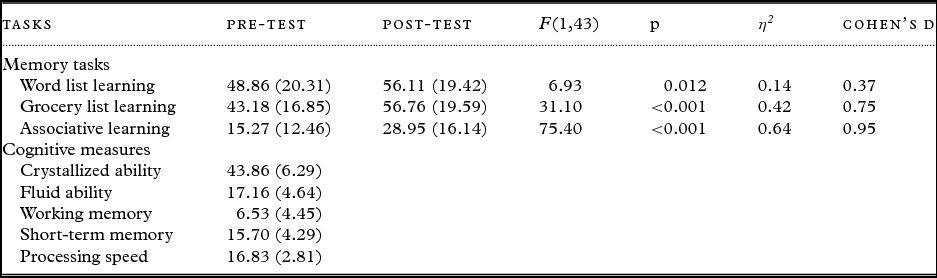
We began by considering changes due to the training program. Next, we examined mechanisms underlying memory performance by computing Pearson's correlations between age, cognitive measures, and memory tasks before and after the training. Finally, we reported the results of regressions in order to investigate the predictive role of baseline in memory, age, and cognitive measures on post-test memory performances. Mean performances and standard deviations for cognitive measures and memory tasks performance are reported in Table 1.
Means value (standard deviations) and results of ANOVA for memory tasks performance (expressed in percentage of correct responses) as a function of testing session (pre- and post-test) and cognitive measures

Effects of memory training on memory tasks
To evaluate the efficacy of the training on memory tasks, we ran a repeated-measures ANOVA on every memory task with time (pre- vs. post-test) as within-subject factor. The results showed a significant main effect of time on all measures, revealing an improvement in performance from pre- to post-test on the word list learning task, grocery list learning task, and associative learning task. Results of ANOVA are reported in Table 1.
Predictors of improvement across memory training
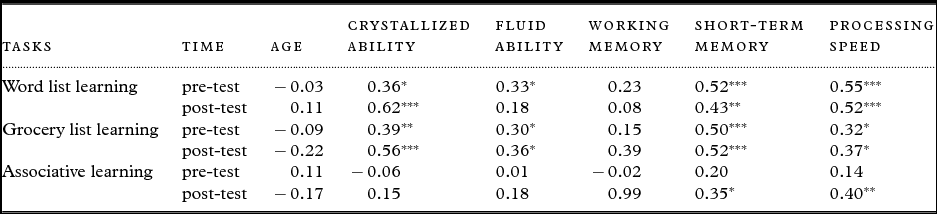
Prior to examining the role of baseline performance, age, and cognitive measures in memory improvement during the training, we considered the associations between age and cognitive measures with memory tasks at pre- and post-test. Table 2 shows these correlations.
Pearson correlations between age, cognitive measures, and performances in memory tasks at both pre- and post-test

Note: *p <0.05; **p <0.01; ***p ≤ 0.001.
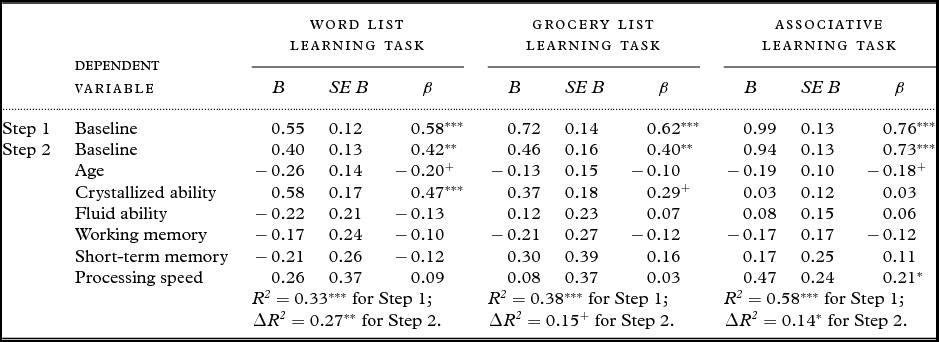
In order to examine the predictors of improvement across memory training, we conducted a series of stepwise regressions. In each of these regressions, we considered memory post-test scores as the criterion and entered: (1) baseline performance (i.e. pre-test) of memory tasks at the first step, and (2) age and all cognitive measures at the second step. Results of these analyses are presented in Table 3.
Regression analyses on memory post-test performances

Note: Word list learning task: Step 1, F(1, 42) = 21.14, p<0.001, Step 2, ΔF(6, 36) = 4.05, p = 0.003; Grocery list learning task: Step 1, F(1, 42) = 25.68, p<0.001, Step 2, ΔF(6, 36) = 1.96, p = 0.097; Associative learning task: Step 1, F(1, 42) = 58.38, p<0.001; Step 2, ΔF(6, 36) = 3.08, p = 0.015.
+ p<0.10; *p<0.05; *p<0.01; ***p ≤ 0.001.
Concerning the word list learning task, analyses revealed that baseline performance in the practiced word-list learning task at Step 1 explained a significant percentage of the variance. Entering age and cognitive measures at the second step, the amount of explained variance significantly improved, where crystallized ability emerged as significant predictors above and beyond baseline performance. The effect of age was negative but not statistically significant (p = 0.078).
For the non-practiced grocery list learning task, at Step 1 the baseline performance in the grocery learning task explained a significant percentage of the variance. Entering age and cognitive measures at the second step did not improve the amount of explained variance.
Regarding the non-practiced associative learning task, Step 1 was significant. Entering age and cognitive measures at the second step, the amount of explained variance significantly improved. Results indicated that processing speed was a significant predictor (p = 0.052) above and beyond baseline performance. The effect of age was negative but not statistically significant (p = 0.062).
Discussion
The aim of the present study was to analyze the profile of older adults who were likely to benefit most from a strategic memory training program previously revealed as effective in improving memory performance in a sample of healthy elderly adults (Cavallini et al., Reference Cavallini, Pagnin and Vecchi2003a; Reference Cavallini, Pagnin and Vecchi2003b).To this end, we examined the associations between training gains and memory baseline performance for practiced and non-practiced tasks, age, fluid and crystallized abilities, working memory, short-term memory, and processing speed.
Consistent with our previous studies (Cavallini et al., Reference Cavallini, Pagnin and Vecchi2003a; Reference Cavallini, Pagnin and Vecchi2003b), we found an improvement both in practiced and non-practiced memory tasks confirming the efficacy of the training.
Our main goal was to investigate who benefited most from the training. For the practiced memory task (i.e. word-list learning), regression analysis revealed that the improvement in performance was significantly explained by performance at baseline and crystallized ability. This finding indicates that older adults with higher memory performance and higher crystallized ability at pre-test were those who improved more during the training. For the non-practiced memory tasks, the regression analyses showed a different pattern of results based on the type of task. For the grocery list learning task, analysis showed that improvement in memory transfer was significantly explained by baseline memory performance. Also, crystallized ability had a marginal influence on training benefit. Concerning the associative learning task, improvement in performance was significantly explained by baseline memory performance and processing speed. Hence, older adults who start with a high memory performance at pre-test and possess a higher rate of processing speed showed more transfer gains in the associative learning task. Also, age was a marginal negative predictor of the practiced task and of the associative learning non-practiced task, younger older adults tended to benefit the most from the training.
Consistent with previous research (McKitrick et al., Reference McKitrick, Friedman, Brooks, Pearman, Kraemer and Yesavage1999; Sandberg et al., Reference Sandberg, Rönnlund, Derwinger-Hallberg and Stigsdotter Neely2016), the findings herein suggest that baseline memory capacity is a critical predictor of the training benefits for both practiced and non-practiced memory tasks. Older adults with good performance at memory baseline benefit most from the present strategic memory training. Moreover, our results provide further support that crystallized ability is important for training gain (Bissing and Lusting, Reference Bissig and Lustig2007; Sandberg et al., Reference Sandberg, Rönnlund, Derwinger-Hallberg and Stigsdotter Neely2016; Lecce et al., Reference Lecce, Ceccato, Rosi, Bianco, Bottiroli and Cavallini2017). Indeed, the measure which we used to evaluate crystallized ability is a verbal knowledge task that is a well-known predictor of learning in older adults (Rast, Reference Rast2011).
For processing speed, results reveal that it predicts transfer training gain in the paired associative task. This is in line with studies showing that processing speed is related to associative learning (Kyllonen et al., Reference Kyllonen, Tirre and Christal1991; Kurtz and Zimprich, Reference Kurtz and Zimprich2014). According to the limited time and simultaneity mechanisms proposed by Salthouse (Reference Salthouse1996), high processing speed may facilitate the encoding of the to-be learned material and the retrieval. Specifically, the limited time mechanism posits that a lower processing speed impedes the completion of elementary cognitive operations due to the lack of internal time. The simultaneity mechanism posits that a lower processing speed reduces the quality and quantity of information encoding. It may be that older adults with a higher level of processing speed are faster in adapting strategies to new and different materials than their slower counterparts. Albeit other research has reported processing speed ability as a correlate of plasticity (e.g. Kliegl et al., Reference Kliegl, Smith and Baltes1990; Singer et al., Reference Singer, Lindenberger and Baltes2003), this is the first study finding that processing speed predicts benefits in a transfer task.
For age, even if it was not a strong predictor, its marginal negative relationship with training benefits is in line with the amplification model (Verhaeghen and Marcoen, Reference Verhaeghen and Marcoen1996).
Regarding working memory, although we expected that this ability could have a role in predicting training gains, in our study it was not related to performance improvement. It may be that to use and adapt memory strategies, other cognitive variables, such as vocabulary and processing speed, are more relevant predictors for older adults. Indeed, as reported by Verhaeghen and Marcoen (Reference Verhaeghen and Marcoen1996), working memory was a predictor of training gain of young adults and not of older adults.
Like any study, ours has limitations that should be deliberated in future research. The first is the relevancy of the age-range of the sample. In order to identify the profile of older adults who benefit most from the strategic memory training, future studies should therefore select different age groups, ranging from young–old to old–old adults. Furthermore, since the sample in the present study consisted of older adults belonging to the University of Third Age, where they attended several cultural activities, there is the possibility that these older adults presented basic high cognitive abilities and are motivated in using strategies. Future studies should recruit older adults selected from the general population. Moreover, this study did not include a control group. However, the amount of memory gains found in this study is similar to those reported in Cavallini et al.’s study (Reference Cavallini, Dunlosky, Bottiroli, Hertzog and Vecchi2010), involving a control group. Finally, follow-up assessment session was not included in the present study. Hence, one other issue which future research should investigate is whether the aforementioned variables are also important predictors for the long-term effect of strategic memory training.
To summarize, the present study has identified the profile of older adults who are likely to benefit from a strategic memory training. In line with the amplification model (Verhaeghen and Marcoen, Reference Verhaeghen and Marcoen1996), our results indicate that older adults with a higher baseline memory capacity and with more efficient cognitive resources were those who tended to benefit the most from our training. These findings lead us to have a better knowledge of older adults’ responses to a strategic memory intervention and are useful to develop and adapt the level of training to cognitive resources. Indeed, it may be that older adults with less efficient cognitive resources would need for different activities to maximize training benefits (e.g. more practice, more time to learn strategies, etc.). Future research will need to focus on evaluating whether different versions of the same training are suited for different levels of older adults’ cognitive ability.
Conflicts of interest
None.
Description of authors’ role
Alessia Rosi supervised all aspects of the training implementation. She was responsible for carrying out the statistical analysis and had a major role in writing the manuscript. Federica Del Signore and Elisa Canelli conducted the memory training, collected, and coded the data. They also helped in the manuscript evaluation. Sara Bottiroli elaborated the content of the training and assisted with writing the manuscript. Nicola Allegri and Tomaso Vecchi collaborated to evaluate and edit the submitted manuscript. Elena Cavallini designed the study and elaborated the content of the training. She also had a major role in writing the manuscript and revising it critically for important intellectual content. All authors read and approved the final version of the manuscript.
Acknowledgments
This research was funded by the Rotary Club Lomellina. The authors gratefully acknowledge Maria Luisa Portaluppi, President of the Rotary Club Lomellina, for her contribution in providing financial support for this project.