INTRODUCTION
Since Bangladesh became independent in 1971, its democracy has remained unconsolidated, characterized by dictatorial and authoritarian power through politically manipulated elections (Riaz Reference Riaz2019b). This is symptomatic of, what is called, competitive authoritarianism (see Diamond Reference Diamond2002b). Yet, the knowledge on how unconsolidated democracy has led to the rise of competitive authoritarianism in Bangladesh is limited. Our paper aims to address this puzzle by investigating the mechanisms that facilitated the shift from unconsolidated democracy to the competitive authoritarianism.
Bangladesh has a history of multiple military coups between the 1970s and 1990s. A major political shift occurred in 1991 when General Hussain Muhammad Ershad stepped down and Begum Khalida Zia stepped up in the power through an election. However, since 1991, the threat to the democracy has come from the military dictators but by political parties and leaders themselves, who have engaged in manipulating and undermining the democratic system, particularly the elections. Further, the ruling parties have often deliberately bypassed the parliament while the opposition parties also undermined the parliamentary processes, which also weakened democracy (Moniruzzaman Reference Moniruzzaman2009, 566).
December 2008 marked another turning point when the power was transfer to the Bangladesh Awami League (henceforth BAL) party through the general election. Since then, the BAL has continually been in the power. In 2014, the BAL re-legitimized its authority through an election, which was boycotted by almost all opposition parties. As a result, 154 out of 300 parliamentary seats were uncontested by the oppositions political parties. Although the opposition parties involved in the 2018 election, massive election violence and vote rigging by the ruling BAL party resulted into the sharp decline of liberal democracy in Bangladesh, especially after 2014 (see Figure 1).
Liberal democracy index of Bangladesh (1971–2019); adapted from the Varieties of Democracy (V-Dem) database (April 19, 2020)

Despite elections have occurred between the governments (especially 2008 on-wards), Bangladesh has become a hybrid regime (see Riaz Reference Riaz2014). In addition to marginalizing political oppositions and dissents, religion has increasingly guided the authoritarian politics and there is the gradual shrinking of the civil society (Riaz Reference Riaz2014; Hasan Reference Hasan, Eide, Orgeret and Mutluer2019; Lewis and Hossain Reference Lewis and Hossain2019).Footnote 1
Previous studies on democracy in Bangladesh have analyzed how historical, socio-political, religious, and structural conditions and the shifting alliances among political elites have resulted in the rise and fall of democracy and the military dictatorship (see Khan and Husain Reference Khan and Husain1996; Kochanek Reference Kochanek2000; Jahan Reference Jahan2003; Riaz Reference Riaz2005a; Reference Riaz2019a; Islam Reference Islam2006). The work of Kukreja (Reference Kukreja, Kukreja and Singh2008), Baxter (Reference Baxter2018), Riaz (Reference Riaz2014; Reference Riaz2019b), Murshid (Reference Murshid1993), and Mozahidul Islam (Reference Mozahidul Islam2015), among others, have particularly examined the threats to democracy and the problems of democratic consolidation. The authoritarian nature of politics in Bangladeshi is often studied under a broad concept of illiberal democracy (Zakaria Reference Zakaria2007), hybrid regime (see Diamond Reference Diamond2002a; Levitsky and Way Reference Levitsky and Way2010a; Riaz Reference Riaz2019b), or fragmented democracy (Wagner Reference Wagner1999). However, not much work has been done to analyze how democracy has recently been challenged by the actors of democracy themselves such as political parties, which operate within the framework of liberal democracy. Moreover, the existing literature is also limited in explaining the processes and mechanisms through which a competitive authoritarian regime has emerged particularly after 2008.
It is against this backdrop that we examine the characteristics of competitive authoritarian regime in Bangladesh. We argue that the way the BAL has undermined political oppositions and suppressed dissenting voices through manipulating elections has resulted into an opposition void or the systemic absence of a political opposition. This indicates that Bangladesh is moving toward a one-party system. In the meantime, the authoritarian regime of the BAL has also institutionalized authoritarian policies and co-opted the political leaders to consolidate the power. This signals toward Bangladesh becoming a competitive authoritarian state.
This article is based on a desk-based research combined with a fieldwork in Dhaka between November 2017 and July 2018. The desk-based part of the research included a critical discourse analysis, covering journal articles and articles from newspapers and magazines on the history and practice of democracy in Bangladesh since the 1970s. This was followed by face-to-face expert interviews in the fieldwork. During the fieldwork, 50 in-depth expert interviews were conducted with the specialists of politics and Islamism in Bangladesh. They were chosen purposively based on their teaching, research, and practical experiences. The interviews elicited the expert's views on shifts and characteristics of democracy and its deficiency, the role of opposition political parties, civil society and religious groups, the recent changes in laws and policies, and their effects on democratic values and practices.
CONTEXTUALIZING THE THEORY OF COMPETITIVE AUTHORITARIANISM IN BANGLADESH
In competitive authoritarian regimes, as Levitsky and Way (Reference Levitsky and Way2002; Reference Levitsky and Way2010a; Reference Levitsky and Way2010b) argue, formal democratic institutions are not entirely absent or eliminated as is often the case in a dictatorship; rather these institutions are present but manipulated and misappropriated by authoritarian rulers to claim their legitimacy and exercise unlimited power. Unlike other forms of authoritarianism,Footnote 2 a competitive authoritarian regime is a hybrid, located between democracy and what Diamond calls a “politically closed authoritarian[ism]” (Diamond Reference Diamond2002b, 25).
Although democracy is primarily characterized by competitive elections, in a competitive authoritarian regime, elections often lack transparency. Diamond interrogates election as the criteria of a functional democracy and argues that regimes cannot be simply classified as democratic just because they hold elections between governments (Diamond Reference Diamond2002a). What actually matters for democracy is an open competition and the space for political oppositions, which are deficient in a competitive authoritarian regime.
Competitive authoritarianism is differentiated from an electoral democracy based on the criteria of freedom, fairness, and inclusiveness of elections (Schedler, Diamond, and Plattner Reference Schedler, Diamond and Plattner1999). In the light of these criteria, Howard and Roessler (Reference Howard and Roessler2006) contend that despite the presence of regular competitive elections between governments and the presence of a political opposition, election victories are often determined by coercion, intimidation, and fraud committed by incumbent leaders in the competitive authoritarian regimes. Thus, competitive authoritarianism provides an authoritarian leader with the legitimacy, albeit often contested and disputed, through manipulating democratic institutions to an extent that it fails to meet the conventional minimum standard for a democracy (Levitsky and Way Reference Levitsky and Way2002; Reference Levitsky and Way2010a).
To some extent, a competitive authoritarian state shares the elements of an illiberal democracy (Zakaria Reference Zakaria2007) or hybrid regime (Diamond Reference Diamond2002a; Riaz Reference Riaz2019b); therefore, empirically, competitive authoritarianism usually becomes diluted within the study of hybridity and illiberal democracy. However, Schedler (Reference Schedler2006) considers competitive authoritarianism a distinctively authoritarian regime type in contrast to “hybrid regimes” and “defective democracies” because a competitive authoritarian regime can hardly survive outside the framework of a liberal democracy.
Using the concept of competitive authoritarianism discussed above, we find that competitive authoritarianism in Bangladesh has emerged out of the authoritarian rulers' struggle for political survival. On the one hand, authoritarian leaders require to claim legitimacy from “below,” and for this reason, the role of democratic institutions, especially elections, is hardly rejected by authoritarian political elites—in this case, the political elites in the government. On the other hand, we also find that in Bangladesh, political survival of authoritarian leaders also relies on traditional patron–client modes of social and political mobilizations that also has a religious dimension such as Islamic religious ideologies and practices.Footnote 3 This means, as we will explain later, Islamic ideologies and belief system also play a pivotal role in expanding political patronage to the religious community that in turn helps to consolidate the competitive authoritarian regime.
To claim legitimacy while, at the same time, preserve traditional modes of social and political mobilizations based on clientelist politics, competitive authoritarian leaders in Bangladesh such as those from the BAL have combined election manipulation with other social and political mechanisms for survival. The other mechanisms that we have identified include both coercive and non-coercive strategies to regime survival: systemic marginalization of political oppositions leading to an oppositional void, institutionalization of authoritarian policies, and co-option of religious leaders.
Although these three mechanisms are specific to the characteristic of competitive authoritarian regime in Bangladesh, they also share some commonalities, at least conceptually, with the trends in other authoritarian contexts. For example, highlighting a coercive strategy of an authoritarian regime survival, the study on Malaysia (Ufen Reference Ufen2009), Singapore (Ortmann Reference Ortmann2011), and Thailand (Pongsudhirak Reference Pongsudhirak2003) is illustrative of how authoritarian leaders and parties survive in power by marginalizing political oppositions. By contrast, non-coercive strategies of regime survival, such as through co-option of a segment of the political opposition, have been discussed by Albrecht (Reference Albrecht2005) in his study on Egypt. In the 1990s, the Egyptian incumbents reacted to the challenge of societal dissent by co-opting opposition forces which in turn supported to the rise of an authoritarian regime (Albrecht Reference Albrecht2005).
In his study of competitive authoritarian regime in Turkey, Castaldo (Reference Castaldo2018) has argued that one of the facilitating conditions for Erdogan's populism which ultimately acted as a catalyst for the growth of a competitive authoritarian regime was to bring a targeted constitutional change to join the European Union (EU). The point Castaldo intends to make is similar to what we call institutionalization of authoritarian policies in our study. Similarly, in another study on Turkey, Esen and Gumuscu (Reference Esen and Gumuscu2016) have identified three factors that contributed to the growth of competitive authoritarianism: election manipulation, lack of civil liberties, and uneven playing fields for opposition. The last of these factors is similar to, what we have called in this paper, marginalization of the opposition.
A BRIEF CONTEXT OF LIBERATION AND DEMOCRACY IN BANGLADESH
The foundational conception of nationalism and nation-state in Bangladesh was inclusive, as it collectively mobilized Hindu and Muslim religious identities into one unified form of secular Bangladeshi national identity.Footnote 4 The Bangladeshi linguistic nationalism catalyzed the liberation war, which resulted into the formation of Bangladesh as a sovereign nation state in 1971 (see Haggett Reference Haggett2002; Jamal Reference Jamal2008; Haider Reference Haider2009; Jones Reference Jones2016). Accordingly, the new constitution of Bangladesh was founded on the principles of democracy, nationalism, socialism, and secularism (Riaz 2008).
Despite modernization of the Bangladeshi society over time, Hasan (Reference Hasan, Eide, Orgeret and Mutluer2019) argues that patron–client relation has continued in the political sphere which continues to shape both political and social mobilizations. Thus, patronization of politics and asymmetrical power relations characterize the modes of political mobilizations in contemporary Bangladesh. To understand this dynamic, we must first examine a brief history of political structures and conditions that evolved into the rise of an illiberal comparative authoritarian regime. We have identified three waves of such evolution as discussed in the next sections.
THE FIRST WAVE: FROM INDEPENDENCE TO A CONSTITUTIONAL COUP
The Bangladeshi liberation war, led by Sheikh Mujibur Rahman (henceforth Mujib), was ruthlessly crushed by the Pakistani administration which promoted Islamic religion rather than language and culture as a basis of state formation. Ganguly (Reference Ganguly2002) states that “the Operation Searchlight,” carried out by the Pakistani military, brutally suppressed the Bengali calls for self-determination rights. Some Islamist parties including Jama'at-e-Islami, which opposed the liberation war, worked with the Pakistani military in the operation that killed between 300,000 and 3,000,000 during the 9 months of the liberation war in 1971, what many believe was a typical case of “genocide” in the history of Bangladesh (Sisson and Rose Reference Sisson and Rose1990; Alston Reference Alston2015).Footnote 5
In March 1971, Mujib, the leader of the liberation war, was arrested and put in a jail in West Pakistan. A government in exile was formed and stationed in Calcutta, India. Inside the country, soldiers from the East battalion, the East Bengal regiment, defected and played a key role in the declaration of independence. On March 26, 1971, Bangladesh declared independence and soon got a recognition of an independent sovereign nation state.
The government in exile nominated Mujib the President of the newly independent Bangladesh. However, upon his return to the country on January 10, 1972, Mujib refused to assume the role of the President, stating that a parliamentary, rather than a presidential system, would better suit the country (Maniruzzaman Reference Maniruzzaman1976). Unlike in Pakistan, Mujib contended, the spirit of the creation of Bangladesh was not to be ruled by one man, the President. As Mujib issued the “Provisional Constitution of Bangladesh Order,” replacing the presidential system by the Westminster type of parliamentary democracy (Halim 2012, 35–36), many believed (what eventually turned out to be false) that the power was effectively decentralized through an electoral democracy.
The dynamic, however, changed swiftly. Mujib became ambitious for total power and was attracted to a Soviet-style of non-democratic one-party system although he categorically rejected the Soviet communist ideology (Maniruzzaman Reference Maniruzzaman1976). On December 28, 1974, the Mujib government declared an emergency, suspending fundamental human rights including freedom of speech, freedom of association, and limiting the power of the high court, arguably to curb political instability and redress poor economic development threatened by anti-liberation elements. On January 25, 1975, Mujib randomly amended the constitution to provide for a presidential form of government. The change authorized the President to form one “National Party” and suspended the activities of all political groups that refused to join the “new” national party (Maniruzzaman Reference Maniruzzaman1976, 120). The amendment also limited the power of the High Court by establishing control over the judiciary and brought all private newspapers under government. This drastically reconfigured the distribution of power, undermined the role of parliament as an institution of democratic checks and balances, and sidelined the politicians as the voice of the “people.” Nonetheless, the change also sparked strong resistance from the majority of member of Mujib's own party—the BAL. Thus, the country sought to return to a one-party Presidential system, through a constitutional coup carried out by an opportunistic political elite aspired to rule the country without an opposition (Halim Reference Halim2016). The high political ambition of establishing a one-party system from the Mujib government era can be found in the authoritarian politics of the BAL after 2014 (we will return to this matter later).
THE SECOND WAVE: MILITARY DICTATORSHIP AND THE STRUGGLE FOR LEGITIMISATION AND A LOCAL SUPPORT BASE
Following the constitutional amendment, President Mujib announced the formation of the national party called “the Bangladesh Krishak Sramik Awami League (BKSAL)” on June 6, 1975, banned all political parties, and called them to join the national party (Islam Reference Islam1984). However, leftist and communist parties such as the Jatio Samajtrantrik Dal (JSD), East Pakistan Communist Party—Marxist and Leninist, the Bangladesh Communist Party (Leninist), and the Purbo Bangla Sarbohara Party refused to join. Nationalizing political parties to shift toward a one-party system faltered primarily because of the president's arbitrary decision that was rejected from within his party. In the meantime, in 1972, President Mujib reorganized the Jatiya Rakkhi Bahini (JRB) (the National Security Force)—a paramilitary wing of the BAL formed by the Mujib government—to arguably maintain law and order. The hidden agenda, however, was to expand a clientelist politics with an intention to expand social and political base of the BAL. The reorganization formally brought the JRB under the control of newly appointed district governors, who directly reported to the president. The political protection and impunity provided to the JRB made the organization notorious to the extent that criticisms against it mounted nationally and internationally, particularly for its involvement in human rights abuses, political killings, shootings, and forced disappearances (Ahmed Reference Ahmed1984; Riaz and Fair Reference Riaz and Fair2010).
Mujib's one-party authoritarian regime had two principal enemies. First, the denial of the multi-party system was a coercive and aimed at maintaining political order, which resulted into deep antagonism between the BAL and the opposition political parties. Second, as the Mujib government planned to expand the JRB force from about 25,000 in 1975 to 130,000 in 1980, it provoked a strong reaction from the regular army force which consisted of about 55,000 soldiers at that time (Maniruzzaman Reference Maniruzzaman1976). With the restructure plan, the JRB force appeared to look like a competition or the military and was likely to surpass the number of the regular military while military recruitment had virtually stopped (Maniruzzaman Reference Maniruzzaman1976, 122). Furthermore, the military budget, which was about 13% of the total expenditure at that time, declined significantly in the subsequent years, leaving the military struggling to expand and modernize its force. Consequently, partly because of the growing frictions between the military and the civilian authority (or the government), on August 25, 1975, the military staged the first coup. President Sheikh Mujibur Rahman and his whole family, except two daughters, were killed and many top leaders including Sheikh Moni and Abdur Rab Sarniabad were arrested (Islam Reference Islam1984). The JRB surrendered to the military.
After a brief period of military coups between August and November, finally, Major General Ziaur Rahman emerged as a de-facto military ruler on November 7, 1975. Zia ruled the country first as the Deputy Chief Martial Law Administrator for the first few months and then as the Chief Martial Law Administrator and the Commander-in-Chief of the Armed Forces. In April 1977, he took over the position of the President.
A political turning point in this period was the assassination of General Zia on May 30, 1981. Although the death of Zia is still a mystery, it is believed that he was killed by General Manzoor because of his personal rivalry and revenge with General Zia (Islam Reference Islam1984).Footnote 6 Following Zia's assassination, Lieutenant General Ershad grabbed the power and ruled Bangladesh until 1990.
The military regimes between 1975 and 1990 were a major setback to the democracy. The country slid back in terms of democratic gains as political freedom, electoral democracy, and space for civil society were powerfully suppressed (Bari Reference Bari2015; Halim Reference Halim2016; Sikdar and Hasan Reference Sikdar and Hasan2016; Jahan Reference Jahan2018; Sheikh and Ahmed Reference Sheikh and Ahmed2019). However, this period also laid a foundation for an illiberal political culture upon which competitive authoritarian regimes have sprung after 1990. To understand how today's competitive authoritarian political culture has emerged from the past, we must first examine how the military dictatorship consolidated and legitimized power through the strategies of coercion as well as co-option. Manipulation of elections, initiation of targeted policy changes, and extension of the local support base are particularly notable.
Soon after coming to the power, Zia initiated targeted constitutional and policy changes intended to pave the way to establish a hybrid “bureaucratic state” with an extremely centralized authority.Footnote 7 Some have called it an “administrative state” (Islam Reference Islam1984, 566). In 1978, Zia decreed the constitution which allowed him to appoint one-fifth of the members of Council of Minister by bringing people from outside of the parliament. As a result, the first several years of Zia's government was dominated by civil and military bureaucrats handpicked by Zia. Unlike the Mujib regime, Zia worked closely with the military and in fact offered many incentives to co-opt them to consolidate his regime from “above”. For example, the defense budget increased from 0.8% of the gross domestic product (GDP) in 1975 to 1.5, 1.6, and 1.3% of the GDP in the year 1676, 1977 and 1978, respectively.Footnote 8
But this arrangement would not necessarily ensure legitimacy (of the government) nor could it enjoy political support from “below.” To mitigate this shortcoming, Zia misappropriated election to claim legitimacy and consolidate his dictatorial regime. First, he legitimized his authority through a presidential referendum held on May 30, 1977, which he won with an overwhelming majority (The New York Times 1981). Inspired by this victory, Zia lifted the ban on Islamist political parties in May 1978 and contested the presidential election from the Jatiyotabadi Front (in short JF or the National Front), using a nationalist platform. He won the election securing 76% votes although nationwide voter turnout was only 53% (Baxter and Rashiduzzaman Reference Baxter and Rashiduzzaman1981).Footnote 9
Soon after the election victory, Zia began to consolidate local political base through the formation of his own political party—the Bangladesh National Party (henceforth BNP)—in September 1978, which was later joined by many fringe parties. At this point, Zia shifted his political strategy from relying heavily on military and civil administrators to mobilizing a nationalist sentiment using the traditional patron–client structures of power and domination. This form of locally-based power and control was exercised through the formation of village institutions such as the Gram Partirakkhi Bahini (the Village Defence Force) and the Swanirvar Gram Sarkar (the Self-Sufficient Village Government) (Haque Reference Haque1981).Footnote 10
Additionally, Zia's regime also manipulated religion for political gains, for instance by co-opting the Islamic religious leaders (Islam Reference Islam2011; see Means Reference Means1969). A distinct form of state-supported political Islam emerged during this time and had a dual effect on politics. On the one hand, Islamic consciousness intersected with politics and began to influence people's political choices at a very local level. People's political choices were shaped by religious leaders and their ideologies. On the other hand, as the state invested millions of dollars into the country, reportedly with support from Muslim countries in the Middle East, to cater to the politically motivated mullahs, new religious and political narratives emerged to support the aspiration to turn Bangladesh into an “Islamic Republic” (Bhardwaj Reference Bhardwaj2011; Islam Reference Islam2011, 32).
Unlike Zia, the Ershad regime (from 1981 to 1990) used coercive and punitive means to consolidate power. His time was particularly marked as rigging election, restricting political rights, using religious sentiments, and establishing state-sponsored corruption (Jahan Reference Jahan2018; Pintu Reference Pintu2019). These grievances eventually led to mass protests in the streets in the late 1980s joined by almost all political parties. In the face of a collective opposition and widespread revaluation, General Ershad finally agreed to hand over power to an elected government.
At the time of the regime change from the military to democratic parties, a new arrangement was negotiated among parties to hold an election under a neutral government headed by the Chief Justice. It was a short-term constitutional solution agreed to prevent manipulation of elections by incumbent leaders. Accordingly, the fifth parliamentary general election was held on February 27, 1991 under the leadership of the Chief Justice. With only 55% voter turnout, the BNP won 140 out of 300 seats and Khalida Zia became the Prime Minister (Nohlen, Grotz, and Hartmann Reference Nohlen, Grotz and Hartmann2001).
In 1996, the incumbent government of BNP proceeded to hold another election. The opposition parties, led by the BAL, resented arguing that the election must be held under a non-partisan government as per the previous agreement. Over the dispute, the BAL called for 173 days countrywide strikes demanding to amend the constitution to allow election under a neutral government. Finally, a negotiation was reached between the BNP government and the opposition parties which was followed by the 13th amendment to the constitution made on March 1996. One major feature of the amended was that it legalized a provision of apolitical and non-partition taker government for running elections.
Although Bangladesh entered into multi-party democracy in 1991 marked by a transfer of power from military dictators to a civilian authority, the period from 1991 to 2006 was shrouded in mistrust, confrontational politics, and political blame games. Street agitations, political violence, and dysfunctional parliament were the feature of the political instability that continued to threaten liberal democracy. Regular elections during this period remained the only functional democratic institution (Riaz Reference Riaz2014). The parliament became almost dysfunctional due to boycotting of parliament sessions by the opposition and the government's reluctance to engage in critical discussions on significant national issues (Hasan Reference Hasan2015).Footnote 11 The governments (by BAL and BNP) during this period were distracted from the parliamentary business and concentrated in creating an all-powerful “Prime Ministerial System” (Molla 2000, 10). With endemic corruptions, the country gradually moved toward semi-authoritarian hybrid regime (Riaz Reference Riaz2019b).
The caretaker government, formed by a neutral non-party leader and headed by the Chief Justice, successfully held a free and fair election in 1996 and 2001. However, a controversy emerged over the retirement age of the then chief justice KM Hassan before the 2007 election. The BAL alleged that the BNP extended the retirement age of chief justiceFootnote 12—arguably a loyal to the BNP—so as to install him as the head to the interim government. The mistrust caused Hasan refusing to assume the role of the chief advisor to the interim government. The political uncertainty caused by the refusal of Hasan to assume the role of chief advisorFootnote 13 was finally resolved by forming a military-backed but non-partition civilian “caretaker” government (Jahan Reference Jahan2015). Thus, the political fiasco brought the military back to the power, although this time the military did not take over the power directly, but controlled everything as a caretaker government. The military government lasted for 2 years without any constitutional mandate and was criticized for imposing the state of emergency, restricting fundamental rights, and punitively imprisoning selected political leaders mostly on corruption cases.Footnote 14
Finally, the military-backed government was forced to hold the ninth national parliamentary election in 2008. The BAL party forged a grand alliance with 14 smaller parties, including the military dictator General Ershad's Jatiya Party. The BAL alliance won 263 out 300 seats while the rival four-party alliance led by the BNP won only 30 seats (Haider Reference Haider2011, 54–55). Since 2009, the BAL party has continually been in power until today.
THE THIRD WAVE: DEEPENING OF A COMPETITIVE AUTHORITARIANISM
Emulating the political culture of the military dictatorship era, the BAL has gradually deepened an authoritarian regime using a number of mechanisms operating within a framework of an unconsolidated democracy as we discuss below.
Election Manipulation
The BAL government brought the 15th amendment to the constitution on June 30, 2011, proposing several changes that would weaken democratic checks and balances and empower the executive over the judicial and legislative bodies. In addition to abolishing the provision of a non-partisan caretaker government for the purpose of election, the constitutional change introduced a new provision to empower the Election Commission (EC). This means, in the case of any election dispute, the constitution would mandatorily require a court to hear the EC's view before issuing any order. Thus, the empowerment of the EC effectively disempowered the judicial system in matters concerning election-related complaints.Footnote 15
In line with the 15th amendment, the BAL government refused to form an impartial caretaker government ahead of the 2014 election.Footnote 16 In response, the main opposition, the BNP, boycotted the election in 2014. In what appeared to be an “election without opposition,” 154 out of 300 parliamentary seats remained uncontested. The election recorded the lowest voter turnout of 22% (Akhter Reference Akhter2015). Despite the legitimacy of the election seriously questioned nationally and internationally, the BAL and its allies secured more than 270 out of 300 seats. As a result of the manipulation of election by the incumbent government of the BAL party, the parliament virtually lacked an opposition.Footnote 17
Manipulation of election continued in 2018 election. Riaz (Reference Riaz2019b) has analyzed how the EC and the civil administration adapted a double standard in disqualification of candidates, which particularly disadvantaged opposition candidates. There are several accounts of how the election was rigged by the BAL. One example that demonstrates such malpractice is how the ballot boxes were filled in the night before the election day (Antara Reference Antara2018a; Reference Antara2018b; Siddiqui and Paul Reference Siddiqui and Paul2019; Riaz Reference Riaz2019a; The Daily Star 2019).
We have learned that harassment of the opposition candidates and their poor safety and security was another means used to manipulate the elections by the BAL government. Our finding remains consistent with the study of Riaz (Reference Riaz2019b) that ruling party activists attacked opposition candidates and activist while the security forces were just bystanders. Use of the security apparatus to manipulate the election further depicts that law enforcement authorities were complicit in the politically engineered manipulation process (Riaz Reference Riaz2019b).
In 2018 election, voter turnout went up to 80%, a drastic increment in compared to the last election. However, irregularities and vote riggings were recorded massively. Transparency International Bangladesh (TIB) has extensively documented irregularities in 94% of the constituencies. Irregularities included fake votes in 82% of seats, the silent role of the administration and law enforcement forces in 84% of seats, and vote casted at the night before the election in 66% seats (The Daily Prothom Alo 2019).Footnote 18
The stories of manipulation of the election process, even in the local-level elections, by the incumbent political party and its powerful leaders were not uncommon across the country. What is, however, remarkable is how the very institution of democracy—election—has been manipulated to legitimize the power but discard the democracy itself. Also, in many ways, this very mechanism of manipulation is not so different from how military regimes had consolidated power in the past. However, the difference we find between contemporary politics of BAL and the military dictatorship is that the BAL has looked beyond the election manipulation to consolidate power in ways that deepen a competitive authoritarian regime.
Marginalization of Political Opposition and “Oppositional Void”
We find that in the absence of political dialogue and moderation between political parties, the ruling party has resorted to coercion rather than cooperation in dealing with the opposition. The consequence is that there has been a shift in political culture from “marginalization” to “elimination” of opposition and dissenting voices which has resulted into a phenomenon of, what we call, an “oppositional void.”
Different strategies are applied to reproduce the oppositional void over time after 2008. One common strategy undertaken by the BAL government is the arrest and prosecution of opposition leaders. In a way, this strategy appears to be a continuation of the tactics developed by the military regimes in the lead up to the election in 2008 (see more in the next paragraph). Some respondents stated that on February 8, 2018, the BNP chairperson, Begum Khalida Zia, was arrested and was sentenced to imprisonment for 5 years for a charge of embezzling 21 million takas ($253,000) in foreign donations meant for a charity named after former President Ziaur Rahman, Zia's husband. Her elder son and heir apparent, Tarique Rahman, and four others were also sentenced to 10 years in prison. Nearly a month later, although Zia was granted bail, the Supreme Court stayed the bail within a week without assigning any reason. Zias BNP labeled this as a conspiracy hatched to annihilate the opposition.Footnote 19
But this is not the first time when a senior political leader is arrested in a corruption charge. The military-backed caretaker government had launched an aggressive arrest ahead of 2008 election. We learned from interviews that in the month of February 2007 alone, the caretaker government of the military arrested about 1,585 people including senior political leaders like Nazmul Huda and Salahuddin Quader Chowdery on corruption charges. The BNP leader and former prime minister Khalida Zia was arrested on September 3 while BAL leader Sheikh Hasina was arrested on July 16, 2007 on charges of extortion and taking bribes from businessmen, although both were freed before the 2008 election. Notably, after coming to the power in 2008, the BAL government dropped the charges against Prime Minister Sheikh Hasina while the similar cases against the opposition leaders have remained surprisingly active.
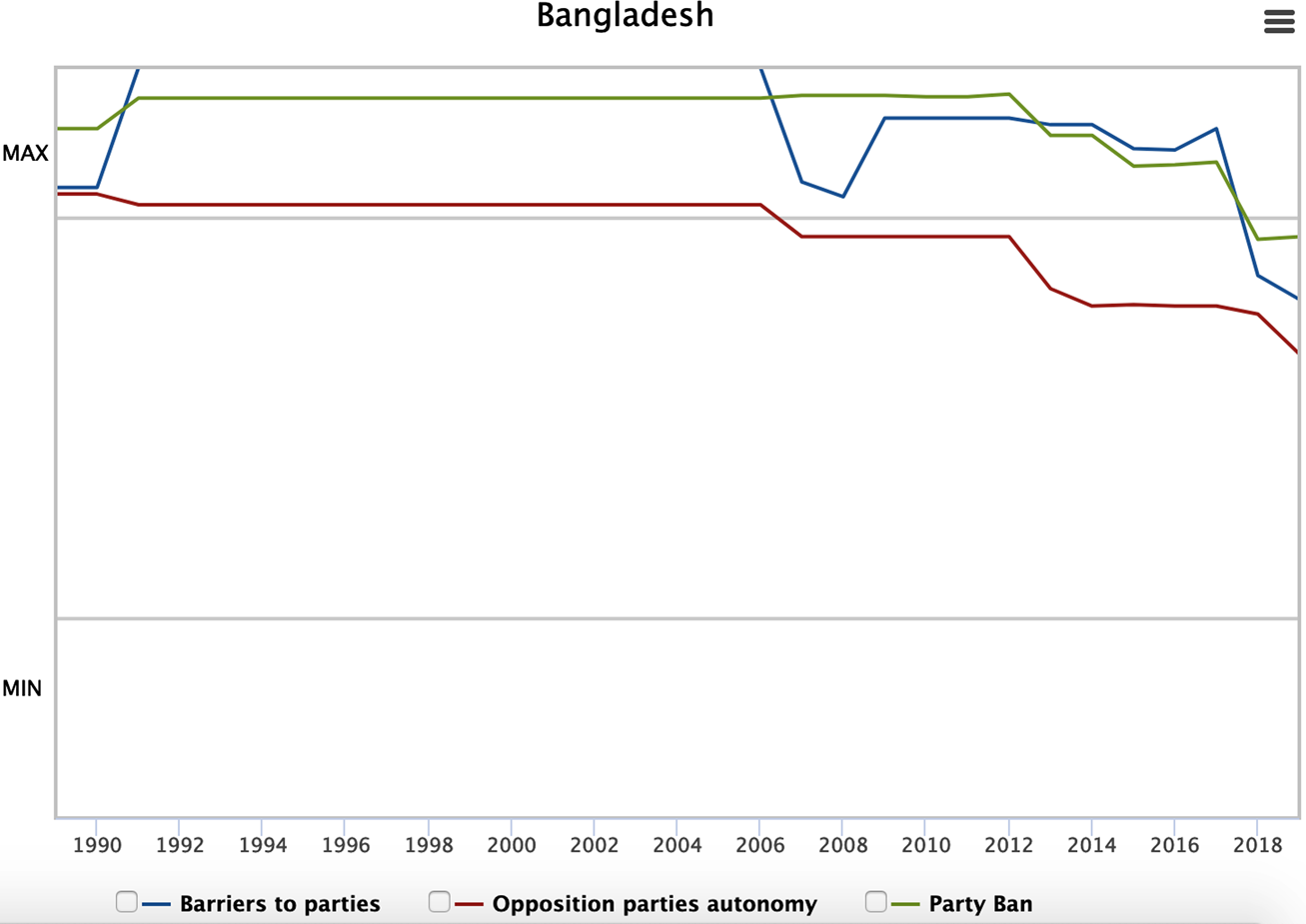
Our finding remains consistent with many other reports. For example, in a report, Creating Panic: Bangladesh Election Crackdown on Political Opponents and Critics, Human Rights Watch (2018) has described how the BAL government systematically cracked down on opposition leaders and the critics of government in order to silence the political opposition and dissenting voices in a bid to weaken the opposition forces. A notable example is that BAL issued more than 30,000 criminal cases against the BNP leaders and supporters while more than 8,000 of them were arrested before the election (Siddiqui, Das, and Paul Reference Siddiqui, Das and Paul2018; Antara Reference Antara2018a; Reference Antara2018b). The arrest seems politically motivated as some of the charges were fake or what is called a “ghost case” in which the accused were either dead, abroad, or hospitalized at the time of the alleged offences (Human Rights Watch 2018). Taken together, the attacks on opposition political parties have become a driving factor of diminishing political freedom. This finding remains consistent with the dataset by the Variety of Democracy (V-DEM), which also shows a sharp decline in political party freedom since the BAL party came to power in 2008 (see Figure 2).
Indictors of political party freedom in Bangladesh (1990–2019). Adapted from the Variety of Democracy (V-DEM) database (April 18, 2020)

The lack of freedom for (oppositional) political party has become a hall mark of the emerging one-party system that functions as a facilitator of a competitive authoritarian regime. Although the opposition is near eliminated, elections are alive and vulnerable to be manipulated by the incumbent party. An interviewee characterizes the phenomenon as “democracy without an opposition” or hence an oppositional void. He explained:
There is no strong opposition to keep in check and balance in the political system of Bangladesh. Democracy is present here by name only. The BAL has become the only political party to exercise power. BNP is no more in a strong position.Footnote 20
It is also remarkable to discuss how religion and politics have interacted in the course of political alliance building. The BAL announced an electoral alliance with an obscure Islamist group, the Bangladesh Khilafat Majlish (BKM) in 2006, prior to the election. The deal was that BKM would lend its political support to the BAL and the latter would recognize the private madrassa education without corresponding state supervision, and also lift a High Court ban on declaring fatwas or religious edicts (we will return to the madrassa education issue in the next section). Civil society membership and rights activists were baffled and outraged since they had fought bitterly against the BNP and its allies on these very issues (Riaz and Fair Reference Riaz and Fair2010, 20).
The situation of oppositional void—that is the tendency to remove opposition from elections and parliaments—embraces a coercive strategy and is somewhat similar to what Esen and Gumuscu (Reference Esen and Gumuscu2016, 1,582) call an “uneven playing fields for opposition” in their study on Turkey.Footnote 21
Institutionalization of Authoritarian Policies
A notable change by the 16th amendment to the constitution was that it rendered the parliament a superior position than the judiciary. In the political term, it empowered the BAL government to control the judicial system, for instance, by removing the chief justice if he/she posed a direct threat to the government's authoritarian policies. In the constitutional term, the amendment distorted the separation of power which is a fundamental principle of a functional democracy (Chowdhury Reference Chowdhury2015).
A question that arises with regard to the relationship between the parliament and judiciary is to what extent the judiciary was independent. The constitution of Bangladesh has a clear provision for an independent judiciary, as stipulated in the Section 22: “The State shall ensure the separation of the judiciary from the executive organs of the State.” However, the independence of a judiciary has often been questioned given that the legislative and executive bodies continuously attempt to minimize the autonomy of the judiciary. To avoid this conflict, the provision of the Supreme Judicial Council (SJC) was introduced through the 5th amendments to the constitution in 1978. Even, the SJC cannot initiate any legal action without the president's permission and it is crystal clear that the president is a titular head of the state who is bound to listen to the prime minister before taking any action, according to Article 48(3) of the Constitution: “The president shall act in accordance with the advice of the prime minister.” Furthermore, posting, promotion, and transfer of the judges of subordinate judiciary are still in the hands of the law ministry (Sobhan Reference Sobhan2017). In this regard, Mollah (Reference Mollah2012) contends that some provisions of the constitutions contradict to the concept of judicial independence. He goes on to argue that the Judiciary system inherited from the British has always been dependent and as such it was not “strong enough to control and hold government officials accountable to the legal system of Bangladesh” (Mollah Reference Mollah2012, 73).
This brief discussion of the controversy of the judicial independence foregrounds the political context on which the BAL government sought to consolidate power by forcing the Chief Justice Surendra Kumar Sinha to resign in November 2017. In his book, called A Broken Dream, Sinha (Reference Sinha2018) has clearly explained how the government amended the constitution to bring the judiciary under its control as a symptom of rising authoritarianism ironically functioning with a disputable democratic framework.
A series of other administrative and policy changes occurred following the 16th amendment, particularly affecting election policies. An example, according to a respondent interviewed in December 2017, was the changes brought to the local government election system. With the new election policy, candidates are only nominated by political parties. This form of nomination system institutionalized a patronage politics in which candidate's loyalty weighs higher than his/her performance. “Political will” of individual candidates surrendered to the patronization of politics, making electoral politics an “elitist game” rather than a bottom-up system of representation. This was explained by an interviewee: “this partisan politics changed the traditional system of locally-driven politics and instead introduced partisan politics at the local level.”Footnote 22 Decided at the time when the opposition has been systematically weakened, the new election policy means that the patronage politics at the local level ultimately works in the favor of the authoritarian BAL party.
The Digital Security Act 2018 is another draconian law, passed by the Jatiya Sangsad (Parliament of Bangladesh) on September 19, 2018, that deserves a discussion here. The Act replaced the existing controversial Information and Communication Technology (ICT) Law. Enacted in 2006 by the then BNP led government and amended in 2013, the ICT Law was criticized for the provisions which provided the security forces unlimited power to arbitrarily arrest people on charges of cybercrimes (Mamun Reference Mamun2018). The new Act is even more dangerous and provides unlimited power to the security forces. Since its enactment, public intellectuals, civil society activists and journalists have become the forefront victims of the new Act which restricts freedom of speech (Hasan Reference Hasan2018; Mamun Reference Mamun2018). Most of those who were arrested under the Act mostly come from urban areas. It is reported that 11 cases were filed against 21 journalists from March to June 2017 under section 57, and most of the cases are related to news reporters (Adhikary Reference Adhikary2017). Shahidul Islam's case is worth noting. On August 6, police filed a case against the noted photographer, Shahidul Islam. According to the Police, he tried to instigate students and create instability in the country by spreading false information and rumors on social media. The inspector alleged that Shahidul's remarks were aimed at worsening the law and order situation, tarnish the image of the country, and hurt the sentiments of students by spreading rumors to instigate them to be engaged in destructive acts (Shaon Reference Shaon2018).Footnote 23
Likewise, a Dhaka court has handed down a 3-year jail sentence to a university teacher for posting a Facebook status wishing the death of Prime Minister Sheikh Hasina. His Facebook status reads: “Sheikh Hasina has been providing driving licence without tests. Result of providing driving licence … everybody dies, but why does Sheikh Hasina not die?” (DailyStar 2015; Tipu Reference Tipu2015). Even after enacting the Digital Security Act, some journalists were arrested for writing news reports (DailyStar 2019). Reports of arrest under the new act are mounting. At least 63 people have been arrested under the Act and mostly for their activities against the prime minister, her father, and the government on social networking sites, especially on Facebook and YouTube (Rashid Reference Rashid2019).
Referring to how civic space is shrinking due to the Digital Act, an interviewee further explains this phenomenon: “The political environment in Bangladesh is suffocating, where a citizen is not allowed to exercise his political rights.”Footnote 24 Another respondent further reiterated this view:
the current government is an autocratic government, that does not allow any protest against any kind of injustice. They killed the protestors in cross-fire, arrested them, and drove them away in various other ways.Footnote 25
Co-Option of Religious Leaders
Bangladesh is a predominantly a Muslim country and the home to nearly 10% of the world's Muslim population. Even though secularism was one of the founding principles of the republic state, Islamic religious leaders have enormous influence in politics (Riaz Reference Riaz2005b; Hasan Reference Hasan2011). We find that religious leaders are key figures in wider social and religious as well as political mobilizations as these kinds of mobilization are structured by locally-driven hierarchical power structure in which religious leaders are placed at the top. For this reason, as discussed in the historical section, military and civilian governments have maintained close associations with mullahs and Islamist leaders.
As also noted above, political Islam flourished under the military governments of Ziaur Rahman and Hussain Mohammed Ershad as they relied on the religious community to gain political support in the name of protecting the Islam and nationalism. It was during their times that the secular features of the constitution were eroded. Although the Supreme Court in 2010 restored secularism as one of the key tenets of the country's constitution, Islam was kept the state religion in Bangladesh. The influence of growing Islamist movements such as the Hefazat-e-Islam is one of the reasons why the BAL government reinstated secularism while keeping Islam as the state religion.
The growing religiosity is a political project that favors the BAL party. For instance, asserting that Bangladesh is a Muslim majority country, Sheikh Hasina declared the country to be run as per the Madinah Charter and the last sermon and directives of Prophet Muhammad. She also added, “There will be no law against Holy Quran and Sunnah here ever.” She also assured that the government had stated clearly in the Women's Policy that if any international law has anything against the Quran and the Sunnah it will not be applicable in Bangladesh (Country to be run as per Madinah Charter: PM 2014). An adviser to Sheikh Hasina asserted in April 2010 that the “[Bangladesh] Awami League is the only Islamic Party in Bangladesh … if anyone opposed the [Bangladesh] Awami League, he/she would be expelled from the fold of Islam” (Islam Reference Islam2011, 137).
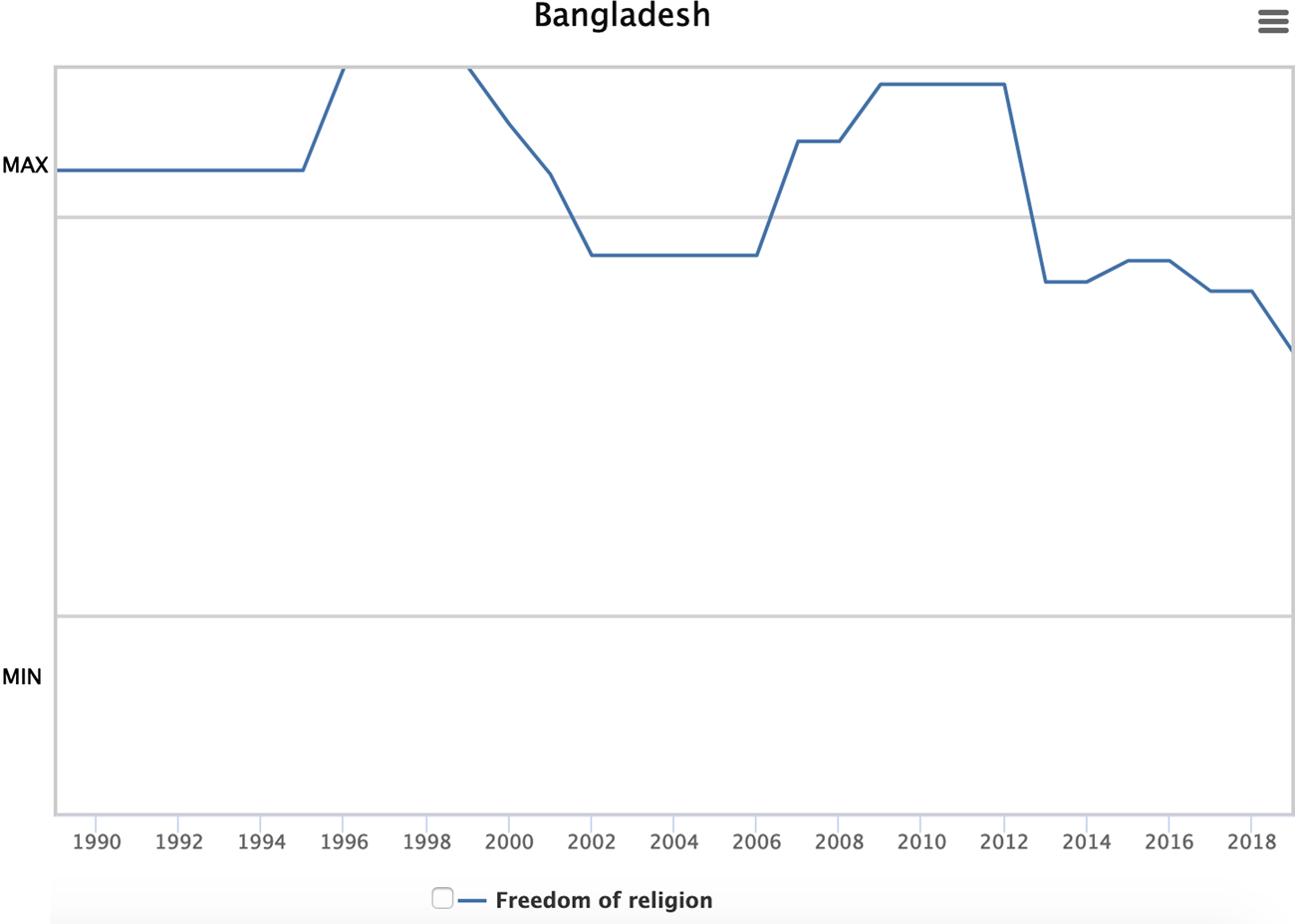
This kind of intolerant assertion not only illustrates of how the BAL is bringing religion and politics together to advocate for an illiberal authoritarian regime, but it also reveals how religious freedom has become a rare in Bangladesh. This also partly explains why declining religious freedom (see Figure 3) and authoritarianism have gone hand in hand.
Indictors of religious freedom in Bangladesh (1990–2019). Adapted from the Variety of Democracy (V-DEM) database (April 18, 2020)

In our view, this kind of assertion was particularly meant to garner support of the Rightist parties such as the Federation of Bangladesh Tarikat, the Zaker Party, and the Hefazat-e-Islam who have large Islamic voter bases. In Muslim countries, Islam is considered not only as a philosophy but also a political system that collectively drives social, cultural, and economic development (Hossain Reference Hossain2016). Thus, it remains in the interest of a political party to re-strengthen its ties with wider Muslim society through religiously driven perpetuating patron–client relationship. In this case, the BAL government is reluctant to antagonize Muslim leaders; rather we find that the government has been keen to extend patronage politics by co-opting Islamic leaders in several ways.
First, the BAL government issued an order in April 2017 recognizing the top Qawmi madrassa degree as equivalent to a post-graduate master's degree (Govt publishes gazette on highest Qawmi madrasa degree recognition 2017). As a result, for the first time in the history of Bangladesh, 1,010 Qawmi madrassa students joined government service a year later (Madrassa Students to Lead the Country in Future 2018).
Second, Bangladesh's Education Ministry was preparing to print the 2017 editions of its standard Bengali textbooks when a group of conservative Islamic religious scholars demanded the removal of 17 poems and stories they deemed “atheistic.” By the time the books were distributed to schools in January, 17 poems and stories were gone, with no explanation from the government. Other changes had crept in, too: First graders studying the alphabet were taught that “o” stands for orna, a scarf worn by devout Muslim girls starting at puberty, not for oal, a type of yam; and a sixth-grade travelogue describing a visit to the Hindu-dominated north of India was replaced by one about the Nile in Egypt. The changes were barely noticeable to the general public, but they alarmed some Bangladesh intellectuals, who saw them as the government's accommodating shift toward radical Islam (Barry and Manik Reference Barry and Manik2018).
Third, one of the ongoing projects of the government, in cooperation with the Saudi government, is to build one model mosque and Islamic cultural center in each district and upazila (sub-district). In total, there would be 560 such mosques and centers and will cost 90,624.1 million taka (nearly 10 million USD) (Model Mosque and Islamic Cultural Centre 2016). The BAL used this project in their 2018 election campaign. Likewise, from 2009 to 2013, the government published 540 books through the Islamic Foundation, established 2,500 mosque-based libraries, and supplied books to 5,000 other libraries to spread Islamic knowledge among the people (Success of the Government from 2009 to 2013, 2014, 42–43).
These examples support the claim we made earlier that the social base of the competitive authoritarian regime in Bangladesh is conditioned by an interplay between religion and politics and the co-option of the religious community at the expense of religious freedom.
CONCLUSIONS
Bangladesh's democracy has its enemy from “within.” The major threats to democracy, since the country became independent, has come from greedy and opportunistic political elites and their allies, and for this reason the risk comes from “within” rather than outside of a democratization process. In several occasions in the past, as we have shown in this paper, these political elites have emerged as a dictator through military coups, often accompanied by political assassinations and coup d'état. However, at least since 2008, there has not been any military coup but authoritarian forces have seriously challenged the un-consolidated democracy. As we have shown in this paper, the authoritarian regime, spearheaded by the BAL, has emerged powerfully (mis)using a democratic framework and institutions and, in turn, it is challenging democratic practice by moving toward a one-party system.
Our analysis shows that the authoritarian regime of the BAL, which has remained in power continually since 2009, has emerged manipulating elections as a principal mechanism for legitimization and consolidation of power. The principal function of the election, in this case, is not so much to promote transparent, free, and fair competition among parties and candidates and the transfer of power between government as is the case in democracies. Rather the elections under the BAL government have become a vehicle for legitimizing authoritarian politics and policies, which is anti-democratic. It is this coercive mechanism of manipulating elections in an undemocratic manner that makes Bangladesh a typical case of competitive authoritarian state.
In so far as elections are concerned, even the military dictators, such as General Zia, have misused them to legitimize their power and authority, and nominally fulfil the criteria to show as if the dictatorship was a functional democracy. Thus, Bangladesh has a history of authoritarianism that manipulated election, allowing some form of extremely controlled and strategic competition under the military dictatorships. However, since 2009, competitive authoritarian rulers have begun to look beyond elections for the search of political mechanisms that would both legitimize authoritarian power and expand political mobilization.
As we have shown in this paper, politics in Bangladesh has always relied on patron–client modes of social and political mobilizations, especially in the post-colonial era. Therefore, at one end, political elites and authoritarian rulers are under pressure to meet legitimacy, which they accomplish by manipulating elections. On the other hand, they are also reluctant to weaken traditional patron–client relations which sustains the loyalty of the political clients—hence the people. Election manipulation weakens political oppositions but it does not necessarily sustain the loyalty of the politicians' clients—the people. Therefore, to fulfil the dual purpose of weakening political opposition and continuously enjoying the loyalty and support of the people, authoritarian rulers in Bangladesh have relied on other mechanisms such as targeted policy reforms and co-option of religious leaders. The political mechanisms of competitive authoritarianism discussed in this paper show that religion, particularly Islam, is a central organizing force used by authoritarian rulers to induce policy changes that institutionalize political patronage of the Islamic religious community. For this reason, the authoritarian regime in Bangladesh is less likely to survive without co-opting the religious leaders.
We conclude by noting that to understand competitive authoritarianism in Bangladesh in different political junctures, we must expand our focus from manipulation of election to other mechanisms discussed in this paper and their interaction with religion, through which an authoritarian ruler is able to claim legitimacy while keeping patron–client modes of political mobilization intact to gain wider public support. It is for this reason, the competitive authoritarian regime in Bangladesh disrupt democratic freedom and operates in a grey area, swinging between dictatorship and unconsolidated democracy.